NATIONAL ACADEMY PRESS
2101 Constitution Avenue, NW Washington, DC 20418
NOTICE: The project that is the subject of this report was approved by the Governing Board of the National Research Council, whose members are drawn from the councils of the National Academy of Sciences, the National Academy of Engineering, and the Institute of Medicine. The members of the committee responsible for the report were chosen for their special competences and with regard for appropriate balance.
The Center for Science, Mathematics, and Engineering Education (CSMEE) was established in 1995 to provide coordination of all the National Research Council’s education activities and reform efforts for students at all levels, specifically those in kindergarten through twelfth grade, undergraduate institutions, school-to-work programs, and continuing education. The Center reports directly to the Governing Board of the National Research Council.
This study by the Center’s Committee on Development of an Addendum to the National Science Education Standards on Scientific Inquiry was developed under grants from the National Science Foundation, National Aeronautics and Space Administration, and Governing Board Initiative of the National Academies. Any opinions, findings, or recommendations expressed in this report are those of the members of the committee and do not necessarily reflect the views of the funders.
Library of Congress Cataloging-in-Publication Data
Inquiry and the National Science Education Standards : a guide for teaching and learning / Center for Science, Mathematics, and Engineering Education, National Research Council.
p. cm.
Includes bibliographical references and index.
ISBN 0-309-06476-7 (pbk.)
1. Science—Study and teaching—Standards—United States. 2. Inquiry (Theory of knowledge) I. Center for Science, Mathematics, and Engineering Education.
LB1585.3 .I57 2000
507.1′073—dc21
00-008103
Additional copies of this report are available from the
National Academy Press,
2101 Constitution Avenue, NW, Lock Box 285, Washington, DC 20055. Call (800) 624-6242 or (202) 3334-3313 (in the Washington metropolitan area).
This report is also available online at http://www.nap.edu.
Printed in the United States of America.
Copyright 2000 by the National Academy of Sciences. All rights reserved.
THE NATIONAL ACADEMIES
National Academy of Sciences
National Academy of Engineering
Institute of Medicine
National Research Council
The National Academy of Sciences is a private, nonprofit, self-perpetuating society of distinguished scholars engaged in scientific and engineering research, dedicated to the furtherance of science and technology and to their use for the general welfare. Upon the authority of the charter granted to it by the Congress in 1863, the Academy has a mandate that requires it to advise the federal government on scientific and technical matters. Dr. Bruce M. Alberts is president of the National Academy of Sciences.
The National Academy of Engineering was established in 1964, under the charter of the National Academy of Sciences, as a parallel organization of outstanding engineers. It is autonomous in its administration and in the selection of its members, sharing with the National Academy of Sciences the responsibility for advising the federal government. The National Academy of Engineering also sponsors engineering programs aimed at meeting national needs, encourages education and research, and recognizes the superior achievements of engineers. Dr. William A. Wulf is president of the National Academy of Engineering.
The Institute of Medicine was established in 1970 by the National Academy of Sciences to secure the services of eminent members of appropriate professions in the examination of policy matters pertaining to the health of the public. The Institute acts under the responsibility given to the National Academy of Sciences by its congressional charter to be an adviser to the federal government and, upon its own initiative, to identify issues of medical care, research, and education. Dr. Kenneth I. Shine is president of the Institute of Medicine.
The National Research Council was organized by the National Academy of Sciences in 1916 to associate the broad community of science and technology with the Academy’s purposes of furthering knowledge and advising the federal government. Functioning in accordance with general policies determined by the Academy, the Council has become the principal operating agency of both the National Academy of Sciences and the National Academy of Engineering in providing services to the government, the public, and the scientific and engineering communities. The Council is administered jointly by both Academies and the Institute of Medicine. Dr. Bruce M. Alberts and Dr. William A. Wulf are chairman and vice chairman, respectively, of the National Research Council.
COMMITTEE ON DEVELOPMENT OF AN ADDENDUM TO THE NATIONAL SCIENCE EDUCATION STANDARDS ON SCIENTIFIC INQUIRY
Peter Dow (Chair),
First Hand Learning, Inc.
Richard A. Duschl,
School of Education, King’s College London
Hubert M. Dyasi,
City College (City University of New York)
Paul J. Kuerbis,
The Colorado College
Lawrence Lowery,
University of California at Berkeley
Lillian C. McDermott,
University of Washington
Lynn Rankin,
Exploratorium Institute for Inquiry
Mary Lou Zoback,
Western Earthquake Hazards Program, U.S. Geological Survey
Staff, Center for Science, Mathematics, and Engineering Education
Rodger Bybee
Kristance Coates
Linda DePugh
Jay Hackett
Susan Loucks-Horsley
Steve Olson
Harold Pratt
Lisa Vandemark
Tina Winters
COMMITTEE ON SCIENCE EDUCATION K–12
Jane Butler Kahle (Chair),
Miami University, Oxford, OH
J. Myron Atkin,
Stanford University, Stanford, CA
Caryl Edward Buchwald,
Carleton College, Northfield, MN
George Bugliarello,
Polytechnic University, Brooklyn, NY
Beatriz Chu Clewell,
The Urban Institute, Washington, DCW
William E. Dugger,
Technology for All Americans, Blacksburg, VA
Norman Hackerman,
The Robert A. Welch Foundation, Houston, TX
Leroy Hood,
University of Washington, Seattle, WA
William Linder-Scholer,
SciMathMN, Roseville, MN
Maria Alicia Lopez Freeman,
California Science Project, Monterey Park, CA
John A. Moore,
University of California, Riverside, CA
Darlene Norfleet,
Flynn Park Elementary School, University City, MO
Carolyn Ray,
Urban Systemic Initiative, Cleveland, OH
Cary Sneider,
Boston Museum of Science, Boston, MA
Rachel Wood,
Delaware State Department of Public Instruction, Dover, DE
Robert Yinger,
School of Education, Baylor University, Waco, TX
Reviewers
This report has been reviewed in draft form by individuals chosen for their diverse perspectives and technical expertise, in accordance with procedures approved by the National Research Council’s Report Review Committee. The purpose of this independent review is to provide candid and critical comments that will assist the authors and the Center for Science, Mathematics, and Engineering Education in making the published report as sound as possible and to ensure that the report meets institutional standards for objectivity, evidence, and responsiveness to the study charge. The review comments and draft manuscript remain confidential to protect the integrity of the deliberative process. The committee wishes to thank the following individuals for their participation in the review of this report:
Lloyd Barrows, University of Missouri
Ken Bingman, Shawnee Mission West High School
Al Janulaw, California Science Teachers Association and Creekside Middle School
Dean Kamen, DEKA Research and Development Corporation
John Layman, University of Maryland (Retired)
Michael Martinez, University of California at Irvine
Joseph Mcinerney, Johns Hopkins University School of Medicine
Gail Paulin, Tucson Unified School District
Laurie Peterman, Anoka-Hennepin School District
Ursula Sexton, WestEd
Although the individuals listed above have provided many constructive comments and suggestions, responsibility for the final content of this report rests solely with the authoring committee and the National Research Council.
Foreword: A Scientist’s Perspective on Inquiry
When I was growing up in the 1950s in the suburbs of Chicago, the educational experiences that meant the most to me were all associated with my struggling to meet a challenge that had captured my interest and initiative. I remember writing a long report on “The Farm Problem” in the seventh grade in which my task was to explain why our government was paying farmers for not growing a crop. In the eighth grade I had to explain to the rest of my class how a television set works. And in the ninth grade I remember poring over books on spectroscopy in the Chicago public library to prepare a report on its uses in chemistry.
All three of these tasks, and many others that interested me as a student, involved what we now call “inquiry.” Teaching science through inquiry allows students to conceptualize a question and then seek possible explanations that respond to that question. For example, in my field of cell biology, cell membranes have to be selectively permeable — they have to let foodstuffs like sugars pass inward and wastes like carbon dioxide pass out, while holding the many big molecules that form the cell inside. What kind of material could have these properties and yet be able to expand as the cell grows?
It is certainly easy to remember another and more familiar type of science teaching from my childhood. In this approach — which remains depressingly common today — teachers provide their students with sets of science facts and with technical words to describe those facts. In the worst case, this type of science teaching assumes that education consists of filling a student’s head with vocabulary words and associations, such as mitochondria being “the powerhouses of the cell,” DNA being the “genetic material,” and motion producing “kinetic energy.” Science classes of this type treat education as if it were preparation for a quiz show or a game of trivial pursuit.
This view of science education has many problems. Most students are not interested in being quiz show participants. They fail to see how this type of knowledge will be useful to them in the future. They therefore lack motivation for this kind of “school learning.”
Most important, this kind of teaching misses a tremendous opportunity to give all students the problem-solving, communication, and thinking skills that they will need to be effective workers and citizens in the 21st century.
Inquiry is in part a state of mind — that of inquisitiveness. Most young children are naturally curious. They care enough to ask “why” and “how” questions. But if adults dismiss their incessant questions as silly and uninteresting, students can lose this gift of curiosity. Visit any second-grade classroom and you will generally find a class bursting with energy and excitement, where children are eager to make new observations and try to figure things out. What a contrast with many eighth-grade classes, where the students so often seem bored and disengaged from learning and from school!
The National Science Education Standards released by the National Research Council in 1995 provide valuable insights into the ways that teachers might sustain the curiosity of students and help them develop the sets of abilities associated with scientific inquiry. The Standards emphasize that science education needs to give students three kinds of scientific
skills and understandings. Students need to learn the principles and concepts of science, acquire the reasoning and procedural skills of scientists, and understand the nature of science as a particular form of human endeavor. Students therefore need to be able to devise and carry out investigations that test their ideas, and they need to understand why such investigations are uniquely powerful. Studies show that students are much more likely to understand and retain the concepts that they have learned this way.
For example, one skill that all students should acquire through their science education is the ability to conduct an investigation where they keep everything else constant while changing a single variable. This ability provides a powerful general strategy for solving many problems encountered in the workplace and in everyday life. The Lawrence Hall of Science in Berkeley, California, has developed a set of fifth-grade science lessons that give students extensive experience in manipulating systems with variables. These lessons begin with the class working in groups of four to construct different sized pendulums from string, tape, and washers. After each group counts the number of swings of their pendulum in 15-second intervals — yielding quite different results among groups — the groups conduct further trials that eventually trace the source of the variability to differences in the lengths of the strings. This leads to graphing as a means of displaying the data for future work with pendulums. Ideally, the teacher should use this particular sequence of lessons to teach students about the history of clocks, emphasizing the many changes in society that ensued once it became possible to divide the day and night into reliable time intervals.
Contrast this science lesson with a more traditional lesson about pendulums. In such a lesson, the teacher does most of the talking and demonstrating. Often, students display their knowledge about such variables as length of the pendulum, weight, and starting height by filling in a series of blanks on a worksheet.
The challenge for all of us who want to improve education is to create an educational system that exploits the natural curiosity of children, so that they maintain their motivation for learning not only during their school years but throughout life. We need to convince teachers and parents of the importance of children’s “why” questions. I’m reminded of the profound effect that Richard Feynman’s father had on his development as a scientist. One summer, in the Catskills Mountains of New York when Feynman was a boy, another boy asked him, “See that bird. What kind of bird is that?” Feynman answered “I haven’t the slightest idea.” The other boy replied, “Your father doesn’t teach
you anything!” But his father had taught Feynman about the bird — though in his own way. As Feynman recalls his father’s words:
“See that bird? It’s a Spencer’s warbler.” (I knew he didn’t know the real name.) “… You can know the name of that bird in all the languages of the world, but when you’re finished, you’ll know absolutely nothing whatever about the bird. You’ll only know about humans in different places and what they call the bird. So let’s
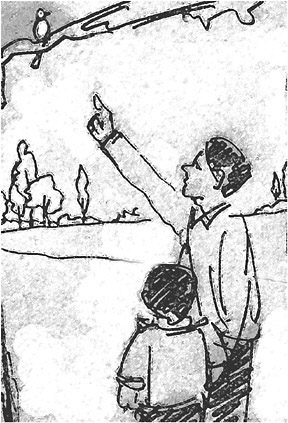
look at the bird and see what it’s doing — that’s what counts.”
The book you are about to read illuminates this approach to teaching science. It builds on the discussion of inquiry in the National Science Education Standards to demonstrate how those responsible for science education can provide young people with the opportunities they need to develop their scientific understanding and ability to inquire. The process must begin in kindergarten and continue, with age-appropriate challenges, at each grade level. Students must be challenged but also rewarded with the joy of solving a problem with which they have struggled. In this way, students recognize that they are capable of tackling harder and harder problems. As they acquire the tools and habits of inquiry, they see themselves learn. There can be nothing more gratifying, or more important, in science education.
Bruce Alberts
President, National Academy of Sciences
Preface
In December 1995 the National Research Council (NRC) released the National Science Education Standards, which, as stated in the “Call to Action” at the beginning of the Standards, spell out “a vision of science education that will make scientific literacy for all a reality in the 21st century.” The release of the Standards was the culmination of an extensive process of consensus-building. In 1991 the President of the National Science Teachers Association, among others, asked the NRC to coordinate efforts to develop national standards for science education. Between 1991 and 1995, groups of teachers, scientists, administrators, teacher educators, and others organized by the NRC produced several drafts of the Standards and submitted those drafts to extensive review by others in these same roles. The result was a document that, since its release, has been a driving force behind improvements in U.S. science education.
A prominent feature of the Standards is a focus on inquiry. The term “inquiry” is used in two different ways in the Standards. First, it refers to the abilities students should develop to be able to design and conduct scientific investigations and to the understandings they should gain about the nature of scientific inquiry. Second, it refers to the teaching and learning strategies that enable scientific concepts to be mastered through investigations. In this way, the Standards draw connections between learning science, learning to do science, and learning about science.
As required by the charge to its authoring committee, Inquiry and the
National Science Education Standards has been designed to serve as a practical guide for teachers, professional developers, administrators, and others who wish to respond to the Standards’ call for an increased emphasis on inquiry.
The committee charge further called for:
-
a background discussion of inquiry;
-
a summary of pertinent research and scholarly writings that argue convincingly for the value of inquiry in science education;
-
Actions that teachers, administrators, parents, and others need to take; and
-
A bibliography of resources for planning and implementation assistance.
In response to this charge, the guide is divided into eight chapters and three appendices:
-
Chapter 1, “Inquiry in Science and in Classrooms,” sets the stage for describing the multiple roles of inquiry by comparing a geologist’s scientific inquiry with that of a class of fifth-grade students and their enterprising teacher.
-
Chapter 2, “Inquiry in the National Science Education Standards,” clarifies the vision of scientific inquiry framed in the Standards.
-
Chapter 3, “Images of Inquiry in K-12 Classrooms,” examines science as inquiry by presenting and discussing a series of classroom vignettes at the elementary school, middle school, and high school levels.
-
Chapter 4, “Classroom Assessment and Inquiry,” discusses the varied functions of and strategies for assessment in inquiry-oriented classrooms.
-
Chapter 5, “Preparing Teachers for Inquiry-Based Teaching,” discusses the professional development of teachers from undergraduate preparation to continuous learning throughout their careers.
-
Chapter 6, “Making the Case for Inquiry,” describes the results of research into inquiry-based teaching and learning.
-
Chapter 7, “Frequently Asked Questions About Inquiry,” gives short answers to some of the questions frequently asked by classroom teachers, administrators, parents, and others.
-
Chapter 8, “Supporting Inquiry-Based Teaching and Learning,” describes how leadership from principals and other administrators can further the use of inquiry in teaching and learning.
-
The appendices provide elaborations of the abilities and understandings of inquiry from the Standards; guidelines for selecting inquiry-oriented instructional materials; and a list of resources related to inquiry-based science education.
A number of the chapters in the report feature vignettes of teachers and students engaged in using and learning about inquiry. These vignettes are based on actual experiences witnessed by committee members and contributors to the report. Some details have been altered to emphasize particular points. The purpose of the vignettes is to illustrate the key ideas in the text, not to represent idealized classroom and professional development scenarios.
This guide has been produced under the direction of the Committee on Science Education K-12 (COSE K-12), a standing board within the Center for Science, Mathematics, and Engineering Education at the National Research Council. COSE K-12 formed the Committee on Development of an Addendum to the National Science Education Standards on Scientific Inquiry and charged the committee with producing a document that would help educators improve the quality of teaching, learning, and assessment through the use of inquiry. Funding for the project came from the National Science Foundation, the National Aeronautics and Space Administration, and the Governing Board Initiative of the National Academies.
The committee has written this guide to be used in a number of ways. Classroom teachers, science department chairs, science supervisors, and professional developers can use it directly to improve teaching and learning. School administrators and members of the public can use it to understand and promote inquiry-based teaching and learning. Professional developers and teacher educators can use it to improve the ways they work with teachers and better to model and design inquiry-oriented learning experiences for prospective and practicing teachers. University science faculty can use it to rethink the content and teaching strategies they use in courses attended by preservice teachers. Scientists can use it to guide their work with teachers. And the many other individuals and groups who believe that the process of inquiry should be part of every science classroom can use it to spark discussion and guide their efforts to effect change.
Readers who choose not to read this book from cover to cover should begin with Chapters 1 and 2, which provide a foundation for the remaining chapters. In Chapter 3 the vignettes represent different grade spans, depending on their grade level interest, so readers may want to be selective in which vignettes they read. Other chapter selections will depend on the particular role and need of the reader. For example, Chapter 5 speaks especially to teacher educators and professional developers and Chapter 8 to administrators and other leaders of science reform initiatives.
This guide is the first in a series of
planned addenda to the Standards. Addenda on science and technology and on classroom assessment are also being prepared. The Center also has produced several other documents that support standards-based reform in science education, including publications about selecting instructional materials, designing multi-year curriculum programs, and using the findings of the Third International Mathematics and Science Study to improve science curricula and teaching.
On behalf of the committee, I acknowledge with deep appreciation the contributions of Elizabeth Stage, Ron Anderson, Jim Minstrell, Denis Goodrum, Maryellen Harmon, Doris Ash, Lezlie DeWater, and David Hartney, who produced written material; Mike Atkin, Kathy DiRanna, Sally Crissman, Kathy Stiles, JoAnne Vasquez, and Henry Heikkinen, who advised us on early drafts; and the many teachers and teacher developers whose inquiry-based teaching experiences illustrate the ideas in these pages. We especially thank Susan Loucks-Horsley and Jay Hackett, who served as project directors for different phases of this report; other dedicated Center staff who helped us conceptualize, improve, and produce this report, including Rodger Bybee, Harold Pratt, Lisa Vandemark, Kristance Coates, Linda DePugh, and Tina Winters; writer Steve Olson whose editing greatly improved the report; and dozens of teachers and administrators who participated in workshops where our ideas and frameworks were tried out, for their invaluable feedback.
Peter Dow, Committee Chair