


Below is the uncorrected machine-read text of this chapter, intended to provide our own search engines and external engines with highly rich, chapter-representative searchable text of each book. Because it is UNCORRECTED material, please consider the following text as a useful but insufficient proxy for the authoritative book pages.
/ c,, /Y / r -IAs_
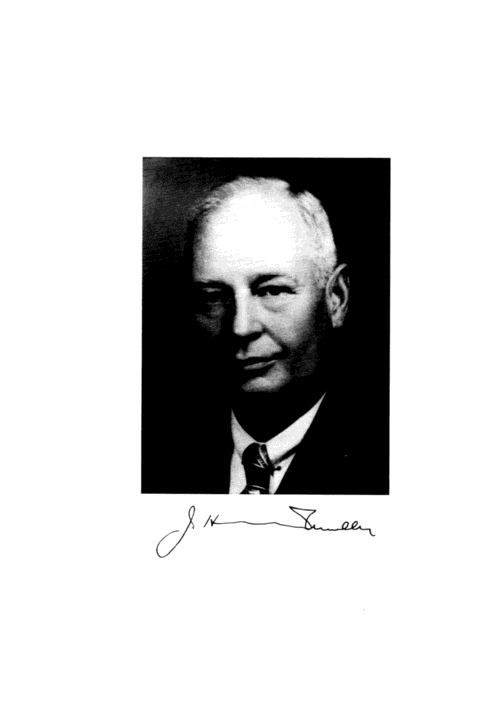
JOHN HOWARD MUELLER June 13, 1891-February 16, 1954 BY A. M. PAPPENHEIMER, JR. - JOHN HOWARD MUELLER was born ~une 13, IS9l, in Sheffield, Massachusetts, where his father was a Unitarian minister. After a few years, the family moved to Illinois, where young Howard received his secondary schooling. He then attended Illinois Wesleyn University, receiving his B.S. degree with honors in biology in 1912. Two years as an in- structor of chemistry at the University of Louisville followed; he was awarded an M.S. degree in 1914. While at Louisville he became interested in bacteriology ant! pathology, and in the summer of 1914 he attenclec} a summer course in pathology at the College of Physicians and Surgeons, Columbia University. The instructors in this course encouraged him to remain as a graduate student at Columbia, which he clicI. He was awarded an Alonzo Clark Fellowship in Pathology ant! received his Ph.D. degree in 1916. He worked as assistant pathologist at the Presbyterian Hospital until war was declared in 1917; he then enlistecI as a private anct went overseas with the Presbyterian Hospital Unit to Etretat, France, where he actively participated in the work that demonstratec! that "trench fever" (like typhus fe- ver, a rickettsial diseased was transmitted by lice. It was cloubt- less cluring this period that he became interested in patho- genic bacteria ant! in their physiology anct metabolism. His 307
308 BIOGRAPHICAL MEMOIRS talents were recognized by the Army, and he was commis- sioned a lieutenant in the Sanitary Corps before the war ended. On his return to civilian life in 1919, Mueller was ap- pointed an instructor in the bacteriology department, chaired by Hans Zinsser, at the College of Physicians and Surgeons. There he began his studies on the cultural require- ments of pathogenic bacteria. Papers I and II of this series appeared in 1922. In introducing the series, Mueller wrote: Perhaps the most important results to which success in such a piece of work might lead, are the applications of the findings to problems of more general biological importance, particularly to those of animal metabolism. For, whatever may prove to be the nature of these substances which cause growth of bacteria, they are largely or entirely components of animal tis- sue, and it is probable that they are either needed also by the animal body and supplied by plant or other sources, or else are synthesized by the animal itself to fill some metabolic requirement. When it is possible to catalogue the substances required by pathogenic bacteria for growth, it will probably be found that most of them are either required by, or im- portant in, animal metabolism, and while many of them will surely be compounds at present familiar to the physiological chemist, it is equally probable that some will be new, or at least of hitherto unrecognized im- portance. It was not long before his predictions were verified. He soon found that although he could use an acid hydrolysate of animal protein supplemented with tryptophane instead of commercial "peptones"as a base for growth of Strepto- coccus hemolyticus, the hydrolysate could not be replaced by a mixture of the then known amino acids. This led to the frac- tionation of casein hydrolysate and to the discovery of a new, ubiquitously distributed sulfur-containing amino acid: meth- ionine. Mueller's 1923 paper in the journal of Biological Chem- istry reporting the isolation of the new amino acid from acid hydrolysates of casein and of ovalbumin and his determina-
- ~OHN HOWARD MUELLER 309 tion of its elemental composition is an excellent example of the thoroughness that characterized all of his work. He made a good many derivatives and carried out the elementary anal- ysis of each one himself. This lee! to the correct empirical formula: CHAOS. Only two likely structural formulae were possible. An organic chemist from Cambridge Univer- sity suggested to him that the new amino acid might simply be the ethyl thioether of cysteine. Mueller proceeded to syn- thesize this thioether and provect that it was not identical with his new amino acid, the structure of which he stated re- mainect to be cleterminect. In the same year as the discovery of methior~ine, Hans Zinsser was appointed chairman of the Department of Bac- teriology and Immunology at the Harvard Meclical School anct asked Mueller to join him as an assistant professor. After arriving in Boston, Mueller was persuaclect to abandon- temporarilyhis studies on bacterial nutrition. Tnsteact he joiner! Zinsser in the study of so-callect "residue antigens" extracted from pneumococci, tubercle bacilli, yeast, and other microorganisms. These heat-stable, nonprotein anti- gens were inclepen(lently shown to be polysaccharicles by Av- ery and his coworkers, whose subsequent brilliant work re- vealed their role in the pathogenesis of pneumococcal lobar pneumonia and other bacterial diseases. At about this time in England, W. E. Gye publishect a series of papers purporting to show that Rous chicken sarcoma fi~- trates contained two essential factors, both of which were re- quired for tumour induction. The first was a substance spe- cifically affecting certain chicken cells and thereby rendering them susceptible to transformation to malignancy by a virus. The same virus was supposedly present in many mammalian tumours, including human carcinomas. Because the impli- cations of this work seemed so important at the time, Mueller attempted unsuccessfully to repeat Gye's experiments. and
310 BIOGRAPHICAL MEMOIRS spent several frustrating years working on this problem. In the end, Gye came to work in Mueller's laboratory, anct in 1929 a joint paper appeared in the Journal of Experimental Medicinebut with two opposing sets of conclusions: one written by Gye, the other by Mueller. Subsequent events prover! Mueller's interpretation of the data to be correct. After these rather disappointing years, Mueller finally re- turne(1 to the fielc! that had always been his major interest since his early work leading to the discovery of methionine. Papers ~ and II of the series "Studies on the Culture Require- ments of Bacteria" appeared in the Journal of Bacteriology in 1922; paper ITI did not appear until 1933! Nevertheless, in 1930 when Mueller began his classic studies on the nutrition of the diphtheria bacillus, bacterial cells were still regarded! as lowly forms of life that tract little, if any, relationship to the cells of higher animals and plants. Tissue extractives, inspis- sated serum, "peptones," etc., were regarclec! as essential for the cultivation of pathogenic microorganisms, and any no- tion of bacterial genetics was unheard of. It was not until 1929 that the first enzyme (urease) was crystallized and shown to be protein. The decade that followoct must be regarded as the most fruitful of Mueller's career. He selected the diphtheria bacil- lus as the organism for his intensive studies. From the very outset, he recognized the importance of being able to mea- sure growth quantitatively. Spectrophotometers were not yet on the market, anct Mueller clecided to use the micro- Kjelc~hal method! for estimation of growth as bacterial nitro- gen. Although this method was tedious, it was accurate. It also gave him a great advantage over others who were begin- ning to enter the field because it became possible to work out conditions for maximal yields of the bacteria and their prod- ucts. Within a few years the Mueller laboratory had identified
JOHN HOWARD MUELLER 311 which amino acids were essential for growth of the diphtheria bacillus and hac! macle the important observation that differ- ent strains of the same bacillus varied widely in their amino acid requirements. (For example, if a certain amino acid! was not needled for growth of a given strain, that strain possessed the enzymes required for its biosynthesis.) Mueller then went on to isolate anct identify what he called "accessory" factors. He isolatec! nicotinic acid from liver anc! shower] that it or nicotinamide were essential growth factors for all strains of the diphtheria bacillus being tested. With S. Cohen he iso- latecl a second factor from liver that proved to be ,13-alanine. He then showed that pantothenic acid would also satisfy the ,(3-alanine requirement, and others founct cliphtherial strains that were clependent on pantothenic acid itself for growth. Soon afterward, both nicotinamide and pantothenic acid were shown to be part of the vitamin B complex required for animal nutrition. Finally, in paper X of the series that alv- peared in 1937, Mueller clescribecT the isolation and identi- fication of pimelic acid from cow urine, which was required in trace amounts for growth. Later, after the discovery of biotin, pimelic acid was shown by du Vigneauc! to be an in- termecliate in biotin biosynthesis. Thus, by 1940 the prediction Mueller had made in 1922 had been fully realized, anct the universality of biochemistry hacl become accepted by everyone. The importance of Muel- ler's research in helping to bring about this recognition should not be forgotten. It was his work on bacterial nutrition that paved the way for the rapid identification of coenzymes ant} for the eluciclation of the pathways of intermediary me- tabolism ant] biosynthesis that took place in the 1940s anct early 1950s. The work on nutrition of the diphtheria bacillus also had important practical applications in improving the yielc! ant! quality of the diphtheria toxin used in production of toxoid for human immunization. By 1941 the diphtherial
312 BIOGRAPHICAL MEMOIRS studies were essentially complete, and Mueller turned his ma- jor attention to the tetanus bacillus and to production of its toxin. These studies were still in progress at the time of his death in 1954. Hans Zinsser died in 1940 anct shortly thereafter Howard Mueller was appointed to succeed him as head of the cle- partment. Mueller was one of those rare inclividuals who con- tinuect to work with his own hands even after becoming chair- man of a large department at a major university. He was an early riser, and daybreak usually found him at the bench. Several hours later, soon after his elevated research associate ant! friend Pauline Miller had arrived, Mueller was ready to leave the laboratory for his office to pursue his administrative duties. He took his obligations toward the department, to- ward the teaching of medical students, and toward his clinical associates very seriously. He was interested in all aspects of infectious disease and felt that his own research should be medically oriented with ultimate practical applications. And indeed, in audition to its fundamental scientific importance, much of his work die! have important practical application in · · . . · . - ~ immunization and In diagnosis. Mueller was a man of great generosity who had impec- cable integrity particularly with regard to scientific accu- racy and an unusual capacity for brushing aside all that was irrelevant in order to get at the core of the matter. He had no use for the sham, the half-truth, or the pretentious. Those who knew him well were always impressed by his moclesty- inueea, he user! to refer to himself as only "a high school chemist." Yet as pointer! out in the "Minute" on his life that was read to the faculty of medicine of Harvard University following his death: "Howard Mueller belongs among the scientific 'elite' as Kirtley Mather has recently defined them- that is among those who actively seek insight and meaning, whose minds are constantly on the alert to the possibility of
JOHN HOWARD MUELLER 313 new generalizations anc! new relationships as distinguishecl from those who merely know how to clo that which they have been trained to do." No better example of his remarkable insight can be given than his reaction to the 1944 discovery by Avery, Macleocl, and McCarty that the rough-to-smooth transformation could be induced by DNA. In his chapter on the chemistry and metabolism of bacteria, which was written in that same year for the Annual Review of Biochemistry, Muel- ler wrote (the italics are mine): In other words it appears that a polymer of a nucleic acid may be incorporated into a living, degraded cell, and will endow the cells with a property never previously possessed, namely, the ability to produce a cap- sule composed of a complex polysaccharide entirely different in structure from that produced by the smooth organism from which the degraded form was originally derived. When thus induced the function is perma- nent, and the nucleic acid itself is also reproduced in cell division. The importance of these observations can scarcely be overestimated and stim- ulates speculation concerning such matters as the chemical basis for spec- ificity in nucleic acids, and the genetic implications presented by the ability to induce permanent mutation in a cell by the introduction of a chemical substance. Such speculation may well include considerations of the relation of this phenomenon to the sequence of events following the introduction of a filterable virus (or a bacteriophage particle) into a susceptible cell. Mueller wrote those worcts at a time when recombination in bacteria was unknown, microbial genetics did not exist, and no one had previously spoken of mutations in connection with bacteria.
314 BIOGRAPHICAL MEMOIRS B IBLIOGRAPHY 1920-1921 Growth-determining substances in bacteriological culture media. Proc. Soc. Exp. Biol. Med., 18:225-28. Observations on bacterial metabolism. Proc. Soc. Exp. Biol. Med., 18: 14-17. 1921-1922 A new sulphur-containing amino acid isolated from casein. Proc. Soc. Exp. Biol. Med., 19:161-63. 1922 Studies on cultural requirements of bacteria. I. I. Bacteriol.,7 :309- 24. Studies on cultural requirements in bacteria. II. I. Bacterial., 7:325-38. 1923 A new sulfur-containing amino-acid isolated from the hydrolytic products of protein. I Biol. Chem., 56: 157-69. A new sulfur-containing amino-acid isolated from the hydrolytic products of protein. II. Sulfur excretion after ingestion. T. Biol. Chem., 58:373 -75. 1924 With I. Tomcsik. The chemical nature of residue antigen prepared from yeast. J. Exp. Med., 40:343-52. With M. Wayman and H. Zinsser. A preliminary report on the chemical composition of residue antigen. Proc. Soc. Exp. Biol. Med., 21:241-43. 1925 With H. Zinsser. On the nature of bacterial allergies. l. Exp. Med., 41:159. A chemical study of tuberculin. Proc. Soc. Exp. Biol. Med.,22:209- 11. With D. E. Smith and S. Litarczek. "Residue antigen" from a strain of Friedlander bacillus. Proc. Soc. Exp. Biol. Med., 22:373-74.
JOHN HOWARD MUELLER 315 Chemical studies on tuberculin. Proc. Natl. Acad. Sci. USA, 11 :23- 25. 1926 Observations on Gye's work with the Rous sarcoma. Proc. Soc. Exp. Biol. Med., 23:704. A chemical study of the specific elements of tuberculin. I. I. Exp. Med., 43: 1-8. A chemical study of the specific elements of tuberculin. II. The preparation of residue antigen from old tuberculin. l. Exp. Med., 43:9-12. 1927 The virus problem in transplantable tumors. (Abstract.) I. Bacte- riol., 13:26. An experimental study of Gye's cancer theory. I. Exp. Med., 45:243-62. 1928 With H. Zinsser. Antigenic properties of the bacterial cell and an- tibody reactions. In: The Newer Knowledge of Bacteriology and Im- munology, ed. E. O. Jordan and I. S. Falk, pp. 721-32. Chicago: University of Chicago Press. The effect of oxidation of filtrates on a chicken sarcoma (chicken tumor I-Rous). I. Exp. Med., 48:343-49. The oxidative destruction of the agent of the chicken tumor I (Rous). Science, 68:88-89. 1929 With W. F. Gye. An experimental study of the etiology of chicken sarcoma I (Rous). I. Exp. Med., 49:195. 1931 With L. Whitman. An improved method for the detection of hemo- lytic streptococcus carriers. I. Bacteriol., 21:219-23. The effect of alexin in virus-antivirus mixtures. I. Immunol., 20: 17-23.
316 BIOGRAPHICAL MEMOIRS 1932 With K. S. Klise. Agglutination of hemolytic streptococci. (Ab- stract.) I. Bacteriol., 23:83. With K. S. Klise. Mass cultures of Streptococcus hemolyticus in broth. Proc. Soc. Exp. Biol. Med., 29:454-55. With S. Sturgis. Prevention of blood coagulation by cysteine. Sci- ence, 75:140. With K. S. Klise. A method for the agglutination of hemolytic streptococci. i. Immunol., 22:53-59. 1933 With K. S. Klise, E. F. Porter, and A. Graybiel. Studies on cultural requirements of bacteria. III. The diphtheria bacillus. I. Bac- teriol., 25:509-19. With K. S. Klise. An agglutinative classification of the hemolytic streptococci of scarlet fever. J. Infect. Dis., 52:139-45. 1934 Amino acids required by the diphtheria bacillus for growth. Proc. Soc. Exp. Biol. Med., 32:318-20. 1935 Studies on cultural requirements of bacteria. IV. Quantitative es- timation of bacterial growth. I. Bacteriol., 29:383-87. Studies on cultural requirements of bacteria. V. The diphtheria bacillus. J. Bacteriol., 29:515-30. Studies on cultural requirements of bacteria. VI. The diphtheria bacillus. I. Bacteriol., 30:513 -24. With I. Kapnick. Studies on cultural requirements of bacteria. VII. Amino acid requirements for the Park-Williams no. 8 strain of diphtheria. J. Bacteriol., 30:525-34. Methionine as an impurity in natural leucine preparations. Sci- ence, 81 :50-51. 1936 Studies on cultural requirements of bacteria. VIII Utilization of glutamic acid by the diphtheria bacillus. J. Bacteriol., 32:207- 10.
JOHN HOWARD MUELLER 1937 317 With Y. Subbarow. Studies on cultural requirements of bacteria. IX. Tissue extractives in the growth of the diphtheria bacillus. I. Bacteriol., 34: 153 -61. Studies on cultural requirements of bacteria. X. Pimelic acid as a growth stimulant for C. diphtheriae. ]. Bacteriol., 34: 163-78. With S. Cohen. Beta alanine as a growth accessory for the diph- theria bacillus . I. B. acteriol ., 34: 381 - 86. Nicotinic acid as a growth accessory substance for the diphtheria bacillus. I. Bacteriol., 34:429-41. Pimelic acid as a growth accessory for the diphtheria bacillus. l. Biol. Chem., 119: 121-31. Substitution of p-alanine, nicotinic acid, and pimelic acid for meat extract in growth of diphtheria bacillus. Proc. Soc. Exp. Biol. Med., 36:706-8. Nicotinic acid as a growth accessory for the diphtheria bacillus. I. Biol. Chem., 120:219-24. Pimelic acid as a growth accessory factor for a strain of the diph- theria bacillus. Science, 85:502. With A. M. Pappenheimer, fir., and S. Cohen. Production of potent diphtherial toxin on a medium of chemically defined composi- tion. Proc. Soc. Exp. Biol. Med., 36:795-96. 1938 The replacement of meat infusion by known substances in the cul- tivation of Corynebacterium dipEtheriae. (Abstract.) I. Bacteriol., 35:7-8. A synthetic medium for the cultivation of C. diphtheriae. ]. Bacte- riol., 36:499-515. The utilization of carnosine by the diphtheria bacillus. I. Biol. Chem., 123:421. With A. Klotz. Pantothenic acid as a growth factor for the diphthe- ria bacillus. l. Am. Chem. Soc., 60:3086-87. 1939 Factors concerned in formation of toxin by the diphtheria bacillus. (Abstract.) In: Third International Congress for Microbiology, Ab- stracts of Communications, p. 203. International Association for Microbiology.
318 BIOGRAPHICAL MEMOIRS A simplified formula for diphtheria toxin broth. I. Immunol., 37: 103-12. An unidentified growth factor for certain strains of the diphtheria bacillus. Proc. Soc. Exp. Biol. Med., 40:632-33. 1940 Physical and chemical properties of filterable viruses. In: Virus and Rickettsial Diseases with Especial Consideration of Their Public Health Significance, pp. 65-88. Cambridge, Mass.: Harvard University Press. With P. A. Miller. Tetanus toxin production on a simplified me- dium. Proc. Soc. Exp. Biol. Med., 43:389-90. With i. C. Snyder. Nutritional factors concerned with colony de- velopment of C. dipAtheriae. Proc. Soc. Exp. Biol. Med., 45:243. With S. Cohen. Oleic acid in colony development of C. diphtheriae. Proc. Soc. Exp. Biol. Med., 45:244. Hans Zinsser ~ 1878 - 1940~. J. Bacteriol., 40: 747-53. Nutrition of the diphtheria bacillus. Bacteriol. Rev., 4:97-134. 1941 With P. A. Miller. Production of diphtheric toxin of high potency (100 Lf) on a reproducible medium. J. Immunol., 40:21-32. With E. R. Johnson. Acid hydrolysates of casein to replace peptone in the preparation of bacteriological merlin ~ Tmm,~nn1 40:33-38. ~ . %,, . in, ~ . ., With P. A. Miller. A modification of Rosenthal's chromium-sulfuric acid method for anaerobic cultures. I. Bacteriol., 41:301-3. With S. Cohen and J. C. Snyder. Factors concerned in the growth of Cornyebacterium diphtherial from minute inocula. J. Bacteriol., 41 :581-91. With E. B. Schoenbach and I. F. Enders. The apparent effect of tyrothrycin on Streptococcus hemolyticus in the rhinopharynx of carriers. Science, 94:217-18. The influence of iron on the production of diphtheria toxin. l. Immunol., 42:343. With J. Hinton. A protein-free medium for primary isolation of the gonococcus and meningococcus. Proc. Soc. Exp. Biol. Med., 48:330-33.
JOHN HOWARD MUELLER 1942 319 With O. F. Cox and M. McDermott. Delayed planting of gonococ- cus cultures: Preliminary report. Vener. Dis. Info., 23:226-27. With I. Hinton and P. A. Miller. Growth requirements of Neisseria. (Abstract.) I. Bacteriol., 43: 100. With P. A. Miller. Growth1 requirements of Clostridium tetani. J. Bac- teriol., 43:763 -72. With P. A. Miller. Folic acid in the growth of Cl. tetani. Proc. Soc. Exp. Biol. Med., 49:211-12. 1943 With R. E. Feeney and P. A. Miller. Growth requirements of Clos- tridium tetani. II. Factors exhausted by growth of the organism. I. Bacteriol., 46:559-62. With R. E. Feeney and P. A. Miller. Growth requirements of Clos- tridium tetani. III. A "synthetic" medium. J. Bacteriol., 46:563- 71. With P. A. Miller. Large-scale production of tentanal toxin on a peptone-free medium. J. Immunol., 47:15-22. The relation of the carrier to epidemic meningitis. Ann. Intern. Med., 18:974-77. With L. R. Seidman and P. A. Miller. A comparison of antigenicities of hydrolysate and peptone tetanus toxoids in the guinea pig. i. Clin. Invest., 22:321-24. With E. B. Schoenbach and I. I. ~ezukawicz. Conversion of hydrol- ysate tetanus toxin to toxoid. l. Clin. Invest., 22:319-20. With E. B. Schoenbach, l. l. ~ezukawicz, and P. A. Miller. Produc- tion of tetanus toxin on peptone-free media. l. Clin. Invest., 22:315-18. With L. R. Seidman and P. A. Miller. Antitoxin response in man to tetanus toxoids. }. Clin. Invest., 22:325-28. 1943-1944 Nutrition of the single cell: Its applications in medical bacteriology. Harvey Lect. Ser. 39: 143-61. 1944 With R. G. Gould and L. W. Kane. On the growth requirements of Neisseria gonorrhoeae. ]. Bacteriol., 47: 287-92.
320 BIOGRAPHICAL MEMOIRS With O. F. Cox and M. A. Kinney. Methods of transporting gono- cocci to laboratories for cultural studies. Vener. Dis. Info., 25:207-9. 1945 The chemistry and metabolism of bacteria. Annul Rev. Biochem., 14:733-48. With P. A. Miller. Production of tetanal toxin. I. Immunol.,50:377- 84. 1946 Graduate training in bacteriology. (Abstract.) J. Bacteriol., 51:630. With P. A. Miller. A new tellurite plating medium and some com- ments on the laboratory "diagnosis" of diphtheria. I. Bacteriol., 51 :743-50. With H. L. Ley, Jr. On the isolation from agar of an inhibitor for Neisseria gonorrhoeae. ]. Bacteriol., 52:453-60. 1947 With F. S. Cheever. Epidemic diarrhea! disease of suckling mice; manifestations, epidemiology, and attempts to transmit disease. I. Exp. Med., 85:405-16. With P. A. Miller. Factors influencing the production of tetanal toxin. I. Immunol., 56: 143-47. 1948 With P. A. Miller. Factors affecting the production of tetanus toxin: Temperature. I. Bacteriol., 55:421-23. With S. Lavin and L. E. Farr. Shaking device for multiple contain- ers. Proc. Soc. Exp. Biol. Med., 68:99-100. With F. S. Cheever. Epidemic diarrhea! disease of suckling mice; effect of strain, litter, and season upon incidence of disease. I. Exp. Med., 88:309-16. With P. A. Miller and E. M. Lerner. Factors influencing the pro- duction of tetanus toxin: Gaseous products of growth. i. Bac- teriol., 56:97-98. With P. A. Miller. Unidentified nutrients in tetanus toxin produc- tion. J. Bacteriol., 56:219 -33.
JOHN HOWARD MUELLER 1949 321 With P. A. Miller. Inhibition of tetanus toxin formation by D-serine. }.Am.Chem.Soc.,71:1865. With P. A. Miller. Glutamine in the production of tetanus toxin. I. Biol. Chem., 181 :39-41. 1950 The use of thick paper for chromatography. Science, 112:405-6. With W. L. Aycock. Meningococcus carrier rates and meningitis incidence. Bacteriol. Rev., 14: 115-60. 1951 With H. E. Umbarger. Isoleucine and valine metabolism of Esche- r?chia coli. I. Growth studies on amino acid-deficient mutants. I. Biol. Chem., 189:277 - 85. With R. M. Drew. A chemically defined medium suitable for the production of high titer diphtheriae toxin. I. Bacteriol., 62: 549-59. 1954 With P. A. Miller. Variable factors influencing the production of tetanus toxin. J. Bacteriol., 67:271-77. With N. H. Fisek and P. A. Miller. Muscle extractives in the pro- duction of tetanus toxin. I. Bacteriol., 67: 329-34. 1955 With P. A. Miller. Separation from tryptic digests of casein of some acid-labile components essential in tetanus toxin formation. i. Bacteriol., 69:634-42.
