


Below is the uncorrected machine-read text of this chapter, intended to provide our own search engines and external engines with highly rich, chapter-representative searchable text of each book. Because it is UNCORRECTED material, please consider the following text as a useful but insufficient proxy for the authoritative book pages.
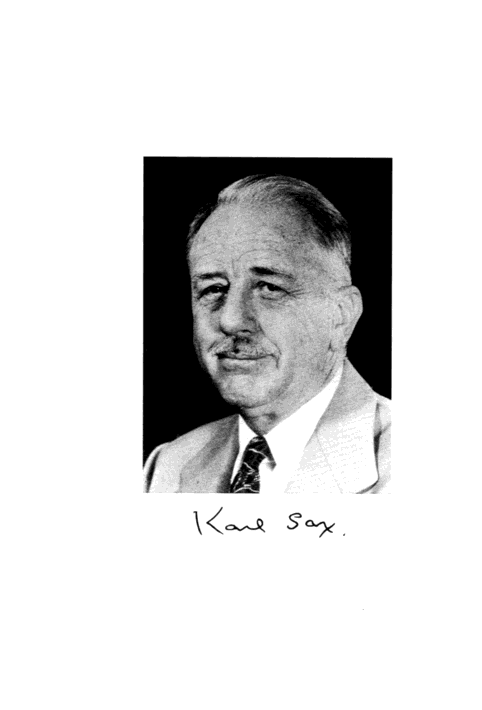
KARL SAX November2, 1892October S. 1973 BY CARL P. SWANSON AND NORMAN H. GILES As I view my contribution to the writing of our time, it seems to me to consist of a double affirmative, saying first that an awareness and experience of Mature is necessary to Man if he is to have his humanity, and saying in the second place that that same awareness must have something of a re1tigious quality, the Italian pieta, ifyo?~ will. Mature is a part of our humanity, and without some awareness and experi- ence of that divine mystery man ceases to loe man. When the Pleiades and the wind in the grass are no longer a part of the human spirit, a part of the very push at bone, man becomes, as it were, a kind of cosmic outlaw, having neither fee completeness and the integrity of the animal nor the birthright of a true humanity. TH E S E W O R D S by Henry Beston from his now classic vol- ume, Outermost House, strike us as uniquely applicable to Karl Sax. He would not have been found wanting although he, most certainly would have raised a quizzical eyebrow un- less the term "religious quality" were stripped of any cloying mysticism. He grew up and throughout his life remained close to the soil, ant! he expressed in words ant! actions the dignity, integrity, inner strength, and outer optimism that are so often the legacy of such a birthright. He knew the wheat- fields of southeastern Washington; he knew how to care for and to harvest that which he had sown; and he knew the wonder of growing things, whether these were plants or hu- 373
374 BIOGRAPHICAL MEMOIRS man beings. He acknowlecigect his birthright and was proud of it, anct he shared it with those in both high ant] low places. His public career was a long and ctistinguished one, but to those who knew him privately as well, that record was but a partial measure of a great and warm human being. Karl Sax was born of pioneer parents in Spokane, Wash- ington, on November 2, IS92; he stied in Meclia, Pennsylva- nia, on October 8, 1973, less than a month shy of his eighty- first birthday. His father, William L. Sax, was, at various times, schoolteacher, county superintendent of schools, farmer, businessman, ant! mayor of Colville, Washington. His mother, Minnie A. Sax knee Morgan), was an artist and ama- teur botanist. An exposure to plants and to the natural en- vironment as well as the advantages of higher education were very much a part of his early background. Sax entered Wash- ington State College in 1912 to major in agriculture, and it was here that he met Professor Ec~ward Gaines, a wheat breeder in the Experiment Station. Gaines lect him into re- search and uncloubtedly encouraged him to continue his studies at the graduate level. As Sax once wrote, "Here ~ learned that one could have all of the pleasures of an agri- cultural career without the financial headaches by going into agricultural research work." This early experience with the problems and techniques of plant breeding expanded into a continuing ant} absorbing interest that was pursued through- out his life. Other later studies brought him national ancT international recognition, but they never fully replacect his need to be close to the soil and to growing things. Sax gracluated from Washington State College in 1916, the year in which his first scientific paper appeared. Prior to graduation he had married his cytology teacher, Dr. H ally Jolivette. In the fall of 1916, she accepted an instructorship at Wellesley College, and he entered the Bussey Institution Graduate School of AppliecI Biology of Harvard University
KARL SAX 375 to work under the direction of Professor E. M. East. He re- ceivec] an M.S. clegree in 1917, but his graduate studies were interrupter! by WorIct War I. He entered the army as a private and was clischarged as a seconct lieutenant in the Coast Ar- tillery in ~ 9 ~ 8. Sax's first academic position was as an instructor in ge- netics at the University of California, Berkeley, where he also undertook cytological studies in the genus Crepis uncler Pro- fessor E. B. Babcock. His stay in Berkeley was brief, however, as was his next move to the private Riverbank Laboratories in Geneva, Illinois, where he initiated his studies on wheat. In 1920 he accepted a position at the Maine Agricultural Experiment Station in Orono; here he completed his cloc- toral thesis on wheat hybrids, and the D.Sc. was awarclect to him in 1922 by the Bussey Institution. One of his colleagues at Orono was John W. Gowen, anti they collaborated on a number of occasions: the genetics, productivity, and root and buc! selection of apples were their primary concerns. The wheat studies were pursued almost as an avocation, but Sax consiclered the papers dealing with wheat species and hybrids to be his most important contribution cluring these early years in large part because they were among the first of the publisher! works that opened up what was then the new sci- ence of cytotaxonomy in this country. Sax remained at Orono until ~ 928 when he was appointed associate professor of plant cytology at the Arnold Arbore- tum ant! named to the faculty of the Bussey Institution Gracl- uate School of Applied Biology, an affiliate of Harvard Uni- versity concerned! with teaching ancl research in agriculture ant! horticulture. Here he joinect a faculty of distinguished biologists: W. M. Wheeler and C. T. Brues in entomology, W. E. Castle and E. M. East in genetics, Oakes Ames in eco- nomic botany, ant] I. W. Bailey in wooc! anatomy. The gracI- uate student bocly must also have been a stimulating one be-
376 BIOGRAPHICAL MEMOIRS cause many of those who received their degrees from the Bussey Institution were to become worthy successors to their professors. Sax was elevated to a full professorship in 1936, the same year in which the dissolution of the Bussey graduate school took place. (In the view of President Lowell, Harvard and applied biology were incompatible.) The dissolution, how- ever, necessitated a move of office, laboratory, and students to the new Biological Laboratories in Cambridge; here he taught courses in cytology and, for a while, genetics Sax took over teaching the latter on the death of Professor East in 1938. This move, on the other hand, did not terminate his association with the Arboretum and the Bussey. His cytotax- onomy studies continued, and many of his students lived in the Bussey buildings during the summer months of their graduate careers. For many of us this was during the latter years of the Great Depression and under the lengthening shadows of World War Il; to make ends meet we were en- couraged by him to grow our own vegetables and to raid the Arboretum for appropriate fruits. With the retirement of E. D. Merrill, Sax was appointed acting director of the Arnold Arboretum in 1946; in 1947 he was named its third director. He held simultaneously the rather empty title of superintendent of the Bussey Institu- tion. But both administrative appointments were abruptly terminated by Harvard University in 1954 as a result of his vigorous but losing opposition to the proposal that the gen- eral resources of the Arnold Arboretum books, herbarium specimens, and funds be transferred to Cambridge as part of a move for the consolidation of botany. Sax not only be- ~ . lieved that the science of botany suffered when instruction at the Bussey was terminated, and that it would deteriorate fur- ther when interest in the Arboretum as a living center for horticultural studies was lessened; he also considered the ac-
KARL SAX 377 tion taken by the Harvard Corporation to be an outright breach of trust. To combat the transfer, he enlisted the aid of The Friends of the Arnold Arboretum and cooperated with them when the group filed suit in Massachusetts against the corporation. He contenclect that he, as director and as a matter of principle, could not be party to the divestiture of the Arboretum's resources without juclicial review and legal approval. Sax remained as professor of biology in Cambridge until his retirement in ~ 959, but the controversy left its mark. The latter years were bitter ones: he was hurt by the aliena- tion of some of his botanical colleagues and by the scientific decline of the Arboretum that hac] been for so long a signif- icant part of his productive years. About thirty graduate students took their acivancecT de- grees with Sax, and another fourteen spent their postdoc- toral years in his laboratory. He is remembered ant! revered with unabashed affection by these students; in his gruff but quiet way he embraced them all ant! brought them into his family. As he said, "My academic children seemed almost as much a part of our family as our three sons." . Karl Sax established a solid! and enviable reputation both in this country ant] abroad. He was as well known to nur- serymen as to his fellow cytologists, ant! this was reflected in his professional affiliations and in the honors bestowed on him. He was a member of the Genetics Society of America, serving as president in 1958; the Botanical Society of Amer- ica he received its certificate of merit in 1956; American Society of Horticultural Science; American Genetics Associa- tion; Population Association of America; Planned Parent- hooc! League, serving as president of the Massachusetts chap- ter in ~958; American Academy of Social anct Political Sciences; and the Radiation Research Society. He was electec! to membership in the American Academy of Arts and Sci- ences ~ ~ 94 ~ ~ anc! the National Academy of Sciences ~ ~ 94 ~ ),
378 BIOGRAPHICAL MEMOIRS to honorary membership in Phi Beta Kappa (1941) and the Japanese Genetics Society (1956), and as foreign correspon- dent to the French Academy of Agriculture (19461. The Jack- son Dawson Memorial Medal of the Massachusetts Horticul- tural Society was awarded to him in 1959, as was the Norman I. Coleman Award of the American Association of Nursery- men in 1961. He received an honorary doctoral degree from the University of Massachusetts in 1965, from his alma mater Washington State University in 1966, and from the University of Maine in 1971. He was equally pleased, however, to be named "Horticulturist of the Year" (1959) by the Student Horticultural Club of the University of Massachusetts, and to be grouped, by Katherine White in The New Yorker, with Charles Sargent and Ernest "Chinese" Wilson as "a distin- guished plantsman." Sax was a national lecturer on the academic circuit for the American Institute of Biological Sciences in 1957 and in 1962 for Sigma Xi. In 1951 he received the signal honor of being asked to deliver the Lowell Lectures in Boston, choosing as his topic world population problems. The research and publication record of Karl Sax spanned a period of fifty-five years (1916-1971) with but a brief in- terruption for military service. The publications fall gener- ally into three groupshorticulture, chromosomal studies, ant! demography with considerable overlap of the first two areas as much of the cytogenetic and cytotaxonomic work was done on ornamental species in the Arnold Arboretum. The horticultural aspects of Sax's professional career began with his appointment to the Maine Experiment Station, where he was much occupied with improvement of productivity in apples. This interest, which initially involved propagation, crossing, and sterility, was continued at the Arboretum, but the focus of the work was now directed toward an under- standing of the origin of the Pomoideae, the production of
KARL SAX 379 desirable ornamental hybrids, and the means for dwarfing well-known and useful varieties of nursery stocks. The dwarf- ing of fruit trees hacl been practiced empirically for hun- cireds of years before being introduced into the Americas but the basis of dwarfing was not unclerstood in a scientific sense. By experimenting with a wide variety of intervarietal, inter- specific, and even intergeneric combinations of rootstocks and scions; by the use of different interstocks between root and scion; and by single ant! double bark inversions to block the flow of nutrients through the phIoem, Sax contributed significantly to an unclerstanding of the phenomenon, re- ~lucecl the variability of graft compatibility and growth, anti simplified the techniques to the point where the average nur- seryman could readily produce his own dwarfs. In the area of plant breeding, Sax and his students- in particular George Skirm were successful in creating a num- ber of excellent hybrids that quickly found their way into the ornamental tracle. He was especially proud of the graceful cherry "Hally ~olivette," a hybrid between Prunus subbirtella ant! P. apetela, which he namer] for his wife and frequent collaborator. (The fact that Jolivette couIct be translated from the French into "pretty little one" acicled icing to the cake of tribute.) The magnolia "Dr. Merrill" honored his predecessor as director of the Arboretum, while the crabapple hybrids "Henry DuPont" and "Henrietta Crosby" were named after two of the loyal Friends of the ArnoIct Arboretum, who were also his personal friends ant! research sponsors. The "Blanche Ames" honored a clistinguishec! botanical artist who was also the wife of Professor Oakes Ames; the hybrid "Mary Potter" was so named because one of the parent species was Malus sargenti, named after her father, Charles Sargent. Sax also producect a number of Forsythia hybrids. Beatrix Farrancl, a well-known lanclscape architect, Friend of the Ar- boretum, and designer of the gardens at Dumbarton Oaks
380 BIOGRAPHICAL MEMOIRS in Washington, D.C., was recognized by having a triploid hy- brid named after her. This turned out to be a lesser improve- ment than the tetraploid "Arnold Giant," winner of an award of merit by the Royal Horticultural Society of England. The "Arnold Dwarf" proved to be an interesting ground cover but a meager producer of flowers. Still another of his Forsythia hybrids, the "Karl Sax," was subsequently named by a nurs- eryman who was testing it in his trial plots. The chromosomal studies fell into two subcategories: cy- totaxonomy and the effects of radiation and chemicals on chromosome structure. As indicated earlier, his wheat studies provided him with a doctoral thesis as well as helping to es- tablish what was then the developing field of cytotaxonomy in this country. He shared with the Japanese cytologists Ki- hara and Sakamura the credit for discovering the role of polyploidy and interspecific hybridization in the origin of certain wheat species, a seminal work of great significance in understanding the nature of some of our basic food plants. Comparable studies, in which Hally Jolivette Sax often par- ticipated, were carried out on a wide variety of groups grow- ing or being tested in the Arboretum: Pomoideae, Pinaceae, Rosaceae, CycIadales, Hamamalidaceae, Vitis, Yucca and Agave, Rhododendron, Paeonia, Ulmus, and Platanus. The karyotypes of Yucca and Agave were shown to be sufficient- ly unique to cause them to be removed from the L.iliaceae, and to be given familial status in the Agavaceae; moreover, the complete fertility and regular meiotic pairing in the Lon- don plane tree, a hybrid between Platanus occidentalis and P. Oraentalis, demonstrated that separation by the Atlantic Ocean for millions of years did not necessarily involve chromosomal rearrangements and accompanying sterility. It was Sax's interest in the American species of Tradescan- tia, sparked no doubt by his collaboration with Edgar Ander- son of the Missouri Botanic Garden, that led to the emer-
KARL SAX 381 gence of radiation cytology out of what began as a cyto- taxonomic survey of the Commelinaceae. Sax unclerstooc] that chromosomal rearrangement must play some kind of role in evolution and speciation and that the large size and small number of Tradescantia chromosomes in the readily available haploid microspores macle them ideal for experi- mental purposes. Recognizing that X rays not only induced mutations but chromosomal rearrangements as well, he ini- tiatect his radiation studies in 1935. The atom bomb anct the horrors of radiation exposure were nearly a clecacle in the future. Tradescantia paludosa was the species of choice, and the following two clecades witnessed an extraordinary outpour- ing of papers by Sax and his students papers that proviclect qualitative and quantitative information on the frequency of both inclucect and spontaneous aberrations. The implication and transference of these data to problems of radiation ther- apy, evolution, and speciation were inevitable, as was acicti- tional information related to the effects of temperature, cell cycle, (lose rate, and dose fractionation on the final frequency of inducecl change. Sax was the father of radiation cytology, anct he spawned a whole generation of "chromosome bust- ers." In his later years, and particularly after retirement, Sax turned to the chromosomal aspects of aging in seeds, and to the radiomimetic effects of caffeine, insecticides, and chemi- cal food acIditives. While he vigorously pursued his horticultural and chro- mosomal investigations, Sax still managed to take an interest in and make a significant contribution to the area of clemog- raphy. His initial entry into this field undoubtecITy stemmed from his close association with his graduate mentor and now colleague, Professor E. M. East; but it was probably fostered as well by the interest of Castle ant! Brues in applied eugenics. In 1923 East hac! publishecT Mankind at the Crossroads, a Mal-
382 BIOGRAPHICAL MEMOIRS thusian indictment of the present and future consequences of-unchecked human fecundity in a world of limitect re- sources and agricultural productivity. He acivocated a con- scious and deliberate practice of birth control; in his words, "parentage must not be haphazard." Sax was similarly Mal- thusian. (Believing that what he acivocatec! publicly shouIct be first practiced at home, he urged all of his graduate students to read the so-callect "Bussey Bible," a collection of articles on birth control.) The first of a continuing flow of articles ap- pearec! in The Scientific Monthly in 1944, but the gist of his thinking was set forth in his Lowell Lectures. The talks were prepared for book form uncler the title Malthus and the Mod- ern World; this was subsequently alterect to Standing Room Only: The Challenge of Over-Population, which appeared in 1955 ant] was reissued in paperback in 1960. Mil(l-mannered and retiring as he was in his personal re- lations, Sax was actively aggressive in the Planned Parent- hood League and in his demographic speeches and articles. His local target was the restrictive birth control law of Mas- sachusetts. These laws were subsequently changed by a ref- erendum sponsored by the Planned Parenthood League but not before Sax hacl invoked the wrath of many religious leaders and particularly those of the Roman Catholic Church of Boston ant! its suburbs. (The Church proclaimed to its flock that "birth control is against God's Law" ant! urger! all parishioners to vote down the referenclum.) He viewer! the harassment that resulted as a measure of the effectiveness of his stanct, and so he continuer! his fight on a national scale- believing, as has proven to be the case, that financial sect to the undercleveloped countries without accompanying infor- mation ant! aid regarding birth control was not only politi- cally immoral but, in a human sense, ultimately self-clefeating and cruel as well. He considered India a lost cause in this respect, but he held high hopes for the Latin American coun-
KARL SAX 383 tries if aid to them could be tempered with something more than material benefits and weapons. Sax was a realist and a pragmatist. He was particularly clisturbe(1 by demographic anti scientific Pollyannas who, through ignorance or design, duped the public with glowing scenes of future happiness and an abundance for all. Con- sequently Sax reviewed Enough and to Spare, a book by Har- var(1 colleague Kirtley Mather, in a tempere(1 but (devastating manner to show that both Mather's demography and his bio- logical postulates were utterly without foundation, that his optimism was basec! largely on pious hopes. Sax himself tract a clear vision of the role of science in the betterment of man- kincl, but he hac] an equally clear vision of its limitations as well. In another political direction, Sax took strong exception to the praise that some leacling British and American scien- tists among them Julian Huxley, J. B. S. Halclane, J. D. Ber- nal, and L. C. Dunn accorded! Soviet science, particularly genetics. He was too much of a dirt farmer as well as a cyto- geneticist to accept Lysenkoism, and he was among the first to call the scientific worId's attention to the oppressive treat- ment given such men as Vavilov, Dubinin, Navaschin, anct Timofeeff-Ressovsky. Retirement in 1959 brought a change of place and of pace. Sax establisher! and maintained an experimental gar- clen on his son's estate in Mectia, Pennsylvania, but he also traveled ant! lectured widely. In the years between 1956 anct 1966 he held visiting professorships at the Universities of Florida, Tennessee, Georgia, and California at Davis; at Yale University; ant! at North Carolina State University. For a brief period in 1962, he was resident collaborator at the Brook- haven National Laboratory. In 1961, at the age of sixty-nine, he was a Guggenheim fellow at Oxford University where C. D. Darlington, the clean of British cytologists, held sway.
384 BIOGRAPHICAL MEMOIRS Darlington and Sax were sharply contrasting scientists. As Sax once wrote, paraphrasing Francis Bacon, he was the ant, the gatherer of quantitative ciata from which his ideas emerged; Darlington was the spider, the gifted spinner of theories in which facts were often of secondary importance. Both tract published on chromosome structure, the mecha- nisms of crossing over, and the origin of chiasmata, with the Darlingtonian views the more nearly correct. Both were also interested in demography Sax again the pragmatist, Dar- lington the theorist, as he wove genetics, race, Ids, mating patterns, and the improvement of mankind into his mental cobwebs. It is regrettable that their conversations were not recorcled, for Sax, in his own way, had great respect for Dar- lington's facile minct even though he referred to Darling- ton's Recent Advances in Cytology as "a masterpiece of mytho- genesis." In his later years, Professor anti Mrs. Sax spent each win- ter at the University of Georgia. He published regularly clur- ing these years, and his papers continucct to reflect the breadth of his interests. Fittingly, one of his last journal pa- pers was in response to a request from the Genetics Society of Japan, of which he was an honorary member. Perhaps even more fittingly, it was coauthored by Mrs. Sax, his companion, colleague, and gentle critic for fifty-eight years. Comparisons are more likely to be invidious than they are to illuminate, but Professor Sax's secure place in his several fields of interest was earned and not thrust upon him: he was an imaginative and cleclicatect scientist, a plant breeder of note, and a citizen who hacI a clear vision of the place of science in human affairs. His greatness as a human being, however, was innate. To those of us who gained our scientific stripes uncler his tutelage, and who came to know him pri- vately as well, he was a father figure: a quiet, decent man who at times was reservecl, gruff, even unapproachable; at other
KARL SAX 385 times, warmly human and humorous. He treated us all alike, encouraging everyone, but infinitely patient if we couIct only plod. He was not an eloquent speaker. He let his published papers speak for themselves, or he cleferrect to his students and colleagues at national and international meetings. But when his deeply held and cherished principles were chal- lengecl or misrepresented, he never hesitated to enter the lists. Supported always by Mrs. Sax, he was never an unpre- pared or unworthy opponent. He rarely dealt in personalities when the subject was controversial, for he couIcT respect an- other's position or belief even when he disagreed with it; but he was not a compromiser of principles even though, as in the Arnold Arboretum controversy, it might cause him an- guish ant! cost him position and friends. Karl Sax was survived by his wife, Hally Jolivette, who passed away on March 20, 1979; three sonsDr. Karl J., an industrial organic chemist, Dr. W. Peter, a psychiatrist, anct Edward D., an industrial engineer; nine grandchildren; eight great-grancichilctren; and those who, like ourselves, remem- ber him with creep and sincere affection.
386 BIOGRAPHICAL MEMOIRS BIBLIOGRAPHY 1916 Fertilization in Fritillar~a pudica. Bull. Torrey Bot. Club, 43:505- 22. 1918 The inheritance of doubleness in Chelidonium majus, L. Genetics, 3:300-307. The behavior of the chromosomes in fertilization. Genetics,3:309- 27. 1921 Sterility in wheat hybrids. I. Sterility relationships and endosperm development. Genetics, 6:399-416. A simple device for weighing seeds. Bot. Gaz., 71:399. With J. W. Gowen. Productive and unproductive types of apple trees. T Hered., 12:291-300. Studies in orchard management. II. Factors influencing fruit de- velopment of the apple. Bull. Maine Agric. Exp. Stn., 298:53- 84. Chromosome relationships in wheat. Science, 54:413-15. 1922 With J. W. Gowen. The relation of tree type to productivity in the apple. Bull. Maine Antic. Exo. Stn.. 305: 1-20. Sterility relationships in Maine apple varieties. Bull. Maine Agric. Exp.Stn., 307:61-76. Sterility in wheat hybrids. II. Chromosome behavior in partially sterile hybrids. Genetics, 7:513-52. Sterility in wheat hybrids. III. Endosperm development and F2 sterility. Genetics, 553-58. A ~r~ , ~ 1923 With H. C. McPhee. Color factors in bean hybrids. I. Hered., 14:205-8. NOTE: The authors would like to thank Professor William Provine of Cornell University for checking the bibliography.
KARL SAX 387 With I. W. Gowen. The cause and permanence of size differences in apple trees. Bull. Maine Agric. Exp. Stn., 310:1-8. With I. W. Gowen. Permanence of tree performance in a clonal variety and a critique of the theory of bud mutation. Genetics, 8:179-211. The association of size differences with seed-coat pattern and pig- mentation in Phaseolus vulgaris. Genetics, 8:552-60. Bud and root selection in the propagation of the apple. Proc. Am. Soc. Hortic. Sci., 20:244-50. With I. W. Gowen. The place of stocks in the propagation of clonal varieties of apples. Genetics, 8:458-65. The relation between chromosome number, morphological char- acters and rust resistance in segregates of partially sterile wheat hybrids. Genetics, 8:301-21. 1924 The nature of size inheritance. Proc. Natl. Acad. Sci. USA,10:224- 27. With E. F. Gaines. A genetic and cytological study of certain hy- brids of wheat species. I. Agric. Res., 28: 1017-32. With Hally Olivetti Sax. Chromosome behavior in a genus cross. Genetics, 9:454-64. The "probable error" in horticultural experiments. Proc. Am. Soc. Hortic. Sci., 21:252-56. Nursery stock investigations. Proc. Am. Soc. Hortic. Sci., 21.310- 12. 1925 Fertilization of apple orchards in Maine. Bull. Maine Agric. Exp. Stn., 322:1-8. 1926 With Iva M. Burgess. Varieties of ensilage corn for Maine. Bull. Maine Agric. Exp. Stn., 330:49-56. Sweet-corn breeding experiments. Bull. Maine Agric. Exp. Stn., 332:113-44. Quantitative inheritance in Phaseolus. ]. Agric. Res., 33:349-54. A genetical interpretation of ecological adaptation. Bot. Gaz., 82:223-27.
388 BIOGRAPHICAL MEMOIRS Statistical methods in horticulture. Proc. Am. Soc. Hortic. Sci. 23: 141-49. 1928 Bud and root selection in the apple. Bull. Maine Agric. Exp. Stn., 344:21-32. Chromosome behavior in Triticum hybrids. (Verhandl. V. Internat. Kongresses Vererbungs-wissenschaft, Berlin, 1927.) Z. Indukt. Abstamm. Vererbungsl., suppl. 2: 1267-84. 1929 Chromosome counts in Vitis and related genera. Proc. Am. Soc. Hortic. Sci., 26:32, 33. Chromosome behavior in Sorbopyrus and Sorbaronia. Proc. Natl. Acad. Sci. USA, 15:844, 845. 1930 Chromosome number and behavior in the genus Syringa. ]. Arnold Arbor., 11:7 - 14. With D. A. Kribs. Chromosomes and phylogeny in the Caprifoli- aceae. I. Arnold Arbor., 1 1: 147-53. Chromosome structure and the mechanism of crossing over. I. Ar- noldArbor., 11:193-220. Arnold Arboretum cytological laboratory report, 1929-1930. T. Arnold Arbor., 11 :237, 238. Chromosome stability in the genus Rhododendron. Am. I. Bot., 17:247-51. 1931 The origin and relationships of the Pomoideae. I. Arnold Arbor., 12:3-22. Chromosome numbers in the ligneous Saxifragaceae. I. Arnold Arbor., 12: 198-206. Arnold Arboretum cytology laboratory report, 1930-1931. I. Ar- nold Arbor., 12:299. The smear technique in plant cytology. Stain Technol., 6: 117-22. Chromosome ring formation in Rhoeo discolor Cytologia, 3:36-53. Crossing over and mutation. Proc. Natl. Acad. Sci. USA, 17:601-3.
KARL SAX Plant hybrids. Arnold Arbor. Bull. Popul. Inf., 5:17-20. 1932 389 With E. C. Abbe. Chromosome numbers and the anatomy of the secondary xylem in the Oleaceae. J. Arnold Arbor., 13:37-48. The cytological mechanism of crossing over. }. Arnold Arbor., 13: 180-212. Chromosome relationships in the Pomoideae. I. Arnold Arbor., 13:363-67. Arnold Arboretum cytological laboratory report, 1931-1932. I. Ar- nold Arbor., 13 :450, 451. Meiosis and chiasma formation in Paeonia su~ruticosa. ]. Arnold Arbor., 13:375 - 84. The cytological mechanism for crossing over. In: Proceedings of the Sixth International Genetics Congress, vol. 1, pp. 256-73. Brook- lyn: Brooklyn Botanic Gardens. Flowering habits of trees and shrubs. Arnold Arbor. Bull. Popul. Inf., 6:14-16. Review of Recent Advances in Cytology, by C. D. Darlington. Collect- ing Net, 7:201 - 3. 1933 With Edgar Anderson. Segmental interchange in chromosomes of Tradescantia. Genetics, 18:53-67. With Hally Jolivette Sax. Chromosome number and morphology in the Conifers. I. Arnold Arbor., 14:356-75. With H. W. Edmonds. Development of the male gametophyte in Tradescantia. Bot. Gaz., 95: 156 - 63. Species hybrids in Platanus and Campus. J. Arnold Arbor., 14:274- 78. Chromosome behavior in Calycanthus. ]. Arnold Arbor., 14:279- 81. The origin of the Pomoideae. Proc. Am. Soc. Hortic. Sci., 30: 147- 50. Chromosome numbers in Ulmus and related genera. J. Arnold Ar- bor., 14:82-84. With Susan Delano McKelvey. Taxonomic and cytological relation- ships of Yucca and Agave. J. Arnold Arbor., 14:76-81.
390 BIOGRAPHICAL MEMOIRS 1934 Interlocking as a "demonstration" of the occurrence of crossing over. Am. Nat., 68:95, 96. With Edgar Anderson. A cytological analysis of self-sterility in Tra- descantia. Bot. Gaz., 95 :609-21. With I. M. Beat. Chromosomes of the Cycadales. I. Arnold Arbor., 15:255-58. With Edgar Anderson. Interlocking of bivalent chromosomes in Tradescantia. Genetics, 19:157-66. With L. M. Humphrey. Structure of meiotic chromosomes in me crosporogenesis of Tradescantia. Bot. Gaz., 96:353-62. Cytology for students. (Review of Introduction to Cytology, by L. W. Sharp.) Science, 80:407. 1935 . With Edgar Anderson. Chromosome numbers in the Hamameli- daceae and their phylogenetic significance. I. Arnold Arbor., 16:210-15. Chromosome structure in the meiotic chromosomes of Rhoeo dis- color Hance. I. Arnold. Arbor., 16:216 -24. The cytological analysis of species-hybrids. Bot. Rev., 1: 100-17. Variation in chiasma frequencies in Secale, Vicia and Tradescantia. Cytologia, 6:289-93. The effect of temperature on nuclear differentiation in microspore development. J. Arnold Arbor., 16:301-10. With Hally Jolivette Sax. Chromosome structure and behavior in mitosis and meiosis. I. Arnold Arbor., 16:423-39. 1936 The experimental production of polyploidy. i. Arnold Arbor., 17: 153-59. With Ladley Husted. Polarity and differentiation in microspore de- velopment. Am. I. Bot., 23:606-9. Polyploidy and geographic distribution in Spiraea. ]. Arnold Ar- bor., 17:352-56. Chromosome coiling in relation to meiosis and crossing over. Ge- netics, 21:324-38. With Edgar Anderson. A cytological monograph of the American species of Tradescantia. Bot. Gaz., 97 :433-76.
KARL SAX 1937 391 Eject of variations in temperature on nuclear and cell division in Tradescantia. Am. I. Bot., 24:218-25. Chromosome inversions in Paeonia suffruticosa. Cytologia, Fujii tu- bilee Volume:108-14. With Hally iolivette Sax. Stomata size and distribution in diploid and polyploid plants. J. Arnold Arbor., 18: 164-72. Chromosome behavior and nuclear development in Tradescantia. Genetics, 22:523-33. Review of Recent Advances in Cytology, by C. D. Darlington. I. He- red., 28:217-19. 1938 The relation between stomata counts and chromosome number. I. Arnold Arbor., 19:437-41. Chromosome aberrations induced by X-rays. Genetics, 23:494- 516. 1939 The time factor in X-ray production of chromosome aberrations. Proc. Natl. Acad. Sci. USA, 25:225-33. With K. Mather. An X-ray analysis of progressive chromosome splitting. J. Genet., 37:483-90. With E. V. Enzmann. The effect of temperature on X-ray induced chromosome aberrations. Proc. Natl. Acad. Sci. USA, 25:397- 405. 1940 An analysis of X-ray induced chromosomal aberrations in Trades- cantia. Genetics, 25:41-68. The effect of radiation on chromosome structure. Am. Philos. Soc. Yearb., 1940:240, 241. 1941 With J. G. O'Mara. Mechanism of mitosis in pollen tubes. Bot. Gaz. 102:629-36. With C. P. Swanson. Differential sensitivity of cells to X-rays. Am J. Bot., 28:52-59.
392 BIOGRAPHICAL MEMOIRS The behavior of X-ray induced chromosomal aberrations in Allium root tip cells. Genetics, 26:418-25. Types and frequencies of chromosomal aberrations induced by X- rays. Cold Spring Harbor Symp. Quant. Biol., 9:93-101. 1942 The distribution of X-ray induced chromosomal aberrations. Proc. Natl. Acad. Sci. USA, 28:229-33. The mechanisms of X-ray effects on cells. i. Gen. Physiol.,25:533- 37. Diffusion of gene products. Proc. Natl. Acad. Sci. USA, 28:303-6. 1943 The effect of centrifuging upon the production of X-ray induced chromosomal aberrations. Proc. Natl. Acad. Sci. USA, 29:18- 21. With Robert T. Brumfield. The relation between X-ray dosage and the frequency of chromosomal aberrations. Am. I. Bot., 30:564-70. 1944 Population problems of a new world order. Sci. Mon., 58:66-71. Soviet biology. Science, 99:298-99. 1945 The demographic dilemma. Science, 101 :325-26. Lilac species hybrids. I. Arnold Arbor., 26:79-84. Population problems. In: The Science of Man in the World Crisis, ed. Ralph Linton, pp. 258-81. New York: Columbia University Press. 1947 How new plants are made. Horticulture, 25(n.s.~: 127, 128. Mechanism of heredity. Am. Fruit Grow., 67: 16, 28, 29. Plant breeding at the Arnold Arboretum. Arnoldia, 7:9-12. Temperature effects on X-ray induced chromosome aberrations. Genetics, 32:75 -78. Soviet science and political philosophy. Sci. Mon., 65:43-47.
KARL SAX 393 The Arnold Arboretum during the fiscal year ended June 30, 1947. I. Arnold Arbor., 28:447 - 52. The Arnold Arboretum of Harvard University. Arnold Arbor. Bull., 10~31:9, 10, 24. The Bussey Institution. Arnoldia, 7:13-16. With Hally tolivette Sax. The cytogenetics of generic hybrids of Sorbus. J. Arnold Arbor., 28: 137-40. 1948 The Arnold Arboretum during the fiscal year ended June 30, 1948. I. Arnold Arbor., 29 :422-28. 1949 The Arnold Arboretum during the fiscal year ended June 30, 1949. J. Arnold Arbor., 30:450-55. John George Jack, 1861-1949. l. Arnold Arbor., 30:345-47. The use of Males species for apple rootstocks. Proc. Am. Soc. Hor- tic.Sci.,53:219-20. . . 1950 Rootstocks for lilacs. Arnoldia, 10:57-60. The cytological effects of low intensity radiation. Science, 112:332- 33. Dwarf trees. Arnoldia, 10:73 -79. Oakes Ames, 1874 - 1950. J. Arnold Arbor., 31:335 - 49. The effect of X-rays on chromosome structure. I. Cell Comp. Phys- iol., 35 (suppl. 1~:71-81. The Arnold Arboretum during the fiscal year ended June 30, 1950. J. Arnold Arbor., 31:430-34. The effect of the rootstock on the growth of seedling trees & shrubs. Proc. Am. Soc. Hortic. Sci., 56:166-68. Population and agriculture. In: Twentieth Century Economic Thought, ed. Glen Hoover, pp. 647-68. New York: Philosophical Library. 1951 Biological resources as a factor in international understanding. Sci. Mon., 72:300-305. Can the earth feed its millions? UN World, 5:22-25.
394 BIOGRAPHICAL MEMOIRS Photosynthetic energy via agriculture. Proc. Am. Acad. Arts Sci., 79:205-11. The Arnold Arboretum during the fiscal year ended June 30, 1951. i. Arnold Arbor., 32:412-16. Food resources and population growth. Bull. At. Sci., 7:105-7. Population problems in world development. In: Social Progress Through Technology: The Human Conditions of Economic Growth, pp. 4-6. (A week-end conference in four panels.) MIT Foreign Student Summer Project. Cambridge, Mass.: MIT Press. 1952 With Henry Luippold. The effect of fractional X-ray dosage on the frequency of chromosome aberrations. Heredity, 6: 127-31. With E. D. King and H. A. Schneiderman. The effects of CO and O on the frequency of X-ray induced chromosome aberrations in Tradescantia. Proc. Natl. Acad. Sci. USA, 38:34-43. The Arnold Arboretum during the fiscal year ended June 30, 1952. i. Arnold Arbor., 33:403-9. 1953 Interstock effects in dwarfing fruit trees. Proc. Am. Soc. Hortic. Sci., 62:201-4. Enough for all? (Review of The Road to Abundance, by I. Rosin and M. Eastman.) J. Hered., 44:203, 204. The Arnold Arboretum during the fiscal year ended June 30, 1953. J. Arnold Arbor., 34:412-16. Review: Symposium on chromosome breakage. Science, 118:658, 659. With H. Kihara. Genetics in the U.S.S.R. I. Hered.,49~4~:132, 158. 1954 The control of tree growth by phloem blocks. I. Arnold Arbor., 35:251-58. Here's an easy way to dwarf trees. Better Fruit, 49:9, 10. Population problems of Central America. Ceiba, 4: 153 -64. Stock and scion relationship in graft incompatibility. Proc. Am. Soc. Hortic. Sci., 64:156-58.
KARL SAX 1955 395 With E. D. King. An X-ray analysis of chromosome duplication. Proc. Natl. Acad. Sci. USA, 41:150 - 55. The effect of ionizing radiation on plant growth. Am. I. Bot., 42:360-64. With E. D. King and H. Luippold. The effect of fractionated X-ray dosage on the frequency of chromatic and chromosome aber- rations. Radiat. Res., 2:171 - 79. Evaluation of the recombination theory. I. Cell. Comp. Physiol., 45(suppl. 2~:243-47. Plant breeding at the Arnold Arboretum. Arnoldia, 15:5-12. With A. G. Johnson. Induction of early flowering of ornamental apple trees. J. Arnold Arbor., 36: 110 - 14. Dwarf trees with bark inversion. Am. Fruit Grow., 75~3~:38, 39. Standing Room Only: The Challenge of Overpopulation. Boston: Beacon Press. Pflanzenzuchtung im Arnold Arboretum. Dtsch. Baumsch.,7: 177- 83. 1956 What's new in plant propagation? Natl. Hortic. Mag., 35:116-18. With Alan Q. Dickson. Phloem polarity in bark regeneration. I. Arnold Arbor., 37: 173-79. Paste the poison ivy. Arnoldia, 16:5-8. The story behind dwarf fruits. Horticulture, 34(n.s.~:203, 233. The population explosion, pp.3-61. Headline Series, Foreign Pol- icy Association no. 120. Review of Chromosome Botany, by C. D. Darlington. Science, 124:688. 1957 The control of vegetative growth and the induction of early fruit- ing of apple trees. Proc. Am. Soc. Hortic. Sci., 69:68-74. The effect of ionizing radiation on chromosomes. Q. Rev. Biol., 32: 15-26. Dwarf ornamental and fruit trees. Proc. Plant Propagators Soc., 7: 146-55.
396 BIOGRAPHICAL MEMOIRS 1958 The juvenile characters of trees and shrubs. Arnoldia, 18:1-6. The genetic future of man. In: The Population Ahead, ed. Roy G. Francis, pp.87-97. Minneapolis: University of Minnesota Press. Experimental control of tree growth and reproduction. In: The Physiology of Forest Trees, ed. K. Thimann, pp.601-10. New York: Ronald Press. Forsythia "Beatrix Ferrand." Natl. Hortic. Mag., 37: 112, 113. Breeding ornamental trees and shrubs. Proc. Plant Propagators Soc., 8:120-26. 1959 The cytogenetics of facultative apomixis in Malus species. J. Arnold Arbor., 40:289-97. 1960 Meiosis in interspecific pine hybrids. For. Sci., 6:135-38. Standing Room Only: The World's Exploding Population, rev. ed. (pa- per). Boston: Beacon Press. 1961 With Hally Olivetti Sax. The effect of age of seed on the frequency of spontaneous and gamma ray induced chromosome aberra- tions. Radiat. Bot., 1:80-83. Radiation sensitivity of Tradescantia microspore chromosomes to a second exposure of X-rays. Radiat. Res., 14:66 '-73. 1962 With Hally Olivetti Sax. The effect of X-rays on the aging of seeds. Nature, 194:459, 460. Aspects of aging in plants. Annul Rev. Plant Physiol., 13:489-506. 1963 The stimulation of plant growth by ionizing radiation. Radiat. Bot. 3: 179-86. With Lloyd A. Schairer. The effect of chronic gamma irradiation on apical dominance of trees. Radiat. Bot., 3:283-85. With H ally Jolivette Sax. The effect of chronological.and physio- logical aging of onion seeds on the frequency of spontaneous
KARL SAX 397 and X-ray induced chromosome aberrations. Radiat. Bot., 4:37-41. 1964 The world's exploding population. Perspect. Biol. Med., 7:321-30. Population problems. Topic, 8:5 -19. 1965 With H. I. Teas and Hally {olivette Sax. Cycasin: Radiomimetic effects. Science, 149:541, 542. 1966 Biological problems of the age of science. Wash. State Rev., 10:5- 9. The Bussey Institution: Harvard University's Graduate School of Applied Biology. J. Hered., 57: 175-78. With Hally Jolivette Sax. Radiomimetic beverages, drugs and mu- tagens. Proc. Natl. Acad. Sci. USA, 55:1431 - 35. Radiomimetic effects of beverages, drugs and insecticides. Cran- brook Inst. Sci. Newsl., 36:46-49. The world population explosion. Medicine Today, 1:8-14. 1968 With Hally Jolivette Sax. Possible mutagenic hazards of some food additives, beverages and insecticides. {pn. I. Genet., 43:89-94. With Hally Jolivette Sax and Wayne Binns. Radiomimetic effects of veratrum. Toxicon, 6:69-70. 1969 Ethical aspects of the population crisis. BioScience, 19:303. 1970 With Hally Jolivette Sax and W. B. Itturian. Effects of sonic energy on chromosomes. Environ. Mut. Soc. Newsl., 5:24, 25.
