
2
Determinants and Consequences of Drug Use
In this chapter, the committee provides a general overview of the extant research on the determinants and consequences of drug use, with special emphasis on methodology and integration among research traditions. In it we do not make recommendations; rather, this chapter provides relevant background material for analyses of illegal drug policy.
DETERMINANTS OF DRUG USE
A basic understanding of the determinants of drug use, especially of abuse and addiction, is a prerequisite to serious discussion of drug control policy. Different research disciplines, from neuroscience to economics to social psychology, offer distinct perspectives. These perspectives are not mutually exclusive, but, in practice, each discipline has investigated some determinants of drug use to the exclusion of others. Efforts to integrate the various disciplines will enhance understanding of drug use and help to inform drug policy.
Advances in neuroscience suggest that the addiction process involves multiple factors that vary across drugs, individuals, and the environment (O’Brien, 1995). To focus only on one of these elements is to oversimplify, yet research on drug use has often isolated certain variables to the exclusion of others. For example, economic research tends to focus on the price of illegal drugs as a general measure of the incentives faced by consumers (Becker and Murphy, 1988; Orphanides and Zervos, 1995; Hung, 2000). Other nonpecuniary costs undoubtedly also influence drug use, but they
have been hard to quantify, so economic research into these areas has been scant. Little is known about the incentives provided by legal and social sanctions aiming to deter drug use (discussed in Chapter 6). Moreover, economists have generally not considered environmental, family, or peer influence on drug use. Conversely, social psychologists have studied individual, family, peer, neighborhood, and social risk factors for drug use but have generally neglected the economic costs of using drugs.
The first section of this chapter summarizes what is known about the determinants of drug use and describes methodological and data-related problems in evaluating these determinants. It begins with a review of the neuroscience perspective, with an emphasis on how the effects of drug use vary across drugs, individuals, and their circumstances. It then examines economic research on the price sensitivity of drug use. Finally, it summarizes what is known about how individual and social factors may influence drug use.
This survey is intentionally brief. The literature on the determinants of drug use is enormous in volume and scope. Researchers in criminology, economics, sociology, psychology, biochemistry, neurobiology, and epidemiology have sought to understand the determinants of illegal drug use. Since a comprehensive survey of this large literature is beyond the purview of this report, this section attempts to summarize key features of the knowledge base that may be important to evaluate the effectiveness of drug control policies. For a contemporary and more comprehensive review of what is known about the addictive process, see the recent Institute of Medicine reports, Pathways of Addiction (1996) and Dispelling the Myths About Addiction (1997).
The Neuroscience Perspective on Addiction
Many medical researchers view addiction as a disease similar to other chronic and relapsing conditions, such as asthma, diabetes, and hypertension (Institute of Medicine, 1995, 1996, 1997; O’Brien and McLellan, 1996; Leshner, 1997). According to this perspective, the physical dependence created by some drugs plays a relatively minor role. Treating the pain and suffering that starts when drug use stops is straightforward, while effective intervention to prevent relapse into drug-taking is quite complex. Long-term changes to the brain circuitry and the emotional cues that can trigger this circuitry may last a lifetime (Institute of Medicine, 1997). As with any chronic relapsing disease, understanding the dynamic processes of initiation, escalation, reduction, persistence, and relapse are especially important and difficult challenges. The processes that affect initiation of drug use are not identical to those that promote persistence of drug use or development of drug dependence (e.g., see Tsuang et al., 1999; Stallings et
al., 1999; Kendler et al., 1999; Bucholz et al., 2000). Similarly, the processes that influence relapse are not necessarily identical to either of these earlier processes (e.g., see Siegel, 1984; Childress et al., 1993; Brewer et al., 1998; Robbins et al., 2000).
Advances in the neuroscience of addiction are beginning to provide a strong scientific basis for drug abuse treatment and prevention programs as well as other drug control policies (Institute of Medicine, 1996). Neuroscientists have long linked drug addiction with some disruption of the brain reward system (Olds and Milner, 1954; Wise, 1978; Cooper et al., 1996). Many drugs, including illegal drugs, can change feeling-states and may induce pleasurable feelings through actions within the central nervous system. This can happen in a number of different ways, depending on the drug, and often involves the neurotransmitter dopamine (Institute of Medicine, 1997). Normally, after release, a “transporter” returns dopamine back to the neuron that released it.1 Cocaine causes a buildup of dopamine by effectively blocking the transporter and preventing the neurotransmitter from deactivating. Amphetamine causes the neuron to release more dopamine by essentially putting the transporter into “reverse.” Heroin, alcohol, and other drugs also affect an array of reward and neurotransmitter pathways, some (but not all) linked to the dopamine transporter mechanisms (e.g., see Ritz et al., 1987, 1988; Maldonado et al., 1997; Self, 1998; Yoshimoto et al., 2000).
An important feature of the addictive process is that the feeling-states induced by drug use can be affected by past consumption. The mechanisms are different for each category of drug: nicotine, opioids (heroin), sedatives (alcohol), and stimulants (cocaine, amphetamines). Some research on the stimulant drugs suggests a sensitization model. According to this model, repeated use of stimulants sensitizes certain aspects of the reward system so that a small amount of the drug or even an environmental cue previously associated with the drug can precipitate renewed drug use. Desensitization, or tolerance, involves a different model, in which exposure to a drug causes less response than was previously caused. This phenomenon is particularly prominent with opiates, such as heroin, and sedatives, such as alcohol. Tolerance can be explained in part by the response of the nervous system acting to maintain a constant balance of neural activity in spite of major changes in stimulation. The nervous system integrates attempts to keep the body in a state of equilibrium.
These neuro-adaptive changes are critical for producing addiction. Taken with adequate dose and frequency, addictive drugs produce long-
lasting changes in brain functioning that continue after the last dose of the drug (Leshner, 1997; O’Brien, 1995).2 While all illegal drugs affect brain systems, they do so in different ways and thus have different behavioral effects. Table 2.1 displays nine general classes of drugs by functional or behavioral activity. In terms of behavioral responses, alcohol and marijuana are sedating, whereas cocaine and amphetamines are powerful stimulants. Opiates such as heroin have multiple effects, including stimulation, relaxation, and analgesic actions. Nicotine stimulates and relaxes different systems. All of these are associated with the development of dependence, and all can lead some users to report craving, obsession-like thinking about drug use, and compulsion to use drugs, even when the degree of stimulation or sedation is minimal.
Other drug-related conditions and processes also come into play, including the purity and efficacy of one drug relative to another. Similarly, the route of administration appears to influence the addictive properties. Drugs that are smoked or injected reach the brain more rapidly than those that are ingested; these routes of administration are associated with more rapid onset and produce more powerful effects. The importance of purity and mode of administration can be demonstrated in considering the coca plant. Crack cocaine is far more addictive than chewed coca leaves, although both come from the same source. Crack cocaine is smoked, thereby producing volatized pure drug in the lungs’ surface area. This process is far more fast-acting and addictive than occurs when powder cocaine absorbed via the nasal passage (Institute of Medicine, 1997).3
The potency and form of administration may also play important roles in the initiation and intensification process. Smoking and injecting drugs cause discomforts that may discourage use and intensification. In contrast, ingesting drugs in either liquid or tablet form is not likely to cause similar physical discomfort.
TABLE 2.1 Classification of Abusive and Additive Drugs
|
Class |
Description |
|
Caffeine |
Produces wakefulness, mild central nervous system (CNS) and cardiovascular stimulation, Mild tolerance, dependence following chronic use. |
|
Alcohol |
Produces dose-dependent relaxation, disinhibition, mild euphoria, inebriation, intoxication, CNS depression, liver damage. Significant tolerance and dependence-withdrawal following chronic use; intense craving, alcoholism. |
|
Nicotine |
Produces mild CNS and cardiovascular stimulation. Tolerance and dependence-withdrawal following chronic use; intense craving; nicotine addiction. |
|
Depressants (sedatives, hypnotics, anxiolytics): barbiturates, methadqualone, diazepam, and other benzodiazepines |
Produce dose-dependent relaxation, disinhibition, mild euphoria, inebriation, intoxication, CNS depression. Significant tolerance and dependence withdrawal following chronic use; craving; addiction. |
|
Cannabinoids (marijuana, hashish: tetrahydrocannabinol (THC) |
Produce dose-dependent relaxation, disinhibition; alterations of mood, emotion and behavior; inebriation, intoxication. Mild tolerance. |
|
Opiates (opioids) and related analgesics: heroin, codeine, morphine, synthetic opioids. |
Produce dose-dependent analgesia, euphoria, disinhibition, anesthesia, CNS depression. Significant tolerance and dependence-withdrawal following chronic use; intense craving; opioid addiction. |
|
Stimulant: cocaine, amphetamine, methamphetamine, methylphenidate |
Produce dose-dependent mild-strong CNS stimulation, behavioral hyperactivity, adverse cardiovascular effects, euphoria. Tolerance and dependence withdrawal following chronic use; intense craving; addiction. |
|
Hallucinogens: lysergic acid diethylamide (LSD), mescaline, psilocybin, dimethyltryptamine (DMT), dimethoxymethylamphetamine (DOM), MDA, MDMA (“ecstasy”), phensyclidine (PCP; “angel dust”) ketamine |
Symptoms vary depending on which drug: visual distortions, hallucinations, mood changes, arousal, euphoria, anxiety, agitation, emotional withdrawal, thought disturbances, aggressive behavior, panic, catatonia. Mild tolerance with chronic use; little or no withdrawal. |
|
Inhalants: solvents, aerosols, acetone, benzene, nitrous oxide, amyl nitrate |
Produce dose-dependent relaxation, mild euphoria, dizziness, disinhibition, inebriation, intoxication, anesthesia, CNS depression, liver damage, cardiovascular depression. |
|
Source: Institute of Medicine (1997: Table 1.1). |
|
Why do some people who experiment with drugs become addicted, while others do not? The answer to this question is quite complicated. The ways in which a particular drug activates, reinforces, and desensitizes pleasure can vary with dose, frequency, and chronicity of use; drugs also vary in their effects across individuals and environments. Medical researchers often view the contraction of a disease as an interaction of an agent, a host, and the environment. Applying this framework to drug use, the agent is the drug taken. As described above, drugs differ in effect. The host refers to the characteristics of the individual drug user, including genetic makeup, family history, traits of temperament or personality (e.g., openness to experience, or to risk-taking behavior), affiliation with drug-using peers who provide models for drug-taking behavior, and expectations about the drug effects. Individuals respond to the same drug in the same dose in different ways. The last piece of this disease contraction sequence, the environment, refers to availability of the drug and the sociocultural context surrounding its use. Experience and social context exert powerful effects on the brain and thus on behavior. Environmental cues also alter the effects of use. Thus the addiction process involves multiple simultaneous factors that vary across drugs, individuals, and environments (O’Brien, 1995).
Economic Research on Price Sensitivity
Economic research on the determinants of drug use focuses on the relationship between quantity consumed and price. In particular, a demand function relates consumption of a commodity to its price. The price elasticity of demand is the percentage change in consumption that is caused by a 1 percent change in the price. For example, if a 1 percent increase in the price causes a 0.5 percent decrease in consumption, then the price elasticity of demand is –0.5. It may seem that demand for an addictive substance is likely to be insensitive to price, so that the price elasticity of demand is close to zero, but this is not necessarily the case. The demand for cigarettes provides an illustration. The many studies of the price elasticity of demand for cigarettes have found that the long-run price elasticity of demand is in the range –0.27 to –0.79 for the population as a whole and –0.9 to –1.3 for college students (Chaloupka, 1991; Becker et al., 1994; Chaloupka and Wechsler, 1997).
Demand functions and price elasticities must be understood to formulate effective drug policies. In particular, many antidrug policies are aimed at increasing the price that consumers must pay for a drug. If demand does not change when the price increases, then such policies will have little effect on consumption but will increase drug sellers’ earnings. These policies may also increase property crimes by consumers who need
more money to buy higher-priced drugs. A policy that has such effects is counterproductive. In contrast, if demand is highly sensitive to price, then policies that increase drug prices will cause desirable decreases in consumption and sellers’ earnings.
Recent estimates of price elasticities of demand for cocaine and heroin vary widely, although several studies report elasticities that are quite high (that is, the elasticities may have large negative values).4 Caulkins (1995) obtained price elasticity estimates of –2.5 and –1.5 for cocaine and heroin, respectively. Saffer and Chaloupka (1995) estimated the price elasticity of participation (that is, the fraction of individuals who use an illegal drug) to be in the range –0.8 to –0.9 for heroin and –0.4 to –0.6 for cocaine. Grossman et al. (1996) estimated the long-run price elasticity of participation in cocaine use to be in the range –1.3 to –1.6, and estimated the long-run price elasticity of frequency of use conditional on participation to be –0.5. Chaloupka et al. (1998) obtained estimates of cocaine participation elasticities by youths in the range –0.2 to –1.0. The elasticity of frequency of use conditional on participation was in the range –0.3 to –0.5, and the estimated elasticity of demand was in the range –0.6 to –1.5. In summary, recent estimates of the price elasticity of demand for cocaine span a range of –0.6 to –2.5.
It is difficult to know how one should judge the various estimates of price elasticities of demand for cocaine and heroin. In addition to spanning a very wide range, they all suffer from a variety of severe conceptual and data-related difficulties, which are described below. The effects of these problems on estimation accuracy are unknown. Accordingly, existing estimates of demand functions and price elasticities should be treated as only suggestive. Certainly, none can be extrapolated to an environment in which prices for illegal drugs are much lower than they are now (due, for example, to a reduction in the penalties for possession, distribution, or sale).
Why Estimating Demand Functions and Price Elasticities Is Difficult
In the committee’s judgment, the severe, unsolved conceptual and data-related problems involved in the estimation of demand functions for illegal drugs mean that no persuasive demand function for cocaine or other illegal drugs has yet been estimated. The problems with existing estimates include:
-
Lack of reliable price data. The development of a demand function consists of using statistical methods to relate observed price changes to changes in consumption. Price data that indicate what consumers really pay are needed to do this. The committee found that existing data on the prices of illegal drugs do not represent actual drug prices in cities.
-
Price dispersion. The prices of illegal drugs vary greatly among transactions. The same dealer may charge different prices to different buyers, and prices may vary greatly over the distance of a few city blocks. In addition, the prices paid by different buyers may change in different ways over time. Moreover, a buyer may have some control over the price he pays. One way of controlling the price is by choosing the amount to purchase. There is substantial quantity discounting of cocaine and heroin, even within the range of quantities found in retail transactions. Thus, the price per unit purchased is likely to be lower if the quantity purchased is large than if it is small. A consumer may also be able to influence the price by his choice of seller. In particular, a consumer may choose to familiarize himself with several sellers and may choose not to buy from a high-priced seller if he knows that a lower-priced one is nearby. The committee knows of no model of demand for illegal drugs that takes account of potential price dispersion. All studies that have come to our attention use a price index as a proxy for sale prices. The price index typically is an estimate of the cost of one gram of pure cocaine or heroin in a city. The index is constant over all transactions in a given city and year (see Chapters 3 and 5 for a detailed discussion).
-
Other costs. The sale price is only one of the costs that a consumer pays for an illegal drug. There are also search costs (the time spent looking for a seller), the costs associated with any legal penalty that may be incurred if the consumer is arrested, and, possibly, psychological costs associated with committing an illegal act. The committee found no source of data on search costs and no demand model that attempts to incorporate these costs.5 Data are available on legal penalties for possessing illegal drugs (see Chapter 6 for further discussion of this issue). The committee knows of three studies that have incorporated these into a model of de-
-
mand for an illegal drug (Saffer and Chaloupka, 1995; Chaloupka et al., 1998; DeSimone, 1998).
-
Lack of quantity data. Data on the quantities of drugs that consumers buy do not exist. To be most useful, a dataset should give quantities purchased in individual transactions, but even city-level aggregate consumption data might be useful.6 Because quantity data are not available, existing demand models use proxies. One common proxy is participation; this is a binary indicator (or a yes/no measure) of whether an individual has used a specified drug in a specified time period such as the past 30 days. Another proxy is the frequency of use (the number of times that an individual has used a drug in a specified time period). Some studies use both proxies—for example, Grossman et al. (1996) and Chaloupka et al. (1998) —estimate models of participation and of frequency of use conditional on participation. The accuracy of participation and frequency of use as proxies for quantity consumed is unknown (see Chapter 3 for further discussion of quantity data).
-
Addiction. The utility that a consumer obtains from current consumption of an addictive drug depends on his past consumption (Becker and Murphy, 1988). Therefore, in a demand model for an addictive drug, current consumption depends on past consumption in addition to the price. If the consumer is foresighted, then current consumption also depends on future consumption (Becker et al., 1994). The dependence of current consumption on past and (possibly) future consumption increases the difficulty of obtaining suitable consumption data. Specifically, longitudinal consumption data measuring the quantity consumed over time are needed.7 The Monitoring the Future (MTF) survey provides longitudinal data on participation and use frequency by youths. Grossman et al. (1996) used these data to estimate a demand function for cocaine that takes account of the effects of addiction. No other consumption study reviewed by the committee was longitudinal. Instead, studies employed a
-
cross-sectional model, relating an indicator of current consumption to the current price, which does not take the effects of addiction into account.
-
Heterogeneity of consumers. Cocaine consumers include casual and heavy users. These two groups face similar prices (or distributions of prices) but have very different consumption patterns. The levels of the demand functions of casual and heavy users are obviously different. It is possible that the slopes (the changes in consumption due to a unit change in price) are also different. For example, casual users may be more responsive to changes in prices than are heavy users. If so, the high elasticities of participation found in recent studies of demand may mainly reflect responses of casual users to price fluctuations. In addition, the finding that frequency of use (conditional on participation) is less responsive to price than the number of users may be strongly influenced by the behavior of heavy (high frequency) users who are relatively insensitive to price changes. No demand model that the committee has seen allows for the possibility that casual and heavy users have different price sensitivities.
-
Cross-elasticities. Some illegal drugs may be substitutes or complements for others. If so, the demand for one drug may depend on the price of another. Most studies have ignored such cross-elasticity effects. Two exceptions are models of demand for heroin and cocaine by Caulkins (1995) and a model of marijuana participation by DeSimone (1998). Moreover, possible complementarities are the focus of research on what has been called the gateway effect (see Chapter 7 for further discussion).
-
The dynamics of drug use. No existing empirical model of demand for drugs describes the process by which individuals initiate and make transitions among different levels of drug use (for example, from nonuse to casual use, from casual use to nonuse or heavy use). Everingham and Rydell (1994), Rydell and Everingham (1994) and Everingham et al. (1995) propose a conceptual framework for modeling such transitions. However, the data that are required for empirical study of drug use dynamics and their dependence on prices and other costs of drug use are not available to researchers. Implementation of such a study would require a longitudinal dataset that describes drug use by individuals over time. The Monitoring the Future survey gathers longitudinal data on participation and frequency of use by youth, but it rarely makes the data available to researchers.
-
Heterogeneity of drugs. Cocaine is sold in several chemically distinct forms (mainly cocaine base and powder cocaine). These forms have different prices, and consumers consider them to be different products. It is therefore likely that different forms of cocaine have different demand functions and price elasticities. The committee is aware of no study that has estimated separate demand functions or price elasticities for different forms of cocaine.
The lack of suitable data is the most serious obstacle to developing better demand functions and estimates of price elasticities. It is unlikely that significantly better estimates can be developed without better data on retail prices, quantities transacted and consumed, and search costs. Improved data on quantities and search costs will be most useful if they are longitudinal. Without reliable price and consumption data, it is not possible to predict the outcomes of policy measures aimed at influencing the price or availability of illegal drugs, and it is not possible to evaluate the effects of these policies after they have been implemented.
Individual and Social Risk Factors
Some research explores the statistical association of drug use with risk factors, which characterize individuals or their environment. Risk factors are conditions and processes that, when present, signal an increased likelihood that individuals will develop a behavior or a health-related condition (Garmezy, 1983).8 A large literature provides a wealth of information on the risk factors associated with drug use: children growing up with addicted parents are more likely to use and abuse, deviant adolescents are more likely to use as adults, individuals residing in high-crime areas are more likely to use, etc. These and other risk factors are sometimes taken to be “candidate causes” of drug use—suspected causal influences for which there may not be enough evidence to make a firm claim of causation.
Other risk factors, in contrast, signal a reduced likelihood of a behavior or condition, such as drug use or drug dependence. Some are thought to act by offering direct resistance to ill health or maladaptation. The gene-linked enzymes involved in alcohol and nicotine metabolism, which encourage drowsiness or another symptom that discourages further use, are of this type. Others are thought to act by canceling or modifying the negative effects of risk-increasing factors. For example, frequent participation in church-related activities may reduce the risks associated with living in neighborhoods with street-level drug markets (Crum et al., 1996). Some may directly reduce a dysfunction, lessen the effect of the risk-increasing factors, disrupt the process through which certain factors operate to cause a dysfunction, or prevent the initial occurrence of deleterious factors (Coie et al., 1993).
|
BOX 2.1 Categories of Risk Factors Individual Predisposing Factors: Early and persistent antisocial, aggressive, or rebelliousness behavior Impulsiveness, low self-control, sensation-seeking Low levels of social and emotional competency Informal Controls: Attachments to parents and other individuals School success/attachment to school/commitment to education or work Belief in rules in general Social Influences to Use: Association with/exposure to drug-using models: parents, siblings, or peers Low levels of parental supervision and monitoring Parental/sibling attitudes favorable to drug use Psycho-social work environment Perceived Norms Favoring Drug Use: Lax or inconsistently enforced laws limiting the possession, use or sales of drugs Unclear or inconsistent messages about substance use Inconsistent application of consequences for use Incorrect perceptions of the prevalence of use |
Suspected risk factors can be organized into the clusters shown in Box 2.1.9 Early-established personality characteristics (e.g., irritable temperament, harm-avoidant personality traits, social anxiety, maladaptive or aggressive behavior in early elementary school) may predispose some individuals to seek dangerous thrills or constrain their capabilities for recognizing and avoiding risky situations. People with psychiatric disorders, including depression, attention deficit disorder, and anxiety disorders, have higher risks of using and abusing drugs. Individuals with these characteristics may be more likely to experiment with drugs, to continue using drugs, and to fail to reduce drug use in the face of persistently harmful consequences.
Certain individuals may also be at higher risk of becoming drug users due to inherited traits. While not definitive, a mounting body of evidence suggests that the genetic pathways are related to the adverse conse-
quences of drug-taking and possibly initiation and continuation of use (Institute of Medicine, 1996, 1997). Studies of families show that children of alcoholics are at much higher risk of developing the disorder even if adopted at birth and raised by nonalcoholic adoptive parents. Studies of twins and adopted children suggest that early onset of alcoholism is strongly influenced by genetic factors, while later onset seems more strongly influenced by environmental and emotional factors. Some Asians with a specific genotype are biologically protected from becoming alcoholics. Caucasians are not known to have this genotype, but there is evidence of genetic influence on early tolerance to alcohol and with it an increased vulnerability to alcoholism (Institute of Medicine, 1996; Yoshida et al., 1991). Animal studies have demonstrated strong genetic influences over both use and intensification, and while specific genes and combinations of genes have not yet been identified, there is evidence for the inheritance of a variety of alcohol-related traits, including preference, sensitivity, tolerance, and withdrawal (e.g., see Argawal and Goedde, 1990; Yoshida et al., 1991; Uhl et al., 1995; Institute of Medicine, 1996, 1997; Merikangas et al., 1998b; Tsuang et al., 1998; Kendler and Gardner, 1998; Kendler and Prescott, 1998a, 1998b; Foroud and Li, 1999; Adams et al., 1999; Uhl, 1999; True et al., 1999; Kendler et al., 1999; Sellers and Tyndale, 2000).
In addition to individual risk factors, social factors may also play an important role. Sociologists and social psychologists have long sought to determine how social interactions and environment more generally may affect drug use. Suggestive statistical associations have frequently been reported. Risk-associated characteristics of families and communities, which may be constant (e.g., multigenerational family history of drug dependence), or time-varying conditions (e.g., harmful processes of abusive or coercive social interaction within families) are related to subsequent use. Children of addicts are more likely than their counterparts to use and abuse drugs as adults. Neighborhood and community drug use patterns and crime rates are correlated with use (Luthar and Cushing, 1999; Petronis and Anthony, 2000). Association with substance-using peers is also highly predictive of substance use. Adolescent use generally takes place among peers and most individuals also experience some peer influence to use drugs (Van Etten et al., 1997; Van Etten and Anthony, 1999).
Of course, social factors may be associated with less drug use. The costs of use are higher for people who have greater stakes in conformity, who care about maintaining the respect of people to whom they are attached, and who care about the investments they have made in their futures. In control theory terminology, individuals with weak bonds to society are more likely to engage in risky, harmful, or criminal behaviors
because they are not constrained by emotional ties to loved ones, commitments to conventional goals, or strong normative beliefs about what is right and wrong (Hirschi, 1969). Individuals who are strongly bonded to society are less likely to engage in risky behaviors. Individual decisions about their own use will depend on the strength of the social pressure to use relative to their perceptions of what is at stake if they do use, as well as their perceptions of what is normative behavior.
There is a growing body of evidence on processes of interplay between individual characteristics and social or contextual circumstances. This evidence has taken the field beyond overly simplistic “nature versus nurture” debates, in which an individual’s genes have been advanced as the ultimate causes of drug dependence from one side and an individual’s social circumstances have been advanced as the ultimate cause of drug dependence from the other side. Especially in research on the causal processes that lead toward drug dependence, there is compelling reason to recast this argument. In place of “nature versus nurture” is a conceptual model of “nature transacting with nurture” (e.g., see Collins et al., 2000). The transactions involve a dynamic interplay between the individual and the environment, social and otherwise.
For example, with respect to certain facets of early temperament and personality, such as extroversion and openness to experience (sometimes called novelty seeking), there is evidence of inheritance from one generation to the next, a set of heritability estimates from studies of monozygotic and dizygotic twins, and evidence on the importance of experiences after conception (e.g., see Rose et al., 1988; Eaves et al., 1999; True et al., 1999). Regarded as individual-level characteristics, these facets of temperament and personality help to determine an individual’s repertoire of behavior, including social activities with peers and illegal drug use (e.g., see Kosten et al., 1994; True et al,. 1999; Kendler and Prescott, 1998a, 1998b). In turn, outgoing behavior and social activities may shape whether and when an individual participates in higher-risk social groups that ultimately may include opportunities to try illegal drugs such as cocaine. Nevertheless, it would be a mistake to assume that there is no reciprocal transaction, and there is evidence that the social interactions and circumstances of these environments also shape the individual’s future behavior and activities, including the probability and frequency of future entry into higher-risk social groups, membership in these social groups, and socialization into the social roles of the groups. Hence, the individual-level characteristics and behaviors are involved in selection of environmental circumstances, and the environmental circumstances, in turn, shape the future individual-level characteristics and behaviors.
A similar theme of dynamic interplay and transaction has emerged in recent research on parental influences on adolescent and young adult
socialization and behavior, including levels of youthful and young adult drug involvement. Recent observational studies provide suggestions of parental influence on drug involvement under some circumstances, even when affiliation with drug-using peers and variations attributable to different neighborhood environments are taken into account (e.g., see Chilcoat and Anthony, 1996; Brook et al., 2000). Nonetheless, there are contrary observations about the influence of parents (e.g., see Petraitis et al., 1998; Kendler et al., 2000; Collins et al., 2000) and an increased appreciation for the influence of adolescent children on the variations in parenting styles and practices they experience in individual household environments (e.g., see Daniels et al., 1985; Niederhiser et al., 1999). Future research may be expected to yield more integration of the individual-oriented and the environment-oriented models to account for development of drug involvement over the life span, with increasing attention to multilevel or contextual influences of family and neighborhood (e.g., see Kendler et al., 1997; Chilcoat et al., 1996; Duncan et al., 1997; Groenewegen et al., 1999; Petronis and Anthony, 2000).
Research on drug use is especially interesting in relation to these transactions because the pharmacological actions of drugs have been found to be of importance in several different ways. Behavioral science research provides a quite clear view of the reinforcing functions of drug use. From behavioral laboratory evidence on experienced cocaine users, it is clear that many of these users respond to the positively reinforcing functions of cocaine use in a predictable way: they work hard to secure more cocaine. One may infer that outside the laboratory, this behavioral response to the reinforcing functions of cocaine includes a willingness to enter into higher-risk social environments in which there are opportunities to use cocaine. In sequence, facets of the individual’s personality are expressed in the behavior of entering higher-risk social environments in which cocaine is available. Once cocaine use begins, the cocaine-associated reinforcement may help draw the individual back to these environments, and the environmental circumstances again shape the probability and frequency of future return.
A more recent line of evidence from the neuroscience research on postsynaptic signaling mechanisms provides an additional example of the transactions between nature and nurture. As noted earlier, environmental exposure to cocaine actually produces a change in the expression of genes, with presumed impact on future sensitivity to the drug and the development of dependence. Here, there is a clear example of a feature of the environment (i.e., a drug) that does not change the genetic makeup of the individual, but rather alters the expression of the genes within the individual’s genome. This altered gene expression, in turn, has implications for the future behavior of the drug-using individual, whether he or
she will seek out future opportunities to use cocaine, and whether ultimately he or she requires treatment for cocaine dependence.
Despite the many investigations that have shed light on the suspected risk factors, there remains much to be learned about causal mechanisms determining use, dependence and addiction. Difficult methodological and data-related hurdles confront efforts to draw strong inferences about the individual-level and social-level circumstances, conditions, and processes that determine use.
For social scientists and policy analysts, the problem is especially complicated (see Manski, 2000 and Musto, 1995). Even if credible empirical evidence for social interactions should emerge, such evidence is likely to leave open basic questions about the processes at work. Does the stigma associated with drug use fall as the prevalence of use in the peer group rises? Do youth learn about the attractiveness of drug use by observing it in their environment (Feldman, 1968)? Manski (2000:130) illustrates this problem as follows:
To see the importance of understanding endogenous interactions at a deeper level, consider the crack cocaine epidemic of the 1980s, which appears to have subsided during the 1990s. A plausible explanation of the course of the epidemic begins with positive expectations interactions as youth of the ‘80s may have observed some of their peers initiate crack usage and apparently enjoy it. There also may have been positive preference interactions of the stigma-reducing type. Eventually, however, youth of the ’90s may have observed the devastating long-term outcomes experienced by addicts of the ’80s, and subsequently may have chosen not to initiate crack use themselves. If this story of observational learning is correct, then an information campaign warning of the devastating effects of crack addiction might have been effective in the early stages of the epidemic, but superfluous later on.
Without better data, researchers will continue to be unable to evaluate risk factors associated with intensification, abuse, addiction, desistance, and relapse. In particular, there are no consumption data and no longitudinal data available to the public. Lacking data on quantity, existing studies generally focus on prevalence of use within a specified time period. Without longitudinal data, the problem of causal interpretation of risk factors is likely to remain unresolved.
CONSEQUENCES OF DRUG USE
Concerns about the consequences of drug use for users and nonusers are central to U.S. drug policy, as manifest by drug prevention curricula, public service advertisements, and public statements by government officials. Yet much greater attention is given to statistical patterns of drug
prevalence—the number and percentage of people in various demographic groups that have recently or have ever used drugs—than to a careful description of the quantity and frequency and consequences of use, or to the causal relationships among these variables (see MacCoun, 1998; Reuter and Caulkins, 1995). The emphasis on prevalence is explicit in the National Drug Control Strategy (NDCS) reports published by the White House over the past decade, which provide an annual list of specific national goals for drug policy. For many years, the list consisted entirely or almost exclusively of goals pertaining to reductions in the prevalence of drug use. The 1998 document, Performance Measures of Effectiveness, was an important departure in this respect, offering a lengthy and detailed list of goals pertaining to reductions in various indices of the quantity of drug consumption and its health and behavioral consequences.
The long-time emphasis on prevalence is understandable. Logically, most (but not all) of the risks of drug use are borne only by those who decide to use drugs; if there were no drug users, there would be no drug-related harms. The threshold separating the nonuser and the user is viewed as a kind of irrevocable Rubicon in the formal perspective of criminal law, as well as the informal perspective of concerned parents, spouses, and teachers. Tracking trends in prevalence is and should be an essential metric for drug policy analysis, but it is a fairly limited one, based on a crude dichotomy between those who use and those who do not use drugs.
In this section, we argue that that there are compelling reasons to expand and improve the monitoring and analysis of the consequences of drug consumption. Such improvements would lay the foundation for analyzing the complex relationship between drug use patterns and their consequences. We then raise some largely unexplored conceptual and analytic issues involving the complex relationship between drug use patterns and their consequences. We end with a discussion of the effects of laws and their enforcement on the consequences of drug use.
Monitoring Consumption and Its Consequences
Box 2.2 provides a list of major categories of harmful consequences associated with drug use in contemporary American society; the list has several notable features. First, the categories of consequences are quite heterogeneous—medical, psychological, sociological, and economic. Second, the consequences vary with respect to their primary bearers—some are mostly borne by users themselves, others by their intimates and neighbors, others by society. Third, some flow primarily from the psychopharmacological properties of the drugs and their effects on user behaviors, while others are at least partly attributable to the acquisition and use of
|
BOX 2.2 Abbreviated List of Drug-Related Harms Physical/mental illnesses Diseases transmitted to others Accident victimization Health care costs (drug treatment) Health care costs (drug-related illnesses, injuries) Reduced performance in school Reduced performance at workplace Poor parenting, child abuse Psychopharmacological crime and violence Economically motivated crime and violence Fear and disorder caused by users and dealers Criminal justice costs Corruption of legal authorities Strain on source-country relations Infringements on liberty and privacy Violation of the law as an intrinsic harm Source: Adapted from MacCoun et al. (1996). |
drugs in the context of a particular form of legal prohibition and its enforcement—a point we address in greater detail later in this section.
In Table 2.2, we briefly list indicators and consequences of drug use as reflected in some of the major federally funded data sources.10 The National Household Survey of Drug Abuse and Monitoring the Future also collect self-reported measures on the consequences of drug use. Some of these measures are problematic because they require respondents to draw potentially invalid causal attributions about the link between their drug use and various conditions—e.g., attributing certain health states to drug use as opposed to a co-occurring illness, or attributing antisocial behaviors to drug use when they might have occurred in its absence. Even when the items don’t require such inferences, their placement in the
TABLE 2.2 Indicators of Drug Use Intensity and Consequences in Federally Funded Data Sources
|
|
Federally Funded Data Sources |
||||||
|
Drug Use |
DATOS |
DC-MADS |
MTF |
NCS |
NHSDA |
NYS |
TEDS |
|
Amount |
Yes |
Yes |
Yes |
Yes |
Yes |
Yes |
No |
|
Frequency |
Yes |
Yes |
Yes |
Yes |
Yes |
Yes |
Yes |
|
Ever used |
Yes |
Yes |
Yes |
Yes |
Yes |
Yes |
No |
|
First use |
Yes |
Yes |
Yes |
Yes |
Yes |
No |
Yes |
|
Heaviest use |
Yes |
No |
No |
Yes |
No |
No |
No |
|
Last/recent use |
Yes |
Yes |
Yes |
Yes |
Yes |
Yes |
No |
|
Behavioral consequences |
Yes |
Yes |
Yes |
Yes |
Yes |
Yes |
No |
|
Health consequences |
Yes |
Yes |
Yes |
Yes |
Yes |
Yes |
No |
|
Perceived risks |
Yes |
Yes |
Yes |
No |
Yes |
No |
No |
|
Drug availability |
No |
No |
Yes |
No |
Yes |
No |
No |
|
Setting |
No |
Yes |
Yes |
No |
No |
No |
No |
|
Increased use for same effect |
Yes |
Yes |
No |
No |
Yes |
No |
No |
|
Withdrawal symptoms |
Yes |
Yes |
No |
Yes |
No |
No |
No |
|
Expected future use |
Yes |
No |
Yes |
No |
No |
No |
No |
|
Illegal activities |
DATOS |
DC-MADS |
MTF |
NCS |
NHSDA |
NYS |
TEDS |
|
Problems with police (gen.) |
Yes |
No |
Yes |
Yes |
No |
No |
Yes |
|
Illegal acts/violations |
Yes |
Yes |
Yes |
No |
Yes |
Yes |
No |
|
Arrests |
Yes |
Yes |
No |
No |
Yes |
Yes |
No |
|
Health and mental health |
DATOS |
DC-MADS |
MTF |
NCS |
NHSDA |
NYS |
TEDS |
|
Health status |
Yes |
Yes |
Yes |
Yes |
Yes |
Yes |
No |
|
Pregnancy status |
Yes |
Yes |
No |
Yes |
Yes |
Yes |
Yes |
|
Health statistics |
No |
No |
No |
No |
Yes |
Yes |
No |
|
HIV status |
Yes |
No |
No |
Yes |
No |
Yes |
No |
|
Mental health status |
Yes |
Yes |
Yes |
Yes |
Yes |
Yes |
Yes |
|
Emotional well-being/satisf. |
Yes |
No |
Yes |
Yes |
Yes |
Yes |
No |
|
|
Federally Funded Data Sources |
||||||
|
Drug Use |
DATOS |
DC-MADS |
MTF |
NCS |
NHSDA |
NYS |
TEDS |
|
Social support |
Yes |
No |
Yes |
Yes |
No |
Yes |
No |
|
Stressful life events |
Yes |
No |
No |
Yes |
No |
Yes |
No |
|
Problems at work |
Yes |
Yes |
No |
Yes |
No |
Yes |
No |
|
Behavior risks |
No |
Yes |
Yes |
Yes |
No |
Yes |
No |
|
Victimization |
Yes |
No |
Yes |
Yes |
No |
Yes |
No |
|
Domestic violence |
Yes |
No |
No |
Yes |
No |
Yes |
No |
|
DSM codes/diagnosis |
Yes |
No |
No |
Yes |
No |
No |
Yes |
|
History/psych problems |
Yes |
Yes |
No |
Yes |
No |
Yes |
No |
|
Tx. History/psych problems |
Yes |
Yes |
No |
Yes |
Yes |
Yes |
Yes |
|
Family history/psych probs. |
Yes |
No |
No |
Yes |
No |
No |
No |
|
Family history/drug use |
Yes |
No |
No |
Yes |
No |
No |
No |
|
HIV risk behaviors |
Yes |
Yes |
No |
Yes |
Yes |
Yes |
No |
|
Social values and attitudes |
No |
No |
Yes |
No |
No |
Yes |
No |
|
Leisure activities |
Yes |
No |
Yes |
No |
No |
No |
No |
|
Note: DATOS=Drug Abuse Treatment Outcome Study; DC-MADS=(Washington) DC Metropolitan Area Drug Study; MTF=Monitoring the Future; NCS=National Comorbidity Survey; NHSDA=National Household Survey on Drug Abuse; NYS=National Youth Survey; TEDS= Treatment Episode Data Set SOURCE: Excerpted and adapted from a larger table published by the Substance Abuse and Mental Health Data Archive at http://www.icpsr.umich.edu/SAMHDA/varmat.html, 3/19/00. |
|||||||
context of detailed questions about drug use may distort recall and reporting.
Sources of data on drug use consequences are not well suited for supporting causal inferences. Indeed, the phrase “drug use consequences” is potentially misleading, as many apparent consequences may actually be spurious correlations. Relative to nonusers, heavy drug users are known to be disproportionately impulsive, less educated, less likely to be employed, more criminally involved, and less healthy. Drug use can cause or augment these characteristics, but it can also be a consequence of one or more of these characteristics. Isolating the causal role of drug use is a difficult challenge; there is a small body of laboratory experiments with adult volunteers, but this type of research is ethically and methodologically constrained.
These limitations for drawing causal inferences mean that existing data provide a fragile and incomplete foundation for recent efforts to estimate the aggregate consequences of U.S. drug use (Harwood et al., 1998; Rice, 1999). The inadequacy of these estimates has been documented by Cohen (1999), Kleiman (1999) and Reuter (1999). Moreover, these aggregated estimates are of limited value for policy analysis. They may facilitate budgetary planning and serve a rhetorical role in mobilizing public support for drug policy, but they provide little insight into the dynamics of the drug problem or its responsiveness to alternative strategies and tactics of policy intervention.
Dose-Response Relationships
Some alternate methodologies for improving understanding of drug use consequences are available. One underutilized approach for understanding the relationship between drug use and its consequences is dose-response analysis—a standard methodology in pharmacology (Julien, 1998), epidemiology (Lilienfeld and Stolley, 1994), and technological risk analysis (Morgan, 1981). In a simple dose-response analysis, the strength or intensity of a given type of response (e.g., a physical symptom) is plotted (on the vertical axis) as a function of increasing dose (on the horizontal axis). Alternatively, the vertical axis depicts the percentage of subjects (e.g., laboratory animals, human participants) displaying the response in question. Dose-response curves show that organismic responses to many biological or technological stimuli have an S-shape, with relatively little response at very low doses, a steep rise in response probability or intensity, and an eventual plateau. These S-shaped curves graphically depict three key concepts (Julien, 1998:33). The potency of the stimulus is shown by the location of the curve on the horizontal (dose) axis; more potent stimuli are shifted toward the left end of the axis, so that smaller
doses are required to yield a given response. The maximum effect of the stimulus is shown by the peak of the curve on the vertical axis. Finally, the steepness of the slope of the curve depicts the difference between ineffective and effective doses with respect to producing the effect of interest.
Dose-response curves are routinely used to study some properties of psychoactive drugs (Gable, 1993; Julien, 1998) —in particular, the effective dose (ED), which is usually the dose needed to produce the drug’s major psychopharmacological effect in 50 percent of respondents and the lethal dose, (LD), which is the dose sufficient to kill 50 percent of respondents. The ratio between the effective dose and the lethal dose is a common index of the drug’s overdose potential, and common street drugs vary widely in their ED:LD ratios. These analyses are largely based on laboratory analyses, often using animal subjects. Much less common are dose-response analyses based on field research, examining psychoactive drug use by humans in naturalistic field settings. In contrast, such analyses are fairly common in the epidemiological literature on alcohol consumption. For example, we have fairly good epidemiological evidence on the dose-response relationships between alcohol consumption and road fatalities, stroke fatalities, breast cancer, and violent criminality (Corrao et al., 1999; Edwards et al., 1994).
Very little is known about the dose-response relationships for the consequences of drug use depicted in Box 2.2. Understanding those dose-relationships is an ambitious, but in our view a fruitful, research agenda. Among the questions that might be addressed:
-
What are the acute risks of a given incident of drug use? In other words, what is the dose-response relationship, for a given consequence, across the range of doses actually taken in street use of each drug?
-
What are the chronic risks of a career of drug use? In other words, what is the dose-response relationship if the horizontal axis is converted to cumulative dose over time? Chronic risks will vary with the user’s experience with the drug (e.g., tolerance reduces overdose potential at any given dose, but the poor health consequences of prolonged use may leave experienced users more vulnerable in other ways). Cumulative risks are often difficult for casual users to observe; by definition, such evidence takes longer to accumulate, and heavy users are often socially isolated from casual users. Moreover, there is psychological evidence that people have difficulty appreciating that statistically small acute risks can accumulate to large probabilities with repeated exposure to a hazard (Doyle, 1997).
-
How does the cumulative dose-response relationship over a drug-using career vary according to rate and tempo at which that total dose is accumulated? Some risks may vary mostly as a function of the quantity
-
consumed per incident; possible examples include overdoses, domestic violence, and motor vehicle accidents. Other risks may vary mostly as a function of the frequency of consumption; possible examples include dependency, income-generating crime, lost productivity, and poor parenting.
-
Are there lagged or delayed effects of drug use? Examples of this would include AIDS deaths as a lagged consequence of injection drug use with contaminated needles, and liver cirrhosis as a lagged effect of alcohol consumption.
-
How do these dose-response parameters vary across types of drugs, types of users (age, gender, socioeconomic status, etc.), and geographic, temporal, and cultural variations in the purity and potency of the substance and the ways in which it is consumed (e.g., snorting versus smoking)?
-
How can we determine the causal direction of dose-response relationships? One approach is through laboratory experiments; for example, many studies have examined the effects of various drugs on cognitive or psychomotor functioning or on aggressive behavior. But these studies provide limited evidence on drug use in realistic social environments or on the aggregate contribution of drugs to various categories of harm. Correlational field studies are vulnerable to the possibility that individuals with a higher propensity for danger self-select higher consumption levels (Zuckerman, 1994). This will spuriously inflate the quantity-risk relationship.
A better understanding of this full range of dose-response relationships would be valuable for many reasons. First, this information might provide an important deterrent to initiation for nonusers and to escalation for casual users. Second, such information would provide a firmer foundation for estimates of the aggregate costs of drug use (Harwood et al., 1998; Rice, 1999). Third, it would facilitate longitudinal inferences regarding trends in drug use and its outcomes. For example, to the extent that morbidity and mortality are sometimes lagged consequences of drug use or consequences of cumulative rather than incidental use, data on emergency room visits and drug-related deaths are potentially misleading as proxies for otherwise underestimated hard drug prevalence. Fourth, a better understanding of dose-response relationships might support more effective decision making about the allocation and targeting of drug policy instruments and resources (e.g., arrests, prison space, treatment slots, prevention efforts) across types of users, drugs, and settings. Finally, this kind of information might facilitate the development of more sophisticated and credible analytical models of the drug problem, its
trends over time and space, and its potential responsiveness to various policy initiatives.
Distribution of Drug Use and Its Consequences
Researchers have devoted considerable attention to the aggregate distribution of alcohol consumption and its changes over time and across settings and modalities of use (see Edwards et al., 1994; Skog, 1993). Like many human attributes, the frequency distribution of alcohol consumption has an asymmetric, positively skewed shape. This asymmetry partly reflects the fact that consumption is bounded on one end at zero, but only fuzzily bounded at the high end by human biological constraints. It may also reflect multiplicative relationships among the causes of consumption and, conceivably, the nature of addiction (c.f., Skog, in Edwards et al., 1994). There is good reason to expect a similar distributional form for many if not all of the illegal psychoactive drugs (Everingham and Rydell, 1994).
Whatever its causes, this skewed distribution may have important consequences for drug policy analysis and intervention. First, it implies that the harmful consequences of drug use are not evenly distributed across all users. Many harms are disproportionately concentrated among heavy users—sharing of infected needles, unsafe sexual behavior, and income-generating violent crime.
These observations enable better understanding of drug use and its consequences. Everingham and Rydell (1994) used an analysis of the statistical distribution of cocaine consumption in an attempt to understand two seemingly contradictory patterns in the early 1990s. On one hand, there was a fairly dramatic decline in the prevalence of cocaine use (i.e., the number of users) between 1983 and 1990. On the other hand, various indicators of the harmful health and crime consequences of cocaine remained fairly stable over the same period. Using a variety of indirect sources of evidence—since direct data was not available—and a simple epidemiological model of the flow of individuals between nonuse, casual use, and heavy use, Everingham and Rydell estimated that while cocaine prevalence declined between 1983 and 1990, the total quantity of cocaine consumption remained fairly stable. According to their estimates, 22 percent of the current users of cocaine accounted for 70 percent of the total cocaine consumed in 1990. Their conclusion was that the decline in cocaine prevalence was primarily due to the cessation of use by casual experimenters, leaving a hard core of heavy, persistent users (Figure 2.1).11
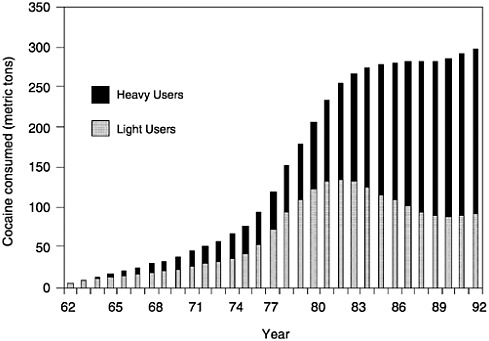
FIGURE 2.1 Change in statistical distribution of cocaine consumption over time.
Source: Adapted from Everingham and Rydell (1994).
This type of systems research, better supported by data, has potential to provide a more complete picture of patterns and consequences of drug use.
Alcohol researchers have used the analysis of consumption distributions to conduct a fruitful—if still unresolved—debate about the relative efficacy of two alternative targeting strategies for drug policy (Edwards et al., 1994; MacCoun, 1998; Rose, 1992). One strategy is to disproportionately target the heaviest users, because they account for such a large share of total consumption and, as a consequence, are at higher risk of causing harm to themselves and others. Others argue that there may be greater aggregate benefit from reducing consumption among casual users; they pose fewer risks individually, but they typically outnumber heavy users by a wide margin.12
Obviously, a comprehensive drug control program should target both typical users and hard-core users. The relative effectiveness of targeting typical versus hard-core users will probably vary according to several factors (MacCoun, 1998). Everything else being equal, it will be more effective to target typical users when the dose-response curve rises very quickly with small doses and when the statistical distribution of consumption is fairly symmetric. It should be added that reducing typical users can also be effective as an attempt to decrease the eventual number of hard-core users. It will be more effective to target heavy users when the dose-response curve rises slowly at low doses and when the statistical distribution of consumption is heavily skewed. Thus the ability to create accurate dose-response curves promises benefits for reduced consumption of illegal drugs.
Reciprocal Effects of Drug-Related Harms on Levels of Use
Complicating any analysis of the relationship between drug use patterns and drug-related harms is the possibility that the risks of drug use have a reciprocal causal influence on the prevalence, incidence, and quantity of drug use. The decision to use, or to escalate, illegal drug use may not reflect a purely rational risk calculation (see MacCoun, 1993), but it seems likely that both potential users and current users are influenced by their perceptions of the risks—health risks, legal risks, and social risks. Still, evidence on this point is surprisingly ambiguous. Analyses of Monitoring the Future data consistently show a negative correlation between the perceived riskiness of drugs and the likelihood of their use (Bachman et al., 1998), but the causal direction of this correlation is not clear.
Musto (1971, 1987) and Johnston (1991) have each proposed a “generational forgetting” account of drug epidemics, in which the risks and disorder associated with the use of a drug become increasingly visible, triggering a reduction in initiation. As the number and visibility of users declines over time, this risk information becomes less accessible, and initiation begins to rise again, renewing the cycle. This model is plausible but largely untested. There are simply too few cycles of data to test the model, much less establish the cyclical nature of drug epidemics. On the surface at least, the generational forgetting model also conflicts with another piece of conventional wisdom in drug policy circles—the contention that providing risk information is relatively ineffective as a strategy for discouraging drug use (discussed in Chapter 7). But it is possible that direct observation of hard-core users has a discouraging effect that is more powerful or more credible than classroom-based risk information (see Fazio et al., 1978; Feldman, 1968).
MacCoun (1997) notes that the total harm (of a given type, for a given drug) is the product of average harm (per incident of use)×total use (number of incidents of use). Thus, if reductions in average harm bring about increases in total use, there is no guarantee that a drop in average harm will produce a decline in total harm. Critics of harm reduction strategies (such as needle exchange) often contend that such approaches send the wrong message—potentially undermining attempts to discourage drug use. Although that claim is rarely articulated in any detail, MacCoun (1998) has examined several plausible interpretations. One is relevant to the present discussion: specifically, the notion that a reduction in the average harmfulness of an incident of drug use may make drugs more desirable. MacCoun (1998) cites evidence from other domains suggesting that interventions to reduce risk can have offsetting behavioral effects; for example, the presence of air bags tends to make people drive slightly faster, everything else being equal. Yet in the domains that have been studied, the safety interventions have been beneficial on the whole, despite these offsetting effects. MacCoun argues that the available evidence suggests that needle exchange programs reduce net harm in this same sense. But he argues that as a general principle, all drug interventions should be evaluated for their effects on several key dimensions: the likelihood of using a drug, the quantity and frequency of drug use, and the average harmfulness (by various criteria) of each incidence of use.
Separating the Effects of Drug Use from the Effects of Illegality of Use
No responsible analysis of the harmful consequences of drug use can ignore the possibility that many of the harms of drug use are either caused or augmented by the legal prohibition against these drugs and its enforcement. Drug prohibition is inevitably a source of government intrusion into citizens’ lives. Many (but not all) overdoses occur due to the unknown purity and potency of illegally purchased drugs. The sharing of contaminated syringes is largely a consequence of the artificial scarcity created by their illegality. And much of the criminality and violence associated with drug use (but by no means all) is due to the high price of illegal drugs and the conditions of their sale in illegal markets.
Consider the drug-crime link. Goldstein (1985) has provided a useful distinction between three types of links between drugs and violence. First, psychopharmacological violence is attributable to the fact that the ingestion of some drugs (e.g., alcohol, stimulants, barbiturates, PCP) makes some individuals more excitable, irrational, or violent than they would be otherwise. Second, economically compulsive violence occurs when ad-
dicted users engage in economically motivated violent crime (e.g., robbery) in order to support an expensive habit of drug use. Finally, systemic violence occurs as a consequence of the nature of illegal drug trafficking—territorial disputes among dealers, conflicts with disgruntled customers and angry neighbors, intimidation to promote debt collection, and so on. Goldstein and colleagues (1992) estimate that in New York City in 1988, 74 percent of all drug- and alcohol-related homicides fell into the systemic category; of those, 61 percent involved crack cocaine and 27 percent involved powder cocaine. Another 4 percent of all drug- and alcohol-related homicides were primarily economically compulsive. Only 14 percent were primarily psychopharmacological in nature, and 68 percent of those involved alcohol—a legal drug. Two open questions are whether the relative frequencies of each type of homicide have changed over time, and whether nonhomicide drug crimes fit a similar profile.
But as several authors have argued in detail (Kleiman, 1992; MacCoun et al., 1996; MacCoun and Reuter, 2001), the premise that drug prohibition causes some drug-related harm does not necessarily imply that ending prohibition would, on net, reduce total drug-related harm. It is likely that many of the harmful consequences of drug use would be significantly reduced under a regulated policy of legal access to drugs—but not all harms. And even if average harm declined overall, there is no guarantee that net or total harm would decline as a result. Recall that total harm= average harm per incident of use×total use. If average harm declined under legalization, the effect on total harm would then depend on whether total use increased. If the average harmfulness of an incident of use (on any given dimension of harm) dropped but total use increased, the net effect on total harm is uncertain; it could fall, remain constant, or increase significantly (MacCoun and Reuter, 2001). Thus, legalization is an unproven and potentially risky strategy for reducing drug-related harms.
For these reasons, the observation that drug illegality contributes to drug harmfulness is by no means tantamount to endorsing drug legalization. In discussing this point, we acknowledge concerns about the fear of sending the wrong message about the harms of drugs. However, inadequate analysis of the consequences of drug use gives a rhetorical advantage to advocates of legalization without allowing a serious examination of the merits and weaknesses of their arguments. Moreover, the failure to address the full consequences of drug prohibition results in lost opportunities for reducing drug-related harm under a policy of prohibition.
REFERENCES
Adams, L.D., W.Gong, S.D.Vechia, R.G.Hunter, and M.J.Kuhar 1999 CART: From gene to function. Brain Research 848(1–2):137–40.
Anthony, J.C., and J.E.Helzer 1995 Epidemiology of drug dependence. In Ming T.Tsuang, Mauricio Tohen, and G. E.P.Zahner, eds., Textbook in Psychiatric Epidemiology. New York. John Wiley and Sons.
Argawal, D.P., and H.W.Goedde 1990 Alcohol Metabolism, Alcohol Intolerance, and Alcoholism. Berlin: Springer-Verlag.
Bachman, J.G., L.D.Johnston, and P.M.O’Malley 1998 Explaining recent increases in students’ marijuana use: Impacts of perceived risks and disapproval, 1976 through 1996. American Journal of Public Health 88:887–892.
Becker, G.S., M.Grossman, and K.M.Murphy 1994 An empirical analysis of cigarette addiction. American Economic Review 84:396– 418.
Becker, G.S., and K.M.Murphy 1988 A theory of rational addiction. Journal of Political Economy 96:675–700.
Brewer, D.D., R.F.Catalano, K.Haggerty, R.R.Gainey, and C.B.Fleming 1998 A meta-analysis of predictors of continued drug use during and after treatment for opiate addiction. Addiction 93(1):73–92.
Brook, J.S., M.Whiteman, S.Finch, and P.Cohen 2000 Longitudinally foretelling drug use in the late twenties: Adolescent personality and social-environmental antecedents. Journal of Genetic Psychology 161(1):37–51.
Bucholz, K.K., A.C.Heath, and P.A.Madden 2000 Transitions in drinking in adolescent females: Evidence from the Missouri adolescent female twin study. Alcoholism—Clinical and Experimental Research 24(6):914– 23.
Buck, A.A., T.T.Sasaki, J.J.Hewitt, and A.A.Macrae 1968 Coca chewing and health. An epidemiologic study among residents of a Peruvian village. American Journal of Epidemiology 88(2):159–77.
Caulkins, J.P. 1995 Estimating Elasticities of Demand for Cocaine and Heroin with Data from the Drug Use Forecasting System. H.John Heinz III School of Public Policy and Management, Carnegie Mellon University.
1994 Developing Price Series for Cocaine. Drug Policy Research Center. Santa Monica, CA: RAND.
Caulkins, J.P., and P.Reuter 1998 What price data tell us about drug markets. Journal of Drug Issues 28:593–612.
1997 Setting goals for drug policy: Harm reduction or use reduction? Addiction 92:1143– 1150 .
Chaloupka, F.J. 1991 Rational addictive behavior and cigarette smoking, Journal of Political Economy 99:722–742.
Chaloupka, F.J., M.Grossman, and J.A.Tauras 1998 The Demand for Cocaine and Marijuana by Youth. Working paper 6411. Cambridge, MA: National Bureau of Economic Research.
Chaloupka, F.J., and H.Wechsler 1997 Price, tobacco control policies and smoking among young adults. Journal of Health Economics 16:359–373.
Chilcoat, H.D., and J.C.Anthony 1996 Impact of parent monitoring on initiation of drug use through late childhood. Journal of the American Academy of Child and Adolescent Psychiatry 35(1):91–100.
Chilcoat, H.D., N.Breslau, and J.C.Anthony 1996 Potential barriers to parent monitoring: Social disadvantage, marital status, and maternal psychiatric disorder. Journal of the American Academy of Child and Adolescent Psychiatry 35(12):1673–82.
Childress, A.R., A.V.Hole, R.N.Ehrman, S.J.Robbins, A.T.McLellan, and C.P.O’Brien 1993 Cue reactivity and cue reactivity interventions in drug dependence. NIDA Research Monographs 137:73–95.
Cohen, M.A. 1999 Alcohol, drugs and crime: Is “crime” really one-third of the problem? Addiction 94:644–647.
Coie, J.D., N.F.Watt, S.G.West, J.D.Hawkins, J.R.Asarnow, H.J.Markman, S.L.Ramey, M.B.Shure, and B.Long. 1993 The science of prevention: A conceptual framework and some directions for a national research program. American Psychologist 48:1013–1022.
Collins, W.A., E.E.Maccoby, L.Steinberg, E.M.Hetherington, and M.H.Bornstein 2000 Contemporary research on parenting: The case for nature and nurture. American Psychology 55(2):218–32.
Cooper, J.R., F.E.Bloom, and R.H.Roth 1996 Cellular foundation of neuropharmacology. Pp. 9–48 in The Biochemical Basis of Neuropharmacology, 7th Edition. New York: Oxford University Press.
Cornish, J.L., P.Duffy, and P.W.Kalivas 1999 A role for nucleus accumbens glutamate transmission in the relapse to cocaine-seeking behavior. Neuroscience 93(4):1359–1367.
Cornish, J.L., and P.W.Kalivas 2000 Glutamate transmission in the nucleus accumbens mediates relapse in cocaine addiction. Journal of Neuroscience (Online). 20(15):RC89.
Corrao, G., V.Bagnardi, A.Zambon, and S.Arico
1999 Exploring the dose-response relationship between alcohol consumption and the risk of several alcohol-related conditions: A meta-analysis. Addiction 94:1551–1573.
Crane, B.D., A.R.Rivolo, and G.C.Comfort 1997 An Empirical Examination of Counterdrug Interdiction Program Effectiveness. IDA paper, p. 3219. Alexandria, VA: Institute for Defense Analyses.
Crum, R.M., M.Lillie-Blanton, and J.C.Anthony 1996 Neighborhood environment and opportunity to use cocaine and other drugs in late childhood and early adolescence. Drug and Alcohol Dependence 43(3):155–61.
Curtis, R., and T.Wendel 2000 Lockin’ Niggas Up Like It’s Goin’ Out of Style: The Differing Consequences of Police Interventions in Three Brooklyn, New York, Drug Markets. Conference on Drug Markets and Law Enforcement Strategies. Arlington, VA: National Institute of Justice.
1999 Toward the Development of a Typology of Illegal Drug Markets. Unpublished paper prepared for Committee on Data and Research for Policy on Illegal Drugs.
Daniels, D., J.Dunn, F.F.Furstenberg, Jr., and R.Plomin 1985 Environmental differences within the family and adjustment differences within pairs of adolescent siblings. Child Development 56(3):764–74.
DeSimone, J. 1998 Is marijuana a gateway drug? Eastern Economic Journal 24:149–164.
Doyle, J.K. 1997 Judging cumulative risk. Journal of Applied Social Psychology 27:500–524.
Duncan, T.E., S.C.Duncan, H.Hops, and A.Alpert 1997 Multi-level covariance structure analysis of intra-familial substance use. Drug and Alcohol Dependence 46(3):167–80.
Eaves, L., A.Heath, N.Martin, H.Maes, M.Neale, K.Kendler, K.Kirk, and L.Corey 1999 Comparing the biological and cultural inheritance of personality and social attitudes in the Virginia 30,000 study of twins and their relatives. Twin Research 2(2):62–80.
Edwards, G., P.Anderson, T.F.Babor, S.Casswell, R.Ferrence, N.Giesbrecht, C.Godfrey, H.D.Holder, P.Lemmens, K.Mäkelä, L.T.Midanik, T.Norström, E.Österberg, A.Romesljö, R.Room, J.Simpura, and O.Skog 1994 Alcohol Policy and the Public Good. Oxford, England: Oxford University Press.
Everingham, S.S., and C.P.Rydell 1994 Modeling the Demand for Cocaine. Prepared for the Office of National Drug Control Policy and the U.S. Army. Santa Monica, CA: RAND.
Everingham, S.M.S., C.P.Rydell, and J.P.Caulkins 1995 Cocaine consumption in the United States: Estimating past trends and future scenarios. Socio-Economic Planning Sciences 29:305–314.
Fagan, J. 1992 Drug selling and licit income in distressed neighborhoods: The economic lives of street-level drug users and dealers. In A.V.Harrell and G.E.Peterson, eds., Drugs, Crime, and Social Isolation. Washington, DC: Urban Institute Press.
Fazio, R.H., M.P.Zanna, and J.Cooper 1978 Direct experience and attitude-behavior consistency: An information processing analysis. Personality and Social Psychology Bulletin 4:48–51.
Feldman, H. 1968 Ideological supports to becoming and remaining a heroin addict. Journal of Health and Social Behavior 9(14):31–155.
Foroud, T., and T.K.Li 1999 Genetics of alcoholism: a review of recent studies in human and animal models. American Journal of Addictions 8(4):261–278.
Gable, R.S. 1993 Toward a comparative overview of dependence potential and acute toxicity of psychoactive substances used nonmedically. American Journal of Drug and Alcohol Abuse 19:263–281.
Garmezy, N. 1983 Stressors of childhood. In N.Garmezy and N.Rutter, eds., Stress, Coping and Development in Children. New York: McGraw-Hill.
Goldstein, P. 1985 The drug/violence nexus: A tripartite conceptual framework. Journal of Drug Issues 14:493–506.
Goldstein, P., H.H.Brownstein, and P.J.Ryan 1992 Drug-related homicide in New York: 1984 and 1988. Crime and Delinquency 38:459– 476.
Gossop, M., P.Griffiths, B.Powis, and J.Strang 1994 Cocaine: Patterns of use, route of administration, and severity of dependence. British Journal of Psychiatry 164(5):660–664.
Gottfredson, D.C. 2000 Delinquency Prevention in Schools. New York: Cambridge University Press. Gottfredson, D.C., M.A.Harmon, G.D.Gottfredson, E.M.Jones, and J.A.Celestin
1996 Compendium of Prevention Program Outcomes and Instrument Locator. Ellicott City, MD: Gottfredson Associates, Inc.
Groenewegen, P.P., H.G.Leufkens, P.Spreeuwenberg, and W.Worm 1999 Neighbourhood characteristics and use of benzodiazepines. Netherlands Social Science Medicine 48(12):1701–1711.
Grossman, M., F.J.Chaloupka, and C.C.Brown 1996 The Demand for Cocaine by Young Adults: A Rational Addiction Approach. Working paper 5713. Cambridge, MA: National Bureau of Economic Research.
Hansen, W.B., and P.M.O’Malley 1996 Drug use. In R.J.DiClemente, W.B.Hansen, and L.E.Ponton, eds. Handbook of Adolescent Health Risk Behavior. New York: Plenum Press.
Harwood, H.J., D.Fountain, and G.Livermore 1998 The Economic Costs of Alcohol and Drug Abuse in the United States, 1992. Rockville, MD: National Institute on Drug Abuse.
Hatsukami, D.K., and M.W.Fischman. 1996 Crack cocaine and cocaine hydrochloride. Are the differences myth or reality? Journal of the American Medical Association 276(19):1580–1588.
Hawkins, J.D., M.W.Arthur, and R.F.Catalano 1995 Building a Safer Society: Strategic Approaches to Crime Prevention: Preventing Substance Abuse. Chicago: University of Chicago Press.
Hawkins, J.D., R.F.Catalano, and J.Y.Miller 1992 Risk and protective factors for alcohol and other drug problems in adolescence and early adulthood: Implications for substance abuse prevention. Psychological Bulletin 112(1):64–105.
Hirschi, T. 1969 Causes of Delinquency. Berkeley: University of California Press.
Hung, A. 2000 A Behavioral Theory of Addiction. Working Paper, The Heinz School, Carnegie Mellon University.
Institute of Medicine 1997 Dispelling the Myths About Addiction: Strategies to Increase Understanding and Strengthen Research. Washington, DC: National Academy Press.
1996 Pathways of Addiction: Opportunities in Drug Abuse Research. Washington, DC: National Academy Press.
1995 The Development of Medications for the Treatment of Opiate and Cocaine Addictions: Issues for the Government and Private Sector. Washington, DC: National Academy Press .
1994 Reducing Risks For Mental Disorders: Frontiers for Preventive Intervention Research. Washington, DC: National Academy Press.
Johanson, C.E., F.F.Duffy, and J.C.Anthony 1996 Associations between drug use and behavioral repertoire in urban youths. Addiction 91(4):523–534.
Johnston, L.D. 1991 Toward a theory of drug epidemics. In L.Donohew and H.E.Sypher, eds., Persuasive Communication and Drug Abuse Prevention. Hillsdale, NJ: Lawrence Erlbaum Associates.
Julien, R.M. 1998 A Primer of Drug Action, 8th ed. New York: W.H.Freeman.
Kelz, M.B., J.Chen, W.A.Carlezon, Jr, K.Whisler, L.Gilden, A.M.Beckmann, C.Steffen, Y.J.Zhang, L.Marotti, D.W.Self, T.Tkatch, G.Baranauskas, D.J.Surmeier, R.L.Neve, R.S. Duman, M.R.Picciotto, and E.J.Nestler 1999 Expression of the transcription factor deltaFosB in the brain controls sensitivity to cocaine. Nature 16:401(6750):272–276.
Kendler, K.S., and C.O.Gardner, Jr. 1998 Twin studies of adult psychiatric and substance dependence disorders: Are they biased by differences in the environmental experiences of monozygotic and dizygotic twins in childhood and adolescence? Psychological Medicine 28(3):625–633.
Kendler, K.S., L.Karkowski, and C.A.Prescott 1999 Hallucinogen, opiate, sedative and stimulant use and abuse in a population-based sample of female twins. Acta Psychiatrica Scandinavica 99(5):368–376.
Kendler, K.S., J.Myers, and C.A.Prescott 2000 Parenting and adult mood, anxiety and substance use disorders in female twins: An epidemiological, multi-informant, retrospective study. Psychological Medicine 30(2):281–294.
Kendler, K.S., and C.A.Prescott 1998a Cocaine use, abuse and dependence in a population-based sample of female twins. British Journal of Psychiatry 173:345–350.
1998b Cannabis use, abuse, and dependence in a population-based sample of female twins. American Journal of Psychiatry 155(8):1016–1022.
Kendler, K.S., P.C.Sham, and C.J.MacLean 1997 The determinants of parenting: An epidemiological, multi-informant, retrospective study. Psychological Medicine 27(3):549–563.
Kendler, K.S., L.M.Karkowski, L.A.Corey, C.A.Prescott, and M.C.Neale 1999 Genetic and environmental risk factors in the aetiology of illicit drug initiation and subsequent misuse in women. British Journal of Psychiatry 175:351–356.
Kessler, R.C., and R.H.Price 1993 Primary prevention of secondary disorders: A proposal and agenda. American Journal of Community Psychology 21(5):607–633.
Kleiman, M.A.R. 1999 “Economic cost” measurements, damage minimization and drug abuse control policy. Addiction 94:638–641.
1992 Against Excess: Drug Policies for Results. New York: Basic Books.
Koob, G.F. 2000 Neurobiology of addiction. Toward the development of new therapies. Annals of the New York Academy of Science 909:170–185.
Kosten, T.A., S.A.Ball, and B.J.Rounsaville 1994 A sibling study of sensation seeking and opiate addiction. Journal of Nervour and Mental Disease 182(5):284–289.
Ledermann, S. 1956 Alcool, Alcoolisme, Alcoolisation, Volume 1. Paris: Presses Universitaires de France.
Leshner, A. 1997 Addiction is brain disease, and it matters. Science 278.
Levitt, S.D., and S.A.Venkatesh 1998 An Economic Analysis of a Drug-Selling Gang’s Finances. Working paper 6592. Cambridge, MA: National Bureau of Economic Research.
Lilienfeld, D.E., and P.D.Stolley 1994 Foundations of Epidemiology, 3rd ed. New York: Oxford University Press.
Luthar, S.S., and G.Cushing 1999 Neighborhood influences and child development: A prospective study of substance abusers’ offspring. Development and Psychopathology 11(4):763–784.
MacCoun, R. 1993 Drugs and the law: A psychological analysis of drug prohibition. Psychological Bulletin 113:497–512.
1998 Toward a psychology of harm reduction. American Psychologist 53:1199–1208.
MacCoun, R., and P.Reuter 2001 Drug War Heresies: Learning from Other Vices, Times, and Places. New York: Cambridge University Press.
MacCoun, R., P.Reuter, and T.Schelling 1996 Assessing alternative drug control regimes. Journal of Policy Analysis and Management 15:1–23.
Maldonado, R., A.Saiardi, O.Valverde, T.A.Samad, B.P.Roques, and E.Borrelli 1997 Absence of opiate rewarding effects in mice lacking dopamine D2 receptors. Nature 388(6642):586–589.
Manski, C.F. 2000 Economic analysis of social interactions. Journal of Economic Perspectives 14:115– 136.
1995 Identification Problems in the Social Sciences. Cambridge, MA: Harvard University Press.
Merikangas, K.R., R.L.Mehta, B.E.Molnar, E.E.Walters, J.D.Swendsen, S.Aguilar Gaziola, R.Bijl, G.Borges, J.J.Caraveo-Anduaga, D.J.DeWit, B.Kolody, W.A.Vega, H.U.Wittchen, and R.C.Kessler 1998a Comorbidity of substance use disorders with mood and anxiety disorders: Results of the International Consortium in Psychiatric Epidemiology. Addictive Behavior 23(6):893–907.
Merikangas, K.R., M.Stolar, D.E.Stevens, J.Goulet, M.A.Preisig, B.Fenton, H.Zhang, S.S. O’Malley, and B.J.Rounsaville 1998b Familial transmission of substance use disorders. Archives of General Psychiatry 55(11):973–979.
Moffitt, T.E. 1993 Adolescent-limited and life-course-persistent antisocial behavior: A developmental taxonomy. Psychological Review 100:674–701.
Morgan, M.G. 1981 Probing the question of technology-induced risk. IEEE Spectrum 18:58–64.
Musto, D.F. 1995 Perception and regulation of drug use: The rise and fall of the tide. Annals of Internal Medicine 15:123(6):468–469.
1971/1987 The American Disease: Origins of Narcotic Control New York: Oxford University Press.
National Development and Research Institutes 1997 Natural History of Crack Distribution/Abuse. Rockville, MD: National Institute on Drug Abuse.
Negrete, J.C. 1992 Cocaine problems in the coca-growing countries of South America. CIBA Foundation Symposium 166:40–50.
Neiderhiser, J.M., D.Reiss, E.M.Hetherington, and R.Plomin 1999 Relationships between parenting and adolescent adjustment over time: Genetic and environmental contributions. Developmental Psychology 35(3):680–692.
O’Brien, C.P. 1995 Drug addiction and drug abuse. In The Pharmacological Basis of Therapeutics, 9th Edition, J.G.Hardman and L.E.Limbard, eds. New York: McGraw Hill.
O’Brien, C.P., and A.T.McLellan 1996 Myths about the treatment of addiction. Lancet 347:237–240.
Office of National Drug Control Policy 1999 The Price of Illicit Drugs: 1981 through the Second Quarter of 1998. Washington, DC: Abt Associates.
1997 What America’s Users Spend on Illegal Drugs: 1988–1995. Washington, DC: Abt Associates.
Olds, M.E., and P.Milner 1954 Positive reinforcement produced by electrical stimulation of septal area and other regions of the rat brain. Journal of Comparative and Physiological Psychology 47:419– 427.
Orphanides, A., and D.Zervos 1995 Rational addiction with learning and regret. Journal of Political Economy 103(4):739– 758.
Petronis, K.R., and J.C.Anthony 2000 Perceived risk of cocaine use and experience with cocaine: Do they cluster within U.S. neighborhoods and cities? Drug and Alcohol Dependence 57(3):183–192.
Petraitis, J., B.R.Flay, T.Q.Miller, E.J.Torpy, and B.Greiner 1998 Illicit substance use among adolescents: A matrix of prospective predictors. Substance Use and Misuse 33(13):2561–2604.
Reuter, P., R.MacCoun, and P.Murphy 1990 Money from Crime: A Study of the Economics of Drug Dealing in Washington, D.C. Report R-3894-RF. Santa Monica, CA: RAND.
Reuter, P. 1999 Are calculations of the economic costs of drug abuse either possible or useful? Addiction 94:635–638.
Reuter, P., and J.Caulkins 1995 Redefining the goals of national drug policy: Recommendations from a working group. American Journal of Public Health 85:1059–1064.
Rice, D.P. 1999 Economic costs of substance abuse, 1995. Proceedings of the Association of American Physicians 111:119–125.
Riley, K.J. 1997 Crack, Powder Cocaine, and Heroin: Drug Purchase and Use Patterns in Six U.S. Cities . Office of National Drug Control Policy and the National Institute of Justice.
Ritz, M.C., R.J.Lamb, S.R.Goldberg, and M.J.Kuhar 1988 Cocaine self-administration appears to be mediated by dopamine uptake inhibition. Progress In Neuro-Psychopharmacology and Biological Psychiatry 12(2–3):233–9.6.
1987 Cocaine receptors on dopamine transporters are related to self-administration of cocaine. Science 237(4819):1219–1223.
Robbins, S.J., R.N.Ehrman, A.R.Childress, J.W.Cornish, and C.P.O’Brien 2000 Mood state and recent cocaine use are not associated with levels of cocaine cue reactivity. Drug and Alcohol Dependence 1:59(1):33–42.
Rose, G. 1992 The Strategy of Preventive Medicine. New York: Oxford University Press.
Rose, R.J., M.Koskenvuo, J.Kaprio, S.Sarna, and H.Langinvainio. 1988 Shared genes, shared experiences, and similarity of personality: Data from 14,288 adult Finnish co-twins. Journal of Perspectives in Social Psychology 54(1):161–171.
Rydell, C.P., and S.S.Everingham 1994 Controlling Cocaine. Report prepared for the Office of National Drug Control Policy and the U.S. Army. Santa Monica, CA: RAND.
Saffer, H., and F.Chaloupka 1995 The Demand for Illicit Drugs. Working paper 5238. Cambridge, MA: National Bureau of Economic Research.
Self, D.W. 1998 Neural substrates of drug craving and relapse in drug addiction. Annals of Medicine 30(4):379–389.
Sellers, E.M., and R.F.Tyndale 2000 Mimicking gene defects to treat drug dependence. Annuals of the New York Academy of Science 909:233–246.
Siegel, R.K. 1984 Cocaine aroma in the treatment of cocaine dependency. Journal of Clinical Psychopharmacology 4(1):61–62.
Simon, D., and E.Burns 1997 The Corner: A Year in the Life of an Inner City Neighborhood. New York: Broadway Books.
Skog, O.J. 1993 The tail of the alcohol consumption distribution. Addiction 88:601–610.
Stallings, M.C., J.K.Hewitt, T.Beresford, A.C.Heath, and L.J.Eaves 1999 A twin study of drinking and smoking onset and latencies from first use to regular use. Behavioral Genetics 29(6):409–421.
Tourangeau, R., L.J.Rips, and K.Rasinski 2000 The Psychology of Survey Response. New York: Cambridge University Press.
True, W.R., A.C.Heath, J.F.Scherrer, H.Xian, N.Lin, S.A.Eisen, M.J.Lyons, J.Goldberg, and M.T.Tsuang 1999 Interrelationship of genetic and environmental influences on conduct disorder and alcohol and marijuana dependence symptoms. American Journal of Educational Genetics 88(4):391–397.
Tsuang, M.T., M.J.Lyons, R.M.Harley, H.Xian, S.Eisen, J.Goldberg, W.R.True, and S.V. Farina 1999 Genetic and environmental influences on transitions in drug use. Behavioral Genetics 29(6):473–479.
Tsuang, M.T., M.J.Lyons, J.M.Meyer, T.Doyle, S.A.Eisen, J.Goldberg, W.True, N.Lin, R. Toomey, and L.Eaves 1998 Co-occurrence of abuse of different drugs in men: the role of drug-specific and shared vulnerabilities. Archives of General Psychiatry 55(11):967–972.
Uhl, G.R. 1999 Molecular genetics of substance abuse vulnerability: A current approach. Neuropsychopharmacology 20(1):3–9.
Uhl, G.R., G.I.Elmer, M.C.LaBuda, R.W.Pickens. F.E.Bloom, and D.J.Kupfer, eds. 1995 Genetic influences in drug abuse. In Psychopharmacology: The Fourth Generation of Progress. New York: Raven Press.
Van Etten, M.L., and J.C.Anthony. 1999 Comparative epidemiology of initial drug opportunities and transitions to first use: Marijuana, cocaine, hallucinogens and heroin. Drug and Alcohol Dependence 54(2):117–125.
Van Etten, M.L., Y.D.Neumark, and J.C.Anthony. 1997 Initial opportunity to use marijuana and the transition to first use: United States, 1979–1994. Drug and Alcohol Dependence 49(1):1–7.
Wise, R.A. 1978 Catecholamine theories of reward: A critical review. Brain Research 152:215–247.
Yoshida, A., L.Hsu, and M.Yasunami 1991 Genetic of human alcohol metabolizing enzymes. Progress in Nucleic Acid Research and Molecular Biology 40:235–287.
Yoshimoto, K., S.Ueda, M.Nishi, Y.Yang, H.Matsushita, Y.Takeuchi, B.Kato, Y.Kawai, K.Noritake, S.Kaneda, Y.Sorimachi, and M.Yasuhara 2000 Changes in dopamine transporter and c-Fos expression in the nucleus accumbens of alcohol-tolerant rats. Alcohol—Clinical and Experimental Research 24(3):361–365.
Zuckerman, M. 1994 Behavioral Expressions and Biosocial Bases of Sensation Seeking. New York: Cambridge University Press.


