
Part II
Data for Monitoring the Nation’s Drug Problems
Accurate description of trends and cross-sectional patterns in drug use, prices, and other relevant variables is essential to informed analysis and development of drug control policy. Theorizing and qualitative observation do not carry one very far toward the objective of assessing the effectiveness of alternative policies. Adequate data are necessary first to monitor the nation’s drug problems and then to analyze policy impacts.
In Part II, we examine the data now regularly collected by the federal government and other agencies to monitor the nation’s drug problems and consider how these data could be enhanced. Chapter 3 describes and evaluates these data. Chapter 4 examines principles for and the organization of such data collection in the federal statistical system.
The types of data discussed here are essential to inform drug control policy, but they do not suffice. Richer data aiming to shed light on specific aspects of drug use and detailed features of drug markets are needed to support research evaluating particular drug control instruments. How-
ever, such richer data may be collected as the need arises, rather than on the regular schedule that is basic to the monitoring function. Data needs for analysis of particular drug control instruments are discussed in Part III.1
3
Data Needs for Monitoring Drug Problems
This chapter examines several types of data that are or should be regularly collected and disseminated by the federal government and other agencies to monitor the nation’s drug problems. We first describe and evaluate the main data systems providing information on drug use. We then discuss surveillance data that would be useful to provide early warnings of drug epidemics. Next we evaluate the System to Retrieve Information from Drug Evidence (STRIDE) data, the primary existing series on drug prices and purity. Finally, we discuss how aggregate statistics on drug production, consumption, and prices could be incorporated into the national macroeconomic accounts.
DATA ON DRUG USE
Four datasets are widely used to monitor trends and cross-sectional patterns in drug use in the United States. Two are nationwide population surveys: Monitoring the Future (MTF) surveys school students, and the National Household Survey of Drug Abuse (NHSDA) surveys the noninstitutionalized residential population age 12 and over. These surveys are based on probability samples of known populations. Hence these data can be used to draw conventional statistical inferences about the surveyed populations.
The other two data systems sample events rather than persons: the Arrestee Drug Abuse Monitoring (ADAM) surveys booked arrestees, and the Drug Abuse Warning Network (DAWN) provides information on
drug-related episodes at emergency rooms and within the coroner’s jurisdiction. These “event-based” surveys have been used for operational purposes in the criminal justice and public health systems. They also are capable of providing evidence on emerging problems in high-risk populations.
In this section we describe each of the four surveys, none of which provides information on drug consumption; we go on to recommend study of the feasibility of obtaining such information. Next we discuss issues of population coverage and sample size in the four surveys. We then investigate how nonresponse and inaccurate response may affect measurement of levels and trends in drug use.
Description of the Surveys
The four primary surveys used to monitor drug use in the United States collect information on whether the respondent used a wide range of illegal drugs (see Table 3.1). Specific questions are asked about alcohol, tobacco, marijuana, cocaine, hallucinogens, heroin, inhalants, and nonmedical use of psychotherapeutics. The surveys also include various levels of detail on the respondent’s demographics, health status, insurance, drug treatments, illegal activities, perceptions, and geographic location.
The National Household Survey of Drug Abuse (NHSDA) is a multistage probability sample providing annual self-report estimates of the number of drug users, their pattern of use, and their characteristics. The survey covers the U.S. civilian population age 12 and older. About 2 percent of the population is not covered, including persons who are in the military, in jail, in a long-term residential treatment regimen, and those who are homeless but not in shelters.
The National Commission on Marihuana and Drug Abuse conducted the first survey in 1972–1973. The National Institute on Drug Abuse (NIDA) then conducted surveys approximately every 2 to 3 years from 1973 to 1991. Since 1992, the Substance Abuse and Mental Health Service Administration (SAMHSA) has conducted the survey annually. Over the years, the sample size has been increased from 9,000 in 1988 to 26,000 in 1998 and 70,000 in 1999. The sample is now sufficiently large to enable estimation of the prevalence of illegal drug use in each of the 50 states. The sampling scheme is also stratified to ensure adequate representation by age, race, and ethnic background.
The instrument includes questions about the drug use of the respondent. For each drug and for combinations of drugs, the survey elicits information on the frequency of use within the respondent’s lifetime, past year, and past 30 days. Respondents are asked the age when they were first exposed to and first used each drug, as well as when they last used it.
Questions are also asked about perceived risks associated with using illegal drugs, the actual health and behavioral consequences of use, and the availability of drugs. In early waves of the survey, respondents were asked to specify the amount and cost of marijuana and cocaine consumed within the past 30 days. However, these consumption and expenditure questions have not been asked since the early 1990s.
Given the sensitive nature of the questions posed, substantial resources are devoted to eliciting accurate responses. The surveys are conducted by face-to-face interviews in the home or at a private location, if possible. Various steps are taken to ensure confidentiality and anonymity, but frequently this is not possible for respondents ages 12–17 (U.S. General Accounting Office, 1993).1
Monitoring the Future (MTF) is an ongoing annual study of students in public and private schools in the United States based on a sample developed using a multistage random selection procedure. It assesses the prevalence of and trends in self-reported drug use among school students. It also asks questions concerning peer norms regarding drugs, beliefs about the dangers of illegal drugs, and perceived availability of drugs (Johnston et al., 1993, 1998). Illegal drugs, alcohol, tobacco, psychoactive pharmaceuticals (non-medical use), and inhalants are included. Students who have dropped out of high school (about 15 percent of those who enter) are not surveyed.
The University of Michigan’s Institute for Social Research has conducted the survey each year since 1975. The survey initially focused on high school seniors but expanded to include 8th and 10th grade students in 1991. In 2000, 13,286 12th grade students were surveyed in 134 schools. Sample sizes for students in 8th and 10th grades were 17,311 (156 schools) and 14,576 (145 schools), respectively.
The MTF instrument includes questions about the drug use of student respondents. For each drug, the survey elicits information on the frequency of use within the respondent’s lifetime, past year, and past 30
TABLE 3.1 Characteristics of Major Drug Data Collection Systems
|
Survey/Data Collection System |
Sample |
Data Collection |
Sampling |
|
National Household Survey of Drug Abuse (NHSDA) |
18,000 interviews per survey (calendar) year during 1994–96; 25,000 per year in 1997–98; 70,000 per year starting in 1999 |
Personal Interview at home using Audio-CASI |
Nationally representative multistage sample of the general population |
|
Monitoring the Future (MTF) |
Approx. 50,000 8th 10th, and 12th graders surveyed each year. |
In-class questionnaire and follow-up survey |
Nationally representative sample of students in school |
|
Arrestee Drug Abuse Monitoring (ADAM) Program |
Adult males and females arrested and booked during the data collection period. Generally each site collects quarterly data from 200–250 adult male arrestees, 100–150 adult female arrestees, 100–150 juvenile male arrestees (at 12 sites) and a small sample of female juvenile arrestees (at 8 sites). |
Personal interview and urinalysis |
Sample of arrests in selected booking facilities |
|
Drug Abuse Warning Network (DAWN) |
National representative sample of more than 600 nonfederal, short-stay emergency department visits per year. Data are also collected from approximately 146 medical examiners and coroners in 41 metropolitan areas. |
Medical record abstraction |
Probability sample of emergency department presentations; census of selected medical examiner facilities |
|
Frequency of Data Collection |
Geographic Coverage |
Prevalence Estimates |
Purpose |
|
Throughout the calendar year |
National |
Lifetime; past 12 months; past 30 days |
To track use of illegal drugs and other addictive substances and to collect related information from among the general population. |
|
Throughout the calendar year with longitudinal follow-up of 12th graders once every 2 years |
National |
Lifetime, past 12 months; past 30 days |
To track use of illegal drugs and other addictive substances among students registered for school. |
|
Quarterly: data are collected for a two-week period, four times a year |
23 cities |
None |
To track the illegal drug use among arrests. |
|
Throughout the year |
National |
None |
To track emergency department cases and medical examiner deaths caused by the use of illegal drugs or the abuse of prescription and over-the-counter drugs. |
days. Respondents are asked when they first used the drug. Questions are also asked about perceived risks associated with using drugs, about the actual health, social, and behavioral consequences of use, about the availability of drugs, about the setting in which the student consumes drugs, and about expected future use.
Given the sensitive nature of the questionnaire, major efforts are made to obtain valid responses and to ensure confidentiality. For 8th and 10th graders, the survey is anonymous. Seniors (12th grade) are asked to provide identifying information so that follow-up surveys can be conducted. This tracking information is administered separately from the questionnaire and kept apart from it to protect privacy. Nonetheless, the degree to which the loss of anonymity has compromised the validity of self-reports is uncertain (General Accounting Office, 1993).
Beginning with the graduating class of 1976, follow-up surveys have been administered biannually by mail to representative subsamples of respondents up to age 32, and then again at age 35 and 40. The resulting panels provide the only detailed, ongoing source of longitudinal data on drug use in the United States.2 In principle, these panel data would permit researchers to address pressing questions regarding the effects of policies on drug use and the effects of drug use on behavior, as well as basic epidemiological questions regarding duration of drug use episodes. However, citing concern for the confidentiality of respondents’ identities, the Institute for Social Research has not made the MTF longitudinal data available to external researchers.
The lack of access to the longitudinal data from Monitoring the Future has been a major concern among researchers, and the committee shares this concern. Without effective research access, the quality of the MTF data can not be assessed objectively, nor can judgments be made about whether to collect additional longitudinal data. While MTF cross-sectional data are made available in public-use format via the Inter-university Consortium for Political and Social Research (ICPSR) archive, the critical longitudinal data are not available to researchers outside the MTF team. These data are important for answering questions related to the continued pattern of drug use, which is key to policy decisions regarding the efficacy of alternative drug policies. These data in particular, and longitudinal data on drug consumption in general, may provide essential information for evaluating the efficacy of alternative drug policies. Two features about illegal drug control policy make longitudinal data uniquely important. First, illegal drug consumption and markets are complex and involve many confounding factors. Second, drugs are addictive; that is,
consumption today influences consumption tomorrow. Longitudinal data are at least very valuable and perhaps essential to disentangle the many confounding factors and understand the addictive process. As discussed throughout this report, analysis of the dynamic process of drug use, evaluation of causal risk and protective factors, the relationship between prices, enforcement, and demand, and the effect of socioeconomic conditions on the illegal drug market all benefit from valid longitudinal data.
Recently, the MTF staff announced the availability of Internet-based access to its full dataset for cross-sectional studies. These data go beyond the public-use datasets and allow for more detailed and specific analyses. However, requests to use these datasets are mediated by MTF staff, who must execute the computer programs to extract the results, review them for privacy protection, and forward them to the requesters.
The committee is concerned that even this limited kind of access is not provided for the longitudinal datasets. The committee notes that the National Center for Education Statistics has developed a system for handling sensitive school-based surveys, including its longitudinal surveys. This system allows researchers and the public online access to public-use versions of these datasets. It also extends researchers access to the full datasets upon their agreement to abide by a privacy agreement.
The committee emphasizes its serious concern for the lack of research access to the MTF panel data. Providing access to the underlying data, while ensuring appropriate protections for confidentiality, is an important objective of statistical policy. Wide access to datasets encourages use of the data and enlists the broad community of researchers in the task of analyzing and understanding current trends. Equally important is that external analysis provides the critical function of reviewing the data and the methods of those who gather the data and helps inform the research community and policy makers about the usefulness and limitations of the data. At the same time, it alerts policy makers to the need for improvements and the best applications of the results.
In our view, it is in the public interest to have full access to all data of MTF, with appropriate protection for confidentiality. The committee recommends that the Office of National Drug Control Policy and the granting agency (currently the National Institute on Drug Abuse) establish an oversight committee of statisticians and other experts, knowledgeable in procedures for balancing the needs for public access with the goal of confidentiality, to establish guidelines for providing access and for monitoring whether access to the data is quickly and easily provided.
There are a number of possible approaches that the oversight committee could recommend. One is that the National Institute on Drug Abuse undertake an agreement with the National Center for Education Statistics
to deposit the MTF files in its archives so that they can be made available to researchers on the same basis as other sensitive school-based surveys. Other approaches may be even more effective. In any case, the committee recommends that the granting agency require that the contractors who gather data for Monitoring the Future move immediately to provide appropriate access to the longitudinal data. Finally, the committee recommends that if access is not provided in accordance with the guidelines of the oversight committee, the Office of National Drug Control Policy and the granting agency consider whether the public interest requires relocating the grant in another organization that will provide the level of access necessary for the data to be most useful for purposes of informing public policy on illegal drugs.
The Arrestee Drug Abuse Monitoring Program (ADAM) is a redesign of the Drug Use Forecasting program (DUF), which operated first in 13 sites and later in 23 sites from 1987 to 1996. As a precursor to ADAM, a history of the development of the DUF program is important. DUF was designed to capture information about illegal drug use among persons arrested and held in booking facilities (usually jails). Active criminal offenders are a population found by research to be at extremely high risk for drug use (Hser et al., 1998; Wish and Gropper, 1990). They also constitute a population of special concern because of the social harm caused by their drug use. It is well documented that offenders who use illegal drugs commit crimes at higher rates and over longer periods of time than other offenders, and that predatory offenders commit fewer crimes during periods when they use no hard drugs (Chaiken and Chaiken, 1990).
The DUF program had two components which have been continued in the ADAM program. The first was a structured questionnaire administered by a trained interviewer to an arrested person who had been in a booking facility for not more than 48 hours. Second, a biological assay was included in the form of a urine specimen collected from the respondent to corroborate self-reported claims of drug use (National Institute of Justice, 1992, 1994, 1998). DUF/ADAM is the only national drug use survey that regularly utilizes drug testing. Data were collected each quarter on approximately 225 males in each site. Later, adult females and juvenile males and females were added to some but not all site samples. By 1992, as virtually the only source of continuous information on drug use within an offender population, DUF had come to be thought of as one of the major indicators of illegal drug use (U.S. General Accounting Office, 1993).
The U.S. General Accounting Office found that although DUF had a variety of uses and benefits, there were serious problems associated with its sampling methods. Some of these shortcomings are remedied in the new ADAM design (National Institute of Justice, 1998; 1994; U.S. General Accounting Office, 1993). The ADAM program was implemented in 1997
in the 23 DUF sites and 12 new sites to improve estimates of drug use among booked arrestees. The new ADAM methodology carefully defines the population being sampled in each site (typically all arrests at the county level). A goal of ADAM, according to the National Institute of Justice, is to provide estimates that are equally precise in each site. The new methodology therefore tailors case production to such factors as site size and the rates at which booked arrestees test positive in different jails (National Institute of Justice, 1998).
ADAM has also initiated a probability-based sample of arrests in each site, involving the random selection of a sample from a roster of all booked arrestees who were eligible to be interviewed during the referent data collection period. Selection intervals are based on the case flow in each site, so that interviewing is conducted when the greatest volume of arrests occurs.
The new design facilitates better individual site estimates and also supports important research on within-city and city-to-city variations in the nature of drug markets and in patterns of use among arrestees. Available resources do not permit the implementation of ADAM in a representative sample of jurisdictions across the country.
The Drug Abuse Warning Network (DAWN) compiles data on hospital emergency department episodes that medical staff conclude were the result of the abuse of legal and illegal drugs. The survey is administered in an ongoing national probability sample of general-purpose, nonfederal, short-stay hospitals with at least one 24-hour emergency department. The current sample design, which has been employed since 1988, is based on the survey of hospitals conducted by the American Hospital Association. The sample is updated once each year as new survey information is released. Hospitals are compensated for the time expended by the staff in preparing the DAWN records. Emergency department estimates are produced for 21 metropolitan statistical areas and for the nation. Hospitals outside these 21 areas are sampled to allow for national estimates based on a probability sample.
The survey covers episodes involving persons age 6 and older who were treated in the hospital’s emergency department with a presenting problem that medical staff decide was induced by or related to the non-medical use of a legal drug or any use of an illegal drug. The DAWN report records a limited set of information about the patient and the drug use that caused the emergency department episode. DAWN classifies the motive for drug abuse as dependence, suicide attempt or gesture, or to achieve psychic effects. DAWN data elements are abstracted retrospectively from medical documentation produced during the patient’s treatment in the Emergency Department.
DAWN also collects information on drug-related deaths from selected
medical examiner offices. In 1999, 139 medical examiners and coroners in 41 metropolitan areas reported to DAWN. However, this component is not based on a probability sample. As a result, drug-related deaths from DAWN cannot be extrapolated to the nation as a whole or to individual metropolitan areas in which medical examiner participation is incomplete. Also, medical examiners review only a limited number of the deaths occurring in their jurisdiction, and the types of cases under medical examiner review varies across jurisdictions. There is no linkage between the medical examiner and emergency department components of DAWN.
Consumption Data
Existing surveys of drug use collect information on frequencies of use but not on the quantity of drugs that users consume. The absence of information on drug consumption leaves a major gap in the nation’s ability to monitor the dimensions of drug problems. Data on drug consumption are essential for understanding the operation of drug markets; the dynamics of initiation, intensification, and desistance; the response of drug use to changes in prices; and the public health and economic consequences of drug use. The committee recommends that work be started to develop methods for acquiring consumption data.
The committee acknowledges that obtaining accurate consumption data may present problems that cannot be easily solved. Accurate quantity information cannot be elicited directly if drug consumers do not have quantitative knowledge of the weight and purity of the drugs bought on any given purchase occasion. The committee could not find systematic research on the subject, but discussions with the Drug Enforcement Administration staff and ethnographers suggest that drug users commonly describe the purchased material in informal terms (e.g., bags, vials, rocks, lines) that do not translate into precise measures of weight and purity.
Even if drug users cannot provide precise information on the weight and purity of their drug purchases, they may be able report valuable data related to consumption. In particular, they may be able to report their expenditures on drugs and to give informal descriptions of the quantity consumed (see the section below on drug prices).3 Whether or not consumers can or will provide accurate information about these details of drug purchases warrants investigation.
Consumers’ lack of quantitative knowledge of what they have bought is also a source of serious difficulty in acquiring data on drug prices. This is because the price is the cost of a specified quantity of a drug with a
specified purity. Because quantity and purity information are needed to estimate both prices and consumption, the committee has concluded that the acquisition of price and consumption data is usefully thought of as different aspects of the same problem. A method for acquiring information on the price, quantity, and purity of retail drug purchases is outlined in the section below on drug prices.
Population Coverage and Sample Size Issues
What the NHSDA and MTF Can and Cannot Reveal About Drug Use
The NHSDA and MTF are national probability surveys of particular segments of the U.S. population. Setting aside the response problems discussed later in this chapter, the sample data can be used to draw inferences about the surveyed populations. MTF does not survey high school dropouts. The NHSDA excludes about 2 percent of the population age 12 and older, including active military personnel, persons living in institutional group quarters (e.g., prisons and residential drug treatment centers) and homeless people not living in shelters.
Incomplete coverage is a problem if one wants to draw inferences for the general population or the excluded subpopulations, rather than the surveyed subpopulations. The groups not covered by the NHSDA and MTF sample designs may be particularly important for monitoring drug use in the United States. High school dropouts, homeless people, and people in institutions may exhibit substantially higher rates of drug use than the general population.4 These high-risk “hidden populations” may contribute disproportionately to drug use in general and the use of more stigmatized drugs in particular (U.S. General Accounting Office, 1993).
The NHSDA and MTF data alone cannot be used to draw inferences about groups that are not surveyed. Similarly, the data cannot provide reliable estimates for subpopulations that are surveyed but for whom the effective sample sizes are small.5 Thus, these surveys cannot be used to draw precise inferences about variation in drug use across important
|
4 |
Also excluded are active military personnel who are less likely to use drugs. The Worldwide Survey of Substance Abuse and Health Behaviors among Military Personnel covers active military personnel (see, for example, Bray et al., 1995; Bachman et al., 1999; Mehay and Pacula, 1999). Chapter 7 provides further discussion. |
|
5 |
As in many large-scale national surveys, the NHSDA and MTF use complex sample designs that first sample clusters and then respondents within clusters. In clustered samples, the number of observations is not tantamount to the effective sample size. These survey design effects should be accounted for when evaluating the precision of an estimator. For further details of the effective sample sizes in the national drug use surveys, see Gfroerer et al. (1997b). |
demographic and geographic groups. For example, the MTF sample cannot be used to accurately estimate prevalence rates by race or by state. The NHSDA, which has recently been redesigned to provide adequate representative subsamples for each of the 50 states, cannot reasonably be used to draw conclusions about local drug use. Many important drug control policies, however, occur within local boundaries.
These surveys may also be ineffective at describing the characteristics of illegal drug users, or at least users of more stigmatized drugs. Consider heroin. With only 63 past-year heroin users in the 1998 NHSDA survey, little can be learned about the demographic or socioeconomic characteristics of this group.
The committee recommends that methods be developed to supplement the data collected in the National Household Survey of Drug Abuse and Monitoring the Future in order to obtain adequate coverage of subpopulations with high rates of drug use. One possibility is to broaden the sampling frames of the existing surveys. MTF might be redesigned to cover teenagers rather than just students. The NHSDA might be expanded to cover institutionalized populations. Redesigning MTF and expanding the NHSDA pose challenging tasks, but the committee does not see insurmountable scientific problems given sufficient will and resources. Another possibility is to combine data from the NHSDA and MTF with other sources of information. In the next section, we discuss some of the data sources that could be linked.
What the ADAM and DAWN Can and Cannot Reveal About Drug Use
ADAM and DAWN are samples of particular events in the United States. These surveys can be used to draw inferences about the population of users identified through these events. ADAM is designed to provide estimates of the frequency and characteristics of arrests in which the arrested person has used drugs. DAWN can be used to estimate the number of person-visits to emergency departments for problems related to illegal drugs. Tracking drug use through arrest and emergency department events could serve to detect emerging problems in high-risk populations. ADAM and DAWN could also be used to evaluate the burden placed on the criminal justice system and hospitals by drug-related episodes. It remains the case, however, that ADAM and DAWN provide information on events, rather than people. These data cannot be used to infer drug use in general populations.6
Linking Data Systems
It is too much to expect that any single omnibus sample design should be able to serve all needs effectively. It has often been suggested, in other settings, that data systems designed for specific purposes could be linked (National Research Council, 1995; Charles, 2000). In fact, federal agencies responsible for gathering data to monitor trends in drug use demonstrate a clear appreciation of the importance of linking data samples collected at different times. Careful linkage of data from one reporting period to the next promotes ready interpretation of upward or downward trends when warranted by the validity and precision of the data (e.g., see Substance Abuse and Mental Health Administration, 1999; National Household Survey on Drug Abuse Series: H-11; Tables 2.2–2.10).
There has been less attention to linkages of drug data across different reporting systems in a manner that discloses systematic jurisdictional or geographical variation. That is, the samples for each data system often have been defined and made operational quite independently, without a plan for linking the data across systems. Each data system offers its own annual or more frequent reports, but there is little integration of the evidence from multiple data sources, even when the sources serendipitously have included the same jurisdictions or geographical areas within their samples.
Table 3.2 illustrates the nature of an overlap in recent samples for a selection of federal drug use monitoring systems. Atlanta, for example, has been included at the “primary sampling unit” level in recent samples of all five of the listed activities: NHSDA, DUF/ADAM, DAWN, the Community Epidemiology Work Group, and Pulse Check (the latter two are explained below in the section on data for early warning of drug epidemics). Baltimore has been included in all but one of the samples.
A table of this type demonstrates an opportunity for linking data sources in a manner that could promote the study of local area variation in drug use and drug policy. A synthetic analysis of data from multiple drug use monitoring systems within single jurisdictions, over time, would have certain value for local planning efforts. To some extent, the Community Epidemiology Work Group and Pulse Check activities provide for a synthesis of information from these multiple sources, as well as from state or locally sponsored monitoring activities that augment the federal data systems (e.g., see Sloboda and Kozel, 1999). This synthesis is informal and qualitative in nature rather than formal and quantitative.
TABLE 3.2 A Selection of Metropolitan Statistical Areas Represented in Two or More Samples Used For Federal Drug Surveillance Initiatives
To be sure, there are isolated examples of integration across multiple drug data sources to characterize individual metropolitan areas. There has also been creative use of census data, treatment admissions data, and mortality data in an attempt to apply NHSDA results to a “small area estimation” task (e.g., see Substance Abuse and Mental Health Administration, 1997). There is, however, no systematic and continuing effort to perform data syntheses in a manner that could help the sum of the parts supply more information than can be extracted from each data source analyzed independently.
The committee does not take a position on the many complex and difficult issues that would almost certainly be involved in effectively linking different datasets on illegal drugs. While we do not make formal recommendations, in our judgment the feasibility of linking the national drug use surveys with other databases warrants serious investigation. With respect to analyses of already-gathered data, a mechanism could be created to allow investigators to discover the serendipitous overlap in
these samples and to make the required linkages across datasets. With respect to the planning of future samples, a mechanism could be created to promote more deliberate linkages of data sources, rather than leave this linkage up to chance. Three possibilities are outlined below.
Linking Federal, State, and Local Data Systems. In its 1993 evaluation of drug use surveys, the U.S. General Accounting Office weighed how to effectively measure use at the state and local level, concluding that there are no obvious solutions. Its report found that the NHSDA would be “an expensive tool and would not constitute a useful indicator of some of the more serious drug use problems” and recommended that it should continue to be used to provide national prevalence estimates but not state-level estimates. This recommendation notwithstanding, the NHSDA sample size was subsequently increased in an effort to produce reliable state-level estimates.
There are in place several federally coordinated systems of state-administered data on illegal drugs that might usefully be studied as models.7 The Drug and Alcohol Services Information System of the Substance Abuse and Mental Health Administration is compiled from information provided by state substance abuse agencies. The Center for Substance Abuse Treatment sponsors State Needs Assessment Studies, conducted by selected state substance abuse agencies. The Centers for Disease Control and Prevention collaborates with state health agencies to collect sensitive data in the Behavioral Risk Factor Surveillance System. The National Drug Intelligence Center links law enforcement intelligence data on drugs, gangs, and violence from nearly 15 federal agencies, and the Regional Information Sharing System integrates data from state and local law enforcement agencies (see Charles, 2000, for further details). In addition to these federally coordinated efforts, there are several states that have developed their own systems of linking data from multiple in-state sources. For example, California and Washington have such systems.
Linking NHSDA with Offender Databases. It has sometimes been suggested that the NHSDA data be linked with ADAM and with surveys of prison populations by the Bureau of Justice Statistics (BJS) in an effort to produce national estimates that appropriately cover the high-risk subpopulation of offenders. The feasibility of such linkages is not yet clear and should be investigated. ADAM, after all, is a survey of events (ar-
|
7 |
There is a long list of studies that include state or local data. A partial list of over 50 studies with state-specific information can be found using a searchable database: http://neds.calib.com/datalocator/search.cfm. |
rests) rather than of persons. The BJS prisoner surveys do cover the institutionalized offender population that the NHSDA misses, but they are at present performed only once every five years or more. There are three relevant BJS surveys:
-
The Survey of Inmates in State Correctional Facilities, conducted every five years, provides information on individual characteristics of prison inmates. In addition to standard elements, such as current offenses and sentences, criminal histories, family background, and education level, data are collected on prior drug and alcohol abuse and on exposure to treatment and other in-prison services. Data for this survey are collected through personal interviews with a nationally representative sample of 14,000 inmates in about 300 state prisons and exist for 1974, 1979, 1986, 1991, and 1997.
-
The Survey of Inmates in Federal Correctional Facilities, first conducted in 1991 and again in 1997, collects data on the same variables used in the Survey of Inmates in State Correctional Facilities. These are also self-report data, elicited through personal interviews with a probability-based sample of 4,041 federal inmates. Based on the completed interviews, estimates for the entire correctional population are developed. Data from the combined inmate surveys are reported as the Survey of Inmates in State and Federal Correctional Facilities. The interview completion rate exceeds 90 percent for both the federal and state surveys.
-
The Survey of Inmates in Local Jails is periodically administered to collect data on the family background and personal characteristics of jail inmates. It includes detailed data on past drug and alcohol use and history of contact with the criminal justice system. The survey relies on personal interviews with a nationally representative sample of almost 6,000 jail inmates. Data are available from this series for years 1978, 1983, 1989, and 1996.
For a more complete description of these BJS Surveys, see Appendix B.
Linking NHSDA with Treatment Databases. It has also been suggested that the NHSDA data be linked with DAWN and with surveys of populations receiving treatment in an effort to produce national estimates of the high-risk subpopulation in need of and who receive treatment.8 The feasi-
bility of such linkages is not yet clear. DAWN, after all, is a survey of events (emergency department drug-related cases) rather than of persons. The Substance Abuse and Mental Health Administration, working cooperatively with state substance abuse agencies, compiles lists of treatment facilities and periodically collects information about the number and characteristics of persons receiving treatment. There are three relevant treatment data sets:
-
The Drug and Alcohol Services Information System includes a national roster of treatment facilities, a census of these facilities and information about clients.
-
The Uniform Facility Data Set is an annual census of clients in treatment. It tracks the number and characteristics of clients in treatment as of a reference date each fall.
-
The Treatment Episode Data Set uses admissions records to compile information about patients in facilities receiving public funding.
These surveys, however, are primarily designed to describe the characteristics and efficacy of treatment programs. They do not include persons needing treatment who do not get it. Furthermore, they are not designed as samples of people receiving treatment, but rather provide samples of treatment episodes.
Implications of Response Problems for Analysis of Levels and Trends in Drug Use
Whether the subject of interest is prevalence, frequency, or quantity consumed, questions about the quality of self-reports of drug use are inevitable. The usefulness of the data obtained from a survey is reduced if some sampled individuals fail to answer one or more questions on the survey (nonresponse) or give incorrect answers (inaccurate response). In particular, nonresponse and inaccurate response may lead investigators to draw incorrect conclusions from the data provided by a survey. Response problems occur to some degree in nearly all surveys but are arguably more severe in surveys of illegal activities. For example, some individuals may be reluctant to admit that they engage in illegal behavior, whereas others may brag about such behavior and exaggerate it.
It is widely thought that nonresponse and inaccurate response may cause surveys such as the NHSDA and MTF to underestimate the prevalence of drug use in the surveyed populations (Caspar, 1992). It is often assumed, however, that these surveys provide accurate information about trends. For example, the principal investigators of MTF state that “biases in the [MTF] survey will tend to be consistent from one year to another,
which means that our measurement of trends should be affected very little by such biases” (Johnston et al., 1998:47–48). Similarly, Anglin et al. (1993) state that “it is easier to generate trend information…than to determine absolute level.”9
Consider, for instance, drawing inferences on the levels and trends in annual prevalence of use rates for adolescents during the 1990s.10 Data from MTF imply that annual prevalence rates for students in 12th grade increased from 29 percent in 1991 to 42 percent in 1997. Data from the NHSDA indicate that the annual prevalence rates of use for adolescents ages 12 to 17 increased from 13 percent in 1991 to 19 percent in 1997.11 Both series suggest that from 1991 to 1997, the fraction of teenagers using drugs increased by nearly 50 percent. Does the congruence in the NHSDA and MTF series for adolescents imply that both surveys identify the trends, if not the levels, or does it merely indicate that both surveys are affected by response problems in the same way?
This section discusses the effects of nonresponse and inaccurate response in the NHSDA and MTF on estimates of levels and trends in the prevalence of drug use. The conclusions vary by response problem. If nonresponse is the only significant problem (that is, incorrect responses do not occur), then the data provided by the NHSDA and MTF provide bounds on prevalence levels and identify the directions of sufficiently large changes in prevalence. If inaccurate responses are also present, then the data alone may not identify levels, trends, or even the directions of large changes in prevalence. With certain assumptions, both the levels and trends can be identified. In a paper prepared for the committee, Pepper provides a more detailed discussion (see Appendix D).
The committee concludes that these response problems, although not
unique to drug use surveys, do hinder inferences on the levels and trends in the proportions of people who are consuming illegal drugs in the United States. These problems, however, do not imply that the data are uninformative or that the surveys should be discontinued. Rather, researchers using these data must either tolerate a certain degree of ambiguity or must be willing to impose strong assumptions. The problem, of course, is that ambiguous findings may lead to indeterminate conclusions, whereas strong assumptions may be inaccurate and yield flawed conclusions (Manski, 1995; Manski et al., 2000).
There are practical solutions to this quandary. If stronger assumptions are not imposed, then the way to resolve an indeterminate finding is to collect richer data. Data on the nature of the nonresponse problem (e.g., the prevalence rate of nonrespondents) and on the nature and extent of invalid response in the national surveys might be used to both supplement the existing data and to impose more credible assumptions. A sure remedy is to increase the frequencies of correct responses in surveys.
Nonresponse. Nonresponse is an endemic problem in survey sampling. Approximately 15 percent of the students surveyed by MTF fail to respond to the questionnaire and approximately 25 percent fail to respond to the NHSDA.12 These nonresponse rates are similar to those achieved by the National Survey of Family Growth, which also asks for sensitive information, and not much higher than those of the Current Population Survey, which is used to measure the unemployment rate. The committee recommends a systematic and rigorous research program (1) to understand and monitor nonresponse and (2) to develop methods to reduce nonresponse to the extent possible. The inferential problems that may arise in the absence of a better understanding of nonresponse are elaborated below.
The MTF and NHSDA data are uninformative about the behavior of nonrespondents. Thus, these data do not identify prevalence unless one makes untestable assumptions about the responses that nonrespondents would have given if they had responded. A simple example illustrates the problem. Suppose that 100 individuals are asked whether they used illegal drugs during the past year. Suppose that 25 do not respond, so the nonresponse rate is 25 percent. Suppose that 19 of the 75 respondents used illegal drugs during the past year and that the others did not. Then the reported prevalence of illegal drug use is 19/75=25.3 percent. How-
ever, true prevalence among the 100 surveyed individuals depends on how many of the nonrespondents used illegal drugs. If none did, then true prevalence is 19/100=19 percent. If all did, then true prevalence is [(19+25)/100]=44 percent. If between 0 and 25 nonrespondents used illegal drugs, then true prevalence is between 19 and 44 percent. Thus, in this example, nonresponse causes true prevalence to be uncertain within a range of 25 percent.
Prevalence rates and trends can be identified if one makes sufficiently strong assumptions about the behavior of nonrespondents. The most common assumption is that nonresponse is random conditional on a set of observed covariates. It implies that prevalence among nonrespondents is the same as prevalence among respondents with the same values of the covariates. The NHSDA, for example, provides sampling weights that can be used to correct for nonresponse under the assumption the fraction of drug users is identical for respondents and nonrespondents within observed subgroups (e.g., age, sex and race groups).
The committee is not aware of empirical evidence that supports the view that nonresponse is random. In fact, there is limited empirical evidence to the contrary.13 Caspar (1992) used a shortened questionnaire and monetary incentives to elicit responses from 40 percent of the nonrespondents to the 1990 NHSDA in the Washington, D.C., area. He found that nonrespondents have higher prevalence rates than do respondents. It is not known whether this finding applies to all nonrespondents or only those who responded to Caspar’s survey.
Rather than impose the missing-at-random assumption, it might be sensible to assume that the prevalence rate of nonrespondents is no less than the observed rate for respondents.14 Maintaining this assumption,
Pepper obtained bounds on prevalence (Appendix D). The lower bound results if prevalence among nonrespondents equals that among respondents. The upper bound results if all nonrespondents use illegal drugs. True prevalence is within these bounds. Using data from MTF, Pepper found that annual prevalence for 12th graders lies between 29 and 40 percent in 1991 and between 42 and 51 percent in 1997. Thus, the data place prevalence within about a 10 percentage point range. The estimates imply that prevalence increased in the 1990s, although the magnitude of the increase is not revealed. In particular, from 1991 to 1997, prevalence increased by at least 2 percentage points (from 40 to 42 percent) and may have increased by as much as 22 points (from 29 to 51 percent).
Using data from the NHSDA, Pepper found that annual prevalence for adolescents ages 12 to 17 was between 13 and 35 percent in 1991 and between 19 and 39 percent 1997. Thus, the data restrict the prevalence rate to a 20 percentage point range. The direction of any trend is not revealed. Prevalence might have fallen by 16 percentage points (from 35 to 19 percent) or increased by 26 percentage points (from 13 to 39 percent). Thus, in the absence of additional information, the NHSDA data are uninformative about the direction of even large changes over this period.
The direction and magnitude of the change in prevalence can be identified if one makes sufficiently strong assumptions about drug use among nonrespondents. The magnitude is identified if one assumes that prevalence is the same among respondents and nonrespondents. The direction is identified if one assumes that prevalence among nonrespondents did not decrease by too much. In the NHSDA data on 12- to 17-year-olds, Pepper found that true prevalence increased from 1991 to 1997 under the assumption that prevalence among nonrespondents did not decrease by more than 18 percentage points during this period. This assumption may be acceptable to many observers, but it cannot be verified or refuted empirically using any data of which the committee is aware. Thus, potentially strong though possibly plausible assumptions are required to estimate the direction of the trend of prevalence, whereas weaker assumptions suffice to bound prevalence levels.
School Nonresponse and Replacement in MTF. School nonresponse is a particularly troubling source of uncertainty in estimates obtained from MTF data. MTF asks schools to participate in its study, and students are sampled from the participating schools. Each year, between 30 and 50 percent of the selected schools decline to participate, in which case a similar school (in terms of size, geographic area, and other characteristics) is recruited as a replacement. If a 30 to 50 percent nonresponse rate were incorporated into the bounds described earlier, then the MTF data would not identify the direction of even the largest changes in prevalence. This problem does not arise if the decision of a school to participate in MTF is
unrelated to illegal drug use among its students. The principal investigators of MTF argue that this is the case (Johnston et al., 1998), but there is little empirical evidence to support (or refute) their claim. Perhaps the investigators are right, in which case school nonresponse does not affect identification of trends from MTF data. Alternatively, nonrespondent schools may have very different prevalence levels and trends, in which case MTF cannot be used to identify trends. We simply do not know.
Also troubling is the method of replacing nonrespondent schools. The replacement schools are not found using the original sampling scheme, but instead are purposefully selected to be “similar” to schools that decline to participate. If there are unobserved differences between the replacement and the dropout schools, the sampling properties are compromised. Replacing schools does not solve the nonresponse problem.
In the committee’s judgment, alternatives to the current MTF sample design warrant serious consideration as means to more effectively collect information on teenage drug use. A household survey of teenagers similar in design to the National Longitudinal Survey of Youth or the NHSDA would almost certainly achieve higher response rates and would, moreover, cover school dropouts. Or the present school-based design of MTF might be retained, but the manner of selecting respondent schools changed to enhance response rates. At a minimum, the survey design should explicitly account for school nonresponse, with any replacement schemes formally considered to be part of the sample design.
Inaccurate Response. Self-report surveys on deviant behavior invariably yield some false reports. Respondents concerned about the legality of their behavior may falsely deny consuming illegal drugs. Desires to fit into a deviant culture may lead some respondents to falsely claim to consume illegal drugs. Thus, despite considerable resources devoted to reducing misreporting in the national drug use surveys, invalid response remains an inherent concern.
This measurement problem is conceptually different from the nonresponse problem. The fraction of nonrespondents is known, but the fraction of respondents who give invalid responses is not. Thus, the methods used to investigate the effects of nonresponse are not applicable to incorrect response. Rather, one must obtain information or make assumptions about self-reporting errors.
There is a large literature that provides evidence on the magnitude of misreporting in some self-reported drug use surveys. Validation studies have been conducted on arrestees (Harrison 1992, 1997; Mieczkowski, 1990), addicts in treatment programs (Darke, 1998; Magura et al., 1987, 1992; Morral et al., 2000; Kilpatrick et al., 2000), employees (Cook et al.,
1997), people in high-risk neighborhoods (Fendrich et al., 1999), and other settings. See Harrison and Hughes (1997) for a review of the literature.
Despite this literature, little is known about misreporting in the NHSDA and MTF. Existing validation studies have largely been conducted on samples of people who have much higher rates of drug use than the general population. Respondents are usually not randomly sampled from some known population. The response rates to these surveys are often quite low.
A few studies have attempted to evaluate misreporting in broad-based representative samples. However, lacking direct evidence on misreporting in the national probability surveys, these studies make strong, unverifiable assumptions to infer validity rates. Biemer and Witt (1996) analyzed misreporting in the NHSDA under the assumption that smoking tobacco is positively related to illegal drug use and independent of valid reporting. They found false negative rates (that is, the fraction of users who claim to have abstained) in the NHSDA that vary between 0 and 9 percent. Fendrich and Vaughn (1994) evaluated denial rates using panel data on illegal drug use from the National Longitudinal Survey of Youth (NLSY), a nationally representative sample of individuals who were ages 14 to 21 in the base year of 1979. Of the respondents to the 1984 survey who claimed to have ever used cocaine, nearly 20 percent denied use and 40 percent reported less frequent lifetime use in the 1988 follow-up. Of those claiming to have ever used marijuana in 1984, 12 percent later denied use and just over 30 percent report less lifetime use. These logical inconsistencies in the data are informative about validity only under the assumption that the original 1984 responses are correct.
Both of these studies require unsubstantiated assumptions to draw conclusions about validity. Arguably, smokers and nonsmokers may have different reactions to stigma and thus may respond differently to questions about illegal behavior. Arguably, the self-reports in the 1984 National Longitudinal Survey of Youth are not all valid. Thus, neither study can be used to draw strong conclusions about validity rates.
Still, several broad conclusions about misreporting have been drawn. At the most basic level, there appears to be consistent evidence that some respondents misreport their drug use behavior. More specifically, valid self-reporting of drug use appears to depend on the timing of the event and the social desirability of the drug. Recent use may be subject to higher rates of bias. Misreporting rates may be higher for stigmatized drugs, such as cocaine, than for marijuana. False negative reports seem to increase as drug use becomes increasingly stigmatized. The fraction of false negative reports appears to exceed the fraction of false positive reports, although these differences vary by cohorts. Finally, the validity rates can
be affected by the data collection methodology. Surveys that can effectively ensure confidentiality and anonymity and that are conducted in noncoerced settings will tend to have relatively low misreporting rates.
Without knowledge of the fraction of respondents who misreport their drug use, it is not possible to identify either prevalence levels or trends. Johnston et al. (1998) argue that invalid reporting rates in the national surveys are low and vary little from year to year so that the data can be used to infer trends. Pepper discusses some potentially plausible assumptions about incorrect response that make it possible to bound prevalence level (Appendix D). It is not known, however, whether either Johnston’s or Pepper’s assumptions are correct.
Concerns about inaccurate response in the NHSDA and MTF are not new. In fact, in a new effort to learn more about the validity of self-reports, SAMHSA is undertaking a project that works with a subsample of about 2,000 people from the 1999 NHSDA panel. The study will administer the questionnaire following normal procedures, then will hold de-briefing sessions in which respondents will be encouraged to give true answers to the questions, on the grounds that the results are important because policy will be based on them. Respondents will then be offered $25 for a urine sample and $25 for a hair sample. This effort went into the field in September 1999. The sample is limited to those ages 12 to 25, the age group that has the highest rates of drug use. Data collection will continue for one year. The questions cover use of tobacco, marijuana, opiates, and amphetamines. The committee is encouraged by the recent initiation of a project to evaluate inaccurate response in the NHSDA, but this project should be considered as only the first step.
Without consistent and reliable information on inaccurate response in the national surveys, researchers will be forced to make unsubstantiated assumptions about the validity of responses. Thus, the committee strongly recommends a systematic and rigorous research program (1) to understand and monitor inaccurate response in the national use surveys and (2) to develop methods to reduce reporting errors to the extent possible.
DATA FOR EARLY WARNING OF DRUG EPIDEMICS
The U.S. government, in partnership with the individual states, has created a remarkable source of surveillance information that provides timely early warning about infectious disease outbreaks in essentially all local area jurisdictions, and the spread of epidemics across the nation. On occasion, this surveillance network also has functioned quite well to detect and to disrupt epidemics of noninfectious origin, but not for such drugs as cocaine, crack, MDMA (“ecstasy”), or other illegal drugs.
Several definitions may help to clarify this discussion. First, an “epidemic” refers to an unusual occurrence of disease or a health-related condition or event (e.g., drug-taking) in a specified place, time, and population; in this case, “unusual” means more than expected for that place, time, and population. Epidemics are defined by their unexpected or unusual character rather than by magnitude; in order to promote early response to threats that might grow exponentially if left unattended, there is a quite low quantitative threshold for declaring that an epidemic might be starting.
Second, early in the epidemic process, as a disease, health-related condition, or event begins to mount within a specified place, time, and population, the term “outbreak” sometimes is used. As a term, “outbreak” is less exact than “epidemic,” and some epidemiologists say “outbreak” where others say “epidemic,” but most would agree that outbreak is what we call an epidemic in its earliest stages, and that many outbreaks do not progress to become epidemics. In many ways, an outbreak is like an epidemic’s embryo, and the embryo may not hatch.
Third, in the context of public health work, “surveillance” refers to the intelligence activities: deliberate efforts to detect unusual occurrence of disease, health-related conditions or events, in a manner that can be distinguished by its practicality, completeness of coverage of local area populations, and timeliness, rather than by its accuracy or scientific validity and precision. If it is to be successful, surveillance must occasionally result in a falsely positive warning—that is, an outbreak that remains in embryonic form and does not become an epidemic. In light of the catastrophes that can occur when disease epidemics are not detected until very late stages, the occasional falsely positive warning is the penalty paid in order to escape warnings about public health disasters of major significance that come too late.
This overview of basic public health concepts may come as a surprise to readers who are accustomed to thinking about drug abuse surveillance in terms of the data collection systems discussed in this chapter. None of these data systems is especially timely, and none has a fine-grained coverage of local areas within the nation. If they were refined to give detailed coverage of all local areas, they would be so costly as to be completely impractical.
Nevertheless, a cursory reading of the background history of these data systems reveals that they were intended to provide surveillance information concerning the drug use of the U.S. population (NHSDA, MTF, DUF/ADAM), as well as overdoses and other hazards associated with drug use (DAWN). The questions raised about the suitability of these data to measure drug use must be held in check when this intention is brought into focus. A surveillance system generally is designed to value
falsely positive warnings about outbreaks and epidemics at the level of local areas more than falsely negative warnings, and to provide information that will help public health officials responsible for local, state, and national emergency responses to mobilize early against emerging threats. As such, the principles guiding construction of surveillance systems are not necessarily the same as the principles that guide the construction of survey instruments for policy evaluation.
Nonetheless, we also can see that these survey data systems often fall short in terms of the principles of surveillance. It is difficult to characterize reports from these systems as timely, although it is clear that available resources are not sufficient or are not deployed in a manner that allows more timely reporting. It also is difficult to characterize the systems as being useful for local responses to drug problems. It is feasible for MTF to provide reports on local areas, by aggregating information across schools, but the MTF staff has not produced reports of this type, reportedly because of concern about violation of the confidentiality and privacy of schools and students participating in the MTF assessments each year.
Partly in response to a recognition that the nation’s large data systems lack the timeliness and local area coverage of standard public health surveillance systems, the National Institute on Drug Abuse has fostered development of a Community Epidemiology Work Group (CEWG) initiative, and the Office of National Drug Control Policy has fostered development of Pulse Check. For the limited number of local areas that are included within their catchment boundaries, CEWG and Pulse Check provide a periodic check on local area conditions. For example, CEWG reports in the early 1980s represent one of the earliest sources of information about displacement of the use of powder cocaine by the freebase forms of cocaine, such as crack, which became more widely available during the later 1980s. CEWG reports also have provided one track of the epidemic spread of methamphetamine (“ice”) smoking from the West to the East, often along major interstate highways. NIDA has produced instructional manuals and guidelines for community groups and leaders who may wish to organize local area community epidemiology work groups, although CEWG participation continues to provide coverage of no more than a small fraction of local areas in the country.
It may be useful to consider the approaches that infectious disease epidemiologists have taken when they have faced the task of designing and maintaining surveillance for the U.S. population. Whereas a complete history and review of these approaches is beyond the scope of this report, a useful example is the National Notifiable Disease Surveillance System, which captures reports of cases of specific diseases of public health importance (mainly diseases of infectious origin). The reports themselves originate with practitioners and are published on a weekly basis in a
periodical, Morbidity and Mortality Weekly Reports, and in electronic form on the Internet. As described in one report, “State and local public health officials rely on health-care providers, laboratories, and other public health personnel to report the occurrence of notifiable diseases to state and local health departments. Without such data, trends cannot be accurately monitored, unusual occurrences of diseases might not be detected” (Morbidity and Mortality Weekly Reports, 1997).
One might ask what motivates the practitioners to provide the case reports for processing and tabulation. The answer is, in part, the existence of state laws and regulations, which mandate reporting of specified “notifiable” diseases and conditions. The mandated list of notifiable diseases differs across the states, as do the requirements for information to accompany each report. The Centers for Disease Control and Prevention (CDC) has become a partner with the states in this process, first by offering technical assistance, and more recently by establishing policies that regularize reporting of cases and a set of uniform criteria for public health surveillance. For example, the CDC definitions provide for distinctions between laboratory-confirmed cases, epidemiologically linked cases (e.g., in which the patient had contact with one or more infected or exposed other), probable and suspected cases (e.g., classified as “probable” or “suspected” for reporting purposes on the basis of clinical features but not confirmed by laboratory tests). In addition to receiving weekly reports, the CDC collates the reports and publishes them weekly in the Morbidity and Mortality Weekly Reports, with a level of detail for states, cities, and counties that has never been seen in national surveillance of drug use or drug-associated problems.
About five years ago, a CDC steering committee was convened to help create integrated public health information and surveillance systems for the United States. The final report of the steering committee provides a comprehensive overview of the CDC’s notifiable disease reporting system, as well as supplemental sources of public health information and surveillance. The report is remarkable for its scope and depth, but it is striking that it does not discuss the integration of surveillance activities or information on the use of illegal drugs, one of the foremost public health challenges that faces the nation.
At first, one might ask whether this omission is due to the highly sensitive and confidential nature of information about an individual’s drug use. After all, a physician or other health care provider might hesitate to provide a report about an illegal activity. In counterpoint, it is possible to reply that the same types of consideration come into play with respect to other notifiable diseases, including sexually transmitted diseases such as syphilis and gonorrhea, and one imagines that the confidentiality of notifiable information about HIV and AIDS cases is as sensitive
or more sensitive than the confidentiality of information about an individual’s past use of a specific drug.
It also is instructive to note that, in a particular episode, the CDC’s surveillance systems were capable of identifying a drug-related toxicity very early in the course of an epidemic, and they also were successful in mounting a public health intervention campaign that ended the epidemic within 12 months of its detection. The story of this late 20th century public health success has been told by Anthony and Van Etten (1999), who stress that the credit for reporting the first cases belongs to a single physician health care provider who noticed a possible connection between an idiopathic syndrome of eosinophilia myalgia and his patients’ extramedical use of nutritional supplements. These nutritional supplements were being taken by the patients, without medical prescription, for some of the reasons illegal drug users give for their use of such drugs as marijuana (e.g., to relieve tension, for calming purposes, to aid sleep). The consequences of consuming apparently contaminated supplies of the nutritional supplement (l-tryptophan) included the serious and potentially fatal eosinophilia myalgia syndrome. CDC officials recognized the similarities in clinical and epidemiological features of the reported cases with the clinical features reported for fatalities in a rapeseed oil epidemic in Spain some years before. The federal officials’ recognition of these similarities led them to increase their efforts to identify possible cases and to launch small clinical case-control studies to test alternative causal hypotheses. Within nine months of the first case report, the several small case-control studies allowed tracing of the etiologic agent back to contaminated batches of l-tryptophan imported from Japan; manufacturers and sellers complied with a voluntary ban on sales of the product, and the epidemic stopped. Follow-up laboratory investigation traced the contamination to a change in production methods used in some factories in Japan.
Hence, the CDC’s method of surveillance by collecting and collating reports of notifiable diseases and other health-related conditions and events provides a model that might be emulated in the nation’s efforts to gain a capacity for more timely and locally targeted drug intervention efforts. These methods are not necessarily suitable for evaluation of national policy or even local area policies. Nonetheless, they may prove to be an important element in a national plan for gathering of data about drug-taking, and the consequences of drug-taking in the U.S. population.
Against this background, the committee makes the following conclusions and recommendations:
The nation’s capacity for early warning of drug epidemics is quite limited, except perhaps in the areas already covered by the Community Epidemiology Work Group and Pulse Check techniques, or in the local areas surveyed for DUF/ADAM and MTF. Even when these surveys have
sufficiently large samples to answer questions about variation from place to place or from time to time, the data for local areas generally are not collated and reported for use by public health authorities in the local areas, at the state level, or nationally. The exceptions are to be found in occasional local area reports in the Community Epidemiology Work Group publications.
In contrast, the nation has developed a quite refined capacity for early warning of infectious disease epidemics and health-related conditions and events captured by the CDC’s routine surveillance networks. To some extent, the success of these surveillance networks and their provision of information that is useful in guidance of public health action rests on state-level regulations and laws about notifiable diseases and conditions, including sensitive conditions such as syphilis, gonorrhea, and HIV/ AIDS, with due attention to confidentiality and privacy of the case reports. Nonetheless, even when the conditions are not mandated as notifiable conditions, the CDC surveillance network has demonstrated its capacity to detect and to disrupt epidemics as they occur.
Development of the nation’s capacity to detect outbreaks and epidemics of drug-taking at an early stage can have the benefit of careful study of the surveillance systems developed for other health-related conditions. The report of the CDC steering committee provides an overview of principles and procedures for creation of an integrated public health information and surveillance system. Illegal drug use and its associated hazards do not appear to have been considered explicitly by the CDC steering committee. The committee recommends that the Office for National Drug Control Policy and the Centers for Disease Control and Prevention undertake to develop principles and procedures for information and surveillance systems on illegal drug-taking and its associated hazards.
DATA ON DRUG PRICES
Data on prices of illegal drugs are important for many drug policy studies. Analyses of price levels and price changes provide information about the effects of policy interventions and market forces that influence the supply of and demand for drugs. For example, a policy action that increases the price of an illegal drug (possibly an increase in legal penalties for selling it) may greatly reduce use of the drug if the demand for it is sensitive to price (highly elastic) but not if the demand is insensitive to price (inelastic). Consequently, estimates of price elasticities of demand and of price changes in response to policy interventions are important components of cost-effectiveness analyses of alternative approaches to reducing drug use. Price data are also used in studies of the effectiveness
of enforcement and interdiction activities. In these studies, the increase (if any) in the price of an illegal drug following a major enforcement or interdiction action has been used to indicate the effectiveness of the action (see, for example, Yuan and Caulkins, 1998; Crane et al., 1997; DiNardo, 1993). Agencies of the federal government use price data to estimate quantities of illegal drugs consumed in the United States. Consumption is not measured directly, but estimates of expenditures on illegal drugs are available from surveys. Consumption is estimated by dividing expenditures by a price estimate (National Research Council, 1999). Caulkins and Reuter (1996) provide further discussion of the uses of price data in drug policy analysis.
The most widely used source of data on prices of illegal drugs is the System to Retrieve Information from Drug Evidence (STRIDE). STRIDE contains records of acquisitions of cocaine, heroin, and other illegal drugs by undercover agents and informants of the Drug Enforcement Administration (DEA) and the Metropolitan Police of the District of Columbia (MPDC). The data include the type of drug acquired, the amount acquired, its purity, the date of the acquisition, and the city in which the acquisition took place. If the acquisition was a purchase (as opposed to a seizure, for example), the data include the price paid. Several features of these data make them unique among drug price datasets. Specifically, the STRIDE data:
-
Are records of individual purchases,
-
Include the quantity and purity of each purchase,
-
Have wide geographical coverage and span a time period from the late 1970s to the present, and
-
Are readily available to analysts.
These features make the STRIDE data highly attractive to policy analysts who study factors that affect or are affected by the prices of illegal drugs.
Policy analyses involving drug prices often begin by using STRIDE or, occasionally, other data to construct a price index (see, for example, Abt Associates, 1999; Grossman et al., 1996; Crane et al., 1997; Chaloupka et al., 1998; Saffer and Chaloupka, 1995; Caulkins, 1994; Rhodes et al., 1994; DiNardo, 1993). The price index provides the indicator of price levels and movements in the subsequent analysis. For example, Yuan and Caulkins (1998), Crane et al. (1997), and DiNardo (1993) use movements in price indices as indicators of the effectiveness of enforcement or interdiction actions. Grossman et al. (1996), Chaloupka et al. (1998), and Saffer and Chaloupka (1995) use price indices to estimate models of the demand for illegal drugs.
This section provides an evaluation of the suitability of the STRIDE price data for use in drug policy analyses. It also evaluates the methods that have typically been used to construct drug price indices. It concludes with suggestions for developing improved price indices for illegal drugs. The major conclusions of this section are:
-
The STRIDE price data have been collected for administrative purposes and not with an eye to producing reliable data on the prices of illegal drugs. The procedures used to collect the price data do not conform to standard methods that have been developed by statistical agencies for estimating wholesale or retail prices.
-
Comparing the price data on illegal drugs collected by different agencies indicates that there are major inconsistencies among datasets. As a result, the committee concludes that the STRIDE price data are unlikely to be representative of the prices for illegal drugs paid by most users of these substances.
-
The committee concludes that a major effort is needed to improve the quality and reliability of the price data. Such an effort will require a further assessment of the reliability of the STRIDE data along with an investigation into alternative methods for collecting improved price data.
Given the techniques that underlie the collection of the STRIDE price data, it is not surprising that they contain significant problems of reliability and interpretation. The data are mainly records of drug acquisitions made to support criminal investigations and prosecutions. The decision of the DEA to buy drugs is based on criteria that aim at serving this objective. The criteria were not designed with policy analysis in mind and are almost certainly not the ones that would be used if the objective were to develop price indices or to support policy analyses of markets for illegal drugs. In particular, as we explain below, the STRIDE data are not a random sample of an identifiable population and are not designed to be representative of the population of drug transactions in any city or the nation.
The STRIDE data are widely used by those who study price trends and construct total expenditure estimates. They are also used in analytical studies, such as ones that estimate the impact of price on consumption or of interdiction efforts on prices. While it is sometimes recognized that the STRIDE price data are not accurate measures of the prices paid by consumers of and traffickers in illegal drugs, their use is often defended as being “realistic” or at least reasonably accurate, perhaps containing a small and hopefully constant multiplicative error. This view is based on the assumption that prices paid by Drug Enforcement Administration
and other law enforcement agents must be realistic. If the prices were not realistic, then dealers would become suspicious, and agents might be endangered or unable to buy drugs.
This argument misses an important distinction between realistic and representative prices. In any given market, there is not a single price for a specified quantity and purity of an illegal drug. There is a distribution of prices. To be useful for policy analysis, price data must be representative of this distribution. The distribution of prices paid by law enforcement agents need not be representative of the distribution of prices in the market even if the price paid in each transaction is realistic. The price paid by a law enforcement agent is likely to be realistic if it is within the range of the distribution of market prices. There are infinitely many distributions of prices that are realistic by this definition, but there is only one true market distribution. Figure 3.1 illustrates this point. The solid line shows a possible distribution of market prices. The dashed line shows a hypothetical distribution of “realistic” prices. The two distributions are very different. The realistic prices in the figure tend to be higher than the market prices but are well within the range of the market price.
STRIDE Data
STRIDE records drug acquisitions made in support of criminal investigations by the Drug Enforcement Administration and the Metropolitan Police of the District of Columbia. A criminal investigation by the Drug Enforcement Administration begins when the staff of a DEA field office learn of a drug shipment or marketing operation. This information is usually received from an informant or a wiretap. Officials in the field office must decide whether to initiate their own investigation based on this information or turn the information over to state or local law enforcement agencies for further investigation. If the investigation is turned over to a state or local agency, then there is no record of it in STRIDE unless the local agency is the Metropolitan Police of the District of Columbia. Records of MPDC acquisitions of illegal drugs are included in STRIDE because chemical analyses of drugs acquired by the Metropolitan Police of the District of Columbia are carried out in a DEA laboratory.
There are over 160 DEA field offices. DEA officials told members of the committee that the criteria for deciding whether to initiate a criminal investigation are locally determined. The criteria vary among field offices and over time within field offices. For example, New York and Miami are major ports of entry for cocaine. Consequently, the DEA field offices in those cities tend to focus on seizing shipments that arrive at international airports and other international points of entry in the New York and Miami areas. The DEA offices in New York and Miami devote relatively
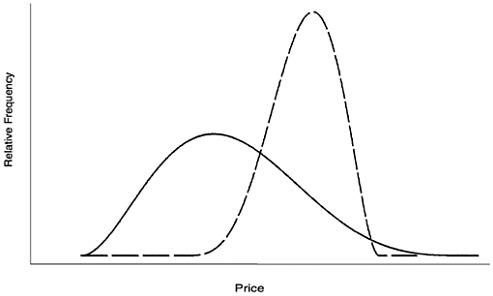
FIGURE 3.1 A possible distribution of market prices (solid line) and a hypothetical distribution of “realistic” prices that differs from the market distribution (dashed line).
little attention to retail and wholesale dealers, leaving responsibility for them to local authorities. A DEA agent who had experience in the New York and the Phoenix field offices reported that a sales operation that would generate great excitement in Phoenix might attract no interest in New York. Chicago has become a major cocaine transshipment point in recent years, and the Chicago field office is increasingly focused on seizing large shipments. It tends to take an interest in retail or wholesale dealers only if they are associated with especially violent street gangs that are unusually dangerous to the community. Moreover, because the Drug Enforcement Administration is primarily oriented toward disrupting and dismantling large distribution and sales organizations rather than individual retail dealers, it tends to focus on wholesale and higher level operations, leaving most retail-level enforcement to state and local authorities. Thus, most purchases of drugs by DEA agents and informants are of larger-than-retail quantities.
In summary, the STRIDE data are gathered according to criteria that serve the law enforcement objectives of DEA field offices. The data acquisition procedures are not designed to provide representative samples of price distributions in drug markets. Assessing the reliability of the STRIDE data is therefore an important issue for researchers in this field.
Appendix A explores some of the implications of the data acquisition process for the usefulness of the STRIDE data for policy analysis. The appendix describes two models of the relation among the price, quantity, and purity of cocaine base purchased in the Washington, D.C., area during 1990–1998. One model was developed by using STRIDE records of purchases by agents and informants of the Drug Enforcement Administration. The other model was developed by using STRIDE records of purchases by agents and informants of the Metropolitan Police of the District of Columbia. If the price data in STRIDE were representative of true market conditions in the Washington area, then estimates of price distribution obtained from the DEA and MPDC models would be identical up to the effects of random sampling errors. The results presented in the appendix, however, show that there are large, systematic differences between price distributions estimated from the two datasets. There are also large differences between estimates of price changes over time.
The finding that the DEA and the MPDC data lead to different price estimates and trends implies that the two datasets on prices of cocaine base cannot both be representative of actual market conditions in the Washington area. The data do not indicate the accuracy with which either dataset approximates true market conditions. It is possible that one of the datasets gives a good approximation and the other does not. It is also possible that neither dataset gives a good approximation. Similar comparisons cannot be made using data for other cities because records of purchases of illegal drugs by the local police of other cities are not available. Nonetheless, the results obtained with the Washington data and examination of the data acquisition criteria on which STRIDE is based persuade the committee that the STRIDE data has serious methodological shortcomings and is likely to contain major and at present unknown errors.
The data presumably capture shifts in the location of the distribution of prices that are large compared with the width of the distribution and to the effects of variations in data-acquisition criteria. The large reductions in cocaine and heroin prices that apparently occurred during the 1980s (Rhodes et al., 1994) may be examples of such location shifts. However, in the absence of independent evidence on the extent to which the STRIDE price data are accurate indices of the prices of illegal drugs at either the wholesale or retail level, the committee concludes that the STRIDE price data are of questionable reliability for use in estimating demand functions, in estimating the effects of policy interventions that may cause modest price changes, and in carrying out other economic and policy analyses that require accurate measures of price variations.
The inadequacy of the existing STRIDE price data is a major impediment to reliable assessments and research on illegal drugs. The committee
is unaware of any effort that is under way in the federal government or elsewhere to develop methods for collecting price data on illegal drugs.15The committee recommends that work be started to develop methods for improving existing data and acquiring more reliable drug price data.
The committee has not attempted to design a method for gathering price data. However, we do offer a suggestion as a starting point for further investigation of the best way to acquire price data that would be suitable for economic and other policy analyses.
-
It may be possible to carry out a survey in which randomly sampled individuals in one or more cities are asked the price of their last drug purchase (if any), the date of the purchase, the name of the drug, and the quantity purchased. As in ADAM, the quantity would be specified in informal terms such as bags, vials, lines, etc. Alternatively, randomly sampled individuals could be asked to keep diary records of their purchases over some period of time. The survey would be designed to reach high-risk groups, such as homeless people as well as those currently reached by surveys such as the NHSDA. Respondents would be assured of confidentiality and that their responses will not put them in legal jeopardy.
-
In addition, arrangements would be made for professional buyers to make purchases of drugs. The prices paid would be recorded and the purchased material sent to a laboratory for determination of the quantity (in grams) and purity of the purchased material. The professional buyers would be provided with immunity from arrest while making purchases. The information thus acquired would make it possible to estimate quantity and purity conditional on the informal description of quantity purchased (bag, vials, lines, etc.), the price paid, and the city in which the purchase was made.
The committee notes that providing professional buyers with immunity from arrest requires significant changes in existing policies of law
-
enforcement organizations. This may prevent implementation of Step 2 in the short run. However, records of drug purchases in STRIDE include informal descriptions of the quantities that were bought. Accordingly, a short-run alternative approach of limited usefulness that is easier to implement is to use STRIDE’S informal descriptions. The committee stresses that this is a short-run, temporary alternative and not a long-run substitute for developing a reliable technique for price measurement.
-
The information acquired in steps 1 and 2 could be combined to yield an estimate of the distribution of prices in individual transactions in the area and for the time period in which the data were gathered. The information could also be used to estimate the distribution of quantities purchased and purity.
Another approach, which might be taken in parallel with the approach just described, would be for the Drug Enforcement Administration to establish a small pilot study to develop procedures for well-designed and routinized collection of price data on illegal drugs. This approach would involve the DEA’s setting up a small statistical unit with the responsibility of designing experiments to collect more reliable price data and of working with field offices to implement the plan. This approach is an example of the usefulness, described in detail in Chapter 4, of upgrading the statistical expertise in agencies. The price collection effort could be undertaken collaboratively with other government statistical agencies who have experience in collecting price data and doing surveys on illegal drugs.
Price Indices
A price index is an indicator of the price of a unit of a commodity or of a group of commodities. For example, if the commodity of interest is retail quantities and purities of cocaine base, the index might be the price of one gram of 75 percent pure cocaine base. If retail quantities and purities of cocaine base and powder cocaine are both of interest, then the price index might be a weighted average of the prices of 1 gm of 75 percent pure cocaine base and 1 gm of 50 percent pure powder cocaine.
The construction of a price index is relatively simple if one observes a random sample of purchase prices of the commodity or commodities of interest (e.g., a random sample of purchases of 1 gm of 75 percent pure cocaine base). The index is then the average of the observed prices. However, a dataset on prices of illegal drugs is unlikely to contain multiple records of purchases of, say, 1 gm of 75 percent pure cocaine base. For example, for the period January 1984 to June 1998, the STRIDE data that were made available to the committee contain no records in which exactly
1 gm of 75 percent pure cocaine base was purchased. Therefore, the price index for an illegal drug must be inferred from prices of purchases of a range of quantities and purities. This is done by using statistical methods to estimate the relation between the mean (or median) price of the drug, the quantity and purity of the material purchased, and any other relevant variables (e.g., the calendar year or city in which the purchase was made). Abt Associates (1999), Crane et al. (1997), Caulkins (1994), Rhodes et al. (1994), and DiNardo (1993), among others, have constructed price indices for cocaine this way.
An important problem in the construction of a price index for an illegal drug is that the available data may record only a small number of purchases in a given city and time period. This is the case in STRIDE, for example (see Appendix A). Therefore, analysts have typically pooled data from different cities and different forms of cocaine to obtain samples that are large enough to permit precise inference. Such pooling presents no special difficulties if the dependence of the mean (or median) price on quantity and purity (called the price function) is the same in all cities and for all commodities (e.g., for powder cocaine and cocaine base).
There are, however, good reasons for expecting the price function to be different in different cities and for different forms of cocaine. Retail markets in different cities may be supplied by different distribution networks and may interact only weakly if at all. For example, a cocaine user in Washington, D.C., is unlikely to buy cocaine in Chicago or to know the price of cocaine there. Thus, the mechanisms that tend to equalize the prices of many legal products in different cities are weak in markets for illegal drugs. In addition to being influenced by different distribution networks, prices in different cities may be influenced by differences in the aggressiveness of law enforcement, income levels, and poverty rates, among other factors. Similar reasoning applies to the prices of different forms of cocaine. Converting one form to another requires skills that many cocaine users and dealers do not possess. The cost of conversion tends to separate the markets for the two forms of cocaine. Appendix A and Caulkins (1997) show that the STRIDE data produce different price functions for powder cocaine and cocaine base in the same city and that price functions that are estimated from the STRIDE data are different in different cities.
When different cities and commodities have different price functions, then a price index that is estimated from pooled data can exhibit fluctuations and trends that do not exist in any of the markets whose data were pooled. In other words, the price index can exhibit fluctuations and trends that are artifacts of the pooling procedure and do not reflect true market conditions. The occurrence of such artifacts is especially likely when, as happens in STRIDE, the relative numbers of observations from different
cities or for different forms of cocaine vary from year to year (Appendix A). However, variations in relative numbers of observations are not the only possible source of misleading price fluctuations and trends. Variations over time in the shapes of the distributions of prices are another. The STRIDE data exhibit variations over time in the distributions of prices.
Figures 3.2 and 3.3 present a simple example that illustrates this problem. In this example, the price of cocaine depends only on the quantity purchased; large quantities cost less per gram than small ones. Figure 3.2 shows hypothetical price functions in two cities. These functions give the average price of cocaine according to quantity purchased. Suppose that the price functions do not change over time. Then the price of 1 gm of cocaine is $80 in city 1 and $120 in city 2. The prices do not vary over time, so true market prices show no trends or fluctuations over time.
Suppose, now, that the available data consist of the following numbers of observations of price and quantity in each of 10 years:
|
Year |
Number of Observations from City 1 |
Number of Observations from City 2 |
|
1 |
20 |
40 |
|
2 |
25 |
35 |
|
3 |
30 |
30 |
|
4 |
35 |
30 |
|
5 |
20 |
25 |
|
6 |
45 |
30 |
|
7 |
50 |
25 |
|
8 |
55 |
35 |
|
9 |
50 |
30 |
|
10 |
55 |
40 |
The number of observations in city 1 tends to increase over time (possibly due to increasing aggressiveness of law enforcement), but year 5 is an exception to this trend. The number of observations in city 2 varies from year to year but shows no upward or downward trend. Assume that the purchased quantities of cocaine are in the range 0–2 gm in both cities. The purchase price of a given quantity varies randomly around the price function for the city in which the purchase is made. In this example, the range of variation is approximately ±$20.16
Suppose that a price index series is constructed by pooling the data from the two cities. In each year, the data from the two cities are combined and a price function is estimated from the combined data. The price index for that year is the price of 1 gm of cocaine according to the esti-
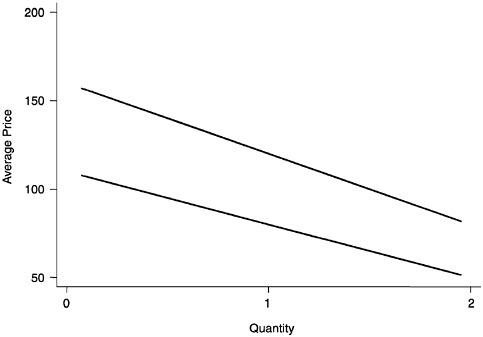
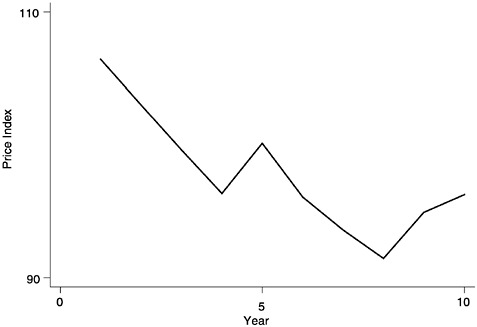
mated price function. Figure 3.3 shows the resulting price index series. The price index tends to decrease from years 1 to 8, but there is an upward fluctuation in year 5. The index increases from years 8 to 10. However, the trend and fluctuations shown in Figure 3.3 are artifacts of the pooling of the data from cities 1 and 2. The true average price of 1 gm of cocaine does not vary over time in either city. Thus, the price index obtained from the pooled data is highly misleading. Pooling has given rise to the appearance of price trends and fluctuations that do not exist in the markets in which the data were collected.
Misleading results such as those illustrated in Figure 3.3 can be avoided by estimating separate price functions for each time period (e.g., year), market (e.g., city in the example), and commodity of interest. The price function for a given time period, market, and commodity is used to estimate the price of one unit of the commodity in that time period and market. A combined price index is constructed as a weighted average of the prices obtained for all commodities and markets in the given time period. If there are several different amounts or purities of interest, then the estimated price of each can be included in the weighted average. The weight assigned to a particular market and commodity is proportional to the quantity of the commodity that is sold in that market. The weights can be based on quantities sold in a base year or they can be based on yearly sales volumes. In the former case, the price index varies over time only if market prices vary. In the latter case, the price index also reflects variations in the relative sales volumes of different commodities and in different markets. The relative merits of different weighting schemes are discussed in economics textbooks and depend to some extent on the intended use of the price index. The committee does not take a position on which weighting scheme is best for drug policy analysis.
To date, most of the research constructing or using prices on illegal drugs has not relied on the extensive research and practical experience on price indices that exists in the federal government and in the academic community. The committee notes that the principles underlying the construction of price indices are well established in the official national statistical community. For example, the Bureau of Labor Statistics uses standard and well-tested procedures to construct retail and wholesale price indices, taking into account regional differences, seasonal variation, and other factors.
The committee recommends that a major effort be devoted to “importing” standard procedures on constructing price indices into the development of price indices for illegal drugs. This effort should take place in collaboration with federal statistical agencies that specialize in this area, particularly the Bureau of Labor Statistics. Appropriate techniques would address a number of important issues. Aggregating across
different prices in different regions, which was discussed above, is one issue that must be confronted. Future price indices developed from the STRIDE data should take account of differences between the prices of cocaine base and powder cocaine and the dependence of price on quantity (such as on the number of packages purchased). The use of appropriate methods would minimize spurious price movements caused, for example, by variations over time in the numbers of observations in different cities and variations in the relative numbers of observations of transactions of cocaine base and powder cocaine.
Improving existing price data and developing new methods for collecting more accurate price data are among the highest priorities for improving data on illegal drugs. Until accurate price data are constructed, the nation will remain poorly informed about the trends in prices of illegal drugs, about short-run movements, about the efficacy of short-term interventions, and about the trends or levels of total expenditures on illegal drugs. Improving price data requires immediate and high-level attention from the agencies involved in producing accurate and timely information on illegal drugs.
DEVELOPMENT OF A SET OF NATIONAL DRUG ACCOUNTS
One of the major shortcomings of current information systems on illegal drugs is the lack of a systematic set of accounts that track the dollar flows in this sector. The current national income and product accounts focus on market transactions in the legal sector of the economy. Two major omissions are nonmarket activities (such as the value of work at home or the environment) and illegal market activities. The latter include not only production and expenditures on illegal drugs but prostitution, illegal gambling, money laundering, bribes, and smuggling.
The committee recommends that consideration be given to constructing a set of satellite accounts that track the flows in sectors comprising legal and illegal drugs. This set of accounts would be called the National Drug Accounts. These satellite accounts would not enter into the current core national income and product accounts.
Purpose
National drug accounts would serve several purposes. First, they would help track the drug economy. They would provide information on its importance to the total economy, its size relative to the sizes of relevant sectors of the legal economy (e.g., tobacco, pharmaceuticals), and whether it is growing or shrinking. Information on total consumption and produc-
tion could be used to develop improved estimates of the social costs of illegal drugs.
Second, national drug accounts would provide data for aggregate studies of the drug economy, or parts of it, such as the cocaine segment. For example, the study by RAND of the cost-effectiveness of alternative approaches to controlling cocaine was handicapped by the lack of reliable data on the major segments of the cocaine market (Rydell and Everinghom, 1994). A set of National Drug Accounts could provide the necessary data. Indeed, it seems unlikely that empirical economic analyses of the illegal drug industry can be carried out without moving toward a rudimentary set of national illegal accounts.
Third, a set of National Drug Accounts, together with existing data and accounts on other addictive substances, could help researchers better understand a number of major policy issues in the drug market. Some examples of issues that would be aided by improved data are the substitution and complementarity patterns with other goods and services, the impact of drugs on the overall economy, and the impact on international trade flows.
Finally, because such accounts would ideally include both financial flows as well as physical flows, they would help with tracking money laundering and the drug and drug-financed linkages between the United States and other countries.
Elements of National Drug Accounts
The structure of National Drug Accounts would be similar to that of existing accounts for the legitimate economy. The important components would be:
-
A set of expenditure accounts, in current and constant prices, for major illegal and legal drugs.
-
A set of production accounts for the production of each of the major sector.
-
A set of income accounts breaking down the incomes earned in this sector into the major components (wages, profits, cost of goods sold, etc.).
-
A set of import and export accounts that estimate the trade flows between the United States and other countries.
-
A set of flow-of-funds accounts that track the monetary component of the “circular flow” of sales and purchases.
-
A set of regional accounts focusing on production, expenditures, and income by state.
These accounts could be constructed independently as they would rely on different surveys or estimates. Although it would be ideal to have each of the six components, construction of even one or two would be helpful.
Feasibility
The federal government and statistical agencies in other countries currently prepare a wide variety of supplemental accounts of the kind proposed here. For example, the U.S. Bureau of Economic Analysis, which is responsible for constructing the National Income and Product Accounts, has prepared environmental and natural resource accounts, accounts for research and development, transportation satellite accounts, and prototype accounts for unpaid household work. While the committee has not investigated the practices in other countries, there have apparently been attempts to build a set of drug accounts for Colombia and some consideration of integrating accounts for drugs has been given in The Netherlands.
The accounts could be readily constructed for legal drugs. Moreover, there are rough estimates of many of the components for illegal drugs. However, it must be emphasized that constructing a full and accurate set of accounts would be difficult because of the problems with obtaining the data on many prices and quantities. There is likely to be strong synergy between the data needed to construct the National Drug Accounts and the data needs discussed elsewhere in this report (see particularly the discussion of the utility of better data on prices and on total consumption).
One of the advantages of using the methodology of the National Income and Product Accounts is that uncertainties are retained as statistical discrepancies rather than being swept under the rug.
REFERENCES
Abt Associates 1999 The Price of Illicit Drugs: 1981 through the Second Quarter of 1998. Report prepared for the Office of National Drug Control Policy.
Anglin, M.D., J.P.Caulkins, and Y.I.Hser 1993 Prevalence estimation: Policy needs, current status, and future potential. Journal of Drug Issues 345–361.
Anthony, J.C., and M.Van Etten 1999 Epidemiology and its rubrics. In Comprehensive Clinical Psychology, Bellack and Hersen, eds. Amsterdam: Pergamon.
Bachman, J.G., P.Freedman-Doan, and P.M.O’Malley 1999 Changing patterns of drug use among U.S. military recruits before and after enlistment. American Journal of Public Health 89:672–677.
Bray, R.M., L.A.Kroutil, S.C.Whelless, M.E.Marsden, S.L.Bailey, J.A.Fairbanks, and T.C. Hartford 1995 Department of Defense Survey of Health Related Behaviors Among Military Personnel. Research Triangle Park, NC: Research Triangle Institute.
Biemer, P., and M.Witt 1996 Estimation of measurement bias in self-reports of drug use with applications to the national household survey on drug abuse. Journal of Official Statistics 12(3):275– 300.
Caspar, R. 1992 Followup of nonrespondents in 1990. In C.F.Turner, J.T.Lessler, and J.C.Gfroerer, eds., Survey Measurement of Drug Use: Methodological Studies. DHHS Pub. No (ADM) 92–1929. Washington, DC: U.S. Department of Health and Human Services.
Caulkins, J.P. 1994 Developing Price Series for Cocaine. Santa Monica, CA: RAND.
1997 Is crack cheaper than (powder) cocaine? Addiction 92:1437–1443.
Caulkins, J.P., and R.Padman 1993 Quantity discounts and quality premia for illicit drugs. Journal of the American Statistical Association 88:748–757.
Caulkins, J., and P.Reuter 1996 The meaning and utility of drug prices. Addiction 91:1261–1264.
Chaloupka, F.J., M.Grossman, and J.A.Tauras 1998 The Demand for Cocaine and Marijuana by Youth. Working paper 6411. Cambridge, MA: National Bureau of Economic Research.
Chaiken, J.M., and M.Chaiken 1990 Drugs and predatory crime. Drugs and Crime, Michael Tonry and James Q.Wilson, eds. Vol. 13 of Crime and Justice: A Review of Research. Chicago: University of Chicago Press.
Charles, B. 2000 Successful Database Integration Models and Prospects for Cross-Application to Drug Prevention Database Integration. Unpublished paper presented at a meeting of the Committee on Data and Research for Policy on Illegal Drugs, Washington, DC.
Cook, R.F., A.D.Bernstein, and C.M.Andrews 1997 Assessing drug use in the workplace: A comparison of self-report, urinalysis, and hair analysis. In L.Harrison and Hughes, eds., The Validity of Self-Reported Drug Use: Improving the Accuracy of Survey Estimates. NIDA Research Monograph, Number 167. Washington, DC: U.S. Department of Health and Human Services.
Crane, B.D., A.R.Rivolo, and G.C.Comfort 1997 An Empirical Examination of Counterdrug Interdiction Program Effectiveness. IDA paper P-3219. Alexandria, VA: Institute for Defense Analyses.
Darke, S. 1998 Self report among injecting drug users: A review. Drug Alcohol Dependence 51:253– 263.
DiNardo, J. 1993 Law enforcement, the price of cocaine, and cocaine use. Mathematical and Computer Modeling 17:53–64.
Grossman, M., F.J.Chaloupka, and C.C.Brown 1996 The Demand for Cocaine by Young Adults: A Rational Addiction Approach. Working paper 5713. Cambridge, MA: National Bureau of Economic Research.
Fendrich, M., T.P.Johnson, S.Sudman, J.S.Wislar, and V.Spiehler 1999 Validity of drug use reporting in a high risk community sample: A comparison of cocaine and heroin survey reports with hair tests. American Journal of Epidemiology 149(10):955–962.
Fendrich, M., and C.M.Vaughn 1994 Diminished lifetime substance use over time: An inquiry into differential underreporting. Public Opinion Quarterly 58(1):96–123.
Gfroerer, J., J.Lessler, and T.Parsley 1997a Studies of nonresponse and measurement error in the national household survey on drug abuse. In L.Harrison and Hughes, eds., The Validity of Self-Reported Drug Use: Improving the Accuracy of Survey Estimates. NIDA Research Monograph 167: 273–295. Washington, DC: U.S. Department of Health and Human Services.
Gfroerer, J., D.Wright, and A.Kopstein 1997b Prevalence of youth substance use: The impact of methodological differences between two national surveys. Drug and Alcohol Dependence 47:19–30.
Harrison, L.D. 1992 Trends in illicit drug use in the United States: Conflicting results from national surveys. International Journal of the Addictions 27(7):917–947.
1997 The Validity of Self-Reported Drug Use in Survey Research: An Overview and critique of research methods. In L.Harrison and A.Hughes, eds., The Validity of Self-Reported Drug Use: Improving the Accuracy of Survey Estimates. NIDA Research Monograph 167:17–36. Washington, DC: U.S. Department of Health and Human Services.
Harrison, L., and A.Hughes, eds. 1997 The Validity of Self-Reported Drug Use: Improving the Accuracy of Survey Estimates. NIDA Research Monograph 167. Washington, DC: U.S. Department of Health and Human Services.
Horowitz, J., and C.F.Manski 1998 Censoring of outcomes and regressors due to survey nonresponse: Identification and estimation using weights and imputations. Journal of Econometrics 84:37–58.
Hser, Y.I. 1992 Prevalence estimation: Summary of common problems and practical solutions. Journal of Drug Issues 23(2):335–343.
Hser, Y.I., K.Boyle, and M.D.Anglin 1998 Drug use and correlates among sexually transmitted disease patients, emergency room patients, and arrestees. Journal of Drug Issues 28(2):437–454.
Johnston, L.D., P.M.O’Malley, and J.G.Bachman 1998 National Survey Results on Drug Use from the Monitoring the Future Study, 1975– 1997, Vol. I. Rockville, MD: National Institute on Drug Abuse.
1993 National Survey Results on Drug Use from the Monitoring the Future Study, 1975– 1992. Vols. I and II. Rockville, MD: National Institute on Drug Abuse.
Kilpatrick, K., M.Howlett, P.Dedwick, and A.H.Ghodse 2000 Drug use self-report and urinalysis. Drug and Alcohol Dependence 58(1–2):111–116.
Magura. S., D.Goldsmith, C.Casriel, P.J.Goldstein, and D.S.Linton 1987 The validity of methadone clients’ self-reported drug use. International Journal of Addiction 22(8):727–749.
Magura. S., Freeman, Q.Siddiqi, and D.S.Lipton 1992 The validity of hair analysis for detecting cocaine and heroin use among addicts. International Journal of Addictions 27:54–69.
Manski, C.F. 1995 Identification Problems in the Social Sciences. Cambridge, MA: Harvard University Press.
Manski, C.F., J.Newman, and J.V.Pepper 2000 Using Performance Standards to Evaluate Social Programs with Incomplete Outcome Data: General Issues and Application to a Higher Education Block Grant Program. Thomas Jefferson Center Discussion, paper 312.
Mehay, S.L., and R.L.Pacula 1999 The Effectiveness of Workplace Drug Prevention Policies: Does ‘Zero Tolerance’ Work? October. NBER Working Paper No. W7383
Mieczkowski, T.M. 1996 The prevalence of drug use in the United States. In M.Tonry, ed., Crime and Justice: A Review of Research 20:347–414.
1990 The accuracy of self-reported drug use: An evaluation and analysis of new data. In R.Weisheit, ed., Drugs, Crime and the Criminal Justice System.
Molotsky, I. 1999 Agency survey shows decline last year in drug use by young. New York Times, August 19.
Morbidity and Mortality Weekly Reports 1997 <http://epbiwww.cwru.edu/mmwr/vol46/website> (accessed February 27, 2001).
Morral, A.R., D.McCaffrey, and M.Y.Iguchi 2000 Hardcore drug users claim to be occasional users: Drug use frequency underreporting. Drug and Alcohol Dependence 57(3):193–202.
National Institute of Justice 1998 Annual Report on Drug Use Among Adult and Juvenile Arrestees. A Research Report. Washington, DC: U.S. Department of Justice.
1994 Drug Use Forecasting: Annual Report on Adult & Juvenile Arrestees. Washington, DC: U.S. Department of Justice.
1992 Drug Use Forecasting: Annual Report on Adult & Juvenile Arrestees. Washington, DC: U.S. Department of Justice.
National Research Council 1999 Transnational Organized Crime: Summary of a Workshop. Committee on Law and Justice. P.Reuter and C.Petrie, eds. Washington, DC: National Academy Press.
National Research Council and Institute of Medicine 1994 Integrating Federal Statistics on Children: Report of a Workshop. Committee on National Statistics and Board on Children, Youth, and Families. R.Hauser and M. Straf, eds. Washington, DC: National Academy Press.
Office of Applied Studies 1997 Substance Abuse in States and Metropolitan Areas: Model Based Estimates from the 1991–1993 National Household Surveys on Drug Abuse Summary Report. Washington, DC: U.S. Department of Health and Human Services.
Office of National Drug Control Policy 1997a Report of the Drug Control Research, Data, and Evaluation Committee. Washington, DC: U.S. Government Printing Office.
1997b What America’s Users Spend on Illegal Drugs, 1988–1995. Washington, DC: U.S. Government Printing Office.
Reuter, P. 1997 Drug use measures: What are they really telling us? National Institute of Justice Journal, April 1999.
1993 Prevalence estimation and policy formulation. Journal of Drug Issues 23(2):167– 184.
Rhodes, W., R.Hyatt, and P.Scheiman 1994 The price of cocaine, heroin and marijuana 1981–1993. Journal of Drug Issues 24:383– 402.
Rydell, C.P., and S.S.Everingham 1994 Controlling Cocaine: Report prepared for the Office of National Drug Control Policy and the U.S. Army. Santa Monica, CA: RAND.
Saffer, H., and Chaloupka, F. 1995 The Demand for Illicit Drugs. Working paper 5238. Cambridge, MA: National Bureau of Economic Research.
Sloboda, Z., and N.Kozel 1999 Frontline Surveillance: The Community Epidemiology Work Group on Drug Abuse. In Drug Abuse: Origins & Interventions, M.Glantz and C.Hartel, editors. Washington, DC: American Psychological Association Press.
Steel, E., and H.W.Haverkos 1992 Epidemiologic studies of HIV/AIDS and drug abuse. American Journal of Drug Alcohol Abuse 18(2):167–175.
Substance Abuse and Mental Health Services Administration 1999 Year-End 1998 Emergency Department Data from the Drug Abuse Warning Network. Washington, DC: U.S. Department of Health and Human Services.
1997 Substance Abuse in State and Metropolitan Areas: Model Based Estimates from the 1991– 1993 National Household Surveys on Drug Abuse Summary Report. Washington, U.S. DC: Department of Health and Human Services.
U.S. General Accounting Office 1993 Drug Use Measurement: Strengths, Limitations, and Recommendations for Improvement. GAO/PEMD-93–18. Washington, DC: U.S. General Accounting Office.
Wish, E.D., and B.A.Gropper 1990 Drug testing by the criminal justice system: Method, research, and applications. Pp. 321–339 in J.Q.Wilson and M.Tonry, editors, Drugs and Crime:. Chicago: University of Chicago Press.
Yuan, Y., and J.P.Caulkins 1998 The effects of variation in high-level domestic drug enforcement on variation in drug prices. Socio-Economic Planning Sciences 32:265–276.


