
Page 219
6
Biomechanics
This chapter provides a review of the biomechanics literature on the low back and upper extremities. Biomechanics is the study of forces acting on and generated within the body and of the effects of these forces on the tissues, fluids, or materials used for diagnosis, treatment, or research purposes. The discussion begins with an overview of basic concepts and methods. This is followed by the two literature reviews. The study selection criteria are presented at the beginning of each review. The two bodies of literatures differ in maturity; the research on the low back is more substantial. The number of studies reviewed is 196 for the low back and 109 for the upper extremities.
CONCEPTS OF LOAD TOLERANCE
The term “load” describes physical stresses acting on the body or on anatomical structures within the body. These stresses include kinetic (motion), kinematic (force), oscillatory (vibration), and thermal (temperature) energy sources. Loads can originate from the external environment (such as the force generated by a power hand tool) or they may result from voluntary or involuntary actions of the individual (for example, lifting objects). The term “tolerance” is used to describe the capacity of physical and physiological responses of the body to loading.
Acute Trauma Load-Tolerance Injury Model
Acute trauma injuries refer to those arising from a single identifiable event. Examples of acute injuries include fractures, lacerations, and contusions. Disorders resulting from acute trauma may occur when transient
Page 220
external loads, which are transmitted through biomechanical loading of the body, exceed internal tolerances of the affected tissues for mechanical strain, resulting in pain, discomfort, impairment, or disability. These factors may be affected by individual and organizational factors and by the social context in which the individual is operating.
Cumulative Trauma Load-Tolerance Model
Work-related musculoskeletal disorders arise from a complex interaction of events that may accumulate over time. In contrast to the acute trauma model, the cumulative trauma model assumes injury may result from the accumulated effect of transient external loads that may, in isolation, be insufficient to exceed internal tolerances of tissues. It is when this loading accumulates by repeated exposures, or exposures of sufficiently long duration, that the internal tolerances of tissues are eventually exceeded. The cumulative trauma model therefore explains why many musculoskeletal disorders are associated with work, because individuals often repeat actions (often many thousands of times) throughout the workday, or spend long periods of time (as much as eight hours or more daily) performing work activities in many occupations. Internal mechanical tolerance represents the ability of a structure to withstand loading. It is clearly multidimensional and is not considered a threshold but rather the capacity of tissues to prolong mechanical strain or fatigue. Internal tissue tolerances may themselves become lowered through repetitive or sustained loading.
A schematic diagram useful for elaborating the factors that can cause pain, discomfort, impairment, and disability is illustrated in Figure 1.2. External loads are produced in the physical work environment. These loads are transmitted through the biomechanics of the limbs and body to create internal loads on tissues and anatomical structures. Biomechanical factors include body position, exertions, forces, and motions. External loading also includes environmental factors whereby thermal or vibrational energy is transmitted to the body. Biomechanical loading is further affected by individual factors, such as anthropometry, strength, agility, dexterity, and other factors mediating the transmission of external loads to internal loads on anatomical structures of the body.
Measures of External Loads
External loads are physical quantities that can be directly measured using various methodologies. External kinetic measurements, for example, include physical properties of the exertions (forces actually applied or created) that individuals make. These measurements have the
Page 221
most direct correspondence to internal loads because they are physically and biomechanically related to specific anatomical structures of the body. When external measurements cannot be obtained, quantities that describe the physical characteristics of the work are often used as indirect measures. These include (a) the loads handled, (b) the forces that must be overcome in performing a task, (c) the geometric aspects of the workplace that govern posture, (d) the characteristics of the equipment used, and (e) the environmental stressors (e.g., vibration and cold) produced by the workplace conditions or the objects handled. Alternatively, less directly correlated aspects of the work, such as production and time standards, classifications of tasks performed, and incentive systems, are sometimes used as surrogate measures to quantify the relationship between work and physical stress.
The literature contains numerous methodologies for measuring physical stress in manual work. Studies from different disciplines and research groups have concentrated on diverse external factors, workplaces, and jobs. Factors most often cited include forceful exertions, repetitive motions, sustained postures, strong vibration, and cold temperatures. Although the literature reports a great diversity of such factors, it is possible to group these methodologies into a coherent body of scientific inquiry. A conceptual framework is presented below for organizing the physical parameters in manual work.
Physical Stresses
Physical stress can be described in terms of fundamental physical quantities of kinetic, kinematic, oscillatory, and thermal energy. These basic quantities constitute the external and internal loading aspects of work and energy produced by, or acting on, the human in the workplace.
Kinetic (Force) Measurements
Force is the mechanical effort for accomplishing an action. Voluntary motions and exertions are produced when internal forces are generated from active muscle contraction in combination with passive action of the connective tissues. Muscles transmit loads through tendons, ligaments, and bone to the external environment when the body generates forces through voluntary exertions and motions. Internal forces produce torques about the joints and tension, compression, torsion, or shear within the anatomical structures of the body.
External forces act against the human body and can be produced by an external object or in reaction to the voluntary exertion of force against an external object. Force is transmitted back to the body and its internal
Page 222
structures when opposing external forces are applied against the surface of the body. Localized pressure against the body can transmit forces through the skin to underlying structures, such as tendons and nerves. Pressure increases directly with contact force over a given area and decreases when the contact area is proportionally increased.
Contact stress is produced when forces compress the soft tissues between anatomical structures and external objects. This may occur when grasping tools or parts or making contact with the workstation. Contact stress may be quantified by considering contact pressure (force per unit area). An increase in contact force or a decrease in contact area will result in greater contact stress. Pounding with the hands or striking an object will give rise to stress over the portion of body contact. Reaction forces from these stress concentrations are transmitted through the skin to underlying anatomical structures.
Kinematics (Motion) Measurements
Motion describes the displacement of a specific articulation or the position of adjacent body parts. Motion of one body segment relative to another is most commonly quantified by angular displacement, velocity, or acceleration of the included joint. Motion is specific to each joint and therefore motions of the body are fully described when each individual body segment is considered together. Motions create internal stress by imposing loads on the involved muscles and tendons in order to maintain the position, transmitting loads to underlying nerves and blood vessels, or creating pressure between adjacent structures within or around a joint.
Oscillatory (Vibration) Measurements
Vibration occurs when an object undergoes oscillatory or impulsive motion. Human vibration occurs when the acceleration of external objects acts against the human body. Vibration is transmitted to the body through physical contact, either from the seat or the feet (whole-body vibration) or when grasping a vibrating object (hand-arm vibration). Whole-body vibration is associated with vibration when riding in a vehicle or standing on a moving platform. Hand-arm vibration, or segmental vibration, is introduced by using power hand tools or when grasping vehicular controls. Physiological reactions to human-transmitted vibration include responses of the endocrine, metabolic, vascular, nervous, and musculoskeletal systems.
External vibration is transmitted from the distal point of contact to proximal locations on the body, which sets into motion the musculoskeletal system, receptor organs, tissues, and other anatomical structures.
Page 223
Vibration transmission is dependent on vibration magnitude, frequency, and direction. Dynamic mechanical models of the human body describe the transmission characteristics of vibration to various body parts and organs. Such models consider the passive elemental properties of body segments, such as mass, compliance, and viscous damping. Vibration transmission is affected by these passive elements and is modified by the degree of coupling between the vibration source and the body. The force used for gripping a vibrating handle and the posture of the body will directly affect vibration transmission.
Thermal (Temperature) Measurements
Heat loss occurs at the extremities when working outdoors, working in indoor cold environments such as food processing facilities, handling cold materials, or exposing the hands to cold compressed air exhausts. Local peripheral cooling inhibits biomechanical, physiological, and neurological functions of the hand. Exposure to localized cooling has been associated with decrements in manual performance and dexterity, tactility and sensibility, and strength. These effects are attributable to various physiological mechanisms.
Physical Stress Exposure Properties
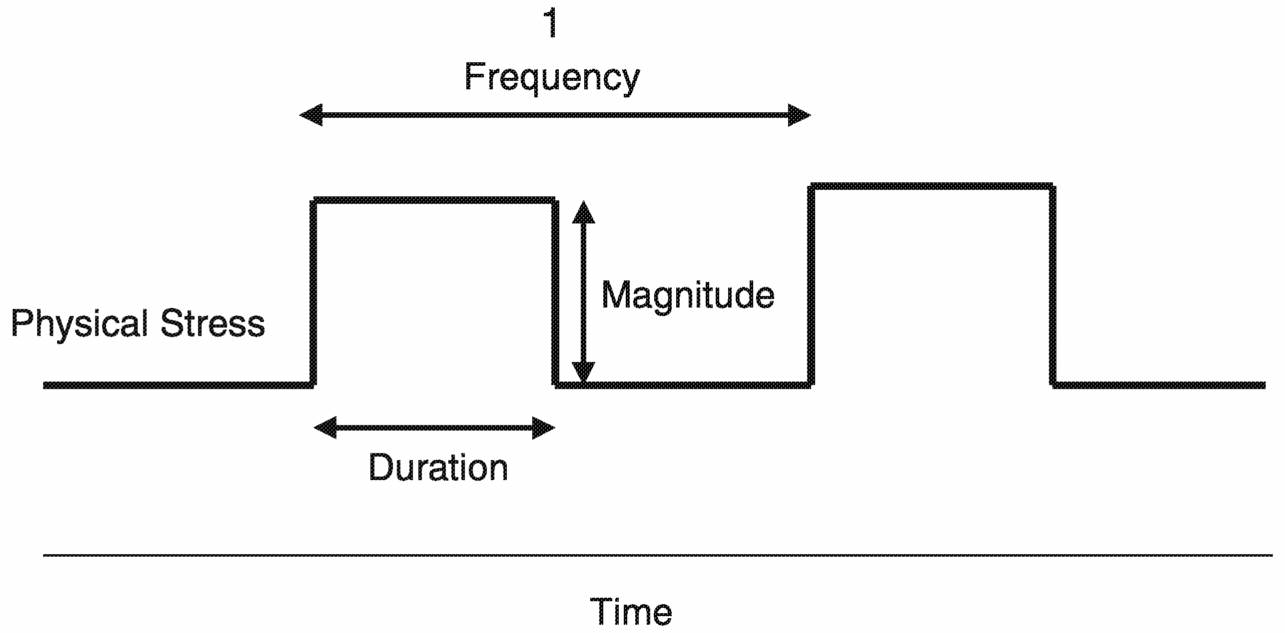
The physical stresses described above may be present at varying levels. These variations can be characterized by three properties: magnitude, repetition, and duration. The relationship between physical stresses and their exposure properties is illustrated in Figure 6.1. Magnitude is the
~ enlarge ~
FIGURE 6.1 Representation of magnitude, duration, and repetition for physical stress-time.
Page 224
extent to which a physical stress factor is involved. Magnitude quantifies the amplitude of the force, motion, vibration, or temperature time-varying record and has the physical units of the corresponding physical measure (e.g., Newtons of force, degrees of rotation, m/s2 of vibration acceleration, or degrees Celsius of temperature). Repetition is the frequency or rate at which a physical stress factor repeats. Duration corresponds to the time that one is exposed to a physical stress factor and is quantified in physical units of time.
Force is quantified by its magnitude, the repetition rate, and duration of force application at a given location of the human body. Measures of motion include the magnitude of joint angular displacement, velocity, or acceleration; the repetition rate of the motion; and the duration time that the motion is sustained. Vibration is quantified by the magnitude of the acceleration of a body, the repetition rate at which vibration occurs, and the duration time the vibration is sustained. Similarly, temperature level and associated repetition rate and duration quantify cold exposure.
Interactions
The characteristic exposure properties of physical stresses together quantify external loads acting against the body. Combinations of different physical stresses and exposure properties can be used to describe factors that are commonly reported for quantifying exposure. These relationships are summarized in Table 6.1. Physical stresses are correspondingly quantified as described in Table 6.2. This organization is useful because it provides a construct for comparing and combining studies using different measurements and methodologies, as represented in Table 6.1, into a
|
Property |
|||
|
Physical Stress |
Magnitude |
Repetition Rate |
Duration |
|
Force |
Forceful exertions |
Repetitive exertions |
Sustained exertions |
|
Motion |
Extreme postures and motions |
Repetitive motions |
Sustained postures |
|
Vibration |
High vibration level |
Repeated vibration exposure |
Long vibration exposure |
|
Cold |
Cold temperatures |
Repeated cold exposure |
Long cold exposure |
Page 225
|
Property |
|||
|
Physical Stress |
Magnitude |
Repetition Rate |
Duration |
|
Force |
Force generated or applied |
Frequency with which force is applied |
Time that force is applied |
|
Motion |
Joint angle, velocity, acceleration |
Frequency of motion |
Time to complete motion |
|
Vibration |
Acceleration |
Frequency with which vibration occurs |
Time of vibration exposure |
|
Cold |
Temperature |
Frequency of cold exposure |
Time of cold exposure |
common framework. For example, physical stress measurements using a survey methodology that simply assesses the presence or absence of highly repetitive wrist motions can therefore be compared with a study that measures the frequency of motions using an electrogoniometer. This is possible because both studies have quantified the repetition property of wrist motion. Similarly, a study that considers the weight of objects lifted can be compared with a study that assesses muscle force using electromyography because both studies quantify the magnitude of force. A body of scientific knowledge from diverse investigations thus emerges.
The external physical stress factors described above relate to distinct internal physical stress factors. This relationship is summarized in Table 6.3. For example, force magnitude is directly related to the loading of tissues, joints, and adjacent anatomical structures, as are the metabolic and fatigue processes of contracting muscles. The strength of these relationships depends on the particular measurement and the type of stress. Biomechanical and physiological mathematical models have been developed to quantitatively describe some of these relationships. Moore, Wells, and Ranney (1991) and Armstrong et al. (1993) have recognized similar relationships between external and internal factors.
Internal Loads
The musculoskeletal system is the load bearing structure within vertebrate animals. Bony structures bear gravitational forces and internal forces of skeletal muscle contraction in maintaining the body posture. As such, bones are the primary load-bearing tissue within the body. Forces applied to the body, including gravity, compress or bend the bones. Liga-
Page 226
|
Property |
|||
|
Physical Stress |
Magnitude |
Repetition |
Duration |
|
Force |
|
|
|
|
Motion |
|
|
|
|
Vibration |
|
|
|
|
Cold |
|
|
|
Note: * Indicates internal stress.
Page 227
ments hold together the bony structure by crossing articulations where bones interconnect. Retinacula share similar structural and biomechanical properties to ligaments that act as pulley systems by guiding tendons around articulations. Tendons are the connective tissues that attach muscle to bone and therefore transmit muscle forces to the skeletal system to produce voluntary movements and exertions. A consequence of force exerted by the body or acting against the body, motions produced by the body, oscillatory energy transmitted to the body, or thermal energy released from the body, is that adjacent tissues are subjected to mechanical and thermal loads. These include ligaments and connective tissue, tendon, muscle, intervertebral discs, and nerves. A detailed examination of how each of these tissues is subjected to internal loading follows.
Ligaments and Connective Tissue
By their nature, as the connective tissues linking bones within the skeletal system, ligaments are primarily exposed to tensile loads. A typical stress-strain curve for ligamentous tissue reveals that the tissue initially offers little resistance to elongation as it is stretched; however, once the resistance to elongation begins to increase, it does so very rapidly. Thus, the ligaments, while loosely linking the skeletal system, begin to resist motion as a joint's full range of motion is approached. By severing ligaments in cadaveric lumbar motion segments, Adams et al. (1980) showed that the supraspinous-interspinous ligaments segments are the first ligamentous tissues to become stressed with forward bending of the lumbar spine. Stability and movement of the spine or any other articulation within the low tensile region of the ligamentous stress-strain curve must be accomplished using muscular contraction. This is not to say that ligaments do not contribute to joint loading. Several authors have shown that with extreme flexion (forward bending) of the torso, there is an electrical silence in the spinal musculature (Floyd and Silver, 1955; Golding, 1952; Kippers and Parker, 1984; Toussaint et al., 1995). This finding suggests that at times ligaments are used to resist the bending moments acting on the spine. The degree of ligamentous contribution to the forces placed on the intervertebral disc during manual material handling tasks has been debated in the scientific literature (Cholewicki and McGill, 1992; Dolan, Earley, and Adams, 1994; Potvin, Norman, and McGill, 1991). Nevertheless, there is consensus that ligaments are subjected to tensile stress with extreme movements and hence can contribute to the mechanical loads placed on the body's articulations, including the intervertebral disc.
When ligaments act as a turning point for tendons (pulleys), they are exposed to shear forces and contact stresses. For example, the transverse
Page 228
carpal ligament, in bridging the carpal bones in the wrist, forms a pulley by which the path of the finger flexor tendons is altered when the wrist is flexed. Similarly, the palmar ligaments maintain the path of the tendons from the finger flexor muscles to the distal phalanges. Goldstein et al. (1987) showed that the tendon strain on the proximal side of the transverse carpal ligament was greater than the strain on the distal side of the ligament. This finding indicates that the friction between the tendon and the ligament results in the ligament being exposed to shear loads in addition to normal loads. Goldstein et al. (1987) also demonstrated that the magnitude of shear was dependent on an interaction between tensile load and posture.
Tendons
Tendons are a collagenous tissue that forms the link between muscle and bone. The orientation of the collagen fibers in tendons is in the form of parallel bundles. This arrangement of fibers minimizes the stretch or creep in these tissues when subjected to tensile loading (Abrahams, 1967). With repeated loading of synovial tissues, surrounding tendons can become inflamed, particularly where the tendons wrap around bony or ligamentous structures. In more severe cases, the collagen fibers of the supraspinatus tendon can become separated and eventually degraded, wherein debris containing calcium salts creates further swelling and pain (Schechtman and Bader, 1997).
Muscles
Skeletal muscles provide locomotion and maintenance of posture through the transfer of tension by their attachment to the skeletal system via tendons. Tension is developed through active contraction and passive stretch of contractile units, or muscle fibers.
The musculoskeletal system uses simple mechanics, such as levers, to produce large angular changes in adjoining body segments. Consequently, the amount of muscular force required to produce a desired exertion or movement depends on the external force characteristics (resistance or load dynamics handled) and the relative distance from the fulcrum to the point of external force application and from the fulcrum to the point of muscular insertion. While the effective distance between the fulcrum and the point of insertion for a specific muscle varies depending on the angle of the joint, the leverage of the muscles is almost always very small relative to the load application point, hence the internal muscle forces are usually several times larger than the external forces. As a result, most of the loads experienced by the joints within the body during exer-
Page 229
tions result from the internal muscle forces as they work in opposition to the external forces.
Intervertebral Disc
The intervertebral disc serves as a joint since it permits rotation and translation of one vertebra relative to another. It also maintains the space between vertebrae so that spinal nerves remain unimpinged and protects the upper body and head from the large peak forces experienced in the lower extremities. Anatomically, the disc is comprised of two parts: the nucleus pulposus and the annulus fibrosus. The nucleus pulposus is in the central region of the disc and is comprised of a gelatinous mixture of water, collagen, and proteoglycans. The annulus fibrosus is comprised of alternating bands of angled fibers oriented approximately 60 degrees relative to the vertical (White and Panjabi, 1990). In essence, the disc behaves as a pressure vessel and transmits force radially and uniformly. Thus, the disc is capable of withstanding the large compressive forces that result from muscular recruitment. Hutton and Adams (1982) found that cadaver discs from males between the ages of 22 and 46 could, on average, withstand single loads of over 10,000 N before failure occurred. In most cases, the failure was in the thin bony membrane that forms the boundary between the disc and the vertebral body (vertebral endplate) rather than through nuclear prolapse. Since the disc is an avascular structure, the health of the endplate is critical for nutrient exchange, and even small failures may hasten the degenerative process.
Researchers have found that prolapsed discs occurred more frequently when the vertebral segments were wedged to simulate extreme forward bending of the spine (Adams and Hutton, 1982). In this position, the anterior portion of the annulus fibrosis undergoes compression while the posterior portion is under tensile stress. Over 40 percent of the cadaver discs tested by Adams and Hutton (1982) prolapsed when tested in this hyperflex posture, and with an average of only 5,400 N of compression force applied. This finding shows that the disc is particularly susceptible to bending stresses. In a later study in which Adams and Hutton (1985) simulated repetitive loading of the disc, previously healthy discs failed at 3,800 N, again mostly through trabecular fractures of the vertebral bodies. Taken together, these studies show that the disc, especially the vertebral endplate, is susceptible to damage when loading is repetitive or when exposed to large compressive forces while in a severely flexed posture.
Since in vitro studies of lumbar motion segment failure may not fully represent the state of affairs in vivo, additional factors have been considered. It should be clear from earlier discussions of muscle that the internal
Page 230
forces created by the muscles could be quite large in response to even modest external loads. When the muscles that support, move, and stabilize the spine are recruited, forces of significant magnitude are placed on the spine. Several investigators have quantified spine loads during lifting and other material handling activities. The earliest attempts to quantify the spinal loads used static sagittal plane analyses (Morris, Lucas, and Bresler, 1961; Chaffin, 1969). Validation for these modeling efforts came from disc pressure and electromyographic studies (Nachemson and Morris, 1964). More advanced models have been developed to quantify the three-dimensional internal loads placed on the spine. Schultz et al. (1982a) developed and validated an optimization model to determine the three-dimensional internal spine loads that result from asymmetric lifting activities.
Others have quantified spine loads indirectly by examining the reaction forces and moments obtained with linked segment models. McGill and colleagues (McGill, Norman, and Cholewicki, 1996) have shown that there is a very strong predictive relationship (r 2 = .94) between the external spine moments and the spine reaction forces generated by their electromyographic-assisted model. This indicates that the changes observed in the more readily quantifiable spine reaction moments, due to changes in the modeled task parameters, are representative of the changes in actual spine loading. Increased lifting speed, lower initial lifting heights, and longer reach distances all significantly increase the spine reaction moments and hence have a significant impact on the compressive and shear forces acting on the disc (de Looze et al., 1993, 1994); Frievalds et al., 1984; Leskinen et al., 1983; McGill and Norman, 1985; Schipplein et al., 1995; Buseck et al., 1988; Dolan, Earley, and Adams, 1994; Tsuang et al., 1992). More recently, three-dimensional dynamic linked segment models have been developed to evaluate the spine loading during asymmetric tasks (Gagnon, Plamondon, and Gravel, 1993; Gagnon and Gagnon, 1992; Kromodihardjo and Mital, 1987; Lavender et al., 1999). These later models have been useful for documenting the spine loads (indirectly) that stem from lifting activities that involve twisting and lateral bending.
Nerves
Nerves, while not contributing either actively or passively to the internal forces generated by the body, are exposed to forces, vibration, and temperature variations that affect their function. Carpal tunnel syndrome is believed to result from a combination of ischemia and mechanical compression of the median nerve within the carpal canal of the wrist. Evidence of compression of the median nerve by adjacent tendons has been reported by direct pressure measurements (Tanzer, 1959; Smith,
Page 231
Sonstegard, and Anderson, 1977). Electrophysiological and tactile deficits consistent with carpal tunnel syndrome have been observed under experimentally induced compression of the median nerve (Gelberman et al., 1981, 1983). A biomechanical model of the wrist developed by Armstrong and Chaffin (1979) predicts that median nerve compression will increase with increased wrist flexion and extension or finger flexor exertions. Increased intracarpal canal pressure was observed by Armstrong et al. (1991) for wrist and finger extension and flexion and for increased grip exertions. Rempel (1995) reports similar findings for repetitive hand activity and during typing.
Environmental stimuli, for example cold temperatures and vibration, have been shown to affect the response of peripheral nerves. Low temperatures, for example, can affect cutaneous sensory sensitivity and manual dexterity. Vibratory stimuli, with repeated exposure, are believed to cause, via a reflex response, (nerve) contraction of the smooth muscles of the blood vessels associated with Raynaud's syndrome. Less severe nerve damage resulting from vibratory stimuli has been associated with paresthesias and tingling sensations. Hand-arm vibration syndrome includes vascular disorders with the following symptoms: blanching of the digits after the use of vibrating hand tools (Gemne, 1997), and neurological disorders with complaints of persistent paraesthesia, or numbness extending into the hands and upper limbs (Letz et al., 1992). Often these symptoms are suggestive of neurological complaints, such as carpal tunnel syndrome or ulnar nerve entrapment (Palmer, Crane, and Inskip, 1998).
Measurements of Internal Loading
Physical stress imparted to internal tissues, organs, and anatomical structures in manual work is rarely measured directly. Due to the obvious complexities and risks associated with invasive internal physical stress measurements, investigations often employ indirect internal measures or external measurements that are physically related to internal loading of the body. Internal physical stress measures include electrophysiological measurements, such as electromyograms, or external measures of internal compartmental pressures.
Physiological Responses
Muscle Cocontraction
The synergistic activation of the muscles controlling an articulation is often referred to as cocontraction. In many cases, the cocontraction is
Page 232
between muscles working fully or partially in opposition to one another. From a biomechanical perspective, cocontraction is a way in which joints can be stiffened, stabilized, and moved in a well-controlled manner. Cocontraction, however, also has the potential to substantially increase the mechanical loads (compression, shear, or torsion) or change the nature of the loads placed on the body's articulations during an exertion or motion. This is because any cocontraction of fully or partially antagonistic muscles requires increased activation of the agonistic muscles responsible for generating or resisting the desired external load. Thus, the co-contraction increases the joint loading first by the antagonistic force, and second by the additional agonist force required to overcome this antagonistic force. Therefore, work activities in which cocontraction is more common impose greater loads on the tissues of the musculoskeletal system.
Localized Muscle Fatigue
As muscles fatigue, the loadings experienced by the musculoskeletal system change. In some cases, the changes result in alternative muscle recruitment strategies or substitution patterns wherein other secondary muscles, albeit less suited for performing the required exertion, are recruited as replacements for the fatigued tissues. This substitution hypothesis has received experimental support from Parnianpour et al. (1988), who showed considerable out-of-plane motion in a fatiguing trunk flexion-extension exercise. It is believed that the secondary muscles are at greater risk of over exertion injury, in part due to their smaller size or less biomechanically advantageous orientation, and in part due to their poorly coordinated actions. Alternatively, larger adaptations may occur that result in visible changes in behavior. For example, changes in lifting behavior have been shown to occur when either quadriceps or erector spinae muscles have been selectively fatigued (Novak et al., 1993; Trafimow et al., 1993; Marras and Granata, 1997a, 1997b). Fatigue may also result in ballistic motions or exertions in which loads are poorly controlled and rapidly accelerated, which in turn indicates that there are large impulse forces within the muscles and connective tissues.
Localized muscle fatigue can also occur in very low-level contractions, for example those used when supporting the arms in an elevated posture. In this case, the fatigue is further localized to the small, low-force endurance fibers (slow twitch) within the muscle. Because the recruitment sequence of muscle fibers during exertions works from smaller to larger fibers, the same small slow-twitch fibers are repeatedly used and fatigued even during low-level contractions (Sjøgaard, 1996). Murthy et
Page 233
al. (1997), using near-infrared spectroscopy to quantify tissue oxygenation as an index of blood flow, found reduced oxygenation within 10 to 40 seconds of initiating sustained contractions at values as low as 10 percent of the muscle's maximum capacity, thereby indicating an interference with the metabolic processes.
Tonic Vibration Reflex
Vibration can introduce disturbances in muscular control by way of a reflex mediated through the response of muscle spindles to the vibration stimulus (Eklund, Hagbarth, and Torebjork, 1978). This reflex is called the tonic vibration reflex, which results in a corresponding change in muscle tension when vibration is transmitted from a vibrating handle to flexor muscles in the forearm (Radwin, Armstrong, and Chaffin, 1987). Grip force increases observed for sinusoidal vibration at 40 Hz was comparable to grip force when handling a load twice as great. This effect was not observed for 160 Hz vibration.
Vibration direction and the frequency of the vibration stimuli have a strong and significant influence on impedance of the hand (Burstrom, 1997); an increased vibration level resulted in significantly less impedance for frequencies over 100 Hz, while hand and arm flexion and abduction made a significant contribution for frequencies below 30 Hz. The vibration response characteristics of the hand and arm differed, depending on whether the signal was a discrete frequency signal or a signal consisting of several frequencies.
EMG spectral analysis indicates that motor unit harmonic synchronization decreases and subharmonic synchronization increases as vibration frequency increases (Martin and Park, 1997). It has been suggested that the synchronization process influences muscle fatigue, since it forces the driving of motor units, leading to a decrease in contraction efficiency. This phenomenon probably results from an impairment of excitation-contraction coupling. High-frequency vibration (> 150 Hz) tends to induce less motor unit synchronization in a frequency range beyond the known mechanical resonance of biological tissues.
Measures of Internal Tolerances
Physiological Measures
Internal tissue tolerances are often related to external or indirect measures of exposure. These commonly include electrophysiological measures, such as amplitude changes in integrated electromyograms and frequency shifts in electromyogram spectra, and nonspecific physiologi-
Page 234
cal measures, such as heart rate, oxygen consumption, substrate consumption, and metabolite production.
Psychophysical Measures
The psychophysical method is an approach used to estimate internal tolerances through the human ability to estimate magnitudes and subjectively express exposure limits to physical stress. The cross-modality matching method asks human subjects to estimate a stimulus magnitude based on a visual-analog scale. A 10-point linear or logarithmic scale is often employed, anchored by verbal conditions at each end of the scale. The general Borg scale (Borg, 1982) is a commonly used visual-analog scale for quantifying perceived exertion levels anchored by the terms “nothing at all” at 0 and “extremely strong” at 10. Intermediate verbal anchors such as “very weak” at 1 and “moderate” at 3, “strong” at 5, and “very strong” at 7 are sometimes included.
Another psychophysical approach is the method of adjustment. This paradigm asks the subject to continually adjust the stimulus to the maximum level that is perceived safe. The method has been pioneered by Snook and used extensively for establishing psychophysical limits for manual lifting and for upper limb exertions and motions. The experimental paradigm for manual lifting requests subjects to perform repetitive lifts at a given rate in a posture and lifting motion dictated by such physical settings as the horizontal distance from the body for the origin and destination of the lift and the distance the object is lifted. The subject repeatedly adjusts the load lifted by adding or subtracting weights to establish the limit.
The Whole-Person Concept
The load tolerance model described in Figure 1.2 illustrates that biomechanical loading does not occur independently of interactions between internal tolerances and adverse outcomes. Biomechanical loading specifically may be altered when internal tolerances are exceeded. This can occur, for example, through substitution muscle recruitment patterns for fatigued muscles, resulting in loads imposed on additional muscles, or by increased compartment pressures, nerve entrapments, or loads acting on anatomical structures caused by swelling and inflammation. Furthermore, adverse outcomes of pain and discomfort may result in individual adaptations or behaviors that alter postures or substitute other aspects of the body for performing a work task. Biomechanical loading is also affected by individual characteristics, such as anthropometry, strength, agility, dexterity, and other factors mediating the transmission of external loads
Page 235
to internal loads on anatomical structures of the body. These interactions are complex and necessitate considering the person as a whole organism.
LOW BACK BIOMECHANICS
The objective of this section is to examine the evidence that there is a biomechanical pathway between physical occupational demands and the risk of suffering a low back disorder. Our assessment is made in relation to the conceptual model adopted in this report and specifically relative to the biomechanical pathways highlighted in Figure 1.2. This figure portrays a biomechanical pathway in terms of a relationship between loads imposed on a structure and the mechanical tolerance of the structure. This model also recognizes that both the loading characteristics and the tolerance levels can be influenced by physiological responses. In terms of the loading, the musculoskeletal system may be influenced by either adaptation to or intensification of the load. The tolerance may be mediated by pain responses or discomfort. Overall, if the loading of the structure exceeds the tolerance, then this situation can result in a disorder. Figure 1.2 accounts for the possibility that various influences may trigger this injury pathway and response.
External loads, such as those associated with work, are expected to influence the biomechanical loading of the spine. This model also allows for the possibility that other factors may influence this load-tolerance-disorder pathway at different points in the pathway. It is important to realize that individual factors as well as organizational factors and social context can influence biomechanical loading and structure tolerance, as well as the risk of suffering a disorder; these issues are covered in other sections of this report. The objective of this section is to explore the evidence, in this context, that external loads can trigger the pathway to low back disorders.
We examine exclusively the evidence that physical loading of the spine and supporting structures may result in low back pain. This contention is assessed via several approaches, including workplace observations of biomechanical factors relative to rates of low back pain reporting, biomechanical logic, pain pathways, and intervention research.
Chapter 2 reviewed trends associated with types of work (job titles) and the reporting of low back disorders. These investigations identified warehousing, patient handling, and general materials handling jobs as associated with back pain at a higher rate than other types of occupations. Laboratory biomechanical analyses have shown that these types of activities can lead to greater loadings on the spine (Leskinen et al., 1983; Schultz et al., 1987; Zetterberg, Andersson, and Schultz, 1987; Cholewicki, McGill, and Norman, 1991; McGill, 1997; Marras and Davis, 1998; Chaffin, Ander-
Page 236
son, and Martin, 1999; Granata and Marras, 1999; Marras et al., 1999a, 1999b; and Marras, Granata, et al., 1999), and thus jobs associated with these higher spine loading tasks are consistent with greater reporting of back injuries. This is consistent with the logic described in Figure 1.2.
Biomechanical Risk Factors Measured in the Workplace
The panel reviewed the industrial observation literature for information relating biomechanical loading of the body and reports of low back disorder. For our assessment, the literature was screened with respect to biomechanical relevance. Whereas most epidemiologic studies are primarily concerned with methodological considerations, biomechanical assessments are primarily concerned that the information (exposure metric) assessed has biomechanical meaning. Hence, while many assessments of occupationally related low back disorder risk have occurred in the literature, many of these assessments have not used exposure metrics that would be considered relevant to a biomechanical assessment. Such a situation would mask or obscure any relationship with risk.
For example, numerous studies have found that lifting heavy loads is associated with an increased risk of low back pain (Kelsey et al., 1984; Videman, Nurminen, and Troup, 1984; Bigos et al., 1986; Spengler et al., 1986; Battie et al., 1989; Riihimaki et al., 1989b; Burdorf, Govaert, and Elders, 1991; Bigos et al., 1992; Andersson, 1997; Bernard, 1997b). However, such gross categorical exposure metrics have little meaning in a biomechanical assessment. As discussed in a previous section, from a biomechanical perspective, a given external (to the body) load can impose either large or small loads on the spine (internal forces), depending on the load's mechanical advantage relative to the spine (Chaffin, Andersson, and Martin, 1999). Therefore, in order to understand biomechanical loading, specific quantifiable exposure metrics that are meaningful in a biomechanical context are necessary for the purposes of this review. Only then can one address the issue of how much exposure to a biomechanical variable is too much exposure.
The literature was screened to identify biomechanically relevant, high-quality industrial surveillance studies. High-quality biomechanically related industrial surveillance studies consisted of studies that met the following criteria:
-
The assessment addressed an aspect of the basic load-tolerance construct that is the heart of a biomechanical assessment. In other words, specific biomechanical parameters (e.g., load location in space) were of interest as opposed to gross categorical parameters (e.g., load weight alone).
Page 237
-
The exposure metric can provide quantifiable information about loads imposed on the back during work.
-
The measurement of risk was not based solely on self-reports, which have been shown to be unreliable (Andrews, Norman, and Wells, 1996).
-
Outcome measures are quantifiable on a continuous measurement scale (e.g., studies that relied on self-reports of exposure or simply noted whether the lifted weight was over a given threshold were excluded).
-
The experimental design consisted of either a prospective study, case-control study, or a randomized controlled trial.
Study Results
Several industrially based observational studies meeting these criteria have appeared in the literature and offer evidence that low back disorder is related to exposure to physical work parameters on the job. Chaffin and Park (1973) performed one of the first studies exploring this relationship. This study found that “the incidence rate of low back pain (was) correlated (monotonically) with higher lifting strength requirements as determined by assessment of both the location and magnitude of the load lifted” (Chaffin and Park, 1973:513). They concluded that load lifting could be considered potentially hazardous. It is important to note that this study suggested that not only was load magnitude significant in defining risk but also load location was important. This view is consistent with biomechanical logic, discussed later. This evaluation also reported an interesting relationship between frequency of exposure and lifts of different magnitude (relative to worker strength). This study suggested that exposure to moderate lifting frequencies appeared to be protective, whereas high or low rates of lifting were common in jobs with greater reports of back injury.
A prospective study performed by Liles et al. (1984) observed job demands compared with worker's psychophysically defined strength capacity. The job demand definition considered load location relative to the worker, as well as frequency of lift and exposure time. Demands were considered for all tasks associated with a material handling job. This study identified the existence of a job demand relative to a worker strength threshold above which the risk of low back injury increased. This study found that there was a “job severity threshold above which incidence and severity dramatically increased” (Liles et al., 1984:690).
Herrin and associates (1986) observed jobs over three years in five large industrial plants, where they evaluated 2,934 material handling tasks. They evaluated jobs using both a lifting strength ratio as well as estimates of back compression forces. A positive correlation between the
Page 238
lifting strength ratio and low back injury incidence rates was identified. They also found that musculoskeletal injuries were twice as likely for predicted spine compression forces that exceeded 6,800 N. The analyses also suggest that prediction of risk was best associated with the most stressful tasks (as opposed to indices that represent risk aggregation).
Punnett and colleagues (1991) performed a case-control (case-referent) study of automobile assembly workers, in which risk of back pain associated with nonneutral working postures was evaluated. In this study, back pain cases over a 10-month period were studied, referents were randomly selected after review of medical records, interview, and examination, and job analyses were performed by analysts who were blinded to the case-referent status. Risk of low back pain was observed to increase as trunk flexion increased. Risk was also associated with trunk twisting or lateral bending. Finally, this study indicated that risk increased with exposure to multiple postures and increasing exposure time. Specifically, the study indicated that risk increased as the portion of the duty cycle spent in the most severe postures increased.
Marras and colleagues (1993, 1995) biomechanically evaluated over 400 industrial jobs by observing 114 workplace and worker-related variables. Exposure to load moment (load magnitude × distance of load from spine) was found to be the single most powerful predictor of low back disorder reporting. This study has been the only study to examine trunk kinematics along with traditional biomechanical variables in the workplace. This study identified 16 trunk kinematic variables resulting in statistically significant odds ratios associated with risk of low back disorder reporting in the workplace. While none of the single variables was as strong a predictor as load moment, when load moment was combined with three kinematic variables (relating to the three dimensions of trunk motion) along with an exposure frequency measure, a strong multiple logistic regression model resulted that described reporting of back disorder well (O.R. = 10.7). This analysis indicated that risk was multivariate in nature, in that exposure to the combination of the five variables described reporting well. The model recognizes a trade-off between the variables. For example, a work situation that exposes a worker to low magnitude of load moment can still represent a high-risk situation if the other four variables in the model were of sufficient magnitude. This model has been recently validated in a prospective workplace intervention study (Marras et al., 2000a). When the results of this study are considered in conjunction with the Punnett study (1991), it is clear that work associated with activity performed in nonneutral postures increases the risk to the back. Furthermore, as the posture becomes more extreme or the trunk motion becomes more rapid, reporting of back disorder is greater. These results are mean-
Page 239
ingful from a biomechanical standpoint and suggest that risk of low back disorder is associated primarily with mechanical loading of the spine, as well as that when tasks involve greater three-dimensional loading, the association with risk becomes much stronger. Three-dimensional loading of the spine would be expected to affect the disc, ligaments, muscles, and other structures proximal to the spine.
Norman and associates (1998) recently assessed cumulative biomechanical loading of the spine in automotive assembly workers. This observational study identified four independent factors for low back disorder reporting: integrated load moment (over a work shift), hand forces, peak shear force on the spine, and peak trunk velocity. This study showed that workers in the top 25 percent of loading exposure on all risk factors reported low back pain at a rate about six times greater than those in the bottom 25 percent of loading.
Fathallah and associates (Fathallah, Marras, and Parnianpour, 1998b) evaluated a database of 126 workers and jobs to precisely quantify and assess the complex trunk motions of groups with varying degrees of low back disorder reporting. They found that groups with greater reporting rates exhibited complex trunk motion patterns involving high magnitudes of trunk combined velocities, especially at extreme sagittal flexion, whereas the low-risk groups did not exhibit any such patterns. This study showed that elevated levels of complex simultaneous velocity patterns along with key workplace factors (load moment and frequency) were unique to groups with increased low back disorder risk.
Waters and colleagues (1999) evaluated the usefulness of the revised NIOSH lifting equation in an industrial observation study of 50 industrial jobs. The evaluation considered factors expected to be associated with spine loading, including load location measures. These measures defined an expected worker tolerance (identified by biomechanical, physiological, strength, or psychophysical limits) and were compared with the load lifted. The results of this study indicated that as the tolerance was exceeded, the odds of back pain reporting increased up to a point and then decreased.
The findings from these studies are summarized in Table 6.4. Only two studies have estimated spinal load at work, and both have found a positive association between physical loading at work and low back pain reporting. The other studies are consistent with this finding. Even though these studies have not evaluated spinal loading directly, the exposure measures included were indirect indicators of spinal load. Load location or strength ratings are both indicators of the magnitude of the load imposed on the spine. All but one study found that one of these measures was significantly associated with back pain reporting. Most of the remain-
Page 240
|
Risk Factors Identified |
||||||||||
|
Author |
#Jobs |
Capacity/Demand Ratio |
Load Location |
Load Moment |
Frequency |
Kinematics |
Spinal Load |
3-D |
Multiple Factors |
Comments |
|
Chaffin and Park, 1973 |
103 |
• |
• |
• |
Prospective |
|||||
|
Liles et al., 1984 |
101 |
• |
• |
• |
• |
Prospective |
||||
|
Herrin et al., 1986 |
55 |
• |
• |
• |
• |
Prospective |
||||
|
Punnett et al., 1991 |
95 case 124 referent |
• |
• |
• |
Case-control |
|||||
|
Marras et al., 1993, 1995 |
403 |
• |
• |
• |
• |
• |
• |
Case-control |
||
|
Norman et al., 1998 |
104 cases 130 referent |
• |
• |
• |
• |
Case-control |
||||
|
Fathallah et al., 1998b |
126 |
• |
• |
• |
• |
• |
• |
Case-control |
||
|
Waters et al., 1999 |
36 |
• |
• |
• |
• |
• |
• |
Cross-sectional 1 year prospective |
||
|
Marras et al., 2000 |
50 |
• |
• |
• |
• |
• |
• |
Prospective validation |
||
Page 241
ing exposure metrics (load location, kinematics, and three-dimensional analyses) are important from a biomechanical standpoint because they mediate the ability of the trunk's internal structures to support the external load. Therefore, as these metrics change, they can change the nature of the loading on the internal structures of the back. This assessment also shows that risk is multifactorial, in that risk is generally much better described when the analysis is three dimensional and more than one risk factor measure is considered. No high-quality biomechanical relevant industrial surveillance studies have been identified that contradict these results.
Implications
Collectively, these studies demonstrated that when meaningful biomechanical assessments are performed at the workplace, strong associations between biomechanical factors and the risk of low back disorder reporting are evident. Several key components of biomechanical risk assessment can be derived from this review. First, all studies that have compared worker task demands with worker capacity have been able to identify thresholds above which reporting of low back disorder increases. Second, increased low back disorder reporting can be identified well when the location of the load relative to the body (load moment or load location) is quantified in some way. Nearly all studies have shown that these factors are closely associated with increased low back pain reports. Third, nearly all studies have shown that frequency of material handling is associated with increased reporting of low back pain. Fourth, many studies have shown that increased reporting of low back pain can be well characterized when the three-dimensional dynamic demands of the work are described, as opposed to static two-dimensional assessments. Finally, nearly all of the high-quality biomechanical assessments have demonstrated that risk is multidimensional, in that a synergy among risk factors appears to intensify increased reporting of low back pain. While many of these relationships are monotonically related to increased low back pain reports, some have identified associations that were nonmonotonic. Specifically, exposure at moderate levels of load and frequency of lifting appears to represent the lowest level of risk, whereas exposure at greater levels represents the greatest level of risk. Whereas many of the high-quality biomechanical studies explored different aspects of risk exposure, none of these studies provides evidence contradicting these key component findings.
Page 242
Spine Loading Assessments
Biomechanical logic suggests that damage occurs to a structure when the imposed loading exceeds the structure's mechanical tolerance. In support of this, the high-quality biomechanical workplace observation studies demonstrate a positive correlation between increased biomechanical loading and increased risk for low back disorder at work. Currently, it is infeasible to directly monitor the spinal load of a worker performing a task in the workplace. Instead, biomechanical models are typically used to estimate loading. However, an understanding of the differences between methods of spine assessment can help place the findings of these different observational studies in perspective.
Biomechanical models of spinal loading have evolved over the past several decades. The early models of spine loading made assumptions about which trunk muscles supported the external load during a lifting task (Chaffin and Baker, 1970; Chaffin et al., 1977). These models assumed that a single muscle vector could be used to summarize the load supporting (and spine loading) internal force that was required to counteract an external load lifted by a worker. These models assumed that lifts could be represented by a static lifting situation and that no coactivation occurred among the trunk musculature during lifting. All solutions to the model were unique in that workers with the same anthropometric characteristics performing the same task would be expected to yield the exact same spinal loads. The main focus of such models was assessment of spinal compression. These models could be employed in surveillance studies simply by videotaping a lifting task and measuring the weight of the object lifted. Such a model was employed in one of the surveillance studies described earlier (Herrin, Jaraiedi, and Anderson, 1986).
Later models were expanded to the point at which they could account for the contribution of multiple internal muscles' reactions in response to the lifting of an external load. These models predicted compression forces as well as shear forces imposed on the spine. The first functional multiple muscle system model used for task assessment was developed by Schultz and Andersson (1981). This study demonstrated how loads handled outside the body could impose large spinal loads due to the coactivation of trunk muscles necessary to counteract this external load. This model represented a much more realistic situation. However, this modeling approach led to an indeterminant solution (since many muscles were represented in the model, a unique solution became difficult). Therefore, many subsequent modeling efforts attempted to determine which muscles would be active (Schultz et al., 1982b; Bean, Chaffin, and Schultz, 1988; Hughes and Chaffin, 1995). These efforts resulted in
Page 243
models that worked well for static loading situations but did not necessarily represent the more realistic, dynamic lifting situations well (Marras, King, and Joynt, 1984).
Since prediction of muscle recruitment was difficult under realistic (complex) material handling conditions, later efforts attempted to monitor muscle activity directly using muscle activity as an input to multiple muscle models. These biologically assisted models typically employed electromyography (EMG) as the muscle activity monitor. These models were able to realistically model most dynamic three-dimensional lifting activities (McGill and Norman, 1985, 1986; Cholewicki, McGill, and Norman, 1991; Marras and Sommerich, 1991a, 1991b; Cholewicki and McGill, 1992; Cholewicki and McGill, 1994; Granata and Marras, 1993; 1995a; Marras and Granata, 1995, 1997a, 1997b). Available validation measures suggest that these models have good external as well as internal validity (Granata, Marras, and Davis, 1999; Marras, Granata, and Davis, 1999). Granata and Marras (1995a) demonstrated how miscalculations of spinal loading could occur unless realistic assessments of muscle recruitment could be determined. The disadvantage of these biologically assisted models is that they require EMG applications to the worker, which is often unrealistic at the workplace.
The evolution of these models can have an impact on the interpretation of the work relatedness of mechanical loading of the spine. As indicated in the review of quantitative biomechanical surveillance studies, most spine loading estimates performed at the workplace employed two-dimensional, single-equivalent muscle models. Thus, one would expect that in these studies, the spinal compression was underestimated and shear force estimates would not be realistic.
Given that these models are based on different modeling assumptions and vary greatly in their degree of comprehensiveness, it is not unexpected that some variability in reported findings would be apparent. Hence, when reviewing the status of risk-related evaluations, one must be vigilant in considering the analytical assumptions and tools used in reaching their conclusions.
Relationship Between Workplace Observations and Spine Loading
Given these limitations and the impracticality of monitoring EMG at the worksite, many tasks are simulated under laboratory conditions so that a better, more realistic, estimate of spine loading can be derived. A literature exists that has evaluated many work situations under such situations. In this section, we investigate whether the risk factor components identified in Table 6.4 can be associated with greater loading of the spine and back.
Page 244
It is indeed possible to evaluate several of the risk situations observed in Table 6.4 using quantitative biomechanical models. The assessment by Herrin et al. (Herrin, Jaraiedi, and Anderson, 1986) has applied a single-equivalent muscle model to work situations and found that compressive loads imposed on the spine of more than 6,800 N greatly increased risk.
The assessment by Punnett and colleagues (1991) did include a biomechanical analysis of the loads lifted by the worker if the load exceeded 44.5 N. Using a three-dimensional biomechanical static model (Chaffin, Anderson, and Martin, 1999), compressive loads on the spine were evaluated as workers assumed various postures. Even though the risk analysis indicated that risk was associated with extreme flexion, lateral bending, and trunk twisting, the results of the biomechanical analysis indicated that “less than 3% of the analyzed postures resulted in peak compressive forces of 3,430 N (the point at which compressive forces are believed to cause damage)” (Punnett et al., 1991:344). It should be noted that the biomechanical model used for this assessment was a static “single-equivalent” muscle model. As noted earlier, since these types of models are unable to account for muscle coactivation, they often underestimate compression (Granata and Marras, 1995b). In addition, it is not clear from the paper that shear forces were analyzed. Given the nonneutral postures observed, one would expect that spinal shear forces would be more significant from a biomechanical standpoint than compressive loading.
The field observations by Marras and colleagues (Marras et al., 1993, 1995, in press) identified moment, trunk flexion, trunk lateral velocity, trunk twisting velocity, and frequency of lifting as multivariate risk factors. These studies quantified the exposure levels at which each risk factor became safe or risky. Under controlled laboratory conditions, these authors employed biologically assisted models to assess the biomechanical significance of exposure to these “field documented” safe or risky exposure levels for all five risk factors. In a series of studies, they showed that exposure to higher load moments and forward flexion (Marras and Sommerich, 1991a, 1991b; Granata and Marras, 1993, 1995a), exposure to greater lateral trunk velocity (Marras and Granata, 1997b), exposure to greater twisting velocity (Marras and Granata, 1995), and exposure to higher repetitions (Marras and Granata, 1997a) were all similar in that at higher levels of exposure, increased cocontraction of the trunk musculature was observed. This higher level of coactivation was responsible for greater compressive spine loading. In addition, increases in both lateral and anterior-posterior shear were noted especially for the lateral bending and twisting risk factors. These analyses indicated that exposure to greater load moments, nonneutral postures, and trunk motion all resulted in a more complex recruitment of the trunk musculature that logically increased mechanical loading of the spine. Thus, these studies indicated
Page 245
that when more comprehensive, three-dimensional dynamic biomechanical models were employed, field observations of risk correlated well with biomechanical loadings (Granata and Marras, 1999).
These analyses also relate well to the findings of Norman and associates (Norman et al., 1998). They employed a simplified two-dimensional quasi-dynamic model to analyze spinal loading. Even though this model was not three-dimensional and did not assess multiple trunk muscle recruitment, it was calibrated against a biologically assisted three-dimensional fully dynamic model (McGill and Norman, 1986, 1987). Both the field surveillance as well as the biomechanical interpretation of the risk factors in this study agree well with field surveillance and biomechanical interpretation of risk factors described earlier by Marras and colleagues.
Hence, it is clear that unless sufficiently sensitive and robust biomechanical analyses are performed at the worksite, the relationship between factors associated with workplace observations of risk and biomechanical loading may not be apparent or this relationship may be underestimated. Related to this finding is the concept that for ergonomic interventions to be useful, the analysis must be sensitive enough to represent components of risk present in a particular job. For example, a prospective review of ergonomic interventions associated with 36 jobs with a history of back risk demonstrated that only one-third of the interventions sufficiently controlled low back disorder risk (Marras et al., in press). More in-depth analyses of these jobs indicated that workers responsible for ergonomic interventions often did not employ ergonomic assessment tools that were sensitive enough to identify the nature of the risk. This study showed that employment of more sensitive tools would have identified which assessments might have controlled for the biomechanically associated risks. Thus, this study shows that, often when ergonomic interventions are found to be ineffective, it is simply the case that the wrong intervention was selected, not that ergonomic interventions cannot be effective.
Spine Loading During Specific Work Tasks
Certain tasks or jobs have been associated with greater risk of low back disorder. These tasks include patient handling (Videman, Nurminen, and Troup, 1984; Jensen, 1987; Garg and Owen, 1992; Knibbe and Knibbe, 1996), material handling in distribution centers and ware-housing operations (Waters, Putz-Anderson, and Baron, 1998), and team lifting (Sharp et al., 1997). Several biomechanical evaluations of these jobs have been performed using some of the more robust models discussed above. A biologically assisted model was used to evaluate patient handling tasks (Marras et al., 1999a). An evaluation of spinal loading indicated that of the one-person and two-person patient handling techniques
Page 246
studied, none resulted in a spinal load that was within acceptable levels. Similar results were found using more traditional biomechanical assessments (Garg and Owen, 1992).
Load handling has been studied from a biomechanical standpoint to a great extent, with numerous studies indicating that excessive loads could be imposed on the spine during lifting (Chaffin, 1979; Schultz and Andersson, 1981; Garg et al., 1983; Freivalds et al., 1984; McGill and Norman, 1985; Anderson, Chaffin, and Herrin, 1986; Chaffin, 1988; Cholewicki and McGill, 1992; Gallagher et al., 1994; Davis, Marras, and Waters, 1998; Fathallah et al., 1998a). Loading pallets in a distribution environment was studied recently (Marras, Granata, and Davis, 1999). This study is significant because it demonstrated that significant loading was not just a function of load magnitude but also a function of position of the load relative to the spine.
Loads handled at low heights and at greater horizontal distances from the spine greatly increase the loading on the spine. This increased loading is due to two features. First, greater distance of the load from the spine increased the load moment, which required greater internal forces to counterbalance the external load. These increased internal forces resulted in greater spine loading in both compression and shear. These findings are consistent with the observations of the importance of load moment noted in Table 6.4. Second, lifting from low positions requires more of the body mass to extend beyond the base of support for the spine. This action also increases the moment imposed about the spine due to the weight of the torso and distance of its center of mass relative to the base of support for the spine. In addition, the supporting muscles must operate in a state of lengthened tension that is known to be one of the weakest positions of a muscle. Thus, risk is associated with greater loading of the spine as well as reduced muscular capacity of the trunk muscles.
Finally, team lifting has been shown to severely alter the lifting kinematics and positions of workers (Marras et al., 1999b). This biomechanical analysis has shown that these constrained postures once again increase coactivation of the trunk musculature and result in increases in both compressive and shear loadings of the spine.
Pathways Between Pain Perception and Tissue Loading in the Spine
If mechanical factors are responsible for low back pain reporting, then logic dictates that there should be evidence that mechanical stimulation of a structure should lead to the perception of low back pain. This section will examine the evidence that such a linkage or pathway exists between mechanical stimulation and low back pain. From a biomechanical stand-point, there are several structures that may lead to pain perception in the
Page 247
back when stimulated. There is evidence in the literature that both cellular and neural mechanisms can lead to pain. Both laboratory and anatomical investigations have shown that neurophysiological and neuroanatomical sources of back pain exist (Bogduk, 1995; Cavanaugh, 1995; Cavanaugh et al., 1997). Typically, these pathways to pain involve pressure on a structure that directly stimulates a pain receptor or triggers the release of pain-stimulating chemicals.
Investigations have identified pain pathways for joint pain, pain of disc origin, longitudinal ligaments, and mechanisms for sciatica. In the case of facet pain, several mechanisms were identified including an extensive distribution of small nerve fibers and endings in the lumbar facet joint, nerves containing substance P, high-threshold mechanoreceptors in the facet joint capsule, and sensitization and excitation of nerves in the facet joint and surrounding muscle when the nerves were exposed to inflammatory or algesic chemicals (Dwyer, Aprill, and Bogduk, 1990; Ozaktay et al., 1995; Yamashita et al., 1996). Evidence for disc pain was also identified via an extensive distribution of small nerve fibers and free nerve endings in the superficial annulus of the disc and small fibers and free nerve endings in the adjacent longitudinal ligaments (Bogduk, 1991, 1995; Cavanaugh, Kallakuri, and Ozaktay, 1995; Kallakuri, Cavanaugh, and Blagoev, 1998).
Several studies have also shown how sciatic pain can be associated with mechanical stimulation of spine structures. Moderate pressure on the dorsal root ganglia resulted in vigorous and long-lasting excitatory discharges that would explain sciatica. In addition, sciatica could be explained by excitation of dorsal root fibers when the ganglia were exposed to the nucleus pulposus. Excitation and loss of nerve function in nerve roots exposed to phospholipase A2 could also explain sciatica (Cavanaugh et al., 1997; Chen et al., 1997; Ozaktay, Kallakuri, and Cavanaugh, 1998). Finally, the sacroiliac joint has also been shown to be a significant, yet poorly understood source of low back pain (Schwarzer, Aprill, and Bogduk, 1995). Hence, these studies clearly show that there is a logical and well demonstrated rationale to expect that mechanical stimulation of the spinal structures can lead to low back pain perception and reporting. How these relate operationally to clinical syndromes is less certain.
Spine Tissue Tolerance
Biomechanical logic dictates that loads imposed on a structure must exceed a mechanical tolerance limit for damage to occur. In this section we examine the load tolerances associated with different spinal structures that have been shown to be sensitive to pain, in an attempt to determine
Page 248
whether the levels at which the spinal structures are loaded in the workplace can be expected to exceed the tolerances of those structures.
In general, the issue of cumulative trauma is significant for low back pain causality in the workplace. Lotz and colleagues (Lotz et al., 1998) have demonstrated that compressive loading of the disc does indeed lead to degeneration and that the pattern of response is consistent with a dose-response relationship that is central to the idea of cumulative trauma.
Vertebral Endplate
The literature is divided as to the pain pathway associated with trabecular fractures of the vertebral bodies. Some researchers believe that damage to the vertebral endplate can lead to back problems in workers, whereas others have questioned the existence of this pathway. Those supporting this pathway believe that health of the vertebral body endplate is essential for proper mechanical functioning of the spine. Damage to the endplate nutrient supply has been found to result in damage to the disc and disruption of spinal function (Moore, 2000). This event is capable of initiating a cascading series of events that can lead to low back pain (Brinkmann, 1985; Siddall and Cousins, 1997a, 1997b; Kirkaldy-Willis, 1998). The tolerance of the vertebral endplate has been studied in several investigations. Studies have shown that the endplate is the first structure to be injured when the spine is loaded (Brinkmann, Biggemann, and Hilweg, 1988; Calahan and McGill, in press). The tolerance of the endplate has been observed to decrease by 30-50 percent with exposure to repetitive loading (Brinkmann, Biggemann, and Hilweg, 1988). This pattern is consistent with the evidence that the disc is sensitive to cumulative trauma exposure. The endplate is also damaged by anterior-posterior shear loading (Calahan and McGill, in press). Several biomechanical studies have demonstrated that the tolerances of specific spinal structures can be exceeded by work tasks.
Evidence of activity-related damage may also be suggested by the presence of Schmorls nodes. Some research (but not all) suggests that Schmorls nodes are healed trabecular fractures (Vernon-Roberts and Pirie, 1973) and linked to trauma (Vernon-Roberts and Pirie, 1973; Kornberg, 1988).
Significant evidence exists that endplate tolerance is dependent on the position of the spine when the structure is loaded. Fully flexed positions of the spine have been shown to greatly reduce loading tolerance (Adams and Hutton, 1982; Gunning and McGill, in press). Thus, proper biomechanical assessments of low back risk at work can be performed only when the posture of the trunk is considered. The industrial surveillance efforts of Punnett et al. (1991) and Marras et al. (1993, 1995) show
Page 249
that risk of low back disorder increases as trunk postures during work deviate from an upright posture.
Shear forces applied to the spine have also been shown to decrease the tolerance of the disc structure, especially when the spine is in a flexed position (Cripton et al., 1985; Miller et al., 1986; McGill, 1997). These findings are consistent with the field surveillance observations of Norman et al. (1998) as well as spine loading observations (McGill and Norman, 1985, 1986; Granata and Marras, 1993, 1995a).
Finally, age and gender have been identified as individual factors that affect the biomechanical tolerance limits of the endplate. Jagger and colleagues (Jager, Luttman, and Laurig, 1991) have demonstrated through cadaver studies that increasing age as well as gender can affect the strength tolerance of the endplate.
All of the industrial surveillance studies shown in Table 6.4 indicate that load location (known to affect trunk posture), observed trunk posture, or both are associated with an increased risk of low back pain at work. Furthermore, the review of the spine loading literature has also indicated that handling loads with the trunk moving in nonneutral postures increases muscle coactivation and the resultant spine loading (Marras and Sommerich, 1991a, 1991b; Granata and Marras, 1993, 1995a, 1995b; Marras and Granata, 1995, 1997b). Loading the spine in these deviated postures decreases the tolerance of the spine structures. Hence, the pattern or risk in the workplace, spine structure loading, and endplate tolerance reductions are all consistent with a situation that would indicate that certain work conditions are related to an increased biomechanical risk for low back disorder.
Disc
The disc itself is subject to direct damage with sufficient loading. Herniation may occur when under compression and when the spine is positioned in an excessively flexed posture (Adams and Hutton, 1982). Also, repeated flexion under moderate compressive loading has produced repeated disc herniations in laboratory studies (Calahan and McGill, in press). Anterior-posterior shear forces have been shown to produce avulsion of the lateral annulus (Yingling and McGill, in press). Torsion tolerance of the disc is low and occurs at a mere 88 Nm in an intact disc and as low as 54 Nm in the damaged disc (Farfan et al., 1970; Adams and Hutton, 1981). Fatallah and colleagues have shown that such loads are common in jobs associated with greater rates of low back disorder reporting (Fathallah, Marras, and Parnianpour, 1998a, 1998b).
Complex spinal postures including hyperflexion with lateral bending and twisting can also produce disc herniation (Adams and Hutton, 1985;
Page 250
Gordon et al., 1991). This observation is consistent with industrial surveillance studies indicating increased risk associated with complex working postures, as laboratory investigations of spinal loading while tasks are performed in these complex postures, both by Fathallah, Marras, and Parnianpour (1998a, 1998b). These investigators have also implicated load rate via trunk velocity in complex working postures as playing a significant role in risk.
Evidence exists that biomechanical tolerance to risk factors associated with material handling might also be modulated as a function of the time of day when the lifting is performed. Snook and colleagues (1998) showed that flexion early in the morning is associated with greater risk of pain. Fathallah, Marras, and Wright (1995) showed similar results and concluded that risk of injury was also greater early in the day when disc hydration was at a high level. Hence, the literature suggests a temporal component of risk associated with the time of day of the biomechanical exposure.
Vertebral Body
The cancellous bone of the vertebral body is damaged when exposed to compressive loading (Fyhrie and Schaffler, 1994). This event often occurs along with disc herniation and annular delamination (Gunning and McGill, in press). Damage to the bone appears to be part of the cascading series of events associated with low back pain (Brinckmann, 1985; Siddall and Cousins, 1997a, 1997b; Kirkaldy-Willis, 1998).
Ligaments
Ligament tolerances are affected by the load rate (Noyes, De Lucas, and Torvik, 1994). Thus, this could explain the increased risk associated with bending motions (velocity) that have been observed in surveillance studies (Fathallah et al., 1998a, 1998b). The architecture of the interspinous ligaments can create anterior shear forces on the spine when it is flexed in a forward bending posture (Heylings, 1978). This finding is consistent with the more recent three-dimensional field observations of risk (Punnett et al., 1991; Marras et al. 1993, 1995; Norman et al., 1998). In vitro studies of passive tissue tolerance have identified 60 Nm as the point at which damage begins to occur (Adams and Dolan, 1995). This is consistent with the field observations of Marras et al. (1993, 1995), who found that exposure to external load moments of 73.6 Nm was associated with high risk of occupationally related low back pain reporting. Similarly, Norman and colleagues (1998) reported nearly 30 percent greater load moment exposure in jobs associated with risk of low back pain. The mean moment
Page 251
exposure for the low back pain cases was 182 Nm of total load moment (due to the load lifted plus body segment weights).
Spine curvature has also been shown to affect the loading and tolerance of the spinal structures. Recent work has shown that when spinal curvature is maintained during bending, the extensor muscles support the shear forces of the torso. However, if the spine is flexed during bending and posterior ligaments are flexed, then significant shear can be imposed on the ligaments (McGill and Norman, 1987; Potvin, McGill, and Norman, 1991; McGill and Kippers, 1994). Cripton and colleagues (1985) found that the shear tolerance (2000-2800 N) of the spine can be easily exceeded when the spine is in full flexion.
There also appears to be a strong temporal component to ligament status recovery. Ligaments appear to require long periods of time to regain structural integrity, and compensatory muscle activities are recruited (Solomonow et al., 1998; Stubbs et al., 1998; Gedalia et al., 1999; Solomonow et al., 2000; Wang et al., 2000). The time needed for recovery can easily exceed the typical work-rest cycles observed in industry.
Facet Joints
The facet joints can fail in response to shear loading. A tolerance has been estimated at 2,000 N of loading (Cripton et al., 1985). Lateral shear forces have been shown to increase rapidly as lateral trunk velocity increases (Marras and Granata, 1997b), especially at the levels of lateral velocity that have been associated with high-risk jobs (Marras et al., 1993).
Torsion can also cause the facet joints to fail (Adams and Hutton, 1981). More rapid twisting motions have been associated with high-risk jobs and laboratory investigations have explained how increases in twisting motion can lead to increases in spine loading in compression as well as shear (McGill, 1991; Marras and Granata, 1995).
As with most tolerance limits of the spine, the posture of the spine affects the overall loading of the spine significantly (Marras and Granata, 1995). Loading of the specific structure depends greatly on specific posture and curvature of the spine. Load sharing occurs between the apophyseal joints and the disc (Adams and Dolan, 1995). Thus, spinal posture and the nature of the spine loading dictate whether damage will occur to the facet joints or the disc.
Adaptation
It has been well established that tissues adapt and remodel in response to load. Adaptation in response to load has been identified for bone (Carter, 1985), the ligaments (Woo, Gomez, and Akeson, 1985), the
Page 252
disc (Porter, Adams, and Hutton, 1989), and the vertebrae (Brinkmann, Biggeman, and Hilweg, 1989a, 1989b). Adaptation suggests that there is good rationale for the higher risk observed in response to high-risk jobs demanding high spinal loading as well as very low levels of spinal loading (Chaffin and Park, 1973; Videman, Nurminen, and Troup, 1990). The lowest level of risk has been observed at moderate levels of loading. Thus, there appears to be an ideal zone of loading that minimizes risk. Above that level, tolerances are easily exceeded; below that level, adaptation does not occur. This is consistent with epidemiologic findings as well as the adaptation literature.
Psychosocial Pathways
A body of literature exists that attempts to explain how psychosocial factors may be related to the risk of low back disorder. While reviews have implicated psychosocial factors as associated with risk (Bongers et al., 1993; Burton et al., 1995) and some have dismissed the role of biomechanical factors (Bigos et al., 1986), few studies have properly evaluated biomechanical exposure along with psychosocial exposure in these assessments. A recent study by Davis and Heaney (2000) has shown that no studies have been able to adequately assess both dimensions of risk.
A recent biomechanical study (Marras et al., 2000) has shown that psychosocial stress does have the capacity to influence biomechanical loading. This laboratory study has demonstrated how individual factors such as personality can interact with perception of psychosocial stress to increase trunk muscle coactivation and subsequent spine loading. Hence, it appears that psychosocial stress may influence risk through a biomechanical pathway.
Low Back Summary
Collectively, this review has shown that there is a strong biomechanical relationship between risk of low back disorder reports and exposure to physical loading in the workplace. The epidemiologic evidence has shown that risk can be identified when ergonomic evaluations properly consider: (1) worker capacity in relation to job demands, (2) the load location and weight magnitude relative to the worker, (3) temporal aspects of the work, (4) three-dimensional movements while the worker is lifting, and (5) exposure to multiple risk factors simultaneously. The biomechanical literature that has evaluated the loading of the spine structures in response to these field-identified risk factors has shown that there are identifiable changes in the recruitment pattern of the muscles and subsequent increases in spine structure loading associated with greater exposure to these risk factors. The literature has also identified pain path-
Page 253
ways associated with increased loading of the structures. Finally, our review of the literature has shown that the loading of these spinal structures can lead to structural damage that can precipitate the pain response pathway.
While there are certainly individual factors that put a person at risk for back pain, overall this body of literature indicates that back pain can be related to levels of excessive mechanical loading of the spine that can be expected in the workplace. The literature also indicates that appropriate reduction of work exposure can decrease the risk of low back disorder. Studies that have not been able to identify this linkage typically have used assessment techniques that were either not appropriate or insufficiently sensitive for proper biomechanical assessment at the workplace. Hence, it is clear, from a biomechanical perspective, that exposure to excessive amounts of physical loading can increase the risk of low back disorder.
UPPER BODY BIOMECHANICS
The following section reviews the literature concerned with the upper limb in the context of the conceptual model presented in Figure 1.2. The focus is the upper body segments or joints (neck, shoulder, elbow, wrist, hand, fingers). Since the upper arms and neck are mechanically linked, it is therefore not practical to consider them in isolation. This is reflected in the literature focusing on these aspects, which usually treats the neck, shoulders, and upper arms as a functional unit. The research reviewed includes primarily laboratory methods (i.e., measuring a tolerance-dependent variable while systematically manipulating selected load variables) but a small number of “in-plant” studies were also considered, in which laboratory methods were followed in the field. While most studies were performed in vivo in a true laboratory setting, we also considered some cadaver studies and biomechanical models in which strain was measured or computed while systematically manipulating external physical stress.
The literature review was limited primarily to articles that were published in English in a refereed journal since 1980. A small number of frequently cited articles published before 1980 are also included. Epidemiologic and clinical studies were excluded, since these studies are considered in Chapter 4. It is important to note, however, that the results from the review of the epidemiologic literature on upper extremities concludes that there is a strong association between physical factors and upper extremity disorders. Specifically, the following factors are implicated—force, vibration, repetition, and temperature as well as combinations of repetition and force or repetition and cold.
Page 254
The following review discusses the strength of the relationships among (1) physical factors and external loads in the workplace, (2) external physical loads and internal tissue loads, (3) external physical loads and internal tolerances, and (4) external loads and pain, discomfort, functional limitations, and disability.
Physical Stress Factors and External Loading
The cumulative trauma model ( Figure 1.2) illustrates how external loads encountered in the workplace act on the person. This section reviews the current literature since 1980 dealing with workplace factors, such as hand tool vibration or weight of objects handled, and their effect on external loading on the human operator. These articles describe how upper extremity exposure to physical stresses (i.e., force, posture, vibration, and temperature) is affected by various attributes of work. A summary of the articles reviewed is contained in Table 6.5. Physical loading as examined in these articles was not necessarily linked to injuries.
Force
Force exerted in occupational tasks can be directly affected by the weight of objects handled, forces for operating equipment and tools, and frictional characteristics between surfaces grasped and the skin (Radwin, Armstrong, and Chaffin, 1987; Radwin et al., 1992; Frederick and Armstrong, 1995). External force exposure is sometimes controlled by altering loads and exertions necessary for accomplishing tasks and the characteristics of objects handled, such as balance and friction. Frederick and Armstrong (1995) suggest that use of friction enhancements for handles and objects handled may help reduce pinch force for objects requiring upward of 50 percent or more of maximum pinch strength.
Numerous articles have considered how keyboard mechanical design characteristics affected finger force magnitude in keyboard use. A common keyboard design uses small plastic domes behind each key to provide resistance. When the finger strikes the key with sufficient force, allowing the switch mechanism to make contact, the dome collapses. These domes can be designed to have different collapsing forces and displacement characteristics.
Several laboratory investigations controlled key switch make- (activation) force. Armstrong et al. (1994) demonstrated that peak forces corresponding to each keystroke were 2.5 to 3.9 times above the required make-force; the lowest forces were associated with the keyboards with the lowest make-forces. Peak forces also decreased as typing speed increased. Rempel et al. (1997b) found that fingertip force increased by 40
Page 255
|
Physical Work Attribute |
||||||||||||||
|
Force |
Motion |
Vibration |
Temperature |
|||||||||||
|
Reference |
External Load |
Work Activity |
Mag |
Rep |
Dur |
Mag |
Rep |
Dur |
Mag |
Rep |
Dur |
Mag |
Rep |
Dur |
|
Hand and Wrist |
||||||||||||||
|
Radwin, Armstrong, and Chaffin , 1987 |
Grip force |
Handle vibration and load handled |
• |
• |
||||||||||
|
Burstrom and Lundstrom, 1988 |
Energy absorbed by hand-arm |
Handle vibration |
• |
|||||||||||
|
Schoenmarklin and Marras, 1989a |
Wrist deviation |
Angled hammer handles |
• |
|||||||||||
|
Burstrom, 1990 |
Mechanical impedance of hand-arm |
Handle vibration and grip force |
• |
• |
||||||||||
|
Scheffer and Dupuis, 1989 |
Finger-tip temperature |
Exerting a static load on a vibrating handle in a cold environment |
• |
• |
• |
|||||||||
|
Martin, Roll, and Hugon, 1990 |
Energy absorbed by hand-arm |
Handle vibration and grip force |
• |
|||||||||||
|
Fritz, 1991 |
Vibration transmission to hand-arm |
Handle vibration |
• |
|||||||||||
|
Radwin and Oh, 1992 |
Finger force |
Load handled |
• |
• |
||||||||||
|
continues |
||||||||||||||
Page 256
|
Physical Work Attribute |
||||||||||||||
|
Force |
Motion |
Vibration |
Temperature |
|||||||||||
|
Reference |
External Load |
Work Activity |
Mag |
Rep |
Dur |
Mag |
Rep |
Dur |
Mag |
Rep |
Dur |
Mag |
Rep |
Dur |
|
Schoenmarklin and Marras, 1993 |
Wrist velocity and acceleration |
Wrist flexion/extension and forearm pronation/supination |
• |
|||||||||||
|
Armstrong et al., 1994 |
Finger force |
Keyboard force and typing speed |
• |
• |
||||||||||
|
Jeng, Radwin, and Rodriquez, 1994 |
Pinch overexertion |
Pinch force required |
• |
|||||||||||
|
Frederick and Armstrong, 1995 |
Pinch force |
Load handled and handle friction for a hand transfer task |
• |
|||||||||||
|
Oh and Radwin, 1997 |
Hand displacement and velocity |
Power hand tool torque, work orientation, and torque buildup time |
• |
• |
• |
|||||||||
|
Radwin and Jeng, 1997 |
Keying force |
Keyboard force and key travel |
• |
• |
||||||||||
|
Rempel et al., 1997b |
Keying force |
Keyboard force |
• |
|||||||||||
|
Oh and Radwin, 1998 |
Hand displacement |
Power hand tool torque and torque buildup time |
• |
• |
||||||||||
|
Marshall, Mozrall, and Shealy, 1999 |
Wrist range of motion |
Wrist posture |
• |
|||||||||||
|
Radwin and Ruffalo, 1999 |
Keying force |
Keyboard force and key travel |
• |
• |
||||||||||
|
Gerard et al., 1999 |
Keying force |
Keyboard force and key mechanism |
• |
|||||||||||
Page 257
percent when the key switch make-force was increased from 0.47 N to 1.02 N.
Radwin and Jeng (1997) systematically investigated specific key switch design parameters, including make-force, make-travel, and overtravel during repetitive key tapping. A mechanical apparatus independently controlled key switch parameters and directly measured finger exertions. Peak force exerted decreased 24 percent and key-tapping rate increased 2 percent when the key over-travel (displacement beyond the make-force) was increased from 0.0 to 3.0 mm. These results indicated that a key switch mechanism designed to provide adequate over-travel might enable operators to exert less force during repetitive key tapping without inhibiting performance. Similar results were replicated by Radwin and Rufalo (1999) using the same apparatus. Gerard et al. (1999) evaluated the effects of key switch characteristics on typing force by transcriptionists at an insurance company and concluded that buckling spring keyboards have decreased typing force, possibly due to greater feedback characteristics.
Posture
The availability of electronic equipment for measuring human kinematics has made it possible to quantify dynamic motions of the hand and wrist for different attributes of work. One laboratory study that investigated wrist motion characteristics associated with changing the handle angle of hammers used electrogoniometers for continuously measuring wrist ulnar-radial deviation during each hammer stroke (Schoenmarklin and Marras, 1989a). Hammer handles bent at 20 and 40 degrees resulted in less overall ulnar deviation than straight hammers; however, the reduction in ulnar deviation at hammer impact was possibly offset by increased radial deviation at the beginning of the stroke. Schoenmarklin and Marras (1993) used a similar apparatus for measuring wrist motions in a sample of industrial workers who performed repetitive work on a regular basis. Flexion-extension peak velocity and acceleration were approximately twice that of radial-ulnar and pronation-supination peak velocity, and acceleration was more than twice that of flexion-extension.
Since the upper limbs may be considered biomechanically as a complex series of joined linkages, fixing the position of one joint can greatly affect the limits of motion for other joints. A laboratory study investigated the effects of complex wrist-forearm postures on wrist range of motion in the flexion-extension and radial-ulnar deviation planes (Marshall, Mozrall, and Shealy, 1999). Combinations of wrist-forearm postures had significant effects on wrist range of motion; the largest effects were those of wrist flexion-extension on radial deviation. The study also found that
Page 258
wrist deviation measurements obtained with an electrogoniometer were significantly different from those obtained manually. Gender was also a significant factor.
Vibration
A study by Radwin, Armstrong, and Chaffin (1987) demonstrated that hand-arm vibration exposure, similar to the vibration associated with the operation of power hand tools, directly affects the force exerted when handling tools. Grip force was shown to increase when the hands were exposed to 40 Hz vibration during a one-minute exertion, compared with grip forces in an equivalent task with no vibration or vibration at a frequency of 160 Hz.
Vibration transmission to the body depends on the coupling between the vibrating source and the hands, vibration direction, as well as the frequency characteristics of the vibration. Energy absorbed by the handarm system when exposed to sinusoidal vibration exhibited a local maximum for absorption in the range 50-150 Hz with vibration in the x-direction (Burstrom and Lundstrom, 1988). A local maximum was not observed for vibration in the z-direction, and overall differences between postures were not significant. The mechanical impedance of the hand and arm when exposed to sinusoidal vibration was primarily affected by the frequency and direction of vibration (Burstrom, 1990). Impedance also increased with greater levels of vibration and stronger grip force and was greater in males than females, an effect attributed to the larger size and mass of the limbs. A biomechanical model developed by Fritz (1991) computed the forces and torques transmitted between the masses and the energy dissipated for several combinations of vibration frequency and acceleration. The model demonstrated that the hand and palmar tissues dissipated energy for vibration frequencies greater than 100 Hz.
Temperature
One laboratory study systematically investigated the combined effects of exposure to hand-arm vibration and cold air temperature on skin temperature of the fingertips (Scheffer and Dupuis, 1989). Mean skin temperature decreased from 32° F for 25° air temperature to 13° for 5° air temperature. Under the additional stress of vibration and vibration combined with the static load, a further decrease of the mean skin temperature was observed. The individual reaction to the stressors varied considerably across the subjects. The fingertip temperature decrease was more pronounced with concurrent exposure to force and vibration.
Page 259
Interactions
Several laboratory studies have conducted investigations that consider the specific interactions between multiple physical stress factors. One study examined the interactions between vibration and force when subjects gripped a simulated hand tool (Radwin, Armstrong, and Chaffin, 1987). The magnitude of this increase in hand force was of the same order as for a twofold increase in load weight. The force exerted in power hand tool operation is also affected by the interaction between posture and load. One study demonstrated that the individual finger force contribution was neither equal nor constant over different loads and force requirements (Radwin and Oh, 1992). As exertion levels increased, the contribution of the index and middle fingers increased more than the ring and small finger.
The effects of power hand tool impulsive reaction forces acting on tool operators are dependent on tool-generated forces (torque output and duration), as well as posture (work location and orientation). Oh and Radwin (1997) showed that hand tool and workstation characteristics affect physical stress on operators during right-angle nut runner use. These results showed that involuntary hand motions in reaction to power hand tool torques were minimal when torque was lowest for vertical workstations closest to the operator, or when horizontal workstations were farthest from the operator. Less hand motion was observed for the horizontal workstations than for the vertical workstation. Little correlation was found between static strength of subjects and handle kinematics. Oh and Radwin (1998) observed that the effects of torque buildup time on handle kinematics were not monotonic. Among the five buildup times tested, hand motion was greatest for 150 ms.
External Physical Loading and Internal Loads
The relationship between external loading and biomechanical loading (internal loads and physiological responses) has been investigated in cadaver studies, in situ during surgical procedures, and in vivo by the use of electrophysiological measurements or small transducers attached to catheters. Several studies have identified an increased risk when the magnitude and duration of two or more physical stressors are considered together. A summary of articles dealing with these effects is presented in Table 6.6.
Biomechanical Models of External Forces and Postures on Tendon Loads
Mechanical relationships among external forces, postures, and internal tendon loading were demonstrated by Armstrong and Chaffin (1979)
Page 260
|
External Load |
||||||||||||||
|
Force |
Motion |
Vibration |
Temperature |
|||||||||||
|
Reference |
Internal Load |
External Load |
Mag |
Rep |
Dur |
Mag |
Rep |
Dur |
Mag |
Rep |
Dur |
Mag |
Rep |
Dur |
|
Hand and Wrist |
||||||||||||||
|
Weiss et al., 1995 |
In vivo carpal tunnel pressure |
Wrist flexion/extension and radial/ulnar directions |
• |
|||||||||||
|
Gerard et al., 1996 |
EMG muscle activity in finger flexor and extensor muscles |
Keyboard force during typing |
• |
|||||||||||
|
Rempel et al., 1997b |
EMG muscle activity |
Keyboard force during typing |
• |
|||||||||||
|
Grant and Habes, 1997 |
EMG muscle activity in flexor and extensor digitorum |
Simulated meat cutting tasks using different grips and wrist postures |
• |
|||||||||||
|
Rempel et al., 1994 |
In vivo carpal tunnel pressure |
Repetitive load transfer |
• |
|||||||||||
|
Rempel et al., 1997a |
In vivo carpal tunnel pressure |
Forearm pronation/supination and wrist flexion/extension, finger press force, and wrist posture |
• |
• |
||||||||||
|
Keir, Bach, and Rempel, 1998 |
In vivo carpal tunnel pressure |
Finger force for press and pinch postures |
• |
• |
||||||||||
Page 261
|
Werner et al., 1997 |
In vivo carpal tunnel pressure |
Forearm pronation/supination and wrist flexion/extension |
• |
||||||
|
Seradge et al., 1995 |
In vivo carpal tunnel pressure |
Wrist flexion/extension, finger force, grasping a cylindrical object, and making a fist |
• |
• |
|||||
|
Werner, Bir, and Armstrong, 1994 |
In vivo carpal tunnel pressure |
Reverse Phalen's maneuver (wrist extension with extended fingers) |
• |
||||||
|
Keir et al., 1997 |
Cadaver carpal tunnel pressure and median nerve contact pressure |
Wrist flexion/extension, ulnar/radial deviation, and loaded flexor tendons |
• |
• |
|||||
|
Szabo and Chidgey, 1989 |
In vivo carpal tunnel pressure |
Wrist flexion/extension and 30 cycles per minute passive wrist flexion-extension for one minute |
• |
• |
• |
||||
|
Gelberman et al., 1981 |
In vivo carpal tunnel pressure |
Wrist flexion/extension |
• |
||||||
|
Skie et al., 1990 |
Wrist dimensions and cross-sectional area using MRI |
Wrist flexion/extension |
• |
||||||
|
Smith, Sonstegard, and Anderson, 1977 |
Cadaver median nerve pressure |
Load on finger flexor tendons and wrist flexion/extension |
• |
• |
|||||
|
Goldstein et al., 1987 |
Cadaver wrist tendon creep strain |
Wrist flexion/extension and cyclical tendon loading |
• |
• |
• |
• |
|||
|
Dennerlein et al., 1998 |
FDS tendon tension measured in vivo |
Finger force |
• |
||||||
|
continues |
Page 262
|
External Load |
||||||||||||||
|
Force |
Motion |
Vibration |
Temperature |
|||||||||||
|
Reference |
Internal Load |
External Load |
Mag |
Rep |
Dur |
Mag |
Rep |
Dur |
Mag |
Rep |
Dur |
Mag |
Rep |
Dur |
|
Armstrong and Chaffin, 1979 |
Finger flexor tendon load |
Wrist flexion/extension and grip |
• |
• |
||||||||||
|
Kim and Fernandez, 1993 |
EMG muscle activity in finger flexors and extensors, heart rate and systolic blood pressure |
Push force and wrist flexion/extension in repetitive drilling task |
• |
• |
• |
• |
||||||||
|
Klein and Fernandez, 1997 |
EMG muscle activity in finger flexors and extensors, and heart rate |
Pinch force, wrist flexion/extension, and task duration in a repetitive lateral pinching task |
• |
• |
• |
• |
• |
• |
||||||
|
Dahalan, Jalaluddin, and Fernandez, 1993 |
EMG muscle activity in finger flexors and extensors, and systolic blood pressure |
Grip force and duration in repetitive grip exertions |
• |
• |
• |
|||||||||
|
Oh and Radwin, 1998 |
EMG muscle activity in finger flexors, extensors, biceps and triceps |
Power hand tool torque and torque buildup time |
• |
• |
||||||||||
|
Lind et al., 1982 |
EMG muscle activity |
Sustained isometric grip |
• |
• |
||||||||||
Page 263
|
Marley and Fernandez, 1995 |
Systolic blood pressure, and EMG muscle activity in finger flexors and deltoids |
Wrist flexion/extension for a sustained repetitive drilling task |
• |
• |
• |
• |
• |
• |
||||||
|
Radwin, Armstrong, and Chaffin, 1987 |
EMG muscle activity |
Handle vibration and load |
• |
• |
||||||||||
|
Park and Martin, 1993 |
EMG muscle activity extensor muscles in hand flexor and |
Handle vibration and grip level |
• |
|||||||||||
|
Martin, Roll, and Hugon, 1990 |
Energy absorbed by hand-arm |
Handle vibration and grip force |
||||||||||||
|
Holewijn and Heus, 1992 |
EMG muscle activity in the FDS |
Sustained grip in a cold environment |
• |
• |
• |
• |
||||||||
|
Neck, Shoulder, and Upper Arm |
||||||||||||||
|
Erdelyi et al., 1988 |
EMG muscle activity in the upper trapezius |
Keyboard tasks using arm supports |
• |
|||||||||||
|
Grant and Habes, 1997 |
EMG muscle activity in the shoulder |
Simulated meat cutting tasks in different postures |
• |
|||||||||||
|
Hagberg, 1981 |
EMG muscle activity |
Prolonged shoulder flexion and abduction |
• |
• |
||||||||||
|
Hagberg and Sundelin, 1986 |
EMG muscle activity |
Work-rest schedule for a word processing task |
• |
|||||||||||
|
Aaras et al., 1997 |
EMG muscle activity in the upper trapezius |
Keyboard and mouse tasks using arm supports |
• |
• |
||||||||||
|
continues |
||||||||||||||
Page 264
|
External Load |
|||||||||||||||||
|
Force |
Motion |
Vibration |
Temperature |
||||||||||||||
|
Reference |
Internal Load |
External Load |
Mag |
Rep |
Dur |
Mag |
Rep |
Dur |
Mag |
Rep |
Dur |
Mag |
Rep |
Dur |
|||
|
Feng et al., 1999 |
EMG muscle activity in the deltoideus anterior, deltoideus latereralis, and trapezius |
Manipulative tasks with and without arm balancers |
• |
||||||||||||||
|
Cook and Kothiyal, 1998 |
EMG muscle activity in anterior and middle deltoids and trapezius |
Shoulder abduction during mouse operation |
• |
||||||||||||||
|
Harvey and Peper, 1997 |
EMG muscle activity in right posterior deltoid, upper trapezius, and lower trapezius/rhomboid |
Using a computer mouse to the right of a keyboard compared to a trackball at the keyboard center |
• |
||||||||||||||
Page 265
for the carpal tunnel of the wrist using the analogy of a pulley and a belt. A tendon sliding over a curved articular surface may be considered analogous to a belt wrapped around a pulley. That model reveals that the force per arc length, Fl, exerted on the trochlea is a function of the tendon tension, Ft, the radius of curvature, r, the coefficient of friction between the trochlea and the tendon, μ, and the included angle of pulley-belt contact, θ, such that:
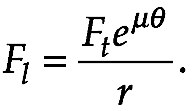
~ enlarge ~
(1)
When the extrinsic finger flexor tendons wrap around the trochlea, the synovial membranes of the radial and ulnar bursas surrounding the tendons are compressed by forces in both flexion and extension. The resulting compressive force is directly proportional to the tension developed in the tendons and the finger flexor muscles, which are related to the external force of exertion by the hand.
Normally the coefficient of friction between the tendon and trochlear surface would be expected to be very small. The model predicts that if the supporting synovia became inflamed and the coefficient of friction μ increased, Fl would increase (Chaffin and Andersson, 1991). This would also result in increased shearing forces Fs as the tendons attempt to slide through their synovial tunnels, since shear forces are generally proportional to Fl and the coefficient of friction:
Fs = Flμ.
(2)This gives rise to the concept that repeated compression could aggravate further synovial inflammation and swelling.
Armstrong and Chaffin (1979) also showed that the total force transmitted from the belt to a pulley, FR, depends on the wrist angle θ, and the tendon load, Ft, as described by the equation:
FR= 2Ftsin(θ/2).
(3)Consequently, the force acting on adjacent anatomical structures, such as ligaments, bones, and the median nerve, depends on the wrist angle. The greater the angle is from a straight wrist, the greater the resultant reaction force on the tendons. The same equation also shows that the resultant force transmitted by a tendon to adjacent wrist structures is a function of tendon load.
The relationship of external to internal loading has been studied using cadaver hands. Armstrong and Chaffin (1978) used sized cadaver hands to statistically evaluate biomechanical models of finger flexor displacements and to develop predictive models of finger flexor tendon dis-
Page 266
placements that can be used for hands and wrists of various sizes. Tendon excursions during finger and wrist motions were related to hand size. Excursions were consistent with predictions of biomechanical models. An et al. (1983) continuously recorded tendon excursions during rotation of individual index finger joints throughout the joint's ranges of motion using seven cadaver hand specimens from amputated limbs. In this study, excursions and joint-displacement relationships were observed not to be always linear. Moment arms of the tendons with respect to joint centers were derived from excursion data for modeling muscle force in the hand.
Goldstein et al. (1987) investigated the effects of cyclic loading on cumulative strain in tendons and tendon sheaths of human cadaver hands. Viscoelastic properties were measured under simulated physiological loading conditions by attaching strain gauge transducers on tendons just proximal and distal to an undisrupted carpal tunnel. Shear traction forces were significantly greater in the extended and flexed wrist postures compared with the neutral wrist posture and were significantly greater in flexion than in extension. Under conditions of severe loading (long load duration with short recovery time), creep strain increased as a function of load cycle and load magnitude, indicating an accumulation of strain under cyclical loading.
In a laboratory study, Balnave, Davey, and Allen (1997) recorded tension in the tendon, contact force at the fingertip, and finger posture while patients gradually increased the force applied by the fingertip and then monotonically reduced it to 0 N. The average ratio of the tendon tension to the fingertip force ranged from 1.7 to 5.8, which was considerably larger than the ratio predicted by isometric tendon models. Subjects who used a pulp pinch posture had a greater ratio than subjects who flexed the DIP joint in a tip pinch posture.
Studies of External Forces and Postures on Nerve Entrapment
Research has demonstrated and quantified relationships between exertions and posture on internal loading of the median nerve in the wrist. When cadaver wrist median nerves were replaced with a balloon transducer, pressures were significantly greater at 4.54 kg tendon load than at 2.27 kg load (Smith, Sonstegard, and Anderson, 1977). Pressures were also significantly greater with the wrist in flexion, compared with neutral and extended postures. When the profundus tendons were not tensed, pressure in the tunnel remained negligible until wrist flexion approached 60° Keir et al. (1997) similarly observed that hydrostatic pressure in the carpal tunnel was affected by both wrist posture and tendon load. The
Page 267
greatest pressures with no load were seen in wrist extension. Muscle loading elevated carpal tunnel pressure, particularly the loading of profundus longus with the wrist in extension and the digital flexors with the wrist flexed.
Studies of the carpal tunnel serve to elucidate the relationship between external load, posture, and internal pressure. Gelberman et al. (1981) demonstrated that in vivo intracarpal canal pressure was greater in carpal tunnel syndrome patients than in controls. Werner, Bir, and Armstrong (1994) demonstrated that intracarpal canal hydrostatic pressure was significantly greater in the reverse Phalen's posture than in either the Phalen's or modified Phalen's, and the effects on median sensory latency was greater in carpal tunnel syndrome patients than in normal controls.
According to Szabo and Chidgey (1989), patients with early and intermediate carpal tunnel syndrome showed elevated pressures compared with baseline following exercise. Neither controls nor advanced patients showed a significant post-exercise increase. Furthermore, Werner et al. (1997) found that for healthy subjects who underwent a standardized set of maneuvers that systematically varied hand, wrist, and forearm position, intracarpal carpal canal pressure was least when the wrist was in a neutral position, the hand relaxed with fingers flexed and the forearm in a semipronated position. In this study, wrist extension and flexion produced the greatest increase in pressure, followed by forearm pronation and supination. Radial and ulnar deviation also increased the pressure, but to a lesser extent. Weiss et al. (1995) also found that carpal tunnel pressure increased with greater deviation from a neutral position and was greater for patients than for controls.
In a laboratory study, Rempel et al. (1997a) explored the relationship between carpal tunnel pressure and fingertip force during a simple pressing task. This study demonstrated that fingertip loading increased carpal tunnel pressure independent of wrist posture, and that relatively small fingertip loads had a large effect on carpal tunnel pressure. Keir, Bach, and Rempel (1998) found that although the external load on the finger remained constant, the internal loading, as measured by carpal tunnel pressure, experienced a nearly twofold increase by using a pinch grip.
Magnetic resonance images of the wrist in the neutral position, 45-degree flexion, and 45-degree extension have been used to measure the distance between confining structures around the median nerve (Skie et al., 1990). In this study, dimensions in flexion were significantly smaller than dimensions in the neutral and extended positions. Flexion of the wrist produced a palmar rearrangement of the flexor tendons, creating potential compression of the median nerve. The nerve responds to these
Page 268
forces by becoming interposed in various positions between the superficial flexor tendons.
Rempel et al. (1994) investigated the effects of repetitive hand activity on carpal tunnel pressure and whether wearing a flexible wrist splint influences pressure. The task involved healthy subjects loading and unloading 1 lb. cans from a box at a rate of 20 cans/minute for a period of 5 minutes with and without a wrist splint. Carpal tunnel pressure increased from an average of 8 to 13 mm Hg without a splint to 21 mm Hg with the splint. The increase in carpal tunnel pressure while wearing the splint at rest was attributed to increased external pressure.
Electromyographic Studies of Muscle Activity Due to External Loads
Numerous studies have observed how muscle activity increases with increased external loads. Several studies have examined actual or simulated use of hand tools. A simulated drilling task that controlled applied force and wrist flexion found that EMG activity in the finger flexor and extensor muscles increased with force (Kim and Fernandez, 1993). Dahalan and colleagues (1993) observed that EMG activity in the flexors and extensors increased with greater grip force in a similar simulated gripping task. Gerard et al. (1996) investigated the effect of keyboard key stiffness on muscle activity. The peak finger flexor and peak finger extensor EMG increased with increasing keyboard make-force.
Klein et al. (1997) studied pinching using a lateral pinch posture for different combinations of wrist posture and pinch force. EMG activity in the hand flexor and extensor muscles increased with force magnitude and wrist flexion angle. A laboratory study by Grant and Habes (1997) examined upper extremity muscle activity using postures similar to those observed in the meatpacking industry. The results showed that handle position (reach posture) had a significant effect on the EMG/force ratio in all muscles.
Power hand tool reaction force has been shown to affect forearm muscle activity. Oh and Radwin (1998) observed that the effect of torque buildup time in power hand tool use on muscular activity was not monotonic. Greater EMG activity levels were observed for torque buildup times between 150 to 300 ms than for faster or slower buildup times.
EMG has also been a useful measure for studying muscle activity during the use of keyboard and mouse data entry devices. Erdelyi et al. (1988) investigated the influence of forearm angle, as well as the effect of different arm supports, on the electrical activity (EMG) of the upper trapezius muscle during keyboard work in healthy workers and persons
Page 269
with shoulder pain. EMG activity decreased in the patients but not in the controls when the subjects used arm supports. The static load on the shoulders during keyboard use decreased significantly as the forearm was lowered. Aaras et al. (1997) evaluated postural load (muscle activity) during keyboard data entry, using a mouse while seated with forearm support, and using a mouse while seated without forearm support. Muscle activity in the trapezius during keyboard work was significantly reduced when sitting with supported forearms compared with sitting and standing without forearm support. The duration of time when the trapezius load was below 1 percent MVC was also significantly greater with forearm support versus no support. During seated work with a mouse, supporting the forearm significantly reduced the static load on the trapezius. Harvey and Peper (1997) observed that all of their subjects had significantly greater mean surface EMG activity recorded from the right upper trapezius, right posterior deltoid, and right lower trapezius-rhomboid during mouse use compared with using a trackball positioned centrally. Surface EMG levels remained elevated during the entire trial period of right-side mouse use without evidence of micro breaks (< 1 s epochs of low surface EMG activity). The authors attribute the increased EMG activity to shoulder abduction required for mouse use.
Feng et al. (1999) recorded EMG activity and posture angles of the shoulder and arm while subjects performed an upper extremity manipulative task in a seated posture on a horizontal table at elbow height, with and without arm support. The use of an arm balancer reduced EMG activity in the anterior deltoid muscle during a variety of light manipulative tasks. Cook and Kothiyal (1998) examined the influence of mouse position, relative to the keyboard, on shoulder and arm muscular activity and working posture. This study showed that mouse position affects muscle activity levels and upper extremity posture. Moving the mouse closer to the midline of the body reduced shoulder muscle activity.
External Physical Loading and Internal Tolerances
Measures of internal tolerances for mechanical strain and fatigue are often quantified using physiological measurements or psychophysical assessments. A summary of articles measuring internal tolerances due to external loads appears in Table 6.7.
Physiological Measures of Mechanical Strainor Fatigue from External Loads
Electromyography and blood flow have been used to measure the effects of work pauses on localized muscle fatigue in the upper limbs.
Page 270
|
External Load |
||||||||||||||
|
Force |
Motion |
Vibration |
Temperature |
|||||||||||
|
Reference |
Internal Load |
External Load |
Mag |
Rep |
Dur |
Mag |
Rep |
Dur |
Mag |
Rep |
Dur |
Mag |
Rep |
Dur |
|
Hand and Wrist |
||||||||||||||
|
Snook et al., 1997 |
Maximum acceptable torque |
Work duration in repetitive ulnar deviation task |
• |
• |
• |
• |
• |
• |
||||||
|
Kim and Fernandez, 1993 |
Maximum acceptable frequency, rating of perceived exertion |
Push force and wrist flexion/extension in repetitive drilling task |
• |
• |
• |
• |
||||||||
|
Klein and Fernandez, 1997 |
Maximum acceptable frequency, rating of perceived exertion |
Pinch force, wrist flexion/extension and task duration in a repetitive lateral pinching task |
• |
• |
• |
• |
• |
• |
||||||
|
Snook, Ciriello, and Webster, 1999 |
Maximum acceptable torque |
Grip posture, wrist ulnar deviation, and exertion frequency in a repetitive wrist extension task |
• |
• |
• |
• |
• |
• |
||||||
|
Ulin et al., 1990 |
Rating of perceived exertion |
Power screwdriver shape and vertical height |
• |
|||||||||||
Page 271
|
Harber, Hsu, and Pena, 1994 |
Rating of perceived exertion |
Pull force, wrist flexion/extension, and grip posture |
• |
• |
||||||||||
|
Dahalan, Jalaluddin, and Fernandez, 1993 |
Maximum acceptable frequency, rating of perceived exertion |
Grip force and duration in repetitive grip exertions |
• |
• |
• |
|||||||||
|
Davis and Fernandez, 1994 |
Maximum acceptable frequency |
Wrist posture in repetitive drilling task |
• |
• |
||||||||||
|
Ulin et al., 1992 |
Subjective preference |
Power screwdriver shape, vertical height, work orientation, and reach distance |
• |
|||||||||||
|
Schoenmarklin and Marras, 1989a |
EMG mean power frequency |
Hammering into vertical and horizontal surfaces using tools with varying handle angles |
• |
|||||||||||
|
Snook et al., 1995 |
Maximum acceptable torque |
Exertion frequency for repetitive wrist flexion-extension using power and pinch grips |
• |
• |
• |
• |
• |
• |
||||||
|
Oh and Radwin, 1998 |
Rating of perceived exertion |
Power hand tool torque and torque buildup time |
• |
• |
||||||||||
|
Ulin et al., 1993a |
Rating of perceived exertion |
Reach for a power screwdriver task |
• |
• |
||||||||||
|
Ulin et al., 1993b |
Rating of perceived exertion |
Frequency of a power screwdriver task on horizontal and vertical surfaces |
• |
• |
• |
• |
Page 272
|
External Load |
||||||||||||||
|
Force |
Motion |
Vibration |
Temperature |
|||||||||||
|
Reference |
Internal Load |
External Load |
Mag |
Rep |
Dur |
Mag |
Rep |
Dur |
Mag |
Rep |
Dur |
Mag |
Rep |
Dur |
|
Fleming, Jansen, and Hasson, 1997 |
EMG mean power frequency |
Gripping with and without gloves |
• |
• |
||||||||||
|
Petrofsky et al., 1982 |
EMG mean power frequency |
Sustained isometric grip |
• |
• |
||||||||||
|
Baidya and Stevenson, 1988 |
EMG mean power frequency |
Repeated wrist extensions against a load until exhaustion |
• |
• |
• |
• |
• |
• |
||||||
|
Linqvist, 1993 |
Rating of perceived exertion |
Power hand tool torque, torque buildup time, and shutoff time |
• |
• |
||||||||||
|
Marley and Fernandez, 1995 |
Maximum acceptable frequency, rating of perceived exertion, and EMG mean power frequency in finger flexors and deltoids |
Wrist flexion/extension for a sustained repetitive drilling task |
• |
• |
• |
• |
• |
• |
||||||
|
Armstrong et al., 1989 |
Subjective rating of comfort |
Tool weight, handle circumference, vertical work location, and horizontal reach |
• |
• |
||||||||||
|
Gerard et al., 1999 |
Subjective preference |
Keyboard key mechanism |
• |
|||||||||||
Page 273
|
Martin, Roll, and Hugon, 1990 |
Perceived intensity of an electrical stimulus |
Handle vibration |
• |
|||||||||||
|
Blackwell, Kornatz, and Heath, 1999 |
EMG mean power frequency for FDS muscle |
Power grip handles with different spans |
• |
• |
||||||||||
|
Murthy et al., 1997 |
Oxygenation of extensor carpi radialis |
Exertion level, duration, and recovery |
• |
• |
||||||||||
|
Bystrom and Kilbom, 1990 |
Blood flow in forearm and EMG activity in extensor digitorum communis |
Intermittent isometric hand grip exertions |
• |
• |
||||||||||
|
Neck, Shoulder, and Upper Arm |
||||||||||||||
|
Oberg, Sandsjo, and Kadefors, 1994 |
EMG mean power frequency in the trapezius |
Holding loads in the hands for a given shoulder posture |
• |
• |
||||||||||
|
Hagberg and Sundelin, 1986 |
Perceived exertion |
Work-rest schedule for a word processing task |
• |
|||||||||||
Page 274
Petrofsky et al. (1982) found that EMG activity level increases and mean power frequency decreases as a function of time during sustained isometric contractions. Hagberg and Sundelin (1986) evaluated the effects of short pauses on EMG activity during word processing tasks and found that static loading was relatively low during the typing tasks, 3.2 percent MVC for the right shoulder, and 3.0 percent MVC for the left shoulder. There was a significant negative correlation between pauses and static load on the right trapezius muscle. In another study, Baidya and Stevenson (1988) observed that the rate of decrease in the center frequency of wrist extensor EMG signals was greater for the larger extension angle than for repetitive wrist movements. In this study, ulnar deviation did not affect the rate of fatigue (center frequency shift).
Bystrom and Kilbom (1990) found that when work-rest duty cycle (contraction/relaxation) and contraction intensity were controlled, forearm blood flow was insufficient even at isometric contractions of low intensity (10 percent MVC), indicating that vasodilating metabolites play an active role for blood flow in low-intensity isometric contractions. This study also showed that maximal blood flow in the forearm during relaxation periods (25-30 ml/min/100 ml) is reached at 25 percent MVC. Only a cycle of intermittent exercise at 10 percent MVC and (10 sec work + 5 sec rest) and (10 sec work + 10 sec rest) at 25 percent MVC was considered acceptable with regard to local fatigue.
Kim and Fernandez (1993) found that heart rate, systolic blood pressure, and flexor and extensor EMG activity increased with force during a simulated drilling task. Heart rate also increased when working with increased wrist flexion angles. Marley and Fernandez (1995) found that when subjects maintained a 5.4 kg simulated drilling force for a total duration of three minutes, systolic blood pressure and deltoid EMG activity increased with trial duration and wrist flexion angle, while deltoid median power frequency decreased with wrist angle and trial duration, indicating localized fatigue.
Dahalan, Jalaluddin, and Fernandez (1993) observed that several physiological measures (systolic blood pressure, EMG activity in the flexors and extensors) increased with increased grip force. Systolic blood pressure increased with exertion duration. Klein and Fernandez (1997) found that mean heart rate increased with increasing pinch force and that EMG activity increased with force magnitude, wrist flexion angle, and task duration. Endurance time was greater without gloves (Fleming, Jansen, and Hasson, 1997). Fatigue of the digitorum superficialis, as inferred from EMG frequency shifts, did not change as a function of grip size; however, there was an optimal grip size for greater absolute forces (Blackwell, Kornatz, and Heath, 1999).
Page 275
Tissue oxygenation is another measure of muscle fatigue. Murthy et al. (1997) investigated the sensitivity of near-infrared spectroscopy technique to changes in tissue oxygenation at low levels of isometric contraction in the extensor carpi radialis brevis muscle. They found that mean tissue oxygenation decreased from the resting baseline (100 percent tissue oxygenation) to 89, 81, 78, and 47 percent for 5, 10, 15, and 50 percent MVC, respectively. Tissue oxygenation levels at 10, 15, and 50 percent MVC were significantly less than the baseline value.
Holewijn and Heus (1992) evaluated the effects of temperature on muscle function in the upper extremity. The endurance time for the sustained contraction at 15 percent MVC was reduced by 50 percent with warming, compared with the reference condition. RMS EMG was not affected by temperature; however, the mean power frequency shifted to a lower value at the beginning of the sustained grip exertion in the cooled condition.
Psychophysical Measures of Mechanical Strain or Fatigue for External Forces and Postures
Psychophysical measures have been used to study perceptions of comfort and intensity while performing lifting tasks. Automobile assembly workers were asked to use a 10-point scale with verbal anchors to rate the tool mass, grip force, handle size, vertical work location, horizontal work location, and overall satisfaction with a tool (Armstrong, Punnett, and Ketner, 1989). Tools with mass less than 2.0 kg, handle circumferences less than 12 cm, horizontal work locations of 38 cm or less, and vertical work locations between 102 and 152 cm were the most preferred. Harber and colleagues (Harber, Hsu, and Pena, 1994) used the psychophysical approach to demonstrate that grip type, force level, and wrist angle affected perceptions of work intensity and comfort while performing a one-handed lifting task. Subjects preferred wrist extension over wrist flexion and a power grip over a pinch grip.
Oberg and colleagues (Oberg, Sandsjo, and Kadefors, 1994) found that physiological (EMG) and psychophysical measures of fatigue in the trapezius muscle were correlated at high load levels but not at low load levels. This indicates that subject sensations of fatigue may be caused by factors unrelated to changes in recruitment of motor units.
Psychophysical measures have also been applied to the study of perceptions of acceptable torque during repetitive wrist motion. Stover Snook, who pioneered psychophysical methods for lifting, established a procedure to ascertain the maximum acceptable torques for various types and frequencies of repetitive wrist motion (Snook et al., 1995). Four ad-
Page 276
justable workstations were built to simulate repetitive wrist flexion with a power grip, wrist flexion with a pinch grip, and wrist extension with a power grip. In general, maximum acceptable torque decreased as the exertion frequency increased for the three types of exertions. Maximum acceptable torque was greatest for power grip flexion and least for power grip extension. Maximum acceptable torque decreased over the seven hours of testing. There were no significant differences in maximum acceptable torque from day to day; however, the average maximum acceptable torque for a 5 days per week exposure was 36.3 percent lower than for the same task performed 2 days per week.
In an experiment similar to the one for wrist flexion-extension, Snook et al. (1997) quantified maximum acceptable torques for ulnar deviation motions of the wrist similar to a knife-cutting task at various repetition rates using the psychophysical method. The subject adjusted the resistance on the handle while the experimenter manipulated or controlled all other variables. The subjects were instructed to work as if they were paid on an incentive basis. Maximum acceptable torque decreased over the 7 hours of testing in both series. Maximum acceptable torque decreased with increasing frequency in both series, but the change was not statistically significant.
Snook, Ciriello, and Webster (1999) employed the same method to determine maximum acceptable torque for extension motions of the wrist performed with a pinch grip. Maximum acceptable torque and extension duration decreased with increasing task frequency. Maximum acceptable torque during wrist extension with a pinch grip was less than wrist flexion with a pinch grip, wrist flexion with a power grip, or ulnar deviation.
Psychophysical measures were used by Kim and Fernandez (1993) to investigate simulated repetitive drilling tasks. Maximum acceptable frequency decreased with greater drilling force and with greater wrist flexion. Ratings of perceived exertion increased with force and with wrist flexion angle. Marley and Fernandez (1995) used the method of adjustment to determine the maximum acceptable frequency for a simulated drilling task. The psychophysically adjusted task frequency was significantly lower when wrist deviation was required, particularly wrist flexion. A similar laboratory study investigated the maximum acceptable frequency for a simulated gripping task (Dahalan, Jalaluddin, and Fernandez, 1993). Maximum acceptable frequency decreased significantly as grip force magnitude and exertion duration increased. Ratings of perceived exertion increased with higher grip force.
Davis and Fernandez (1994) found that the acceptable frequency for a simulated drilling task was maximum with a neutral wrist position and decreased with increased angles of wrist flexion, extension, and radial
Page 277
deviation. Marley and Fernandez (1995) showed that maximum acceptable frequency for a simulated drilling task decreased as a function of wrist flexion angle. Klein and Fernandez (1997) evaluated the effects of wrist posture on maximum acceptable frequency for a simulated drilling task. Wrist flexion (10 and 20 deg), extension (20 and 40 deg), and radial deviation (10 and 20 deg) all produced significant decreases in maximum acceptable frequency compared with the neutral posture.
Another area in which psychophysical measures have been used is to study lifting, positioning, and pinching tasks. Work duration for limiting shoulder-girdle fatigue during lifting-positioning tasks decreased, as with force and with repetition rate (Putz-Anderson and Galinsky, 1993). When repetition and reach height were varied, task duration decreased, as with required working height and with required repetition rate. Males tended to engage in longer work trials than females, despite controlling for upper body strength.
Klein and Fernandez (1997) used the psychophysical approach to determine maximum acceptable frequency for pinching using a lateral pinch posture. Maximum acceptable frequency was reduced as wrist flexion angle, force magnitude, and task duration increased. Perceived exertion increased with force magnitude, wrist flexion angle, and task duration.
A number of experiments performed by Ulin employed psychophysical methods for studying power hand tool orientation, location, and shape. Following each treatment, subjects rated exertion level and discomfort using three psychophysical scales (the Borg 10-point ratio rating scale and two 10-centimeter visual analog scales used to rate comfort and ease of work). Subjects were instructed to imagine that they were assembly line workers performing the task for an 8-hour day. In 1990, Ulin et al. determined the preferred work location for driving screws with a pistol-shaped screwdriver to be 114 to 140 cm for a mixed male-female subject pool. In a 1992 study, Ulin et al. demonstrated how work location, work orientation, and tool selection affected perceived exertion when using pneumatic hand tools. Lowest exertions were observed when working in neutral postures. Ulin and colleagues found (1) that perceived exertion was lowest when the horizontal reach distance was small and when working at mid-thigh or elbow height (1993b) and (2) that perceived exertion increases as a function of work pace (1993a). In addition, perceived exertion is affected by work location, work orientation, and tool type. Both work location and task frequency were significant factors in determining the Borg rating. As work pace increased, so did the Borg rating of perceived exertion for each work location. Driving screws at elbow height on the vertical surface and with the lower arm close to the body on the horizontal surface was the work location that produced the lowest ratings of
Page 278
perceived exertion. Differences in local discomfort were found for the vertical work locations. While driving screws at knee height, the torso was most stressed, at elbow height the wrist-hand were most stressed, and at shoulder height the shoulder and upper arm were the most stressed.
Schoenmarklin and Marras (1989b) demonstrated that hammer handle angle did not significantly affect forearm muscle fatigue based on a shift in EMG mean power frequency, but wall hammering produced marginally greater muscle fatigue than did bench hammering. Linqvist (1993) observed a correlation between power hand tool handle displacement and subjective strain ratings. This laboratory study investigated responses to power tool spindle torque reaction forces during the final stages of tightening threaded fasteners with a right-angled nut runner. A distinctive feature of nut runners during the torque reaction phase is that the handle is rapidly displaced as torque builds up, causing a movement of the upper extremity. Subject ratings of strain increased monotonically as a function of torque level. Ratings of strain were higher for medium-hard joints compared with hard joints, and ratings of strain were higher for slow-shutoff tools compared with high-shutoff tools. Ratings of strain were positively correlated with the handle displacement; correlations were strongest for the slow-shutoff tool used on a hard joint. Oh and Radwin (1998) evaluated the relative effects of power hand tool process parameters (target torque, torque buildup time, and workstation orientation) on subjective ratings of perceived exertion. Increasing the torque reaction force resulted in higher ratings of perceived exertion. Subjective ratings of perceived exertion were lowest when torque buildup time was 35 ms; however, greater peak torque variance was associated with this condition.
Radwin and Ruffalo (1999) investigated the effects of key-switch design parameters on short-term localized muscle fatigue in the forearm and hand. Subject reports of fatigue were reduced with the lower key make-force. Self-reported fatigue occurred in all cases (keying rate decreased over the duration of the test session), but no significant differences were observed based on RMS EMG for low-level exertions in repetitive keying.
A laboratory study evaluated the effects of muscle, tendon, or skin vibration on the early and late components of polyphasic cutaneous responses elicited in the flexor carpi radialis muscle by electrical stimulation of the radial nerve at the wrist (Martin, Roll, and Hugon, 1990). Palm skin vibration depressed both components of the flexor reflex, while skin vibration on the back of the hand induced either a facilitation or an inhibition. In addition, this kind of vibration modified the location of the
Page 279
sensation evoked by the electrical stimulation of the nerve. In all cases, the vibration stimulus attenuated the perceived intensity of the electrical stimulus. These observations suggested to the authors a possible impairment of the protective withdrawal reflex under vibratory environmental conditions at rest and eventually in active muscles.
External Physical Loading and Pain, Discomfort, or Functional Limitations
The following section reviews literature that directly investigated pain, discomfort, or functional limitations due to external loading. The studies that are reviewed report short-term impairments of function observed in the laboratory or in the field, rather than long-term impairments or disabilities. Studies dealing with longer-term effects are reviewed in the epidemiology literature covered in Chapter 4. Rather these studies reveal relationships between workplace exposures and short-term outcomes such as pain, discomfort, and level of function. A summary of these articles is presented in Table 6.8.
Pain and Discomfort Due to External Loading
In some studies, pain and discomfort have been examined in relation to work posture and force. For example, Schoenmarklin and Marras (1989b) found that hammering on a vertical wall resulted in significantly greater discomfort than hammering on a bench. Gerard et al. (1999) found that subjective discomfort increased as a function of key make-force with rubber dome key switches. Lin, Radwin, and Snook (1997) found that force, wrist flexion angle, and repetition are all significant factors in determining discomfort. They developed a subjective model of discomfort on a 10-cm analog scale. The continuous model was compared with and agrees with discrete psychophysical data from other published studies.
Other studies have demonstrated the effects of pace and work schedule on perceived pain, discomfort and exertion. For example, a study by Hagberg and Sundelin (1986) found that pain and discomfort reports increased with longer durations of work time. The increase was smallest when the work-rest cycle included short rest periods. In a laboratory experiment, Snook et al. (1997) found that the rate of pain and discomfort reports increased with longer duration of work in which subjects adjusted the resistance of a handle while grasping it with a power grip and repetitively moving it through 80 deg ulnar deviation wrist motion, similar to a knife-cutting task (Snook et al., 1997). In a study by Ulin et al. (1993b) both work location and task frequency were found to be significant factors—
Page 280
|
External Load |
||||||||||||||
|
Force |
Motion |
Vibration |
Temperature |
|||||||||||
|
Reference |
Adverse Outcome |
External Load |
Mag |
Rep |
Dur |
Mag |
Rep |
Dur |
Mag |
Rep |
Dur |
Mag |
Rep |
Dur |
|
Hand and Wrist |
||||||||||||||
|
Imrhan, 1991 |
Pinch strength |
Wrist and pinch posture |
• |
|||||||||||
|
Snook et al., 1997 |
General discomfort |
Work duration in repetitive ulnar deviation task |
• |
• |
• |
|||||||||
|
Radwin and Jeng, 1997 |
Keying rate |
Keyboard force |
• |
|||||||||||
|
Radwin and Ruffalo, 1999 |
Keying rate and localized discomfort |
Keyboard force |
• |
|||||||||||
|
Ulin et al., 1990 |
General discomfort |
Vertical height in power screwdriver operation |
• |
|||||||||||
|
Schoenmarklin and Marras, 1989b |
General discomfort |
Orientation for hammering |
• |
|||||||||||
|
Ulin et al., 1993a |
General discomfort |
Power hand tool shape, work orientation, and work location |
• |
• |
• |
• |
||||||||
|
Batra et al., 1994 |
General discomfort and grip strength |
Glove thickness |
• |
• |
||||||||||
|
Fleming, Jansen, and Hasson, 1997 |
Endurance time |
Gripping with and without gloves |
• |
• |
||||||||||
Page 281
|
Schiefer et al., 1984 |
Manual performance in block threading, knot tying, peg test, and threading screws |
Cold environment |
• |
|||||||||||
|
Gerard et al., 1999 |
Localized discomfort |
Keyboard key mechanism |
• |
|||||||||||
|
Gerard and Martin, 1999 |
Manual performance in visual-manual tracking |
Handle vibration and recovery time |
• |
• |
||||||||||
|
Riley and Cochran, 1984 |
Manual performance in pegboard, pencil tapping, tweezers manipulation, and assembly |
Cold environment |
• |
|||||||||||
|
Malchaire, Piette, and Rodriguez-Diaz, 1998 |
Vibration perception threshold |
Handle vibration |
• |
|||||||||||
|
Lin, Radwin, and Snook, 1997 |
General discomfort |
Force and posture repetition frequency |
• |
• |
• |
• |
||||||||
|
Lin and Radwin, 1998 |
General discomfort |
Force and posture and repetition frequency |
• |
• |
• |
• |
||||||||
|
O'Driscoll et al., 1992 |
General discomfort |
Force and posture and repetition frequency |
• |
• |
• |
• |
||||||||
|
Knowlton and Gilbert, 1983 |
Grip strength |
Following hammering tasks using hammers with angled handles |
• |
• |
||||||||||
|
Mital, Kuo, and Faard, 1994 |
Torque strength |
Use of common hand tools and gloves |
• |
|||||||||||
|
continues |
Page 282
|
External Load |
||||||||||||||
|
Force |
Motion |
Vibration |
Temperature |
|||||||||||
|
Reference |
Adverse Outcome |
External Load |
Mag |
Rep |
Dur |
Mag |
Rep |
Dur |
Mag |
Rep |
Dur |
Mag |
Rep |
Dur |
|
Holewijn and Heus, 1992 |
Grip strength, maximum rhythmic frequency and endurance time |
Cooling the hands |
• |
|||||||||||
|
Dempsey and Ayoub, 1996 |
Pinch strength |
Wrist flexion/extension, ulnar/radial deviation, and pinch separation |
• |
|||||||||||
|
Pryce, 1980 |
Grip strength |
Wrist flexion/extension and ulnar/radial deviation |
• |
|||||||||||
|
O'Driscoll et al., 1992 |
Grip strength |
Wrist flexion/extension and ulnar/radial deviation and handle size |
• |
|||||||||||
|
Blackwell, Kornatz, and Heath, 1999 |
Grip strength |
Handle size |
• |
|||||||||||
|
Hallbeck and McMullin, 1993 |
Grip strength |
Wearing gloves while varying wrist flexion/extension |
• |
• |
||||||||||
|
Jeng, Radwin, and Rodriquez, 1994 |
Maximum pinch rate |
Pinch force |
• |
|||||||||||
Page 283
|
Neck, Shoulder, and Upper Arm |
||||||||||||||
|
Oberg, Sandsjo, and Kadefors, 1994 |
Localized discomfort in the trapezius muscle region |
Duration of holding a load with the shoulder abducted |
• |
• |
||||||||||
|
Putz-Anderson and Galinsky, 1993 |
Time for localized discomfort for the shoulder girdle |
Load in the hand and repetition rate in repetitive lifting and positioning tasks |
• |
• |
• |
|||||||||
Page 284
that is, as work pace increased, so did the Borg rating of perceived exertion for each work location. Differences in local discomfort were found for the vertical work locations.
Functional Limitations Due to External Loading
Marshall, Mozrall, and Shealy (1999) demonstrated that the combination of wrist-forearm posture had significant effects on wrist range of motion. Pryce (1980) studied the effect of wrist posture (neutral and ulnar deviation, and 15 deg each side of neutral in volar and dorsiflexion) and maximum power grip strength. Strength was affected by ulnar deviation angle, and grip force was greatest in the neutral position and decreased as the deviation angle increased. Strength was also affected by extension-flexion angle. Knowlton and Gilbert (1983) investigated the effects of ulnar deviation on strength decrements when using hammers to drive nails in a standard task. Grip strength was measured before and after performing the hammering task. Peak grip strength was reduced by an average 67 N with a conventional claw hammer compared with 33 N with a curved-handle ripping hammer. Average grip strength was reduced by 84 N with the claw hammer compared with 49 N with the ripping hammer. There was no significant difference between the number of strikes required to complete the task with the two tools.
Imrhan (1991) examined the effects of different wrist positions on maximum pinch force. The results showed that all of the deviated wrist positions reduced the observed pinch strength, with palmar flexion having the greatest effect and radial deviation having the least. O'Driscoll et al. (1992) also investigated the effects of posture on grip strength. Grip strength was reduced in any deviation from a self-selected position. Measured strength and the degree of wrist extension was inversely related to the handle separation distance on the Jamar dynamometer. This was true regardless of hand size, although the effects were more pronounced for small hands. A laboratory study by Hallbeck and McMullin (1993) found that gender, glove type, hand dominance, and wrist position had a significant effect on the magnitude of power grasp. Force was maximized with a bare hand in a neutral wrist posture.
Dempsey and Ayoub (1996) reported that gender, wrist posture (neutral, maximum flexion, maximum extension, maximum radial deviation, and maximum ulnar deviation), pinch type (pulp2, pulp3, chuck, and lateral), and pinch width (1, 3, 5, and 7 cm) all had significant effects on strength. Maximum values were obtained with a neutral wrist, a separation distance of 5 cm, and a lateral grasp. Female strength was on average 62.9 percent of male strength.
Page 285
Blackwell, Kornatz, and Heath (1999) investigated the effect of grip span on isometric grip force. An optimal grip size allowed for the greatest forces. Batra et al. (1994) demonstrated that reduction in grip strength was positively correlated with glove thickness but not with glove size. In a subsequent analysis, the following selected glove attributes were correlated to reductions in demonstrated strength: (1) tenacity—friction between the glove and a standard piece of plastic, (2) snugness—hand volume versus glove volume, (3) suppleness—a measure of pliability, and (4) thickness. A decrease in grip force was significantly affected by glove type—asbestos and leather gloves reduced grip strength to approximately 82.5 percent of bare-handed levels, while surgical gloves reduced grip strength to 96.3 percent of bare-handed levels.
Mital and colleagues studied the influence of a variety of commercially available gloves on the force-torque exertion capability of workers when using wrenches and screwdrivers in routine maintenance and repair tasks (Mital, Kuo, and Faard, 1994). Subjects exerted a maximum volitional torque during a simulated task. The results indicated that tool type was a predictor of volitional torque. Gloves also affected volitional torque; torque was greater with the use of gloves.
Temperature can be an important moderating variable. Riley and Cochran (1984) studied manual dexterity performance at different ambient temperatures. Subjects wore typical industrial worker apparel without gloves during manual dexterity tests. Results indicated that after 15 minutes of cold exposure, there was no difference between performance at 12.8 and 23.9 degrees Celsius, but there was a difference between performance at 1.7 and 12.8 degrees as well as between performance at 1.7 and 23.9 degrees. Holewijn and Heus (1992) found that isometric grip strength was significantly reduced by cooling. The rate of force buildup was also influenced by temperature, with slower buildup under conditions of cooling. Cooling reduced the maximum grip frequency by 50 percent compared with the reference condition. The endurance time for the sustained contraction at 15 percent MVC was reduced by 50 percent with warming compared with the reference condition.
A psychomotor task was developed by Jeng, Radwin, and Rodriquez (1994) for investigating functional deficits associated with carpal tunnel syndrome. A rapid pinch and release psychomotor task utilizing muscles innervated by the median nerve was administered. Subjects were instructed to pinch the dynamometer above an upper force level and then release below a lower force level as quickly as possible. Average pinch rate decreased from 5.4 pinches/sec to 3.7 pinches/sec as the upper force increased from 5 to 50 percent MVC. Pinch rate was significantly faster and overshoot force was less for the dominant hand. Control subjects
Page 286
performed 25 to 82 percent better than subjects with carpal tunnel syndrome. Age contributed 6 percent of the total variance for pinch rate and 7 percent of the total variance for the time below the lower force level. The results suggest that patients with carpal tunnel syndrome may experience similar functional psychomotor deficits in daily living and manual work activities. Schiefer et al. (1984) demonstrated that finger skin temperature and performance on manual dexterity tests decreased as the ambient air temperature decreases.
Upper Limb Summary
Overall, the literature reveals that there are strong relationships between physical loads in the workplace and biomechanical loading, internal tolerances, and pain, impairment, and disability. Although many of these relationships are complex for the upper limb, the associations are clear. The biomechanical literature has identified relationships between physical work attributes and external loads for force, posture, vibration, and temperature. Research has also demonstrated relationships between external loading and biomechanical loading (i.e., internal loads or physiologic responses). Relationships between external loading and internal tolerances (i.e., mechanical strain or fatigue) have also been demonstrated. Finally, relationships have been shown between external loading and pain, discomfort, impairment, or disability. Although the relationships exist, the picture is far from complete.
Individual studies have for the most part not fully considered the characteristic properties of physical work and external loading (i.e., magnitude, repetition, or duration). Few studies have considered multiple physical stress factors or their interactions. The absence of these relationships, however, does not detract from the basic theoretical construct of the load-tolerance model. In fact, it suggests the need for additional research.
When considered together, a broader picture emerges. The existence of relationships together supports the load-tolerance model presented in this report. Furthermore, biomechanics forms the basis to reduce external loading. The relationships that are established indicate appropriate interventions for reducing exposure to external loads in the work environment through ergonomics and work design. Future research efforts targeting the missing relationships may help provide additional workplace interventions for preventing and reducing the risk of work-related disorders.


