
9
Implementing the Strategy
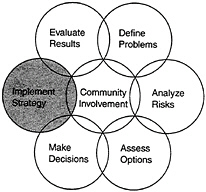
The preceding four components of the risk-management framework established the foundation necessary for the implementation of a risk-management strategy at PCB-contaminated sites. The nature of the PCB-contamination problem and its subsequent risks have been defined, and potential management options have been evaluated. As a result of these analyses, a risk-management strategy has been developed on the basis of input from all affected parties. The fifth stage of the framework is the implementation of the strategy.
The committee recognizes that implementation is often the stage in a risk-management project where a substantial disconnect occurs between previous planning and risk-management objectives and the subsequent field operations. Decisions that look good on paper or in the meeting room can be more problematic when they are put into practice, and communication and trust among the interested parties can break down. For this reason, implementation must involve all affected parties. Implementation requires detailed planning, funding, and evaluation throughout its entire process. Furthermore, the implementation plan must be flexible to respond to unforseen situations or problems. For instance, estimated risks might change during the implementation process because of unanticipated environmental factors (e.g., floods or storms) or the development of new remediation technologies, new regulatory requirements, or the availability of new scientific data. In other situations, short-term risks that were not factored into the initial risk assessments (e.g., risks to workers
at the contaminated sites or risks of transporting the dredged materials through a community) have to be considered. These considerations might require that the implementation plans be modified or revised completely. As shown in Box 9-1, New Bedford Harbor offers a specific example of mid-course correction occurring during management, stemming from concerns of local residents about risks from exposures to contaminated sediments and from exposures that might result from the management of the sediments.
|
BOX 9–1 Midcourse Evaluation at New Bedford Harbor From the 1940s until the late 1970s, the New Bedford Harbor area (the Achusnet River estuary) received wastes from industries using PCBs in the manufacture of capacitors and other electrical components. Following several years of assessment (1976–1981), EPA added this site to the National Priorities List. Sediments in the upper part of the harbor (Figure 9–1) contained PCBs at concentrations of as much as 100,000 ppm or greater on a dry-weight basis. Management action concerns were focused on the hot spots; the upper and lower Harbor, and the Buzzards Bay area. In 1983, EPA began to evaluate alternatives for addressing the PCB contamination. Initial remediation included PCB-contaminated sediments with concentrations in excess of 4,000 ppm with a sediment volume of about 10,000 m3. An environmental feasibility study (EFS) and pilot studies for remediation were completed in 1989, and EPA recommended the use of a cutterhead dredge connected to a hydraulic pipeline, which would deliver sediment to a confined disposal facility (CDF), where, dewatering, treatment of the water, and incineration of the PCBs in the sediment would occur (EPA 1997). However, concerned community groups raised strong objections to the incineration of the PCBs, and the incineration plan was modified. The revised plan called for the temporary storage of the dewatered sediment in a CDF along the edge of the upper harbor near the hot spot (Figure 9–2) until a final decision for treatment of the dredged sediments could be made. Dredging of the hot spot was completed in 1995. Subsequently, after consideration of several alternatives, including pilot studies of solidification and chemical destruction of the sediments, the sediments were further dewatered and moved to an offsite Toxic Substances Control Act-permitted landfill. This example shows how mid-course correction might be necessary in certain stages of the framework and illustrates the importance of involving affected parties early in the process to achieve a desirable outcome. |
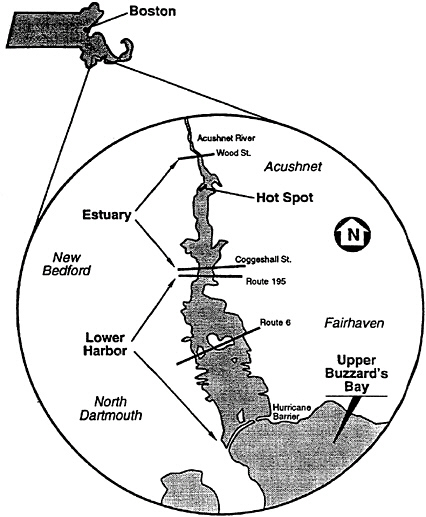
FIGURE 9–1 Site map of New Bedford Harbor. Source: EPA (1992).
Throughout the implementation process, there must be continual feedback between the application of the management option and the subsequent monitoring conducted to establish if risk-management goals and engineering objectives (if applicable) are being met (see Chapter 10 for a discussion of monitoring). This feedback is extremely important, as monitoring should be used to determine whether any course modification is necessary. Feedback is also particularly important for PCB-contaminated sites because of the biopersistence and changing toxicity of PCBs over time. Because PCBs are not static contaminants, it is imperative that affected parties know both the short-
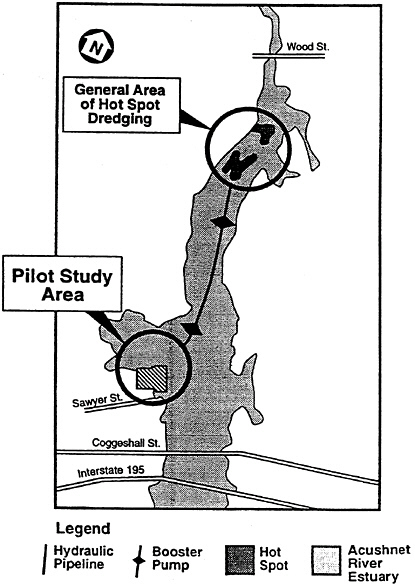
FIGURE 9–2 Selected alternative for hot-spot sediments. Source: EPA (1992).
term and long-term effectiveness of a management option. Feedback between implementation and monitoring can also be used to evaluate the impacts of the risk-management strategy on ecological resources. Box 9-2 illustrates the important role played by ambient-air monitoring at the New Bedford site, where high ambient-air PCB concentrations forced a delay in the management process.
|
BOX 9–2 Ambient Monitoring During Remediation of New Bedford Harbor Ambient-air monitoring during hot-spot dredging at New Bedford Harbor was designed to protect public health by maintaining PCB concentrations below certain levels. There was concern that sediments suspended during the dredging operation would release PCBs to the water, which was relatively shallow, especially at low tide (1–3 m). That release in turn might result in exchange of PCBs from the water to the atmosphere, resulting in increased atmospheric concentrations. Sixteen air-monitoring stations were located around the upper harbor area, and initial concentrations before remedial dredging of the hot spots were collected. Initial background assessments found average PCB concentrations ranging from 10 to 50 ng/m3, depending on the sampling location around the harbor, with maximum concentrations of 100 to 200 ng/m3. The following “trigger” levels were agreed upon and published in a bulletin sent to all interested parties: Shut-Down Level—The shut-down level of 1,000 ng/m3 was based on the recommendation of the National Institute for Occupational Safety and Health (NIOSH) for toxic substances in the workplace. If a single air sample exceeded the shut-down level, dredging was to be immediately stopped until the source of the PCBs was identified and corrective action taken. Action Level—The action level was 500 ng/m3. If a single air sample exceeded the action level, the dredging contractor had to make changes in the dredging process to reduce the emitted concentrations of PCBs. These changes could include reducing the period of dredging each day or operating the dredge at lower speeds. Notice Level—The notice level was based on measured background PCB concentrations in the vicinity of the hot spot, when there is no dredging. The notice level was estimated from the average of the four background sampling events plus 30 ng/m3. If the average daily sample exceeded the notice level, the contractor had to notify the government and identify the corrective action. Table 9–1 contains the record of the averages and maximums for the entire hot spot. This figure illustrates that during the dredging operations, 26% of the samples exceeded the notice level, 1% of the samples exceeded the action level, and 0.25% (or 10 samples) exceeded the shut-down level (EPA 1997). Air monitoring did result in the shut down of the dredging operations and was important for identifying the potential health risks to the local community. This example illustrates the importance of feedback between the implementation phase of the strategy and the monitoring of its outcomes. |
TABLE 9–1 Summary of Airborne PCB Sampling Results: New Bedford Harbor Hot-Spot Dredging Remedy
Coupling implementation with monitoring will also provide valuable information on the effectiveness of specific remediation technologies and management options. This information can be used to compile a database,
such as the General Electric Corporation’s Major Contaminated Sediment Sites Database (General Electric 1999), that would serve as a catalogue of demonstration projects. Such a comprehensive database would be useful as a risk communication tool and could also serve to identify areas for further research, including new or improved remediation technologies and monitoring techniques.
Many of the issues relating to implementation of a risk-management strategy have been addressed in the NRC report Contaminated Sediments in Ports and Waterways: Clean Up Strategies and Technologies (1997). The report emphasizes several salient issues pertaining to contaminated sediments. The issues addressed include the need for the development of a project plan and the subsequent components, including affected and interested party involvement, interim controls, and source control.
PROJECT PLAN
Successful implementation of the selected risk-management strategy begins with a project plan. A project plan should be developed that details the schedule of activities that will occur, what additional activities need to be conducted to ensure the management options are as effective as possible, who will be involved in conducting and orchestrating these activities, how they will be carried out, and what the costs are. Elements of the project plan can include a more extensive site characterization, specific to the risk-management options chosen; necessary source control; and specifications of performance standards to be met during the risk-management process. A key factor in the development of a project plan is the involvement of the affected parties. The project plan may be implemented in phases, particularly if the site is very large, complex, several management options are to be used, or a new technology is to be tried. In the latter case, the project plan may call for a pilot test of the technology before it is used on a field scale. The plan should then specify what will constitute a successful pilot test and what activities are anticipated if the test is a success or failure.
A critical element of the implementation project plan is the request for proposal (RFP). A well-written, comprehensive RFP in which the project objectives, technology specifications, and desired schedule are clearly specified is essential to satisfactory project completion. The development of an RFP requires a more detailed understanding of the site characteristics than was obtained during the initial site and risk assessments. Greater emphasis should be placed on the spatial distribution of PCBs; the physical, chemical, and environmental factors affecting contaminant dispersal and degradation
and human and wildlife exposure; and any applicable regulatory requirements, such as permits.
During implementation, it must be recognized that many considerations can potentially and profoundly affect project protocols, technology applications, scheduling, and costs. These considerations include seasonal factors that might dictate the management option to be used (e.g., the presence of ice cover), concerns regarding the impact of the management option on the ecosystem (e.g., loss of spawning grounds), and limitations on the recreational uses of the contaminated site (e.g., the presence of silt curtains preventing boat passage). These considerations will vary depending on the type and location of the water body that is being managed (e.g., ice cover is a problem at northern sites and wide rivers might not be obstructed by the placement of silt curtains). Ideally, respondents to the RFP will have a thorough understanding of the physical and environmental characteristics of the site.
Because the project plan should be viewed as the time to clarify all expectations of the management outcomes and to put in place procedures that acknowledge the “high visibility” of most management projects and the need for success, there must be flexibility to allow for modifications in the project plan. Too often emphasis is placed more on administrative protocols than on engineering or scientific end points. The strict timelines typical of many engineering projects are often not appropriate with sediment-management projects. At these sites, there is a need to minimize or eliminate adverse environmental impacts or human exposure, and these considerations dictate procedures. There might be numerous uncertainties regarding either the site or the technology characteristics. For instance, at the General Motors facility in Massena, New York, a specific area had PCB concentrations that exceeded 500 mg/kg. After as many as 32 dredge passes, it was determined that target cleanup levels (ranging between 0.1 and 1.0 mg/kg for sediment) in this area would not be achieved with dredging alone and that capping would be necessary (Chapter 7, Box 7-5; BBL 1996). This situation highlights the need for both a flexible project plan and a contract that can be modified if the original strategy is shown to be ineffective or otherwise in need of revision.
Innovation should be encouraged throughout the management process, not only for the actual implementation of the management option but also for the site and risk assessment and monitoring stages as well. It is also important that the evaluation be conducted frequently so that problems can be identified and addressed early in the process. Contracts should include economic incentives for the development and use of new technologies and protocols to stimulate innovative risk-management efforts, including, when appropriate, the beneficial use of contaminated materials (e.g., as construction aggregate) or habitat restoration. The committee suggests that CDFs can be used as experi-
mental sites to test innovative methods for treating sediments. Incentives for innovative but protective approaches can be based on a variety of performance metrics, including production rates or remedial endpoints, such as contaminant concentrations or bio-indicators (e.g., species diversity). These incentives have the potential to contribute substantially to an increase in the rate of successful site risk management.
A partnership between a broad-based group of affected parties can also assist in implementation of the risk-management strategy. Success at such projects as the St. Paul Waterway (Box 7-5 and Appendix D) and Waukegan Harbor (Box 8-2) highlight this. Partnering is particularly important in management of sites where costs and risks are high and there is a good potential for contention and liability.
Affected parties who are involved in the implementation process will have a better appreciation of the progress and problems that can occur at the site. These partnerships are particularly important for larger systems, such as the Fox River or the Hudson River. In such large, multifaceted, and dynamic regions, contaminant management upstream could result in adverse effects in downstream regions. Management efforts to satisfy needs of one region might not coincide with the needs or desires of the residents in an adjoining region, as is evident among communities along the upper and lower Hudson River. Under such conditions, identification of the requisite affected parties might be best served by the formation of a watershed-wide committee to bring together the disparate and geographically separated groups and their respective points of view. Although it might be difficult or impossible to satisfy all factions of this larger group, successful implementation of the risk-management strategy requires their active participation in the process and consideration of their opinions and concerns.
SOURCE CONTROL
As discussed in Chapter 7, source control should be the first milestone in any risk-management strategy. The failure to control a source and prevent recontamination often represents one of the major impediments to overall site risk management. The possibility of continuing contaminant inputs, at even extremely low concentrations, makes it substantially more difficult to specify engineering endpoints for contractual and operational purposes and complicates subsequent evaluations of both the efficiency and efficacy of contaminated sediment removal or containment and the desired long-term benefit of the management strategy. Beyond those operational effects, the potential for continuing contamination can also affect acquisition of the required state and
federal permits. Without some assurance that the primary PCB source is eliminated or negligibly small, regulatory agencies might find it difficult to issue project permits, arguing that the need for continuing risk-management and the associated disruption might be more of a risk than the undisturbed presence of the PCBs. Therefore, it is imperative that sources be controlled before proceeding with management measures.
Despite the importance of source definition and control and its influence on the implementation of a risk-management strategy, it might be difficult to achieve. At some sites, sources are difficult to identify and may be even more difficult to eliminate and control. Their origin and associated transport might be distant from the ultimate sink. That has been illustrated at several sites, including the Housatonic River in Massachusetts and the Fox River in Green Bay, Wisconsin, where there was a failure to identify the source early in the management process, resulting in wasted expenditures of money and time. At other sites, sources might be even more elusive or diffuse. Allocating responsibilities and costs among all sources might expedite implementation of the risk-management strategy.
CONCLUSIONS AND RECOMMENDATIONS
As discussed in Chapter 8, overlapping and frequently contradictory regulations and goals can lead to delays in implementation of the risk-management plan and the subsequent frustration of affected parties. Such delays can result in increased costs, increased contamination levels, larger areas of contamination, and other problems. The committee recommends that the appropriate federal, state, and local regulatory agencies coordinate the various legal and regulatory requirements under which they operate to expedite the implementation of the selected risk-management strategy.
REFERENCES
BBL (Blasland, Bouck & Lee). 1996. St. Lawrence River Sediment Removal Project Remedial Action Completion Report. Prepared for General Motors Powertrain, Massena, New York. Blasland, Bouck & Lee, Syracuse, New York. June.
EPA (U.S. Environmental Protection Agency). 1992. Superfund Program, New Bedford Harbor Site, New Bedford, Massachusetts, Proposed Plan. Region 1, U.S. Environmental Protection Agency. January.
EPA (U.S. Environmental Protection Agency). 1997. Report of the Effects of the Hot Spot Dredging Operations New Bedford Harbor Superfund Site, New Bedford, Massachusetts. October.
General Electric Company. 1999. Major Contaminated Sediment Site Database. Available: http://www.hudsonwatch.com/mess/.
NRC (National Research Council). 1997. Contaminated Sediment in Ports and Waterways: Cleanup Strategies and Technologies. Washington, DC: National Academy Press.


