
Executive Summary
BACKGROUND
Polychlorinated biphenyls (PCBs) are synthetic organic chemicals that are widespread environmental contaminants found in air, water, sediments, and soils around the globe. PCBs are not simple compounds, but are complex mixtures of individual chlorobiphenyls that contain 1 to 10 chlorine atoms. They were manufactured in the United States from 1929 to 1977. Their low reactivity and high chemical stability made them useful in a number of industrial applications, particularly in electrical transformers and capacitors. These same qualities make many individual chlorobiphenyls slow to degrade upon their release to the environment relative to most other organic chemicals. PCBs bind strongly to organic particles in the water column, atmosphere, sediments, and soil. The deposition of particle-bound PCBs from the atmosphere and the sedimentation of them from water are largely responsible for their accumulation in sediments and soils.
As PCBs move through the environment, the absolute and relative concentrations of individual chlorobiphenyls change over time and from one environmental medium to another because of physical and chemical processes and selective bioaccumulation and metabolism by living organisms. These processes result in mixtures that are substantially different from the original mixtures that were released to the environment. The identification, quantification, and risk assessments are complicated by these changes in the composition of the PCB mixtures.
Numerous bodies of water in the United States contain PCB-contaminated sediments that pose current and potential future risks. PCBs in sediments can
enter the aquatic food chain, thus contaminating aquatic organisms, including fish, and ultimately placing humans and wildlife at risk of adverse health effects from consumption of these organisms. Acknowledging the human health risks posed by exposure to PCBs at many contaminated sites, some state health and environmental agencies have issued fish and wildlife consumption advisories to caution sport fishers and hunters and their families against eating the fish or wildlife from these sites. The risks of PCB-contaminated sediments, however, extend beyond direct health effects to humans and wildlife. For example, the establishment of fish and wildlife advisories might result in economic hardship for people who rely on the consumption of fish and in erosion of culture for native communities that have a fishing tradition. The presence of contaminated sediments might curtail the recreational use of the body of water for swimming or fishing or lead to restrictions on maintenance dredging, thereby potentially affecting water-borne transportation.
In recent years, substantial progress has been made in the scientific understanding of the dynamics of PCBs in the environment and the effects of PCBs on humans and ecosystems. However, important issues remain regarding the overall risks of PCB-contaminated sediments and the management strategies best suited to reduce them.
Effective management of PCB-contaminated sediments is often challenging. Many PCB-contaminated sediment sites are large, measured in acres or miles—or in tons of sediment. The sheer volume and mass of PCB-contaminated sediments at these sites makes the application of any remediation option a difficult task. The implementation of a comprehensive risk-management strategy is even more complex. Management of these sites is further complicated by the fact that many of the sediments also contain other chemicals of concern, including polycyclic aromatic hydrocarbons, metals, and pesticides. The time required to design and implement a management strategy and to evaluate its effectiveness might reasonably range from years to decades. Thus far, management strategies have been evaluated fully at only a few contaminated sites. Some but not all of these contaminated sites have been designated as Superfund sites under the Comprehensive Environmental Response, Compensation, and Liability Act (CERCLA) of 1980.
THE COMMITTEE’S TASK
In an effort to address these complexities and to understand the risks associated with the management of PCB-contaminated sediments, the U.S. Congress directed EPA to “enter into an arrangement with the National
Academy of Sciences to conduct a review which evaluates the availability, effectiveness, costs, and effects of technologies for the remediation of sediments contaminated with polychlorinated biphenyls, including dredging and disposal.” In response to this congressional request, the National Research Council (NRC) convened the Committee on Remediation of PCB-Contaminated Sediments, which prepared this report. The committee was charged to address the following tasks:
-
Select, refine, and apply a scientific, risk-based framework for assessing the remediation alternatives for exposure of humans and other living organisms to PCBs in contaminated sediments.
-
Evaluate the likelihood that the specified remediation technologies will achieve their remedial objectives, by considering different site-specific conditions such as water and sediment dynamics.
-
For a few selected sites and using the framework, estimate human and ecological risks associated with each of the specified remediation approaches for contaminated sediments containing PCBs in light of the availability, costs, and effectiveness of the various approaches.
-
Where applicable, recommend areas for future research.
THE COMMITTEE’S APPROACH
During its deliberations, the NRC committee held three public sessions (Washington, DC; Green Bay, Wisconsin; and Albany, New York) to gather information from a broad audience with interest in the remediation of PCBcontaminated sediments. Two of these meetings were held in areas with known PCB contamination (i.e., the Fox River in Wisconsin and the upper Hudson River in New York) so that the committee could hear from affected parties about their understanding of the risks posed by the sediments and of possible management options. Numerous affected parties attended the meetings and/or submitted written materials to the committee. The committee considered these materials in the preparation of this report.
In the sections below, the committee presents its conclusions regarding the need for a framework to evaluate the overall risks associated with the management of PCB-contaminated sediments. The committee identifies an appropriate framework and, in the report, uses selected actual sites to illustrate key aspects of the framework. The committee highlights its general conclusions based on its recognition of the uniqueness of each contaminated site, and makes recommendations for further scientific and engineering research.
Furthermore, the committee provides a general assessment of the human health and ecological impacts associated with management approaches that may be used at contaminated sites.
After considerable deliberation, the committee does not believe that it is possible to state unequivocally whether dredging, capping, monitored natural attenuation, or any particular remediation option is applicable in general to PCB-contaminated sediment sites. Because each PCB-contaminated site is unique, the selection of remediation options and a risk-management strategy must be based on site-specific factors and risks. Therefore, the committee finds that, without detailed knowledge of a particular site, it is inappropriate to make generalizations concerning whether an option will be effective.
The committee is aware that many readers expect this report to recommend remediation options that are most suitable for reducing the risks associated with PCB-contaminated sediments or on the options that would be most applicable to specific sites. However, the committee strongly believes that making such recommendations is not appropriate, because selection of remediation options must be based on numerous site-specific factors that require evaluation by all affected parties, including local communities and federal and state regulatory agencies. In the committee’s view, the adequacy of the site-specific decisions depends upon the extent to which they are consistent with the risk-management process that the committee recommends.
MAJOR CONCLUSIONS AND RECOMMENDATIONS
The committee’s major conclusions and recommendations concerning the risks posed by PCB-contaminated sediments and the options that may be used to manage them are given below. The following sections explain, amplify, and provide support for these conclusions and recommendations. Additional detailed information related to these conclusions and recommendations are provided in the chapters of the report.
-
The committee’s review of recent scientific information supports the conclusion that exposure to PCBs may result in chronic effects (e.g., cancer, immunological, developmental, reproductive, neurological) in humans and/or wildlife. Therefore, the committee considers that the presence of PCBs in sediments may pose long-term public health and ecosystem risks.
-
The paramount consideration for PCB-contaminated sediment sites should be the management of overall risks to humans and the environment rather than the selection of a remediation technology (e.g., dredging, capping or natural attenuation).
-
Risk management of PCB contaminated sediment sites should comprehensively evaluate the broad range of risks posed by PCB contaminated sediments and associated remedial actions. These risks should include societal, cultural, and economic impacts as well as human health and ecological risks.
-
Risk management of PCB-contaminated-sediment sites should include early, active, and continuous involvement of all affected parties and communities as partners. Although the need for involvement of the affected communities has often been recognized, it has not been implemented on a consistent basis.
-
All decisions regarding the management of PCB-contaminated sediments should be made within a risk-based framework. The framework developed by the Presidential/Congressional Commission on Risk Assessment and Risk Management provides a good foundation that should be used to assess the broad range of risks associated with PCB-contaminated sediments and the various management options for a site.
-
Risk assessments and risk-management decisions should be conducted on a site-specific basis and should incorporate all available scientific information.
-
Identification and adequate control of sources of PCB releases to sediments should be an essential early step in site risk management.
-
There should be no presumption of a preferred or default risk-management option that is applicable to all PCB-contaminated-sediment sites. A combination of technical and non-technical options is likely to be necessary at any given site.
-
Current management options can reduce risks but cannot completely eliminate PCBs and PCB exposure from contaminated sediment sites. Because all options will leave some residual PCBs, the short- and long-term risks that they pose should be considered when evaluating management strategies.
-
Long-term monitoring and evaluation of PCB-contaminated sediment sites should be conducted to evaluate the effectiveness of the management approach and to ensure adequate, continuous protection of humans and the environment.
-
Further research is recommended in several areas of investigation. These research areas concern:
-
A better assessment of human health and ecological risks associated with mixtures of individual chlorobiphenyls present in specific environmental compartments.
-
The impact of co-contaminants (e.g., polycyclic aromatic
-
hydrocarbons and metals) on PCB risk assessments and risk-management strategies.
-
Processes governing the fate of PCBs in sediments, including erosion, suspension, transport of fine cohesive sediments, pore water diffusion, biodegradation, and bioavailability.
-
Improvement of ex situ and in situ technologies associated with removal or containment of PCB-contaminated sediments, treatment of PCB-contaminated material, and disposal of such sediments.
-
Pilot scale testing of innovative technologies, such as biodegradation and in situ active treatment caps, to assess their effectiveness and applicability to various sites.
-
The impact of continuing PCBs releases and global environmental cycling on site-specific risk assessments.
DISCUSSION
1. The committee’s review of recent scientific information supports the conclusion that exposure to PCBs might result in chronic effects (e.g., cancer, immunological, developmental, reproductive, neurological) in humans and/or wildlife. Therefore, the committee considers that the presence of PCBs in sediments may pose long-term public health and ecosystem risks.
The toxicity of PCBs is complicated because PCBs are mixtures and not individual chemicals. The toxicity of different PCB mixtures varies because the dose-effect relationships differ for individual chlorobiphenyls. The more chlorinated PCBs are less likely to be metabolized in humans and wildlife and, therefore, bioaccumulate to a greater extent. The less chlorinated PCBs are more water soluble and have shorter half-lives in the body because of more rapid metabolism and excretion. The greater metabolism and more rapid excretion of the less chlorinated PCBs does not necessarily indicate less concern for toxicity, because some metabolites of these PCBs may also be toxic. Consequently, the health and ecological risks associated with PCB mixtures can vary as the chemical composition changes as a function of space, time, and trophic level. Organisms at the top of the food chain, including humans, tend to accumulate PCBs in their tissues, placing them at risk for adverse health effects.
Toxicological studies have implicated PCBs in a variety of adverse effects, including increased risk of cancer in workers and developmental and neurological effects in infants. Recent toxicological studies have associated the less chlorinated PCBs with immunotoxic, neurotoxic, and endocrine effects.
Wildlife exposed to PCBs have also exhibited adverse effects ranging from subtle biochemical changes to population-level impacts. These effects include the induction of certain enzymes, liver damage, depletion of important compounds such as vitamin A, embryo lethality, birth defects, and neurobehavioral deficits.
2. The paramount consideration for PCs-contaminated sediment sites should be the management of overall risks to humans and the environment. The selection of a remediation option or technology (e.g., dredging, capping or natural attenuation) should be made within a risk-management context.
It is the conclusion of the committee that decision-making often focuses too quickly on defining appropriate remediation technologies. All remediation technologies have advantages and disadvantages when applied at a particular site, and it is critical to the risk management that these be identified individually and as completely as possible for each site. For example, managing risks from contaminated sediment in the aqueous environment might result in the creation of additional risks in both aquatic and terrestrial environments. These additional risks might occur either in the same communities and ecosystems affected by the in situ sediments or in other communities or ecosystems affected by the transport, treatment, or disposal of contaminated dredged material. The evaluation of sediment management and remediation options should take into account all costs and potential changes in risks over time for the entire sequence of activities and technologies that constitute each management option. Removal of contaminated materials can adversely impact existing ecosystems and can remobilize contaminants, resulting in additional risks to humans and the environment. Thus, management decisions at a contaminated site should be based on the relative risks of each alternative management action.
3. Risk management of PCB-contaminated-sediment sites should comprehensively evaluate the broad range of risks posed by PCB-contaminated sediments and associated remedial actions. These risks should include societal, cultural, and economic impacts as well as human health and ecological risks.
The committee found that the risks from PCB-contaminated sediments extend beyond traditional human health and ecological risk assessments as practiced by EPA and other regulatory agencies. The committee emphasizes that societal, cultural, and economic risks should also be considered when developing and implementing a risk-management strategy for the contaminated sediments. These risks are discussed in Chapters 5, 6, and 7 of the
report. For example, restrictions on commercial and recreational fishing can impact local communities, as occurred in New Bedford Harbor where PCB-contaminated sediments resulted in economic losses to the commercial lobster fishery. Cultural impacts can result when subsistence use of a resource is lost, affecting such traditions as sharing among the community or passing on indigenous knowledge to younger generations, as occurred among the Mohawk Community of Akwesasne on the St. Lawrence River. Marine transportation can be affected by restrictions on dredging due to the need to handle contaminated sediments. Use of a framework that will allow consideration of this broader definition of risks is essential for successful risk management.
In general, the committee found that regulatory agencies do not give sufficient attention to such risks as ecological effects, impacts on the local economy, or effects on cultural traditions. Furthermore, little consideration appears to be given to the risks to affected parties or ecosystems located near disposal sites in the case where the removal of contaminated sediments is chosen as the remediation option.
4. Risk management of PCB-contaminated-sediment sites should include early, active and continuous involvement of all affected parties and communities as partners. Although the need for involvement of the affected communities has often been recognized, it has not been implemented on a consistent basis.
Affected parties include government regulators at all levels, community groups and individuals, elected officials, environmental organizations, trade associations, and industry. Because an understanding of the risks posed by PCB-contaminated sediments extends to community values and concerns beyond traditional scientific and technical considerations, the involvement of the affected parties, including the local communities and others who might be affected by the contamination and potential remediation activity, is integral to a successful management process. These affected parties, particularly community groups, should be treated as partners in all stages of the risk-management process and have access to the resources necessary to allow their participation in this process. It is important that such involvement be started early and be continuous, active, and transparent.
5. All decisions regarding the management of PCB-contaminated sediments should be made within a risk-based framework. The framework developed by the Presidential/Congressional Commission on Risk Assessment and Risk Management provides a good foundation that should be used to assess the broad range of risks associated with PCB-contaminated sediments and the various management options for a site.
Much of the dissension that occurs among parties at a given site often appears to focus on the selection of a remediation technology to remove and/or treat the PCB-contaminated sediments. This argument often occurs before the risks at the site have been clearly identified and before the need for their management is established. At some sites, there might be a desire to reduce a specific risk even if such a reduction would mean that the risk is transferred from one area to another, or if mitigation of one risk might result in a greater risk elsewhere. For a site, it is important to consider “overall” or “net” risk in addition to specific risks. A comprehensive approach is needed to address all the risks—societal, cultural, economic, ecological, and human health—of a PCB-contaminated site, as well as the changes in risk that occur with various management approaches. A risk-based framework helps risk managers—whether they are governmental officials, private businesses, or individual members of the public—make good risk-management decisions.
The committee considered a number of frameworks for risk assessment and risk management that had been developed by various organizations, including those proposed in the 1983 NRC “red book,” Risk Assessment in the Federal Government: Managing the Process, EPA’s 1991 Risk Assessment Guidelines for Superfund (RAGS), and EPA’s 1999 Guidelines for Ecological Risk Assessment. Although several of these frameworks are useful for conducting standard health and ecological risk assessments, the committee sought a framework that is inclusive of the broader range of risks that are associated with PCB-contaminated sediments. In addition, the committee sought a framework that would be applicable both to newly identified sites and to sites where the management process is already in progress.
The committee selected the framework developed by the Presidential/ Congressional Commission on Risk Assessment and Risk Management, Framework for Environmental Health Risk Management (1997) (see Figure ES-1), as appropriate for managing the risks posed by PCB-contaminated sediments, potential remediation options, and risks that remain when the remediation is complete. This framework provides a systematic approach to risk management and includes the following stages: Involve the affected parties early and actively in the process.
-
Define the problem.
-
Set risk-management goals.
-
Assess risks.
-
Evaluate remediation options.
-
Select a risk-management strategy.
-
Implement the risk-management strategy.
-
Evaluate the success of the risk-management strategy.
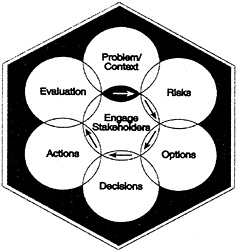
FIGURE ES-1 Framework for environmental health risk management.
The major advantages of this risk-management framework are that (1) it can be applied to any PCB-contaminated-sediment site that might have both new and ongoing remediation; (2) it is iterative, allowing any stage in the framework to be revisited as new information about the site, its environs, remediation technologies, environmental dynamics, or health effects of PCBs becomes available; (3) it can be used to address risks ranging from human health to economic impacts at a site; and (4) it involves all affected parties in all stages of the management process.
6. Risk assessments and risk-management decisions should be conducted on a site-specific basis and should incorporate all available scientific information.
Comparative assessments of overall short-term and long-term risks from various risk-management options are site-specific and depend upon thorough, integrated assessments of human health, ecological, social, cultural, and economic risks. In addition, the broad range of risks at a site—before, during, and after application of a risk-management option—should be assessed so that the overall risk reduction from application of the option is clear. Some examples of these broad-ranging risks include economic impacts, such as changes in the use of a waterway for recreational or commercial purposes, or changes in cultural norms, such as loss of fishing to a culture where fishing is at its core.
Current studies on the toxicity and fate of PCBs in the environment should be used to inform risk assessments at contaminated sites. In recent years, there has been important progress in the scientific understanding of the human health and ecological effects of PCBs and their environmental dynamics. Risk assessments based on the original PCB mixture that entered the environment are not sufficient determinants of either the persistence and toxicity of the weathered PCB mixture present in the sediment or the risks to humans and the ecosystem posed by the weathered mixture. Risk characterizations—and sampling and monitoring to support them—should be performed on the basis of specific congeners and the total mixture of congeners that exist at each site,
rather than on the basis of “total PCBs” (all PCB congeners) or Aroclor (commercial PCB mixtures). This method will allow for an accounting of the differences in the physicochemical, biochemical, and toxicological behavior of the different congeners in the risk calculations.
Many PCB-contaminated sites contain elevated concentrations of other chemicals of concern such as DDT, polycyclic aromatic hydrocarbons, dioxins, furans, and metals. However, the knowledge base for addressing multiple chemical risks is severely limited. As new information becomes available on PCB interactions with other chemicals of concern, it should be factored into ongoing risk assessments. The presence of contaminants other than PCBs at a site can affect the degree of risk reduction achievable by a given risk-management strategy.
Traditional human health and ecological risk assessments are based on the analysis of the hazards and the potential for exposures to the chemical in the environment. For this purpose, exposure models can be used to describe all relevant PCB-exposure pathways from the contaminated sediments through the aquatic food web and to specific organisms. These models should factor in exposures to sensitive populations. With regard to human health, these populations include but are not limited to the elderly, pregnant women, infants, children, and culturally or economically unique populations. For ecosystems, sensitive populations and threatened and endangered wildlife and their habitats should be considered.
PCB mass balance and bioaccumulation models to project future PCB exposure levels have been developed for a number of sites. These models have most often been applied to evaluate natural attenuation scenarios, but in some cases they have also been used to examine the efficacy of other remediation options. The model formulations are reasonably well-developed, but even at sites where extensive data collection has been performed, model calibration and application require a certain degree of professional judgment. The scientific basis for model parameter specification, model calibration procedures, and model assumptions (e.g., of future loading conditions) should be carefully reviewed. Where possible, models should be calibrated and applied on a congener-specific basis to provide a more rigorous calibration and a more representative description of PCB behavior. All these models and their results, which have inherent uncertainty, should be peer reviewed.
The ultimate use of mass balance and bioaccumulation models needs to be tied to risk-management goals. This is a key point since the reduction of PCB mass in sediments is not necessarily equivalent to reduction in exposure or risk. Exposure to, and thus risks from PCBs, is mainly a function of the biological availability of PCBs in the surface sediments, and not the total mass of PCBs in the sediments, particularly PCBs in sediments below the biologi-
cally active zone. Intrusive remediation technologies such as dredging, and the mixing of buried PCBs into the biologically active sediment layer have the potential to disperse buried PCBs and thereby, increase risk in the short term; however, the slow leakage of PCBs from deeper sediments to overlying surface sediments by diffusive processes may serve as a longer-term source.
Contaminated sites might also have contributions from the global redistribution of PCBs. Therefore, such continual global contributions, as well as continuing sources at or near the site, should be considered in the overall risk assessment and in the selection of the management strategy.
7. Identification and adequate control of sources of PCB releases to sediments should be an essential early step in site risk management.
Source identification and control should be the first goal of any risk-management strategy. In some cases, it might be necessary to reassess the risk-management goals and the potential effectiveness of any prescribed remediation technology if it appears that there are continuing sources that cannot be identified or curtailed at a site. If a significant external source of PCBs is not identified or is allowed to persist, then efforts to reduce contaminant levels through other management options are not likely to be successful; for example, this occurred on the Hudson River in 1991, when a previously unidentified source of PCBs was found at an abandoned paper mill (see Chapter 7). Full development of an accurate, verifiable, material-balance-based mathematical model of the site remains one way to identify as-yet-unidentified sources. Lack of source control might make sediment remediation efforts to reduce site-specific risks unsuccessful. In other cases, a continuing source, if not too significant, might simply limit the reduction that is achievable in contaminant levels.
8. There should be no presumption of a preferred or default risk-management option that is applicable to all PCB-contaminated-sediment sites. A combination of technical and nontechnical options is likely to be necessary at any given site.
The development of a successful risk-management strategy at a site requires a combination of technical and nontechnical options. Technical options include source control, dredging, capping, and bioremediation; nontechnical options include natural attenuation and institutional controls (e.g., fish consumption advisories or covenants). A risk-management strategy may include some combination of the following options; each of which is described below:
-
Institutional controls.
-
Source control (discussed previously).
-
Natural attenuation.
-
In situ treatments, which include
-
Capping.
-
Biological degradation.
-
-
Multicomponent removal and ex situ treatments, which include
-
Dredging technologies.
-
Treatment technologies for dredged materials before disposal.
-
Ex situ treatment and disposal technologies.
-
Technologies for management of residual contaminants.
-
Institutional controls are “interim controls” implemented to control exposure to contaminants and reduce risk to humans and the environment until risks can be reduced to acceptable levels by other remediation options. There are four general categories of institutional controls: government controls; proprietary controls; enforcement tools with institutional-control components; and informational devices.
Natural attenuation processes will be a part of any remediation strategy, because some residual PCBs are expected to remain at a site despite efforts to remove all contamination. Natural attenuation processes consist of sedimentation and/or biodegradation. These processes are most effective in areas that are hydrodynamically stable and where deposition of clean sediments is occurring, resulting in the burial of the contaminated sediments. Biodegradation might occur either anaerobically or aerobically depending on the composition of the PCB mixture and nature of the sediments.
In situ treatment options include capping and enhanced biological degradation. The use of capping is limited to sites where adequate placement and maintenance of the cap is feasible. For example, in situ containment by thick-layer capping and armoring can be an effective means of reducing risks where the cap can be maintained because of (1) a hydrodynamically stable environment, (2) adequate design of protective structures, and (3) adequate monitoring and maintenance of the containment system. See Chapter 7 for a description of in situ capping in Hamilton Harbor, Lake Ontario. Other innovative in situ treatments, such as enhanced biological degradation and active treatment caps, are still in the experimental stage and are not yet practical options for remediating PCB-contaminated sediments.
Ex situ remediation technologies, such as dredging and dry excavation, might have limited applicability due to their high cost, difficulty in controlling contaminants during removal, and lack of disposal options for post-treatment residuals. However, ex situ remediation technologies may be effective for
exposed and accessible “hot spots” that pose significant risks. Removal options such as dredging and dry excavation require pre-treatment (dewatering and volume equalization) and appropriate treatment and disposal options for the excavated sediments (landfilling, treatment, incineration, or placement in a confined disposal facility) and for any separated liquids. Dredging at sites such as Manistique Harbor, Michigan, and the Grasse River at Massena, New York, is discussed in Chapter 7. The committee concluded that there have been substantial improvements in the ability of removal technologies to target and process specific sediment zones. However, there have been few improvements in methods to contain contaminants during removal and subsequent treatment and disposal. None of the ex situ options is completely effective in eliminating risks. Therefore, these residual risks must be considered when comparing in situ versus ex situ management options.
The optimal risk-management strategy to be chosen for a particular site depends upon site-specific factors and conditions, such as sediment depth, currents, ecosystems, extent of contamination, and cocontaminants, as well as local social, legal, cultural, and economic considerations. The effectiveness of any strategy is dependent on those site-specific conditions and cannot be predicted without a full understanding of the hydrogeological setting and the risk-reduction potentials of the management options appropriate for that site. Selection of the risk-management strategy will depend upon which risks need to be addressed.
9. Current management options can reduce risks but cannot completely eliminate PCBs and PCB exposure from contaminated sediment sites. Because all options will leave some residual PCBs, the short- and long-term risks that they pose should be considered when evaluating management strategies.
Because of the dimensions of many PCB-contaminated-sediment sites (some covering many miles), complete removal of all PCBs from a site is neither feasible nor practical. Even after the application of a remediation technology, some level of residual contamination will remain. The efficacy and adequacy of any option to manage residual contamination depends on site-specific factors, such as water currents, type of sediment, and topography of the river bed.
There are uncertainties inherent in the assessment and application of any remediation technology. These uncertainties include predictions of failure of the technology (e.g., stability of the cap), estimates of the level of residual contamination, and the financial costs expected at a particular site. Specific areas of uncertainty include (1) the long-term stability of sediment and
sediment caps and the types of failure that might occur if caps are destabilized; (2) assessment of residual PCB mass and concentration levels resulting from the inability to capture or target all contaminated sediments; (3) assessment of the bioavailability of PCBs in the surface sediments; and (4) estimates of the financial costs for a remediation strategy due to inadequate site characterization.
Decision-makers selecting a risk-management strategy for a site should be sensitive to how the affected parties are informed about, perceive, and accept not only the short-term and long-term risks from PCBs, but also those risks resulting from the implementation of any remediation technologies. For example, a community might consider the risk of a critical habitat loss during remediation to be a priority, particularly if there are threatened or endangered species present.
10. Long-term monitoring and evaluation of PCB-contaminated-sediment sites should be conducted to evaluate the effectiveness of the management approach and to ensure adequate, continuous protection of humans and the environment
Long-term evaluation at a site is crucial to determining the success of the chosen management strategy. Monitoring information is available from only a few sites where a risk-management strategy has been implemented and fewer still where it has been completed—for example, Massena, New York; New Bedford, Massachusetts; Duwamish Waterway, Washington, and Manistique Harbor, Michigan. Long-term monitoring results are sparse, in part because most actual management efforts were conducted within the past 5 years, and only a few were conducted as long as 10 years ago. There are significant disincentives to conducting long-term monitoring, including costs and a need for closure. Nevertheless, such monitoring is critical to evaluating the effectiveness of any management strategy, both at that site and at other similar sites where the management options might be applicable.
Presently available monitoring information has been gathered mainly during implementation to (1) measure ambient exposures to PCBs to protect human health; (2) monitor PCB releases to water and PCB concentrations in either wild-caught or caged fish and other aquatic organisms in an effort to minimize ecological risks; and (3) assess bioavailable PCBs in the surface sediments. In addition to monitoring during implementation, adequate long-term monitoring is needed to ensure that the protection of human health and the environment has occurred.
The collection of baseline data for new sites before risk management is undertaken is essential. For ongoing sites where additional remediation is
likely, the collection of data during the implementation of the current management strategy may form the basis for future management decisions. Adequate data for pre-remediation baseline assessment are often lacking at sites currently undergoing remediation, making evaluation of the effectiveness of the risk-management strategy difficult.
Short-term and long-term assessments of the efficacy of the risk-management strategy require carefully planned and adequately funded monitoring. Information gathered from assessments of completed and ongoing management projects should be used in the risk assessments, and within the risk-management framework, to inform decisions about remediation options and management strategies for other sites. The information to be gathered should not be restricted to that identified in the remedial investigation/feasibility study guidelines or in the guidelines for conducting human health or ecological risk assessments. Rather, data-gathering efforts should be directed to determine the successful management of all types of risk, including societal, cultural, and economic risks. Therefore, the types of information that might need to be gathered could include, but not necessarily be limited to, data such as number of fish caught by sport fishers, loss of revenues to marinas, and restrictions on navigation.
Each site should have a communication mechanism by which the affected parties can have rapid and easy access to monitoring data and a clear understanding of the implications of the data. Various mechanisms may be used to provide this access; interactive websites and a central repository for the data such as a public library may be used. These mechanisms need to be coupled with an agreed upon mechanism for involvement of all parties in the management process if the monitoring data indicate significant deviations from the expected results.


