
1
The Committee's Task and the Particulate-Matter Research Enterprise
THE COMMITTEE'S TASK
The Committee on Research Priorities for Airborne Particulate Matter was convened by the National Research Council (NRC) in January 1998 at the request of the U.S. Environmental Protection Agency (EPA) pursuant to directions from Congress in EPA's fiscal year 1998 appropriations report. The congressional request for this independent NRC study arose from scientific uncertainties in the data used in EPA's July 1997 decision to establish new National Ambient Air Quality Standards (NAAQS) for airborne particulate matter (PM) smaller than 2.5 µm in aerodynamic diameter (EPA 1997).1 Contemplating the next and later reviews of the new standards in 2002 and every 5 years thereaf-
|
1 |
PM10 refers to particulate matter collected by a sampling device with a size-selective inlet that has a 50% collection efficiency for particles with an aerodynamic diameter of 10 µm. PM2.5 is similarly defined except with reference to a 2.5-µm size cut. “Total suspended particles” (TSP) was defined as the particle mass collected by a sampling device with a size-selective inlet that has a 50% collection efficiency for particles with an aerodynamic diameter of about 30 µm. |
ter and EPA's proposed schedule for regulatory implementation of the new standards (Table 1.1), Congress mandated and appropriated substantial funds for EPA to conduct a major research program to reduce the scientific uncertainties. It also directed the EPA administrator to arrange for the NRC to provide independent guidance for planning the research program and monitoring its implementation. Specifically, the committee was charged to assess research priorities, and develop a conceptual research plan, and monitor research progress made over the 5 years 1998-2002 toward improved understanding of the relationships among airborne PM, its various sources, and its effects on public health.
TABLE 1.1 EPA's Review and Implementation Timetable for Particulate-Matter Standardsa
|
Past Actions |
|
|
1971 |
EPA issues TSP NAAQS |
|
1979-1987 |
Criteria and standards are reviewed |
|
1987 |
EPA issues PM10 NAAQS |
|
1994-1997 |
Criteria and standards are reviewed |
|
1997 |
EPA issues PM2.5 and revised PM10 NAAQSs |
|
1999 |
EPA designates areas as “unclassifiable” regarding attainment of NAAQS for PM2.5 |
|
1998-2000 |
PM2.5 monitors are placed nationwide |
|
Planned Actions |
|
|
1998-2003 |
PM2.5 monitoring data to be collected nationwide |
|
2002 |
EPA will complete 5-year scientific review of PM2.5 standards, leading to possible revision |
|
2002-2005 |
EPA will designate nonattainment areas for PM2.5 |
|
2005-2008 |
States will submit implementation plans for meeting PM2.5 standard. |
|
2012-2017 |
States will have up to 10 years and two 1-year extensions to meet PM2.5 standards |
|
a The impact of the U.S. Supreme Court decision on this timetable is unknown. That decision is pending at the time of completion of this report. |
|
The committee's formal statement of task is presented in Appendix B. This is the committee's third report; a fourth report is scheduled for the end of 2002.
Because the committee has been directed to focus on human health effects, it did not include consideration of research on the effects of airborne PM on nonhuman biota and the environment (see Text Box 1.1). The committee's focus has been on contributions to ambient PM from human activity. Of course, airborne PM includes a natural component and some of those particles (such as pollen) have shown adverse health effects.
The committee's first report, Research Priorities for Airborne Particulate Matter: I. Immediate Priorities and a Long-Range Research Portfolio was released in 1998 (NRC 1998). It proposed a conceptual framework for a national program of PM research (see Figure 1.1) identified 10 high-priority research topics linked to key policy-related scientific uncertainties (see Table 1.2); and presented a 13-year integrated “re-
|
TEXT BOX 1.1 Nonhuman Effects of Airborne Particles In addition to effects on human health, airborne particles have other important effects. Light scattering and absorption in the atmosphere can reduce visibility and cause discoloration of the sky. Interference with solar radiation and particleborne nutrient and acid fluxes can affect ecosystem and agricultural productivity because of reduction or redistribution of light or chemical substances in the environment. Particle deposition onto surfaces leads to the discoloration of historic buildings, monuments, and museum collections. Particle deposition also can accelerate the corrosion of metal structures as varied as bridges and outdoor sculptures. And, there can be direct or indirect health effects on wild and domesticated animals. EPA has the responsibility under the Clean Air Act to consider secondary national ambient-air-quality standards that provide appropriate protection from the “welfare” effects of air pollutants, such as those listed above. The work of this NRC committee has been directed solely at providing the design of a research program that elucidates the human health effects of airborne particles. The committee notes that EPA has the further obligation to conduct research on the nonhealth effects of airborne particles, and it urges EPA to design and implement its own research program to that end. |
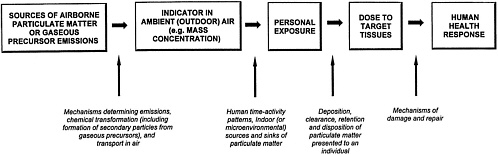
FIGURE 1.1 A general framework for integrating particulate-matter research. Note that this figure is not intended to represent a framework for research management. Such a framework would include multiple pathways for the flow of information. Sources: Modified from NRC (1983, 1994), Lioy (1990), and Sexton et al. (1992).
TABLE 1.2 Key Scientific Uncertainties Related to the Source-to-Response Framework
|
Source → Concentration (or other indicator)
|
|
Concentration (indicator) → Exposure
|
|
Exposure → Dose
Asthma Chronic obstructive pulmonary disease (COPD) Heart disease Age: infants and elderly Others |
|
Dose → Response
Inflammation Host defenses Neural mechanisms |
search investment portfolio” containing recommended short- and long-term phasing of research and estimated costs of such research.
In its second report, Research Priorities for Airborne Particulate Matter: II. Evaluating Research Progress and Updating the Portfolio, the committee described its initial plans for monitoring the progress of research (NRC 1999). In addition, the research recommendations from the committee's first report were reviewed and updated, and two of the recommended research topics were substantially revised. The committee's updated research investment portfolio for fiscal years 2000-2010 is shown in Table 1.3. The committee's estimates for technical support are presented in Table 1.4.
In response to the committee's first two reports, Congress and EPA made substantial changes in EPA's research program and other technical activities related to PM. In fiscal year 1997, EPA's enacted budget for PM research and related technical work was about $21 million. However, for fiscal years 1998-2001, that amount was increased substantially by Congress: $50.2 million, $55.7 million, $62.4 million, and $65.3 million, respectively. Table 1.5 summarizes the levels of resources allocated to the 10 categories of research recommended by this committee for fiscal years 1998-2001. The table shows the amounts of funding allocated to intramural and extramural research funding for each category. Most of the funding has been used to support intramural studies within EPA.
It is important to note that the work of the committee is separate from the process of reviewing the PM NAAQS. The committee's work is intended to provide advice on the PM research program, which informs the review process. Therefore, the committee was neither charged nor constituted to evaluate the adequacy of the scientific foundation of EPA's 1997 decision to issue new PM standards; in addition to scientific information, such a decision involves policy judgments beyond the realm of science. As part of the NAAQS review process, EPA has prepared a draft “criteria document” that reviews the latest scientific information to be used as the scientific basis of reevaluation of the PM NAAQS. Drawing from the criteria document, EPA's “staff paper” is being prepared to provide a written assessment of the most policy-relevant scientific information and technical analyses that form the basis of recommendations and decisions about the NAAQS.
TABLE 1.3 Committee's Research Investment Portfolio for FY 2000-2010: Timing and Estimated Costsa ($ million/year in 1998 dollars) of Recommended Research on Particulate Matter
|
2000 |
2001 |
2002 |
2003 |
2004 |
2005 |
2006 |
2007 |
2008 |
2009 |
2010 |
|
|
SOURCE, CONCENTRATION, and EXPOSURE |
|||||||||||
|
1. Outdoor vs. human exposure |
3.0 |
||||||||||
|
2. Exposure to toxic PM components |
|||||||||||
|
2a. Methods |
1.0 |
||||||||||
|
2b. Studies |
4.0 |
4.0 |
4.0 |
4.0 |
4.0 |
||||||
|
3. Emission sources |
2.5 |
2.5 |
2.5 |
2.5 |
|||||||
|
4. Models |
|||||||||||
|
4a. Source-orientedb |
4.5 |
4.5 |
4.5 |
4.5 |
4.5 |
4.5 |
4.5 |
||||
|
4b. Receptor-oriented |
1.0 |
1.0 |
1.0 |
||||||||
|
EXPOSURE and DOSE-RESPONSE RELATIONSHIP |
|||||||||||
|
5. Assessment of hazardous PM components |
|||||||||||
|
5a. Toxicologic and clinical studies |
8.0 |
8.0 |
8.0 |
||||||||
|
5b. Epidemiology |
1.0 |
6.0 |
6.0 |
6.0 |
6.0 |
6.0 |
6.0 |
6.0 |
6.0 |
6.0 |
6.0 |
|
6. Dosimetry |
1.5 |
1.5 |
|||||||||
|
7. Effects of PM and copollutants |
|||||||||||
|
7a. Copollutants (toxicology) |
4.0 |
4.0 |
4.0 |
4.0 |
5.0 |
5.0 |
5.0 |
5.0 |
5.0 |
5.0 |
5.0 |
|
7b. Copollutants, long term (epidemiology) |
6.0 |
6.0 |
6.0 |
6.0 |
6.0 |
6.0 |
6.0 |
6.0 |
6.0 |
3.0 |
3.0 |
|
8. Susceptible subpopulations |
3.0 |
3.0 |
3.0 |
3.0 |
3.0 |
3.0 |
|||||
|
9. Toxicity mechanisms |
|||||||||||
|
9a. Animal models |
3.0 |
3.0 |
3.0 |
3.0 |
|||||||
|
9b. In vitro studies |
3.0 |
3.0 |
3.0 |
3.0 |
|||||||
|
9c. Clinical studies |
3.5 |
3.5 |
3.5 |
3.5 |
|||||||
|
ANALYSIS AND MEASUREMENT |
|||||||||||
|
10a. Statistical analysis |
1.0 |
1.0 |
1.0 |
1.0 |
|||||||
|
10b. Measurement error |
1.5 |
3.0 |
2.0 |
2.0 |
|||||||
|
SUBTOTALS |
47.5 |
54.0 |
51.5 |
42.5 |
28.5 |
28.5 |
21.5 |
17.0 |
17.0 |
14.0 |
14.0 |
|
RESEARCH MANAGEMENT COST c (ESTIMATED AT 10%) |
4.8 |
5.4 |
5.2 |
4.3 |
2.9 |
2.9 |
2.2 |
1.7 |
1.7 |
1.4 |
1.4 |
|
TOTALS |
52.3 |
59.4 |
56.7 |
46.8 |
31.4 |
31.4 |
23.7 |
18.7 |
18.7 |
15.4 |
15.4 |
|
a The committee's rough but informed collective-judgment cost estimates for the highest-priority research activities recommended in this report. See Chapter 3 of NRC 1999 and Chapter 4 of NRC 1998 for explanations. These estimates should not be interpreted as a recommended total particulate-matter research budget for EPA or the nation, for reasons explained in NRC 1998. b These estimates are in addition to costs for EPA's "supersite" program and expansion of the nationwide speciation network, as well as likely expenditures by states, local agencies, and industries for source-emissions inventories and field-measurement campaigns in support of model-evaluation studies (see Table 1.4). c Research management includes research planning, budgeting, oversight, review, and dissemination, cumulatively estimated by the committee at 10% of project costs. |
|||||||||||
TABLE 1.4 Committee's Technical-Support Estimates: Timing and Estimated Costs a ($ million/year in 1998 dollars) of Additional Technical Work Needed for Implementation of Emissions Control Programs for Airborne Particles
|
2000 |
2001 |
2002 |
2003 |
2004 |
2005 |
2006 |
2007 |
2008 |
2009 |
2010 |
|
|
ACTIVITY |
|||||||||||
|
1. Source testing by regulatory programs |
5.0 |
5.0 |
5.0 |
5.0 |
5.0 |
||||||
|
2. Compilation of interim PM emission inventory |
1.0 |
1.0 |
1.0 |
1.0 | |||||||
|
3. Compilation of PM emission inventory based on results of new source information |
1.0 |
1.0 |
1.0 |
||||||||
|
4. Field studies in support of air-quality model evaluation and testing |
20.0 |
20.0 |
20.0 |
20.0 |
20.0 |
||||||
|
TOTALS |
1.0 |
21.0 |
26.0 |
26.0 |
25.0 |
25.0 |
6.0 |
1.0 |
1.0 |
||
|
a Technical-support expenditures by all public and private sponsoring organizations. |
|||||||||||
TABLE 1.5 EPA Intramural and Extramural PM-Research Enacted Budgets and Implementation for FY 1998-2001 ($ million/year in actual dollars)a
|
NRC Committee Recommended Research Topic |
Recipientb |
FY 1998 |
FY 1999 |
FY 2000 |
FY 2001 |
|
1. Outdoor vs. human exposure |
Total |
$6.3 |
$8.2 |
$8.1 |
$5.3 |
|
Intramural |
$4.1 |
$8.2 |
$7.6 |
$4.8 |
|
|
Extramural |
$2.2 |
$0.0 |
$0.5 |
$0.5 |
|
|
2. Exposure to toxic PM components |
Total |
$0.5 |
$0.0 |
$0.6 |
$0.6 |
|
Intramural |
$0.0 |
$0.0 |
$0.0 |
$0.0 |
|
|
Extramural |
$0.5 |
$0.0 |
$0.6 |
$0.6 |
|
|
3. Emission sources |
Total |
$5.5 |
$7.0 |
$4.7 |
$4.5 |
|
Intramural |
$3.6 |
$5.6 |
$4.2 |
$4.0 |
|
|
Extramural |
$1.9 |
$1.4 |
$0.5 |
$0.5 |
|
|
4. Air-quality models |
Total |
$0.5 |
$0.4 |
$6.6 |
$7.2 |
|
Intramural |
$0.0 |
$0.4 |
$6.0 |
$6.7 |
|
|
Extramural |
$0.5 |
$0.0 |
$0.6 |
$0.6 | |
|
5. Assessment of hazardous PM components |
Total |
$7.9 |
$7.9 |
$8.1 |
$6.7 |
|
Intramural |
$4.1 |
$3.3 |
$4.8 |
$4.5 |
|
|
Extramural |
$3.8 |
$4.6 |
$3.2 |
$2.2 |
|
|
6. Dosimetry |
Total |
$1.5 |
$0.6 |
$1.3 |
$1.1 |
|
Intramural |
$1.0 |
$0.6 |
$0.8 |
$0.6 |
|
|
Extramural |
$0.4 |
$0.0 |
$0.5 |
$0.5 |
|
|
7. Effectsof PM and copollutants |
Total |
$2.3 |
$7.4 |
$6.4 |
$11.7 |
|
Intramural |
$0.0 |
$2.6 |
$2.3 |
$4.7 |
|
|
Extramural |
$2.3 |
$4.9 |
$4.1 |
$7.0 |
|
8. Susceptible subpopulations |
Total |
$8.4 |
$2.7 |
$2.9 |
$2.7 |
|
Intramural |
$3.9 |
$2.4 |
$1.9 |
$1.7 |
|
|
Extramural |
$4.6 |
$0.3 |
$1.0 |
$1.0 |
|
|
9. Toxicity mechanisms |
Total |
$5.6 |
$8.3 |
$8.2 |
$8.4 |
|
Intramural |
$2.5 |
$2.7 |
$3.0 |
$3.6 |
|
|
Extramural |
$3.1 |
$5.7 |
$5.2 |
$4.8 |
|
|
10. Analysis and measurement |
Total |
$1.6 |
$1.2 |
$1.0 |
$1.0 |
|
Intramural |
$1.1 |
$1.2 |
$0.5 |
$0.5 |
|
|
Extramural |
$0.5 |
$0.0 |
$0.5 |
$0.5 |
|
|
SUBTOTAL |
$40.1 |
$43.8 |
$47.8 |
$49.3 |
|
|
INTRAMURAL |
20.3 |
27.0 |
31.1 |
31.1 |
|
|
EXTRAMURAL |
19.8 |
16.9 |
16.7 |
18.2 |
|
|
Management expenses c |
$1.9 d |
$3.6 e |
$5.9 e |
$1.7 |
|
|
Working capital and operating expenses |
— d |
— e |
— e |
$8.0 |
|
|
TOTAL FOR NRC RECOMMENDED RESEARCH |
$42.0 |
$47.3 |
$53.7 |
$59.0 |
|
|
Implementation-Related Activity f |
|||||
|
Technical support |
Total |
$2.9 |
$3.4 |
$3.2 |
$1.7 |
|
Intramural |
$2.9 |
$3.4 |
$3.2 |
$1.7 |
|
|
Extramural |
$0.0 |
$0.0 |
$0.0 |
$0.0 |
|
|
Supersites |
$2.9 |
$2.0 |
|||
|
Emissions characteristics, factors, and controls |
Total |
$4.0 |
$3.5 |
$1.2 |
$1.0 |
|
Intramural |
$3.7 |
$3.2 |
$1.2 |
$1.0 |
|
|
Extramural |
$0.4 |
$0.4 |
$0.0 |
$0.0 |
|
The criteria document and the staff paper are reviewed in draft form by the public and by EPA's Clean Air Scientific Advisory Committee.
On May 14, 1999, a panel of the U.S. Court of Appeals for the District of Columbia Circuit remanded several NAAQS issued by EPA in July 1997, including the new standards for PM2.5 (EPA 1997). The court required EPA to provide more explanation of its decisionmaking process and criteria in setting the standards. The U.S. Supreme Court was later asked to consider this case and heard oral arguments on November 7, 2000. The potential impact of the court's upcoming decision on EPA's implementation schedule for the PM NAAQS (see Table 1.1) is unknown. That decision is pending at the time of completion of this report.
As stated in its second report, the committee believes strongly that the PM research program should continue to move forward expeditiously. Whatever the resolution of the legal proceedings, the public health and regulatory issues concerning PM will remain. The scientific uncertainties related to those issues are of paramount importance to public policy, and a promising national research effort to reduce the uncertainties has been initiated at great effort and expense. If stopped, a research program of this scope could not easily be started again, and any substantial disruption in the current and planned research efforts might be very costly to the nation in economy and public health.
THE PARTICULATE-MATTER RESEARCH PROGRAM
EPA's Office of Research and Development (ORD) has aligned its PM research program to respond to the set of research priorities identified by this committee. The overall research effort involves inhouse studies at EPA laboratories and centers, EPA funding of university-based research centers and investigator-initiated competitive research grants, and enhanced collaboration with other agencies and organizations. Several components of the research program are discussed below. Because this overall program has been in existence for only a few years, much of the research initiated as part of it is still in progress. Much relevant research is also being funded by other governmental and nongovernmental agencies.
Research Centers
In fiscal year 1998, Congress urged EPA to establish as many as five university-based research centers focused on PM and provide additional funding to expand PM research efforts. The PM research centers were solicited to construct integrated programs that address PM research needs in exposure, dosimetry and extrapolation modeling, toxicology, and epidemiology. These centers were established as part of EPA' s Science to Achieve Results (STAR) Program through a competitive award process. EPA issued a request for applications that encouraged the proposals to include a multidisciplinary approach and, in carrying out the proposed research, to take advantage of existing air-quality databases and major new databases as they become available. Each of the following centers received an award of about $8 million to be expended over a 5-year period: New York University School of Medicine; University of Rochester; University of California, Los Angeles; Harvard University School of Public Health; and University of Washington.
Ambient-Air Monitoring
The air-quality measurement system now being implemented includes several key elements: an extensive network of PM mass monitors installed on a population-weighted basis and intended primarily to measure compliance of different metropolitan areas with the 1997 NAAQS for PM2.5; a much smaller number of continuous PM2.5 monitors in key metropolitan areas; a network of speciation monitors to provide basic and comparable speciation of PM2.5 samples; and the supersites, which involve intensive shorter-term sampling efforts at selected sites around the country.2
To commence the PM supersite program, EPA selected two phase I sites: Atlanta, GA and Fresno, CA. Seven phase II sites were awarded cooperative agreements in January 2000: New York, NY; Pittsburgh, PA; Baltimore, MD; St. Louis, MO; Houston, TX; Los Angeles, CA; and
|
2 |
Chapter 4 of this report represents a brief case study concerning implementation of the supersite and speciation programs. |
Fresno, CA. The work in Atlanta for phase I has been completed and EPA is considering additional work at this site. Funding for the supersites is provided by EPA's Science and Technology appropriations, including funds provided through the Office of Air and Radiation and ORD. The primary objectives of the supersites are to obtain atmospheric measurements for the following purposes:
-
To characterize PM and its constituents, precursors, copollutants, atmospheric transport, and source categories that affect airborne PM.
-
To address research questions and scientific uncertainties about PM source-receptor-exposure-effects relationships.
-
To compare and evaluate different methods of characterizing PM (such as different sampling and monitoring techniques).
Particulate-Matter Management Infrastructure
In its first two reports, the committee emphasized the critical need for the federal government to provide overarching and integrated management for the PM research program. Without such management, it is likely that useful and interesting individual research projects will lack synthesis into a coordinated, multidisciplinary program to ensure that key PM research questions are answered. To accomplish integrated management, the committee recommended, in its second report, that the proposed expansion of the charter of the Air Quality Research Subcommittee of the Interagency Committee on Environment and Natural Resources (CENR) 3 be “encouraged to promote greater coordination of the resources of the federal government
|
3 |
CENR is part of the National Science and Technology Council. The overall aims of the Air Quality Research Subcommittee are to enhance the effectiveness and productivity of U.S. air-quality research and to provide a better scientific basis for decisionmaking on policies designed to improve air quality. |
on PM research.” Specifically, the committee called for a coordinated, peer-reviewed, interagency strategy that would include the following:
-
A process and budget to implement the PM research portfolio recommended by the committee.
-
The specific methods that would be used to coordinate research across agencies on a continuing basis.
-
Strategies and mechanisms for leveraging funding within the federal sector, state governments, and the private and nonprofit sectors.
The committee was pleased to hear at its May 2000 meeting that the CENR Air Quality Research Subcommittee charter had been expanded and that efforts were under way, as a critical first step in creating an integrated federal strategy, to establish a complete federal inventory of PM research and to make it available through the Particulate Matter Research Activities web site (www.pmra.org). (See Chapter 2 for a description of the inventory.) On the basis of the inventory, the Air Quality Research Subcommittee is developing a strategy for integrating federal research on PM. Successful completion of these efforts continues to be a key to the success of the PM effort.
In its second report, the committee also noted that EPA is the agency with the largest mandate and budget for PM research. The committee recommended that EPA implement an effective management structure to ensure multidisciplinary integration of its research and air-quality monitoring efforts. Specifically, the report recommended that “top EPA research and policy officials should participate and provide management guidance during all major decision points in planning, managing, implementing, and evaluating the PM research program.”
EPA has taken several important steps to implement the structure necessary for the success of the PM research effort. Specifically, it has established a formal management structure, led by an ORD PM research program manager; this has enabled the initial development of multiyear research budgets (an important innovation) and regular reporting of budget priorities and progress toward addressing the
research priorities. The agency has also continued to commit resources comparable with those proposed in the committee's research portfolio. And the assistant administrator for ORD had tasked EPA's Board of Scientific Counselors to review the management of the research effort in detail and provide specific recommendations on how to improve management.
At the same time, EPA's Office of Air and Radiation (which has important responsibility for monitoring, supersites, and emission inventories) participates in the EPA management structure for PM programs and has undertaken some valuable efforts to integrate research needs into the implementation of the monitoring and supersite program. However, there needs to be a strong senior-level commitment to sustaining and managing these efforts over the long term. (See the discussion and recommendations in Chapter 4.) Mechanisms for ensuring better cross-agency implementation of scientific initiatives have been recommended in a recent report of the NRC Committee on Research and Peer Review in EPA (NRC, 2000).
ORGANIZATION OF THIS REPORT
In the next chapter, the committee discusses its six evaluation criteria and the approach it used for evaluating progress of the PM research program. Chapter 3 presents the committee's review of progress made in each of the 10 topics in the research portfolio. Chapter 4 summarizes findings and recommendations resulting from the committee 's evaluation of progress made in research on PM. The chapter also addresses general issues related to the program's implementation, providing a briefcase study in EPA's implementation of the speciation and supersite air-monitoring program.


