
Page 45
6
Alternatives Available by 2006
The Information Age will alter modern warfare in the twenty-first century just as the Industrial Age altered twentieth century battlefields with new forms of integrated mechanization. (Scales, 1999)
OVERVIEW
A variety of systems could be available for implementation by 2006. Some would be improvements of existing systems; some would be the results of DOD's early efforts to identify alternatives; and some would be combinations of systems that have been under consideration for other missions. However, unless DOD gives these new technologies a very high priority, six years will not be long enough for the weaponization of any innovative technology. These new alternatives will be characterized by the separation of sensors and kill mechanisms and improved communications between sensors and soldiers. In the near term, a “man-in-the-loop” will still be necessary, but sensors will alert him much earlier and more subtly than current APL, which only provide notification by exploding on contact. This chapter describes nonmateriel and materiel alternatives that could be available by 2006.
NONMATERIEL ALTERNATIVES
Some adaptations of tactics and doctrine may provide alternatives to certain aspects of APL, although none would replace all APL functions. In the near future, it may be possible to develop new tactics and doctrine that incorporate improvements in sensors and communications and provide more suitable alternatives than those currently available. However, the committee could not identify alternative tactics or operational concepts that could, on their own by 2006, provide tactical advantages similar to those provided by APL.
MATERIEL ALTERNATIVES
Common Features
Man-in-the-Loop
The man-in-the-loop feature requires that a soldier determine whether a target is friendly or hostile, visually or by using sensor input, before activating the response element. Although the man-in-the-loop satisfies humanitarian concerns and would reduce fratricide, it introduces some new vulnerabilities: (1) if the soldier/operator is disabled or killed, the minefield becomes inoperable; (2) the requisite communication links between the soldier/operator and the mines can be disrupted rendering the minefield ineffective; (3) a single soldier/operator may have difficulty processing large amounts of data under stressful, chaotic conditions; (4) some sensor capabilities, such as video imagery, are subject to degradation by adverse weather conditions or terrain; (5) sensors and communication systems could be susceptible to electromagnetic pulse.
Delinked Sensor-Shooter Concept
Separating the sensor from the response element (whether lethal or nonlethal) would provide a range of responses to an enemy breach. If the target can be identified prior to firing on it, the response can be more accurate and more effective. However, the more complicated the system, the more vulnerable it is to countermeasures. For example, some sensor capabilities, such as video imagery, are subject to
Page 46
degradation by certain adverse weather conditions or terrain. In addition, sensors and communication systems are more susceptible to electromagnetic pulse and similar phenomena than mechanical APL. Furthermore, systems in which the sensor is separated from the response element can not, by definition, respond instantaneously.
The committee evaluated 15 alternative systems that should be available by 2006. These are listed, along with some of their characteristics, in Table 6-1. Six of the alternatives would be used against dismounted threats. These were compared with the current M14 and M16 mines as a baseline. The nine alternatives that would be used against mounted threats were compared with the current M87 Volcano mixed mine system as a baseline. Descriptions of the alternatives follow as well as brief written assessments and a table measuring the alternatives against the criteria described in Chapter 4.
|
Dismounted Enemy |
Mounted Enemy |
|||||||
|
System Name |
APL/AT/Mixed Non-Mine |
Self-destructing/Self-deactivating |
Lethal/Nonlethal |
Ottawa Complianta |
Remotely Delivered |
Hand Emplaced |
Remotely Delivered |
Hand Emplaced |
|
Hand-Emplaced Sensor Field (HESF) |
n/m |
n/a |
n/a |
Y |
X |
|||
|
Nonself-Destructing Alternative (NSD-A) Track I |
APL |
Y |
L |
b |
X |
|||
|
Sphinx-Moder Perimeter Defense System |
APL |
N |
L |
Y |
X |
|||
|
Multiple-Shot Claymore Mine |
APL |
N |
L |
Y |
X |
|||
|
Bounding Nonlethal Munition (BNLM) |
n/m |
n/a |
N/L |
Y |
X |
|||
|
Taser Nonlethal Munition |
n/m |
n/a |
N/L |
Y |
X |
|||
|
Wide Area Munition Product Improvement Program (WAM PIP) |
AT |
Y |
L |
Y |
X |
|||
|
Remote Area-Denial Artillery Munition (RADAM) Track I |
Mix |
Y |
L |
N |
X |
X |
||
|
RAAMS Enhanced with Telemetry (RD Telemetry) |
AT |
Y |
L |
Y |
X |
|||
|
Canister-Launched Area-Denial System (CLADS)c |
APL |
n/a |
N/L |
Y |
X |
X |
||
|
Volcano-CLADS |
Mix |
Y |
L |
Y |
X |
X |
||
|
AT Pure-Modular-Pack Mine System |
AT |
Y |
L |
Y |
X |
|||
|
AT Pure-Gator |
AT |
Y |
L |
Y |
X |
|||
|
Dual-Purpose Improved Conventional Munition (DPICM) with Random-Delay Fuzing (Popcorn) |
Mix |
Y |
L |
Y |
X |
X |
||
|
Small Short-Duration Mine System (SSDMS) |
Mix |
Y |
L |
N |
X |
X |
a The committee used the definition found in the Ottawa Convention to determine whether a system would be Ottawa compliant.
b Ottawa compliance would depend on whether the battlefield override switch was a part of the design.
c Assumed to be used alongside AT mines.
For Use Against Dismounted Threats
Hand-Emplaced Sensor Field
Source: Committee on Alternative Technologies to Replace Antipersonnel Landmines in discussions with DOD scientists
The Hand-Emplaced Sensor Field (HESF) could provide an early warning that dismounted intruders were approaching. The sensors could combine acoustic, laser, and infrared virtual trip wires, infrared imaging, motion, video, biological, seismic, or other technologies. Sensor input could be communicated back to the operator via either wire/fiber optics or wireless communication using a Single-Channel Ground-to-Air Radio System (SINCGARS).
The distance between the sensors and the friendly location would depend on the situation. Sensors would be far
Page 47
enough away to give the operator and his leadership time to assess the situation and take appropriate action. Responses could include alerting nearby outposts, dispatching a manned patrol, and sending a more sophisticated sensor array to gather more information. If enemy activity were confirmed, the operator would notify the leadership, who could take appropriate action, such as calling for direct or indirect fire.
HESF could reinforce the capabilities of the DOD Track I alternative (NSD-A) envisioned for use in Korea by giving soldiers time to react appropriately rather than being forced to take almost instantaneous action and having to be fully alert at all times.
With appropriate sponsorship, HESF with the following existing or emerging components could be ready by 2006: existing components of the Improved Remotely-Monitored Battlefield Sensor System, fiber optics, commercial antiintrusion technology, and near state-of-the-art sensors that are being developed in governmental and developmental laboratories.
Doctrine and tactics for the HESF would have to be developed. Areas to be addressed would include: maximizing the use of terrain; reducing the enemy's ability to defeat the sensors; establishing patterns of sensor emplacement; and detailing how sensors would be integrated into the tactical plan to complement and take full advantage of other tactical weapons in the battlefield area.
The most difficult challenge is likely to be in hardening and integrating the various components. The Army has already conducted some experiments on the HESF concept, and the research community has invested heavily in sensor technologies in the past several years. However, there is currently no funded program for developing an HESF.
Advantages
-
HESF would be compliant with the CCW Amended Protocol II and the Ottawa Convention.
-
HESF would provide early warning, allowing enough time for a coordinated tactical response that could bring in all available weapon systems.
-
The system has a man-in-the-loop, which may address humanitarian concerns.
-
The additional reaction time may reduce fratricide and injuries to noncombatants.
Disadvantages
-
Hand emplacement is time consuming.
-
HESF would require that new tactics and doctrine be developed.
-
Differentiating among enemy soldiers, noncombatants, friendly forces, and animals could be difficult.
-
HESF would have higher research, development, and procurement costs than other alternatives in this category.
-
No resources for development and production are currently available.
-
HESF could not be used for deep operations because sensors would have to be close to friendly forces.
-
HESF would have to be supported with other weapons systems.
The Track I Alternative to Nonself-Destructing APL
Source: U.S. Department of Defense/Office of the Project Manager, Mines, Countermine, and Demolitions, briefings to Committee on Alternative Technologies to Replace Antipersonnel Landmines (Rosamilia, 2000)
The DOD Track I initiative has begun the development of an alternative (NSD-A) to nonself-destructing APL, which uses co-located sensors and kill mechanisms controlled by a man-in-the-loop. When activated by an intruder, the sensor sends a signal to the soldier/operator's control panel (a repeater may be necessary to relay the signal). Depending on the rules of engagement, an observer may oversee the area to ensure positive identification. The kill mechanism is a munition, much the same size and with much the same effect as the current M14/M16, but may be augmented or replaced by a nonlethal weapon.
NSD-A systems are being developed to meet the requirements of the CINC in Korea for protective APL minefields. One option requested by the CINC is the ability to put the mines in an autonomous mode (i.e., to remove the man-in-the-loop) in certain tactical situations, such as when the commander anticipates an attack by an overwhelming enemy force. Technically, this can be accomplished by altering the software used in the system. Engagement of this so-called “battlefield override switch” would render the system noncompliant with the Ottawa Convention (see Box 6-1 on p. 55). If the switch was engaged, the NSD-A would self-destruct in four hours.
Doctrine and tactics would have to be revised to address the NSD-A alternative, and all of the proposed NSD-A systems would require extensive research, development, testing, and evaluation programs, which are fully funded at present.
Advantages
-
NSD-A would comply with the CCW Amended Protocol II.
-
Without the battlefield override switch, NSD-A would comply with the Ottawa Convention.
-
The system has a man-in-the-loop, which should minimize friendly and noncombatant casualties.
-
NSD-A could include nonlethal options that may alleviate humanitarian concerns and allow for more military options.
-
The self-destruct feature alleviates humanitarian concerns.
-
The early warning provided by the sensor would be at least equivalent to warnings by most APL.
Page 48
Disadvantages
-
If the system includes the battlefield override switch, it would not comply with the Ottawa Convention.
-
The time required for system emplacement, as well as the reaction time of the man-in-the-loop, are unknown.
-
Because mines must be hand emplaced, the system would not be practical for use beyond immediate defensive positions.
Sphinx-Moder Perimeter Defense System
Source: Data from French Embassy (Etienne Lacroix Defense, 1998)
This French system is described as a way to improve the protection of fixed assets, troop concentrations, and command centers. The control and firing panel, with power supply, is connected to the firing unit by a 150-meter connecting cable. Three types of ammunition can be used: fragmentation rounds, warning (flash-bang) rounds, and training rounds. The firing unit is loaded with three canisters, each containing two fragmentation or warning “spheres,” which are launched in a 140-degree arc a distance of 50 meters (fragmentation) or 80 meters (warning). The fragmentation spheres appear to detonate at ground level indicating either a time-delay or impact fuze. The warning round is designed to produce an air burst. A number of devices can be combined into a comprehensive system with a central control panel to provide interlocking coverage.
The Sphinx-Moder appears to be a ground adaptation of a vehicle-mounted system. No sensors are described in the product literature, so the identification of targets requires a man-in the-loop as an observer. It appears that the fire command will fire all three dispensers on the launcher, which can be reloaded, and an unfired unit can be relocated.
In several respects, the principles of operation appear to be similar to those of the Claymore. The Sphinx is a manportable unit (20 kilograms, 240 millimeters high, 550 millimeters long, 480 millimeters wide) that can be operated on any type of surface, set up for operation within 10 minutes, and operated in an urban area or any other area without cover. U.S. doctrine and tactics would have to be revised to address this alternative.
French industry is marketing the Sphinx as an available system, and photographs in the literature indicate that at least one prototype has been produced. It is not known if additional research, development, testing, and evaluation would be required before fielding. The ammunition appears to be adapted from a vehicle application and, therefore, should be available.
Advantages
-
Based on the limited information available, the Sphinx appears to comply with CCW Amended Protocol II and the Ottawa Convention.
-
The Sphinx has a man-in-the-loop, which should minimize friendly and noncombatant casualties.
-
The presence of the Sphinx, which can disarm and/or maim an enemy, should have a psychological impact, although probably less of an impact than APL.
Disadvantages
-
Sphinx would not provide an early warning of enemy presence.
-
Sphinx requires a soldier or a separate sensor package to provide a warning equivalent to the warnings provided by most APL/APL alternatives.
-
The time required for system emplacement, as well as the reaction time of the man-in-the-loop, are unknown.
-
Sphinx would not be appropriate for use in tactical minefields because the mines must be hand emplaced, which would be difficult beyond immediate defensive positions.
Multiple-Shot Claymore Mine
Source: Committee on Alternative Technologies to Replace Antipersonnel Landmines
The present Claymore mine has two disadvantages: it is a single-shot munition, and its cone of fire is fixed upon emplacement. The multiple-shot Claymore mine would be a three-shot version that could be modified in elevation and azimuth by a small, battery-powered electric motor. The multiple-shot Claymore mine is dependent on a rocket-propelled projectile rather than an explosive-backed projectile. The rocket grain would have to be of sufficient size for the projectile to achieve a velocity adequate to penetrate body armor. Three Claymores would be positioned back-to-face in a light aluminum or plastic frame. The setback of the rocket exhausts would release a spring that would kick the spent mine out of the frame and move the next mine into firing position.
The multiple-shot assembly would be equipped with an infrared sensor (plus optical sensor used in daylight) for surveillance of the field of fire. To conserve energy, a forward placed trip wire would alert the surveillance sensor. The surveillance scene would be transmitted to a remote observer who would determine if the breach was by friend or foe and would give the order to fire for each round, as appropriate.
The deployment of the multiple-shot Claymore mine would be the same as for the Claymore, but new tactics and doctrine would have to be developed. All technology is within the state of the art, although some research and development on the rocket-propelled projectiles would be necessary. The multiple-shot Claymore might be available by 2003.
Advantages
-
The system does not have the single-shot, fixed field of fire limitation of the current Claymore.
Page 49
-
The multiple-shot Claymore would comply with the CCW Amended Protocol II and the Ottawa Convention.
-
Human operators would discriminate between friend and foe.
-
Mines could be neutralized by removal for reuse.
Disadvantages
-
Together these mines would be heavier and bulkier than a single-shot Claymore, which would make it more difficult for a dismounted soldier to carry it into battle and conceal.
-
The multiple-shot Claymore has higher research, development, and procurement costs than other alternatives in this category.
Bounding Nonlethal Munition
Source: Existing Developmental System (Irish, 2000)
The Bounding Nonlethal Munition (BNLM), a joint Army/Marine Corps nonlethal project, is a hand-emplaced, low-hazard, low-shrapnel-producing, target-initiated munition. The system is designed to confuse and disorient an enemy force. BNLM is a recoverable, reusable, aluminumcased munition that comes in three different types designed to deliver three separate payloads—rubber balls, a kevlar net, and paint balls. BNLM requires a Canister-Launched Area-Denial System (CLADS) launcher.
The BNLM is designed for use in military operations other than war such as countering civil disturbances, protecting the site and area around key facilities, and dealing with threats before a situation escalates and requires lethal force. A limited number of BLNM are included in the Army Nonlethal Capability Set and the Marine Corps Capability Set for contingency operations.
The BNLM is in the concept exploration phase of development. If munitions with different payloads can be standardized, all of them could be delivered via the CLADS launcher.
Advantages
-
Even though BNLM explode on contact, presence, or proximity of a person, they should still be acceptable under the Ottawa Convention because their payloads are nonlethal.
-
BNLM complies with the CCW Amended Protocol II.
-
Maintenance and storage costs are expected to be moderate.
-
Nonlethal payloads will alleviate humanitarian concerns and reduce friendly casualties.
Disadvantages
-
The effects of nonlethal devices on humans are not fully known.
-
Because BNLM is not lethal, it will have a limited psychological or physical effect on a determined enemy.
-
Pellets cannot penetrate a shield or body armor.
Taser Nonlethal Munition
Source: Briefings by the Department of Defense/Office of the Project Manager, Mines, Countermine, and Demolitions (Persau, 2000)
The conceptual Taser munition would use the same nonlethal “stun” technology currently used by civilian police to temporarily incapacitate uncooperative subjects. Upon activation, an audible alert would indicate the presence of an intruder. The sensor would automatically identify the intruder whether standing or prone, day or night, at a range of up to 5 to 6 meters in its sector of surveillance. Once triggered, the Taser would fire a pair of electrically charged darts propelled by a rifle round primer. The darts would be connected to a battery and other electronic circuitry in the munition by thin 6-meter wires. Once the two pronged darts attach to skin or clothing, they would deliver an incapacitating electric shock of 50,000 volts in 4 to 6 microsecond pulses 10 to 20 times per second.
The current power supply can support approximately 10 minutes of continuous operation. However, because the desired effect is achieved in a few seconds, and because recovery from the Taser is not immediate, the electric shocks could be cycled to extend the time of incapacitation to several hours. With low-power-consumption technologies, the Taser could operate for extended periods of time. Vital components could be configured with a self-destructing feature. Testing by the U.S. Army Tank-Automotive and Armaments Command's Armament Research, Development, and Engineering Center has shown that even if the dart is affixed to military clothing, heavy body armor, or a kevlar helmet, the electrical shock will still be conducted to the target. The hand-emplaced version of the Taser, which would be lightweight and pocket-sized, would have an on-off capability so it could be redeployed. Dispensed Tasers are not expected to be recoverable.
The Taser munition could also be deployed via a launcher currently used for existing scatterable mines. The handemplaced munition would house one Taser unit triggered by trip wire; the launched version would house two Taser units oriented 90 degrees from each other, operating independently, and triggered by a passive infrared sensor. Tasers could provide nonlethal, APL-like protection for key positions, facilities, or AT mines.
Many of the components required to build the Taser already exist. Depending on user requirements, a moderate developmental effort could be required to move the munition into the production phase. Current research and development are being done as part of the Fiscal Year 1999 Joint
Page 50
Non-Lethal Weapons Directorate Technology investment proposal led by the Armament Research, Development, and Engineering Center. The contractor has demonstrated an initial concept prototype. No funded follow-on effort is planned, and no user Operational Requirements Document (ORD) for a formal development or acquisition program has been developed.
Advantages
-
Because electric shocks are considered to be nonlethal, Tasers should be acceptable under the Ottawa Convention.
-
Tasers should also be compliant with the CCW Amended Protocol II.
-
Little or no collateral damage is associated with the Taser.
-
Maintenance and storage costs are expected to be moderate.
-
Existing platforms now used to deliver scatterable mines could be used to deliver Tasers.
-
The hand-emplaced version can be turned off and redeployed.
-
Nonlethal effects would alleviate humanitarian concerns and minimize friendly casualties.
Disadvantages
-
The effects of nonlethal devices on humans (particularly children) are not fully known. However, the experience of police forces is a rich source of data that may not be available for other nonlethal technologies.
-
Taser munitions are not lethal and, therefore, will have a limited psychological or physical effect on a determined enemy.
-
Intruders could deflect the darts with antiriot shields.
-
Hand emplacement is time consuming and manpower intensive.
-
The dispnsed version is not redeployable.
For Use Against Mounted Threats
Hornet/Wide Area Munition Product Improvement Program
Source: Briefings by the U.S. Department of Defense/Office of the Project Manager, Mines, Countermine, and Demolitions (Strano, 2000)
The Hornet/Wide Area Munition product improvement program (WAM PIP) is a two-phased evolutionary program to improve the Hornet/WAM hand-emplaced AT mine. Improvements include an on/off capability, man-in-the-loop overwatch, and improved sensors. The first phase, the A1 version, would place a man-in-the-loop. The A1 would use the line-of-sight SINCGARS to connect a series of Hornet/ WAMs to an operator-controlled, hand-held, terminal-unit laptop computer. With the embedded Global Positioning System (GPS) capability, the operator would be able to view an electronic map of the field showing the exact location and status of each mine. The Hornet/WAM minefield and the hand-held terminal unit could be separated by three to five kilometers. The operator would be able to turn the Hornet/ WAM on remotely, then off, then on again; while off, friendly forces or noncombatants could cross a minefield safely. In the on mode, the mines would operate autonomously.
The operator would also be able to activate the sensors remotely as sentries or arm, disarm, redeploy, or self-destruct each munition. In the sentry mode, the sensors would signal the hand-held terminal unit when heavy or light vehicles were detected, but the munition would not attack unless commanded to do so. Each Hornet/WAM could be redeployed prior to initial arming. Current self-destructing and antihandling capabilities would be retained in the A1 version, which is currently scheduled to be type classified as standard in the second quarter of Fiscal Year 2002.
The second phase of the WAM PIP, the A2 version, would have an improved sensor to improve target detection and an improved dual-purpose warhead that would perform better against “soft” targets, as well as heavy armor. Both of these improvements are being developed by the Air Force SFW PIP. The A2 is currently scheduled to be type classified as standard in the fourth quarter of Fiscal Year 2003. The A2 version (like the A1 version) would require hand emplacement.
The Hornet/WAM is currently used against armored forces in protective and tactical minefields. As improved versions of the munition are fielded, changes would have to be made to doctrinal publications. The WAM PIP is a comprehensive, fully funded, research, development, testing, and evaluation program.
Advantages
-
The WAM PIP would comply with the CCW Amended Protocol II and the Ottawa Convention.
-
The system has a man-in-the-loop, which should reduce friendly and noncombatant casualties.
-
The WAM PIP has a sensor that would provide detection information to the operator.
-
The WAM PIP would have an antihandling device to inhibit tampering.
-
The self-destructing feature and command on-off should address humanitarian concerns.
Disadvantages
-
Hand emplacement would severely limit the utility and range of the WAM PIP on the battlefield.
-
The projected unit cost is high compared to the cost of standard AT mines.
-
Line-of-sight communications would limit the use of the WAM PIP.
Page 51
Remote Area-Denial Artillery Munition (RADAM)
Source: Briefing by the U.S. Department of Defense, BRTRC Technical Research Corporation (Bornhoft, 1999)
The proposed Remote Area-Denial Artillery Munition (RADAM) would combine the existing RAAMS (AT mines) and ADAM (APL) into one 155-mm howitzer projectile. The rationale for this combination is to provide AT mines with the same protection APL provides against dismounted breaching attempts and adhere to the presidential policy of not using pure APL outside of Korea after 2003. Existing doctrine and tactics should be adequate for RADAM, although adjustments to publications and firing tables would have to be made. RADAM would require research and development to adapt existing systems and an extensive redesign testing program.
Advantages
-
RADAM would be an artillery-deliverable mixed system compliant with current presidential policy.
-
RADAM would comply with the CCW Amended Protocol II.
-
The combined AT / APL projectile would have efficient single-tube delivery and simplified logistics requirements.
Disadvantages
-
RADAM would not comply with the Ottawa Convention.
-
A significant number of artillery assets would be required to emplace a large minefield.
-
RADAM would have no command-destruct feature, and the self-destruct times could not be extended by command.
Remote Antiarmor Mine System Enhanced with Telemetry
Source: Committee on Alternative Technologies to Replace Antipersonnel Landmines
Remote Antiarmor Mine System (RAAMS) enhanced with telemetry (RD-Telemetry) would add a subminiature telemetry and communications package to the existing RAAMS system. The telemetry would calculate the precise location of the dispensed mines (e.g., out to approximately 20 kilometers from a firing howitzer and hundreds of meters above ground) by using the GPS, inertial guidance, or other methodologies. The data communicated back to friendly forces by a miniature radio inside the projectile would provide a precise estimate of the ground location of scattered mines. The information could also be transferred directly to combat digital command and control systems to update digital maps in the battlefield sector automatically with symbols showing the locations and self-destruct times of the mines. RD-Telemetry would have two principal benefits: (1) it would increase friendly situational awareness and thereby reduce fratricide caused by friendly soldiers unknowingly entering one of their own AT minefields; (2) after hostilities, more accurate locations could be used to plot mined areas and confirm that all mines have self-destructed.
This technology could be applied as a proof of principle in the RAAMS and then applied to all mine payloads, including mines dispensed by ground vehicles (Volcano), mines dispensed by aircraft (Gator and Volcano), and other submunitions. More complex communications would then be necessary to relay data from on-the-ground mines to a data-fusion or command center.
The system would be delivered by existing 155-mm howitzer projectiles and other systems used to remotely deliver AT mines. With near real-time knowledge of the location of emplaced minefields, remotely delivered AT minefields could be used “just in time” to support mobile forces and other operations. This would reduce the time an enemy has to locate and clear artillery-delivered AT mines and reduce the need for integrated APL to protect the AT mines. Antihandling devices on 20 percent of the munitions would discourage tampering.
Upgrading the RAAMS projectile and developing the capability of receiving and processing signals from the telemetry device are likely to require at least moderate research and development. Although most of the components to develop this system exist, integration with existing systems will require careful planning. Integrating transmitted data into existing command and control digital systems would also require moderate research and development.
Advantages
-
RD-Telemetry would comply with the CCW Amended Protocol II and the Ottawa Convention.
-
Twenty percent of these mines would have an anti-handling device to inhibit tampering.
-
The self-destruct feature would help alleviate humanitarian concerns.
-
A more precise estimate of the ground location of scattered mines could reduce fratricide caused by friendly forces inadvertently entering a friendly minefield.
-
A more precise estimate of the ground location of remotely delivered mines could be helpful for confirming that mines had (or had not) self-destructed.
-
If combat commanders were confident of the location of scattered mines in a critical area, they might be able to use remotely delivered AT mines “just in time” thus decreasing the chance that the enemy could find and clear the minefield.
Disadvantages
-
A significant number of artillery assets would be necessary to emplace a large minefield.
Page 52
-
The system would not have a command-destruct feature, and self-destruct times could not be extended by command option.
-
Research, development, and acquisition costs are high.
-
No existing research and development program could lead to the technology required for this enhancement.
Canister-Launched Area-Denial System (CLADS)
Source: Briefings by the U.S. Department of Defense/Office of the Project Manager, Mines, Countermine, and Demolitions (Irish, 2000)
Canister-Launched Area-Denial System (CLADS), a joint Army/Marine Corps nonlethal program, will be based on the Volcano multiple-delivery mine system. The launcher rack will hold 20 canisters, each of which contains four or five nonlethal munitions that can be used at extended stand-off ranges. These nonshrapnel-producing munitions will deploy trip wires upon landing. When activated, they will emit an audible warning and fire .32-caliber nonlethal rubber balls. CLADS will have a 360 degree radius of 5 to 15 meters and will be delivered by High-Mobility Multipurpose Wheeled Vehicles (HMMWVs) or rotary-wing aircraft. Production versions are envisioned to self-destruct approximately 48 hours after deployment.
CLADS is expected to be used in upcoming warfighting experiments. Plans to use this system include military operations other than war, civil disturbances, protection of key sites and facilities, and dealing with threats before a situation escalates to the point that lethal force must be used. Although CLADS is in the concepts exploration phase of research and development, it is currently on hold.
Advantages
-
Even though CLADS will be activated by contact, presence, or proximity of a person, they should be acceptable under the Ottawa Convention because their payloads are nonlethal.
-
CLADS complies with the CCW Amended Protocol II.
-
The use of nonlethal payloads will alleviate humanitarian concerns and reduce friendly casualties.
-
Employment will be relatively rapid.
-
The presence of a self-destruct feature will alleviate humanitarian concerns.
Disadvantages
-
The effects of nonlethal devices on humans are not fully known.
-
Because CLADS is nonlethal at normal engagement ranges, its psychological and physical impacts will be limited.
-
Research, development, and procurement costs will be high.
Volcano-CLADS
Source: Committee on Alternative Technologies to Replace Antipersonnel Landmines
The committee proposes that the Volcano system be modified to combine one CLADS munition (in place of the APL) and five standard Volcano AT mines in one canister. The Volcano-CLADS system would be used in protective and tactical minefields in all engagement areas on the battlefield. The mines would be laid out in a random distribution and would self-destruct at a selected time. The AT mines use a magnetic-influence fuze and a self-forging fragment to provide full-width coverage beneath armored targets. The nonshrapnel-producing CLADS munitions would deploy trip wires upon landing and would emit an audible warning and .32-caliber nonlethal rubber balls, when activated. Self-destruct times would be set at launch for 4 hours, 48 hours, or 15 days. The system would cover a 360-degree radius of 5 to 15 meters.
The dispensers could be mounted on several tracked or wheeled vehicles or on UH-60 Blackhawk helicopters. The system would consist of the launcher rack and dispenser control unit, vehicle-specific mounting hardware, and mine canisters. A completely loaded dispenser would hold 160 canisters, or 960 mines. The mines would be placed in a uniform density, approximately one mine per linear meter over an area of one square kilometer. The minefields could be emplaced anywhere on the battlefield reachable by the dispensing vehicles.
The Volcano-CLADS would not be covered in current doctrinal manuals; the development of tactical employment options would also be necessary. Development of the CLADS munition would have to be completed and integrated into the modified Volcano canister. The Volcano launcher and the Volcano AT mines are already developed.
Advantages
-
Both the AT mines and the nonlethal CLADS would comply with CCW Amended Protocol II and the Ottawa Convention.
-
The presence of a self-destruct feature would help alleviate humanitarian concerns.
-
The nonlethal CLADS would alleviate humanitarian concerns and minimize friendly casualties, although the AT mines would be lethal.
Disadvantages
-
The absence of a lethal APL component could reduce the time it would take a dismounted force to breach the AT minefield.
-
The effects of nonlethal devices on humans are not fully known.
-
The CLADS would not be lethal at normal engagement
Page 53
-
Research, development, and procurement costs would be high.
ranges and would, therefore, have a limited psychological or physical impact.
Antitank-Pure Modular-Pack Mine System
Source: Committee on Alternative Technologies to Replace Antipersonnel Landmines
The Modular-Pack Mine System (MOPMS) is a manportable, 73.6 kg “suitcase” dispenser, normally used to close gaps in large minefields or to establish point minefields. It is technologically feasible to remove the APL from a standard MOPMS to create this variant, although more MOPMS would be required to create a large tactical minefield than are normally available to a unit. Each man-portable dispenser in the AT-pure version would contain 21 AT mines that could be dispensed on command by a signal sent either by wire or from a special radio transmitter (M71 remote control unit). If the mines were not dispensed, the dispenser could be relocated and used in another tactical situation. The mines would have a set self-destruct time of four hours; the self-destruct time could be extended three times. The mines could be command detonated if the tactical situation dictated.
Tactical use of the current MOPMS is covered by current doctrine; some modifications might be necessary to cover AT-pure MOPMS. The removal of APL and the reconfiguration of MOPMS to an AT-pure configuration should not require major research and development. However, modernization of the communications in the launcher and the M71 remote control unit would require research and development.
Advantages
-
AT-pure MOPMS would comply with the CCW Amended Protocol II and the Ottawa Convention.
-
The presence of a self-destruct feature would address humanitarian concerns.
Disadvantages
-
The small number of mines in the total inventory could limit the overall utility of this system.
-
The absence of APL is likely to reduce the time required for a dismounted force to breach a MOPMS minefield.
Antitank-Pure Gator
Source: Committee on Alternative Technologies to Replace Antipersonnel Landmines
The current Gator, which is designed for use in tactical minefields in all engagement areas on the battlefield, can be used wherever a tactical aircraft can reach. It is technologically feasible to remove the APL from the current mixed Gator system to create an AT-pure variant. The AT mine uses a magnetic-influence fuze and a self-forging fragment to provide full-width coverage beneath armored targets. Air Force and Navy versions differ only in the number of mines in the tactical munition dispensers used to deliver the mines.1 Each mine has a square-shaped aeroballistic protective casing designed to aid dispersion. Self-destruct times, set by the pilot prior to release, are 4 hours, 48 hours, or 15 days. Although Gator can be used in close combat situations, its intended use is for deep or interdiction targets.
Tactical use of the current system is covered in current doctrinal manuals; some modifications may be necessary for an AT-pure system. The removal of the APL and the reconfiguration to an AT-pure system should not require major research and development.
Advantages
-
The AT-pure Gator system would comply with the CCW Amended Protocol II and the Ottawa Convention.
-
The system would have an antihandling device to deter tampering; this device could kill or wound an enemy.
-
The self-destruct feature would address humanitarian concerns.
Disadvantages
-
The absence of APL is likely to decrease the time required for a dismounted force to breach the minefield.
Dual-Purpose Improved Conventional Munitions with Random-DelayFuzing
Source: U.S. Department of Defense scientists, Vietnam Veterans of America Foundation
The Dual-Purpose Improved Conventional Munitions (DPICM) with random-delay fuzing (sometimes called “popcorn”) was suggested as an alternative by the Vietnam Veterans of America Foundation (Rossiter, 1999). Each remotely deployed DPICM submunition would be fitted with a delay fuze set to detonate randomly after dispersal from the carrier (hence the popcorn effect). Submunitions would be dispersed over already remotely delivered AT-pure minefields containing RAAMS, Gator, or Volcano.
Random detonations of the submunitions would deter dismounted breaching attempts during the random-delay period, which could be set to coincide with the self-destruct time of the AT mines. Casualties would be caused by controlled fragmentation of the case. If an enemy force was
1 The Air Force dispenser, the CBU-89/B, contains a total of 94 AT mines, whereas the U.S. Navy dispenser, the CBU-78/B, contains 60 AT mines.
Page 54
known to be enroute to the area, the delay fuze could be set for a shorter time, such as 30 minutes.
Current DPICM can be delivered by the MLRS, which would deliver 12 rockets, each containing 644 DPICM or by two 155-mm artillery projectiles, an M483 containing 88 DPICM or an M864 containing 72 DPICM.
Doctrine and tactics would have to be revised for the popcorn version of the DPICM, and the development of the random-delay fuze would require a research, development, testing, and evaluation program.
Advantages
-
DPICM/popcorn would comply with the CCW Amended Protocol II and the Ottawa Convention.
-
Because of its random activation, this system would have a psychological impact on an enemy.
-
The random detonation could disrupt normal dismounted breaching methods (e.g., probing, hand grapnel, rifle-fired grapnel, or line charge).
-
DPICM/popcorn could be used alone as an area-denial weapon.
Disadvantages
-
DPICM/popcorn would require two launch platforms if combined with AT mines delivered by Gator or Volcano.
-
DPICM/popcorn would be difficult to use close to friendly troops because the delivery system is imprecise.
-
DPICM/popcorn would have a very small lethal radius and would, therefore, require a very large expenditure of ordnance.
-
High-density distribution may be necessary to achieve the desired effect, which could entail diverting artillery assets from higher priority targets.
-
If the MLRS were used for delivery, a minimum of six rockets would have to be loaded with DPICM, thus reducing the flexibility of the MLRS.
-
Because the submunition would be exploded while on its side (not the designed position), it would be less effective than a normally deployed DPICM.
-
Because the submunition detonates randomly, it is not as lethal as APL.
-
Random detonation of popcorn submunitions could cause adjacent AT mines to detonate.
-
Random detonations could alert the enemy to the location of the minefield.
Small Short-Duration Mine System
Source: Briefing by U.S. Department of State, Arms Control and Nonproliferation Advisory Board (Garwin and Sherman, 2000)
The Small Short-Duration Mine System (SSDMS) would be a hand-emplaced canister containing a combination of current scatterable APL and AT mines similar or identical to Gator/Volcano mines. The mines would remain in the canister until a secure radio command was received, at which time they would be pyrotechnically ejected, emplaced, and activated. From this point forward, the mines would be activated by the target. If the mines were not triggered within a preset period of time (30 days maximum after emplacement), they would self-destruct by exploding. If for some reason the self-destruct mechanism failed, they would self-deactivate when the batteries ran down, in 120 days or less.
The SSDMS would consist of three units: the canister, the mines, and a radio receiver. The canister, about 12 centimeters in diameter, 5 to 6 centimeters high, and weighing about 16 kilograms, would house six mines and the radio receiver. The canister is essentially a single Volcano tube with a radio receiver added. With intermittent duty cycles, canister battery life could be extended to several years. The overwatch control unit (the radio) would allow a soldier/ operator to emplace the mines by command. Variants of the basic design could be optimized for steeply inclined surfaces.
To create a denied zone, the canisters would be installed upon warning of an imminent attack, as the United States now plans to do with its hand-emplaced, nonself-destructing APL in Korea. Installation of SSDMS would be more rapid than with present mines (because six mines could be installed at once) but would require more digging. SSDMS could also be installed in peacetime because, unlike M14 and M16 APL, the SSDMS canister would be harmless until further action is taken. Because the mines themselves would not be emplaced, the canisters could remain in their installed positions indefinitely under the terms of the CCW Amended Protocol II. The security of the canisters could be improved by burying them, which could probably be done rapidly using a post-hole digging device.
When required, the mines would be emplaced by firing the canisters via a remote command from a secure radio signal. The commander would have the option, which he does not have now with conventional mines, of laying all of the mines in a field at once or emplacing some and holding the rest in reserve for emplacement under fire without risking his own troops.
Unlike today's persistent mines, SSDMS mines would present no long-term hazard. When the threat had receded or the conflict had ended, unfired canisters could either be left in place for future contingencies or recovered for later use. For SSDMS to be effective, communications would have to be secure.
Advantages
-
SSDMS would be an all-weather, all-terrain system that used familiar, existing components.
-
SSDMS would comply with the CCW Amended Protocol II.
Page 55
-
Technical risk and costs would be very low.
-
Development would require two to three years, most of which would be spent in testing.
-
SSDMS would enable the United States to retire its entire stock of persistent APL and, perhaps, some of its persistent AT mines as well.
Disadvantages
-
Although SSDMS mines could be remotely emplaced, the canisters would have to be hand emplaced.
-
SSDMS would not comply with the Ottawa Convention.
-
Covert emplacement would be time consuming.
COMMITTEE ASSESSMENTS
Materiel Alternatives Against Dismounted Targets
Lethal Alternatives
Three lethal alternatives could be available for use against dismounted forces: the multiple-shot Claymore, the French Sphinx-Moder perimeter defense system, and DOD's Track I initiative, NSD-A. The first two scored relatively well; the third is discussed in considerable detail in Box 6-1. Both the multiple-shot Claymore and the Sphinx-Moder would be improvements over the current Claymore. For area-denial, either would be more effective than the M14 and M16; however, neither would provide any early warning.
The Track I alternative NSD-A could provide, by 2006, similar or enhanced tactical advantages for U.S. forces as compared to those provided by current M14 and M16 mines. The battlefield override switch, a software capability that allows the system to operate autonomously, is highly contentious because, as presently designed, it would render the NSD-A non-Ottawa compliant. The issues surrounding this switch are explained in some detail in Box 6-1. Even though the timing of a decision on the switch or other programmatic delays could jeopardize the timeline, the NSD-A system appears to be technically mature enough to be available by 2006. This weapon system could be greatly enhanced in the future by planning for the inclusion of additional sensors, nonlethal elements, and an Ottawa-compliant battlefield override capability.
Recommendation. The development and production of the Track I alternative to nonself-destructing landmines (NSD-A) system should be aggressively pursued to ensure its availability by 2006.
Recommendation. Two suites of weapon software should be developed simultaneously in preparation for a presidential decision concerning the Ottawa Convention. If compliance with the Ottawa Convention were desired, the battlefield override switch, as currently designed, would not be used in the production of the NSD-A. If the president decides that other considerations outweigh Ottawa compliance, the option of retaining the switch would be available. In any case, Ottawa-compliant variations to the battlefield override switch should be explored to provide the United States with greater flexibility.
BOX 6-1Track I Nonself-destructing Alternative (NSD-A)
The NSD-A was scheduled to enter the engineering and manufacturing development phase in the fall of 2000. However, the design of the NSD-A system has not been finalized pending a decision on whether or not to include the “battlefield override switch” capability. The battlefield override switch would permit the soldier/ operator to activate software that would place the system in an autonomous mode. With this feature engaged, the man-in-the-loop would no longer be required to activate the munition, which would become a conventional, target-activated APL. Because this is a very contentious issue, DOD is conducting a separate study as part of its decision-making process. As of January 2001, this study had not been completed. The purpose of the battlefield override switch is to prevent U.S and friendly casualties. However the inclusion of the switch would render the NSD-A system non-Ottawa compliant. Several rationales have been proposed for including it: (1) in some situations an extremely large enemy force might present so many targets that the NSD-A soldier/operator would be overwhelmed with information and unable to operate the system effectively; (2) in the event of a withdrawal under fire, placing the mines in an autonomous mode could extend their utility by inflicting casualties and delaying the enemy without requiring that the soldier/operator remain in the area; (3) the autonomous system would protect unobservable AT mines used to bolster defenses along lightly defended, economy-of-force sectors. The committee was informed that either version of the NSD-A software is technologically feasible. Therefore, the issue is really political, based on how strongly the United States is committed to complying with the Ottawa Convention. The NSD-A with the battlefield override switch would provide the military with greater flexibility in responding to enemy threats. However, the Ottawa-compliant version of the NSD-A without the battlefield override switch appears to have significant tactical advantages over existing M14/M16 APL and would reduce the potential for fratricide and noncombatant casualties. |
Nonlethal Alternatives
As discussed in Chapter 3, nonlethal variants by themselves cannot replace APL. Although a Joint Staff-level directorate has been established to explore the feasibility of nonlethal weapons, few resources have been allocated for
Page 56
this purpose. Nonlethal alternatives assessed by the committee scored lower than APL because they are not likely to arouse the life-threatening terror characteristic of lethal munitions or cause the serious disruptions brought about by casualties. In general, nonlethal weapons are less likely to deter a determined enemy, although in certain military operations, nonlethal variants may be useful.
Two promising nonlethal alternatives, BNLM and the Taser nonlethal munition, were considered as hand-emplaced deterrents to dismounted threats. Both weapons, which could be developed as remotely delivered devices, would provide protection against dismounted breaches of AT minefields by warning of attempted breaches and slowing the enemy long enough to enable U.S. forces to complete a maneuver or bring in additional fire. A remote deployment capability for the BNLM is currently under consideration.
Sensor System
HESF could alert a soldier/operator of an intruder; the operator could then monitor the situation via the sensors and activate the kill mechanism when and if necessary. Whereas APL have a very limited radius of effects, the HESF would bring available combined arms to bear much earlier.
HESF illustrates the significant added value of sensor systems closely integrated with a communications package and a kill mechanism for various APL alternatives. Some form of kill mechanism would have to be used with this system to make it complete. As sensor technologies are developed beyond 2006, their value will surely increase.
Recommendation. Sensor technology should be leveraged immediately to develop sensor systems to improve a soldier's ability to discriminate among friends, foes, and noncombatants in all terrain and all weather conditions at much greater battlefield ranges.
Materiel Alternatives Against Mounted Targets
The committee considered nine alternatives to current mixed systems, using the Volcano M87 as a baseline for comparison. The committee was also provided with descriptions of systems under consideration by DOD as part of the Track III search for alternatives. None of these systems had been developed enough to be assessed, although several did appear to be promising. Because of the need to protect proprietary information, none of them is described here.
Under current policy, no fully equivalent alternative to mixed systems is likely to be available by 2006. Other than the Track III search for an alternative, little is being done that could lead to the fielding of a satisfactory alternative. The Hornet/ WAM, with its large lethal radius and antihandling device, could replace most of the tactical functions currently provided in mixed systems but has no remote delivery capability. If a satisfactory remote delivery capability could be developed by 2006, the Hornet/WAM appears capable of performing the mixed-minefield mission satisfactorily.
Recommendation. Promising Track III concepts should be developed into weapon system programs. The development of any of these concepts by the 2006 deadline, however, would require that considerable additional resources be allocated for development and procurement.
Protecting Antitank Mines
The DPICM with random-delay fuzing (popcorn) did not score as well as other alternatives for protection against a mounted target. Although random detonations might deter a dismounted enemy, they could also result in friendly casualties and the fratricidal explosion of nearby AT mines, as well as alert the enemy to the location of the minefield. Random detonations would not provide an early warning of ground attack as would a sensor or activated lethal or nonlethal APL alternative. One advantage of DPICM/popcorn is that it could be used on its own as an area-denial weapon.
Nonlethal Alternatives in Mixed Systems
CLADS, a joint Army-Marine Corps nonlethal program currently on hold, is designed to be remotely delivered and could be deployed with AT mines to protect them. CLADS was evaluated against the mixed system baseline of the Volcano M87, both as a weapon launched alongside AT mines and as part of a mixed system. The committee also considered an adaptation of the current Volcano system, which would include one CLADS nonlethal munition in the same canister as five Volcano AT mines, creating a mixed system with a nonlethal APL component. The advantage of this adaptation over stand-alone CLADS is that the APL alternative would be more uniformly dispersed among the AT mines. This mixed system concept, however, has not yet been tested and would require more research and development than the purely nonlethal version. In general, however, CLADS is a promising alternative that may protect AT minefields from dismounted breaches.
Recommendation. The development of nonlethal variants to support antipersonnel landmine alternatives should be emphasized. Funding should be restored and development accelerated for the nonlethal Canister-Launched Area-Denial System (CLADS). The CLADS munition should then be integrated into Volcano (M87A1) canisters to provide a mix of antitank and nonlethal antipersonnel munitions.
Antitank Mixed Systems
SSDMS would consist of hand-emplaced canisters containing a combination of APL and AT mines that would remain in the canister, thus harmless, until a radio command
Page 57
ejected and activated them. Although this system would be an improvement over today's nonself-destructing APL and AT mines, it would also have some disadvantages. The canisters could not be remotely emplaced, meaning that SSDMS could not be used in rapid maneuver situations. In addition, because the system includes APL, it would not be compliant with the Ottawa Convention.
Another mixed system considered by the committee was RADAM, a concept under development by DOD that would combine the existing RAAMS (AT mines) and ADAM (APL), which are now fired separately, into one projectile. This is another contentious issue which is more fully described in Box 6-2.
Recommendation. Until a long-term solution can be developed, the Area-Denial Artillery Munition (ADAM) should be retained in the inventory for use with the Remote Antiarmor Mine System (RAAMS). Production of the Remote Area-Denial Artillery Munition (RADAM) should be halted and funding redirected toward the development of long-term alternatives for mixed systems.
Antitank-Pure Mine Systems
In the near term, several existing mixed landmine systems will continue to be capable of destroying tanks and other vehicles without APL components, albeit with an undefined loss of protection from dismounted breaches. Although much testing remains to be done to determine the amount of protection APL provide to AT minefields (see Appendix D), the committee considered the removal of the APL component of two mixed systems, MOPMS and Gator. Their military effectiveness would then be equivalent to that of the current Volcano M87A1 and RAAMS, which are also AT-pure systems. In fact, all four systems were scored similarly, although slightly different military advantages and disadvantages would result from different modes of employment. The AT-pure MOPMS had a higher humanitarian score because a man-in-the-loop would dispense the mines.
One idea developed by the committee was RAAMS enhanced with telemetry (RD-Telemetry), which would involve upgrading the existing projectile that contains AT mines with a subminiature telemetry and communications package that could calculate the precise dispensed locations of mines and communicate the information back to friendly forces. The benefits of RD-Telemetry would include reduced fratricide by improving the situational awareness of friendly soldiers and by more accurate location of the remotely delivered minefields. In addition, if combat commanders were immediately informed of the locations of deployed mines, they could use them just in time and also reduce the enemy's ability to find and clear the minefield. Although much research and development would be necessary to provide more complex communications, the technology might be applied to other submunitions.
BOX 6-2Remote Area-Denial Artillery Munition (RADAM)
The use of all pure APL (except the Claymore) has been limited by presidential policy to Korea after 2003. To maintain an artillery-delivered mixed landmine system, DOD has only two options: (1) request a change in presidential policy to allow the continued use of ADAM fired in tandem with RAAMS; or (2) develop RADAM. ADAM is the only artillery deliverable APL in the U.S. inventory. Rather than lose this capability, DOD devised a short-term solution combining ADAM and RAAMS into a single 155-mm projectile to maintain the mixed capability in artillery-delivered scatterable mines until another alternative is developed. The combined RADAM projectile would have the benefits of single-tube delivery and simplified logistics. Otherwise, RADAM would provide no significant military advantage over the combined use of RAAMS and ADAM. In addition, RADAM would not be Ottawa compliant. The committee concluded that the disadvantages of RADAM outweigh its advantages as an interim solution. The creation of RADAM would take the Ottawa-compliant RAAMS out of the inventory and create a new noncompliant munition. The funds spent creating RADAM could be better spent on the development of an Ottawa-compliant alternative. |
The system the committee considered to be the best AT-pure alternative against a mounted enemy available by 2006 is the Hornet/WAM PIP. This two-phased, evolutionary improvement to the existing Hornet/WAM, hand-emplaced AT mine is a comprehensive, fully funded research, development, testing, and evaluation program. The first phase, scheduled to be type classified (accepted for service) by fiscal year 2002, would add a man-in-the-loop to monitor the sensors and partially control the minefield, while the mines continue to operate autonomously. The second phase, scheduled for type classification by fiscal year 2003, would add a more sophisticated sensor, an improved target detection device, and a dual-purpose warhead. In the committee's opinion, the Hornet/WAM PIP's much greater kill radius would provide military advantages over the baseline Volcano M87, forcing an enemy to clear a passage lane more than 200 meters wide for tanks, thus, significantly delaying a dismounted breach.
The disadvantage of the Hornet/WAM PIP is that it is not remotely deliverable, and the PIP does not include this development. Other allied nations have fielded hardened, Hornet/ WAM-sized AT mines that can be delivered by MLRS. Hardening the mine and developing a remote delivery capability appears to be an Ottawa compliant, low-risk alternative to current mixed minefields.
Page 59
~ enlarge ~
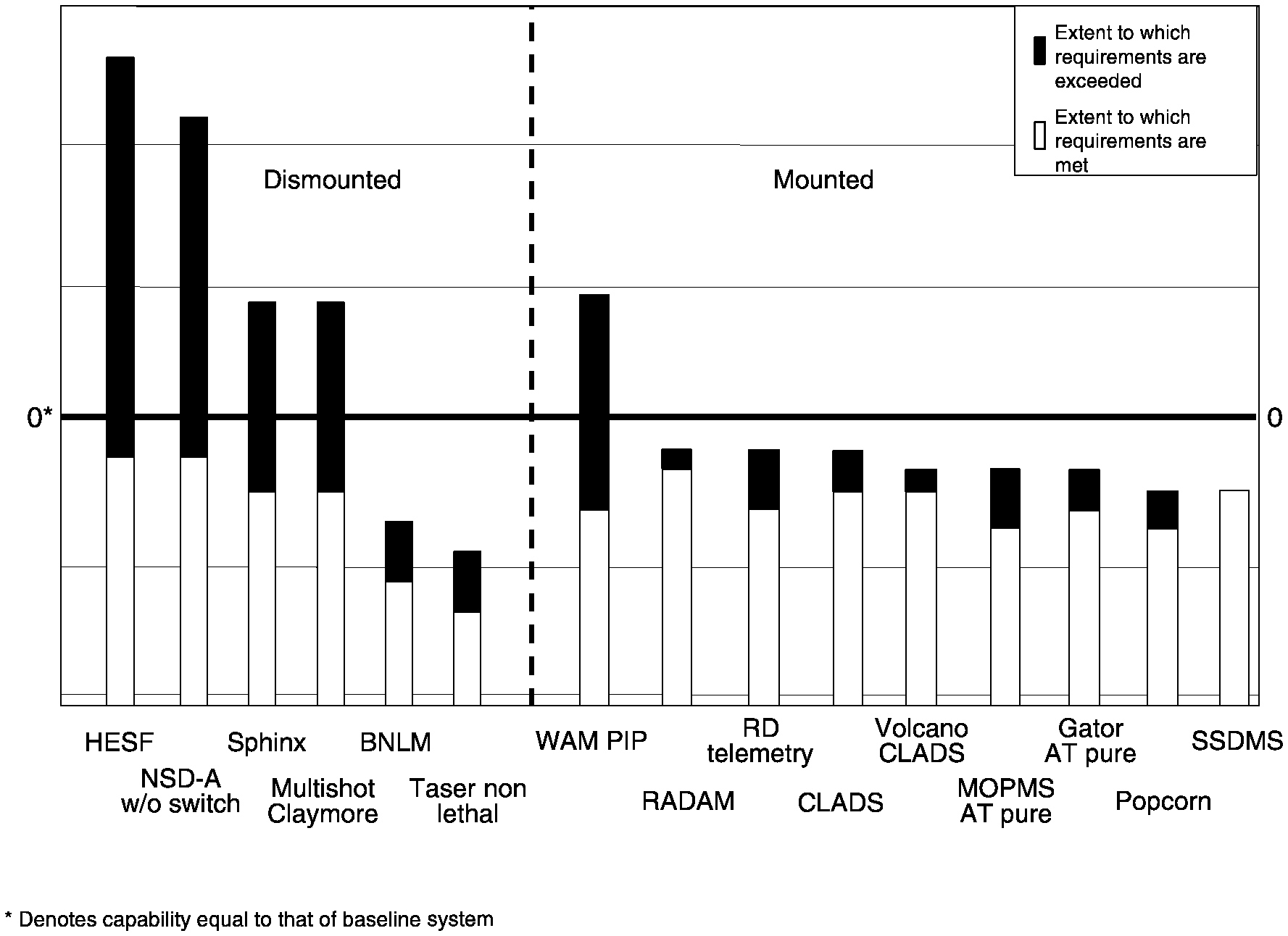
FIGURE 6-1 Military effectiveness of alternatives available by 2006 based on qualitative scoring by the committee.
Recommendation. The feasibility, cost, and schedule of providing a remote delivery option for Hornet/WAM should be investigated. Shock hardening of the mine to withstand the impact of remote delivery appears to be an Ottawa-compliant, low-risk solution to current mixed minefields.
Summary
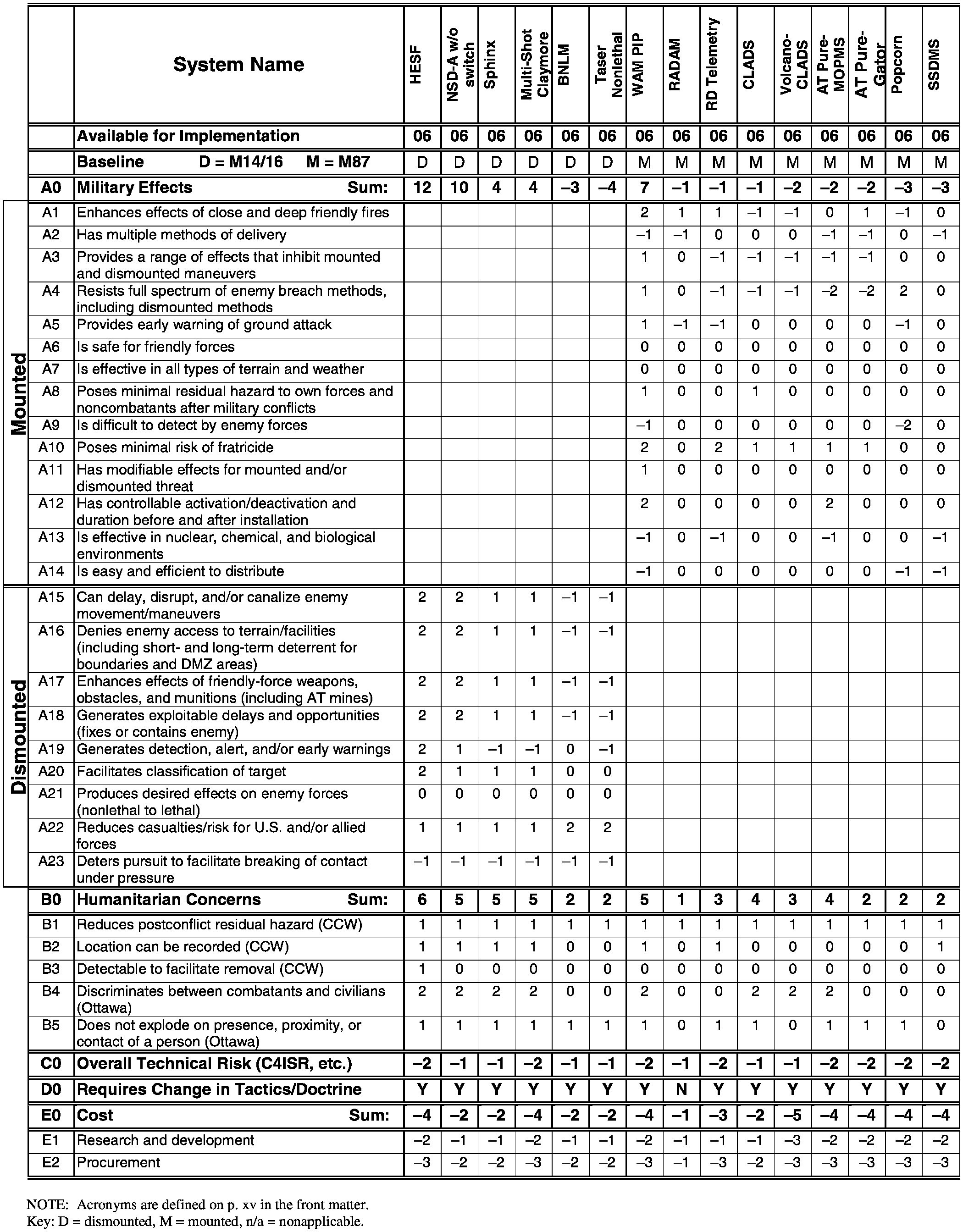
The criteria and scores are shown in Table 6-2. The details of how these scores were derived can be found in Chapter 4.
Figure 6-1 is a graphical summary of the scoring. In keeping with the Statement of Task, this graph shows only the relative military effectiveness of candidate systems without regard to cost, risk, or humanitarian factors. Each bar on the graph is a composite. The lower portion (white) shows the degree to which each system meets the military effectiveness requirements in comparison to the baseline system. If the candidate system meets all of the requirements at least as well as the baseline system, the score is 0. If it is less effective in any requirement, the score is less than 0. The upper portion (dark shading) of the bar shows capabilities that exceed those of the baseline system.
These graphs use the methodology described in Chapter 5. In general, if the total height of the bar is high, the system is likely to be militarily effective. If the value of the lower portion of the bar is near 0, the system meets most of the military requirements. If the lower bar is much lower than 0, the system probably has significant differences from the baseline mine and will not perform some desired functions. However, that system may still be militarily effective if it performs some functions much better than the baseline system. Because the scoring criteria were not weighted, these graphs should be used only for assessing trends and making qualitative comparisons.


