Page 287
BASIL WRIGHT WILSON
1909-1996
BY THORNDIKE SAVILLE, JR.
PREPARED WITH THE ASSISTANCE OF OTHERS, PARTICULARLY, ELIZABETH WILSON AND ROBERT O. REID
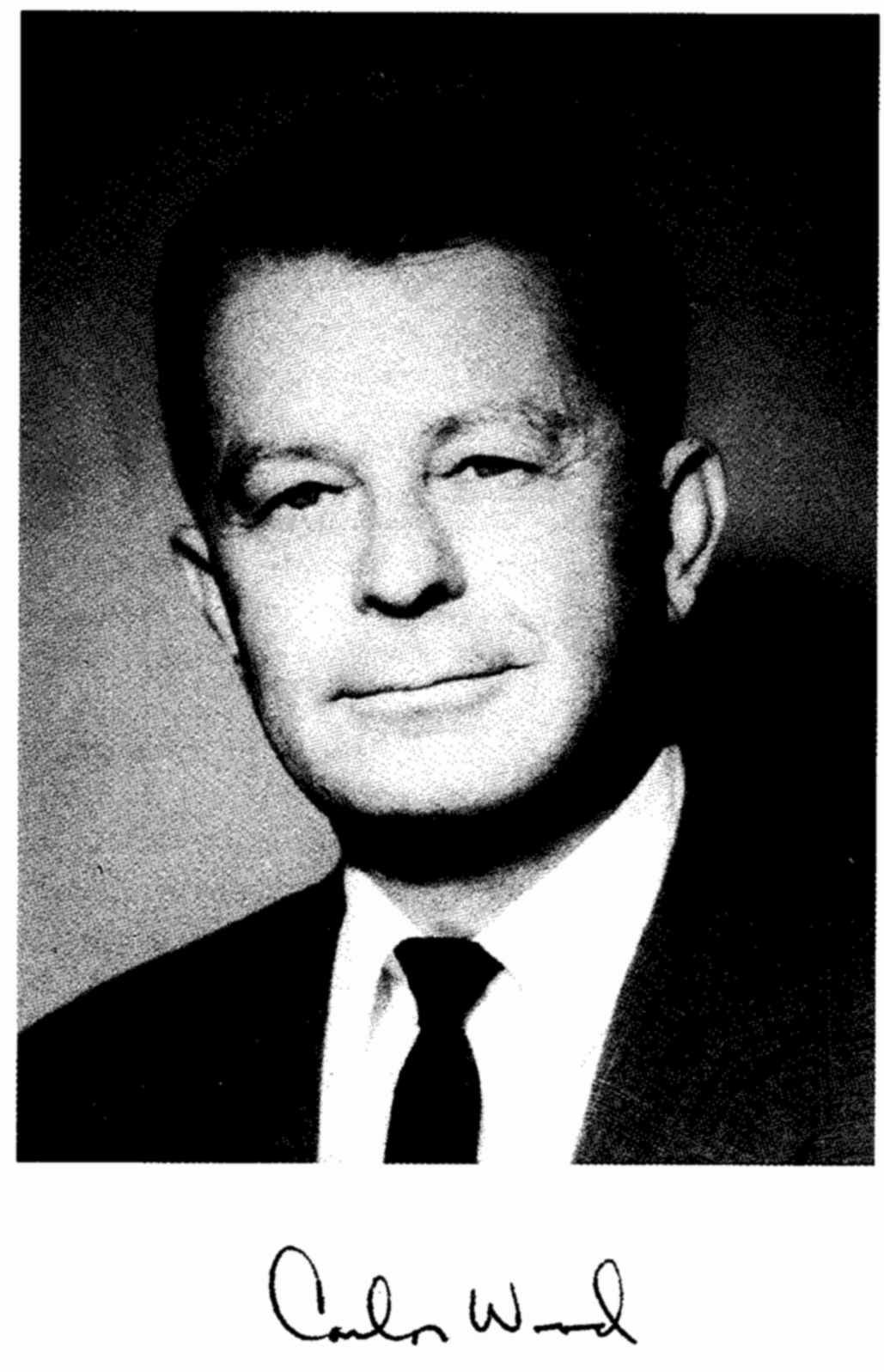
BASIL WRIGLEY WILSON, consulting oceanographic engineer and noted researcher in the fields of coastal and oceanographic engineering, who made pioneering contributions to ship motion and mooring technology, died February 9, 1996, in Pasadena, California, at the age of eighty-six. He is survived by his wife, Betty, and four children (Mary, Richard, Gerald, and Derek).
Elected to the National Academy of Engineering in 1984, Basil was a dedicated professional known for his thoroughness and his problem-solving capabilities, often involving innovative concepts—breaking new ground and charting new waters. His 1967 work on harbor-ship oscillations is as valid today as when he first pioneered the development, and continues to influence design practice throughout the world. Basil's interests were wide-ranging; he was a gifted artist and photographer; he was a poet, writing and illustrating two children's books; he was a nature lover and wildlife enthusiast. He was a perfectionist who knew only one way to do things—to do them as well as they could be done, and to do them right. This principle he applied equally in his engineering contributions and in his avocations of art, poetry, and nature.
Basil was born in Cape Town, (Union of) South Africa, of English parents. One grandfather was a vicar at Great Missenden, and one grandmother was a Wrigley, related to the chewing gum family, hence Basil's middle name. His father, George Hough
Page 288
Wilson, went out to South Africa as a reporter on the Cape Times, where he rose to be editor. Basil's education was broadly based, and he received a B.Sc. degree with honors (civil engineering) at the University of Cape Town in 1931. From 1932 to 1952 he worked with the South African railways and harbors in the research engineering area, where at first he was concerned mainly with problems of bridge vibration, stresses in railroad track, and mechanics of motion of railway vehicles on curves. During this time he also developed the first hydraulic harbor model in South Africa, for Port Elizabeth, in 1932.
In 1938 he was selected as a Commonwealth Fund Service Fellow (at that time, only five each year were selected from the Commonwealth countries outside Great Britain) and did graduate work at the University of Illinois, receiving an M.S. degree (railway engineering) in 1939 and a C.E. degree in 1940. There he met his future wife, Elizabeth Mary Davenport, who was studying library science. They were married in Cape Town in February 1941.
In 1942 Basil was placed in charge of designing and operating a large engineering model of Table Bay and its harbor to experiment on ways to control and reduce the effects of surging in the harbor. The model itself was one of the first of its kind. The understanding developed from his model and the extensive field observations he undertook was incorporated in his 1951 D.Sc. dissertation at the University of Cape Town. Theoretical considerations for range action and motions of moored ships developed at this time underlie much of what we know and do in the field today. Continuing work in this field throughout his career, he published a number of papers, four of which have received professional awards (Arthur M. Wellington Prize, American Society of Civil Engineers (ASCE), 1952; The Institution Award, South African Institution of Civil Engineers, 1960; Overseas Premium, Institution of Civil Engineers, London, 1968; Norman Medal, ASCE, 1969). His 1967 paper in the Proceedings, ICE, The Threshold of Surge Damage for Moored Ships, developed a simplified expression for the difficult nonlinear dynamics of ship mooring coupled with harbor resonance. This expression is still most useful in resolving realistic engineering prob-
Page 289
lems—applied recently to harbor-ship oscillation problems in the Port of Long Beach, California. A 1977 invited paper then virtually solved the ship motion problem for any situation.
In 1952 Basil moved to the United States, becoming a citizen in 1956, taking a teaching and research position at the Texas A&M University (TAMU). This period was at the beginning of the coastal and ocean engineering initiative at TAMU, and Basil played an important role. During this time, in addition to innovative work on mooring line dynamics, he developed an improved procedure for predicting the height and period characteristics of waves in the variable winds of moving fetches. He later adapted this procedure for high-speed computation, and it was used successfully both in this country and abroad. At this time too, he did innovative work on storm surge caused by hurricane winds, particularly in a definitive work on New York Harbor, but also for the Gulf of Mexico.
As a sidelight to his professional efforts, while at TAMU Basil started a tradition of giving to individuals leaving the department a plaque done in color with a poem in Old English script and an appropriate hand-drawn illustration, combining avocation with vocation.
From 1961 to 1968 Basil continued work in these areas with National Engineering Science Company (Pasadena, California) and Science Engineering Associates (San Marino, California). He also applied his wave dynamics insight to tsunamis and explosion waves. The large and damaging tsunami generated by the 1964 Alaskan earthquake was the subject of a major study by the National Research Council to which Basil contributed significantly, and his material formed the substance of two papers in the final 1972 report.
Going into private practice in 1968, Basil continued to contribute to these areas, advising clients on harbor surging, tsunami hazards, and mooring forces in particular. Among his many clients were Chicago Bridge and Iron (dynamic behavior of off-shore structures and mooring of supertankers); United States Naval Civil Engineering Laboratory (earthquake occurrence and effects in ocean areas); Weston Geophysical Research; Southern California Edison; Pacific Gas and Electric; the Nuclear Regula-
Page 290
tory Commission (tsunami hazards at coastal power plants); Dames and Moore (mooring facilities); Kaiser Engineering (exposed mooring of large ships); Bechtel (port locations on the Algerian coast); and the Iron and Steel Corporation of South Africa (long wave effects and loading facilities). Though acting as a consultant, Basil was concerned with teaching throughout his life, through participation in a number of short courses and seminars at coastal institutions in this country and invited lectures abroad.
Throughout his professional career, Basil garnered many awards, the most important being the Arthur M. Wellington Prize (1952), Norman Medal (1969), and John G. Moffatt-Frank E. Nichol Harbor and Coastal Engineering Award (1983), from ASCE; the Overseas Premium (1968) from the Institution of Civil Engineers, London; the Institution Award (1959), Shape Memorial Lecture (1975), and the Award for Meritorious Research (1984) from the South African Institution of Civil Engineers; and the Distinguished Alumnus Award of the Civil Engineering Alumni Association, University of Illinois (1987). He was elected to the National Academy of Engineering in 1984 and because an honorary member of ASCE in 1988.
Basil was active in his professional societies, serving on a number of committees, particularly in the ASCE Waterways Division and Technical Councils on Ocean Engineering and Lifeline Earthquake Engineering. He was a fellow and honorary member of ASCE; a fellow of the Institution of Civil Engineers (London), the South African Institution of Civil Engineers, and the American Association for the Advancement of Science; and a member of several other professional societies. He was a registered engineer in the state of Texas. His publications numbered over one hundred among them pioneering efforts which have influenced significantly work in the coastal field. He was also a director of the Pasadena Artist Association.
Basil's work on Table Bay, Cape Town, and his later theoretical work underlies modern harbor surge work. Work beginning with observations in Table Bay on the way surges affected moored shipping and continuing with theoretical analysis resulted in 1977 in a description of methods for handling ship motion problems
Page 291
for virtually any situation. He developed a generalized formulation of rope influence in the basic equations of moored ship motion in waves and surges, including the strong nonlinearity of both elastic properties under cyclic loading and catenarian configuration (from which the conditions under which a ship could rupture its mooring lines or crush the fenders are determinable). Following his extensive analysis of the large and damaging tsunami from the 1964 Alaskan earthquake and study of earthquake incidence worldwide, estimates of tsunami hazards have been developed for a number of locations, particularly nuclear power plants. He has been responsible for major advances in techniques for wave prediction (particularly with moving fetches), hurricane surge and flooding prediction, submarine pipeline stability under wave loading, and wave forces. His insight into the physical background and his mathematical capability, coupled with his thoroughness and determination, have left a major engineering legacy in the coastal field, furthering materially the knowledge base for the civil engineering discipline.
These achievements came despite a progressing deafness, which at times made communication difficult, and which influenced him to go into engineering rather that follow in his father's footsteps as a journalist. But his love of writing remained throughout his life, as shown not only by his technical literature, but by his poetic children's books and his lengthy annual Christmas poems summarizing the past year.