
Appendix A
The RERF Dosimetry Measurements Database and Data Collection for the Dosimetry Reassessment
The RERF Dosimetry Measurements Database attempts to compile a detailed list of analytically useful data on measurements of thermoluminescence and neutron activation in Hiroshima and Nagasaki. The database is intended to contain an entry for every such measurement that has been made and documented. The database is prepared in Access™ and has custom screens for data entry and checking that are programmed in Visual Basic™, as shown in Figures A-1 and A-2. Source documents for the data are detailed in a table of references (Table A-2). Chapters and appendixes of the DS86 final report are listed separately in the table of references (Table A-2). In addition to the DS86 final report, the database includes listings for 42 published papers and various other reports, proceedings, and notes from meetings.
In addition to the table of references, there are also linked tables of samples, subsamples, and measurements in the database. Data are entered exactly as they appear in source documents, sometimes with extensive annotation in the notes field to aid in interpretation. RERF maintains and updates the database by vetting the existing entries and adding new data. A summary cross-tabulation of measured samples in the database is given in Table A-1 for samples that fit the “surface, line of sight” criterion discussed in Appendix B. The database also contains results for a number of other samples, notably core samples that yield information at various depths in rock or concrete.
Initially, efforts were made to maximize the information in the database from available source documents. RERF supported and participated in the efforts of the Committee on Dosimetry for the RERF to obtain detailed information directly from investigators for the purpose of a comprehensive uncertainty analysis. In November 1998, Mr. Lowder and Dr. Takashi Maruyama, accompanied by Dr. Cullings, visited
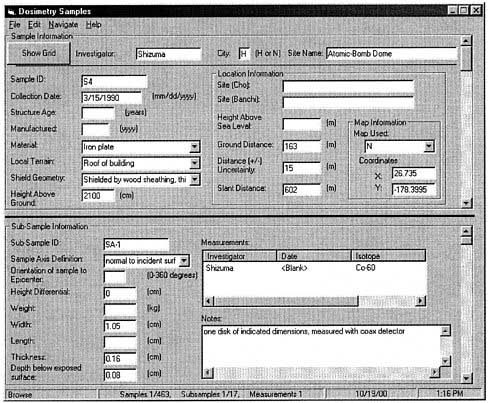
FIGURE A-1 Sample data-entry screen of RERF dosimetry measurement database.
the laboratories at Hiroshima University Geniken (Dr. Hoshi), Hiroshima University Saijou Campus (Dr. Shizuma), Kanazawa University (Dr. Nakanishi), and N.I.R.S. at Chiba near Tokyo (Maruyama and Kumamoto) for meetings, tours, and consultations. They also met with Dr. Fujita and Mr. Watanabe, of RERF, who have extensive personal knowledge and records of sample collection, storage, and distribution.
In December 1998, a detailed questionnaire prepared by Mr. Lowder, which is included at the end of this appendix, was sent to all investigators who had made measurements of interest for the uncertainty analysis. Written responses were received only from Dr. Hamada and Dr. Kato.
In December 1999, Dr. Maruyama and Dr. Cullings again visited the laboratory of Dr. Nakanishi with a detailed list of requested information.
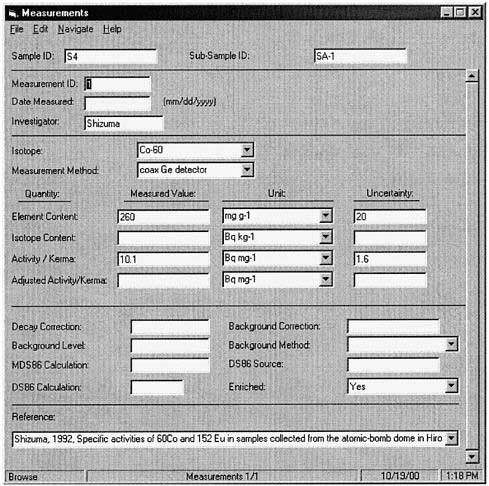
FIGURE A-2 Measurements data-entry screen of RERF dosimetry measurement database.
Dr. Cullings has exchanged letters and materials with Dr. Shizuma. In April 2000, Dr. Cullings wrote letters to Dr. Nakanishi, Dr. Iimoto, Dr. Hamada, Dr. Shimazaki (Dr. Okumura’s group in Nagasaki) and Dr. Shizuma, requesting spectra and additional detailed information on background issues. Responses were received from Dr. Iimoto, Dr. Kimura (Dr. Hamada’s group), and Dr. Shizuma.
In September 2000, Dr. Cullings attended a meeting of the Hiroshima dosimetry group and made a brief presentation regarding environmental background samples and questions concerning the accuracy of the trapezoidal approximation of background versus peak counts at low sample radioactivity levels.
The information obtained from all those inquiries has been archived at RERF and has been used to augment and correct the database as appropriate.
TABLE A-1 Measured Locations in the RERF Databasea (by Site Name, Ground Range in m, and Azimuth in Degree)
|
Hiroshima 32P (measured in 1945) |
|||||||||
|
? |
76 |
242 |
|
|
? |
660 |
? |
|
|
|
? |
178 |
4 |
|
|
? |
682 |
75 |
|
|
|
? |
305 |
79 |
|
|
? |
705 |
? |
|
|
|
? |
331 |
? |
|
|
? |
721 |
296 |
|
|
|
? |
331 |
? |
|
|
? |
968 |
? |
|
|
|
? |
358 |
311 |
|
|
? |
1025 |
299 |
|
|
|
? |
417 |
56 |
|
|
? |
1080 |
? |
|
|
|
? |
433 |
132 |
|
|
? |
1305 |
? |
|
|
|
? |
470 |
? |
|
|
|
|
|
|
|
|
Hiroshima 36Cl |
|||||||||
|
Saikouji |
94 |
265 |
Hiroshima University E Buildingb |
1354 |
165 |
||||
|
Motoyasu Bridge |
102 |
245 |
|||||||
|
Aioi Bridgeb |
300 |
318 |
Teishin Hospital (Communications Hosp.) |
1368 |
44 |
||||
|
Fukoku Seimei Buildingb |
317 |
131 |
|||||||
|
Gokoku Shrineb |
398 |
351 |
Hiroshima University Radioisotope Bldgb |
1427 |
163 |
||||
|
Kirin Beer Hallb |
664 |
112 |
|||||||
|
Chugoku Electric Power Co. |
676 |
175 |
Hiroshima University Seifu Dormitoryb |
1427 |
176 |
||||
|
Sinkojib |
870 |
325 |
|||||||
|
Old NHK Buildingb |
988 |
83 |
Red Cross Hospital North Bldgb |
1469 |
182 |
||||
|
Hiroshima City Hall |
1000 |
177 |
|||||||
|
Ganjiojib |
1029 |
32 |
Red Cross Hospitalb |
1501 |
180 |
||||
|
Tokueijib |
1140 |
108 |
Hiroshima Postal Savings Bureau |
1606 |
177 |
||||
|
Jyunkyojib |
1217 |
122 |
|||||||
|
Hosenjib |
1225 |
334 |
Hiroshima Bank of Creditb |
1703 |
350 |
||||
|
Hiroshima University Elementary Schoolb |
1269 |
167 |
Hiroshima Commercial High Schoolb |
2863 |
222 |
||||
|
Hiroshima 60Co |
|||||||||
|
Shima Hospital |
0 |
0 |
Sentry Box |
640 |
131 |
||||
|
Hiroshima Post Office |
55 |
313 |
Kirin Beer Hall |
670 |
113 |
||||
|
Saikou-ji |
94 |
302 |
Chugoku Electric Power Co. |
687 |
174 |
||||
|
Motoyasu Bridge |
128 |
248 |
Kodokan |
720 |
274 |
||||
|
Atomic-Bomb Dome |
163 |
~308? |
Water Trough |
793 |
351 |
||||
|
Monument of victory |
213 |
50 |
Hiroshima City Hall |
1014 |
180 |
||||
|
Sumitomo Bank |
250 |
? |
Powder Magazine |
1197 |
11 |
||||
|
Yasuda Seimei Building |
257 |
116 |
Yokogawa Bridge |
1295 |
343 |
||||
|
Hiroshima Bank |
269 |
206 |
Yokogawa Bridge |
1295 |
343 |
||||
|
Aioi Bridge |
300 |
325 |
Red Cross Hospital |
1481 |
180 |
||||
|
Fukoku Seimei Building |
331 |
146 |
Red Cross Hospital |
1484 |
180 |
||||
|
Honkawa Primary School |
373 |
297 |
Hiroshima Bank of Credit |
1703 |
350 |
||||
|
Fukuromachi Primary School |
441 |
? |
|
||||||
|
Hiroshima 152Eu |
|||||
|
Shima Hospital |
0 |
0 |
Shirakami Shrine G1 |
478 |
163 |
|
Sei Hospital |
55 |
334 |
Naka Denwa-Kyoku (Telephone Ofc) |
529 |
131 |
|
Hiroshima Post Office |
55 |
313 |
|||
|
Saikou-ji |
94 |
302 |
Honkawa stone lantern (gangi) |
531 |
250 |
|
Motoyasu Bridge, Pillar 2 |
101 |
249 |
|||
|
Saikou-ji, grave |
107 |
265 |
Seiju-ji |
546 |
305 |
|
Daiichi Bank |
129 |
118 |
Kyoden-ji |
548 |
272 |
|
Motoyasu Bridge Pillar 1 |
132 |
248 |
Sanin Godo Bank |
618 |
96 |
|
Chiyoda Seimei Bldg |
132 |
84 |
Kakomachi stone wall |
629 |
232 |
|
Atomic-Bomb Dome |
137 |
308 |
Sorazaya Shrine |
653 |
326 |
|
Motoyasu Bridge, Railing |
146 |
243 |
Myocho-ji |
654 |
288 |
|
Atomic-Bomb Dome |
150 |
~308 |
Chugoku Electric Power Co. |
655 |
174 |
|
Atomic-Bomb Dome |
161 |
307 |
Akisaya-cho |
675 |
35 |
|
Nihon Seimei Bldg |
163 |
147 |
Hiroshima Castle |
694 |
32 |
|
Atomic-Bomb Dome |
165 |
~308 |
Kawaramachi stone wall |
714 |
238 |
|
Atomic-Bomb Dome |
168 |
~308 |
Chugoku Electric Power Co. |
720 |
174? |
|
Atomic-Bomb Dome |
173 |
~308 |
Kodo Primary School |
720 |
274 |
|
Banker’s Association |
178 |
155 |
Choukaku-ji |
849 |
76 |
|
Rest House |
189 |
~90 |
Tamino’s House |
875 |
125 |
|
Monument of victory |
213 |
50 |
Hiroshima Prefectural Office |
881 |
217 |
|
Sensho-ji |
229 |
148 |
Honkei-ji |
893 |
186 |
|
Hiroshima Bank (Geibi Bank) |
250 |
89 |
Enryu-ji |
912 |
0 |
|
Yorozuyo Bridge stone wall |
924 |
209 |
|||
|
Hiroshima Bank |
250 |
89 |
Shingyo-ji |
927 |
329 |
|
Yasuda Seimei Bldg |
253 |
116 |
Teramachi stone wall |
949 |
334 |
|
Sumitomo Bank |
255 |
101 |
Hiroshima Radio Station |
988 |
83 |
|
Aioi Bridge P1 |
258 |
318 |
Hiroshima City Hall |
1017 |
181 |
|
Daido Seimei Bldg |
269 |
87 |
Tenma bashib |
1029 |
275 |
|
Jisen-ji |
272 |
266 |
Kozen-ji |
1163 |
123 |
|
Fukoku Seimei Bldg |
317 |
146 |
Iwamiya-cho |
1197 |
96 |
|
Honkawa stone wall |
344 |
261 |
Hiroshima University |
1255 |
~165 |
|
Gogoku Shrine, Lantern |
344 |
351 |
Hiroshima University |
1274 |
~165 |
|
Honkawa Primary School |
359 |
286 |
Hiroshima University |
1298 |
~165 |
|
Gokoku Shrine, Marble |
377 |
347 |
Sumiyoshi shrineb |
1307 |
213 |
|
Gokoku Shrine, Guarding Lion |
381 |
349 |
Hiroshima University |
1328 |
~165 |
|
Honkawa Primary School |
389 |
360 |
Hiroshima University, Primary School |
1335 |
166 |
|
Gokoku Shrine |
398 |
351 |
|||
|
Sanyo Memorial Hall |
410 |
150 |
Kyo Bridge, Railing |
1357 |
91 |
|
Motomachi Stone Wall 1 |
420 |
336 |
Teishin Hospital (Communications Hospital) |
1370 |
44 |
|
Seigen-ji |
427 |
141 |
|||
|
Honkawa Bridge stone wall |
434 |
261 |
Kannon bashib |
1618 |
237 |
|
Geibi Bank, Tsukamoto Branch |
465 |
261 |
Hiroshima Commercial High Schoolb |
2863 |
222 |
|
Hiroshima 63Ni |
|||||
|
Atomic-Bomb Dome |
163 |
~308? |
Hiroshima University Radioisotope Bldgb |
1461 |
163 |
|
Bank of Japanb |
367 |
153 |
|||
|
Soy Sauce Breweryb |
948 |
90 |
Sumitomo Bankb |
1880 |
88 |
|
City Hallb |
1013 |
180 |
|
|
|
|
Univ. Elementary Schoolb |
1304 |
167 |
|
|
|
|
Hiroshima TLD |
|||||
|
Shima Hospital ? |
14 |
346 |
HUPS |
1397 |
166 |
|
Motoyasu bashi ? |
113 |
258 |
HUPS |
1401 |
167 |
|
? |
188 |
330 |
HUPS |
1422 |
166 |
|
? |
194 |
50 |
HUPS |
1425 |
167 |
|
“Zaimoku-cho, Dempuku-ji” |
400 |
SW |
HUPS |
1426 |
165 |
|
“Zaimoku-cho, Seigan-ji” |
420 |
SW |
HUFS |
1428 |
167 |
|
“Zaimoku-cho, ?” |
430 |
SW |
HUFS |
1428 |
166 |
|
? |
460 |
117 |
HUFS |
1433 |
167 |
|
Naka Telephone Office |
507 |
129 |
HUFS |
1449 |
165 |
|
Naka Telephone Office |
523 |
132 |
HUFS |
1450 |
167 |
|
Sanin Bank |
621 |
95 |
HUFS |
1451 |
165 |
|
? |
623 |
89 |
Red Cross Hospital |
1452 |
206 |
|
Choguku Electric Co. |
665 |
174 |
Red Cross Hospital |
1452 |
181 |
|
Choguku Electric Co. |
692 |
175 |
HUFS |
1457 |
167 |
|
? |
715 |
92 |
HUFS |
1459 |
166 |
|
“Ninomaru, Hiroshima Castle” |
750 |
NNE |
HUFS |
1460 |
166 |
|
HUFS |
1461 |
167 |
|||
|
Nishishin-machi |
800 |
W |
HU Radioisotope Bldg. |
1462 |
163 |
|
“Nishishin-machi, koen-ji” |
960 |
NNW |
Red Cross Hospital |
1501 |
180 |
|
“Nishishin-machi, Shozen-ji” |
970 |
NNW |
Postal Savings Bureau |
1591 |
177 |
|
Chokin-kyoku (Postal Savings) |
1613 |
178 |
|||
|
“Honmaru, Hiroshima Castle” |
980 |
NNE |
Postal Savings Bureau |
1604 |
178 |
|
Nobori-cho (Japanese house) |
1131 |
85 |
Postal Savings Bureau |
1605 |
177 |
|
Chokin Kyoku (Postal Savings) |
1613 |
178 |
|||
|
HUPS |
1271 |
167 |
|||
|
HUPS |
1282 |
168 |
Postal Savings Bureau |
1613 |
177 |
|
HUPS |
1298 |
167 |
Postal Savings Bureau |
1631 |
176 |
|
HUPS |
1316 |
167 |
Japan Elec. Meters Insp. Corp. |
1793 |
356 |
|
HUPS |
1338 |
166 |
|||
|
HUFS-I |
1338 |
168 |
“Meisen-ji” “Oni-gawara” |
1909 |
107 |
|
HUFS |
1377 |
165 |
HUT (HUFE) |
2051 |
178 |
|
HUS |
1378 |
168 |
“Hiramoto” “Oni-gawara” |
2053 |
253 |
|
HUFS |
1387 |
167 |
HUFE |
2054 |
180 |
|
HUFS |
1388 |
166 |
Kirihara house |
2453 |
287 |
|
HUFS-E |
1388 |
169 |
Ryomatsu-sho (Provisions Depot) |
3133 |
168 |
|
HUFS |
1393 |
166 |
|||
Nagasaki 152Eu
|
Nagasaki 36Cl |
||||||
|
Nagasaki University |
Fuchi Middle School |
1156 |
203 |
|||
|
Hospital |
650 |
144 |
Konpira-san Anti-aircraft Batteryb |
1580 |
127 |
|
|
Mitsubisihi Steel |
1075 |
181 |
||||
|
Nagasaki 60Co |
||||||
|
? |
18 |
? |
? |
353 |
? |
|
|
? |
39 |
? |
? |
460 |
? |
|
|
? |
63 |
? |
? |
472 |
? |
|
|
? |
82 |
? |
Nagasaki Medical School Building |
520 |
125 |
|
|
? |
92 |
? |
||||
|
? |
93 |
? |
Shiroyama Schoolb |
540 |
|
|
|
? |
96 |
? |
? |
561 |
? |
|
|
? |
118 |
? |
Nagasaki Medical School Building |
590 |
12 |
|
|
? |
249 |
? |
||||
|
Takatani Houseb |
290 |
? |
Nagasaki University Hospitalb |
653 |
144 |
|
|
? |
307 |
? |
||||
|
? |
330 |
? |
Motoki Bridgeb |
780 |
N |
|
|
? |
343 |
? |
Mitsubishi Steelb |
935 |
S |
|
|
? |
347 |
? |
COMM SCHOOL |
1030 |
~300? |
|
|
? |
19 |
? |
N5 |
427 |
? |
|
|
Shimono-kawa |
20 |
NNE or ESE or S |
? |
432 |
? |
|
|
? |
40 |
? |
? |
435 |
? |
|
|
Shimono-kawa |
48 |
NNE or ESE or S |
? |
457 |
? |
|
|
? |
62 |
? |
Urakami Churchb |
465 |
60 |
|
|
Shimono-kawa |
80 |
NNE or ESE or S |
? |
474 |
? |
|
|
? |
80 |
? |
? |
523 |
? |
|
|
Shimono-kawa |
93 |
NNE or ESE or S |
N6 |
528 |
? |
|
|
? |
93 |
? |
N7 |
555 |
? |
|
|
? |
94 |
? |
? |
560 |
? |
|
|
? |
96 |
? |
? |
590 |
? |
|
|
Shimono-kawa |
100 |
NNE or ESE or S |
? |
591 |
? |
|
|
N1 |
100 |
? |
? |
628 |
? |
|
|
? |
109 |
? |
? |
635 |
? |
|
|
Shimono-kawa |
110 |
NNE or ESE or S |
? |
641 |
? |
|
|
? |
115 |
? |
N8 |
645 |
? |
|
|
N2 |
226 |
? |
Gokoku shrine |
651 |
303 |
|
|
? |
247 |
? |
Nagasaki University Hospitalb |
653 |
144 |
|
|
Urakami-gawa |
250 |
WSW |
||||
|
Urakami-gawa |
255 |
WSW |
? |
668 |
? |
|
|
Urakami-gawa |
293 |
WSW |
? |
682 |
|
|
|
Urakami-gawa |
300 |
WSW |
Nanzan schoolb |
704 |
22 |
|
|
? |
308 |
WSW |
? |
710 |
? |
|
|
Yana bashib |
311 |
296 |
? |
751 |
? |
|
|
? |
312 |
? |
? |
776 |
? |
|
|
|||||||||||||||||||||||||||||||||||||||||||||||||||||||||||||||||||||||||||||||||||||||||||||||||||||||||||||||||||||||||||||||||||||||||||||||||||||||||||||||||||||||||||||||||||||||||||||||||||||||||||||||
TABLE A-2 References in the RERF Dosimetry Measurements Database
|
RefID |
First Author |
Year |
Title |
Journal |
|
1 |
Egbert |
1995 |
Computerized data acquisition and retrieval system for archival of Hiroshima and Nagasaki A-bomb activation measurements and calculations |
Book (Science Applications International Corporation) |
|
2 |
Gritzner |
1987 |
Sulfur activation at Hiroshima |
DS86 Vol. 2:283–292 |
|
3 |
Hasai |
1987 |
152Eu depth profile of a stone bridge pillar exposed to the Hiroshima atomic bomb: 152Eu activities for analysis of the neutron spectrum |
Health Phys. 53:227–239 |
|
4 |
Kato |
1990 |
Gamma-ray measurement of 152Eu produced by neutrons from the Hiroshima atomic bomb and evaluation of neutron fluence |
Jpn. J. Appl. Phys. 29:1546–1549 |
|
5 |
Kato |
1990 |
Accelerator mass spectrometry of 36Cl produced by neutrons from the Hiroshima bomb |
Int. J.Radiat. Biol. 58:661–672 |
|
6 |
Kaul |
1987 |
Calculation of dose in quartz for comparison with thermoluminescence dosimetry measurements |
DS86 Vol. 2:204–241 (Appendix 11 to Chapter 4) |
|
7 |
Kerr |
1983 |
Tissue kerma vs distance relationships for initial nuclear radiation from the atomic bombs Hiroshima and Nagasaki |
First 1983 RERF Workshop: 57–103 |
|
8 |
Kerr |
1990 |
Activation of cobalt by neutrons from the hiroshima bomb |
ORNL 6590 |
|
9 |
Milton |
1968 |
Tentative 1965 radiation dose estimation for atomic bomb survivors |
ABCC Technical Report 1–68 |
|
10 |
Nakanishi |
1987 |
Residual neutron-induced radioactivities in samples exposed in Hiroshima |
DS86 Vol. 2:310–319 |
|
11 |
Nakanishi |
1991 |
Residual neutron-induced radionuclides in samples exposed to the nuclear explosion over Hiroshima: Comparison of the measured values with the calculated values |
J.Radiat. Res. S:69–82 |
|
12 |
Nakanishi |
1993 |
Calculated and measured 152Eu activity in roof tiles exposed to atomic bomb radiation in Nagasaki (in Japanese) |
1992 research report on effects of the atomic bombs |
|
RefID |
First Author |
Year |
Title |
Journal |
|
13 |
Okumura |
1997 |
Reassessment of Atomic bomb neutron doses (in Japanese) |
FY 1996 Report of Research Group on Atomic Bomb Related Symptoms |
|
14 |
Roesch |
1987 |
Book (US-Japan joint reassessment of atomic bomb radiation dosimetry in Hiroshima and Nagasaki) |
|
|
15 |
Shibata |
1994 |
A method to estimate the fast-neutron fluence for the Hiroshima atomic bomb |
J.Phys. Soc. Jpn. 63:3546–3547 |
|
16 |
Shizuma |
1992 |
Specific activities of 60Co and 152Eu in samples collected from the atomic-bomb dome in Hiroshima |
J.Radiat. Res. 33:151–162 |
|
17 |
Shizuma |
1992 |
Low-background shielding of Ge detectors for the measurement of residual 152Eu radioactivity induced by neutrons from the Hiroshima atomic bomb |
Nuclear Instruments and Methods in Physics Research B66:459–464 |
|
18 |
Shizuma |
1993 |
Residual 152Eu and 60Co activities induced by neutrons from the Hiroshima atomic bomb |
Health Phys. 65:272–282 |
|
19 |
Shizuma |
1997 |
|
Notes from October 1997 meeting |
|
20 |
Straume |
1992 |
Neutron discrepancies in the DS86 Hiroshima dosimetry system |
Health Phys. 63:421–426 |
|
21 |
Straume |
1994 |
Neutrons confirmed in Nagasaki and at the army pulsed radiation facility: Implications for Hiroshima |
Radiat. Res. 138:193–200 |
|
22 |
Tatsumi-Miyajima, J |
1991 |
Physical dosimetry at Nagasaki— 152Eu of stone embankment and electron spin resonance of teeth from atomic bomb survivors |
J.Radiat. Res. Suppl.: 83–98 |
|
23 |
Hashizume |
1967 |
Estimation of the air dose from the atomic bombs in Hiroshima and Nagasaki |
Health Phys. 13:149–161 |
|
24 |
Hashizume |
1983 |
Present plans for dose reassessment experiments by the Japanese |
Second 1983 RERF Workshop: 7–12 |
|
25 |
Nakanishi |
1983 |
152Eu in samples exposed to the nuclear explosions at Hiroshima and Nagasaki |
Nature 302:132–134 |
|
RefID |
First Author |
Year |
Title |
Journal |
|
26 |
Maruyama |
1987 |
Comments on 60Co measurements |
DS86 Vol. 2:335–339 (Appendix 16 to Chapter 5) |
|
27 |
Sakanoue |
1987 |
In situ measurement and depth profile of residual 152Eu activity induced by neutrons from the atomic bomb in Hiroshima |
DS86 Vol. 2:261–265 (Appendix 7 to Chapter 5) |
|
28 |
Hoshi |
1989 |
152Eu activity induced by Hiroshima atomic bomb neutrons: Comparison with the 32P, 60Co, and 152Eu activities in dosimetry system 1986 |
Health Phys. 57:831–837 |
|
29 |
Kimura |
1990 |
Determination of specific activity of cobalt (60Co/Co) in steel samples exposed to the atomic bomb in Hiroshima |
J.Radiat. Res. 31:207–213 |
|
30 |
Saito |
1987 |
Radiochemical estimation of neutron fluence of Hiroshima and Nagasaki atomic bombs |
DS86 Vol. 2:249–251 (Appendix 4 to Chapter 5) |
|
31 |
Hoshi |
1987 |
Data on neutrons in Hiroshima |
DS86 Vol. 2:252–255 (Appendix 5 to Chapter 5) |
|
32 |
Straume |
1995 |
Personal communication (SAIC DB) |
Personal communication (SAIC DB) |
|
33 |
Straume |
1997 |
ABCC-RERF 50th Anniversary |
ABCC-RERF 50th Anniversary |
|
34 |
Hoshi |
1985 |
Distribution of 152Eu in bridge |
Summary reports of grants in aid for Monbusho 1985 pp 17–19 |
|
35 |
Nakanishi |
1986 |
DS86 (SAIC DB) |
DS86 (SAIC DB) |
|
36 |
Nakanishi |
1986 |
86-report (SAIC DB) |
86-report (SAIC DB) |
|
38 |
Egbert |
1997 |
SAIC database |
SAIC database |
|
39 |
Hashizume |
1967 |
Estimation of air dose from the atomic bombs, Hiroshima and Nagasaki |
ABCC TR 6–67 |
|
40 |
Loewe |
1981 |
Revised estimates of neutron and gamma-ray doses at Hiroshima and Nagasaki |
Germantown Conference Proceedings: 25–51 |
|
41 |
Kerr |
1981 |
Findings of a recent Oak Ridge National Laboratory review of dosimetry for the Japanese atom-bomb survivors |
Germantown Conference Proceedings: 52–97 |
|
RefID |
First Author |
Year |
Title |
Journal |
|
42 |
Maruyama |
1981 |
Dosimetry studies in Japan |
Germantown Conference Proceedings: 201–208 |
|
43 |
Kato |
1982 |
Aioi Bridge |
Proc. Hiroshima University of Geniken 23:179–186 |
|
44 |
Hamada |
1983 |
Measurement of 32p activity induced in sulfur in Hiroshima |
First 1983 RERF Workshop: 45–56 |
|
45 |
Loewe |
1983 |
Calculation and interpretation of in situ measurements of initial radiations at Hiroshima and Nagasaki |
First 1983 RERF Workshop: 138–155 |
|
46 |
Okajima |
1983 |
Measurement of neutron-induced 152Eu radioactivity in Nagasaki |
First 1983 RERF Workshop: 156–168 |
|
47 |
Hamada |
1983 |
32P activity induced in sulfur in Hiroshima: reevaluation of data by Yamasaki and Sugimoto |
Second 1983 RERF Workshop: 52–55 |
|
48 |
Pace |
1983 |
Sulfur activation in electric pole insulators in Hiroshima |
Second 1983 RERF Workshop: 56–58 |
|
49 |
Sinclair |
1983 |
Rapporteur’s report |
Second 1983 RERF Workshop: 59–63 |
|
50 |
Kato |
1984 |
Aioi Bridge |
Hiroshima Igaku 37:345–348 |
|
51 |
Maruyama |
1985 |
Commentary on 60Co measurements |
Unpublished draft (SAIC) |
|
52 |
Nakanishi |
1985 |
|
Monbusho report pp 25–43 |
|
53 |
Kato |
1985 |
|
Monbusho report pp 44–52 |
|
55 |
Hashizume Tajima |
1985 |
Concerning rebar 60Co rebar measurements |
Letter to Dean Kaul |
|
56 |
Kerr |
1985 |
ORNL iron surface measurements (not to appear in publications for record only) |
Memo to Joe Pace |
|
57 |
Okajima |
1985 |
Draft report (alternate version appears in green book) |
Nagasaki University |
|
58 |
Loewe |
1987 |
Organ Dosimetry |
DS86 Vol. 1:306–404 (Chapter 8) |
|
59 |
Yamasaki |
1987 |
Radioactive 32P produced in sulfur in Hiroshima |
DS86 Vol. 2:246–247 (Appendix 2 to Chapter 5) |
|
60 |
Maruyama |
1987 |
Composition of concrete from Joyama Primary School, Nagasaki |
DS86 Vol. 2:248 (Appendix 3 to Chapter 5) |
|
RefID |
First Author |
Year |
Title |
Journal |
|
63 |
Okajima |
1987 |
Quantitative measurement of the depth distribution of 152Eu activity in rocks exposed to the Nagasaki atomic bomb |
DS86 Vol. 2:256–260 (Appendix 6 to Chapter 5) |
|
65 |
Shimizu |
1987 |
Estimation of 32P induced in sulfur in utility-pole insulators; at the time of the Hiroshima atomic bomb |
DS86 Vol. 2:266–268 (Appendix 8 to Chapter 5) |
|
67 |
Tajima |
1987 |
Estimation of exposure dose |
DS86 Vol. 2:269–271 (Appendix 9 to Chapter 5) |
|
68 |
Hamada |
1987 |
Measurements of 32P in sulfur |
DS86 Vol. 2:272–279 (Appendix 10 to Chapter 5) |
|
71 |
Hasai |
1987 |
152Eu depth profile of stone bridge pillar exposed to the Hiroshima atomic bomb, Data acquisition of 152Eu activities for the analysis of fast neutrons |
DS86 Vol. 2:295–309 (Appendix 13 to Chapter 5) |
|
73 |
Kimura |
1986 |
|
Report to Monbusho pp 13–27 |
|
74 |
Miyajima |
1986 |
|
Report to Monbusho pp 55–61 |
|
75 |
Nakanishi |
1986 |
|
Report to Monbusho pp 62–72 |
|
76 |
Nakanishi |
1986 |
Residual neutrons in Hiroshima |
Draft report |
|
77 |
Hoshi |
1986 |
Motoyasu Bridge pillar |
Draft (perhaps green book paper) |
|
78 |
Nakanishi |
1987 |
|
Isotope Center News Number 7 pp 2 |
|
79 |
Kerr |
1987 |
Letter to Shigematsu August 14, 1987 |
Unpublished |
|
80 |
Kato |
1987 |
Europium isolation… |
Anal. Sci. 3:493–497 |
|
81 |
Tajima |
1988 |
Letter to Bill Ellett June 10, 1988 |
Unpublished |
|
82 |
Brenner |
1988 |
Neutron doses at Hiroshima |
Columbia University Rad res annual report pp 61–64 |
|
83 |
Anon |
1989 |
Notes from Irvine meeting |
Unpublished |
|
84 |
Kimura |
1989 |
Steel bridge |
Hawaii meeting |
|
85 |
Maruyama |
1989 |
Notes on Yokogawa Bridge |
Hawaii meeting manuscript |
|
RefID |
First Author |
Year |
Title |
Journal |
|
86 |
Nakanishi |
1989 |
152Eu measurements |
Hawaii meeting notes |
|
87 |
Ruehm |
1990 |
The neutron spectrum of the Hiroshima A-bomb and DS86 |
Nuc. Inst. Meth. Phys. Res. pp 557–562 |
|
88 |
Straume |
1990 |
Use of accelerator mass spectrometry in the dosimetry of Hiroshima neutrons |
Nuc. Inst. Meth. Phys. Res. pp 552–556 |
|
89 |
Shigematsu |
1991 |
Japanese measurements |
Letter to Bill Ellett 9–9–91 |
|
90 |
Straume |
1992 |
Handout on 36CL |
Irvine meeting |
|
91 |
Hoshi |
1991 |
Studies of radioactivity produced by the Hiroshima atomic bomb: 1. Neutron-induced radioactivity measurements for dose evaluation |
J.Radiat Res. Suppl. 20–31 |
|
94 |
Hoshi |
1996 |
|
Proceedings of Nagasaki Symposium 50th anniversary pp 175 |
|
96 |
Okajima |
1997 |
Nagasaki Eu measurements |
1996 Report to Monbusho |
|
105 |
Shizuma |
1998 |
Residual 152Eu and 60Co activity induced by atomic bomb neutrons in Nagasaki |
manuscript |
|
106 |
Shizuma |
1998 |
Residual 60Co activity in steel samples exposed to the Hiroshima atomic bomb neutrons |
Health Phys. 75:278–284 |
|
107 |
Nagatomo |
1995 |
Thermoluminescence dosimetry of the Hiroshima atomic-bomb gamma rays between 1.59 km and 1.63 km from the hypocenter |
Health Phys. 69:556–559 |
|
108 |
Nagatomo |
1992 |
Comparison of the measured gamma ray dose and the DS86 estimate at 2.05 km ground distance in Hiroshima |
J.Radiat. Res. 33:211–217 |
|
109 |
Ichikawa |
1987 |
Thermoluminescence dosimetry of gamma rays from the Hiroshima atomic bomb at distances of 1.27 to 1.46 kilometers from the hypocenter |
Health Phys. 52:443–451 |
|
110 |
Uehara |
1988 |
Monte Carlo simulations of doses to tiles irradiated by 60Co and 252Cf simulating atomic bomb gamma-ray fluences |
Health Phys. 54:249–256 |
|
RefID |
First Author |
Year |
Title |
Journal |
|
111 |
Hoshi |
1989 |
Thermoluminescence dosimetry of gamma rays from the Hiroshima atomic bomb at distances of 1.91–2.05 km from the hypocenter |
Health Phys. 57:1003–1008 |
|
112 |
Haskell |
1987 |
Thermoluminescence measurement of gamma rays—report on University of Utah analyses |
DS86, Vol. 2:153–169 |
|
113 |
Ichikawa |
1966 |
Thermoluminescence dosimetry of gamma rays from the atomic bombs in Hiroshima and Nagasaki |
Health Phys. 12:395–405 |
|
114 |
Ichikawa |
1987 |
Thermoluminescence measurement of gamma rays by the quartz inclusion method |
DS86 Vol. 2:137–144 |
|
115 |
Nagatomo |
1988 |
Thermoluminescence dosimetry of gamma rays from the atomic bomb at Hiroshima using the predose technique |
Radiat. Res. 113:227–234 |
|
116 |
Nagatomo |
1991 |
Thermoluminescence dosimetry of gamma rays using ceramic samples from Hiroshima and Nagasaki: A comparison with DS86 estimates |
J.Radiat. Res. 32 (Suppl.): 48–57 |
|
118 |
Maruyama |
1987 |
Thermoluminescence measurements of gamma rays (Chapter 4) |
DS86 Vol. 1:143–184 |
|
119 |
Roesch |
1987 |
US-Japan joint reassessment of atomic bomb radiation dosimetry in Hiroshima and Nagasaki: final report (Vol. 1) |
DS86 Vol. 1 |
|
120 |
Roesch |
1987 |
US-Japan joint reassessment of atomic bomb radiation dosimetry in Hiroshima and Nagasaki: final report (Vol. 2) |
DS86 Vol. 2 |
|
121 |
Maruyama |
1987 |
Reassessment of gamma-ray doses using thermoluminescence measurements |
DS86 Vol. 2:113–124 (Appendix 1 to Chapter 4) |
|
122 |
Ichikawa |
1987 |
Thermoluminescence measurement of gamma rays |
DS86 Vol. 2:125–136 (Appendix 2 to Chapter 4) |
|
123 |
Ichikawa |
1987 |
Thermoluminescence measurement of gamma rays: quartz inclusion method |
DS86 Vol. 2:137–144 (Appendix 3 to Chapter 4) |
|
RefID |
First Author |
Year |
Title |
Journal |
|
124 |
Nagatomo |
1987 |
Thermoluminescence measurement of gamma rays by the pre-dose method |
DS86 Vol. 2:145–148 (Appendix 4 to Chapter 4) |
|
125 |
Hoshi |
1987 |
Thermoluminescence measurement of gamma rays at about 2000 m from the hypocenter |
DS86 Vol. 2:149–152 (Appendix 5 to Chapter 4) |
|
126 |
Haskell |
1987 |
Thermoluminescence dosimetry of atomic bomb gamma rays: University of Utah analyses |
DS86 Vol. 2:153–169 (Appendix 6 to Chapter 4) |
|
127 |
Eagleson |
1987 |
Report from the Armed Forces Radiobiology Research Institute concerning LINAC and 60Co irradiations |
DS86 Vol. 2:169–170 (Appendix 6a to Chapter 4) |
|
128 |
Hoffman |
1987 |
Report on calibration and irradiation of samples with the UDM 137Cs beam irradiator at the University of Utah |
DS86 Vol. 2:170–171 (Appendix 6b to Chapter 4) |
|
129 |
Bailiff |
1987 |
Thermoluminescence analyses of Hiroshima ceramic tile and Nagasaki brick using the pre-dose and inclusion techniques |
DS86 Vol. 2:172–183 (Appendix 7 to Chapter 4) |
|
130 |
Huxtable |
1987 |
Conventional thermoluminescence characteristics of a Hiroshima tile and a Nagasaki brick |
DS86 Vol. 2:184–189 (Appendix 8 to Chapter 4) |
|
131 |
Stoneham |
1987 |
Thermoluminescence results on slices from a Hiroshima tile UHFSFT03 |
DS86 Vol. 2:190–197 (Appendix 9 to Chapter 4) |
|
132 |
Haskell |
1987 |
Interlaboratory calibration using NBS-irradiated Mg2SiO4:Tb |
DS86 Vol. 2:198–203 (Appendix 10 to Chapter 4) |
|
134 |
Thompson |
1983 |
US-Japan joint workshop for reassessment of atomic bomb radiation dosimetry in Hiroshima and Nagasaki |
First 1983 RERF Workshop |
|
135 |
(RERF) |
1983 |
Second US-Japan joint workshop for reassessment of atomic bomb radiation dosimetry in Hiroshima and Nagasaki |
Second 1983 RERF Workshop |
|
136 |
Ichikawa |
1983 |
Thermoluminescent dating and its application to gamma ray dosimetry |
First 1983 RERF Workshop: 104–114 |
|
RefID |
First Author |
Year |
Title |
Journal |
|
137 |
Hoshi |
1983 |
Thermoluminescent dating and its application to gamma ray dosimetry |
First 1983 RERF Workshop: 115–121 |
|
138 |
Maruyama |
1983 |
Reassessment of gamma ray dose estimates from thermoluminescent yields in Hiroshima and Nagasaki |
First 1983 RERF Workshop: 122–137 |
|
139 |
Ichikawa |
1983 |
Measurement of gamma ray dose from the atomic bomb by the quartz inclusion technique |
Second 1983 RERF Workshop: 30–31 |
|
140 |
Haskell |
1983 |
The use of thermoluminescence analysis for atomic bomb dosimetry: estimating and minimizing total error |
Second 1983 RERF Workshop: 32–44 |
|
141 |
Maruyama |
1983 |
Preliminary measurements of thermoluminescent yield with samples irradiated indoors |
Second 1983 RERF Workshop: 45–47 |
|
142 |
Lowder |
1983 |
Rapporteur’s report |
Second 1983 RERF Workshop: 48–51 |
|
143 |
Bond |
1982 |
Reevaluations of Dosimetric Factors: Hiroshima and Nagasaki. Proceedings of a Symposium held at Germantown, Maryland, September 15–16, 1981 |
Germantown Conference Proceedings |
|
144 |
(NCRP) |
1988 |
Proceedings of the Twenty-third Annual Meeting of the National Council on Radiation Protection and Measurements: New Dosimetry at Hiroshima and Nagasaki and Its Implications for Risk Estimates |
NCRP Proceedings No. 9 |
|
145 |
Hamada |
1988 |
Early work carried out by Japanese scientists |
NCRP Proceedings No. 9:5–13 |
|
146 |
Roesch |
1988 |
Historical perspectives |
NCRP Proceedings No. 9:14–22 |
|
147 |
Christy |
1988 |
Overview of the new dosimetry: the physical basis |
NCRP Proceedings No. 9:23–28 |
|
148 |
Haskell |
1988 |
The use of thermoluminescence |
NCRP Proceedings No. 9:32–48 |
|
149 |
Kosako |
1988 |
Neutron activation studies related to the reassessment of Hiroshima and Nagasaki atomic-bomb dosimetry |
NCRP Proceedings No. 9:49–63 |
|
RefID |
First Author |
Year |
Title |
Journal |
|
150 |
Kaul |
1988 |
An assessment of dosimetry system 1986 (DS86) components |
NCRP Proceedings No. 9:64–88 |
|
151 |
Kerr |
1988 |
Sulfur activation in Hiroshima |
NCRP Proceedings No. 9:99–106 |
|
152 |
Loewe |
1988 |
Perspectives on radiation dose estimates for A-bomb survivors |
NCRP Proceedings No. 9:107–1 16 |
|
153 |
Whalen |
1988 |
Source spectrum and output spectrum calculations |
NCRP Proceedings No. 9:117–120 |
|
154 |
Woolson |
1988 |
The dosimetry system 1986 (DS86) |
NCRP Proceedings No. 9:123–135 |
|
155 |
Preston |
1988 |
The use of DS86 for the computation of dose estimates for Japanese A-bomb survivors |
NCRP Proceedings No. 9:136–149 |
|
156 |
Higashimura |
1963 |
|
Science 139:1284 |
|
157 |
Shizuma |
1997 |
152Eu depth profiles in granite and concrete cores exposed to the Hiroshima atomic bomb (1997) |
Health Phys. 72:848–855 |
|
158 |
Shizuma |
1997 |
Identification of 63Ni and 60Co produced in a steel sample by thermal neutrons from the Hiroshima atomic bomb |
Nuclear Inst. Meth. A 384:375–379 (1997) |
|
159 |
Fujita |
1996 |
Exposed materials possessed by RERF which can be made available for TLD and neutron measurements |
Report to Dosimetry Committees at Irvine, CA, Meeting |
|
160 |
Nakanishi |
1996 |
Recent improvements in radiochemical procedure for determination of 152Eu at extremely low level |
Report to Dosimetry Committees at Irvine, CA, Meeting |
|
161 |
Maruyama |
1996 |
Summary of thermoluminescence dosimetry measurements in Hiroshima and Nagasaki |
Report to Dosimetry Committees at Irvine, CA, Meeting |
|
162 |
Kosako |
1996 |
Compilation of experimental dosimetry data for atomic bomb dose reassessment |
Report to Dosimetry Committees at Irvine, CA, Meeting |
|
163 |
Iimoto |
1996 |
Measurement of 152Eu induced by atomic bomb neutrons in Nagasaki |
Report to Dosimetry Committees at Irvine, CA, Meeting |
|
164 |
Iimoto |
1999 |
Improved accuracy in the measurement of 152Eu induced by atomic bomb neutrons in Nagasaki |
Rad. Prot. Dos. 81 (2): 141–146 (1999) |
|
RefID |
First Author |
Year |
Title |
Journal |
|
165 |
Maruyama |
1988 |
Reassessment of gamma doses from the atomic bombs in Hiroshima and Nagasaki |
Rad. Res. 113:1–14 (1988) |
|
166 |
Hoshi |
1992 |
Benchmark test of transport calculations of gold and nickel activation with implications for neutron kerma at Hiroshima |
Health Phys. 63 (5): 532–542 (1992) |
|
167 |
Kato |
1988 |
Measurements of neutron fluence from the Hiroshima atomic bomb |
J.Radiat. Res., 261–266 (1988) |
|
168 |
Blamart |
1992 |
Oxygen stable isotope measurements on a gravestone exposed to the Hiroshima A-bomb explosion and the “Dosimetry System 1986” |
Chemical Geology (Isotope Geoscience Section) 101:93–96 (1992) |
|
169 |
Ruehm |
1992 |
36Cl and 41Ca depth profiles in a Hiroshima granite stone and the Dosimetry System 1986 |
Z.Phys. A—Hadrons and Nuclei 341:235–238 (1992) |
|
170 |
Ruehm |
1995 |
Neutron spectrum and yield of the Hiroshima A-bomb deduced from radionuclide measurements at one location |
Int. J.Radiat. Biol.68 (1): 97–103 (1995) |
|
171 |
Nakanishi |
1998 |
Specific radioactivity of europium-152 in roof tiles exposed to atomic bomb radiation in Nagasaki |
J.Radiat. Res., 39:243–250 (1998) |
|
172 |
Endo |
1999 |
DS86 neutron dose: Monte Carlo analysis for depth profile of 152Eu activity in a large stone sample |
J.Radiat. Res., 40:169–181 (1999) |
|
173 |
Ito |
1999 |
A method to detect low-level 63Ni activity for estimating fast neutron fluence from the Hiroshima atomic bomb |
Health Phys. 76(6): 635–638 (1999) |
|
174 |
Kimura |
1993 |
Determination of specific activity of 60Co in steel samples exposed to the atomic bomb in Hiroshima |
Radioisotopes 41:17–20 (1993) |
|
175 |
Maruyama |
1999 |
Determinations of background in the pre-dose TL technique |
draft manuscript, personal communication from Dr. Maruyama 12–13–99 |
|
176 |
Straume |
2000 |
Neutron measurement update |
Notes from Dosimetry Workshop, Hiroshima, 13–14 March, 2000 |
|
RefID |
First Author |
Year |
Title |
Journal |
|
177 |
Shizuma |
2000 |
Residual radioactivity measurement in Hiroshima and Nagasaki for the evaluation of DS86 neutron fluence |
Poster at IRPA 10, Hiroshima, May, 2000 |
|
178 |
Shizuma |
1999 |
Contribution of background neutron activation in the residual activity measurement and present status of 152Eu measurements for Nagasaki samples |
Notes from binational meeting on RERF dosimetry, Irvine, CA, January 1999 |
|
179 |
Goldhagen |
1996 |
Neutron spectrum measurements at distances up to 2 km from a uranium fission source for comparison with transport calculations |
Proceedings of the American Nuclear Society Topical Meeting, April 21–25, 1996 |
|
180 |
Maruyama |
2000 |
Summary of thermoluminescence measurements in Hiroshima and Nagasaki |
U.S.-Japan Joint Dosimetry Workshop, March 13–14, 2000, Hiroshima, Japan |
QUESTIONNAIRE
This questionnaire prepared by W.Lowder and T.Maruyama of the U.S. and Japanese dosimetry committees, is designed to provide a basis for the collection of important information with regard to each sample of environmental material analyzed for neutron activation or gamma-induced thermoluminescence at Hiroshima and Nagasaki. Its purpose is to indicate the key questions that will be addressed during the visits of Dr. Maruyama and Mr. Lowder to the various laboratories in the U.S. and Japan where relevant measurements and calculations have been made. The individual investigators can make use of this questionnaire to prepare for those visits and have the needed information readily available at the time.
The information gathered will be used to conduct an uncertainty analysis designed to identify and quantify those factors that contribute to the overall uncertainties of both measurements and calculations. The term “uncertainty” refers to both precision and accuracy, involving questions of reproducibility and bias. It can be expressed in terms of confidence limits, probable errors, standard deviations, etc.
The questionnaire is divided into four sections. All investigators should review section A, which uniquely identifies the subject samples. Since different investigators are often involved in the various aspects of the collection, processing, and measurement of the samples and the conduct of the associated calculations,
only those later sections that pertain to the work done at your laboratory need be considered. However, it is essential that each sample as measured can be unambiguously related to a particular field sample as collected and to a particular fluence calculation at the location of collection. So particular attention should be paid to those questions relating to sample and subsample ID’s, origin, transfer between laboratories, and current status, as well as relevant calculations. Note that some questions are repeated in different sections, so that each section is self-contained.
Section A: Basic Information
-
Provide name of responder and institution.
-
Provide ID of sample(s), type of material, and a brief description.
-
Indicate field sample collection location (city, structure, distance and direction from hypocenter).
-
Indicate type of measurement, e.g., “thermal neutron activation, 152Eu” or, “T quartz.”
Section B: Field Sample Collection and Treatment
-
Provide field sample ID as assigned by the collector.
-
Provide date of collection and name of responsible investigator.
-
Provide a brief description of the sample as collected, including type of material, size, and weight.
-
Describe the site of collection, including the structure containing the samples, local terrain (water and ground), and overall structural shielding geometry associated with nearby structures (to define the immediate environment surrounding the sample that affects the calculations).
-
Give the age of the structure containing the sample and of the sample, if different.
-
Give the height above ground of the sample collection point.
-
Give the sample orientation relative to the line-of-sight to the burst.
-
Provide the distance and direction from the hypocenter as determined by the collector, and indicate the method used for this determination.
Provide an estimate of the uncertainty in the distance determination and indicate the method used.
-
Describe any treatment of the field sample, including the division into subsamples.
-
Provide the ID’s of any subsample, as assigned by the collection library.
-
Indicate the disposition of sample and subsamples, including when, where, and to whom they were sent.
-
Describe the current status of any sample or subsample retained at the collection laboratory.
Section C: Measurement Sample Preparation and Measurement
-
Indicate sample or subsample ID’s as received (collector’s and/or investigator’s).
-
Give date received and from whom.
-
Describe the sample or subsample(s), including location of collection and field sample ID.
-
Indicate the origin of the sample or subsample(s), including both location of collection and field sample ID.
-
Describe sample treatment procedures to prepare measurement sample(s), e.g., further division, chemistry.
-
Provide any information on sample composition, how the composition was determined, and the source of such information.
-
Indicate the position of measurement sample in collected field sample, if known.
-
Provide ID’s of each measurement sample and date of measurement.
-
Describe briefly the method of measurement, including calibration procedures.
-
Indicate whether calibration factors have been checked by means of intercomparisons with other laboratories or other methods of quality assurance.
-
Give the direct result(s) of the measurement(s) and its uncertainty, indicating exactly what was measured.
-
Indicate how the measurement uncertainty was determined.
-
Describe how the measurement background was determined (e.g., contributions from contamination, natural radiation).
-
Describe the conversion of the measured quantity to the desired quantity, (give numerical values and units for all quantities in this conversion, including background).
-
Give the final result(s) (that is, the eventual “M” in the C/M determination), with uncertainty and units.
-
Indicate how this uncertainty was determined.
-
Indicate the calculation result(s) used to determine the C/M ratio(s) (give source and reference for such results).
-
Give the final result(s) for the C/M ratio, with estimated uncertainty.
-
Describe how the uncertainty in the C/M ratio(s) was determined.
-
List all published papers, laboratory reports, and reports to the dosimetry committees that include and discuss these particular measurements.
Section D: Calculations
-
Describe briefly the field sample collection site (city, structure, distance and direction from the hypocenter), and indicate if an independent estimate was made of distance from the hypocenter (with value and uncertainty).
-
Provide field and/or measurement sample ID’s.
-
If different from DS86, describe briefly how free-air neutron or gamma fluences at the field sample collection site were determined.
-
Describe how the sample response was calculated. Include information on how the collection site was modeled (e.g., sample location and properties, structures, local media) and how the radiation transport from free air to the sample location was determined.
-
Give the calculated values, with uncertainties, of free-air fluences, fluence at the sample location, and sample response.
-
Indicate how the uncertainties were determined.
List known published papers, laboratory reports, and reports to the dosimetry committees that include and discuss these calculated values and associated C/M ratios.


