
Page 55
3
Structure and Evolution of the Universe
Physics at the earliest moments of our universe, when it was unimaginably hot and dense, is intimately related to physics at the highest energies. The universe then, a fraction of a second after the Big Bang, was a hot quantum soup of the fundamental particles being revealed in today's particle accelerators. All the forces of nature were at play. Even gravity, a tiny force for the physics of individual atoms and nuclei today, was strong. The physics of that era set the course for the future evolution of the universe, leading to what we see today: a vast, expanding cosmos of stars, galaxies, and unknown dark matter extending 13 billion light-years in all directions.
The observations revealing this picture of the early universe can be made only with sophisticated instruments using technology developed largely out of basic research on the physics of matter in the laboratory. For example, detectors based on ultrapure semiconductor chips, carried in satellites guided by radiotelemetry and atomic clocks, detect the light emitted from the hot Big Bang that has been propagating toward us for the last 13 billion years, much cooled by the expansion of the universe.
The link between basic physics and the world beyond Earth revealed by astronomy is also one of understanding:
-
By applying the principles of physics learned in laboratories on Earth we can explain our observations of distant parts of the universe.
-
Astrophysical observations are becoming increasingly important probes of frontier questions in fundamental physics. As the questions of physics evolve to very large and very small length scales, more and more phenomena that are important at these scales are to be found in space.
The increasing dependence of astrophysical observation on physics-based technology and the deepening ties between the fundamental laws of
Page 56
physics and the phenomena observed in the distant cosmos are the dominant themes in today's exploration of the universe.
NEW TOOLS: NEW WINDOWS ON THE UNIVERSE
Advances in physics are crucial for the development of new observational tools that further our understanding of the cosmos. New tools that measure electromagnetic wavelengths from radio waves to gamma rays have widened our window on the universe (see sidebar “Next Steps in the Exploration of the Universe”). And, using neutrinos and gravitational waves, new windows are being opened (see sidebar “Three New Windows”).
NEXT STEPS IN THE EXPLORATION OF THE UNIVERSE
Our ability to study the universe is growing dramatically. We now view the universe with eyes that are sensitive to wavelengths from radio waves 10 cm long to gamma rays of wavelength 10−16 cm. Advances in materials and device physics have spawned a new generation of low-noise, high-sensitivity detectors. These new eyes have allowed us to see the universe as early as 300,000 years after its birth, to detect the presence of black holes and neutron stars, and to watch the birth of stars and galaxies.These photos show two of the next steps in this exploration: The Sloan Digital Sky Survey's 2.5-m telescope at Apache Point, New Mexico (left), will chart a million galaxies; the Chandra X-ray Observatory (right) will extend our view of the x-ray universe out past 5 billion light-years. 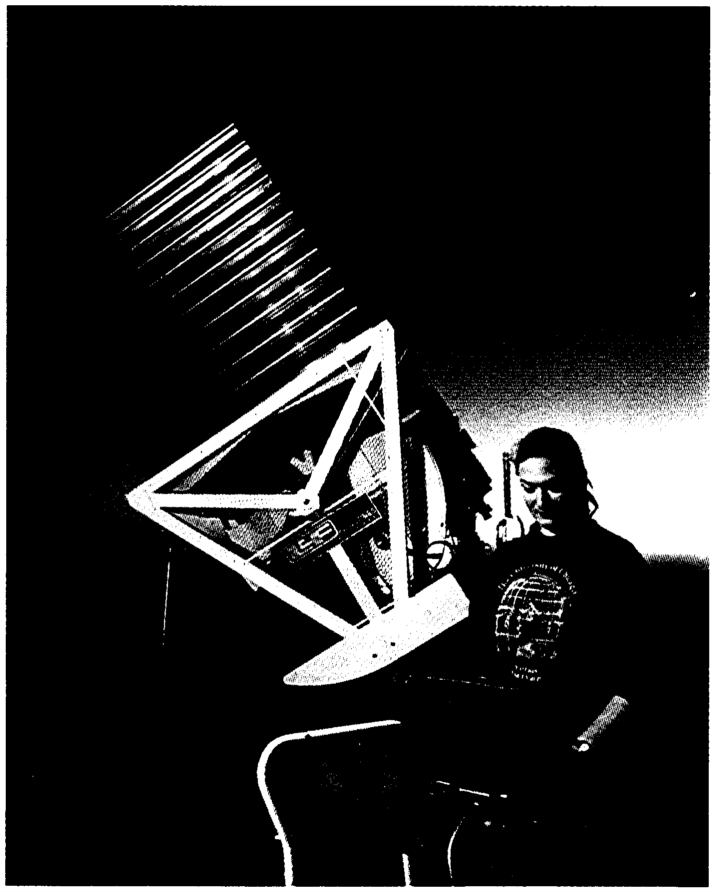
~ enlarge ~ 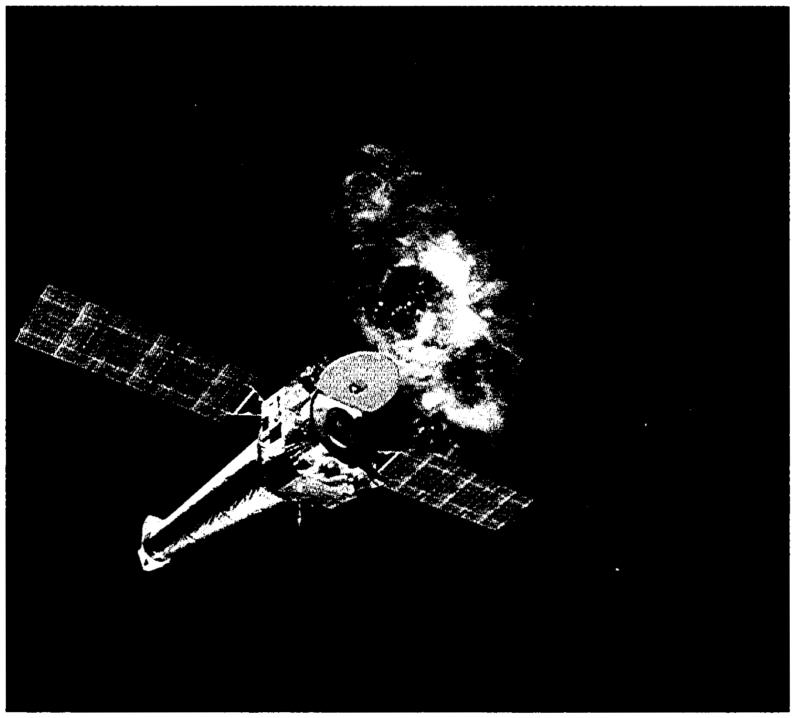
~ enlarge ~ |
Page 57
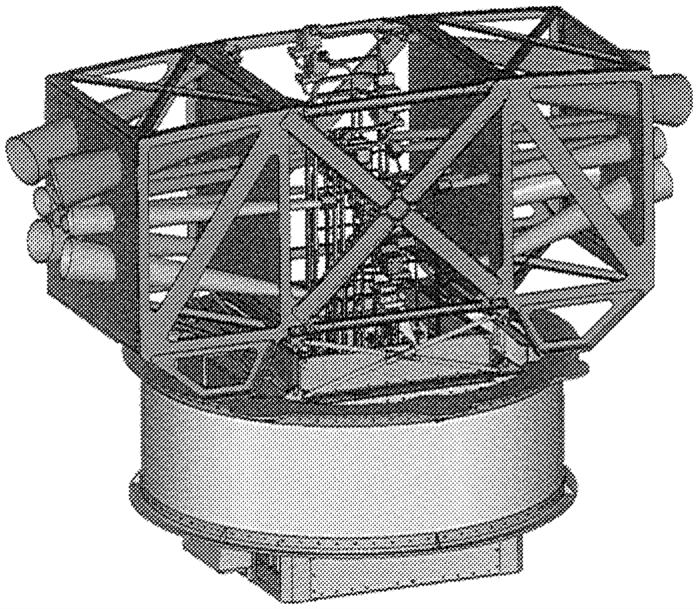
THREE NEW WINDOWSBy 2003 the Microwave Anisotropy Probe satellite (MAP) (left) will produce unprecedented high-resolution images of the cosmic microwave background, the cooling fireball of the Big Bang, seen at a time when the universe was only one thousandth its present size. Together with maps of the elusive dark matter in our vicinity, these data will lead to a new era in precision cosmology. 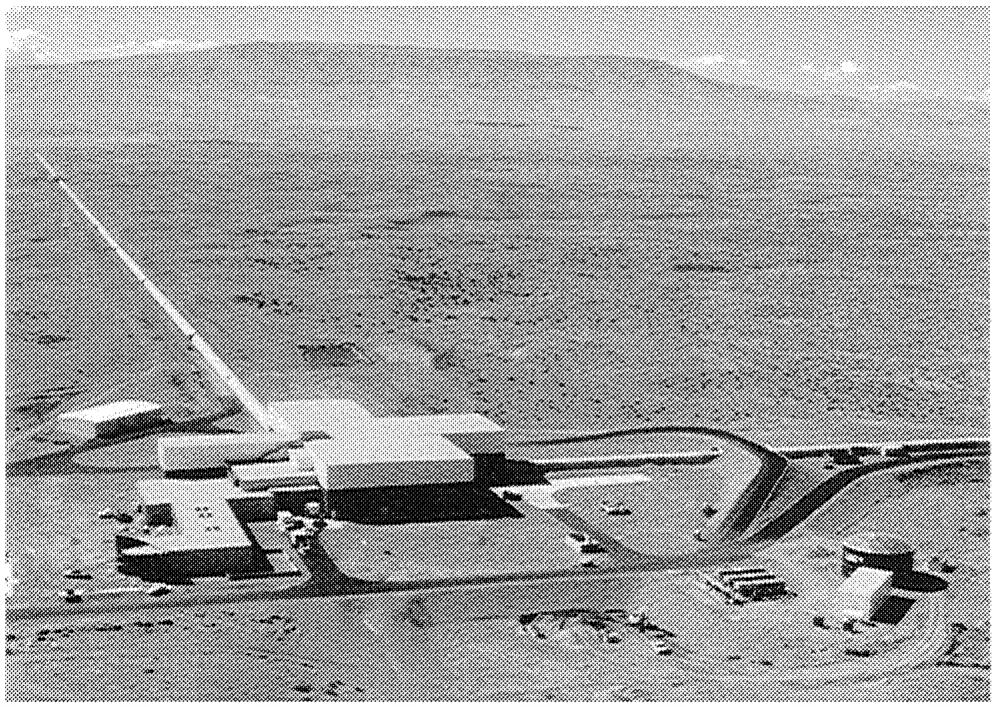
~ enlarge ~ LIGO (right) is a set of giant laser interferometers sensitive to ripples in the fabric of space-time. It may detect gravitational radiation, waves in the space-time warp produced by coalescing nearby pairs of neutron stars or black holes. 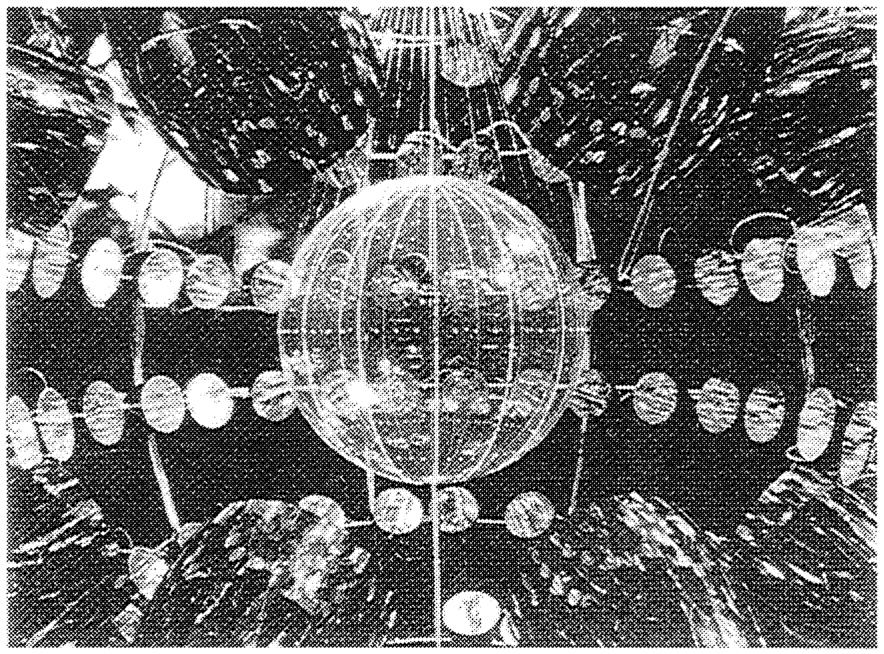
~ enlarge ~ The BOREXINO neutrino detector (left) will for the first time allow us to see the elusive low-energy neutrinos from the decay of 7Be in the Sun's core. This measurement will provide critical new data on the mass of the neutrino and its other properties. |
Page 58
Electromagnetic Waves
At radio wavelengths, giant interferometers employing radio telescopes spanning Earth chart the fall of matter into supermassive black holes. Millimeter-wavelength radio telescopes give us a view of astrophysical molecules and the cosmos at very early times. New satellite experiments map the microwave radiation that is the residual light from the Big Bang, giving us a detailed picture of the universe only 300,000 years after its beginning. Newly constructed large ground-based telescopes covering the infrared spectrum will be used to study galaxies at the time of their formation 11 billion to 13 billion years ago.
Optical telescopes are increasingly effective at capturing the feeble light from objects at the edge of the observable universe. The Hubble Space Telescope has vastly increased this reach, and the Next-Generation Space Telescope would probe the cosmos to even greater distances, seeing optical and infrared light produced at even earlier epochs. Wide-angle surveys probing the cosmos will generate terabytes of data and provide unique opportunities for understanding the cosmic forces generated by the dark matter that fills the universe. These surveys will also help us to understand how the arrangement of the galaxies developed.
At the shortest wavelengths, x-ray and gamma-ray studies of the universe are in their infancy but are already providing spectacular surprises. The Rossi X-ray Timing Explorer has tested general relativity in strong gravitational fields. The orbiting Chandra X-ray Observatory is pushing the exploration of x-ray luminous clusters of galaxies out to extreme distances and probing nearby supernova remnants for the elusive cause of their explosions. Satellite gamma-ray telescopes have revealed a class of ultraluminous sources of gamma radiation, some of which mysteriously emit a burst of radiation brighter than any other object in the universe. Several of these gamma-ray bursts have been associated with unusual supernovae. Satellite experiments are planned that will extend this exciting frontier, revealing more about these sources.
Neutrinos and Gravitational Waves
Neutrinos and gravitational waves offer new windows on the universe very different from those available using electromagnetic waves. Neutrinos are a natural probe of extremely hot and dense environments, where they are copiously produced and from which their weak interaction allows them to escape. Supernova 1987A was the explosive death of a massive star; its
Page 59
burst of neutrinos was detected in the United States by the IMB (Irvine-Michigan-Brookhaven) experiment in northern Ohio and at the Kamiokande facility in the Japanese alps. The process of nuclear burning at the center of the Sun, which makes the Sun a star, also produces neutrinos. Sensitive detectors including Super-Kamiokande in Japan, SAGE in Russia, and GALLEX in Italy have confirmed that neutrinos come from the Sun at a level below expectations. This discrepancy is now thought to be due to new physics—the nonzero mass of neutrinos allowing for the mixing of neutrino species—and is a frontier area of particle physics. New detectors (SNO in Canada and BOREXINO in Italy) will soon provide critical tests of this idea.
Gravitational waves are ripples in space and time propagating with the speed of light. Predicted by Einstein's general theory of relativity, gravitational waves produced by mass in motion can be detected by observing the motion of test masses as the ripples pass by. But since gravity is the weakest of the forces that act on matter, gravitational waves require large receivers for their detection. While there is direct evidence for the existence of gravitational waves in the motion of compact stars, such waves have never been detected on Earth. The worldwide network of gravitational wave detectors now under construction will attempt to detect these minute ripples. The U.S. effort—the Laser Interferometer Gravitational-wave Observatory (LIGO)—consists of two 4-km-long interferometers in Hanford, Washington, and one in Livingston, Louisiana.
These detectors have a dual role. They are experiments that test fundamental physics: the existence and character of gravitational waves. But they also offer a new way to see astronomical phenomena. Gravity's weak coupling to matter makes gravitational waves a unique window on the universe. Once produced, very little of a wave is absorbed. Gravitational wave detectors may enable us to see deeper into the environment around massive black holes and to moments in the universe earlier than those accessible by electromagnetic radiation.
Neutrino and gravitational wave detectors, looking outward, are not the only new windows on the universe. There is compelling evidence that up to 90 percent of the matter in the universe is made up not of the familiar protons, neutrons, and electrons that are the building blocks of the stars and planets but of unknown particles. This is called “dark matter,” as it is matter not found in luminous stars (see sidebar “Dark Matter Then and Now”). Can we detect such dark matter particles in the laboratory? The vast majority of the dark matter must be moving slowly to avoid disturbing the formation of galaxies. Weakly interacting, massive particles (WIMPs) are a possible candidate. If these make up the dark matter, Earth is drifting through a sea of
Page 60
DARK MATTER THEN AND NOW
COBE map. Small temperature fluctuations of the microwave background, the cooling cosmic fireball, are seen in this map (enclosed by text) made by the Cosmic Background Explorer satellite. These temperature fluctuations are related to developing dark matter densities at a time when the universe was only one thousandth its current age. New satellites will give even higher-resolution snapshots of the early universe. Different candidate dark matter particles will cluster in different ways in the intervening billions of years. 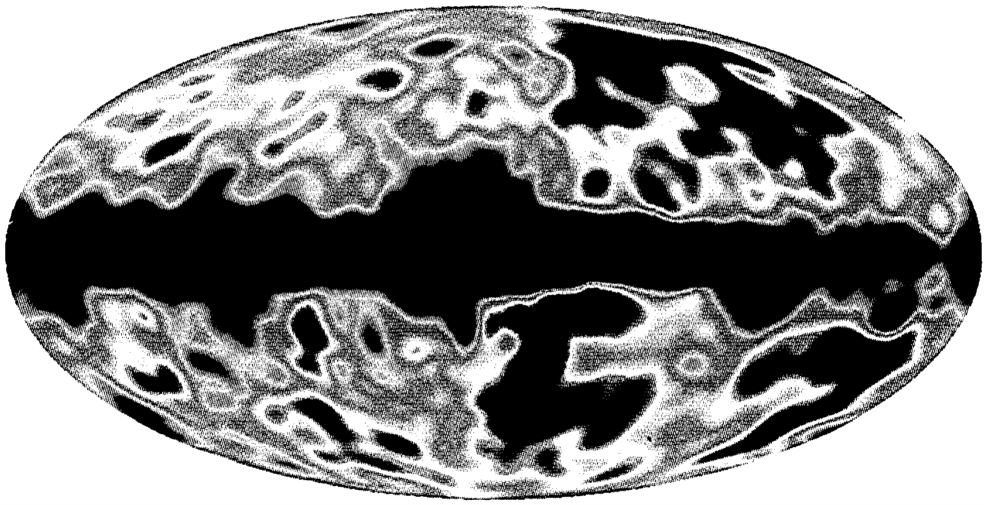
~ enlarge ~ Cosmic mirage. A huge concentration of dark matter—seen 10 billion years after the Big Bang—is revealed by the space-time warp it creates around its host cluster of galaxies (see image at bottom). This mass warps the images of background galaxies. Millions of these images may be analyzed to reconstruct a map of the mass distribution of the dark matter over large areas on the sky. This distribution, in turn, may be used to test theories of dark matter and structure formation, as well as to understand the underlying physics. 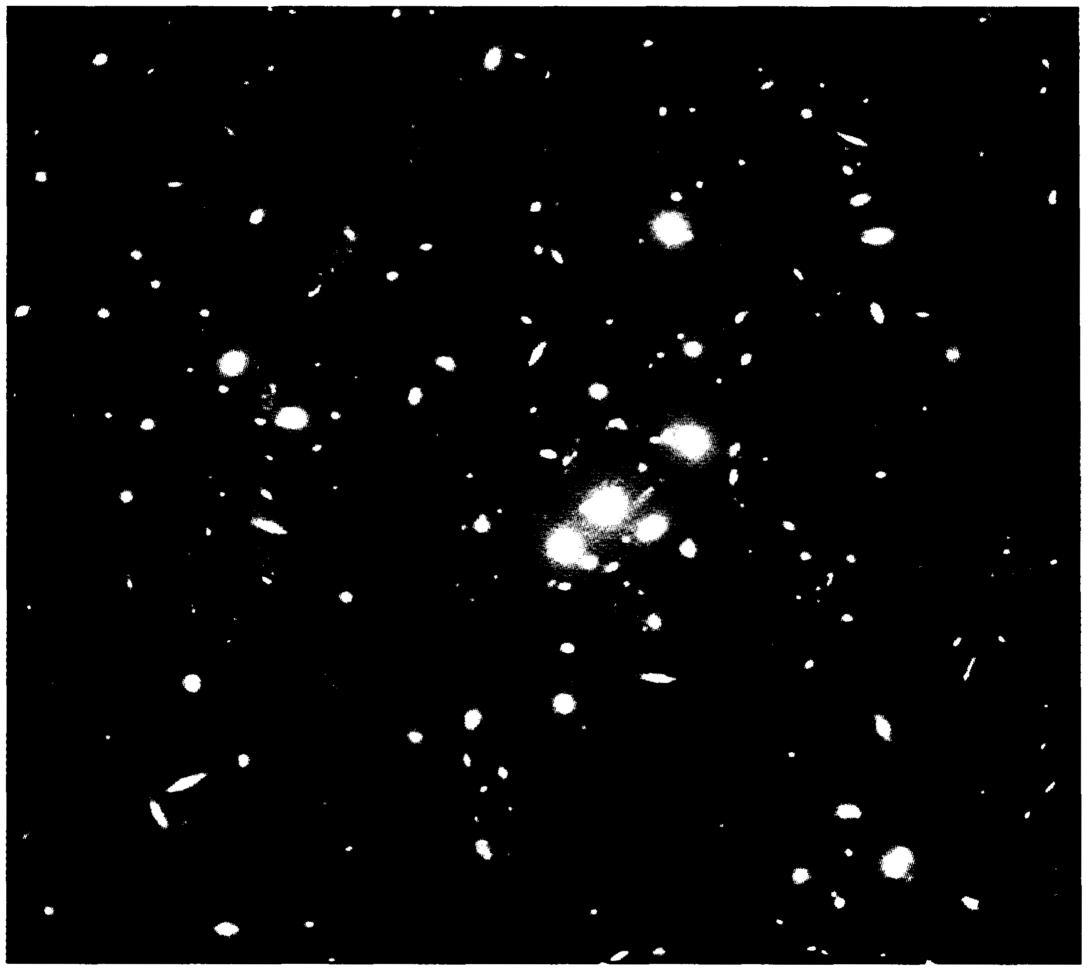
~ enlarge ~ |
Page 61
them as it travels around the Sun and as the Sun orbits the galactic center. Earth itself is therefore a moving platform for detectors of such dark matter. Several very sensitive experiments for direct laboratory detection are now under way. Other dark matter candidates, called axions, are also being sought in Earth-bound experiments.
All these advances in observational capability—the product of basic and applied research in the physics of materials, optics, and devices—are enabling us to explore the universe to its furthest reaches, to its earliest moments, and through its most explosive events.
NEW LINKS
In astrophysics, the basic laws of physics are used to understand the large variety of objects that can be seen in the universe (planets, stars, galaxies, black holes, gravitational waves and lenses, dark matter, pulsars, quasars, x-ray sources, and gamma-ray bursts, to name just a few). As the frontiers of physics move to larger and smaller length scales, astrophysics is becoming more strongly linked to the physics studied in laboratories on Earth. Three examples illustrate this trend: cosmology, nuclear astrophysics, and black holes.
Cosmology
We live in an evolving universe filled with tens of billions of galaxies within our sphere of observation. Cosmic structures, from galaxies to clusters of galaxies to superclusters to the universe itself, are mingled together with invisible dark matter whose presence is known only through its gravitational effects. The light received from the most distant galaxies takes us back to within a few billion years of the beginning. The microwave echo of the Big Bang is a snapshot of the universe long before galaxies formed. A multitude of observations over the past decade have permitted cross-checks of our basic model of the past universe as a dense, hot environment in which structure forms via gravitational instability driven by dark matter.
What is the nature of the dark matter in the universe? What controls the development of structure in our universe? What do we know about the geometry and topology of our universe? How did it originate? These are fundamental questions that can be addressed by observation and careful deduction from our laboratory-tested knowledge of physics.
Our understanding of the universe has increased dramatically in the last decade. We can now map the small temperature variations (30 parts per
Page 62
million) in the remnant microwave radiation from the epoch when electrons combined with protons, only 300,000 years after the Big Bang. These variations, in turn, are related to the underlying gravitational effects of dark mass-energy fluctuations left over from an even earlier time. Thus, it is possible to see a filtered version of the primordial universe—an important frontier for physics at energies higher than those achievable in Earth-bound accelerators.
Important clues to this new physics are coming from observations of dark mass-energy, including its spatial distribution and the clumping of dark matter over cosmic time. Until recently we have had to rely on proxies for observations of dark matter—for example, the notion that luminosity is somehow related to mass and that luminosity might trace the dark matter. However, virtually all of the dark matter is nonluminous: Stars (and related material) contribute a tiny fraction (about 0.4 percent) of the mass required to halt the expansion of the universe, while the amount of matter known to be present from several estimates of its gravitational effects contributes about 100 times as much as stars. The dark matter cannot be made out of the familiar nuclear building blocks (protons, neutrons): Our understanding of the synthesis of light elements in the Big Bang, together with recent measurements of the primeval abundance of deuterium, reveals a universe in which ordinary matter (even nonluminous dead stars and dust) composes only 10 to 20 percent of the total mass. What is this dark matter and how is it related to the physics of the hot early universe? Some understanding of this will come from mapping the dark matter itself.
We can now map the dark matter over vast regions of space using the gravitational bending of light, seen as the distortion of images of distant galaxies. These telltale image distortions reveal the “invisible” foreground dark matter clumps, yielding two-dimensional maps of the dark matter distribution on the sky. Maps of the dark matter at various cosmic epochs will tell us the story of structure formation and constrain the physical nature of dark matter.
Is there cosmologically significant energy other than the dark matter? Using a certain type of supernova (type la) as a calibrated light source (“standard candle”), two groups—the Supernova Cosmology Project and the High-Z Supernova Team—both conclude that the expansion of the universe is accelerating rather than decelerating. If correct, this implies that much of the energy in the universe is in an unknown component, with negative pressure. The simplest explanation is a vacuum energy density (called a cosmological constant) with about 60 to 70 percent of the mass-energy required to make the universe flat. The rest would be made up by the dark matter itself.
Page 63
Thanks to new tools, we are now entering the age of precision cosmology. When taken together, observations of the dark matter, dark energy, and fluctuations in the remnant radiation from the Big Bang will in the next few years give us a percent-level precision on several critical cosmological parameters, testing the foundations of our understanding of the universe. Because of the profound relationship between physics at the smallest distance scales and the details of the early universe and dark mass-energy, this will open a new window for physics.
Cosmology touches fundamental physics in many different ways. In elementary-particle physics, a unified theory of the basic constituents of matter is a major objective. If new particles make up the dark matter, they must fit naturally into such a scheme; conversely, unified theories predict the nature of the dark matter. In this way, cosmology and fundamental-particle physics are linked. If the missing energy is an energy of the vacuum (a cosmological constant), then the link is even stronger. The value of the cosmological constant is one of the major unsolved problems in the theory of the basic interactions. Simple estimates would lead to values as much as 10120 times greater than allowed by cosmological data. A definitive measurement of this central parameter from cosmology is critically important for the future development of particle physics.
Many features of the present universe can be explained by assuming that it underwent a very rapid expansion very early in its history. Inflation is the generic name given to this idea. Many different inflationary mechanisms have been proposed, all connected with the nature of the basic constituents of matter and how they behaved at that early epoch. Accelerator physics at the highest energies, which measures the properties of these constituents, explores the link between microphysics and cosmology. A nonrelativistic (cold) dark matter and inflation scenario is consistent with a large body of indirect observations: measurements of the anisotropy of the cosmic microwave background, redshift surveys of the distribution of luminous matter today, and supernova probes of acceleration. However, observations have only begun to discriminate between different inflationary mechanisms and different versions of cold dark matter.
The strong link between cosmology and elementary particle physics arises in part because the highest energies characterizing the particle physics frontier, unattainable in any conceivable accelerator on Earth, are actually reached in the Big Bang. The Big Bang thus provides one of the few “laboratories” for this kind of physics, although not one subject to our manipulation and control. Closer to home are the puzzling ultrahigh-energy cosmic rays that have recently been detected, a billion times more energetic
Page 64
than the particles in man-made accelerators. According to current understanding, such energetic cosmic rays should not exist: They should have lost their energy via interactions with the cosmic background radiation from the Big Bang. Do these cosmic rays portend new physics? We do not know, but if so it would not be the first time that cosmic rays have revealed new physics.
Gravitational physics is another area that is closely tied to cosmology. Gravity governs the structure and evolution of the universe on the largest possible scales. Although it is the weakest of the fundamental forces, it is not confined to small distances as are the nuclear forces, nor is it cancelled by opposite charges as is the electromagnetic force. It is universal, long range, and always attractive. Standard cosmological models incorporate the dynamics predicted by Einstein's general theory of relativity, as indeed does our whole idea of the Big Bang. In the future it should be possible to test Einstein's theory over these large distances by observing the changes in the expansion of the universe. Determining the cosmological constant is an important part of that test because the cosmological constant is one of the two parameters in Einstein's equation.
Gravitational physics is a two-frontier science, important on both the largest and smallest scales being researched by contemporary physics. The smallest scales, reached in the very early universe, are those of quantum gravity—discussed in Chapter 4 —where our classical notions of space and time are expected to break down. Quantum gravity is important for cosmology not only because it is part of the fundamental dynamical theory describing the evolution of the universe but also because it frames another of the fundamental laws: a theory of the cosmological initial quantum state—a quantum theory of how the universe originated.
Nuclear Astrophysics
The physics of our universe is interwoven so that following one problem may lead to solving another. Recently, a combination of observations with the Beppo-SAX satellite and two ground-based optical telescopes produced proof that some sources of high-energy gamma-ray bursts are at high redshift and so must be the most luminous objects in the universe. Such events require energies that strain even the capabilities of black hole dynamics, and they could well be a source of measurable gravitational waves and, possibly, neutrino bursts. The possible identification of the unusual supernova SN1998bw with the equally special gamma-ray burst GRB980425 is a fascinating clue. Some supernovae produce energies 10 to
Page 65
100 times larger than previously recognized and/or produce relativistic jets pointing at Earth. What is the nature of these gigantic explosions?
A first step in solving the puzzle is to simulate the explosions, using the consequences of known physics, and compare simulations with observations. The dramatic evolution in computer power is beginning to make such three-dimensional, time-dependent modeling feasible. An important issue is how such complex calculations may be tested for reliability in a way that is independent of the observations to be understood.
Some help may come from a surprising source. High-intensity lasers built for the study of inertial confinement fusion and for national defense projects have been used to make scale models of a supernova. This is done by blasting a small target with an enormous pulse of laser light. Although the laser targets have dimensions of 0.1 cm and explode in 20 ns, this is a good model for supernova mantles with dimensions larger than the Sun and durations of hours. Furthermore, petawatt lasers have reached such high intensities that they can produce relativistic plasmas, making possible the experimental study of relativistic jets of particles believed associated with several exotic astrophysical phenomena.
As in the Big Bang, explosive nucleosynthesis (the production of atomic nuclei in supernova explosions) is a diagnostic of the explosion itself. Utilizing this diagnostic requires understanding the nuclear microphysics underlying the supernova explosions, including the associated nucleosynthesis and its impact on the chemical evolution of our galaxy. Included in this will be the resolution of still unsolved problems in our understanding of the mechanism of supernova explosions and the origin of the heavy elements. Both, in turn, are connected to neutrino physics and the properties of exotic, neutron-rich nuclei, subjects that we hope to be able to study in the laboratory in the decade ahead. The modification of matter by thermonuclear alchemy using high-intensity lasers, and its subsequent ejection into conditions in which it may be analyzed, gives a means of probing these explosive environments.
This is another case of an intersection of two fields of physics (nuclear physics and astrophysics) that will receive an enormous push because of the booming technology of astrophysics: Hubble Space Telescope measurements of abundances in metal-poor stars, detection of gamma-ray lines from new sources (such as 44Ti), x-ray pictures of supernova remnants, and nuclear chemistry probes of individual stellar grains. There is great potential for learning new nuclear astrophysics in the coming decade. The mechanisms for supernovae of type la (the standard candles mentioned earlier) and type II (those core-collapse supernovae that produce neutron stars and
Page 66
black holes) are two of the major computational challenges in nuclear astrophysics (see sidebar “Stars in the Laboratory”). These mechanisms may be related to the even more energetic explosions causing the gamma-ray bursts. These bursts, in turn, must also be accurately simulated; they are a
STARS IN THE LABORATORY
Most of the visible matter in the universe is in the form of yellow stars like the Sun. Their central temperatures and densities are becoming accessible to experiment by focusing light from many lasers into a tiny volume. Thermonuclear reactions may occur under these conditions, making these experiments interesting for research in astronomy, controlled fusion, and nuclear weapons. The computer simulation of the interior of the explosion of supernova 1987a predicted complex instabilities between layers of the star (below). 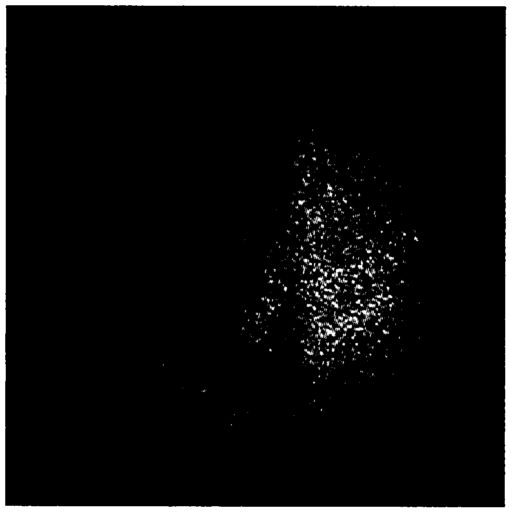
~ enlarge ~ Experiments on the Omega laser at the University of Rochester provide small-scale versions of the explosion (100 billion times smaller in radius); above, right, are shown the effects of such instabilities in multiple layers. In this sense, the experiments give a scale model of the supernova, on which both our ideas about the explosion and our computer simulations of it can be tested. 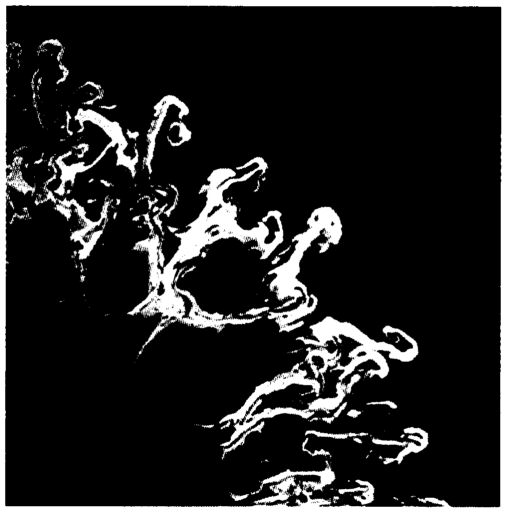
~ enlarge ~ Constructing reliable and accurate simulations of such complex phenomenon is at the frontier of astrophysics and plasma physics. Below, a researcher shows his son how he simulates supernovae and laser experiments. 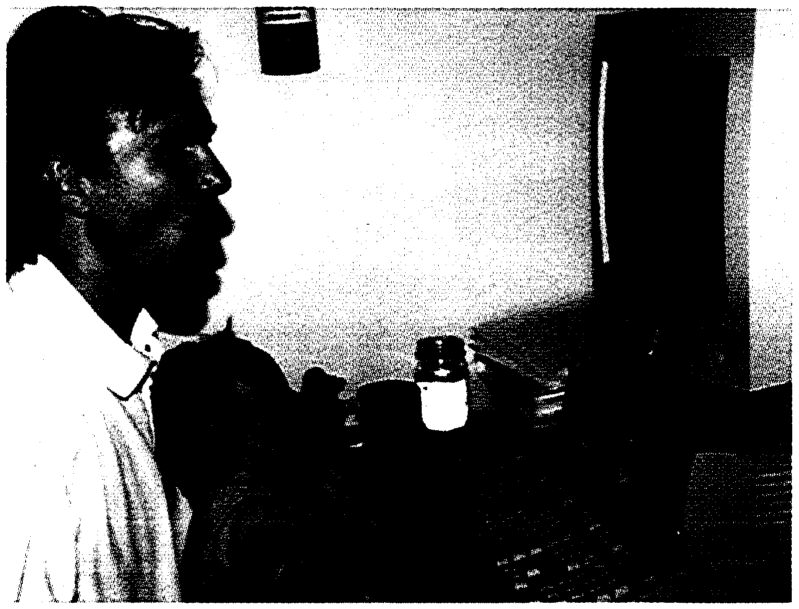
~ enlarge ~ |
Page 67
promising source of gravitational waves for the LIGO detectors. Finally, those same type la supernovae, which were used to infer the acceleration of the universe, must be understood better before they can provide an accurate distance scale. This will require an improved knowledge of the atomic physics of ionized cobalt and other iron-group elements.
Black Holes
Perhaps nowhere is the connection between fundamental physics and astrophysics clearer than in the physics of black holes. The key idea of Einstein's battle-tested theory of gravity—general relativity—is that mass curves four-dimensional space and time. General relativity predicts that when mass is compressed into a small enough volume, this curvature, and the consequent gravitational pull at the surface, will be too large for anything to escape, even light. The surface of a black hole, called its horizon, is like a one-way membrane. Matter, information, and observers can fall into it but nothing can emerge from it.
Black holes are surprisingly simple objects. Typically produced in nature by complex gravitational collapse, general relativity predicts that in the end they are characterized by just a few numbers. As S. Chandrasekhar put it, “The black holes of nature are the most perfect macroscopic objects there are in the universe: the only elements in their construction are our concepts of space and time. And since the general theory of relativity provides only a single unique family of solutions for their description, they are the simplest objects as well.” 1 Black holes occur throughout the universe because the attractive force of gravity leads to continual compression of mass. Black holes with masses comparable to that of our Sun have been discovered all over our galaxy as unseen members of certain x-ray-emitting double star systems. These x rays are generated when hot gases are stripped from the normal companion star and fall into the black hole.
Supermassive black holes have been detected at the center of many galaxies, including our own, by observing their effects on the motion of the surrounding matter. These black holes are up to a billion times more massive than the Sun and are likely to be in the center of every large galaxy. Matter falling into such a huge black hole, which becomes hot and radiates as its pressure rises, is thought to be the source of the activity seen in active galactic nuclei (AGN) and the hugely luminous quasars. Astrophysicists are
1 S. Chandrasekhar. 1992. A Mathematical Theory of Black Holes. Oxford University Press, New York, p. 1.
Page 68
trying to understand the behavior of matter, radiation, and magnetic fields inside these accretion disks of infalling matter.
Present observations reveal black holes only indirectly—by their effects on surrounding luminous matter. Sufficiently advanced gravitational wave detectors should be able to receive directly the gravitational radiation from perturbed black holes and to test further the predictions of Einstein's theory. Making these predictions involves computation on very large scales, which in turn requires an intensive effort to formulate the computation effectively.
The massive black holes of astrophysics may not be the only black holes that exist in the universe. Microscopic black holes may have been produced in the early universe, small enough that quantum gravity could be important for their understanding. Although prohibited classically, matter inside black holes can tunnel out quantum mechanically. This effect, predicted by Stephen Hawking in the early 1970s, has the consequence that black holes emit radiation like blackbodies. Indeed, the smaller the mass, the higher the temperature, so that evaporating black holes eventually explode. In these explosions, which have not yet been detected experimentally, space-time curvatures are reached that are greater than any since the Big Bang. At these curvatures, space and time behave quantum mechanically, and physics at the highest energy scales, such as the physics associated with the unification of the fundamental interactions, plays an important role.
QUESTIONS AND OPPORTUNITIES
Our knowledge of the universe is accelerating, driven by new observational results. Cosmology is in the midst of a golden age. Within 10 years we may have a cosmological theory that explains almost all the fundamental features of the universe: its smoothness and flatness, the heat of the cosmic microwave background, the asymmetry between ordinary matter and so-called nonbaryonic matter, and the origin of structure. At the present time, however, there is much we do not understand.
Is the universe spatially flat, as predicted by inflation? Does the absence of antimatter and the tiny ratio of matter to radiation (around 10−10) involve forces operating in the early universe that violate baryon-number conservation and matter-antimatter symmetry? Is inflation the correct theory of the earliest moments of the universe, and if not, what is? Is the expansion of the universe today accelerating rather than slowing down because of the presence of vacuum energy or something even more mysterious? How is this vacuum energy related to quantum gravity?
Page 69
What are gamma-ray bursts? How do black holes form? Can we directly detect neutrinos from the relativistic jets in gamma-ray bursts? Can we detect gravitational waves from core collapse in a supernova or in a merger involving a black hole? What determines whether a core collapse becomes a black hole or a neutron star? The list goes on.
Exciting opportunities abound in the coming decade for exploring these fundamental questions, thanks to advances in applied physics and technology. A paradigm based on profound connections between cosmology and elementary particle physics—inflation along with cold dark matter—holds the promise of extending our understanding to an even more fundamental level and much earlier times and of shedding light on the unification of the forces and particles of nature. As we enter the 21st century, a flood of observations is testing this paradigm.


