
9
Scientific Inquiry and How People Learn
John D. Bransford and M. Suzanne Donovan
Many of us learned science in school by studying textbooks that reported the conclusions of what scientists have learned over the decades. To know science meant to know the definitions of scientific terms and important discoveries of the past. We learned that an insect has three body parts and six legs, for example, and that water (H2O) is a molecule composed of two hydrogen atoms and one oxygen atom. We learned that the planets in our solar system revolve around the sun and that gravity holds us to the earth. To be good at science meant to reproduce such information as accurately and completely as possible. The focus of this kind of instruction was on what scientists know.
Of course, many of us were also introduced to “the scientific method.” This typically involved some variation on steps such as “formulate a hypothesis, devise a way to test the hypothesis, conduct your test, form conclusions based on your findings, and communicate what you have found.” Often information about the scientific method was simply one more set of facts to be memorized. But some of us were given opportunities to use the scientific method to perform hands-on experiments. We might have tested whether wet or dry paper towels could hold the most weight; whether potential insulators such as aluminum foil, paper, or wool were the best ways to keep a potato hot; and so forth. This emphasis on the scientific method was designed to provide insights into how scientists know. Much of this science instruction—both the “what” and the “how”—was inconsistent with the principles highlighted in How People Learn (see Chapter 1).
Two major national efforts conducted during the last decade have provided new guidelines and standards for creating more effective science edu-
cation. The new guidelines include an emphasis on helping students develop (1) familiarity with a discipline’s concepts, theories, and models; (2) an understanding of how knowledge is generated and justified; and (3) an ability to use these understandings to engage in new inquiry.1 At first glance, the traditional science instruction described above appears to fit these guidelines quite well. The first (emphasis on familiarity with a discipline’s concepts, theories, models) appears to focus on what scientists know; the second (emphasis on understanding how knowledge is generated and justified) how they know. If we let students engage in experimentation, this appears to comport with the third guideline (emphasis on an ability to engage in new inquiry). Like Lionni’s fish (see Chapter 1), we can graft the new guidelines onto our existing experience.
But both the new guidelines and the principles of How People Learn suggest a very different approach to teaching. Simply telling students what scientists have discovered, for example, is not sufficient to support change in their existing preconceptions about important scientific phenomena.2 Similarly, simply asking students to follow the steps of “the scientific method” is not sufficient to help them develop the knowledge, skills, and attitudes that will enable them to understand what it means to “do science” and participate in a larger scientific community. And the general absence of metacognitive instruction in most of the science curricula we experienced meant that we were not helped in learning how to learn, or made capable of inquiry on our own and in groups. Often, moreover, we were not supported in adopting as our own the questioning stance and search for both supporting and conflicting evidence that are the hallmarks of the scientific enterprise.
The three chapters that follow provide examples of science instruction that are different from what most of us experienced. They are also consistent with the intent of the guidelines of the National Research Council3 and the American Association for the Advancement of Science,4 as well as the principles of How People Learn. The authors of these chapters do indeed want to help students learn what scientists know and how they know, but they go about it in ways that are quite different from more traditional science instruction.
The three chapters focus, respectively, on light (elementary school), physical forces such as gravity (middle school), and genetics and evolution (high school). They approach these topics in ways that support students’ abilities to (1) learn new concepts and theories with understanding; (2) experience the processes of inquiry (including hypothesis generation, modeling, tool use, and social collaboration) that are key elements of the culture of science; and (3) reflect metacognitively on their own thinking and participation in scientific inquiry. Important principles of learning and instruction are discussed below.
PRINCIPLE #1: ADDRESSING PRECONCEPTIONS
It is often claimed that “experience is the best teacher.” While this is arguably true in many contexts, what we learn from our experience varies considerably in terms of its generality and usefulness. With respect to science, everyday experiences often reinforce the very conceptions of phenomena that scientists have shown to be limited or false, and everyday modes of reasoning are often contrary to scientific reasoning.
Everyday Concepts of Scientific Phenomena
Students bring conceptions of everyday phenomena to the classroom that are quite sensible, but scientifically limited or incorrect. For example, properties are generally believed to belong to objects rather than to emerge from interactions.5 Force, for instance, is seen as a property of bodies that are forceful rather than an interaction between bodies.6 As described in Chapter 10, students believe objects to “be” a certain color, and light can either allow us to see the color or not. The notion that white light is composed of a spectrum of colors and that the specific colors absorbed and reflected by a particular object give the object the appearance of a particular color is not at all apparent in everyday experience. Scientific tools (prisms) can break white light into colors. But without tools, students see only white light and objects that appear in different colors (rainbows are an exception, but for the untrained they are a magnificent mystery).
Students enter the study of science with a vast array of such preconceptions based on their everyday experiences. Teachers will need to engage those ideas if students are to understand science. The instructional challenge of working with students’ preconceptions varies because some conceptions are more firmly rooted than others. Magnusson and Palincsar (Chapter 10) note that some elementary students in their classrooms believe that shadows are “objects,” but this preconception is easily dispelled with fairly simple challenges. Other preconceptions, such as the idea that only shiny objects reflect light, require much more time and effort to help students change their ideas.
It is important to remember that most preconceptions are reasonable based on students’ everyday experiences. In the area of astronomy, for example, there is a widespread belief that the earth’s seasons are caused by the distance of the earth from the sun rather than by the angle of the earth’s axis with respect to the sun, and it is very difficult for students to change these preconceptions.7 Many experiences support the idea that distance from a heat source affects temperature. The closer we stand to radiators, stoves, fireplaces, and other heat sources, the greater is the heat.
Interestingly, there are also experiences in which we can manipulate the intensity of heat by changing the angle of a heat source—by pointing a hair dryer on one’s head at different angles, for example. But without the ability to carefully control distance from the head or the tools to measure small changes in temperature (and without some guidance that helps people think to do this experiment in the first place), the relationship between heat and angle with respect to the heat source can easily be missed.
Everyday Concepts of Scientific Methods, Argumentation, and Reasoning
Students bring ideas to the classroom not only about scientific phenomena, but also about what it means to “do science.” Research on student thinking about science reveals a progression of ideas about scientific knowledge and how it is justified.8 The developmental sequence is strikingly similar to that described in Chapter 2 regarding student reasoning about historical knowledge. Scientific knowledge is initially perceived as right or wrong. Later, discrepant ideas and evidence are characterized as “mere opinion,” and eventually as “informed” and supported with evidence.9 As in history, the sequence in science is more predictable than the timing. Indeed, many students may not complete the sequence without instructional support. In several studies, a large proportion of today’s high school students have been shown to be at the first stage (right or wrong) when thinking about various phenomena.10
Research has also explored students’ reasoning regarding scientific experimentation, modeling, the interpretation of data, and scientific argumentation. Examples of conceptions that pose challenges for understanding the scientific enterprise are summarized in Box 9-1. While research findings have been helpful in identifying problematic conceptions, less is known regarding the pace at which students are capable of moving along the developmental trajectory, or undergoing conceptual change, with effective instructional experiences. The chapters that follow provide many compelling examples demonstrating the kinds of changes in student thinking that carefully designed instructional experiences can support.
Conceptual Change
How People Learn emphasizes that instruction in any subject matter that does not explicitly address students’ everyday conceptions typically fails to help them refine or replace these conceptions with others that are scientifically more accurate. In fact, the pioneering research that signaled the tenacity of everyday experience and the challenge of conceptual change was done in the area of science, especially physics.11 One of the pioneers was
Jim Minstrell, a high school physics teacher and author—along with Pamela Kraus—of Chapter 11. That chapter begins with Minstrell describing an experience in his classroom that prompted him to rethink how he taught physics. He was teaching about universal gravitation and forces at a distance. He found that his students did reasonably well when asked to compute force based on “what if” questions involving a change in the distance of an object from a planet. He found, however, that when asked to think qualitatively about the situation, most of his students were basing their thinking on ideas that were reasonable from their everyday perspective, yet widely discrepant from the ways physicists have learned to think about these situations. For example, when Minstrell asked students to assume that there was no air or friction affecting an object pulling a weight, a number of the students offered that everything would just float away since that is how things work in outer space.
Minstrell notes that this experience raised fundamental questions in his mind, such as what good it is to have students know the quantitative relation or equation for gravitational force if they lack a qualitative understanding of force and concepts related to the nature of gravity and its effects. It became clear that simply teaching students about abstract principles of physics provided no bridge for changing their preconceptions. Minstrell and Kraus discuss ways of teaching physics that are designed to remedy this problem. A study suggesting the advantages of assessing student preconceptions and designing instruction to respond to those preconceptions is summarized in Box 9-2.
The authors of all three of the following chapters pay close attention to the preconceptions that students hold about subject matter. For example, the elementary school students discussed by Magnusson and Palincsar (Chapter 10) had had many years of experience with light, darkness, and shadows—and they brought powerful preconceptions to the classroom. The high school students discussed by Stewart, Cartier, and Passmore (Chapter 12) came with many beliefs about genetics and evolution that are widespread among the adult population, including the beliefs that acquired characteristics can be passed on to offspring, and that evolution is purposeful and proceeds toward a specific goal.
The authors of each chapter focus on issues of conceptual change as a major goal for their instruction. This view of learning is quite different from the more traditional view that learning simply involves the addition of new facts and skills to an existing knowledge base. Understanding scientific knowledge often requires a change in—not just an addition to—what people notice and understand about everyday phenomena.12
The chapters that follow focus specifically on creating conditions that allow students to undergo important changes in their thinking and noticing. Everything from the choice of topics to be explored to the procedures for
|
BOX 9-1 Research into students’ thinking about scientific knowledge and processes reveals some common misconceptions and limited understandings (summarized by AAAS13):
|
hypothesis testing and discussion contributes to the successful achievement of this goal. For example, Magnusson and Palincsar note that the study of light allows children to see the world differently and challenge their preconceptions. The examples discussed in the chapters on physics and genetics also illustrate many rich opportunities for students to experience and understand phenomena from new perspectives. Such opportunities for students to experience changes in their own noticing, thinking, and understanding are made possible because of another feature of the programs discussed in these chapters: they all integrate content learning with inquiry processes rather than teaching the two separately. This point is elaborated below.
|
PRINCIPLE #2: KNOWLEDGE OF WHAT IT MEANS TO “DO SCIENCE”
Feynman characterized the scientific method in three words: observation, reason, and experiment.21 Einstein emphasized the importance of imagination to scientific advancement, making it possible for the reasoning that follows observation to go beyond current understanding. This view of science extolled by some of its greatest minds is often not recognizable in classroom efforts to teach students how to do science.
We have noted that in the past, teaching the processes, not just the outcomes, of science often involved no more than memorizing and reproducing the steps of an experiment. However, even when science instruction
|
BOX 9-2 A computer-based DIAGNOSER program was designed to help teachers elicit and work with student preconceptions in physics.22 The program assesses students’ beliefs about various physical phenomena and provides recommended activities that help students reinterpret phenomena from a physicist’s perspective. The teacher uses the feedback from DIAGNOSER to guide instruction. Data were collected for students of three teachers at Mercer Island School who used the program and were compared with data for students in a comparable school where the program was not used in physics instruction. Data were collected on Miller Analogies Test math scores for students from both schools, so that individual students were compared with others who had the same level of mathematics achievement. In the figure below, the math scores for both groups on the same mechanics final exam are plotted. The results suggest that students’ understanding of important concepts in physics was substantially better in the Mercer Island school, and this result was true for students at all mathematics achievement levels. 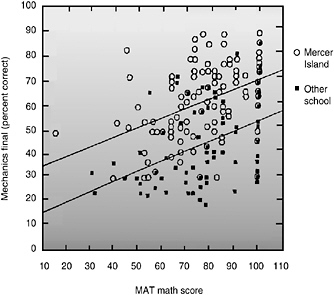 Scores of students from Mercer Island and a comparable school on mechanics final. |
is shifted in the direction of engaging in scientific inquiry (as is happening more frequently in today’s classrooms), it can be easy to emphasize giving students “recipes for experiments”—hands-on activities that students engage in step by step, carefully following instructions, using measurement tools, and collecting data. These lockstep approaches shortchange observation, imagination, and reasoning. Experimenting may mean that students are asked to conduct a careful sequence of activities in which the number of quarters a wet and dry paper towel can hold is compared in multiple trials, and data are carefully collected and averaged. Yet the question that needs investigation is often unclear, and the reasoning that would lead one to think that either a wet or a dry paper towel would be stronger can remain a mystery to students. As in specific content areas in science, information about the enterprise of science can be passed along to students without an opportunity for them to understand conceptually what that enterprise is about. Indeed, many students believe that everything they learn in science classes is factual; they make no distinction between observation and theory.23
The science programs discussed in the following chapters represent a very different approach to scientific inquiry. They do not involve simply setting aside “inquiry time” during which students conduct experiments that are related in some way to the content they are learning. Instead, students learn the content by actively engaging in processes of scientific inquiry. Students may still learn what others have discovered about a phenomenon (see Magnusson and Palincsar’s discussions of helping students learn from “second-hand knowledge”). But this is different from typical textbook exercises because the value of reading about others’ discoveries is clear to students—it helps them clarify issues that arise in their own inquiry. Reading to answer a question of interest is more motivating than simply reading because someone assigned it. It also changes how people process what they read.24
Opportunities to learn science as a process of inquiry (rather than simply having “inquiry times” that are appended to an existing curriculum) has important advantages. It involves observation, imagination, and reasoning about the phenomena under study. It includes the use of tools and procedures, but in the context of authentic inquiry, these become devices that allow students to extend their everyday experiences of the world and help them organize data in ways that provide new insights into phenomena.25 Crucial questions that are not addressed by lockstep experimental exercises include the following: Where do ideas for relevant observations and experiments come from in the first place? How do we decide what count as relevant comparison groups? How can sciences (e.g., astronomy, paleontology) be rigorously empirical even though they are not primarily experimental? Definitions of what counts as “good science” change as a function of what is being studied and current theorizing about the ideas being investigated. A
simple but informative example of how definitions of good scientific methods depend on knowledge of the conceptual issues one is studying is provided in Box 9-3.
One of the most important aspects of science—yet perhaps one of the least emphasized in instruction—is that science involves processes of imagination. If students are not helped to experience this for themselves, science can seem dry and highly mechanical. Indeed, research on students’ perceptions of science indicates that “they see scientific work as dull and rarely rewarding, and scientists as bearded, balding, working alone in the laboratory, isolated and lonely.26 Few scientists we know would remain in the field of science if it were as boring as many students believe.
Generating hypotheses worth investigating was for Einstein an extremely important part of science, where the “imagination of the possible” played a major role. Nobel Laureate Sir Peter Medawar also emphasizes the role of imagining the possible:
Like other exploratory processes, [the scientific method] can be resolved into a dialogue between fact and fancy, the actual and the possible; between what could be true and what is in fact the case. The purpose of scientific enquiry is not to compile an inventory of factual information, nor to build up a totalitarian world picture of Natural Laws in which every event that is not compulsory is forbidden. We should think of it rather as a logically particular structure of justifiable beliefs about a Possible World—a story which we invent and criticize and modify as we go along, so that it ends by being, as nearly as we can make it, a story about real life.27
The importance of creative processes in the conduct of science can also be understood by exploring the types of reasoning and investigative choices that have made some scientific investigations particularly productive and feasible. For example, Mendel’s critical insight about the discrete nature of heredity was a consequence of his selecting peas for his experiment (see Box 9-4). Other major advances in understanding heredity were equally dependent on scientists finding an approach to investigation that would allow the complexity of the world to be sufficiently simplified to uncover fundamental relationships.28 This very engaging dimension of the scientific enterprise is hidden when students’ inquiry experience is limited to the execution of step-by-step experiments.
The chapters that follow present a variety of ways to help students experience the excitement of doing science in a way that does justice to all stages of the process. The authors describe experiences that allow students to see everyday phenomena with new eyes. They provide opportunities for
both inventing and testing models of invisible processes, adopting and sometimes adapting tools to make the invisible visible. Students reason about relationships between theory and data. Furthermore, they do so by creating classroom communities that simulate the important roles of scientific communities in actual scientific practice.29 This involves paying careful attention to the arguments of others, as well as learning the benefits of group interaction for advancing one’s own thinking.
PRINCIPLE #3: METACOGNITION
The third principle of How People Learn emphasizes the importance of taking a metacognitive approach to instruction. Much of the research on metacognition focused on the comprehension of text (see Chapter 1) clearly applies to science, where texts can be quite complex and difficult for many students to comprehend. However, more recent research targeted specifically to the monitoring of and reflection on scientific reasoning has also shown promising effects.
A striking example is the work of White and Frederiksen (see Box 9-5), who designed a physics inquiry curriculum called ThinkerTools. The curriculum uses inquiry instruction to engage students in investigations that allow them to confront their misconceptions and develop a scientific understanding of force and motion. Students taught with the ThinkerTools curriculum displayed a deeper conceptual understanding than students taught with a traditional curriculum. This advantage remained even when the ThinkerTools students were in inner-city schools and were compared with students in suburban schools, and when the ThinkerTools students were several years younger. White and Frederiksen later extended the curriculum to include a metacognitive component—what they refer to as “reflective assessment.” Students taught with the curriculum including this metacognitive component outperformed those taught with the original curriculum. Gains were particularly striking for lower-achieving students.
Another study, by Lin and Lehman,30 demonstrates that metacognitive instruction can be effective for college students. In their experiments, students learned about strategies for controlling variables in a complex science experiment that was simulated via computer. As they studied, some received periodic questions that asked them to reflect on—and briefly explain—what they were doing and why; others did not receive these questions. On tests of the extent to which students’ knowledge transferred to new problems, those in the metacognitive group outperformed those in the comparison groups.
The authors of the following chapters do not necessarily label their relevant instructional moves as “metacognitive,” but they emphasize helping students reflect on their role in inquiry and on the monitoring and critiquing of one’s own claims, as well as those of others. They also emphasize that
|
BOX 9-3 Imagine being asked to evaluate the following experiment and conclusions: A group of biologists compare data from across the world and note that frogs seem to be disappearing in an alarming number of places. This deeply concerns them, because the frogs may well be an indicator species for environmental changes that could hurt us all. The biologists consider a number of hypotheses about the frogs’ disappearance. One is that too much ultraviolet light is getting through the ozone layer. One group of researchers decides to test the ultraviolet light hypothesis. They use five different species of frogs—an equal number of male and female. Half of the frogs receive constant doses of ultraviolet light for a period of 4 months; this is the experimental group. The other half of the frogs—the control group—are protected so they receive no ultraviolet light. At the end of the 4 months, the biologists find that there is no difference in death rates between the frogs in the experimental and control groups. This finding suggests that ultraviolet light is probably not the cause of the frogs’ demise. What do you think about the biologists’ experiments and conclusions? Are there questions you would want to ask before accepting their conclusions? Are there new experiments that you would want to propose? This problem has been addressed by hundreds of individuals in classes and workshops.31 Many of these individuals know a considerable amount about experimental design and typically note a number of strengths and weaknesses about the experiment. Strengths include the fact that it had an experimental/control design that involved several different species of frogs, used stratified random sampling, and so forth. Weaknesses include such concerns as the possibility that the doses of ultra-violet light that were used were too weak; that the light was provided for too short a time (i.e., only 4 months); or that the experimenters did not wait long enough to see the effects of the ultraviolet light, so maybe they should have looked at differences in illness between the two groups rather than comparing the death rates. |
|
Such concerns are valid and relatively sophisticated, but they reflect a lack of knowledge about general principles of biology—principles that raise serious questions about the preceding experiment. In particular, very few people question the fact that only adult frogs were used in the experiment (multimedia materials viewed by participants showed clearly that the frogs were all adults). To understand potential environmental effects on a species, one must look at the life cycle of the species and attempt to identify points in that cycle where the species might be the most vulnerable. For example, when DDT endangered eagles, it did so not by killing the adults but by making the egg shells so brittle that they broke before the offspring could hatch. Overall, what counts as an adequate experimental or empirical design is strongly affected by the current state of knowledge of a particular field. Learning about “the scientific method” in the abstract fails to help students grasp this important idea. An interesting side note is that people who have participated in the preceding demonstration have been asked whether they ever studied life cycles in school. Almost all have said “yes”; however, they learned about life cycles as isolated exercises (e.g., they were asked to memorize the stages of the life cycle of a fly or mosquito) and never connected this information to larger questions, such as the survival of a species. As a consequence, the idea of life cycles had never occurred to them in the context of attempting to solve the above problem. In Chapter 1, Bruner’s ideas32 about curriculum organization are discussed; those ideas are highly relevant in this context. For example, he cautions against teaching specific topics or skills without clarifying their context in the broader fundamental structure of the field; rather, students need to attain an understanding of fundamental principles and ideas. Those presented with the frog problem may have learned about life cycles, but their teachers and texts did not explain the importance of this information in the broader structure of the field of knowledge. To paraphrase Whitehead,33 knowledge that was potentially important for exploring the frog problem remained “inert.” |
|
BOX 9-4 Gregor Mendel’s major contribution to the field of genetics rested on his choice of peas. Many famous men at the time were conducting experiments in plant breeding, but no general principles had emerged from these experiments. Typically they involved plant organisms that differed on a variety of dimensions, and the offspring were found to be intermediate or, in rare cases, more like one parent plant than the other. Mendel chose peas for certain critical features: they have both male and female structures and are generally self-fertilizing, but their structure makes it possible to prevent self-fertilization (by removing the anthers before they mature). Numerous varieties of peas were available that differed on certain discrete dimensions; Mendel chose varieties with seeds that were green or yellow, smooth or wrinkled, etc. When the peas were cross-fertilized, they consistently showed one of the two characteristics. When plants with smooth and wrinkled seeds were crossed, they consistently had offspring with smooth seeds. This result suggested that one characteristic is, in Mendel’s term, dominant. But when these offspring were self-fertilized and produced their own offspring, characteristics of each of the original parent plants appeared in members of the new generation. The stunning conclusion—that offspring carry genetic information that is recessive but can nonetheless be passed along to future generations—represented a major advance. To appreciate Mendel’s contribution is not just to know the terms he used and the experimental procedures he followed, or even the outcome of his work. It is to understand as well the important role played by his experimental design, as well as the reasoning that led him to design a productive experiment. |
being metacognitive about science is different from simply asking whether we comprehend what we read or hear; it requires taking up the particular critical lens through which scientists view the world.
Magnusson and Palincsar provide excellent examples of how metacognitive habits of mind for science require different kinds of questions than people typically ask about everyday phenomena. For example, they note that for young children and for many adults, the assumption that things are as they appear seems self-evident. But science is about questioning the obvious. When we do this, unexpected discoveries often come to light. For example, a scientific mindset suggests that the observation that shiny things reflect light needs to be explained, and this requires explaining why dull objects do not reflect light. As these issues are investigated, it becomes clear that the initial assumption was wrong and that dull objects do indeed reflect
light—but at a level that is not always obvious in our everyday experiences. As Magnusson and Palincsar note:
Engaging children in science, then, means engaging them in a whole new approach to questioning. Indeed, it means asking them to question…. It means questioning the typical assurance we feel from evidence that confirms our prior beliefs, and asking in what ways the evidence is incomplete and may be countered by additional evidence.
The authors of Chapters 11 and 12 also place a great deal of emphasis on helping students become aware of ways in which scientific inquiry goes beyond peoples’ everyday ways of interacting with their environment. The authors attempt to help students compare their personal “ways of knowing” with those developed through centuries of scientific inquiry. Helping students understand the tendency of us all to attempt to confirm rather than rigorously test (and possibly refute) our current assumptions is one example of a metacognitive approach to science instruction. The approach is deepened when we help students learn why and how to create models of phenomena (especially the invisible aspects of phenomena) that can then be put to an empirical test.
The following chapters emphasize another aspect of metacognition as well: helping students learn about themselves as learners. The authors describe classroom activities and discussion that encourage students to reflect on the degree to which they contribute to or detract from group processes, and on the degree to which efforts to communicate findings (e.g., in writing) uncover “holes” in one’s thinking that otherwise might remain invisible.
The authors’ decisions about the topics they discuss (light, force and gravity, genetics and evolution) were guided in part by the opportunities these topics provide to help students think differently not only about the subject matter, but also about how they “know,” and how their everyday approaches to knowing compare with those scientists have developed over the last few centuries.
THE HOW PEOPLE LEARN FRAMEWORK
As noted in Chapter 1, authors of the chapters in this volume were not asked to tie their discussion explicitly to the framework of How People Learn that suggests classrooms should be learner-centered, knowledge-centered, assessment-centered, and community-centered. Nevertheless, it can be useful to see how this framework applies to their work.
|
BOX 9-5 ThinkerTools is an inquiry-based curriculum that allows students to explore the physics of motion. The curriculum is designed to engage students’ conceptions, to provide a carefully structured and highly supported computer environment for testing those conceptions, and to steep students in the processes of scientific inquiry. The curriculum has demonstrated impressive gains in students’ conceptual understanding and the ability to transfer knowledge to novel problems. White and Frederiksen34 designed and tested a “reflective assessment” component that provided students with a framework for evaluating the quality of an inquiry—their own and that of others. The assessment categories included understanding the main ideas, understanding the inquiry process, being inventive, being systematic, reasoning carefully, applying the tools of research, using teamwork, and communicating well. Students who were engaged in reflective assessment were compared with matched control students who were taught with ThinkerTools, but were asked to comment on what they did and did not like about the curriculum without a guiding framework. Each teacher’s classes were evenly divided between the two treatments. There were no significant differences in students’ initial average standardized test scores (the Comprehensive Test of Basic Skills was used as a measure of prior achievement) between the classes assigned (randomly) to the different treatments. Students in the reflective assessment classes showed higher gains both in understanding the process of scientific inquiry and in understanding the physics content. For example, one of the outcome measures was a written inquiry assessment that was given both before and after the ThinkerTools inquiry curriculum was administered. This was a written test in which students were asked to explain how they would investigate a specific research question: “What is the relationship between the weight of an object and the effect that sliding friction has on its motion?”35 Students were instructed to propose competing hypotheses, design an ex- |
|
periment (on paper) to test the hypotheses, and pretend to carry out the experiment, making up data. They were then asked to use the data they generated to reason and draw conclusions about their initial hypotheses. Presented below are the gain scores on this challenging assessment for both low- and high-achieving students and for students in the reflective assessment and control classes. Note first that students in the reflective assessment classes gained more on this inquiry assessment. Note also that this was particularly true for the low-achieving students. This is evidence that the metacognitive reflective assessment process is beneficial, particularly for academically disadvantaged students. 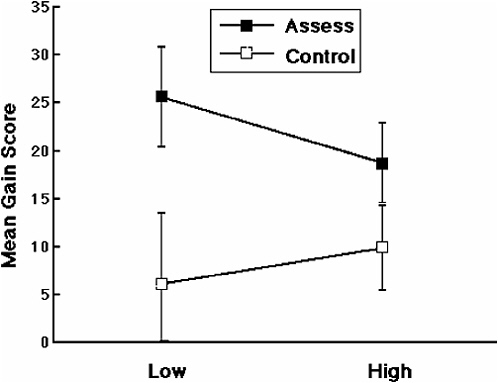 |
Learner-Centered
All three of the following chapters place a great deal of emphasis on the ideas and understandings that students bring to the classroom. Each begins by engaging students in activities or discussions that draw out what they know or how they know, rather than beginning with new content. Students are viewed as active processors of information who have acquired concepts, skills, and attitudes that affect their thinking about the content being taught, as well as about what it means to do science. Like Lionni’s fish (see Chapter 1), students bring preconceptions to class that can shape (or misshape) learning if not addressed. These chapters engage students’ ideas so that they can be reexamined, reshaped, and built upon.
Knowledge-Centered
Issues of what should be taught play a fundamental role in each of the chapters that follow. While engaging in inquiry involves a great deal of activity that is under students’ control, the authors are quite clear about the knowledge that students need to acquire to understand the topic, and they guide students’ inquiry to ensure that the necessary concepts and information (including the terminology) are learned. The chapters emphasize both what scientists know and how they know. But the authors’ approaches to instruction make these more than lists of information to be learned and steps to be followed.
Of particular importance, opportunities for inquiry are not simply tacked on to the content of a course; rather, they are the method for learning the content. This sets the stage for a number of important changes in science instruction. Simply having students follow “the scientific method” probably introduces more misconceptions about science than it dispels. First, different areas of science use different methods. Second, as discussed above, lockstep approaches to conducting science experiments exclude the aspects of science that are probably the most gratifying and motivating to scientists—generating good questions and ways to explore them; learning by being surprised (at disconfirmations); seeing how the collective intelligence of the group can supersede the insights of people working solely as individuals; learning to “work smart” by adopting, adapting, and sometimes inventing tools and models; and experiencing the excitement of actually discovering—and sharing with friends—something that provides a new way of looking at the world.
Assessment-Centered
The word “assessment” rarely appears in the three chapters that follow, but in fact the chapters are rich in assessment opportunities. Students are helped to assess the quality of their hypotheses and models, the adequacy of their methods and conclusions, and the effectiveness of their efforts as learners and collaborators. These assessments are extremely important for students, but also help teachers see the degree to which students are making progress toward the course goals and use this information in deciding what to do next. It is noteworthy that these are formative assessments, complete with opportunities for students (and teachers) to use feedback to revise their thinking; they are not merely summative assessments that give students a grade on one task (e.g., a presentation about an experiment) and then go on to the next task.
Community-Centered
The dialogue and discussion in each of the following chapters indicate that the teachers have developed a culture of respect, questioning, and risk taking. Disconfirmation is seen as an exciting discovery, not a failure. A diverse array of thoughts about issues and phenomena is treated as a resource for stimulating conversations and new discoveries—not as a failure to converge immediately on “the right answer.” Discussions in class help support the idea of a “learning community” as involving people who can argue with grace, rather than people who all agree with one another (though, as Magnusson and Palincsar suggest, this can take some time and effort to develop).
CONCLUSION
While each of the three chapters that follow has much to offer in demonstrating instructional approaches designed to incorporate important lessons from research on learning, we remind the reader that these chapters are intended to be illustrative. As noted earlier, there are many ways to build a bridge that are consistent with the principles of physics, and this is also true of relationships between course design and general principles of learning. It is the intention of the following chapters to provide approaches and ideas for instruction that other teachers may find useful in their own teaching. Indeed, the approaches are ones that require of teachers a great deal of responsiveness to their students’ ideas and thinking. Such approaches to teaching will most likely succeed if teachers understand the principles that drive instruction and incorporate them into their own thinking and teaching, rather than making an effort to replicate what is described in the chapters that follow.
NOTES
|
1. |
American Association for the Advancement of Science, 1993; National Research Council, 1996. |
|
2. |
Carey, 2000. |
|
3. |
National Research Council, 1996. |
|
4. |
American Association for the Advancement of Science, 1993. |
|
5. |
Brosnan, 1990. |
|
6. |
Driver et al., 1985. |
|
7. |
Schneps and Sadler, 1987. |
|
8. |
Benchmarks Online Available: http://www.project2061.org/tools/benchol/bolintro.htm [October 2004]. |
|
9. |
Kitchener, 1983; Perry, 1970. |
|
10. |
Kitchener, 1983; Kitchener and King, 1981. |
|
11. |
Clement, 1993; Driver et al., 1985; Pfundt and Duit, 1991. |
|
12. |
Carey, 2000; Hanson, 1970; National Research Council, 2000. |
|
13. |
American Association for the Advancement of Science, 1993. |
|
14. |
Carey et al., 1989; Schauble et al., 1991; Solomon, 1992. |
|
15. |
Wollman, 1997a, 1997b; Wollman and Lawson, 1977. |
|
16. |
Schauble, 1990, p. 2. |
|
17. |
Grosslight et al., 1991. |
|
18. |
Kuhn et al., 1988. |
|
19. |
Jungwirth, 1987; Jungwirth and Dreyfus, 1990, 1992. |
|
20. |
Jungwirth, 1987; Jungwirth and Dreyfus, 1992. |
|
21. |
Feynman, 1995. |
|
22. |
Hunt and Minstrell, 1994. |
|
23. |
Brook et al., 1983. |
|
24. |
Biswas et al., 2002; Palincsar and Brown, 1984. |
|
25. |
Petrosino et al., 2003. |
|
26. |
American Association for the Advancement of Science, 1993. |
|
27. |
Medawar, 1982. |
|
28. |
Moore, 1972, Chapter 4. |
|
29. |
Kuhn, 1989. |
|
30. |
Lin and Lehman, 1999. |
|
31. |
Bransford, 2003. |
|
32. |
Bruner, 1960. |
|
33. |
Whitehead, 1929. |
|
34. |
White and Frederiksen, 1998. |
|
35. |
White and Frederiksen, 2000, p. 2. |
REFERENCES
American Association for the Advancement of Science. (1993). Benchmarks for science literacy. New York: Oxford University Press.
Biswas, G., Schwartz, D., Bransford, J., and the Teachable Agent Group at Vanderbilt. (2002). Technology support for complex problem solving: From SAD environments to AI. In K.D. Forbus and P.J. Feltovich (Eds.), Smart machines in education: The coming revolution in educational technology (pp. 71-97). Menlo Park, CA : AAAI/MIT Press.
Bransford, J.D. (2003). Frog problem. Paper presented at the American Physiological Society as the Claude Bernard Distinguished Lecturer of the Teaching of Physiology, San Diego, CA.
Brook, A., Briggs, H., and Bell, B. (1983). Secondary students’ ideas about particles. Leeds, England: The University of Leeds, Centre for Studies in Science and Mathematics Education.
Brosnan, T. (1990). Categorizing macro and micro explanations of material change. In P.L. Lijnse, P. Licht, W. de Vos, and A.J. Waarlo (Eds.), Relating macroscopic phenomena to microscopic particles (pp. 198-211). Utrecht, The Netherlands: CD-p Press.
Bruner, J. (1960). The process of education. Cambridge, MA: Harvard University Press.
Carey, S. (2000). Science education as conceptual change. Journal of Applied Developmental Psychology, 21(1), 13-19.
Carey, S., Evans, R., Honda, M., Jay, E., and Unger, C. (1989). An experiment is when you try it and see if it works: A study of grade 7 students’ understanding of the construction of scientific knowledge. International Journal of Science Education, 11, 514-529.
Clement, J. (1993). Using bridging analogies and anchoring institutions to deal with students’ preconceptions in physics. Journal of Research in Science Teaching, 30(10), 1241-1257.
Driver, R., Guesne, E., and Tiberghien, A. (1985). Some features of children’s ideas and their implications for teaching. In R. Driver, E. Guesne, and A. Tiberghien (Eds.), Children’s ideas in science (pp. 193-201). Berkshire, England: Open University Press.
Feynman, R.P. (1995). Six easy pieces: Essentials of physics explained by its most brilliant teacher. Reading, MA: Perseus Books.
Grosslight, L., Unger, C., Jay, E., and Smith, C. (1991). Understanding models and their use in science: Conceptions of middle and high school students and experts. International Journal of Science Education, 17(16), 59-74.
Hanson, N.R. (1970). A picture theory of theory meaning. In R.G. Colodny (Ed.), The nature and function of scientific theories (pp. 233-274). Pittsburgh, PA: University of Pittsburgh Press.
Hunt, E., and Minstrell, J. (1994). A cognitive approach to the teaching of physics. In K. McGilly (Ed.), Classroom lessons: Integrating cognitive theory and classroom practice (pp. 51-74). Cambridge, MA: MIT Press.
Jungwirth, E. (1987). Avoidance of logical fallacies: A neglected aspect of science education and science-teacher education. Research in Science and Technological Education, 5, 43-58.
Jungwirth, E., and Dreyfus, A. (1990). Identification and acceptance of a posteriori casual assertions invalidated by faulty enquiry methodology: An international study of curricular expectations and reality. In D. Herget (Ed.), More history and philosophy of science in science teaching (pp. 202-211). Tallahassee, FL: Florida State University.
Jungwirth, E., and Dreyfus, A. (1992). After this, therefore because of this: One way of jumping to conclusions. Journal of Biological Education, 26, 139-142.
Kitchener, K. (1983). Educational goals and reflective thinking. The Educational Forum, 75-95.
Kitchener, K., and King, P. (1981). Reflective judgment: Concepts of justification and their relationship to age and education. Journal of Applied Developmental Psychology, 2, 89-116.
Kuhn, D. (1989). Children and adults as intuitive scientists. Psychological Review, 96, 674-689.
Kuhn, D., Amsel, E., and O’Loughlin, M. (1988). The development of scientific thinking skills. San Diego, CA: Academic Press.
Lin, X.D., and Lehman, J. (1999). Supporting learning of variable control in a computer-based biology environment: Effects of prompting college students to reflect on their own thinking. Journal of Research in Science Teaching, 36(7), 837-858.
Medawar, P. (1982). Plato’s republic. Oxford, England: Oxford University Press.
Moore, J.A. (1972). Heredity and development (second edition). Oxford, England: Oxford University Press.
National Research Council. (1996). National science education standards. National Committee on Science Education Standards and Assessment, Center for Science, Mathematics, and Engineering Education. Washington, DC: National Academy Press.
National Research Council. (2000). How people learn: Brain, mind, experience, and school. Committee on Developments in the Science of Learning and Committee on Learning Research and Educational Practice, Commission on Behavioral and Social Sciences and Education. Washington, DC: National Academy Press.
Palinscar, A.S., and Brown, A.L. (1984). Reciprocal teaching of comprehension-fostering and comprehension monitoring activities. Cognition and Instruction, 1(2),117-175.
Perry, W.G., Jr. (1970). Forms of intellectual and ethical development in the college years. Fort Worth, TX: HBJ College Publishers.
Petrosino, A., Lehrer, R., and Shauble, L. (2003). Structuring error and experimental variation as distribution in the fourth grade. Mathematical Thinking and Learning, 5(2 and 3),131-156.
Pfundt, H., and Duit, R. (1991). Bibliography: Students’ alternative frameworks and science education (third edition). Kiel, Germany: Institute for Science Education at the University of Kiel.
Schauble, L. (1990). Belief revision in children: The role of prior knowledge and strategies for generating evidence. Journal of Experimental Child Psychology, 49, 31-57.
Schauble, L., Klopfer, L.E., and Raghavan, K. (1991). Students’ transition from an engineering model to a science model of experimentation. Journal of Research in Science Teaching, 28, 859-882.
Schneps, M.H., and Sadler, P.M. (1987). A private universe (Video). Cambridge, MA: Harvard Smithsonian Center for Astrophysics.
Solomon, J., Duveen, J., Scot, L., and McCarthy, S. (1992). Teaching about the nature of science through history: Action research in the classroom. Journal of Research in Science Teaching, 29, 409-421.
White, B.C., and Frederiksen, J.R. (1998). Inquiry, modeling, and metacognition: Making science accessible to all students. Cognition and Instruction. 16(1), 3-117.
White, B.C., and Frederiksen, J.R. (2000). Technological tools and instructional approaches for making scientific inquiry accessible to all. In M.J. Jacobson and R.B. Kozma (Eds.), Innovations in science and mathematics education (pp. 321-359). Mahwah, NJ: Lawrence Erlbaum Associates.
Whitehead, A.N. (1929). The aims of education. New York: Macmillan.
Wollman, W. (1977a). Controlling variables: Assessing levels of understanding. Science Education, 61, 371-383.
Wollman, W. (1977b). Controlling variables: A neo-Piagetian developmental sequence. Science Education, 61, 385-391.
Wollman, W., and Lawson, A. (1977). Teaching the procedure of controlled experimentation: A Piagetian approach. Science Education, 61, 57-70.
