
3
Putting Principles into Practice: Teaching and Planning
Rosalyn Ashby, Peter J. Lee, and Denis Shemilt
It has been argued thus far that the learning of history can be accelerated and deepened through consistent application of the key findings from How People Learn, and that these findings should be applied in ways that acknowledge what is distinctive about the historical enterprise and the particular challenges it poses to students (see Chapter 2).
The first key finding of How People Learn emphasizes the importance of students’ preconceptions. Teachers must take account not only of what students manifestly do not know, but also of what they think they know. This finding is confirmed in the study of history by both research and experience.1 Much of the gap between what we teach and what students learn is attributable to the fact that students link new knowledge about the past to preexisting but inappropriate knowledge derived from everyday life. Thus, for example, an account of the growth of medieval towns may be linked to existing knowledge about the growth of trees; that is, students assume medieval buildings got bigger, and so the towns grew. More significant still, students have critical misconceptions—about how we know about the past, about the relationship between historical accounts and the past they represent, about what counts as an answer to a “why” or a “how” question, and so on—that are more difficult to access but that impact profoundly the ways in which students construe what they are taught. To the extent that we are able to identify the preconceptions held by students, we may preempt misunderstandings about the substantive past and, more important, seek to modify and develop the conceptual tools students need to make sense of history.
The second key finding of How People Learn emphasizes the importance of providing students with conceptual structures and tools with which to organize and manipulate factual knowledge. Students must have a deep
foundation of factual knowledge, but this is not tantamount to saying that they must learn all there is to know about any topic or set of topics. Because history is an information-rich subject, it is easy for students to flounder in a sea of facts that cannot be contained or controlled. And because history is about people and events that are halfway recognizable, it can sometimes be viewed as a series of weird soap operas. Thus, the foundations of factual knowledge must be deep in the sense that its layers of historicity are understood; in other words, the rules by which communities work and people interact are likely to shift according to time and place. In addition, as is argued in Chapter 2, the substantive facts and ideas of history must be understood in the context of a conceptual framework that includes second-order concepts such as those associated with time, change, empathy, and cause, as well as evidence and accounts. Indeed, it has been argued that the systematic development of such concepts is essential for students to be able to organize knowledge in ways that facilitate retrieval and application.
The third key finding of How People Learn emphasizes the importance of metacognitive approaches that enable students to reflect on and control their own learning. This finding relates to the development of second-order concepts noted above. Students can acquire and refine the conceptual tools necessary to organize and manipulate information only to a limited extent until they are explicitly aware of what they are doing. In order, for example, to determine that a given source is reliable for some purposes but not for others, or to decide that a source can yield evidence of things that it purports to neither say nor show, students must be able not merely to draw inferences, but also to know that they are doing so and to make those inferences objects of consciousness that are evaluated against rules. This level of metacognitive awareness is unlikely to be achieved in the lower grades, but its achievement may be accelerated if teachers of third and fourth graders focus their attention on such questions as “How do we know?” “Is this possible?” and “If this could have happened, can we say that it did happen?”
This chapter examines what these three key findings entail for the ways in which we work with students in the classroom and for the strategies used to plan history teaching. The first section sets the stage for what follows by addressing the issue of the extent to which these findings can realistically be applied in the classroom. The next two sections demonstrate the applicability of the findings by presenting two detailed example classroom case studies.
THE REALITY TEST
The three key findings of How People Learn and the arguments advanced in the preceding chapter may be thought to reflect too favorable a view of the realities of teaching in some classrooms. Indeed, we may not
always have carte blanche in what is taught, but feel obliged to work within the narrow space between national standards on the one hand and locally adopted textbooks on the other. In consequence, the second key finding may appear to presume that we have more freedom in what we teach than is always allowed us. Worse still, the emphasis placed in the previous chapter and in the first key finding on the identification and systematic development of preconceptions and second-order concepts assumes that we have more in-depth knowledge of how and what students think than may be the case. At the start of the school year, we may know names and test scores but little else. Students must still be taught even if we lack in-depth analysis of their existing knowledge of pre-Columbian civilization or their ability to empathize with predecessors. Last but not least, the exhortation to take “a metacognitive approach to instruction” may appear overly optimistic for some students, who by the end of the year still have not acquired any kind of coherent story. What chance do they have of becoming metacognitively aware?
These are fair points, and can serve as acid tests of the value of what is presented below. At the same time, the reader must keep in mind that a chapter such as this cannot provide a simple recipe for instant success, as any experienced history teacher will know only too well. A lesson plan for unknown children in unknown classrooms invites disaster. This is not just because all students are different personalities; both research and experience tell us there are more specific reasons. Individual students have different prior conceptions of history, the past, and how things happen in the world. In addition, students at any given age are likely to be working with a wide range of ideas (see Box 3-1). We can make some informed predictions about what ideas are likely to be prevalent among students in a particular grade, but research makes it clear that in any given class, some students are likely to be thinking in much more sophisticated ways, perhaps even using the sorts of ideas more common among students many years older. Likewise, some will be operating with much simpler ideas.
Moreover, if we talk here about “fourth graders” and “youngsters” or “seventh graders” and “older students,” we are not implying that changes in ideas are an automatic consequence of age. Many seventh graders will happily go on thinking in much the same ways as fourth graders if they are not made aware of the problems their everyday ideas create. Teachers are not the only impetus for changing students’ ideas, but it is part of our job as teachers to act as if we were. Because we cannot predict the starting points of any particular class of students, the discussion of example lesson tasks in the following case studies must be qualified by “ifs,” alternatives, and conditional moves. At the same time, however, practical moves with real teaching materials used by the authors and by serving teachers in both the United Kingdom and the United States are suggested.2 They nevertheless remain
|
BOX 3-1 The CHATA research discussed in Chapter 2 reveals the conceptual understandings of some 8-year-old students to be more advanced than those of many 14-year-olds. For example, when asked to explain why one account of the Roman invasion of Britain conflicts with another, some 7- and 8-year-olds suggest that the authors may have chosen to record “different facts” because they were asking different questions about the invasion, while many 14-year-olds claim that one or other author “made mistakes” in their account. It follows that when working with typical mixed-ability classes, teachers must accommodate a “7-year gap” between the ideas of the lowest- and highest-attaining students. Two other CHATA findings are significant in this connection. First, ideas about different second-order concepts do not develop in lockstep. A student’s understanding of evidence and accounts may be the most advanced in the class, but her grasp of causal and empathetic explanation may not be as good, and her understanding of time and change may even be below the class average. Second, students’ ideas about history do not develop as a necessary consequence of maturation. Many seventh and eighth graders are happy with their mental furniture and see no need to rearrange or replace it. To some extent, this is because they lack metacognitive awareness and conclude that they “are no good at history.” It is one of the more difficult jobs of teachers to show such students how they can “get good” at the subject, albeit at the cost and effort of ongoing mental makeover.3 |
examples only, and do not offer “the best way” to teach these or any other topics.
Two case studies are presented in this chapter. Each involves a specific task—comprising teaching materials and questions—in the context of how the task might be used in developing students’ ideas about historical evidence. The focus of the first case study is a familiar topic, “The Pilgrim Fathers and Native Americans”; the second deals with a more unusual topic, “St. Brendan’s Voyage.” It might appear illogical to start with the Pilgrim Fathers, since the topic chronologically precedes the Brendan voyage. The fact that the task in the Brendan case study is written for fourth graders, while that in the Pilgrims case study is for sixth graders, may make the order appear even more wayward.
Given appropriate teaching, we would expect sixth graders on the whole to outperform fourth graders in their understanding of historical evidence. If their teaching has been designed to develop their understanding of evidence, older students will, on the whole, apply more powerful ideas than younger ones. However, we have already seen that the “7-year gap” means
there is considerable variation in students’ ideas, and in any case, students’ ideas will depend in part on what they have already learned. Moreover, historical questions can be answered at very different levels of sophistication, so that students from a range of different grades can profitably tackle the same materials and questions. Students need not wait until they reach a certain grade to benefit from trying to weigh the evidence for the claim that St. Brendan reached America a thousand years before Columbus, but more conceptually sophisticated students will give different answers than less sophisticated ones.
Of course, the language we use in designing our questions and materials is likely to set limits on the range of students who will be able to work with them, and we cannot expect young students to have the same understanding of the adult world—even in the present—as older students. Thus, it still makes sense to talk of designing tasks for a particular grade, at least as far as setting limits below which use of the task would be unwise. But if we encounter students from sixth or seventh grade who have not developed ideas about evidence that we would normally begin to teach in fourth grade, we might profitably use the “fourth-grade” task with them.
We therefore begin with the Pilgrim Fathers and Native Americans case study, on the grounds that it will be a much more familiar topic for most teachers than the Brendan voyage. The discussion of evidence work in this first case study assumes that reference is made to a standard textbook and that we have no privileged knowledge about student preconceptions and misconceptions. The case study aims to illustrate, first, how it is possible to identify and work with student preconceptions during the process of teaching; second, how student ideas about a second-order concept, that of evidence, can be developed in ways that support, not supplant, the teaching of substantive history; and third, how it is possible to promote metacognitive awareness among students who have no special ideas and abilities.
While the materials and questions in the Pilgrim Fathers and Native Americans case study are designed for students who already have some acquaintance with ideas about evidence, the aim of the second case study—on St. Brendan’s Voyage—is to introduce less sophisticated students to some key ideas about evidence in the context of an adventure without losing them in masses of content. There is also a difference in focus between the two case studies. Discussion of the first emphasizes the identification and refinement of previously acquired ideas about evidence, whereas the second case study concentrates on the teaching of students who have yet to reach first base and, in particular, who cannot yet make clear and stable distinctions between well-founded and speculative accounts of the past.
Although the tasks in the two case studies were designed with students in grade 4 (St. Brendan) and grade 6 (Pilgrim Fathers) in mind, materials and questions from both can be and have been used from grades 4 through 8
and beyond. This notwithstanding, decisions about how—and even whether—materials and questions are used with given classes must be informed by the ideas the students are already working with and the kind of responses we expect. In any case, nothing in what follows is about learning that can be accomplished in a single or even several short sessions. Even when students appear to have understood what has been taught in one context, we will need to return to it in other topics. Changes in students’ ideas take time, patience, and planning.
WORKING WITH EVIDENCE: PILGRIM FATHERS AND NATIVE AMERICANS
Exploring the Basis for Textbook Claims and the Nature of Sources
The choice of the arrival of the Pilgrims as a topic for discussion here implies no claims about what should or should not be taught. However, it is clearly a popular topic in textbooks, and one with which readers are likely to be familiar. It is also relevant to the broader topics, such as “Exploration and Encounter” and “The Settlement of New England” that are regularly taught. Moreover, it is a topic that offers opportunities to explore the Pilgrims’ significance for later generations in America, and supports an examination of the complex relationships between the newcomers and the native inhabitants that can help break down stereotyping. There is also a very rich record available from the testimony of the Pilgrims that can provide worthwhile and exciting learning opportunities, particularly in connection with understanding the nature of historical evidence.
The questions in the Pilgrims’ task work at two levels. First, they can expose the assumptions students appear to be working with, and second, as a consequence, they provide the teacher with a basis for a learning dialogue with the students.4 As will be seen, such a dialogue can challenge the misconceptions that become apparent and encourage the development of more powerful ideas, while at the same time providing the teacher with information about future learning needs. Testimony of the kind provided in the materials associated with this task needs to be understood evidentially, and part of the teacher’s task is to encourage students to think in more complex ways about the experiences, ideas, and beliefs of these “eyewitnesses.”
The source materials can interact with the textbook so as to transport students from the security of a few historical particulars and descriptions of the arrival of the Mayflower in Cape Cod Bay in 1620 to the more precarious circumstances of William Bradford and John Pory and the early seventeenth-century world they inhabited. The time and place can be richly explored
through the materials left behind, and the legacy of the events considered through their impact on later societies. The search for access to this world through these materials is likely to be halting and problematic for young students; good storytellers may well be tempted to believe they can open it up to their students without involving the testimony of those involved more directly. Working with students, who are happy to grapple with the difficulties inherent in materials of this kind, provides us with a different perspective. Learning experiences of any kind, however, need structures, with clear objectives.
An approach of this kind can be used for a wide range of age and ability groups. The format can remain the same but the task made to differ in its language level; the nature, length, and quantity of the sources used; and the extent of visual material needed to support ideas. The task was initially designed for sixth graders but was taught to U.K. sixth and eighth graders as a whole-class lesson. The examples quoted are of two kinds: written answers to the teachers’ whole-class questions, and excerpts from a recorded follow-up discussion with a small group of three sixth graders. (The small-group recording offers a more detailed picture than written answers can provide of how students responded to the questions.) U.K. students’ perspective on the Pilgrims is likely to differ from that of equivalent students in the United States, but the focus here is on students’ evidential understanding.
Five sources have been chosen. The extracts taken from William Bradford’s journal have been set out separately in Sources 1 and 3, separating the arrival of the Mayflower from the expedition ashore, so as to allow students easier access. The extracts have also been edited to limit the difficulty for these 12- and 15-year-olds.
The three written sources provide testimony from William Bradford about the arrival and settlement of the Pilgrims at Plymouth in 1620 and testimony from John Pory, a visitor to the settlement in 1622. Through these sources, the teacher is able to explore students’ existing understandings of “eyewitness” accounts, and to encourage students to look behind this testimony to consider the circumstances, ideas, and beliefs of the people directly involved.
The two paintings depicting the arrival of the Pilgrims allow the teacher to explore and challenge students’ misconceptions about these sources as a record of the actual events of the time. They also give the teacher an opportunity to encourage students to recognize that while the paintings may not provide evidence of the events of 1620, they do provide evidence of the significance attached to the arrival of the Pilgrims in 1620 by later generations.
The Pilgrims’ task begins by presenting students with extracts from their textbooks and a map showing them the location where the action takes place. The second textbook extract provides an opportunity to introduce the
testimony of William Bradford and the evidence it may not have been intended to provide.
How do we know about the arrival of the Pilgrims in America? The Mayflower finds land, and the Pilgrims look for a place to settle.
One textbook tells us:
On November 11, 1620, after 10 weeks at sea, a small, storm-battered English vessel rounded the tip of Cape Cod and dropped its anchor in the quiet harbor of what is now Provincetown, Massachusetts. The people in the ship were too tired and sick to travel farther. While the Mayflower swung at anchor in Provincetown harbor, a landing party looked for a place to settle. These men explored a small bay on the western edge of Cape Cod. They found a swift-running stream with clear, fresh drinking water. The area seemed ideal for a settlement. In December, the Pilgrims anchored the Mayflower in the bay and began building Plymouth Plantation.5
Another textbook tells us:
They found a spot on the inner shore of Cape Cod Bay and promptly named it for the town from which they had sailed—Plymouth. At Plymouth the Pilgrims found abandoned cornfields. Their leader, William Bradford, sadly described their situation. “What could they see,” he wrote, “but a hideous and desolate wilderness… what could now sustain them but the spirit of God and his grace?”6
Here is a map to help you locate the places the textbook is talking about.
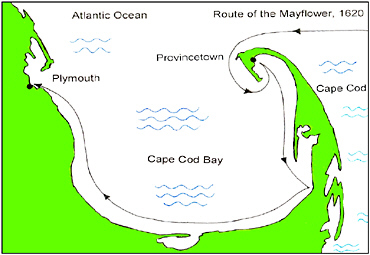
Once the students are familiar with this basic material from the textbooks, the teacher can give them a briefing sheet. This briefing sheet has three main purposes: to introduce the students to their inquiry, to encourage an enthusiasm for the work, and to provide them with an ultimate goal—the production of their own substantiated account of the arrival of the Mayflower and the decision to settle in Plymouth. The briefing sheet enables the students to focus on the instructions, to which they can return if necessary; the teacher works through the instructions with the class, clarifying, checking understanding, and reinforcing them as necessary.
Source 1: An extract taken from William Bradford’s personal journal, finished in 1650. Bradford was one of the leaders of the English Separatists whom we now call the Pilgrims.
Having arrived in a good harbor, and brought safe to land, they fell upon their knees and blessed God who had delivered them. They had no friends to welcome them and no inns to refresh their weather beaten bodies; no houses to go to for food. When St. Paul (in the bible) was shipwrecked the barbarians were kind to him and his friends but the barbarians here when they met with the Separatists and their friends were readier to fill their sides full of arrows. And it was winter, and they knew the winters here to be subject to fierce storms, and dangerous to travel to known places, much more to search an unknown coast. They could only see a desolate wilderness, full of wild beasts and wild men—and what multitudes there might be of them they knew not. What could now sustain them but the Spirit of God and his Grace?
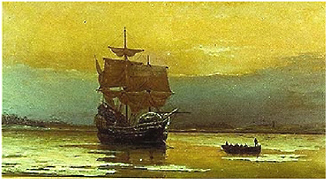
Source 2: “The Mayflower on Her Arrival in Plymouth Harbor” by William Formsby Halsall. Painted in Massachusetts in 1882.
|
Briefing Sheet Things for you to think about and things for you to do How do the people who wrote the textbooks know about these events when they happened nearly 400 years ago? The second of these textbook writers gives us a clue about how they found out.
The first textbook tells us more than the second textbook, but the second textbook helps us understand how the writer knew about the Pilgrims’ arrival.
Your inquiry will involve looking carefully at some sources and doing some hard thinking. |
 Can you spot it?
Source 3: Another extract taken from William Bradford’s personal journal, finished in 1650.
Arrived at Cape Cod on the 11th of November and a few people volunteered to look for a place to live. It was thought there might be some danger but sixteen people were given permission to explore. They were well armed and led by Captain Standish. They set off on the 15th of November; and when they had marched about a mile by the seaside, they spotted five or six persons with a dog coming towards them, who were savages; but they fled from them and ran up into the woods, and the English followed them, partly to
|
Source: A source is something that has survived from the past that we can use to find out about the past. Sources help us work things out that we wouldn’t otherwise know.
(These questions will be useful to your teacher because they will help her understand how you are thinking.)
(While you are answering your teacher’s questions, she will collect your questions and think about how to find answers to them.) Words you might need to know about: Pilgrims: These people were looking for a place to live so that they could worship God in their own way without interference. They were called Separatists at the time because they separated themselves from the official ideas the priests in England taught about God. Later people called them the Pilgrims, and sometimes the Pilgrim Fathers. Shallop: A small boat. This was used to get close to land because the Mayflower could not safely go into shallow water. |
see if they could speak with them, and partly to discover if there might be more of them lying in ambush. But the Indians left the woods and ran away on the sands as hard as they could so they followed them by the track of their feet for several miles. When it was night they set up a guard and rested in quiet that night; and the next morning followed their track till they had headed a great creek and so left the sands and turned another way into the woods. They followed them by guess, hoping to find their dwellings; but they soon lost both them and themselves. At length they found water and refreshed themselves, being the first New England water they had drunk.
Then they changed their direction to get to the other shore, and on the way found a pond of clear, fresh water, and shortly after a large area of clear ground where the Indians had formerly set corn, and some of their graves. And further on they saw new stubble where corn had been set the same year; also they found where lately a house had been, where some planks and a great kettle was remaining, and heaps of sand newly paddled with their hands. Which, they digging up, found in them Indian baskets filled with corn of different colors, which seemed to them a very goodly sight (having never seen any such before). This was near the place of the river they thought they might find and they found it where it opened itself into two arms with a high cliff of sand in the entrance but more like creeks of salt water than fresh, and they saw a good harbor for their shallop. Then they returned to the ship lest the others might be in fear of their safety; and took with them part of the corn and buried up the rest.
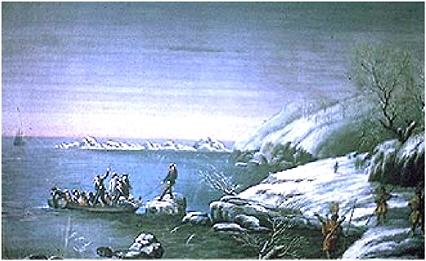
Source 4: “The Landing of the Pilgrims” by Michael Felice Corne. Painted in Salem, Massachusetts, between 1803 and 1806.
Source 5: Written by John Pory, an official from the settlement at Jamestown, farther south in Virginia, after he had visited Plymouth in 1622.
Whether it was because of the wind or the backwardness of their ship’s captain they did not arrive where they had planned. Instead they reached the harbor of Cape Cod, called Pawmet by the Indians. After some dangerous errors and mistakes, they stumbled by accident upon the harbor of Plymouth where it pleased Almighty God (who had better provided for them than they could imagine) to land them where there was an old town, which several years before had been abandoned by the Indians. So they quietly and justly settled down there without having to push any of the natives out, so not so much as one drop of blood was shed. Even the savages themselves did not claim any title to it so that the right of those planters to it is altogether unquestionable. The harbor is good for shipping both small and great being land-locked on all sides. The town is seated on the ascent of a hill. There is plenty both of fish and fowl every day in the year and I know no place in the world that can match it.
The briefing sheet is designed to encourage students to record their own questions during their initial examination of the sources. This is done to make transparent any difficulties the students might encounter with the sources, and to encourage them to generate their own questions as part of the longer-term goal of developing their independent learning strategies. After their initial perusal of the sources and the recording of their own questions, the students are asked to respond to their teacher’s questions. It is useful to explain to the students that these questions may well look similar to those they have raised themselves, demonstrating that questions are not necessarily the special province of the teacher. Normally the teacher will promise to collate the questions raised by the students and pursue answers to them in the following session. Students may raise the point that none of the sources directly record the thoughts of the native population at the time; this creates the opportunity to ask the students to think about why that is and what those thoughts might have been.
Students’ written responses to the teacher’s questions are used to provide the teacher first with an understanding of the students’ preconceptions about evidence, and second with an opportunity to begin a learning dialogue about the nature of these sources and their potential as evidence (see questions 1, 2, 3, and 4). In addition, the questions provide a means to support the first steps in developing students’ understanding of the beliefs that influenced the Pilgrims’ actions (see questions 5 and 6). These questions are simply examples, and there are many other ways in which the selected sources could be used to both diagnose and develop students’ thinking.
|
Teacher Question 1. The first textbook writer describes the Mayflower’s arrival. He tells us that “a small storm-battered English vessel rounded the tip of Cape Cod.” Source 2 is a painting showing the Mayflower arriving at Cape Cod. We know that when the ship’s master sailed it back to England, it quickly fell into disrepair and rotted. So how would the person painting the picture in Source 2 have been able to work out what the Mayflower looked like? What is this question trying to find out about students’ existing understanding? The question is designed to check whether students understand that
The question also probes whether students understand the ways in which the painter might have knowledge of the Mayflower, and whether they see the painting as providing direct information about the arrival of the Mayflower or as evidence of its significance to later generations. What is this question trying to encourage students to reflect on as a means of developing their understanding? The question is trying to develop students’ understanding of evidence by encouraging them to see:
|
The responses of two particular groups of students—aged 12 and 15—to some of the questions exemplify the kinds of moves students make. (If no age is given for a quotation, the example comes from the younger group.)
You need to be able to see for yourself.
Simon assumed that the painter might have seen the Mayflower before it left England, ignoring the time gap between the painting and the event it depicted. He claimed that “the person who drew the picture knew what the boat looked like because he might have seen it in the port before she set sail for America.” Jennifer, recognizing a time difference, believed there would still be something left of the Mayflower, and was convinced that “the person painting the picture in Source 2 was able to work out what the Mayflower looked like by visiting the remains.” Some 12-year-olds saw that the painter could not have been an eyewitness, but argued that it was therefore not possible to know what the ship looked like. As Adam explained, “The person painting Source 2 wouldn’t have known what the Mayflower had looked like as he wasn’t even there.”
If you weren’t there to see for yourself, then you need access to someone who was.
Typically, many students felt the need to connect the painter with the subject matter of the painting by creating a direct link with an eyewitness. Peter said, ”The painter could have got the information from a person who actually saw the Mayflower.” In saying this, however, Peter stretched the age of the possible witness to an improbable extent to accommodate his thinking, while simultaneously shrinking the amount of time that passed between 1620 and the production of the painting in 1882. “Since it was a hundred years after, there may have been people alive from the vessel to describe it.” The importance to some students of an eyewitness as a way of knowing about the past is clearly considerable.
Contact could be maintained with the eyewitness by means of knowledge handed down through the generations.
Students can, of course, be more realistic about the time difference. Elliot pointed out that the painting “was painted 262 years after the voyage.” He looked for a different kind of link to the original witness, the handing down of knowledge within a linear sequence. He suggested, “It must have been told by the voyagers to their children, and then to their children, and then to their children, what it looked like.” He recognized that this might have created difficulties for the artist and claimed, “The painter is probably drawing partly from what he’s been told and partly from his imagination.” In
a similar vein, Edward recognized the difficulty of both a drawing of the Mayflower surviving over a long period of time and this kind of information being available as oral evidence over such a long period. He wrote:
I don’t think he could have [worked out what the Mayflower looked like]. The only way he could was if there was a drawing that had remained for over 250 years which is unlikely. It also says that the artist painted it in 1882 so it couldn’t have been spread about by word of mouth.
In recognizing the problems, however, Edward provided no solution for how we might check the appearance of the Mayflower and thus the accuracy of the information in the painting. The absence of a direct link and uncertainties of transmission make a determination of accuracy difficult.
You can use a scissors-and-paste approach.
When faced with the difficulties of direct access or transmission error, many students operate with a scissors-and-paste approach to piece together what is available and what they can trust. Robert explained that “the person who painted it knew what the Mayflower looked like because another artist had probably provided it in Britain and he altered the angle and scenery.” He was working with the idea that the picture of the Mayflower needs to be an exact copy of its arrival in the bay, almost a photograph of the event, and saw the possibility of piecing information together to produce this result. Robert believed that the details of the ship might have been available to the artist through a previous picture of the Mayflower in England, but that the American painter would have been able to create the setting needed to portray this event, perhaps from his own personal geographical knowledge.
You have to work it out from other sources or knowledge available to you.
The awareness of a broader range of records available to the historian can help students recognize that we are not left totally helpless without eyewitnesses (or indeed, as some believe, without the recovery of the Mayflower itself). Julie, aged 15, suggested, “The artist may have studied pictures of other early seventeenth-century ships and drawn one. The painter might have incorporated knowledge from these into his painting.” Melanie, also 15, claimed in her written answer to this question, “There would have been blueprints, paintings and maybe even a sister ship to the Mayflower.”
Students’ need for a direct link with the events, however, can remain very strong. Peter was particularly keen on having access to something tangible from the period.
|
Peter |
They have this age testing machine and they can test how old things are. |
|
Teacher |
What would they be testing with that? |
|
Peter |
Maybe things on the ship. |
|
Matthew |
Yes, but then that would only tell us when it was manufactured and not when it circled round Cape Cod, and it still wouldn’t tell us what it looked like. |
|
Peter |
Well that would be in William Bradford’s diary. |
|
Matthew |
I think it was based on what was probably a regular design and all that would have changed was mast shapes so it could have been like a regular ship. |
|
Peter |
The archaeologists might have got it up from the sea, with all sorts of cranes and things. |
|
Matthew |
But it had rotted. |
|
Peter |
Well the basic shape might be there just not all the fine details. |
Even when he came under pressure from his teacher and Matthew, Peter remained convinced that the recovery of the ship or a direct description of it is essential. He was clearly familiar with the way in which science, archaeology, and technology might assist the historian.
|
Teacher Question 2. In Source 3, William Bradford is talking about the first people who went ashore. He tells us that it wasn’t until they had “marched about a mile by the seaside” that “they spotted five or six persons with a dog coming towards them.” He tells us they “fled and ran away into the woods, and the English followed them.” But Source 4 shows the Native Americans waiting on the shore to meet them. How do I solve this confusion? What is this question trying to find out about students’ existing understanding? The question explores whether students are making decisions simply on the basis of whether someone was there or not (Bradford |
|
was, the artist wasn’t), or they understand that people’s intentions in producing the sources also need to be taken into account. What is this question trying to encourage students to reflect on as a means of developing their understanding? The question is designed to encourage students to reflect on:
|
Trust the source who was in a position to know.
We must expect many students, convinced of the need for an eyewitness, to respond in a direct and uncomplicated way to this question. George, for example, wrote, “William Bradford was there and the painter wasn’t.” Given the claim being made, this is a perfectly justifiable answer. Jack also made the point about Bradford being in a position to know, and explained the conflicting information in the painting by pointing out that stories change over time:
I think that Source 3 was right, as he was one of the leaders of the Pilgrims. In his own personal diary he was probably writing the events that happened when they happened, whereas Source 4 was drawn almost 200 years after the events. Over 200 years stories change.
These students did not question whether Bradford was among the actual party that first went ashore. They made the assumption that he was there. The idea of “being there” is often generalized by students and taken as sufficient to validate a great deal. Sometimes they use “from the time” regardless of the distance between the person providing testimony and the event itself. In this case, however, the students made a legitimate distinction.
You need to understand the purpose of the artist.
In pursuing this question with students, an important goal is to help them understand that the painting is not meant to be a photographic image of an exact moment in time, and that although it is “just a painting,” it can
often yield information about how past events were seen by later generations.
Some 12-year-olds considered the artist’s purpose in relation to the information contained in the painting. Daniel, for example, said, “I think that the Indians are in the picture to show that they were there first, and that they were watching for them even if they weren’t seen.” Daniel’s response is interesting in two ways. First, it suggests a specific purpose on the part of the artist, showing that Daniel was aware that this intent must be considered if the painting is to be understood. Second, the response introduced a perspective not yet suggested by the text extracts and the sources, nor at this stage by the questions. Daniel was sensitive to the position of the Native Americans. In the questions he had recorded when first looking at the sources, he had written about the painting (Source 4), “Were the Indians watching them from the land?” About John Pory’s testimony (Source 5), he raised the question, “Why didn’t the native Indians attack them?”
When Adam began to muse on the production of both paintings (Sources 2 and 4) in a follow-up classroom discussion, the teacher used Daniel’s written response to explore the issue further.
|
Adam |
It’s funny that it’s done in Massachusetts the same as the other one. |
|
Teacher |
Yes. Let me just run this past you all and see what you think about this. This answer by someone in your class says, “In this picture I think the Indians are in the picture to show that they were there first, and that they were watching for them, even if they weren’t seen.” |
Matthew recognized the point being made when the teacher confronted the students with Daniel’s response, and he elaborated on it. Although both Matthew and Daniel were making assumptions about the artist’s actual intentions, they clearly recognized that the artist was not necessarily attempting a historical reconstruction.
|
Matthew |
I think that’s very good ’cos art isn’t always total fact it’s usually symbolism because you couldn’t put tiny men on there showing that they are far away, it could very well symbolize, yeah, that these Native Americans are here first and its not really the Pilgrims’ land at all. |
|
Adam |
I think the Indians would be very territorial, like protect their land and their territories and say, like, “This is my territory, go away!” |
The teacher probed the students’ ideas further by getting them to consider the possibility that the painting might provide evidence of the importance of the event to future generations, and might not necessarily be an attempt to recognize the Native Americans’ first claim to the land.
|
Teacher |
You remember the part where we said that those who arrived on the Mayflower become known as the Pilgrim Fathers later on. And that kind of means that the painting might really be trying to say these people are really important because they established, it was the beginning, they are the “Fathers” who made this part of America what it was at the time the painting was done. So what might the artist want to portray about these people—the Pilgrim Fathers? Would the painter be concerned to portray the Native Americans’ position? Would the historical accuracy matter that much in this case? |
|
Matthew |
Like they would want to show them as great because they founded the white part of America. |
|
Adam |
Maybe it was to make the Pilgrims look good. |
|
Peter |
Yeah, make the Pilgrims look like they are fending off the Indians, make the Pilgrims look good. |
Matthew took the point further, and an awareness of past attitudes and perspectives came into play.
|
Matthew |
I think this painting could be somewhat racial and that they are kind of trying to say that these Pilgrims are the white fathers and that the Native Americans shouldn’t be there, its just for these people which isn’t fair, its very racial, but that’s what could be portrayed—it could be a racial statement. |
|
Teacher |
That’s interesting, but what would we need to know to interpret the painting? It may not have been intended to be racial, but merely to focus on the arrival of the Pilgrims, and the Native Americans are just there as part of the scenery. The racial aspect may be more unconscious than we are supposing, or the artist may have wanted to reflect this as a peaceful encounter. |
|
Adam |
You would need to know about the painter who actually painted it. You need some background information. |
|
Peter |
Then we could find out the truth about what it’s saying. |
|
Teacher |
Would the information you need be just information about the painter? What else would you need to know? |
|
Matthew |
What period of time it was painted and whereabouts it was painted. They could be changed with society, like giving in to society [meaning agreeing with predominant ideas?] because, like, most people in Salem, Massachusetts, which is where this was painted, were white, so he wanted to portray the white people as the great greats … or however you want to interpret it. |
|
Teacher |
There was some very good thinking there actually, and I think you got us on to that point, didn’t you, Matthew, about symbolism, and therefore what you’re saying to me seems to be that the painting is not supposed to be exactly what happened at the time but may be more about what it means to people later on, and at a particular time and place. |
In this excerpt, the teacher sought to discover whether Matthew was close to adopting a more subtle approach than his initial position had suggested, and his response showed a growing awareness of the complexities of interpreting the intentions of the painter and the kind of knowledge one needs about the society in which the painter was working (see Box 3-2). This is a strong hint that Matthew will be able to use any new information and source materials judiciously and to understand the significance of the Mayflower’s arrival for future generations. The materials to be used in future lessons with these particular students will need to explore the different relationships among groups of people at the time and the complexities of the Mayflower legacy.
|
Teacher Question 3. The writer of Source 5 tells us, “The harbor is good for shipping both small and great, being landlocked on all sides” and “The town is seated on the ascent of a hill.” How did the writer know this? |
|
BOX 3-2 The disposition to interpret historical data with reference to the social contexts within which they were produced and intended to be used is slow to develop and, even when developed, may be difficult to activate. Working with a group of “college-bound” seniors who “represented the successes of our educational system,” Sam Wineburg found that they were disposed to take at face value a “patently polemical” account of the skirmish between British soldiers and colonial farmers at Lexington Green in 1775. Wineburg concludes that these able seniors “failed to see the text as a social instrument skillfully crafted to achieve a social end.”7 It is necessary to account for the disparity in ideas and assumptions between the “college-bound” seniors and the more sophisticated sixth graders who engaged with the Pilgrim Fathers materials and tasks. Three factors are significant in this connection. First, it may be easier for students to construe pictorial rather than textual sources within a supplied or inferred context of social meanings and intentions. Second, the text used by Wineburg carried the received authority of a textbook account and, as Wineburg notes, “the textbook, not the eyewitness accounts, emerged as the primary source.” Teaching of the sixth graders, on the other hand, had systematically diminished the credibility of the Mayflower painting by pointing out that the artists could not possibly have witnessed the events depicted. Third, and perhaps most significant, the teachers who worked with the Pilgrim Fathers materials and tasks had the development of students’ understanding of evidence concepts as their principal objective. The seniors, as Wineburg observes, should not be “overly” criticized since “these aspects of text, while central to the skilled reading of history, are rarely addressed in school curricula.” |
|
Teacher Question 4. John Pory, the writer of Source 5, tells us that when the Pilgrims reached the harbor of Cape Cod, they found “an old town, which several years before had been abandoned by the Indians.” The writer was not one of the people who arrived on the Mayflower, so how did he know this? What are these questions trying to find out about students’ existing understanding? These two questions work together. They are designed to check whether students understand that “being in a position to know” is |
|
not just a matter of whether someone was there at the time, but also depends on the kind of knowledge we are asking about. What are these questions trying to encourage students to reflect on as a means of developing their understanding? The questions encourage students to:
These kinds of reflections can encourage students to move beyond the face value of testimony and begin to draw inferences, getting sources to yield what they did not set out to reveal. |
You need to make distinctions among kinds of claims.
Pory’s claim in Source 5 that “the harbor is good for shipping both small and great, being landlocked on all sides” and that “the town is seated on the ascent of a hill” are based on his own observation of the geographic advantages of Plymouth during his visit in 1622. Students who have become familiar with source work are likely to look at the source caption and recognize this. Pory’s claim that the town was one that “several years before had been abandoned by the Indians” is, however, of a different kind, and may well have rested on word of mouth from either the native population or more likely the Pilgrims’ own story of their arrival, told to him during his visit. The circumstances at Plymouth may indeed have reached him by word of mouth at Jamestown, but his written account of Plymouth is in the context of his visit. The advantages of Plymouth’s geographic location and the Pilgrims’ relationships with the Native Americans would no doubt have been a subject of discussion between someone from Jamestown and the leaders of the Plymouth settlement, and Pory’s account helps the teacher introduce students to the importance of these advantages for the Plymouth settlers.
We should expect many 12-year-olds, and perhaps most 15-year-olds, to be able to distinguish between the different claims addressed in these two questions. Jonathan’s written answers demonstrated his ability to make this distinction:
Question 3: The writer of Source 5 would know this because he visited Plymouth two years after the Pilgrims’ settlement and not many changes of this kind would have happened.
Question 4: John Pory probably asked William Bradford about this because they were both in Plymouth in the same decade.
Jonathan understood that Plymouth’s geography was unlikely to change quickly and that Pory would have been able to see these features for himself. He was also aware, like many in his age group, that Pory’s knowledge base for the second claim might have depended on what others at Plymouth had told him.
Generalizing.
Some students will suggest William Bradford’s journal as the basis for John Pory’s knowledge of Plymouth and pay little attention to the information attached to Source 5 about the visit to Plymouth in 1622, or decide that this information is not relevant to the question. David’s responses are illustrative:
Question 3: The writer would have known this by the personal diary of William Bradford which they found.
Question 4: He could have known this because of the diary of William Bradford.
Students like David may not take into account that Bradford’s journal was not published until 1650, and may therefore not ask themselves whether Bradford would have shown Pory any records he had made or whether, during a visit in the circumstances of early settlement, these things would have been an important matter for discussion between the two men (and indeed others). David did not get behind this source to the circumstances surrounding its production. If he had looked at the source caption, he did not use it to inform his response.
Another kind of response is to recognize that a site visit could provide this kind of evidence, but not to think about the difference between the geographic features of the site, which are unlikely to have deteriorated, and the signs of an abandoned town, which may well have been obliterated by the activities of the 2 years between the arrival of the Pilgrims and Pory’s visit. The concept of “town” here is also likely to be important: if students imagine a Native American settlement as consisting of brick or stone buildings, an answer such as Vincent’s makes more sense.
Question 3: The writer might have known this by going to the site and finding ruins.
Question 4: This question has the same answer as question 3.
Vincent was presumably assuming that Patuxet (the name used by the native population for the abandoned town on which the Plymouth Plantation was built) would still have been visible in the way the ruins of a modern town might be. Although there may have been signs of a settlement, it is more plausible that the abandoned town would have been an important topic of the conversations that took place between Pory and the settlers, particularly given the comparative advantage an “abandoned town” had for the Pilgrims in their relationship with the native population.
If we return to one of the groups of students reflecting on these questions with their teacher and look at a substantial portion of their discussion, the importance of understanding exactly what students mean becomes very clear. Unless we know the distinctions that matter here—the ones that indicate crucial steps in students’ understanding—we can blur students’ ideas and fail to help them move forward.
In discussion with his teacher, Peter—forever enthusiastic—suggested a range of possible sources that Pory might have used as a basis for his claims, while Matthew tried to pin down the circumstances of the visit, and made a distinction between what Pory would have been able to see for himself and what he might have been told by the people of Plymouth. Adam challenged Pory’s second claim by suggesting it rested on hearsay. Their teacher triggered this discussion by focusing on questions 3 and 4.
|
Teacher |
We need to look at Source 5. It says the harbor is good for shipping both small and great, being landlocked on all sides. Some people asked about what landlocked meant. Do you understand what that means now? |
|
All |
Yes. |
|
Teacher |
Pory also tells us that the town is seated on the ascent of a hill. And one question there is how does he know that? And a further question is that he also tells us that when the Pilgrims reached the harbor of Cape Cod they found an old town, which several years before had been abandoned by the Indians. So I want to know how the writer knew that, because he wasn’t on the Mayflower. Can you explain each of those to me? |
|
Peter |
Well maybe for the second one it could have been that the leader, William Bradford, maybe it was in his journal, and maybe also that he’s been to see that place and he has found signs of markings, like Indian words and statues of their gods. |
|
Matthew |
Yeah because it says here “Written by John Pory an official from the settlement at Jamestown, further south in Virginia, after he has visited Plymouth in 1622,” so he had actually visited, so that explains the geographical point, and then it could have been from word of mouth from the people who were actually on the Mayflower so they are talking to each other. That’s how he finds out about the old town that several years had been abandoned by the Indians. |
|
Adam |
Yeah, that’s probably true but that doesn’t make his source as reliable as it could be then, because his source is not based on pure facts, it’s probably not based on pure fact, it’s probably based on word of mouth and what he’s been told. |
Perhaps Adam used the phrase “not based on pure facts” in an attempt to distinguish between the physical environment available for all to see, and as a consequence easily testable, and the kind of knowledge that comes secondhand to someone, resting on another’s word about what he or she had seen or heard. The teacher checked the students’ understanding of this distinction, but it was Matthew who responded.
|
Teacher |
Which one of these things can you say that for? Both of those questions? |
|
Matthew |
No. I believe like I said before, that where it says the harbor is good for shipping both small and great, being landlocked on both sides, you can see through your eyes, so you don’t need to be told about that, but in order to be told about the old town it has to have been by word of mouth which can sometimes be twisted like we managed to find that paintings can be twisted by social … surroundings. |
|
Peter |
Even if he did get it by word of mouth people do twist the truth as you go along. |
|
Adam |
Like Pass it on. |
This discussion goes beyond the parameters of questions 3 and 4 in a search for some general principles. Matthew’s notion of “twisting the truth” appears to appeal to a familiar, everyday understanding of intentional distortion, but his reference to “social surroundings” may indicate an understanding that “twisting” may be less deliberate. Adam’s analogy with the game Pass it on reflects the same ambiguity between transmission errors as a consequence of the very nature of word-of-mouth information and deliberate distortion (although Peter’s comment was clearly about the latter).
The teacher explored how far the students could think more precisely about intentions, because the second of John Pory’s claims is not of the sort likely to have come about through a deliberate attempt to twist the truth. The students nevertheless continued to pursue the issue of deliberate distortion.
|
Teacher |
If you are going to use the word “twist,” can you make distinctions between the kind of things people are likely to twist and those they aren’t? |
|
Peter |
If it was something important and they didn’t want anybody to find out about it they twist it so they think it was something else. |
|
Matthew |
It depends who they are supporting, um, say the Pilgrims did something really bad. Say they murdered Indians while they were sleeping just out of want for their land, they would make it sound a bit better, like that the Indians did so many horrible things to them that they didn’t actually do, so that it was even a good deed to go and murder them while they were sleeping. |
|
Adam |
They wouldn’t even say they were sleeping. They would say the Indians came to them so they killed them in battle and so they were great warriors. |
These speculations brought Peter back to the sources they were examining. Despite the previous discussion about the status of the painting in Source 4, he used this source as a stimulus to articulate his concerns about the Native American perspective.
|
Peter |
Yeah, and you know where it says abandoned by the Indians, well in Source 4 it shows that the Indians were actually still there, so whether |
|
|
maybe the Indians were slaughtered or maybe they were hiding, because they did not want those people to come over and take the land and change their cultures, and then these people just found their land, and they are threatened by it, and they think they are going to take over their culture. |
|
Adam |
Yeah, leading on from what Matt says about the way they exaggerate things, it says they was abandoned but the people could have done, like, invaded their culture and slaughtered them, and therefore they would say there were no Indians there so it was abandoned to make them sound, like, not so bad. |
|
Matthew |
So it would be to look like they were great. |
|
Peter |
Supposedly. |
|
Matthew |
In American people’s eyes they were, because they founded their land and would see it as their land. |
The students had begun to think of the general context of what an encounter of this kind might mean to the Native Americans, and as a consequence found it difficult to believe in the convenience of the “abandoned” town (all the more convenient if the “town” is still conceived of as a collection of permanent structures in which the new arrivals could find shelter). They also believed that the Pilgrims would have felt some need to justify their claim to Plymouth. At this point, the students, as well as their teacher, had begun to recognize the need for material that would enable some of these questions and assumptions to be pursued.
|
Teacher |
Well, before you can answer all those kinds of questions you need to know some more things perhaps, some more background information. |
|
All |
Yeah. |
|
Teacher |
But just let me get clear what you are saying that you have got in this source written by John Pory. You made the important point didn’t you, that some things he could have seen for himself, but that he would not have been able to see for himself the bit about the abandoned town, and you are saying he might have heard about that from the people who were there. The point then that Matthew is making is that it would be difficult to see that |
|
|
first hand, and that he would be relying on the Pilgrims for that information, and so Matthew is just saying that there might be an issue here, that he might be a bit worried about doing that and that it may not be quite right. It may be that if we know something more about John Pory and the Pilgrims we can think about this point further. |
You need to get behind the record to the concerns of the people who produced them.
The teacher then pursued the further objective involved in these questions—that concerned with thinking about the kinds of things particular people might record. An attempt was made to encourage the students to consider why the advantages at Plymouth had a particular resonance with John Pory.
|
Teacher |
Why is Pory concerned with these things anyway, this kind of information? Why would he record this kind of information? If I told you that he came from the settlement farther south, and that the settlement farther south, when they got to America there wasn’t any abandoned land and they were having a lot of problems. So why might that make him want to mention this? |
|
Adam |
Probably to let his settlement know, and they have probably got friends and allies, that they have got abandoned land, and maybe they could share with those who haven’t actually got any. |
It is clear that the knowledge base with which students are working is unlikely to be sufficient to pursue this matter further at this stage. The need for additional information exists on a more or less continuous basis in history lessons. It is vital in this task not to crowd out the evidence objectives by providing too many factual details too soon, but at this point it is difficult to advance understanding without further contextual understanding. Some details can be provided without risk, as the students will be in a position to assimilate them and use them effectively to shed light on the problems they have already identified. These details have a context that will give them meaning.
The teacher, aware of these difficulties and of the overall scheme of work, was able to tell the students that a comparative study of the settlements at Plymouth and Jamestown would be part of their future work and would shed light on John Pory’s concerns. In addition, she explained that the following lesson would use further source material to explore other matters: the circumstances of the abandoned town; the relationship between the Pilgrims and the Wampanoags, who lived in the immediate area; and the changing nature of the relationships between the settlers and the native populations with the arrival of a Mr. Weston and his attempt to create a settlement at Wessagusett. The teacher also knew (but did not tell the students at this time) that they would be learning about the changes in these relationships in the context of patterns of white penetration into the lands populated by the native peoples of the eastern lands of North America over a longer time span.
Understanding what is likely to get recorded and under what circumstances: diaries.
Students in the sixth, seventh, and eighth grades tend to be quite aware that we depend on traces from the past in order to say anything about it; as we have seen, however, they are likely to assume that if this testimony is less than accurate, we will face difficulty. When testimony is still the main idea in the students’ toolkit, one of the first things they suggest as a good source for historians is a diary. The following exchange indicates why.
|
Teacher |
Perhaps we could come back to the things in William Bradford’s diary because several people in the class asked how Bradford knew the Native Americans—Bradford calls them barbarians—were ready to fill them full of arrows. The question people wrote down when they were looking at this source was, “How did he know they were ready to do this?” So what I want you to do is to try to shed some light on this for us. |
|
Adam |
It’s very strange really because you know when you write a diary, no one would lie to a diary because that would be just like lying to yourself. It would be a ridiculous thing to do. |
|
Peter |
I think he might lie in his diary, maybe because he knows that one day or another, people some how or another are going to find his diary, and he wants to, maybe, twist this so that people hear what he wants them to think. |
The teacher had returned to William Bradford’s testimony to encourage the students to consider how the language of such a text can help us recreate the circumstances in which records are made and hence the subject matter that is likely to be recorded, and to examine the further question of how a diary becomes a publication. The aim was to see how far the students were thinking beyond the simplistic dichotomy of “telling the truth” or “lying” that came out in the exchange between Adam and Peter. The students were aware that we can make moves that go beyond testimony, but it is precisely testimony that they confronted in this material. The teaching objective was therefore to help them see that even when we have testimony, we have to use it in quite subtle ways. In other words, we have to use it as evidence, not just as testimony. This means thinking about how the testimony arose. The teacher explored the students’ ideas to provide herself with an informed starting point for the next exercise.
|
Teacher |
What about us thinking about the way diaries get written, we need to think about the circumstances in which diaries get written. |
|
Matthew |
Yes, because you’re not exactly, it’s like talking to a really good friend, because mostly people start it off like “Dear Diary” so they’re not really leaving it for someone else to find. It’s just like having someone to talk to, because I know they are not there, but you just feel better after you have written it down. |
|
Teacher |
Do you think people might write their diary up every day? |
|
Adam |
Well some people do, like Anne Frank, she did. |
|
Teacher |
But she was in a room with nothing else—she was restricted in what else she could be doing. In what sort of circumstances might people not write their diary up every day? |
|
Matthew |
Oh, if there is something exciting happening they probably wouldn’t do it so when they were on the ship then he probably would have filled it in, but by the time they had landed he would probably be so excited he wouldn’t, that would be the last thing on his mind, he probably wouldn’t be able to do those things. |
|
Adam |
And if he did it would be like dear diary too excited to write we just did this and that, right see you tomorrow, so he might have written it a lot later. |
|
Teacher |
It would be nice to go into this further, but we are not going to have time to do that today. But what I was trying to do was to get you to think about how when the Pilgrims arrived they had an awful lot of things to cope with because they had had this dreadful journey, they were exhausted, and clearly some of them are very ill or dying, and maybe William Bradford was very busy when they arrived. He might not have had time to write up his diary on a regular basis, and if you write a diary later on, what are you likely to write about compared with if you write a diary every day? |
|
Adam |
Pick out all the good points, because if you have had some really down times you don’t want to make it worse by writing about the bad things. |
|
Peter |
And I think if you write in your diary every day you just write what happened today, and if you, say, write up a date a week later you think, “Wait a minute! I’ll only write this,” because you don’t want people going through your stuff and finding this. “I want them to find good things.” |
|
Teacher |
Do you think he is just writing this out personally for his own benefit? I mean this is a man who eventually becomes the Governor of Plymouth. |
|
Matthew |
I suppose it could be for both, because personally, like, maybe other people know what Indians are really like, and maybe they all put their ideas and extracts into this diary so that it can be passed down so that everyone can remember the story of the Pilgrims and we do now. Maybe they had plans so that everyone would remember who they were and what they did. |
|
Adam |
And how great they were. |
|
Teacher |
So in the extract you were looking at, by William Bradford, Source 1, what does it say at the top? |
|
Adam |
I think he sort of writes it in the past tense, he says “having arrived.” |
|
Teacher |
And what does it actually say about the source? |
|
Adam |
Personal journal finished in 1650, and they arrived in 1620, so that’s, like, a 30-year diary. |
|
Peter |
I don’t think anyone would have a 30-year diary. |
|
Matthew |
Well if he is a great man … |
|
Peter |
Maybe it’s not for personal use, because for personal use it would be more like a child, and when you are 20 you are more mature, so you wouldn’t really bother. Not many adults keep diaries for personal use, so maybe he just thought, “Oh, I will leave it for future generations.” |
|
Teacher |
If you know you are a small group of people who have gone all the way across the Atlantic Ocean creating a new settlement … |
|
Matthew |
Yeah, you are going to want people to take notice of it. If there is a small number they might not even survive, or like reproduce and they are going to want other people who come to the land to think, “Oh my God, these people were great,” and, like, other people from the past, like, think that if you won a battle God was on your side so they might think, “Oh my God, God was on their side so he must be the true God!,” so he is increasing their religion which would still make their name. |
|
Peter |
And it may even have worked because like in America they have carved out of rock the foreheads of the forefathers so it probably even worked. |
The teacher was aware that in future lessons, her students would need to develop more subtle understandings about the nature of diary accounts, their relationship to record keeping, and the level of awareness of authors of these accounts with respect to the possible legacies they were creating. In particular, the students would need to understand the responsibility that William Bradford, as governor of a settlement of this nature, would have had for keeping particular kinds of records. Within this context, they would need to be able to differentiate, even within the same document, among different kinds of information and whether the document is being used as a record or relic source.
Ideas, Beliefs, and Attitudes
Although the focus of the Pilgrims’ task as discussed here is on the concept of evidence, an important connection exists between that concept and some aspects of empathy. If students are to know what a source may be used to argue, they need to understand two closely related things. First, they must understand what sort of thing a source is as an object that has social meaning at a particular time—in this case a diary (or, more precisely, a journal). Second, they must be able to begin to understand the ways of seeing the world, and the associated values, manifested by the source.
In the above discussion, Matthew introduced an opportunity to consider how religious beliefs, particularly that of “providence,” actually work. In explaining that winning a battle would actually be evidence of God being on your side, Matthew also suggested that successes of this kind would reinforce such a belief. This is a complex understanding, and it will be valuable to him when in further studies he is asked to give explanations of some of the later actions of the European settlers on the eastern coast of America. The Pilgrims’ task contains two questions that would provide an introduction to such later work. The first is a simple question asking students to use Sources 1 and 5 to identify who the Pilgrims believed was helping them when they arrived at Cape Cod.
|
Teacher Question 5. The writer of Source 1 and the writer of Source 5 seem to share the same beliefs about who was helping the Pilgrims when they arrived at Cape Cod. Who did they think was helping them? What is this question trying to find out about students’ existing understanding? This question explores students’ understanding of:
What is this question trying to encourage students to reflect on as a means of developing their understanding? |
|
The question encourages students to:
This question is also an opportunity to introduce the specific idea of “providence.” |
A majority of sixth graders were able to identify God as the agency the Pilgrims believed was helping them, but another response we are likely to encounter is that it was the Native Americans who really helped the settlers. In many ways, students are quite right to say this (and indeed in the evidence work that followed, the students were introduced to Squanto), but the issue here was how the Pilgrims would have seen things, and in particular how they would have interpreted the help they received from the Native Americans as the manifestation of divine providence. Later the students often emphasized the practical support the Pilgrims received as a consequence of either the good will of the native population or the food stores of the native population that the Pilgrims found. Sean, for example, wrote, “I think the Indians helped them because why would they suddenly have a grudge with someone they just met.” This response was illuminating because it turned the question into one about who he thought provided the help, rather than one about who the writers of the sources thought was helping. In claiming that “in Source 1 and 5 they have the Native Americans helping them,” Colin was being less than precise, but appeared to have picked up the discovery of the supplies from Source 3, together with Pory’s remarks to the effect that the native population made no objection to the settlement in Plymouth, and to have seen this as important practical help.
Other students made the distinction between our way of seeing things and the beliefs of people such as Bradford and Pory. These students were ready to recognize that it is past ideas that count here. Alex drew inferences from the religious practices of the Pilgrims to their beliefs. She wrote, “They thought God was helping them as they blessed God when they arrived.” Janine, aged 15, saw as a routine consequence of their religion that they would believe the help was from God: “They thought that God was helping them because the Pilgrims were supposed to be very religious so God would help them.” In discussion with Peter, Matthew, and Adam, the teacher explored this question further.
|
Matthew |
I think that is pretty obvious. I’m sure they believed it was God helping them; it’s quite easy to figure that out. [He then quoted Bradford.] “They fell upon their knees and blessed God who had delivered them.” |
|
Adam |
And then it says, backing up Matt’s idea, in Source 5, “After some accidents and mistakes he stumbled on the harbor of Plymouth where it pleased Almighty God who had better provided for them than they could imagine.” |
|
Teacher |
What do you think he meant by “than they could imagine”? |
|
Adam |
I think he means, like, they got better land than him because they got an abandoned town, so John Pory’s group in South Virginia didn’t have that, so God had provided them better. |
|
Peter |
And in those times most things were based round religion, religion was very important in those days. |
|
Teacher |
What kind of religion is this that you are talking about? |
|
All |
Catholic? Christians? |
|
Teacher |
Did you read the bottom of that page about the Pilgrims? [pointing to the definition of Pilgrims on the briefing sheet] |
|
Adam |
Oh no. They’re Protestants, and they’re getting away from the English church because they don’t want to abide by their laws. |
|
Teacher |
Do you know the word “providence”? If I said people believed in “divine providence” would you know what I meant? If I said you believe that God lets you know whether what you are doing is OK, would you know what I meant? |
|
Adam |
Like in a vision? |
|
Teacher |
What kind of things could you use to decide how God is going to let you know? |
|
Adam |
He could come to you in a dream. |
|
Teacher |
What is God likely to do to people that please him? |
|
Matthew |
Give them good weather and be nice to them. |
|
Adam |
Give them what they want. |
|
Teacher |
So how do you know? |
|
Adam |
If you have got a good life. |
|
Teacher |
Yes, if something good happens to you. |
|
Adam |
Then you know. |
|
Teacher |
How are you going to see that? |
|
Adam |
As an act of God. |
The teacher drew their attention to the particulars of the Pilgrims’ situation.
|
Teacher |
Right, so what about this abandoned village? |
|
Matthew |
To them it’s like an act of God because its more than they could have imagined possible. |
|
Peter |
They might have said, like English kings, they say, like God chose me to be king. So the Pilgrims could be saying, well, God has told me that I have to live here. |
|
Teacher Question 6. Why did religious people like the Pilgrims think they had the right to take over land that wasn’t theirs? What is this question trying to find out about students’ existing understanding? This question explores the extent to which students:
What is this question trying to encourage students to reflect on as a means of developing their understanding? The question is designed to:
|
This question of how people see things is important for understanding what to make of evidence and is central to any kind of empathy (whether
understanding patterns of belief and values or explaining particular actions; see Box 3-3). The Pilgrims’ task allows this understanding to be taken further, and question 6 pursues one major thread, presenting students with a paradox.
Students’ answers to question 6 revealed attempts to make what today appears to be rather indefensible behavior less unpalatable. Sean explained:
The Pilgrims wanted to discover more land and find out what the world looked like. They were not aiming to take over land when they set off, they were just aiming to discover more land and find out if the land around them was inhabited or if they were the only people existing along with other people they knew existed such as the French and Scandinavians.
Sean actually avoided explaining the relevant action of the Pilgrims, or at least justified it as not intentional, suggesting that the Pilgrims were in fact part of a larger movement of people who were benign explorers.
In the small-group discussion we have been following, the teacher drew the attention of Peter, Adam, and Matthew to this question.
|
Teacher |
Let’s think about this right they think they have to take the land. |
|
Adam |
They believe they had the right like Peter said, because they needed to get away and after some errors and accidents like they stumbled across a harbor, whether it was because of the wind or the backwardness of their ship’s captain they did not arrive where they had planned, so they therefore believed that God did not want them to live where they had planned, so whether it was the ship’s captain or the wind, God changed it around, so that instead they reached the harbor of Cape Cod, so therefore they believed that God wanted them to live there. |
Peter took this argument further, suggesting they would need to justify the action in terms of the Native Americans’ religious “failings,” and Matthew was concerned that their religious beliefs should not go unrecognized. Peter, however, reinforced the point more precisely by talking about how the Pilgrims might justify their action in their own terms, rather than according to the way we would look at this situation now.
|
BOX 3-3 A major step for young students of history is to recognize that they cannot rely on our modern ways of thinking to explain why people in the past acted as they did. In action research in U.K. schools carried out by Dickinson and Lee and by Ashby and Lee, groups of three students in grades 5 to 8 were asked to explain why the Anglo-Saxons used the ordeal to find out whether someone was guilty or innocent of a crime.8 Their discussions were recorded on videotape. Some students dismissed the ordeal as absurd, but others tried to make sense of it by turning it from a form of trial into a method of punishment aimed at deterrence. Their reaction was that, given any reasonable—i.e., modern—ideas and values, it could not have been a trial, so it must have been something else. If it was so deliberately unfair (by our standards), then it must have been doing what we would do if we behaved like that. As one group of eighth graders said, “If this is as unfair as we seem to make out it is, no one’s going to steal anything,” because they will be “scared they’ll get caught.” Students thinking like this cease to think of the ordeal as part of a trial, and reduce it to a form of deterrent. Some students slip into calling the ordeal a “punishment.” Another move made by students is to recognize that the Anglo-Saxons held different religious beliefs from ours, but then to treat this as part of the problem: the ordeal is the sort of absurd thing you would expect from their religion. A few eighth graders, however, not only were able to use the different ideas held by the Anglo-Saxons to explain why the ordeal took the form it did, but were even prepared to switch perspective to judge present institutions in what they thought of as Anglo-Saxon terms.
|
|
Peter |
They might have even thought that God was punishing the Indians because the Indians weren’t very religious. |
|
Matthew |
Weren’t they, they had Gods, other Gods, didn’t they? |
|
Adam |
Yes, they had statues and things, totem poles and things? |
|
Peter |
The Pilgrims could have said in, like, their defense, that you have not been worshiping the right God, so you have been bad, so you can go away. |
The Language of Sources, Interpretation, and Other Perspectives
At the end of the discussion with Peter, Adam, and Matthew, their teacher wanted them to consider more carefully the different ways in which actions may be interpreted.
|
Teacher |
Do you think when Bradford talks of the group of native people as “running away” that the native people would have described it as “running away”? |
|
Adam |
I wouldn’t think so. I think they would say [sic] it as “going back to your tribe to tell them what was happening.” |
|
Matthew |
To tell them. |
|
Adam |
They might say, “We’ve got white people with different ideas and a strange language. We need back-up, we’ve got to get ready for these people or otherwise they could change our entire habitat our entire …” |
|
Teacher |
So you are saying that if you don’t attack someone as soon as they land and you go away, you don’t have to see that as “running away.” I know I’m probably putting words in your mouth here, but would you see this kind of “running away” as being scared or being sensible? |
|
Matthew |
Being sensible because like it says they were greeted by five or six people with a dog, and how are five or six people and a dog going to take on the people with the firearms? |
|
Peter |
Maybe they can sense, like, these people are dangerous so it might be a mixture of both really. |
|
Teacher |
So sensible people have to work out what’s going on before they make decisions? |
|
Peter |
Well maybe it’s a mixture of being sensible and being scared. |
|
Teacher |
Have you heard that expression, “Fools rush in where angels fear to tread”? |
|
Adam |
Yes. Angels are smart so they back off but fools they rush in and get killed. |
|
Teacher |
So this may have been not “running away” in the way we might understand it, as it is described, but making sure that they could assess the situation in their own way in their own time. |
In the absence of testimony from the Native Americans, this conversation about how to understand a relatively concrete and simple action opens up the possibility of helping students think about the way our picture of the actions of the Native Americans is mediated by the cultural assumptions of the settlers.
The exploratory approach exemplified by this task and the ensuing dialogue enables us to gauge our students’ understanding of historical evidence, particularly their understanding of how to use testimony as evidence. We can then engage more confidently in direct teaching, knowing that we have a clearer understanding of the ideas with which particular students are working. The evidence work was not, of course, detached from gaining knowledge of the topic. In fact, the richness of the sources generated a great deal of excitement and a wealth of questions. Students were keen to know more about what happened: to understand the opportunities that were available to the Pilgrims, the nature of the difficulties they faced, and how they dealt with those difficulties. They raised questions about the native population: Who were they? What kinds of beliefs and ideas did they hold? How did they live? Were they friendly? How did they feel about the arrival of the Pilgrims? Did they mind them taking the corn? Did they help them? Did they attack them? Did they feel threatened? While some waited with anticipation for the next lesson, others went off to search the Web for answers to their questions. Work focused on developing ideas about how evidence had simultaneously opened up opportunities to explore the historical content. It was as if, in grappling with the sources, they had acquired a vested interest in knowing.
WORKING WITH EVIDENCE: THE ST. BRENDAN’S VOYAGE TASK
The Pilgrim Fathers’ case study exemplifies how several important things can be happening at once in the classroom. Developing an understanding of key second-order concepts and learning about the past can go hand in hand. At the same time as they are learning about evidence, students can
acquire knowledge ranging from relatively straightforward matters, such as the physical conditions the Pilgrims faced on their arrival in America, to more sophisticated ideas, such as seventeenth-century conceptions of Providence.
We can try to understand students’ ideas and at the same time build on or reshape those ideas. As we probe students’ use of source materials to discover their preconceptions about how one can know about the past, we have an opportunity to develop their understanding of testimony by encouraging them to think about how it may have arisen. Encouraging such thinking in turn opens up new opportunities to consider what kinds of beliefs are involved, so that the students begin to consider the nature of the source. Students capable of discussing these matters are not far from an understanding of how sources may be used as evidence.
Of course, the ideas about evidence that surface in the Pilgrims’ case study give us only a snapshot of students’ ideas at one point in time. Such ideas may be more or less well consolidated and stable; they may be accessible to students in one context but not in another. We cannot assume that any changes that take place in one lesson have been fully grasped, so it will be important to return to them in other encounters with history. Still more important, the ideas we uncover in our probing will depend partly on what has been taught in previous grades. The students’ ideas might have been different if their earlier teaching had been different.9 The point is not that someone might have taught the students about the Pilgrims already in an earlier grade, but that they could have begun to learn about evidence much earlier, through different content—something exciting that we think is appropriate for youngsters and still fits into our overall content framework (in this case that of migrations, explorations, and encounters). Equally, we may sometimes want to help a group of older students who happen not to have had the opportunity to confront ideas about historical evidence, or whose understanding remains weak.
The St. Brendan task is an example of one possible way in which we might begin much earlier than sixth grade to develop students’ ideas about how one can know the past. The story of St. Brendan’s voyage in the sixth century allows us to raise the question, “Did an Irish monk land in America about 1,000 years before Columbus?” This is a question of the kind many students enjoy, and the different layers of evidence available make it highly suitable for addressing the problems of making valid statements about the past. As historical “content,” its importance lies in helping students see that—even if it were true that Brendan reached America—“firsts” of this kind often lead nowhere. However, the discussion here focuses not on historical significance, but on learning about historical evidence, and serves only as an example of how such a task might work, not a prescription to be followed as “the right way to teach.”
The story of St. Brendan may appear to be a matter of peripheral interest to a grand theme such as migration, exploration, and encounter, but it is possible to use very small amounts of content to tackle big ideas. We must avoid swamping any students with content, but this is especially important with younger or less sophisticated students. They need space to think, and teachers need time to help them. The purpose of the St. Brendan task is to develop students’ ideas of historical evidence, not to give them large quantities of information. We must not repeatedly ambush students with things they do not know when the point of the task is to equip them with ideas to help them think more effectively about what they do know. This is an important reason why the—relatively—self-contained St. Brendan story is used. The voyage of St. Brendan is also useful because it is likely to be unfamiliar to students (see Box 3-4).
The St. Brendan task is designed primarily for young students from fourth grade up. (How far up will depend on what targets we set; students can respond to open-ended questions at very different levels.) It differs significantly from the Pilgrims’ task, in part because it is designed to put teaching first rather than to aid in the “diagnosis” of students’ ideas. Nonetheless, teaching and diagnosis must go hand in hand.
Preparing for the Task
Before proceeding with the St. Brendan task, we must consider both the preconceptions the students will be bringing to the task and just what we might achieve with them.
The student quotations used in the Brendan case study are from written work done after whole-class teaching in the United States and the United Kingdom, and also from recorded oral work with small groups. The group work (with U.K. children) was important because it allowed students’ discussions to be recorded so as to give an accurate and detailed picture of some of what was said, and as a result, the majority of the examples are taken from the recordings. But it is important to emphasize that the Brendan task is not designed particularly for group work, and has been used in the United States and the United Kingdom with full classes from grades 2 to 6.
Preconceptions About How We Know About the Past
Research and experience suggest that the preconceptions we are likely to encounter will be something along the following lines.10 Many students between fourth and sixth grades will not have thought about how we know of the past and will have no settled ideas about how we can gain such knowledge. They may treat the matter as being about where we find the information—which books or encyclopedias we consult or whom we ask—
|
BOX 3-4 Students are frequently resistant to teachers’ attempts to change their ideas. One reason for this is their lack of metacognitive awareness, which can make it difficult for them to distinguish between what they think they already know about a topic and new information presented by a teacher or inferred from evidence. VanSledright set out as researcher and teacher to teach fifth graders American history, while at the same time developing their understanding of historical enquiry.11 He presented the students with Hakim’s conjecture that local Powhatan Indians withheld food and supplies from Jamestown, perhaps laying siege to the stockade for much of the winter of 1609–1610. He provided the students with primary source materials and a framework for questioning those materials. The task was to test Hakim’s claim. VanSledright reports the difficulties some students experienced in having to put aside their everyday ideas and prior assumptions to focus on the available evidence. Having picked up on the testimony of Governor George Percy—who spoke of “great plenty” in 1605 in contrast to Captain John Smith, who reported starvation at Jamestown in 1624—the students resolved this conflict by depicting Percy as someone covering up the truth. Many of the students used the testimony as evidence that Percy had survived the famine. Ignoring the temporal context (perhaps influenced by Disney’s character in “Pocahontas,” the rather fat and greedy Governor Ratcliffe, whose dog was called Percy) the students decided that George Percy had hoarded and eaten all the food and was therefore responsible for the famine. This position was difficult to shake. As VanSledright tells us, “Given the documents at our disposal, it was likely that either poor leadership in hunting and gathering food over the winter or a siege by the Powhatans was a more palatable, evidence-based interpretation of the Starving Time. However, the die appeared to be cast. The popularity of ‘liar Percy,’ who hoarded food for himself, became the interpretive mantra of all but … four students.” It follows that much may be gained by working with topics that are completely new to students and do not figure in folk histories, and about which films—by Disney or anyone else—have not been made. |
not about what evidence we examine. Others will have given the matter some thought and will assume we cannot really know because we were not there. For some students, this is where their thinking will stop.
A majority of the students who have thought about how we gain knowledge of the past are likely to think that true reports (typically diaries or accounts handed down in families) may allow us to know what happened.
But many will recognize that there may be problems in obtaining such reports. Typically they will point out that people do not always tell the truth. They are also likely to suggest the possibility of transmission errors (a conception modeled on the party whispering game, where a message changes as it is passed on). They may also assume that we cannot know whether reports are true or not. Older students—and some fourth graders—may mention exaggeration and bias as additional problems. Even among those students who have some idea about links with the past, many will think the only way to check the truth of reports properly would be to go back into the past to witness what happened; thus in the end, these students, too, are likely to come back to the position that we cannot really know about the past because we were not there.
Box 3-5 summarizes the range of student assumptions about how we know of the past that we are likely to encounter in our teaching. Our goal is to help students see that knowing about the past is a problem of working things out using evidence, but we may have to be content with less: if some students move from seeing the problem in terms of information to thinking of it in terms of testimony, we will have achieved something important.
|
BOX 3-5
|
What Are We Trying to Achieve?
As teachers we could choose to do all sorts of things with the Brendan story, but in this discussion we focus on some key shifts in ideas. First is the shift from the idea that we just have information about the past that is usually true (but sometimes false) to the idea that any claim about the past needs testing and some sort of backup. Second is the shift from the idea that we cannot say anything about the past unless someone from the time left us a true report (testimony) to the idea that we have to work out what happened using evidence.
By the end of the Brendan task, fourth graders who started with little experience of working with historical evidence should understand (at least in this context) that the past is not given information, fixed by books or authorities; that we have no direct access to the past; and that we do not rely on someone from the time telling us truthfully what happened. Nonetheless, we can work out what happened; indeed, a discipline called “history” exists precisely because we have to work it out. Students should also understand that often we cannot be certain about what happened, but this does not mean guessing is sufficient: when we cannot be certain, we can still produce stronger or weaker arguments about what answers make most sense. This understanding is likely to remain highly unsophisticated after just one task, and students will find it difficult to articulate what counts as a “stronger” or “weaker” argument. This is why it is important to return frequently and explicitly to what makes an argument work or fail in a range of contexts.
This level of understanding is likely to be enough for many fourth-grade students. However, some youngsters may already be working with much more sophisticated ideas than most of their classmates, and eventually we want all our students to go beyond the above shifts in ideas. Thus it is worth thinking about how to take students’ ideas about evidence a little further should such opportunities arise.
Only when we are clear about the question we are asking can we say what evidence is available, and it is our question that allows us to begin to consider whether a source of evidence is reliable. People often talk of written sources as more or less “reliable” as though these accounts are reports to be judged on what they are deliberately telling us—mere testimony that we must accept or reject (whether in part or as a whole). Students often think of reliability as inherent in the source instead of asking themselves, “Reliable for what?” We might expect some students to go further, and understand that we can ask a question that is not about what the source is reporting at all. All this indicates the importance of helping students understand that it is questions that lie at the heart of using evidence. Students also tend to think of reliability as an all-or-nothing property of a source rather than as a judgement about how far the source can be used as evidence to answer a particu-
lar question. They should understand that some questions place heavier burdens on a source than others. In other words, the burden of proof resting on a source varies according to both the nature of the source and the demands and precision of the question. For example, answers to the question, “Did Bjarni Herjólfsson accidentally reach Labrador in the tenth century?” may impose a greater burden of proof on a source than does the question, “Could the Vikings have reached America?”
Students can begin to tackle these problems by considering something close to their lives. How reliable is a school report? Can we answer that question without knowing what it is supposed to be evidence for? Is it as reliable for providing evidence of a student’s school behavior as for providing evidence of the teacher’s attitude toward the student? Many fourth graders are well able to appreciate the importance of the question we ask if we begin with everyday examples:
|
Teacher |
If I say “Here’s your teacher’s report, on you, what are the things I can learn about you, and what sort of things can’t I find about you from this report?” what would you say? |
|
Jeff |
You could learn how we act around our teacher. |
|
Carly |
If we chat, and not listen. |
|
Teacher |
What wouldn’t we be able to learn? |
|
Jeff |
How we act at home, what sort of games we play on our Playstation. |
An extension of these ideas is that our questions need not ask about what the source is trying to tell us. Moreover, some sources are not trying to give us any kind of true story about something that happened; they are relics of an activity, not reports on it.
|
Teacher |
OK, supposing I get one of your exercise books. Is there anything in it about you? There’s nothing in it telling a story about you? Does that mean I couldn’t say anything about you on the basis of what’s in the book? |
|
Carly |
Our handwriting and spelling … |
|
Jeff |
You could say I’m not very good at writing. |
|
Teacher |
So if a historian picked up your exercise book, she could tell something about you even if you weren’t trying to tell her anything. |
The Brendan task actually sidesteps talk about “reliability,” precisely because it can too easily lead youngsters to think in terms of accepting or rejecting something as a true or false report rather than thinking about how to use it as evidence. There is a sense in which it is doubly misleading to think of the Brendan story as a true report of something. How could this story possibly be testimony that Brendan reached America? There was no “America” when the story was written, so no one could write a report of his reaching it. This is another reason why the whole tenor of the task is one of working out the best answer we can get to what is our (twenty-first-century) question.
If the Brendan task were used with students in the seventh grade and beyond, we would be thinking in terms of more sophisticated understanding (even fourth or third graders who started with more powerful ideas than those we assumed in the previous section would be capable of making real gains here). In particular, it would be worth developing the idea that to make sense of a piece of evidence, we must know what kind of thing it is. The account of the voyage of St. Brendan is not a failed attempt to give a factual report of an exploration, but a story about a saint. There is not a necessary conflict between its inclusion of supernatural events and its having a basis in fact, because if the author were writing for an audience that expected wonders, their absence would simply weaken the story. So even in the unlikely event that the writer had access to an oral tradition that gave a detailed account of a more modern kind, we would scarcely expect the story to have been written in that way. The teaching target, then, is to help students see that we cannot decide whether the Brendan story will help answer the question “Did Brendan get to America?” by dismissing it as a “made-up” story, any more than they can simply accept it as a “true story.” We are trying to get them beyond this simple dichotomy and encourage them to ask, “What kind of story is this?”
How can we know what inferences we are entitled to draw from a source? At this point, we are touching on ideas generally labeled “empathy” or “perspective taking.” The link between evidence and empathy is the general principle that, if we are to be able to use any particular source of evidence to answer a question, we must know what kind of thing the source is. And we cannot know what kind of thing a source is if we do not know what it meant to the people who produced it. Only if we understand that a source is, say, a piece of religious exhortation rather than a news report can we avoid making serious mistakes in the way we argue from it. And knowing what a source is means knowing what people at the time saw it as, which in turn requires knowing about people’s world view at the time. Students may find it easy to deal with this issue in the context of everyday items with which they are familiar, especially if those items have a place in the students’ culture that is not always obvious to adults. For example, students would
likely have little trouble in seeing how a future historian who assumed that a high-status brand of sneaker was just a shoe might find it difficult to understand how someone would commit a crime to obtain it.
However, a task designed to tackle students’ ideas about understanding people in the past would have to offer them more material about Brendan’s world than is required in the evidence task on which we are focusing here. We must not confuse our goals by attempting too much at once, and in any case, there are other specific ideas that students need to learn in connection with empathy. It is enough in the Brendan task to help students see that they need to ask what kind of story they are dealing with before they can safely use it as evidence.
Preconceptions About People, Society, and How the World Works
It is much more difficult to predict what assumptions students will have about the substantive past than what they will assume about the discipline of history. This is so because in the former case, so many assumptions are possible in so many different areas, even with relatively circumscribed content such as the Brendan story.
The problem of identifying students’ assumptions is complicated enough when we confine ourselves to their ideas about what is physically possible. Some will expect wooden objects to last for thousands of years and think it possible for submarines to search the entire seabed of the Atlantic in a week or two to find the remains of a small wood-and-leather boat. Many will have no idea what an ocean current is or why it might have made a difference in what destination a sailing boat with a steering oar could reach. Some will imagine icebergs to be rather small objects, a few yards across. (And of course few will know the location of the Faroe Islands, Iceland, or Newfoundland. Here, however, it is easier for the teacher to list essential knowledge and make sure it is available.)
Predicting students’ prior conceptions is even more difficult when it comes to ideas about what people do. The one thing we can be fairly sure of is that students will assume people in the past thought as we do. Thus in teaching about Brendan, we are likely to find students arguing that the story may have been exaggerated so that it was more exciting, and that one reason for this was that the writer could make a better profit. Behind this argument, of course, is a picture of a world that has always had widely available books, mass literacy, and a capitalist economic system.
What all this means is that as teachers we need to be sensitive to students’ substantive assumptions as we proceed—hence the importance of lessons in which students have room to express their ideas so that there is some chance of discovering what those ideas are. But it is important to
remember with something like the Brendan task, which is designed to develop understandings about the discipline of history, that not all students’ substantive misconceptions actually matter for the task at hand. For this task, the focus is their thinking about how we know about the past, not on correcting every minor misconception about geography or even about how society works.
Working Through the Task
The Question
We begin with the question:
Did an Irish monk land in America about 1,000 years before Columbus?
As teachers we need to be very clear in our own minds about the question right from the start, even if it is not necessarily sensible to pursue this with the students as an abstract issue at the outset. This particular question is asking about what happened, not just what was possible. Since in history it is always the question that decides what can be evidence and how that evidence can be used, this is an important point.
We tell the students that they are going to look at some important historical sources and that they will use these sources as evidence to try to obtain the best answer they can to the question. The idea of “the best answer you can get” is something that can be woven into the discussion as it proceeds.12 By the end of the task, we will want all the students at least to understand that “the best answer” means the one for which we have the best evidence. Some students will be able to think in more sophisticated terms—perhaps something more like “the answer that makes the best sense of the most evidence and is not knocked out by anything.”
The Story
We next give students an introduction to the story of St. Brendan’s voyage and the story itself to read. (This material can be read by the teacher, but preferably should not be read around the class by students since doing so tends to break up the picture, especially if the students read in a halting manner.) Issues about the meaning of words or sentences can be addressed at the end, but not in a way that preempts interpretation. For example, there should be no hint that the supernatural elements in the story might also be interpreted naturalistically or that they are somehow signs of the story’s
being discredited or “untrue.” At this stage, we normally try to avoid offering any views of our own on the nature of the story or its veracity. We need to find out how our students see it.
|
Introduction: The Story of St. Brendan (All the underlined words are explained at the end.) Sometime between the year 900 and the year 1000, someone wrote down an amazing story. It was written in the Latin language. The story described how an Irish monk called St. Brendan went on a long voyage lasting 7 years to a land called the Land of Promise. We know that Brendan lived in Ireland between (roughly) 486 and 578. There are things in the story that make some people think Brendan might have crossed the Atlantic Ocean and reached America. It is quite likely that the story comes from even earlier times than 900, but we don’t know that. There are more than 120 versions of the story in Latin and more in other languages. They all say almost the same things. 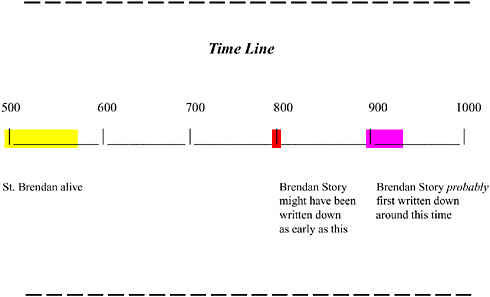 |
|
The Voyage of St. Brendan (This is a shortened version of the story. It misses out some of the adventures of St. Brendan and his crew of monks. All the underlined words are explained at the end.) St. Brendan lived at Clonfert in Ireland. He was head of a community of 3000 monks. One day a monk called Barrind visited Brendan and told him about a Land of Promise across the sea in the west. It was a wonderful place, special to God. Brendan decided to go and find this Land of Promise. He and his monks built a boat with a wooden frame, covered in tanned leather. He put food and drink in the boat to last for 40 days, and also spare leather and fat for greasing it. 1. An Irish boat, copied from a carving done on a stone pillar some time between 700 and 800. 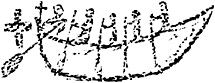 Brendan set out with 17 other monks and sailed west. After 15 days they landed on a tall rocky island. A dog led them to a settlement, where they found a meal waiting for them. They stayed for 3 days without seeing anyone, but food was always set out on the table for them. Next they landed on an island with lots of streams, all full of fish. It was called the Island of Sheep, because flocks of sheep roamed over it all year round. A man gave them food. Then they visited another island that was rocky and bare. They made a fire to cook food, when suddenly the “island” began to move. The monks quickly jumped into their boat, just in time to see the “island” swim off with the fire still burning. St. Brendan told the monks that it was the biggest fish in the ocean, and its name was “Jasconius.” |
|
2. The monks land on Jasconius. A picture painted between 600 and 700 years after Brendan’s time. 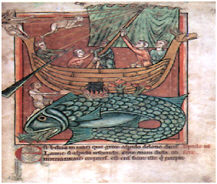 After this the monks sailed to an island called The Paradise of Birds. They hauled their boat almost a mile up a narrow stream, and found a huge tree covered in white birds. A bird flew down and told Brendan that the birds were men’s spirits, and that he would have to search 7 years to find the Land of Promise. The birds sang hymns and chanted prayers at the right times of day. A man called the Steward brought food across to the monks. (He was the man who had given them food on the Island of Sheep.) The monks were at sea for 3 months before they came to another island. They were so exhausted that they could hardly row the boat against the wind. On the island they found monks who had agreed to keep silent (so that they could concentrate on thinking about God). The monks had been there 80 years, and none of them had been ill. They showed Brendan how their lamps were lit by a miraculous flaming arrow each evening. The monks had many adventures before they found the Land of Promise. Many times they found themselves back at the Island of Sheep. But they still continued their search. Once they found a column of crystal sticking up out of the sea. It was surrounded by a mesh that was the color of silver and as hard as marble. They found an opening in the mesh and took the boat close to the column. St Brendan and his monks measured the column. Its four sides were each 700 yards long. The monks then took hold of the mesh and pulled the boat out to the open sea. |
|
3. A modern picture of what we think Brendan’s boat might look like. 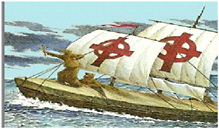 Another day the monks were blown towards an island, and Brendan was worried. He heard the sound of a forge, with the thud of a hammer on an anvil. As the monks came near the island, an islander came out and threw molten metal and hot stones at them. A lump flew 200 yards over their heads and fell into the sea. The sea round it boiled, and smoke rose up. Then more islanders rushed down to the shore and threw hot stones at the monks. Soon it looked as if the whole island was on fire. The sea boiled, the air was filled with a howling sound, and there was a terrible smell. Brendan told his monks they had reached the edge of Hell. They sailed away as fast as they could. In the end the Steward from the Isle of Sheep had to help them find the Land of Promise. They left the Isle of Sheep again, and after 40 days at sea they sailed into a great fog. The Steward said the fog always encircled the Land of Promise. At last they saw a great light, and the boat came to the shore. The land was full of fruit trees. They explored for 40 days, but still did not come to the end of the land they were exploring. Finally they reached a big river, which Brendan said they would not be able to cross. A man came to them, spoke to them by name, and said the land would eventually be made known to all people at a time when Christians were being persecuted. Brendan gathered samples of fruits, and sailed home with his monks. Explanation of Words in the Story Latin Latin was the language people used for writing in Brendan’s time. Almost the only people in Europe who could write were Christian monks and priests. Christian priests continued to use Latin for |
|
most of their writing for more than 1,000 years after Brendan’s time. Monk Monks are men who spend their lives studying God, worshipping him, and trying to do what God wants. They live together in communities called monasteries, helping each other and worshipping God together. Communities Communities are groups of people who live or work together. Land of Promise This means a land where everything is right for people to live a great life. It’s the sort of land where it is easy to find food, where all the plants and flowers are beautiful and grow well, and the climate is comfortable. Tanned leather This was specially toughened leather. It was soaked in juice from the bark of oak trees to make it stronger. Column A column is shaped like a pillar or a fat post, usually taller than it is wide. Crystal The monks meant the column was hard, bright, and semitransparent. Mesh A mesh is like the sort of pattern you get with a net: squares with lines or gaps between them. Marble This is a very hard kind of stone, often used for expensive buildings or for gravestones. Forge A forge is where blacksmiths make tools or weapons out of hot iron. Anvil This is a big block (usually made of iron) that blacksmiths use. When they are beating some hot iron into shape with a hammer (to make a tool or a weapon), they rest the hot iron on the anvil. |
Working Things Out for Ourselves
Once the students have read the story and preferably had a chance to talk to each other about it, we can ask, “What do you think? Did St. Brendan get to America? What’s your hunch?” After time for a free discussion, part of
the point of which is to discover the way students are thinking about how we know the past or about how the Brendan story might be tested, we can press for justifications. “How can we take this further? What kind of backup can you give for your hunches? It needs to be something that might persuade someone else.”
The first target is to build the idea that claims about the past cannot be taken simply as (given) information, true or false. We have to be able to justify them, and this may raise problems for us. The kinds of moves students are making will need to be made explicit and weighed. What exactly are they doing to test the claim here? What is helpful? What does not work? Are they treating the sources simply as information? (See Box 3-6.)
We need to encourage students to think about their own strategies and arguments as much as about Brendan. Some group work may be valuable here, although whole-class discussion can be highly effective if students are used to really listening to each other.
We also want to begin to counter the idea that we are totally dependent on someone in the past telling us a true story. We can try to make students
|
BOX 3-6 When they start using historical evidence, students seldom pay much attention to the provenance of the sources, especially when they are looking at pictures. But faced with a paradox and a little encouragement to look more closely, they can often take major steps beyond treating sources as information.
|
|
BOX 3-7 Youngsters are not generally accustomed to thinking about the kind of knowledge they have and how they are using it, so although they are well aware of the concrete suggestions they have made, getting them to consider these ideas reflexively may be difficult.
This exchange among third graders is the start of a process, not a secure achievement at this point. |
aware of the kinds of criteria they are already using that are not dependent on authority (given information) or on testimony (see Box 3-7). They raise such questions as “Could this incident have happened?”, “Do birds sing hymns?”, and “Isn’t the Atlantic a bit rough for a little leather boat?” The fifth graders in the following (written) examples provide plenty for their teacher
to go on, but the key point to emphasize is that we are not completely helpless if someone is not “telling the truth.”
|
Greg |
I think St. Brendan did get to America. But the story would sound more real if they took out all of the talk birds. You could find out by going to a library, and if the library doesn’t have it, ask somebody else. |
|
Barbara |
I’m not sure [if Brendan got to America]. To me he could have just sailed to another part of Ireland he didn’t know about. I don’t even think this story is true, because the stewardess [sic] was also before them, so he could have reached “America” before them. When they first met him, how did they know they weren’t already in America? The way the story is told just sounds fake. If no one had been to America, how did they know about it, and why did it take so long to write about it? If we wanted to find out, we would have to take everybody who thought about this back in time, because one person could lie. |
Many students, like these third graders, distinguish between “true stories” and “fake” or “made-up stories.”
|
Charlene |
If they wrote it like 300 years after he’d done something, it couldn’t, it might not be true ’cos they don’t actually know. |
|
Joe |
How would they know this would’ve happened all those years after? |
|
Sonny |
The story could be carried on by other people. |
|
Charlene |
But it might be made up. |
|
Sonny |
It might be not true, it might be, like … |
|
Charlene |
Made up. It might be, what do they call, is it fiction or nonfiction? |
|
Teacher |
It’s fiction if it’s made up. |
|
Charlene |
Yeah, fiction. |
We need to be sure students are clear that factual stories try to say true things, whereas fiction is invented, and does not have to be true. But this is just making sure that everyone is starting from the same point because, as noted earlier, we need to get students beyond this simple dichotomy. Young-
sters often have problems in conceptualizing something that is not straightforwardly true or untrue. Take the following discussion among third graders.
|
Teacher |
What sort of story do you think this is? |
|
Ricky |
I think it’s like sort of true, and not true, sort of story, between that. |
|
Teacher |
Half way between true and not true? And why do you think that? |
|
Ricky |
It might be, in that bit, they, he might [much hesitation and repetition of start of sentence] … I don’t know what I’m going to say now [laughs]. |
|
Teacher |
[Laughs] No, keep going…. Sounded interesting. |
|
Ricky |
I’ll start again. I think it’s between that because he might not get there, and it’s like sort of made up, some of this, I think. |
|
Teacher |
What makes you think some of it is made up? |
|
Ricky |
Because there couldn’t be a giant fish—there’s no giant fishes around now. |
|
Lenny |
You know that fish, it could be a whale-shark. |
The idea that Brendan may possibly have reached America or that his doing so may be more or less likely tends to be expressed in terms of Brendan going part of the way. Halfway between true and made up is turned into part of the way to America.
|
Bill |
He could’ve gone somewhere near America. |
|
Steve |
He might have done it to Canada. |
|
Naomi |
Yeah, but America just doesn’t fit. |
|
Steve |
I think it was Canada. |
|
Teacher |
They’re including all that as America. It’s the continent of North America, not the country—there wasn’t one called America then. |
|
Naomi |
I think it was round about America but not America. |
|
Teacher |
So where was it then? That’s not a good move, because now you’ve got a worse problem, because you’ve got to say where it could have been, and there isn’t anywhere it could have been. |
|
Steve |
What’s under America? |
|
Teacher |
More of America. |
|
Bill |
Mexico! Might be Mexico. |
|
Steve |
Could’ve gone to Cuba. |
|
Teacher |
But if he got that far, he could have got to America. |
|
Bill |
America’s so big. He could’ve gone that side of the world [pointing to Indian Ocean]. |
Note that the problem here is not that the students’ geography is shaky (although that may be true), but that they have a desperate need to find something Brendan might have reached that is not America. If the story cannot be accepted but cannot be dismissed, the answer must be that Brendan got part of the way, or even went a different way. This notion is a proxy for talk of possibility or likelihood. Mitch, a fifth grader, may be thinking in this way when he suggests, “I think it’s not possible because he might have went in circles, there might have been another way to get to America to go the opposite way, or it might not work because of the wind and currents.”
Much of the discussion will be based on plausibility, partly because the task is deliberately designed so that initially it gives little else to go on; thus students are able to make judgments without having to master a mass of material. They generally will not use the word “plausible,” but it is valuable to introduce the term here to make them more aware of their own thinking. As students are introduced to new evidence, we can then keep returning to the question, “How plausible do you think the story is now?”
Most students at this stage talk in terms of “everyday” plausibility—what would be plausible if the story were written today. Ideas that appeal to what was likely then do not usually emerge until later, when we turn to the kind of story the Brendan voyage is. The distinction is highly sophisticated, but occasionally a few students will hint at it. Such responses need reinforcing—not necessarily at this point if doing so discourages other responses, but as something to return to should the chance arise.
Thinking About the Story from the Outside
To build on the general ideas students use to make their first judgment about Brendan’s voyage, we can ask a simpler question: “Is it even possible that a boat like Brendan’s could make a journey across an ocean?” Because we want to know how the students are thinking, we can also ask, “How could we find out?”
If the students are to make good progress in answering these questions, they will need to consider more specific knowledge, namely other relevant
things we know about Brendan and his times. But students often suggest making a copy of the Brendan boat to see what it can do, and because Tim Severin did exactly that, this is a good time to introduce his reconstruction and his crossing of the North Atlantic.13 Shirley, a fifth grader, immediately saw the possibilities: “I don’t think Brendan got to America. We could find out by remaking the events, finding how possible each is and when they might have been.”
|
How far could a leather boat have managed to sail? In the 1970s someone made a leather boat just like the one St. Brendan would have used and tried to sail it from Ireland to America. He was called Tim Severin, and he and four other sailors sailed from Ireland to Iceland in the summer of 1976, and then from Iceland to Newfoundland in the summer of 1977. They had to sail through some rough seas, and past icebergs but the boat did not sink and they made it successfully! Below is a photograph of Tim Severin’s reconstruction of a boat from Brendan’s time. The picture shows the boat just as it reached the coast of Newfoundland. 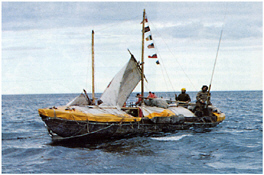 Scientists think that the climate was probably warmer in the times when Brendan was sailing than it is now. Brendan might not have met such gales and rough seas as Tim Severin did on his voyage. What do we know about the sort of boat St. Brendan would have used? |
|
The boat Brendan would have used would have been made of specially toughened leather, sewn over a wooden frame. The boat would have used sails on the open sea, and people would have rowed it with oars when it was near the land. Below is an Irish boat, copied from a carving done on a stone pillar sometime between 700 and 800.  Map 1. The North Atlantic Ocean, where St. Brendan would probably have had to go if he did get to America. 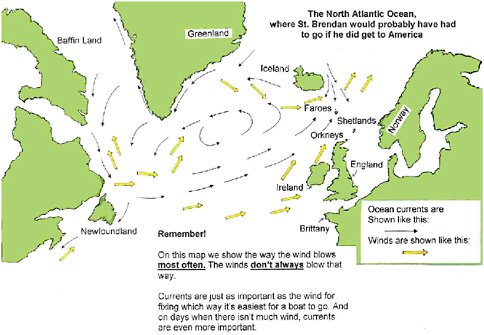 |
|
Map 2. Places we think it likely that St. Brendan visited.  What do we know, or think might be true, about St. Brendan?
|
Map 1 is especially useful at this juncture since we want to add material to allow students to think about the story in the context of more particular historical knowledge. It is obviously important to check that students have some conception of the size of the Atlantic. But more important, without Map 1, they tend to dismiss the evidence of the sea journeys offered in Map 2 on the grounds that America is so much farther on a direct route that the shorter voyages are irrelevant. Map 1 shows what kind of journey might have taken place. It allows students to see the relationships among the islands that might have broken up Brendan’s journey, and how winds and ocean currents would have dictated that he take precisely that kind of route.
Even so, some fourth graders will not see the connections to be made without careful teaching.
Having looked at the further evidence shown above, Shirley (fifth grade) commented, “Yes, it is possible because Tim Severin did it, but you need rations and tools.” Students from third grade up can be very suspicious of such a reconstruction, pointing out that Tim Severin knew where he was going, and St. Brendan did not. For third graders, the fact that Tim Severin had a crew of only four represents a crucial difference because they would have eaten less food than a larger crew.
Some students will find it difficult to grasp the idea that because it may have been possible for a boat like Brendan’s to reach America, this tells us nothing about whether it did do so. (Of course, recognizing the possibility makes the question of whether it did do so one that may be worth asking.) We can ask students directly: “Tim Severin’s voyage proves that a leather boat can sail across the Atlantic. Does that prove that Brendan did make it to America?” Joe, a third grader, wants Brendan to have made it, and shifts from a claim about what was possible to a claim about what Brendan actually did:
|
Joe |
This is proof. This is proof of it. |
|
Teacher |
What, Tim Severin’s copy is the proof? |
|
Joe |
Yeah, it … |
|
Teacher |
What does it prove? |
|
Joe |
It proves, like, that he did go from Ireland to America, to the Land of Promise, and if he did it, then probably Brendan did it. |
|
Teacher |
That who did? |
|
Joe |
Brendan. |
|
Teacher |
It’s proof that Brendan did go? |
|
Joe |
Yeah, it’s proof. |
The issue of what weight the evidence will bear can be raised at this point: the Severin voyage is strong evidence if our question is whether the voyage was possible, but carries much less weight if the question is whether Brendan actually reached America. This is a difficult idea, but it is accessible to many fourth graders, particularly if something like Cartoon 1 (provided by Phil Suggitt) is used to reinforce the point.
In this example, Charlene, a third grader, doesn’t immediately understand what is involved when the teacher asks her to use the idea in another context but then suddenly sees how it works:
Cartoon 1.
|
Teacher |
Tim Severin’s voyage, what did we think it did prove? |
|
Charlene |
That Tim Severin got there, but Brendan might’ve not. |
The teacher then asks what questions their exercise books will and will not answer.
|
Charlene |
I don’t know what you mean. |
|
Teacher |
I’m looking at your exercise book now. What questions can I ask that it will answer for me? |
|
Joe |
It will answer if we are, a nice character—no! If we are messy! |
|
Teacher |
And what won’t it answer? |
|
Charlene |
It won’t answer, like, if I’m, if I get along with my Mum or my brother, or if I don’t. |
|
Teacher |
Your exercise book’s like the donkey. If we ask it the question about what your writing’s like, or what you were doing on a certain day in class, it can carry those questions. |
|
Charlene |
Mmm [agrees]. |
|
Teacher |
If we ask it the question “How do you get on with your Mum?”… |
|
Charlene |
It’d collapse! |
Once they get used to the idea, students begin to use it themselves, as in this example, also from third grade.
|
Teacher |
Because it’s a story about a saint, will it let us say anything about whether Brendan got to America or not? What do you think? |
|
Ricky |
I think that story would collapse. |
|
Lenny |
I don’t think it would collapse for whether he got to America or not, because, um I need to check on the map [hunts for map], Newfoundland, well, that’s part of America, isn’t it, and he got to Newfoundland. |
We can pursue this concept further by asking what difference the evidence about Brendan’s known seagoing (Map 2 and the factual statements linked to it) makes to the weight Tim Severin’s voyage will bear for our big question. Common reactions include the claim that Brendan probably did get somewhere (substituting “halfway there” for “possibly got there”) and, depending on prior learning, comments about how far Viking or Roman ships managed to sail, with conclusions (positive or negative) about what that meant for Brendan’s leather boat.
Thinking About the Story from the Inside
The students have already been thinking about the internal evidence (i.e., the evidence that can be found in the story itself), of course, and some may already have introduced natural explanations for the supernatural events in the story. But we now require a closer and more systematic consideration of the story. Two sets of questions start things off:
Make a list of the three things in the story that would best back up the claim that Brendan reached America. How do they back up the claim?
What parts of the story make the claim that Brendan reached America a shaky one? Pick the three things that seem to you hardest to accept. How do they make it hard for us to believe that the story shows that Brendan reached America?
These questions can produce widely varying results. Some students are skeptical from the start, whereas others want Brendan to have succeeded. Both groups find the second question much easier than the first. As an answer to the first question, fruit trees do not amount to much! The only way to see the evidence inside the story as supporting the claim that Brendan reached America is (1) to interpret key events in the story naturalistically, and then (2) to use evidence from outside the story to show how those events fit the route Brendan is most likely to have taken. One powerful line of argument is the difficulty of finding an alternative destination that fits as well as America. If any of the story is to be treated seriously as an actual voyage, what other destination could fit the events better? This kind of understanding appears to be tacit in some youngsters’ comments, but to see its importance and be able to articulate it involves sophisticated thinking, generally done spontaneously only by older students.
To bring out the way in which events in the story fit the most likely route, students need to be conscious of alternative ways of seeing some key events. For this purpose, the materials used in this example focus on the crystal column and the “edge of Hell.” The first step is to raise the general issue of how we interpret things, using a concrete example—the duck-rabbit and the bird-antelope. (See Cartoons 2 and 3, provided by Phil Suggitt.)
Before we take a closer look at bits of the story, we need to think about how we make sense of things we see or things we read. What do these two pictures show?

Cartoons 2 and 3.
Strictly speaking, because these examples depend on perception and not on how we understand text, they are different from history. There is a danger here. There is no right answer in any sense, and nothing turns on which answer is chosen. The danger is that students may think this is true of interpretation in history. It is important to stress that in the case of Brendan, we are trying to decide what happened, and we have something to go on. Students can be reminded that they have already used material from outside the story. If handled carefully, the analogy, despite its defects, is close enough
to engage fourth graders, and it creates considerable excitement and amusement among younger students.
The bird-antelope raises questions about the shaded area on its neck. Is this fur or feathers? The answer depends on the interpretation of the whole picture; the details are too ambiguous to settle the issue. We go back and forth between the shading and the overall shape to decide what the animal is. Something analogous applies with Brendan: the way we view the story will help determine how we view particular incidents within it, and vice versa. However, it would not be wise to pursue this point unless the students are already making sense of the basic issue—that some things can be interpreted in more than one way. The next step is to ask the students to look again at the paragraph in the story about the crystal column. Some students will already have seen that the column may have been an iceberg, although many fourth graders do not think of this interpretation at first. If we ask, “Can you think of two different ways this part of the story could be interpreted?” and then provide the pictures below as either a confirmation or a revelation, we can give a concrete example of interpretation, categorizing the pictures as supernatural and natural interpretations. (See Cartoons 4 and 5, provided by Phil Suggitt.)
Cartoons 4 and 5.
This material often provokes exchanges such as the following (fourth grade):
|
Bill |
I think it’s a fairy tale, like, a bit like Cinderella and the Fairy Godmother, like … |
|
Naomi |
Like the birds and spirits and that sort of thing. |
|
Steve |
If you reckon it’s a fairy tale, you don’t see people trying to kill you in fairy tales, do you … |
|
Bill |
Some fairy tales there are—Little Red Riding Hood—the wolf tries to eat you. |
|
Naomi |
I think it’s a kind of fairy tale. |
|
Bill |
A fairy tale, ’cos people throwing molten hot rocks, wouldn’t they actually burn their hands? |
|
Steve |
But it could’ve been real people, and it could’ve been a volcano, and the crystal could’ve been an iceberg, and the fish could’ve been a whale, and the talking birds [long pause] parrots [triumphantly]. |
|
Bill |
[Contemptuously] How can you get white parrots? Must be a one-in-a-million chance to see a white parrot. |
The “jug” or chalice in the supernatural picture provokes questions and enables us to complicate matters a bit. The fuller version of the story allows the teacher to raise a note of caution about jumping to conclusions.
Before you come to a decision, you ought to look at a fuller version of what the writer actually wrote, not just the summary you’ve had to work with so far. Here it is.
|
One day after they had said Mass, they saw a column in the sea. It did not appear to be far away, and yet it took them three days to get near it. When the Man of God came near to it, he couldn’t see the top, because it was so high. It was higher than the sky. All around the column was an open-meshed net, with openings so large the boat could pass through the gaps. They didn’t know what the net was made of. It was silver in color, but seemed to be harder than marble. The column itself was of clearest crystal. The monks pulled on the meshes of the net to get the boat through it. There was a space about a mile wide between the net and the column. They sailed all day along one side of the column, and could still feel the heat of the sun through its shadow. The Man of God kept measuring, and the side was 700 yards long. It took four days to measure all four sides. On the fourth day they saw an ornamental church plate and jug in a window of the column. They were made of the same material as the column. Saint Brendan took hold of the plate and the jug, and said, “Our Lord Jesus has shown us a miracle, and given me these two gifts so that other people will believe us.” |
The Mass (which can be explained simply as a religious service) and the title “the Man of God” for St. Brendan both help to emphasize that the story is connected with religious beliefs and is not just a “factual report” of what happened. We can ask, “Has this changed the way you think we should interpret the crystal column, or not? Why?”
We then give the same treatment to the “Hell” passage. The students reread the relevant paragraph of the story, and then we ask, “Is this piece of the story natural or supernatural?” Once again two pictures emphasize the basic point, but this time they are rapidly followed by some new information. It is this information that opens up the possibility of interpreting three major incidents in the voyage, in addition to the iceberg, as indicating just the kinds of things that might have been encountered on a voyage that followed prevailing Atlantic winds and currents. (See Cartoons 6 and 7, provided by Pill Suggitt.)
Cartoons 6 and 7.
|
Some facts we have good reasons to be sure about
|
Some fourth graders will initially deny that that there could be volcanoes in Iceland because volcanoes are hot and Iceland is cold, so it is important not to allow this misconception to make nonsense of the kind of progress we are trying to make. The questions we ask to this end can be straightforward, reinforcing the importance of interpretation: “How should we interpret the visit to the island that Brendan said was Hell? Could the Isle of Sheep have been a real place?” Students quickly appreciate the idea that there may be a case to be made for saying that Brendan passed the Faroes and Iceland, encountered an iceberg somewhere during his journey, and ended up in the fogs close to Newfoundland. For some students, the result is a huge step in understanding. In the following example, Joe, a third grader, begins to see that his earlier ideas were too simple:
|
Joe |
Brendan’s gone from Ireland, to the Faroes, named it the Island of Sheep, then went to Iceland, called it [pauses] … |
|
Teacher |
Called it Hell. |
|
Charlene |
Why? |
|
Teacher |
Because Hell’s supposed to be very hot and smoky and smelling. |
|
Joe |
Called it Hell, and saw the people throwing rocks at him which was really a volcano, and then on the way saw the iceberg, which they thought was the crystal column but really it was the iceberg, and then they saw the fog and then they got lost, then came to Newfoundland, and the whole thing is part true, part fiction. |
|
Teacher |
Right. But you started by saying it was all made up. |
|
Joe |
It’s not all made up. The person going from there to there [points to map] is true. But all |
|
|
this [edge of Hell, etc.], all that rubbish is not true. |
|
Teacher |
So, why would that be there if it was true that he made that trip? Why would they put it in those other funny ways? |
|
Joe |
They put the miracles in because they thought, they would think, that it’d be true. |
In the last sentence there are signs that Joe is beginning to see that having miracles in the story might have made sense at the time. This is a big step for a third-grade student.
At this point, we have to be careful that students do not think the matter is sewn up. Rereading the passages about the hymn-singing birds, Jasconius, and the arrow that miraculously lit the lamps is a useful way of reminding students that whatever they say about the story must explain these things as well.
Finding Out What Kind of Story the Brendan Story Is
The problem can now be put to students as follows. If we say this story is just a made-up tale, we have to explain why it appears to make sense as a voyage in the Atlantic Ocean. If we say the story describes a real voyage because we can interpret apparently supernatural events as really being natural, we have to explain the things that do not fit so easily. What this means is that we need to help students consider what kind of story they are dealing with. Doing so raises matters that not all fourth graders can grasp, but it is worth introducing them here even though we will need to return to them in other lessons on other topics. Indeed, none of the ideas dealt with in this material can be assumed to stay with students after just one lesson; all need to be woven into a series of lessons.14
The goal here is to help students understand that if we are to know what weight this story can bear as evidence of Brendan’s reaching America, we need to know what its writer was trying to accomplish and the conventions of the time (see Box 3-8). If it is a story intended to show what a splendid saint Brendan was, we should expect it to be “embroidered” with supernatural events whether they had a natural basis or not. Just because we treat magical events as implausible, we should not expect people then to have done the same. Indeed, as a story about a saint, it would be highly implausible without such events. If the students now look at some more evidence, we can ask, “What sort of story is this?”
|
BOX 3-8 The tendency to assume that people in the past shared our ways of thinking and acting has been found among students in Canada as well as in the United States and the United Kingdom. Peter Seixas asked Canadian tenth graders to watch selected scenes from two popular films dealing with the relations between Native Americans and whites in the 1860s—The Searchers and Dances with Wolves.15 The 10 students were asked to explain the differences between the films and to say which gave a more accurate picture of life for Native Americans and for the whites in the west in the 1860s. The interpretative framework of Dances with Wolves coincided with students’ own assumptions: they agreed with its portrayal of Indian and white lives and the picture it gave of relationships between the two groups, and they saw its modern cinematic techniques and the “realistic” portrayal of how people act as making it more believable. Having limited knowledge of the topic, in assessing the film they fell back on their general knowledge of human nature and their sense of a believable narrative. Seixas suggests that, “Ironically, the more a ‘historical’ film presents life in the past as being similar to life in the present, the more believable it is to these students.” The Searchers, with its dated cinematic conventions and acting, provoked the students into thinking about the status of the film, whereas when they had watched Dances with Wolves they had treated it as a window on the past. The conventions of The Searchers were dismissed as “the more primitive techniques of an earlier age,” but students had more difficulty dealing with its interpretative stance. Seixas emphasizes the importance of confronting students with interpretative stances that differ from their own as a means of challenging and developing ideas about historical films by making the apparent “transparency” of films that accord with our present preconceptions more problematic. |
|
What are writings from those days (500–1000) usually like? They generally don’t give many of the details we might expect (times, dates, or where things happened) and are often vague about exactly what happened. When they give details, they often say different things about the same event. Often people who wrote in these times weren’t trying to get the details right. They weren’t writing news reports. They might have been trying to show how a good person ought to live, or how God |
|
helped good people and punished bad ones. Other times they might be telling the story of a great hero. A very common sort of Irish story was the “imram,” which was a made-up tale about a sea voyage. People liked hearing such stories. But most imrams were probably written later than the time when the story of St. Brendan’s voyage was written. Some people think “The Voyage of St. Brendan” is different from the usual writings of the time. For instance, one lady who is an expert on writings from 500 to 1,000 is puzzled because “The Voyage of St. Brendan” doesn’t keep going on about Brendan doing miracles. She says that when writings from this time are about saints, most of them make sure to have the saint doing lots of miracles. (That is because they wanted to show how good a saint he or she was, and how powerful God is.) But in “The Voyage of St. Brendan,” Brendan doesn’t do miracles himself. |
The material demands a good deal of thought, but with some guidance, fourth-grade students can begin to incorporate it into their arguments:
|
Bill |
I wonder what the entire thing comes to? Nine years and 7 years and 40 days and another 40 days and … |
|
Teacher |
It adds up to a long time, yes, but it’s a bit like … What about it saying the iceberg reached the sky, the crystal column reached the sky? |
|
Naomi |
It means it’s really tall. |
|
Teacher |
So when it says 40 days and 40 nights? |
|
Steve |
It means really long. |
|
Teacher |
I mean, if they’re not trying to tell us how long something takes, then maybe it’s a mistake for us to say, “Hang on, lets add all these up and see what they come to,” because they’re not even trying. It’s a bit like stories about “Long, long ago….” |
|
Bill |
They don’t actually tell us when it was, do they? So it’s a bit like this, they don’t actually tell us how long the journey was. |
|
Teacher |
That’s right. That’s what it says here in this bit look [pointing to the students’ sheet]—What are writings like in those days?—most stories were like that in those days, they didn’t give all the exact figures, they didn’t have to add up. |
|
Bill |
Yeah. |
We can now introduce the notion of “embroidering” a story as changing the way it is presented to make it more acceptable to its audience and ask, “Why do people embroider stories? Might people at the time this story was written have had different reasons from ours for embroidering?” We should try to avoid introducing such words as “exaggerate” or “distort,” and especially such ideas as “making it exciting.” These notions would preempt the everyday ways in which students will already be thinking about the audience, exemplified in the following fourth graders’ exchange:
|
Teacher |
What sort of story do you think it is? |
|
Steve |
A legend, or [pauses] … |
|
Teacher |
Why would somebody have written a story like this? |
|
Steve |
To be famous? |
|
Bill |
Or he could make a profit on it selling his story. |
The issue here is that our embroidering of a story may be done in different ways and for different reasons from those of people at the time the story took its present form. Our questions must help students rethink their assumptions: “Who is the hero of this story? What sort of person is he? What were saints supposed to be like? If you believed in miracles and supernatural events, what would tell you if someone was a saint? What could someone writing this story (more than a thousand years ago) put in it that would show everyone Brendan was a saint?” Finally, we can ask, “Would embroidering a story like this one make it more or less plausible to people living then? Why?”
At this point we are asking students to grasp, albeit in a simple way, first, that people in the past thought differently from us, and second, that to make sense of what we want to use as evidence, we have to understand how they thought. In doing so, we are touching on empathy, and we need to remember what ideas our students are likely to be working with. Many of them will willingly recognize that people then believed in supernatural events, but see this simply as proof that in those days, people were pretty stupid and therefore gullible (see Box 3-9). Such a deficit view of the past (see also Chapter 2) does not necessarily stop third graders from beginning to understand that the Brendan story may be rather different from a modern travel account.
|
Teacher |
What sort of story was he trying to write? |
|
Ricky |
It might be one that he thought, like, if it was a volcano that he made it like people throwing it, so like volcanoes are natural things, and he changed them to people, and that, Jesus and everything else like that. |
|
BOX 3-9 The idea that people in the past could not do what we can and were not as clever as we are is very stubborn, even in the face of strong pressure. It is worth quoting part of a long exchange among fourth graders to show just how stubborn.
|
|
Teacher |
Why would he want to do that? |
|
Ricky |
So it’s more interesting, and something to do about God. |
|
Teacher |
Why would he want to make it something about God? |
The connection between willingness to underestimate people in the past and a deficit picture of the past derived from a technological idea of progress is quite apparent here. The students repeatedly accepted that their argument was inadequate, but kept returning to it anyway. This exchange continued for some time, but there was little sign that it did any more than modify the edges of the students’ ideas. Deeper changes require specifically targeted tasks and frequent return to the issue in a variety of contexts. |
|
Ricky |
‘Cos he said he’s a Man of God. |
|
Teacher |
Why try to find the Land of Promise? Why go to all this trouble? |
|
Lenny |
Because monks are normally very, worship God a lot, and the Island of Promise was to do with God too. |
|
Teacher |
Why do you think somebody would write this story then? What do you think they were trying to show? |
|
Lenny |
They were trying to show that Brendan was a special man. |
|
Teacher |
And what sort of special? |
|
Lenny |
Well, sort of, holy. |
By the seventh grade, many students should be trying to use their understanding of the world in which people lived and the beliefs and values of the people they are studying to explain the things these people did, not just dismiss them.
|
Teacher |
What does the story tell us about the person who actually wrote it? Is there anything we can work out? |
|
Trudi |
I think the person who wrote this down believed in God quite strongly, because all the time he’s referring things back to God, and that may be from mistakes, or what he’d heard, or been told, but I think if they didn’t believe it then they wouldn’t have written it down quite so much; it seems very likely they were very strong believers in God. |
|
Haley |
I think he probably wanted them to think, “Wasn’t God great,” probably, or something like that, or saying like, “God’s really good, look what he’s done, they’ve reached America,” and stuff like that. I think he wanted the audience to think about God. |
|
Trudi |
He wanted the readers to realize that if you’re good and you worship God, then he’s going to be there for you, and he’ll look after you, but if you don’t, then he won’t take care of you, because it seems very certain that they thought that and the reason why he found all these places or visited all these places was because God was looking after him. |
|
Jane |
I think that, it seems like the sort of story that was meant for, maybe like, village people who were at church or something, instead of having a Bible reading, maybe having this, getting the message across to them that religion was very |
|
|
important and they should believe in that, rather than just for maybe like a child reading it for a bedtime story or someone reading it as a book. |
It is important, however, not to assume that only older students can think like this. After his group had worked through the material with his teacher, Don, a third grader, expressed the understanding he had achieved:
|
Teacher |
So if the story’s written like that, for that sort of reason, does that mean it can tell us more, or tell us less, or what? |
|
Jilly |
Probably about the same. |
|
Don |
It probably makes it like more, because without God doing miracles, people who weren’t saints, they would say, Brendan ain’t a saint, ’cos God didn’t do miracles for him, so without God, being a saint, I reckon it’d be less, but if Brendan’s a saint and God does stuff for him, I reckon that story must be more [believable]. |
We are now dealing with matters that are difficult for most fourth graders, so we can give them some help in the form of some possibilities to talk about. “What sort of story are we dealing with here? Have a look at these suggestions, and decide which you agree with and which you don’t: (a) It is just a religious story about what a holy man St. Brendan was, showing what wonderful things he did to find the Land of Promise that was special to God. (b) It is a story about a real voyage that St. Brendan made to America. (c) It is a story based on real events, but meant as a religious story about how holy St. Brendan was. (d) It is an ‘imram’—just an exciting made-up voyage story.” We have to be careful here about the grounds on which students are making their choice. Some fourth graders choose (a) because the sentence gives details of what is in the story, even when they are thinking something more like (c). But once the alternatives have been clarified, students can make some penetrating points. Helen, a fifth grader, wrote:
I think it is (c) because he wasn’t all that holy [not enough, presumably, for (a)] and for (b) it wasn’t all real like the talking birds, but you could make sense out of that. He wasn’t being real holy and I just think that it is based on real events and he misinterpreted some things and he thought some things were supernatural sort of things instead of natural things.
Andy, an eighth grader, chose (c) and explained: “Because I think that this story could have happened (the geography at least), but I think that religious influence was then added to show the power of God/St. Brendan.”
The task can be ended here with a return to the big question: “Did an Irish monk land in America about 1000 years before Columbus?” But a further step is possible if there is time and the students are sufficiently engaged in the problem.
|
Possible clues as to whether Brendan reached America—what’s been found in Iceland. Historians know that:
Possible clues as to whether Brendan reached America—what’s been found in Greenland. Historians know that:
Possible clues as to whether Brendan reached America—what’s been found in Vinland. Historians know that:
|
|
time of sunrise the sun’s rays just reach the notch on the left side, when it is Christmas Day.” (A “notch” in the rock is a line cut in the rock.) Which clues fit with which? 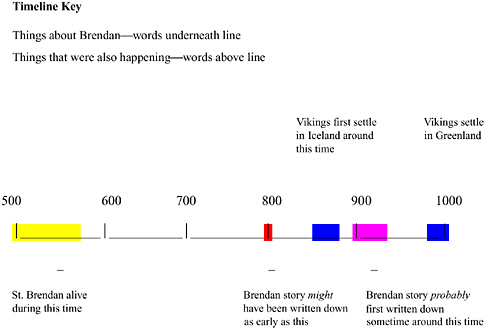 |
Having made some progress in deciding what kind of story St. Brendan’s voyage is, we can go back to looking at other things we know might help in answering our big question. The clues include some quite shaky evidence (we do not have to use all the clues in the example here), and students tell us a great deal about their assumptions as they decide what the evidence shows (see Box 3-10). Students’ ideas about the strength of this broader evidence are not easy to predict. They depend on understandings and assumptions about how people behave, how long physical objects survive, the rates at which languages change, and what importance the students attach to “usually” or the views of one “expert.” But these are precisely the things we need to bring out at this stage.
A common fourth-grade response is to focus on the content and maintain that the new evidence does not help “because it’s all about the Vikings.” Insistence on looking carefully at the timeline and thinking about what the
|
BOX 3-10 Keith Barton’s work with young students in history suggests that they shrink the scale of human activities and reduce long-term processes to events or individual actions.16 The spatial shrinkage is evident in the following example from the Brendan task:
This is a frequent kind of strategy for finding remains, and despite Charlene’s practical solution, the scale of the Atlantic and the task is hugely underestimated. Teaching the Brendan material also produces signs of temporal shrinkage, even with older students, and sometimes a tendency to reduce a series of events to single occurrences. Some cases are very clear. “I didn’t know there were people a thousand years before Columbus,” said one eighth grader, “I thought there were just dinosaurs.” Some are more subtle:
|
Vikings found can shift students’ positions here. But although they can see relevant issues, they do not always find it easy to produce explanations.
|
Bill |
Maybe Brendan got to America on Christmas Day, because it’s saying at the time of sunrise a ray grazes the notch on the left side on Christmas Day. |
|
Teacher |
Who could have carved it? |
|
Bill |
They [the Native Americans] weren’t really Christmas Day sort of religious people. |
|
Teacher |
How else could it have got carved there then? |
|
It is difficult to see why Anna should think these are Brendan’s monks. Why should it be the same group of monks? Is it not more likely that there has been more than one voyage? A teacher using the material comments that (after looking at what the Vikings found in Iceland) her eighth-grade students thought in a similar way with a diametrically opposite conclusion. They “wondered how Irish monks could be at an island 300 years later. They pointed out that there were no women on the island, so how could the community of monks have been continuous since St. Brendan.” Jane (seventh grade) may be making similar—past shrinking—assumptions:
|
|
Bill |
Maybe somebody got there before Brendan. |
|
Teacher |
What do we need to know? |
|
Bill |
We need to know it’s definitely Irish writing and it definitely does say that, not … |
|
Teacher |
And we need to know one other thing as well … Think about what you said right at the beginning, that made you suspicious of the story, when you saw the timeline. |
|
Bill |
Oh! What time it was. |
Seventh graders are usually more skeptical about the Vikings’ supposed recognition of the Irish language, often making comments such as “It may not necessarily have been Irish. It could’ve been any other language.” But although they can come up with explanations for the rock carving, they can still find it difficult to envisage alternatives.
|
Haley |
There’s some carvings been found on a rock, in erm, Ancient Irish writing, I think that might have something to do with it, if Irishmen were writing on stones then it probably was the monks, who were there, I don’t know who else it could be really. |
|
Jane |
I agree with Haley, I don’t think somebody’s going to go to a stone now and write Ancient Irish on it. |
The inferences here are fine, provided we rule out more recent fraud or the possibility of simple overinterpretation of marks by people who, like many of the fourth graders, want St. Brendan to have made it to America. If such overinterpretation is a fault, however, it is not one that betrays conceptual weaknesses in connection with understanding evidence, but perhaps an understandable degree of optimism and excitement.
As a final step, we can ask some questions designed to see what more general ideas the students are using by the end of the task. “What would you say to someone who said: (a) We can’t say anything about this. (b) We weren’t there, so anyone can say what they want. (c) We either have to believe the Brendan story or we have to trash it.” For fourth graders, we are likely to be quite satisfied if we get responses suggesting that we have had some impact on their everyday ideas. If we can effect a shift such as that evident in the responses of these fourth graders between the beginning of the task and the end, our students will have made valuable progress.
Ideas at the beginning of the topic:
|
David |
You can’t get it right because none of us know. |
|
Teacher |
Why do none of us know? |
|
David |
Well, like everyone’s guessed. |
|
Teacher |
And why are we guessing? |
|
David |
Because we don’t know what he really did. |
|
Teacher |
And why don’t we know? |
|
Jeff |
Because we weren’t there at that time. |
Ideas toward the end of the topic:
|
Jeff |
[If we interpret it naturally] half of it makes sense. |
|
Teacher |
So if we can’t say, “It’s impossible that Brendan reached America,” what can we safely say? |
|
Jeff |
Inconclusive. |
|
Teacher |
Supposing someone said, “If no one left us the true story, we can’t know?” Do you agree with that, or disagree with it? |
|
David |
Disagree. |
|
Jeff |
No, ‘cos there’s lots of evidence. |
(Note that Jeff had not used “inconclusive” before this point, and the word had not been taught.) In response to the final questions, the students take a similar position, and Jeff’s last comment in this excerpt could almost sum up our teaching goals for the whole unit:
|
Teacher |
What would you say now, after working through this, to someone who said, “We can’t say anything about this?” |
|
Carly |
We could find out about it. |
|
Teacher |
OK, what about the second thing, “We weren’t there, so anyone can say what they want?” |
|
David |
Nonsense! ’Cos there’s evidence, so you can, say … |
|
Teacher |
So you can’t say just what you want? You have to say … |
|
David |
The truth, what you found out. |
|
Teacher |
Has the evidence shown you the truth, or…? |
|
David |
It helps you. |
|
Teacher |
OK, what about the last one, “We either have to believe the Brendan story or we have to trash it?” What about that one? Is that right or not? |
|
David |
No. |
|
Jeff |
In the story, there are some things that make sense, you don’t have to trash it, you just have to make sense. |
Research and experience suggest that understandings such as those displayed by students in the fourth-grade study of St. Brendan’s voyage are
likely to transfer to higher grades and to different topics.17 Students who have such learning experiences will be better prepared for the study of the Pilgrims in a later grade. Developing students understanding of core, second-order concepts in history will be more effective if that development is planned across the years. In fact, our most important conclusion is that successfully achieving an effective integration of conceptual (second-order) understanding and content coverage, as emphasized in How People Learn, can best be achieved with planning of history teaching across grades 4 through 12. Individual teachers can achieve important shifts in student thinking, as we see in the lessons described above. But student progress and teacher effectiveness will be far greater if those who determine the agenda for history teaching across the school years do so with careful attention to the progression in student understanding of both second-order concepts and content coverage. An illustration of how such planning might be accomplished is provided in Appendix 3A.
APPENDIX 3A IMPLICATIONS FOR PLANNING
Student learning in history will best be supported if instructional planning across the school years includes both second-order concepts and content coverage. Planning for progression in students’ mastery of the two, however, differs in several critical respects. The sequence of substantive topics that we plan to address may be ordered by reference to chronology, theme, and scale. We offer an example across 4 years for illustrative purposes:
|
Grade 4: |
The First Americans: Origins and Achievements Worlds Apart: Europe, Africa, and Asia before the Voyages of Exploration |
|
Grade 5: |
The Great Civilizations of Pre-Columbian America The Voyages of Exploration: First Contacts among Native Americans, Europeans, and Africans |
|
Grade 6: |
Spanish and Portuguese Conquests Early English Colonization: The Pilgrim Fathers |
|
Grade 7: |
Government and Liberty in the Early American Colonies The American Revolution |
Such a plan dictates what is to be addressed; when the teacher is to do so; and, within limits, how long it should take. A topic such as the Pilgrim Fathers, for example, will be taught once and once only at the elementary level or in junior high school. It is likely to be taught to all students in a given grade. And, after a given period of time, all students will move on to a new topic without reference to how much they have or have not learned about the Pilgrim Fathers.
Planning for progression in second-order concepts is different. It is informed not by our selection of particular passages of the past for study, but by models of progression based on systematic research and on classroom experience of the kind illustrated in the discussion of the Pilgrim Fathers and St. Brendan’s topics. These models are hierarchical and describe significant stages in the development of students’ thinking over time. A model of progression for the second-order concept of evidence is given in Box 3A-1.
We should remember that what is presented in Box 3A-1 is a model and not the model. There is no such thing as a definitive model for evidence or for any other second-order concept, although all research-based models are—or should be—compatible. They may vary, however, in the number of levels they include and in the emphasis given to different aspects of students’ thinking. Nor do these models prescribe or describe the ways in which the ideas of any individual student should or will develop. They are generalizations applicable to the majority of students that appear to be sustainable across generations and nationalities. They may be compared with footpaths across a mountainside: these footpaths exist because most walkers have elected to follow a given route across the mountainside; not all walkers will have done so, and more than one trail may lead to the desired destination.
A teacher who leads a school party may plan to take students along a chosen path rather than to allow each to find his or her own way across the mountain. Most would find this to be a wise decision even if some students are disposed to seek out the more boggy areas and others to head for sheer rock faces. This analogy breaks down in one crucial respect, however: while it is possible to march students along a mountain trail in reasonably good order, students will move through the levels of a model of progression at very different speeds. For example, they may jump one level altogether, moving straight from level 3 to level 5. Indeed, by tenth grade some students will have moved beyond level 6 of the model in Box 3A-1, while others will remain at level 2. It follows that levels of conceptual understanding cannot be attached to grades or to topics, and that some students will have to repeat work at quite similar levels of conceptual challenge when they change topics, while others will be able to move on to tackle new and more demanding conceptual problems.
This point is illustrated by a comparison of the responses of the sixth-grade (Pilgrim Fathers) and fourth-grade (St. Brendan) students presented
|
BOX 3A-1 1. Pictures of the past The past is treated as if it is the present; students treat potential evidence as if it offers direct access to the past. Questions about the basis for statements about the past do not arise. Stories are just stories. 2. Information The past is treated as fixed and known by some authority; students treat potential evidence as information. Given statements to test against evidence, students match information or count sources to solve the problem. Questions arise about whether the information offered is correct or incorrect, but no methodology is attributed to the study of history for answering such questions beyond an appeal to books, diaries, or what has been dug up. These sources, although sometimes seen as being connected with the past, provide transparent information that is either correct or incorrect. 3. Testimony The past is reported to us either well or badly, by people living at the time. Questions regarding how we know about the past are regarded as sensible; students begin to understand that history has a methodology for testing statements about the past. Conflicts in potential evidence are thought appropriately to be settled by deciding which report is best. Notions of bias, exaggeration, and loss of information in transmission supplement the simple dichotomy between truth telling and lies. Reports are often treated as if the authors are more or less direct eyewitnesses—the more direct, the better. |
above. On the whole, the sixth-grade students operate at a higher conceptual level than those in the fourth grade, but the conceptual understanding of some fourth-grade students is more advanced (relative to the model of progression in Box 3A-1) than that of some sixth-grade students. This observation may appear to argue against the wisdom, or even the practicability, of planning for the progression of understanding with respect to second-order
|
4. Cut and paste The past can be probed even if no individual reporter has told us truthfully or accurately what happened. We can piece together a version by picking out the true statements from different reports and combining them. In one student’s words, “You take the true bits out of this one, and the best bits out of that one, and when you’ve got it up, you’ve got a picture.” Notions of bias or lies are supplemented by questions about whether the reporter is in a position to know. 5. Evidence in isolation Statements about the past can be inferred from pieces of evidence. We can ask questions of sources that they were not designed to answer, so that evidence will bear questions for which it could not be testimony. There are many sources of evidence that are not reports of anything (nineteenth-century rail timetables, for example, were not constructed for the benefit of historians). This means historians may be able to work out historical facts even if no testimony has survived. Evidence may be defective without involving bias or lies. Reliability is not a fixed property of a source, and the weight we can place on any piece of evidence depends on what questions we ask of it. 6. Evidence in context Evidence can be used successfully only if it is understood in its historical context: we must know what it was intended to be and how it relates to the society that produced it. Making this determination involves the suspension of certain lines of questioning and a provisional acceptance of much historical work as established fact (a known context). We cannot question everything at once. Contexts vary with place and time (a sense of period begins to be important). |
concepts. If students cannot be kept together, why not allow them to make their own way across the conceptual mountainside?
There are several answers to this question. First, all students may be expected to make more rapid progress if we plan to take them along a given trail rather than leaving them to find their own way. Second, if trails are made explicit, students may grasp (and, it may be hoped, become
metacognitively aware) that they are expected to walk across the mountains rather than play in the foothills and watch the clouds drift by. After all, this is what paths are for—for walking from here to there. If we plan to achieve progress in students’ ideas about evidence, change, and so on, students may become aware that their understandings must develop irrespective of changes in the factual scenery as one topic succeeds another. Third, if we plan to achieve progress in students’ conceptual understanding in particular ways, it is easier to anticipate the preconceptions and misconceptions that students may bring to any topic. Doing so makes it easier for us to identify, to exploit, and to remediate the ideas students use to make sense of the work at hand. To return to the previous analogy, if we notice that we have lost a few students, that they are no longer with us, it is easier to check back on or near the trail along which we planned to take them than to scour the entire mountain.
If these arguments are accepted, it remains to illustrate what planning in conformity with the second key finding of How People Learn might look like. Although planning should address the totality of history education from fourth to twelfth grade and all relevant second-order concepts, a more modest illustration may suffice.
As already indicated, history teaching at the fourth-grade level may cover such topics as The First Americans: Origins and Achievements and Worlds Apart: The Americas, Africa, Asia, and Europe before the Voyages of Exploration. These topics are likely to be broken down into a number of units of work intended to occupy 4-8 hours of teaching. The Worlds Apart topic, for instance, might include the following units:
Unit 1: Filling the World with People
Unit 2: People Go Their Separate Ways
Unit 3: First Contacts: Did St. Brendan Sail from Ireland to America?
Unit 4: First Contacts: Why Didn’t the Norse Stay in America?
The topic aims to develop students’ understanding of a particular period in history, that of the Voyages of Discovery. Students may be relied upon to forget much of what they are taught; thus it is necessary to identify the dates—usually for the key generalizations and understandings, rather than for the details—that we wish them to retain. Teaching tasks and assessments can then be focused on the transmission and development of these key generalizations and understandings. What these are or should be is negotiable. The Worlds Apart topic may focus narrowly, for example, on the independent evolution of new and old world civilizations to provide the students with descriptions and explanations of cultural misunderstandings and clashes in the sixteenth and seventeenth centuries. An alternative ap-
proach would aim to give students an understanding of the “one world” revolution that began with the exploration, colonization, and commercial exploration of the Americas and elsewhere, which may be seen as the start of the process we now call “globalization.”
What may be less familiar is a stage of planning that goes beyond the identification of key generalizations and, in accordance with the second principle of How People Learn, also identifies key ideas about the second-order concepts associated with evidence and accounts, change and development, and empathetic and causal explanation that students use to make sense of the those generalizations. For the units of work listed under the Worlds Apart topic, teaching what we want students to learn with respect to generalizations about the past may be combined with developing their understanding of second-order concepts along the following lines.
|
Unit 1:
|
It should be noted, first, that attempts to refine students’ understanding of change, as of any other second-order concept, should not displace teaching about the past, but will certainly affect the ways in which such teaching takes place. The discussion of the Pilgrim Fathers’ and Voyage of St. Brendan tasks illustrates the nature of this impact. It is not practical to address all second-order concepts within a single unit of work. For this reason, the conceptual focus of a set of units is likely to vary, as indicated below.
|
Unit 2:
|
|
Unit 3:
|
The target ideas in these units are informed by the model of progression for evidence outlined earlier and, as previously argued, cover the range of learning outcomes accessible to the majority of fourth-grade students. Some students will still struggle to master these ideas in seventh and eighth grades, whereas the understanding of others will have moved far beyond even the most difficult of these ideas.
A final set of examples deals with the concept of causal explanation—provided in Unit 4 on page 172.
In the examples given for the Worlds Apart topic, each second-order concept is addressed once and once only. If two topics are taught at each grade, it follows that each second-order concept will be revisited at least once each year and that planning for systematic progression across grades is possible.
The examples provided here are, of course, only an illustration of the start of the planning process. Detailed planning with reference to content, materials, and activities must flesh out the key generalizations and ideas exemplified above. At the same time, our planning should also take account of the other key findings of How People Learn. The planning grid presented in Box 3A-2 shows how all three key findings might figure in planning to develop students’ understanding of the concept of evidence, using the St. Brendan and Pilgrims’ tasks as examples.
|
Unit 4:
|
The first column in the planning grid shows the content to be covered and the key questions that organize that content. The key questions are designed to allow us to bring together the content and the relevant second-order understandings. Although there are two different topics—St. Brendan and the Pilgrims—the questions for both the fourth- and sixth-grade work are concerned with the same key question: “How do we know?” Teaching will therefore need to focus on the concept of historical evidence. But decisions will need to be made to ensure that the teaching is appropriate for the age and ability of the students.
Before more precise teaching goals can be written into plans of this kind, some consideration must be given to the first key finding of How People Learn—that “students come to the classroom with preconceptions.” In accordance with this finding, the planning examples for fourth and sixth grades include in the second column of the grid likely preconceptions to be checked out. These are planning reminders of the preconceptions about evidence that research suggests students are likely to hold. At the same time,
we must keep in mind the range of ideas we are likely to encounter at any age. The point is not that all students will think the same things, but that we might expect to find ideas such as these among most fourth- or sixth-grade students, depending on what has been taught before. So if our sixth graders have already done the St. Brendan task, as well as similar work designed to develop their understanding of evidence in the context of other topics, we would expect that many of them already understand the preconceptions listed as needing to be considered in the Pilgrim Fathers’ task. If the students have done no such work, we would be safer to anticipate their still holding some of the preconceptions listed under the Brendan task when the time comes to tackle the Pilgrims’ task.
The preconceptions listed in Box 3A-2 for both grade 4 (ideas about sources as information or as testimony) and grade 6 (ideas about sources as evidence in isolation) relate to the progression model for evidence (Box 3A-1). That model also provides a framework for thinking about teaching targets; in Box 3A-2, the third column for both grades 4 and 6 sets forth the key conceptual understandings to be taught, in line with the second finding of How People Learn. These understandings build the preconceptions listed in the previous column, and are intended to ensure that our teaching enables students to consolidate or extend their previous learning. Thus, whereas the St. Brendan task targets some rather broad principles about the use of evidence that make history possible, the Pilgrims’ task concentrates on important ideas about how inferences can be drawn from testimony, ideas that allow students to consolidate their understanding of evidence. The Pilgrims’ task also sets a planning target for extending students’ understanding by introducing ideas about situating evidence in the broader context of the society from which it comes.
If the St. Brendan grid and the Pilgrims’ grid are examined together, the relationship between the preconceptions to be checked out and the key conceptual understandings to be taught becomes evident. It is this relationship that is crucial for ensuring that progression in students’ understanding takes place. The evidence progression model (Box 3A-1) provides an aid to planning here. For example, it is important for a sixth-grade teacher to know not just what content has been taught to students in previous grades, but also what conceptual understandings have been gained. If colleagues are guided by common planning, such knowledge of students’ understanding is likely to be a more realistic goal.
The key point here is that when students move from one topic to another, they should also be given the opportunity to move forward conceptually. It is important for teachers to have a sense of the possible progression for students. In addition to supporting the kind of planning that ensures students are given work appropriate to their abilities, this kind of knowledge can help in dealing with the range of abilities that are likely to exist within
|
BOX 3A-2
|
||||||||||||||||||||
|
||||||||
any one class. If the fourth-grade teacher understands the learning plans of the sixth-grade teacher, it becomes possible to introduce some ideas earlier for students who may benefit. It may also be important for the sixth-grade teacher to be able to reinforce understandings that have been taught earlier but are shaky for some students.
The third key finding of How People Learn—that “a metacognitive approach to instruction can help students learn to take control of their own learning by defining learning goals and monitoring their progress in achieving them”—is also an important aspect of the planning process. The last column on the planning grids in Box 3A-2 lists the metacognitive questions adopted for these units of work. It is clear that these questions are closely related to the kinds of understandings we are trying to develop in students and can help raise their consciousness of what is at issue when using evidence. Questions of this kind increase students’ awareness of the knowledge and understanding they have, and enable them to see that some answers to questions actually solve problems while other answers do not. This kind of awareness helps students recognize that answers provided by other students are relevant to the problems they themselves faced in their attempts at answers. Planning of the kind exemplified here that links questions to key second-order concepts can help teachers develop these questions into full-fledged metacognitive strategies. Moreover, metacognitive questions have additional advantages. Students’ use of such questions allows their teachers to gain insight into their understanding and their misconceptions and thereby take advantage of learning opportunities that arise in the classroom, and to think about the kinds of adjustments that will be necessary in day-to-day planning to support individual learning needs, as well as longer-term goals.
The planning principles discussed here for fourth and sixth grades with respect to evidence would, of course, need to be extended to other second-order concepts and to other grades to enable the formulation of a long-term plan for a school history curriculum. These principles provide a structure for systematically revisiting ideas that inform all the history we want our students to learn, regardless of the topic. Such ideas are at the heart of history. They introduce students to the possibility of treating accounts of particular passages of the past as better or worse, more or less valid, in a rational way. History such as this does not succumb to vicious relativism on the one hand or to fundamentalism on the other. Rather, it exemplifies the central values of an open society.
NOTES
REFERENCES
Ashby, R, and Lee, P.J. (1987). Children’s concepts of empathy and understanding in history. In C. Portal (Ed.), The history curriculum for teachers (pp. 62-88). London, England: Falmer Press.
Barton, K.C. (1996). Narrative simplifications in elementary students’ historical thinking. In J. Brophy (Ed.), Advances in research on teaching vol. 6: Teaching and learning history (p. 67). Greenwich, CT: JAI Press.
Dickinson, A.K., and Lee, P.J. (1984). Making sense of history. In A.K. Dickinson, P.J. Lee, and P.J. Rogers (Eds.), Learning history (pp. 117-153). London, England: Heinemann.
Jordan, W.D., Greenblatt, M., and Bowes, J.S. (1985). The Americans: The history of a people and a nation. Evanston, IL: McDougal, Littell.
Lee, P.J., and Ashby, R. (2000). Progression in historical understanding among students ages 7 to 14. In P. Seixas, P. Stearns, and S. Wineburg (Eds.), Knowing, teaching and learning history: National and international perspectives (pp. 192-222). New York: University Press.
Lee, P.J., and Ashby, R. (2001). Empathy, perspective taking and rational understanding. In O.L. Davis Jr., S. Foster, and E. Yaeger (Eds.), Historical empathy and perspective taking in the social studies. Boulder, CO: Rowman and Littlefield.
Lee, P.J., Ashby, R., and Dickinson, A.R. (1996). Progression in children’s ideas about history. In M. Hughes (Ed.), Progression in learning. Bristol, PA: Multilingual Matters.
Leinhardt, G. (1994). History: A time to be mindful. In G. Leinhardt, I.L. Beck, and C. Stainton (Eds.), Teaching and learning in history. Mahwah, NJ: Lawrence Erlbaum Associates.
Seixas, P. (1993). Popular film and young people’s understanding of the history of native-white relations. The History Teacher, 26, 3.
Seixas, P. (1994). Confronting the moral frames of popular film: Young people respond to historical revisionism. American Journal of Education, 102.
Severin, T. (1996). The Brendan voyage. London, England: Abacus.
Shemilt, D. (1978). History 13-16 evaluation study. Unpublished evaluation report submitted to the Schools Council, London, England.
Shemilt, D. (1980). History 13-16 evaluation study. Edinburgh, Scotland: Holmes McDougall.
Shemilt, D. (1987). Adolescent ideas about evidence and methodology in history. In C. Portal (Ed.), The history curriculum for teachers. London, England: Falmer Press.
Todd, L.P., and Curtis, M.(1982). The rise of the American nation. Orlando FL: Harcourt Brace Jovanovitch.
VanSledright, B. (2002). In search of America’s past (pp. 59-66). New York: Teachers College Press.
Wineburg, S. (2001). Historical thinking and other unnatural acts. Philadelphia, PA: Temple University Press.
