
3
Watershed Setting
As noted in Chapter 2, landscape setting is a critical consideration when planning and constructing a wetland mitigation project. This chapter further discusses the relationship between wetlands, landscape position, and watersheds. After a brief introduction to watershed organization, the relationship of wetland functions to landscape position in the watershed is described, followed by a discussion of how multiple forces within watersheds impinge on wetland functions. It is concluded that wetlands now in the landscape of most watersheds are of a type and location that are an outcome of historical development and regulatory process. The committee concludes that the wetland remnants of the development process may not constitute the best configuration of wetland type for a watershed. This conclusion has implications for the kind of wetland planning that might be required in some of the nation's watersheds and the compensatory mitigation practices in those watersheds.
WATERSHED ORGANIZATION AND LANDSCAPE FUNCTION
A watershed is the land area that drains into a stream or other water body. Within a watershed, both nontidal and tidal stream networks have an orderly arrangement of channels that feed into one another. Stream and river channels are described by stream ordering systems (see Box 3–1). In general, watershed organizational structure governs the flow of water and associated nutrients through these systems, the relationship between hydrological processes and the position of the wetland in the watershed,
|
BOX 3–1 Stream Order Stream order is inversely proportional to stream number. There are far more first-order streams than other streams. In many watersheds the first-order streams encompass 60% to 80% of the total watershed area. This relationship between stream order and stream number has been used to estimate the acreage of potential riparian wetlands adjacent to water courses. Brinson (1993) made this estimation and concluded that even though high-order streams had larger wetlands, the number of small-order streams compensated for the small size of the adjacent riparian wetlands. Thus, the total area of wetlands along small streams is similar to that for wetlands along higher-order streams. The difference, however, is that the small wetlands along first-order streams are more subject to developmental stress, a topic discussed later. In a study of the distribution of wetlands in a Maryland coastal plain watershed, Haas (1999) found that most of the wetlands were divided among three main topographic positions: headwater (above the channel head), at tributary junctions, and along the main channel. The wetlands at these sites had different average areas; the headwater wetlands were the smallest, and size tended to increase with stream order. |
the distribution of riparian wetlands in the watershed, and the relationship between wetland functions and watershed position. Tidal channels are similarly organized, although with different stream order/area relationships than inland streams (Myrick and Leopold 1963; Rinaldo et al. 1999). In both drainage networks there is a minimum area required to sustain a channel (Montgomery and Dietrich 1988; Rinaldo et al. 1999).
WETLAND FUNCTION AND POSITION IN THE WATERSHED
The hydrological organization of the landscape into watersheds provides a context within which to evaluate the position and possible functions of compensatory mitigation wetlands. Wetlands occur in a variety of physical settings, including coastal lowlands, topographic depressions, broad flats on interstream divides, the base of slopes, and topographic highs with little slope (Winter and Woo 1990). Location in the landscape influences geological characteristics, such as slope; thickness and permeability of soils; and the composition, stratigraphy, and hydraulic properties of the underlying strata, all of which influence surface and subsurface flows of water.
Degradation of wetlands contributes to an overall decrease in watershed ecological function. Watershed scale can include river basins, subbasins or smaller hydrological units or drainage areas, the size of
which is dependent on the wetland function(s) of interest. The purpose of this chapter is to demonstrate that these units are hydrologically connected, and thus wetland functions are integrated on a watershed basis. Consequently, wetland mitigation should be considered on a watershed basis. Examples of watershed assessment approaches are presented in Chapter 8.
Several approaches used to determine wetland function focus on the position of wetlands in the landscape. The hydrogeological approach (Winter 1986), hydrogeomorphic approach (Brinson 1993), and hydrological equivalency (Bedford 1996, 1999) all have elements of watershed-scale assessment. Hydrological equivalency and landscape position have been viewed as important components of wetland restoration in recent years (Bedford 1996; Bell et al. 1997).
Restored and created wetlands should be self-sustaining (Mitsch and Wilson 1996); to be self-sustaining, they must be properly sited in the watershed. One way to target mitigation sites to appropriate landscape positions is through the development of basinwide wetland restoration and mitigation plans. The evaluation of watershed position on the functions of existing wetlands and on restored, created, and enhanced wetlands has been aided by the development of new technology. Global positioning system (GPS) technology provides a simple means for locating wetland sites in the landscape. GPS information is easily used with geographical information system (GIS) databases and analysis tools to facilitate watershed analysis. The U.S. Geological Survey supports watershed analysis efforts by providing topographic databases and watershed boundaries that have been coded according to the relative size of the watershed.
How Does Position in the Watershed Affect Hydrology?
One of the most frequently cited functions of wetlands is their ability to reduce the effects of flooding by temporarily storing storm water and gradually releasing it to streams as modulated surface flow (Dennison and Barry 1993) and/or groundwater discharge that constitutes stream base flow. Novitzki (1985) showed that watersheds in the northeastern United States with 4% or greater wetland areas had 50% lower peak flows compared with watersheds without wetland areas. To provide this function, the receiving wetland must occur at a relatively lower topographic elevation within the watershed than the contributing uplands. Typical inland wetlands that provide floodwater storage include riparian or floodplain wetlands.
Riparian wetlands (wetlands immediately adjacent to streams) receive significant groundwater and/or surface-water runoff from a con-
vergent sector of the landscape. This effect of topography on runoff and the development of saturated conditions have been discussed by Dunne and Black (1970) and Dunne and Leopold (1978) and developed into topography-based flow models by Beven (1982). Much of the water carried by stream channels in all regions is first delivered to first-or second-order streams.
In some regions, watershed organizational structure may not be integrated by surface topography, in which case subsurface-water flows dominate the hydrological system. An example of that is the prairie pothole region of North Dakota, South Dakota, and Iowa, where surface-watershed boundaries encompass a small area around each pothole or lake, while in many of these regions the groundwater system is integrated, with small ephemeral potholes that leak groundwater down-gradient to larger and more perennial systems (Winter 1986). Upslope ephemeral potholes recharge groundwater, while the down-gradient potholes constitute groundwater discharge areas. Potholes that remain inundated for prolonged periods of time and still do not attenuate a significant amount of surface runoff are likely dominated by groundwater processes.
How Does Position in the Watershed Affect Water Quality?
As described in Chapter 2, the position of a wetland in a watershed plays an important role in water-quality function. Wetlands improve the water quality of receiving waters by removing nutrients and sediment. To provide this water-quality function, the receiving wetland must also occur at a relatively lower topographic elevation in the watershed than the contributing uplands. Typical inland wetlands that occupy relatively lower landscape positions and provide water-quality functions include riparian or floodplain wetlands, isolated depressional wetlands (such as playas, prairie potholes, and vernal pools), and wetlands at the base of slopes.
Riparian wetlands or buffer zones at the head of stream channels have the greatest opportunity to mediate water quality (due to sediment trapping, denitrification, nutrient uptake, trapping of phosphate sorbed onto soil particles) because their action occurs before the water enters the mainstream channel. There is a large volume of literature describing nutrient cycling and assimilation in many types of wetlands (see review by Vymazal 1995).
The value of riparian wetlands for water quality by preventing nutrients and sediment from entering streams has been shown by many research efforts (Lowrance et al. 1983; Jacobs and Gilliam 1985; Correll and Weller 1989; Groffman et al. 1991; Daniels and Gilliam 1996). Their value for other stream health functions, such as moderating fluctuations in
stream temperature, controlling light quantity and quality, enhancing habitat diversity, modifying stream morphology, and enhancing food webs and species richness, may equal their value for pollutant reduction (EPA 1995; USDA 1997). Nitrate reduction by riparian wetlands in subsurface waters moving toward the stream has been studied more than most other water-quality functions. This function is widely recognized, but the amount of nitrate reduction depends on stream morphology, sediment chemistry, hydraulic conductivity of sediments and soils, carbon content, relative wetness or depth to shallow groundwater, and so forth (Hill 1978; Peterjohn and Correll 1984; Lowrance et al. 1984; Johnston 1993; Bohlke and Denver 1995; Hill and Devito 1997; O'Connell 1999; Prestegaard 2000). The ability of riparian wetlands to remove sediment and phosphorus from surface runoff water may also be diminished by channelized flow (Daniels and Gilliam 1996). Although there are variations in the effectiveness of riparian wetlands for various water-quality functions, in general, they are extremely effective. Because of this, Gilliam et al. (1996) have considered headwater riparian wetlands as the most important factor controlling nonpoint source pollution in humid areas, and it is a national policy of the U.S. Department of Agriculture's Natural Resources Conservation Service to promote use of the general model of riparian buffers presented by Welsch (1991). Wetlands in other watershed locations are important for water quality, but they cannot substitute for the effect of riparian wetlands present on low-order streams.
The value of wetlands for water quality is highly recognized for the Mississippi River drainage basin where a scientific panel from the National Oceanic and Atmospheric Administration (NOAA) recommended significant increases in riparian zones and wetlands to help with hypoxia problems in the Gulf of Mexico (Mitsch et al. 1999). The NOAA committee recommended restoring and/or creating 24 million acres of wetlands and predicted that this increase would reduce the nitrogen input into the Gulf by 40%. This NOAA-appointed committee also recognized that placement of the wetlands in the watershed is of vital importance.
Tremendous water-quality improvement has been documented for constructed storm-water wetlands (Schueler 1992; Brix 1993; Bingham 1994; Brown and Schueler 1997; Malcom 1989) and waste-water treatment wetlands (Reddy and Smith 1987; Hammer 1989; Cooper and Findlater 1990; Moshiri 1993; Corbitt and Bowen 1994; DuBowy and Reaves 1994; Hammer 1997). Constructed wetlands have much potential for assimilating nutrients and improving water quality in a watershed, but treatment wetlands and, to a lesser extent storm-water wetlands, often evolve to dense monoculture stands of Typha, Scirpus, or Phragmites, which will “effectively remove target contaminants from influent waters while providing habitat for a few muskrats, blackbirds and some songbirds but
little else” (Hammer 1997). Thus, the use of compensatory wetlands for storm-water treatment may achieve watershed water-quality goals but at the expense of other ecological functions lost or degraded at the impact site. It is important that all lost or impacted functions be mitigated. Stormwater wetlands might best serve watershed water-quality goals, in which case other functions might best be compensated for at another location within the watershed. But such decisions can be effectively addressed only by applying appropriate functional assessment tools on a watershed scale.
In the southeastern United States, there is a large acreage of inland nonriverine wetlands, such as pocosins and pine savannahs, that occur on broad flats and often exist at higher relative elevations in the watershed. The areas are relatively flat, so water moves slowly across the soil surface. They are often located miles from a naturally occurring stream, and excess rainfall can take several weeks to dissipate. The hydrology and degree of wetness are driven by rainfall and evapotranspiration. Although the quality of water discharged from these wetlands is high (Richardson et al. 1978; Richardson et al. 1981; among others), these wetlands do not provide a cleansing water-quality function in the watershed, because they rarely receive natural inputs of poor-quality water (Evans et al. 1993). By releasing storm water slowly, they moderate peak storm flow and provide extended baseflow through the watershed.
Wetlands as Animal Dispersal Corridors in Watersheds
Dispersal of plants and animals is influenced by the proximity and number of wetlands in a geographic area. Connectivity between (Harris 1988) and functional interdependence of wetlands with other landscape units (Bedford and Preston 1988) can also affect animal use because many species (e.g., some amphibians) require an upland-wetland matrix.
Most wetland species of reptiles, amphibians, small mammals, and possibly nonflying invertebrates do not have capabilities for overland migration if terrestrial corridors are obstructed. Birds and flying insects are exceptional in that a disrupted terrestrial landscape can be negotiated without complication, permitting movement to another wetland when necessary.
The functioning of many wetland animal populations on a long-term basis is inherent to the source-sink dynamics of metapopulations that require connectivity in the terrestrial landscape (Gibbs 1993; Burke et al. 1995; Semlitsch 2000). Although populations of many or most wetland animals can fluctuate dramatically in numbers seasonally and annually (Pechmann et al. 1991), most wetland species will remain associated with a particular wetland as long as environmentally suitable conditions per-
sist. However, hydroperiod variability can result in major fluctuations in the numbers of species from year to year (Snodgrass et al. 2000), with the consequence that alternative wetlands must be reached for breeding and feeding opportunities in some years. Many species take advantage of, and actually require, alternative wetlands during periods of drought. To avoid extirpation from natural causes, a variety of isolated wetlands must be accessible by overland routes (see Box 3–2). Species need alternative wetlands in the landscape when a particular wetland experiences a period of environmental duress.
The aquatic and semiaquatic fauna that use wetlands are key components of wetland structure, productivity, and overall functioning. How-
|
BOX 3–2 Ecological Functions of Small, Isolated Wetlands Of 371 isolated depression wetlands known as “Carolina bays” in South Carolina, most (87%) are smaller than 4 hectares (ha), and 46% are 1.2 ha or smaller. Because they are small, the Carolina bays are more variable than larger wetlands and more likely to dry temporarily during most years. The smaller their size, the lower the probability that species predatory on amphibians, such as fish and dragonfly larvae, will be present during winter and spring when many amphibians are developing. Most fish are restricted to permanent water systems, whereas dragonfly eggs are laid in the warmer months with larvae that persist until the following spring. Thus, if the wetland dries in autumn, neither fish nor dragonfly larvae are present when autumn- and winter-breeding amphibians enter the wetland or while larvae are developing. Field research in Carolina bays shows that these small isolated wetlands are critical for amphibians. When the bays are of a suitable water depth, they are used for breeding by a wide array of salamanders and frogs. When the smaller wetlands are too dry, the larger bays act as refugia, so that collectively the “metapopulations” of amphibians persist. Additional studies indicate that the maximum dispersal distance for many amphibian species may be less than 1 kilometer (km). The ability of a population to persist is thus limited by the proximity and juxtaposition of small isolated wetlands. As the distance between wetlands increases, the potential for migration and recolonization by amphibians decreases. Using a GIS with maps of the locations of wetlands of different sizes, Semlitsch and Bodie (1998) showed that if all wetlands smaller than 4 ha were removed, the nearest-wetland average distance would increase from 471 meters (m) to 1,633 m—beyond the critical dispersal distance for most amphibians. The coupling of data on amphibian life histories, dispersal distances, and wetland size and distribution provides convincing evidence that a network of small isolated wetlands is essential for ecosystem function in many regions. |
ever, many of the species of animals for which the aquatic portion of a wetland is critical are equally dependent on the surrounding terrestrial habitat. The importance of terrestrial habitat beyond the margin of standard wetland delineation has been unequivocally demonstrated for salamanders and freshwater turtles (Burke and Gibbons 1995; Semlitsch 1998) and is implicit on the basis of the ecology and behavior of other terrestrially dispersing species, including frogs, snakes, and mole crickets (Dole 1965; Semlitsch 1986; Seigel et al. 1995). The issue of including terrestrial habitat in the characterization of wetlands and in evaluating the appropriateness of restored and created wetlands extends to the aspect of terrestrial connectivity between small wetlands in a regional landscape and is an essential feature for assuring the persistence of some wetland species (Semlitsch and Bodie 1998). The biological portion of a functional wetland habitat forms a trophic structure that includes consumers as well as producers; hence, consideration must be given to environmental features of wetlands that are requisite for completion of the life cycle of wetland faunal inhabitants.
On the basis of these facts and principles, the incorporation of animal populations requiring terrestrial movement into the design of compensatory wetlands requires that interwetland distances be taken into account (Semlitsch and Bodie 1998). Local populations can be extirpated and regional species forced to extinction if there are no opportunities for recolonization of wetlands during periods of environmental stress (e.g., extended drought). Also, an undisturbed upland buffer that goes beyond the jurisdictional wetland boundary under the Clean Water Act is essential for some species (Semlitsch and McMillan 1980; Burke and Gibbons 1995; Semlitsch 1998). Therefore, both terrestrial connectivity between wetlands in the landscape and the terrestrial habitat surrounding the prescribed wetland must be considered in designing mitigation wetlands. The ecological requirements for key faunal components of many wetland systems should become a consideration in compensatory mitigation if wetland integrity is to be maintained.
Watershed Position and Self-Sustaining Compensation Projects
A guiding principle in wetland mitigation is that where impacts are permanent, mitigation should be too. However, wetland compensation sites are new features in the landscape, so there must be confidence that the mitigation will protect and preserve desired wetland functions in perpetuity. Permanence means locating, designing, and managing the site for its long-term sustainability in a changing landscape. Permanence also means establishing the institutional means for assuring protection and management of the site over time.
Permanence is promoted when the enhanced, restored, and created wetlands are self-sustaining. A self-sustaining wetland does not require machines or human intervention in order to exist. Water inputs to the wetland come from natural sources (surface water, groundwater, precipitation) without the use of pumps and other water-control structures. Once established, vegetation should be maintained by natural regeneration and competitive selection, as opposed to using herbicides, replacement plantings, and weeding to promote certain plant species over others. In practice, created wetlands are rarely self-sustaining. The committee saw many examples of created wetlands in which costly management practices were implemented during the 5-year monitoring period typically required by design specifications, practices that maintained the wetland in a state that would not be ecologically sustainable should those practices cease (see Appendix B).
To be self-sustaining, wetlands must be properly sited in the landscape. An approach to increase the likelihood of establishing sustainable hydrology is to identify reference wetlands on a landscape or basinwide scale for a wide range of wetland types. Brinson and Rheinhardt (1996) state that the advantages of using a reference wetland approach are (1) making explicit the goals of compensatory mitigation through identification of reference standards from data that typify sustainable conditions in a region, (2) providing templates to which restored and created wetlands can be designed, and (3) establishing a framework whereby a decline in functions resulting from adverse impacts or a recovery of functions following restoration can be estimated both for a single project and over a larger area accumulated over time. Key hydrological parameters that need to be quantified include location, frequency, duration, and timing of saturation or inundation.
Although there are differences in quantifying wetland hydrology, there are also promising new approaches. Bedford (1996) suggests that the numbers needed to quantify hydroperiod and other hydrological variables on a long-term basis are only available for a small number of wetland types. Hunt et al. (1999) suggest that linkages between hydrology and wetland structure have been difficult to quantify, especially when the hydrology is driven by groundwater flow processes. Tweedy (1998) demonstrated that simulation models could be used to predict many of the hydrological parameters for nonriverine wetlands on broad flats (see Figure 3–1), especially such parameters as water-table depth, with reasonable reliability. Suhayda (1997) used simulation modeling to evaluate the impacts of barrier islands on wetland hydrology in Louisiana. Hunt (1996) suggested the use of reference wetland simulations to establish reference wetland hydrological parameters for jurisdictional purposes. A similar approach would seem practical for relating reference wetland hydrology
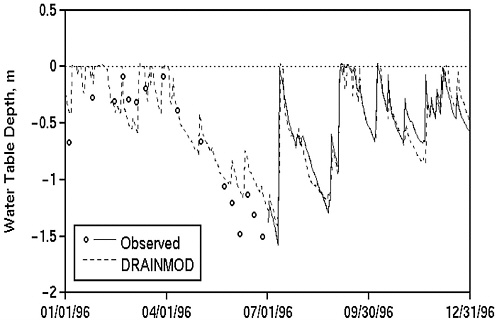
FIGURE 3–1 Comparison between observed and DRAINMOD (hydrological model)-simulated water-table depths for a wetland restoration site in Craven County, N.C., 1996. SOURCE: Tweedy (1998). Reprinted with permission of the author.
to mitigation sites. Short-term monitoring of the reference site could provide the data necessary for model calibration. The calibrated model could then be used to establish hydroperiod relationships based on simulation analyses of long-term climate records.
Constructed, enhanced, or restored wetlands may be particularly vulnerable to external influences because they are still immature and may not have developed resilience to chronic change, catastrophic disturbance, and surrounding population growth and development that bring increased nutrient and contaminant loading and more frequent hydrological changes. For this reason, a site should be able to “evolve” with the landscape over time.
Numerous sites observed by the committee were not positioned in landscape locations that would ensure sustainability. This observation was judged to be due in part to preference of on-site, in-kind mitigation. Some sites were properly located but were threatened by future developments in the watershed, demonstrating that landscape position alone is not sufficient. The problems associated with watershed development include altered hydrology, trash accumulation, and invasive plants and animals. Once a watershed is developed, it may be impossible to provide conditions that are favorable to the mitigation site.
Other external factors that may impinge on the long-term ecological sustainability of a mitigation wetland include deleterious influences of natural pest species (e.g., intense grazing by herbivores such as migratory or resident geese) and large-scale disturbances such as hurricanes, fire, sea-level rise, and climate change (see Box 3–3). The committee recognizes that it is impractical to expect individual permittees to design for and be
|
BOX 3–3 Sea-Level Rise and Wetlands Placement Sea-level rise, caused by both natural processes and increased concentrations of greenhouse gases, threatens the sustainability of coastal wetlands because (1) sea level will continue to increase for the foreseeable future, (2) a large rise in sea level will cause a net loss of wetlands, and (3) coastal development will block the natural inland migration of wetlands (Titus 1999). Global sea-level rise estimates vary dramatically, but 1.8 to 1.9 mm/yr may be a reasonable median rate, including correction for postglacial rebound (Douglas 1995, 1997). Based on current projections of greenhouse gas emission rates, with no future remedial reductions, sea level may rise from 31 to 110 cm by 2100 (IPCC 1990). A 50-cm rise in sea level would involve inundation of 24,000 square kilometers (km2) in the United States (Neumann et al. 2000). The areas most vulnerable to sea-level rise are in the mid- and south-Atlantic states and along the Gulf Coast, where land subsidence is also a concern, although parts of New England, San Francisco Bay, and Puget Sound also are vulnerable (Neumann et al. 2000). For example, it is estimated that 21% (22,000 acres) of Delaware's coastal emergent wetlands would be inundated (MARA Team 2000). Inundation would not be the only threat; storm frequency, intensity, and surge levels also would increase. The contingency of climate change and sea-level rise argues for landscape-scale planning and implementation of wetland restoration, creation and enhancement, and preservation. The consequences of increased temperatures and reduced precipitation may need to be designed into mitigation projects particularly vulnerable to changes in flooding duration and frequency in wetlands such as prairie pothole and peatland wetlands. Drier wetlands, such as depressional, slope, flats, and river and lake fringe wetlands (Brinson 1995), may need additional design features to ensure protection of the proper hydrological regime. Inland migration of coastal emergent marshes, mangroves, forested wetlands, and seagrass and other submergent vegetation systems may need to be accommodated to some extent through, for example, “managed retreat” and reduction of armored shorelines. Strategic restoration of coastal marshes by breaching of dikes and levees may need to be advanced to accommodate an increased tidal prism and coastal erosion in estuaries. Marsh sediment accretion rates must be maintained by the preservation and enhancement of sediment sources and transport patterns and rates. Dams further impair sustainability of downstream wetlands by eliminating sediment transport that could counteract rising sea levels. |
held accountable for such long-term, uncontrollable factors. However, watershed assessment and prioritization provide a framework for identifying and avoiding future high-risk areas for mitigation sites. The contingency of climate change and sea-level rise argues for landscape-scale planning and implementation of wetland creation, restoration, and preservation.
WATERSHED-SCALE PATTERNS OF WETLAND LOSSES
As discussed in Chapter 1, wetland losses have occurred with changes in runoff and erosion due to urbanization and agricultural land uses. Other factors that result in both direct fill/destruction and indirect impacts and wetland losses include channelization, groundwater withdrawal, and flood-control practices.
Losses Due to Urbanization
Urbanization of watersheds is often extensive in headwater regions. In older, built-out urban areas, headwater wetlands and wetlands along first-order streams may have been put into storm sewer networks. This loss of streams and springs is well documented in some regions (e.g., Williams 1977). The loss of wetlands in this context can be evaluated by a comparison of wetlands and their distribution in urban and adjacent nonurban watersheds.
Losses Due to Agricultural Uses
The position of the stream channel head in the landscape is controlled by runoff processes and surface topography (Dietrich et al. 1986). An increase in overland flow tends to move a stream channel upslope because less area is required to initiate the channel head. This upslope migration of stream channels has been documented in agricultural areas and has often resulted in the loss of headwater wetlands and some first-order stream wetlands. Thus, the pattern of wetlands in a watershed often reflects previous land-use practices. For example, channel incision in Wisconsin, Maryland, and Pennsylvania has resulted in significant loss of wetlands in headwater positions and along first-order streams (Prestegaard 1986; Prestegaard and Matherne 1992).
Many wetlands have also been lost due to land drainage for agricultural or other land uses. For examples, sedge meadows, wet prairies, and other wetlands were easily drained for agriculture in central Wisconsin (Curtis 1959), Iowa, and elsewhere in the Midwest (Prince 1997). In this process, unchannelized portions of the landscape are channelized into
existing watersheds, thus extending the stream network. Channelization of downstream portions of these river networks often deepens the existing river channel and destroys adjacent riparian zones and wetlands (Prestegaard et al. 1994). Inadvertent channel network changes have also occurred as a result of agricultural and urban land uses. Increased runoff from agricultural lands has generally caused a headward migration of stream channels in many areas. This leads to incised stream channels in many headwater regions (Costa 1975) and loss of headwater wetlands (McHugh 1989; Prestegaard and Matherne 1992). Thus, channelization practices have led to the loss of both prairie pothole wetlands that were not originally part of watershed systems and riparian wetlands along the original river courses.
Losses Due to Groundwater Withdrawals
Groundwater withdrawals have particularly affected wetlands and riparian zones along higher-order streams in arid and semiarid regions. An example is provided by Stromberg et al. (1996), who demonstrated the effect of groundwater withdrawals on riparian zones and riparian wetlands in arid regions.
Wetland Losses Due to Flood-Control Practices
Wetland losses have also occurred as a result of flood-control practices. For example, levees restrict connections between the river and the adjacent flood plain, affecting riparian wetlands. Levees, reservoirs, and other flood-control structures also serve to modify the timing of flood events, either by minimizing the size or modifying the frequency and duration of flood flows. Infrequent flooding can modify floristic communities in flood-plain areas, often allowing the development of forests in formerly herbaceous wetlands (Bren 1992). The importance of flooding, particularly in large (downstream) river systems, has been emphasized as the flood-pulse concept (Bayley 1995; Bornette and Amoros 1996; Middleton 1999).
A WATERSHED TEMPLATE FOR WETLAND RESTORATION AND CONSERVATION
Several authors have argued for a hydrogeological or hydrogeomorphic template for wetland mitigation and development (Moore and Bellamy 1974; Bedford 1996; 1999). This would suggest compensation projects that would be selected based on set functional priorities of the watershed. In practice, some in-lieu fee programs (see Chapter 4) have
already stated such a watershed orientation for selecting compensation projects (Scodari and Shabman 2000). In addition, a watershed perspective may suggest preservation (Kentula 1999; Winston 1996) as an integral part of maintaining wetland heterogeneity in watersheds.
CONCLUSIONS
-
Watershed organizational structure governs the flow of water and associated nutrients through a watershed, the relationship between hydrological processes and the position of a wetland in the watershed, and the relationship between wetland functions and watershed position.
-
Wetland location and position in the landscape influence surface and subsurface flows of water.
-
Equivalency of hydrological conditions and landscape position with reference systems and impact sites are viewed as important components of wetland restoration and creation.
-
Restored and created wetlands should be self-sustaining; to be self-sustaining, they must be properly sited in the watershed.
-
The position of a wetland in a watershed plays an important role in water-quality function.
-
Dispersal of plants and animals in a watershed is influenced by the proximity and number of wetlands in a geographic area and the functional interdependence of wetlands with other landscape units.
-
Numerous mitigation sites observed by the committee were not positioned in landscape locations that would ensure sustainability.
RECOMMENDATIONS
-
Site selection for wetland conservation and mitigation should be conducted on a watershed scale in order to maintain wetland diversity, connectivity, and appropriate proportions of upland and wetland systems needed to enhance the long-term stability of the wetland and riparian systems. Regional watershed evaluation should greatly enhance the protection of wetlands and/or the creation of wetland corridors that mimic natural distributions of wetlands in the landscape.
-
Riparian wetlands should receive special attention and protection because their value for stream water quality and overall stream health cannot be duplicated in any other landscape position.


