
4
Global Warming as a Possible Trigger for Abrupt Climate Change
The review of possible mechanisms in Chapter 3 showed that in a chaotic system, such as the earth’s climate, an abrupt climate change always could occur. However, existence of a forcing greatly increases the number of possible mechanisms. Furthermore, the more rapid the forcing, the more likely it is that the resulting change will be abrupt on the time scale of human economies or global ecosystems. Although abrupt climate changes have shocked ecosystems and societies over the last few millennia, these climate changes have not been as dramatic as those that occurred during the last ice age. It is probably no coincidence that stability of the climate increased when ice-sheet size and atmospheric carbon dioxide concentration largely leveled off at the end of the ice age.
Greenhouse gases are accumulating in the earth’s atmosphere and causing surface air temperatures and subsurface ocean temperatures to rise. It is now the consensus of the science community that the changes observed over the last several decades are most likely in significant part the result of human activities and that human-induced warming is expected to continue (NRC, 2001). As discussed in Chapters 2 and 3, the abrupt climate changes of the past were especially prominent when orbital processes were forcing the climate to change most rapidly during the cooling into and warming out of the ice age, consistent with the results from modeling that forcing of climate increases the possibility of crossing thresholds that trigger abrupt change (e.g., Boxes 3.1 and 4.1). Given our understanding of the climate
|
Box 4.1 Abrupt Climate Change in the Ancient Hot House About 55 million years ago, the earth underwent an abrupt climate change known as the Late Paleocene Thermal Maximum (LPTM), recently renamed the Paleocene-Eocene Thermal Maximum (PETM) (Kennett and Stott, 1991; Dickens et al., 1995; Dickens, 1999; Norris and Röhl, 1999; Bains et al., 1999). Against the backdrop of an already warm climate with reduced pole-equator temperature contrasts, bottom water temperatures increased by 4-6°C (Thomas and Shackleton, 1996), and high-latitude surface temperatures by 4-8°C, over 10-20 kyr (Norris and Röhl, 1999). Thirty to fifty per cent of benthic foraminifera went extinct (Thomas and Shackleton, 1996). The suite of dramatic global changes inferred for the LPTM includes increased aridity in subtropical latitudes and increased high-latitude precipitation (Robert and Maillot, 1990; Schmitz et al., 2001). At the onset of the LPTM warming, marine and terrestrial carbon isotope values exhibit a negative shift of at least 2.5 per mil (Norris and Röhl, 1999). The only known sources for this quantity and composition of carbon today are the vast reserves of natural gas hydrate in oceanic, deep lake and polar sediments and the free methane gas trapped beneath hydrate deposits. Methane hydrate is a solid complex of methane and water that is stable only at low temperatures and high pressures, such as found in sediment of the mid-depth and deep ocean. The carbon isotope signature during the LPTM is indicative of massive destabilization of marine methane hydrates (Dickens et al., 1995); it is estimated that 1,200-2,000 gigatons of methane gas were released. |
system and of the mechanisms involved in abrupt climate change, this committee concludes that human activities could trigger abrupt climate change. Impacts cannot be predicted because current knowledge is limited, but might include changes in coupled modes of atmospheric-ocean behavior, the occurrence of droughts, and the vigor of thermohaline circulation (THC) in the North Atlantic. More research is needed to better understand the relationship between human influences on climate, especially global warming, and possible abrupt climate change.
CHANGES IN NORTH ATLANTIC THERMOHALINE CIRCULATION
A question of great societal relevance is whether the North Atlantic THC will remain stable under the global warming expected for the next few
|
The cause of the LPTM warming is unknown (Dickens, 1999) but has been speculated to be increased volcanism (Thomas and Shackleton, 1996) or low-latitude deepwater formation (Bains et al., 1999). Recently, Bice and Marotzke (in press) presented results from an ocean general circulation model indicating that a sudden switch of deepwater formation from high southern to high northern latitudes could have led to mid-depth and deep-ocean warming of around 5°C. The switch was caused by a slow increase in the atmospheric water cycle, as expected under increasing temperatures (Manabe and Bryan, 1985; Manabe and Stouffer, 1993), and consistent with LPTM sedimentary evidence (Robert and Maillot, 1990; Schmitz et al., 2001). The mid-depth warming displayed by the model could destabilize large volumes of methane hydrate in the depth range of 1,000-2,000m over much of the world ocean. The THC switch seen in the model of Bice and Marotzke (2001) and the inferred subsequent methane release are an abrupt climate change, according to the definition given in Chapter 1. When the freshwater forcing is reduced to pre-LPTM values, deepwater is again formed in the Southern Hemisphere, with a hysteresis characterized by case (b) in Figure 3.1. The climate during the LPTM may well be a valid past analogue of the greenhouse world expected for the next several centuries (Dickens, 1999), despite the different continental configuration. The results of Bice and Marotzke (2001) indicate more severe potential consequences of a drastic change in THC, as might occur in a future greenhouse world (Manabe and Stouffer, 1993), than previously assumed. |
centuries. A possible shutdown of the THC would not induce a new glacial period, as press reports suggested; however, it clearly would involve massive changes both in the ocean (major circulation regimes, upwelling and sinking regions, distribution of seasonal sea ice, ecological systems, sea level) and in the atmosphere (land-sea temperature contrast, storm paths, hydrological cycle, extreme events). The most pronounced changes are expected in regions that are today most affected by the influence of the North Atlantic THC (e.g., Scandinavia and Greenland).
Current knowledge of the evolution of the THC is summarized in the Third Assessment Report of the Intergovernmental Panel on Climate Change (2001b). Several comprehensive coupled climate models were run with a scenario of increasing greenhouse gas forcing for the next 100 years. Most models show a reduction in the THC in response to the forcing (Plate 7). This is due to enhanced warming of the sea surface in the high latitudes and
a stronger poleward atmospheric transport of moisture, leading to more precipitation in the North Atlantic region. Those two effects, in concert, lead to an increase in buoyancy of the North Atlantic surface waters, which reduces the THC. Although the relative strength of the two mechanisms is debated and uncertain (Dixon et al., 1999; Mikolajewicz and Voss, 2000), most climate models seem to show a general reduction in the Atlantic THC in response to global warming.
The exceptions to this behavior remind us of the inherent uncertainties present in the simulations. It is not clear whether all relevant feedback mechanisms are considered properly in the current generation of climate models and whether their strength is simulated realistically. A simulation by Latif et al. (2000) suggested that changes in the El Niño-Southern Oscillation (ENSO) frequency and amplitude might change the freshwater balance of the tropical Atlantic in such a way that increases in buoyancy in the high latitudes are compensated for by drier (and hence more saline) conditions in the tropics. Gent (2001) reported on a simulation in which evaporation from a warmer sea surface in the North Atlantic is not compensated for by enhanced precipitation, and this simulation results in a stabilization of the THC. While it is not currently possible to decide which simulations are more realistic—those of Plate 7 showing a THC decrease or those that do not—the two simulations by Latif et al. (2000) and Gent (2001) illustrate that the quantitatively correct simulation of heat and freshwater flux changes is essential for the projection of the evolution of the THC under global warming.
However, there are other uncertainties regarding the fate of the THC. Research indicates that the realized warming and the associated changes in the hydrological cycle constitute a threshold for the THC (Manabe and Stouffer, 1993). Also, the rate of warming appears to influence the stability of the circulation (Stocker and Schmittner, 1997; Ahmad et al., 1997), because the ocean heat uptake is limited by mixing; faster warming in the atmosphere produces stronger vertical density gradients in the ocean, which tend to reduce the sinking. Faster warming makes the THC less stable to perturbations. Furthermore, both theoretical arguments (Marotzke, 1996) and model simulations (Tziperman, 1997) suggest that the THC becomes less stable when it is weaker (i.e., once reduced, the THC is more susceptible to perturbations). In the extreme case very close to a threshold, the evolution of the THC loses predictability altogether (Knutti and Stocker, 2001) (Figure 4.1) as discussed in the next section. It is intriguing that recent measurements show that an important part of the North Atlantic
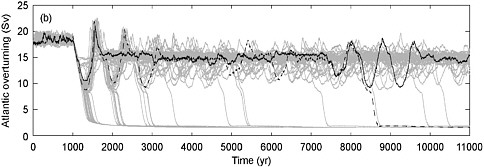
FIGURE 4.1 Evolution of the maximum overturning in the Atlantic (strength of the thermohaline circulation [THC]) for a coupled model of reduced complexity for 100 realizations of the model. Radiative forcing is increased from years 1000 to 1140, equivalent to a doubling of CO2, and then held constant. The warming pushes the model closer to the bifurcation point, and transitions usually occur when the overturning is weakened. Two individual realizations are highlighted by the black lines (Knutti and Stocker, 2001).
THC (the Faroe Bank overflow from the Nordic Seas; Hansen et al., 2001b) has experienced both a reduction in total flow and a warming and freshening over the last 50 years, consistent with many model projections. However, the entire THC is not monitored. This highlights the importance of maintaining and increasing measurements and data-model comparisons that capture the behavior of the entire system.
LIMITED PREDICTABILITY CLOSE TO AN INSTABILITY
Possible instabilities of the THC also have important implications for the predictability of future climate change. Model simulations show that as an instability is approached, small deviations in initial or boundary conditions can determine whether a transition to a different equilibrium will occur, which inherently limits predictability. This behavior has been investigated with a climate model of reduced complexity (Knutti and Stocker, 2001). The threshold is approached by a prescribed global warming over about 140 years, equivalent to a doubling of carbon dioxide. Small random fluctuations, as produced by atmospheric disturbances at the ocean surface, can excite large changes in the THC when the system is close to a threshold (Figure 4.1). Many experiments with the same model but slightly different initial conditions (Monte Carlo simulations) indicate that the North Atlan
tic THC can undergo many oscillations before it settles in an active or a collapsed state. In some cases, a rapid collapse of the THC occurs many thousands of years after the perturbation. Obviously, beyond the problem of approaching an instability point and the increased vulnerability of the THC to further perturbation, such an evolution results in a much more unpredictable climate system (Figure 4.1).
These simulations are performed with a simplified model that includes only a limited set of processes. Experiments with comprehensive models are necessary to determine whether more realistic models exhibit similar behavior close to bifurcation points. In such models it would be crucial to identify whether there are regions or components in the climate system that could serve as early warning systems for a potential THC reduction or shutdown.
CHANGES IN NATURAL MODES OF THE ATMOSPHERE-OCEAN SYSTEM
Data suggest that there has been an increase in the frequency of occurrence of El Niño conditions and a possible change in characteristic time scales of this phenomenon (e.g., Urban et al., 2000; Tudhope et al., 2001; see Chapter 2). However, the time series is too short to establish whether such rapid mode shifts are part of the natural, long-term variability inherent in this phenomenon or whether this is already a manifestation of a perturbed system. It has been suggested that this change in mode may be a response of the tropical Pacific to anthropogenic warming (Trenberth and Hoar, 1996).
Comprehensive climate models have just started to include credible representations of ENSO, which makes available tools to investigate the possible responses of the tropical Pacific atmosphere-ocean system to climate change. One model suggests that warming will cause El Niño events to become more frequent and stronger (Timmermann et al., 1999). Apart from regional implications, such a development could have far-reaching impact on other components of the climate system. For example, ENSO causes worldwide teleconnections, and it changes the freshwater balance of other ocean provinces (such as the tropical Atlantic). This provides a mechanism to modify the sea-surface salinity and hence the THC (Latif et al., 2000). Changes in the frequency and amplitudes of natural modes might not only evolve rapidly and thus manifest themselves as abrupt climate change, but they may also trigger other processes that lead to abrupt climate change.
As discussed in Chapter 2, strong trends have been occurring in the
North Atlantic Oscillation/Arctic Oscillation (NAO/AO). Among many possible causes, Shindell et al. (1999) suggested that these trends are a response to greenhouse-gas-induced warming. Large impacts could result from continuation and strengthening of such trends, perhaps leading toward a locking of the system in one of the preferred patterns (Palmer, 1999; Corti et al., 1999). Feedbacks on the THC have received the most attention (see below); other complex questions, including linkages with ENSO and other modes, merit greater attention in the future.
Most hypotheses with respect to possible abrupt changes in natural modes are based on but a few model experiments. Some of the models still have known biases (e.g., with respect to ENSO frequency). Nevertheless, such simulations indicate that changes in natural modes are a possibility when climatic conditions change.
Oceanic circulation modes may also experience major changes with greenhouse warming. Alteration of the THC thus can involve changes in structure in addition to a simple decrease or increase in amplitude. The present North Atlantic circulation involves two important modes of THC: the deep overflow branch originating in the Greenland-Iceland-Norwegian-Barents Seas, and the rapidly responding middle-depth THC driven by convection in the Labrador Sea (Plate 4). Wood et al. (1999), using a climate model with no flux corrections, suggested that greenhouse warming of the Nordic Seas between Greenland and Norway will cause reduction in density of the deep overflows. As they move south of Greenland they then will fail to circulate westward as boundary currents into the Labrador Sea. This, in turn, promotes a collapse of Labrador Sea deep convection, which is the primary driver of intermediate-depth THC (Häkkinen, 1999). The paleoclimatic record based on benthic and planktonic foraminifera (Hillaire-Marcel et al., 2001) suggests that Labrador Sea convection might indeed have been shut down for long periods during the previous interglacial warm period. This ironic scenario shows how the two modes of THC can interact, and in this case alter the balance in favor of the overflow mode.
POSSIBLE FUTURE ABRUPT CHANGES IN THE HYDROLOGICAL CYCLE
One of the most striking predictions of climate models and theory is that global warming will put more moisture into the atmosphere in the tropics and generally accelerate freshwater transport to higher latitudes. Melting of land-fast ice, sea ice, and permafrost and biological or geological
changes in drainage basins might provide extra abruptness to the freshwater cycle. Increasing precipitation and streamflow has been documented in North America. During the twentieth century, the zone 30°N to 85°N has experienced a 7-12 percent increase (Intergovernmental Panel on Climate Change, 2001a); this is the region critical to the Arctic and Atlantic Oceans. In 1998, the region north of 55°N was the wettest on record; and in the middle northern latitudes, precipitation has exceeded the 1961-1990 mean every year since 1995.
In global-warming scenarios, the GFDL coupled-climate model suffers a major decrease in THC amplitude owing to the resulting load of buoyant freshwater on top of the far northern Atlantic. The increase in precipitation minus evaporation (plus runoff from land) north of 45°N is nearly 50 percent under doubled carbon dioxide (Manabe and Stouffer, 1994). In other climate models, the freshening of the surface ocean is less strong, but high-latitude warming has the same effect. Adequate observations to establish crucial rates of the freshwater cycle are not being carried out.
One of the most important issues is the possibility of increase in extreme events related to land-surface hydrology. As summarized in Intergovernmental Panel on Climate Change (2001b), model projections of global warming find increased global precipitation, increased variability in precipitation, and summertime drying in many continental interiors, including “grain belt” regions. Such changes might produce more floods and more droughts. On the basis of the inference from the paleoclimatic record, it is possible that the projected changes will occur not through gradual evolution proportional to greenhouse-gas concentrations, but through abrupt and persistent regime shifts affecting subcontinental or larger regions. The inability to conduct long simulations with coupled models validated against paleoclimatic records, owing to resource limitations, leaves many uncertainties.
ICE SHEET CHANGES
Shrinkage or disappearance of all or part of a large ice sheet in response to natural or human-caused forcing remains a poorly quantified possibility. Changes in the balance between snowfall and melting at the ice-sheet surface might be important in the future (e.g., Intergovernmental Panel on Climate Change, 2001b), but attention is focused on changes in ice flow because they might affect sea level more rapidly and probably will be more difficult to predict.
The Heinrich layers in North Atlantic sediment indicate that rapid changes in flow of one of the ice-age ice sheets have delivered large quantities of icebergs to the ocean, perhaps over centuries and with substantial effect on sea level. Among the modern ice sheets, attention is focused, although not exclusively, on the West Antarctic ice sheet because its bed is in many places below sea level, well lubricated, and deeper toward the center of the ice sheet. These characteristics allow the possibility of West Antarctic flow instabilities (Weertman, 1974; Oppenheimer, 1998; Alley and Bindschadler, 2000). A sea-level change of about 5 m (from the West Antarctic ice sheet alone) (Plate 8) to perhaps more than 10 m (including response of the East Antarctic ice sheet to loss of the West Antarctic ice) in a few centuries may be possible, even if unlikely (Intergovernmental Panel on Climate Change, 2001b).
No prediction of change is yet available, and large uncertainties are attached to possible rates and magnitudes of change. Sedimentary evidence from beneath the West Antarctic ice sheet indicates that the ice sheet shrank substantially or disappeared at least once after it formed, although at an unknown rate (Scherer et al., 1998). The current, locally rapid changes in the West Antarctic ice sheet are difficult to explain, but the average change across the ice sheet is small (Alley and Bindschadler, 2000). Modeled behavior includes the possibility of large and rapid ice-sheet changes (MacAyeal, 1992), but behavior in other models is more stable (Hulbe and Payne, 2001). The major southern sites of formation of oceanic deep-waters are close to the West Antarctic ice sheet, and deep-water formation involves interaction with floating extensions of the ice sheet called ice shelves (e.g., Schlosser et al., 1994). The freshwater delivery of Heinrich events to the North Atlantic was associated with greatly reduced formation of deep-water in the vicinity and very large climate anomalies well beyond the region of freshwater supply (Broecker, 1994). Thus, any large changes in the ice sheets could affect many aspects of climate in addition to sea level (Plate 8).
OUTLOOK
If the increase in atmospheric greenhouse gas concentration leads to a collapse of the Atlantic THC, the result will not be global cooling. However, there might be regional cooling over and around the North Atlantic, relative to a hypothetical global-warming scenario with unchanged THC. By itself, this reduced warming might not be detrimental. However, we
cannot rule out the possibility of net cooling over the North Atlantic if the THC decrease is very fast. Such rapid cooling would exert a large strain on natural and societal systems. The probability of this occurring is unknown but presumably much smaller than that of any of the more gradual scenarios included in the Intergovernmental Panel on Climate Change report (Plate 7). The probability is not, however, zero. Obtaining rational estimates of the probability of such a low-probability/high-impact event is crucial. It is worth remembering that models such as those used in the Intergovernmental Panel on Climate Change report consistently underestimate the size and extent of anomalies associated with past changes of the THC; if the underestimate results from lack of model sensitivity possibly linked to overly coarse resolution or other shortcomings rather than from improper specification of forcing, future climate anomalies could be surprisingly large.
Even if no net cooling results from a substantial, abrupt change in the Atlantic THC, the changes in water properties and regional circulation are expected to be large, with possibly large effects on ecosystems, fisheries, and sea level. There are no credible scenarios of these consequences, largely because the models showing abrupt change in the THC have too crude spatial resolution to be used in regional analyses. To develop these scenarios would require the combination of physical and biological models to investigate the effects on ecosystems, and the “nesting” of large-scale and coastal models to investigate sea-level change.
If we are to develop the ability to predict changes in the THC, we must observe its strength and structure as a fundamental requirement, akin to the necessity to observe the equatorial Pacific if one wants to forecast El Niño. So far, however, no observational network exists to observe the THC on a continuous basis. We also need to learn more about which upstream processes and regions are the source of the observed changes in the THC. Present-day observations show substantial decadal changes in the temperature of the warm Atlantic currents flowing toward the Arctic Ocean and in the outflows of freshwater and ice from the Arctic Ocean (e.g., Dickson et al., 2000). Both have been observed to affect the characteristics of the cold deep overflows that cross the Greenland-Scotland Ridge southward to drive the THC (e.g., Hansen et al., 2001b). Systematic, long-term observations of the fluxes influencing the THC are needed. Moreover, remote influences on the THC must be monitored, in particular the low-latitude atmospheric water-vapor transport from the Atlantic to the Pacific and the influence of Southern Ocean changes.
Meltwater from the Greenland ice sheet and glaciers and permafrost
also feed into source regions of the THC. Changes in any of these fluxes could contribute to THC changes. The result from Cuffey and Marshall (2000) that modest warming above recent conditions during the previous interglacial led to major shrinkage of the Greenland ice sheet suggests that large changes in Greenland are likely in the future. Changes in river and groundwater discharge are similarly important.
Arctic sea-ice volume appears to have shrunk dramatically in recent decades (Vinnikov et al., 1999; Johannessen et al., 1999; Rothrock et al., 1999). The influence of that decline on the freshwater budget of the Atlantic THC is unknown but could be critical. It is crucial to know the net freshwater flux from the Arctic Ocean to the Nordic Seas, in the form of both sea ice and low-salinity surface water. The sea ice emerging from Fram Strait is thought to influence convection in the Greenland Sea and, after being transported through the Denmark Strait in the East Greenland Current, in the Labrador Sea. Indeed, sea ice from the Arctic could be the origin of such events as the Great Salinity Anomaly that have been documented in the North Atlantic (Dickson et al., 1988; Häkkinen, 1993). Given the importance of freshwater forcing for the stability of the THC, such events might presage change in the circulation. However, even if melting Arctic sea ice does not markedly influence the THC, sea-ice disappearance is likely to have radical consequences for Arctic ecosystems and possibly regional climate. It is not now possible to quantify such possibilities.


