
Page 185
12
Chemicals from Plants
John W. Frost, K.M. Draths, David R. Knop, Mason K. Harrup, Jessica L. Barker, and Wei Niu
Michigan State University
Virtually all pseudo commodity and commodity chemicals as well as most fine chemicals are synthesized from petroleum feedstocks. It has been estimated that 98% of all chemicals produced in the United States in excess of 2 × 10⁷ kg are synthesized from petroleum and natural gas. 1 By contrast, chemicals isolated as natural products from plants or produced by microbes from carbohydrate feedstocks are typically restricted to ultrafine chemicals and a relatively few fine chemicals. The goal of our research effort is to ascertain how the widest possible spectrum of commodity, pseudo commodity, fine, and ultrafine chemicals can be synthesized from polyol starting materials such as d-glucose, d-xylose, l-arabinose, and glycerol. These starting materials, in turn, are derived from renewable feedstocks derived from plants such as starch, hemicellulose, cellulose, and oils. A key feature of these conversions is the use of recombinant microbes as synthetic catalysts.
The implications of switching chemical manufacture from its current reliance on nonrenewable fossil fuel feedstocks to utilization of renewable, plant-derived feedstocks is considerable. The U.S. chemical industry currently uses 5 quads (1 quad = 1 × 10¹⁵ British thermal units) of carbon for manufacture of organic chemicals. 2 If these 5 quads of carbon were derived from renewable feedstocks, a net consumption of CO2 would be realized, given that the polyols used as starting materials are biosynthesized by plants from CO2 and are essentially immobilized forms of CO2. Since international treaties eventually require reductions in CO2 emissions in the United States, large-scale consumption of CO2 to make chemicals may be used as a credit to offset CO2 emissions resulting from combustion of fossil fuels to generate electricity and combustion of petroleum-based transportation fuels.
Synthesis of chemicals from CO2-derived feedstocks requires that an understanding be developed of the factors that influence the yield and titer of chemicals that are microbially synthesized from polyol starting materials. Effective interfacing of microbial catalysis with chemical catalysis is also critical to being able to synthesize the widest possible spectrum of chemicals from renewable polyols. Finally, the diversity of molecules that can be microbially synthesized from polyols is ultimately dependent on the diversity of microbes, biosynthetic pathways, and genes encoding biosynthetic enzymes that are available to synthetic chemistry.
Page 186
YIELD AND TITER CONSIDERATIONS
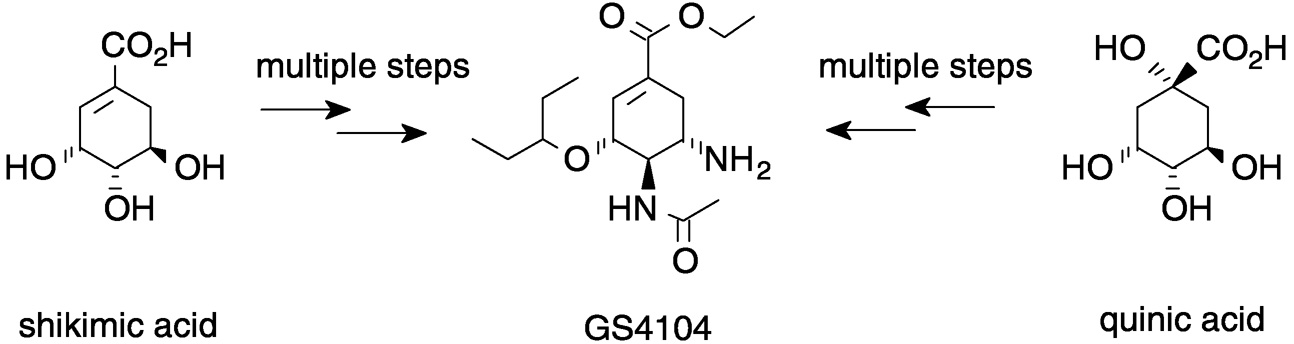
GS4104 is a neuraminidase inhibitor that is effective as an anti-influenza drug. 3 Currently marketed by Roche as Tamiflu, the key problem with the synthesis of this drug was the availability of the hydroaromatic starting material. Shikimic acid is an obvious candidate as a starting material; it is a cyclohexene carboxylic acid possessing the appropriate asymmetric centers. However, only limited quantities of shikimic acid were available because its isolation from the seeds of Illicium plants is expensive. 4 The unfavorable price and limited availability of shikimic acid have been major impediments to its use by chemists as a chiral synthon. Quinic acid, which is isolated from Cinchona bark, 4 is less expensive and more available. This hydroaromatic has been widely employed by chemists as a chiral synthon, 5 although considerably more steps are required to convert quinic acid into GS4104 ( Figure 12.1) relative to the use of shikimic acid as starting material. 3 The scarcity and expense of shikimic acid are similar to those of numerous natural products that are important pharmaceutical building blocks because they too have to be isolated from plants whose cultivation does not benefit from large-scale monoculture.
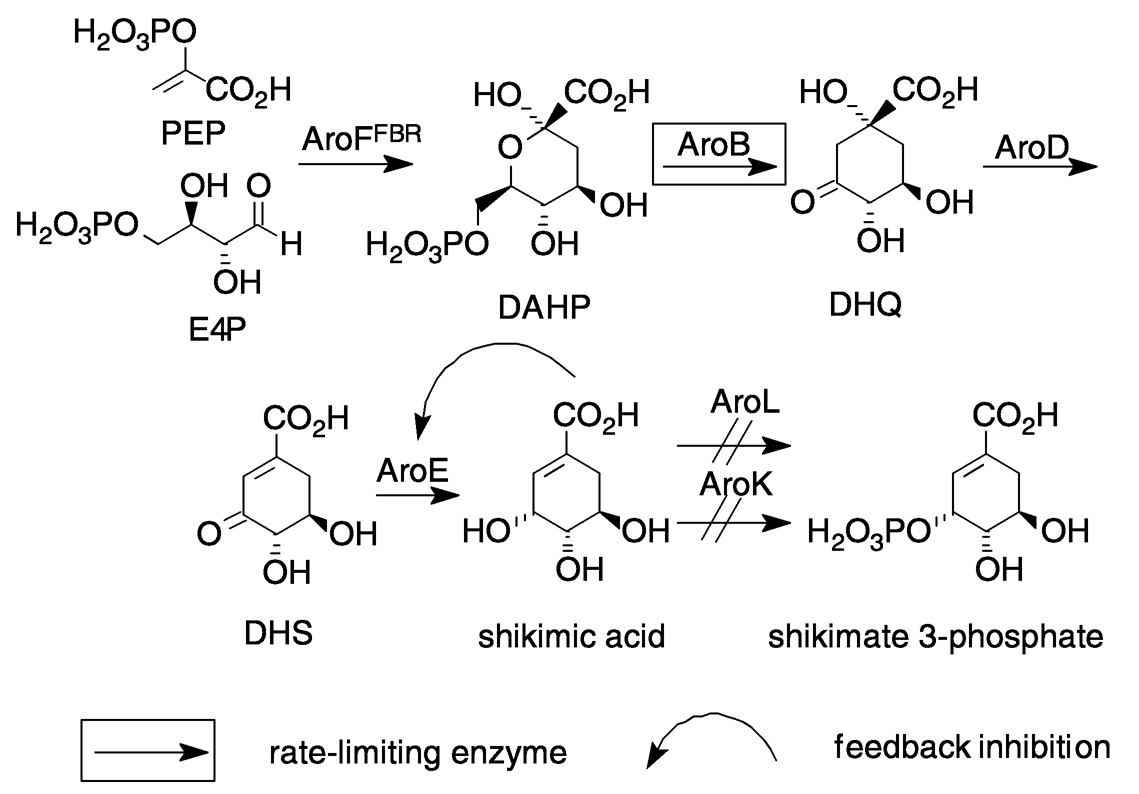
Our task was to design and construct a microbe that would synthesize shikimic acid. 6 Escherichia coli was selected as the starting point for construction of a shikimate-synthesizing biocatalyst. Shikimic acid is an intermediate in the common pathway of aromatic amino acid biosynthesis ( Figure 12.2), which begins with the condensation of phosphoenolpyruvic acid with d-erythrose 4-phosphate catalyzed by 3-deoxy-d-arabino-heptulosonic acid 7-phosphate (DAHP, Figure 12.2) synthase. DAHP is then cyclized to 3-dehydroquinic acid (DHA) by aroB-encoded 3-dehydroquinate synthase. Dehydration of 3-dehydroquinic acid catalyzed by aroD-encoded 3-dehydroquinate dehydratase is followed by the reduction of the resulting 3-dehydroshikimic acid (DHS) to the desired shikimic acid by aroE-encoded shikimate dehydrogenase. To prevent the conversion of shikimic acid into shikimate 3-phosphate, both isozymes of shikimate kinase were inactivated by transduction using P1 phage of aroL478::Tn10 and aroK17::CmR. The next task was to increase the flow of carbon down the common pathway. This was accomplished by plasmid localization of a mutated isozyme of DAHP synthase encoded by aroFFBR that is insensitive to feedback inhibition by aromatic amino acids. By blocking the conversion of shikimic acid into shikimate 3-phosphate, de novo biosynthesis of aromatic amino acid is blocked. 1-Phenylalanine, 1-tyrosine, 1-tryptophan, and aromatic vitamins must be added to cultures to enable the microbial construct to grow, but they inhibit DAHP synthase activity and thus the flow of carbon into the common pathway. Employment of aroFFBR and the encoded DAHP synthase that is insensitive to feedback inhibition is thus critical to directing increased carbon flow into aromatic amino acid biosynthesis. 6
Individual common pathway enzymes become impediments to increased carbon flow due to their inability to convert substrate into product at a rate sufficiently rapid to avoid cytoplasmic accumulation and subsequent export of the substrate into the culture medium. 7 3-Dehydroquinate synthase and shikimate dehydrogenase are both impediments to increased carbon flow that result, respectively, in accumu-
~ enlarge ~
FIGURE 12.1 Starting materials for the synthesis of the neuraminidase inhibtor GS4104.
Page 187
~ enlarge ~
FIGURE 12.2 Shikimic acid biosynthesis.
lation of 3-deoxy-d-arabino-heptulosonic acid (DAH) and 3-dehydroshikimic acid (DHS in Figure 12.2). 7 These accumulating metabolites reduce the yield and titer of the desired shikimic acid and introduce contaminants that require additional purification of product shikimic acid. Accumulation of DAH is eliminated by site-specific insertion of a second aroB locus encoding DAHP synthase into the genomic serA locus. 7b The resulting increase in the specific activity of 3-dehydroquinate synthase eliminates DAH accumulation. Accumulation of 3-dehydroshikimic acid results from feedback inhibition of aroE-encoded shikimate dehydrogenase by shikimic acid. 7a A portion of this inhibition can be circumvented by the increase in shikimate dehydrogenase-specific activity attendant with plasmid localization of aroE. Site-specific insertion of aroB into the genomic serA locus also provides for plasmid maintenance. The only way the final shikimate-synthesizing construct can grow in minimal salts medium lacking l-serine supplementation is to retain the plasmid encoding the serA locus along with the aroE and aroFFBR loci.
The E. coli SP1.1/pKD12.112 construct incorporating all of the aforementioned genetic elements was cultivated under batch-fed fermentor conditions at 33°C, pH 7, and with dissolved O2 maintained at 10% of air saturation. Under these conditions, E. coli SP1.1/pKD12.112 synthesized 20.2 g/L of shikimic acid in 14% yield. 6 Although 1.9 g/L of quinic acid was produced, this amount was sufficiently low that it could easily be removed by recrystallization. To put the yield of shikimic acid achieved thus far into perspective, it is important to note that besides the in vivo activity of DAHP synthase, carbon flow directed into the common pathway is also dictated by the availability of d-erythrose 4-phosphate and phosphoenolpyruvic acid. By improving the availability of these substrates, the theoretical maximum yield for E. coli-catalyzed synthesis of shikimic acid from glucose is 86%. 8 Achieving such yields would likely move shikimic acid from the realm of a scarce natural product used as a chiral synthon to the realm of an inexpensive building block chemical possessed of disposable chirality and an attractive assemblage of carbon atoms.
INTERFACING AND BIOCATALYSIS
Although shikimic acid and quinic acid are certainly not large-volume chemicals, these hydroaromatics provide an intriguing entry point into large-volume fine chemicals and pseudocommodity chemi-
Page 188
cals. Early syntheses of a number of chemicals employed hydroaromatic starting materials. For example, Woskresensky reported that hydroquinone was produced upon “dry distillation” of quinic acid in 1838. 9 The “quin” root of hydroquinone reflects this genesis. Eykmann reported in 1891 that refluxing concentrated HCl solutions of shikimic acid resulted in the formation of p-hydroxybenzoic acid. 10 With microbe-catalyzed conversions of glucose into shikimic acid and quinic acid, the opportunity presents itself to synthesize hydroquinone and p-hydroxybenzoic acid from glucose.
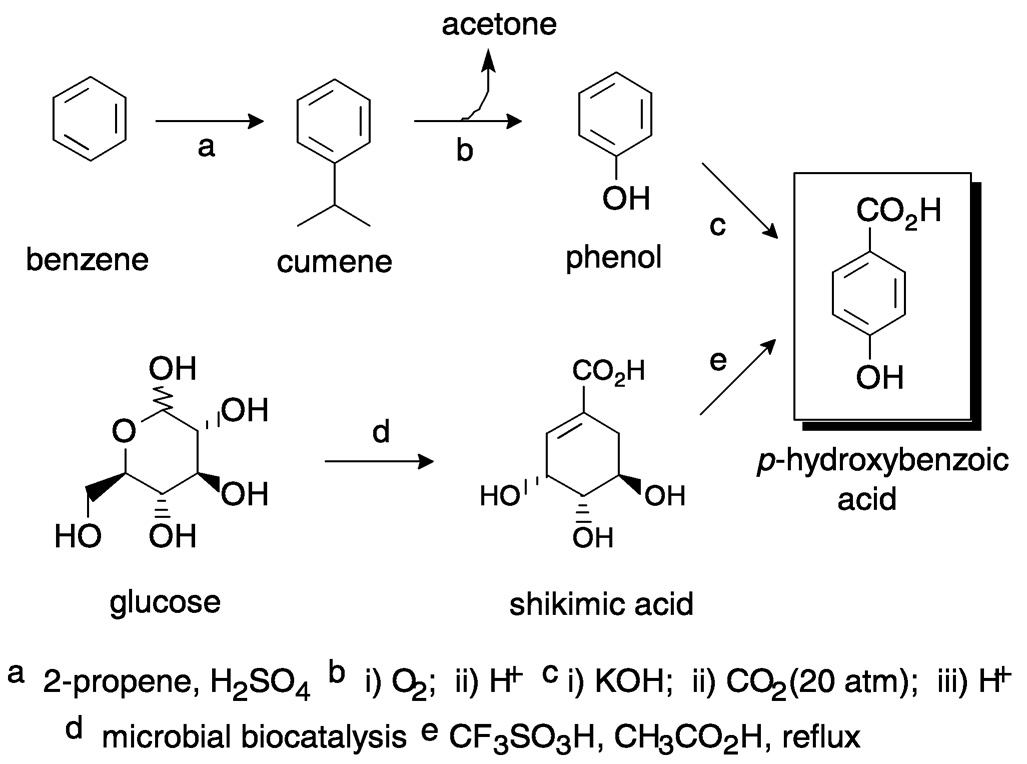
p-Hydroxybenzoic acid ($4/kg) is a fine chemical used in the manufacture of dyes, pharmaceuticals, and pesticides. Methyl, ethyl, propyl, and butyl p-hydroxybenzoate (known as parabens) are antimicrobial agents found in food, pharmaceutical, and cosmetic applications. 11 Estimates of the market volume for p-hydroxybenzoic acid are difficult to find, although use of parabens is estimated at 1.4 × 10⁶ kg/per year. 12 An emerging market for p-hydroxybenzoic acid is as a component of liquid crystalline polymers such as Xydar and Vectra. 13 p-Hydroxybenzoic acid is manufactured by Kolbe-Schmitt reaction ( Figure 12.3, top) of dried potassium phenoxide with 20 atmosphere (atm) dry carbon dioxide at 180-250°C. 14, 15 Product potassium p-hydroxybenzoate is converted to its free acid upon addition of mineral acid. The Kolbe-Schmitt reaction is more typically associated with manufacture of salicylic acid (o-hydroxybenzoic acid), which produces p-hydroxybenzoic acid as a by-product. However, thermal rearrangement of the potassium salt of salicylic acid above 150°C leads to predominant formation of p-hydroxybenzoic acid.
A variety of different acids were examined as catalysts for the dehydration of shikimic acid to p-hydroxybenzoic acid. The best yields for conversion of shikimic acid into p-hydroxybenzoic acid were obtained using trifluoromethanesulfonic (CF3SO3H) as the acid catalyst and acetic acid (CH3CO2H) as the reaction solvent ( Figure 12.3, bottom). With this dehydration, a route for synthesis of p-hydroxybenzoic acid from glucose is established. The utility of employing both biocatalysis and chemical catalysis becomes apparent upon consideration of an entirely microbe-catalyzed conversion of glucose into p-hydroxybenzoic acid. Such a biocatalytic route has the advantage that p-hydroxybenzoic acid is synthesized directly. However, one important disadvantage of this strategy is that p-hydroxybenzoic acid is toxic to microbes. Although the toxicity of p-hydroxybenzoic acid toward microbes is signifi-
~ enlarge ~
FIGURE 12.3 Synthetic routes to p-hydroxybenzoic acid: top: chemical synthesis; bottom: combined microbial and chemical synthesis.
Page 189
cantly lower than the microbial toxicity of parabens, it is sufficient to impose a limit on the titer and yield of p-hydroxybenzoic acid synthesized by a microbe directly from glucose. Shikimic acid, in contrast to p-hydroxybenzoic acid, is not toxic to microbes.
Despite the promise of synthesizing p-hydroxybenzoic acid by chemical dehydration of microbially synthesized shikimic acid, there are a number of significant hurdles that have to be surmounted. The yield of p-hydroxybenzoic acid obtained from shikimic acid using CF3SO3H as the dehydration catalyst was 75%. In all of the acid-catalyzed dehydrations of shikimic acid, by-products were formed that proved to be difficult to remove without significant loss of product p-hydroxybenzoic acid. Dehydration of shikimic acid required the use of acetic acid as the reaction solvent to avoid the high concentrations of mineral acid (8-12 M) that would be required to catalyze dehydration of shikimic acid in aqueous solution. Acid-catalyzed dehydrations also had to be carried out with purified shikimic acid. Attempts to convert shikimic acid in clarified fermentor broth failed to produce significant yields of p-hydroxybenzoic acid, thus necessitating that shikimic acid be isolated from the fermentor broth prior to its acidcatalyzed dehydration. Additional product loss was encountered during purification of p-hydroxybenzoic acid from acid-catalyzed dehydration of shikimic acid. Combining the yield for microbe-catalyzed conversion of glucose into shikimic acid (14%), the percent recovery of shikimic acid from fermentor broth (86%), and the yield for acid-catalyzed dehydration of shikimic acid after product purification (50%), the overall yield for converting glucose into p-hydroxybenzoic acid is 6%. For comparison, the typical range of yields our group has achieved for direct microbe-catalyzed conversion of glucose into p-hydroxybenzoic acid is 4-13%.
In any multistep synthesis of a chemical product, even relatively small incremental losses in yield in individual reactions, isolations, or purifications have a cumulatively large impact on lowering overall yield. The loss of shikimic acid during isolation from fermentation broth, the crude yield for acidcatalyzed dehydration of shikimic acid, and the loss of p-hydroxybenzoic acid during product purification reduce the overall yield of p-hydroxybenzoic acid synthesized from glucose. Indeed, the overall yield for synthesis of p-hydroxybenzoic acid via acid-catalyzed dehydration of shikimic acid is reduced to the point where this route does not have an advantage in yield relative to direct, microbe-catalyzed conversion of glucose into p-hydroxybenzoic acid. However, significant improvements in the yield of microbe-catalyzed synthesis of shikimic acid can likely be achieved. Homogeneous or heterogeneous, shape-selective acid catalysts that are compatible with use in water at elevated temperatures also need to be elaborated. The availability of such catalysts could improve the yield for conversion of shikimic acid into p-hydroxybenzoic acid, reduce the generation of difficult-to-purify by-products, and avoid the need to use CH3CO2H as the reaction solvent.
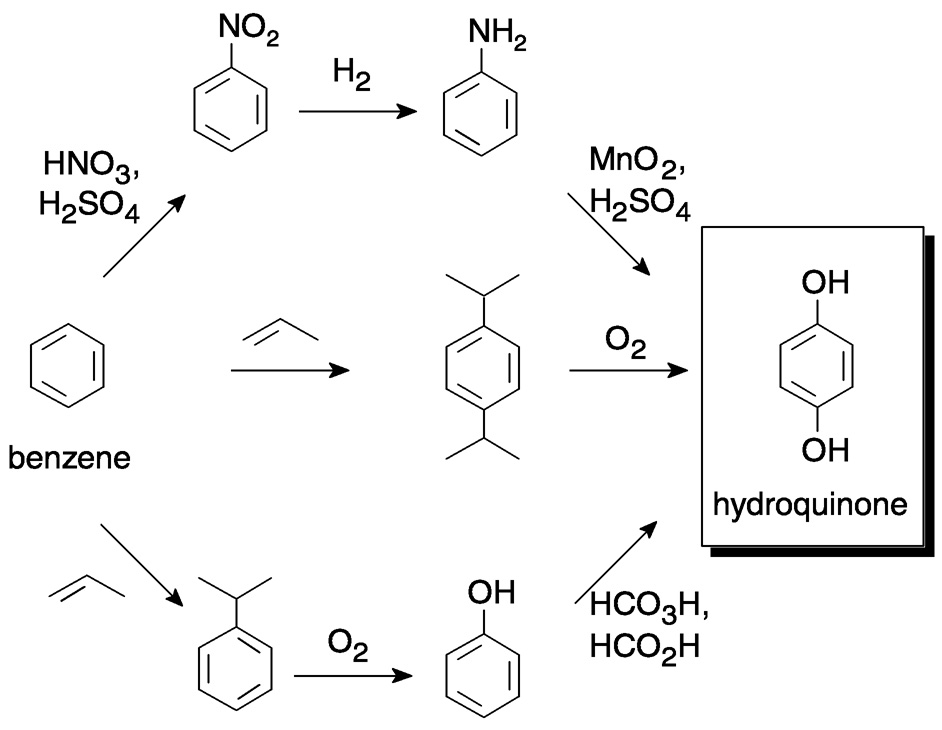
Hydroquinone is a pseudocommodity chemical ($5/kg) produced globally at volumes of 4.5-5.0 × 10⁷ kg per year. 16 The major use of hydroquinone is as a photographic developer. Hydroquinone is also employed as a precursor to antioxidants used in rubber and food applications as well as an intermediate in dye manufacture. Oxidation of aniline is the oldest process ( Figure 12.4, top) for hydroquinone production and accounts for a relatively modest percentage of global hydroquinone synthesis (approximately 4 × 10⁶ kg/per year). 16 Aniline is initially oxidized by manganese dioxide (MnO2) in aqueous sulfuric acid (H2SO4). Benzoquinone is then reduced by Fe0 or hydrogenated to afford product hydroquinone. This manufacturing technique generates large quantities of manganese sulfate (MnSO4), ammonium sulfate ((NH4)2SO4), and iron oxide salts. 16, 17
Hydroperoxidative synthesis 16, 17 ( Figure 12.4, middle) accounts for approximately 2.5 × 10⁷ kg of hydroquinone production per year. p-Diisopropylbenzene is synthesized by zeolite-catalyzed Friedel-Crafts reaction of benzene or cumene with propylene or isopropanol. Air oxidation of p-diisopropylbenzene proceeds at 90-100°C in an aqueous NaOH solution containing organic bases along with cobalt
Page 190
~ enlarge ~
FIGURE 12.4 Hydroquinone synthesis.
or copper salts. Hydroperoxycarbinol and dicarbinol are produced along with the dihydroperoxide during air oxidation. Treatment with acid and H2O2 converts the hydroperoxycarbinol and dicarbinol to the dihydroperoxide, which is cleaved to form acetone and hydroquinone. During the acidic cleavage, explosive organic peroxides can form that present a safety hazard. 16
Reaction of phenol with hydrogen peroxide (H2O2) in the presence of strong acids leads to a mixture of hydroquinone and catechol ( Figure 12.4, bottom). 16, 17, 18 This hydroxylation process accounts for approximately 1.4 × 10⁷ kg of hydroquinone production per year. The ratio of hydroquinone to catechol is controlled to a finite extent by the acidity of the catalyst. ZSM zeolites, an aluminosilicate zeolite with high silica and low aluminum content, such as TS-1 are also used as the acid catalyst. 16
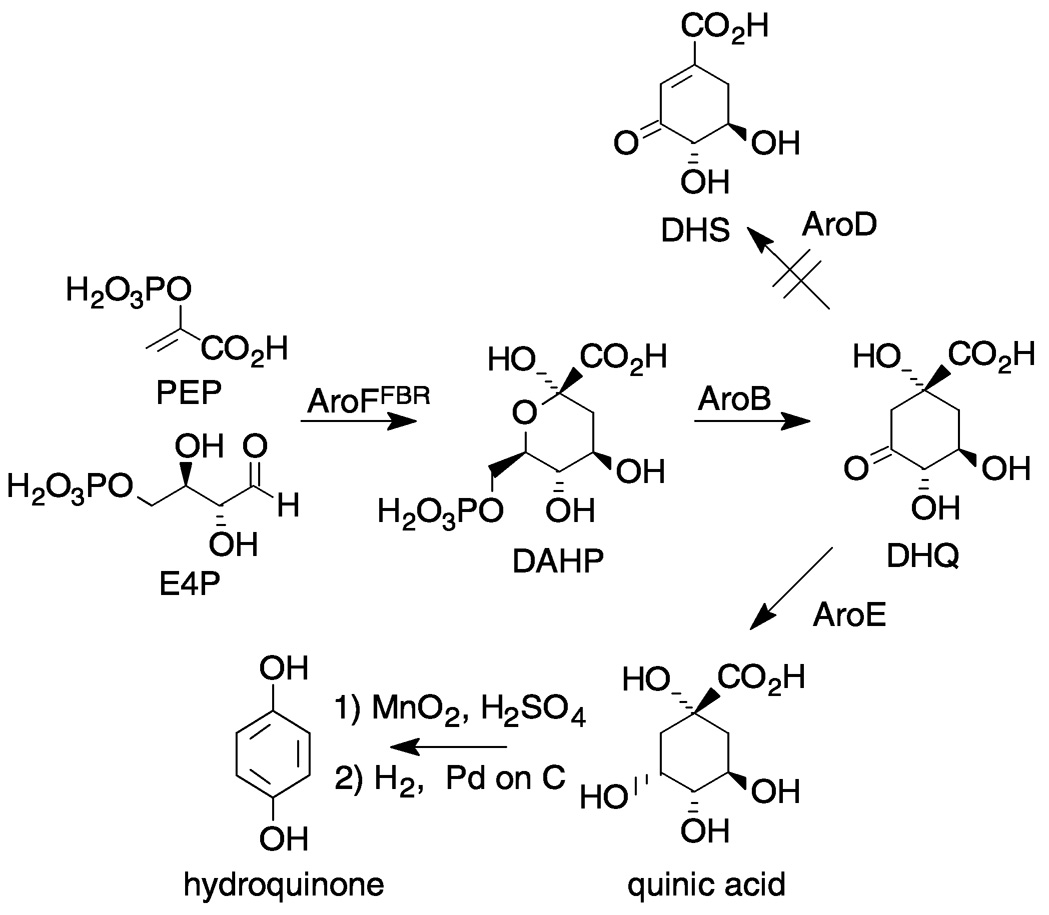
Observations made during synthesis of shikimic acid provided an avenue for elaborating a microbial synthesis of quinic acid ( Figure 12.5) that would be appropriate for conversion of glucose into hydroquinone. Along these lines, E. coli QP1.1/pKD12.112 was constructed. 6 Host strain QP1.1 was derived by homologous recombination of aroB flanked by serA sequences into the genomic serA locus of E. coli AB2848. As with E. coli SP1.1, this insertion increases 3-dehydroquinate synthase activity and, by disruption of the serA locus, provides a method for maintenance of plasmids containing serA inserts. E. coli QP1.1 carries a mutation in the aroD locus, which renders 3-dehydroquinate dehydratase catalytically inactive. Carbon flow directed into the common pathway of aromatic amino acid biosynthesis can thus not proceed beyond 3-dehydroquinic acid ( Figure 12.5). Transformation of E. coli QP1.1 with the same plasmid used to construct E. coli SP1.1/pKD12.112 leads to E. coli QP1.1/pKD12.112. Instead of catalyzing the reduction of 3-dehydroshikimic acid to shikimic acid as it does in E. coli SP1.1/pKD12.112, aroE-encoded shikimate dehydrogenase catalyzes ( Figure 12.5) the reduction of 3-dehydroquinic acid to quinic acid in E. coli QP1.1/pKD12.112. Cultivating E. coli SP1.1/pKD12.112 under glucose-limited, batch-fed fermentor conditions at 33°C, pH 7, and with dissolved O2 maintained at 10% of air saturation led, in 60 hours, to the synthesis of 60 g/L of quinic acid in 23% yield. 6 The only by-product that accumulates along with product quinic acid is a relatively small concentration (2.6 g/L) of 3-dehdyroquinic acid.
Although it is theoretically possible to convert glucose into hydroquinone, the fundamental problem with such a route is the toxicity of hydroquinone toward microbes, which is significantly greater than that of p-hydroxybenzoic acid. Conversion of glucose into quinic acid and subsequent chemical oxidation of quinic acid to hydroquinone allow hydroquinone's potent toxicity toward microbes to be circum-
Page 191
~ enlarge ~
FIGURE 12.5 Combined microbial and chemical synthesis of hydroquinone.
vented. Quinic acid in crude fermentation broth, from which cells have been removed, can be oxidized to benzoquinone in 40% yield after acidification of the broth with H2SO4, addition of technical-grade MnO2, and heating for 1 hour at 100°C. 19 When quinic acid is purified prior to oxidation, 70% conversions of quinic acid to benzoquinone can be achieved. 19 Reduction of benzoquinone affords hydroquinone. Alternatively, aqueous solutions of quinic acid can be converted directly to hydroquinine in 10% yield when heated at 100°C for 18 hours with technical-grade MnO2 without adding acid. 19
As with shikimic acid, considerable improvements in the microbe-catalyzed synthesis of quinic acid from glucose need to be and likely can be achieved. The subsequent oxidation of quinic acid to hydroquinone is another area of research in which fundamental advances in catalysis have to be achieved. The current oxidation of quinic acid to benzoquinone using MnO2 is a stoichiometric oxidation. This runs counter to the current trend toward development of metal-catalyzed oxidations that are catalytic in the amounts of metal required. Although a variety of cooxidants can be employed, elaboration of a metalcatalyzed oxidation in which O2 is the cooxidant would be particularly desirable. Sufficiently mild conditions for oxidation of quinic acid to hydroquinone may be identified whereby overoxidation to benzoquinone is avoided and hydroquinone is obtained directly from quinic acid. Metal-catalyzed oxidations have to be compatible with use of water as the reaction solvent. Preferably, elaborated catalysts should be sufficiently robust to mediate the oxidation of quinic acid in clarified, crude fermentor broth.
CREATING NEW BIOSYNTHETIC PATHWAYS
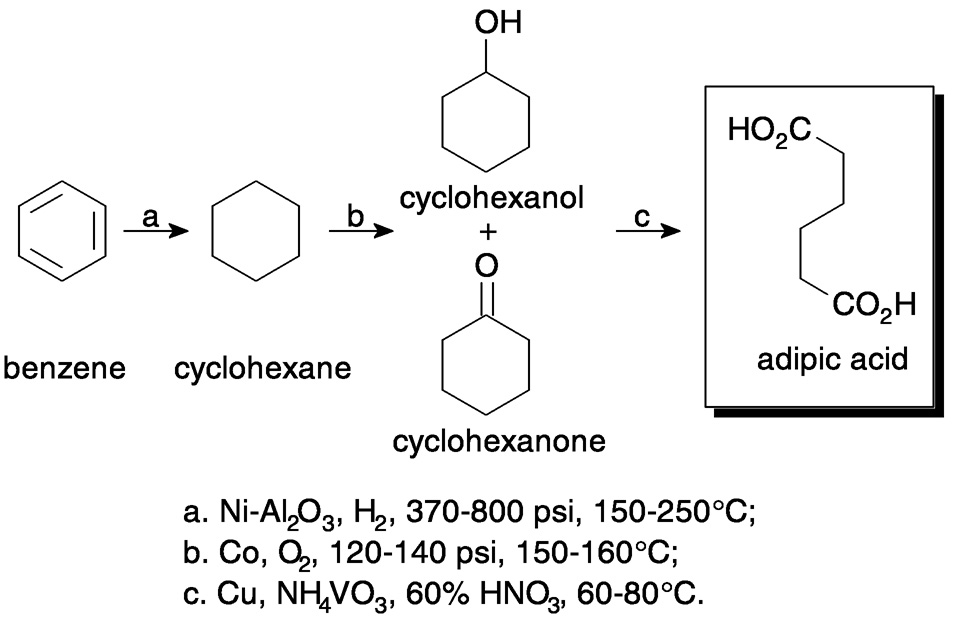
Adipic acid is a commodity used primarily in the synthesis of nylon-6,6. Annual global production of adipic acid is approximately 2 × 10⁹ kg. 20 Although a number of new, creative routes have been elaborated for synthesis of adipic acid, 21 most adipic acid manufacture ( Figure 12.6) begins with hydrogenation of benzene to cyclohexane. 20 Oxidation of cyclohexane affords a mixture of cyclohexanol and cyclohexanone. This mixture is then further oxidized to afford adipic acid. The nitrous oxide (N2O),
Page 192
~ enlarge ~
FIGURE 12.6 Synthesis of adipic acid.
which is formed as a by-product in the nitric acid oxidation of cyclohexanone and cyclohexanol, is a greenhouse gas and an ozone depleter. 22 Approximately 10% of the annual increase in N2O levels may arise from this single organic reaction. 22
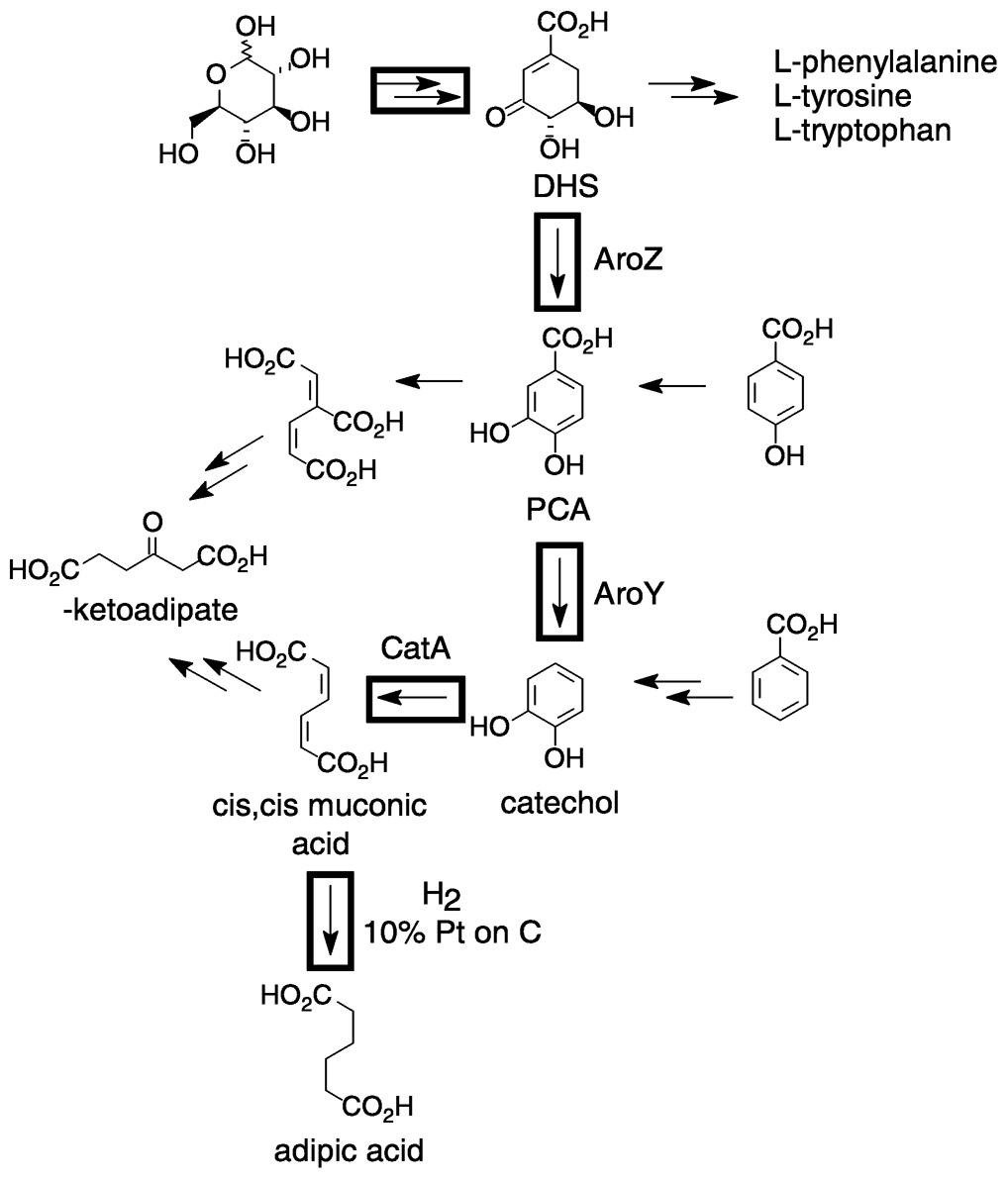
As with the synthesis of p-hydroxybenzoic acid and hydroquinone from glucose, synthesis of adipic acid from glucose employed both microbial catalysis and chemical catalysis. A recombinant microbe was constructed to synthesize cis,cis-muconic acid from glucose ( Figure 12.7). 23 Catalytic, chemical hydrogenation of the cis,cis-muconic acid then afforded adipic acid ( Figure 12.7). 23 Directing increased carbon flow down the common pathway of aromatic amino acid biosynthesis employed the same strategies as previously described for microbe-catalyzed synthesis of shikimic acid. Microbe-catalyzed synthesis of cis,cis-muconic acid differed in that 3-dehydroshikimic acid (DHS, Figure 12.6) accumulated instead of shikimic acid. DHS accumulated due to a mutation present in the aroE locus that renders shikimate dehydrogenase catalytically inactive in the host E. coli strain used for synthesis of cis-cis-muconic acid.
3-Dehydroshikimate dehydratase, which is encoded by the aroZ locus isolated from Klebsiella pneumoniae, catalyzed the dehydration of DHS to form protocatechuic acid (PCA, Figure 12.7). PCA is typically a catabolic intermediate in the p-hyroxybenzoate branch of the β-ketoadipate pathway ( Figure 12.7). Protocatechuate decarboxylase, which is encoded by the aroY locus also isolated from K. pneumoniae, then catalyzes the decarboxylation of PCA into catechol ( Figure 12.7). Catechol, which is typically encountered in nature as a catabolic intermediate, is distinguished from PCA by virtue of its intermediacy in the separate benzoate branch of the β-ketoadipate pathway ( Figure 12.7). AroY is a member of a larger family of enzymes that catalyze decarboxylations of benzoic acids possessing electron-donating substituents. Although these enzymes are stable in intact cells, decarboxylase activity is quickly lost in cell-free extracts obtained from cell lysis.
Use of K. pneumoniae as the source for isolating aroZ and aroY is quite advantageous due to the close evolutionary relationship of this microbe to E. coli. This relationship means similar codon use for the two microbes and allows both aroY and aroZ to be expressed in E. coli from their K. pneumoniae promoters. The last step in the microbe-catalyzed portion of adipic acid synthesis is the catechol dioxygenase-catalyzed conversion of catechol into cis,cis-muconic acid, which accumulates in the culture supernatant. Catechol dioxygenase is encoded by the catA locus isolated from Acinetobacter calcoaceticus. Conversion of glucose into cis,cis-muconic acid thus employs genetic elements of three different microbial species.
Page 193
~ enlarge ~
FIGURE 12.7 Combined microbial and chemical synthesis of adipic acid.
In our original work, an E. coli host containing three plasmids was used to catalyze the conversion of glucose into cis,cis-muconic acid under shake flask conditions. 23 Our most recent construct uses a single plasmid and catalyzes the conversion of glucose into cis,cis-muconic acid under controlled, fedbatch fermentor conditions similar to those employed for microbe-catalyzed synthesis of shikimic acid and quinic acid from glucose. After removal of the biocatalyst, the clarified fermentation broth is treated with activated carbon to remove unidentified molecules in the broth that poison platinum catalysts. The cis,cis-muconic acid can then be hydrogenated over a platinum-on-carbon catalyst to afford adipic acid in nearly quantitative yield.
For the synthesis of shikimic acid, we elaborated the naturally occurring biosynthesis of a hydroaromatic. The elaborated route to adipic acid, by contrast, has no equivalent in nature. Collecting genes from various microbes and assembling these genes in a single microbial host has created a fundamentally new biosynthetic pathway. Because the starting material possesses the high oxygen content of glucose, the last step of the synthesis is a reduction of cis,cis-muconic acid to adipic acid. No by-products are formed during this reduction and no N2O is generated. This contrasts sharply with use of a deoxygenated starting material such as benzene for adipic acid synthesis. Introducing the requisite oxygen atoms in route to adipic acid requires extensive oxidation. Formation of N2O is a strategic by-product of such a synthesis.
CONCLUSION
When ongoing genome sequencing and allied functional genomic efforts are combined with the interfacing of chemical catalysis with biocatalysis, a variety of connections can likely be made between
Page 194
carbohydrate starting material and chemical product. Our research is only at the beginning of efforts to delineate the basic connections between plant-derived starting materials and chemical product. This is essentially an exercise in target-oriented chemical synthesis. In progressing from shikimic acid to p-hydroxybenzoic acid and then to hydroquinone, we have moved from an ultrafine chemical to a fine chemical and then to a pseudocommodity chemical. Each of these steps constitutes a sizable increase in the volume of the chemical that is manufactured. However, it is not until major commodity chemicals such as adipic acid are synthesized from plant-derived feedstocks that significant progress can be made in transforming the 5 quads of carbon used as starting materials 2 in chemical synthesis in the United States into a form of CO2 sequestration.
It is important to emphasize that conversion of plant-derived starting materials into chemical products must ultimately lead to industrial-scale processes that yield chemical products at a manufacturing cost that is competitive with their current production from petroleum-derived carbon. Ultrafine chemicals and smaller-volume fine chemicals provide an invaluable proving ground for such activities. Because of the inherent value-added nature of these chemicals, the fundamentals of yield and titer considerations can be elaborated and then scaled up to syntheses commercially practiced by the pharmaceutical and flavor and fragrance industries. The lessons learned will be critical to the large-scale, microbe-catalyzed conversions needed for cost-effective manufacture of pseudocommodity and commodity chemicals from plant-derived feedstocks.
Chemists are uniquely trained to identify and elaborate the connections between plant-derived starting materials and chemical products. At the same time, it is essential that chemists view construction of microbial catalysts as an activity every bit as central to chemical synthesis as development of inorganic and organometallic catalysts. At one time, synthetic chemists were particularly interested in the use of glucose as a starting material in synthetic chemistry. Employment of chiral synthons as starting materials is still an important activity. However, the bioproducts industry is producing an expanding variety of starting materials such as l-lysine and lactic acid at commodity chemical prices and volumes. Transforming this new generation of starting materials into existing and new chemical products requires the development of new syntheses and new synthetic methodologies compatible with use of water and fermentation broths as the reaction solvent. Target-oriented synthetic chemistry and synthetic methodology development thus become equal players with molecular biology and biochemical engineering in the synthesis of chemical products from plants.
REFERENCES
1. P. 4. Organic Building Blocks of the Chemical Industry. Wiley : New York , 1989 .
2. , Alternate Feedstocks Program Technical and Economic Assessment; U.S. Department of Energy, Office of Industrial Technologies : Washington, DC , 1993 .
3. (a) , , , , , , , , , , , and J. Am. Chem. Soc. 119, 681, 1997 . (b) , , , , , , , , , , , , and J. Org. Chem. 63, 4545, 1998 .
4. , Shikimic Acid: Metabolism and Metabolites. Wiley & Sons : New York , 1993 .
5. , , , , , Tetrahedron Asymmetry 8, 3315, 1997 .
6. , , and , J. Am. Chem. Soc. 121, 1603, 1999 .
7. (a) , and J. Am. Chem. Soc. 115, 11581, 1993 . (b) , , J. Am. Chem. Soc. 118, 5605, 1996 .
8. , and J. Am. Chem. Soc. 117, 2395, 1995 .
9. Justus Liebigs Ann. Chem. 27, 257, 1838 .
10. Ber. Dtch. Chem. Ges. 24, 1278, 1891 .
Page 195
11. (a) P. 251. In Kirk-Othmer Encyclopedia of Chemical Technology 4th Edition, Volume 8 , Kroschwitz, J. I., Ed., Wiley : New York , 1993 . (b) hydroxycarboxylic acids, aromatic.” , and P. 510. In Ullmann's Encyclopedia of Industrial Chemistry; Wiley : Volume A 13 , New York .
12. P. 467. Organic Building Blocks of the Chemical Industry. Wiley . New York , 1989 .
13. , CHEMTECH 1994 . “Understanding the thermoplastic polyester business.” 24( 4).
14. (a) P.500 in Kirk-Othmer Encyclopedia of Chemical Technology, 3rd Edition, Volume 20 , Grayson, M. Ed., Wiley : New York , 1982 .
15. Organic Building Blocks of the Chemical Industry: Wiley : New York , 1989 .
16. , , , and P. 996 in Kirk-Othmer Encyclopedia of Chemical Technology, Fourth Edition, Volume. 13 . Kroschwitz, J. I.,and Howe-Grant, M., Eds. Wiley : New York , 1995 .
17. P. 39 in Kirk-Othmer Encyclopedia of Chemical Technology, Third Edition, Volume 13 , Grayson, M. Ed., Wiley : New York , 1981 .
18. , and Industrial Aromatic Chemistry. Springer-Verlag : New York , 1988 .
19. , , and J. Am. Chem. Soc. 114, 9727, 1992 .
20. , and Pp 466-493 in Kirk-Othmer Encyclopedia of Chemical Technology, Fourth Edition, Volume 1 . Kroschwitz, J. I., and Howe-Grant, M., Eds., Wiley : New York , 1991 .
21. (a) , , and Science 281, 1646, 1998 . (b) , , , and Green Chem. 1, 275, 1999 . (c) , , and Angew. Chem. Int. Ed. 39, 2310, 2000 . (d) , , and Angew. Chem. Int. Ed. 39, 2313, 2000 . (e) , , , , , and Topics Catalysis, 13, 253, 2000 .
22. (a) , and Science 251, 932, 1991 . (b) , and Nature 319, 109, 1986 .
23. , and J. Am. Chem. Soc. 116, 399, 1994 .
DISCUSSION
Leo Manzer, DuPont: In my experience working with biologists at DuPont and other places, I have found that they sometimes treat the chemistry too simply. They “cheat,” somewhat and equate acids with their salts. In your process, you mentioned, adipate, not adipic acid. I am curious as to whether you are in fact, making the sodium salts, by doing the biology in basic media, or are you actually making the acids?
John Frost: There are several critical impediments that have to be overcome in order to make the process work. The first is catalyst immortalization, so that you can go from batch production to continuous production. This is widely accessible. There is research and development going on in that area.
The salts issue is the second hurdle. Ideally, you want bacteria that operate at a pH of 3, but once you start factoring in the salts, it becomes difficult. The presence of the acid removes the need for sterilization, so you do get something back from it. The salt stream issue remains one of the major impediments, and more work needs to be done to resolve it. It is an issue that people who work in this area don't always appreciate.
Tom Baker, Los Alamos National Laboratory: You commented that you are using bioengineering instead of organometallic compounds to do the catalysis. For catalysis in water, there have been developments using water-soluble compounds as catalysts, such as soluble metal phosphine compounds. One characteristic they have is that they are not very susceptible to the kinds of sulfur compound poisoning that you mentioned. Have you considered using some of these water-soluble catalysts for any of the chemical processing?
John Frost: The way we operate in my group is that, essentially, everybody acts as an organic chemist. We will independently synthesize a critical intermediate and evaluate the chemical details first. Once we get that, then we do the genetic engineering.
Page 196
The biocatalysis we use to interface is not ideal. There are tremendous opportunities in this area, but we just have not had time to investigate them thoroughly yet.
Rosemarie Szostak, Department of the Army: I have been fascinated with the area of genetically modified organisms (GMOs) for a while, even though I am an inorganic chemist. What regulations are you subject to in your use of these GMOs, and do you envision adverse public opinion about what you are doing?
John Frost: Regulatory hurdles have caused enormous frustration. In this research, we work with a form of E. coli called K12. We work in K12 because it is the easiest one for us to get regulatory clearance, both in the United States through the Environmental Protection Agency and in Europe through the European Union.
E. coli may or may not be the best catalyst for making a chemical, but it comes down to what you can get through the regulatory process. There are two types of E. coli that people have historically worked with—K12 and another type called B. They were going through the regulatory process back in the days when I was in graduate school in the 1970s. Many people were concerned about “Andromeda strains” in Cambridge, and at the time, the public discussions that happened were extremely important. A lot of validation had to be done, and through the regulatory process, K12 was accepted.
Getting a process with E. coli B cleared has been much more difficult. . There are tanks with E. coli B, and you will have a hard time even letting people use those tanks. It is also problematic beyond that, unless you get significantly away from the generally recognized as safe (GRAS) organisms.
In Europe, it is very bizarre. For example, Italy's policy has changed overnight. It used to be that whatever we wanted made could be done in Italian labs without much problem. Now it's not as easy. We sent a strain off for production in Italy accompanied by 12 pages of very detailed documentation that included the entire trail, where every gene came from.
In Switzerland, an adamantly anti-biotech country, they were going to ban all recombinant work. I think this was voted down last year. Yet, oddly enough, in Switzerland, we don't have a problem. Going into Switzerland is very easy for us.
In terms of the public perspective, I am lucky. The public has a perception, courtesy of the pharmaceutical industry, that there is indeed a benefit from a GMO. Also, the results of this work are not for human consumption. That protects me from a certain group of people.
However, I have transgenic plant colleagues in the center that I direct. Some of these people have had dire problems with those opposed to their research. We've had two buildings burned down by environmentalists, the second one just last year. This group could be considered a “fringe” group. It gets speaker lists from events like this and starts sending threats by e-mail. We have a detective in our police force that deals with the e-mail threats. They go through a database with the Federal Bureau of Investigation to determine whether it is a credible threat. These labs are guarded by police at night. There is a big difference between a microbe in this context and a transgenic plant that is in the outside world. For the latter, there is more concern about mobilized genetic elements and the issue of food.
Regulatory hurdles are a serious consideration, no matter what you are doing, but to address your question, the problems depend on where you are and what you are doing. Once we start moving into chimeric and mosaic organisms, which is ultimately going to happen when we start going to chromosomal shuffling, it is going to be even more difficult than now.
Alex Bell, University of California at Berkeley: Toward the end of your talk, you alluded to the interplay between biocatalysis and conventional catalysis. I think that is an interface where some
Page 197
exciting opportunities exist. Could you tell us more about what you think are the research needs and opportunities in this area?
John Frost: Let's start with the basic. The problem with the Williamson ether synthesis is that you get a mole of salt per mole of product. When you look at large cellulose processes—say, methylcellulose—you are making a huge amount of salt when you make a huge amount of product, because to get this cellulose, you have to use a caustic of some kind to solubilize the cellulose, which also hydrolyzes most of the alkylating agent. If you did the same process biocatalytically, you could get rid of that salt, as long as you had the microbe capable of doing the alkylation.
A different interface is catalytic upgrading of fermentation broth, which uses both catalytic reduction and catalytic oxidation. For example, let's take a basic one that ought to be easy to do—reduction of a carboxylic acid to a primary alcohol. If you are doing it in a target-oriented, academic environment, you would use diborane. This has quantitative yields. The problem with that is that the stoichiometric reaction comes from boron trifluoride, I believe. That is where the diborane comes from. If you try to do the same thing with catalytic hydrogenation, you start seeing use of copper chromite and nickel catalysts. You can also do this on rhodium now.
When converting a carboxylic acid to the alcohol, the process typically runs at between 100 and 200°C and at 3,000 to 5,000 pounds per square inch hydrogen. So I consider that an example of a very basic organic reaction. The problem is that under those conditions, other chemical reactions, such as hydrocarbon cracking, will occur. It would be wonderful if we had catalytic options that would work at much more mild conditions. Oxidation of organic chemicals is an example of another research area with opportunities. Selective oxidation of hydroxyl groups is an area that has some wonderful opportunities in it.
Panel Discussion
Alex Bell, University of California at Berkeley: Before we start, I would like to suggest thinking about the policy issues involved with the management of carbon that came up in discussions yesterday and have been touched upon again this morning. The question is, How do we translate this area into a research agenda, particularly for the chemical sciences? I think we have an opportunity, with the four gentlemen here on the panel, to address some of these questions.
Richard Alkire, University of Illinois: I would like to ask a question that involves the pace of innovation. I think all the talks today, and many of the others, have proposed new and innovative ways to do process chemistry and processing, which have to be evaluated. I think Leo mentioned that in some cases, corporations can invest 10 or 15 years to do this. So the question is, How do we speed the pace of innovations so that it takes 10 months or, if we do already know the research, 10 weeks, instead of 10 years?
Corporations that make airplanes and cars have figured out how to do this by the strategic use of information technology. They can model fluid flow, heat transfer, and vibration, and then take this and develop lift, drag, weight, and performance characteristics. They can test airplanes before they build them. They can manufacture, assemble, and do inventory control with a high level of information resources.
In the chemistry and chemical engineering area, we can model at the molecular level. We can do heat transport and reaction, optimization, process control. So the tools seem to be available. Yet it would appear that they are not actually used strategically to speed the innovation. The question is, Can
Page 198
information technology be used more strategically than it is by the chemical process industry? Does carbon management give an entry or a driver for its better use? If so, what are the characteristics of applications where a breakthrough or an advancement in that area might first appear.
Patrick Gruber, Cargill Dow LLC: That kind of information actually is used, and we do it, too, each time that we develop a new process, and we have done lots of them. We use all modeling techniques that are available, information-based techniques that are based on fundamentals. Each time we use models, then we stand back and consider what risk we are taking. In the airplane industry, for example, they are working with extremely well-characterized materials, not forefront materials. They are optimizing manufacturing systems based on what they have done before.
In the chemical industry and in the agricultural industry—we have worked in both—the optimization of the distribution systems has been done. The optimization of processes is being modeled. They are well optimized. As to what happens when you try to shorten the development cycle, I can give you a specific example—the scaling up of polylactic acid (PLA).
You do all the chemistry, you do all the fundamental tests, you think you know it. You talk with all the best modeling experts in the world and all the best polymer processing people. Then you say, here is how it should work. Guess what? PLA doesn't behave like other polymers. It has got its little nuances. The only way to find this out is to have put it under those conditions and thus advance the forefront of knowledge in the way this PLA macromolecule behaves in that regime. The knowledge didn't exist before. This happened to us in trying to figure out how to remove the residual lactide monomer effectively.
Everybody was wrong. Fundamentals predicted the wrong thing. It didn't work. Now, from an industrial opportunistic point of view, you have to appreciate that we know how to do it and others don't. So we are happy. That is the problem you run into. If we had just said, for sure it would work—but didn't test it even though everybody who is an expert said it will work—we would have a big problem.
Leo Manzer, DuPont: Let me add a comment there as well. I think how to increase the pace of innovation is a great question to ask. Every time we try to scale up something we get asked the same question. Do you really want to spend another $10 million for a pilot plant? Can we do it any faster?
I have a lot of scars from attempts where we have tried to bypass those kinds of expensive intermediate steps, Richard. Most of the time, it doesn't work. One process in particular, we scaled it up and we found that after a couple of months on-line, we ended up with an impurity in the recycle stream that we never saw in the laboratory work. It appeared only after many months on-line and it couldn't be separated from the final product. It cost all kinds of money to get that out after the plant was built.
I think it is a great question to ask and it is a good objective from an engineering and a modeling research standpoint, but there is a lot of risk in skipping some of those intermediate steps.
Harold Kung: I think I will discuss your question from a somewhat different point of view. You asked, “What does it take to bring innovation to a different level?” I am talking from the experience I learned from a program that was discussed here earlier, the so-called Partnership for a New Generation of Vehicles (PNGV). It was a very successful program in my opinion, and it started with a new paradigm. The industry and government buy into it saying, “We want to build a car that can have 80 miles per gallon fuel economy, with all the other usual attributes.”
If the chemical or the fuel industry started with something like that, instead of asking, How can we improve our process by 1% here, 2% here—change the paradigm completely? You must be willing to invest the resources to do it.
Page 199
A number I heard last year, in one of the National Research Council reports on this PNGV program, is that the companies and government together were spending close to $1 billion in research and development in that program per year. If the chemicals and fuel industries are willing to do something of that sort, they or the researchers can start looking at creative innovations that may or may not pan out. Pieces of those innovations would find their way into improving the existing processes for the industry as a whole.
It is very difficult to schedule innovation, but by putting resources and commitment to it and getting people interested in improving the environment, there will be a lot of good things that can come out.
Patrick Gruber: There is one other aspect I should mention. When we look at a new process, we have a rudimentary idea and we turn it into some kind of process flow diagram and then make a model of it. Then we ask ourselves, “What does it mean in terms of energy and cost? What is it sensitive to?” We don't care so much about the absolute of what it is. We do sensitive analysis and determine which risks we are talking about and where we should focus our effort. That is a slightly different discipline than straight chemical engineering, because we are doing stuff that is total fantasy.
For example, we have all kinds of processes. I bet we have 10 different processes on how to deal with salt in fermentations, sitting there, all of which we predict should work. The question is, Which one do we pilot and prove?
Tom Rauchfuss, University of Illinois: I want to start off with a comment about educational trends that we are seeing at the university level. That is, the Department of Energy (DOE) and the National Science Foundation (NSF), which are fundamental to driving the research that underpins much of what we are talking about today and yesterday, are peanuts compared to the National Institutes of Health (NIH).
NIH is really driving the agenda at the universities, at least in the chemistry departments. The level of funding is perhaps triple what it is in DOE and NSF. Consequently, colleagues, new colleagues, are moving into those areas. Organometallic and process engineering are viewed as almost passé.
This is a major structural change. What we are hearing at the same time is that the basic organometallic and process engineering is critical to what is happening or what is needed in the carbon management area. Funding inequity is a very serious problem, or at least a phenomenon. I don't know whether it is a problem.
To a certain extent, “bio-anything” is viewed by new graduate students and new faculty as extremely sexy, and they are rewarded immediately when they go to Washington, D.C., with four- and five-year grants with direct costs that are hundreds of thousands of dollars more than you are getting from the other agencies.
It is an interesting cultural trend. I am not sure that industry is really prepared for the shortfall of people trained in the correct areas that is coming in a few years. I am interested in hearing what trends you see. For example, John, you probably have some overlap with these areas as well. I would be interested in hearing what you have to say about how this shortfall should be addressed in the National Academies.
John Frost, Michigan State University: I play alphabet soup. My best grants are the ones that are rejected. You know, what you have said hits it right on the head. I will give you an example of what happened to me. I was an associate professor and I was having funding problems. I had just moved, pretty much, into this area. I was looking at the fact that I wasn't going to be able to meet payroll in August. I turned around and I licensed one of my key pieces of technology to a company. That was the single most stupid thing I have done in my life. Then after that, the funding started to go back up. I felt,
Page 200
you know—the first agency to fund me was the Environmental Protection Agency (EPA). It was not NIH. It was not NSF. I hold no grudges. They fund me now.
In terms of the comment you made, I really feel that keenly. When I sit on NIH study sections, I fundamentally wonder what the level of chemical understanding is in the proposals that I see. Some of this is “sexy,” but it borders on intellectual masturbation. What can you do on this? NIH has done one thing that is relevant to this area. It is desperately trying to deal with this metabolic engineering issue. Basically, what is going on here is that, Americans are very good at discovering things and then the Japanese eat our lunch. They have not been able to get a study section together on this, which would help chemical engineering. That is because of “insiding.” I mean, the last thing people want is another study section that can reduce their piece of the pie. NIH has struggled and started to move somewhat successfully into some areas that are not typically associated with it. I think that your point is well taken, because you also see this in graduate students, in terms of how good their training is. It affects the pace at which we can do research. I don't have any answers. I see the same thing and I play all sides of the coin: United States Department of Agriculture, Environmental Protection Agency, National Science Foundation, National Institutes of Health, whatever else is out there.
What you said is exactly right. One NIH grant is worth three NSF grants. Is that good or bad? I think it is cause for concern. I don't know if that answers your question. Even what I have done, which falls under the “bio-thing,” I have felt the hounds nipping at my heels, as it were.
Richard Wool, University of Delaware: I have a question for the panel regarding bio based materials. In terms of making bio-based materials, either you can derive your starting molecules from microbes or you can get your starting molecules from plants, and you can genetically engineer both of those pathways.
Then you can have mixed pathways. From your perspective, in terms of carbon management, are there any strong driving forces in either the molecules from microbes or the molecules from plants that you think should be pursued or combined or mitigated? Do you know where the carbon management—the CO2 recovery optimum—would be within those systems?
Patrick Gruber: I think for almost all the processes I can imagine, the preferred route will be directly related to the amount of energy used.
Next would be the equivalent of the yield, starting with the right oxidation states. One of the things that I have seen people do is take glucose, which is highly oxidized, then do a bunch of chemistry to it and turn it back into something that has no oxygen at all. This is not a good idea. There has got to be some more fundamental knowledge gained in picking the right raw materials, and manipulating them.
This sounds quite simple. It isn't, though. When you start applying biotechnology techniques in plants or microbes or whatever—and John showed a good example—where they are doing one that has a couple of double bonds. I can imagine a scenario where you have manipulated something to make a new raw material. It then is a totally different game and paradigm. You have to be thinking up front about where that optimum is, what it looks like, how might it come to be, and then make trade-offs to actually reach it.
In general, if you have maintained your yield and minimized your energy, you will usually have done well on minimizing carbon dioxide production.
Richard Wool: I wonder if Leo would care to comment on DuPont's perspective on this.
Leo Manzer: I can't comment. I don't know. I would make a comment, though, totally unrelated, but I want to emphasize a point that Pat and John made as well. I think there are real opportunities here, as we
Page 201
talk about renewable resources and so on. It is not to try to do it all with enzymes or bugs or whatever or chemically. There is a great opportunity here—and I am involved in this myself—in trying to learn some of the biology so I can talk with some of these guys.
Sitting through some of these conferences is pretty tough when they go with acronyms all over the place, but there is an opportunity to say, “Hey, let's take it part way and then do what I ought to do best, and that is chemical catalysis and take it the rest of the way.” I think that is where the future lies, certainly in DuPont.
Richard Wool: That was my last question. This creates a beautiful interdisciplinary interface that rarely exists, even within universities, where it should happen the easiest. Within industry, these units tend to be very well accepted.
Leo Manzer: It is in handfuls of people that I am talking about who are superb at cutting across boundaries. It is handfuls of people. It is really tough, because I think it is the way to go. In biology or chemistry, everyone has to understand economics. This means they have to know about the process technology.
The chemical engineers that are doing it need to understand both the chemistry and the biological issues that arise, as in catalysis or some other type of thing.
We have had problems when we have people who cannot get out of their little box—these are the rules and things that I learned working with petrochemical—based products in the chemical industry. Get rid of those paradigms and let's get some new ones, to the point of getting rid of people.
Richard Wool: Is there a suggestion here for the federal government to begin looking at new centers within universities or within industry, or joint between them, about how to have a mix of the right kind of people to address these problems? Something needs to be done. These people don't exist, as we talk. I don't know what the answer is. I do know it is disturbing if people are sent to make more metabolic engineering tools. I don't like that very much. We need to solve problems and get things done and implemented to make money some way. Tools are nice, if I am going to start my own company and sell a tool, but I'm not. My company makes products. Therefore, this means an integrated system of solving problems using process technologies, chemical engineering, chemistry, and biology, all of it integrated. This is what needs to be done. This is what needs to get funded. It is disappointing if the funding shifts so for over to the bio side that we forget the rest.
Leo Manzer: I wonder if this isn't an opportunity for universities to try to train students in chemistry and biology more on the process side of things. It is just learning the language. It is still chemistry when you get down to the nuts and bolts of the thing. I sat through a meeting a couple of weeks ago on microbiology, and I didn't understand one word. I didn't know whether they were successful or not. It is a matter of taking the time to learn the language. You think it is hard to get chemists and engineers together? That is insignificant compared to getting biologists and chemists together, I think.
David Keith, Carnegie Mellon University: This panel has illustrated wonderfully the enormous potential of chemical and biochemical process engineering to really improve the environmental performance of our energy and chemical technologies. I think the promise is extraordinary.
This panel has also illustrated some real thoughtfulness about the complexity of what environmental performance means. I address a question to the panel but, first, a critique.
The critique is that I feel that many people, when thinking about better chemicals and especially “green” chemical processes, have reasonably naive notions about what is better environmental perfor
Page 202
mance. As a starting point, there is the simple notion that using fossil fuels is always worse than using biochemicals.
So how do we inject into folks like you, who are thinking about designing better processes, the best knowledge we have about what really constitutes environmental insult. How do we measure it and how we do that kind of policy analysis? How do we do this at a process level and how do we do it at the level of national policy?
Patrick Gruber: I will take a shot here. The issue best illustrated is life-cycle inventory (LCI) analysis. In theory, it is quite easy to calculate the energy that we use. If I ask the simple question: Where did that energy come from? And ask what does it mean? This is a problem. The data is old, for one. Electric companies have improved their processes, but these improvements are not reflected in avalanche data.
Understanding the source matters. The standard assumptions for LCI don't differentiate whether the source was clean or not would be, and this was a clean place, because it is all uniform across the grid. With those kinds of assumptions, you are disinclined to have a discussion with the electric company that has the wire going to your plant. I need to be able to say, Hey, my customers care, I need this cleaner. I need to have specific data so that we can have discussion. This is what needs to occur in order to make a dent. So what this comes down to is, How do you change supplier behavior? Without information and data that are real, you can't have the discussion.
The same thing would be true in farming. If we want corn LCI information, we have got to have data. Who is going around talking to farmers to see what farming practices are used? What inputs are you using? Are you improving? How does it roll up at county levels? We need data that is useful for decision-making, then we can determine more fully how to improve.
John Frost: I could add something about educating people on environmental costs and what not, I have seen texts in this area, et cetera. I am underwhelmed by what I see.
David Keith: So am I.
John Frost: It falls into the category of fuzzy. What I think is—and actually I think you alluded to this earlier—if you train people in a traditional sense to focus on cost of carbon, titer, and yield, you will, in that process, address environmental issues. I am not so convinced that we need to be teaching people how to save Bambi. I think we need to focus on our nuts and bolts, and from that, I think good things will happen.
David Keith: I certainly agree we don't need to teach people how to save Bambi. What I want to do is connect hard-headed assessments of the environmental costs of various industrial activities to the folks who are designing those processes. There is a lot of soft-headed routinized calculation of environmental insult that, in fact, doesn't hold up under serious scrutiny.
Patrick Gruber: I think you answered your own question. What we need is to develop data and models based on regional and local data. This is tough, but it needs to be done. Otherwise, we are going to get wrong decisions.
A product like ours gets sold across the world. We need to take into account local waste disposal systems. For me to assume that it is going to be landfilled in Germany is a mistake. In Germany, disposable plastics are going to be incinerated.
Page 203
Glen Crosby, Washington State University: I would like to return to one issue that was brought up by Tom Rauchfuss, concerning a very serious imbalance in the amount of funding that is going into health-related or biologically oriented research in the universities and the amount going into physical sciences and engineering.
I think this is really serious. It is a lot more serious than people know. I think there are ways of addressing it. One way is, of course, it is beginning to happen. Harold Varmus, when he was head of NIH, went out of his way to emphasize the importance of having developments in the physical sciences to support the biomedical community. I think that was a very fine statement and I think it had an effect.
The more serious problem, in my opinion, is why students are not going into the chemical and physical sciences. That problem starts farther back. It starts in the high schools in this country because no one now majoring in physics or chemistry intends to go into a high school and teach.
The people who are now teaching physical sciences in high schools are trained mainly in biology. They reflect that attitude and they also reflect an insecurity regarding our sciences when they teach them. So there is a very serious mismatch between the education of teachers and what they are required to teach.
As a member of the board of directors of the American Chemical Society, I have been extremely worried about this issue. I have proposed that we run a professional development program at the national level, funded through industry. We should take those teachers who are educated in the biological sciences, and who are being forced to teach physics and chemistry without solid knowledge in it, and run a professional development program in the molecular sciences. The program would try to build on their biological interest and background, and enable them to teach physics and chemistry better.
Can it be done? Yes. I have done it in my own state. It nearly killed me, but I did it in my own state, while being underfunded for this, but I think it can be done nationally.
If we are going to have an infrastructure in this country that is going to lead us and keep us in the forefront in the twenty-first century, we have to do something about the basis of the scientific learning that occurs in high schools and therefore goes through the community colleges and universities.
It is now slowly eroding. The flight of students into the biological sciences is not necessarily all pull. Some of it is push, because they are not educated in mathematics and physical sciences in high school and they find themselves unable to study these things in colleges and universities. They are unable to do the very simple things that are necessary to be successful in those elementary courses because of an extremely poor background in high school. We are going to have to address this issue. It is not just something that we can throw away, and it is going to have to be more than just government programs.
It is going to have to be industrial input. As I listened today, I thought to myself, “if some of the things I heard today were being talked about in freshman chemistry classes, it would be extremely exciting to kids.”
So the message here is that we cannot have the kinds of people you want emerging from our graduate programs unless we give serious thought to what is happening in our high schools, particularly, and what is happening in our school systems. We cannot expect teachers, people who become highly educated, to step into our schools and be paid $22,000 a year. The American tax payer is going to have to start paying. Otherwise, we will have to import all of our serious scientific and engineering personnel from abroad. This is something that we are going to have to face as a nation.
Klaus Lackner, Los Alamos National Laboratory: It appears, from presentations over the last two days, that the overarching opinion seems to be that carbon emission will be constrained. Somehow or another we should use less of it, particularly if it is of a fossil nature, and we have to put away what we use.
Page 204
If you believe what is going on in the sequestration world, nobody believes this will be a success unless the price per ton of carbon is less than $100. The impact on the industry is similar to raising the price of oil by roughly $10 a barrel. We saw this size impact last year and survived. Clearly, you want to deal with this and improve all of these issues, but I think you have to keep the orders of magnitude when it comes to the environmental issues.
We are talking a lot about what to do technically and scientifically in these areas where we can make improvements. Clearly you want them and they are very worthwhile. Ultimately, chemistry will be needed in dealing with the issues of dealing with CO2. We need to have a better understanding of CO2 chemistry. If you put it underground, we have to deal with the geochemistry of how it interacts with where it goes. If we form mineral carbonates, we are clearly constrained by a lack of understanding of how to do this. More work in this area by many more people will be required to make these processes elegant and efficient.
I really would try to put a plea in for the chemistry field as a whole, to take on the big challenge that needs to be dealt with if you want to use fossil fuel for the next 50 years. Given the time constants of changing infrastructure, we will have to deal with the sequestration issue and do it right.
Jae had it absolutely right. We have to go to zero emission, which is a nontrivial effort. I view all of this as being very important and actually driven by economic constraints. If the cost of carbon goes up, all of the things discussed earlier are important, but let's not forget the biggest driver in it—which is the combustion of fossil fuels.
John Frost: If you look at nature in terms of CO2 removal capability, there are ribulose bisphosphate carboxylase, and phosphoenolpyruvate carboxylase, which are marvelous. Ribulose bisphosphate carboxylase is less effective because oxygen is required in its reaction with CO2. Thus, in nature, there are enormous opportunities for CO2 sequestration.
Klaus Lackner: I absolutely agree with that. I just would say, let's have some of the focus on those areas.
John Frost: I think that will happen naturally as you go along. It is also incumbent on chemists to understand that nature does it a lot better than they do. They need to study these systems to see if, in a truly chemical sense, they are able to create the chemical systems that can sequester CO2, or improve on those systems that are doing it.
So, this goes back to something that was addressed earlier in terms of ignorance between various fields. I mean, it crosses everything. I am ignorant about a lot of things. Other people are ignorant about a lot of things. CO2 fixation in large-scale fermentors is doable at 1 atmosphere. You don't necessarily have to clean gases up. Nitrogen and sulfur are fine for bugs. What you want to do is genetically engineer your organism so that, with proper weathering, it would become appropriate humus. I don't have the foggiest notion of what direction to genetically engineer that microbe. I basically have to talk to Dr. Dirt and I don't know where Dr. Dirt is.
That is one of these field issues. I think there are enormous opportunities that are available in chemistry. There are also some opportunities that we haven't even talked about. For example, one of the things you notice in aerobics, is that you produce about a gram of biomass per gram of product. It is not until you go anaerobic are you in good shape.
Klaus Lackner: When I phrased my question, I didn't want to exclude anything—quite the contrary. We had a lot of discussion on the policy level about these hundreds to thousands of billions of tons of
Page 205
carbon we will, over the next century, have to deal with. I think we should focus some of the energy across the board on that question.
John Frost: Let me make one other comment. In some grant applications, you have to write an environmental impact statement. These things are usually toss-offs that aren't taken seriously. It would be useful if they were taken seriously. It would absolutely force people to start talking to people in other fields. To give a classic example, a very good transgenic plant person received a very large grant to do functional genomics in hemicellulose biosynthesis. I heard this and I went over and started talking, “Gee, this is great, this is great, this is great.” I realized that he didn't have the foggiest understanding of why you would be interested in a pentose stream. It finally came back that he didn't have the foggiest notion of what a theoretical yield was in microbe-catalyzed conversion for use of a pentose as a starting material versus use of a hexose as a starting material.
I realized that this wasn't even necessary in the proposal process. In the review process, it wasn't even deemed important. If you have that kind of activity, I think you would have people stepping up to the plate in the fashion that you are saying you wish people would.
Patrick Gruber: Oddly enough, when you said we need some catalytic means to do sequestration, it wasn't until after a while that I considered nonbiological means. It is just chemistry done differently. It doesn't matter which it is. If that is a valuable problem to solve, apply the tools and solve it. We need to figure out what catalyst, chemistry, and systems and process engineering.
Digby MacDonald, Pennsylvania State University: This question is for the two gentlemen from industry. In these types of panels, we frequently hear about what industry needs in students in view of research. What do you do to support research or students, and what do you plan to do in the future to increase whatever programs you have going on.
Leo Manzer: At DuPont, for example, to help students, we donate a lot of money to departments across the board. Maybe the shift is a little bit away from traditional areas into newer areas, but there is a lot of money going to support students, research projects, and so on in those areas that we see as critical to the future. Maybe this doesn't sit well with some areas that are not perceived to be exciting anymore, but that is just the way it is. We have students working in the laboratories for the summer.
Digby MacDonald: Could you comment on any increase in the future in this support and which areas you plan to support?
Leo Manzer: I think it is pretty clear, if you read the press, that our future is in the area of life sciences. Therefore, it is only fair to assume that money is going to go into those types of areas and away from more traditional chemistry and chemical engineering areas.
I may or may not agree with this, but that is the way it is. If this is the future, you might as well go with it. This is why I have decided to move myself over into the biological area. As painful as it may be, I am trying to talk to these folks.
What I find very, very interesting is that they haven't got a clue of what is going on in the world. The biology folks can splice genes and they can do all kinds of really nifty stuff. I spent three weeks in a lab doing a lot of pipetting and decided doing it once was enough. I learned a little bit of the words, but they don't know anything about process development. Making salts is fine with them, but I have been trying to solve these problems for years, and recycling salts just doesn't make it when you are dealing with
Page 206
cheap things like adipic acid. So I think there is an opportunity for the areas to get together and for an educational process to proceed both ways.
Patrick Gruber: Cargill Dow is a small company. So your question is probably better answered by either Cargill or Dow. We have our select universities that we fund, work with, and hire students. We give them money because we want them trained a certain way. For us, it is not huge amounts of money, but it is enough to make a dent in their programs. We also have summer programs and internships. All the time we are trying to find people we would like to hire.
C. B. Panchal, Argonne National Laboratory: I would like to go back two issues. Yesterday we talked about energy and today we are talking about chemicals with selective reactions of the bioproducts. In the United States and worldwide, we should identify 10 of the basic chemicals we need, such as styrene. Then, alternate chemical paths to make them should be developed.
That will be good in this way. Industry is going to continue. It is going to improve. Much less energy is required today than 10 or 15 years ago per unit produced. What we need is the development of alternative chemical paths or alternative processes. If you look at the amount of solvent we use in industry and at the consumer level, it is a tremendous amount and we don't know what happens at the end. Even if only 10% escapes, you can see the impact on the environment.
Look at the total picture, not just productivity, but side reaction suppression, which is the major cost for purification and separation. Let's find a way that does not require too much separation, like membrane reactors.
I don't know that you need to comment on that one. What we are looking for is a state of change. We are not discovering new chemicals. It is the same chemical made in different ways.
Leo Manzer: I think there is an opportunity to do both things. Certainly looking at new chemical routes to the top 10 or 15 chemicals is fine. I think the other way to go is look at the properties that we are after and go after alternates—polylactic acid, for example, instead of styrene. Instead of building these big massive plants that consume lots of energy and fossil fuels, find some other way to get the desired properties from a different product altogether.
Another comment, too, on solvents—just keep in mind, once you have taken water out of the tap and put it into a process, it isn't water any more. It needs to be purified and treated like anything else.
David Cole, Oak Ridge National Laboratory: I just want to make a comment to echo what Lackner mentioned a minute ago.
The problem we are dealing with is a huge amount of CO2 going into the atmosphere. As many of the multilab reports have pointed out, there is going to have to be a multitude of technologies used to address the problem, both from the chemical processing point of view and from the geologic point of view. We need to look at all those various technologies to address this problem.
We are talking about mitigating CO2 from the power plant we have near Oak Ridge, the Bovon power plant, which produces tons of CO2 per day. There was a fair bit of activity afoot using microbes that respire or take up CO2 and make carbonate minerals, as well as algae. They do this fairly quantitatively. This is an area of active research. I think it would be good to get that out in the open so people know about it. Of course, the issue of genetic engineering to optimize the carbonate precipitation process of these microbes also is something of interest and is being worked.
The specific question I have for Dr. Frost is, With regard to Escherichia coli, are there other microbes that people are looking at across the board to produce chemicals in the way that you have
Page 207
described, or is E. coli the only microbe? Are there other opportunities out there to look at various reaction pathways that depend on the microbe's starting point?
John Frost: In the United States, you have a lot of K12 processes. In Japan, it is Corynebacterium spp. Another microbe Gluconobacter oxydans is used in the manufacture of ascorbic acid.
I think what you are asking is, What is the best organism to use and how does the best organism relate to some of these issues? I think that if you are starting to define the best organism, you are looking for an organism that uses—you can define some of these things pretty well. You want facilitated diffusion for glucose uptake so that you are not sacrificing yield for rates of glucose uptake because you can always have plenty of glucose in a tank. You want an organism that works very effectively at low pH. Gluconobacter, which is related to Acetobacter, which goes back to Louis Pasteur, is an awesome example. These organisms synthesize 0.4 moles of acetic acid, and are very happy in 0.4 M acetic acid. These types of acidic bacteria have been used not that far back. They are useful organisms.
The other thing that you want is an organism that naturally expresses CO2-fixing capacity. I put my money on pyruvate carboxylase because it requires adenosine triphosphate (ATP) versus phospho-enolpyruvate (PEP) and it doesn't have oxygenase reactivity.
Now, where things become very interesting concerns the best reduction capability. The best reduction capability is in the anaerobes. If you try to use an anaerobe as a production platform, it grows glacially and at very low density, which presents problems. So you start getting into the interesting and potentially controversial area of creating chimeric organisms. You take the desired megabase out of an anaerobe, de novo resynthesize it for proper codon usage and proper folding, and introduce these into a Klebsiella, E. Coli, or Gluconobacter backbone to create the catalyst that you need. Everything that you need is out there, but it does not exist in a single organism. Even if it were to exist in a single organism, you have some very serious regulatory issues right now as to whether you would be able to use that organism.
David Cole: That was where I was heading. I was also simply trying to point out that there is a multitude of natural microbe species that, from an ecological point of view, may be used in a simpler processes, compared to complex chemistry.
These bacteria actually fix CO2 directly and dump out a biomineral. They are not as efficient as direct chemistry but nonetheless provide an interesting pathway for fixing carbon in a bulk kind of way.
John Frost: Your comment about the CO2-fixing carbonate bacteria is a really neat area that has a lot of potential. This also gets back to what I was suggesting in the biological area, which is somewhat related to what we have been talking about in chemistry.
When you get away from Streptomyces, E. coli, Arabidopsis, and you get into some of these other areas, there aren't techniques to transform these organisms, nor are there people who can get money to do it. This is hard stuff. For the Streptomyces, it is my country for a good transformation technique.
In these atypical organisms that you are talking about, you have to go back to the 1970s in E. coli, and create a whole area of fundamental underpinnings that is going to allow you to manipulate them. There are no funding agencies doing that. It is a real problem. We have become really narrow in terms of what we can manipulate.
David Cole: I agree, and to make one last comment, I think the problem is this disconnect between different disciplines. We talk microbiology community versus geochemistry community versus chemical community. Without a connection between these various disciplinary approaches, we are going to
Page 208
act as separate entities and we are not going to have the connection we need to solve some of these problems.
To do genetic engineering on a natural microbe, such as an epithermophilic or mesophilic bacteria we find underground, is almost impossible. No one wants to talk to us about that kind of issue. They only want to see us use it as a means to remediate a contaminated zone. We have got to go back to a point where we can start understanding the chemical and metabolic processes of these kinds of microbes before we can even begin to attempt to do the fixation. Yet they are out there. That is the key issue.
Closing Remarks.
Tobin Marks, Northwestern University: Let me say a few things as the co-organizer. First of all, I find that I have come away tremendously stimulated. I have learned a great deal. I have gained a new perspective on how important the carbon management issue it is, how complex it is, how difficult it is to discern green versus non-green, and what the life-cycle analyses are. I have learned a great many things.
I came away also with the feeling that there really is a need for a very broad agenda—one that is molecularly, macromolecularly, and biologically oriented. I think there is a need for mechanisms that will stimulate interdisciplinary research, maybe through centers, but also stimulate interdisciplinary education in terms of preparing a work force that can attack these kinds of problems. So this is one thing that I thought was really terrific about this workshop, and we sincerely thank all of the speakers for their contributions.


