
RICHARD C. STARR
August 24, 1924–February 3, 1998
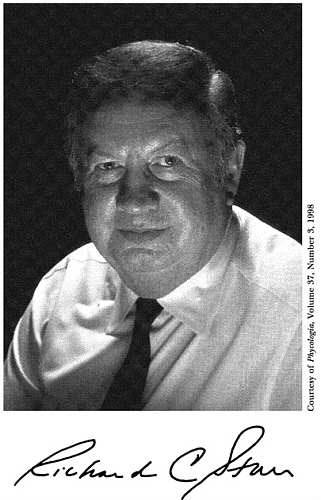
BY ANNETTE W. COLEMAN AND JEFFREY A. ZEIKUS
RICHARD STARR WAS THE outstanding freshwater phycologist of the last half century. He early recognized the value of pure cultures of algae, not just to study life histories but for biochemical, physiological, and genetic work as well. The importance of clones of documented usage led him to establish the Culture Collection of Algae in America, which became the premier collection in the world and the foundation of modern research on algae. While shepherding the collection through its first 47 years and teaching courses both winter and summer, Richard Starr conducted an active research program that yielded significant insights into life history events of algae, including isolation and identification of several plant sexual hormones. His professional contributions—and collaborations and associations that arose from them—were worldwide, earning him major prizes and awards, all richly deserved. His research continued until the day of his death, only a few months after his full retirement from teaching.
Richard Cawthorn Starr was born in Greensboro, Georgia, on August 24, 1924. The Great Depression and the early death of his father left the family in straitened circumstances, and his mother had to take a job to help support young Richard and his sister. Perhaps this influenced his lifelong
concern with caring for his mother, and Georgia was always considered home. After high school, Richard attended Georgia Southern Teacher’s College (B.S. in secondary education in 1944), fully intending to teach high school. This he did, briefly, but somewhere along the line he decided to take a master’s degree at George Peabody College (M.A. in 1947). That led to enrollment at Vanderbilt University in the Ph.D. program. The seminal influence came here, for he met and chose to study under Harold C.Bold, a charismatic mentor and one of the very few phycologists in the United States at that time who had met such European scholars as F.E.Fritsch, a fellow of the Royal Society. For Richard, from then on, the study of algae became the love of his life. Beginning with single green algae cells isolated from soil samples, the favorites of his own major professor Harold C.Bold, his interests progressed to the morphologically elegant desmids and finally to the beautifully motile Volvocales.
Starr worked out the life cycle of Chlorococcum, a green soil alga, for his Ph.D. He did this not just from collected samples but also from material brought into the laboratory and cultured through its various life stages. The life history characteristics of such simple soil algae were only revealed by establishing and studying pure cultures, using techniques previously developed by others for bacterial and fungal research. This new approach to understanding protistan organisms was in its infancy. A major developer and pioneer proponent was E.G.Pringsheim, then at Cambridge University in England, where he had found shelter after fleeing Prague with several hundred cultures of algae. Pringsheim was to be the second seminal influence on Starr, for Richard obtained a Fulbright Fellowship to support a year (1950–51) in England with Pringsheim during his doctoral period. There he learned not only the most recent
details of Pringsheim’s culture techniques but he also brought back to the United States samples of Pringsheim’s algal collection, samples that later contributed to the core of the U.S. collection.
Upon his return from Cambridge and completion of his thesis at Vanderbilt in 1952, Starr took a teaching position in the Botany Department of Indiana University, where he rose rapidly through the ranks. Here a year later he formally established the Culture Collection of Algae, making these strains available at minimal cost to anyone. This collection was supported throughout the years by grants from the National Science Foundation and in turn so were the Ph.D. programs of the early graduate students well into the 1960s and beyond. The list of cultures published with and distributed by the Journal of Phycology included far more information than simply a listing of the species available. The isolator and collecting location were given where known. Starr also included precise details on how one could isolate individual algae, what formulae were most appropriate for culture media, and the best light and temperature conditions for growth. For several different algae, Starr described in the list how instructors could demonstrate sexual reproduction in living cultures in the classroom, a dynamic subject that always elicited the interest of the general biology student. With the passing years, thanks to his developing habit of driving around the countryside sampling pig ponds, drainage basins, pools and streams, trees, soils, and even hoof prints, additional clonal isolates of a wide variety of algae accumulated in the collection.
Indiana University was the home of some remarkable biologists of the mid-century, including Herman J.Muller of Drosophila fame and T.M.Sonneborn of Paramecium fame. Constant exposure to their activities gave Starr a continuous infusion of knowledge on genetics and on protozoa. By
1954 he had published his first paper on genetics of algae, an analysis of a “natural” mutant of the desmid Cosmarium. His growing interest in the Conjugales led to his second algal foray abroad, to the laboratory of Paavo Kallio in Turku, Finland, in the summer of 1956. Spirogyra, Cosmarium, Netrium, Closterium, and Micrasterias became subjects of graduate studies (M.A.Allen, L.Tews, P.W.Cook, P.J.Biebel, B.E.Lippert, and R.Korn).
The edge of the approaching wave of Volvocales was already in the laboratory, however. Starr’s collecting habits had turned up a sample of Gonium sociale that, upon cloning, proved to be homothallic, forming zygotes within a clonal culture. Colonial green flagellates and related unicells arrived in collection after collection over the next 20 years, often along with a graduate student dedicated to each genus and species (A.W.Coleman, N.J.Lang, M.E.Goldstein, A.E.Brooks, R.Carefoot, W.H.Darden, D.O.Harris, G.E.Kochert, R. Lynn, M.D.McCracken, E.G.Palmer, W.Vande Berg, R.F. Meredith, J.W.Heimke, J.A.Zeikus, R.Palmer, R.O’Neil, M.A.Messina, C.E.Miller, J.H.Allensworth, E.R.Jones, and M.Wood). Analyses of life cycles and nutrition led to ever-improved methods of controlling sexual reactions in culture. He made certain that his students learned all the techniques of isolating and establishing clonal populations of algae they had collected in the field, including how best to induce their asexual and sexual reproductive phases to reveal hitherto unsuspected events. For the Volvocacean family particularly, a vast foundation of information was compiled and numerous isolates were added to the culture collection. Augmented by isolates from collections made during everyone’s travels, Pandorina, Eudorina, Volvulina, Platydorina, and Pleodorina flourished and were soon joined by Gonium and Astrephomene brought by J.R.Stein during her visit for a year. With these organisms, culture methods both for the
propagation and for the analysis and manipulation of sexual cycles were perfected, and comparisons revealed for the first time how genetically diverse many similar morphologies might be.
If a student wished to pursue a problem somewhat aside from the typical ones being done by other students, Starr was amenable to such explorations. Examples of atypical student research topics were deriving mathematical expressions for growth patterns in algae; establishing how fungal parasites attack and destroy algal cells while carrying out their own reproduction; and comparing the ultrastructure of genera within the same taxonomic family to detect similarities and differences. Funding for student research came from his own grants or else he made suggestions on fellowship application procedures. Years after a student had left for a permanent faculty position elsewhere, he could always be depended upon for a glowing letter of support. Even a cash loan to a financially strapped graduate student was not unusual for Richard Starr.
From the smaller members of the Volvocales it was an obvious step to Volvox, but one that took another foreign trip, to Dr. Hirose in Kobe, Japan, where collecting provided the famous Volvox carteri f. nagariensis strains. These continue to this day as the premier material for developmental and genetic studies. The Volvox, species presented new problems in controlling gametogenesis, for here a clear influence of male “induction” of female sexual development was observable. While his continuing line of graduate students handled the various Volvox species, Starr concentrated on the developmental patterns of V. carteri f. nagariensis, a readily mutable and promising object for analysis of development. In 1975 he published a careful analysis of cell lineage during development.
Again, a trip abroad led to a major discovery. In 1972-73
an Alexander von Humboldt-Stifting senior award allowed Starr to visit the Max Planck Institute in Koeln, where he developed a collaboration with Prof. Lothar Jaenicke, a collaboration both lifelong and full of mutual appreciation. The symbiosis was the more amazing because Jaenicke was the consummate biochemist and Starr happily declared that his biochemistry text was the Sigma Catalog. The major scientific consequences of this association were twofold. The first was the isolation and identification and eventually the cloning and sequencing of the gene responsible for the “inducing” material in Volvox carteri. Two decades later the same duo solved the chemical nature of the pheromones in Chlamydomonas allensworthii, responsible for sperm attraction to the egg.
Through these busy years of research and graduate teaching, Starr remained a tireless and dedicated teacher of undergraduates, both in courses and as the hired hands in his laboratory. Starr was not just a dynamic lecturer. His stylish and very accurate drawings on the chalkboard lent visual interest for students once they became accustomed to his being left-handed. An almost unbroken string of summers from 1952 to 1963 found Starr at Woods Hole Marine Biological Laboratory, teaching the marine phycology course, a situation where his teaching influenced a large proportion of the coming generations of phycologists. He brought in outstanding scholars to present lectures on their particular subjects of specialization, among whom were G.F.Papenfuss of Berkeley, John Kingsbury of Cornell, Walter Herndon of Tennessee, and Tyge Christensen of Denmark. Starr made certain that scholarship money was available for his graduate students to attend a summer session, because it was his opinion that one could not be considered a well-educated phycologist without a period of study of marine algae in their natural habitats.
Teaching algae or cryptogamic botany, Starr was known for both the early hour of his laboratory sessions and for the living, performing laboratory materials he provided through careful and clever manipulation of growth beforehand. Laboratory sessions were not somber affairs though, and he was capable of asking such questions as: Why would P.T.Bamum be interested in having Oedogonium in his collections? Answer: Because it produces dwarf mates. As a major professor, Richard Starr was demanding of excellence of scholarship, long hours spent in the lab, and diligent seminar attendance. He made it possible for all his students to attend national meetings to give oral or poster presentations, and he went out of his way to introduce students to famous senior scientists whenever possible.
After Starr moved himself and the algae collection to the University of Texas at Austin in 1976, he received both student and faculty awards recognizing his excellence in teaching. His scientific prominence led to his appointment to the Ashbel Smith Professor chair, and at its inception in 1987 to the Harold C. and Mary L.Bold Regents Professor of Cryptogamic Botany chair. At Texas his broadening interests added graduate studies on Glaucophytes and fungi (T.S.Kantz and J.F.White) to the continuing line of Volvocalean work, but he never missed an opportunity to initiate a culture of a new or unusual organism. The cyanobacterial genus named in his honor by a former student was discovered by Starr in a soil sample he had collected from near the Great Ruins in Zimbabwe. This soil sample was but one of many collected during his worldwide trips seeking Volvox. After he first saw the obviously undescribed organism, he successfully established clonal cultures of it for further study. To date, Starria zimbabweensis is still known only from these cultures.
By the time of the move to Texas, Starr’s reputation as a
scholar and researcher had earned him election to the National Academy of Sciences (1976). This honor was preceded by the Darbaker Prize (1955) and the Merit Award of the Botanical Society (1973), followed by the Gilbert Morgan Smith Medal of the National Academy of Sciences (1985) and the Phycological Society of America Award of Excellence (1997). His talents as farsighted organizer were also in steady use, as treasurer, vice-president, and president (1959–60) of the Phycological Society of America, as secretary, vice-president, and president (1971) of the Botanical Society of America, as secretary of the International Phycological Society, and as chair of the Botany Section of the National Academy of Sciences. They also led to his chairmanship of the organizing committee for the first International Phycological Congress (1978), and his joining the first delegation of American botanists to visit China after the Cultural Revolution. The Chinese academic community had suffered greatly through the policies of the Cultural Revolution, and Starr helped with both lectures and personal encouragement to restore the Chinese phycological community. This led to numerous exchanges of scholars, welcomed both at Texas and other U.S. sites. Altogether Starr’s contributions to international scientific cooperation, particularly in phycology, closely rival in importance even his culture collection.
Researcher, teacher, scholar, head of the culture collection and its constant advisor, promoter of international scientific discourse—all these were Richard Starr. He was a gifted microscopist and his remarkable research results with algae introduced many to the advantages of their study. His infectious love of the algae and his model presentations in lectures and symposia enticed even more researchers to these organisms. Because his scientific standards were high he was never shy about expressing an opinion, but he remained
a consummate gentleman. His early students called him (not to his face, of course) Uncle Dickie or Pookey, but his standard appellation was “Doc,” and Doc was the constant source of almost infinite information on the algae.
Starr was also an excellent scientific microphotographer both in black and white and color using a variety of microscopes, and his living cultures were subjects of magnificent color films involving time-lapse views of dynamic processes such as colony inversion in Volvox and gamete fusion in Spirogyra. He taught all his graduate students to use the darkroom and the fruits of this instruction are well demonstrated in their beautifully illustrated dissertations and subsequent publications.
He was a boon companion wherever he traveled in the world, a talented raconteur with a broad sense of humor. His foster dogs, wide-screen TV, and love of classical music, but not excluding Dolly Patron, gave him relaxation. But nowhere was he happier than when he sat down at his microscope with a freshly collected sample from a cow pond to see what was there. He would pull some pipettes and isolate individual cells or organisms. Each subsequent morning, long before others of the department even arrived, he could be found moving slowly along the hanging line of tubes in the light room armed with his pocket magnifier, checking the meniscus and sides of each tube for the appearance of growth. His newly collected soil samples from Australia and New Zealand were awaiting attention on the day he died.
THE AUTHOR GRATEFULLY ACKNOWLEDGES the significant contribution to this memoir of Norma J.Lang of the University of California, Davis. The information provided by Lothar Jaenicke and John Heimke and the journal Phycologia’s permission to reproduce the photograph is also appreciated.
TAXA NAMED IN HONOR OF RICHARD STARR
Starria gen. nov. (Cyanophyta, described by N.J.Lang. J. Phycol. 13(1977):288–96.
Chlorococcum starrii sp. nov. (Chlorophyta, described by F.R. Trainor and P.A.Verses. Phycology 6(1967):237–39.
Cystomonas starrii, transferred by H.Ettl and G.Gartner. Nova Hedwigia 44(1987):509–17.
SELECTED BIBLIOGRAPHY
1949 A method of effecting zygospore germination in certain Chlorophyceae. Proc. Natl. Acad. Sci. U. S. A. 35:453–56.
1954 Inheritance of mating type and a lethal factor in Cosmarium botrytis var. subtumidum Wittr. Proc. Natl. Acad. Sci. U. S. A. 40:1060–63
1955 A comparative study of Chlorococcum Meneghini and other spherical, zoospore-producing genera of the Chlorococcales. Indiana University Science Series, No. 20.
Sexuality in Gonium sociale (Dujardin) warming. J. Tenn. Acad. Sci. 30:90–93.
1958 The production and inheritance of the triradiate form in Cosmarium turpinii. Am. J. Bot. 45:243–48.
1962 A new species or Volvulina Playfair. Arch. Microbiol. 42:130–37.
1968 Cellular differentiation in Volvox. Proc. Natl. Acad. Sci. U. S. A. 59:1082–88.
1969 Structure, reproduction, and differentiation in Volvox carteri f. nagariensis Iyengar, strains HK 9 and 10. Arch. Protistenk. 111:204–22.
With D.O.Harris. Life history and physiology of reproduction of Platydorina caudata Kofoid. Arch. Protistenk. 111:138–55.
1970 Volvox pocockiae, a new species with dwarf males. J. Phycol. 6:234–39.
With M.D.McCracken. Induction and development of reproductive cells in the K-32 strains of Volvox rousseletii. Arch. Protistenk. 112:262–82.
1971 Sexual reproduction in Volvox africanus. In Contributions to Phycology, eds. B.C.Parker and R.M.Brown, pp. 59–66. Lawrence, Kan.: Allen Press.
Control of differentiation in Volvox. Symp. Soc. Study Dev. Growth 29:59–100.
With W.J.Vande Berg. Structure, reproduction and differentiation in Volvox gigas and Volvox powersii. Arch. Protistenk. 113:195–219.
1972 A working model for the control of differentiation in Volvox carreri f. nagariensis Iyengar. Mem. Soc. Bot. Fr. 1972:175–82.
1974 With L.Jaenicke. Purification and characterization of the hormone initiating sexual morphogenesis in Volvox carteri f. nagariensis Iyengar. Proc. Natl. Acad. Sci. U. S. A. 71:1050–54.
With R.C.Karn and G.A.Hudock. Sexual and asexual differentiation in Volvox obversus (Shaw) Printz, strains Wd3 and Wd7. Arch. Protistenk. 116:142–48.
1975 With R.Meredith. The genetic basis of male potency in Volvox carteri f. nagariensis. J. Phycol. 11:265–72.
1979 With J.W.Heimke. The sexual process in several heterogamous Chlamydomonas strains in the subgenus Pleiochloris. Arch. Protistenk. 122:20–42.
1980 With J.A.Zeikus. The genetics and physiology of noninducibility in Volvox carteri f. nagariensis Iyengar. Arch. Protistenk. 123:127–61.
1981 With C.E.Miller. The control of sexual morphogenesis in Volvox capensis. Ber. Deutsch. Bot. Ges. 94:357–72.
1984 Colony formation in the algae. In Encyclopedia of Plant Physiology N. S., vol. 17, eds. H.F.Linskens and J.Heslop-Harrison, pp. 261–90.
1986 With L.Jaenicke, R.Gilles, and C.E.Miller. Signals for the timing of differentiation in Volvox: Amino acids and glycoproteins as messenger molecules. Nova ACTA Leopoldina NF 56:467–72.
1995 With F.J.Marner and L.Jaenicke. Chemoattraction of male gametes by a pheromone produced by female gametes of Chlamydomonas. Proc. Natl. Acad. Sci. U. S.. A. 92:651–55.
1996 With L.Jaenicke. The lurlenes, a new class of plastoquinone-related mating pheromones from Chlamydomonas allensworthii (Chlorophyceae). Eur. J. Biochem. 241:581–85.


