
APPENDIX A
Details of Amphibious and Logistics Over-the-Shore Operations
THE THREAT ENVIRONMENT
Should U.S. forces be called on to execute the present and evolving naval strategy (“Forward…From the Sea,” “Operational Maneuver From the Sea,” and “Ship to Objective Maneuver” (STOM)) in full, the Navy, with Marine Corps assistance, must be able to place the Marines ashore with speed, surprise, flexibility, and acceptable casualties. The Navy must also be able to sustain the Marines ashore with firepower and logistics—and, in prolonged operations, the Army and Air Force as well.
In any future power projection mission U.S. naval forces must be prepared to meet or circumvent an integrated antiamphibious assault (IA3) defense similar to that developed by the former Soviet Union, since many potential U.S. antagonists still use former Soviet military doctrine—a defense consisting of perimeter, main, and very shallow water (VSW) mine barriers in the beach approaches, and tough obstacles interspersed with antitank (AT) and antipersonnel (AP) mines in the surf zone (SZ) and the craft landing zone (CLZ).
To gauge the current U.S. capability to deal with an IA3 defense, and to help fill any gaps in that capability, the committee used the Joint Countermine Advanced Concept Technical Demonstration (JCM ACTD) nominal threat lay-down employed in JTFEX 97–3 held at Onslow Bay in September 1997 (see Box A.1).
MINE COUNTERMEASURES IN SUPPORT OF SHIP TO OBJECTIVE MANEUVER
Expeditionary maneuver warfare is the overarching concept that encompasses four integrated supporting operational concepts that characterize how the
|
Box A.1 JCM ACTD Nominal Threat Lay-Down The JTFEX 97–3 threat lay-down deviates from classic IA3 doctrine by adding a very shallow water (VSW) mine barrier. The following detailed description of the threat is for a nominal threat lay-down, not a high-end lay-down. Perimeter Minefield The seaward mine barrier is placed approximately 50 nautical miles from shore, and in 40 to 200 ft of water. The distance from shore may vary depending on bathymetry and the range of covering fire. The perimeter minefield is 25 nautical miles in length and 0.5 nautical miles deep. It consists of one row of 500 MKB moored contact mines and two rows of 200 KMD II-1000 bottom influence mines with spacing of 150 to 200 yd spacing between mines to prevent countermining, i.e., one mine detonation causing adjacent mines to detonate. Main Minefield The intermediate mine barrier consists of five mine belts placed 7 to 9 nautical miles from shore, and, again, in 40 to 200 ft of water. Each belt is 5 nautical miles long and 1 nautical mile deep. The first two mine belts consist of two rows totaling 150 MKB moored contact mines spaced 125 yd apart, and one row of 50 KMD II 500 bottom influence mines spaced 150 to 200 yd apart. Two other mine belts consist of a total of 80 MYAM moored contact mines in two rows, and one row of 40 KMD II 500 bottom influence mines, all spaced 250 yd apart. The fifth belt consists of 250 MKB moored contact mines in three rows with mines spaced at 120-yd intervals. Very Shallow Water Minefield Added to the classic IA3 mine defense is a mine barrier located 0.5 nautical miles from the surf zone (SZ). The barrier is 12 nautical miles in length and 0.3 nautical miles deep, and consists of a total of 1000 Al Muthena-35 and PDM-3ya moored contact mines in two rows with mines spaced at 40 and 20 yd intervals, respectively, and one row of 200 Manta bottom influence mines spaced 110 yd apart. |
Marine Corps will fulfill its national security role, as well as project power and influence in the 21st century. These concepts are (1) peacetime forward presence, (2) crises prevention and deterrence, (3) expeditionary operations from a sea base, and (4) sustained operations ashore. The Navy will continue to play a key role with support at varying levels in all four of these concepts. Its ability to carry out mine countermeasures (MCM) in support of STOM missions from a sea base will be critical for success and will demand new thinking on how to accomplish that requirement.
STOM will be executed by Marine air-ground task forces (MAGTFs) at Marine expeditionary unit (Special Operations Capable) (MEU (SOC)), Marine
|
Engineer and Beach Barrier The final barrier covers the SZ (10 to 0 ft) and the craft landing zone (CLZ) (high-water mark (HWM) to the beach exit zone (BEZ)). According to the Defense Planning Guide1 the SZ is 571.58 ft for a gradient of 1:99, and 1743.60 ft for a gradient of 1:300. The CLZ is taken as the 300 ft from the HWM to the BEZ. The SZ barrier is approximately 3.5 nautical miles long, and consists of three clusters of mine belts, each 1000 to 2000 yd long. In water depths of 10 to 3 ft the belts are made up of 1000 PDM-1 tilt rod mines spaced at 6-yd intervals, and 750 PDM-1 tilt rod mines spaced at 8-yd intervals. Near the HWM 3000 TM-36/TM-57 (or equivalent) antitank (AT) mines and PMN/POMZ (or equivalent) antipersonnel (AP) mines are spaced at 6-yd intervals. The mine barrier in the CLZ consists of one row of 6000 PMN/POMZ AP mines, and two rows of 3000 AP/AT mines (TM-46/TM-57 and PMN/POMZ) spaced at 6-yd intervals. There are 600 obstacles beginning with the SZ and covering the CLZ. The first row begins with hardwood logs, telephone poles, or railroad rails driven into the offshore bar and angled seaward. The second row, in the shallower part of the SZ, consists of 4×4×4 ft cubes of 3000 psi concrete. The CLZ obstacle defense consists of one row of steel hedgehogs made of 4×4×5/8 in. angle iron, each leg 4 ft long and welded together, and one row of tetrahedrons made of 4×4×5/6 in. angle iron, each leg 5 ft long and welded. Between these rows is a single roll of concertina wire behind which is a triple row. The obstacles, of course, are superimposed on the SZ and CLZ minefields. The characteristics of the mines used in the nominal threat lay-down are well known. Not included are mines whose existence and characteristics are only speculative. Such mines might include acoustic anti-invasion mines, self-burying mines, advanced stealth mines, anti-MCM mines, pure pressure mines, distributed sensor mines, and mines with computers for control of multiple sensitivity, ship count, and counter-countermeasure settings. |
expeditionary brigade (MEB), and Marine expeditionary force (MEF) levels depending on the threat from theater ballistic missiles (TBMs), cruise missiles, and mines, along with available assets to deal with them. STOM employs the principles of maneuver warfare on land to maneuver on the sea in littoral regions in order to project combined arms MAGTFs directly against objectives well inland from the sea base. Specifically, STOM will allow for tactical movement by air and surface means from over the horizon directly toward assigned objectives inland without the need for stopping to seize and build up beachheads before moving on. It means that the unit will have the ability to avoid opposition strengths in coastal areas, while finding weaknesses or “gaps” in enemy defenses
that can be exploited through maneuver. This also means finding mine-free areas in the shallow water (SW) and VSW—or gaps in existing minefields that seaborne forces can maneuver through. The MV-22, the advanced amphibious assault vehicle (AAAV), and the landing craft, air-cushioned (LCAC) will give the commander the flexibility of speed of maneuver from over the horizon, across the beach, and inland that has not been possible in the past.
STOM is a distinct change from the way amphibious operations, including the planned amphibious landing at Ash Shuaybah in Kuwait, have been conducted over time. Amphibious operations have always called for the establishment of a beachhead, the buildup of supplies, and then the attack inland toward assigned objectives. There was little flexibility in this approach, and it was difficult to avoid enemy strengths due, in part, to the limitations of intelligence, lack of maneuver space, and the limited capabilities of the platforms utilized in ship-to-shore movement.
The fundamental requirement for STOM to succeed in the future is accurate and responsive intelligence available to commanders in common tactical pictures supported by appropriate databases. There must be a coherent and coordinated intelligence, surveillance, and reconnaissance (ISR) plan that is built around surveillance, clandestine reconnaissance, and lane search that extends from offshore assembly areas through the beach exit zone (BEZ) and into the area just landward of the BEZ. The ISR operations in accordance with the plan must remain covert from initial tasking (C-Day to a notional C+502) to the commencement of seaborne maneuver by the MAGTF. The tasked assets in the ISR plan should be able to detect the transportation of mines and obstacle materials from depots to coastal areas, develop accurate environmental data and bottom mapping, determine both mined and unmined areas from the SW zone to the beach, and detect mining and obstacle construction on and behind the beaches in potential landing areas. This effort involves tasking national, theater, and tactical surveillance and reconnaissance assets by the joint task force (JTF) (see Figure 2.5 in Chapter 2), and it must be prioritized at the highest levels in order to get the necessary information. This is the only way that commanders can develop the tactical situation and appropriate maneuver plans for STOM missions in littoral regions where there is the potential threat of enemy mines.
New geographical definitions and coordination measures for STOM, not utilized in conventional amphibious operations in the past, are being developed as a means for determining the best areas for exploitation. The ISR plan should provide the commander with the necessary information for selecting the best geographical area with the least risk. These geographical areas are described in Box A.2.
|
Box A.2 Littoral Penetration and STOM The littoral penetration area (LPA) is a geographical area designated by the joint task force (JTF) commander delegated overall responsibility for the forthcoming operation in conjunction with the supported and supporting commanders (see Figure A.1). This area must be of sufficient size to permit unrestricted control of sea, air, and land operations. Normally one LPA is associated with each objective area, and there may be more than one LPA under consideration early in the planning process. The distances involved in narrowing down the selected areas under consideration may stress the available Navy surveillance and reconnaissance assets in the beginning, and other national and joint surveillance assets will have to be utilized to gather the required intelligence. Littoral penetration zones (LPZs) can be divided into smaller geographical zones to enhance command and control or facilitate coordination of maneuver or fire power. There could be several LPZs under consideration within the LPA that has been selected by the JTF commander for the operation. Each LPZ may contain several alternate axes for use by airborne or surface maneuver forces. The size of the LPZ should be sufficient to support the maneuver of the ground combat 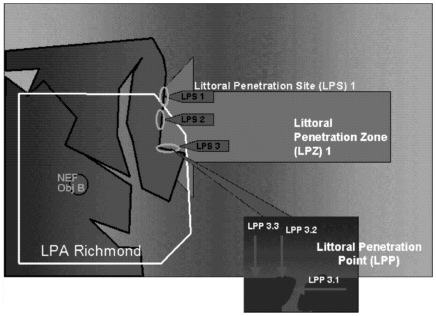 FIGURE A.1 Littoral control measures, littoral penetration area (LPA). SOURCE: Marine Corps Combat Development Command. 2000. Ship to Objective Maneuver Concept of Operations (draft), Warfighting Requirements Division, Quantico, Va., August 8, p. 7. |
|
element of a Marine expeditionary brigade (see Figure A.2). Surveillance assets continue to be utilized while clandestine reconnaissance systems are brought into play that are cued by surveillance information. Reconnaissance assets should include, but are not limited to, nuclear-powered submarines (SSNs) and sea-airland teams (SEALs) utilizing the advanced SEAL delivery system and unmanned undersea vehicles, the remote mine-hunting system, unmanned aerial vehicles (Global Hawk, Predator), and the joint surveillance and target attack radar system (JSTARS) in a standoff mode. The littoral penetration site (LPS) is a continuous segment of coastline within an LPZ through which maneuver forces cross by airborne or surface means. The LPS must be of sufficient size to support a battalion landing team (BLT) (see Figure A.2). Surveillance assets continue to provide coverage while clandestine reconnaissance assets conduct detailed mine reconnaissance to determine lanes 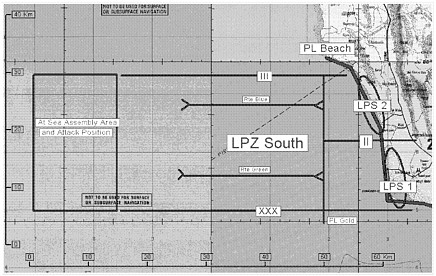 FIGURE A.2 Littoral control measures, littoral penetration zone and littoral penetration site (LPA and LPS). SOURCE: Marine Corps Combat Development Command. 2000. Ship to Objective Maneuver Concept of Operations (draft), Warfighting Requirements Division, Quantico, Va., August 8, p. 30. |
|
either through or around identified mined areas in the water and on the beach. There could be three or more LPSs in one LPZ. The littoral penetration point (LPP) is a point in an LPS where the actual transition from waterborne to landborne movement occurs. For planning purposes, an LPP can be up to 250 m wide and will be designed to support a mounted infantry company team, supported by landing craft, air-cushioned (LCAC). Each company team will normally have multiple LPPs in its zone of action (see Figure A.3). Surveillance assets should continue to be used to watch the beach areas and potential routes off the beach and inland toward assigned objectives. Clandestine reconnaissance units, the very shallow water detachment, and other assets continue to hunt for mines and prepare them for demolition in designated lanes prior to H-Hour on D-Day. Potential obstacles and mines in the surf zone and on the beach, if detected around LPPs, will have to be dealt with by organic or joint breaching systems as the surface maneuver forces move along designated lanes onto the beach. 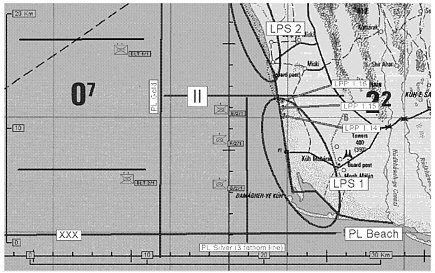 FIGURE A.3 Company maneuver control near shore, littoral penetration points (LPPs). SOURCE: Marine Corps Combat Development Command. 2000. Ship to Objective Maneuver Concept of Operations (draft), Warfighting Requirements Division, Quantico, Va., August 8, p. 31. |
The Office of Naval Research (ONR) is supporting an assessment of the concept of MCM in support of STOM. This assessment is being carried on in coordination with OPNAV (N75), the Marine Corps Combat Development Command (MCCDC) at Quantico, and the Marine Corps Warfighting Laboratory (MCWL). Funding to support a myriad of activities to include the annual wargaming plan, assessment of emerging concepts of operations (CONOPS) associated with the aforementioned STOM control features, and the continued development and demonstration of small unmanned undersea vehicles (UUVs) and other sensors is maintained through the MCM future naval capability (FNC). It is clear that this effort is making progress in solving clandestine reconnaissance requirements from the SW to the CLZ in support of STOM. UUVs that are affordable, clandestine, and include a variety of capabilities will occupy an important role in the future of mine countermeasures. The Navy must acquire a family of UUVs and appropriate sensors if it is to operate effectively in shallow water in support of amphibious power projection missions in the future.
The committee concluded that ONR’s assessment of the concept of MCM in support of STOM, in cooperation with OPNAV (N75), MCCDC, and MCWL, is headed in the right direction and should be continued.
The Navy’s organic MCM CONOPS, currently under consideration in the fleet, is indirectly supportive of the concept of MCM in support of STOM initiative; however, none of the five developing MCM systems associated with the MH-60S helicopter are covert. With this organic MCM capability in the battle groups in the future, it is reasonable to assume that they would support the carrier battle groups (CVBGs) and amphibious ready groups (ARGs) as they approach the designated LPA (see Box A.2) prior to a STOM operation. The surveillance and clandestine reconnaissance systems would already be gathering the necessary information to support the STOM commander within the LPA. The necessity for retaining tactical surprise and lowering the potential risk to the MH-60S in daylight would preclude its employment until the rapid follow-on clearance phase begins after the STOM operation has been executed. This organic capability will play a major role in clearing at-sea assembly areas necessary to support maritime prepositioning force (MPF) (future) shipping if instream offloading is required for the sustainment of MEB- or MEF-size elements ashore (see Figure A.4).
An examination of both national and theater surveillance systems (see Figure 2.5 in Chapter 2) showed that those needed for use in gathering critical information are already in place. The majority of the clandestine reconnaissance systems, as well as those required for detailed lane search, are either in place or in varying stages of development. The emerging STOM CONOPS at Quantico and the MCM in support of the STOM CONOPS should bring all of this together into a coherent plan that can be utilized if it is needed in the future. Gathering the necessary information to support these CONOPS is not and should not be under the sole purview of the unit intelligence officers. It must be the responsibility of the commanders to know what they need and drive the requirement for both
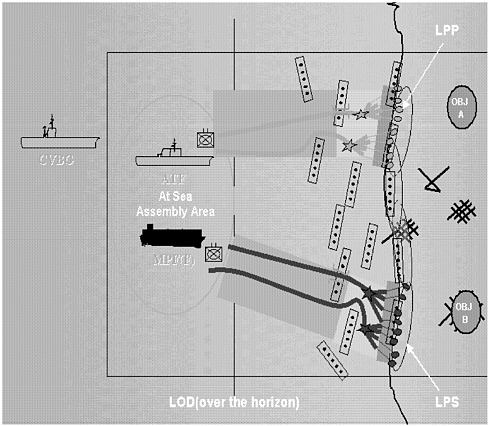
FIGURE A.4 Maneuver in a mined environment from the at-sea assembly area. SOURCE: Marine Corps Combat Development Command. 2000. Ship to Objective Maneuver Concept of Operations (draft), Warfighting Requirements Division, Quantico, Va., August 8, p. 32.
surveillance and reconnaissance assets at the right level of priority. The committee believes that there is a serious lack of knowledge in this area and that the Services need to address it in the appropriate schools. A robust and well-integrated ISR capability is absolutely vital to the success of the STOM concept.
INTELINK CONTINGENCY PLANNING TOOL
One of the biggest impediments to rapid planning is gaining access to the information and intelligence necessary to validate potential courses of action. The amount of available information on INTELINK is overwhelming, yet there is no equivalent of a card catalog or Dewey Decimal System to facilitate a search.
As a result, there is a reliance on search engines that are inefficient, incomplete, and time consuming.
A Marine Corps project aimed at reducing the time it takes to get critical infrastructure data to support the planning effort involves two separate initiatives. The first, development of an enterprise portal for operational intelligence, is nearly ready for worldwide distribution. The second phase involves gathering the baseline infrastructure data currently residing in open source material and hundreds of intelligence databases. This effort, called prepositioning intelligence, is a three-step process that will assign priorities or collection priorities in each of the three MEFs and in areas of responsibility (AORs), assign responsibilities, and train analysts to find information via INTELINK and the Internet and send it to Marine Corps Intelligence Activity (MCIA), Quantico, Virginia. MCIA, the designated production agency for VSW intelligence information for the Services, will then make the information more generally available by appropriate means.
By prepositioning intelligence months in advance during peacetime, staffs can reduce the time necessary to research this same information in crisis, thereby increasing the time available to provide situational awareness and predictive analysis (critically short commodities). There is no reason why Navy and Marine Corps planners will not be able to access this available information via the INTELINK in preparation for power projection operations in the littorals in the future. Information on mine stockpiles, mining activities, and early bottom mapping in regions of potential contingencies, as well as data on gradients, tides, and other environmental parameters that could be available through MEDAL, should also be made accessible through this developing planning tool. Access to INTELINK is through the SIPRNET or the joint world intelligence collection system.
Despite numerous efforts to develop a common tactical picture to support commanders in the field and at sea, they still suffer from the effects of architectures that contain “stovepiped” systems. Getting timely and accurate intelligence is critical if the STOM CONOPS or the MCM in support of the STOM CONOPS is to succeed. The committee is aware of the continuing evaluations ongoing in the Third Fleet with the littoral surveillance system (LSS). Similar to the Army’s tactical exploitation system (TES) in terms of capability, but with 85 to 90 percent less footprint, LSS promises to bring fused information to the commanders at sea or ashore. This system will interface with numerous satellites and tactical aircraft sensors and will process and exploit their data, imagery, and information. It will combine all former tactical exploitation of national capabilities (TENCAP) functionality into a single, integrated, scalable system and will have the capability to serve as an interface between national systems and in-theater tactical forces. Most of the surveillance and wide-area reconnaissance systems listed in the suggested aforementioned ISR plan should be able to link to the LSS in the future (2005 and beyond).
REQUIREMENTS FOR AMPHIBIOUS LANE AND COUNTERMINE AND COUNTEROBSTACLE CLEARANCE
Before listing Marine Corps countermine and counterobstacle (CMCO) requirements, the committee notes that the Commandant of the Marine Corps reinstated the MEBs in the fleet Marine force after publication of the Marine Corps CMCO requirements document. This committee believes that it is imperative that the Navy develop a CMCO capability in the near term to far term that will support the power projection requirements for a minimum of two MEBs (amphibious or MPF) simultaneously. This capability is realistic and will also support the transition to the emerging concept of MPF (future).
While the organic MCM CONOPS currently under assessment in the fleet will assist the battle groups and amphibious ready groups as they approach the designated LPAs, it will not be a substitute for surveillance and clandestine reconnaissance systems required to support amphibious power projection missions from the SW zone to across designated LPPs. Application of rigorous intelligence, surveillance, and reconnaissance methods in a timely manner is the key to allowing unencumbered maneuver and sustainment for the MEBs.
The Marine Corps requirements for mine and obstacle clearance in the VSW, SZ, and CLZ are promulgated in a March 25, 1999, memorandum from the Commanding General, Marine Corps Combat Development Command (MCCDC), entitled “Amphibious Counter-Mine and Counter-Obstacle (CMCO) Requirements in Support of Operational Maneuver From the Sea (OMFTS).” This document is scheduled to be examined for revision in order to address issues that have changed regarding CMCO requirements.
CMCO requirements for the near, mid, and far term are defined as follows:
-
Near term. From FY00 to FY08, the period leading up to the initial operational capability (IOC) of the MV-22 and advanced amphibious assault vehicle (AAAV).
-
Mid term. From FY09 to FY14, that period of time when OMFTS and STOM mobility capabilities are being fielded, undergoing refinement of their tactics, techniques, and procedures, and leading to OMFTS and STOM full operational capability (FOC) in FY14. The fielding of an instride mine clearance and obstacle reduction capability from the deep water through the initial craft landing zone (ICLZ) will be essential for unencumbered maneuver and sustainment.
-
Far term. From FY15 and beyond, that period when OMFTS and STOM mobility is fully fielded. Complete fielding of mobility assets, improved CMCO C4ISR systems, and in-stride breaching and neutralization capability will enable true unencumbered maneuver and sustainment.
The requirements document expresses four concerns of specific interest to this study:
-
Organic MCM assets will be useful in providing detection and limited clearance in the sea lanes of communication for both the carrier battle group (CVBG) and amphibious task force (ATF). However, they will be of limited assistance in amphibious operations in the littoral against a determined threat.
-
The current Navy organic MCM plan reflects the transition of CMCO capabilities to ATFs. This proposal must weigh any advantage an organic system offers against its potential displacement of landing force assets.
-
The LCAC mission to deliver CMCO systems, in accordance with the Navy Mine Certification Plan, is projected within the future year defense plan. It is imperative that the requirement for all LCAC missions as well as the quantity of craft and crews be determined. This analysis must ensure that additional missions will not have an adverse effect on the LCAC’s original purpose of delivering assault and assault follow-on echelon forces ashore.
-
As the assault CMCO capabilities mature, concurrent work must begin immediately on defining and resolving the follow-on clearance requirements of the naval Services. For every transit lane across a littoral penetration point, even with the seabasing of major logistics support and services, three additional follow-on echelon lanes are required to support fuel, ammunition, and sustainment. Currently, the responsibility for follow-on LCAC landing zone clearance is undetermined.
Before listing Marine Corps lane-clearance requirements it should be noted that while intelligence, surveillance, and reconnaissance, rigorously applied in a timely manner, may permit mines and obstacles to be interdicted or avoided to allow unencumbered maneuver in some scenarios, there will be others in which there is no alternative but to clear and breach the mine and obstacle defenses. For instance, North Korea, Iraq, Iran, Cuba, and the former Yugoslavia and Syria have limited landing sites and have or are refining an IA3 doctrine, and such choke points as the Straits of Hormuz and Malacca may present a similar problem.
Near-Term CMCO Required Capabilities
Transit Lane Neutralization and Clearance
Transit lanes begin at the line of departure (LOD) and extend to the 40-ft contour, a distance of up to 25 nautical miles. Required are six 165-yd lanes cleared to tolerance within 48 hours, with a 72-hour threshold.
Very Shallow Water Neutralization
Using a slope of 1:300, the six 165-yd transit lanes will be extended to the 10-ft contour (SZ) within 48 hours, 72-hour threshold. The requirement envisions VSW clearance by the VSW MCM detachment.
Surf Zone Breach
The SZ breach will be conducted by the first assault wave. Required are two 50-yd assault lanes for each transit lane. The objective is to clear all ATF littoral penetration points (LPPs), up to 12, within 10 min, 20-min threshold, from the launch of the first munitions, using a gradient of 1:300.
Landward Breach
To allow uninterrupted landward transition of AAVs/AAAVs, the Marines will extend the 50-yd assault lanes through to the BEZ (100 yd) at a breaching speed of 10 min, 20-min threshold.
Assault Clearance
Upon completion of the landward breach, the Marines, using mechanical equipment, will immediately begin clearing an 80×80 yd initial craft landing zone (ICLZ) to receive LCAC-delivered waves. The objective clearance speed will be 60 min, 90-min threshold.
Marking
Due to deficiencies in the ability to navigate through gaps and cleared/ breached lanes, a marking system must be employed to provide optical or electronic guidance for all AAAVs, LCACs, and other landing craft in all manageable sea states, and under conditions of reduced visibility.
Mid-Term CMCO Required Capabilities
Other than providing a CMCO capability in sea states up to and including sea state 3, there are no radical changes between near- and mid-term requirements.
Transit Lane Neutralization and Clearance
With the introduction of the AAAV the LOD will move seaward to a distance of 25 nautical miles or greater. Required is the clearance of up to six 165-yd lanes within 24 hours, 48-hour threshold.
Very Shallow Water Neutralization
It is anticipated that unmanned systems will begin to replace reliance on human divers and mammals. No other changes are required.
Initial Craft Landing Zone Standoff Clearance
The Navy must field an ICLZ standoff clearance and obstacle reduction capability that will neutralize mines and reduce obstacles to a uniform height of less than 10 in. just prior to the SZ breaching. The objective clearance rate is within 10 min of the first munitions launch, using no more than 10 percent of ATF organic fixed-wing air tasking order (ATO) D-Day sortie rate, 20-min threshold, with no more than 20 percent of the ATO D-Day sortie rate. Although the ICLZ is a defined and located area, ICLZ clearance systems may be needed to clear other inshore CLZs in support of follow-on waves to prevent delays in logistical throughput. This additional application of ICLZ clearance systems for CLZ clearance must be addressed in follow-on analysis of clearance alternatives.
Surf Zone Breach
After employment of the ICLZ clearance system, assault breaching systems (ABS) will be brought into the assault lane and will explosively breach 50-yd connections to the ICLZ through the SZ. Using a 1:300 gradient, the ABS must be capable of breaching without entering the SZ, and within parameters consistent with the near-term requirements (10 min, 20-min threshold).
Marking
Until all landing craft, to include assault follow-on echelon craft, have inherent C4ISR detection, reception, and navigational systems to avoid mines or navigate through electronically marked lanes, physical marking systems will remain a requirement.
Far-Term CMCO Required Capabilities
With full implementation of OMFTS and STOM mobility assets (MV-22, AAAV, LCAC), the vision of unencumbered mobility must become a reality. This includes the ability to detect and avoid mines, with a limited ability to conduct in-stride breaching at locations and times of choosing.
Detect, Classify, Mark
Using national assets augmented by theater intelligence, surveillance, and reconnaissance (ISR) systems, detection will continue prior to and during the ATF’s movement to a theater and assembly at sea. Upon entry into the theater, covert systems will confirm surveillance and reconnaissance findings, classify mines and obstacles, and mark them with a digital tagging system for immediate dissemination.
Dissemination
With due attention paid to jamming vulnerability, dissemination of mine and obstacle locations, as they are uncovered, must continue throughout the planning and initial execution phase of the assault as input to constructing a tactical operational picture in near real time.
Precision Navigation
Navigation capabilities will increase to a level such that all landing craft and vehicles will have the ability to safely maneuver within the CMCO environment based on continually updated mine and obstacle locations.
Current CMCO Capability
Table A.1 summarizes current and developing U.S. CMCO capability, and Figure A.5 indicates the likely number of mines and obstacles to be encountered for each transit lane using the nominal threat lay-down as outlined in Box A.1.
TABLE A.1 Preassault Inshore Countermine Warfare Current Capability
|
Status |
Surveillance |
Reconnaissance |
VSW/CMW |
SZ/CMW |
ICLZ/CMW |
|
Fielded |
0 |
VSW detachment (MMS) |
VSW detachment (MMS) |
0 |
M-1 plow LDC |
|
Joint Countermine ACTD |
LRS |
COBRA ASTAMIDS (T) |
0 |
EN/ATD |
Power blade (T) EN/ATD |
|
R&D program |
LRS ADS/ DADS |
UUVs (Remus/SAHRV/ CETUS/Morpheus) AROSS COBRA |
Biosensor/ SAS |
SABRE/ DET Hydra-7 MODS 5-in./ 155-mm projectiles |
SABRE/ DET Hydra-7 MODS 5-in./ 155-mm projectiles |
|
Gaps in capability to fully execute preassault CMW |
0 |
0 |
0 |
0 |
0 |
|
NOTE: See Appendix F for definitions of acronyms used. T=program terminated. |
|||||
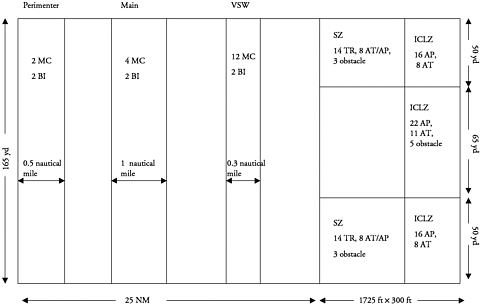
FIGURE A.5 Mine and obstacle density per transit/assault lane. MC=moored contact; BI=bottom influence; AP=antipersonnel mine; AT=antitank mine.
The technical discussions in Chapter 5 of this report describe the systems listed in Table A.1.
Penetration of the minefields and obstacles in the transit lanes to the beach depends on a complex interaction of systems used in various time phases of the operation. The next section, “Amphibious Operations,” describes the operational sequence of events in penetrating to the beach, and the timing of the sequence, as well as how the various mine-hunting and neutralization force elements and systems are brought into play during these events.
AMPHIBIOUS OPERATIONS
To serve as a baseline for its assessment of inshore mine countermeasures, the committee formulated a sequence of events leading to power projection (amphibious operations) in a theater contingency. The sequence was constructed from available documentation and extensive briefings by mine warfare community leadership. The time windows may be altered by the scenario and by competing warfare demands, including competition for national surveillance assets. The key to meeting or improving on the stated time lines is the continuum of intelligence, surveillance, and reconnaissance conducted in a window as narrow as 10 to 20 days prior to D-Day.
As discussed later in this section, a Marine expeditionary brigade (MEB) may be the most likely amphibious power projection force of the future.
To assist in visualizing the sequence of operations, the committee summarizes material presented above (Box A.2): A landing penetration area is of sufficient size to accommodate an MEF-level landing, which could consist of two MEBs (one amphibious and one MPF). A landing penetration zone is an area of sufficient size, within an LPA, to accommodate a regimental landing team (RLT)-level landing. A landing penetration site is an area, within each LPZ, of sufficient size to accommodate an MEB-level landing.
It is assumed that a nominal 30-day period is available for amphibious operations preparation leading to a D-Day on day C+30. Whether an MEF-level force can be assembled and prepared for assault in 30 days may be debatable. In all likelihood assembling such a force might take approximately 60 to 70 days. Even assembly of an MEB may take up to 45 days. However, the 30-day assumption is probably the minimum feasible for assembly and preparation and represents the most stressing time line for MCM support of an MEF.
Sequence of Events Necessary to Allow Planning and Execution of MCM Support
D-30 (C-Day)
Prior indications and warning (I&W) information has led to tasking of the theater commander in chief (CINC) to prepare for expeditionary operations, including amphibious operations. The theater CINC issues a tasking order to the commander, joint task force (CJTF) on C-Day to prepare for amphibious operations on C+30 (D-Day), along with other concurrent expeditionary operations.
The theater CINC tasks national and theater surveillance assets to conduct initial or continuing surveillance of enemy force disposition and defensive preparations, including beach defenses. Surveillance data is processed into intelligence over the next 3 days.
Surveillance assets employed in support of upcoming amphibious operations are assumed to be either clandestine or wide enough in area coverage to conceal landing site intentions.
D-30 to D-27
The CJTF reviews available historical intelligence of enemy capabilities, including sea mines and coastal beach defenses.
The CJTF initiates a rapid planning process designating the joint operating area (JOA). He tasks subordinate commanders, including the commander, amphibious task force (CATF), with providing alternative courses of action and a
recommended course of action for operations in the JOA, including the amphibious operation.
The CJTF and CATF review prior and ongoing surveillance results, along with historical intelligence. The CATF is assisted by the commander, landing force (CLF) and the CATF’s mine warfare commander (MIWC). They collectively identify alternative LPAs within the JOA, each LPA of sufficient size to land six BLTs each.
The CJTF and CATF refine surveillance tasking to support further determination of LPZs, each of sufficient size to land two BLTs within each candidate LPA.
The CATF responds to CJTF tasking with alternative courses of action and a recommended course of action with associated, preferred LPA.
D-27 to D-20
The CJTF selects a course of action, including amphibious operations and LPA. He provides a JOA concept of operations and commander’s intent as further guidance to the CATF and all other subordinate commanders. Supported and supporting commanders are identified for various phases of operation in the JOA. Presumably, but not necessarily, the CATF is the supported commander shortly before D-Day, and the CLF becomes the supported commander at the appropriate point in the amphibious operation, and for some time following D-Day.
The CATF requests/tasks surveillance assets to further refine the common operational picture relative to amphibious operations within the selected LPA. This action would engage a wide spectrum of national and theater surveillance assets as well as tactical intelligence assets. This effort is directed primarily toward selection of three landing penetration zones in the LPA with the intent of landing two BLTs in each LPZ.
The CATF, CLF, and MIWC begin an evaluation of potential LPZs and potential LPSs within each LPZ. Nominally, two LPSs within each LPZ will need to be selected for the two BLTs landing in each LPZ. The evaluation also considers the efficacy of:
-
Potential at-sea assembly areas for amphibious and logistics shipping;
-
Enemy disposition/threat;
-
Beach trafficability and availability of egress to inland objectives;
-
Level of beach defenses; and
-
Relative difficulty/viability of mine and obstacle clearance/reduction in various portions of each LPZ.
At this point evaluation of items 1, 3, and 5 depends both on surveillance and historical environmental data. As indicated elsewhere in this report, a robust
peacetime environmental data collection effort is essential in order to effectively support all naval forces, especially the CATF, MIWC, and CLF, in amphibious operations.
As surveillance continues and results are processed and disseminated during this period, the selection of LPZs becomes clearer to the CATF, CLF, and MIWC. Refinement of the operational picture with additional surveillance missions adds further clarity.
Near the end of this period, one or two MEBs may have assembled in-theater, and MPF (future) and amphibious shipping are assembling in an area protected from enemy defenses, including sea mines, for integration of all MEB elements.
D-20 to D-10
Early in this period the CATF, CLF, and MIWC have agreed upon and established the three preferred LPZs, each for landing two BLTs.
Additional surveillance results continue to add clarity to candidate LPSs within each selected LPZ. The surveillance information is related primarily to SZ and CLZ defenses and enemy threat ashore. Deployed surveillance systems may also have noted mine-laying activity seaward of the SZ provided they were deployed early enough in the contingency.
To further define the selection of two LPSs in each LPZ, the CATF tasks MCM clandestine reconnaissance missions to conduct wide-area reconnaissance of the LPZs. A typical clandestine reconnaissance capability is the submarine-delivered long-term mine reconnaissance system (LMRS). The surface ship equivalent, the remote mine-hunting system (RMS), may also be used. Both of these systems are limited to 40 ft of water and deeper.
The wide-area reconnaissance builds an operational picture of minelike contact density in each LPZ. Fusion of this processed data with information in the historical environmental database begins to focus on likely LPSs within each LPZ. Additionally, definition of at-sea assembly area(s) and transit lanes landward through the LPSs becomes clearer.
As early as possible in this time period, at-sea assembly areas for amphibious and logistics shipping in each LPZ are identified, and sea mine clearance has begun. All available and appropriate MCM assets may be used since the assembly areas are at a distance of 25 to 50 miles from shore defenses. Where feasible, assembly areas should be located in water depths greater than 200 ft (300 ft preferred for nonmilitary shipping) in order to avoid damage from nonmobile bottom influence mines. A moored mine threat in these depths, with the possible exception of rising moored mines, is much easier to deal with in the absence of bottom influence mines.
At this stage of planning, definition of assault follow-on lanes for sea-based logistics flow should have begun. Present estimates (as opposed to defined
requirements) indicate three additional lanes for each assault lane through the SZ and up the beach (two assault lanes per BLT, for a total of 12 assault lanes) will be required, giving a total of 48 logistics lanes through the SZ and up the beach.
If the additional lanes are immediately adjacent to assault lanes, then MCM clearance is basically a widening of assault lanes. However, due to the potential for fratricide, standoff breaching will not be possible once the assault has begun, thus adding to clearance time lines and requiring additional technologies. If logistics lanes are sufficiently separated from assault lanes to allow standoff breaching, this significantly increases the CMCO requirement since additional transit lanes will be required from the assembly area, each with its assault lanes, to and through the SZ and up the beach.
Near the end of this period the MEB and associated shipping may be nearly assembled. Continued interaction between the CATF, CLF and MIWC, tempered by continuing surveillance results and MCM wide-area reconnaissance, should allow selection of six LPSs and associated candidate landing penetration points from some greater number of candidates under prior consideration.
Clearance of the at-sea assembly areas will require roughly 5 to 10 days from commencement. In water less deep than desired, more time will be required due to the possibility of bottom influence mines, adverse bottom conditions, and so on. However, the likelihood of less than desired water depths 25 to 50 miles from shore is minimal in many areas of interest. Exceptions are the Arabian Gulf and the Straits of Taiwan, as well as the Yellow Sea, where 63 percent of the water is less than 180 ft deep.
D-10 to D-2
At the beginning of the period, the LPA, three LPZs, and six LPSs have been selected. The associated at-sea assembly areas have been selected with mine clearance in progress.
Definition of final LPP selection is continuing with due consideration of CMCO requirements and enemy defenses ashore. Concurrently, definition of logistics lanes to support the MEB ashore is continuing.
Surveillance is continuing throughout the period to detect any changes in enemy threat disposition that might influence the final selection of the 12 required LPPs at H-48.
MCM wide-area reconnaissance must transition to the mine-hunting function of detection and classification by the beginning of this period. This is necessary to complete the definition of minelike contacts in the long transit lanes from the assembly area(s) to all candidate LPPs. This definition is necessarily completed by H-48 to allow sufficient time for mine reacquisition, identification, and clearance between H-48 and H-1.
It is also possible that the necessity for having more than 12 candidate LPPs from which to select 12 finally may require detection and classification in seven
or eight LPS transit lanes in the three LPZs. Currently, MCCDC informally indicates a preference for four candidate LPPs per BLT from which two will be selected just prior to assault (possibly as late as H-2).
Clandestine MCM requirements up to H-1 largely drive the selection of mine-hunting assets, and the number of transit and logistics lanes dictates a sizable inventory of those chosen. In addition, these assets will have to concurrently collect environmental data. Depending on the clandestine assets utilized, some mine identification may have already taken place. However, the majority of minelike objects will require reacquisition, identification, and the placement of neutralization charges. Ideally, mine neutralization charges will be remotely detonated through an acoustic modem between H-1 and H-Hour to maintain the element of surprise as long as possible.
The time requirement for mine clearance (reacquisition, identification, and placement of neutralization charges) is between H-48 and H-1. Attempting to do detection, classification and identification, and placement of neutralization charges in this time window is not considered feasible at the present time.
The requirement for clearance of mines in transit lanes between H-48 and H-1 allows the CATF, CLF, and MIWC to delay selection of the final six (possibly more) transit lanes until as late as H-48. As mentioned above, selection of LPPs occurs shortly before H-Hour (approximately the latest time that allows tasking and preparation of air sorties and other methods of delivering standoff SZ and ICLZ breaching systems).
Final assembly of the MEB has taken place at the end of this phase.
D-2 to D-Day (H-Hour)
Amphibious and logistics shipping move to the at-sea assembly area(s) in preparation for the operation. Remaining deception operations are ongoing.
Surveillance continues to monitor the enemy threat ashore, enabling final LPP selection as late as possible.
Upon final selection of LPPs, tasking of standoff assault breaching systems for the SZ and ICLZ occurs. Note that Marine Corps CMCO systems will clear the ICLZ following the SZ breach by Navy systems from now through 2008. Thereafter, Navy standoff systems will breach the ICLZ just before breaching the SZ. These Navy systems will have to be fielded in time to support the full operational capability (FOC) of Marine Corps mobility systems (AAAV, M-22, LCAC) in roughly 2014.
As time allows, feedback from reacquisition, identification, and charge placement activities during this period is used to make final adjustments of transit lanes. Marking of cleared lanes occurs by placement of in situ indicators and/or identifying Global Positioning System tracks for landing vehicle control systems.
Remotely controlled minesweeping assets, capable of immediately preced-
ing assault waves at assault speeds, are prepared for final clearance level improvement and proofing of cleared lanes.
H-1 to H-Hour
Neutralization charges in transit and logistic lanes are remotely activated.
Assault lanes are breached and the ICLZ cleared by the Navy standoff systems (after the near term). The time requirement is 10 min, 20-min threshold.
The SZ is breached shortly before landing at LPPs. The time requirement is 10 min, 20-min threshold.
Assault waves are en route to the LPPs, preceded by minesweeping assets. Assault vehicles conform to marked transit lanes unless tactically required to deviate at the risk of entering an uncleared area. This may be possible at little risk if surveillance and reconnaissance assets have been able to accurately mark the positions and boundaries of mine belts.
H-Hour Plus
All Navy MCM assets begin broadening all transit and assault lanes to land follow-on echelons and sustainment logistics. If the Army and the Air Force are to participate, then the number and width of cleared lanes must be further increased, or harbors cleared if available.
The VSW Transit Lane Challenge
From the operational sequence of events presented above, it is possible to derive a requirement for six transit lanes, each 165 yd wide from the at-sea assembly area(s) to and through the LPSs. There exists a potential requirement for additional 165-yd transit lanes to provide last-minute alternative routes to and across the beach, and to accommodate sustainment logistics. Therefore the committee assumed an additional transit lane for each LPS. This separate set of transit lanes for logistic purposes prevents the fratricide of incoming assault traffic as assault logistics lanes are opened. These six additional transit lanes may need to be cleared in the same time window (preassault) as the six required transit lanes so as not to unduly delay the flow of logistics to forces ashore. This imposes an additional stress on forces available for the MCM task.
This requirement can be used to define the VSW clearance force structure consisting of diver teams, marine mammal and handler teams, and UUV teams. Although diver and mammal teams may eventually be replaced by UUV teams, there will be a transition phase in which a combination of both capabilities will be needed to meet requirements.
In the future a decision may also be made to retain some diver and mammal teams even after the advent of large numbers of UUVs. For example, detection of
buried mines is currently dependent on mammal systems, and may remain so for an extended period. Also, diver teams will probably still be needed for recovery and exploitation of enemy mines. And until technology provides a means for UUVs to effectively place neutralization packages on or near mines, divers and/ or mammals will still be needed.
Wide-area reconnaissance between D-20 and D-10 will provide a relatively gross contact density picture in each LPZ from which to narrow the selection of two LPSs in each LPZ. It is imperative to commence detection and classification functions in each LPS in the vicinity of the “best estimate” transit lanes no later than about D-10 to D-15. This will allow refinement of the “best estimate” transit lanes, and, more importantly, define the specific locations of the minelike contacts to be dealt with later. Without this early detection and classification effort the capability to reacquire, identify, and place neutralization charges in all transit lanes between H-48 and H-1 will probably not be feasible.
Although it is not the intent of this report to determine VSW force structure, it was considered worthwhile to estimate the capability of the currently constituted VSW detachment for clearing a single transit lane for landing a BLT. In doing so, existing area coverage rates and schemes of employment were used. Additionally, the following assumptions were made:
-
The remote mine-hunting system (RMS) will be used for detection and classification as close to the shore as its low observable characteristics permit. The assumption here is that it can operate in to 10 nautical miles off the shore without enemy detection.
-
The at-sea assembly area(s) are 30 miles from shore, and are cleared by other means (organic and/or dedicated MCM assets).
-
Detection and classification provide some limited identification, but this function must be accomplished largely after reacquisition in the H-48 to H-1 time window. However, RMS missions will have identified mines from minelike contacts in to the 10-nautical-miles mark.
-
Diver and mammal teams have very low observability. It is further assumed that they will operate only at night, as is their present tactic to achieve clandestine operations.
-
Minelike contact densities from wide-area MCM reconnaissance are approximately 8 per square nautical miles in 70 percent of the area of operation, and approximately 15 per square nautical mile in 30 percent of the area of operation. It is further assumed that the higher minelike contact density will be in the shallowest area of operation. Actual contact densities may vary in real-world contingencies. Again, an accurate environmental database developed in peacetime will pay significant dividends in minimizing the required level of effort.
-
Traditional explosive ordnance disposal (EOD) MCM detachment support will be required to augment the VSW detachment in the reacquisition, identification, and placement of neutralization charges. This will be done at distances
-
offshore that are undetectable during daylight (EOD MCM detachments are daylight-only capable).
-
The Navy will develop neutralization charges that can be placed on or near mines and can be remotely detonated on command.
In summary, the available VSW force structure must do detection and classification of mines and nonmine minelike bottom objects (NOMBOs) in a transit lane extending from 10 nautical miles offshore to the SZ between D-10 and D-2. It must further reacquire, identify, and place neutralization charges on identified mines in a transit lane from 30 nautical miles offshore landward to the SZ, less the augmentation available from EOD MCM detachments. The SZ boundary extends approximately 1725 yd seaward from the high-water mark on the beach. Since transit lane segments will probably vary from a simple straight line (in order to avoid mine belts in some cases), the committee assumed a 15 percent increase in the track segment lengths to account for other than straight line approaches. This results in a total of 32 miles for a transit lane length.
An approximation points to a VSW detachment capability to perform the necessary MCM functions in one transit lane over approximately 15 nights. This would imply that a VSW detachment as currently constituted might be able to support a BLT-level assault given the above assumptions. However, if an alternate assault transit lane or an additional logistic transit lane is needed, clearance by a single VSW detachment could not be done without roughly doubling the time required to complete the preassault clearance for the BLT.
First-generation UUVs may provide area coverage as much as twice, and mission times on the order of four or five times, that of divers and mammals. This increase in capability will still require a robust force structure and logistics footprint for the UUVs required for an MEB-level amphibious operation.
Clandestine Operations
There is legitimate concern about telegraphing intended landing sites. Most of the surveillance systems capable of monitoring mine-laying activity have a footprint large enough to obscure that intent. It is with the operation of minefield reconnaissance systems that the problem of clandestine operations begins to be a matter of concern.
Because some level of broad-area surveillance is available to any country, the arrival of U.S. forces in assembly or patrol areas off an enemy coast will be known, and monitored to some degree. The enemy also knows, or will be prepared for the eventuality, that small units launched from these assembly areas will be probing their defenses over the 25 nautical miles or so separating the assembly areas and their coast, and will be trying to detect them for indications of intent.
Imposing a clandestine requirement on U.S. reconnaissance platforms is a severe penalty in both design and operation that translates into cost and time. It would seem, then, that some compromise between the level of detectability and alternative measures might be called for. Deception, for instance, is a well-established military tactic. The United States successfully convinced the Germans that Operation Overlord would occur across the Straits of Dover rather than along the much longer southern route, and it created the illusion of an amphibious assault on the Kuwaiti beaches that never took place. Such measures, of which there are many, should be used to reduce the burden imposed by the clandestine requirement. If the enemy detects a probe in one area only, that is intent. If he detects probes in 10 areas, that is confusion as to intent.
Similarly, there is a reluctance to neutralize mines by high-order detonation in the more distant perimeter and main mine belts more than a few hours before assault for fear of giving away intended transit lanes. Explosives are cheap; why not set off charges in many locations while the mines are being detonated? Without belaboring the point, the committee suggests that the issue of clandestine operations be reconsidered in the light of alternative means of obscuring and confusing intent.
The requirement for clandestine reconnaissance, particularly in the inshore area, imposes both cost and time on the performance of that mission. The Navy will have to determine and incorporate tactics, including diversion, disinformation, and obscuration, aimed at reducing the level of covertness now required of VSW reconnaissance vehicles.
JOINT LOGISTICS OVER THE SHORE
Postassault mine clearance to support the heavy logistics flow required by the Army and the Air Force, as well as the Marine Corps, places an additional, and in some cases much greater, demand on MCM assets. A review of available references by the Military Sealift Command staff did not indicate the existence of a set of requirements for anchorage area and logistics lanes needed to determine MCM and obstacle clearance requirements for Army and Air Force logistics.
Additionally, Marine Corps requirements statements are currently limited to an estimate of approximately three logistics lanes through the SZ and ICLZ for each transit lane. The operational requirements document (ORD) for clearance of offshore areas for assault follow-on echelon (AFOE) and MPF shipping is now under review. In its present version, required clearance is not viable within the desired time lines. If sea-based logistics shipping can provide the necessary logistics flow from the at-sea assembly area, a simple expansion of the existing requirement for amphibious shipping anchorage area(s) may suffice.
If joint logistics over the shore (JLOTS) clearance requirements are similar to the existing ORD for AFOE and MPF shipping, or even greater, then a signifi-
cant shortfall of MCM and obstacle clearance capability probably exists, and may exist indefinitely considering planned and programmed MCM forces. If the Army adopts a lighter footprint in the future and adequate time lines for clearance, the necessary clearance might become feasible. Another aspect of this challenge is that the JLOTS area(s) may be significantly separated from previously cleared sea-based logistics areas. However, if JLOTS areas are in a benign area, then dedicated MCM force assets can be used in water depths greater than 40ft.
The Navy, Marine Corps, Army, and Air Force together need to identify the requirements for logistics shipping and associated areas and lanes to be cleared of mines and obstacles in order that MCM asset requirements can be defined and resources furnished for the near-, mid-, and far-term support of forces ashore.


