
1
The Mine Warfare Problem
Naval mines can be used strategically, channeling or denying passage through restricted waters and in and out of ports needed for sustenance by littoral nations. They can shape the naval battlespace, the approaches to it, and routes of commerce, setting the conditions of a campaign. Used tactically, they can slow or stop movement to and through narrow straits and to landing zones on beaches, and in so doing can also make a slowed or stopped force more vulnerable. Yet despite the many instances in which mines were important in past conflicts, the U.S. Navy historically has underrated mine warfare as an element of naval warfare.
During the Civil War the Confederate forces at the Battle of Mobile Bay, unable to meet the Union fleet on equal terms, used mines as a defensive barrier. In that battle Rear Admiral David Farragut, the Union commander, using techniques involving surveillance and reconnaissance followed by mine hunting and avoidance of the located minefield—techniques that are similar in concept to those in use today1—penetrated the barrier losing only a single ship. This action perhaps helped establish an attitude that has persisted to this day: that mine warfare is principally for the use of weaker naval forces to defend against, and to be overcome by, stronger ones. It was nevertheless at great expense, 80 years later, that German and Japanese minefields had to be overcome both to allow merchant shipping to move in and out of allied ports and to clear the way for offensive landings in both the Atlantic and Pacific theaters of war.
Less noticed, mining by the allies had some notable successes in World War II. In the Atlantic war, the Royal Air Force (RAF) flew 20,000 mine-laying sorties over a period of 5 years, sinking 638 ships with the loss of 450 aircraft. This compares with 366 ships sunk directly by RAF torpedoes and bombs over the same period with the loss of 857 aircraft. Only 196 Axis ships were sunk by British submarines and surface ships.2 Similarly, in the Pacific theater mines dropped by U.S. B-29s in the spring of 1945, together with American submarine warfare, effectively isolated Japan from all overseas sources of food and resources for the rest of the war.3
In the more recent past, the United States has not been averse to using sea mines.4 During the Vietnam War, in May 1972, thousands of magnetic-acoustic mines were dropped in Haiphong harbor and in other harbors along the North Vietnamese coast, virtually stopping the delivery of war materials by sea.5 Within 3 days, 27 foreign merchant vessels were trapped in port. When peace talks broke down the area was reseeded in November 1972. For 2 more years, without loss of U.S. life, this mining campaign continued to stop shipping into and out of Haiphong and other North Vietnamese harbors, thus interdicting 95 percent of the seaborne logistics resupply to North Vietnam.
A limited attempt to employ mines during the Persian Gulf War proved less successful. On January 18, 1991, four A-6 aircraft dropped 42 mines, but the Iraqis shot down one A-6. Based on the continued Iraqi naval activity following the U.S. mining, it appears that the minefield, which was not reseeded, had no discernible effect on Iraqi operations. This experience highlights the importance of developing survivable means of delivery (and reseeding) in hostile areas such as by standoff aircraft or submarines.
Despite the successes of naval mining both by and against the United States, the U.S. Navy has generally held its use in relatively low regard. Although there was some continuing attention to the Soviet mine warfare threat during the Cold War, the U.S. Navy planned to rely primarily on NATO allies for countermine warfare in the event of maritime hostilities. To help counter the Soviet submarine threat, the Navy did field sophisticated CAPTOR homing mines in the 1970s.
MINE WARFARE FOR OPERATIONAL EFFECTIVENESS
Countermine Warfare
More recently, the U.S. Navy’s interest in mine warfare took a strong turn upward when the Chief of Naval Operations directed, in a 1995 white paper, that mine counter-measures (MCM) —a critical element of countermine warfare— should receive much more attention and should become organic to battle forces at sea rather than remain exclusively the domain of a separate supporting force.6
This increased Navy interest grew out of the Gulf War experience and the growing realization that sea mines are readily available to potential U.S. opponents and are relatively inexpensive. Russia, Italy, Sweden, and others are major suppliers of modern mines to the more than 50 countries that today possess a sea mining capability. Potential U.S. Navy and Marine Corps contingency regions have significant mineable waters, including the Persian Gulf, the Strait of Hormuz, the Taiwan Strait, the Red Sea, the Adriatic Sea, the Yellow Sea, the Korea Strait, and the coastal margins of the Sea of Japan. (See Figures 2.1 through 2.4 in Chapter 2 for illustrative locations of potential minefields in water depths consistent with known mine characteristics.)
During the “Tanker War” in 1987–1988, the USS Roberts was heavily damaged by a drifting mine, leading to the embarrassing image of U.S. warships following, rather than leading, the tankers they were nominally protecting. During Desert Storm, Iraqi mines impeded U.S. amphibious assault planning and heavily damaged two U.S. warships—the cruiser Princeton and the amphibious carrier Tripoli—effectively removing them from further support of the operations.
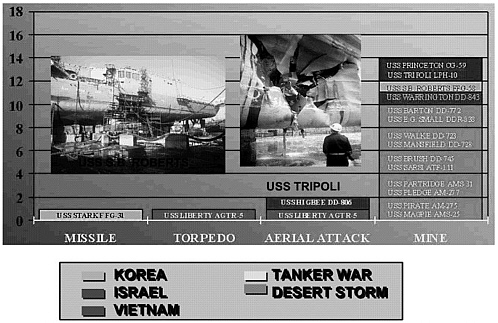
Mines are particularly valuable to hostile “asymmetric” forces that cannot engage U.S. naval forces directly. Naval mines are more widespread and in many ways more difficult—and certainly more time-consuming—to counter than the likely air and missile threats. Since World War II 14 U.S. Navy ships have been sunk or damaged by mines, whereas only 2 have been damaged by missile or air attack (see Figure 1.1).7 In all the time since World War II, no U.S. ship has been damaged by submarine action. Of the 14 mine hits on ships, 10 occurred during the Korean War, and North Korea remains a potential antagonist today.
Countermine warfare is much more than mine countermeasures. In the mine
warfare framework used by the Commander, Fifth Fleet, countermine warfare involves five phases:
-
Intelligence collection and surveillance,
-
Notification of imminent mining,
-
Interdiction, both on land and at sea,
-
Post-interdiction intelligence evaluation and dissemination, and
-
Mine countermeasures.8
The first four phases emphasize measures intended to prevent mines from entering the water. Current carrier battle groups and amphibious ready groups deploy with capabilities to plan and execute the first four phases of countermine warfare. The fifth phase—mine countermeasures—addresses localizing the threat posed by mines already laid or thought to have been laid. Because they have very limited MCM capability, today’s carrier battlegroups and amphibious ready groups depend on the specialized support provided by the dedicated MCM forces.
Mining
While the threat of sea mines to U.S. interests is now receiving increased U.S. Navy attention as a significant part of potential antagonists’ “asymmetric warfare” arsenal, mines are also an important element of naval power available to the United States. This is particularly true at a time when the U.S. Navy is shrinking but is still being assigned to littoral missions spread progressively more widely around the world. Antiship mines, safely delivered by U.S. submarines or standoff aircraft, could effectively shut down commercial and military shipping as a potentially effective coercive measure in a crisis short of direct combat. They could also be used protectively to prevent interference with U.S. naval force missions, and as an extension of the fleet for such tasks as bottling up an invasion force. Strategically employed, remotely controlled, smart minefields incorporating a distributed sensor system could be a cost-effective counter to the feared proliferation of quiet nonnuclear submarines.
International conventions signed by the United States forbid the laying of armed sea mines in international waters in peacetime unless they are continuously monitored and international shipping is warned of their location. Today, advanced sensor and networking technology, together with advanced ocean surveillance of shipping, could enable remote control of naval mines. This capability could set the stage for their legal use to forestall wider conflict or to set conditions favorable for U.S. naval force operations.
Operational Considerations for Mine Warfare
In reviewing future concepts and possible scenarios, the committee was impressed by the number and diversity of operational drivers basic to the conduct of effective mine warfare activities. The most pertinent operational considerations are the following:
-
Uncertain scenarios. In planning for future contingencies, the U.S. Navy and the military in general must be prepared to adapt to a variety of scenarios, and to locales that are expected to be increasingly close to shore, in mineable waters, as the Navy continues to implement its “Forward…From the Sea” vision.9 These contingencies could cross the full spectrum of military operations, from military operations other than war, to small-scale contingencies, to major theater wars.
-
Uncertain allied and coalition support. A reduced U.S. military overseas infrastructure and varying access to foreign basing place a premium on robust afloat basing plus logistics and maintenance support in-theater that is capable, timely, and available at the right locations.
-
Multimission conflicts. Declining warship and aircraft squadron force levels combined with increased multimission demands in joint and coalition operations mean that multimission conflicts will occur, and various concepts of operation (CONOPS), including those associated with mine warfare, must realistically reflect expected asset availability.
-
Reduced time lines. The time allotted to countering the mine threat has decreased. Fast-paced expeditionary and maneuver warfare reduces associated time lines allocated for achieving maritime battlespace superiority (including countering undersea threats such as mines).
-
Limited forces early in contingencies. Some short-warning situations are inevitable, with the likely result that only a few forces will be in-theater early (prior to the arrival of continental United States-based forces). These limited forces will have to deal with the potential threat from mines, as well as other threats.
-
Dispersed force operations. In the future, surface warships and submarines may be dispersed throughout the theater doing key task unit operations (strike, fire support, theater air defense, and theater ballistic missile defense) as opposed to operating primarily in close proximity to a battle group. Warships so employed will have to provide much of their own self-protection against various threats, including mines.
-
Network-centric operations. Future platforms and sensors involved in countermine operations would be nodes in an overall communications network.
A shared picture of operations and fused sensor data, including naval minefield information, would support interactive collaborative mission planning and enhance battlespace situation awareness.
-
Low tolerance for losses. The objective of an adversary’s area-denial strategy may be to produce unacceptable losses (not commensurate with stated U.S. military objectives) and thereby undermine U.S. military involvement and influence. It has been said that the loss of even a single U.S. warship (particularly if it involves a ship sinking and high loss of life) may for some lesser contingencies “inflict enough damage to make the political cost of involvement unacceptably high.”10 Recent military losses in Lebanon (the 1983 Marine barracks destruction) and Somalia (the 1993 firefight in Mogadishu) are examples of such losses that were considered inconsistent with military objectives, resulting in eventual U.S. military disengagement and withdrawal.
FUTURE CAPABILITY—NEXT STEPS
History, the current and future threat projection, and other operational as well as considerations make clear that countermine warfare should concern the planners of future U.S. naval and joint forces at least to the same extent as air or submarine threats. Additionally, because of the great potential benefits to U.S. maritime operations that could result from U.S. employment of modern sea mines, such capabilities are worth preserving. Of particular importance are the intelligence, surveillance, and reconnaissance (ISR) aspects of mine warfare, since that is where mine warfare really starts, regardless of the specific purposes for which such information is ultimately used. It is the considered opinion of this committee that, in order to ensure the capabilities of the U.S. Navy into this new millennium, the priority and attention afforded to mine warfare must be increased dramatically and religiously sustained.
Most of the subsequent discussion in this report deals with problems the Navy must solve and programs the Navy must bring to fruition to ensure having an adequate mine warfare capability later in this decade. This focus on Navy programs is not meant to imply that the Marine Corps, the other military Services, the intelligence agencies, and the unified commands have negligible roles in mine war—they do not. As with most complex military operations, mine warfare operations are inherently joint. The unified commands actually operate the mine warfare forces in-theater; the intelligence agencies provide vital ISR information; Marine Corps units must work closely with the Navy in any amphibious operations and interface with Army mine warfare (and other) operations ashore; Navy and Coast Guard units must work together closely in inshore mine warfare opera-
tions both overseas and, should the occasion arise, in U.S. waters; and the Air Force is trained and its bombers are configured to quickly deliver large quantities of naval mines.
In the chapters that follow, mining and countermine warfare are discussed separately. Chapter 3 addresses U.S. capabilities for and the potential advantages of sea mining. The discussions of countermine warfare in Chapters 4 and 5 encompass the two main thrusts of current Navy programs—programs to make mine counter-measures capability organic to the Navy’s battle groups, and the continuing need for a dedicated, specialized MCM force. These discussions in Chapters 3, 4, and 5 are preceded by a discussion in Chapter 2 of some crosscutting, fundamental issues in force integration, such as ISR, that involve both mining and offshore and inshore countermine warfare.
Because the Navy’s mine warfare programs are so potentially important, because developments in this warfare area have lagged behind those in other warfare areas, and because of the complexity inherent in establishing a new major area of naval warfare, the committee found it appropriate to offer a larger number of more detailed recommendations than is customary for reports of this kind. These recommendations provide the committee’s best judgment on how current mine warfare programs can be strengthened to meet future naval force needs, how additional efforts should be developed to address future capability shortfalls, and how the naval forces can better leverage joint or national assets to meet their objectives. The most important of these recommendations are highlighted in the Executive Summary under seven overarching summary recommendations; the remainder are included in the relevant sections of Chapters 2 through 5.


