
Page 20
2 Development of Vehicle Subsystems
CANDIDATE SYSTEMS
The success of the PNGV program depends on integrating R&D programs that can collectively improve the fuel efficiency of automobiles within the very stringent boundary conditions of size, reliability, durability, safety, and affordability of today's vehicles. At the same time the vehicles must meet emission regulations, be largely recyclable, and use components that can be mass produced and maintained similar to current automotive products.
To achieve the Goal 3 fuel economy target of 80 mpg (1.25 gallons per 100 miles), the energy conversion efficiency of the chemical conversion system (e.g., a power plant, such as a compression-ignition direct-injection [CIDI] engine or a fuel cell) averaged over a driving cycle will have to be at least 40 percent. This challenging goal requires developing and integrating many vehicle system concepts. For example, the primary power plant will have to be integrated with energy-storage devices and the vehicle structure will have to be built of lightweight materials. Every aspect and function of the vehicle will have to be optimized, both individually and as part of the vehicle system. No aspect of the vehicle function can be left untouched, from minimizing the energy expenditure for maintaining comfort in the passenger cabin to significantly improving the conversion efficiency of the exhaust-gas after-treatment systems.
The USCAR partners have chosen the hybrid-electric vehicle (HEV) as the power train in their respective concept cars. The HEV uses stored energy in the battery to drive an electric motor that provides power boost to the engine, thereby permitting a smaller engine that can be operated closer to optimum conditions. This results in increased energy conversion efficiency, reduced emissions, and
Page 21
the potential to recover a fraction of the vehicle's kinetic energy during braking. Not only were the concept cars demonstrated by the PNGV partners in 2000 a great technological achievement, they also helped clarify the remaining hurdles to achieving success for the PNGV program. It is apparent that the fuel cell will not be feasible in a production-prototype vehicle by 2004. This leaves the internal combustion engine as the primary energy converter, and even using the most efficient one, the CIDI diesel engine, the three-times fuel economy target remains a stretch goal. If maximization of fuel economy is the design target, the diesel engine is the first choice; however, meeting the mandated emission standards is a major challenge for the diesel engine. Therefore, a critical consideration to maximize fuel economy is reduction of nitrogen oxides (NOx) and particulates, the two emission standards that are most difficult for the diesel engine to meet.
Reducing the cost for manufacturing and moving the concept technology into current and future vehicles has now become a central factor, so there has been a notable shift in emphasis during 2000–2001 to cost reduction and manufacturability. Resources are being focused on continued development of enabling technologies, such as exhaust-gas after-treatment systems, fuel composition effects on system performance, advanced battery energy storage systems, and power electronics and component cost reduction. The investigations of promising longer-term prospects, such as advanced combustion systems and fuel cell technologies, are also continuing.
The PNGV presented to the committee an overview of the status and critical development issues of the candidate energy-conversion and energy-storage technologies that survived the 1997 technology selection process. Overviews of candidate electrical and electronic systems and advanced structural materials for the vehicle body were also presented.
This chapter addresses the following technology areas and related issues:
-
Four-stroke internal-combustion reciprocating engines;
-
Fuel cells;
-
Electrochemical storage systems (rechargeable batteries);
-
Power electronics and electrical systems;
-
Structural materials;
-
Vehicle safety; and
-
Fuels.
The committee reviewed R&D programs for each of these technologies, along with related vehicle safety and fuels issues, to assess progress so far and the developments required for the future. In the committee's opinion the PNGV continues to make significant progress in developing the candidate systems and identifying critical technologies that must be addressed to make each system viable. The committee is pleased that, since the introduction of the concept vehicles in 2000, there has been a shift in program focus to include affordability.
Page 22
INTERNAL COMBUSTION RECIPROCATING ENGINES
The internal combustion engine continues to be the primary candidate power plant for meeting near-term PNGV program goals. To meet the fuel economy target (80 mpg) of Goal 3 the internal combustion engine will have to be integrated into an HEV configuration. The CIDI engine, using diesel fuel, is the most efficient of the internal combustion engines. Consequently, in the near term, taking advantage of the high efficiency of the diesel engine and integrating it into an HEV is the most promising way to attain maximum vehicle fuel economy. However, the challenges of meeting the new California Air Resources Board (CARB) and the U.S. Environmental Protection Agency Tier 2 emission standards are a major hurdle for the CIDI engine (NRC, 1999, 2000), even when used in an HEV power train. In maintaining its quest for a vehicle with fuel consumption of 1.25 gallons per 100 miles (80 mpg) the PNGV has continued its focus on the diesel engine as the primary energy converter for the vehicle. As a result, PNGV has continued its aggressive investigation of different approaches to emission reduction for CIDI engines. To achieve the emission targets will require an integrated approach to further refinements in engine design and operation, aggressive development of exhaust-gas after-treatment and its integration into the power-train system, and modification of the fuel to allow optimum engine performance while facilitating the exhaust-gas emission-reduction technologies. The most notable fuel modification is the need to reduce the sulfur content in the fuel. These three aspects of reducing NOx and particulate matter were discussed in the committee's sixth report (NRC, 2000). The partnership continued its emphasis on the system approach during 2000–2001. The primary emphasis continues to be exhaust-gas after-treatment systems; however, work continues on fundamental combustion systems, such as homogeneous charge compression ignition (HCCI), basic injection, and combustion analysis, that if successful could offer some emissions reduction and fuel economy improvement.
There is a general sentiment that emission standards can be met with incremental development of known technology applied to homogeneous-charge spark-ignition engines and probably with direct-injection spark-ignited gasoline engines. Using the spark-ignited engine, however, would result in a reduction in the vehicle's fuel economy compared with that of a diesel engine. Each of the partners has proprietary in-house programs on both homogeneous and direct-injection spark-ignition engines. The fuel economy of gasoline direct-injection engines and the challenge of reducing their emissions to meet CARB low-emission vehicle (LEV 2) and federal Tier 2 standards falls between those of the homogeneous spark-ignited gasoline engine and the diesel engine. Because the in-house programs are proprietary, those efforts are not reported here. This review focuses on the status of the partners' joint R&D efforts for diesel engines and the identification of the critical barriers that need to be surmounted for success in the PNGV program.
Page 23
Program Status and Plans
The unveiling of the concept cars by each of the three USCAR partners in 2000 represented a transition in the PNGV program. The concept cars are a successful technology demonstration that also serves to focus more sharply the critical technical hurdles remaining for successful completion of the program. Clearly, manufacturability and affordability are two critical issues on which PNGV has now placed increased emphasis. The post-concept-car aspect of the program also signifies a shift to a higher degree of in-house proprietary effort by each of the partners as plans are made to transfer the concept car technologies into their respective products. The committee was given individual proprietary briefings by each of the partners to help it understand the extent of these efforts.
In addition to the proprietary internal work PNGV continued its programs of collaborative work on precompetitive fundamentals. This involves work on the interaction between fuel composition and engine performance, investigations of combustion fundamentals and diagnostics, and emission control systems, primarily exhaust-gas after-treatment. The partnership's activity in the four-stroke direct- injection (4SDI) engine technical area is a major collaborative effort of the individual partners, the national laboratories, and a few universities. The Pacific Northwest National Laboratory, Lawrence Livermore National Laboratory, Lawrence Berkeley National Laboratory, Sandia National Laboratories, Los Alamos National Laboratory, National Renewable Energy Laboratory, Argonne National Laboratory, Oak Ridge National Laboratory, and the Department of Energy Headquarters are all active collaborators with the partnership. University participation includes Wayne State University, the University of Wisconsin, and the University of Michigan.
It is important to remember that development of a vehicle power train that maximizes fuel economy while minimizing emissions requires a power-train systems approach. There will be interactions among the fuel, the engine, and the exhaust-gas after-treatment subsystems. PNGV is addressing this systems issue; however, for the purposes of the following discussion, it is convenient to divide it into three components: engine combustion, emission control systems, and engine-fuel interactions.
Engine-Combustion System Developments
The challenge of meeting the CARB LEV 2 and Tier 2 emission standards with a diesel engine was highlighted in the 2000 committee report (NRC, 2000). A critical requirement is that tailpipe NO x and particulate matter (PM) emissions will need to be drastically reduced for the diesel engine to become a viable PNGV power plant. It is unlikely that requisite emission reductions will be achieved through in-cylinder combustion modification alone; exhaust-gas after-treatment will almost certainly be necessary. However, a reduction in engine-out emissions
Page 24
reduces the after-treatment conversion efficiency required. Furthermore, it may be necessary to tailor the engine exhaust composition to the after-treatment device, which means being able to control the combustion process. Therefore, understanding combustion fundamentals continues to be important.
The engine combustion investigations reported to the committee this year had as objectives: further understanding of in-cylinder combustion phenomena, development of diagnostics that would facilitate optimization of in-cylinder combustion, and demonstration of a fuel system for dimethyl ether, which is a non-sooting fuel.
The partnership has established a draft technical R&D plan and engine technology performance targets for the 80 mpg (1.25 gallons per 100 miles) PNGV vehicle. The Technical R&D Plan Draft Objectives for CIDI engines operating on diesel fuel are (Howden, 2000):
-
By 2002 develop and validate NO x (0.2 g/mile) and PM (0.02 g/mile) emission control technologies;
-
By 2004 develop and validate NO x (0.07 g/mile) and PM (0.01 g/mile) emission control technologies; and
-
By 2007 demonstrate the capability to meet Tier 2 Bin 3 emissions (NO x: 0.03 g/mile; PM: 0.01 g/mile). 1
The engine technical targets are given in Table 2–1. The emission targets in the table are for the tailpipe output, considering the combined system of the fuel, engine, and after-treatment devices. The 4SDI technical team also quantified emission targets for the engine alone: 0.36 g/mile for NO x and 0.04 g/mile for PM. The difference between these levels and the 2004 targets of 0.07 and 0.01 g/mile for NO x and PM will need to be achieved through the exhaust-gas after-treatment system.
It is convenient to categorize the projects in the 4SDI program as those that address short-term issues and those that address longer-term issues. In the engine combustion subprogram, the near-term projects include (1) developing advanced fuel injection systems; (2) studying the cylinder-to-cylinder distribution and transient response of exhaust-gas recirculation (EGR); (3) developing in-cylinder combustion and PM measurements; and (4) performing detailed comparisons between combustion data obtained in an optical research engine, a similar metal engine, and the predictions of sophisticated three-dimensional computer simulations. Projects in the longer time frame focus on continued investigation of HCCI
1The California LEV 2 targets for NO x and participates are LEV NO x=0.05 g/mile at 50,000 miles and LEV PM=0.01 g/mile at 100,000 miles. This is simplified for illustrative purposes; the California emission regulations are a complex set of rules.
Page 25
|
Year |
|||
|
Characteristics |
2002 |
2004 |
2007 |
|
Best brake thermal efficiency (%) a |
44 |
45 |
46 |
|
Best full load thermal efficiency (%) b |
42 |
43 |
44 |
|
Displacement power density (kW/L) c |
42 |
45 |
47 |
|
Specific power (W/kg) |
590 |
625 |
650 |
|
Durability (hours) |
>3,500 |
>5,000 |
>5,000 |
|
Emission control cost ($/kW) d |
5 |
4 |
3 |
|
Exhaust emission control device volume (L/L) e |
3 |
2 |
1.5 |
|
Engine cost ($/kW) d , f |
30 |
30 |
30 |
|
NO x emissions g (g/mile) h |
0.2 |
0.07 |
0.03 |
|
PM emissions g (g/mile) i |
0.02 |
0.01 |
0.01 |
|
Fuel economy penalty due to emission control system (%) |
<5 |
<5 |
<5 |
a Ratio of mechanical power out to fuel energy rate (lower heating value) in.
b Ratio of mechanical power out to fuel energy rate (lower heating value) in at peak power.
c Ratio of the peak power output divided by the volumetric displacement of the engine.
d Assumed high-volume production of 500,000 units per year.
e Volume of emission control system (in liters) per liter of engine displacement.
f Constant out-year cost targets reflect the objective of maintaining engine system cost while increasing engine complexity.
g Full-useful-life emissions using advanced petroleum-based fuels as measured over the federal test procedure as used for certification in those years.
h NOx values given are tailpipe emissions; the engine-out target for NOx is 0.36 g/mile. The difference between this number and the tailpipe emission target will need to be achieved through after-treatment systems.
i PM values given are tailpipe emissions; the engine-out target for PM is 0.04 g/mile. The difference between this number and the tailpipe emission target will need to be achieved through after-treatment systems.
combustion, with assessments of how advanced variable compression ratio engine concepts and electromagnetically or hydraulically actuated engine valves—often referred to as camless engines—could enhance combustion control.
It is generally agreed that EGR will have to be employed to meet emission standards. Typical engines tend to exhibit a quadratic increase of PM emissions with EGR increases. Furthermore, the engine's tolerance for EGR varies inversely with load. The exact reasons for these behaviors are not known. Through its fundamental research programs PNGV is developing a diagnostic for use in production engines for measuring the cylinder-to-cylinder EGR distribution. Being able to minimize or eliminate the maldistribution of EGR between different
Page 26
engine cylinders should enable maximum exploitation of this emission reduction technology.
More insight into the fuel-injection and air-entrainment processes was gained through optical diagnostics in a high-pressure, high-temperature constant-volume vessel. For a further understanding of in-cylinder particulate phenomena a collaborative effort was started between PNGV and Sandia National Laboratories to address real-time particulate diagnostics for size, number density, and volume fraction. Real-time measurements of the particulate emissions during a cold start have been made for both a turbocharged diesel-powered vehicle and one with a port-injected spark-ignition engine. Even though the measurements are qualitative, the results of the particulate measurements for relative size distributions and mass concentrations for the two engines are consistent with those obtained using conventional measurement techniques during steady-state operation. The particulate levels from the spark-ignition engine are approximately one order of magnitude below those of the diesel engine. The size data are important, as there is growing concern about a correlation between particulate size and adverse health effects. If consensus is reached on the importance of the particulate size and adverse health effects, the partnership will be in a position to assess the status of the engine it is developing.
The collaborative effort between Sandia National Laboratories, Wayne State University, and the University of Wisconsin, Madison, continues. In this program an optical engine, metal engine, and advanced computer simulation are being used to enhance PNGV's fundamental understanding of in-cylinder processes. The combination of optical diagnostics, metal engine operation, and computational comparison are being used to improve the capabilities of the simulation, which in turn is being implemented for design optimization.
A more basic approach to in-cylinder emission reduction is being pursued through PNGV's program on HCCI combustion. PNGV's research and an exhaustive literature review have confirmed that HCCI combustion is limited to light-load operation. Therefore, before HCCI combustion can be employed in an automotive engine, methods of control must be developed. Commonly used methods to control HCCI combustion include variable valve timing, variable compression ratio, variable residual gas retention, active ignition via hot surfaces or auxiliary injection, variable mixture preparation schemes, and variable fuel chemistry. The PNGV is active in evaluating the potential of these techniques through combustion diagnostics (being done at Sandia National Laboratories) and fuel composition-engine interactions, and investigations of variable valve actuation and variable-compression-ratio systems. The challenges are many and great; however, if successfully developed, these combustion approaches could be integrated into a more conventional engine-operating scheme to improve emissions and fuel economy, but probably not for the 2004 time frame.
In 2000, it was reported that the 4SDI technical team, working with the Department of Energy, awarded Cummins Engine Company and Detroit Diesel
Page 27
Corporation cooperative agreements to develop PNGV-size CIDI engines. Since the announcement the respective companies have formed alliances with catalyst manufacturers and are developing complete CIDI engine systems, including exhaust-gas after-treatment.
After-Treatment and Controls and Sensors
The most difficult challenge facing the 4SDI technical team is to develop power trains that meet the legally mandated emission standards. At this point in the program the only hope for meeting these standards is through the development of very effective exhaust-gas after-treatment systems. As was the case during the committee's sixth review, the 4SDI technical team devoted a majority of its effort to this activity in 2001. The primary focus of its effort is reducing the NO x and PM emissions from the diesel engine.
NO x After-Treatment Systems. The 4SDI technical team presented its strategy for NO x control technology development to the committee. The plan is to pursue extensive in-cylinder EGR, which will require optimizing the EGR systems in conjunction with NO x-reduction after-treatment systems. After-treatment techniques being studied include selective catalytic reduction (SCR) systems using urea (NH2CONH2); active lean-NO x reduction systems using fuel as the reductant; NO x absorbers or traps with catalyst systems; and nonthermal-plasma catalytic systems. Passive lean-NO x catalytic systems have been dropped from consideration. The 4SDI technical team believes that the major breakthrough in conversion efficiency needed to make them viable is unlikely in program's time frame.
The highest NO x conversion efficiency and the least fuel economy penalty have been achieved using an SCR system with urea as the reductant. Conversion efficiencies of approximately 80 percent over the Federal Test Procedure (FTP) driving cycle have been obtained with simulated feed gas. This resulted in a projected fuel economy penalty of less than 0.5 percent. Engine tests using a 1.2-liter DIATA (direct-injection, aluminum, through-bolt assembly) engine indicated 70 percent NO x conversion efficiency. The remaining technical issues for SCR with urea are avoiding production of ammonium nitrate and ammonium sulfate under low-temperature operation; eliminating ammonia slip at high temperatures; size and cost of the system; developing a viable way to store, deliver, and replace the urea onboard the vehicle; and infrastructure issues for urea distribution and delivery to the vehicle. A urea SCR system will also require tailpipe NO x and NH3 sensors for closed-loop control of urea injection.
Active lean-NO x catalyst systems use hydrocarbon injection, most likely fuel, upstream of the catalyst to promote the NO x reduction. The best performance of such systems to date yields conversion efficiencies of less that 50 percent, with fuel economy penalties of 5 to 8 percent. This efficiency is too low to meet emission standards. In addition, the temperature range for peak conver-
Page 28
sion is too narrow and occurs at too low a temperature to match the maximum efficiency operating range of the engine. In addition, the catalysts are susceptible to moisture degradation. For active lean-NO x catalyst technology to be viable, the conversion efficiencies, moisture resistance, and light-off temperature range will all have to be improved (i.e., new catalysts must be developed).
Nitrogen oxide traps have been demonstrated to work very well. However, they are sensitive to sulfur contamination. This sulfur sensitivity does not appear to have a minimum threshold. Any sulfur in the exhaust will contaminate the trap. Reducing the sulfur level in the fuel but not eliminating it will only reduce the rate at which the trap becomes contaminated. Test data indicated that even with a fuel sulfur level of 3 ppm, the absorber's NO x-trapping efficiency was reduced from 95 percent to 80 percent in just 250 hours. Regeneration of the trap to get rid of the sulfur requires temperatures on the order of 650 to 700°C for up to 10 minutes and adversely affects the trap's durability. Even if the sulfur contamination problem can be eliminated, the NO x traps, like the active catalyst systems, require regeneration by injection of hydrocarbons, again most likely fuel. Consequently there is a fuel economy penalty associated with NO x traps. The 4SDI technical team estimates that this fuel economy penalty would be approximately 5 percent.
Adding a sulfur trap would extend the lifetime of current NO x traps. This means that either a sulfur trap regeneration procedure must be developed or a routine maintenance schedule for sulfur trap replacement must be mandated. Successful development of a viable sulfur trap would then pave the way for use of other sulfur-sensitive technologies (e.g., continuously regenerating particulate traps). To address this critical need DOE's Office of Advanced Automotive Technologies (OAAT), working with the PNGV, has included sulfur-trap development and sulfur-tolerant catalyst material development in a recent solicitation. The request for proposals details specifications for the sulfur trap and the sulfur-tolerant catalysts that are directly aimed at PNGV needs. The funding levels are $1.5 million, with a 20 percent industry cost share, for each topic. The program duration is two years.
Although it is still in the research stage, there is growing optimism about the potential of nonthermal plasma catalysis for NO x, and possibly particulate, control (much of the work is being conducted at the Pacific Northwest National Laboratory). Creating a plasma within a dielectric catalytic material enhances NO x reduction. It is believed that the plasma converts some of the NO in the exhaust gas to NO2 and partially oxidizes the hydrocarbon reductant to intermediate hydrocarbon species, aldehydes, and carbon monoxide (CO). These intermediate hydrocarbon species and the NO2 are then involved in the reduction reactions at the NO x catalyst. An oxidation catalyst is then needed downstream of the plasma catalyst to remove the residual hydrocarbons (HC) and CO. To date the best performance achieved in the laboratory has been a NO x conversion of approximately 60 percent with a fuel economy penalty of approximately 5 per-
Page 29
cent. (A conversion efficiency of greater than 95 percent will be required to meet Bin 2 of the federal Tier 2 emission regulations.) Development work is continuing to investigate different catalyst combinations and is pursuing techniques for reducing the energy consumption. One interesting experiment was performed that applied the plasma system to a urea SCR system while simulating engine cold start. The temperature at the end of the test was only 140°C, and excellent low-temperature performance was achieved.
One of the reasons for the high level of interest in plasma catalysis is that the NO2 generated by the plasma as part of the NO x reduction process is also known to be an oxidant for PM. It may be possible to incorporate a plasma catalysis system that will reduce both NO x and particulates in the same device. An experimental plasma-catalyst diesel particulate filter was tested. The catalyst bed served as a trap for the larger particles and seemed to oxidize the smaller ones. It successfully reduced the particulate mass emissions over a particle size range of 10 to 350 nm. When the device was tested without the plasma operating, the passage of particles smaller than 200 nm became excessive, peaking at 700 million particles per cubic centimeter at a particle size of approximately 50 nm. When the device was operated with the plasma, the particle flux was on the order of 1 million particles per cubic centimeter for all size ranges. This is approximately the particle emission rate for a homogeneous spark-ignited engine. Chemi-cal analysis of the particulates indicated that the plasma was also effective in reducing the polycyclic aromatic content of the particulate matter. Such characteristics of the particulate matter are not currently subject to regulation; however, these data are important as they establish a database for evaluation relative to the findings of current investigations into the possible link between particulate composition and size and adverse health effects.
The above results are encouraging. However, the catalyst bed to which the plasma is applied eventually became clogged with particulate matter and needed to be regenerated, a common problem for all diesel particulate filters. In total, the plasma-catalyst after-treatment technology is an exciting program. The plasma catalyst system offers the advantages of NO x removal over a wide temperature range, low NO2 production, and very-low-temperature NO x removal with urea SCR and possibly even PM removal. Because it is a new technology, there is reason for optimism that it will improve with further maturity. The significant challenges at this time are its electrical power consumption and the question of whether future improvements in conversion efficiency will be sufficient to meet future emission standards, which will undoubtedly be lower than the current CARB LEV 2 and Tier 2 standards.
Particulate Control Systems. PM reduction strategies include fuel injection optimization, regenerative particulate traps, and fuel and lubricant modifications, which will be discussed below in the “ Engine-Fuel Interactions ” section. The degradation of fuel economy, as well as the expense, is a concern for all these
Page 30
approaches. Most vehicles will require participate traps to meet the new PM emission standards. The two major issues for the particulate traps are how well they filter out very small particles (d < 250 nm) and how easily they can be regenerated. The 4SDI technical team is pursuing particulate trap regeneration technology and is closely following the activity in Europe, where in 2001 Peugeot is planning to introduce a regenerative particulate trap that uses the Rhodia Eolys™ cerium-based fuel additive.
In addition to the cerium-based fuel additive, techniques for particulate trap regeneration include microwave ignition, electrical ignition, and catalytic regeneration with a catalyst in the trap (continually regenerating trap [CRT]). The CRT oxidizes the PM using NO2, which is produced catalytically at the entrance of the trap. The catalyst to produce NO2 is sulfur sensitive, and consequently the CRT requires low-sulfur fuel or a sulfur trap. The PNGV is actively investigating or evaluating all these approaches to trap regeneration.
Although particle size is not a component of the emission standards, increased attention is being given to the size distribution of the PM emitted from combustion systems. Of concern is the complex relationship between particle size, particle number, and total particulate matter mass and adverse health effects with a suggestion that particle number may be especially important for ultrafine particles less than 500 nm in diameter. The 4SDI technical team has started to build such a database. The particle sizes measured range from approximately 50 to 500 nm. Tests were conducted for steady-state operation with a filter but without regeneration. The results indicated that the particle size distributions before and after the filter were similar in terms of the number of particles as a function of size. However, the number density and volume fraction of particulates were reduced by over 99 percent.
The assessment of the filters as a PM control technology remains optimistic. The primary issues that must be addressed are the durability, regeneration efficiency, and cost of these devices.
Vehicle Testing. In an effort to move closer to practical demonstration of the different after-treatment systems and to address the issues of integrating them into the entire power-train system, the 4SDI technical team is performing integrated power-train vehicle testing. Two different research vehicles fitted with experimental after-treatment systems, particulate traps, and a NO x absorber or urea SCR system are being tested on a special low-sulfur fuel (4 ppm sulfur). Results from these tests indicate that under ideal conditions Tier 2 emission standards are achievable with small diesel vehicles and advanced controls. Of course, these results are from highly controlled research tests. The life of the NO x absorber and the extent to which it is affected by sulfur in the exhaust remain problematic. Reducing sulfur sensitivity, enhancing absorber performance, and developing improved regeneration will be the focus of further efforts. Much work is still required.
Page 31
The 4SDI engine still faces major challenges: NH3 slip, 2 ammonium nitrate generation, urea introduction, and catalyst activity for urea SCR systems; degradation from sulfur of NO x traps and continually regenerating particulate traps; system fuel economy reduction; and system sensing and control. It also appears that, if NO x traps are to be used, a method of regeneration to remove the sulfur must be developed. As discussed above, this is a very challenging problem. If a breakthrough is not achieved in the next 18 to 24 months, it is unlikely that the diesel engine will be able to achieve the production-prototype status by 2004.
Sensors and Controls. PNGV and DOE's OAAT have recognized that precise and interactive control systems will be necessary to achieve optimization of the power train, combining the fuel, engine, and after-treatment system. Critical to developing these control systems is the availability of sensors to supply the requisite inputs to execute the control strategy. Therefore, sensor development is included in a recent OAAT solicitation. The request for proposals describes a program of $1.5 million for three years with a 25 percent industry cost share. New sensors for NO x, PM, and O2 are requested. The performance specifications for these sensors directly address PNGV needs. The requested deliverables are laboratory bench-level demonstrations after 12 months. Based on the results of the bench tests, a decision will be made regarding continuation. The end goal of the program is engine dynamometer demonstrations of the respective sensors.
Engine-Fuel Interactions
The interactions among fuel, engine, and exhaust-gas after-treatment system are very complex and full of multi-faceted trade-offs. The cost of producing the fuel, modifications required to the existing infrastructure, and the trade-off between engine efficiency and emissions all must be considered. If new fuel performance specifications are necessary, most likely the government will have to be involved to oversee their introduction into the market. By necessity, the energy industry (i.e., the fuel companies), relevant government agencies, and the PNGV partners need to collaborate in the program.
In an effort continued from the previous year, the investigation of the effects of fuel chemistry and physical properties on engine performance and emissions was an area of intense activity this year. Partnership efforts included auto and oil company ad hoc test programs; the Advanced Petroleum-Based Fuel-Diesel Emission Control (APBF-DEC) program; an ultra-clean fuels initiative; a Coordinating Research Council Advanced Vehicle/Fuel/Lubricants committee; the CARB fuel cell fuel program; and EUCAR (European Council for Automotive Research and Development)/USCAR cooperative fuels research programs.
2Ammonia slip refers to the emission of unconverted ammonia or ammonium compounds (sulfate and nitrate) in the exhaust.
Page 32
The ad hoc test program between the oil companies and the PNGV partners represents a continuation of the effort reported in the committee's sixth report (NRC, 2000). The objective of the program is to identify advanced diesel fuels and fuel properties that would enable the successful use of compression ignition engines to meet the new emission standards. The energy companies participating in the ad hoc program are BP-Amoco, ExxonMobil, Shell, Marathon-Ashland, Citgo, and Equilon. In the program each of the USCAR partners tested four fuels in their own PNGV CIDI engines. In addition, DOE has evaluated each of the fuels in a commercial light-duty CIDI engine. The fuels tested were a CARB commercial #2 diesel as the baseline, a low-sulfur, low-aromatics, high-cetane petroleum-based diesel (LSHC), a neat Fischer-Tropsch diesel (FT-100), and a blend of 15 percent dimethoxymethane (DMM15) and 85 percent LSHC. These fuels were chosen to determine whether fuel composition might have significant effects on exhaust emissions, and no attempt was made at this stage to conform to all of the fuel specifications, such as whether they can be used in winter climates. A more detailed listing of the fuel properties and the different engine operating conditions under which they were tested is given in Table 2–2 and Table 2–3.
During this year the scope of the ad hoc program was enlarged. Several new objectives were added. First, attempts were made to assess the contribution of lubricating oil to PM and NO x emissions. Second, a sharper focus on identifying the desirable characteristics of fuel oxygenates was undertaken. Finally, a more detailed chemical characterization of the PM was incorporated into the data analysis procedure.
The initial phase of this work concentrated on minimizing the engine-out PM and NO x emissions using steady-state dynamometer tests. The next phase of the program will concentrate on tailpipe emissions involving after-treatment systems, including transient tests, and a different set of fuels. The results reported to the committee were only for the first phase of the program. The PNGV made the results public through publication in technical papers, namely the Society of Automotive Engineers (SAE) Congress 2001 (Gardner et al., 2001; Hilden et al., 2001; Kenny et al., 2001; Korn, 2001; Szymkowski et al., 2001).
To date, test results indicate that the fuel does have an effect on the engine-out PM and NO x emissions; however, there was significant variation in the effectiveness of the fuel for reducing emissions for different operating conditions and from engine to engine. In some cases the emissions were worse for the test fuels than for the CARB base fuel. In general the Fischer-Tropsch and DMM/LSHC fuels exhibited the greatest reduction in particulate matter. At some conditions a factor-of-two reduction in PM was observed relative to the CARB base fuel. Nitrogen oxide emissions were not so dramatically affected. The greatest reduction in NO x seen with the test fuels relative to the base CARB fuel was 30 percent. This is somewhat encouraging; however, the level of reduction needed to meet the Tier 2 standards is closer to an order of magnitude, as opposed to a factor of two. Thus, none of the fuels tested would have enabled the engine to meet the
Page 33
|
Fuel Property |
CARB a |
LSHC b |
DMM15 c |
FT-100 d |
|
Specific gravity, 15°C |
0.8379 |
0.8168 |
0.8208 |
0.7803 |
|
Initial boiling point, °C |
191 |
208 |
41 |
222 |
|
T10, °C |
215 |
232 |
64 |
257 |
|
T50, °C |
253 |
277 |
262 |
288 |
|
T90, °C |
308 |
321 |
317 |
324 |
|
End point, °C |
330 |
343 |
341 |
337 |
|
Cetane number |
48.4 |
64.6 |
59.4 |
81.1 |
|
Mono aromatics, wt% |
15.0 |
8.9 |
8.4 |
1.2 |
|
PAH e (Di and Tri), wt% |
5.1 |
1.0 |
0.8 |
0.0 |
|
Total aromatics, wt% |
20.1 |
9.9 |
9.2 |
1.2 |
|
Carbon (C), wt% |
86.48 |
85.70 |
80.92 |
84.77 |
|
Hydrogen (H), wt% |
13.48 |
14.30 |
13.70 |
15.12 |
|
Oxygen (O), wt% |
0.05 |
0.00 |
5.38 |
0.11 |
|
Nitrogen (N), ppmw |
9 |
<1 |
<1 |
2 |
|
Sulfur (S), ppmw |
175 |
1 |
<2 |
0 |
|
Flash point, °C |
72 |
85 |
<2 |
98 |
|
Cloud point, °C |
−24 |
−4 |
−6 |
0 |
|
Pour point, °C |
−33 |
−7 |
−9 |
−1 |
|
Kinematic viscosity (40°C), cSt |
2.457 |
2.921 |
1.861 |
3.204 |
|
HHV f kJ/g |
45.9 |
46.3 |
43.2 |
47.2 |
|
LHV g kJ/g |
42.6 |
43.3 |
40.8 |
43.9 |
a CARB = CARB commercial #2 diesel fuel.
b LSHC = low-sulfur, low-aromatics, high-cetane petroleum-based diesel.
c DMM15 = blend of 15 percent dimethoxymethane and 85 percent LSHC.
d FT-100 = neat Fischer-Tropsch diesel fuel.
e PAH = polyaromatic hydrocarbon.
f HHV = higher heating value.
g LHV = lower heating value.
emission standards without extensive after-treatment. Consequently, Phase 2 of the program, in which the fuels are tested in a power-train system that includes after-treatment, is very important. It was also found that the lubricating oil could contribute from 0 to 36 percent of the particulate mass. The contribution depends on the engine-operating mode. Light-load operation results in the largest lubricating oil contribution.
Because of the encouraging results of PM reduction from oxygenated fuels, 71 potential oxygenate blending agents were studied. The oxygenates were evalu-
Page 34
| TABLE 2-3 Engine Operating Conditions of Ad Hoc Fuel Test Program | |||
| Time Weighting Factors (seconds) | |||
|
Engine Speed (rpm) and Brake Mean Effective Pressure (bar) |
Moderate EGR Schedule (%) |
GM | DaimlerChrysler/Ford |
|
Idle, 1,200rpm/0.1 bar |
40 |
700 |
N/A |
|
1,500 rpm/2.62 bar |
30 |
600 |
600 |
|
2,000 rpm/2.0 bar |
30 |
375 |
375 |
|
2,300 rpm/4.2 bar |
18 |
200 |
200 |
|
2,600 rpm/8.8 bar a |
7 |
25 |
25 |
a DaimlerChrysler tests were run at 2,500 rpm at this condition.
ated on the basis of their oxygen content, flash point, solubility, stability, viscosity, cetane number, lubricity, elastomer compatibility, potential toxicity, bio-degradability, and air quality impact. From the 71 candidate compounds 2 were chosen for future tests: di-butyl maleate and tripropylene glycol monomethyl ether.
Phase 1 of the ad hoc program is now complete. Discussions are under way for the complete emission-control testing systems evaluation, Phase 2. The projected timetable for Phase 2 is on the order of two years.
Since the APBF-DEC program is just getting under way, no technical results are available for evaluation. The mission of the APBF-DEC program is to identify optimal combinations of fuels, lubricants, diesel engines, and emission-control systems to meet continually decreasing emission standards, while maintaining customer satisfaction. Attention also is being given to the possibility of additional emission constraints, such as unregulated substances and ultrafine particulate matter. It is estimated that $35 million will be needed for the program. A government and industry steering committee and working groups will guide the program.
As the PNGV plans its technical program for the future, knowledge of the characteristics of the fuel that will be available in the market and the timetable for introduction of “new” fuels is critical. The partnership feels there will be little change in commercial fuel quality before 2004. Perhaps there will be incremental decreases in the fuel sulfur level and some public test programs of low-sulfur fuel in this time frame. In the 2004 to 2008 time frame, the sulfur level of highway diesel fuel will drop to a 15-ppm cap at the pump. This level of sulfur could enable advanced emission control systems to be introduced. Beyond 2008 advanced fuels will be needed. It is not clear exactly what their performance characteristics should be; however, it is critical that the joint industry-government research programs actively participate in determining what characteristics are needed and provide a feasible way to bring these new fuels to the market.
Page 35
Assessment
The 4SDI technical team has made excellent progress in continuing the development of a power-train system to meet the PNGV goals. The year 2000 USCAR concept cars are a triumph in integrating promising technologies into demonstration vehicles. As it should be, activities are now concentrating on transferring the technologies demonstrated in the concept cars to the products of the respective partners. These activities are in progress in each of the USCAR companies.
In the 4SDI technical program the challenge continues to be addressing the trade-off between fuel economy and emission reduction technologies. It is generally believed that the spark-ignition engine can meet the emission standards through further development of existing emission reduction technologies. However, the spark-ignition engine, either homogeneous charge or direct-injection gasoline, does not offer the fuel economy improvement potential of the CIDI engine. Each of the partners has proprietary in-house programs addressing the continued improvement of spark-ignition engines. In the pre-competitive cooperative programs, the diesel engine continues to be the focus of research as the desired power plant for the PNGV program. It offers the potential for the best fuel economy with the most realizable near-term manufacturability. The critical issue for the diesel engine continues to be whether the emission standards for NO x and particulate matter can be met. At this point in the program the prospect of meeting the emission targets with the CIDI engine is improving but is still speculative.
Even though significant progress has been made in the area of exhaust-gas after-treatment and its integration into an engine power train, there is still no clear “winning” technology that has emerged. Each technology has its attractions and its deficiencies. It appears that particulate traps as a generic approach have emerged as the most viable approach for particulate reduction; however, the method of regenerating the traps is still an open issue. After-treatment reduction of NO x is still a wide-open arena, with many subtle and difficult technical issues for each approach under consideration. NO x traps work well but suffer from extreme sulfur sensitivity. Urea SCR systems are sulfur insensitive but suffer from issues of how to incorporate urea into the vehicle and support for a new infrastructure. Plasma reduction systems are promising but still very much in the research stage. All after-treatment systems will introduce new sensing and system control challenges that are just now beginning to be addressed. In summary, there are no clear winners and it is not yet certain whether sufficient development can be done between now and 2004 to enable the diesel engine, with an after-treatment system, to meet the requisite emission standards. The next 18 to 24 months will be critical.
The sulfur content of highway diesel fuel will be reduced to a 15-ppm cap by a recently promulgated EPA regulation, but it is not known whether this level will be an enabler for the emission reduction technologies under consideration. The
Page 36
fuel composition will most likely be a factor, but the best composition and properties have yet to be determined. Nor is it likely that fuel composition changes will eliminate or drastically reduce the required conversion efficiencies of the after-treatment systems. Critical issues have been identified and programs are addressing them. The activity is intense, but the time is short.
Global competitiveness is one of the objectives of the PNGV program. The statement of task asks that the committee comment on PNGV activities in light of the committee's knowledge of worldwide R&D on the various technologies under development for advanced, high-fuel-economy vehicles (see Chapter 1). As part of its activities the committee solicited an overview presentation on engine and after-treatment development in Europe from a representative of FEV, a respected international company in this area (see Appendix C). This gave the committee one benchmark on the technology status of the PNGV partnership. The topic, engine and after-treatment development, was chosen because it is one of the most critical technical areas in which PNGV is working, and is in essence a critical decision point for determining whether the maximum fuel economy of the vehicles under development in the PNGV will be met. Based on this presentation, and its own knowledge of developments occurring worldwide, the committee believes that the partnership is indeed at the cutting edge in terms of its knowledge and understanding of light-duty diesel engine technologies and exhaust-gas after-treatment development.
The committee also believes, however, that, because the European community is actively developing, manufacturing, and marketing diesel-powered light-duty vehicles, most new diesel engine developments will probably emanate from Europe, rather than from PNGV. Assessments of the technical status of the partnership in the areas of homogeneous-charge and direct-injection, spark-ignited engines are more difficult; these are highly proprietary areas for the companies. There is some sentiment that the Japanese may be the technical leaders in these areas, especially the development of the direct-injection, spark-ignited engines.
Recommendation
Recommendation. The PNGV should continue the aggressive pursuit and development of lean-combustion exhaust-gas after-treatment systems. The PNGV should also work to develop a detailed systems-modeling effort to quantify the fuel economy penalty associated with using different technologies to meet the emission standards. These efforts should include quantification of the extent to which vehicle hybridization can be used to reduce emissions and the fuel consumption impact of changing the vehicle's primary energy converter.
Page 37
FUEL CELLS
Even though the fuel cell portion of the PNGV has been accepted as being on a longer time scale than other candidate technologies, it still represents an advantageous and potentially viable alternative. No other energy converter appears to have a better potential for combined low-emission, high-energy conversion efficiency than fuel cells. There are, though, many substantial barriers remaining to the realization of a mass-manufactured consumer vehicle. These barriers include performance as well as physical, fuel-related, and cost issues.
Resolution of issues concerning component physical properties, system arrangement and behavior, performance, and cost has continued to progress through the PNGV efforts, and no insurmountable barriers have been identified. On the other hand, progress is much slower than expected (based on original targets and schedules), and some of the development results to date are still far short of those needed for automotive manufacturing viability. As development shifts more toward automobile integration concerns, other types of issues, such as those affecting drivability (start-up time, transient capability) and those associated with a range of operating conditions and hostile environments (long exposure to low temperatures, desert conditions, climbing long hills or mountains), must be resolved. In addition, of course, many mass-manufacturing issues are far from resolution, and many are undoubtedly still unknown.
Some of the problem areas can be mitigated in the near term by the use of gaseous hydrogen as the onboard stored fuel. This fuel choice eases (but does not really solve) cost problems and virtually eliminates most drivability concerns. This is because fuel processors used to provide hydrogen from stored onboard methanol, gasoline, or other hydrogen-bearing fuels add cost and time delays (as well as weight and volume) compared to a system using onboard stored gaseous hydrogen.
It has been recognized for some time that, for fuel-cell-powered vehicles, fuel selection is not an independent issue but is very much tied to the successes in onboard fuel processor technology development. Furthermore, the onboard fuel energy conversion efficiency is also very much affected by fuel choice. An onboard “gasoline” fuel processor, for example, can reduce energy conversion efficiency as much as 10 to 15 percentage points, thus reducing (or even eliminating) the efficiency advantage of a fuel cell over an internal combustion engine. Indeed, the onboard use of pure hydrogen fuel results in the least complex system, as well as the highest onboard fuel energy conversion efficiency; however, hydrogen is currently produced almost entirely from natural gas in a process that also involves considerable energy loss and the generation of emissions, including CO2. There are additional energy losses and emissions produced in compressing and distributing the hydrogen for ultimate use in fuel cell vehicles. Hydrogen is, in addition, more expensive per unit of fuel energy than gasoline and, due to onboard storage volume limitations, typically results in a reduced vehicle range
Page 38
compared with liquid hydrocarbon fuels. Also significant with regard to the use of hydrogen as a vehicle fuel is the almost complete lack of required infrastructure. A comprehensive analysis of overall “well to wheels” efficiency and cost for various fuels and propulsion systems, including hydrogen and fuel cells, has recently been published (Weiss et al., 2000).
The reduced complexity and cost, as well as the improved drivability, will likely ensure that the first generation of fuel-cell-powered automobiles will be fueled by hydrogen. That hydrogen is a likely short-term fuel choice was further evidenced by the 2000 Tokyo Automobile Show, where most major manufacturers displayed fuel-cell-powered concept cars and all but the DaimlerChrysler Necar 5 and the Jeep Commander were hydrogen fueled. The Necar 5 and Jeep Commander were methanol fueled and were significant in that the passenger compartment of neither, including the small A-class vehicle, was compromised by the fuel cell or fuel-storage components. With pressurized hydrogen, most of the vehicles had diminished passenger compartments or trunk space, primarily to accommodate the volume needed for hydrogen storage. A few of the modified production vehicles, like the International Fuel Cells (IFC) hydrogen-fueled fuel cell system integrated into the Hyundai Santa Fe sport utility vehicle (SUV), showed little or no reduction of passenger or cargo space (e.g., all components, including the hydrogen tanks, were in the engine compartment or under the floor pan [ground clearance was reduced a bit]), but it is doubtful whether any of the fuel cell vehicles (except perhaps methanol-fueled vehicles) would provide a range in excess of 100 miles.
The first generation of fuel cell vehicles is expected, based on projections from the major automobile manufacturers, to be produced by the 2003–2005 time frame. If the manufacturers select (as seems likely) pressurized hydrogen as the fuel of choice, then these first vehicles will almost certainly be limited to very narrow and select markets (such as certain fleet vehicle applications) where range and fuel infrastructure are not major considerations. The availability of fuel cell vehicles to the general public will be delayed until an acceptable fuel infrastructure can be provided for a “new” fuel or until an acceptable fuel-cell-powered vehicle can be manufactured that can use the existing fuel infrastructure. Most of the PNGV development efforts are oriented toward the latter of the two scenarios, although there are also efforts directed toward the former. This is felt to be an appropriate distribution of effort, since at least for the foreseeable future, both vehicle range and consumer fuel cost favor the use of liquid fuels and the existing fuel infrastructure.
The PNGV fuel cell technology development program involves two distinctly different types of activities: those oriented toward achieving certain levels of fuel cell performance (efficiency, emissions, life) and those oriented primarily toward compatibility with the manufacture and marketing of automobiles (size, weight, noise, start-up time). Cost is a factor for virtually all fuel cell applications, but is clearly more of an issue for automotive than for stationary applica-
Page 39
tions. Thus, many of the targets for the PNGV fuel cell programs are far more stringent than they would be for nonautomotive applications. The significance of this is that, even though industry fuel cell developers appear to have reached a self-sustaining level of activity, the adaptation of fuel cells to automobiles would probably be on a much longer time scale without the PNGV efforts.
Program Status
The Year 2000 and Targets
Early in the PNGV program the year 2000 was chosen as a major milestone year for fuel cell technology development. The year 2004 was selected as the final milestone in the development program, but the year 2000 represented a time when intermediate targets were scheduled to have been met. Consequently, it was also a year that required an in-depth assessment of the development program and an evaluation of both the appropriateness of the individual targets and actual progress made toward meeting each target. The year 2000 targets covered a range of efficiency, emissions, physical, and cost parameters and were focused on approaching the composite of attributes needed for a gasoline-fueled 3 fuel cell energy converter ready to be seriously considered as an automobile power plant manufacturing alternative. “Approaching” is a key word in this context since the year 2004 was chosen as the year actually to meet these composite attributes. Thus the 2000 targets were somewhat less demanding than the 2004 targets.
The year 2004 was already an extension of the original PNGV Goal 3 technology development schedule. This extension was made several years ago for fuel cells when it became clear that (1) the original time schedule projections were not realistic due to the very immature status of fuel cell development and (2) fuel cell systems should not be dropped from the program but retained as a long-term component since there were (and are) many potential benefits to society associated with the technology. Extending the schedule for fuel cell development did not involve compromising the ultimate targets, which represented huge (in some cases orders of magnitude) advances in the technologies when compared with the then current state of technology.
As the fuel cell development programs continued into the year 2000 it again became clear that, in spite of impressive progress in virtually every area of activity, intermediate targets were not going to be met. This reality also carried the implication that the ultimate goals were also unlikely to be achieved by the year 2004. However, as before, the substantial progress that had been made and the continuing recognition of the potential benefits, especially in the area of
3Gasoline in this context refers to a petroleum-based fuel similar to present gasoline that could use the existing infrastructure.
Page 40
extremely low emissions and high energy efficiency, when operating on hydrogen, suggested a continuation with further modified targets and/or schedules. Also relevant to this issue are the individual targets that were established years ago and represented combined judgments about what was necessary, and also what might be accomplished, for a realistic fuel-cell-powered automobile. These judgments were based on adapting fuel cells to then existing concepts of advanced vehicles, and without access to some of the modeling and simulation tools that are currently available to the developers. In addition, this committee recommended in its sixth report that “PNGV should conduct trade-off analyses to establish relative priorities for fuel-cell technical targets and cost targets” (NRC, 2000). The basis for the committee's recommendation was that, since it was already clear that not all targets were going to be met, the PNGV technical team should establish which targets were the most critical to be met (or even tightened) and which could be loosened without compromising the long-term PNGV goal of a marketable consumer fuel cell automobile. As a result, the targets and schedules were revisited by the Fuel Cell Technical Team members, who are recommending essentially a four-year extension with most of the year 2000 targets shifting to 2004 and the 2004 targets shifting to 2008. The Fuel Cell Technical Team also recommended a few changes in the magnitude of individual targets.
The Year 2000 Status and Progress Toward Targets
As reported by the Fuel Cell Technical Team, the only year 2000 target that was achieved for the complete integrated gasoline fuel cell system was in the area of emissions; however, just operating the integrated gasoline fuel cell system successfully in 2000 must be considered an important event. Prior to 2000 the gasoline fuel processor and the stack sub-system were developed separately and then operated together, but controlled separately, to demonstrate the capability to operate on gasoline reformate (and other hydrocarbon fuels). Indeed, the lack of an operational integrated gasoline system by late 1999 was noted as a major concern by this committee. It was recognized that many of the important system issues could not be known, much less resolved, until a truly integrated system became operational.
Fortunately, in the year 2000, two integrated gasoline systems became operational:
The Nuvera/Plug Power system, and projections based on this system, are the basis for most of the current status and progress toward targets reported by the Fuel Cell Technical Team.
Page 41
There has been significant progress toward all year 2000 targets, although none except emissions (below Tier 2 levels) has been demonstrated or projected as being able to be met from limited testing to date for the gasoline system. Specific power and power density, for example, are projected to be about 140 W/kg and 140 W/L, compared with year 2000 targets of 250 and year 2004 targets of 300 for both. This means that, based on current technology projections, the complete gasoline fuel cell system would be roughly twice as large and twice as heavy as targeted for the 2004 vehicle. While this is still an area of concern, the scope of progress is evident when compared with similar parameters early in the PNGV, which were at least 10 times the target values. Similar trends are noted with cost values, which have been reduced from projected values of several thousands of dollars per kilowatt to about $300/kW. Like the previous parameters, even with the progress, cost is a major concern when the $300/kW is compared with the 2000 target of $150/kW and the 2004 target of $50/kW.
Start-up time has been reduced from tens of minutes to about six minutes currently, compared with 2000 and 2004 targets of one minute and one-half minute, respectively. Again, there has been substantial progress, but it is still an area of concern. The same is true in such areas as response time and durability, where progress has been good but targets remain elusive. Overall system fuel efficiency at 25 percent of peak power (which is where most operation is expected to occur) is in the mid-30s (in percent) where the 2000 and 2004 targets are 40 percent and 48 percent, respectively. The current efficiency is excellent compared with the average efficiency of about 20 percent obtained with present-day spark-ignited automobile engines. However, the year 2000 PNGV concept cars of Ford, GM, and DaimlerChrysler are HEVs with turbocharged diesel engines. Hybrid-electric vehicle engines operate much closer to peak efficiencies on average than do nonhybrid vehicle engines and probably yield average engine efficiencies also in the mid-30s (in percent) and perhaps even a bit higher.
It is encouraging that there has been a steady increase in the efficiency of fuel processors as the fuel cell development programs have continued. Thus, while current values are high enough that efficiency is not necessarily a major concern, it is clear that continued progress toward the target values for “gasoline” fuel cell systems should be a high priority if such fuel cells are to offer a clear benefit in fuel efficiency over competitive internal-combustion-engine HEV systems.
Significant Accomplishments
There have been significant accomplishments in essentially all developmental areas. For the most part, these were evolutionary advances that resulted in systems, sub-systems, and components being smaller, lighter, less costly, better performing, and more durable. Among these are:
-
A smaller 50-kW fuel-flexible fuel processor (Nuvera);
Page 42
-
A more sulfur-tolerant reformer catalyst (ANL);
-
An air-stable, nonprecious-metal catalyst for fuel processing (ANL);
-
A high-power-density reformate-capable stack (Honeywell);
-
Improved cathode catalysts (LANL); and
-
A lightweight composite bipolar plate (ORNL).
In addition, there were some essentially new products or processes worth noting, such as:
-
A 12-kW microchannel steam reformer (PNNL);
-
Carbon-foam heat exchangers (ORNL);
-
A high-volume fabrication technique for membrane electrode assemblies (3M); and
-
A direct-methanol fuel cell for portable power (LANL).
There were major accomplishments in successfully marrying two fuel-flexible fuel processors with two reformate-capable stacks into two self-contained integrated systems, one by Plug Power/Nuvera and one by IFC. Only limited information has been obtained regarding these two integrated systems, but it appears that both are successfully operating as self-contained units. The Plug Power/ Nuvera system is pressurized while the IFC is near ambient pressure. Continued operation of these systems will help clarify the actual (versus perceived) benefits of the two approaches. Also, it should be noted that even though the technology is still in a much earlier developmental stage than the proton-exchange-membrane (PEM) fuel cell, the direct-methanol technology is advancing rapidly. If sufficiently developed, it has the advantage of using a liquid fuel without a fuel processor, thus making it very attractive for automotive applications. At present it still uses large quantities of platinum catalyst and operates with relatively low efficiency, but it continues to show progress.
While details are not being made public, it is known that there is considerable foreign effort in automotive fuel cell technologies, especially in Japan and Germany. In addition to its obvious integrated fuel cell vehicle work such as the methanol-fueled FCEV experimental vehicle introduced about three years ago, Toyota claims to have a new (and better) hydrogen-absorbing material to store hydrogen onboard a vehicle. A significantly improved hydrogen storage material that is low-cost, safe, and long lived would be one major step toward the feasibility of a hydrogen-fueled consumer vehicle. DaimlerChrysler in Germany has successfully integrated a methanol-fueled fuel cell energy converter with fuel processor into the small A-Class vehicle without infringing on passenger or storage space. This Necar 5 was shown publicly in early 2001 and is now undergoing testing.
In summary, the PNGV fuel cell developmental efforts seem to be well organized and are focusing on the more important areas of concern. In spite of
Page 43
good progress, 2000 targets have not been met and the Fuel Cell Technical Team is recommending essentially a four-year extension in the targets (see Table 2–4). Considering the continued outlook for potential advantages of fuel cells, this seems to be a reasonable recommendation.
Recommendations
Recommendation. Because of the potential for near-zero tailpipe emissions and high energy efficiency of the fuel cell, the PNGV should continue research and development efforts on fuel cells even though achievement of performance and cost targets will have to be extended substantially beyond original expectations.
Recommendation. To help establish target priorities, the PNGV should continue evaluation of the relative importance of various fuel cell development targets through trade-off and sensitivity studies.
Recommendation. The PNGV should use the two 50-kW integrated gasoline fuel cell energy converters (Nuvera/Plug Power and International Fuel Cells) to the extent feasible to understand and characterize further pressurized versus ambient-pressure fuel cell systems.
ELECTROCHEMICAL ENERGY STORAGE
The PNGV program to develop electrochemical energy storage technology for HEVs has focused on advanced batteries—primarily the nickel metal hydride (NiMH) and lithium-ion (Li-ion) electrochemical systems—for about the last seven years. High-power design versions of these batteries were thought to hold the best prospects for meeting the stringent performance, life, and cost targets established early in the PNGV program for the energy storage subsystem of fully competitive HEVs. The soundness of choosing these systems for development is confirmed by the substantial progress made by PNGV toward most of these targets and the commercial use by all Japanese HEVs of either NiMH or Li-ion batteries.
The committee's sixth report addressed the PNGV targets for energy storage systems and reviewed NiMH and Li-ion technology development against these targets, with the general conclusions that, despite significant progress, calendar life, cost, and safety remained concerns for Li-ion technology, which is receiving the bulk of PNGV's battery R&D funds (NRC, 2000). Nickel metal hydride HEV batteries have not quite met performance targets, and, as with Li-ion batteries, projected costs have exceeded targets by about a factor of three. The sixth report noted the leadership of Japanese battery manufacturers, especially in NiMH high-power-battery development and commercial applications in HEVs. These appli-
Page 44
|
Calendar Year |
Old Targets |
|||||
|
Characteristics |
Units |
Status |
2004 |
2008 |
2000 |
2004 |
|
Energy efficiency @ 25% of peak power |
% |
34 |
40 |
44 |
40 |
48 |
|
Energy efficiency @ peak power |
% |
31 |
33 |
35 |
None |
None |
|
Power density |
W e/L |
140 |
250 |
325 |
250 |
300 |
|
Specific power |
W e/kg |
140 |
250 |
325 |
250 |
300 |
|
Cost |
$/kW e |
300 |
125 |
45 |
130 |
50 |
|
Transient response (10 to 90% power) |
sec |
15 |
5 |
1 |
3 |
1 |
|
Cold start-up (−20°C to maximum power) |
min |
10 |
2 |
1 |
2 |
1 |
|
Cold start-up (20°C to maximum power) |
min |
<5 |
<1 |
<0.5 |
1 |
0.05 |
|
Survivability |
°C |
−20 |
−30 |
−40 |
None |
None |
|
Emissions |
— |
<Tier2Bin2 |
<Tier2Bin2 |
<Tier2Bin2 |
Tier 2 |
Tier 2 |
|
Durability |
hours |
1,000 |
4,000 |
5,000 |
2,000 |
5,000 |
a Includes fuel processor, stack, auxiliaries, and start-up devices (excludes gasoline tank and vehicle traction electronics).
Page 45
cations appear to be technically successful and are beginning to create markets for HEVs and batteries even though the Japanese HEV batteries have not yet demonstrated PNGV target life, and costs are more than three times higher than PNGV target costs.
Finally, the sixth report recommended that the PNGV energy storage targets be refined to be fully consistent with the evolving models for optimization of HEV drive trains and operations, and that the advanced materials being developed to overcome Li-ion life, safety, and cost issues be applied in, and validated through, the technologies emerging from the program's main battery development contractors. Together with well-supported development targets, these observations and recommendations are considered an appropriate framework for the current assessment of the PNGV battery program.
Program Status and Progress
Presentations made to the committee at its December 7–8, 2000, meeting, as part of its review of the PNGV program and PNGV's responses to the committee's follow-on questions, showed again that the battery program is well organized in terms of task structure, milestones, and the technical review process. The program is overseen by PNGV's Electrochemical Energy Storage (EES) Technical Team, which represents diverse talents and can draw on the extensive knowledge and resources of the participating automobile manufacturers and federal organizations, primarily DOE and its national laboratories.
The program has met key milestones with the delivery of a full-scale, complete Li-ion HEV battery (SAFT) and 50-V Li-ion battery modules (Polystor). Other significant indicators of progress include calendar life improvements of the program's Li-ion technologies, higher-power NiMH electrode assemblies (GMO), a lower-cost NiMH module design (VARTA), and the initial transfer of advanced Li-ion electrode active materials from ANL to several of the battery developers. The EES Technical Team has revised key battery characterization and test procedures (especially with respect to the dual-mode HEV application) to serve as more realistic representations of anticipated operating conditions. The EES Technical Team also increased the battery life targets as noted in Table 2–5.
The supporting basic research at the national laboratories has contributed important insights on Li-ion cell failure mechanisms and the cause of thermal runaway. Cell and module testing has increased in importance and effort, and it is benefiting from the program's independent battery testing capability at the Idaho National Environmental and Engineering Laboratory. The agreements with the Japanese LIBES (Lithium Ion Battery Energy Storage) program and with EUCAR to discuss calendar-life testing methods also are positive steps. For the first time the HEV batteries being tested by PNGV include Japanese prototypical Li-ion batteries acquired from Shin-Kobe, a subsidiary of Hitachi and leading developer of Li-ion electric vehicle and HEV batteries.
Page 46
|
Power-Assist HEV Battery a Targets |
Dual-Mode HEV Battery a Targets |
|||
|
Previous |
New |
Previous |
New |
|
|
Shallow cycles (25 Wh) |
200 k |
300 k |
n.a. b |
n.a. b |
|
Dual-mode cycles |
||||
|
(80% depth of discharge) |
— |
— |
2,500 |
3,750 |
|
Calendar life (years) |
10 |
15 |
10 |
15 |
a In the power-assist mode, the battery is used only briefly (e.g., up to 20 seconds at any time) to assist the primary power source in the acceleration process. The target of 300 Wh available energy permits such a battery to deliver sufficient energy for several accelerations. In the dual-use mode the battery provides propulsion energy beyond the acceleration process because of the inherently slow response of the primary power source, such as a fuel cell during startup. Depending on the time and power profile over which the battery needs to deliver propulsion energy, such a battery needs to have an available energy and storage capacity several times larger than a power-assist battery.
b n.a.=not applicable.
All the NiMH and Li-ion technologies developed and evaluated in the program are expected to meet the key technical performance targets for the power-assist HEV application: peak pulse power of 25 kW discharge for 18 s, peak pulse recharge/regenerative power of 30 kW for 2 s, and 300 Wh available energy at peak pulse power, all from a nominally 40 kg battery pack. (Although pack weights exceeded 40 kg in a number of tests, so did the measured performance parameters. Prorating battery weight to 40 kg would still leave Li-ion performance well above targets and NiMH so close that evolutionary design improvements should attain the targets.) The dual-mode battery designs similarly are meeting performance targets, in that case with batteries weighing significantly less than the 100-kg target. The summary charts presented to the committee include data on the Delphi Lithium Ion Polymer (LIP) and Argotech/Avestor lithium (metal) polymer battery technologies recently added to the PNGV program. These advanced batteries, too, meet the performance targets for the power-assist HEV application; in the case of Avestor's lithium polymer battery, performance targets are also met for the dual-mode HEV application.
Achievement of sufficiently long battery calendar life continues to be a challenge, especially for Li-ion cells and batteries, but even for the inherently more stable NiMH battery chemistry, achievement of the earlier 10-year-life target has not been proven. The data presented indicate promising life for both NiMH and Li-ion batteries in the power-assist and dual-mode designs and test
Page 47
cycles; however, no actual cycle- or calendar-life test data were presented to the committee. In response to a committee request the EES Technical Team provided some data on elevated-temperature capacity retention of SAFT Li-ion “standard” cells that suggest a significant life improvement of 1999 over 1998 cell technology; however, these life tests were accelerated through elevation of temperature and extended over less than one and a half years. It is questionable whether the seven-year Li-ion battery calendar life projected from these data is realistic, since it apparently is not supported by cell- and battery-level life models verified through real-time testing. This reservation applies to most or all of the calendar-life data obtained in the program to date.
Attaining the PNGV unit cost targets of $300 for power-assist batteries and $500 for dual-mode batteries for any of the program's technologies remains the most difficult program challenge. The volume production costs projected for current-technology power-assist batteries exceed the target by a factor of four to five for Li-ion batteries and by a factor of two to three for NiMH batteries, with similarly large ratios for dual-mode designs. Appropriately, these discrepancies drive much of the program's R&D strategy and efforts, including the emphasis on lower-cost designs, materials, and manufacturing techniques for NiMH and Li-ion batteries, and the pursuit of additional advanced battery technologies (Li-ion polymer; Li [metal] polymer). Although the program is making some progress toward these broad goals, no breakthroughs with reasonable prospects for the dramatic cost reductions needed to meet targets have been achieved.
Assessment of the Program
Several dimensions are relevant when assessing PNGV's electrochemical energy storage and battery program. First, the core of the program consists of well-organized and technically managed development activities centered on the most promising battery systems at several leading developers. Several testing, diagnostic, and materials development projects are supporting core development efforts.
These efforts are guided by performance, life, and cost targets that were developed early in the program. These targets are based on the postulate that HEV performance and cost have to be competitive with those of the corresponding internal-combustion-engine-powered vehicle, but their derivation from the targets for, and characteristics of, an optimized HEV propulsion system has not yet been fully explained to the committee.
As noted above, the battery-cycle and calendar-life targets, originally set to assure a 10-year battery life, have now been raised to 15 years, nominally the life of the vehicle. While this rationale seems reasonable on the surface, in the committee's view even the previous 10-year life target is ambitious (especially for Li-ion and other lithium-based batteries) because of the electrochemical materials transformations and chemical corrosion processes occurring in such
Page 48
batteries. To date no rechargeable battery of any type has shown realistic potential for achieving a 15-year life in high-power cycling service during which temperatures of 40°C or more are likely to be experienced by the battery. The 15-year-life target thus could presage the nominal failure of the program's battery development efforts. Looking ahead, the need to provide a correspondingly long warranty could well discourage prospective manufacturers from making the investments needed to commercialize such batteries.
Similarly, the realism of the cost targets set for power-assist HEV batteries and, even more so, dual-mode HEV batteries may be questioned from two standpoints. First, the probability of attaining such low costs with batteries also meeting life targets must be considered low because inherently less expensive (larger-scale and lower-power) electric vehicle versions of NiMH and Li-ion batteries are unlikely to cost less than $300/kWh in volume production (Anderman et al., 2000). Even cost-optimized 1.5-kWh Li-ion or NiMH batteries are, therefore, unlikely to cost less than $500-$750 per unit in future mass production. Reducing these costs through development of advanced, less expensive materials or lower-cost manufacturing techniques is an important PNGV program goal. However, more than one materials cost breakthrough would be needed for the NiMH or Li-ion technologies, and no such breakthroughs are apparent at this time. Reducing battery cost by reducing capacity (while still demanding that 300 Wh be available at peak pulse power) will result in higher-cost designs and shorter cycle life due to the greater cycling depth and the associated stresses on the battery. Consistent with this view, the projections of the PNGV battery developers for current technology are substantially higher than $500, as are informally obtained estimates of the costs of the batteries used in the currently commercial Japanese HEVs.
The cost issue is even more serious for dual-mode HEV batteries because the specified available energy of 1.5 kWh strongly suggests that the nominal capacity of a dual-mode HEV battery needs to be three to five times larger than the nominal capacity of a power-assist battery. Even allowing for savings due to their lower-power design, dual-mode batteries are likely to cost at least $1,000 to $1,500 per battery unit, or $670–$1,000 per kWh of available energy.
Thus, although most technical aspects of PNGV's battery development program have been progressing satisfactorily, prospects for reaching the newly defined 15-year life targets and the cost targets for both power-assist and dualmode HEV batteries would appear slim, even with continued, significant improvements of the mainstream Li-ion and NiMH materials and manufacturing technologies. Prospects for the newly added Li-ion polymer battery are unlikely to be better since the battery uses similar materials and probably will have higher manufacturing costs due to the need to produce the required thin-film polymeric electrolytes and integrate them into cells. The cost projection for the lithium (metal) polymer HEV battery was even higher, which led PNGV to drop this technology rather quickly, and in the committee's view, correctly, from the program.
Page 49
Given that neither the battery life nor the cost targets are likely to be attained, the committee believes that it is appropriate at this stage of the program to examine critically whether these targets are still appropriate, and how the cost and competitiveness prospects of HEVs are likely to be affected by various levels of battery life and costs that fall short of targets.
In past reports the committee has pointed to the leadership position of Japanese battery companies in NiMH and Li-ion batteries for HEV applications. The PNGV battery program is working on the same battery systems and has achieved comparable performance although the Japanese NiMH HEV battery technology appears to have superior life capability and is ahead in battery manufacturing. If the PNGV's ongoing efforts to develop new, significantly lower cost materials for NiMH and Li-ion HEV batteries are successful, this could result in a technology-based cost leadership position.
One intention of the PNGV program is to help provide viable battery technology choices for the HEV development and commercialization efforts. PNGV's contributions to these choices thus are an important measure when assessing the PNGV battery program and its impacts. In this context the committee notes that the pre-prototype HEV batteries used in the PNGV concept vehicles use battery technologies developed in the PNGV program or, in one case (ArgoTech LIP battery), in the United States Advanced Battery Consortium (USABC) program overseen by the same technical team. The PNGV program connection is less direct for some of the batteries selected by the same manufacturers for their first-generation HEVs intended for commercialization, presumably because they had to rely on technologies that, while not meeting all PNGV targets, are likely to be commercially available in the near term. This points to changing opportunities and therefore an evolving role of the PNGV battery program: to develop technologies that represent major advances—especially longer life and lower cost— over the best commercial or near-commercial NiMH and Li-ion HEV batteries. Success in sustained efforts to achieve such advances would not only enable increasingly viable HEVs but could help establish battery technology leadership as a basis for market competitiveness for the program's battery industry partners. Seen in that context, the current battery life and cost targets remain meaningful, but as stretch goals rather than criteria for success or failure of the PNGV battery program.
Recommendations
Recommendation. PNGV should conduct an independent study of Li-ion battery life predictions and prediction models for a realistic assessment of Li-ion life capability. The assessment should include calendar life and cycle life, and it should be used to assess the prospects of Li-ion batteries to meet the new life targets, with emphasis on the 15-year calendar life.
Page 50
Recommendation. Working with the major developers and independent battery cost experts, PNGV should produce best-case cost projections or estimates for Li-ion and NiMH batteries in mass production, based on the materials cost reductions that might be feasible without and with breakthroughs. PNGV should develop a systematic hybrid-electric vehicle component cost trade-off database that allows the impact of above-target costs of batteries to be determined.
Recommendation. On the basis of the information obtained in the life and cost assessments and trade-offs recommended above, PNGV should critically examine and appropriately revise hybrid-electric vehicle (HEV) battery life and cost targets, retaining the current targets as stretch goals for future HEV battery technologies and the R&D needed to achieve the necessary breakthroughs. To these targets, PNGV should add targets that, if met, make the program's battery technologies viable choices for limited, nearer-term applications, similar to the mid-term targets adopted by the United States Advanced Battery Consortium for battery electric vehicles.
POWER ELECTRONICS AND ELECTRICAL SYSTEMS
All the advanced vehicles being developed under the PNGV program are variants of an HEV. They therefore incorporate some degree of electric propulsion, the energy for which comes from a high-voltage battery. The power-electronic interface between the battery and the motor provides the necessary energy management and electric traction control. The electrical accessories (e.g., ventilating fans, lights, entertainment systems) will require a low-voltage supply, typically 12 V. A 12-V battery charged from the high-voltage battery through a power-electronic converter will most likely provide this supply. These power electronic, electrical accessory, and motor subsystems and their interconnections are the subject of the Electrical and Electronics Systems Technical Team's (EE Tech Team's) work.
In the last committee report, the significant influence of the electrical and electronic systems on total vehicle cost was highlighted (NRC, 2000). At that time it was reported that significant technical innovations in component and manufacturing technologies were needed to meet the aggressive PNGV 2004 cost targets. These cost targets and current values are shown in Table 2–6. The EE Tech Team is still facing a major challenge to reduce these costs. The efficiency targets are equally aggressive and require a reduction of 50 percent in the losses for both the power electronics and motor and generator subsystems.
Program Status and Progress
The EE Tech Team is addressing the cost challenge with three targeted programs: (1) develop an integrated power module specifically for the automo-
Page 51
|
Component |
Specific Power |
Efficiency |
Cost |
|
Power electronics |
|||
|
Today |
4 kW/kg |
95% |
$10/kW a |
|
2004 target |
5 kW/kg |
97–98% |
$7/kW |
|
Motor/generator |
|||
|
Today |
1.5 kW/kg |
92% |
$6/kW |
|
2004 target |
1.6 kW/kg |
96% |
$4/kW |
a Based on proprietary cost models.
SOURCE: PNGV, 1999.
tive application (the automotive integrated power module [AIPM]); (2) develop an automotive electric motor drive (the AEMD); and (3) engage the resources and programs of the national laboratories to develop advanced components for power-electronic systems. During the last year the team has also conducted cost-gap analyses to identify the technology and manufacturing opportunities that are capable of closing the gap between target and present costs. The primary affordability elements are:
-
High-volume, low-manufacturing-cost motor designs;
-
Thermal-management systems;
-
Low-cost, high-performance materials for components, especially capacitors, permanent magnets, and high-voltage connectors;
-
The integration of the AIPM with the AEMD;
-
Cost of system reliability (15 years/150,000 miles); and
-
Cost of the high-current AIPM for the 42-V accessories supply.
The three manufacturers under contract to develop the AIPM—Semicron, Rockwell/Silicon Power Corporation (SPCO), and SatCon—displayed their current hardware for the committee. The technical approach being taken by each was described in last year's committee report (NRC, 2000). Except for one of the contractors, the hardware displayed was not far removed from the conceptual stage. The EE Tech Team has required each contractor to execute a detailed cost-gap analysis in collaboration with suppliers to address four issues:
1. Cost analysis and benchmarking of commercially available products;
2. Identification of technologies for closing the cost, performance, weight, and volume gaps;
3. Selection of partners to supply key technologies; and
4. Development of a schedule for implementation of necessary technologies in the program.
Page 52
After this analysis all three AIPM contractors expressed confidence that the target of $7/kW could be met. Rockwell shared detailed data with the committee. The data show that the year 2000 cost for the Rockwell design is $17/kW, but Rockwell hopes to reach the target of $7/kW for a 55-kW peak-rated AIPM by 2003. Cost reductions of $438 for materials and $108 in labor and overhead are required to achieve this. Descriptions of the other analyses were not made available to the committee, but the EE Tech Team has expressed confidence in the results. Because of the limited supporting evidence provided, the committee is concerned that these expectations are overly optimistic. To monitor progress toward these targets, the EE Tech Team should require its gap analysis to be updated on a regular and frequent basis.
The AEMD contractors are Lynx/Delco Remy and Delphi. The principal challenge is cost, as the power density of available machines is nearly equal to the 2004 target (see Table 2–4). During the past year the AEMD targets have been modified with the addition of the gearbox. These new targets, which are very challenging, are shown in Table 2–7. Lynx/Delco Remy is pursuing an axial-gap, permanent-magnet design with innovative winding structures and rare-earth permanent magnets. The company's attention has been directed to the motor design and not the issues associated with installing the machine in a vehicle. Delphi's approach is to use a more conventional radial-gap induction machine with a number of cost-reducing design innovations for fabricating the rotor and stator laminations. Delphi has also considered the challenge of integrating the machine in a vehicle, and has produced designs for both series and parallel HEV configurations.
Efficiency improvements are expected to come from replacing the presently used induction machine with a permanent-magnet machine. Work being done at the National Aeronautics and Space Administration's Ames Laboratory on bonded magnetic materials is directed at making the manufacturing process of permanent-magnet machines more economically attractive.
|
New Targets with Gearbox |
||
|
|
30 kW |
53 kW |
|
Cost |
$300 |
$450 |
|
Weight |
<22kg |
<35kg |
|
Volume |
<7 L |
<11 L |
|
Efficiency |
>93% |
>93% |
SOURCE: Provided by PNGV in response to committee questions.
Page 53
Programs at the national laboratories and universities continue to be lever-aged by the EE Tech Team, particularly for the development of component technologies. The carbon-foam, thermal-material work at Oak Ridge National Laboratory (ORNL) has been licensed to Poco Graphite Corporation, thereby guaranteeing a supply of material suitable for evaluation by contractors and others working on advanced power-electronic systems. Argonne National Laboratory and Ames are developing high-energy, permanent-magnet materials suitable for high-density motors. ORNL and Virginia Polytechnic Institute continue their work on circuit topologies and control techniques for advanced converters. ORNL also has a program to design drives for low-inductance machines, such as those being developed by Lynx/Delco Remy under its AEMD contract.
Low-cost, high-dielectric-constant materials for capacitors are critical to the solution of the energy-storage (filter) problem in converters. Sandia National Laboratories has been working on this problem and has developed new materials based on polyconjugated aromatics. Five chemistries have been evaluated, and AVX Corporation is commercializing components based on this new material.
Silicon carbide power semiconductor devices have the potential to reduce switching and conduction losses substantially while operating at considerably higher temperatures than silicon devices, resulting in increased efficiency and reduced cooling requirements and weight. This technology is being developed by a large number of organizations including the Office of Naval Research, Purdue University, DaimlerChrysler Corporation, Cree, and the U.S. Tank Automotive Command. To date the only functionally practical device to be demonstrated has been the Schottky diode. During the last few years, however, the purity of the material has been improved by nearly an order of magnitude and costs have been reduced to approximately $20 for 2-inch wafers. The technology has been licensed to Vishay, and the EE Tech Team has proposed that the DOE fund continued development.
Efficiency improvements in the power electronics are expected to come primarily from the availability of generation-4 insulated-gate bipolar transistors (IGBT), the major semiconductor device in these systems. Current devices have a forward drop on the order of 3 volts. Semiconductor manufacturers are antici-pating a drop on the order of 1.5 volts for their generation-4 devices. Additional efficiency improvements are expected from magnetic and dielectric material developments under way at the national laboratories.
The challenge of integrating the AIPM and AEMD is being addressed by Unique Mobility under a Small Business Innovation Research Program contract. Phase 1 of this program has resulted in a demonstrated design with thermal performance significantly superior to conventional designs. Phase 2 of the program is intended to optimize the cooling design and result in a family of modular motor set designs for powers between 15 and 60 kW.
Page 54
Assessment of the Program
The committee has previously stated that the functional specifications of the power electronics and electrical systems have been met (NRC, 1999). The remaining challenges are meeting the physical (packaging), efficiency, and particularly, cost targets. While progress is being made in all these dimensions, there has yet to be a demonstration of the integration of advances to produce a system that displays significant improvements. This said, however, the committee applauds the energy and rigor with which the EE Tech Team has organized and managed its mission. The gap analysis process in particular is a very powerful tool for building confidence that targets have hope of being met. The committee is impressed with the thoroughness with which the EE Tech Team has searched out, evaluated, and incorporated relevant ongoing work in the government and private sectors into the PNGV program.
In the committee's opinion the AIPM is the most critical element on the path to meeting the EE system targets. Furthermore, capacitor development is essential for the success of the AIPM. The three AIPM contractors are pursuing different manufacturing systems, and there seem to be substantial differences in their progress to date. The gap analyses are excellent planning tools, but the EE Tech Team should require that the contractors provide physical demonstrations of their manufacturing designs, specifically in the form of the AIPM. It is also not clear that the communication between the AIPM, AEMD, and system integration contractors, and the materials and component developers, is as close as it should be to obtain the fastest incorporation of component developments into the system designs and analyses.
Meeting both the cost and efficiency targets requires the development of significant new technology. While progress is being made in this regard, the apparent rate of progress is not sufficient to give the committee a high degree of confidence that these targets will be met by 2004.
Recommendations
Recommendation. The automotive integrated power module (AIPM) contractors should be required to accelerate the development of physical prototypes of their design concepts.
Recommendation. The electronics and electrical systems technical team should assure that there is effective communication between the automotive power module (AIPM) and automotive electric motor drive (AEMD) developers and the organizations engaged in material and component development.
Page 55
STRUCTURAL MATERIALS
From the outset of the PNGV program the reduction of vehicle mass was recognized as one of the key strategic approaches in meeting PNGV Goal 3. To achieve Goal 3's 80-mpg target, systems analyses showed that a 40 percent vehicle weight reduction was necessary, together with additional measures such as 40 to 45 percent power-train thermal efficiency, 70 percent efficient regenerative braking, improved drive-line efficiency, and reduced aerodynamic drag. This must be achieved while maintaining the baseline vehicle performance, size, utility, and affordable cost of ownership.
Substantial vehicle-weight reduction targets for various subsystems have been set ( Table 2–8). Achieving these targets will result in an overall reduction in curb weight of the baseline vehicle of about 2,000 lb (40 percent reduction).
Materials Selection, Design, and Manufacturing
In the search for lightweight materials that would allow the targeted large weight reductions (50 percent for the body-in-white, for example), PNGV placed heavy emphasis on materials whose density is substantially less than the steels used in the baseline vehicle (NRC, 1998, 1999). This is particularly evident in comparing the attributes of the PNGV 2000 concept vehicles as shown in Table 2–9. It is interesting that, although one of the concept vehicles made the 80-mpg target and the others came close, none of the vehicles made the weight target, in spite of the heavy use of low-density materials. Also, it appears likely that there will be great difficulty in meeting the PNGV affordability target by 2004.
The high cost of low-density materials and associated manufacturing costs is one of the primary reasons that it will be difficult to meet the PNGV affordability target, as can be seen in Table 2–10. The estimates in relative cost given in
|
Subsystem |
Current Vehicle (lb) |
PNGV Vehicle Target (lb) |
Mass Reduction (%) |
|
Body |
1,134 |
566 |
50 |
|
BIW a |
590 |
— |
— |
|
Chassis |
1,101 |
550 |
50 |
|
Power train |
868 |
781 |
10 |
|
Fuel/other |
137 |
63 |
55 |
|
Curb weight |
3,240 |
1,960 |
40 |
a Body-in-white (BIW) includes all the structural components of the body, the roof panel, and the subframes, but not the closure panels.
SOURCE: Adapted from Stuef, 1997.
Page 56
|
Attributes |
PNGV Targets |
DaimlerChrysler Dodge ESX3 |
GM Precept Hybrid |
Ford Prodigy |
|
Cost/affordability |
Equivalent to current vehicles |
$7,500 price premium |
N/A |
Not affordable |
|
Estimated fuel economy a |
Up to 80 mpg |
72 mpg |
80 mpg |
70 mpg |
|
Curb weight |
898 kg (1,980 lb) |
1,021 kg (2,250 lb) |
1,176 kg (2,590 lb) |
1,083 kg (2,385 lb) |
|
Body structure |
N/A |
LIMBT b on aluminum space frame |
Aluminum space frame & panels, and CFRP c sheet |
Aluminum unibody |
a Fuel economy is in miles per equivalent gallon of gasoline.
b LIMBT=lightweight injection-molded glass-fiber-reinforced polymer (GFRP) body technology.
c CFRP=carbon-fiber-reinforced polymer.
|
Lightweight Material |
Material Replaced |
Mass Reduction (%) |
Relative Cost (per part) a |
|
High strength steel |
Mild steel |
10–24 b |
1 |
|
Aluminum |
Steel, cast iron |
40–60 |
1.3–2 |
|
Magnesium |
Steel or cast iron |
60–75 |
1.5–2.5 |
|
Magnesium |
Aluminum |
25–35 |
1–1.5 |
|
Glass FRP c |
Mild steel |
25–35 |
1–1.5 |
|
Carbon FRP c |
Mild steel |
50–65 |
2–10+ |
|
Aluminum MMC d |
Steel or cast iron |
50–65 |
1.5–3 |
|
Titanium |
Alloy steel |
40–55 |
1.5–10+ |
|
Stainless steel |
Mild steel |
25–40 |
1.2–1.7 |
a Includes both materials and manufacturing costs; the lower bound of unity is a future projection.
b The lower figure is taken from Powers (2000) and the upper bound from NRC (2000).
c FRP=fiber-reinforced polymer.
d MMC = metal matrix composite.
SOURCE: W.F. Powers, 2000.
Page 57
Table 2–10 are supported by an independent study that concluded that use of an aluminum body-in-white (BIW) and closure panels leads to an incremental cost of $1,400 (Schultz, 1999) over the baseline steel BIW and closure panels, depending on several variables.
Another approach to reducing vehicle weight has been taken by the steel industry (Jeannes and van Schaik, 2000; NRC, 2000). The Ultralight Steel Auto Body (ULSAB) project explores the weight reductions that could be achieved through (1) greater use of higher-strength steels than in the baseline vehicle and other approaches, such as steel and plastic sandwich structures; (2) finite element modeling; and (3) innovative manufacturing processes, such as laser-welded tailored blanks and hydro-formed tube structures and roof panels (ULSAB, 1999).
All these processes were integrated into a unified approach to reduce the average steel sheet thickness and thereby save weight. At the end of the study the ULSAB BIW weighed only 447 lb, a 24 percent reduction over the PNGV baseline vehicle. The study also concluded that the ULSAB BIW would be $154 less costly than the baseline BIW.
The American Iron and Steel Institute (AISI) has embarked on a follow-on study to ULSAB, involving an Advanced Vehicle Concept (ULSAB-AVC), which will result in complete design concepts for an ultra-light steel-intensive car that meets projected 2004 vehicle and crash requirements (NRC, 2000). The ULSAB-AVC vehicle will be a PNGV-class vehicle (i.e., a 5-passenger, 4-door sedan) targeted to have an overall length of 187 in (4,750 mm) and a total weight of 2,275 lb when powered by a gasoline-fueled internal combustion engine (ICE). In addition, AISI has projected what the safety standards might be in 2004 and from this projection determined that an additional 55 lb of steel structures will be required to meet this requirement. Considerable progress has been made during the past year. Concepts for the BIW, closures, suspension system, and engine system have been designed and modeled. The design phase should be completed in 2001.
Thus far it appears that the ULSAB-AVC concept is not targeted to include a hybrid diesel and electric power train, which will make it difficult to make a direct comparison between the efficient steel concept and aluminum-intensive vehicle approach. Because steel is the least costly solution, it is prudent for the PNGV team to look for ways to evaluate the unique designs and processes that may have application to lighter metals as well, and to look for ways to increase the weight-reduction potential of this approach.
Materials Roadmap
The PNGV materials team has developed a materials roadmap that identifies lightweight material alternatives for the major subsystems of the vehicle. The roadmap is a multi-year plan and has been summarized in previous committee reports (NRC, 1999, 2000). The process used in selecting candidate materials for
Page 58
the roadmap involved analyzing several materials and processes for each major component (e.g., body structures, body panels, suspension springs, engine components). The span of alternative materials and processes considered was quite broad, ranging from next-generation materials such as plastics, aluminum, and magnesium to aerospace materials, such as titanium alloys and carbon-fiber-reinforced polymers (CFRPs). Generally speaking, the very-long-range alternatives, such as titanium alloy and CFRP components, are very costly. These long-range candidates, however, remain in the roadmap because there are R&D programs aimed at reducing their feedstock costs. With respect to point 3 of the committee's statement of task (see Chapter 1), the committee believes that, based on its own knowledge of worldwide materials developments and extensive benchmarking conducted by the PNGV materials technical team in preparing the materials roadmap, it is very unlikely that the PNGV effort is likely to be blindsided by a new materials technology.
While weight savings have been a prime consideration in choosing R&D work, programs aimed at reducing the cost of low-density materials are a major part of the project portfolio. All areas of cost are being considered, such as improved designs, reducing feedstock costs through alternative processing, reducing part fabrication costs through alternative processes and tooling, and recycling. The synergy that results from taking this holistic view is depicted in Figure 2–1.
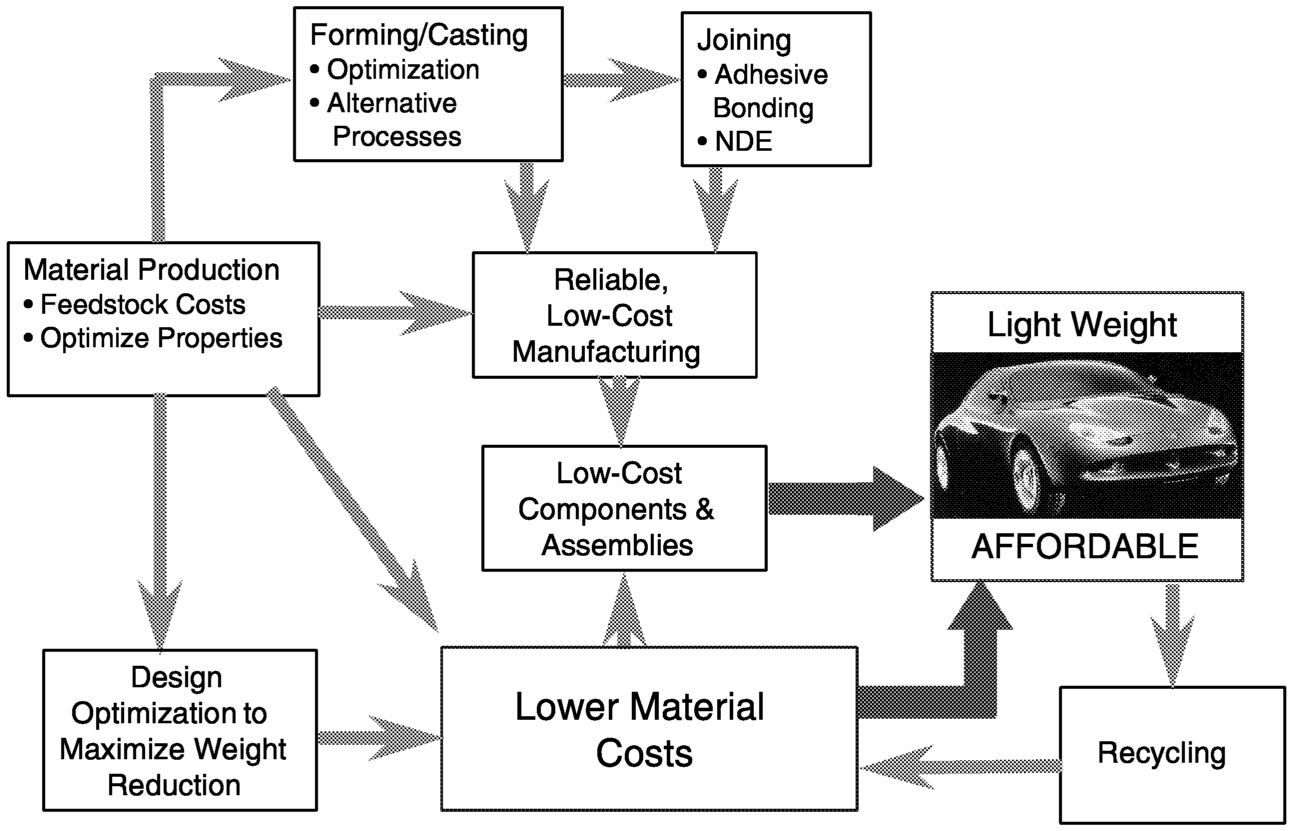
~ enlarge ~
FIGURE 2–1 Lightweight materials: affordability influences. NDE=nondestructive evaluation.
SOURCE: Mehta, 2000.
Page 59
Over 30 materials projects have been established to attack the technical challenges identified in the materials roadmap. Some projects have been completed; others are in progress, and some have just been added. The committee believes that these projects have the potential to remove the barriers that make it difficult to implement alternative materials in today's vehicles.
Program Status
Completed Projects
In a project on Design and Product Optimization for Cast Light Metals, a user-friendly design guide for chassis components was developed, based on solidification simulation models that accurately predict cast microstructure and the resulting mechanical properties. When applied to a cast aluminum control arm, these techniques led to a 26 percent weight savings, reduced cycle time, and cost savings of $1.90 per part.
A project on Stamping Press Optimization of Aluminum Sheet demonstrated the viability of variable blankholder force in improving formability and reducing wrinkling and splitting in simulated and actual auto fenders. This leads to reduced scrap and a reduced need for die fine tuning through welding and grinding, and enables parts reduction and consolidation. A project on Warm Forming of Aluminum Sheet demonstrated the ability to form a complex aluminum door inner panel not possible using traditional stamping. This was accomplished by heating the dies to ∼250°C. This results in reduced scrap due to wrinkling and tearing and eliminates the need for a re-draw stage required in steel.
The Low Cost Aluminum Sheet project to develop 5000-series continuous cast sheet for body structures was successfully completed last year. Belt-cast thin sheet, produced with several process or alloy variations, was used successfully to form several large and challenging prototype parts. This process for producing lower-cost aluminum is being considered by major producers of aluminum sheet.
In the area of polymer composites a High Volume Liquid Composite Molding project (Automotive Composite Consortium Focal Project 2) has demonstrated the ability to produce high-volume preforms (the P-4 process), the ability to mold large structural components, and the viability of structural adhesive bonding. A polymer composite truck pickup box was developed by liquid composite molding, resulting in a weight savings of 27 percent for the complete assembly (see Figure 2–2). A cost model was developed that shows that the composite pickup box is lower in cost relative to steel for target volumes in the range of 50,000 to 75,000 units, as shown in Figure 2–3.
The first application of this composite technology is the pickup box for the 2001 Chevrolet Silverado, which was named one of the Ten Best Innovations of the Year by Popular Science magazine. The box is 50 lb lighter and the tailgate is 15 lb lighter than their steel counterparts. The impact and corrosion resistance of
Page 60
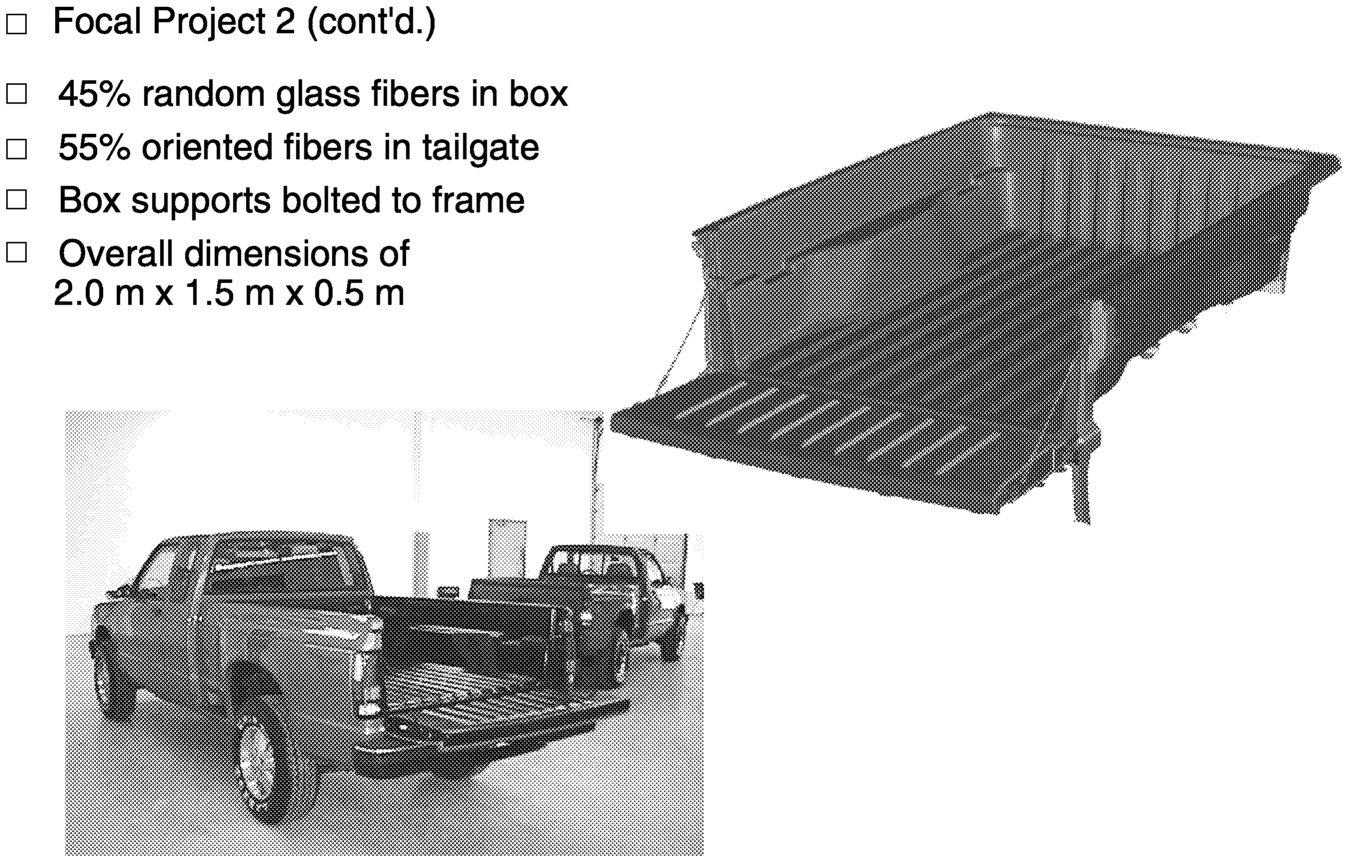
~ enlarge ~
FIGURE 2–2 Polymer composite pickup box.
SOURCE: Mehta, 2000.
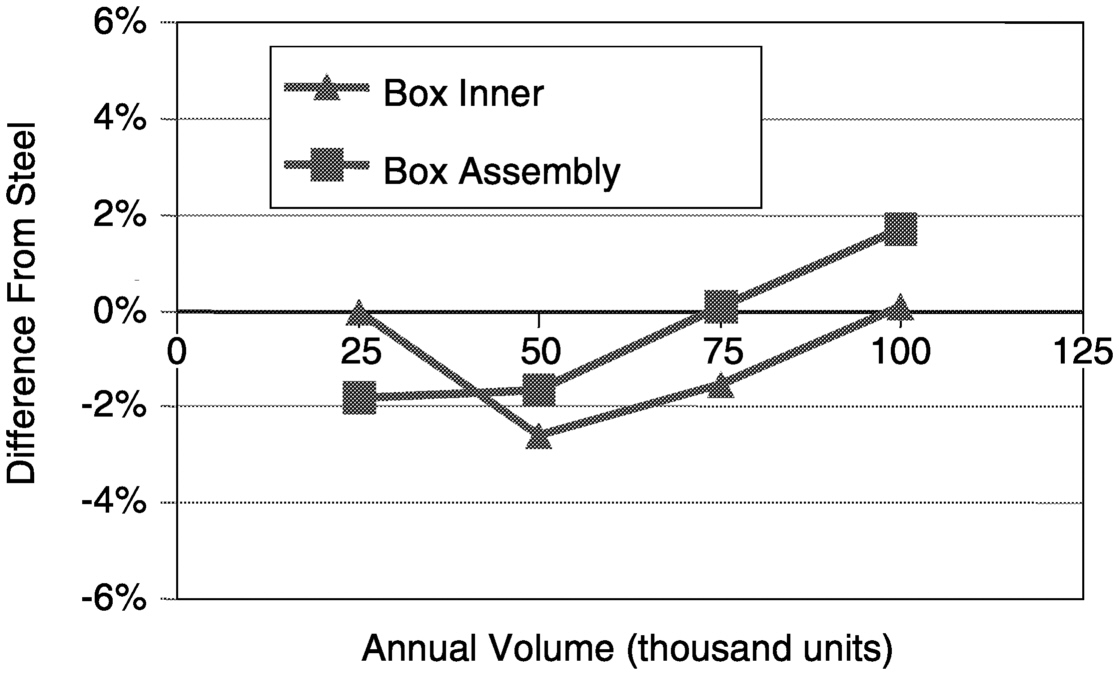
~ enlarge ~
FIGURE 2–3 Cost of polymer composite pickup box relative to the cost of steel pickup box.
SOURCE: Mehta, 2000.
Page 61
the box is far superior to that of steel truck beds. Also, Ford has used sheet molding technology to produce an all-composite, one-piece SUV truck bed for the Ford Explorer Sport Trac. The steel counterpart was 30 percent heavier and composed of 40 separate parts.
Another approach to composite body technology is being pursued by DaimlerChrysler in its proprietary PNGV program (NRC, 1999, 2000). Its process produces large, one-piece parts by injection molding of glass-fiber-reinforced polymer (GFRP) resins. The integrated moldings, which are 25 to 35 percent lighter than mild steel, are attached to an aluminum space frame, resulting in a BIW 50 percent lighter than steel (NRC, 2000). As indicated in Table 2–9, this technology was used in the DaimlerChrysler ESX3 concept vehicle, which achieved the lowest curb weight of the three concept vehicles developed by the USCAR partners (see Table 2–9).
Projects Under Way
Focal Project III (FP III) supported by the Advanced Composites Consortium (ACC) involves the development of BIW structure in GFRP composites. This entails constructing the body from approximately 11 large liquid molded parts, as shown in Figure 2–4. Thus far, computer-aided design (CAD) and coarse finite element analysis (FEA) models have been generated for initial concepts
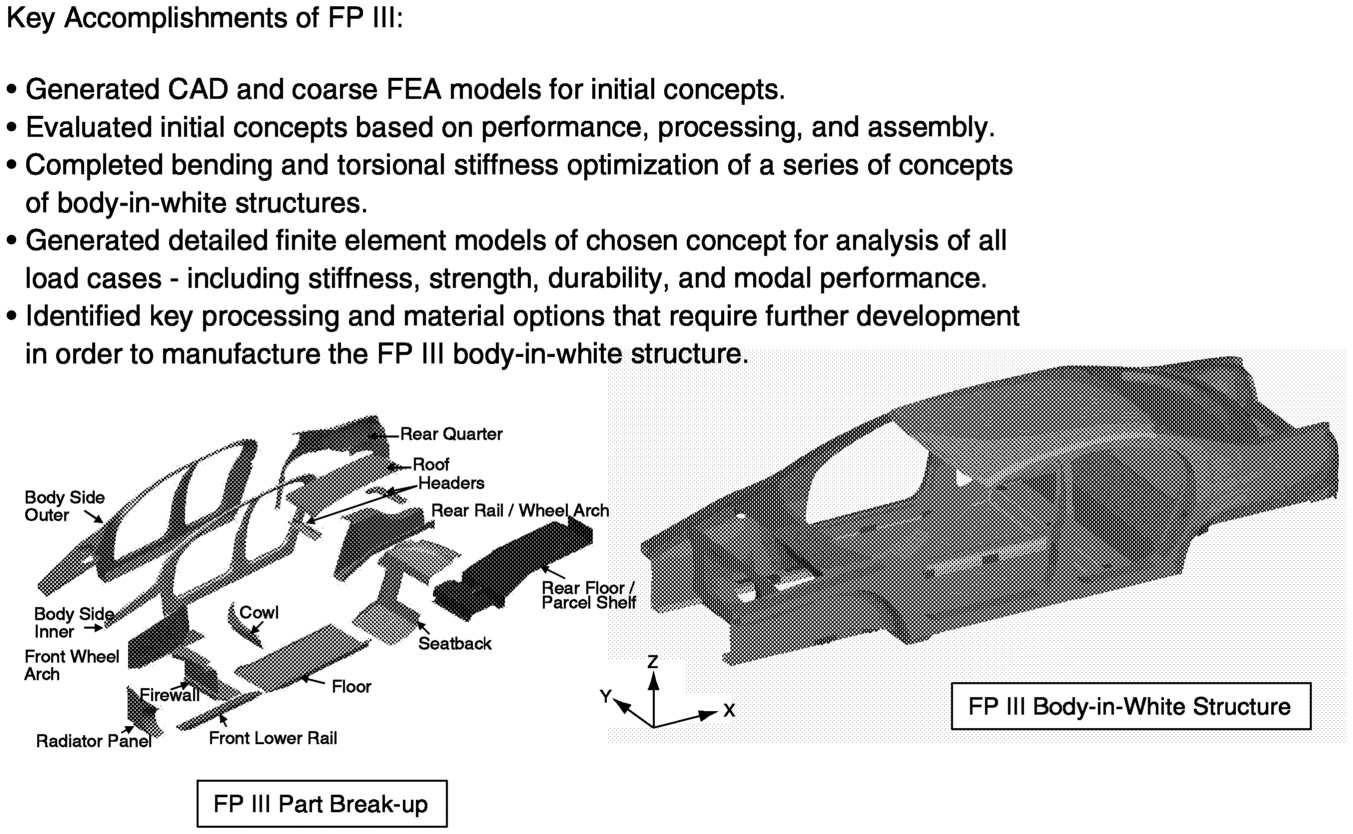
~ enlarge ~
FIGURE 2–4 The ACC Focal Project III body-in-white structure.
SOURCE: Mehta, 2000.
Page 62
and have been evaluated for performance, processing, and assembly. Bending and torsional stiffness of the BIW structure have been optimized. Detailed finite element models of chosen concepts have been generated for analysis of all load cases, including stiffness, strength, durability, and modal performance. Key processing and material options that require further development in order to manufacture the FP III structure have been identified.
In the past, work by the ACC showed that it was difficult to achieve good frontal crash response from polymer composite front-end structures. These early problems have been overcome. The ACC's Focal Project 1 demonstrated that a composite structure can be designed to meet Federal Motor Vehicle Safety Standard (FMVSS) requirements. In this case the front end of an Escort was built and successfully tested in a frontal crash experiment.
Although the ACC projects are aimed at glass FRP, where weight savings are in the range of 25 to 35 percent, the technology of liquid molding of composites can be adapted to carbon FRP, where weight savings approach 65 percent. Projects are in place with suppliers and ORNL to develop low-cost carbon fibers through lower-cost precursors and by microwave processing. Potential exists to reduce fiber cost by 20 percent.
Aluminum metal matrix composite (Al-MMC) applications in chassis and power-train subsystems could account for 30- to 50-lb weight savings. The major hurdles to developing applications of this material are feedstock costs ( Table 2–10) and the development of a reliable process for making the composites. A low-cost powder metal process and a casting process are under development. In the casting process a new and improved batch technique for mixing silicon carbide in the aluminum melt has been developed, and the performance of a lower-cost (silicon carbide) reinforcement has been demonstrated. Equipment that can prepare a 600-kg sample batch of composite material was expected to be operating in January 2001.
In the area of recycling, a project on Aluminum Alloy Scrap Sorting has been initiated to demonstrate the commercial practicality of sorting shredded scrap, using color and laser spectroscopy. This process is capable of separating cast from wrought materials and distinguishing among wrought alloys.
Program Assessment
As the PNGV program moves toward 2004 and the requirement of producing affordable production-prototype vehicles, the PNGV team should attempt to balance the opposing requirements of weight reduction and affordability. The arguments presented in the “ Materials Selection, Design, and Manufacturing ” section above lend credence to this position. The PNGV team should carefully follow the progress on the new ULSAB-AVC project. This modeling study appears to be on track to demonstrating that a 2,275-lb steel-intensive vehicle, operating on a gasoline-powered ICE engine, can be attained. It may be possible
Page 63
to add aluminum and/or magnesium components (hybridize) and/or polymer composites and achieve the vehicle weight target at a much lower cost than with the aluminum-intensive vehicle approach. These design and manufacturing techniques could be used on aluminum-intensive vehicles as well as hybrid steel-aluminum structures.
The challenge in being able to adopt low-density materials on a broad scale is the development of new, low-cost processing methods, including feedstock materials. The committee is satisfied that the PNGV materials technical team has developed a portfolio of R&D programs that is directed toward producing lower-cost, low-density materials. Having said this, the committee finds it difficult to track progress on a given project on a year-to-year basis. Each year the PNGV materials technical team selects a different group of projects on which to report. For example, last year magnesium and titanium projects were discussed, but this year they are barely mentioned. An alternate reporting approach is needed.
Recommendations
Recommendation. Because affordability is a key requirement of the 2004 production-prototype vehicles, the committee believes that more attention should be paid to the design and manufacturing techniques being worked on by the American Iron and Steel Institute in the Ultralight Steel Auto Body Advanced Vehicle Concept project. These techniques should be applied to aluminum-intensive vehicles, as well as hybrid-material body construction. More broadly, the committee urges a systematic, critical examination of the prospects to achieve cost goals for all key vehicle subsystems and components.
Recommendation. Given the difficulty of tracking progress on more than 30 materials R&D projects, PNGV should devise a new reporting approach that measures progress against objectives.
VEHICLE SAFETY
The economic feasibility of PNGV-class vehicles will depend on meeting or exceeding consumer expectations in vehicle function, comfort, and safety. The Goal 3 safety requirement in the 1995 PNGV Program Plan was to meet all Federal Motor Vehicle Safety Standards (PNGV, 1995). Since 1995 consumer choice has shifted to heavier vehicles that also are perceived to provide increased safety. The PNGV vehicle is designed to replace a heavier passenger car of the same size in a fleet that is dominated by even heavier cars and light trucks. This environment may be an impediment to selling these vehicles. Also, since 1995 family vehicles have introduced a profusion of safety features beyond those required by the government, some of which may have to be incorporated into
Page 64
these new vehicles for them to be competitive. In addition to these considerations, the new technologies, introduced by PNGV-type cars, will create new failure modes and safety concerns that will have to be considered.
Status and Progress
The PNGV concept cars were designed to meet all existing standards with the exception of FMVSS 111, which requires outside rear-view mirrors (CFR, 2000). To reduce aerodynamic drag on these vehicles, outside mirrors were replaced with an indirect viewing system that uses digital cameras and a flat screen display inside the vehicle. These designs offer opportunities to increase the amount of information available to the driver. However, it is not known how well a flat screen display will replace the external mirror presentation to the driver under all conditions. Research by the PNGV is planned during 2001 to assist the National Highway Traffic Safety Administration (NHTSA) in evaluating human factors associated with alternatives to exterior mirrors. The results will provide NHTSA research information to assist in a possible upgrade to FMVSS 111.
The 1995 PNGV Program Plan calls for NHTSA involvement to “help assure that any vehicles offered for sale possess structural integrity, include occupant protection systems, and do not compromise safety levels” (PNGV, 1995). In December 1999 the Safety Working Group was established to involve the PNGV industry partners and NHTSA more actively in safety issues. The working group has identified and prioritized five safety research needs by PNGV-class vehicles.
The working group has recognized the need to address safety concerns that extend beyond the goal of meeting the minimum FMVSS. These issues involve the safety of PNGV-related designs that may not be addressed by present standards. For example, in general, customers associate lighter vehicles with decreased safety. This may impede the sales of PNGV-type vehicles. It has been well documented that smaller, lighter vehicles provide less occupant crash protection (DOT, 1997). The PNGV-type vehicle will use lighter materials and new construction techniques to reduce weight but maintain the vehicle size. Consequently, the effect on occupant safety may be mitigated due to increased crush space available. This important issue is being addressed by analyzing field accident data and is funded by the industry partners. The study will examine the relationship between safety and vehicle size, independent of vehicle weight. The absence of PNGV-type vehicles in the database makes it more difficult to separate the effects of vehicle size from vehicle weight. A second study of vehicle size and weight that uses computer modeling of vehicle structures in crashes has been defined but not funded. In its sixth report the committee recognized this research need and recommended that it be accelerated (NRC, 2000).
Page 65
Other as yet unfunded safety research projects identified by the Safety Working Group include (1) mathematical models for joints in integrated materials structures; (2) HEV power trains (power electronics, energy storage); and (3) alternative fuels.
Changes in Environment
The PNGV safety goals developed in 1995 apparently did not anticipate the changes that have subsequently occurred in consumer attitudes toward vehicle weight and safety. Most consumers (and some physicists) equate increases in vehicle weight with increases in safety. In today's market a lightweight vehicle like the PNGV-type vehicle may be unacceptable to safety-conscious consumers. However, the overall safety of a vehicle is not governed totally by the vehicle's weight. Improved crash-avoidance features, higher levels of crash protection, and increased vehicle size can offset the weight disadvantage. The marketability of the PNGV-type vehicle will depend on demonstrating to consumers that they are not trading safety for fuel economy. To date, the PNGV project has not adequately addressed this issue. In addition, since 1995 a large number of new safety features beyond those required by federal standards have been introduced. These features were supported by a competitive market rather than government mandates. Examples of market-driven safety features on today's family vehicles include anti-lock brakes; automatic traction control; automatic stability control; low-tire-pressure warning; and many new occupant restraint devices. By the time PNGV-type vehicles enter the marketplace, the level of vehicle safety technology will be quite different from the 1994 family sedans that were the baseline for PNGV function and safety, and this will have to be reflected in the ultimate designs.
As noted above, consumer choice has shifted during recent years to heavier vehicles that are also perceived to provide increased safety, and marketing for PNGV-type vehicles will have to deal with this perception. In addition, the introduction of new technology has occasionally created new safety concerns, such as unintended injuries and fatalities from air bag deployments in unusual circumstances. These concerns include not only the crashworthiness of new designs and materials but also new safety issues in flammability, fire and explosion, toxicity, sources of heat and chemical burns, and electrical shock. Defining the safety issues associated with the new technologies for PNGV-type vehicles will be a priority of the recently established Safety Working Group. The committee believes that funding for this work will have to be increased to adequately address these issues. Also, research support from the government appears to be nonexistent in this area, which should be corrected.
Page 66
Recommendations
Recommendation. Because of the unresolved issues related to safety, the safety research in support of PNGV should receive a higher priority. Critical projects identified by the Safety Working Group should be accelerated and funded appropriately. More effective research support should be provided by the U.S. Department of Transportation.
Recommendation. Any initial low-volume production fleet vehicles should be monitored for early signs of any safety issues.
FUEL ISSUES
All the power system options under evaluation in the PNGV program appear to require fuel modifications that would have significant impacts on the petroleum industry, as pointed out previously (NRC, 2000). Mindful that fuels compatible with efficient engine technologies must be widely available to produce meaningful reductions in fuel use, the PNGV has continued to investigate the interactions of power systems and fuels. There have been important additional testing programs involving auto and petroleum companies, including the Ad Hoc Diesel Fuel Research Program, the Coordinating Research Council (CRC) Advanced Vehicle, Fuel, Lubricant (AVFL) Committee, and the Advanced Petroleum-Based Fuels (APBF) Program, as well as efforts through the CARB Fuel Cell Program, and EUCAR/USCAR Cooperative Fuels Research (see Chapter 2 section, “ Internal Combustion Reciprocating Engines ”). The primary power plant options under consideration in the PNGV are the CIDI engine in the HEV configuration and fuel cells; the fuel implications of each of these are discussed below.
Fuels for CIDI Engines
The CIDI engine continues to be potentially attractive because of its high efficiency, but emissions of PM and NO x are of concern, particularly in view of the EPA Tier 2 standards. PNGV is pursuing options for reducing engine-out emissions, as well as after-treatment methods. Fuel composition influences both of these approaches.
Sulfur content is probably the most important fuel parameter, affecting both engine-out emissions (primarily particulates) and the performance of after-treatment systems to reduce either NO x or particulates. In the past year priority in the program has been on identifying systems with the potential to meet the Tier 2 standards and, while available data indicate that any sulfur is detrimental, the PNGV has not determined just how low the sulfur content must be to ensure long-
Page 67
term operation. Results show that reducing sulfur improves the effectiveness of SCR systems for NO x control. Work on sulfur traps has continued and indicates that such traps might make it feasible to use sulfur-sensitive after-treatment with sulfur-containing fuels. Upstream trapping of sulfur made it possible to achieve 90 percent reduction of NO x, using a NO x adsorber, which is very sensitive to sulfur. However, available data from Toyota indicate that the trap regeneration temperature will be on the order of 650°C for periods of 10 minutes or more, and even then satisfactory regeneration was obtained only with a feed sulfur content of 8 ppm (Toyota, 2000). Much more work on this concept is required to provide relief from the feed sulfur restriction. Sulfur traps would require periodic maintenance with a frequency depending on the fuel sulfur level, and this would raise the issue of ensuring consumer participation in such maintenance.
Lower-sulfur commercial fuels will be available by June 1, 2006, because of the EPA (Federal Register, 2001) final rule requiring refiners to produce diesel fuel with a maximum sulfur content of 15 ppm. Based on answers to committee questions, the PNGV expects that, to ensure 15 ppm maximum sulfur, the average sulfur content will be 10 ppm (PNGV, 2001). A recent study (DOE, 2000a) indicates that less than 10 ppm sulfur may be required to achieve “minimum acceptable effectiveness” of CIDI engine emission control devices. Nevertheless, in discussions with the committee, PNGV members expressed the view that an average sulfur content of 10 ppm and a maximum level of 15 ppm would be marginally acceptable. If current efforts fail to develop systems that can tolerate the level of sulfur mandated by EPA, a major program re-assessment will be required.
As addressed in the section “ Internal Combustion Reciprocating Engines ” in Chapter 2, fuel composition can impact the production of regulated emissions, most notably PM and NO x. It has been concluded that, even under the most favorable conditions, the reduction of in-cylinder emissions is not sufficient to preclude extensive exhaust-gas after-treatment. In addition to the assessment of fuel composition impacts on regulated emissions, PNGV also investigated the impact of fuel composition on potential health-impacting toxic chemicals. One program completed in 2000–2001 was directed toward chemical characterization of engine-out diesel emissions, including compounds that might have toxicological effects, 4 using advanced fuels. This study showed that use of a Fischer Tropsch “diesel fuel” low in aromatics, or a mixture of an oxygenate and a low-sulfur petroleum fuel, significantly reduced the emissions of hydrocarbons, particulate matter, polyaromatic hydrocarbons (PAHs), and aldehydes, when compared with emissions using conventional diesel fuel. In addition, these fuels produced the lowest overall “toxic” gas and PAH exhaust emissions. Thus, avail-
4Emissions of 4 potentially toxic gaseous emissions, 11 gaseous PAH compounds, and 17 particulate-soluble organic-phase PAH compounds were measured.
Page 68
able data indicate that gross changes in fuel composition (i.e., reducing aromatics content or adding oxygenates) can affect engine-out emissions in significant ways.
The PNGV told the committee that a fuel cetane number of at least 45 will probably be required, and this will restrict the aromatics content to some extent. The committee notes that reducing sulfur to 15 ppm could lead to a reduction in aromatics content and an increase in cetane number since the hydro-treating process used to reduce sulfur will also directionally saturate aromatics. No definitive data on the extent of this effect are available to the committee.
Another program determined the contribution of lubricating oil to the emissions of PM from an advanced diesel engine. Lubricants studied included synthetic and mineral-oil-based materials. CARB diesel and a mixture of an oxygenate and low-sulfur petroleum were used as fuels. These lubricants had a smaller effect on particulate emission than the fuels studied. However the lubricant contribution could become important at very low exhaust emission levels.
The supply of aqueous urea would quickly become an important issue if urea SCR were to become the preferred NO x-control strategy. While this is not a fuels issue, it is mentioned here since fueling stations would be one potential means of providing this urea. Pursuing this possibility would require the cooperation of the petroleum industry.
The committee believes that the most important fuel issue is the sulfur content required to meet long-term emission certification. If the preferred power systems were to require sulfur levels lower than those mandated by EPA or other compositional changes, additional government action would be needed to coordinate the efforts of the auto and petroleum industries to ensure timely availability of commercial fuel. The committee believes that a very important issue is the maximum sulfur level required to meet the long-term emission certification.
Fuels for Fuel Cells
While some work has been initiated on the direct methanol fuel cell, the PNGV has focused primarily on the hydrogen fuel cell with a gasoline fuel processor to provide the hydrogen. The program also includes some work on a flexible-fuel processor as well as distributed hydrogen generation at service stations, combined with onboard storage of hydrogen. This program is developing technologies that could be applied to different fuels, but in applications the fuel processor would be optimized for one fuel only.
The reforming catalyst that converts gasoline to hydrogen is sensitive to sulfur. While progress has been made to increase the sulfur tolerance of this catalyst, it is not clear what sulfur level will be acceptable. In addition, reforming is more difficult with more aromatic gasolines. The systems under development might require a reduction of sulfur and aromatics content; in fact, the required aromatics content might be low enough to require a different petroleum fuel, such
Page 69
as naphtha, as the committee pointed out last year in its sixth report (NRC, 2000). A presentation on the California Fuel Cell Partnership indicated to the committee a lack of optimism for the ultimate success of the gasoline (or modified gasoline) reformer (Wallace, 2001).
Because of the issues with gasoline and the fact that methanol is much easier to reform to hydrogen, reforming of methanol or other oxygenates continues to be in the program. A multiyear program (DOE, 2000b) to address these issues and to explore the use of reformulated diesel, methanol, ethanol, and Fischer-Tropsch liquids in fuel-flexible fuel processors is under way.
While the committee feels that additional efforts are needed to identify fuel and reformer combinations that are feasible, it is not optimistic about the future for fuel-flexible processors, in view of the added complexity introduced by the requirement for multiple fuels. The program is comprehensive in scope. As results are obtained, it will be important to narrow the scope quickly, using decision points that are included in the program plan. The study should include an update of the cost and availability outlook for methanol and other oxygenates based on an updated analysis of the long-term supply and cost of natural gas and from Fisher-Tropsch fuels. As pointed out by the committee last year (NRC, 2000), the capital cost for hydrogen generation at large, central facilities followed by widescale distribution is roughly $3,500 to $6,700 per vehicle. 5 Last year the committee recommended consideration of distributed hydrogen generation at service stations, and DOE has included this in its program mentioned above. The committee notes that reforming of gasoline or methanol is not a clear winner to reduce carbon dioxide emissions and increase overall efficiency of fuel use. As options for off-vehicle hydrogen generation are evaluated, the effects of each approach on life-cycle efficiency and carbon dioxide emissions should be kept in focus. The DOE program also includes work on chemical storage systems, such as metal hydrides, which have the potential to reduce onboard storage volume or storage pressure, or, with additional storage and associated weight, increase the vehicle's driving range.
In view of the difficulties with supplying hydrogen for the hydrogen fuel cell, it is significant that DaimlerChrysler announced in 2000 its first test vehicle, a go-cart equipped with a 3-kW direct methanol fuel cell (with no reformer) (Muller, 2000). The vehicle is reported to have a top speed of 22 mph, and the company has already built a 6-kW, 60-V version. This represents an important step along the way toward development of fuel-cell-powered vehicles that do not require hydrogen. The company estimates that direct-methanol fuel cell vehicles could be available in about 10 years.
5In comparison, the onboard gasoline processor would cost $4,350 per vehicle based on PNGV targets (a 50-kW system at a cost of $300/kW), 29 percent of which is for the fuel processor, and would eliminate the need for a hydrogen distribution system.
Page 70
As pointed out last year, methanol is not widely available at the present time, but it could be distributed through existing service stations with modifications to the supply and distribution system, for example, to maintain product segregation, manage water, and replace any materials not compatible with methanol. Issues related to its corrosive properties and potential public health effects would require further investigation, and time would be required for fuel suppliers to make the facility modifications necessary to supply an additional fuel. In addition, new plants to manufacture methanol could be required depending on the extent of commercial use of this option, and methanol cost would be affected by natural gas cost. On the other hand, because methanol is used to make methyl tertiarybutyl ether (MTBE), if the use of MTBE in gasoline decreases, more methanol could become available without new plants.
It is clear from the foregoing discussion that the hydrogen required by fuel cells could be generated from gasoline, another petroleum liquid fuel, methanol, or natural gas. Some options call for onboard generation, and others, for generation in centralized facilities. Given the program goals of increasing efficiency and reducing fuel consumption, it will be important to make all-inclusive, “well to wheels” analyses (Weiss et al., 2000) to account for all factors associated with providing hydrogen.
The present DOE Hydrogen Program has a total of 77 projects that deal with hydrogen production, storage, and use for both stationary source applications and vehicular use (DOE, 2001).
Recommendations
Recommendation. High priority should be given to determining what fuel sulfur level will permit the preferred compression-ignition direct-injection (CIDI) engine and its after-treatment system to meet all regulatory and warranty requirements. An enhanced cooperative effort between the auto and petroleum industries should be undertaken to ensure that the fuels needed commercially will be available on a timely basis.
Recommendation. Given the breadth of the multiyear Fuels for Fuel Cells R&D Program, the go/no-go decision points should be closely followed to facilitate identification and timely development of the preferred options.


