
C The Current Astronomy and Astrophysics Enterprise
NATIONAL SCIENCE FOUNDATION
The National Science Foundation provides support for astrophysical research in optical/infrared astronomy, radio astronomy, solar physics, and planetary astronomy, and in particle and gravitational-wave astrophysics, via (1) awards for principal investigator grants, (2) instrumentation development, (3) major facility construction, and (4) facility operations. A snapshot of recent funding levels is presented in Table C.1, and selected funding trends are shown in Figures C.1 through C.7.1
Research and teaching funding for the discipline comes primarily from the Astronomical Sciences Division (AST) in the Mathematical and Physical Sciences (MPS) Directorate, with additional support from other parts of MPS (especially for particle astrophysics and gravitational-wave research), the Division of Atmospheric Sciences (for solar physics), the Office of Polar programs (for astronomy from Antarctica), the Directorate
|
|
NOTE: See Figure 1.1 for a schematic depiction of the U.S. astronomy and astrophysics research enterprise. All of the information presented here can be found in much greater detail in Federal Funding of Astronomical Research (National Academy Press, Washington, D.C., 2000). |
TABLE C.1 NSF Astronomy Division Funding Data from FY 2000 (Thousands of Current-Year Dollars)
|
Budget Category |
Dollars |
Percentage of Budget |
|
Research |
33,200 |
24 |
|
Operations |
88,000 |
64 |
|
Construction and instrumentation |
16,800 |
12 |
|
Total |
138,000 |
100 |
|
SOURCE: NSF’s Astronomical Sciences Division. |
||
for Education and Human Resources (for some undergraduate and graduate education), Crosscutting/Interdisciplinary Programs, and the Office of Integrative Activities. NSF supports the operation of six major national observing centers—the National Optical Astronomy Observatory, with facilities in Arizona and Chile; the National Radio Astronomy Observatory, with facilities in New Mexico, West Virginia, Virginia, and Arizona;
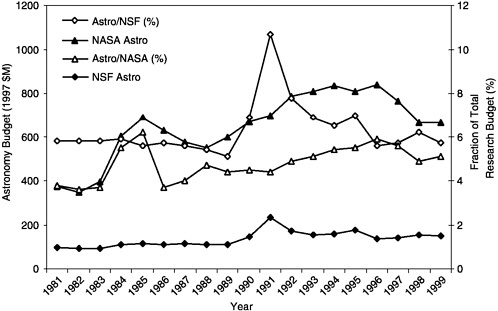
FIGURE C.1 Overall funding of astronomy by NASA and NSF. Astro/NSF and Astro/NASA are the relative fractions of the NSF and NASA research and development budgets allocated to astronomy and astrophysics research (right-hand scale).
SOURCE: After Figure 2.2 in Federal funding of Astronomical Research (National Research Council, National Academy Press, Washington, D.C., 2000), p. 8.
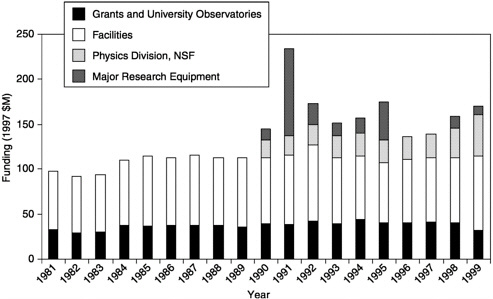
FIGURE C.2 NSF funding for astronomy. Note that funding for university observatories is grouped with that for grants, as in the 1991 Decadal Report.
NOTE: Major research equipment (MRE) bars include funding for the Green Bank Telescope in 1991. The funding denoted by PHY includes support for astrophysics and astronomy programs in NSF’s Physics Division. Data on Physics Division support for astronomy and astrophysics were not available for the years prior to 1990. Funding for the Laser Interferometer Gravitational-wave Observatory is not included in either the MRE or the PHY category in this figure.
SOURCE: After Figure 2.3 in Federal funding of Astronomical Research (National Research Council, National Academy Press, Washington, D.C., 2000), p. 9.
the National Astronomy and Ionosphere Center, which operates the Arecibo Telescope in Puerto Rico; the international Gemini Observatory, with telescopes in Hawaii and Chile; the National Solar Observatory, with telescopes in New Mexico and Arizona; and the Laser Interferometer Gravitational-wave Observatory, with installations in Washington and Louisiana. NSF also supports the High Altitude Observatory in Colorado through the National Center for Atmospheric Research. NSF is the major source of support for millimeter-wave astronomy in the United States through four university radio observatories. The NSF astronomy program is entirely extramural. According to NSF officials, the AST program had approximately 500 active grants in FY 2000, and those contributed to the support of over 450 senior researchers, more than 100 postdoctoral scientists, and more than 500 graduate and undergraduate students.
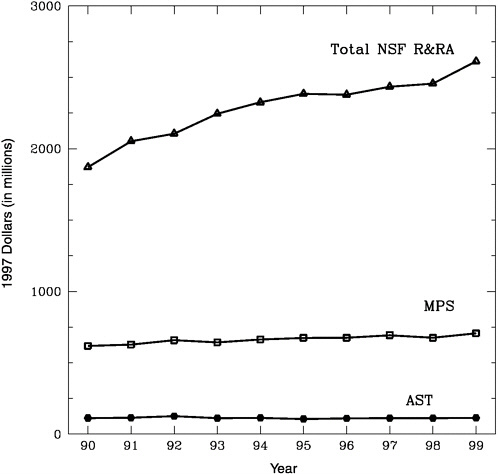
FIGURE C.3 Total NSF, Mathematical and Physical Sciences Directorate (MPS), and Astronomical Sciences Division (AST) funding, FY 1990–1999, in 1997 dollars. Top curve is the total NSF R&RA budget (R.Konkel, from NSF Congressional Budget Summary) and does not include construction. Lower curves are for the MPS Directorate and the AST, also excluding construction (MRE) funding; these lines represent the essential “operating” budgets of the Mathematical and Physical Sciences Directorate and the Division of Astronomical Sciences.
SOURCE: After Figure 5.1 in Federal Funding of Astronomical Research (National Research Council, National Academy Press, Washington, D.C., 2000), p. 27.
Awards for work in solar astronomy from areas other than AST amount to about 130 additional grants to the NSF total (National Research Council, Ground-based Solar Research: An Assessment and Strategy for the Future, National Academy Press, Washington, D.C., 1998) with a commensurate increase in the size of the investigator and student population being affected by NSF research grants.
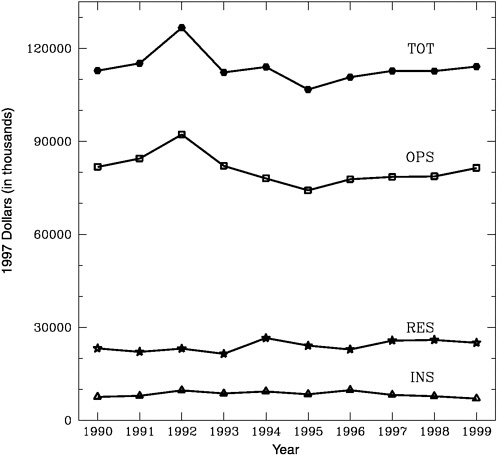
FIGURE C.4 NSF Division of Astronomical Sciences budget in 1997 dollars. The top curve is the total AST budget. Lower curves are for total operations (OPS), research grants (RES), and instrumentation grants (INS) expenditures. Operation of private radio facilities is included in the operations line. The AST budget line does not include major construction funding under the MRE program.
SOURCE: After Figure 5.2 in Federal funding of Astronomical Research (National Research Council, National Academy Press, Washington, D.C., 2000), p. 33.
NASA
NASA support for research in astronomy and astrophysics includes funding for the development of space observatories and instruments on other space missions that conduct astronomical measurements, space mission operations and data processing, research grants for data analysis and other astronomical and astrophysical studies, and other activities in support of space astronomy. Included in the latter category are some ground-
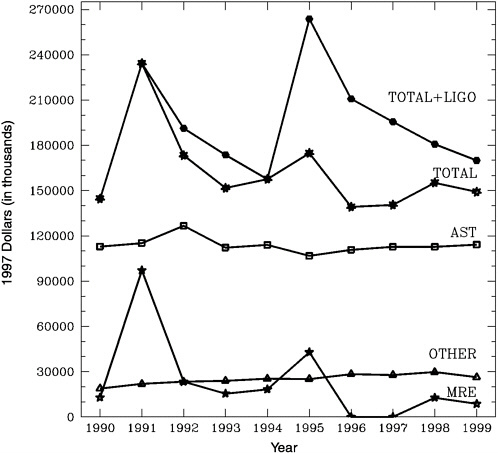
FIGURE C.5 Total NSF budget for astronomy and astrophysics in 1997 dollars, 1990 to 1999. The top curve is the total of the budget for AST, MRE, other, and LIGO. LIGO support is included in this total, but not in astronomy-related MRE, since this is primarily a physics program. The next curve down is the total of AST, MRE, and other budget, without LIGO. Lower curves show the breakouts for AST; astronomy-related MRE, including the VLBA, GBT, Gemini, and ALMA but not LIGO; and other support for astronomy and astrophysics from MPS, OPP, ATM, and OMA.
SOURCE: After Figure 5.3 in Federal Funding of Astronomical Research (National Research Council, National Academy Press, Washington, D.C., 2000), p. 34.
based observatories (most U.S. planetary astronomy), some balloon and sounding rocket projects, and data archival centers. Among the major ground-based facilities or programs to which NASA has contributed some support are the Keck Interferometer Project, the Infra-Red Telescope Facility on Mauna Kea, the 2-Micron All Sky Survey, and the Sloan Digital Survey. A snapshot of recent NASA funding levels is given in Table C.2,
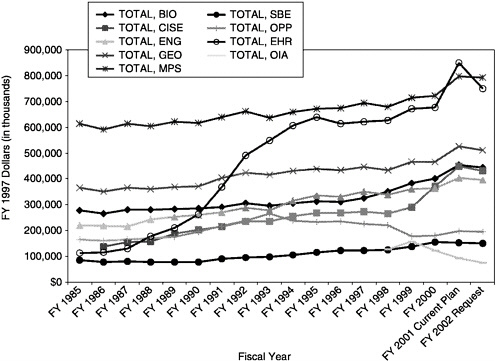
FIGURE C.6 NSF Directorate funding since 1985 (in thousands of FY 1997 dollars).
SOURCE: Data from NSF.
and some funding trends are shown in Figures C.1 and C.8. NASA support for astronomy and astrophysics research resides entirely under the Office of Space Science. In addition to support for research in the extramural scientific community, NASA supports researchers in many of its field installations, all via competitive peer review. According to NASA officials, NASA’s astronomy and astrophysics programs, including solar and planetary astronomy, include approximately 2500 research grants. NASA officials estimated that those grants involve participation by more than 800 senior researchers, nearly 1000 postdoctoral associates, and more than 900 (mostly graduate) students.
DEPARTMENT OF ENERGY
Over the past two decades, the Department of Energy (DOE) has become an important provider of funding for astrophysics, including both university and laboratory groups and large projects. DOE funding for astrophysics comes from the Divisions of High-Energy Physics (HEP) and
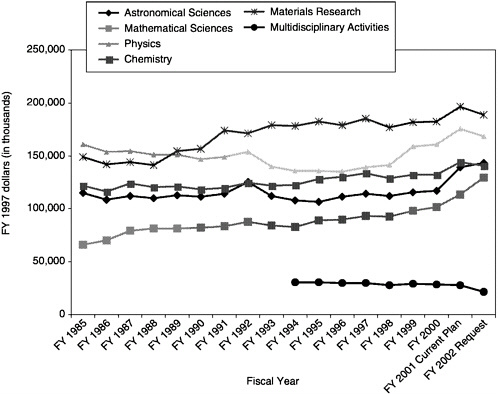
FIGURE C.7 Division budgets since 1985 (in thousands of FY1997 dollars) within NSF’s Mathematical and Physical Sciences Directorate.
SOURCE: Data from NSF.
Nuclear Physics. Total spending was estimated to be $30 million in FY 1997. The HEP program supports university and laboratory groups through continuing grants and contracts and additional money for major projects. In FY 1997, 230 groups were supported at 100 universities. The total budget for this effort was about $13 million, of which about $2.3 million was designated for equipment for the shuttle/space station-based antimatter search, Super Kamiokande (solar, atmospheric, and supernova neutrino and proton decay detector), and MILAGRO and Granite (high-energy gamma-ray detectors). Approximately $12 million was spent at DOE laboratories on astrophysics. Fermilab, Lawrence Berkeley National Laboratory, Lawrence Livermore National Laboratory, Los Alamos National Laboratory, and the Stanford Linear Accelerator Center all have significant efforts in astrophysics. The Division of Nuclear Physics supports several theoretical nuclear astrophysics groups as well as three solar-neutrino experiments.
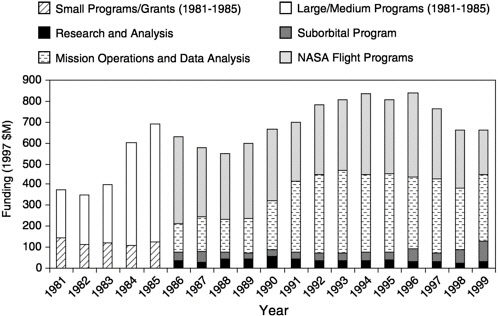
FIGURE C.8 NASA astronomy budget.
SOURCE: After Figure 2.5 in Federal funding of Astronomical Research (National Research Council, National Academy Press, Washington, D.C., 2000), p. 11.
SMITHSONIAN INSTITUTION
The Smithsonian Institution is an independent trust instrumentality of the United States, which also supports a significant astronomy and astrophysics research endeavor, primarily through the Smithsonian Astrophysical Observatory. The program includes support of two major facilities—the F.L.Whipple Observatory, which includes the Multiple Mirror Telescope (jointly operated with the University of Arizona) and the Submillimeter Array on Mauna Kea, currently under development. The conversion of the Multiple Mirror Telescope to a single 6.5-meter telescope, the construction of the Submillimeter Array, and the major instrumentation programs for each are currently covered separately from the basic operations and research budget. The budget for the Smithsonian Astrophysical Observatory in FY 1997 was approximately $16.8 million plus $7.24 million for major facility construction.
DEPARTMENT OF DEFENSE
Department of Defense funding of astronomy and astrophysics is difficult to determine because it is generally distributed throughout a
TABLE C.2 NASA Astronomy Funding Data from FY 2000 (Thousands of Current-Year Dollars)
|
Budget Category |
Dollars |
Percentage of Budget |
|
Research and data analysis |
181,000 |
20 |
|
Operations and non-user data analysis |
113,000 |
12 |
|
Construction and instrumentation |
623,000 |
68 |
|
Total |
917,000 |
100 |
|
SOURCE: NASA’s Office of Space Science. |
||
number of different DOD programs. The report Federal Funding of Astronomical Research (National Research Council, National Academy Press, Washington, D.C., 2000) identified programs with significant federal funding under the U.S. Naval Observatory, Naval Research Laboratory, Air Force Phillips Laboratory, Aerospace Corporation, Sacramento Peak Observatory/National Solar Observatory, Lawrence Livermore National Laboratory, Los Alamos National Laboratory, and National Reconnaissance Office.
INDEPENDENT GROUND-BASED OBSERVATORIES
The private and state observatories dominate the public observatories in optical/infrared ground-based astronomy in terms of access to large telescopes: the private/state observatories control roughly 80 percent of the telescope “glass” available to U.S. astronomers. The largest of these telescopes are summarized in Table C.3, including the NSF-supported Gemini Observatory (which is in effect equivalent to one 8-meter telescope because the United States controls about 50 percent of that international observatory). The committee obtained2 rough FY 2001 funding estimates for the nine major independent observatories,3 which are shown in Table C.4.
Not all of the private and state observatories provided information,
TABLE C.3 Optical/IR Telescopes of Aperture >5 Meters Currently Accessible to U.S. Astronomers or Under Construction
|
Name |
% U.S. |
Year |
Aperture (m) |
Capital Cost (millions of dollars)a |
Instrumentation (millions of dollars)a |
Location |
|
Keck I |
100 |
1993 |
10 |
94 |
13.5 |
Hawaii |
|
Keck II |
100 |
1996 |
10 |
78 |
28.1 |
Hawaii |
|
HET |
90 |
1998 |
9 |
17 |
3.6 |
Texas |
|
MMTb |
100 |
2000 |
6.5 |
23 |
26 |
Arizona |
|
Gemini-Northc |
52 |
1999 |
8 |
86 |
11.2 |
Hawaii |
|
Gemini-Southc |
42 |
2001 |
8 |
86 |
7.6 |
Chile |
|
Magellan I |
90 |
2000 |
6.5 |
38 |
9 |
Chile |
|
Magellan II |
90 |
2002 |
6.5 |
36 |
9 |
Chile |
|
LBT |
50 |
2002 |
2×8.4 |
77 |
13 |
Arizona |
|
SALT |
12 |
2002 |
10 |
17 |
|
South Africa |
|
aCosts are the total construction and current integrated instrumentation budgets, including the U.S. share. bThe MMT capital cost is for the conversion from 4.5-meter only. cGemini instrumentation costs are those included in the original capital construction budget. Gemini has a separate line for new instrumentation that is included in its annual operations budget. SOURCE: After Table 5.13 in Federal Funding of Astronomical Research (National Academy Press, Washington, D.C., 2000), p. 51. |
||||||
TABLE C.4 Estimated FY 2001 Spending by the Nine Major Independent Observatories with an Averaged Annual Construction Expenditure for the 1990s (Thousands of Current-Year Dollars)
|
Funding Category |
Dollars |
Percentage of Funding |
|
Research support (salaries) |
23,000 |
21 |
|
Operations |
35,000 |
33 |
|
Constructiona and development (new instrumentation, upgrades) |
50,000 |
46 |
|
Total |
108,000 |
100 |
|
aThis is an estimate of the average expenditure per year based on the integrated total for the decade 1991 to 2000. It includes the federal contribution (through the Smithsonian Insitution) for the Multiple Mirror Telescope conversion but does not include the $36 million that NASA provided for the Keck Interferometer Project. SOURCE: John Huchra, Harvard-Smithsonian Center for Astrophysics. |
||
and some of those that did specifically asked that their information be used in providing to the committee only integrated totals for the aggregate costs, so these estimates are very rough. There are also other, smaller private optical observatories, such as Michigan-Dartmouth-MIT Observatory, Lowell Observatory, Monterey Institute for Research in Astronomy, Southeastern Association for Research in Astronomy, and so on, which operate telescopes in the 2-meter or smaller class.
The committee did not obtain funding data for the private and state radio observatories, although many of those numbers can be found in Federal Funding of Astronomical Research. The main private and state radio observatories include the Five College Radio Observatory; the Caltech Submillimeter Observatory; the Berkeley, Illinois, Maryland Association (BIMA) array; the Owens Valley Radio Observatory (OVRO); and the Haystack Observatory. BIMA and OVRO will soon be combined to form the Combined Array for Research in Millimeter-wave Astronomy.
Details on solar astronomy observatories in the United States (both private/state and public) can be found in Ground-Based Solar Research: An Assessment and Strategy for the Future (National Academy Press, Washington, D.C., 1998).
SELECTED INTERNATIONAL GROUND-BASED ASTRONOMY FACILITIES
Ground-based optical/infrared astronomy has become an arena of intense international competition, especially in Europe and Japan. Ac-
cording to the decadal survey report (National Research Council, Astronomy and Astrophysics in the New Millennium, National Academy Press, Washington, D.C., 2001), Europe and Japan have together invested in optical/infrared facilities at a level (relative to gross domestic product) greater than 10 times that of the NSF investment over a comparable period, and more than 3 times that of the combined federal, state, and private investment. The international optical/infrared capabilities are characterized by Japan’s 8-meter Subaru Telescope, and the world’s largest combined aperture: the European Southern Observatory’s Very Large Telescope with four 8-meter telescopes in a single integrated complex. Europe, Japan, and Canada are partners with the United States in the Atacama Large Millimeter Array, which will consist of no less than 64 12-meter antennas in the Chilean high desert.
The soon-to-be-published Astronomy and Astrophysics in the New Millennium: Panel Reports (National Academy Press, Washington, D.C., 2001) contains much greater detail on the federal, international, and public/ state observatories for radio, optical/infrared, and solar astronomy.


