
1
Astronomy and Astrophysics at the Start of the New Millennium
ASTRONOMICAL AND ASTROPHYSICAL RESEARCH— THE PAST, PRESENT, AND FUTURE
The fields of astronomy and astrophysics are experiencing an extraordinary period of scientific progress. Researchers and the general public are sharing in a steady stream of new discoveries and theoretical advances on such topics as the origin of solar activity, the formation of planetary systems, the character of black holes, and the origin and large-scale structure of the universe (see Box 1.1). These developments stem largely from the availability of new facilities in space and on the ground (and some underground), rapidly advancing computational capabilities, and an active community of scientists in universities, research institutes, and government and other laboratories in the United States, and in their counterparts across the world.
Astronomy and astrophysics have changed profoundly in recent years, as has science generally. Increasingly, important discoveries are made at the interfaces between disciplines, through the use of complementary tools and the computational resources made possible by advanced supercomputers, and through both space- and ground-based facilities operating at disparate wavelengths. Indeed, the once separate identities of ground- and space-based astronomy are almost a thing of the past as researchers increasingly use the tools and data from both venues in concert. Astrophysicists are even increasingly using, or planning to use, new windows onto the universe such as gravity waves and neutri-
|
BOX 1.1 Some Highlights of Discoveries of the 1990s in Astronomy and Astrophysics
SOURCE: Adapted from National Research Council, Astronomy and Astrophysics in the New Millennium, National Academy Press, Washington, D.C., 2001, pp. 18–19. For nearly every discovery, both NSF and NASA supported the U.S. researchers who used both ground- and space-based facilities, and for some the Department of Energy provided key support as well. |
nos. One remarkable aspect of the major discoveries listed in Box 1.1 is the fact that both ground- and space-based observations played important roles in practically every breakthrough, and this trend is expected to increase. The process of identifying the likely sources of cosmic gamma-ray bursts (Box 1.2) provides a good example of the synergy and interdependence between space and ground observing techniques.
Similarly, contemporary astronomy and astrophysics cannot be parsed by wavelength, by the location of the observing instruments, or by nationality. For example, Box 1.3 describes some of the science that will be enabled by the complementary nature of three future international facilities—the Next Generation Space Telescope, the Giant Segmented Mirror Telescope, and the Atacama Large Millimeter Array—that will observe the universe at different wavelengths and from the ground and in
|
BOX 1.2 Gamma-Ray Burst Imaging 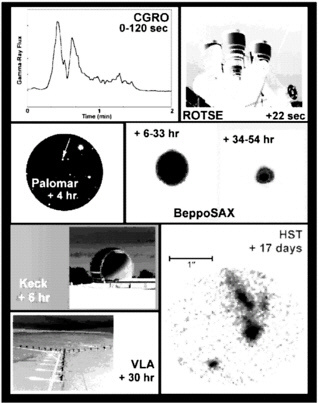 Large advances in understanding gamma-ray bursts have been made possible by the wide variety of facilities available to observe them. The utility of these numerous facilities is best shown using a recent example. On January 23, 1999, the orbiting Compton Gamma-Ray Observatory (CGRO) discovered a gamma-ray burst. The associated optical burst was then observed 22 seconds later by the Robotic Optical Transient Search Experiment (ROTSE). Following that, BeppoSAX detected the x-ray emissions from the event. These observations, especially those by BeppoSAX, allowed astronomers at the Palomar Observatory to determine the precise location of the event, and observers used the Keck telescope in Hawaii to determine the distance and spectrum. Less than a day later, the Very Large Array (VLA) in New Mexico was used to image the afterglow of the event, and 17 days after that the Hubble Space Telescope (HST) finished recording the burst by imaging the galaxy in which it occurred. To date, this is the highest-energy gamma-ray burst ever recorded. Without the wide variety of ground and space instruments available to observe the event much less would have been learned about the nature of these phenomena. SOURCE: Based on image and caption from Figure 2.10 of National Research Council, Astronomy and Astrophysics in the New Millennium, National Academy Press, Washington, D.C., 2001, pp. 74–75. |
|
BOX 1.3 The Complementary Nature of NGST, GSMT, and ALMA 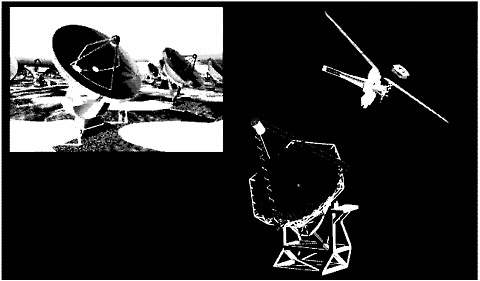 Three state-of-the-art telescopes are on the horizon: the Next Generation Space Telescope (NGST), the Giant Segmented Mirror Telescope (GSMT), and the Atacama Large Millimeter Array (ALMA). When completed, NGST and GSMT will dramatically enhance astronomers’ ability to see faint objects at optical/infrared wavelengths, ranging from galaxies with redshifts over 3 at the edge of the visible universe to Kuiper Belt objects in our own solar system, as well as provide a clearer picture of objects at the limit of the resolving powers of the Hubble Space Telescope or the Keck Observatory. Much as the Keck telescopes and the Hubble Space Telescope work together at present, the NGST and GSMT are expected to complement each other’s observations. NGST will be able to image extremely faint objects at optical and infrared wavelengths. The 30-meter GSMT will use its high spatial and spectral resolution and much larger collecting area to probe much more extensively the discoveries made by the NGST. In addition, the GSMT will be easily upgradable to take advantage of new observational technologies. ALMA, by contrast, will image the “unseen” counterparts to objects that NGST and GSMT will observe, detecting the cool radiation that dominates our universe and is observable only at millimeter and submillimeter wavelengths. ALMA images will probe the veils of obscuring dust to reveal aspects of Kuiper Belt objects, new planetary systems, forming stars, and young galaxies at high redshift that are hidden even from the view of NGST and GSMT. Combined with NGST and GSMT, ALMA will help to provide a cradle-to-grave picture of our universe that will be unprecedented. Together these instruments will be more valuable than the three would be if each were functioning on its own. SOURCE: Images courtesy of NASA’s Goddard Space Flight Center (top right; NGST), the Association of Universities for Research in Astronomy, Inc. (center right; GSMT), and the European Southern Observatory (top left; ALMA). |
space. As with other areas of science, the increasingly large scale of the tools necessary to address the compelling scientific challenges at the forefront of astronomy and astrophysics reflects a major change in the way the science is conducted in the United States and around the world. The increased reliance on large multinational projects requires a stronger, more unified planning and execution structure in the United States, so that the United States can enter into international agreements1 from a position of both intellectual and organizational strength.
While astronomical and astrophysical research has much in common with research efforts in other scientific fields in the United States, there are three attributes of the astronomy and astrophysics enterprise that are important to note in the context of this report. First, the key infrastructure upon which astronomers rely comprises two categories of observing tools, namely, ground- and space-based telescopes. The current federal responsibility for support of those two kinds of observing systems is largely the responsibility of two agencies—NSF for ground-based systems and NASA for space-based systems—with several other agencies (Department of Energy, Smithsonian Institution, and Department of Defense) playing important but smaller roles (see Figure 1.1).2 Second, in contrast with many other areas of physical science, a number of privately sponsored and state-funded observatories play a significant role or even, in the case of optical/infrared astronomy, a dominant role in the U.S. ground-based astronomy and astrophysics enterprise. This direct private sponsorship of major new telescopes for professional research is a testament to the general popularity of astronomy and astrophysics. Third, even though astronomy is becoming a field of large facilities, the typical size of observational collaborations in astronomy remains relatively small—with groups typically consisting of 5 to 10 people or fewer. Consequently, individual initiative within the community plays a significant role in setting the investigator-initiated aggregate scientific program carried out at observatories on the ground and in space.
PLANNING FOR FUTURE PROGRESS
The astronomy and astrophysics community has a unique 50-year tradition of surveying the status of the field at 10-year intervals and set-
|
1 |
For a discussion of such international agreements, see the National Research Council report U.S.-European Collaboration in Space Science (National Academy Press, Washington, D.C., 1998). |
|
2 |
The federal funding system for astronomy and astrophysics is discussed briefly in Appendix C. |
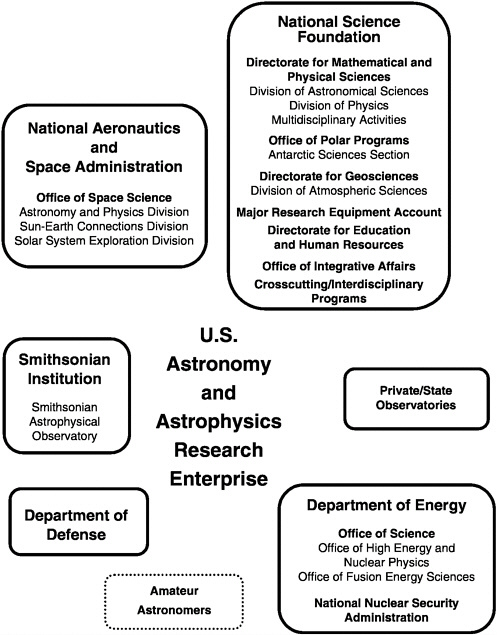
FIGURE 1.1 A schematic representation of the important multiple federal and non-federal elements of the U.S. astronomy and astrophysics research enterprise. The sizes of the individual boxes are not intended to convey any information about the amount of research funding provided by that element. While amateur astronomers participate in some aspects of professional research, they do not directly fund professional astronomers to do research. For more details, see Appendix C in the current report and Federal Funding of Astronomical Research (National Academy Press, Washington, D.C., 2000).
ting consensus priorities for the recommended scientific and programmatic directions of the field for the next decade.3 The preparation of these surveys involves a significant fraction of the astronomy and astrophysics community. Each of the surveys has set ambitious targets for both the community and their federal sponsors, and these survey reports have been remarkably successful in providing blueprints for use by decision makers in the Executive Branch and Congress. Scientists and scientific organizations around the world also use the survey reports as benchmarks for future trends in the field.
The conclusions and recommendations of the most recent survey report (Astronomy and Astrophysics in the New Millennium, National Academy Press, Washington, D.C., 2001), together with a companion NRC report that examined recent trends in the funding and demographics for astronomical and astrophysical research (Federal Funding of Astronomical Research, National Academy Press, Washington, D.C., 2000), have important implications in the context of this study. These two reports raised concerns that in spite of the vigorous pace of scientific developments in contemporary astronomy and astrophysics, there are warning signals and trends that require attention if the field is to continue on this productive path well into the future. These trends were, to a large degree, what prompted the call for potential reform in the Bush administration budget blueprint.4 It is these issues that the current study attempts to address.
Issues Discussed in Recent National Research Council Assessments of the Discipline
Federal Funding Study
The National Research Council report Federal Funding of Astronomical Research (National Academy Press, Washington, D.C., 2000) found that over the last two decades, the balance of research grant support has shifted away from NSF and toward NASA. The report attributed most of this
trend to a significant increase in research grants connected to astronomy and astrophysics missions launched by NASA during a time when growth in funding for NSF astronomy research grants was barely keeping pace with inflation. (This increase in astronomy and astrophysics research grants at NASA was due largely to the integrated research programs of the flagship missions, or so-called Great Observatories—the Hubble Space Telescope, Compton Gamma-Ray Observatory, Chandra X-ray Observatory, and Space Infrared Telescope Facility.) In particular, NSF’s share of federal support for grants to researchers in the discipline fell from 60 percent at the beginning of the 1980s to 30 percent at the end of the 1990s.
The report found that this shift had produced imbalances—for example, funding for broad-based astrophysical theory has not kept pace with the research funding for the field as a whole. And it found that the number, size, and capability of ground-based observing facilities have increased considerably without a commensurate increase in NSF funds for utilizing the facilities. The report suggested including in the plan for each new initiative a strategy for accomplishing its scientific mission. It identified a number of elements that should be included in the strategy, among them funds for enabling instrumentation, for observations and analysis, and for theoretical studies. Finally, the report observed that much of the support of astronomy and astrophysics is now tied to a few flagship NASA missions, making the research community vulnerable to a catastrophic failure of one of these large missions.
Decadal Survey Report
The most recent decadal survey prepared under the auspices of the National Research Council is Astronomy and Astrophysics in the New Millennium (National Academy Press, Washington, D.C., 2001). The report begins with a proposed scientific program for the next decade, describes the ground- and space-based facilities necessary to achieve that program, and then discusses policy recommendations relevant to the current and future health of the field.
The ambitious overarching scientific goal for the field as stated in the decadal survey report is “to develop a comprehensive understanding of the formation, evolution, and destiny of the universe and its constituent galaxies, stars, and planets—including the Milky Way, the Sun, and Earth” (p. 3). The report then proposed five areas that are ripe for significant progress in the next decade. With those major scientific goals as a foundation, the report recommended a set of prioritized initiatives for the next decade (see Table 1.1). The new recommended initiatives have two important aspects. First, they are extremely challenging. Second, space- and ground-based astronomy and astrophysics each have critical roles, with
TABLE 1.1 Prioritized Initiatives (Combined Ground and Space) and Estimated Federal Costs for the Decade 2000 to 2010a,b
|
Initiative |
Ground/Space |
Costc ($M) |
|
Major Initiatives |
||
|
Next Generation Space Telescoped |
Space |
1,000 |
|
Giant Segmented Mirror Telescoped |
Ground |
350 |
|
Constellation-X Observatory |
Space |
800 |
|
Expanded Very Large Arrayd |
Ground |
140 |
|
Large-aperture Synoptic Survey Telescope |
Ground |
170 |
|
Terrestrial Planet Findere |
Space |
200 |
|
Single Aperture Far Infrared Observatorye |
Space |
100 |
|
Subtotal for major initiatives |
|
2,760 |
|
Moderate Initiatives |
||
|
Telescope System Instrumentation Program |
Ground |
50 |
|
Gamma-ray Large Area Space Telescoped |
Space |
300 |
|
Laser Interferometer Space Antennad |
Space |
250 |
|
Advanced Solar Telescoped |
Ground |
60 |
|
Square Kilometer Array Technology Development |
Ground |
22 |
|
Solar Dynamics Observatory |
Space |
300 |
|
Combined Array for Research in Millimeter-wave Astronomyd |
Ground |
11 |
|
Energetic X-ray Imaging Survey Telescope |
Space |
150 |
|
Very Energetic Radiation Imaging Telescope Array System |
Ground |
35 |
|
Advanced Radio Interferometry between Space and Earth |
Space |
350 |
|
Frequency Agile Solar Radio telescope |
Ground |
26 |
|
South Pole Submillimeter-wave Telescope |
Ground |
50 |
|
Subtotal for moderate initiatives |
|
1,604 |
|
Small Initiatives |
||
|
National Virtual Observatory |
Ground & Space |
60 |
|
Other small initiatives |
Ground & Space |
246 |
|
Subtotal for small initiatives |
|
306 |
|
DECADE TOTAL |
|
4,670 |
|
aCost estimates for ground-based capital projects include technology development plus funds for operations, new instrumentation, and facility grants for 5 years. bCost estimates for space-based projects exclude technology development. cBest available estimated costs to U.S. government agencies in millions of FY2000 dollars and rounded. Full costs are given for all initiatives except the Terrestrial Planet Finder and the Single Aperture Far Infrared Observatory. dCost estimate for this initiative assumes significant additional funding to be provided by international or private partner; see Astronomy and Astrophysics in the New Millennium: Panel Reports (2001) for details. eThese missions could start at the turn of the decade. The committee attributes $200 million of the $1,700 million total estimated cost of the Terrestrial Planet Finder to the current decade and $100 million of the $600 million total estimated cost of the Single Aperture Far Infrared Observatory to the current decade. SOURCE: Adapted from Table 1.2 in Astronomy and Astrophysics in the New Millennium (National Academy Press, Washington, D.C., 2001), p. 37. See that report for details on cost estimates, other small initiatives, and separate ground- and space-based priority lists. |
||
high-priority projects in both arenas in roughly equal numbers. For example, the science goal of determining the large-scale properties of the universe is addressed by a combination of the Next Generation Space Telescope (NGST; a successor to the Hubble Space Telescope), the Giant Segmented Mirror Telescope (GSMT; a major advance in ground-based telescopes), and the Large-aperture Synoptic Survey Telescope (LSST; a ground-based survey telescope). All three future facilities are needed to address this science goal because NGST will image the most distant objects in the visible universe, GSMT will characterize the physical properties of these objects, and LSST will study the nature of the dark matter and dark energy that pervade the universe. NASA plays the crucial role in realizing NGST at a federal cost of nearly $1 billion. As conceived, GSMT and LSST would represent the most ambitious efforts ever undertaken in the NSF astronomy program, with a combined federal cost of more than $500 million out of total project costs of nearly $1 billion. NGST is already an international effort, and the two ground-based projects will almost certainly be multinational projects with significant contributions from the private sector.
The policy section of the decadal survey report concluded, in addressing organization and management issues raised by the Congress, that the astronomy and astrophysics research enterprise is currently robust and generally healthy. But the report goes on to express concerns similar to those found in Federal Funding of Astronomical Research, namely, that the balance among various components of the program (especially between the NSF and NASA grants programs) remains a concern, and that a large portion of the total support for astronomy is now tied to a few NASA flagship missions.
To address the question of balance, the decadal survey report recommended several steps to strengthen the ground-based program, including the following:
-
National and independent observatories should be viewed as integrated systems of capabilities for the United States as a whole.
-
Funds for grants for data analysis and the development of associated theory should be included in the budgets of major new ground-based facilities for their first 5 years of operation.
-
The NSF should take more initiative in sharing with the general public the results of the scientific investigations NSF supports.
The decadal survey report further encouraged cooperation among NASA, NSF, and, for some projects, DOE. It recommended that these agencies work together with the research community to build new inter-
agency programs and observed that the Office of Science and Technology Policy is the traditional broker for such cooperation.
The survey report also pointed out that, at NSF, provision of funds for research and analysis to capitalize on the observations made possible by new facilities is often neglected. Moreover, the NSF astronomy grants program is under heavy pressure to fund the analysis of the data obtained at these national ground-based facilities and the private/state observatories. This disconnect between facilities and the funds necessary to operate them differs from the results of NASA’s policy of explicitly tying research funding to the successful peer-reviewed proposals for observations from a space mission. The report recommended that NSF include funding for operations, new instrumentation, and data analysis and theory grants for the first 5 years of operation when budgeting for each new large ground-based facility (see footnote (a) to Table 1.1).


