
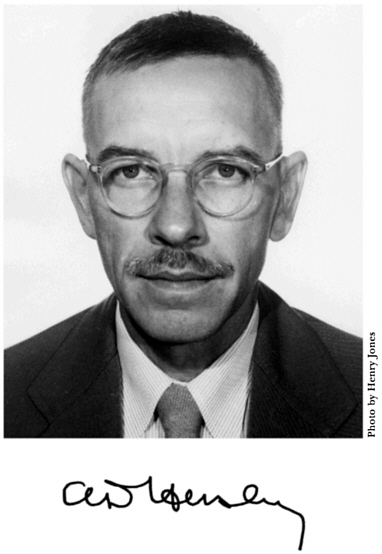
ALFRED DAY HERSHEY
December 4, 1908–May 22, 1997
BY FRANKLIN W.STAHL
MOST STUDENTS OF BIOLOGY know of Hershey—his best known experiment is described in texts of both biology and genetics. This work (1952,1) provided cogent support for the hypothesis that DNA is the conveyor of genetic information. The Hershey-Chase experiment used DNA-specific and protein-specific radioactive labels to show that the DNA of an infecting T2 bacteriophage entered the bacterium while most of the protein could be stripped from the surface of the cell by agitation in a Waring blender. Such abused cells produced a normal crop of new phage particles. Previous evidence implicating DNA in heredity had shown that a property of the surface coat of the pneumococcus bacterium could be passed from one strain to another via chemically isolated DNA. The Hershey-Chase observation justified the view that the entire set of hereditary information of a creature was so encoded. This work counted heavily in making Hershey a shareholder, with Max Delbrück (1906–81) and Salvadore E.Luria (1912–91), of the 1969 Nobel Prize in physiology or medicine.
Al Hershey was born on December 4, 1908, in Owosso, Michigan. He obtained a B.S. in 1930 and a Ph.D. in 1934 from Michigan State College. From 1934 until 1950 he was
employed in teaching and research in the Department of Bacteriology at Washington University School of Medicine. He married Harriet Davidson in 1945; they had one son, Peter. In 1950 Al became a staff member at the Department of Genetics, Carnegie Institution of Washington, Cold Spring Harbor, New York; in 1962 he was appointed director of the Genetics Research Unit of that institution. Al was elected to the National Academy of Sciences in 1958 and was awarded its Kimber Genetics Award in 1965.
Al’s Ph.D. thesis, prepared in the departments of chemistry and bacteriology at Michigan State College, described separations of bacterial constituents identified by the quaint definitions of the times. Except for its evident care and industry the work was unremarkable, merely part of an ongoing study “to arrive ultimately at some correlation between the chemical constitution of [Brucella species], and the various phenomena of specificity by them” (1934).
Al then assumed an instructorship in bacteriology and immunology at Washington University in St. Louis, where he collaborated with Professor J.Bronfenbrenner. From 1936 to 1939 their papers reported studies on the growth of bacterial cultures. From 1940 to 1944 Al’s experiments dealt with the phage-antiphage immunologic reaction and with other factors that influenced phage infectivity. During both those periods about half of the 28 papers bearing Al’s name were authored solely by him. (It was apparently here that Al learned how to handle phage. It may also have been here that Al acquired the idea that authorship belongs to those who do the experiments and should not reflect patronization, rank, title, or even redaction of the manuscript.) Some of these papers may have been important contributions to the understanding of antigen-antibody reactions. To me they appear original, thoughtful, and quantitative, especially those on the use of phage inactivation to
permit the study of the antigen-antibody reaction at “infinite” dilution of antigen (e.g., 1941). But, they interested an audience that did not include many geneticists or others interested in biological replication (except, perhaps, for Linus Pauling).
While at St. Louis Al (1951) showed that phage particles were “killed” by the decay of the unstable isotope 32P incorporated within their DNA. After the central importance of DNA to the phage life cycle (and to genetics) had been demonstrated this “suicide” technique was exploited in other labs in efforts to analyze the phage genetic structure and its mode of replication. Like most early experiments in “radiobiology” these analyses were fun, but not much more.
As recounted by Judson (1996, p. 35), Max Delbrück was attracted by Al’s papers. Perhaps he liked their mathematical, nonbiochemical nature. He must have liked their originality, logical precision, and economy of presentation. Max invited Al to Nashville in 1943 and recorded the following impression: “Drinks whiskey but not tea. Simple and to the point…Likes independence.” Al’s first “interesting” phage papers appeared soon thereafter (1946, 1947).
The ease with which large numbers of phage particles can be handled facilitated the discovery and characterization of mutants that were easily scored. Al recognized that the high infectivity of phage and the proportionality of plaque count to volume of suspension assayed allowed for quantification of mutation far exceeding that possible in most other viral systems. Al measured mutation rates, both forward and back, and demonstrated the mutational independence of r (rapid lysis) and h (host range). He succeeded also in showing (in parallel with Delbrück) that these mutationally independent factors could recombine when two genotypes were grown together in the same host cells (1946, 1947). Thus phage genetics was born as a field of study, and it became
conceivable that not only could the basic question of biological replication be addressed with phage but so also could phenomena embraced by the term “Morgan-Mendelism.”
Al continued the formal genetic analyses of T2 with investigations of linkage. Hershey and Rotman (1948) demonstrated that linkage analysis would have to take into account the production of recombinant particles containing markers from three different infecting phage genotypes. The same authors (1949) used mixed indicators to enumerate all four genotypes from two-factor crosses involving h and r mutants. That trick made it feasible to analyze fully the yields from individual mixedly infected bacterial cells. The signal finding was that all four genotypes of phage could be produced by an individual cell but that the numbers of complementary recombinants, which were equal on the average, showed little correlation from cell to cell. This demonstration of apparent nonreciprocality in the exchange process leading to recombination raised the specter that crossing over in phages would prove to be fundamentally different from that occurring in meiosis. The desire to unify this and other apparently disparate properties of phage and eukaryotic recombination into a single theoretical framework motivated a populational analysis of phage recombination by Visconti and Delbrück (1953).
By most criteria individual T2 particles are haploid (i.e., they contain but one set of genetic material), however heterozygous particles, which contain two different alleles at a single locus, were described by Hershey and Chase (1952,2) at the 1951 Cold Spring Harbor Symposium. Following the elucidation of DNA as a duplex molecule (Watson and Crick, 1953), it was possible to propose heteroduplex models for those heterozygotes. Such models played a central role in all subsequent thinking about recombination,
especially that involving relationships between meiotic crossing over and gene conversion.
Al, like Levinthal (1954) before him, expanded on the Visconti-Delbrück analysis in an effort to connect observations on heterozygotes, which had molecular implications, with the formal concepts proposed to deal with the populational aspects of phage crosses. The paper (1958) convinced many, including Al, that this approach to understanding biological replication was unlikely to be productive.
From this time on, Al’s studies became more down-to-earth (and successful) as he turned from mathematically based genetic analyses to serious studies of phage structure and the biochemistry of phage development. There is no doubt, however, that these studies were informed by Al’s acute awareness of the genetical and radiobiological facts that had to be explained. These new studies were jump started by the blender experiment described above.
Several subsequent papers refined the conclusions of the blender experiment by showing, for instance, that some protein is injected along with the phage DNA (1955). With Watson-Crickery well established by this time these studies were interesting but not threatening to the view that the genetic substance was DNA. During this period Al’s lab published works that described DNA and protein production, and relations between them, in infected cells. They provided the biochemical counterpart of the genetically defined notion of a pool of noninfective, vegetative phage (Visconti and Delbrück, 1953; Doermann, 1953). This change of emphasis allowed Al to write (1956),
I have proposed the ideas that the nucleic acid of T2 is its hereditary substance and that all its nucleic acid is genetically potent. The evidence supporting these ideas is straightforward but inconclusive. Their principal value is pragmatic. They have given rise to the unprecedented circumstance that chemical hypotheses and the results of chemical experiments
are dictating the conditions of genetic experiments. This development I regard as more important than the bare facts I have presented, which may yet prove to be of little or no genetic interest.
Biochemical studies on phage development were clouded by the lack of understanding of phage genome structure. It was not even clear how many chromosomes (DNA molecules) a phage particle contained. Furthermore, although Watson and Crick had specified what any short stretch of DNA should look like (plectonemically coiled, complementary polynucleotide chains), they had been understandably proud of their model, which was structurally coherent in the absence of any specification of longitudinal differentiation. For them it was enough to say that therein lay genetic specificity. For Al that was not enough, and his lab pursued studies dedicated to the physical description of phage DNA. The results of these studies were succinctly reviewed by Al (1970,1) in his Nobel lecture. I’ll briefly summarize my view of them, dividing the studies by phage type.
Al developed and applied chromatographic and centrifugal methods to the analysis of T2 chromosome structure (e.g., 1960,1,2). This work systematized our understanding of the breakage of DNA during laboratory manipulation and had its denouement in the demonstration that a T2 particle contains just one piece of DNA (1961) with the length expected of a linear double helix (Cairns, 1961). That conclusion was in apparent contradiction to genetical demonstrations that T4 chromosomes contained more or less randomly located physical discontinuities (Doermann and Boehner, 1963). A major insight into the structure of T-even phage chromosomes resulted from attempts to reconcile the apparently contradictory physical and genetical descriptions of T-even chromosomes. The basic idea, elaborated and confirmed in a series of papers orchestrated by George Streisinger, was that the nucleotide sequences in
any clone of phage particles were circularly permuted and that the sequence at one end of a given chromosome was duplicated at the other end (the chromosomes were terminally redundant). The predicted circular linkage map provided an elegant frame for displaying the functional organization of the T4 chromosome, as revealed by the pioneering studies of Epstein et al. (1963).
The terminal redundancies of the T-even phage chromosomes provided an additional physical basis for Al’s heterozygotes. (See Streisinger [1966] for references and a more detailed recounting.) These insights were exploited and elaborated by Gisela Mosig, who spent the years 1962–65 in Al’s lab. There she combined her genetical savvy of T4 with studies on the structure of the truncated, circularly permuted DNA molecules that she discovered in certain defective T4 particles. Those studies formed the basis for an elegant demonstration of the quantitative relations between the linkage map of T4 (as constructed from recombination frequencies) and the underlying chromosome (Mosig, 1966). Fred Frankel (1963) and Rudy Werner (1968) in Al’s lab examined the intracellular state of T-even phage DNA. Their discovery that it was a network undermined the Visconti-Delbrück analyses of phage recombination as a series of tidy, pairwise, meiosis-like matings, and well-aimed triparental crosses by Jan Drake (1967) killed the pairwise-mating idea once and for all.
Meselson and Weigle (1961) demonstrated that phage λ DNA, like that of E. coli (Meselson and Stahl, 1958), is replicated semiconservatively in agreement with Watson and Crick’s proposal that the replication of DNA involves separation of the two complementary strands; however, uncertainties about the structure of the semiconserved entities identified by Meselson prevented those experiments from being taken as proof of the Watson-Crick scheme. Careful
measurements of the molecular weight of λ’s DNA (1961) demonstrated that there was just one molecule per particle. That conclusion, combined with autoradiographic measurement of the length of λ DNA (Cairns, 1962), established that λ’s semiconservatively replicating structure is indeed a DNA duplex, putting the issue to rest.
The chromosome of λ also provided a surprise (1963, 1965). Though the chromosomes in a λ clone are all identical (i.e., not permuted), each chromosome carries a terminal 12-nucleotide-long segment that is single stranded and is complementary to a segment of the same length carried on the other end. The complementary nature of the segments gives λ “sticky ends.” These ends anneal at the time of infection, circularizing the chromosome, which can then replicate in both theta and sigma modes. The demonstration of a route by which the λ chromosome can circularize provided physical substance to Alan Campbell’s (1962) proposal that the attachment of λ prophage to the host chromosome involves crossing over between the host chromosome and a (hypothesized) circular form of λ. And, of course, the understanding of λ’s sticky ends, whose annealing creates cos, is exploited by today’s gene cloners whenever they work with a cosmid.
The nonpermuted character of λ’s chromosome made it susceptible to analyses prohibited in T-even phage. For instance, Hershey et al. (1968) demonstrated the mosaic nature of the chromosome: Major segments differed conspicuously from each other in their nucleotide composition. (That conclusion foreshadowed our current understanding of the role of horizontal transmission in prokaryotic evolution.) Al’s lab demonstrated that these differing segments had distinguishable annealing (hybridization) behavior. They exploited those differences to identify the approximate location of the origin of replication (Makover, 1968) and to
identify regions of the chromosome that were transcribed when λ was in the prophage state (Bear and Skalka, 1969).
Al appreciated that progress in science depends on the development of new methods. Among those to which Al’s lab made important contributions were fixed-angle Cs gradients, methylated albumin columns for fractionating DNA, methods of handling DNA that avoid breakage and denaturation as well as methods that would break phage chromosomes into halves and quarters, and the calibration of methods for measuring molecular weights of DNA. Al confessed that the development of a method was painful: His view of heaven was a place where a new method, finally mastered, could be applied over and over. Bill Dove quoted Al as saying, “There is nothing more satisfying to me than developing a method. Ideas come and go, but a method lasts.”
Al occasionally blessed us with his thoughts about the deeper significance of things. His papers “Bacteriophage T2: Parasite or Organelle” (1957), “Idiosyncrasies of DNA Structure” (1970,1), and “Genes and Hereditary Characteristics” (1970,2) delighted his contemporaries and can still be read with pleasure and profit.
But how many people really knew Al Hershey? From his works we can say he was interested in this or that, but such a contention might leave the impression that we have adequately summarized his interests. That is hardly likely. Each of Al’s contributions was truly original: He never copied even himself! Consequently, each paper was a surprise to us. We can surmise, therefore, that his published works do not begin to saturate the library of ideas available to him. His papers must be but a small sampling of his scientific thoughts.
And the rest of his mind? Who knows? Al exemplified reticence. His economy of speech was greater even than his
economy of writing. If we asked him a question in a social gathering, we could usually get an answer like “yes” or “no.” However, at a scientific meeting one might get no answer at all, which was probably Al’s way of saying, in the fewest possible words, that he had no thoughts on that subject suitable for communication at this time.
Encounters with Al were rare, considering that he worked at Cold Spring Harbor, which hosted hundreds of visitors every summer. That’s because Al spent his summers sailing in Michigan, and except at occasional symposia or the annual phage meetings, which came early and late in the season, he was not to be seen.
Thus, most of us who valued Al as a colleague and acquaintance, didn’t really know him. I am one of those, and I suppose that status qualifies me for this assignment: The Al about whom I write is the same Al that most other people did not really know, either. (Some who worked with Al say that his lab functioned well because Laura Ingraham, Al’s long-time associate, really did know his mind.)
The Phage Church, as we were sometimes called, was led by the Trinity of Delbrück, Luria, and Hershey. Delbrück’s status as founder and his ex cathedra manner made him the pope, of course, and Luria was the hard-working, socially sensitive priest-confessor. And Al was the saint. Why? How could we canonize Al when we hardly knew him?
Maybe some of the following considerations apply: The logic of Al’s analyses was impeccable. He was original, but the relevance of his work to the interests of the rest of us was always apparent; he contributed to and borrowed from the communal storehouse of understanding, casual about labeling his own contributions but scrupulous about attributing the ones he borrowed. He was industrious (compulsively so—each day he worked two shifts). He was a superb editor (e.g., 1971) and critic, devastatingly accurate but never
too harsh; he deplored that gratuitous proliferation of words that both reflects and contributes to sloppiness of thought. And his suggestions were always helpful.
Does that qualify him for sainthood? It would if he were in all other respects perfect. And he may have been. Who could tell? Who among us knew this quiet man well enough to know if there was a dark side? Perhaps canonization was a mark of our deep respect for this quintessential scientist. Maybe by canonizing Al we could accept the relative insignificance of our own contributions. Maybe we were just having fun.
But, in his papers Saint Al was there. He talked to the reader, explaining things as he saw them, but never letting us forget that he was transmitting provisional understanding. We got no free rides, no revealed truths, no invitation to surrender our own judgment. And we could never skim, since every word was important. I think this style reflected his verbal reticence, which in turn mirrored his modesty. Examples: “Some clarification, at least in the mind of the author, of the concepts ‘reversible’ and ‘irreversible’ has been achieved” (1943). “On this question we have had more opportunity in this paper to discover than to attack difficulties” (1944). Al’s modesty was dramatically documented by Jim Ebert (at Al’s memorial service, Cold Spring Harbor, summer 1997), who recalled that Al, whose research support was guaranteed by the Carnegie Institution, argued with Carnegie directors for the right to apply for NIH support so that he might benefit from the critiques of his peers.
In science Al appeared to be fearless. Fearlessness and modesty might seem an unlikely combination. Not so. Modesty is kin to a lack of pretense. In the absence of pretense there is nothing to fear.
Tastes of the many flavors of Hershey’s mind and the accomplishments of his laboratory can be best gained from
the annual reports of the director of the Genetics Research Unit, Carnegie Institution of Washington Yearbook (reprinted in Stahl [2000]). The principal investigators of this unit were he and Barbara McClintock. In 1963 Al wrote,
Our justification for existence as a Unit, however, resides in the value of our research. We like to think that much of that value is as unstatable and as durable as other human produce that cannot be sold. Some can be put on paper, however. That we offer with the usual human mixture of pride and diffidence.
Those who worked with Hershey at Cold Spring Harbor include Phyllis Bear, Elizabeth Burgi, John Cairns, Connie Chadwick, Martha Chase, Carlo Cocito, Rick Davern, Gus Doermann, Ruth Ehring, Stanley Forman, Fred Frankel, Dorothy Fraser, Alan Garen, Eddie Goldberg, June Dixon Hudis, Laura Ingraham, Gebhard Koch, André Kozinsky, Nada Ledinko, Cy Levinthal, Shraga Makover, Joe Mandell, Norman Melechen, Teiichi Minagawa, Gisela Mosig, David Parma, Catherine Roesel, Irwin Rubenstein, Ed Simon, Ann Skalka, Mervyn Smith, George Streisinger, Neville Symonds, René Thomas, Jun-ichi Tomizawa, Nick Visconti, Bob Weisberg, Rudy Werner, Frances Womack, and Hideo Yamagishi.
Al Hershey is remembered for his contributions to the understanding of the chemical basis of heredity. He is respected for the style in which those contributions were presented. He is revered for his unwavering respect of the scientific method and of his scientist colleagues. A more complete review of Al’s work, including testimonials from colleagues, can be found in Stahl (2000).
THIS BIOGRAPHICAL memoir is modified from Stahl (1998) with permission of Genetics. Copies of Carnegie yearbook reports and other documents were kindly supplied by the Archives of the Cold Spring Harbor Laboratory.
REFERENCES
Bear, P.D., and A.Skalka. 1969. The molecular origin of lambda prophage mRNA. Proc. Natl. Acad. Sci. U.S.A. 62:385–88.
Cairns, J. 1961. An estimate of the length of the DNA molecule of T2 bacteriophage by autoradiography. J. Mol. Biol. 3:756–61.
Cairns, J. 1962. Proof that the replication of DNA involves separation of the strands. Nature 194:1274.
Campbell, A. 1962. Episomes. Adv. Genet. 11:101–45.
Doermann, A.H. 1953. The vegetative state in the life cycle of bacteriophage: Evidence for its occurrence and its genetic characterization. Cold Spring Harbor Symp. Quant. Biol. 18:3–11.
Doermann, A.H., and L.Boehner. 1963. An experimental analysis of bacteriophage T4 heterozygotes. I. Mottled plaques from crosses involving six rII loci. Virology 21:551–67.
Drake, J.W. 1967. The length of the homologous pairing region for genetic recombination in bacteriophage T4. Proc. Natl. Acad. Sci. U.S.A. 58:962–66.
Epstein R.H., A.Bolle, C.M.Steinberg, E.Kellenberger, R.S. Edgar, M.Susman, G.H.Denhardt, and A.Lielausis. 1963. Physiological studies of conditional lethal mutants of bacteriophage T4D. Cold Spring Harbor Symp. Quant. Biol. 28:375–92.
Frankel, F. 1963. An unusual DNA extracted from bacteria infected with phage T2. Proc. Natl. Acad. Sci. U.S.A. 49:366–72.
Judson, H.F. 1996. The Eighth Day of Creation (expanded edition). New York: Cold Spring Harbor Laboratory Press.
Levinthal, C. 1954. Recombination in phage T2: Its relationship to heterozygosis and growth. Genetics 39:169–84.
Makover, S. 1968. A preferred origin for the replication of lambda DNA. Proc. Natl. Acad. Sci. U.S.A. 59:1345–48.
Meselson, M., and F.W.Stahl. 1958. The replication of DNA in Escherichia coli. Proc. Natl. Acad. Sci. U.S.A. 44:671–82.
Meselson, M., and J.J.Weigle. 1961 Chromosome breakage accompanying genetic recombination in bacteriophage. Proc. Natl. Acad. Sci. U.S.A. 47:857–68.
Mosig, G. 1966. Distances separating genetic markers in T4 DNA. Proc. Natl. Acad. Sci. U.S.A. 56:1177–83.
Stahl, F.W. 1998. Hershey. Genetics 149:1–6.
Stahl, F.W. 2000. We Can Sleep Later: Alfred D.Hershey and the Origins of Molecular Biology. New York: Cold Spring Harbor Laboratory Press.
Streisinger, G. 1966. Terminal redundancy, or all’s well that ends well. In Phage and the Origins of Molecular Biology, eds. J.Cairns, G. S.Stent, and J.D.Watson, pp. 335–40. New York: Cold Spring Harbor Laboratory Press.
Visconti, N., and M.Delbrück. 1953. The mechanism of genetic recombination in phage. Genetics 38:5–33.
Watson, J.D., and F.H.C.Crick. 1953. A structure for deoxyribonucleic acid. Nature 171:737–38.
Werner, R. 1968. Initiation and propagation of growing points in the DNA of phage T4. Cold Spring Harbor Symp. Quant. Biol. 33:501–507.
SELECTED BIBLIOGRAPHY
1934 The chemical separation of some cellular constituents of the Brucella group of micro-organisms. PhD thesis, Michigan State College. Published in co-authorship with R.C.Huston and I.F.Huddleson as Technical Bulletin No. 137 of the Michigan Agricultural Experiment Station.
1941 The absolute rate of the phage-antiphage reaction. J. Immunol. 41:299–319.
1943 Specific precipitation. V. Irreversible systems. J. Immunol. 46:249–61.
1944 Specific precipitation. VI. The restricted system bivalent antigen, bivalent antibody, as an example of reversible bifunctional polymerization. J. Immunol. 48:381–401.
1946 Mutation of bacteriophage with respect to type of plaque. Genetics 31:620–40.
1947 Spontaneous mutations in bacterial viruses. Cold Spring Harbor Symp. Quant. Biol. 11:67–77.
1948 With R.Rotman. Linkage among genes controlling inhibition of lysis in a bacterial virus. Proc. Natl. Acad. Sci. U.S.A. 34:89–96.
1949 With R.Rotman. Genetic recombination between host-range and plaque-type mutants of bacteriophage in single bacterial cells. Genetics 34:44–71.
1951 With M.D.Kamen, J.W.Kennedy, and H.Gest. The mortality of bacteriophage containing assimilated radioactive phosphorus. J. Gen. Physiol. 34:305–19.
1952 With M.Chase. Independent functions of viral protein and nucleic acid in growth of bacteriophage. J. Gen. Physiol. 36:39–56.
With M.Chase. Genetic recombination and heterozygosis in bacteriophage. Cold Spring Harbor Symp. Quant. Biol. 16:471–79.
1955 An upper limit to the protein content of the germinal substance of bacteriophage T2. Virology 1:108–127.
1956 The organization of genetic material in bacteriophage T2. Brookhaven Symp. Biol. 8:6–14.
1957 Bacteriophage T2: Parasite or organelle. Harvey Lectures, Series LI, pp. 229–39. New York: Academic Press.
1958 The production of recombinants in phage crosses. Cold Spring Harbor Symp. Quant. Biol. 23:19–46.
1960 With J.D.Mandell. A fractionating column for analysis of nucleic acids. Ann. Biochem. 1:66–77.
With E.Burgi. Molecular homogeneity of the deoxyribonucleic acid of phage T2. J. Mol. Biol. 2:143–52.
1961 With L.Rubenstein and C.A.Thomas, Jr. The molecular weights of T2 bacteriophage DNA and its first and second breakage products. Proc. Natl. Acad. Sci. U.S.A. 47:1113–22.
With E.Burgi, H.J.Cairns, F.Frankel, and L.Ingraham. Growth and inheritance in bacteriophage. Carnegie Institution of Washington Year Book 60:455–461.
1963 Annual report of the director of the Genetics Research Unit. Carnegie Institution of Washington Yearbook 62:461–500.
With E.Burgi and L.Ingraham. Cohesion of DNA molecules isolated from phage lambda. Proc. Natl. Acad. Sci. U.S.A. 49:748–55.
1965 With E.Burgi. Complementary structure of interacting sites at the ends of lambda DNA molecules. Proc. Natl. Acad. Sci. U.S.A. 53:325–28.
1968 With A.Skalka and E.Burgi. Segmental distribution of nucleotides in the DNA of bacteriophage lambda. J. Mol. Biol. 34:1–16.
1970 Idiosyncrasies of DNA structure (Nobel lecture). Science 168:1425–27. Genes and hereditary characteristics. Nature 226:697–700.
1971 Ed. The Bacteriophage Lambda. New York: Cold Spring Harbor Laboratory Press .


