
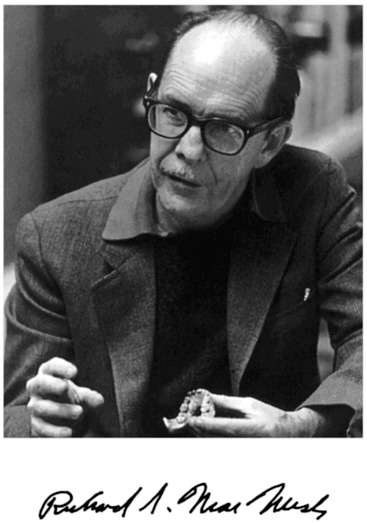
RICHARD STOCKTON MACNEISH
April 29, 1918–January 16, 2001
BY KENT V.FLANNERY AND JOYCE MARCUS
IN THE 1940s, BEFORE the extensive surveys and excavations of archaeologist Richard S. (“Scotty”) MacNeish, little was known about the origins of agriculture and the transition from hunting and gathering to sedentary life in the New World. Over a period of six decades, MacNeish supplied us with enormous quantities of data and developed new ways of thinking about how Native Americans lived during thousands of years of nomadic foraging. He eventually extended his work to places as diverse as the Yukon, New Mexico, Mexico, Belize, Peru, and China.
Richard Stockton MacNeish was born in New York City and grew up in Eastchester and White Plains. His father, Harris Franklin MacNeish, was a professor of mathematics who received his Ph.D. from the University of Chicago in 1912; his dissertation was on “Linear Polars of the k-hedron in n-space.” He also wrote a book entitled Algebraic Technique of Integration, which was reprinted in 1950. MacNeish’s mother, Elizabeth Stockton, was descended from a founder of Princeton University; she hoped her son would attend that institution, but he ended up at his father’s alma mater.
MacNeish developed an early interest in Maya archaeology. In the spring of 1930 his teacher in eighth-grade art history
gave him a prize for a picture album on Maya archaeology. A year later he wrote to Alfred Vincent Kidder, one of the leading archaeologists working for the Carnegie Institution of Washington, asking if he could be a water boy on a Maya dig. Although unable to add the 13-year-old to his project, Kidder did encourage the young MacNeish to study archaeology, thereby initiating a longstanding friendship. Forty years later, in 1971, Scotty would win the medal named for Kidder.
In 1936 MacNeish entered Colgate. His first excavation was at the Nichols Pond Iroquois site in central New York. By 1937 he had managed to join the Rainbow Bridge-Monument Valley Expedition in northeast Arizona, helping to excavate a Tsegi Canyon Pueblo I pithouse under the direction of Ralph Beals. Scotty returned in the summer of 1938 to work with Beals at Cobra Head Canyon, with Watson Smith at Black Mesa, and with George Brainerd at two sites: a Basketmaker III pithouse and Swallow Nest Cave. MacNeish was imprinted in several ways by this early fieldwork. First, Brainerd showed him how to excavate a cave by carefully stripping off one living floor at a time, a technique he would later use in Mexico. Second, MacNeish never stopped suspecting that Basketmaker-style pithouses had preceded the wattle-and-daub residences of Formative Mexico—a view later reinforced by his discovery of a possible pithouse site in the Tehuacán Valley of Puebla.
By his sophomore year, MacNeish was being urged by several Southwestern archaeologists to transfer to the University of Chicago to study with Fay-Cooper Cole. There was unfinished business, however, before he could enroll at Chicago. MacNeish was by this time an accomplished amateur boxer, desirous of a Golden Gloves championship. In 1938 he won the Golden Gloves in Binghamton, New York, an achievement in which he took great pride.
At the time MacNeish enrolled at the University of Chicago, it was an archaeological paradise. The Midwest United States was filled with excavation crews supported by the Depression-era Works Progress Administration. His professor, Fay-Cooper Cole, had staked out the Kincaid Mounds in southern Illinois as the location for Chicago’s field school. At Kincaid MacNeish would hear endless discussions of method and theory from James A.Ford, William Haag, Jesse D.Jennings, John Cotter, Glen Black, Tom Lewis, Madeline Kneberg, and of course, Cole himself.
MacNeish would learn the WPA method of digging in 6″ levels with special shovels and plasterers’ trowels, removing the dirt with a dustpan and screening everything. MacNeish also learned the University of Chicago method of vertical slicing with mattocks, recording everything on square description forms, feature forms, and photo forms. The horizontal scraping techniques by which he found postmolds and earthen floors were to be adapted 10 years later at Pánuco, Veracruz, where he became the first to find postmolds from a Formative Mesoamerican house.
MacNeish received his B.A. from Chicago in 1940. By 1941 he was a graduate student supervisor at Kincaid, receiving $150 a month. In 1944 he wrote his M.A. thesis on the Lewis Focus, a prehistoric culture of Illinois. It would be hard to overestimate the effect of those years at Chicago. First, MacNeish learned how to direct a crew of 80, including surveyors, draftsmen, diggers, screeners, and the “scribes” who filled out the forms; one could still see this organization during his projects in Tehuacán and Ayacucho. Second, he wrote a class term paper for Robert Redfield on Julian Steward’s recently published Basin-Plateau Aboriginal Sociopolitical Groups (1938). Steward’s monograph so impressed Scotty that, for the rest of his career, his syntheses made virtually every region he investigated sound like the Great
Basin. He often used a model, inspired by Steward’s description of the Paiute, in which foragers broke up into microbands in lean seasons and came together to form macrobands during times of plenty.
HIS CAREER IN ARCHAEOLOGY
In 1946 James B.Griffin invited MacNeish to spend a year at the University of Michigan to “settle the problem of Iroquois origins.” In what is still considered a tour de force, MacNeish used the direct historical approach to solve the problem, beginning with the pottery of the historic Iroquois and working back to the ceramics of the prehistoric Owasco and Point Peninsula complexes. In a 1976 article on the Iroquois, MacNeish reminisced on this collaboration: “He [Griffin] wanted to explode this poorly documented speculation and felt that Scotty MacNeish was just the sort of little troublemaker to do the job. What is more, I agreed with him. So, in the fall of 1946, I folded up my tent and migrated to the Museum of Anthropology in Ann Arbor, fired with enthusiasm, to become, I hoped, a dynamite dynamiter.” After analyzing half a million pottery sherds, Scotty did confirm Griffin’s view that the Iroquois had developed in situ rather than being Mississippian immigrants. It was MacNeish’s work on the Iroquois that led to his being honored with the Cornplanter Medal in New York in 1977.
A similar investigation of immigration and culture contact led to MacNeish’s greatest discoveries. The decade of the 1940s was an era when diffusionists sought to explain the Mound Builders of the Southeast United States in terms of migrations from Mesoamerica. Fay-Cooper Cole decided that MacNeish should investigate this explanation for his Ph.D. thesis, so in 1945 he sent Scotty to survey in southern Texas and northern Tamaulipas. MacNeish found no evidence of migration by Mexican groups into Texas, but he
did find five intriguing rockshelters in the Cañon Diablo of the Sierra de Tamaulipas. Protected from rain by the cliffs above and desiccated by high evapotranspiration, the caves were chock full of prehistoric plant remains, twine, basketry, and other normally perishable artifacts.
In retrospect it seems surprising that it took MacNeish two years to raise enough funds to dig these caves, which were destined to change the course of New World prehistory. Finally, in 1948 a grant from the Viking Fund of the Wenner-Gren Foundation got him back to Tamaulipas for an eight-month season. In January of 1949 his crew chief found three tiny, early prehistoric maize cobs at La Perra Cave. Overnight, the period of incipient agriculture in Mexico— a theoretical construct that had been discussed in classrooms but never actually seen—had come to light.
The three most important caves MacNeish found in Tamaulipas were Nogales, Diablo, and La Perra. MacNeish began his excavation at Nogales Cave using the arbitrary 6″ levels and WPA/Chicago methods learned at Kincaid, but soon saw that these would be inappropriate for dry caves. Recalling the way Brainerd had stripped off living floors with a trowel at Swallow Nest Cave in 1938, MacNeish switched to this method at Diablo Cave. By the time he reached La Perra Cave, he had begun to develop his own personal style of cave excavation. First, he divided the cave floor into a grid of squares; then he excavated a small number of alternate squares. This left the natural or cultural stratigraphy of the intervening squares exposed on several sides, making it easier to follow a specific living floor from square to square with a trowel. Gradually, the old inches and feet of the WPA era gave way to the more universally accepted metric system. MacNeish would later refer to this system of excavating by natural or cultural levels, using alternate one-meter grid squares, as the La Perra method.
At the urging of Gordon Ekholm of the American Museum of Natural History, MacNeish took a brief detour in 1948 from his Tamaulipas excavations to the Gulf coastal plain of northern Mexico. At Pánuco, Veracruz, Ekholm had exposed a sequence of six cultural phases in a deep stratigraphic cut in the bank of a river. MacNeish dug a step trench 26 feet down to water level, adding three earlier periods to Ekholm’s sequence.
In Pánuco a local collector of artifacts showed MacNeish the clay model of a house made in prehistoric times. The building was shown as having an oval or apsidal plan, a door in one of the long sides, and a thatched roof like those still used by the Huastec Indians of northeast Mexico. While excavating at Pánuco in deposits of the Middle Formative period (ca. 400 B.C.), MacNeish found a curving line of four postmolds from a similar house crossing his excavation. Not only was this the first archaeologically recovered Middle Formative house from Mexico, it was our first evidence that Gulf Coast houses of that period had been apsidal rather than rectangular.
MacNeish realized that only the introduction of Kincaid-style horizontal scraping into Mexico had allowed him to recover the floor and post pattern of a wattle-and-daub house, something that had eluded George Vaillant of the American Museum of Natural History at El Arbolillo and Zacatenco (near Mexico City) in the 1930s. Vaillant had been trained on the great midden at Pecos Pueblo, and he understandably treated Zacatenco as a midden rather than a village. MacNeish concluded that Midwest techniques were more appropriate than Southwest techniques for finding houses in Formative villages.
In 1949 MacNeish completed a Ph.D. thesis on his Tamaulipas survey and left Chicago for a job with the National Museum of Canada. He was temperamentally suited for
museum work, which allowed him time for field trips and research and provided no distractions (such as teaching). His position did, however, require him to do a reasonable amount of archaeology in Canada. That was no problem. Immediately in 1949 Scotty was off for three months to survey the barrenlands of the Northwest Territories. By 1952 he had surveyed the upper Mackenzie River and excavated sites at Pointed Mountain, Fort Liard, and Great Bear Lake on the Arctic Circle. Taking advantage of the fact that the Northwest Territories were frozen all winter—exactly the season when Mexico was dry and balmy—MacNeish worked out an appropriately ambitious schedule: summer fieldwork in the Arctic, winter fieldwork in Mexico.
MacNeish’s excavations in the Sierra de Tamaulipas had pushed maize agriculture back to 2500 B.C., but he sensed that earlier corncobs were out there somewhere. Encouraged by botanist Paul Mangelsdorf of Harvard, MacNeish turned to the Sierra Madre near Ocampo in southwest Tamaulipas. Javier Romero and Juan Valenzuela of the Mexican National Institute of Anthropology and History had told him that, in 1937, a man named Guerra had led them to mummy-filled dry caves in the Cañon del Infiernillo. MacNeish relocated Guerra, who took him on a harrowing three-day horseback ride through the wilderness. The trip ended at “two magnificent caves with preservation,” sites that Scotty named for Romero and Valenzuela.
In 1953 MacNeish returned with three assistants to excavate. Romero’s Cave had 17 cultural layers, superb activity areas, baskets, mats, string, wild plants, coprolites, and early domestic plants; Valenzuela’s Cave was not as deep, but had equivalent preservation. Bruce Smith of the Smithsonian Institution later reanalyzed and obtained accelerator mass spectrometric (AMS) dates on many of the cultivars from MacNeish’s Ocampo caves. The earliest dates (calibrated to
“real” time) were 4360 B.C. for Cucurbita pepo squash, 4200 B.C. for bottle gourd, and 2455 B.C. for maize.
The caves of Tamaulipas yielded prodigious numbers of projectile points, and MacNeish based his typology on the pioneering efforts of his Texas colleagues. MacNeish did not want to create a new name for every point that looked exactly like one found on the other side of the Río Grande, so he continued to use Texas point names even when he was working hundreds of kilometers from the Río Grande. In response to his Texas critics (who did not like MacNeish’s use of Texas names for Mexican point types), he sometimes displayed his distinctive brand of humor. For example, when MacNeish encountered what looked like a miniature version of the Gary point from Texas, he simply gave it a Mexican diminutive, calling it the Garyito point. This was only one of many legendary MacNeishisms. Others include his naming a serrated point type Pelona, because it reminded him of a woman with disheveled hair.
MacNeish’s career was filled with impressive monographs, which reflected his capacity for monumental amounts of work. During the 1940s and 1950s when he was in the Yukon and Northwest Territories, he was working in regions so remote as to make his three-day trip to Romero’s Cave seem like a picnic. To survive while on survey in some areas of northern Canada, MacNeish had to have bush pilots drop 50-gallon drums of food at critical landmarks along his route. He and his Inuit assistants would then hike from food drop to food drop.
In 1954 he surveyed the coast of the Beaufort Sea to either side of the Mackenzie River delta by whaleboat and canoe, discovering the important Engigstciak site; for the next two summers, he returned to excavate it. Although beset with the problems of solifluction and frost cracks common to many Arctic sites, Engigstciak produced a tentative
sequence of nine cultural complexes. The oldest, the British Mountain complex, contained extinct Bison priscus hunted by early Native Americans; the youngest complexes contained tools recent enough to be considered “Eskimo.” As he often did, MacNeish had found a site that contained virtually the entire archaeological sequence for its region.
Inspired by Engigstciak, MacNeish decided in 1959 to survey on foot a 600-mile stretch of the Firth River, accompanied by a few Inuit assistants. This trip produced only 24 archaeological sites, but twice that many good anecdotes. At one point the hikers found that one of the food drums dropped by their bush pilot had split open on impact, with the odor inspiring a bear to devour most of the contents. “The worst part,” said MacNeish, “was that the bear ate all the cigarettes, so for the rest of the trip two Inuit and I had to share the three remaining smokes.” One hundred miles from the finish line, MacNeish broke his ankle. He was able to hobble the rest of the way only because his boot froze to his foot, “becoming the equivalent of a plaster cast.”
Despite all kinds of hardships, MacNeish emerged from the Canadian barrenlands with a working hypothesis. The campsites of the earliest hunting peoples, he predicted, would tend to occur on eskers—serpentine ridges of gravelly and sandy drift believed to have been formed by streams below glacial ice—which wound across the northern swamps like railroad trestles. From here the hunters could take caribou when they forded the wetlands between eskers. This was one more example of MacNeish’s ability to “think like a prehistoric man,” a skill which later led to his discovery of many of his most important sites.
The final stage of MacNeish’s Yukon work began in 1959, when he moved to Kluane Lake in the southwestern part of the territory. There he would be able to arrive via the Al-Can Highway and buy his supplies in Whitehorse, a consider-
able improvement in logistics. Moreover, he could build on the work of Frederick Johnson of the R.S.Peabody Foundation in Andover, Massachusetts, since Johnson had excavated there in the 1940s. Johnson and MacNeish became good friends and published their Yukon work jointly in 1964.
What intrigued MacNeish about the region was that its Northwest Microblade Tradition had been compared by the likes of Nels Nelson to material from Lake Baikal in Siberia. This might be evidence for at least one of the waves of immigrants crossing the Bering Straits into North America. MacNeish spent 1957–61 excavating at the Gladstone site, the Little Arm site, the Taye Lake site, and other localities in the Kluane River valley. With grizzly bears wandering past his excavation trenches, MacNeish put together a tentative sequence from 8000 B.C. to the first century A.D.
At the stratified Gladstone site, MacNeish found the Northwest Microblade Tradition associated with huntergatherers who fished Kluane Lake in the summer and hunted and trapped mammals in the winter. Their favorite game included moose, black bear, caribou, and bison, and their tool tradition might have begun as early as 5500 B.C. MacNeish separated the stone tools into those of local origin, those with possible Siberian influence and into those showing ties with groups to the south.
By 1958 MacNeish had reached 40 years of age, and while 600-mile hikes down the Firth River were not beyond his ability, he was drawn back to Mexico’s balmy winters and the intellectual challenge of early agriculture. His botanist friends were convinced that Tamaulipas lay too far north to be the place where Mexican agriculture had begun. MacNeish therefore began to look for early sites farther to the south.
The region of Copán in Honduras had caves, but none were sufficiently dry. The same was true of Tegucigalpa,
Comayagua, and the Valley of Zacapa in Guatemala. MacNeish then crossed the border into Chiapas and surveyed the valleys of Comitán and San Cristóbal las Casas; neither had dry caves. In 1959, at the suggestion of Frederick A.Peterson of the New World Archaeological Foundation, he tested the Santa Marta Rockshelter near Ocozocoautla, in the Grijalva River depression of Chiapas. This was a huge shelter with five preceramic levels covering the period from 7000 to 3500 B.C. The animal bones give us a rare glimpse of Archaic hunting in tropical riverine forest, but MacNeish and Peterson found that the shelter had no desiccated plants and only poor preservation of pollen.
Moving north in 1960, MacNeish briefly toured the Valley of Oaxaca and the Río Balsas depression of Guerrero, but found nothing of interest. Huajuapan de León in northern Oaxaca had caves but none were dry, so he continued east through Tequixtepec into Puebla’s Tehuacán Valley. Discouraged after a fruitless three-year search, MacNeish had no inkling that he was about to find just what he was looking for.
The Tehuacán Valley lies in a deep rain shadow between two mountain ranges; it is an area of permanent drought, where evapotranspiration exceeds precipitation for most of the year. MacNeish began surveying at the northwest end of the valley in December 1960 and soon found a series of dry caves near the mineral springs of El Riego. Near Altepexi and Ajalpan in the central valley, the caves were lower in elevation and drier. By January 1961 he was near the southeast end of the valley, where the caves were lower and drier still. The fiftieth site of his Tehuacán survey was a large rockshelter in a cliff called Cerro Agujereado (“Pierced Hill”) near Coxcatlán. During the six-day excavation of a 2-m-by-2-m test pit, MacNeish reached deposits with corncobs the size of a cigarette filter.
MacNeish realized that he might be on the threshold of a great project, yet as an employee of the Canadian government he could not apply to the National Science Foundation for funds. Then he remembered his Yukon collaboration with Frederick Johnson of the R.S.Peabody Foundation in Massachusetts. Douglas S.Byers, director of the Peabody Foundation, agreed that that institution would apply for grants from the NSF and Rockefeller Foundation to fund a Tehuacán Archaeological-Botanical Project with MacNeish as field director.
For the next four years MacNeish used all the managerial skills he had learned at Kincaid to direct a large interdisciplinary project in the Tehuacán Valley. He brought Peterson up from Chiapas to run his field headquarters. He invited Melvin L.Fowler (whose work at the Modoc Rock Shelter in Illinois had impressed him) to dig at Coxcatlán Cave. José Luis Lorenzo sent two of his best students, Angel García Cook and Antoinette Nelken, down from Mexico City to participate. A team of botanists including Mangelsdorf, Walton Galinat, C.Earle Smith, Lawrence Kaplan, Hugh Cutler, and Thomas Whitaker analyzed the plant remains. Richard Woodbury and James Neely studied prehistoric irrigation systems, and Kent Flannery, then a graduate student, was hired to identify animal bones from the excavations. MacNeish and his team tested 15 caves, then concentrated on 6 named El Riego, Tecorral, San Marcos, Purrón, Abejas, and Coxcatlán. All were important, but the greatest was surely Coxcatlán Cave; it belongs in the world-class category of archaeological caves like Tabun and Kebara in Israel, Ksar Akil in Lebanon, and Combe Grenal and Abri Pataud in France.
The Tehuacán Project made MacNeish a household name. He recovered what were (at that time) the oldest maize, the oldest squash and bottle gourds, the oldest chile peppers
and beans, the oldest tomatoes and avocados, the oldest New World cotton, the oldest domestic dogs and turkeys, and the oldest Mexican honey bees. While AMS dates obtained in the 1990s made some of those domesticates younger than originally thought, MacNeish had definitely pushed agriculture back before 7000 B.P. (calibrated).
These finds were important both as agricultural discoveries and as new insights into the origins of sedentary life in Mexico. MacNeish found that a Late Archaic complex of stone bowls was followed by Mexico’s first pottery. Named for Purrón Cave, where they first appeared, these monochrome ceramics resembled (and briefly coexisted with) the stone bowls.
One of the most often reprinted essays to emerge from the Tehuacán Project was MacNeish’s 1964 Science article, “Ancient Mesoamerican Civilization.” That paper featured seven drawings of the Tehuacán Valley, depicting different stages of sociopolitical evolution from 10,000 B.C. to A.D. 1500. Each drawing showed the mountainous valley in three dimensions, a low-level aerial oblique view, with all relevant archaeological sites indicated. How those drawings were created demonstrates the intuitive side of MacNeish’s work.
In 1962 his project had taken over a large house on one of Tehuacán’s main streets. MacNeish shared a bedroom next to the laboratory with his dig foreman and a graduate student. One night Scotty sat bolt upright, got out of his bed, and went to the lab. Others followed, thinking they might be needed. MacNeish seized a felt-tipped Marks-a-Lot and approached a lab table covered with protective brown wrapping paper. On the paper he first sketched the seven three-dimensional maps of the valley, then went back and filled in the archaeological sites for each moment in time. His staff watched in amazement as he located every mountain range, canyon, river, and site from memory.
Although an artist drafted the published version, essentially what you see in MacNeish’s article is what he produced in an hour with a large marking pen. This “eureka” moment typifies the way his syntheses came together on a subconscious level once he had absorbed enough data.
MacNeish always said that the Tehuacán years were the happiest of his life. The intellectual high it produced left him eager to return to the field as soon as his five-volume report was in press. Next he wanted to take on the origins of agriculture and animal domestication in the Andes; the key would be to find a highland valley arid enough to have dry caves.
In 1966 MacNeish sought advice from Andeanists Frédéric Engel, Edward Lanning, Thomas Patterson, and Rogger Ravines, and reconnoitered the Peruvian valleys of Huancayo, Huancavelica, the Río Mantaro, the Río Pampas, and Ayacucho. This was rugged country; on one occasion, Ravines had to pull MacNeish from the water when he slipped and was swept away by a swift mountain stream they were fording. Many prospective caves had preceramic deposits, but their altitude made them too cool and moist for plant preservation. The Huanta-Ayacucho area seemed the most promising, and MacNeish and Ravines eventually came upon Pikimachay (“Flea Cave”) not far from the famous ruins of Wari.
This Andean survey took place during one of MacNeish’s brief forays into teaching. He had moved from the museum in Ottawa to a professorship at Calgary, only to discover that teaching “drove him nuts” and his position in Canada still would not let him apply to the National Science Foundation. The job of his dreams—pure research—finally opened up when Byers and Johnson began to retire from the Peabody Foundation in Andover, paving the way for MacNeish to become director in 1969.
From 1969 through 1975, with National Science Foun-
dation support, MacNeish directed the large interdisciplinary Ayacucho-Huanta Archaeological-Botanical Project. He reunited many of his former collaborators from the Tehuacán Project and made Ayacucho one of the most intensively studied highland valleys in Peru, with more than 600 sites located and a stratigraphic sequence from Late Pleistocene to the Spanish Conquest.
The range of environmental zones covered was impressive, and the major caves reflected this. The Puente Rockshelter lay at 2582 m in thorny scrub and contributed hundreds of guinea pig remains, dating the domestication of this rodent to the preceramic. Pikimachay Cave, at 2850 m, produced a spectacular complex of Pleistocene animals, including extinct horse and giant sloth. Jaywamachay Cave, at 3350 m in humid woodland, was a hunting camp at which large numbers of guanaco and huemal deer had been taken. Tukumachay Cave, at 4350 m in the treeless puna or Alpine tundra, looked out on vicuña territory. Thanks to a large set of measurements taken and a discriminant analysis done by Elizabeth S.Wing, the project was able to document the appearance of domestic llama (and perhaps alpaca) in the preceramic era. Plant preservation was not as good as in Tehuacán, but the excavations shed light on the early history of squash and quinoa and suggested that maize had arrived in Ayacucho by 3000 B.C.
While the archaeological community waited to see what he would do next, MacNeish looked for new worlds to conquer. He had long talked about investigating the origins of rice cultivation, but U.S.-China relations were not yet good enough to make such a project feasible. In 1975, however, the National Science Foundation sponsored an exchange program with China, and MacNeish found himself enroute to Beijing. Then came the unexpected: During a layover in Seattle, MacNeish suffered his first heart attack and under-
went double bypass surgery. As if that were not bad enough, an overdose of anaesthetic left him unconscious for 21 days. He recovered, but with instructions to scrap his travel plans and get some rest. Everyone who knew MacNeish predicted that he would not rest for long; he would simply look for an archaeological region closer to home. That region turned out to be Belize.
In the spring of 1980 MacNeish, S.Jeffrey K.Wilkerson, and Antoinette Nelken began a reconnaissance of coastal Belize. During a survey that sounds like the tropical equivalent of MacNeish’s Arctic barrenlands work, they roamed over 14,000 km2 by boat and truck, locating 230 sites and creating five tentative preceramic phases. Although MacNeish found evidence of a long preceramic sequence, his Belizean sites were shallow open-air localities, unlike the dry caves where he had desiccated plants plus deep stratigraphy. The shallowness of the Belizean sites forced him to rely on seriating the artifact types. MacNeish’s proposed sequence began with a Paleoindian complex called Lowe-ha, which had dart or spear points like those of Loltún Cave, Yucatán, and Madden Lake, Panama (9000–7500 B.C.). It ended with a complex of tools called Progreso; sites of this period (3000– 1800 B.C.?) had grinding stones and were large enough to be incipient agricultural hamlets. Although the tool types assigned to each phase in MacNeish’s Belizean sequence are still being debated, it is impressive how many preceramic sites he found in tropical vegetation in a short period of time.
By 1983, at age 65, MacNeish had retired from the Peabody Foundation. A second period of teaching, this time at Boston University, ended even sooner than the first, providing further proof that only research (and especially fieldwork) could hold his attention. On October 1, 1984,
MacNeish, Frederick Johnson, and physicist Bruno Marino created the Andover Foundation for Archaeological Research.
It had been 46 years since MacNeish assisted Brainerd at Swallow Nest Cave, and he was now ready to go back to the Southwest. He consulted with Linda Cordell, Steadman Upham, and others who might know of dry caves with evidence of early agriculture. Several tests in New Mexico rockshelters produced maize dating to 1225 B.C., but even more intriguing to MacNeish were hints of material that might antedate Clovis, one of North America’s earliest hunting-gathering societies. Not all of his colleagues had been convinced that the Pleistocene fauna in Pikimachay Cave was associated with human occupation. As a result, nothing was likely to please MacNeish more than a cave with indisputable pre-Clovis deposits.
In 1989 the staff of the Environmental Office at the Fort Bliss military base, about 48 km south of Alamogordo, led MacNeish to two caves on the MacGregor Firing Range. One of them, Pendejo Cave, was in a limestone cliff over-looking the dry beds of glacial lakes. The fact that the cave’s name was an obscenity in Spanish delighted MacNeish. Accompanied by project administrator Jane G.Libby and a team from the Andover Foundation, MacNeish dug at Pendejo Cave from 1990 to 1992.
Pendejo Cave was amazing indeed. It had 22 “extremely well defined” strata and produced 72 radiocarbon dates, 60 of which were pre-Clovis. Levels G and H were at least 25,000– 31,000 years old; there were no dates available for Level O (the oldest), but Level N had a date in excess of 36,240 B.P. Two levels produced hair diagnosed as human, the younger sample giving an AMS date of 12,300 B.P. The older hair sample, dating to 19,180 B.P., was initially identified as Mongoloid rather than Native American, suggesting a very early stage in the peopling of the New World. What appear
to be human finger and palm prints were found on clay in Level I and could be older than 30,000 B.P. The two lowest levels had extinct Pleistocene animals.
MacNeish relished the inevitable controversy stirred up by Pendejo Cave. He knew that at least one group of Paleoindian specialists—widely known as the Clovis Police— would be skeptical of any attempt to push human occupation of the New World back to 30,000 B.C. They would question whether the “artifacts” found with extinct fauna were really of human manufacture. A few would suggest that the alleged hearths from which some radiocarbon dates had come were simply burned pack-rat middens. None of this bothered MacNeish; as a former boxer, he was prepared to spar with his opponents until he won on points.
Besides, as exciting as his Fort Bliss work had been, MacNeish was already becoming involved in a new project. In 1991, sixteen years after bypass surgery had thwarted his first attempt to visit China, he was invited to a conference on early agriculture in Jiangxi Province. During a tour of the region, MacNeish was shown many promising caves and rockshelters; in 1992 he applied for permission to test them. After considerable negotiation it was agreed that a joint Sino-American effort—the Jiangxi Origin of Rice Project— would be codirected by MacNeish and Prof. Yan Wenming of Beijing University.
In 1993 MacNeish, Jane Libby, Geoffrey Cunnar, and a team of Chinese and American students began the excavation of Xian Ren Dong (“Benevolent Spirit Cave”) and Wang Dong (“Bucket Handle Cave”). In need of an Old World zooarchaeologist, they added Richard Redding to the team in 1995. By then MacNeish had been given a Chinese name, Mah Nish, which he freely translated “nobleman of the Horse lineage.” Appropriately, it reinforced Scotty’s preferred pro-
nunciation of his family name: MacNish, rather than McNeesh.
MacNeish dug the Jiangxi caves by the La Perra method, establishing a stratified sequence from Upper Paleolithic (24,540 B.P.) to Final Neolithic (4000 B.P.). These caves did not resemble those in Tehuacán, of course; like European or Near Eastern caves, they had good preservation of flint, pottery, and bones but no desiccated plant remains. Fortunately, MacNeish was able to get Deborah Pearsall to train a gifted Chinese student, Zhao Zhijun, in phytolith analysis at the University of Missouri. It was mainly through phytoliths (and flotation of carbonized plant remains) that the origins of agriculture in Jiangxi could be documented.
Preliminary results suggested that phytoliths of wild rice, Oryza nivara, were present at Wang Dong by 17,040 B.P. The first rare phytoliths of domestic rice, Oryza sativa, appeared in both caves between 14,000 and 11,200 B.P. in a period MacNeish named Xian Ren. Domestic rice did not become dominant, however, until 9600–8000 B.P., a time coeval with the advent of cereal agriculture in the Near East. Regarding early animal domestication, Redding’s preliminary results suggested that the chicken may have been present in Neolithic levels dated to 7500 B.P. Thus MacNeish could add to his résumé another world region where he had contributed important data on the origins of agriculture.
By the year 2000 MacNeish was 81, an age by which most archaeologists have long since retired; Scotty, however, was planning his next project in Turkey. He had barely worked out the itinerary when he suffered a mild heart attack, and his “Origins of Agriculture in Turkey” project was put on hold. MacNeish was of course told to rest, but his idea of rest was to visit archaeological sites. On January 16, 2001, during a tour of Maya ruins in Belize, one of
archaeology’s most prolific and colorful practitioners was fatally injured in the crash of his rental car. Having endured for 82 years despite cancer, heart attacks, a near drowning in the Andes, and double bypass surgery, the seemingly indestructible Scotty MacNeish was taken from us by accident. Had he lasted 102 years, we would still consider his death premature.
HIS LEGACY
MacNeish has to be considered one of the greatest American archaeologists of the twentieth century. Almost everything we know about the origins of agriculture and sedentary life in Mexico is directly or indirectly the result of his work; his La Perra method of cave excavation is still being used there. By adding Peru, China, Belize, the Iroquois region, and the Midwest and Southwest United States to the list of regions to which he made contributions, he achieved almost legendary status on an international scale.
MacNeish will also be remembered as an inexhaustible source of amusing anecdotes and first-hand stories of excavations past and present. He was loved by everyone who worked with him in the field, and even won the begrudging respect of his occasional critics, who found him to be pugnacious but entertaining in defense of his work. It may be a long time before archaeology sees a researcher possessed of so superhuman a capacity for hard work. It will be even longer before we see someone so adept at “thinking like a prehistoric man” and, hence, so skilled at finding the best archaeological sites in every region.
CHRONOLOGY
|
1918 |
Born April 29 in New York City to Harris and Elizabeth Stockton MacNeish |
|
1936 |
Entered Colgate University |
|
1938 |
Transferred to the University of Chicago |
|
1940 |
B.A., University of Chicago (major: anthropology; minor: vertebrate paleontology) |
|
1944 |
M.A., University of Chicago |
|
1945 |
Married to June Helm (divorced 1958) |
|
1947 |
Research Fellow, University of Michigan |
|
1949 |
Ph.D., University of Chicago |
|
1963 |
Married Diana Walter (two sons, Richard Roderick and Alexander Stockton) |
|
2001 |
Died in Belize January 16 |
HONORARY DOCTORATES
|
1970 |
Universidad de San Cristóbal de Huamanga, Ayacucho, Peru |
|
1980 |
Simon Fraser University, British Columbia, Canada |
PROFESSIONAL RECORD
|
1941–42 |
Graduate Supervisor, Kincaid Site, Southern Illinois |
|
1944 |
Archaeological Supervisor, Havana Mounds, Illinois |
|
1947 |
Archaeological Supervisor, Eastern Pennsylvania |
|
1948 |
Director, Summer Field School, Wolf Creek Dam, Kentucky |
|
1949–62 |
Senior Archaeologist, National Museum of Canada |
|
1964–68 |
Head, Department of Archaeology, University of Calgary, Canada |
|
1969–83 |
Director, Robert S.Peabody Foundation for Archaeology, Andover, Massachusetts |
|
1982–86 |
Professor, Department of Archaeology, Boston University |
|
1984–2001 |
Director, Andover Foundation for Archaeological Research, Andover, Massachusetts |
AWARDS AND HONORS
|
1944 |
Sigma Psi, University of Chicago |
|
1963 |
Húesped Distinguido y Amigo Predilecto de Tehuacán, Mexico |
|
1964 |
Spinden Medal for Archaeology, Smithsonian Institution |
|
1965 |
Lucy Wharton Drexel Medal for Archaeological Research, University of Pennsylvania Museum |
|
1966 |
Addison Emery Verrill Medal, Peabody Museum, Yale University |
|
1967 |
Elected to the American Academy of Arts and Sciences |
|
1970 |
Alfred Vincent Kidder Medal, American Anthropological Association |
|
1971 |
President, Society for American Archaeology |
|
1973 |
Elected to the British Academy |
|
1974 |
Elected to the National Academy of Sciences |
|
1977 |
Cornplanter Medal for Iroquois Research, Auburn, New York |
|
1985 |
Fiftieth Anniversary Award for Outstanding Contributions to American Archaeology, Society for American Archaeology |
|
1996 |
Award of Recognition, Chinese Historical Society of Southern California, Los Angeles |
|
2000 |
Fryxell Medal for Interdisciplinary Archaeology, Society for American Archaeology |
MEMBERSHIPS
American Association for the Advancement of Science
American Anthropological Association
Society for American Archaeology
Society of Professional Archaeologists
SELECTED BIBLIOGRAPHY
MacNeish’s curriculum vitae reveals that he spent 8,071 days in the field and wrote more than 9 million words; from his numerous publications we have selected merely a sample.
1947 A preliminary report on coastal Tamaulipas, Mexico. Am. Antiq. 13 (1):1–15.
1949 With W.A.Ritchie. The Pre-Iroquoian pottery of New York State. Am. Antiq. 15 (2):97–124.
1952 Iroquois pottery types: A technique for the study of Iroquois prehistory. Bull. Natl. Mus. Canad. 124.
1953 Archaeological reconnaissance in the Mackenzie River drainage. Bull. Natl. Mus. Canad. 128:23–39.
1954 The Pointed Mountain site near Fort Liard, Northwest Territories, Canada. Am. Antiq. 19 (3):234–53.
An early archaeological site near Pánuco, Veracruz. Trans. Am. Philos. Soc. 44 (5):539–641.
1956 Archaeological reconnaissance of the delta of the Mackenzie River and Yukon coast. Bull. Natl. Mus. Canad. 142:46–69.
The Engigstciak site on the Yukon arctic coast. Anthropol. Pap. Univ. Alaska 4 (2):91–111.
1957 With T.W.Whitaker and H.C.Cutler. Cucurbit materials from three caves near Ocampo, Tamaulipas. Am. Antiq. 22 (4):352–58.
1958 Preliminary archaeological investigations in the Sierra de Tamaulipas, Mexico. Trans. Am. Philos. Soc. 48 (6).
1960 With L.Kaplan. Prehistoric bean remains from caves in the Ocampo region of Tamaulipas, Mexico. Bot. Mus. Leafl. Harv. Univ. 19 (2):33–56.
1962 With F.A.Peterson. The Santa Marta rock shelter, Ocozocoautla, Chiapas, Mexico. Pap. New World Archaeol. Found. 14.
1964 The food-gathering and incipient agriculture stage of prehistoric Middle America. In Handbook of Middle American Indians, vol. 1, Natural Environment and Early Cultures, eds. R.Wauchope and R.C.West, pp. 413–26. Austin: University of Texas Press.
With P.C.Mangelsdorf and G.R.Willey. Origins of agriculture in Mesoamerica. In Handbook of Middle American Indians, vol. 1, Natural Environment and Early Cultures, eds. R.Wauchope and R.C.West, pp. 427–45. Austin: University of Texas Press.
Ancient Mesoamerican civilization. Science 143 (3606):531–37.
Investigations in southwest Yukon: Archaeological excavations, comparisons, and speculations. Pap. Robert S.Peabody Found. Archaeol. 6 (2).
With P.C.Mangelsdorf and W.C.Galinat. Domestication of corn. Science 143 (3606):538–45.
1967–72 Ed. The Prehistory of the Tehuacán Valley, vols. 1–5. Austin: University of Texas Press.
1969 With P.C.Mangelsdorf and W.C.Galinat. Prehistoric maize, teosinte, and Tripsacum from Tamaulipas, Mexico. Bot. Mus. Leafl. Harv. Univ. 22:33–63.
1974 Reflections on my search for the beginnings of agriculture. In Archaeological Researches in Retrospect, ed. G.R.Willey, pp. 207–34. Cambridge: Winthrop.
1976 The in situ Iroquois revisited and rethought. In Cultural Change and Continuity: Essays in Honor of James Bennett Griffin, ed. C.E.Cleland, pp. 79–98. New York: Academic Press.
1978 The Science of Archaeology? North Scituate, Mass: Duxbury Press.
1980–83 Ed. Prehistory of the Ayacucho Basin, Peru, vols. 1–4. Ann Arbor: University of Michigan Press.
1986 Preliminary report on archaeological investigations at Tornillo shelter, southern Organ Mountains, New Mexico. Robert S.Peabody Found. Archaeol. Res. Pap. No. 1.
1987 With S.Upham, W.C.Galinat, and C.M.Stevenson. Evidence concerning the origin of Maiz de Ocho. Am. Anthropol. 89 (2):410–19.
1992 The Origins of Agriculture and Settled Life (1st ed.). Norman: University of Oklahoma Press.
1995 With J.G.Libby, eds. Origins of Rice Agriculture: The Preliminary Report of the Sino-American Jiangxi (PRC) Project: SAJOR. Publications in Anthropology No. 13. El Paso: El Paso Centennial Museum.


