
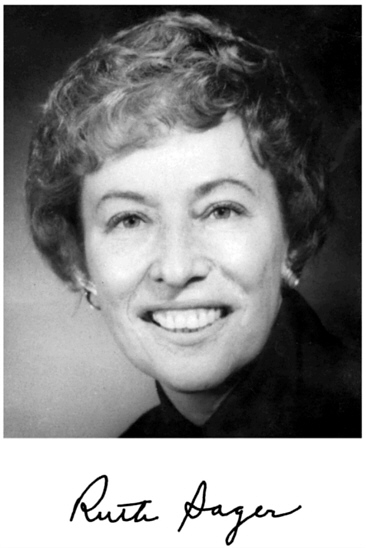
RUTH SAGER
February 7, 1918–March 29, 1997
BY ARTHUR B.PARDEE
RUTH SAGER HAD TWO distinguished careers. In the first she was a leading exponent of organelle, non-nuclear genetics; in the second she was a major innovator in cancer genetics, proposing, discovering, and investigating roles of tumor suppressor genes. At the pinnacle of research on the problem of non-nuclear or cytoplasmic genetics for many years, she almost single-handedly developed this subject of non-Mendelian, cytoplasmic genetics (“A vast, unexplored region of genetics was opened here today” [1963]). The very existence of hereditary determinants other than nuclear genes was doubted by a large part of the scientific community, although it was proposed in 1908 from observations on higher plants. Sager gathered data and argued in support of a second genetic system in the face of great skepticism and finally made this a respectable and exciting major area of genetics.
During her final 25 years she transferred her efforts to the genetics of cancer. Among her outstanding contributions, she devised the first cell lines and culture medium capable of culturing and comparing normal and cancer cells. She emphasized the major role of chromosome rearrangements and the accelerated evolution of cancer cells and the
requirement in a cancer of more than one mutated gene, importantly of tumor suppressor genes in addition to oncogenes. She proposed as early as 1974 that individual genetic defects could be corrected by transferring DNA into cells. “One need not be doomed by one’s genes.”1 She was a pioneer in the novel subject she named “expression genetics,” the identification by their mRNAs of genes that are functionally modified in cancers. She successfully identified numerous genes that are not mutated but whose expressions are altered in breast cancers, such as the mammary serpin maspin. She worked to the end, publishing innovative articles and obtaining a National Institute of Health grant in the month before her death. During her career she published two books (1961, 1972) and more than 200 research articles.
Ruth Sager was born in Chicago on February 7, 1918, daughter of Leon Sager, a businessman with strong intellectual interests, and Deborah Borovik Sager, who died in the 1918 influenza epidemic. She and her sisters, Esther and Naomi, were bought up by her stepmother, Hannah, in an atmosphere honoring learning. She graduated at 16 from New Trier High School. She received an S.B. in mammalian physiology in 1938 at the University of Chicago: “the best thing that ever happened to me.” Her interest in science was sparked by Anton J.Carlson’s lectures: “He was just a fantastic teacher.”2 In 1944 she received an M.S. in plant physiology at Rutgers University. Her World War II years were spent as a secretary and an apple farmer. Her 1948 Ph.D. in maize genetics was under Marcus M.Rhoades at Columbia University. From 1949 to 1951 she was a Merck postdoctoral fellow with Sam Granick at the Rockefeller Institute, working on the chloroplast. From 1951 to 1955 she was a staff member at Rockefeller, where she chose the alga Chlamydomonas reinhardi as a model organism. She was
a research scientist from 1955 to 1965 at Columbia University and worked for a year in Edinburgh during that period.
For 20 years, until the age of 48, she could not obtain a faculty position. “I guess I knew I was right, and I wasn’t terribly upset.”2 Beginning in 1966 and until 1975 she was a professor at Hunter College. Finally, in 1995, she was appointed professor of cellular genetics at Harvard Medical School— among the first women to gain a full professorship at Harvard—and chief of the Division of Cancer Genetics at the Dana-Farber Cancer Institute. She was also a Guggenheim fellow at the Imperial Cancer Research Fund, London, during 1972–73, and was elected to membership of the National Academy of Sciences in 1977.
Sager was first married to Seymour Melman in 1944 and then to the author of this memoir in 1973. She had no children. She died March 29, 1997, of bladder cancer in her home in Brookline, Massachusetts, at the age of 79. She is survived by her sisters, Esther Altschul and Naomi Sager, and her husband, Arthur Pardee.
Ruth Sager was innovative, highly intelligent, enthusiastic, very dedicated to her science, and hard-working; she had high standards and expected equal dedication from her coworkers. She did not suffer fools gladly. Her views of science as a career were:3
The first thing is to be sure of your own abilities. Science is very demanding, you have to be able to think very well and also have a very good memory. You have to really love it. Science is a way of life. I think it all comes from the inside. It really gets to the very core of your existence. It is much like being an artist or a dancer. It’s something that demands everything from you that you are capable of.
I have always been intrigued by the physicists’ approach to scientific inquiry, particularly in the fact that the way to find out something really new is to question the basic tenet of existing theory.
Very early Sager believed that genetics was the core of biology; she knew she was right and she set out to prove it. She never ceased introducing new techniques and concepts into her field, but she found her work ignored until her discoveries proved the majority wrong. But she never really paid a lot of attention to what other people think.
She was described in her fifties as “a calmly articulate and attractive woman (who looks younger by about 15 years) …a tall, striking brunette with a ready smile and a voice that carries a merry lilt.”4,5 She early described herself as “probably the happiest person I know.”5
Not at all narrowly devoted to her science, Sager had numerous outside interests: modern art, travel, music and theater, a rich social life, and she was a fine cook. She took up tennis late in life and played it with great enthusiasm— in spite of limited ability. She was especially fond of relaxing at Woods Hole, where she had a cherished second home, and where she is buried.
Among her honors and distinctions were Phi Beta Kappa in 1938, Sigma Xi in 1947, Guggenheim Fellowship in 1972, Schneider Memorial Lecture Award in 1973, National Academy of Sciences membership in 1977, American Academy of Arts and Sciences membership in 1978, Harvey Society Lecture in 1984, outstanding investigator at the National Cancer Institute in 1985, Gilbert Morgan Smith Medal from the National Academy of Sciences in 1988, membership in the Institute of Medicine in 1992, Princess Takamatsu Award (Japan) in 1992, alumni medallist of the University of Chicago in 1994, and membership on the Advisory Council of the National Institute on Aging.
At the beginning of her career Sager saw the advantages of studying genetics with a model microorganism that had a chloroplast, a sexual life cycle, grew rapidly, and could readily be manipulated for controlling growth and mating.
She chose the single cell alga “Chlamydomonas, a peerless group of organisms…nutritious, esthetically pleasing, and amenable to laboratory experimentation.”2
With talented coworkers, especially her long-time collaborator Zenta Ramanis, she:
-
Developed a mating system for the organism.
-
Early investigated the genetics of the organism—both Mendelian and non-Mendelian—with clear demonstration of the maternal inheritance pattern of the latter.
-
Discovered with Y.Tsubo the first specific “cytoplasmic” gene mutagen, streptomycin, and identified mutants by their resistance to this drug.
-
Discovered ribosomes in the choloroplast of Chlamydomonas, different from those in the cytoplasm, thus providing evidence that expression of genetic information as proteins is carried out by a different system.
-
Discovered with M.R.Ishida that unique DNA is located in isolated chloroplasts. This was the evidence that convinced most scientists that there is indeed a separate non-nuclear organelle genetic system.
-
Performed biochemical studies of the mechanism of exclusion of paternal genes.
-
Developed a system that makes genetic mapping possible by permitting expression of paternal genes.
-
Developed several mapping methods and first published cytoplasmic linkage groups and extensive mapping of an organelle. She showed that the chloroplast DNA is circular.
-
Demonstrated with an in vitro system the basis of maternally inherited drug resistance.
-
Discovered a eukaryotic restriction enzyme.
-
Discovered that there is communication between nucleus and organelles—they send molecular signals back and forth.
-
Showed that maternal DNA is methylated and paternal DNA is not and proposed this difference as the basis of selective destructive elimination of the paternal DNA.
Of her second career, cancer research, she said, “I had really wanted to work on cancer, but it seemed like a very difficult thing to do…. We think that the first change in cancer is a genetic change—something acts to transform an individual cell—whether that something be a viral infection or a chemical or radiation.”2 Entry into the subject was during her sabbatical at the Imperial Cancer Research Fund in 1972–73. From that time her career and her husband’s were independent but highly mutually supportive.
The question was: Which genes cause normal cells to become cancer cells? Oncogenes, recently discovered at that time, were proposed as the basis, but Sager championed inactivations of tumor suppressor genes. “Nature’s own approaches to cancer protection” are in addition deeply involved and are “a vast untapped resource for anticancer therapy.”2 Sager suggested a yin-yang balance of these for cellular homeostasis. Among her cancer research accomplishments were the following:
-
She developed a model system that allows detailed comparisons in the same culture medium between well-matched normal and tumor Chinese hamster embryo fibroblasts (CHEF cells).
-
She emphasized the multigenic basis of tumorigenicity. As with her earlier work she was among the first to champion this then unpopular view at a time when all attention was on single oncogenes. In the late 1970s she initiated investigations into tumor suppressor genes. As with her researches on chloroplast genetics, “there was really no interest in tumor suppressor genes at all until about maybe…1990.”2
-
She demonstrated tumor suppression with cell hybrids and cybrids. Remarkable examples are suppressor genes that promote programmed cell death of defective cells, and these are inactivated in tumors.
-
She showed an initial example of increased genetic instability in cancer cells. A genetic change, amplification of the methotrexate resistance gene, developed much faster in tumor cells than in normal cells.
-
She decided that gene expression would best be investigated in human cells. For this purpose she created a workable human breast cancer cell culture system in which normal and tumor epithelial cells could grow and at similar rates.
-
She introduced the concept of expression genetics, the study of changed gene expressions. Using subtractive hybridization, she discovered the IL-8-related gro gene and others whose mRNA level is modified in tumor cells. She then shifted to the new, simpler differential display technique to discover numerous additional potential tumor suppressor genes, ones whose expression is lost in breast cancers. And she began an investigation of the means to reactivate their expression. Her favorite example was maspin, the gene for a serine protease inhibitor, which is lost in advanced breast cancers and inhibits tumor invasion and metastasis. Vigorous research on this gene continues in numerous laboratories, including those of several of her past students and fellows.
-
She found that these under-expressed genes were not mutated, unlike classical tumor-related genes. Her plan was to use these under-expressed genes as markers for detection and diagnosis, and she hoped for therapies based on restoring their functions.
Her later interests included methylation of DNA and its specific enzymatic cutting and chromosome rearrangements in tumor cells.
Her legacy is expressed in the quotation:5 “For more than half a century Ruth Sager has been a role model for women in health-related scientific research…. She demonstrated vision, insight and determination to develop novel scientific concepts in the face of established dogmas…. Her pioneering researches and original ideas continue to make contributions to biology.”
When asked near the end of her life what she considered to be her most important contribution, she answered, “Well, I don’t think I’ve made it yet.” Many colleagues have carried on her researches, and papers based upon these researches continue to appear. She was a major constructive force in the scientific and personal lives of her many friends and students. She was a role model for many women, being among the earliest successful woman scientists in spite of major career obstacles, but she was never highly active in the women’s liberation movement. When faced with the built-in prejudice of the male scientific community against women, she responded by saying there was nothing she could do, except to be as good a scientist as possible.
She had great concerns in 1994 about politics and the future of science. “The strong influence of fashions in scientific thought continues to play an inhibitory role in scientific progress. I think science is in a rut right now. The way grants are given out just makes matters worse, because the experiment has to be so obvious and practically done already before they’ll fund it.”2
Her career twice demonstrated that some of the best science needs faith and support of novel ideas from the most creative minds.
NOTES
SELECTED BIBLIOGRAPHY
1954 With S.Granick. Nutritional control of sexuality in Chlamydomonas reinhardi. J. Gen. Physiol. 37:729–42.
Mendelian and non-Mendelian inheritance of streptomycin resistance in Chlamydomonas reinhardi. Proc. Natl. Acad. Sci. U.S.A. 40 (5):356–63.
1955 Inheritance in the green alga Chlamydomonas reinhardi. Genetics 40:476–89.
1961 With F.J.Ryan. Cell Heredity. New York: John Wiley and Sons.
1962 Streptomycin as a mutagen for nonchromosomal genes. Proc. Natl. Acad. Sci. U.S.A. 48 (12):2018–26.
1963 With M.R.Ishida. Chloroplast DNA in Chlamydomonas. Proc. Natl. Acad. Sci. U.S.A. 50:725–30.
1965 With Z.Ramanis. Recombination of nonchromosomal genes in Chlamydomonas. Proc. Natl. Acad. Sci. U.S.A. 53 (5):1053–61.
1967 With M.G.Hamilton. Cytoplasmic and chloroplast ribosomes of Chlamydomonas. Ultracentrifugal characterization. Science 157:709–11.
With Z.Ramanis. Biparental inheritance of nonchromosomal genes induced by ultraviolet irradiation. Proc. Natl. Acad. Sci. U.S.A. 58 (3):931–37.
1970 With Z.Ramanis. A genetic map of non-Mendelian genes in Chlamydomonas. Proc. Natl. Acad. Sci. U.S.A. 65:593–600.
1972 Cytoplasmic Genes and Organelles. New York: Academic Press. With D.Lane. Molecular basis of maternal inheritance. Proc. Natl. Acad. Sci. U.S.A. 69:2410–13.
1977 With W.G.Burton, R.J.Roberts, and P.A.Myers. A site-specific single-strand endonuclease from the eukaryote Chlamydomonas. Proc. Natl. Acad. Sci. U.S.A. 74 (7):2687–91.
1978 With A.N.Howell. Tumorigenicity and its suppression in cybrids of mouse and Chinese hamster cell lines. Proc. Natl. Acad. Sci. U.S.A. 75 (5):2358–67.
1979 With W.G.Burton and C.T.Grabowy. Role of methylation in the modification and restriction of chloroplast DNA in Chlamydomonas. Proc. Natl. Acad. Sci. U.S.A. 76 (3):1390–94.
1981 With H.Sano and C.Grabowy. Differential activity of DNA methyltransferase in the life cycle of Chlamydomonas reinhardi. Proc. Natl. Acad. Sci. U.S.A. 78:3118–22.
1982 With B.L.Smith. Multistep origin of tumor-forming ability in Chinese hamster embryo fibroblast cells. Cancer Res. 42:389–96.
1986 Genetic suppression of tumor formation: A new frontier in cancer research. Cancer Res. 46:1573–80.
With W.O’Brien and G.Stenman. Suppression of tumor growth by senescence in virally transformed human fibroblasts. Proc. Natl. Acad. Sci. U.S.A. 83 (22):8659–63.
1988 With A.Anisowicz, D.Zajchowski, and G.Stenman. Functional diversity of gro gene expression in human fibroblasts and mammary epithelial cells. Proc. Natl. Acad. Sci. U.S.A. 85:9645–49.
1989 With V.Band. Distinctive traits of normal and tumor-derived human mammary epithelial cells expressed in a medium that supports long-term growth of both cell types. Proc. Natl. Acad. Sci. U.S.A. 86:1249–53.
With D.A.Kaden, L.Bardwell, P.Newmark, A.Anisowicz, and T.R. Skopek. High frequency of large spontaneous deletions of DNA in tumor-derived CHEF cells. Proc. Natl. Acad. Sci. U.S.A. 86 (7):2306–10.
Tumor suppresser genes: The puzzle and the promise. Science 246:1406–12.
With V.Band, D.Zajchowski, and V.Kalesa. A newly established metastatic breast tumor cell line with integrated amplified copies of cerb B-2 and double minute chromosomes. Genes Chrom. Cancer 1:48–58.
1990 With V.Band, D.Zajchowsky, and V.Kalesa. Human papilloma virus DNAs immortalize normal human mammary epithelial cells and reduce their growth factor requirements. Proc. Natl. Acad. Sci. U.S.A. 87:463–67.
With D.Zajchowski, V.Band, D.K.Trask, D.Kling, and J.L.Connolly. Suppression of tumor forming ability and related traits in MCF7 breast cancer cells by fusion with immortal breast epithelial cells. Proc. Natl. Acad. Sci. U.S.A. 87:2314–18.
With D.Trask, V.Band, D.A.Zajchowsky, P.Yaswin, and T.Suh. Keratins as markers that distinguish normal and tumor-derived mammary epithelial cells. Proc. Natl. Acad. Sci. U.S.A. 87:2319–23.
1995 With K.Swisshelm, K.Ryan, and K.Tsuchiya. Enhanced expression of an insulin growth factor-like binding protein (mac25) in senescent human mammary epithelial cells and induced expression with retinoic acid. Proc. Natl. Acad. Sci. U.S.A. 92:4472–76.
1997 Expression genetics in cancer: Shifting the focus from DNA to RNA. Proc. Natl. Acad. Sci. U.S.A. 94:952–55.
With S.Sheng, P.Pemberton, and M.J.Hendrix. Maspin: A tumor suppressing serpin. Adv. Exp. Med. Biol. 425:77–88.
2000 With K.J.Martin, B.M.Kritzman, L.M.Price, B.Koh, C.-P.Kwan, X.Zhang, A.Mackay, M.J.O’Hare, C.M.Kaelin, G.L.Mutter, and A.B.Pardee. Linking gene expression patterns to therapeutic groups in breast cancer. Cancer Res. 60:2232–38.


