
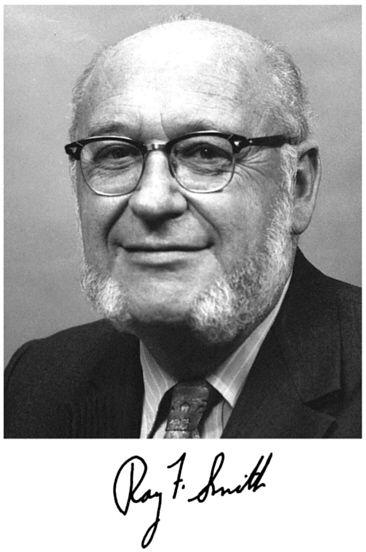
RAY FRED SMITH
January 20, 1919–August 23, 1999
BY PERRY ADKISSON, WILLIAM ALLEN, JOHN CASIDA, AND EDWARD SYLVESTER
RAY F.SMITH, emeritus professor of entomology at the University of California at Berkeley, died August 23, 1999, at his home in Lafayette, California. He was 80 years old. Ray was born on January 20, 1919, in Los Angeles, California. He grew up in Monterey, where his father was a pharmacist, and after graduating from high school, Ray entered the University of California at Berkeley; he completed his B.S., M.S., and Ph.D. degrees there.
Ray joined the Berkeley faculty in 1941 and became not only a significant builder of its entomology program but also an internationally recognized champion of ecological pest control. From each of his distinguished Berkeley faculty mentors he garnered a lifetime appreciation of history, books, and collecting (E. 0. Essig); field ecology and service to agricultural entomology (A.E.Michelbacher), and a deep respect for and interest in systematic entomology and evolution (E.G.Linsley). From the beginning of his academic and experiment station career it was apparent that the hallmark of his teaching, research, and advocacy was to be centered on an ecological approach to analysis and management of the economic ravages of arthropod pests. He enthusiastically adopted the strong Berkeley tradition in agricultural and medical entomology and fully appreciated the
university’s historical accomplishment in biological pest control.
Ray accepted the dictum that pesticides must be considered in the context of existing natural factors of population regulation and, if pesticides are to be used, such use should be minimal and precise in time and target. Shortly after the end of World War II he began a period during which he attracted, stimulated, and trained a formidable group of future leaders in ecological pest management. Building on his early collaborative work with Michelbacher, he pushed the concept of supervised control and for a period of 10 years put it into practice for the management of key pests of alfalfa. The demonstrated success of his approach, one that was solidly based upon pest population assessment and an impressive array of ecological and biological data, gradually evolved into the concept of integrated pest management.
His administrative potential was soon recognized, and in 1959 he was appointed chair of the Department of Entomology and Parasitology, a position he held until 1973. During his tenure the combined leadership of Ray and his dean, E.G.Linsley, saw the department grow, diversify, and consolidate its place on the Berkeley campus. The 1960– 1975 Master Plan for Higher Education in California and the policy of the university’s president, Clark Kerr, to decentralize administrative authority and establish campus autonomy provided additional organization opportunities. The department was reformed into one of entomological sciences, with an academic instructional unit of the Department of Entomology and Parasitology and four autonomous research divisions, viz., agricultural entomology, biological control, invertebrate pathology, and parasitology and medical entomology. With a faculty of 46 and a vigorous broadbased program in research and teaching, its academic ranking became first in the United States.
On a more personal level, Ray’s tolerance, encouragement, and willingness to discuss diverse problems and ideas characterized his stewardship as department chair. No matter the hour or how pressing the work, his door was open to colleagues and students alike—to anyone in need of advice or merely an ear to bend. His energy, patience, and eagerness to be of help were amazing.
After resigning as chair Ray felt there was much more to be done with the concept of integrated pest management. Although Rachel Carson’s Silent Spring had exposed the ecological hazards associated with wide and indiscriminate use of persistent broad-spectrum pesticides, agriculture, forestry, and public health remained beset with serious pest problems that needed resolution. Professor Smith increasingly began to apply his knowledge and administrative talent to build what was to become a second career at national and international levels.
Before stepping down as chair, he was an associate project director (1970–77) of the International Biological Program, a National Science Foundation project entitled “Principles, Strategies and Tactics of Pest Population Regulation and Control in Major Crop Ecosystems,” directed by Carl B. Huffaker, later known as the Huffaker project. Ray also was director for the University of California for Pest Management and Related Environmental Protection Project with the U.S. Agency for International Development (UC/AID), and from 1979 until his retirement in 1982 executive director of the Consortium for International Crop Protection (CICP), which assumed supervision of the UC/AID project.
Professor Smith took a lead in forming the Panel of Experts on Integrated Pest Control of the United Nations Food and Agricultural Organizations (UN/FAO) and the Environmental Program (UN/EP), organized to advise both agencies on the scientific, technical, and education issues
involved in integrated pest management. He headed this panel from 1967 to 1982 and during his tenure both as chair of the FAO panel and as director of CICP he became more deeply involved in promoting integrated pest management globally. Under his leadership the two groups jointly worked to publish materials on the philosophy, principles, strategies, and tactics of integrated pest control, guidelines for implementing integrated pest management systems on major food crops and agromedical approaches to pesticide management, and also established several technical assistance programs in many developing countries.
An enlightened policy of the University of California allows distinguished faculty to accept, with a reduction in programmatic time commitment, leadership positions in affiliated undertakings. Thus, it was within the framework of a multi-university Intersociety Consortium for International Plant Protection (CICP) (Entomological Society of America, Weed Science Society of America, Society of Nematologists, American Phytopathological Society) that Professor Smith put his major effort in the final years of his career as executive director of CICP. He did not use that position simply for administration but for a personal effort, continuous and exhausting, to take the concept, philosophy, and practice of integrated pest management to those responsible for policy in agriculture production and agromedical practices around the world. In particular, he focused on needs of underdeveloped areas of the Americas (Mexico, El Salvador, Guatemala, Nicaragua, Brazil, Colombia, and Peru), Asia (Ceylon, Korea, Thailand, Philippines, and Pakistan) and Africa (Egypt, Kenya, and Senegal). His bibliography, in which some citations were translated and published in German, French, Italian, and Spanish, became filled with references to invitations to speak and participate in symposia, conferences,
seminars, workshops, panels, advisory committees, and consultations.
Professor Smith’s tireless effort and relentless travel through the world’s times zones took their physical toll and eventually led in 1982 to a decision to retire from leadership of the consortium and from the university. This was early for the latter. We are certain that he fully intended to remain active in the international field of integrated pest management, but a debilitating health event, while on a consulting trip in South America, necessitated a professional hiatus. Unfortunately, subsequent health problems continued to restrict his potential for further professional activity. His final illness with throat cancer, prolonged and painful, was spent in the security of home and family. We lost an academic colleague, teacher, friend, and champion of more rationality in the management of arthropod pests, and we are not alone.
He is survived by his wife of 59 years, Elizabeth J.Smith; two children, Kathrine Stark of Lafayette and Donald Smith of McKinleyville, California; a sister, Betty Webler, in Alaska; and seven grandchildren.
ACCOLADES FOR RAY SMITH’S PROFESSIONAL ACHIEVEMENTS INCLUDE:
Member of the National Academy of Sciences
Honorary degree of doctor of agricultural sciences, College van Dekanen, Wageningen, Netherlands
The C.M.Woolworth Award for Outstanding Achievements, Entomological Society of America
Guggenheim fellow
Fellow, American Academy of Arts and Sciences
Fellow, American Association for the Advancement of Science
Fellow, California Academy of Sciences
Fellow, Honorary member, and president, Entomological Society of America
Fellow, Entomological Society of Canada
Honorary member, Korean Society of Plant Protection
Co-recipient, 1997 World Food Prize
Berkeley Citation
Congress Medal, 1983, X International Congress for Plant Protection
SELECTED BIBLIOGRAPHY
1943 With A.E.Michelbacher. Some natural factors limiting the abundance of the alfalfa butterfly. Hilgardia 15:369–97.
1948 With W.M.Hoskins and O.H.Fullmer. Secretion of DDT in milk of dairy cows fed low-residue alfalfa hay. J. Econ. Entomol. 41:759–63.
1949 With D.E.Bryan and W.W.Allen. The relation of flights of Colias to larval population density. Ecology 30:288–97.
1952 With E.G.Linsley and J.W.MacSwain. The life history and development of Rhipiphorus smithi with notes on their phylogenetic significance. Univ. Calif. Publ. Entomol. 9:291–314.
With E.G.Linsley and J.W.MacSwain. Outline for ecological life histories of solitary and semi-social bees . Ecology 33:558–67.
1954 The importance of the microenvironment in insect ecology. J. Econ. Entomol. 47:205–10.
With W.W.Allen. Insect control and the balance of nature. Sci. Am. 190:38–42.
1956 With D.E.Bryan. The Frankliniella occidentalis complex in California. Univ. Calif. Publ. Entomol. 10:339–410.
1958 With W.W.Allen. Some factors influencing the efficiency of Apanteles medicaginis Muesebeck (Hymenoptera: Braconidae) as a parasite of the alfalfa caterpillar, Colias philodice eurytheme Boisduval. Hilgardia 28:1–42.
1959 The spread of the spotted alfalfa aphid, Therioaphis maculata (Buckton) in California. Hilgardia 28:647–94.
With V.M.Stern, R.van den Bosch, and K.S.Hagen. The integration of chemical and biological control of the spotted alfalfa aphid. The integrated control concept. Hilgardia 29:81–101.
1966 With K.S.Hagen. Natural regulation of alfalfa aphids in California. In Ecology of Aphidophagous Insects, Proc. Symp. Liblice near Prague, pp. 297–315. Prague: Academia.
With H.T.Reynolds. Principles, definition and scope of integrated pest control. In Proceedings, FAO Symposium on Integrated Pest Control, pp. 11–17. Rome.
1967 Principles of measurement of crop losses caused by insects. 6th FAO Symposium on Crop Losses, pp. 205–224. Rome.
With J.F.Lawrence. Clarification of the status of the type specimens of Diabroticites (Coleoptera, Chrysomelidae, Gulerucinae). Univ. Calif. Publ. Entomol. 45:1–204.
With R.van den Bosch. Integrated control. In Pest Control: Biological, Physical, and Selected Chemical Methods, eds. W.W.Kilgore and R.L.Doutt, pp. 295–340. New York: Academic Press.
1970 Pesticides: Their use and limitations in pest management. Proc. Conference, North Carolina State University. In R.L.Rabb, and F.E.Guthrie, eds., Concepts of Pest Management, pp. 103–113. Raleigh: North Carolina State University.
1971 The impact of the green revolution on plant protection in tropical and subtropical areas. The 1971 Founders’ Memorial Award Lecture. Bull. Entomol. Soc. Am. 18:7–14.
With R.L.Doutt. The pesticide syndrome-diagnosis and suggested prophylaxis. In Biological Control. Proceedings, AAAS Symposium on Biological Control, Boston, Dec., 1969, ed. C.B.Huffaker, pp. 331–345. New York: Plenum Press.
1973 With C.B.Huffaker. Integrated control strategy in the United States and its practical implication. Europ. Plant Prot. Org. Bull. 3:31–49.
1974 With C.B.Huffaker, P.L.Adkisson, and L.D.Newsom. Progress achieved in the implementation of integrated control projects in the USA and tropical countries. Europ. Plant Prot. Org. Bull. 4:221–39.
With C.B.Huffaker and A.P.Guttierez. The need for systems analysis and its use in the US/IBP integrated pest management project. In Modeling for Pest Management: Concepts, Techniques, and Applications, eds. R.L.Tummala, D.L.Haynes, and B.A. Croft, pp. 209–216. East Lansing: Michigan State University.
1976 Insecticides and integrated pest management. In The Future for Insecticides: Needs and Prospects, eds. J.J.McKelvey and R.L.Metcalf, pp. 489–506. New York: John Wiley and Sons.
1980 With L.Brader and E.J.Buyckx. Past and present activities of the FAO/UNEP panel of experts on integrated pest control. Bull. Entomol. Soc. Am 26:432–35.


