
13
Knowledge and Questions After 15 Years of Research
Paul C. Stern, Thomas Dietz, Nives Dolšak, Elinor Ostrom, and Susan Stonich
The study of institutions for managing common-pool resources has matured considerably since 1985. This chapter assesses the progress of the field as a scientific enterprise, characterizes what has been learned over the past decade and a half, and identifies a set of key research directions for the next decade of research. We find that the field is making marked progress along a trajectory of development that is common to many maturing areas in the social sciences. Some of the advances have practical value for natural resource managers, though knowledge has not progressed to a point at which managers can be offered detailed guidance. And of course, practical guidance must be based on an understanding of both the scientific knowledge base and the local situation. In this chapter we summarize some key lessons from recent research, discuss seven major challenges of institutional design, identify important directions for future research, including key understudied issues, and note ways that the field can benefit from linkages to several related fields of social science research.
PROGRESS OF THE FIELD
Research on institutional designs for common-pool resource management has followed a development path that is similar to many other fields of social science that investigate complex real-world phenomena and develop knowledge intended to be useful for managing those phenomena. These fields seek to understand phenomena that are multivariate, path-dependent (i.e., historically contin-
We are indebted to James Acheson, Kai Lee, Ronald Mitchell, and the chapter authors of this volume for insightful discussions and written comments on drafts of this chapter.
gent), and reflexive (i.e., alterable in important ways by the process of studying them). Many of the processes are hard to study with field experiments and care must be taken in generalizing from laboratory experiments. Thus, establishing causation is always a challenge. The complexity of the phenomena also means that models based on nonexperimental data have many parameters to be estimated relative to the number of observations available. Other fields facing this problem include international conflict resolution (Stern and Druckman, 2000) and comparative politics and sociology (King et al., 1994; Ragin, 1987, 2000; Ragin and Becker, 1992). Program evaluation has a long history of dealing with these issues (see, e.g., Cook and Campbell, 1979; Chen, 1990; Chen and Rossi, 1992; Weiss, 1998). Progress in such fields depends on reducing bewildering arrays of phenomena, each with multiple attributes that may be important, into manageable sets of measurable variables. It also depends on developing theory that specifies relationships among the variables, including identification of causal relationships among variables that can be manipulated intentionally. The development path in such fields typically involves at least four elements, all of which are evident in common-pool resource management research.
Development and Differentiation of Typologies
Typologies are needed to classify the central phenomena under study, the outcomes worthy of investigation, and the factors both internal and external to the central phenomena that shape those phenomena and their effects on larger systems. Without a shared language that differentiates key concepts, theoretical progress is impossible. An example is the increasingly familiar classification of property rights institutions into four major types: individual property, government property, group property, and open access (the absence of rights to exclude) (e.g., Feeny et al., 1990). These types have been further differentiated into subtypes (e.g., Tietenberg, Chapter 6, on subtypes of private property). Another example is the classification of factors affecting institutional functioning into attributes of resources, attributes of appropriators, and attributes of institutions, and of each of these classes into subtypes (see Agrawal, Chapter 2). It can be useful to subdivide these even further. For example, Bardhan and Dayton-Johnson (Chapter 3) identify several kinds of heterogeneity among resource appropriators and conclude that economic heterogeneity and social heterogeneity have independent effects and operate through different causal mechanisms (incentives versus norms). Typologies allow researchers to focus attention on a tractable number of variables and then to state and systematically examine research hypotheses about them.1
Contingent Generalizations
A second element of development is a shift from bivariate research hypotheses to contingent or conditional ones. For example, it has become clear that no
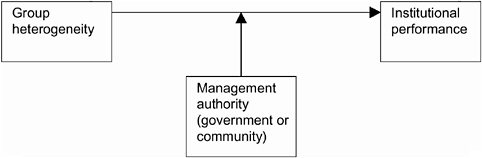
FIGURE 13-1 Schematic representation of an empirically supported contingent relationship between group heterogeneity and institutional performance.
single institutional form is best at maintaining resources across a wide range of environmental and social conditions. Researchers have begun to propose hypotheses about conditions under which particular institutional forms are likely to be successful. Similarly, research has shown that simple bivariate relationships of the sustainability of resource management with the size, heterogeneity, and poverty of the user group may be positive, negative, or curvilinear, depending on contextual factors (Agrawal, Chapter 2). Researchers have responded by developing and testing hypotheses that take these contingencies into account.
Studies with large numbers of cases (large-n studies) are particularly useful for generating such hypotheses because they allow regularities to be observed in subsamples that differ in factors that change the effect of other variables—the factors that make conclusions contingent. For example, Tang (1992, cited by Bardhan and Dayton-Johnson, Chapter 3) reports that heterogeneity among resource appropriators is associated with poorer performance in irrigation systems that are managed by government agencies, but not in community-managed systems (see Figure 13-1). Apparently, some community-managed systems are able to develop rules of allocation and cost sharing that meet the challenges of heterogeneity, while agency-managed systems are not. Similarly, Varughese and Ostrom (2001) show that various forms of heterogeneity within forest user groups depend for their effects on collective action on the specific form of organization established by the group. Identifying this difference in the effects of heterogeneity requires cases that differ in their degree of heterogeneity among both community-managed and government-managed systems.2
Causal Analysis
A third element of development is a shift from correlational to causal analysis. Researchers hypothesize and search for causal paths or mechanisms that can
account for and explain observed associations. These causal models include interactions such as the one just noted where the effect of one independent variable on the dependent variable changes with the value of a third variable. For example, Bardhan and Dayton-Johnson (Chapter 3) theorize that the effects of heterogeneity may follow several causal paths. “Olson effects” (Olson, 1965; see causal path (a) in Figure 13-2) operate when certain resource users have enough at stake, and enough wealth, to maintain the resource on their own even though there are free riders. Two alternative causal paths, (b) and (c), have negative effects on resources and, according to Bardhan and Dayton-Johnson, are more often consistent with the evidence on the functioning of irrigation systems.
Another example of causal models comes from experimental research attempting to understand why communication within a resource user group fosters cooperative outcomes. This research suggests three possible causal mechanisms. Communication may increase group identity or solidarity, create the perception of a consensus to cooperate, or result in actual commitments to cooperate, which function as shared norms to which members adhere (see Kopelman et al., Chapter
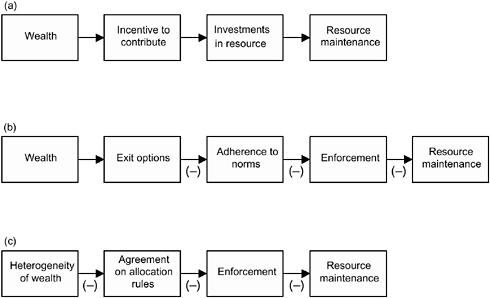
FIGURE 13-2 Three causal paths describing hypothesized effects of wealth or weath inequality on maintenance of common-pool resources.
NOTE: Minus signs (–) signify hypothesized negative effects of wealth or wealth inequality on the variable to the right of the arrow.
4). Experimental researchers have been working to understand whether all or only some of these mechanisms are important for understanding the observed communication effect. One advantage of the experimental approach compared to the analysis of an even larger number of case studies from the field is the ability of experimental researchers to structure the values of hypothesized causal variables so as to obtain clear estimates of their effects (Gintis, 2000). The experiment allows critical simplifications not possible with field data. Recent experiments conducted in field settings with Colombian villagers who are responsible for managing local common-pool resources provide complementary evidence to that generated in experimental laboratories located in universities (Cárdenas et al., 2000).
Research on communication and group norms is part of a larger effort to build causal models that explain how characteristics of resources and resource-using groups link through social institutions to produce outcomes for resource systems. Figure 13-3 presents a schematic model that specifies some such links in detail, focusing particularly on the roles of monitoring and enforcement of existing rules as mediating factors. The model is generally consistent with available evidence. It is also partly speculative and incomplete (e.g., it does not represent a full range of effects of communication nor does it address how some of these independent variables affect each other and may affect the likelihood of self-organization in the first place).
Models such as that in Figure 13-3 do much to advance theory and practice. They move understanding forward from correlation to causation. In doing so they greatly reduce the number of variables and hypotheses to be examined. Such models, when empirically verified, create an importance ranking among the variables: Some emerge as important because of strong direct effects on the sustainability of the resource and other outcomes of concern. Others are important only for their indirect effects. For example, properties of resources and resource users affect resource outcomes only indirectly, mainly by influencing the costs of monitoring and enforcement. Of course, in making policy or designing institutions, the ease with which a variable can be changed, and the consequences of those changes on issues other than commons management, often will be as important as the size of the direct or indirect effect of a variable on commons sustainability. In addition, because institutional design choices are normally the result of negotiation among political actors, the technical characteristics of the options are weighed in the context of their political acceptability.
Models like that in Figure 13-3 can also advance understanding by grouping variables and making connections to related fields of study. In the model shown in Figure 13-3, communication, dense social networks, and practices of reciprocity all affect outcomes through exactly the same causal paths. This suggests that these variables may be considered as multiple indicators of a single underlying construct—perhaps what has been called strength of community (Singleton and Taylor, 1992; Gardner and Stern, 1996), social ties (Petrzelka and Bell, 2000), or
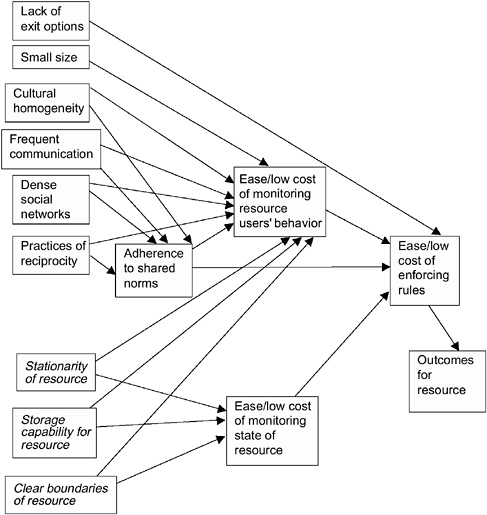
FIGURE 13-3 A schematic causal model postulating ways that costs of monitoring and enforcement mediate between characteristics of resources and resource users and outcomes of resource management institutions.
NOTE: Boxes in top part of left column refer to characteristics of resource users and their groups; boxes in bottom part with italic text refer to characteristics of resources. All arrows indicate posited positive relationships.
social capital (Putnam et al., 1993; Ostrom and Ahn, 2001; but see Abel and Stephen, 2000). It also suggests that what has been learned in research on these constructs may be relevant to problems of designing resource management institutions.
Causal models can be useful to practitioners by helping them to identify
potential ways to intervene to produce desired effects. This model redirects attention from variables on the left of the figure, none of which can be changed directly by institutional design, toward features that are more amenable to institutional solutions, in the middle of the figure.3
Integration of Research Results
The fourth element in the development of research is the integration of results from various research methods, each of which has its own contribution to offer—and its own limitations. Causal models of the sort described in the previous section are one form of integration, but here we are also referring to formal methods of integration and making sense of cross-study comparisons. Controlled experimental research (see Kopelman et al., Chapter 4) provides the strongest evidence for establishing relationships of cause and effect. But it is hard to apply to understanding complex phenomena like resource management institutions because they are hard to simulate realistically in the laboratory and because opportunities for field experiments are limited. Experiments seem to be most useful for understanding influences on the behavior of individuals and small groups that can be simulated in the laboratory. Because experiments must almost always be carried out in simulated resource-use situations, however, their external validity— that is, their relevance beyond the simulation setting—is always open to question.
Case studies have been the most frequently used method in studies of resource institutions. Careful case studies can provide deep understanding of realistic settings. It is difficult, however, to generalize from any single case, with all its contextual and historical uniqueness, to other situations. Careful comparisons across cases, such as was done in the studies reviewed by Agrawal (Chapter 2), can better distinguish phenomena unique to a single case from those with some generality. But as long as case study authors use a wide diversity of theoretical approaches and thus collect data that are not comparable across studies, rarely are there enough cases available with similar variables to support strong generalizations—the data usually leave room for alternative interpretations.
Researchers sometimes turn to multivariate data sets of moderate size to provide stronger evidence. Bardhan and Dayton-Johnson (Chapter 3) report on the results of some such multivariate studies, and databases are being developed that will support future studies of this type (see Gibson et al., 2000a; Poteete and Ostrom, 2001). This research strategy adds breadth not available from individual or small-n case studies, but it is limited by the range and quality of measures available for all cases in the data sets. Sometimes, variables of theoretical importance are not measured at all in a data set or can be measured only by using rough proxies. For example, Dayton-Johnson (2000) uses the number of villages where irrigators live as a measure of social heterogeneity. This measures spatial heterogeneity, but may not measure social or economic heterogeneity.
Another important research method involves the use of formal deductive
theory, typically the theory of games (e.g., Falk et al., Chapter 5), of rational action (e.g., Bardhan and Dayton-Johnson, Chapter 3), or of optimal allocation (e.g., Tietenberg, Chapter 6). Formal theory has the virtue of precision, although the relevance of any particular formulation to practical situations can be determined only by empirical evidence. Put another way, deductions from theory generate hypotheses to explore with empirical methods. If observations do not square with theory, the theory can sometimes be elaborated to account for the data, thus generating new insights. An example is Tietenberg’s explanation (Chapter 6) of why tradable permits seem to work better for controlling emission of air pollutants than for controlling the use of fisheries and water resources. Using simple economic models, advocates have promoted tradable permits for all three resource types, but experience calls attention to differences, particularly in the importance of negative externalities. Fishers of nonregulated species and downstream water users often are harmed by tradable-permit institutions. In contrast, the permitting systems for air pollutants do not seem to have produced externalities that have disrupted these institutions. In this instance, case studies reveal the need for theorists and institutional designers to give more attention to negative externalities produced by permit holders.
Because no research method is definitive, knowledge is best advanced by combining research methods in a strategy that is often referred to as “triangulation” (e.g., Campbell and Fiske, 1959) or “critical multiplism” (Cook, 1985, 1993). Results from using one method may offer hypotheses to explore with other methods, answer questions another method cannot answer, or call into question consistent conclusions from another method. A growing body of literature is intended to facilitate integration across methods and even hybridization of them (Bennett and George, 2001; King et al., 1994; McGinnis, 2000; Ragin, 1987, 2000; Ragin and Becker, 1992). Also relevant to research integration are methods of meta-analysis (e.g., Glass et al., 1981; Rosenthal, 1984; Petitti, 2000). All these kinds of exchange contribute to knowledge. Since the mid-1980s, increased communication and integration across methods of common-pool resource management research has benefitted the field.
Toward a Conceptual Framework
As this volume makes evident, researchers continue to identify variables that may be important for understanding and controlling the effects of resource management institutions. Agrawal (Chapter 2) identifies more than 30 such variables taken from a broad examination of the literature—and this list will surely get longer as research continues. As Agrawal notes, such a long list of variables creates significant challenges for research because of the large number of possible associations and causal relationships that must be examined. As he also notes, the development of theory presents one way through the thicket of possible
hypotheses. Theory can potentially limit the number of theoretically meaningful propositions that are worth examining.
Theoretical propositions are beginning to emerge from recent research, as illustrated by the propositions presented by the relationships in Figures 13-1, 13-2, and 13-3. Other propositions, drawn from Chapters 2 through 12, are listed in the Appendix. We believe it is useful at this time to suggest a general conceptual framework within which such propositions can be placed. The classes of variables identified by Agrawal and others can be arranged into four broad functional categories defined by their possible theoretical relationships:
-
Possible interventions, or independent variables. These are influential factors, including attributes of institutions, that can be altered by policy intervention over the short run.
-
Outcomes, or dependent variables. These are things of importance to resource users that may be affected by resource conditions, resource use, and interventions.
-
Contingencies, or moderator variables. These are factors that are out of the practical control of short-run policy interventions but that may determine how an intervention affects an outcome.
-
Mediators, or intervening variables. These are factors that may affect outcomes but that may in turn be affected by interventions, subject to contingencies.
The typical relationships among these types of variables are represented schematically in the causal model shown in Figure 13-4. A grouping of variables from the commons literature into the four categories appears in Box 13-1.4 This framework and causal model highlights some points that may be worth special attention in future research and practical analysis. One is that interventions often affect outcomes only indirectly through their effects on key intervening variables. The immediate policy challenge is often to influence variables such as the ease of monitoring the resource or adherence to group norms. The model highlights three tasks for theory: (1) to clarify how key intervening variables affect outcomes; (2) to identify the contingencies under which those mediators become critical; and (3) to identify the conditions under which particular interventions can successfully influence them. The framework also suggests that outcomes of interest depend on a variety of policy variables, not only on the design of resource management institutions. Thus, there may be more ways to achieve desired objectives than are immediately apparent.
Figure 13-3 can be seen as an elaboration and specification of the general model. It shows a variety of contingencies along the left edge and postulates their effects on a set of mediators (the center of the figure), all of which in turn affect outcomes. Figure 13-3 adds theoretical specificity by identifying key contingencies and mediators and by postulating causal links among the mediators. It does not, however, postulate effects of interventions on the variables in the figure.
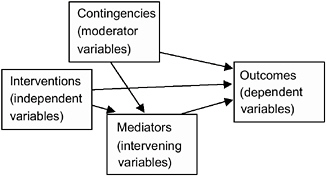
FIGURE 13-4 Schematic causal model showing typical relationships among variable types.
We believe the framework described can advance theory by helping to focus on kinds of propositions likely to have theoretical significance. We also believe it has practical potential because it clearly distinguishes types of variables that are possible policy levers (the independent variables) from two other types of variables that may also affect outcomes: mediators, which are appropriate targets of policy intervention, and contingencies, which must be taken into account in making policy choices, even though policy cannot quickly change them, because the outcome of an intervention may depend on the state of these variables when the intervention is tried.
The framework is incomplete and is not useful for all purposes. For example, it may not prove very useful for understanding the challenges of designing linkages among institutions. Nevertheless, we hope it will prove useful for advancing understanding.
LESSONS LEARNED
As the previous section suggests, research since 1985 has changed the shape of the field and increased the sophistication of understanding, but it has not always produced definitive answers to practical questions. This section summarizes a few key substantive lessons that have gained solid support. We then discuss the practical relevance of knowledge so far developed, drawing extensively on the previous chapters.
This summary is of necessity quite selective and cannot touch all the key points raised in the dozen chapters that precede this one. To offer the reader further help in mining the rich lode of ideas developed in those chapters, the Appendix to this chapter contains a longer list of key findings or propositions and notes the chapters in which they can be found.
|
BOX 13-1 Interventions (Independent Variables) Institutional arrangements regarding resource base (e.g., property rights regime for resource, simplicity of rules, graduated sanctions, accountability of monitors, coordination with institutions at other scales or in other regions) Other institutional arrangements (e.g., development, tax, investment policy; political representation rules) Technology choices (e.g., decision to adopt new monitoring technology) Contingencies (Moderator Variables) Resource system characteristics (e.g., size, boundaries, mobility of resource, storage, predictability) User characteristics (e.g., population, boundaries, social capital, leadership, heterogeneities, prevalence of honesty, interdependence, poverty) Relationships between characteristics of resources and users (see Box 2-5) Institutional forms at other scales or in other regions (e.g., state support for local rules, nesting of institutions, international regimes) Available technology (e.g., cost of technology for exclusion, monitoring) Integration of resource base into global markets Mediators (Intervening Variables) Adherence of users to shared norms Ease/cost of monitoring users’ behavior Ease/cost of monitoring state of resource Ease/cost of enforcing rules Users’ understanding of rules and sanctions Outcomes (Dependent Variables) Sustenance of the resource system (sustainability) Durability of resource management institutions Economic output of the resource system (e.g., productivity, efficiency) Distribution of the economic output (equity) Democratic control |
Some Substantive Lessons
The “Tragedy of the Commons” Model has Major Limitations
The most basic lesson learned from studying actual common-pool resource management is that the metaphor of a “tragedy of the commons” is only apt under very special conditions. When resource users cannot communicate and have no way of developing trust in each other or in the management regime, they will tend to overuse or destroy their resource as the model predicts. Under more typical circumstances of resource use, however, users can communicate and have ways of developing trust. Under these conditions it is possible, though by no means certain, that they will agree on a set of rules (i.e., an institutional form) to govern their use patterns so as to sustain the resource and their own economic returns from it. Much of the research since 1985 can be understood as an effort to identify the factors affecting the likelihood that the resource users, by themselves or in conjunction with external authorities, will develop such rules, with accompanying incentives, and conform to the rules (Jensen, 2000).
Three Conditions Are Necessary, but Not Sufficient, for Emergence of Self-Organized Institutions
Research reviewed in the previous chapters identifies three basic conditions as necessary for resource appropriators to create and sustain effective resource management institutions. First, the resource must be salient enough to the users that they are willing to invest time and energy to create new institutions (Gibson, 2001). Second, users must have the autonomy to devise and change rules (that is, the external institutional environment must give or allow them this autonomy). Third, at least a subset of users must be able to engage in direct communication with each other, including the opportunity to bargain. Given these conditions, whether appropriators will organize, which institutional design they will choose, and the performance and survival of that design depend on specific characteristics of the resource, the resource users, and the repertoire of institutional rules considered.
One Form Does Not Fit All
The research clearly demonstrates that no particular institutional design can ensure successful management of all common-pool resources. Given ecological and social complexity, this finding should not be surprising. There are successes and failures with private property, government property, and community property institutions. What works best depends on specific characteristics of resources, resource users, external factors, details of institutional design, and the interactions among these factors. Thus, practitioners need to find an institutional form that fits the requirements of the biophysical system being used and the social
context of the resource users. Fortunately for practical purposes, research has identified a great variety of institutional forms, thus expanding the practitioner’s kit of tools from which to choose. Unfortunately, research has not yet matched the detailed characteristics of institutional forms to the characteristics of resources, resource users, and the context for which they are most suitable.
“Success” Means Different Things to Different People
The common-pool resource research tradition began with questions about the sustainability of resources. This remains an important question for research, but it is not the only question for resource users. For them, the livelihoods and well-being of humans are often more important than any particular resource. Researchers who want to produce knowledge of practical value need to identify and examine the full range of outcome conditions that matter to the people who use, manage, and/or depend on the resource being studied. It is these people whose decisions the research will inform and who face important tradeoffs. Sometimes, one desirable outcome (e.g., sustainability or equity) can be achieved only by sacrificing another (e.g., efficiency). Institutions may be judged by how well they provide jobs and wealth, maintain good social relations in a community, provide access to resources from outside, and many other criteria in addition to resource sustainability. Research that ignores the multiplicity of valued outcomes is unlikely to produce realistic models for real decisions, which must take account of those varied outcomes.
Indirect and Mediated Effects Are Important
Many of the characteristics of resources and resource users that have been hypothesized to affect the success of institutions (however defined) do so only contingently and indirectly. For example, as already noted, many effects are mediated by the costs of monitoring and rule enforcement. Understanding the indirect effects is important for making sense of the inconsistent bivariate associations that are reported in the literature. It is also important for institutional designers because, although in most cases they can do little to change characteristics of resources and resource users, they can often influence monitoring, enforcement, and other mediating factors in ways appropriate to the context they face.
How Research Can Have Practical Value
When social science aspires to practical relevance, it must face the disjunction between its usual aim, which is to arrive at generalized propositions about the world, and the need of practitioners to act in highly specific but ever-changing circumstances. How can generalized knowledge be useful to these practitioners?
One field in which much thinking has been done about making social science knowledge useful is international relations. The following conclusions, drawn from that field (George, 1993; National Research Council, 2000), are also applicable to the field of common-pool resource management research.5
Practitioners always need many kinds of knowledge to achieve their objectives. Some types of essential knowledge are highly situation-specific and can come only from examining current features of particular situations—the forces in a particular location that are affecting a resource and resource users, and so forth. This can be called “time and place information” (Hayek, 1945). Other kinds of essential knowledge apply across situations. These forms of scientific knowledge tell scholars and practititoners what to expect with certain kinds of groups, in certain kinds of countries, or with certain resources. These kinds of knowledge are generic, that is, cross-situational, and therefore subject to improvement by systematic empirical studies.
The specific, contextually grounded problems practitioners must deal with are usually instantiations of generic problems of resource management. Although occurring in different contexts, these situations are encountered repeatedly. Examples include monitoring resources, enforcing rules, mediating disputes, and achieving cooperation. Practitioners typically consider several specific policy instruments and strategies for dealing with each of these generic problems. In this process they can benefit from the multiple types of knowledge about them.
First, general conceptual models identify the critical variables for dealing effectively with the phenomenon in question and the general logic associated with successful use of strategies or techniques to address a type of problem. For example, the theory of optimal allocation provides a general conceptual model for managing common-pool resources by creating institutions that help individuals clearly know their rights and duties and how these relate to sustainable management. A conceptual model provides a starting point for constructing a strategy for dealing with a particular situation. It assures that the practitioner is attentive to key dimensions of an issue and to the full range of institutional structures that might be brought to bear.
Second, practitioners need conditional generalizations about what favors the success of specific strategies under consideration. This kind of knowledge, as already noted, normally takes the form of statements of conditionality or contingency—that a strategy is effective under certain conditions but not others. Although conditional generalizations are not sufficient to determine which action to take, they are useful for diagnostic purposes. A practitioner can examine a situation to see whether favorable conditions exist or can be created for using a particular strategy or management approach. Good conditional generalizations enable a practitioner to increase the chances of making a good choice about whether and when to use a particular strategic intervention.
Third, practitioners need knowledge about causal processes and mechanisms that link the use of each strategy to outcomes. The effectiveness of pricing mecha-
nisms, for example, is highly dependent on attributes of the resource. Rarely can one find a successful pricing mechanism for irrigation water in a system without reliable storage. If the amount of water available cannot be calculated, few farmers are willing to pay a price for an unknown quantity of water. On the other hand, where dams have been constructed and reliable measures of water quantity exist, farmers have been willing to engage in weekly water markets for centuries (see, for example, Maass and Anderson, 1986). Knowledge about such causal linkages is essential for monitoring the functioning of resource management institutions and for deciding whether they need additional support.
Fourth, in order to craft an appropriate strategy for a situation, practitioners need a correct general understanding of the actors whose behavior the strategy is designed to influence. To act effectively, it is necessary to see events from the perspective of those acting in the situation. Only by doing so can a practitioner diagnose a changing situation accurately and select appropriate ways of communicating with and influencing others. Faulty understanding of others is a major source of miscalculations leading to major errors in policy, avoidable catastrophes, and missed opportunities.
All these types of knowledge are generic in that they apply across situations that have the same characteristics. It is important to emphasize, however, that although such knowledge is useful, even indispensable, a practitioner also needs accurate time and place knowledge to act effectively. Skilled practitioners use their judgment to combine generic and specific knowledge in order to act in what are always unique decision situations, each with its own historical trajectory and current resource and institutional characteristics. The contributors to this volume have attempted to develop the first three kinds of knowledge described: (1) general conceptual models of resource management situations, (2) knowledge about the conditions favoring the success of particular institutional forms, and (3) knowledge about the causal processes that lead them to succeed or fail. In doing this they have had to grapple with other important but difficult issues: defining success, setting reasonable expectations and timelines for evaluating success, identifying indicators of success, and deciding how to make general inferences when historical evidence is imperfect and when one can never know what the outcome would have been if practitioners had acted differently or if events beyond their control had played out differently.
Some writers (e.g., Ostrom, 1990) have translated generic knowledge into sets of institutional design principles: generic advice about properties that should be designed into institutions to increase their chances of long-term success. These include principles such as clearly defining the boundaries of a resource, matching provision and appropriation rules to local conditions, participation of users in making future policies, devising ways of monitoring, using graduated sanctions, providing conflict resolution mechanisms, and recognizing the right to organize. This is a useful translation of the research literature into policy guidance, if practitioners understand that the design principles are provisional and likely to need
refinement on the basis of improved knowledge (see Morrow and Hull, 1996; Asquith, 1999). Of course, the application of design principles is also filtered through the political processes through which institutional design decisions are made, so that these choices involve more than a straightforward application of generic knowledge in a specific situation. The applicability of design principles also changes over time and across contexts and thus proves to be contingent (Weinstein, 2000). For example, based on the discussion of the empirical cases presented at the 1985 Annapolis meeting discussed in Chapter 1, Ostrom (1986:611) proposed that institutions that had developed simple rules were more likely to survive. Specifically, the factor discussed was “The development of a clear-cut and unambiguous set of rules that all participants can know and agree upon.” The logic on which this was based is that the “fewer rules used to organize activities, relative to the complexity of the activities, the more likely that individuals can understand them, remember them, and follow them, and the more likely that infractions will be interpreted by all as infractions” (Ostrom, 1986:611). This is obviously a highly contingent principle that has to be tailored to the complexity of the resource system itself, the cultural heterogeneity of the users, and their communication patterns. Slavish adoption of any stylized version of a design principle is unlikely to be a successful strategy (see Steins et al., 2000). Evidence exists that the “simple-rules” principle applies most strongly to institutions that engage large, diverse groups with weak community ties; small, tightly linked groups sometimes can function quite well with complex rules, provided that the users understand them well (Berkes, 1992).
How can generic knowledge be of practical value?6 We do not expect that it will be prescriptive in the sense of providing a standard set of procedures that tells practitioners exactly what to do in particular situations. However, generic knowledge is useful to practitioners when they combine it with detailed knowledge about the situation at hand. Generic knowledge also has diagnostic value for practitioners. It describes the characteristics that determine the actions that will be effective. After a practitioner has accurately diagnosed a situation, knowledge about what works in which situations comes into play more strongly.
Even with a perfect diagnosis of a situation, however, there are several reasons why generic knowledge cannot be expected to provide detailed prescriptions for action. First, generic social science knowledge will never be as solidly established as, for example, a law of physics. For one thing, human actors can defy the laws said to govern their own behavior; for another, conditions continually change in ways that may invalidate conclusions from past experience. The principle of uniform laws across time and space, so central to the intellectual program of the physical sciences, is not realistic in developing theories about human behavior. Second, the many tradeoffs involved in any decision make general knowledge an imperfect guide to action. All the desired aspects of success cannot be achieved all at once, and choices must be based on tradeoff or compromise. Often, resource sustainability is not the only outcome relevant to practitioners. They must then
weigh sustainability against other desired outcomes such as community governance and economic development.
Despite such limitations, we believe the kinds of knowledge developed in this volume, even with our current limited state of knowledge, will prove useful to resource management practitioners. They can help practitioners identify options for action they might not otherwise have considered, think through the implications of each course of action, and identify ways of monitoring to see if actions, once taken, remain on track.7 However, one must recognize that practitioners may resist accepting conclusions developed by systematic analysis. Many practitioners mistrust such conclusions and prefer their own experiential knowledge and that developed by other practitioners. Although there is some wisdom in relying on what has worked and avoiding what has not, we have noted the difficulty of generalizing across contexts and time periods. This is as much a problem for the practitioner, who would rely on experience, as it is for the researcher. We believe that continued interaction between researchers and practitioners will, over time, improve mutual respect for and understanding of the kinds of knowledge that direct experience and systematic analysis taken together can provide. Bridging the gap between scholarship and practice remains an overriding challenge.
Challenges of Institutional Design
Research has shown that the situation facing institutional designers is multifaceted, more than was previously appreciated. A greater variety of major institutional forms exist than were recognized in 1968, and each form has distinct subtypes. A good example in this volume is Tietenberg’s (Chapter 6) effort to refine the simple notion of tradable permits—one private-property institutional form— to include a range of types of tradable rights and of institutions for addressing the negative externalities of regulating one or a few resources within a complex resource system. Such research clarifies the various institutional possibilities and their implications and helps increase the size of the practitioner’s tool kit.
With such a large tool kit, it is difficult for practitioners to rely on their own experience alone in proposing institutional designs. This is probably a good thing because of the many pitfalls in reasoning from a limited basis of experience (Neustadt and May, 1984). Over time, research can help by developing systematic databases of experience and constructing a better map linking institutional forms to the conditions favoring their successful operation. This effort, however, will take a long time.
Meanwhile, it is useful to interpret available research results in terms of challenges facing institutional design—potential problems that must be addressed for resource management institutions to succeed. This section enumerates seven key challenges, discusses the conditions under which each one is especially critical, and notes some fairly robust strategies—the sort of design principles proposed by Ostrom (1990)—that have been proposed for meeting them.
Low-Cost Enforcement of Rules
Successful institutions are widely recognized to depend on the ability of users to devise rules for access to and maintenance of a common-pool resource and to sanction rule-breaching behavior. Much depends on whether these design characteristics can be achieved at reasonable cost and whether it is possible to get resource users to help provide for the costs (see Trawick, 1999; Ostrom, 2000). As Figure 13-3 indicates, the costs of enforcement, including adjudication of conflicts, are strongly influenced by several characteristics of resources and communities, as well as by the costs of monitoring. Enforcement looms large as a challenge when the resource users do not have the characteristics of strong communities that predispose them to adhere to shared norms. The availability of exit options for major resource users also heightens the enforcement challenge.
Allocation rules can affect the willingness of users to comply voluntarily, thus lowering enforcement costs. An example is the allocation of rights in the United States to use the atmosphere as a sink for sulfur dioxide. The major resource users (electric utilities) agreed to the new institutional design only because the rights to use the resource were allocated to them free of charge, while new users had to purchase their rights to use the resource (see Tietenberg, Chapter 6).
Researchers have identified several design principles that address the enforcement challenge. These include the support by higher authorities of the right of resource users to apply sanctions against those who break their rules, the establishment of clear definitions of who has rights of access, the drawing of clear boundaries around the resource, the importance of participation by resource users in devising the rules, the establishment of graduated sanctions for offenses, and the need for low-cost mechanisms of conflict resolution (Ostrom, 1990).
Monitoring the Resource and Users’ Compliance with Rules
Both types of monitoring are essential for operating or enforcing any rules regulating common-pool resources (see McCay, Chapter 11; Tietenberg, Chapter 6; and Rose, Chapter 7). When resources and resource users’ actions can be monitored reliably with relatively simple and inexpensive methods, it is relatively easy to protect the resources from overuse. When monitoring is difficult, unreliable, or requires sophisticated measurement technologies, it becomes a critical challenge. Figure 13-3 suggests several characteristics of resources and resource users that affect the ease or cost of monitoring; in principle, each of these may require a different kind of response. Factors not shown in the figure may also influence the cost of monitoring.
For example, Rose (Chapter 7) suggests that it is easier to monitor withdrawals of a “good” from a common-pool resource (extractive use) than deposits of a “bad” into a resource (putting pollutants into a sink). Therefore, in regard to moni-
toring, nonpoint forms of pollution may present a more serious challenge to institutional design than some forms of extraction or concentrated forms of pollution. Among pollutants, those that have a nonuniform pattern of effects (i.e., the effect depends on where the change in pollution levels occurs) present especially difficult challenges. Nonuniformity has been a major problem for devising rules for maintaining air quality (Tietenberg, 1974, 1980, 1990), and various institutional design features have been adopted to address it (Dolšak, 2000). Uniformly distributed pollutants with uniform effects also may present difficult challenges of a different form, as the example of greenhouse gas emissions to the atmosphere attests.
Critical tasks for institutional design therefore include understanding the requirements of monitoring, devising institutional and technological means of monitoring, and acquiring the necessary resources to carry these out. Successful institutions perform these tasks in ways appropriate to the situation. One robust strategy for success in monitoring is to make the monitors at least partly accountable to resource users (one of the design principles proposed by Ostrom, 1990). When monitors are hired exclusively by central governments, paid low wages, and sent to distant locations of little long-term interest to them, the temptation to extract illegal side payments may outweigh the benefits of undertaking efforts that are personally costly to them regarding their official responsibilities.
Addressing Negative Externalities for Other Resources
Resource systems that do not affect the conditions of other resources are easier to manage than resources that are part of a complex, interactive system of resources. For example, the stocks of one species of fish may be affected by the quantity of other species harvested (reducing the number of predator species may increase the stock of a given species; reducing the amount of food species may reduce the stocks of a target species). Furthermore, the level of fish stocks may be affected by the quality of water, which is a function of the use of water as a pollution sink (Olsen and Shortle, 1996). When a resource is part of such a complex system, management requires information on the rest of the system, which is often available only after use of the resource for some time. More complex institutions are typically needed to manage the interconnected resource systems and the interrelated groups of users. Successful management may depend on regulating multiple species or even ecosystems, as well as an increased and more heterogeneous population of resource users; it also may require linkages among preexisting institutions with responsibilities for managing parts of the system. As Tietenberg and Rose point out in Chapters 6 and 7, it is very difficult to devise simple individual transferable property rights regimes (such as transferable environmental permits) that can manage such resources effectively.
Reconciling Conflicting Values and Interests
Experimental and survey research, as well as theoretical analyses, indicate that effective cooperation for resource management depends on the presence of a sufficient proportion of individuals in a group of appropriators who place a value on the group’s well-being or who are willing to trust other group members to keep their promises most of the time (see Campbell, 1975; Axelrod, 1984; Sober and Wilson, 1998; Kopelman et al., Chapter 4; Richerson and Boyd, in press). The prevalence of supportive values and attitudes is associated with cultural traditions and strength of community among the appropriators, two factors that institutional designers cannot readily change. They should, however, be alert to a lack of supportive values and attitudes as a major challenge. One of the key challenges of institutional design is to cope effectively with heterogeneity among resource users with respect to predisposition to cooperate in the absence of clear sanctions.
A related challenge is the presence of conflicting values and interests among the appropriators. This challenge, ubiquitous when policy decisions are being made, is most severe when groups are economically and culturally heterogeneous, when members are heterogeneous in their relationships to the resource (e.g., upstream and downstream water users) (Lam, 1998; Tang, 1992), and when members differ in their degree of dependence on the resource (Berkes, 1992). It is also more disruptive when the dynamics of the resource are poorly understood (to be discussed). Resource designs based on market principles, such as tradable permits, are intended to address conflicting interests by facilitating tradeoffs; they may, however, be rejected by some resource users on equity grounds. Recommendations for developing low-cost conflict resolution mechanisms are intended to address the full range of conflicts of values and interests.
Managing Resources with Imperfect Knowledge
Empirical research suggests that it is easier to create and maintain institutions to manage resources whose dynamics are well understood (Gibson et al., 2000a; McCay, Chapter 11; Wilson, Chapter 10). Similar findings are reported in theoretical analyses (Olsen and Shortle, 1996; Pindyck, 1984, 1991). Unfortunately, many important common-pool resources, including ocean fisheries, tropical ecosystems, and the global climate, have poorly understood dynamics that create major management challenges.
Our understanding of the dynamics of a resource may be imperfect in two ways. In one instance, the variables affecting resource stocks are understood, but the relationship is probabilistic and/or highly nonlinear rather than deterministic and linear. Imperfect understanding presents its most serious challenge in a second instance, when the users do not know which variables affect the stocks of a resource or the nature (functional form) or strength of the relationships (see Wilson, Chapter 10; Rosa, 1998; Dietz et al., 2000). This situation makes monitoring
difficult because it is not certain what or how frequently to monitor. The regulation of air pollution provides a good example. Airsheds are significantly affected by variables beyond the control of the institutional design (for example, wind velocity and direction, air temperature). In addition, variations on short time scales are consequential. As a result, monitoring is needed not only of long-term (e.g., annual) averages, but also on short time scales (e.g., hourly maximum limits).
Imperfect understanding also raises significant management problems because of different interpretations of data from monitoring. Scientific experts and resource users are likely to disagree about interpretation, especially when there is a significant divergence of values and interests among the appropriators (Dietz and Stern, 1998; National Research Council, 1996, 1999). The allocation of rights to resource flows and the transferability of these rights also can be problematic when knowledge is lacking about what the appropriate limits should be for resource use (see Tietenberg, Chapter 6; Rose, Chapter 7) and when diverse appropriators disagree about how cautious to be under uncertainty.
Wilson (Chapter 10) suggests that the more uncertain and variable the resource stocks are, the more effort needs to be put into frequent monitoring of the stocks, notification of users and managers when stocks are at levels that should be a cause for concern, and procedures for redefining the limits of resource withdrawals. Many researchers have concluded that uncertainty based in ignorance requires flexible institutions that adjust to improved understanding, allow users to quickly redefine the limits of resource use when the resource stocks require it, and incorporate low-cost conflict resolution methods. It is not yet clear, however, how best to design decision processes that can create the needed flexibility and responsiveness to conflicting demands (National Research Council, 1996; Wilson, Chapter 10).
Establishing Appropriate Linkages among Institutions
Environmental systems do not neatly match the boundaries of the social systems within which they are managed. It is thus unlikely that the rules of any one social system will be adequate for resource management. It is necessary to link institutions both horizontally (across space) and vertically (across levels of organization). The need for vertical linkage is especially critical for resources of large size or high complexity or whose use results in extensive negative externalities for other common-pool resources (Karlsson, 2000). Higher level institutions may support the authority for local enforcement and provide resources for local monitoring or enforcement. When favorable conditions do not exist for local monitoring and enforcement, external authorities can help by providing information, long-term contracts, and enforcement mechanisms, taking into consideration the views of local resource users (Morrow and Hull, 1996). The most extreme challenges of linkage probably arise for global resource management (e.g., the atmosphere, the oceans, global biodiversity). Here, a global interest exists in managing resources
that are directly affected by the local actions of individuals and organizations. Local actions are shaped by local, regional, national, and global institutions. The challenge is to design institutional forms capable of accommodating the demands of governance at all the relevant levels while sustaining resources.
The challenge of linkage, as Young (Chapter 8) and Berkes (Chapter 9) both point out, is not to identify an appropriate institutional level for resource management—institutions at different levels all may have essential contributions to make—but to determine how institutions at various levels can be vertically linked. Linking institutions vertically is a challenge because of the different objectives of governance at different levels. For example, spatially heterogeneous resources create divergent interests in different localities within higher levels of governance, and higher level institutions respond to different economic and political interests than local institutions. Ostrom (1990) proposed a nesting of institutions as a design principle for making needed linkages, but other approaches are also possible. Young and Berkes (Chapters 8 and 9) begin to conceptualize the issues and to propose arrangements that can maintain the benefits of each level of organization.
Adapting to Change in Social and Environmental Conditions
The case-based research makes it clear that effective resource management institutions adapt to variation and change in the resources they manage and to changes in the resource user groups. However, despite much interest in adaptive management approaches (e.g., Holling, 1978; Lee, 1993; Berkes, Chapter 9), how institutions adapt has not received much systematic research attention. Institutional adaptation and flexibility are likely to become increasingly important for common-pool resource management because of increasing rates of change in the stocks of some resources and in the institutional environment, particularly at the international level. These issues are discussed further in the section on understudied issues at the end of the chapter.
RESEARCH DIRECTIONS
Research on common-pool resource management institutions has made great strides since the 1980s. In the next decade, research can progress further by continuing in established directions and by addressing some key understudied issues. We believe the state of the field is such that an investment in these areas will produce results that are both sound science and useful to practitioners.
Continuing the Systematic Development of Knowledge
We have noted that the field is following a path of development typical for this stage of the science. Progress is likely to accelerate if the research commu-
nity pursues this path self-consciously. This implies some changes in styles of research and an increased coordination of the research community around theory development and testing.
The Roles of Case Study Research
Case studies have contributed greatly to knowledge by documenting the limitations of the Tragedy of the Commons model, identifying key variables, and generating hypotheses. Case studies will continue to break new ground, particularly in investigations of “new commons” and interinstitutional linkages, as well as in participatory research (to be discussed). In such frontier research areas, in-depth observation is needed to uncover phenomena or variables that might be missed if researchers looked only at variables known to be important in well-studied areas of the field. However, it is now possible to use case study methods within theoretically driven research programs, for example, using methods of focused and structured case comparison (Bennett and George, in press) and theory-driven evaluation (Birckmayer and Weiss, 2000; Chen, 1990; Chen and Rossi, 1992). It is also possible to mine existing case studies by developing structured coding forms to extract common information about theoretically relevant variables and thus to test propositions (see Ragin, 1987, 2000; Ragin and Becker, 1992; Tang, 1992; Schlager, 1994). The results of such systematic assessments of previous case studies can also point toward critical questions for new case studies. All these strategies should become much more prominent in future uses of case study methods. However, it is important to remember that there are inherent limitations to case approaches, such as those created by the need to compare any case history with a counterfactual scenario based on what might have happened instead (see Tetlock and Belkin, 1996; Roese, 1997).
Expanded Use of Multicase Comparative Methods for Investigating Contingent Hypotheses
Theory has developed to a point that it provides contingent generalizations that can be illuminated by multicase, multivariate research methods. This development implies an increased role in the next decade for relatively large-n, multivariate research as well as for the new case study-based methods already described. Efforts to develop large-n multivariate databases (Agrawal and Yadama, 1997; Ostrom, 1998) provide essential infrastructure for the quantitative multivariate style of multicase research. Syntheses of existing research, such as those offered in several chapters of this volume, are also essential because they generate hypotheses that involve variables that are missing from the large databases but that can be investigated by focused case comparison methods.
Development and Testing of Causal Models
Empirically supported causal hypotheses are emerging at an increasing rate. Experimental methods have long been useful for establishing cause-effect relationships, and they will continue to be useful, especially for studying variables that operate at the individual and small-group levels. Formal models based on game theory and related approaches continue to be fruitful, but their results will require empirical validation. In the next decade, the field will need to begin to use the developing multicase, multivariate data sets intensively for causal modeling, an approach that was rare in the early years of the field. In moving toward this approach, serious attention will have to be paid to the quality and independence of data on theoretically relevant variables, as well as to the development of time series for individual cases and, ideally, time series on many cases to allow the use of panel analysis methods.
Increased Emphasis on Triangulation
The field will continue to benefit from communication among researchers from different methodological and disciplinary traditions, leading to findings that are robust across research methods. Triangulation of methods is most likely to occur in problem-oriented settings, such as the meetings of the International Association for the Study of Common Property and research projects focused on particular institutional design problems. Affirmative efforts may have to be made to bring together representatives of different research traditions that do not normally communicate. It is also important to encourage communication among research subcommunities focused on different resource types as a way to clarify the breadth of applicability of particular elements of theory. Doing this will be important for applying institutional design theory in new and unfamiliar settings.
Improving Conceptual Categories
As theory develops and is tested against a breadth of data, it becomes possible both to refine concepts, adding more resolution, and to combine concepts. Tietenberg’s investigation (Chapter 6) of tradable permits regimes provides good examples of how careful examination of these regimes led to refinement and differentiation in theory—for instance, to account for the fact that regimes that work well for air pollution do not work so well for fisheries. The discussion of Figure 13-3 earlier in this chapter suggests that cultural heterogeneity, communication, dense social networks, and practices of reciprocity may be part of a cluster of variables that reflect a single underlying construct, such as strength of community or social capital. Although these particular developments in theory may or may not prove fruitful, they do reflect a desirable direction in theory develop-
ment, namely, that of refining conceptual categories to better reflect the regularities of experience.
Refining Understanding of Institutional Design
The research community is converging on the idea that all institutional regimes must accomplish certain key tasks (e.g., creating common understanding and agreement on rules, monitoring, enforcement) in order to succeed. Resource managers need to understand these necessary tasks, the conditions under which each one becomes particularly difficult, and the ways that institutions can meet the challenges those conditions pose. Continued efforts by the research community to aid the understanding of resource managers are likely to advance theory as well as to provide practical value.
Key Understudied Issues
In addition to the continued development of knowledge along the lines that are already central to the field and that are discussed in the previous section, we see four major substantive issues that call for intensified attention from researchers. These are (1) understanding the dynamics of resource management institutions, (2) extending insights to more kinds of common-pool resources, (3) understanding the effects of context on resource management institutions, and (4) understanding the role of linkages across institutions.
Dynamics of Resource Management Institutions
An increasing need exists to understand the dynamics of resource management institutions—their evolution and adaptation, the ways they respond to problems of decision making and internal conflict, and the mechanisms that govern change in the institutions and in how they relate to resources (for studies of change in resource institutions, see Becker, 1999; Futemma et al., in press). Such analyses are essential for developing causal models that can explain why certain conditions favor or impede the effective operation of institutions in particular contexts. Because resource institutions must deal with changing environments, however, understanding process and change in institutions is also critical to the practical tasks of institutional design and operation. As the following discussion suggests, studying the dynamics of institutions also can forge links to other active fields of social science research.
Deliberative processes in decision making. It is common to think that scientific analysis of the state of a resource should be insulated from the conflicts involved in making decisions about its use—that the science should influence the decision but the conflicts and tradeoffs involved in making policy should not influence the
science. The literature on common-pool resources often has noted the problem of political pressures on scientific analysis, as illustrated by Wilson in Chapter 10. Although public involvement in institutional design is a given in a democracy, when institutional success depends on the use of scientific and technical information about the environment, many perceive a tension between the imperatives of science and democracy.
The environmental policy literature has been addressing this issue for at least two decades. Although some have argued for a fairly strict separation between “risk assessment” and “risk management” (National Research Council, 1983, is usually cited in this regard), others have argued that public deliberative processes that include input from nonscientists must be integrated with scientific analysis to properly inform public policy (e.g., Cramer et al., 1980; Dietz, 1987). The latter view has entered the mainstream of the environmental policy literature (e.g., National Research Council, 1996, 1999; Commission on Risk Assessment and Risk Management, 1997; Environmental Protection Agency, 2000).
Although this perspective on the role of “interested and affected parties” (National Research Council, 1996) in scientific analysis is perhaps new to the literature on resource institutions (see, e.g., Berkes, Chapter 9), the latter literature has long emphasized the importance of participatory processes in institutional design (e.g., Ostrom, 1990, identifies participation as a principle of institutional design). Berkes notes several forms that such institutions may take when linked to national government, including co-management between local and national bodies and multistakeholder groups. McCay (Chapter 11) suggests that deliberative processes involving scientific experts and resource users may be an important tool for producing common-pool resource management regimes. Wilson (Chapter 10) provides an interesting example of such an arrangement. And as Tietenberg (Chapter 6) suggests, good design of tradable allowance systems requires both analyses of the structure of the market and deliberation about how to allocate permits initially, taking into account both market structure and social values about the allocation of wealth.
Many common-pool resource settings have all the characteristics of situations that benefit from broadly based analytic-deliberative decision processes: multidimensionality of outcomes, scientific uncertainty about the resource, value conflict and uncertainty among those involved, mistrust of some actors by others, and the need to act before scientific uncertainties can be resolved (Dietz and Stern, 1998). It therefore seems likely that the theory and practice of common-pool resource management can benefit from interchange with a growing body of work on public participation processes in environmental and technological decision making (e.g., Renn et al., 1995; Sclove, 1995; Chess et al., 1998; Chess and Purcell, 1999). This work can help illuminate the process variables through which features of institutional design come to influence outcomes and can suggest promising approaches to the process aspects of institutional design. Effective participation mechanisms are especially necessary when acting in the face of scientific
uncertainty and controversy and for accommodating diverse perspectives on resource management issues.
Institutional learning. Ostrom (1990) advised institutional designers to build in procedures for changing rules, on the grounds that success in resource management often depends on the ability of institutions to learn (also see Wilson, Chapter 10). Learning depends on responsiveness to many kinds of information: information from monitoring resource bases and users’ behavior, changes in basic scientific understanding of the resource, and the information and cognitive frameworks of the resource users. Wilson’s chapter illustrates the dangers of failure to learn and of failure to take relevant sources of insight into account.
Although learning is essential, limited empirical research examines how resource management institutions learn. Therefore, little empirical basis exists for advice on how to design institutions for learning. Several lines of research may offer useful starting points, however. Wilson notes the relevance of research on adaptive management (Holling, 1994). Theory and research on deliberative and participatory processes, already mentioned, also offer insights. Also relevant are growing bodies of theory and research on organizational adaptation to environments (e.g., Aldrich and Marsden, 1988) and on learning in policy systems (Sabatier, 1999). Researchers and practitioners interested in making institutions more adaptable may be able to take useful concepts off the shelf rather than starting from scratch. Finally, there is the matter of monitoring the learning process. One of the lessons of decades of program evaluation research has been that policies (i.e., systems of rules) are best instituted as experiments (e.g., Campbell, 1969). They are unlikely to work perfectly when first tried, but they can be refined and improved if their effects are monitored and they are revised accordingly. The program evaluation literature is full of suggested methods that managers and participants in policies and programs can use for evaluating and readjusting them (e.g., Cook and Campbell, 1979; Chen and Rossi, 1992; Weiss, 1998).
Conflict management. The need for low-cost methods of conflict management has long been recognized in the resource management context (e.g., Ostrom, 1990), but little research attention has been given to this aspect of institutional design (but see Blomquist, 1992). Challenges of conflict management are probably most severe when institutions govern people with heterogeneous values, interests, and objectives and when knowledge is contested about how the resource and the resource users will be affected by management decisions. How can such challenges be met? Researchers and practitioners of resource management probably can gain useful insights from a voluminous literature on conflict management, particularly literature that deals with intergroup conflict and with conflict management involving institutions at different levels of organization (e.g., Deutsch and Coleman, 2000; Fisher, 1997; National Research Council, 2000).
Some of this literature specifically addresses environmental policy and other policy conflicts (e.g., Susskind and Cruikshank, 1987; Wondolleck, 1988; Wondolleck and Yaffee, 1994).
Emergence, adaptation, and evolution of institutions. Researchers have only limited understanding of why self-organized resource institutions emerge where and when they do. We also have limited understanding of the processes that govern adaptation to changes in the institutions’ social and biophysical environments. McCay (Chapter 11) draws on theory from psychology and human ecology to address the question of emergence. Richerson et al. (Chapter 12) suggest ways in which evolutionary approaches can shed light on both emergence and adaptation, as well as other related questions. Their evolutionary approach offers a theory-based explanation of the fact that human groups create and maintain self-governing resource management institutions that is an alternative to explanations based entirely on individual self-interest. A parallel approach in the organizational ecology literature uses an evolutionary logic to understand the population dynamics of organizational forms and may also provide useful concepts and tools (Hannan and Freeman, 1989; McLaughlin, 1998). An evolutionary analysis also generates new research hypotheses, as Chapter 12 shows. It may also be useful for opening up questions such as these: What factors shape the rates of evolution of systems of socially created rules (and therefore, the ability of human groups to adapt their institutions to rapidly changing environments)? What can be done to aid human groups with slowly evolving systems of rules living in rapidly changing environments? Does diversity among institutional forms in a population of human groups offer adaptive advantages for the population compared to a uniformity of institutions, as some theorists have argued? Which features of biophysical or social environments are conducive to speciation (creation of new forms) or extinction among institutional forms?
Extending Insights to a Broader Array of Common-Pool Resources
Although the concept of common-pool resources is abstractly defined, much of the empirical base for theory consists of studies of local resources suitable for subsistence of local resource users. Over the past 15 years, researchers and practitioners have begun extending the insights from this research to other settings that fit the definition of common-pool resources but that are nevertheless quite different from those that have received the most research attention (Barkin and Shambaugh, 1999; Burger et al., 2001; Dolsšak and Ostrom, in press).
An early extension was from resource extraction settings to pollution settings. Rose (Chapter 7), Tietenberg (Chapter 6), and Young (Chapter 8) all address the extent to which pollution settings may require different institutional forms from those that work well for extraction settings. Another extension was from local to global commons, such as the atmosphere and nitrogen cycling
through the biosphere, that are showing signs of being threatened by human activities. Technologies now enable monitoring of changes in local environments that affect global commons, thus making it possible to design management institutions at various levels. The key research question is how and to what extent can the lessons from traditional commons be applied to the new commons. One aspect of this question, that of institutional linkages across scales, is discussed in more detail in a later section.
Other settings are being suggested as test beds for extending the insights from research on resource institutions. Some of these involve outputs of technological progress (the Internet, gene pools, human organ banks, the spectrum of frequencies used in telecommunications, public roads) and of new institutional arrangements (for example, budgets of corporations, countries, and international organizations). All of these fit the definition of common-pool resources.
Efforts to extend theory in such directions are likely to be fruitful in several ways. They may offer valuable insights for managing the resources in question. They test the generality of empirical findings of past research. And they are likely to lead to a questioning and refinement of existing knowledge about the conditions and processes affecting institutional success. For example, some research on international and global commons suggests, contrary to much past research on local commons (see Bardhan and Dayton-Johnson, Chapter 3), that heterogeneity of interests can provide a motive for trading across issues and can thereby increase the likelihood of cooperation (Martin, 1995). Attention to global commons also highlights the importance of types of heterogeneity that do not receive much attention in research on traditional commons. The relative shares of an international market obtained by multinational corporations, for example, may affect the ease of negotiating international treaties as well as the formulae used within them (e.g., Benedick, 1991).
Efforts to extend theory in new directions can also bring additional variables into focus. For example, an interesting feature of many global and technological commons that distinguishes them from local subsistence systems is that there can be near-total separation between those who gain the benefits and those who bear the risks. With many forms of regional or global pollution, the benefits of using the environment as a sink are to reduce costs of production for firms, which directly affects their profitability and may indirectly affect the price of the goods or services provided. Thus the benefits are concentrated in the owners of the firm, to a lesser extent the firm’s workers, and to an even lesser extent, those who purchase the goods or services produced. But the associated risks, such as climate change and acid precipitation, are distributed to a very large population that may have only slight overlap with those who are receiving the benefits. The beneficiaries and those at risk may not live in the same nation, let alone in the same community. Research on such commons brings into focus a distributional issue that has received relatively little attention in research on small-scale commons but that may become increasingly important, even for small commons, as resource
systems become more globally integrated. We return to this theme in the next section.
Another variable highlighted by attention to different kinds of resources is the rate of replenishment of the resource and its relationship to rates of use. Most existing research has focused on resource bases that can be significantly degraded on a time scale of years to decades and that can replenish or regenerate themselves on similar time scales. But, as noted in Chapter 1, resources differ greatly in their rates of replenishment. Some, like fossil fuel deposits, replenish at a rate so slow as to be effectively zero from the standpoint of social institutions—no institution has lasted long enough to wait for replenishment. Others, such as broadcast bandwidth and Internet traffic, replenish instantaneously when usage declines. The problem for these is crowding rather than degeneration of the resource base. Still other common-pool resources, such as ocean circulation in the North Atlantic, which maintains the mild climate of Western Europe, probably cannot be described accurately in terms of rates of degradation and replenishment. Degradation is thought to be a nonlinear function of physical processes affected by human activity, with no change until a threshold is crossed and then dramatic change; there may or may not be any possibility of restoring the resource after the threshold has been crossed.
Resources that replenish on different schedules provide different signals. For example, with slowly depleting nonrenewables, the price mechanism induces searches for substitutes, greater efficiency, and exploration to find new supplies. Instantly renewable resources are by definition forgiving in that they instantly reward changes in user behavior. Most resources that are renewable at moderate time scales of years to decades—the ones that have received the most research attention—involve ecological and/or hydrologic systems that are nonlinear and thus difficult to forecast accurately.8 They are subject to rapid shifts from “business as usual” to “crisis” modes, which contributes to the management problem. So far, there is limited knowledge about how different replenishment schedules affect the willingness of resource users to organize and maintain management institutions. Empirical research suggests, however, that users of renewable resources pay close attention to withdrawal and replacement rates. There is some evidence that users are less likely to devise institutions to manage the resources if they estimate that the replacement rate grossly exceeds the withdrawal rate or the withdrawal rate exceeds the replacement rate (Berge and Stenseth, 1999). Also, small groups have been found to have much greater difficulty maintaining resources whose stocks depend on previous stocks and withdrawals than in maintaining time-independent resources (Herr et al., 1997).
Effects of Social and Historical Context
Agrawal (Chapter 2) points out that researchers on institutions have paid much more attention to the characteristics and functioning of institutions than to
the contexts within which institutions function. Recent interest in linkages to other institutions (see the next section) is an exception to this otherwise apt generalization. This section discusses a few important contextual influences on institutional functioning that deserve systematic attention in the coming years.
The globalization syndrome. “Globalization” is not a scientific concept. Nevertheless, certain aspects of the ongoing phenomena usually described by the term almost certainly influence the possibilities for designing effective resource institutions, even at the local level. These include:
-
Enhanced integration and interdependence of ideas, cultures, people, and places that previously had been isolated from or independent of each other;
-
Enhanced integration of people and communities into national and global markets;
-
Integration of what had been local commons managed by informal, traditional systems into international and global economic and governance systems;
-
Tensions between motives for economic integration and motives for political decentralization and devolution, especially in developing countries;
-
Efforts by international institutions to impose standards and obligations on national governments; and
-
A blurring of distinctions between local and global (e.g., the claim that tropical moist forests are a global management issue).
Some of these changes directly affect variables that in turn shape the effectiveness of governance institutions. For example, integration of resource users into world economies tends to make them less dependent on particular local resources, thus increasing their exit options with respect to local resources and management rules (see Figures 13-2 and 13-3 for some implications of increased exit options). Effective institutions that slowly evolved when a local economy was nonmonetized may be substantially challenged if a change to monetized transactions occurs rapidly. Developing rules and norms to offset the temptation to use monetized tax revenue for personal gain is always a challenge. If “taxes” have been collected in the form of labor and materials for many generations, no counteracting rules or norms will have developed for coping with the problem that parts of the public treasury secretly can be allocated for private purposes. Global demand tends to make it more difficult for local groups to control access. Broader commerce in ideas may allow local groups to learn more easily from each other and to transfer knowledge and skills of institution building. The net effects of all these changes is unknown and has barely been theorized or investigated.
Some aspects of globalization are creating new phenomena that are likely to become increasingly important for common-pool resource management. One is resistance to globalization at local, regional, national, and international/global levels. Local and national movements against the spread of genetically engineered
crops, for protection of local rights to intellectual property (e.g., medicinal uses of local plants), and against global trade liberalization have spawned new social movement organizations, many of them concerned with maintaining local control over local resources or protecting local rights to use and manage commons (e.g., Burger et al., 2001). These organizations have asserted the right to participate in institutional design; their assent may be necessary for institutions to function. Also, they are linked across scale and place in ways that may help to spread design innovations.
Globalization phenomena are raising a range of new questions about the proper locus of governance. For example, it is becoming common for crop genetic resources to be developed by multinational corporations that control the genetic material and market it worldwide. The use of this material has major consequences, positive and negative, that concern national and local institutions. Another example is national government decisions in some countries to annul the rights of local resource users to govern wetlands and coastal zones in order to advance national economic development objectives tied to global markets (e.g., tourism, aquaculture) (see, e.g., Ganjanapan, 1998; Agrawal, 1999). Resources that had been managed locally have become contested terrain among local users, national governments, multinational corporations, international development banks, and social movements at various levels. It is noteworthy that some of the important actors on this list have so far received little attention in common-pool resource management research.
Another emerging phenomenon is a blurring of the distinctions between local and global commons and between traditional and new commons. For example, many new global networks of peasants, indigenous peoples, fishers, and others— whose primary objectives relate to access and control of local commons by face-to-face communities—operate as virtual communities linked together by new commons like the Internet. As another example, the destruction of a mangrove ecosystem in Thailand for the construction of a tourist resort or shrimp farm may be a loss of a traditional, local commons to the people who live there. However, from the perspective of international groups like the Mangrove Action Project and Conservation International, this destruction, along with similar acts elsewhere in Asia and Latin America, represents the degradation of a vital global commons.
Other global social changes. Other major social changes that may or may not be related to the globalization syndrome occur on a global level and form part of the context to which resource management institutions must adapt. The list of global social trends may change over time, but a current list should probably include political democratization within nation-states, privatization of government-held assets, the emergence of regional and global economic institutions, and the simultaneous devolution of political control to levels below the nation-state. These trends almost certainly affect the prospects for local resource management and
for effectively linking resource institutions at different levels of social organization. They can be expected to play out differently in different countries and at different levels of social organization. The research community has hardly begun to address these important influences on resource institutions.
Major demographic changes. Now and over the next decades, we can expect to see continued, though slowing, growth of global population, rapid urbanization in developing countries (with the potential for reduced size or stability of rural communities), decreasing household sizes, increased participation of females in education and the labor force, and increased dependence of local resource users on remittances from relatives who have migrated off the land. These demographic changes seem likely to affect the resource management capacities of local groups and levels of concern about rural resources in national governments, perhaps both negatively. However, these hypotheses have not received much research attention.
Technological change. As Agrawal (Chapter 2) has noted, technological change is an important part of the context of resource management institutions. New technology may hasten degradation by enabling more effective harvesting of resources (e.g., better fishing equipment) or providing consumers with attractive products (e.g., all-terrain vehicles) that increase resource demands. It may also help prevent degradation by reducing pollution emissions and facilitating monitoring and enforcement. Of course, technological change is not exogenous to social institutions, though it may be exogenous to small local communities. Institutional designs may induce technological changes that either facilitate or impede achievement of an institution’s objectives. Insights about induced innovation (e.g., Binswanger and Ruttan, 1978) have yet to be applied seriously in research on the design of resource management institutions.
Historical context. The theory of institutions for common-pool resource management has been remarkably ahistorical, considering the important contributions of case study research in the field. Yet it is clear that the options available for institutional design are historically contingent (see, for example, Tietenberg’s discussion in Chapter 6 of the problem of initial allocation of tradable permits for air pollutants). The nature of such historical contingencies is an important topic for future research. This research can be aided immeasurably by the development of time-series data sets on resource management institutions.
Institutional Linkages
We have already noted that a central challenge of institutional design is establishing appropriate links among institutions (Young et al., 1999). Although there are large literatures on resource institutions at small scales, as evidenced in
this volume, and also substantial literatures focused on international to global scales (e.g., Krasner, 1983; Rittberger, 1993; Levy et al., 1995; Hasenclever et al., 1997), knowledge about how to meet the challenge of vertical linkage across scales is still rudimentary (but for a good recent study, see Grafton, 2000). The management of global commons especially highlights the need for appropriate vertical linkages, that is, links among institutions at different levels of social organization. This need is likely to become more acute as increased attention is given to devising institutions to implement international agreements to manage global commons such as the climate and biodiversity. Knowledge about how to meet the challenge of vertical linkage is still rudimentary, however. Practical needs are raising research questions faster than the research community can address them. For example, a problem in particular need of investigation is how to establish linkages at levels below the nation-state to meet management objectives set internationally.
Another problem related to vertical linkage is often referred to in terms of scaling up and down (Gibson et al., 2000b; International Human Dimensions Program, 1999; Young, 1997). It concerns whether lessons learned about institutions at one level of social organization transfer to other levels. The actors at different levels are not completely analogous, so transferability should be expected to be imperfect. For example, individuals using a local commons may create rules that they can enforce on their own and for which they may get support from government at higher levels. Nation-states also can enforce rules on their own, but they cannot turn to a world government for support. Also, although it may make some sense to think of individuals as having a single set of objectives and motives, it is a serious oversimplification to think of states in this way. The actions of each state are a result of various interests and the commitments of a state are much less easily converted into action than those of an individual. Scaling up and down is thus not a straightforward matter: the applicability of learning across scales is an important topic for empirical study.
The study of horizontal linkages, which Young (Chapter 8) notes but does not discuss in detail, is perhaps even less well understood than that of vertical linkages. Yet efforts to establish such linkages appear to be proliferating. For example, as noted earlier, part of the response to global commons problems and to the syndrome of globalization has been the creation of links between local resource user groups and supportive outside groups, including regional, national, and international social movement organizations that in turn link to resource user groups elsewhere. These networks, which often link institutions in the global North and South (roughly, temperate, high-income countries and tropical, low-income countries, respectively), create problems for coordinated action, as well as the obvious opportunities. Problems can arise when organizations based in the North and South have different objectives and goals and different ways of operating. For example, Northern groups are often concerned with global commons and
global environmental governance, while the Southern groups they support often care much more about local livelihood issues.
CONCLUSION
The study of the human uses of common-pool resources has made considerable progress since Hardin’s 1968 article and the recognition in the mid-1980s that it represents a nascent scientific field. It has amassed a considerable body of data on actual common-pool resource use and has used those data to inform significant advances in theory and conceptualization. In particular, simple theoretical formulations such as that of Hardin have been replaced by more complex ones that more accurately reflect empirical reality. The field is identifying the critical variables determining the success of institutions in sustaining resources and meeting other objectives and it is beginning to develop useful explanatory models. It is integrating results from different disciplines, research methods, and resource types in support of improved theory and models, and it is beginning to offer useful input to the decisions of resource managers.
Of course, the field still has far to go. Theoretical development is at an early stage and a number of key questions are still unresolved. In addition, as we have noted, several key issues so far have received little examination. However, as we have also shown, it is now possible to identify clearly a set of research directions that will lead to major advances in theoretical and practical understanding. Pursuing these directions holds promise for advancing understanding of some of the central questions of social science and for providing the kinds of generic knowledge about institutional design that resource managers need to make wise choices.
We are optimistic about the future of commons research. As we have noted, this is a time of theoretical synthesis, methodological advance, and interdisciplinary integration. As our understanding of the commons becomes richer, we believe the commons perspective might be used fruitfully to illuminate a diversity of public policy problems. The commons perspective raises two key questions: Will the dynamics of commons apply in this situation? If so, will either the resource or the institutions that manage it fail, and if so, how? Already commons researchers have begun to ask these kinds of questions in new areas, such as electromagnetic bandwidth and traffic congestion. By pursuing these directions, the commons perspective may prove useful for designing adaptive management strategies for a range of human problems by providing a way of thinking about the dynamic interplay between institutions and resources.
NOTES
REFERENCES
Abel, T.D., and M. Stephen 2000 The limits of civic environmentalism. American Behavioral Scientist 44:614-628.
Agrawal, A., with C. Britt and K. Kanel 1999 Decentralization in Nepal: A Comparative Analysis. A Report on the Participatory District Development Program. San Francisco, CA: ICS Press.
Agrawal, A., and G.N. Yadama 1997 How do local institutions mediate market and population pressures on resources?: Forest panchayats in Kumaon, India. Development and Change 28(3):435-465.
Aldrich, H.E., and P.V. Marsden 1988 Environments and organizations. In Handbook of Sociology, N.J. Smellser, ed. Newbury Park, CA: Sage.
Asquith, N.M. 1999 How Should the World Bank Encourage Private Sector Investment in Biodiversity Conservation? Durham, NC: Sanford Institute of Public Policy, Duke University.
Axelrod, R. 1984 The Evolution of Cooperation. New York: Basic Books.
Barkin, J.S., and G.E. Shambaugh 1999 Anarchy and the Environment. The International Relations of Common Pool Resources. Albany: State University of New York Press.
Becker, C.D. 1999 Protecting a garua forest in Ecuador: The role of institutions and ecosystem valuation. Ambio 28(2):156-161.
Benedick, R. 1991 Ozone Diplomacy: New Directions in Safeguarding the Planet. Cambridge, MA: Harvard University Press.
Bennett, A., and A.L. George in pressCase Study and Theory Development. Cambridge, MA: MIT Press.
Berge, E., and N.C. Stenseth, eds. 1999 Law and the Governance of Renewable Resources. San Francisco, CA: ICS Press.
Berkes, F. 1992 Success and failure in marine coastal fisheries of Turkey. Pp. 161-182 in Making the Commons Work: Theory, Practice, and Policy, D. Bromley et al., eds. San Francisco: ICS Press.
Binswanger, H.P., and V.W. Ruttan 1978 Induced Innovations: Technology Institutions, and Development. Baltimore: Johns Hopkins University Press.
Birckmayer, J.D., and C.H. Weiss 2000 Theory-based evaluation in practice: What do we learn? Evaluation Review 24:407-431.
Blomquist, W. 1992 Dividing the Waters: Governing Groundwater in Southern California. San Francisco, CA: ICS Press.
Burger, J., E. Ostrom, R.B. Norgaard, D. Policansky, and B.D. Goldstein, eds. 2001 Protecting the Commons: A Framework for Resource Management in the Americas. Washington, DC: Island Press.
Campbell, D.T. 1969 Reforms as experiments. American Psychologist 24(4):409-429.
1975 On the conflicts between biological and social evolution and between psychology and moral tradition. American Psychologist 30(11):1103-1126.
Campbell, D.T., and D. Fiske 1959 Convergent and discriminant validation by the multitrait-multimethod matrix. Psychological Bulletin 56:81-105.
Cárdenas, J.-C., J.K. Stranlund, and C.E. Willis 2000 Local environmental control and institutional crowding-out. World Development 29(10): 1719-1733.
Chen, H. 1990 Theory-Driven Evaluation. Newbury Park, CA: Sage.
Chen, H., and P.H. Rossi, eds. 1992 Using Theory to Improve Program and Policy Evaluations. New York: Greenwood.
Chess, C., T. Dietz, and M. Shannon 1998 Who should deliberate when? Human Ecology Review 5:45-48.
Chess, C., and K. Purcell 1999 Public participation and the environment: Do we know what works? Environmental Science and Technology 33:2685-2692.
Commission on Risk Assessment and Risk Management 1997 Framework for Environmental Health Risk Management. Washington, DC: Presidential/ Congressional Commission on Risk Assessment and Public Management.
Cook, T.D. 1985 Post-positivist critical multiplism. Pp. 21-62 in Social Science and Social Policy, R.L. Shotland and M.M. Mark, eds. Beverly Hills, CA: Sage.
1993 A quasi-sampling theory of the generalization of causal relationships. In New Directions for Program Evaluation: Understanding Causes and Generalizing About Them, L. Sechrest and A.G. Scott, eds. San Francisco: Jossey-Bass.
Cook, T.D., and D.T. Campbell 1979 Quasi-Experimentation: Designs and Analysis Issues for Social Research in Field Settings. Boston: Houghton Mifflin.
Cramer, J.C., T. Dietz, and R. Johnston 1980 Social impact assessment of regional plans: A review of methods and a recommended process. Policy Sciences 12:61-82.
Dayton-Johnson, J. 2000 The determinants of collective action on the local commons: A model with evidence from Mexico. Journal of Development Economics 62:181-208.
Deutsch, M., and P. Coleman, eds. 2000 Handbook of Conflict Resolution: Theory and Practice. San Francisco: Jossey-Bass.
Dietz, T. 1987 Theory and method in social impact assessment. Sociological Inquiry 57:54-69.
Dietz, T., R.S. Frey, and E.A. Rosa 2000 Risk, technology and society. In The Environment and Society Reader, R.S. Frey, ed. New York: Allyn and Bacon.
Dietz, T., and P.C. Stern 1998 Science, values, and biodiversity. BioScience 48:441-444.
Dolšak, N. 2000 Marketable Permits: Managing Local, Regional, and Global Commons. Doctoral Dissertation, Dissertation Series, No. 5. Center for the Study of Institutions, Population, and Environmental Change, Indiana University, Bloomington.
Dolšak, N., and E. Ostrom in press The Commons in the Millennium: Challenges and Adaptations. Cambridge, MA: MIT Press.
Environmental Protection Agency 2000 Toward Integrated Environmental Decision-Making. Washington, DC: EPA Science Advisory Board.
Feeny, D., F. Berkes, B.J. McCay, and J.M. Acheson 1990 The tragedy of the commons: Twenty-two years later. Human Ecology 18:1-19.
Fisher, R.J. 1997 Interactive Conflict Resolution. Syracuse, NY: Syracuse University Press.
Futemma, C., F. de Castro, M.C. Silva-Forsberg, and E. Ostrom 2001 The Emergence and Outcomes of Collective Actions: An Institutional and Ecosystem Approach. Working paper, Center for the Study of Institutions, Population, and Environmental Change, Indiana University, Bloomington.
Ganjanapan, A. 1998 The politics of conservation and the complexity of local control of forests in the Northern Thai highlands. Mountain Research and Development 18(1):71-82.
Gardner, G.T., and P.C. Stern 1996 Environmental Problems and Human Behavior. Needham Heights, MA: Allyn and Bacon.
George, A.L. 1993 Bridging the Gap: Theory and Practice in Foreign Policy. Washington, DC: United States Institute of Peace Press.
Gibson, C. 2001 Forest resources: Institutions for local governance in Guatemala. Pp. 71-89 in Protecting the Commons: A Framework for Resource Management in the Americas, J. Burger, E. Ostrom, R.B. Norgaard, D. Policansky, and B.D. Goldstein, eds. Washington, DC: Island Press.
Gibson, C., M. McKean, and E. Ostrom, eds. 2000a People and Forests: Communities, Institutions, and Governance. Cambridge, MA: MIT Press.
Gibson, C., E. Ostrom, and T. Ahn 2000b The concept of scale and the human dimensions of global change: A survey. Ecological Economics 32(2):217-239.
Gintis, H. 2000 Beyond homo economicus: Evidence from experimental economics. Ecological Economics 35(3):311-322.
Glass, G.V., B. McGaw, and M.L. Smith 1981 Meta-Analysis in Social Research. Beverly Hills, CA: Sage.
Grafton, R.Q. 2000 Governance of the commons: A role for the state. Land Economics 76(4):504-517.
Hannan, M.T., and J. Freeman 1989 Organizational Ecology. Cambridge, MA: Harvard University Press.
Hardin, G. 1968 The tragedy of the commons. Science 162:1243-1248.
Hasenclever, A., P. Mayer, and V. Rittberger 1997 Theories of International Regimes. Cambridge: Cambridge University Press.
Hayek, F.A. 1945 The use of knowledge in society. The American Economic Review 35(4) (September):519-530.
Herr, A., R. Gardner, and J. Walker 1997 An experimental study of time-independent and time-dependent externalities in the commons. Games and Economic Behavior 19:77-96.
Holling, C.S., ed. 1978 Adaptive Environmental Assessment and Management. New York: Wiley.
Holling, C.S. 1994 An ecologist’s view of Malthusian conflict. Pp. 79-103 in Population, Economic Development and the Environment, K. Lindahl-Kiessling and H. Landberg, eds. New York: Oxford University Press.
International Human Dimensions Program 1999 Institutional Dimensions of Global Environmental Change. Bonn, Ger.: International Human Dimensions Program.
Jensen, N.N. 2000 Common sense and common-pool resources. Bioscience 50:638-644.
Karlsson, S. 2000 Multilayered Governments. Pesticides in the South-Environmental Concerns in a Globalized World. Linköping, Sweden: Linköping Studies in Arts and Sciences, Linköping University.
King, G., R.O. Keohane, and S. Verba 1994 Designing Social Inquiry. Scientific Inference in Qualitative Research. Princeton, NJ: Princeton University Press.
Krasner, S.D., ed. 1983 International Regimes. Ithaca, NY: Cornell University Press.
Lam, W.F. 1998 Governing Irrigation Systems in Nepal: Institutions, Infrastructure, and Collective Action. San Francisco, CA: ICS Press.
Lee, K.N. 1993 Compass and Gyroscope: Integrating Science and Politics for the Environment. Washington, DC: Island Press.
Levy, M.A., O.R. Young, and M. Zürn 1995 The study of international regimes. European Journal of International Relations 1:267-330.
Maass, A., and R.L. Anderson 1986 …and the Desert Shall Rejoice: Conflict, Growth and Justice in Arid Environments. Malabar, FL: R.E. Krieger.
Martin, L. 1995 Heterogeneity, linkage, and commons problems. Pp. 71-91 in Local Commons and Global Interdependence, R. Keohane and E. Ostrom, eds. London: Sage.
McGinnis, M., ed. 2000 Polycentric Games and Institutions: Readings from the Workshop in Political Theory and Policy Analysis. Ann Arbor: University of Michigan Press.
McLaughlin, P. 1998 Rethinking the agrarian question: The limits of essentialism and the promise of evolutionism. Human Ecology Review 5:25-39.
Morrow, C.E., and R.W. Hull 1996 Donor-initiated common pool resource institutions: The case of the Yanesha Forestry Cooperative. World Development 24(10):1641-1657.
National Research Council 1983 Risk Assessment in the Federal Government: Managing the Process. Washington, DC: National Academy Press.
1996 Understanding Risk: Informing Decisions in a Democratic Society. Committee on Risk Characterization. P.C. Stern and H.V. Fineberg, eds. Washington, DC: National Academy Press.
1999 Perspectives on Biodiversity: Valuing Its Role in an Everchanging World. Washington, DC: National Academy Press.
2000 Conflict resolution in a changing world. Pp. 1-37 in National Research Council, International Conflict Resolution after the Cold War, Committee on International Conflict Resolution. P.C. Stern and D. Druckman, eds. Washington, DC: National Academy Press.
Neustadt, R.E., and E.R. May 1984 Thinking in Time: The Uses of History for Decision Makers. New York: Free Press.
Olsen, J.R., and J.S. Shortle 1996 The optimal control of emissions and renewable resource harvesting under uncertainty. Environmental & Resource Economics 7(2):97-115.
Olson, M. 1965 The Logic of Collective Action: Public Goods and the Theory of Groups. Cambridge, MA: Harvard University Press.
Ostrom, E. 1986 Issues of definition and theory: Some conclusions and hypotheses. Pp. 599-614 in National Research Council Proceedings of the Conference on Common Property Resource Management. Washington, DC: National Academy Press.
1990 Governing the Commons: The Evolution of Institutions for Collective Action. New York: Cambridge University Press.
1998 The international forestry resources and institutions research program: A methodology for relating human incentives and actions on forest cover and biodiversity. Pp. 1-28 in Forest Biodiversity in North Central and South America, and the Caribbean: Research and Monitoring, F. Dallmeier and J.A. Comiskey, eds. Man and the Biosphere Series, Vol. 21. Paris: United Nations Educational, Scientific, & Cultural Organization.
2000 Collective action and the evolution of social norms. Journal of Economic Perspectives 14(3):137-158.
Ostrom, E., and T.K. Ahn 2001 A Social Science Perspective on Social Capital: Social Capital and Collective Action. Report prepared for the Bundestag-Enquete Commission. Bloomington: Indiana University, Workshop in Political Theory and Policy Analysis.
Petitti, D.B. 2000 Meta-Analysis, Decision Analysis, and Cost-Effectiveness Analysis: Methods for Quantitative Synthesis in Medicine. New York: Oxford University Press.
Petrzelka, P., and M.M. Bell 2000 Rationality and solidarities: The social organization of common property resources in the Imdrhas Valley of Morocco. Human Organization 59(3):343-352.
Pindyck, R.S. 1984 Uncertainty in the theory of renewable resource markets. Review of Economic Studies 51:289-303.
1991 Irreversibility, uncertainty, and investment. Journal of Economic Literature 31:1110-1149.
Poteete, A., and E. Ostrom in An institutional approach to the study of forest resources. In Influence of Human Impacts on Tropical Forest Biodiversity and Genetic Resources, J. Poulson, ed. New York: CABI Publishing.
Putnam, R., R. Leonardi, and R.Y. Nanetti 1993 Making Democracy Work: Civic Traditions in Modern Italy. Princeton, NJ: Princeton University Press .
Ragin, C. 1987 The Comparative Method: Moving Beyond Qualitative and Quantitative Strategies. Berkeley: University of California Press.
2000 Fuzzy-Set Social Science. Chicago: University of Chicago Press.
Ragin, C., and H.S. Becker 1992 What is a Case? Exploring the Foundations of Social Inquiry. Cambridge, Eng.: Cambridge University Press.
Renn, O., T. Webler, and P. Wiedemann 1995 Fairness and Competence in Citizen Participation: Evaluating Models for Environmental Discourse. Dordrecht, Neth.: Kluwer.
Richerson, P.J., and R. Boyd in press The biology of commitment to groups: A tribal social instincts hypothesis. In The Biology press of Commitment, R.M. Neese, ed. New York: Russell Sage Foundation.
Rittberger, V., ed. 1993 Regime Theory and International Relations. Oxford: Clarendon Press.
Roese, N.J. 1997 Counterfactual thinking. Psychological Bulletin 121:133-148.
Rosa, E. 1998 Metatheoretical foundations for post-normal risk. Journal of Risk Research 1:15-44.
Rosenthal, R. 1984 Meta-Analytic Procedures for Social Research. Beverly Hills, CA: Sage.
Sabatier, Paul, ed. 1999 Theories of the Policy Process. Boulder, CO: Westview Press.
Schlager, E. 1994 Fishers’ institutional responses to common-pool resource dilemmas. Pp. 247-266 in Rules, Games, and Common-Pool Resources, E. Ostrom, R. Gardner, and J. Walker, eds. Ann Arbor: University of Michigan Press.
Sclove, R. 1995 Democracy and Technology. New York: Guilford Press.
Singleton, S., and M. Taylor 1992 Common property, collective action, and community. Journal of Theoretical Politics 4:309-324.
Sober, E., and D.S. Wilson 1998 Unto Others: The Evolution and Psychology of Unselfish Behavior. Cambridge, MA: Harvard University Press.
Steins, N.A., V.M. Edwards, and N. Röling 2000 Redesigned principles for CPR theory. The Common Property Resource Digest 53(June): 1-3.
Stern, P.C., and D. Druckman 2000 Evaluating interventions in history: The case of international conflict resolution. Pp. 38-89 in National Research Council, International Conflict Resolution after the Cold War, P.C. Stern and D. Druckman, eds. Washington, DC: National Academy Press.
Susskind, L., and J. Cruikshank. 1987 Breaking the Impasse: Consensual Approaches to Resolving Public Disputes. New York: Basic Books.
Tang, S.Y. 1992 Institutions, and Collective Action: Self-governance in Irrigation. San Francisco, CA: ICS Press.
Tetlock, P.E., and A. Belkin, eds. 1996 Counterfactual Thought Experiments in World Politics. Princeton, NJ: Princeton University Press.
Tietenberg, T.H. 1974 The design of property rights for air pollution control. Public Policy 27(3):275-292.
1980 Transferable discharge permits and the control of stationary source air pollution: A survey and synthesis. Land Economics 26(4):392-416.
1990 Economic instruments for environmental regulation. Oxford Review of Economic Policy 6(1):17-33.
Trawick, P. 1999 The moral economy of water: ‘Comedy’ and tragedy in the Andean commons. Working paper, Department of Anthropology, University of Kentucky, Lexington.
Varughese, G., and E. Ostrom 2001 The contested role of heterogeneity in collective action: Some evidence from community forestry in Nepal. World Development 29(5):747-765.
Weinstein, M.S. 2000 Pieces of the puzzle: Solutions for community-based fisheries management from native Canadians, Japanese cooperatives, and common property researchers. Georgetown International Environmental Law Review 12(2):375-412.
Weiss, C.H. 1998 Evaluation: Methods for Studying Programs and Policies. Upper Saddle River, NJ: Prentice Hall.
Wondolleck, J. M. 1988 Public Lands Conflict and Resolution: Managing National Forest Disputes. New York: Plenum Press.
Wondolleck, J.M., and S. Yaffee 1994 Building bridges across agency boundaries. Seattle, WA: U.S. Department of Agriculture Forest Service Pacific Northwest Research Station.
Young, O. 1997 Global Governance: Drawing Insights from the Environmental Experience. Cambridge, MA: MIT Press.
Young, O., A. Agrawal, L.A. King, P.H. Sand, A. Underdal, and M. Wesson 1999 Institutional Dimensions of Global Environmental Change Science Plan. Report no. 9. Bonn: International Human Dimensions Program.
APPENDIX TO CHAPTER 13
Table 13-A presents a collection of findings or propositions put forward by the authors of Chapters 2 to 12 of this volume. It is organized under five headings: Institutional Arrangements, Resource System Characteristics, Group and Individual Characteristics, External Environment, and Interaction among Factors. In terms of the schematic causal model of Figure 13-4, the first heading includes propositions that focus on interventions and the next three headings focus on contingencies. The last category, with one proposition in it, reflects the likelihood that interventions are shaped by contingencies.
Of necessity, the box is telegraphic, covering only the highlights and attempting to summarize careful arguments in single phrases. It is not a full summary of what we know. Rather, we view it as a guide back to the theoretical and substantive content of the 11 chapters that form the heart of the book.
TABLE 13-A Hypotheses about Resource Management Institutions Proposed in Chapters 2 to 12
|
Institutional Arrangements |
|
◆ Effective commons management is a cross-scale co-management process (local, governmental, national, supranational) that allocates specific tasks to the proper level of social organization and ensures that cross-scale interactions produce complementary actions rather than actions that interfere with or undermine one another (Ch. 6, Ch. 8, Ch. 9, Ch. 12). ◆Higher level institutions lack sensitivity to the knowledge, rights, and interests of local stakeholders (Ch. 8). ◆Rather than identifying the “appropriate institutional level,” we need to examine how various institutional levels could be vertically linked (Ch. 8 and Ch. 9). ◆Linking institutions vertically can result in tensions between benefits and costs of institutional arrangements at various levels. These tensions depend on the characteristics of the resource and of the resource users (Ch. 8). ◆Successful commons management requires a system of resilient institutions that evolve over time and reflect dynamics of the ecosystem (and the goods and services they provide) (Ch. 12 and Ch. 9). ◆Tradable permits are more successful in air pollution programs than in fisheries and water resources. The initial allocation problems of tradable permits are least intense for air pollution and most intense for fisheries (Ch. 6). ◆Tradable permits are a flexible approach to resource management. Successful applications of tradable permits can simultaneously protect the resources and provide sustainable incomes for users (Ch. 6). ◆Common property regimes easily evolve within close-knit relations and promote adaptation, long-term stability, and risk sharing (Ch. 7). ◆Tradable environmental allowances apply to loose and stranger relations, and encourage investment, innovation, and commerce (Ch. 7). |
|
◆Tradable environmental allowances are less adaptive to natural environment and more adaptive to human demand; common property regimes are the reverse (Ch. 7). ◆Nongovernmental or governmental organizations should undertake institutional development when individuals or small groups are unwilling and/or able to bear the required costs (Ch. 11). ◆Institutions affect which type of individuals (selfish or reciprocal) are pivotal in social outcomes (Ch. 5). ◆Sanctioning enhances cooperation when there are some reciprocators and the cost of sanctioning is not too high (Ch. 5). ◆Communication enhances cooperation by facilitating coordination, by providing chances to express approval and disapproval, and by creating group identity (Ch. 4 and Ch. 5). ◆Reciprocity, the essential element stimulating cooperation in multiple-time games, results from an individual’s perception of relative payoffs and kindness of other individuals in the game (Ch. 5). ◆Successful institutions find the right balance between incentives, social influence manipulation, and sanctions (Ch. 4). |
|
Resource System Characteristics |
|
◆Larger, simple, and single-focus resources with additive resource use are more easily managed by tradable permits than small, complex, and interactive resources with subtractive use (Ch. 7). ◆Complex resource systems severely limit predictive ability but do not preclude understanding (Ch. 10). ◆Local variations in biogeophysical conditions challenge unified institutional designs made at higher levels (Ch. 8). ◆Resource characteristics are associated with both more or less co-management. Less comanagement tends to occur in air pollution and other large-scale resources and more comanagement tends to occur in groundwater basins and fisheries (Ch. 6). |
|
Group and Individual Characteristics |
|
◆Smaller groups more effectively evoke prosocial instincts than larger groups (Ch. 12) and are more likely to achieve cooperation (Ch. 4). ◆Economic and social heterogeneity have independent effects that operate through different causal mechanisms (incentives versus norms). Either may hamper collective action when large start-up costs are involved (Ch. 3). ◆Heterogeneity in power leads to defection and overharvesting (Ch. 4). ◆People generally have a disposition to cooperate with each other, although dispositions vary considerably from person to person, society to society, and time to time. The variation is best explained by the existence of complex cultural traditions of social institutions (Ch. 12). ◆Evolved prosocial tendencies among human beings combined with culturally evolved institutions make cooperation more likely and more effective (Ch. 12). ◆Users are more likely to devise institutions governing resources if they have good information about the variables that affect the structure of a resource and its dynamics and the seriousness of resource depletion. Identifying factors that affect the dynamics of a resource and that can be manipulated by institutional design is important to the adaptation of institutions (Ch. 11). ◆Individual differences (motives, trust and fear, gender, and culture) and nonindividual differences (institutional design, social structure, perception of the cause of resource depletion, and framing of the problem) affect individuals’ decisions about the extent of resource use (Ch. 4). |
|
◆Interaction of economic incentives and social mechanisms affect the performance of institutions governing resources (Ch. 3). |
|
External Environment |
|
◆Development in computer and information technology decreases monitoring costs and thereby improves institutional performance (Ch. 6). ◆Not the market but the rapid change that accompanies market penetration is the reason for destabilizing traditional commons institutions (Ch. 12). |
|
Interaction among Factors |
|
◆The emergence of common-pool resource institutions depends on collective-choice/rule-in-use and features of both the resources in question and their users (Ch. 11 and Ch. 2). |
Compiled with the help of: T.K. Ahn, Jianxun Wang, Oyebade Kunle Oyerinde, Paul Aligica, Workshop in Political Theory and Policy Analysis, Indiana University.


