
Ensuring Contributions to Materials Science from Small-, Intermediate-, and Large-Scale Science
Introduction
HERBERT H.JOHNSON
Materials is not to be thought of as a single discipline, but rather as a broad and vital field of knowledge and techniques that constitute an essential foundation stone of modern technological societies. In that respect, materials resembles other sprawling fields such as energy, communications, and medical science, each of which encompasses several disciplines and is characterized by intellectual ferment and enormous impact on society.
The several cultures of materials research are a distinguishing feature of the field, a primary source of its intellectual richness and organizational diversity. In contrast to many disciplines the materials field in its present form is relatively new. The materials community has evolved rapidly from separate disciplinary bases in the past quarter century. This process of integration has brought a welcome, but still partial, coherence to the field. It is unlikely, however, that the materials community will ever coalesce into a single discipline. The intellectual and factual breadth of the field is simply too great to be confined within the boundaries of a single disciplinary structure.
It is inevitable, then, that the materials field will on occasion appear disorganized, even turbulent, when compared with more tightly focused and hierarchical fields such as high-energy physics.
Materials also differs from high-energy physics and astronomy, again to use them as examples, in the scale of instrumentation required for experi-
mental research. Advances in fundamental problems in high-energy physics and astronomy require complicated and expensive instruments such as accelerators, storage rings, and telescopes (optical, radio, and orbiting). It is intrinsic to these fields that many experiments require large teams of researchers and a scale of coordinated effort that is absent in most other areas, including materials.
Frontier materials research is, in fact, at present carried out in several modes. Small group research is prominent throughout the materials spectrum in universities as well as in industrial and government laboratories, and small group research continues as a vital source of forefront discoveries. In recent years interdisciplinary research directed toward specific goals, as pioneered by the Materials Research Laboratories (MRL) program, has become increasingly important, as complex materials problems have required the coordinated talents of several investigators. The MRL program has demonstrated the impressive results that can ensue when interdisciplinary groups work toward specific goals with the support of well-developed central laboratory facilities. Finally, a small but growing number of materials investigators are working at large machines, especially synchrotron radiation facilities, obtaining invaluable results that could not be obtained in any other way. This is small group research carried out in a big-science facility and context.
These multiple research modes have arisen because of the increasing complexity of many frontier research problems in materials. Progress often requires the use of several techniques and the associated instrumentation. Interdisciplinary groups become an effective organizational strategy for tackling multifaceted problems. The development of centralized laboratory facilities is essential to minimize equipment costs and to maximize the use of expensive equipment, which should not and cannot be duplicated in every investigator’s laboratory. Each research mode makes a distinctive contribution to the overall strength of the materials field.
Instrumentation will remain a major problem for the universities, not only for research, but for graduate education. The proper training of graduate students requires instrumentation that does not lag in quality and sophistication too far behind the equipment used in industrial and government laboratories. This is essential if new graduates are not to founder in their early professional careers. The cost of the necessary equipment continues to rise rapidly, placing a growing burden on university research groups. Unless present trends can be reversed, the number of universities with comprehensive and high-quality materials research programs will surely decrease in the years ahead.
The conditions for funding of materials research have become increasingly tight and complicated in recent years. There has been a clear trend toward larger grants on more sharply focused topics, at the perceived cost of support to small university groups built around a single professor and his or her
graduate students. Agency program managers appear to be under increasing pressure to turn over their programs in shorter time periods. They sometimes assume an active role in local program decisions, apparently again under pressure to produce specified results over a predetermined period.
This perceived micromanagement of research has put the university system of small group research under additional strain. The time scale in which funding agencies expect significant research results is now equal to or less than the time required for a student to carry out a graduate thesis. This situation has made it much more difficult for faculty members to fund and manage their individual research groups. As a consequence, the university small research group appears to many to be an endangered species!
Problems Facing Small-Science Research in Materials
WILLIAM D.NIX
The quality of materials research depends directly on the quality of the people doing it, whether it is done on a small, intermediate, or large scale. Thus, it is most important, and clearly in the national interest, to attract the brightest and the best to the field. The small-science research group is the basic unit around which graduate education programs are built, and from that perspective it is essential to the entire materials research and development area.
Small-scale research groups typically have close contact with students who are not yet involved in research, so these groups carry the primary responsibility for recruiting for the field. The best candidates sometimes look for ways to be unique and to stand out. They are often idealistic and yet want to do something outstanding that will bear their name. Graduate education through the small-science research group route gives them the opportunity not only to develop their research capability, but also, and of equal importance, to develop intellectually and to prepare themselves for leadership in the field. For this reason alone, small group research is of central importance to the entire field.
A major problem facing small research groups is the escalating need for instrumentation and associated support. The need for modern research instrumentation has been much discussed, is now widely recognized, and is being addressed through various instrumentation programs. Nevertheless, formidable problems remain, especially in the smaller universities. Some universities with substantial past accomplishments can no longer compete in top-rank materials research because of inadequate facilities.
An equally formidable, even more expensive, problem is the need for vastly improved laboratory space and facilities to house future materials research programs. This problem is endemic across the science and engineering fields. Many universities are forced to put modern research programs into space that was constructed many years ago, usually for undergraduate instruction.
The need for greatly expanded and improved facilities and the inability to generate the necessary funds through conventional sources have led some universities to approach the Congress directly for specific appropriations. The concomitant end run around the peer review system has generated a storm of controversy, which shows no sign of abating. It has also surely damaged the financial health of the programs approved through the peer review system.
The universities are not well structured to handle the new instrumentation that is essential for advanced research in all fields of engineering and the physical sciences. Funds are generally not available for new or upgraded laboratory space, for service contracts, or for permanent staff to maintain and operate the increasingly complex new equipment. As a consequence, equipment is often operated at neither optimum specifications nor maximum efficiency. Of course, it is the formal responsibility of the universities to provide funds for these purposes, but they have been slow to realize that modern graduate research programs require new administrative and support structures and sources of funds. The problem is not handled well, even at major institutions.
The Materials Research Laboratories program and the Materials Research Group (MRG) program, both administered by the National Science Foundation, have been a great help in this connection at the universities where these programs exist, but they provide only a small fraction of the help that is needed. It is sometimes suggested that principal investigators at universities should voluntarily include support personnel in their individual research budgets or apportion their research funds to take care of these needs. However, the system contains strong forces that make this suggestion impractical. Research funds for individual principal investigators are limited. Department heads and deans often expect faculty members to generate as much of their salary as possible from contract funds and also to support as many graduate students as possible. The keen competition for funds causes principal investigators to reserve their research funds for only those things that contribute directly to the scientific output of a given project. It is almost invariably counterproductive to individual programs to allocate funds to general support services.
A generally acceptable solution to this problem is not yet evident. It may eventually be necessary to require major research universities to allocate a
reasonable fraction of their funds to research support as a condition for receiving external support.
Strong forces are operating to move university researchers away from the small-science mode and toward a team concept of research. These forces include (1) the need for instrumentation, (2) the necessity for sharing instrumentation, and (3) the increasing complexity of many advanced materials research problems. In addition, the funding agencies appear to be under steady pressure to justify their programs in terms of short answers to application-oriented problems.
This trend has positive features, but it surely has a negative effect on the intellectual development of graduate students. The team concept does prepare students for some forms of industrial research, and it allows them to be associated with high-visibility projects. However, team research also very much restricts the opportunity for intellectual growth during thesis research, as the opportunities for exploratory and original research are usually limited. The planning and goal setting associated with team projects can on occasion reduce a graduate student’s role to that of a cog in a large machine.
Prospective employers invariably ask about the originality shown by graduate students in their thesis research. They rarely ask about students’ ability to fit into a team, except in the context of their ability to get along with people. Originality is best developed and displayed in an unstructured environment. Students must have the opportunity to explore their own ideas and, on occasion, to fail. All evidence suggests that employers of graduate students are interested in people who have been encouraged to think independently and creatively and who are prepared for independent work.
The MRLs and MRGs provide in their interdisciplinary thrust programs a satisfactory compromise between small-scale and team research. Often it is possible to develop a major thrust in a chosen area by clustering groups that operate in a small-science mode. The success of such groups depends on the personalities and interactive chemistries of the people involved. It is a satisfactory experience when it works well but a disaster when done poorly. The most successful collaborations are those that arise spontaneously.
Continuity of support is becoming an increasingly serious problem for university researchers who work in the small-science mode. The research is conducted primarily by graduate students who take between 4 and 5 years to complete their studies, including the thesis. The time scale for this process has not changed significantly in 40 years and is not likely to change in the foreseeable future. Yet, the availability of grants or contracts that extend beyond 1 or 2 years is rare in today’s fast-paced world. It is not uncommon to see graduate students shifted from one project to another several times in the course of their studies. This is inefficient at best, and in some cases even destructive to the student involved. Small-scale research thrives on stable
support that extends over the thesis lifetimes of several students. Most university researchers believe strongly that they have been most productive (as judged by significant papers published or doctoral degrees granted per dollar) in research programs for which support was provided over an extended period of time.
It is often suggested in informal discussions that the development of a new idea in materials science takes a minimum of two graduate-student lifetimes. The first student explores the idea or effect, and the second brings it to fruition and develops the application. However, because the second part of the process depends on the success of the first, some projects would be expected to extend over several student lifetimes.
In spite of the need for stable support, many funding agencies are not able to provide support over an extended period. This may be because of limited total funds, or perhaps because of a perceived need for rapid turnover in the subject matter in an agency program. In any event, their attention span is all too often much shorter than the characteristic time constant for small-science research. In some cases this means that the most pressing problems of the agencies are not addressed by the most gifted and productive university research groups.
Academic materials research is supported almost wholly by the federal government; industry has not been a stable source of long-term funding. This may change as a result of rapidly growing interest in university-industry interactions. However, current university research is directed primarily to basic problems that are of interest to the federal government. This may occasionally lead to neglect of areas that are important to national economic strength. For example, the materials community has played a relatively minor role in the area of microelectronic materials. Magnetic materials is another area that has been neglected by the academic community. The increasing industrial interest in academic materials research may in time lead to a more balanced national materials program.
To the university practitioners of small-scale science, it appears that support for small-scale science is being continually eroded in favor of big science. The reasons for this are both political and sociological. First, it must be acknowledged that many exciting problems in science require large facilities for their solution. However, it is also true that major projects and big science come naturally to the attention of policymakers in the top ranks of government, especially when they are presented by a persuasive and prestigious group of scientists. Furthermore, the big-science communities are considerably more cohesive, essentially because their research progress depends critically upon the development and operation of large facilities. Hence, there is a strong internal driving force that leads big-science communities to develop a tightly focused set of priorities and to present a united front in the never-ending quest for funds.
In contrast, small-science communities such as materials are inherently more decentralized, for the availability of large facilities is not the primary determinant of research success. In materials there are many areas where exciting research progress is possible; some require extensive instrumentation and some do not. Consequently, materials programs appear throughout the budgets of the agencies, but only rarely at a level that attracts the attention of top policymakers. Furthermore, there is no single widely acknowledged organization that can speak for the materials field and convey an authoritative sense of its prospects, accomplishments, and needs. Indeed, researchers in small-science communities are more commonly critical of their colleagues than supportive. This is a problem that the materials community must address.
Basic Research Supported by Mission Agencies
MILDRED S.DRESSELHAUS
A problem that affects all of the scientific communities, including materials, is the question of how to maximize the effectiveness of the basic research programs supported by the mission-oriented agencies. Independent and persuasive studies indicate that the cost of research has been increasing consistently by about 65 percent more than the Consumer Price Index, independent of what the Consumer Price Index is doing at any instant in time. When that fact is considered in relation to the budgeting trends in federal agencies, the only conclusion that can be reached is that there will shortly be a decline in the number of people who will have the privilege of pushing the frontiers of materials science forward.
The materials research community for the first 25 years of the Materials Research Laboratory program has operated on the premise that the federal establishment would continue to provide support on a more-or-less one-way basis. There is of course a different approach, one in which the research community takes the initiative and provides a much more comprehensive rationale for supporting basic research. The following suggestion has less to do with small science, intermediate science, or big science, individually, than it does with the entire research community and the way in which it should relate to the larger technological enterprise.
The suggestion is to place funding of basic science more on a basis of mutual benefit. The core idea of the proposal comes from an experience that most researchers have had at one time or another—consulting for private industry if they are university faculty members or interacting with university
faculty members if they work in industry. Similar relationships hold for staff members of the federal research laboratories.
The proposal is to encourage senior investigators, selected from among the basic research grantees, to visit appropriate groups in the mission agency laboratories for a few days each year to share the experience and expertise gained from years of research in the field. The senior investigators participating in the proposed program would normally be university professors. Many would have significant experience as consultants to private industry; their interaction with the R&D groups in the mission agency would be similar to that of consultants. Participation in this program would of course be voluntary, although in the aggregate it might be expected that about 40 percent of the qualified investigators would participate after receiving research funds from the mission agency for an extended time, perhaps 5 years. Young investigators with less than 10 years of professional experience would normally not be expected to participate. The program might be especially attractive to “elder statesmen” of science, or people who have gone far enough in their careers that they can afford to spend a week or more per year in this kind of activity.
The proposed program has essentially three objectives. The first is to enhance the cost-effectiveness of all programs—the university programs and the programs at the government laboratories, whether they be DOD, DOE, or other federally funded laboratories. There would be a clear gain if this program would enhance the cost-effectiveness of the R&D activities of the laboratories where most of the expenditures of the mission agencies are directed. In this way the basic research programs would gain leverage, and there would be a stronger justification for the expenditures necessary to maintain an effective basic research program in each agency. An expanded justification is desirable, as the cost of research continues to increase, while rapid scientific and technological breakthroughs continue to expand the opportunities for exciting basic research.
The second objective is to develop much stronger bridges of communication between the basic research community and the mission agencies. The benefits of the proposed program would flow in both directions. The results of basic research would be brought in a timely and effective way to the development efforts. At the same time, contact with applied programs often leads to a recognition of new and exciting areas of basic research that are ripe for exploitation. An important additional benefit is that research scientists would be much more aware of the activities in the mission laboratories. This knowledge is important and useful in providing advice to students about the scientific challenges and opportunities that careers in the mission agencies can provide.
The third objective is to broaden understanding and appreciation of the role of basic research, and in this way to accomplish two things: the first is
simply to increase the total amount of resources going into basic research by making it more cost-effective; the second is to buttress the role of basic research so that it can provide even more effective contributions to the technological strength of the nation.
To implement this proposal a pilot program with a small number of participants should be established to evaluate the concept and to learn from early experience. If that evaluation shows that the program would be viable on a national scale and of mutual benefit to enough members of the research and development community, then the program should be enlarged and extended to all who wish to participate.
The Two Domains of Materials Science
ALBERT M.CLOGSTON
Materials science is a highly interdisciplinary field consisting of diverse specialties, including physical metallurgy, solid-state physics, solid-state chemistry, ceramic science, polymer science, materials preparation, and materials analysis. Other individuals would no doubt construct somewhat different lists, depending on their perspective, but that is an indicator of the richness and diversity of the field.
However, these specialties tend to divide into two separate domains, the microscopic and the macroscopic. The microscopic view is concerned mainly with atoms and molecules and the electromagnetic forces that bind them. There is a strong emphasis on such topics as electronic structure, lattice vibrations, and the many interactions of radiation and particles with condensed matter. The macroscopic point of view focuses on the properties of matter in bulk, with typical topics such as microstructure, phase transitions, continuum behavior, and mechanical properties.
These two ways of thinking about materials tend to be vertically integrated with respect to measurements performed, instrumentation used, phenomena studied, and the technologies to which they lead. It is also true that few researchers cross the boundary between these two domains, although those who do often make strong contributions.
In the microscopic domain, which includes solid-state physics, the materials and phenomena studied, and the kinds of instrumentation and measurements required, tend to be associated with what are often described as high-technology industries and materials. With some exceptions these materials are used for their electronic, magnetic, or optical properties. In contrast, research at the microstructure or continuum level leads to technologies
that use high-performance materials, developed primarily for their mechanical properties, often under a wide variety of rigorous operating conditions.
There are tremendous opportunities to advance the science of materials by horizontally integrating studies of the phenomena that are of interest in the microscopic and macroscopic domains. The integration that has occurred over the past quarter century is impressive, but the full potential of the field has not yet been realized. For example, physical metallurgy and solid-state physics have much to say to each other about such topics as interactions at surfaces, fracture, dislocation physics, and electronic materials. Many other examples could be cited. Both physical metallurgy and solid-state physics would derive vast benefits from closer interaction with solid-state chemistry.
As the previous discussion indicates, there is a close connection between materials science and basic materials technology. This tight coupling is one of the striking characteristics of materials science, and certainly one of its greatest strengths. It is the reason why materials science has been the source of major contributions to other sciences and, perhaps even more importantly, to industrial innovation, and why it has such potential for future contributions.
The strong coupling of materials science and technology leads to a second major point, which is the critical role played by basic technology as a link between research and development. This somewhat unconventional view of the research and development process is nevertheless the view of research and development held, at least implicitly, by most of the major industrial laboratories, and also in a formal way by the Department of Defense and the Department of Energy. Basic research as defined by those agencies, for example, can be read to include not only the increase of basic knowledge, but also the increase and enlargement of the technology base for exploratory and advanced development. Basic technology should be recognized as an important research activity, and as the critical link between research and development.
This leads to the proper place for materials research in the overall research and development process. Basic materials science and basic materials technology should both be regarded as research activities in the research and development process. They couple to basic science and basic technologies coming from other sources to make possible the exploratory and advanced development of systems of all kinds, including systems for communications, energy, national security, and transportation.
It is important that basic technology be recognized as a legitimate research activity. It is carried out by the same kinds of people who do basic research for new knowledge. They use the same kinds of instrumentation and the same research methodologies. They are the people who, in industry, do basic research one day and basic technology the next.
New Demands on Materials Science
PRAVEEN CHAUDHARI
Materials science, drawn from studies at the scale of atoms to macroscopic bodies, encompasses much of what we know about the physical world. To cite two examples: the laws of thermodynamics have proved useful not only in designing engines but also in understanding chemical reactions, and quantum mechanics is essential to understanding many scientific phenomena as well as the operation of the silicon transistor.
Materials science is characterized further by the role of empiricism in the practical use of knowledge. It is sometimes believed that if perfect understanding were available, then and only then could a perfect device, or mechanism, or structure be built. However, as those who are knowledgeable about industry know, technology is often at the same level of advancement as science, and occasionally is ahead of it. Thus, scientific understanding and the building of new devices may go hand in hand, with a substantial assist from empiricism.
The interdisciplinary nature of materials science gives rise to the broad scope of its activities and to its importance. This is also true of other interdisciplinary fields such as medical science and computer science. There are also differences between these fields that must be recognized.
In medical science the issues of purpose are well recognized by society. For instance, no one would dispute that to find a cure for cancer is a worthy goal. There is broad and intense interest in knowing how the brain or the human body functions. There is also a sense of immediacy in the medical sciences: a cure for cancer or AIDS is an urgent need.
Computer science differs from medical and materials sciences. It stands in relation to its future much as materials science did before the laws of thermodynamics were discovered. The laws for computer science are still being discovered. It is a nascent, exciting science that will evolve with all of the complexity that is found in materials science.
Materials science is sufficiently complex that to one unfamiliar with the field it appears diffuse and aimless. There are no specific goals and no sense of urgency. Materials researchers need to articulate their role in society. We at the Research Division in IBM have attempted to do this. In so doing we have found it useful to divide scientific work into two categories, called area science and general science.
In area science, scientists and technologists jointly study a particular technology and extract the key technical issues for today and for the future. Those key technical issues are then examined to extract what is called essential, or generic, science—the knowledge that is needed to develop or evolve tech-
nology. Thus, there are two key elements in the process: first, to identify the technical issues and, second, to identify the generic science.
Using this approach, we have found that continuing progress in electronic devices—from data storage to the central processing unit of a computer— depends crucially upon materials and processing sciences. By processing of materials we mean, for example, adding or removing atoms where and when desired. There are many ways to add atoms, including crystal growth, chemical vapor deposition, vacuum deposition, molecular beam epitaxy, sputtering, and electroplating.
There are also many processes by which atoms can be removed. Let us use an etching process as an example of how generic science issues are developed in a given area of science. In the electronics industry, reactive ion etching, an emerging process that is attracting much attention, illustrates the complex demands placed on materials science by advanced technology. Reactive ion etching consists of applying a voltage across charged species in a plasma to accelerate ions, which hit the surface of a substrate. By shielding various areas of the substrate with a “resist,” the substrate can be etched in a directional fashion. Structures can then be constructed by selective deposition of materials into the cavities formed by the original etching treatment.
The density of the plasma used in reactive ion etching lies between the density of matter in intergalactic space and that in nuclear fusion. The chemical and physical properties of the plasma of interest in reactive ion etching are not well known. Moreover, the radicals that exist in these plasmas are not well identified. Until recently, techniques for identifying the chemical species both spatially and temporally were not available.
After the radicals have been identified, the next problem is to investigate the mechanism by which they interact with the substrate. Why is a particular material etched more efficiently than another? Why do polymers behave differently from metals? Why does p-type silicon behave differently from n-type silicon?
The etching reaction occurs not only on the surface of the substrate but also beneath the surface. In fact, the atoms penetrate below the surface. They can be found tens to hundreds of angstroms deep, depending on how the process is carried out. It is important to understand this process in detail, for not only is it desirable to have very clean substrates on which to deposit a substance in a controlled way, but it is also important to be able to produce damage-free regions near the surface of a semiconductor material.
One can ask the following question: If an atom or molecule hits a surface, how does it lose its energy? This question leads to many more detailed questions. What are the modes of energy transfer that apply here? Is there chemisorption or physisorption? How do atoms diffuse near a surface when
a charge is present? Such questions transform a mundane, practical process into a series of questions of fundamental scientific interest.
To go a step further, there are many processes other than reactive ion etching that require understanding a great deal about surfaces and about particle interactions with them. Such understanding is important not only to the computer and electronics industries but also to processes ranging from electroplating, to catalysis, to the evolution of hydrogen in the universe from the atomic to the molecular state.
The study of complex phenomena and processes in industrial technology suggests two important points. The first is that within a given area of science there must be a spectrum of activities that proceed from science to technology. These activities should be evaluated on the basis of their value to society, not on the basis of some arbitrary criterion by which “basic science” is deemed more acceptable than “applied science.” Moreover, distinctions between big science and small science are irrelevant when studying a problem as complex and important as reactive ion etching. Both kinds of science are frequently needed in modern industrial research. In the case of reactive ion etching, many of the modern techniques of materials research are necessary. These include Rutherford backscattering, ion scattering, synchrotron radiation, various surface spectroscopies, nuclear resonance, and transmission electron microscopy.
An important point that cannot be taken for granted or emphasized enough is that the research enterprise of the nation requires an infrastructure that nurtures general science, or science that cannot be identified at present with any particular area of application. This provides the freedom to move freely in a spectrum of specific activity according to the merit of the question being pursued. In materials science three recent developments illustrate the importance of such freedom. The first is the scanning tunneling microscope, which evolved from a desire to improve understanding of the uniformity of dielectrics. When it was shown, however, that atomic resolution could be achieved, the research was redirected into much broader areas of atomic and electronic structure of surfaces. The second example is the quantum Hall effect, which is leading to a better understanding of the behavior of electrons in matter, especially in lower-dimensional systems with various degrees of disorder. The third is the discovery of quasicrystals, which may or may not represent a new structural state of matter but must surely be studied and understood.
Perspectives on Facilities and Instrumentation for Materials Research
Introduction
DEAN E.EASTMAN
In the past few decades, materials research in the United States has emerged as a large national effort vital to our technological and economic welfare. Materials research is interdisciplinary and is carried out through important programs in the university, government, and industrial sectors. Facilities and instrumentation, an essential element of these research programs, are becoming more sophisticated and costly. This chapter presents several perspectives on that element of materials research programs.
Large-Scale Facilities for Materials Research
MARTIN BLUME
Many of the large facilities and the large-scale aspects of materials research originated at Department of Energy (DOE) national laboratories many years ago. The quintessential large facilities are, of course, the high-energy physics facilities. In materials research and in other areas with a strong tradition of small science, these large-scale laboratories evolved gradually; in fact, the first were not built as materials research facilities. They were supported with funds designated for neutron scattering research, for example, from reactor programs.
As a result, there was no problem with funding arrangements until a decade ago, when such facilities started to turn up in materials research budgets. The national laboratories, of course, had their own problems and research programs connected with atomic energy in the days of the Atomic Energy Commission. Thus, DOE not only had these internal programs, but became an agency that also provided large research facilities to universities and, more recently, to the industrial community as well.
The synchrotron light source at the Brookhaven National Laboratory is an example of the large facilities available for materials research. The research carried out at these facilities, as opposed to the high-energy physics facilities, remains basically in the small-science mode and in effect provides research opportunities similar to those in the small laboratories.
For neutron scattering, a fair number of research facilities are available: the intense pulsed neutron source at Argonne, the pulsed source at Los Alamos, and the reactors at Brookhaven and Oak Ridge. In synchrotron radiation the DOE-supported facilities are at Stanford and Brookhaven, with National Science Foundation (NSF)-supported facilities at the University of Wisconsin, Cornell University, and elsewhere. In addition, an electron microscope facility is available at the Lawrence Berkeley Laboratory, a high-magnetic-field facility is available at the Massachusetts Institute of Technology, and there are others.
All of these large research facilities are open to users, and pressures for their use have grown in the last decade. These pressures have had to be responded to by the agencies that fund research in materials science, as opposed to other areas. In the past, materials scientists were accustomed to working parasitically on either a high-energy physics facility or a reactor facility.
The pressures for increased use of synchrotron radiation sources arise from the relatively simple fact that for many generations, x-ray tubes provided more or less the same intensity. With the advent of synchrotron radiation sources, however, came an exponential increase in the intensity of electromagnetic radiation available for research.
Brookhaven has two synchrotron radiation storage rings—an ultraviolet ring that runs at 750 million electron volts (MeV) and provides radiation up to the soft x-ray part of the spectrum, and a high-brightness x-ray ring that runs at 2.5 billion electron volts (GeV) and provides the harder part of the radiation. There are 16 ports for radiation on the ultraviolet ring, each of which is capable of providing up to four experimental beam lines. Similarly, there are 28 ports with perhaps three experimental beam lines possible on each of those ports.
Thus, it is possible to carry out many experiments simultaneously. This provides important advantages, social as well as scientific, but at the same time produces tremendous problems.
The operation of a facility like this differs considerably from that of a high-energy physics facility (where there is only one primary user of the beam) in
that two or three experiments may be going on at one time. How is such a facility organized? How are all of those beam lines built? One way is for the laboratory itself to provide all of the experimental beam lines and then take proposals from each of the users. A difficulty with this approach is that it engenders a large bureaucracy and is counter to the way in which materials science researchers as well as biologists, chemists, and others who use the facility are accustomed to working. The bureaucracy also tends to eliminate spontaneity in the conduct of research. (This is one of the major advantages of having an x-ray source in your basement laboratory. You can go down there without having to ask a committee to use it at a particular time; you can make mistakes and try new things.)
The management of concurrent research at Brookhaven is of interest because it involves a different organizational method—having users build and operate the beam lines. The compromise adopted at Brookhaven is to ask for the organization of participating research teams. These are groups that propose to place instruments at the facility. If a team’s proposal is accepted, the instruments are installed and the Department of Energy provides the photons for research. In return for those photons, the research team makes this instrumentation available one quarter of the time to small users who just want to come in and do a single experiment.
This mode of operation has worked very well. The participating research teams are left to themselves to organize and to carry out their own experiments. A further advantage is that industry is investing in this instrumentation—something that is strongly encouraged. Thus, a system that amounts to time-sharing has succeeded in attracting a fair amount of money and instrumentation expertise.
Many institutions, including governmental laboratories, corporations, and universities, have taken part in this system through the participating research teams. All of them are involved in beam lines at various places. Many of these are beam lines that have been installed by Materials Research Laboratories (MRLs) and are used as parts of the MRLs. Many of the MRLs located near to one another, including those at the University of Pennsylvania, Cornell University, Massachusetts Institute of Technology, and Harvard University, have been actively involved in this way.
Some corporations participating in the Brookhaven system are not known for basic research. Indeed, assistance had to be provided to researchers at some of these corporate research laboratories to enable them to make even a relatively small investment in this equipment outside their own institutions. Thus, some of the corporate research centers have been opened up to basic research. There has also been a good deal of “marriage brokering” to bring together joint university and corporation programs.
Despite the large number of participants in research at Brookhaven, the facility still functions like a small-science facility. It is as if all of the experiments that
required electric power had to be done right at the power plant. Thus, from a research activity viewpoint, facilities like Brookhaven should be viewed not as extremely large single units, but as impressive concatenations of many different facilities and many different types of science. At Brookhaven, for instance, chemists and biologists sit together as members of participating research teams at that early stage. It is important, however, not to overlook the large core cost associated with such a large facility.
Despite the size and complexity of the facility, the operating cost for individual experiments is relatively low. The cost of a shift on one of the beam lines is $80 an hour just for the photons. Although overall operating costs of $14 million per year are not particularly low, the number of beam lines in use is relatively high.
In addition to the participating research teams, many small groups use the facility. For instance, it is not uncommon to see a single professor and a graduate student using one of the beam lines. These small groups can come in at a relatively low initial cost and do this kind of research. Brookhaven has the possibility of providing for travel grants, although this presents one important difficulty—such grants are very useful for small groups, but they can distort the research agenda. They create the possibility that a small group with a good idea but unable to get a research grant will push its efforts in directions dictated by the availability of these facilities.
This important question needs careful attention. This is one reason why it is important to avoid what might be described as “giving away lollipops” with each of the experiments that is funded. It is important not to make research at large facilities (such as Brookhaven) so desirable that people will distort their research in this direction. Balance must be maintained overall in the research program.
It is unfortunate that the funds that are necessary to operate these large facilities often are not fully realized. Consequently, there often is strong pressure to cut back on internal small-science programs at the host laboratory and to use that money for the operation of the large facility. As a consequence of this, at Brookhaven virtually all of the internal research is now based on large facilities.
National Commitment to Facilities and Instrumentation for Materials Research
C.PETER FLYNN
Most university and national laboratory materials research is supported by the National Science Foundation (NSF) through its Division of Materials Research (DMR) and by the Department of Energy (DOE) through the Di-
vision of Materials Sciences (DMS) in Basic Energy Sciences. These two agencies have “grown up” as the field of materials science has come into being over the past two decades. Together they are responsible for about $300 million of yearly materials science funding. This approaches half the annual total in materials research funding for the nation, including that provided from the Department of Defense, industry, the National Bureau of Standards, and so on.
The relevant point for present purposes is that both DMR and DMS commit roughly 25 to 30 percent of their yearly resources to the support of various types of facilities. The details differ in the two cases. Most DOE facility support passes into major Centers for Collaborative Research in such areas as neutron scattering, synchrotron radiation, and electron microscopy, which are established at institutions (both university and governmental) in the DOE Laboratories Program. NSF also supports major centers for synchrotron radiation, microscopy, and so on. Through its Materials Research Laboratories (MRLs), Materials Research Groups (MRGs), and Instrumentation programs, it also funds smaller-scale facilities on a number of university campuses. While the details differ, a massive commitment to the support of facilities is evident in both agencies. Still further facilities for materials research are operated by other organizations, including the National Bureau of Standards and the weapons laboratories at Livermore, Los Alamos, and Sandia.
It is a contemporary phenomenon that such a large portion of research funds is directed to facilities. At the time the MRLs were founded in the early 1960s, there were far fewer facilities, of which neutron sources operated by the Atomic Energy Commission constituted the major part. Without question, the current prominence of facilities funding is in direct recognition of the important role that research facilities play in modern materials science and of the unique research avenues that they open to the enterprising researcher.
Such growth in difficult times has naturally caused tension in funding decisions at both NSF and DOE. A further growth of facilities expenditures by a factor of two to 50 to 60 percent of the total appears unlikely, at least without major new resources, because facilities only contribute to a portion of the entire materials field. To help judge whether the present balance is appropriate, one must be familiar with the level of marginal declinations of research proposals in non-facility-related areas and with the level of marginal research supported by facilities-related programs. The decisions are complex and involve many considerations. These include the fact that facilities are justified in part by the finest work to which they give rise, the long time scales required to establish facilities, the cumulative distortion of the research field and the funding patterns they produce downstream, and many others. These are complex issues on which opinions differ.
Despite the current large investment in materials research, the United States lacks desirable research facilities in a number of areas. At the same time, the marginal rejections of research proposals at both NSF and DOE are alarmingly high in the materials sciences, and the ability to fund new proposals from the brightest young scientists entering the field is dangerously low. The competition between these factors presents a critical dilemma in the disposition of available resources.
In the following brief commentary on the roles that research facilities play, the different types of facilities are referred to as infrastructure, research facilities, and collaborative research centers.
The term infrastructure refers to durable, shareable equipment established in a given research environment for use by several or many researchers to whose work the equipment is, to some degree, beneficial. Examples of such environments might be a campus or department. Equipment typically costs between $100,000 and $300,000. It might consist of a VAX computer, mechanical testing equipment, fairly simple x-ray systems, or a robust scanning electron microscope. Such equipment can be kept up and used to mutual benefit by a number of scientists whose main research directions differ, provided that means for maintenance and occasional expert consultation are available.
To be well used, infrastructure equipment must nevertheless exist inside an organizational framework. If there is an MRL or similar organization on campus, these matters are easily handled. The MRGs—surely a much-needed funding initiative—can bring a leadership structure to many other campuses. Organization is required for maintenance and replacement of infrastructure equipment. A maintenance contract on a computer costs perhaps 10 percent of its purchase price per year, and on an electron microscope perhaps 3 percent. These and other operating costs must generally be defrayed by a system of usage charges. In general, few research universities lack instrumentation of this type, although what exists may not be optimal.
The term research facilities refers to instrumentation that is more specialized, more fragile, and much more expensive than infrastructure equipment. Often these are commercial systems that perform the primary research itself. Examples are high-resolution transmission electron microscopes, surface science systems, machines for advanced materials synthesis, as in molecular beam epitaxy or microfabrication, and complexes of laser equipment. One machine may cost a million dollars. The facility may consist of a single instrument or several. It may be operated by an organization, such as an MRL, or it may be separately funded. Examples of larger complexes are the electron microscopy facilities operated by DOE at Argonne, the University of California at Berkeley, the University of Illinois, and Oak Ridge, and by NSF at Arizona State University, and the NSF surface science facility at Montana State University. These are generally identified with user programs that draw investigators from an extended geographical region.
Research facilities face a number of organizational difficulties. Local expertise at an advanced research level is generally needed to justify the expense. Costs for maintenance, operating, and technical assistance may be considerable. Again, the need to have experts maintain fragile equipment for nonexpert users raises obvious problems. Yet, these questions must be faced. In electron microscopy, for example, the United States still is not self-sustaining in the training of research talent, despite the major role these instruments have played in revealing the structure of solids on the scales of 1 micron to a few angstroms.
Social factors enter into the operation of a research facility and can influence its effectiveness. Because an expert’s involvement is essential, the instruments tend to become captive rather than appropriately accessible. To maintain such equipment at the state of the art can become a funding burden that inhibits other new initiatives. The peer review system has not easily adapted to decisions about organizations with the complexity of MRLs or surface science facilities. The task of handling research facility funding in the best interest of the nation is both delicate and vital.
The third category of facilities is collaborative research centers. These facilities include neutron sources for spectroscopy and synchrotron radiation sources (one or two electron microscope centers with uniquely engineered instruments could possibly be included). Research centers involve large-scale, complex engineering and have price tags of at least $50 million for synchrotron radiation and an order of magnitude more for neutrons. When instrumented, the facilities accommodate 10 to 100 independent projects simultaneously, often operating around the clock.
Collaborative research centers provide the nation with research opportunities that would otherwise be inaccessible. Neutron scattering, for example, has revealed much that is known about phonons in crystals and about magnetic structure. Synchrotron radiation is heir to both x-ray and ultraviolet spectroscopies and has played a key role in the contemporary development of surface science. Existing U.S. neutron reactors at Brookhaven, the National Bureau of Standards, and Oak Ridge are powerful and well used but aging; new facilities are needed. Institut Laue-Langevin in Europe has become a center of activity. The past decade has seen new synchrotron radiation centers built at Brookhaven, Stanford, and Madison to join existing sources. None is yet fully developed. At least two more are planned for special production of hard x rays and high-intensity ultraviolet. Although recent U.S. investment in these areas is more evident than in neutron reactors, these developments only keep us abreast of comparable advances abroad.
Materials science has emerged as a field only over the past two and a half decades—the same period over which the MRLs have existed. A significant part of this self-identification in the United States has occurred in concert with the Division of Materials Research at NSF and the Division of Materials Sciences at DOE. These agencies and the field now face a critical problem:
How can we channel more funds into new research facilities when the funding criteria in other areas of the field are already unrealistically high? Either choice will damage existing programs and cause major research opportunities to be lost.
There are two points to be made. First, the field of materials science is not yet organized so that decisions of this type can be made in the context of the overall national program. Second, the field is not well organized to present its needs appropriately in the national arena.
One major deficiency of the field is the lack of a forum for national consensus. This is not a surprising problem for a field that has drawn itself together from the diverse disciplines of metallurgy, ceramics and polymers, solid-state physics, and chemistry. The National Academy of Engineering and National Academy of Sciences have sponsored symposia on materials science topics and organized bodies such as the Solid State Sciences Committee of the National Research Council. These efforts contribute to the broad exchange of information at a level at least comparable with that of the professional societies in the several areas of materials science. It seems clear, however, that a further ingredient is needed to ensure that representational factors in this diverse field are correctly balanced in the consensus. The funding agencies have charted these difficult waters for a decade or more and have operated representative committees. Their experience is now needed in pulling together an appropriate forum in which national issues in materials science can be discussed and collective decisions can be made in the best interests of the field as a whole.
A representative body of this type would not, of course, eliminate the difficulties mentioned above. The debate over major facility developments would still have charismatic leaders urging decisions that are to their own benefit, and laboratories would still seek to have their own machine concepts funded. Small science would still feel threatened by the encroachment of large machines onto the funding base. The advantage lies in having the debate focused in an arena of continuing, rational discussion. Recommendations could be fitted into a logical pattern in which commitments and priorities evolve hand in hand. It would be possible to consider the way infrastructure, research facility, and collaborative research center funds balance with each other and with science issues unrelated to facilities; whether facilities are in fact paid for substantially with “extra” funds that would not otherwise be available to the field; and whether DOD, industry, and others should contribute more to facility costs to ease the burden on the NSF and DOE materials sciences programs. The best interests of the field are not served by having different bodies recommending solutions to each problem separately.
Materials science could reap a final major benefit from organizing a representational body. By doing so it would identify its own voice in the public debate over funding priorities. Authoritative statements could be made about
the needs of materials science and about the consequences of their neglect. After all, materials science plays as critical a role in national defense and in improving the quality of life as it does in the nation’s industrial well-being and its intellectual progress. The problems of the field are not so much in the division of funds between science and facilities as in the fact that $600 million annually is much too small a national investment in this ubiquitous and still youthful branch of science. Materials scientists need to organize so that this viewpoint becomes recognized and accepted in the national debate.
Instrumentation for Materials Research
J.DAVID LITSTER
Questions of instrumentation for materials research are addressed in the recent report Financing and Managing University Research Equipment, a study carried out under the supervision of the Association of American Universities, the National Association of State Universities and Land-Grant Colleges, and the Council on Governmental Relations. With support from six government funding agencies and the Research Corporation, a three-member field research team, of which I was a member, visited 23 universities, government laboratories, and industrial research laboratories and spoke with approximately 500 people. Recognizing that the existence of a problem in research instrumentation in universities had been well documented by previous studies, we asked the following questions: What changes in federal and state regulations and policies would help solve the problem? What changes should universities make? What changes in tax and other laws might help? What can be accomplished by alternative or creative methods of financing?
Changes can be made in all of these areas to improve the efficiency of university acquisition and management of research equipment. The problem is so large, however, that its solution requires substantial and sustained investment from all available sources.
Let me begin by reviewing the nature of the problem, drawing heavily upon work carried out by the National Science Foundation in its survey of academic research instrumentation in 1982 and 1983.
More than 70 percent of the departments surveyed reported that lack of equipment prevented crucial experiments. About 20 percent of the equipment in their inventory was obsolete. Of the equipment in use, about 22 percent was more than 10 years old; only about 50 percent of the equipment in use is in excellent condition. The report stresses that maintenance and operation of equipment is as serious a problem as getting the money for its initial
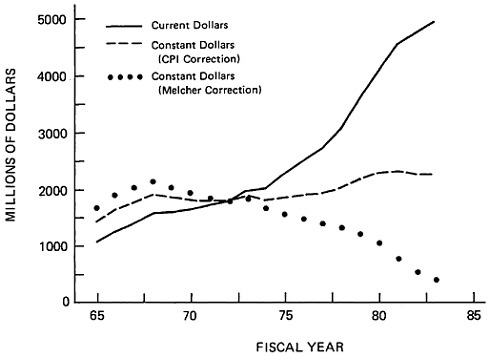
Federal expenditures for R&D in universities and colleges from 1965 to 1983. The solid line shows expenditures in current dollars, and the dashed line is corrected to current dollars using the Consumer Price Index relative to 1972. The dotted line shows expenditures in current dollars corrected for inflation in the cost of scientific equipment.
purchase. With respect to infrastructure, about 50 percent of the departments reported inadequate or nonexistent support facilities.
A further, important ingredient in the problem is the high start-up cost for new projects and for new faculty members. There has been a 78 percent decline in bricks-and-mortar expenditures in real dollars since 1968. This decline also affects instrumentation, since new facilities generally come equipped with instrumentation. Finally, there is the increased sophistication and cost of research equipment in all fields, not just in materials science.
Data in the figure (see above) from the report give a quantitative picture of the research equipment problem. The figure shows the total federal R&D spending in colleges and universities from 1965 to 1983 in current dollars and corrected to constant dollars using the Consumer Price Index. The best data I could find on the proper rate of inflation for costs of research equipment come from an unpublished study by Robert Melcher, a scientist and manager at IBM’s Thomas J.Watson Research Center, Yorktown Heights, New York. Melcher examined the costs of the type of research equipment purchased by
IBM between 1976 and 1981 and found a rate of inflation 1.7 times that of the Consumer Price Index. I have applied Melcher’s correction for inflation and show the results as the dotted line in the figure. This gives an overly pessimistic view of the overall support of research, since most research costs probably increase at a rate closer to the Consumer Price Index. However, it underestimates the seriousness of the problem for research instrumentation, because over most of the period represented in the figure the federal agencies and the universities were reducing the fraction of research dollars that were spent on equipment.
What can be done about this problem? It is important to keep in mind where the resources come from—well over 50 percent of funding for research equipment in materials science is provided by federal agencies; industrial support, which has never been large, accounts for 3 to 5 percent; the universities themselves have been the second major funder of research equipment and have paid for approximately 30 percent of the cost of equipment in use.
What can these various parties do to ease the problem? Federal agencies, for instance, could interpret their regulations, rules, and policies in a consistent way. The present situation tends to make universities unnecessarily conservative in their management practices. It is sometimes difficult to spread the costs of major equipment across Fiscal Year boundaries and certainly across grant boundaries, but frequently this would help. Numerous administrative barriers increase the viscosity of the systems: for example, excessive inventory requirements and the Defense Industry Plant Equipment Center screening for DOD contracts.
In many cases, realistic depreciation allowances for equipment would help, providing that the funds so generated were put toward the purchase of new equipment. This is not a cure-all, of course, because universities can depreciate only the share of equipment that they paid for themselves.
The policies of state agencies raise similar problems because state regulations are frequently more troublesome than those of the federal government. State agencies can help by improving or removing burdensome regulations. In addition, they can help with tax-exempt financing, although it is not clear whether this will be possible if the current proposed federal legislation goes through. In fact, many universities are now seeking to float tax-exempt bonds just to put money in the bank so they will have it in a year or two. Finally, the states could set up agencies to promote science and industry, as North Carolina has already done.
What can the universities do? First, they should recognize that university research differs from that in industry or government laboratories. University research tends to be much more decentralized than it is in industry or government, and significant funding originates from individual principal investigators within the university. However, it is important that, if universities use creative forms of debt financing to acquire equipment, they must not go
into debt in a decentralized fashion. Therefore, it seems likely that resource allocation and planning will become more centralized in universities. Of course, this has its undesirable side effects, and universities will have to make some hard decisions.
Universities will have to cut back on some programs to provide the increased support necessary to maintain the health of others. Each university must investigate its individual potential for university-supported maintenance and repair facilities and perhaps limited inventories of research equipment that could be shared. Iowa State University, for example, has an excellent equipment-sharing program called REAP, elements of which could perhaps be adopted by other universities. In our survey, the field research team investigated carefully the issue of sharing research equipment: Is there enough sharing going on? Should there be more? Are instruments sitting unused? A considerable amount of sharing is already going on in universities, much of which is made possible by the Materials Research Laboratories.
We did find, however, that not in all cases did the universities properly prepare for the realistic costs of operation and maintenance when they were buying research equipment. The universities should try harder to recover realistic depreciation costs. These will, of course, either increase the indirect cost base or increase the direct costs of doing research. Nevertheless, these are real costs that must be met in some way.
We found a further need to work with funding agencies to find an incentive for investigators to transfer equipment to other investigators who might make good use of it, perhaps in other universities. There is little incentive to do that now.
Our overall conclusion was that in the last 10 or 15 years, universities have supported research by supporting people, not instrumentation. Funding by the National Institutes of Health for permanent equipment declined from about 12 percent in 1966 to about 3 percent in 1985, which is clearly too low. Similarly, NSF support for equipment went through a minimum in the period between 1969 and 1976 and has since come back up as the agency recognized the problem.
In summary, an effective and balanced national research program requires that a larger percentage—probably greater than 20 percent—of our resources be devoted to instrumentation, and this must be done on a sustained basis. It will probably be necessary also to increase the size of grants in order to provide this support and to meet the increased costs of operating and maintaining this more sophisticated equipment. If there is no increase in total funding, it may be necessary to reduce the number of grants and the number of investigators supported.
Materials Research and the Corporate Sector
Introduction
ARDEN L.BEMENT, JR.
Many of us have been witness to the increasingly vital force of materials science in the enhancement of U.S. industrial technological potential over the past 25 years. The emergence of new technologies over this period has created demands for advanced materials. Likewise, the development of new materials systems has accelerated advances in new technologies.
This synergistic process has occurred throughout history but never with the intensity apparent today. The major reason for this intensity is our growing ability to devise entirely new materials systems of engineering significance. Examples include the synthesis of diamond and other ultrahard compounds, semiconductor lasers, ultrapure optical wave guides, high-energy-density magnetic materials, high figure-of-merit piezoelectrics, high-modulus fibers, high-purity ultrafine ceramic powders, semiconductor superconductor superlattice and supermatrix devices, polymer blends, and so on.
The establishment of the Materials Research Laboratories (MRLs) was an inspired achievement. The problems faced by the Coordinating Committee for Materials Research and Development 25 years ago are the same problems facing universities today, namely, how to acquire modern research facilities and how to foster cross-disciplinary research efforts to address the more complex problems in materials science. However, the MRLs have achieved much more over the years than the solution to these problems. These labo-
ratories have demonstrated that peer interactions among graduate students brought together from different disciplines to share facilities can intensify the environment for creativity and greatly broaden the learning experience.
Unfortunately, industry’s exposure to the work of the MRLs has been, by and large, indirect, partly because the focus of the MRLs has been considerably upstream conceptually from that of industry. With the exception of a handful of outstanding industrial research laboratories, most companies do not seek out common interfaces with the MRLs. Moreover, interaction with industry was not designed into the MRL model at the outset, certainly not to the extent that it has been included in more recent NSF programs such as the Engineering Research Centers and the Presidential Young Investigators programs.
However, the existing NSF models for industry-university interaction are still far more concerned with leveraging the funding inputs than with leveraging the technology transfer outputs. Since technology transfer is best achieved through personal interactions, the potential for improving the effectiveness of these interactions through collaborative research, scientist exchanges, internships, and the like is far greater than has been realized to date.
Finally, although the United States enjoys a comparative advantage over the rest of the world because of its strong materials science base, this is not enough in the face of growing worldwide competition. We must also be comparatively effective in strengthening our science base and in exploiting it to add greater value to our industrial products. We all share a vital interest in the success of this enterprise because future investment in the national science and technology base will depend directly upon a strong and growing economy. We must find ways to increase the dividends from such investment if we are to build the university research infrastructure that we believe is needed.
While the key to global industrial competitiveness is not science and technology alone, nations that have a strong science and technology base will have a decided advantage in providing new products and services at the highest quality and lowest cost.
This chapter addresses these and other issues centering on the role of materials research in relation to current and future needs, opportunities, and threats in selected industries.
An Automotive Industry Viewpoint of Materials Research
JULIUS J.HARWOOD
The Materials Research Laboratories and the many associated events that have taken place in the materials field since 1960 are in large part responsible for our recognition today that advanced materials are key to many future
industrial innovations and growth in advanced propulsion systems, microelectronics, energy conversion, and a broad range of engineered and manufactured products. Accordingly, advanced materials technology has emerged as one of the major thrusts of national policy planning and programs throughout the industrial world, and particularly in the United States and Japan. Materials technology shares the spotlight with next-generation computers, biotechnology, very-large-scale integrated circuits, robotics, automation, and artificial intelligence.
In the past several years, there has been a shift not only in technological thrust in the United States, but also in the debate and philosophical discussion related to national materials policy. Our concerns have changed from vulnerability of strategic materials and mineral resources to issues related to industrial innovations in advanced materials and research and development priorities associated with these issues.
The debate between high-technology and smokestack industries is over. New technology and knowledge-based industrial activities have emerged as the keys for the future—new technology serving both the core of new entrepreneurial high-technology industries and rejuvenating established industrial sectors. There is a growing awareness that the United States’ materials competitiveness and industrial innovation potential in transportation, communication and information systems, and manufacturing rest more upon the development and application of advanced materials and less critically upon the problems besetting the traditional minerals and commodity industries.
All of this has led to a remarkable intensity of research and development activity and technological developments in advanced materials (worldwide) and the emergence of new materials industries. Also, it is becoming clear that traditional patterns and segmentation of industrial production are not so readily compatible with accelerated and aggressive industrial exploitation of these new materials technologies. New, innovative industrial coalitions, fresh organizational structures, intercompany cooperation, and information sharing in R&D are becoming more and more evident in this country, as are new modes of industry financing and investment, e.g., R&D limited partnerships. These changes hold profound implications for the development of future industrial infrastructures.
This may be particularly true in the commodity materials industries, in which traditional strength in a single or limited range of materials product classes is giving way to a diversified materials character. This transition is markedly evident in the changing industrial scope and activity of several of our large, formerly single-commodity-oriented companies. One sees a growing integration trend in these companies in becoming, as well, producers and suppliers of fabricated end-item components and consumer products for the higher value-added of engineered products in the marketplace.
In like manner, far-reaching changes are taking place in the automotive industry in its all-out attempt to survive the onslaught of foreign competition. New technology has been pinpointed as one of the industry’s keys to survival, and materials technology has been assigned a paramount role in this enterprise. The automotive industry is a voracious consumer of materials and increasingly, unlike in the past, the industry is becoming a key arena in which new high-technology materials and manufacturing methods are being translated into large-scale industrial practice.
In the near term, say by 1990, the automobile may outwardly resemble what is on our roads today, but how that car is manufactured and assembled, the materials from which it is manufactured, and how its functions are controlled are undergoing remarkable changes.
The basic technologies that used to be indigenous to the automotive industry also are changing. Not too many years ago, Ford research was aggressively pushing the development of onboard computers for feedback loop control systems to control engine operations and emissions. In retrospect, it is interesting to recall the debates with the conventional engineering community who preferred to opt for electromechanical hardware, rather than electronic devices, for reliable control systems. Yet, probably the most aggressive in-house training program under way today in the automotive industry is the conversion of mechanical engineers into electronic and electrical engineers to meet the new challenges to the industry. Obviously, as is the case almost throughout the U.S. industrial system, computer scientists and engineers, software analysts, information systems specialists, electronic engineers, and computer personnel of all types are the most sought-after technologists to support design, engineering, development, and manufacturing operations across the board.
Following are a few examples of the newer materials technologies that will exert important influences on the automobile and on the industry.
ELECTRONIC AND INFORMATION MATERIALS
The automobile in a true sense is becoming a communication center on wheels. The impact of electronics and information control systems on driving, engine, braking, suspension and ride quality, transmission, accident avoidance, and driver information operations is only in its infancy. While the automotive industry may not take a leadership role in developing advanced electronic materials, microelectronics, fiber optics, and electro-optical and memory devices, we certainly can expect to see their fast translation and exploitation for automotive vehicle use. In a real sense, the automotive industry will be right on the heels of the electronics and information materials industries, eager to adapt the benefits of photonics, fiber optics, better semiconductor chips, smart sensors, and the like. Semiconductor materials, sensor
materials, and information (electro-optical) materials will become as basic to the automotive industry as were conventional structural materials.
STRUCTURES PLASTICS AND FIBER-REINFORCED PLASTIC COMPONENTS
Over the next 10 years there will be a remarkable change in the use of basic materials in motor vehicles. As is already evident from some of the recent announcements, plastics will play a more and more important role. While the current emphasis still is focused on their use for non-load-bearing exterior panel applications, aggressive application programs are under way to prove out their potential as structural materials candidates. There are experimental vehicles “on the road” that are predominantly plastic cars, with rather exciting performance characteristics.
Even though weight saving will probably always be an important objective, the primary impetus for the use of structural plastics and fiber-reinforced composites does not lie in their weight-saving and fuel-economy potential. Rather, it is the opportunities they provide for low manufacturing investment, lower manufacturing costs, and the ability to be flexible and responsive to changing market conditions and more rapid entry into the marketplace with differentiated and diversified vehicles.
CERAMICS
A third technology, which has emerged as a potentially important automotive class of materials, is advanced ceramics. Much is heard today about “ceramics fever,” denoting the intense efforts and national programs both in the United States and in Japan. Depending upon the sources one prefers, it has been claimed that the total advanced ceramics effort constitutes between $50 million and $100 million per year. Although the predominant current use and projected near-term markets for the new advanced ceramics lie in electronic applications (such as integrated circuit substrates, packages, capacitors, sensors, and dielectrics), the real driving force for the national focus on structural ceramics both in the United States and in Japan, and more recently in Western Europe, is their potential application in advanced automotive heat engines or power plants. It is the potential automotive engine market that drives the large national investments and the remarkable degree of industrial activity that is evident, particularly in companies that heretofore were not involved in traditional ceramic sectors. Dramatic progress has been made in the engineering of new ceramic materials classes and in fabrication processing for shape making.
It is anticipated that ceramic applications in adiabatic diesels and in associated engine applications will be in production vehicles within the next
5 to 10 years. Nissan has already announced the use of ceramic turbocharger rotors in some of its 1986 vehicles and Isuzu talks about having an all-ceramic engine by the 1990s. Ceramic gas turbines also are in development at Ford and General Motors under contracts with the Department of Energy and the National Aeronautics and Space Administration. There is no question that the application of ceramics for low heat-rejection engines (e.g., the adiabatic diesel) and the implications for superior fuel economy represent a major thrust and a new technology for the automotive industry.
NONEQUILIBRIUM MATERIALS: RAPID SOLIDIFICATION TECHNOLOGY
Most lists of important materials technologies for the future would include rapid solidification technology (RST). It is interesting to note that the largest application of RST in the near term will be in the United States. Ironneodymium-boron high-performance magnets made by melt spinning for automotive starter motors will represent the first major, truly high-volume application of RST materials. In fact, one of the giants of the automotive industry will become one of the largest producers of rapidly solidified materials in the United States. The use of these new high-performance magnets enables a reduction of about 50 percent in motor size and weight compared with conventional wire-wound starter motors. Here, then, is a model example of how an industry that is geared to the exploitation of high technology can rapidly adapt itself to the development and application of a new materials technology and become a leader in the field.
MANUFACTURING TECHNOLOGY AND NEAR NET-SHAPE FABRICATION PROCESSING
A radical transformation is taking place in the design, manufacture, and assembly of automotive vehicles. Manufacturing technology and, in particular, near net-shape fabrication processing are a key underpinning of advanced materials technology in the automotive industry.
The automotive industry frequently has been called a chip-making operation because of the large volume of machining operations. Any innovation that minimizes or eliminates machining operations and finishing steps has an obvious impact upon production cost and productivity increase. The development of near net-shape fabrication processing has become a major thrust of manufacturing R&D programs. A strong linkage has emerged between materials technology and manufacturing technology, with the knowledge that the success of a new material, device, or hardware concept depends inherently upon a processing innovation or improvement that did not exist previously.
Information technologies obviously are driving the recognition that man-
ufacturing, in essence, is data technology and information flow. Computer-aided manufacturing (CAM) and computer-integrated manufacturing (CIM) have already demonstrated greater potential for improving manufacturing capability and productivity than has been shown by all other types of advanced manufacturing technologies combined.
SURFACE-MODIFICATION TECHNOLOGY
The ability to transform and control the surface composition, surface structure, and surface properties of materials is emerging as a powerful technological tool. The use of plasma processes such as chemical vapor deposition, physical vapor deposition, sputtering, ion implantation, and laser processing has already demonstrated their inherent power. Fifty percent of all carbide cutting tools are now coated to improve life and performance, and it has been predicted that more than half of all machine tools for cutting and forming will be surface coated before the end of the decade. Surface-modification technology involves highly sophisticated equipment. Our better understanding of surface behavior during the deposition and transformation of nonequilibrium and disordered surface structures, which include gradient, layered, and composite films, offers exciting new approaches for the development of novel materials in addition to more efficient uses of materials.
Clearly, other thrusts in materials science and technology could be cited, but the above half dozen are indicative of the new thrusts in automotive materials technology.
CONCLUSIONS
Since this volume celebrates a quarter century of contributions by the Materials Research Laboratories and their predecessors, a few observations about the Materials Research Laboratories are in order. From a research viewpoint—and the automotive industry is a major employer of researchers— the Materials Research Laboratories and associated faculty research activities have contributed to the industry a major intellectual resource and the people to carry out research. They have fostered new attitudes and new ways of thinking that have spurred the growth of materials technology in the automotive industry.
The Materials Research Laboratories and their cousins on campuses probably will have an even more important future role to play with respect to industrial interaction. As our U.S. industries become more mission oriented and less research oriented because of the pressures of international competition and the constraints of economic and other problems, the next generation of research findings in materials science will probably become the almost exclusive domain of universities and research centers like the Materials Re-
search Laboratories. Except for the few companies that can maintain a respectable scientific research establishment, the industrial structure in the United States increasingly will depend on university research for new scientific ideas. Industrial research and development will concentrate on transforming those ideas into technological progress and applications.
Yet we can note a growing trend in academia, particularly in state-supported colleges and universities, to extend their traditional public service role to become key players in state and regional programs to promote industrial revitalization and technological growth. The new, adaptive industry-oriented mission roles of universities bring some concern about the distribution of university activities and resources between pure research and support for industry technology and growth.
Universities also are developing new, innovative modes of interaction and linkage with industry, including the formation of university sponsored venture capital and entrepreneurial companies. These are providing a new academic proving ground for a new breed of technologists and scientists who can take their place in this coming age of entrepreneurship, as described by Peter Drucker in his recent book Innovation and Entrepreneurship—Practice and Principles. For an industry such as the auto industry, this is all to the good. The automotive industry in its changing mode needs not only technologists who know technology, but technologists who have the instincts, attitudes, and drive to use science and technology in an entrepreneurial fashion.
Materials for the Electrical and Electronics Industry
JOHN K.HULM
Materials research and development at the Westinghouse Electric Corporation are a vital part of the corporation’s business strategy. Westinghouse probably typifies the needs of the electrical and electronic industries for specialized materials. It manufactures electrical and electronic equipment in three general areas:
-
Electric Power Systems Distribution equipment, nuclear plants
-
Industrial Equipment Electric motors, controls, instruments, robots, elevators, escalators, electric transportation systems
-
Defense Equipment Power systems, space, airborne and groundbased radar systems, sonar, missile launching systems
Most of these products make extensive use of advanced materials. About
40 percent of the total effort of the Westinghouse Research and Development Center is devoted directly to work on materials. This includes not only the development of new materials but also the characterization, testing, and evaluation of materials for specific applications. Also included are new methods of manipulating materials—for example, the cutting, drilling, cladding, and joining of materials using lasers.
In Westinghouse laboratories the pressures of product maintenance and improvement and new product development are such that most materials work is highly applied. Currently only 10 to 15 percent of Westinghouse’s effort is devoted to basic or exploratory effort—this mainly constitutes tackling basic problems that stand in the way of advancement of the applied work.
In this climate, Westinghouse relies heavily upon university departments of chemistry, physics, and materials science, as well as the MRLs, for new information on materials, new properties, new methods of preparation and characterization, and so forth. It has joined some cooperative research programs, where the fee is modest. It uses university consultants extensively and bids jointly with various universities on government contracts. Needless to say, many of the materials personnel at Westinghouse were trained in the MRLs or equivalents.
It is not possible to discuss all of the materials research relevant to the diverse group of products that Westinghouse manufactures. Instead, this discussion focuses on two particular questions: (1) What emerging materials will have the greatest effect on our industry in the next 15 years? (2) Which industrial requirements pose the greatest challenge to materials research over the next 15 years?
In my view, the materials affecting Westinghouse to the greatest extent in the next several decades will be those underlying the current revolution in electronics, computers, and communication. Thus, a few of the most important materials functions that directly affect Westinghouse businesses and where there is continuing, rapid change of technology are
-
Sensor materials
-
Integrated-circuit materials
-
Microwave amplifier materials
-
Surface acoustic wave materials
-
Optical fibers
-
Laser materials
-
Electro-optic materials
-
Acousto-optic materials
This pace probably will not slow down before the turn of the century. Indeed, it will probably accelerate, particularly the evolution of the higher-frequency and optical end of the spectrum.
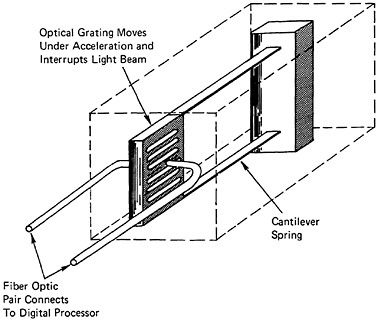
FIGURE 1 Schematic diagram of vibration monitor using a quartz bar to sense movement of the end turns in large turbine generators.
The need for these detection and signal-processing functions for Westinghouse radar and sonar businesses will be obvious. But what do such materials and components have to do with large power plants?
The answer is simply that for the first time in history we have the capability of equipping large machines—such as reactors, turbines, and generators— with first-class nervous systems. We use advanced sensors to detect temperature rise, vibration, electric discharge noise, and chemical emissions. Fiber-optic or acoustic waveguides provide ideal signal output channels where high electrical voltages are present. Data from a variety of sensors can be combined in a probabilistic fashion to diagnose incipient faults. Corrective action can often be taken before the condition becomes serious and forces a plant shutdown, resulting in serious economic loss.
Three examples of new sensors already in experimental use in power systems are vibration monitors that use a quartz bar to sense movement of the end turns in large turbine generators (Figure 1); optical instrument transformers, which measure the current in a high-voltage power line by using the Faraday rotation of polarized light in an optical fiber (Figure 2); and the use of acousto-optic materials to build spectrum analyzers for both military and industrial use. The principle of the third example is that microwave signals from hostile radar sources are converted into acoustic waves in an
acousto-optic cell. The key material in the cell has a high photoelastic coupling coefficient, so that the optical refractive index is modulated by the acoustic wave. This sets up a diffraction grating through which monochromatic laser light is passed. The diffracted light represents a Fourier transform of the original radar signal, producing a power-frequency spectrum that is the basis for applying countermeasures.
Essentially this same device is shortly to be used in an industrial application to analyze gases emitted during combustion in power plants, steel mills, and
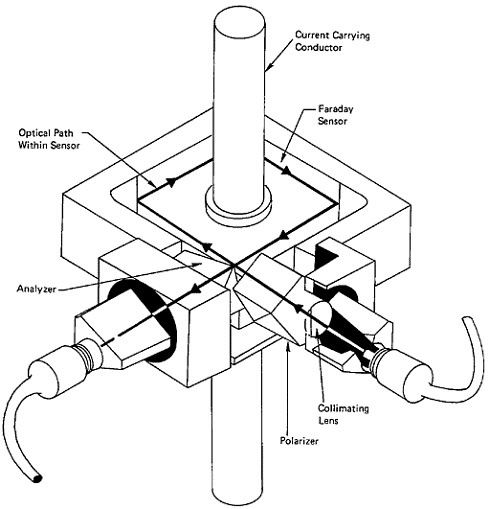
FIGURE 2 Schematic diagram of an optical instrument transformer that uses the Faraday rotation of polarized light in an optical fiber for measuring the current in a high-voltage power line.
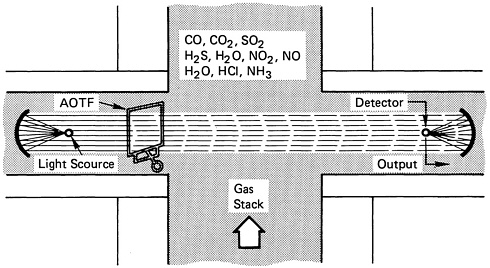
FIGURE 3 Schematic diagram of a spectrum analyzer using an acousto-optic tunable filter (AOTF) to analyze combustion products in industrial applications.
the like (Figure 3). This particular device works in the infrared, and it necessitated development of a new acousto-optical crystal, thallium arsenic selenide.
I see a growing demand for new crystalline materials with special properties as more and more signal conversion and processing are done in the infrared and optical ranges. More complex crystals will have to be grown and new techniques of crystal growth will be needed to better control impurities, stoichiometry, defects, and so on. Even the quality of the electronics workhorse, silicon, is still being improved in the area of device quality, particularly in large power devices for power conversion.
Marching in step with the crystalline explosion is the rapidly growing use of thin films. Improved high-vacuum technology, and techniques such as molecular beam epitaxy (MBE), make it possible to enter a hitherto inaccessible world of new, thin crystalline materials with specially tailored electronic properties.
Westinghouse set up an MBE system that is used to develop thin-film superconductors for Josephson junctions to be applied in high-speed signal processing. The research team has been able to grow single-crystal films of both A15 and B1 superconductors by epitaxial growth on a variety of substrates.
Passive films will play almost as crucial a role as active films, with all gradations in between. New film deposition methods will be needed for glasses, ceramics, and organic materials that will be used as insulators and dielectrics, as well as hermetic encapsulants.
Although the question of where emerging materials will have the greatest impact on Westinghouse has been partially answered, the materials base of electrical energy production and conversion, the so-called energy materials, has not been mentioned. These materials are discussed in relation to the second question, that is, what industrial requirements pose the greatest challenge to materials research over the next 15 years?
Two classes of needs are evident in the materials technology of present-day power plants, reactors, turbines, and generators. The first class includes solutions to long-standing problems of conventional materials— corrosion, stress corrosion, crack growth, insulation aging, and radiation damage. Improvements in this area have been incremental and are likely to remain so. The second class of needs is related to such new materials as amorphous magnetic alloys, fiber-reinforced composites, and superconductors. Here, advances are likely to be more radical but may not be used. For example, U.S. development of superconducting generators is almost at a standstill.
There is always a set of materials problems that are never completely solved. Often these problems are bound up more with plant operation than with basic defects in the materials themselves. In this connection, the extension of plant life has become very important, and nondestructive methods for evaluation of materials are essential.
Defects must be looked for in finished industrial materials. Included are a wide variety of surface and interior defects (Figure 4). Such investigations must often be done under extremely hostile conditions, particularly in nuclear plants, where robotics and remote control are needed.
Various inspection methods have become extremely useful (Figure 5). Most of these have now combined with computer systems to generate complete three-dimensional images of the defect under study. Take, for example, a pitting defect in a tube of a nuclear steam generator—the images may be made from the inside of the tube using two different methods, ultrasonics and eddy currents.
In electric energy technology the turbine generator set is unlikely to be displaced in the next 50 years as the primary method of utility power generation. Coal-fired stations might shift to fluidized bed boilers, and efforts will be made to remove sulfur before it reaches the stack and has to be scrubbed out. One may also view the problem of removing sulfur from coal as a materials problem.
We are likely to see the onset of new auxiliary power sources, even in the next 15 years. The fuel cell, invented around 1820, now seems near industrial deployment because of advances in materials technology. There are several candidates. The phosphoric acid cell has been used in multi-megawatt experimental plants. The solid oxide cell is also coming along rapidly.
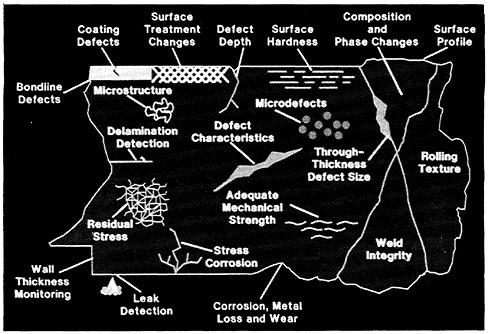
FIGURE 4 Examples of surface and interior defects and conditions affecting the performance of materials. Redrawn, with permission, from New Science Publications, London.
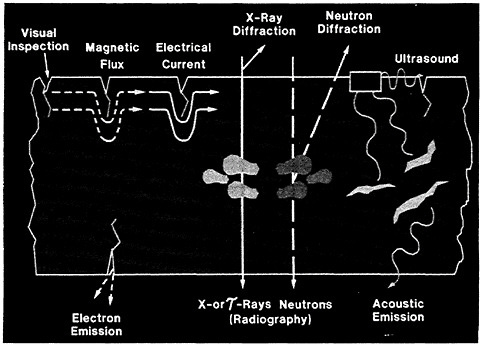
FIGURE 5 Examples of nondestructive testing and inspection methods, many of which are now combined with computer techniques to generate three-dimensional images of defects in materials. Redrawn, with permission, from New Science Publications, London.
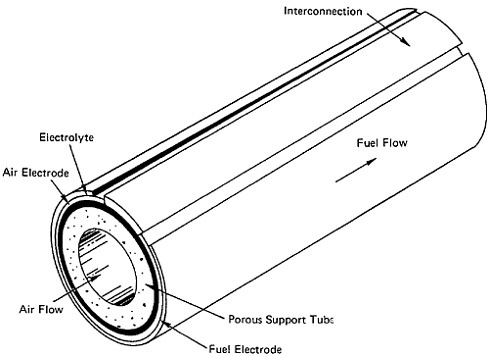
FIGURE 6 Schematic diagram of solid oxide cell, a high-efficiency, all-solid-state power generating device with about 50 percent efficiency.
The solid oxide cell is probably the only high-efficiency, all-solid-state power generating device (Figure 6). The key element is a yttria-zirconia alloy that conducts oxygen ions at 900°C. Gaseous fuel is applied to one side of the tube and air to the other. Oxygen ions migrate through the ceramic and react with the fuel, releasing electrons as they do so. The device thus generates power. It may reach about 50 percent efficiency, exceeding the 42 percent efficiency of a coal-fired plant.
In this area of technology there is a lot of room for research in ionic conduction in solids, and better conductors at lower temperatures would be a great help.
This discussion has focused on the near-term electric energy technologies. Obviously, there are many, more long-term developments, such as fusion, magnetohydrodynamic power, and geothermal power, where the limitations of present high-temperature materials are one of the principal barriers to progress—an area in which future materials research should be concentrated.
Materials Science Research and Industry
HAROLD W.PAXTON
In 1972, when the National Science Foundation (NSF) took over administration of the Materials Research Laboratories (MRLs) from the Advanced Research Projects Agency (ARPA), there were some interesting discussions with the directors, not always totally amicable, on what should be done in the MRLs to differentiate them from the more conventional NSF programs. From those discussions arose the concept of “thrust areas,” where emphasis was placed on bringing several different talents to bear on significant problems of a university’s own choosing. So, in a recent informal survey of my colleagues in industry, my first question, loosely translated, was what have the MRLs done for you lately?
Unfortunately, the answers that came back stated that they could not think of anything that the MRLs were doing that had sufficiently influenced their present concerns.
The experiment was conducted again at a meeting of the Industrial Research Institute (IRI). The IRI is essentially the vice presidents for research and technology from 270 of the nation’s industrial companies. Between them, they spend about 85 percent of the dollars allocated for industrial research.
Members were asked the question approximately as follows: how have the MRLs influenced your research program in the last few years? The question was addressed to representatives from manufacturing companies—ranging from automobile and off-road vehicle manufacturers to chemical companies active in the polymer business, and to others as the occasion arose.
The results were uniform, if not very comforting. MRLs had to be explained to a number of these people, and even after that explanation, no one could be found who could think of any difference the MRLs had made.
I discussed these results with a very respected friend of mine who runs a large materials laboratory at a large corporation. Earlier I had deliberately not asked him or any members of his group because I was sure the MRLs would not only be recognized, but the contributions they could make would be well known to him and his colleagues. He replied, “Not necessarily; I am sure I have a lot of people working for me who have no close association with the MRLs.”
Now, what does this tell us or what should we hope to learn from this admittedly imperfect poll? Please note that it does not tell us that the MRL program is not worthwhile or not doing first-class research and turning out new concepts and the people to introduce these concepts into industry.
What it does tell us is that there is a clear gap in communication between the MRLs and at least a substantial and significant number of U.S. industries. In our present set of concerns with industrial competitiveness on a world
scale, this is a problem we should address. It cannot be dismissed because many of the industries that were informally surveyed have been in the first wave of international difficulty.
We have seen that a succession of industries of increasing sophistication are now facing heavy weather in being competitive internationally. Thus, we have in the MRL system a national asset that is not having the effect it might have.
Industry has to worry a great deal about markets and providing service to our customers. “Know your customers” is the watchword. It would be interesting to know if MRL members think their real customers are at the National Science Foundation or perhaps in a broader arena, such as industry, where their ideas would be picked up and used.
Good coupling between MRLs and many of the process industries will not be easy. Any time we are dealing in commodities—and these days that means not only sheet steel but also silicon wafers and integrated circuits— the large measure of competitive problems is often developmental engineering and good systems management.
In summary, in no way has it been implied that in any way the programs at the MRLs are other than first class. It is, however, difficult to find out what the programs are, and so, at the very minimum, a “highlights” booklet should be prepared each year to be given broad circulation. The extent of knowledge of MRL programs among many industries in the United States is not what it could be and probably not what it should be. The question is, do we want to do anything about it and, if so, what can we do? As a long-time friend of MRLs, I hope we can find some way of getting even more mileage out of this valuable research program, and I would be willing to work with any group that has ideas on doing something about this.
Materials and the Information Age
ALAN G.CHYNOWETH
The term “Information Age” might sound more abstract, less tangible, than “Industrial Age,” more associated with mental processes than physical ones, but it is based just as firmly on materials science and engineering.
True, the Information Age is heavily dependent upon software. But just as sheet music is rather lifeless without the hardware of musical instruments, so also is software useless without integrated circuits for its implementation.
In contrast to the structural, mechanical, and electrical technologies of the Industrial Age, the Information Age makes relatively modest demands on raw material resources and energy and is usually benign in its interaction
with the environment. On the other hand, the communications, computer, and control technologies, the “three Cs” of the Information Age, are probably the most complex, sophisticated, and demanding technology systems yet devised by mankind. They are rich in invention and added value resulting from intensive, often very large and expensive research and development programs.
INNOVATION IN COMPLEX TECHNOLOGIES
So complex are the Information Age technologies that, except for the occasional and unpredicted but vital discoveries in pure research, the lone scientist or engineer is usually ineffective or powerless to foster technological advances on his own. Such advances need groupings of scientists and engineers, each person bringing different knowledge, experience, skills, and expertise to bear on a common interest or scientific or technological objective. Much as we might wish to have individual “compleat” scientists and engineers, it simply is not possible. Even teams of individuals in a given discipline are usually insufficient. Overall technological progress and innovation require interdisciplinary endeavors pursuing a systems approach on a mission that captures the imagination of all involved. Indeed, just as scientific progress often occurs primarily as a result of almost chance encounters between individuals from different scientific backgrounds, so technological innovation requires more deliberate interactions between such individuals and groups of individuals. Thus, by encouraging the cross-fertilization and synergy that can come from such encounters, research laboratories and centers in industry or academia can achieve extraordinary discoveries, results, and progress. Perhaps one of the most important contributions of the Materials Research Laboratories on the university campuses has been fostering greater appreciation of the vital importance of effective interdisciplinary collaboration both among those who stay on the university campus and among those who leave it to join mission-oriented laboratories.
In industry, the necessity of relatively large research and development efforts to achieve critical mass and make technological and business progress in risky and competitive industries runs up against the harsh realities of the marketplace. There are two particularly important approaches for helping to achieve this critical mass in research and development. The first is to provide financial incentives to corporations, particularly through such mechanisms as research tax credits. The continuation of these credits is a factor in improving this country’s technological prowess and competitive position.
The second is through corporate collaboration in research and development. Thanks to the Cooperative Research Act of 1984, we are seeing more of this. I myself am now employed by what may be the world’s largest research and development consortium, Bell Communications Research, or Bellcore,
formed by the seven regional fragments of the former Bell System. Another consortium, the Microelectronics and Computer Consortium, started from the opposite condition—traditionally separate corporations sharing a common interest in meeting the challenge from overseas in the push toward supercomputers.
These and other consortia may well be critical to ensuring this country’s technological progress, but they are not without problems. Perhaps chief among these is when and how to draw the line between shared and proprietary research and development, between cooperation and competition. There are no easy answers to this question. It affects not only research collaboration among industrial companies but also cooperative interaction between universities and industry. The issue needs close attention since its resolution can have a major impact on the prosperity and international competitiveness of this country’s industries.
CHALLENGES TO MATERIALS SCIENCE AND ENGINEERING IN INFORMATION TECHNOLOGIES
The seminal event usually regarded as the start of the Information Age was the discovery of the transistor, itself an outcome of intensive studies of the basic electronic properties of semiconducting materials. And ever since, progress in the three C’s has been largely paced by the rate of progress in the science and technology of electronic and photonic materials, and this is likely to persist for many years.
A long list of scientific and technical challenges and problems can readily be developed, but the first one that I would emphasize is the continued importance of supporting basic research in materials. On this depends the continued discovery of new materials and processes for synthesis and structure fabrication. Such research has always been at the root of technological progress, and we have surely not explored all the opportunities that nature has waiting for us. Recent examples of such new research opportunities include two-dimensional or layered materials, conducting organic compounds, and magnetic semiconductors. A common theme in this research is putting the process-structure-property relationships on a sound theoretical footing. Perhaps the ultimate proof of the mastery of this science will be the routine use of computer-aided design to discover and create new materials with the necessary properties to meet specific needs.
Second, the Information Age is primarily based on electronic devices and materials. Chief among these is the silicon integrated circuit, which is vital in the areas of signal processing, logic, and short-term storage. We are approaching the limits of what can be achieved in terms of fine lines and component density in two dimensions on a silicon chip. Further advances call for mastering the processes necessary for proceeding to the third di-
mension, along with finding clever ways to minimize or facilitate the heat removal problem.
Third, for signal transport, the world is turning increasingly to glass fibers instead of copper wires, to photons instead of electrons. But compared with electronic components, photonic components are still in their infancy. The rate at which the universal communications vision of the Information Age can be turned into reality is still largely determined by the rate at which materials problems can be solved. We need advances in the science and technology of various compound semiconductor materials, of nonlinear optical materials and fibers, and of fluoride or other infrared fiber materials for ultralong-distance, repeaterless transmission. We need advances in optical switching devices, in packaging and interconnection techniques for optical components and for mating these with electronic components, and in fabricating high-speed integrated optoelectronic components.
All these potential advances in electronics and photonics portend the era of truly universal wideband communications—voice, data, facsimile, image, and video. In turn, this will put ever-greater demands on information-storage technology. Unfortunately, we still seem to be in the relative dark ages of rotating machinery—involving discs or tapes, magnetic and optical—when it comes to storing enormous amounts of information. With all the wideband transmission and processing technology coming along, mass storage may well become a bottleneck. Thus, the fourth challenge to materials science and engineering in information technologies is the need for advances in the materials aspects and technologies for mass storage.
Fifth, underlying all of the above materials problems is the relentless trend to smallness—cramming more and more information processing and storage capability into a smaller and smaller volume. This trend has various implications. For one, as dimensions get smaller, the processing and diagnostic equipment needed gets larger and more expensive. Whereas a $10 hacksaw and file might have sufficed to prepare a sample in the early days of physical metallurgy, we now need million-dollar molecular beam equipment and electron microscopes to prepare and study samples on the atomic scale. Although these equipment needs are not of the same extent as those in high-energy physics, they are nonetheless real, multiple, and significant, and demand attention, especially at the universities, where the availability of such equipment can have enormous consequences for improving this country’s competitive position.
Smallness also usually brings with it more vulnerability to damage, corrosion, and other changes on the atomic scale. Ruggedness and reliability may set practical limits on the component density of integrated circuits. Therefore, study of the physical and chemical stability of surfaces and interfaces becomes more critical than ever.
Though information technology is usually regarded as relatively benign
environmentally, one particular facet perhaps needs more emphasis. Many exotic chemicals are used in the manufacturing processes, some of which can be quite hazardous if mishandled. Thus, sixth, toxicity effects, chemical hazards, and ways to avoid or minimize them need more scientific and technical attention.
HUMAN-MACHINE INTERFACE CHALLENGES
The Information Age usually connotes immense information bases on every subject and extensive information transport in various media in all directions before finally contributing to modern society’s information overload. We desperately need improved technologies to handle input and output of information, and today’s computer terminals have very limited capabilities. We need more touch-sensitive displays and direct voice interaction rather than keyboards for entering data. We need machines with artificial intelligence to digest masses of information and computer graphics and to help us understand it. Other major challenges in this arena include pattern recognition, and encryption to ensure privacy. Another need is for portability and ubiquitous availability of information services; this, in turn, depends on better materials for electric batteries. All these challenges will need to be met before the terminal can really begin to be regarded as convenient and useful for sophisticated applications. In fact, the technologies at the interface between humans and machines may set the pace for the Information Age.
BEYOND THE INFORMATION AGE
Topics such as interactive displays and artificial intelligence are beginning to go hand in hand. This is a particularly noteworthy combination of hardware and software, the synergy between which we have hardly begun to address. It perhaps heralds the beginning of the next age—one that we might think of as the age of the intelligent robot or even the Humanoid Age, in which the brawn expanders of the Industrial Age combine with the brain expanders of the Information Age to begin to simulate simple human abilities. Where this combination will lead is for anyone to imagine, but this vision reminds us of a major challenge that continues to mock our relatively puny achievements—the human body, brain, and nervous system. The functioning of all these aspects of human beings is again based on materials, the properties of which we still understand but little. To understand and emulate nature’s success and to develop a robust, often self-healing materials-based system for creating, storing, retrieving, processing, and transmitting information will pose extraordinary challenges to materials scientists and engineers, in collaboration with information scientists and engineers, as far into the future as I, for one, can contemplate.
Contributors
This list includes principal authors of the chapters presented in Parts 1 and 2 of this volume and members of the panels whose remarks appear in Part 3.
WILLIAM O.BAKER retired as chairman of the board of Bell Telephone Laboratories, Inc., in 1980. Dr. Baker received his Ph.D. degree in physical chemistry from Princeton University. He joined Bell Laboratories in 1939 and became head of polymer research and development in 1948. In 1955 he became vice-president of research and for the next 25 years had overall responsibility for research programs at Bell Laboratories. Dr. Baker’s extensive service in national science policymaking includes presidential appointments to the President’s Science Advisory Committee, the National Science Board, the Regents of the National Library of Medicine, and the President’s Intelligence Advisory Board. Dr. Baker is a member of the National Academy of Sciences, the National Academy of Engineering, and the Institute of Medicine.
ARDEN L.BEMENT, JR., is vice-president of technical resources at TRW Inc. Dr. Bement was deputy under secretary of defense for research and engineering from 1979 to 1981 and director of the Materials Science Office of the Defense Advanced Research Projects Agency from 1976 to 1979. He was professor of nuclear materials at the Massachusetts Institute of Technology from 1970 to 1976 and was organizer and principal investigator of the MIT Fusion Technology Program. Dr. Bement is a member of the National Academy of Engineering and has published extensively in materials
science and solid-state physics. He received his Ph.D. in metallurgical engineering from the University of Michigan in 1963.
MARTIN BLUME is deputy director at the Brookhaven National Laboratory and part-time professor of physics at the State University of New York at Stony Brook. Dr. Blume received his B.S. degree in physics from Princeton University and his M.S. and Ph.D. degrees in physics from Harvard University. He joined the Brookhaven National Laboratory in 1962. Dr. Blume’s research interests include theoretical solid-state physics, theory of magnetism, phase transitions, slow neutron scattering, and synchroton radiation. He is a member of the National Research Council Committee on Materials Science and Engineering, of which he is vice-chairman of the Panel on Research Resources in Materials Science and Engineering.
WILLIAM F.BRINKMAN is vice-president of research, Organization 1000, at Sandia National Laboratories, where he directs research in solid-state physics, pulsed power, engineering, systems, materials science, and process science. Dr. Brinkman joined Bell Telephone Laboratories in 1966 and was director of the Physical Research Laboratory from 1981 to 1984, when he moved to Sandia National Laboratories. Dr. Brinkman has worked on theories of condensed matter and spin fluctuation in metals and other highly correlated Fermi liquids. He is a member of the National Academy of Sciences and has chaired the Solid State Sciences Committee and the Physics Survey Steering Committee of the National Research Council. Dr. Brinkman received his B.S. and Ph.D. degrees in physics from the University of Missouri.
JOHN W.CAHN is Senior NBS Fellow in the Center for Materials Science of the National Bureau of Standards. He was professor of materials science at the Massachusetts Institute of Technology from 1964 to 1978 and a research associate in the General Electric Metallurgy and Ceramics Department Research Laboratory in Schenectady, New York, from 1954 to 1964. Dr. Cahn is a member of the National Academy of Sciences and is on the editorial boards of the NBS Journal of Research, the Journal of Statistical Physics, and Phase Transitions. Dr. Cahn holds a B.S. degree in chemistry from the University of Massachusetts and a Ph.D. degree in physical chemistry from the University of California, Berkeley.
PRAVEEN CHAUDHARI is vice-president for science at the IBM Corporation’s Thomas J.Watson Research Center. Dr. Chaudhari received the bachelor of technology degree from the Indian Institute of Technology, Kharagpur, India, in 1961 and the Ph.D. degree in physical metallurgy from the Massachusetts Institute of Technology in 1966. He was a member of the research staff at MIT from 1966 to 1980, before assuming his current position
in the IBM Corporation. Dr. Chaudhari’s research interests include amorphous solids, defects in crystalline solids, crystal plasticity, and electron localization.
ALAN G.CHYNOWETH is vice-president of applied research at Bell Communications Research, Inc. He is responsible for research in the physical, mathematical, computer, information, and communications sciences and engineering related to new technology and service capabilities of telecommunications networks in the Bell Operating Companies. Dr. Chynoweth received the Ph.D. degree in physics in 1950 from the University of London, King’s College. He was on the staff of the National Research Council of Canada from 1950 to 1976 and was director of materials research from 1973 to 1976 when he joined the Bell Laboratories. He was survey director for the National Academy of Sciences Committee on the Survey of Materials Science and Engineering (COSMAT).
ALBERT M.CLOGSTON became chairman of the Center for Materials Science at the Los Alamos National Laboratory in 1982 after retiring from the Bell Telephone Laboratories. Dr. Clogston joined the Bell Laboratories in 1946. His early research interests included the physics of electron tube devices, such as magnetrons and traveling wave tubes. His later work included research in solid-state physics, magnetism, and superconductivity. In 1965 he became director of the Physical Research Laboratory and in 1971 was named vice-president for research at Sandia Laboratories, a subsidiary of Western Electric. He returned to the Bell Laboratories in 1973. Dr. Clogston is a member of the National Academy of Sciences and currently serves on the governing board of the National Research Council. He received his B.S. and Ph.D. degrees in physics from the Massachusetts Institute of Technology.
MORRIS COHEN is Institute Professor Emeritus at the Massachusetts Institute of Technology, where he has been on the faculty since 1937. His fields of interest are materials science and engineering, materials policy, physical metallurgy, phase transformations, and strengthening mechanisms. He is a member of the National Academy of Sciences and the National Academy of Engineering. He chaired the National Academy of Sciences Committee on the Survey of Materials Science and Engineering (COSMAT) and was awarded the National Medal of Science by President Carter. Dr. Cohen received the Ph.D. degree in metallurgy from the Massachusetts Institute of Technology.
FRANCIS J.DI SALVO, JR., is head of Solid State and Physics of Materials Research Department at AT&T Bell Laboratories. After receiving the Ph.D.
degree in applied physics from Stanford University in 1971, Dr. Di Salvo joined Bell Laboratories as a member of the technical staff. He became research head of the Chemical Physics Research Department in 1978 and head of the Solid State Chemistry Research Department in 1981. His primary research interests include electrical and magnetic properties, high-energy-density battery materials, materials synthesis, and physical and chemical properties of solid-state compounds.
MILDRED S.DRESSELHAUS is one of 12 active Institute Professors at the Massachusetts Institute of Technology. Dr. Dresselhaus received her Ph.D. degree from the University of Chicago in 1958. She joined the staff of MIT Lincoln Laboratory in 1960 and was named to the Abby Rockefeller Mauzé Chair in the MIT Department of Electrical Engineering and Computer Science in 1967. Her recent research interests include modification of electronic materials and graphite fibers by intercalation and implantation. Dr. Dresselhaus is a member of both the National Academy of Sciences and the National Academy of Engineering and is a member of the board of directors of the American Association for the Advancement of Science.
DEAN E.EASTMAN is director of development and product assurance for the IBM Corporation’s Systems Technology Division. Dr. Eastman joined the IBM Research Division as a research staff member in 1963. His research interests include condensed-matter physics and surface science. He has contributed to the development of new photoemission spectroscopy techniques and their application to study of the electronic structure of solids and surfaces. Dr. Eastman is a member of the National Academy of Sciences. He received B.S., M.S., and Ph.D. degrees in electrical engineering from the Massachusetts Institute of Technology.
C.PETER FLYNN is professor of physics and director of the Materials Research Laboratory at the University of Illinois. Dr. Flynn serves on the oversight committee for the National Science Foundation Division of Materials Research and has served on various National Research Council committees that deal with solid-state physics and materials science. Dr. Flynn is a fellow of the American Physical Society. He received a Ph.D. degree in physics from Leeds University in England.
BERTRAND I.HALPERIN is professor of physics at Harvard University. Dr. Halperin received the Ph.D. degree in physics from the University of California, Berkeley, in 1965. Before coming to his current position in 1976, Dr. Halperin was for 10 years a member of the technical staff at Bell Laboratories. Dr. Halperin serves on numerous scientific committees and
panels. He is a member of the National Academy of Sciences and a Fellow of the American Physical Society.
JULIUS J.HARWOOD is vice-president of Energy Conversion Devices, Inc., and president of its subsidiary, Ovonic Synthetic Materials Company. Mr. Harwood retired from a 23-year career with Ford Motor Company in 1983 as director of the Materials Sciences Laboratory. He had served as director of physical sciences, manager of research planning, and assistant director of materials sciences at Ford. He headed the Metallurgy Branch of the Office of Naval Research from 1946 to 1960, and during that period served on a special assignment to the Advanced Research Projects Agency to help establish the Interdisciplinary Materials Sciences University Laboratory Program. Mr. Harwood is a member of the National Academy of Engineering. He holds an M.S. degree in metallurgy from the University of Maryland.
JOHN P.HIRTH is professor of materials science and metallurgical engineering at Ohio State University. Dr. Hirth received his Ph.D. in metallurgy in 1958 from the Carnegie Institute of Technology, where he served as an assistant professor from 1958 to 1961. He joined the faculty at Ohio State in 1961 as Mershon Associate Professor of Materials Science and Metallurgical Engineering. He was named to his present post in 1964. Dr. Hirth’s research and teaching interests include nucleation and growth processes, dislocation theory, and physical metallurgy, and he is the author or coauthor of two books and more than 200 articles in these fields. Dr. Hirth is a member of the National Academy of Engineering.
JOHN D.HOFFMAN is director of the Michigan Molecular Institute. After receiving his Ph.D. degree in physical chemistry from Princeton University in 1949, Dr. Hoffman joined the General Electric Company, Schenectady, New York, as a research associate. In 1956 he moved to the National Bureau of Standards as chief of the Dielectrics Section. He was named chief of the Polymers Division in 1964, director of the Institute for Materials Research in 1968, and director of the National Measurement Laboratory in 1978. Dr. Hoffman is a member of the National Academy of Engineering.
JOHN K.HULM is director of corporate research and R&D planning at the Westinghouse Research and Development Center in Pittsburgh. Dr. Hulm received his Ph.D. degree in physics from Cambridge University in 1949. He is also a graduate of the Advanced Management Program, Harvard Business School. Dr. Hulm was a research fellow and professor at the University of Chicago from 1949 until 1954 when he joined Westinghouse. There he has served as director of cryogenics, director of solid-state research, and
manager of the Chemistry Research Division. Dr. Hulm has published widely on superconductivity, ferroelectrics, magnetic materials, and semiconductors.
HERBERT H.JOHNSON is professor of materials science and engineering at Cornell University. Dr. Johnson joined the Cornell faculty in 1960 and was director of the Materials Science Center from 1974 to 1984. His research interests include hydrogen in metals, phase stability, thermodynamics of solids, and corrosion. He has served on numerous industry and government advisory committees on materials science issues and consults extensively in the field. Dr. Johnson received his B.S. degree in physics and M.S. and Ph.D. degrees in physical metallurgy from the Case Institute of Technology.
J.DAVID LITSTER is professor of physics at the Massachusetts Institute of Technology and, since 1983, director of the Center for Materials Science and Engineering. Dr. Litster received his Ph.D. degree in physics in 1965 at MIT and joined the faculty in 1966. Prior to his current position, he was head of the Division of Condensed Matter, Atomic and Plasma Physics in the Department of Physics at MIT from 1979 to 1983. He is a Fellow of the American Physical Society and has worked as a consultant to various corporate, governmental, and academic organizations.
WILLIAM D.NIX is professor of materials science at Stanford University. After receiving his Ph.D. degree in materials science from Stanford in 1963, Dr. Nix joined the faculty. He was director of the Center for Materials Research at Stanford from 1968 to 1970 and is currently associate chairman of the Department of Materials Science. Dr. Nix has conducted research on the mechanical properties of solids and is principally concerned with the relation between structure and the mechanical properties of metals and alloys at high temperatures.
HAROLD W.PAXTON recently retired as vice-president for corporate research and technology assessment for the United States Steel Corporation to become United States Steel Professor of Metallurgy and Materials Policy at Carnegie Mellon University. Dr. Paxton received his Ph.D. degree from the University of Birmingham, England, in 1952. He joined the faculty of Carnegie Institute of Technology in 1953, and in 1966 became head of Carnegie Mellon’s Department of Metallurgy and Materials Science and director of the Metals Research Laboratory. Between 1971 and 1973 he served as the first director of the Division of Materials Research at the National Science Foundation. Dr. Paxton is a member of the National Academy of Engineering.
E.WARD PLUMMER is professor of physics at the University of Pennsylvania. Prior to his current position he was assistant section chief for surface physics at the National Bureau of Standards. Dr. Plummer’s research interests include field emission, angle-resolved photoelectron spectroscopy, and high-resolution inelastic electron scattering applied to surfaces. He is a member of the editorial board of Physical Review B and is a consulting editor of Chemical Physics. He received his Ph.D. degree in physics from Cornell University in 1968.
CALVIN F.QUATE is professor of applied physics and electrical engineering at Stanford University and a senior research fellow at Xerox Palo Alto Research Center. Dr. Quate received his Ph.D. degree in physics from Stanford University in 1950. He was on the staff of Bell Telephone Laboratories from 1949 to 1958 and of Sandia Corporation from 1959 to 1961, when he joined the faculty of Stanford University. Dr. Quate is a member of the National Academy of Sciences and the National Academy of Engineering. His research interests include linear and nonlinear properties of acoustic waves in the microwave region, imaging, scanning electron microscopy, and new concepts for data storage.
LYLE H.SCHWARTZ is director of the Institute for Materials Science and Engineering, National Bureau of Standards. The Institute carries out research on metals, ceramics, polymers, and composites leading to the development of new measurement techniques and standards. Dr. Schwartz was a member of the faculty of Northwestern University’s Materials Science and Engineering Department from 1964 to 1984 and director of the Materials Research Center from 1979 to 1984. Dr. Schwartz has published in physical and mechanical metallurgy, catalysis, x-ray and neutron diffraction, and Mössbauer spectroscopy. Dr. Schwartz received his Ph.D. in materials science in 1963 from Northwestern University.
JOHN H.SINFELT is a senior scientific advisor in the Corporate Research Science Laboratories of Exxon Research and Engineering Company. Dr. Sinfelt joined the scientific staff of the Exxon Research and Engineering Company in 1954 and was named to his current position in 1979. His principal area of research is heterogeneous catalysis, including bimetallic cluster catalysis, and the application of catalysts in petroleum refining. Dr. Sinfelt received the National Medal of Science in 1979 for work that led to the development of new catalyst systems for the efficient production of low-lead gasoline. He is a member of the National Academy of Sciences and the National Academy of Engineering. Dr. Sinfelt received his Ph.D. degree in chemical engineering from the University of Illinois in 1954.
ROBERT L.SPROULL is president emeritus and professor of physics at the University of Rochester. Dr. Sproull received his Ph.D. degree in experimental physics from Cornell University in 1943. He joined the Cornell faculty in 1946 and was named director of the Materials Science Center in 1960. From 1963 to 1965 he directed the Advanced Research Projects Agency. Dr. Sproull moved to the University of Rochester in 1968 and served as president from 1970 to 1975. His research and teaching interests include thermionic electron emission, microwave radar, and experimental solid-state physics.
ALBERT R.C.WESTWOOD is director of the Martin Marietta Laboratories. In 1956, after receiving the Ph.D. degree in physical metallurgy from the University of Birmingham, England, Dr. Westwood joined the research department of Imperial Chemical Industries, Metals Division, in Birmingham. He joined the scientific staff of the Research Institute for Advanced Studies, Martin Marietta Corporation, in 1958 and became associate director and head of the Materials Science Department in 1964. He was named to his current position in 1974. Dr. Westwood is a member of the National Academy of Engineering.
GEORGE M.WHITESIDES is professor of chemistry at Harvard University. Prior to his current position he was Hudson and Dewey Professor at the Massachusetts Institute of Technology. His research interests include reaction mechanisms, organometallic chemistry, applied biochemistry, surface chemistry catalysis, and materials science. He is a member of the National Academy of Sciences. Dr. Whitesides received his Ph.D. degree from the California Institute of Technology in 1964.
Index
A
Adhesion promoters for multilayer substrates, 211–212
Adsorbates
surface studies of, 288, 297–298, 302–304
Advanced Research Projects Agency (ARPA), establishment of IDLs, 35, 37
Aggregates
iron-carbon, 73
nanoscale examination of, 73
osmium-copper, 193–197
ruthenium-copper, 191, 193–194, 198
Aharanov-Bohm effect, 141
Aircraft, polymer composites in, 271
Allied Corporation, solid-state extrusion of polymers, 253
Alloys
aluminum base, 11–12, 56, 62, 78–79, 125, 138, 231
amorphous, 92–95
brittle fracture in, 121–122
ceramic-stiffened, 231–233
copper-cobalt, 96
corrosion-resistant, 59–61, 90
ductile fracture in, 120–121
ductile ordered, 78–84
face-centered (fcc) cubic systems, 96–97
flow properties of, 79–80, 118–120
germanium-silicon, 293
hardening of, 123, 126, 157–158
homogeneous glassy, 77–78
to increase ductility of ceramic solids, 225
ion implantation in, 62–66
iron-nickel, 102
magnetic, 91–95
metal, as catalysts, 189–191
multicomponent, self-reinforced ceramic, 242
nickel base, 11, 74–75, 97, 189–191
polycrystalline, 78–79
polymer, 271–273
problem areas in, 123
refinement of second-phase precipitates in, 61
shear instability in, 120–121
single-crystal processing of, 67–68
strengthening of, 68–69, 78–83
supermodulus effect in, 74–75
superplasticity in, 69–71
titanium, stress corrosion cracking of, 125
toughness/toughening of, 68–69, 103, 120, 122, 126, 231
see also specific alloys
vapor-deposited compositionally modulated, 74–75
XD, 232–233
yttria-zirconia, 361
see also Aggregates; Bimetallic catalysts; Steels
Alumina
dislocation barriers in, 114
impurities in, 212
incorporation of zirconium oxide into, 235
microelectronics applications, 211
porous, biomedical applications, 239
Aluminosilicates as catalysts, 199–200
Aluminum oxide reinforced with SiC whiskers, 236–238
Aluminum, modulus of, 255–256
American Ceramic Society, 225
American Chemical Society, 20, 166
American Physical Society, 278
Angle-dependent inverse photoemission, 301
Angle-resolved photoemission, 283–284, 289, 298–299
Aperiodic tilings, 155–156
Artificial intelligence, 367
AT&T Holmdel Laboratories, 18
Atom scattering, theoretical effort required to study, 285
Atomic and molecular state changes, advances in, 18–19
Atomic Energy Commission, role in establishing MRLs, 27–29, 36
Auger electron microscopy, applications, 123, 189
Automobiles
ceramic-metal composites in, 212, 351–352
high-strength low-alloy steels in, 54, 56
polymer composites in, 275, 351
Automotive industry
computer-aided and computer-integrated manufacturing in, 353
electronic and information materials applications in, 350–351
near net-shape fabrication processing in, 352
B
Bainite formation theory, 104–105
Ball milling to produce SiC fibers, 236
Band-gap engineering, 168–169, 292
Bernstein-Kearsley-Zapas theory, 280
Bimetallic catalysts
aggregates of immiscible components as, 191–193
characterization of, 193
complication in studying, 189
highly dispersed clusters, 193–199
osmium-copper supported on silica, 193–197
platinum-iridium dispersed on alumina, 197–199
platinum-rhenium, 199
ruthenium-copper, 191, 193–194, 198
Bioglass, 239
Biology, role in future of materials science, 220–222
Biomaterials, examples of, 221
Biomedical materials
applications of, 216–217
see also Prosthetics, materials used in
Block copolymers
applications, 273
processing and properties of, 45, 271–273
Bock, H., 12
Boron, effect on ductility and strength of polycrystalline alloys, 78–79
Brillouin spectroscopy, 303–304
Brillouin zone, 75, 302–303, 309
Brittle fracture
in alloys, 121–122
hydrogen role in, 124
problems in studying, 125
Brookhaven National Laboratories
management of concurrent research at, 337–338
operating costs for experiments at, 338
synchrotron radiation equipment, 336
Brooks, Harvey, 28
Bulk materials
methods for studying order in, 138
new phenomena in, 162–166
C
Calcium phosphates, biomedical applications, 239
California Institute of Technology, 47
Carbon fiber
applications, 15–17
production, 207–208
Carnegie Mellon University, 5, 45
Case Western Reserve University, 45
Cast iron, modulus of, 256
Catalysis
in ceramics processing, 205
heterogeneous, 177–178
homogeneous, 177
materials applications of, 215
materials research in, 177–201
outlook for, 201
in petroleum production, 181, 191, 199–200
progress in, 177
at surface of a solid, 177–178
Catalysts
bismuth molybdate systems, 200
cobalt molybdate systems, 200
definition, 177
industrial use, 177
redox, 215
surface study applications in, 293
types of materials used as, 178, 180, 191, 193, 200–201
zeolites, 200
see also Aluminosilicates as catalysts; Bimetallic catalysts; Metal catalysts; Transition metals
Catalytic processes
dehydrogenation of cyclohexane to benzene, 191–194
economical, 217
Houdry cracking, 200
hydrogenolysis of ethane to methane, 178–179, 191–194
oxidation of ethylene, 178
selective inhibition of Group VIII metal, 191–192
steps in, 177
Centre Nationale de Recherche Scientifique (CNRS), 165
Ceramic particles, vapor-phase reactions to produce, 230–231
Ceramics
advances in, 225–227
alloys to increase ductility of, 225
applications in chemistry, 227
automotive applications, 237–239, 351–352
chemical syntheses in, 227–231
cost-effectiveness, 231
electronics applications, 240
fibers incorporated in, 236
mechanical engineering role in, 234–239
medical applications, 239, 242
metallurgical applications, 231–233
in microelectronic devices, 211–213
notch brittleness in, 225, 234
oxide-based, 228
polymeric precursors to, 210, 214, 266–267
single-crystal form, 240
transformation toughening of, 117, 122, 234–239
whiskers incorporated in, 236–237
Ceramics processing
opportunities for chemists in, 204–205
for oxide-based ceramics, 229
Cerevital, 239
Chalcogenides, layered transition-metal, 137
Charge-density waves, discovery, 163
Chemical fuels production, 215
Chemical industry
contributions to materials science, 203, 215
environmentally acceptable processing methods, 217
Chemical processes, molecular control of, 217
Chemical vapor deposition
understanding of, 217
Chemicals, high purity in, 217
Chemisorption measurements
of metal dispersion in catalysts, 182, 185
see also Hydrogen chemisorption
Chemistry
areas in which new synthetic materials will emerge, 219
areas of high activity in, 216–218
ceramics applications in, 227–228
contributions in materials processing, 217
in fabricating microelectronic devices, 212–213
in materials science, 203–222
opportunities in, 211
organosilicon, 208–210
strengths of, 205–206
vectorial, 222
Coatings
antireflective, 312–317
antistatic, 229
biomedical, 239
ceramic, 237
Collapse transition, 277–278
Committee on the Survey of Materials Science and Engineering (COSMAT), report on materials research concept, 4, 6, 38–39
Composites
in aircraft, 274–275
carbon-fiber-reinforced, 207–208
ceramic-metal for automobile engines, 212
failure mode of, 208
fiber-reinforced, 86–87, 209, 351
in situ precipitated, 233
multiphase ceramic, 211–212
optimum size of, 126
piezoelectric, 241
polymer-matrix, 16, 45, 86, 274–277
problems with, 275–276
self-assembling, 217–219, 251, 272
silicon carbide-silicon nitride fibers, 267
submicron, 46
tailoring high-performance multilayer structures, 212, 240–241
see also Alloys
Computer simulations
to describe atom interactions, 114
of dislocation motions, 119
of freezing of a liquid, 156
of molecular dynamics of gas-surface interactions
of scattering processes, 296
see also Models/modeling
Condensed-matter physics, connections with materials research, 131–147
Condon, E.U., 26
Conduction electrons, mass in heavy-electron compounds, 132
Conductors
superionic, 138
Conference on the Mechanical Properties of Engineering Ceramics, 225
Coordinating Committee on Materials Research and Development (CCMRD), role in establishing IDLs, 29, 35–36
Core-hole decay, study of dynamics of, 300
Core-level photoelectron spectroscopy, 284, 299–300
Cornell University, 44–46, 336
Corning Glass Works, biomedical applications of ceramics, 239
Coupling agents, failure of, 211–212
Crack nucleation, 122
Crack propagation
of brittle cracks, 121
in Nicalon fiber, 267
problems in understanding, 118, 125
process, 120–121
resistance of materials to, 117
Crack tip screening
by surrounding dislocations, 117
toughening of ceramic by, 122
Crack tips, hydrogen enhancement of bond breaking at, 124
Cracks/cracking
brittle cleavage, 117
causes, 226
configurations, 117
J integral for, 117
nonpropagating, 122
problems in studying, 118
retardants, 235
solvability of problems with, 125
strain energy release rate, 117
Crystallization of liquids, rate-limiting factor in, 157
Crystallography
on electron microscope, 158–159
x-ray, contribution to polymer studies, 266
x-ray diffraction scattering in, 153
Crystals
acousto-optical, 358
calculation of equilibrium shape of, 153
ceramic, 114
commercial demand for, 358
composite (twins or multiple twins), 153
deviations from periodicity, 153–154
different forms of, 153
distorted icosahedra in, 156
identification of, 153
interfaces with disordered materials, 292
internal structure of, 153
lead, 283
modulated structures, 154–155
nonlinear optical, 45
organic, 45
plastic, 138
urea, 45
vibrational spectroscopy of surfaces of, 301–304
see also Liquid crystals; Quasi-periodic crystals; Single-crystal processing
D
Dammel, R., 12
Delamination of fiberglass-reinforced epoxy circuit boards, 211
Dendrites, 138
Dienes, G.J., 29
Dip coating, application, 229
Disclinations, 126
Dislocation arrays
in fcc metals, 114
Dislocations
barriers to motions of, 114
crack tip screening by, 117, 123
double-kink nucleation and growth, 114
elastic field calculations for, 114
elastic theory of, 112
elimination of in semiconductor devices, 126
flips, origin of, 113
glide plane and bow-out of, 119–120
interphase interfaces, 114
lattice theory of, 112–114
loop approximation, circular, 117
loops encircling particles, 120
multiple, calculations of, 114–116
nonlinear elastic theory applied to, 116
partial, 114
pileups, 225–226
pileup theory, 118
problems in studying, 114–117
reduction of in metallic and semimetallic surfaces, 10
solutes interacting with, 119
solvability of problems of, 125
techniques for studying, 114
vector field theory for, 112
see also Grain boundary dislocations
Disordered electron systems
metal-insulator transitions in, 139
quantum interference effects in, 139–147
Dispirations, 126
Distribution transformers, use of amorphous alloy cores in, 92
Doping
modulation of semiconductors, 169
of polymers, 265
Dow Corning, polymeric precursor development by, 267
Downer, M., 19
Ductile tensile fracture, 120–121, 124
Ductile-to-brittle transition temperature (DBTT), 121–123
Duwez, Pol, 157
E
Electric power industry, materials needs in, 359
Electrical conduction
finite-size effects of, 139
in ultrasmall structures, 139–147
Electrical energy storage, polymer applications in, 214
Electrical resistances of superconductors, 134–135
Electrical/electronics industry, materials for, 354–360
Electron charge-density wave structures, 137
Electron energy-loss spectroscopy, 302–303
Electron microscope/microscopy
crystallography on, 158–159
dark-field, 158
direct lattice resolution, 114
dislocation interactions studied with, 114
facility, 336
of metal dispersion in platinum-alumina catalyst, 183
in polymer science, 255
weak-beam technique, 114
see also Scanning tunneling microscope
Electron spectroscopy
for chemical analysis, 299
see also Synchrotron radiation sources
Electron-beam lithography, fabrication of superconducting line, 142
Electronics
automotive applications, 350–351
multilayer substrates for, 211–212
sensors in power systems, 356–358
Embrittlement
of alloys, 57
of amorphous polymers, 263
of ionic solids, 225
problems in studying, 125
role of impurities in, 123
Energy conversion
in biological systems, 222
chemistry contributions to, 214–215
Engineering
contributions to materials science, 205–206
see also Band-gap engineering; Materials science and engineering
Engineering Research Centers
economic potential of, 8
Epitaxy
strained-layer, 168
see also Heteroepitaxy, definition and applications; Homoepitaxy, definition and applications; Molecular beam epitaxy
Epremian, Edward, 28
Etch processes, applications in microelectronics, 212
Europe, synthesis of solid-state compounds in, 164, 172
Excitation processes on surfaces, 284, 289, 300–301
Extended x-ray absorption fine structure (EXAFS), 184–187, 193–198, 284, 300
F
f-Electron materials, properties of, 133
Federal Council for Science and Technology
role in establishing IDLs, 36
Federov, E.S., 156
Fermi degeneracy temperatures of heavy-electron compounds, 132
Fermions, heavy, discovery of, 163
Field-ion microscopy, applications, 158, 292, 294
Films
barium titanate, 229
Langmuir-Blodgett-like self-assembling monolayer, 217
metallic, 87
passive, 358
quarter-wave interference, 316
see also Ultrathin films
Fluorescence spectroscopy, 304–305
Fork, R., 19
Fractional quantized Hall effect
discovery of, 169
occurrence, 136
plateaus in Hall resistance, 136–137
Fracture of matter, cost of efforts to contain, 11
France, materials research status in, 164–165
Frank, F.C., 155
Frauenfelder, Hans, 18
Funding
for basic science, 327–328
block, feasibility on campuses, 39, 48
for IDL program (FY 1969), 38
for large-scale facilities, 336, 338–339, 342
for materials research equipment, 345–346
for MBE research, 170
of MRL thrust groups, 42–43
needs for solid-state syntheses, 166
small-science trends in, 322–326
sources for university and national laboratory materials research, 338, 339
for U.S. metal-matrix program, 84
G
Geballe, Theodore H., 4
Gels, tungstate and vanadium pentoxide, 229
Geodesic domes, 156
Germany, materials research status in, 164
Gibbs, J.W., 153
Glass fibers, modulus of, 255–256
Glass transition in polymers, 257, 259–260, 262–263
Glass-ceramic materials, processing, properties, and uses, 310–314
Glasses
biomedical, 239
borosilicate, 228
lead borosilicate, 240
lithium aluminosilicate, 236–237
Graham, Thomas, 228
Grain boundary dislocations
elastic field calculations for, 114
nonuniform spacings of, 114
role of, 114
in type 304 stainless steel, 115
Ground state, periodicity of, 156–157
H
Hall resistance, definition, 136
Hall-Petch relation, 55, 73, 118
Heavy-electron compounds, properties, 132–135
Hebb, M.E., 29
Helium-beam spectroscopy, 301–303
Herring, William Conyers, 5
Heteroepitaxy, definition and applications, 168
High-magnetic-field facility, 336
Homoepitaxy, definition and applications, 168
Howe, J.P., 29
Hyaluronic acid, 221
Hydrogen chemisorption
on Group VIII metals, 182
on nickel-copper alloy catalysts, 189–190
on platinum-on-alumina catalysts, 182–183
on ruthenium-copper aggregates, 191
Hydrogen embrittlement, 66, 124–125
Hydrogen storage interstitials, discovery, 163
I
IBM Corp., ceramics applications by, 240–241
Icosahedral molecules and packing units, 155
Icosahedral quasicrystals
decagonal and dodecagonal point groups, 159
diffraction patterns, 151–152
growth of, 159
tools for studying, 158–159
see also Quasi-periodic crystals
IDL program
budget (FY 1971), 41
degrees awarded through, 38
effectiveness in increasing graduate education in materials research, 39
faculty/student participation in, 38, 41
funding for (FY 1969), 38
papers published, 38
research project subject areas, 38
transfer to NSF, 40–42
see also Interdisciplinary Laboratories (IDLs); MRL program; Materials Research Laboratories (MRLs)
Incommensurate structures, 137, 292
Inelastic atom scattering, 285
Inelastic electron scattering, 285, 301
Inelastic helium scattering, 289
Information storage
need for advances in, 366
organic materials applied to, 216
Infrared spectroscopy
surface studies via, 303
to study organic polymers, 247
Integral quantized Hall effect, 136–137
Integrated circuits
interconnect failure in, 88–89
thin-film metallurgy of, 88–91
see also Very-large-scale integrated (VLSI) devices
Intercalation compounds
discovery, 163
incommensurate structures in, 137
interdisciplinary research on, 44–45
Interdisciplinary Laboratories (IDLs)
purpose of, 37–38
quality of education at universities where established, 39
scope of interdisciplinary activities at, 39
universities operating, 36
years of operation of, 36
see also IDL program; Materials Research Laboratories (MRLs); MRL program
Interfaces
chemical modification of, 216
crystal, with disordered materials, 292
energies, 288
equipment and techniques for studying, 45
fiber-matrix, 87
incommensurate, 292
martensitic, 100–102
semiconductor-metal, 291
semiconductor-semiconductor, 136, 291–292
solid-solid, 291
Intergranular fracture, role of impurities in, 123, 124
Inverse photoemission, surface studies via, 284, 300–301
Ion fragmentation, study of, 300
Ion implantation, metallurgical applications, 62–66, 89–90
Ion scattering
advantages in surface studies, 294, 295–298
measurement of angular distribution of backscattered flux, 296
Ionization, core-hole, 299–300
Iowa State University, equipment-sharing program, 346
J
Japan
automotive applications of ceramics, 351
solid-state materials synthesis in, 165–166, 170
Johnson, Roy, 29
Josephson coupling energy, 145
K
Kepler, J., 156
Kevlar 49,
Keyworth, George A., II, 8
Kincaid, John F., 29
Knight shift, 188
Kondo effect in heavy-electron compounds, 135
Kyocera Corporation, single-crystal sapphire applications, 239
L
Landau theory, use to predict crystallization of a liquid, 156
Lasers
role in surface processing, 63–66, 306
surface studies with, 285, 303–306
Lattice mismatch, effect on epitaxial growth, 168
Lattice-trapping barrier, 117
Levine, D., 12
Light-scattering spectroscopy, 303–304
Liquid crystals
areas needing study, 126
formation, 260
induced order in, 138
MRL research on, 44
smectic, hexatic phase of, 138
Lithium niobate, 45
Local-density functional theory, applications, 286–289, 291
Loose aggregate structures, 138
Low-energy electron diffraction (LEED), 294, 295, 297–298
Lower-dimensionality materials, research accomplishments in, 44
M
Magnetic ordering in heavy-electron compounds, 133
Magneto-optical recording of information, 94
Magnetoresistance
of drawn platinum wire, 141–142
of evaporated aluminum film, 139–141
on one-dimensional ring, 142–143
Magnets
applications, 94
large coercive force, 163
permanent, development of alloys for, 93–94, 352
Martin Marietta Laboratories, alloy development, 231–232
Massachusetts Institute of Technology, 5, 45–46, 230–231, 336
Materials research
automotive industry applications, 350
condensed-matter physics and, 131–147
ensuring scientific contributions to, 321–323
equipment costs, 340–341, 344–345
facility types and corresponding equipment, 340–341
financial incentives for, 364
industrial collaboration in, 364–365
instrumentation requirements, 321–323, 329, 343–346
large-scale facilities for, 335–338, 340–341
national commitment to, 19, 338–343
national policy on, 349
new federal funding patterns in, 47, 324, 342–343
priorities in, 9
role of chemistry in, 204–207
small-group, 322–327
social factors in, 341
synthesis loop in, 164
Materials Research Groups, 47–48, 324, 340
Materials Research Laboratories (MRLs)
accomplishments of, 38–39, 43–46, 347–348
block funding in, 40
character of research at, 44
contributions on university campuses, 365
contributions to industrial research programs, 362–363
establishment of, 35
interactions with industry, 348–353, 364–365
new-materials synthesis at, 165
NSF budget for, 43
quality of research at, 44
time-sharing of equipment, 43, 337, 346
universities operating, 36, 43
years of operation of, 36
see also IDL program; Interdisciplinary Laboratories (IDLs); MRL program; Thrust groups
Materials Research Society, role of, 19
Materials science and engineering
arrangements and opportunities for advancing, 13–18, 330
deficiencies in, 342
domains of, 329–330
importance of chemistry to, 203, 219
interconnections of physical and life sciences relative to, 7
products and processes attributable to, 6–7, 10
relations to global resources and uses of matter, 6
Materials synthesis and processing, new techniques for, 307–317
Melt crystallization of organic polymers, 247, 249, 255, 261–262
Metal catalysts
carbides, nitrides, and borides of transition metals as, 201
chemisorption measurements of metal dispersion, 182–184
composition of, 180
in gasoline production, 181, 191
most commonly used, 178
NMR characterization of, 187–189
platinum-on-alumina, 182
rate of reaction, 181
ratio of surface atoms to total atoms, 181–184
refractory material used with, 180
silver, 178
supported, 180–184
typical application of, 181
x-ray absorption spectroscopic characterization of, 184–187
see also Bimetallic catalysts
Metal insulator transitions, discovery, 162–163
Metal-oxide-semiconductor field effect transistors (MOSFETs)
diagram of, 88–89
electrical resistance in, 139–140
electron micrograph of, 146
fractional quantization experiments on, 136
Metallurgical processing
ion implantation and laser-beam processing, 62–66
at nanostructural level, 71–74
single-crystal processing, 67–68
steel refining, 53–54
Metallurgy
applications in ceramics, 231–233
costly gaps in knowledge, 52
microstructural refinements in, 68–78, 87
research opportunities in, 73, 75, 78, 84, 88–89, 95, 103–105
special metallic systems for structural purposes, 78–88
thin-film, of integrated circuits, 87–91
Metals
amorphous, 126
barriers to dislocation motions in, 114
biomedical applications, 269–270
evaporation-condensation processing of, 71–74
future prospects with, 125–126
hydrogen embrittlement of, 124
impurities in, 123–124
microstructure and mechanical properties of, 71, 73–74, 111–127
nanocrystalline, 71–74
nonstructural applications, 88–95
stress corrosion cracking of, 124–125
usefulness, 52–53
see also Alloys; Bimetallic catalysts; Metal catalysts; Organic metals, accomplishments in; specific metals
Metastable phases
creation through rapid solidification, 56, 61, 66, 157–158
transformation to improve toughness of alloys, 75, 120–122
Michigan Molecular Institute, 277
Michigan State University, 277
Michigan Technological University, 277
Microbiology, advances in, 220–222
Microelectronic devices/components
ceramics for, 211
packaging problems, 211–212
problems in fabricating, 211, 213, 217
role of chemistry in, 212
sensors in power systems, 356–358
Microwave resonators, high-dielectric-constant, 163
Mission agencies, basic research supported by, 327–329
Mixed-valence compounds, discovery, 163
Models/modeling
of bulk dislocations, 114
of coherent surface nucleation, 262
of crack propagation, 122
of mixed-mode cracking, 118
pair-potential, 290
of superplasticity, 70–71
three-dimensional, of dislocations, 123
Modulated structures, properties and processing of, 74–78, 87, 91
Modulus enhancement for fine metallic-layer structures, 75, 126
Molecular beam epitaxy (MBE)
discovery, 167
equipment requirements, 170
future of, 169–172
gas-source, 167
structures produced by, 168, 292
Molecular control of chemical processes, 217–219
Molecular genetics, practical applications, 220
Molecular science, new materials, processes, and strategies from, 215–218
Molecular-beam laser-probed experiments, 290
Mössbauer spectroscopy, 71
MRL program
budget, 41–43
current status of, 43
deficiencies in, 39
degrees awarded through, 43
faculty/student participation in, 13, 43
history and development of, 3–5, 20–21, 27–30
impetus for, 5–8, 12, 19–20, 27–29
NSF assumption of, 37, 40–42, 362
peer review process, 43
qualification for core support by, 40
reasons for successes of, 30–33
scientific setting for, 25–26
seed projects, 43;
see also Thrust groups
small-group research support by, 324
successfulness of, 30–33
see also Interdisciplinary Laboratories (IDLs); IDL program; Materials Research Laboratories (MRLs)
Multibeam nonlinear spectroscopy, 304
Multilayer multichip module (MMC), description, 240–241
Multilayer substrates, problems in fabricating, 211
N
National Academy of Sciences, 4, 6, 28, 38–39
National Aeronautics and Space Administration, 36, 277
National Bureau of Standards, 12, 277
National Institutes of Health, funding for equipment, 346
National Magnet Laboratory, 170
National Science Foundation (NSF)
materials research funding, 338–339, 341–342
transfer of IDL program to, 37, 40–42, 362
Neutron scattering
research facilities, 9, 336, 341
use to study organic polymers, 247
Nicalon fiber, 266–267
Nickel
in alloys, 11, 74–75, 97, 102, 189–191
as a catalyst, 181
crystallization from melt, 157
Nippon Carbon Co., Nicalon fiber process, 266–267
Nondestructive examination, 276, 306, 359–360
Nonequilibrium structures characterized as novel forms of structural order, 138
Nonlinear laser spectroscopy, 304
Nonlinear optical phenomena, study of, 286, 290, 305
Nonlinear viscoelastic theory, 279
Northwestern University, 20, 44–46
Nuclear energy
ceramics applications in, 242
materials needs in, 359
Nuclear magnetic resonance
metal catalyst characterization by, 187–189
spin echo technique, 187
Nucleation
autocatalytic, 99–100
heterogeneous, 99–100
homogeneous, 96–99
mechanism in glass-ceramics, 311
theory, 247
O
Office of Naval Research, role in establishing MRLs, 13, 27, 28
Optical communications, organic materials applied to, 216
Optical instrument transformer, 356–357
Optical waveguides, 229, 240, 356
Optically responsive materials, 216, 219, 356–358
Organic chemistry, strengths of, 206
Organic materials
disadvantages of, 206
optically responsive systems applications, 216
Organic metals, accomplishments in, 44–45
Organic polymer chains
behavior in solution, 277–278
folding in, 247–249, 251–252, 254
regularity, 258
Organic polymers
amorphous, 257–263
applications, 15–18, 246, 263–270, 351
chirality, 257–258
commercial importance, 248–249, 265
desirable properties of, 206
doping of, 265
embrittlement of, 263
fractions, 249
glass transition in, 257, 259–260, 262–263
high-strength fibers, 252–255
international advances in, 252
lamellar spherulitic structures in, 249–252, 254–255
morphology and properties, 246–263
piezoelectric, 264–266
as precursors for ceramics, 210, 214, 266–267
processing of, 247, 249, 251–256
reptations in, 257, 260–262, 280
shish kebab structures in, 252–255
in silicon chip technology, 268–269
single-crystal, 247–248
spherulites in, 249–252
tacticity of, 257–258
unusual behavior of, 246, 259–260, 270, 278–279
waste disposal of, 256
see also Polymers
Orowan-Friedel expression for breakaway of a dislocation from pinning particles, 118
Ostwald, Wilhelm, 177
P
Partially ordered systems, study areas in, 138
Particle-assisted deposition processes, fabrication of microelectronic devices, 213
Pauli paramagnetic susceptibilities, of heavy-electron compounds, 132
Peierls stress and energy, calculation of, 112
Pennsylvania State University, 47
Penrose, Richard A.F., 156
Pfann, William G., 10
Phase transformations, solid-state
displacive-diffusional, 103–105
heterogeneous nucleation, 99–100
homogeneous nucleation, 96–99
martensitic, 98–105
plasticity and toughening induced by, 102–103
thermoelastic and nonthermoelastic, 100–102
Phase transitions
MRL-related research accomplishments in, 44–45
within a single molecule, 277–278
Phosphorus
crystallization from melt, 157
removal from steels, 54
Photoacoustic spectroscopy, 304
Photodesorption spectroscopy, 304
Photonics
advances in, 366
ceramics contributions to, 240, 242
Photoresist technology, polymer applications in, 212, 268–269
Photothermal spectroscopy, 304
Physics, contributions to materials science, 205–206
Pileups
crack tip screening by, 117
elastic field calculations for, 114
enhancement of crack nucleation through, 122
Planarity of slip, hydrogen enhancement of, 124
Plastics, engineering, 221
Platinum
as a catalyst, 181, 185, 187–189
diamagnetic compounds, 188
x-ray absorption spectrum for, 184–185
Pohl, Herbert A., 18
Pohl, Robert Wichert, 26
Polybenzthiazole, 217
Polydisilylazane, 267
Polyether ether ketone (PEEK), pathway from crude oil to, 207–208
Polyethylene
commercial value, 257
discovery, 245
glass transition in, 259
modulus of, 255–256
molecular weights, 249–250
negative aspects of, 256
shish kebab structures in, 253–254
single crystals, 247
solid-state extrusion of, 253–255
structure, 247–248
Polyhydroxybutyrate/propionate, 221
Polymer melts, unusual behavior of, 278–280
Polymer science
involvement of other fields in, 280–281
newer theories of, 277–281
Polymers
biologically derived, 221
electrical energy storage applications, 214
electronic components from, 213
glassy, 126
interest in developing, 216
rigid-rod, 217
thermal degradation of, 229–230
see also Organic polymers
Polypropylene
solid-state extrusion of, 256–257
structure, 257–259
Polysaccharides, 220–221
Polytechnic Institute of New York, 47
Polyvinyl fluoride
applications, 265
molecular chain formations, 264–265
statistical mechanics approach to structural transitions in, 45
Powders, nanoscale, production of, 71–72
Power transformers, use of amorphous alloys in, 93
Precipitation hardening of alloys, 157–158
Precursor state, 290
Prepregnated tape, production of, 208
Princeton University, 5
Prosthetics, materials used in, 239, 242, 269–270
Q
Quantized Hall effect, 135–136, 333;
see also Fractional quantized Hall effect; Integral quantized Hall effect
Quantum chemical molecular theory, 287
Quantum interference effects
in disordered electron systems, 139–147
experimental configuration for studying, 141–142
Quartz crystallization from melt, 157
Quasi-periodic crystals
developments in related fields, 154–157
production through RSP, 56, 61
see also Icosahedral quasicrystals
Quasi-periodic structures, 155–156
Quasiparticles, 137
R
Raman scattering spectroscopy, 19, 303–305
Rapid solidification processing (RSP)
in alloy production, 123
automotive applications, 352
creation of metastable phases through, 56, 61, 66, 157–158
grain-growth inhibition, 57–58
refinement of dendritic structures, 57
second-phase refinement by, 58–59, 61
Reactive ion etching, 332–333
Rensselaer Polytechnic Institute, 47
Reptation, polymer movement by, 257, 260–262
Reynolds, Richard A., 9
Roy, Rustum, 9
Rutgers University, 231
Rutherford backscattering, 295–296
S
Sapphire, single-crystal, biomedical applications, 239
Scanning tunneling microscope
operation of, 292–293
problem with, 293
surface studies with, 283, 289, 292–294, 333
Scattering experiments to study surface atomic structure, 285, 289, 292, 294–298
Schottky barrier in, 291
Science Advisory Committee, 3
Screw dislocations
in body-centered cubic crystal, 112
double-kink nucleation on, 124
Second-harmonic generation, probing of surfaces by, 305
Self-assembling systems, development of, 217–219
Semiconductors
band-gap engineering in, 168–169, 308
elimination of dislocations in, 126
energy gaps, 291
gallium arsenide, 167, 169, 170, 213, 268
methods for producing, 167
from molecular precursors, 213
organometallic precursors to, 213
passivating layers on, 292
photoelectrochemical solar cells based on, 214
quaternary, 46
refining of materials for, 10
semimagnetic, 46
silicon preparation for, 208
from strained-layer superlattices, 307–310
surface studies, 284, 286–288, 291, 304
Shank, C., 19
Shechtman, Daniel S., 12, 151, 153–154, 158
Shockley, William, 26
Shyamsunder, E., 18
Silane, 209
Silica gel, 228
Silicon
advances with, 13–16
chemistry of derivatives of, 209
epitaxial growth of metallic silicon compounds on, 13, 288, 291
preparation for semiconductor devices, 208
reconstruction of cleaved (111) surface of, 287
study of energy bands of, 289
Silicon chip technology
polymers in, 268–269
research opportunities in, 366
Silicon oxide fibers, applications, 13–15, 229
Silicon tetrachloride conversion to triethoxypropylaminosilane, 209
Silicon-carbide fibers
route to development of, 209, 229–230, 236, 266
use in ceramics, 236–239
Single-crystal processing, 67–68
Sintering to produce SiC fibers, 236
Slater, J.C., 5
Smyth, C.P., 5
Solar energy systems, chemistry contributions to, 214–215
Solid-state extrusion of polymers, 253–254, 256
Solid-state synthesis
equipment needs for, 166
industrial materials research in, 165
trends in, 164
Solidification
in welding, 45
see also Rapid solidification processing (RSP)
Solitons
crack propagation by, 117
creation and motion of pairs, 114
Solution crystallization of polymers, 251–252, 254
Solution-to-gelation process
applications, 229
compounds used in, 314–315
for controlled-porosity materials, 314–317
hydrolysis of metal alkoxides, 229–230
MRL contributions to, 45
problems with, 229
for producing colloidal dispersions, 229
for synthesis of ceramic powders, 212
Solvents, theta, 277
Specific heats of heavy-electron compounds, 132–134
Spherulitic structure, 249–252, 254
Spin degrees of freedom, contribution to specific heats in heavy-electron compounds, 133–134
Spin-polarized photoemission, 299
Spinodal decomposition, 76, 138
Sputtering
applications, 167
ion yields in, 291
Stanford University, 45–46, 336
Steels
austenitic stainless, 103, 124
controlled rolling of, 54–55
embrittlement of, 54, 66, 123–124
feritic, 124
hydrogen degradation of, 66, 124
modulus of, 256
nickel-chromium, 123–124
oxidation-resistant, 61
processing responsible for unusual properties of, 53–54, 61, 157
refining of, 53–54
stress corrosion cracking of, 124
transformation toughening of, 103
Steinhardt, P.J., 12
Strategic materials, synthesis of, 8–9
Stress-induced crystallization, 253–254
Structural order, novel forms of, 11–12, 137–139
Substrates, multilayer, for electronics, 211–212
Sulfur in steel, reduction of, 53–54
Superconductivity
effects of quantum mechanical fluctuations on, 145
resistance transition of SNS junctions, 143–145
single and triplet, 133
Superconductors
Bardeen-Cooper-Schrieffer, 134
current vs. voltage of tungsten-rhenium line, 142–144
electrical resistances of, 134–135
heavy-electron compounds as, 133, 134
high-field, 163
high-temperature, 169
magnetic, 163
micrograph of square array of SNS junctions, 145, 146
organic, 216
technologically developed films, 163
Superlattices
single-crystal, of magnetic and nonmagnetic metals, 169–170
Superplasticity, behavior characteristics, 69–71
Surface electron spectroscopy, uses of, 283–284
Surface science, progress in, 283–306
Surface theory
advances in, 285–292
interface studies contributing to, 291–292
kinematics at surfaces, 290–291
total energy calculations, 286–289
Surfaces
charge transfer at, 291
chemical reactions at, 290
coincident experiments on, 301
diffraction intensity calculations, 288–289
diffraction of monoenergetic atomic helium beams from, 288
equipment and techniques for examining, 45, 283–306
excitation processes on, 284, 289, 300–301
experimental probes of, 288–290
gas interactions at, 290
laser probing of, 304–306
melting at, 297
metallic screening at, 297
novel forms of order in phases as, 138
periodic structures, 286–287
processing of, 306
Rydberg-like states, 284
scattering experiments on, 294–298
single-crystal, 290
spectroscopic fingerprinting of, 290
spectroscopic tools for studying, 298–301
static characterization of, 291
step densities on, 297
tools for determining atomic structure of, 290, 292–294
vibrational states, 285, 288, 289, 301–305
Surfaces, crystal
reduction of dislocations in, 10
vibrational spectroscopy of, 301–304
Synchrotron radiation facilities, 9, 283, 336, 341
Synchrotron radiation sources
surface studies with, 45, 138, 283–284, 289, 294–296, 298–300
Synthetic Rubber Program, 4, 6
T
Temperatures, ultralow, research accomplishments in, 44
Tetrathiofulvalene-tetracyanoquinodimethane (TTF-TCNQ), 44
Thrust groups
accomplishments of, 44–46
budget for, 43
collaborative use of major equipment facilities, 43
formation of, 42
importance of, 41
interaction among, 43
small-science research by, 325
Transformation toughening
of alloys, 126
of ceramics, 117
Transition metal oxides, development of, 45
Transition metals
carbides, nitrides, and borides as catalysts, 201
Transmission electron microscope, applications, 158
Triethoxypropylaminosilane, conversion of silicon tetrachloride to, 209
Trisodium phosphate, biomedical applications, 239
Tungsten, low-temperature reconstruction of, 287–288
U
Ultrasmall structures, electrical conduction in, 139–147
Ultrathin films
discontinuous coarsening in, 89–90
grain growth in, 89–90
metastable crystal structures in form of, 169
novel forms of order in, 138
single-crystal, 358
status of technology for preparing, 166–167, 358
Ultraviolet spectroscopy, development of, 45
United States
interest in synthesis of solid-state compounds, 164–165, 171–172
research effort in artificially structured compounds, 171
structure of university departments in, 165
United States Department of Defense (DOD), role in developing MRL program, 29, 35
United States Department of Energy, materials research facility funding, 338–339
Universities
chemical research motivations of, 215–216
composites research in, 277
degrees awarded by materials-designated and engineering departments, 40
equipment acquisition by, 345–346
federal R&D expenditures in, 344
interaction with industry, 354, 355
trends in titles of materials departments at, 37
years of establishment and termination of IDLs/MRLs at, 36
see also specific universities
University of California at Santa Barbara, 277
University of Delaware, 277
University of Frankfort, 12
University of Massachusetts, 45, 46, 277
University of Pennsylvania, 12, 20, 44–46
University of Texas at Austin, 47
Uranium oxide spheres, production of, 229
V
Valence-band angle-resolved photoemission, 298–299
van der Waals forces, 246
Van Vleck, J.H., 5
VanVechten, J., 19
Vapor-phase reactions to produce ceramic particles, 230
Very-large-scale integrated (VSLI) devices
ceramics for packaging, 240–242
diffusion barriers in, 91
metallization of, 88–91
Vibrational spectroscopy of crystal surfaces, 301–304
Virginia Polytechnic Institute, 277
Vitalium metal, 269–270
von Klitzing, Klaus, 135–136, 169
von Neumann, John, 28
W
Washington University, 277
Weak localization, 140–142
Westinghouse Electric Corp., materials research at, 354–360
White House Office of Science and Technology, 3, 20
Wires, ultrathin, 142
Wright-Patterson Air Force Base, 277
Wulff, G., 153
X
X-ray diffraction glancing-incidence, 138
X-ray diffraction scattering
in surface studies, 283, 294, 296–298
X-ray emission spectroscopy, minimum volume size for chemical analyses, 158
X-ray photoelectron spectroscopy, 299
Y
York, Herbert, 29
Yost, Charles, 29
Z
Z-phase, 158
Zeolites, use in catalytic cracking, 200
Zirconium oxide, partially stabilized (PSZ), incorporation into ceramics, 235, 239, 241
Zone refining, 10
There was a problem loading page 392.
There was a problem loading page 393.
There was a problem loading page 394.


