
Summary
OVERVIEW
The federal Clean Water Act requires that wetlands be protected from degradation because of their multiple, important ecological roles including maintenance of high water quality and provision of habitat for fish and wildlife. For the last 15 years, this protection has slowed the precipitous decline in wetland acreage observed in the United States since European settlement. However, protection of wetlands generally does not encompass riparian areas—the lands bordering waterbodies such as rivers, lakes, and estuaries—even though they often provide many of the same functions as wetlands. Especially in more arid regions of the country, riparian areas support the vast majority of wildlife species, they are the predominant sites of woody vegetation including trees, and they surround what are often the only available surface water supplies. These features have made riparian areas attractive for human development, leading to their alteration on a scale similar to that of wetlands degradation.
Growing recognition of the similarities in functioning of wetlands and riparian areas and the differences in their legal protection led the National Research Council (NRC) in 1999 to undertake a comprehensive study of riparian areas (with sponsorship from seven federal agencies). The goals of the study were to:
-
define what the term “riparian” encompasses,
-
describe the structure and functioning of natural riparian areas (noting differences across the United States as well as between riparian areas and adjacent waterbodies and uplands),
-
document the impacts to riparian areas from humans and assess present-day riparian acreage,
-
evaluate methods that assess the condition of riparian areas,
-
suggest improved management of riparian areas on forested, agricultural, and developed land (including strategies for complete ecological restoration of riparian areas as well as partial functioning to reflect various objectives), and
-
explore the myriad federal, state, and local laws, regulations, policies, and guidance documents affecting riparian areas.
As outlined below, the NRC committee reached several overarching conclusions and recommendations intended to heighten awareness of riparian areas commensurate with their ecological and societal values. More detailed conclusions and recommendations are found in this summary and throughout the report.
Restoration of riparian functions along America’s waterbodies should be a national goal. Over the last several decades, federal and state programs have increasingly focused on the need for maintaining or improving water quality, ensuring the sustainability of fish and wildlife species, protecting wetlands, and reducing the impacts of flood events. Because riparian areas perform a disproportionate number of biological and physical functions on a unit area basis, their restoration can have a major influence on achieving the goals of the Clean Water Act, the Endangered Species Act, and flood damage control programs.
Protection should be the goal for riparian areas in the best ecological condition, while restoration is needed for degraded riparian areas. Management of riparian areas should give first priority to protecting those areas in natural or nearly natural condition from future alterations. The restoration of altered or degraded areas could then be prioritized in terms of their relative potential value for providing environmental services and/or the cost effectiveness and likelihood that restoration efforts would succeed. Where degradation has occurred—as it has in many riparian areas throughout the United States—there are vast opportunities for restoring functioning to these areas.
Patience and persistence in riparian management is needed. The current degraded status of many riparian areas throughout the country represents the cumulative, long-term effects of numerous, persistent, and often incremental impacts from a wide variety of land uses and human alterations. Substantial time (years to decades) will be required for improving and restoring the functions of many degraded riparian areas. Commensurate with restoration must be efforts to improve society’s understanding of what riparian functions have been lost and what can be recovered.
Although many riparian areas can be restored and managed to provide many of their natural functions, they are not immune to the effects of poor management in adjacent uplands. Upslope management can significantly alter the magnitude and timing of overland flow, the production of sediment, and the quality of water arriving at a downslope riparian area, thereby influencing the capability of riparian areas to fully function. Therefore, upslope practices contributing to riparian degradation must be addressed if riparian areas are to be improved. In other words, riparian area management must be a component of good watershed management.
DEFINING “RIPARIAN”
Riparian areas have received variable levels of attention depending on the field of inquiry. For over 100 years, the term “riparian” has been closely associated with water law. A “riparian” water right generally provides a landowner whose property borders a stream, river, or other body of water the right to use a portion of that water for various purposes. Recognition of the term “riparian” in the basic sciences has been much more recent; since 1970 there has been an explosion of information addressing ecological, hydrologic, biogeochemical, aesthetic, cultural, and social topics related to riparian areas.
Because of the relative newness of our understanding of how riparian areas function, a single precise ecological definition of the term has not yet emerged. However, most scientific definitions of “riparian” share common features, including mention of location in the landscape, hydrology, and sometimes vegetation and soil type. Because the lack of a consistent definition has been identified as a major problem of federal and state programs that might manage and protect these areas, the NRC committee developed the following definition.
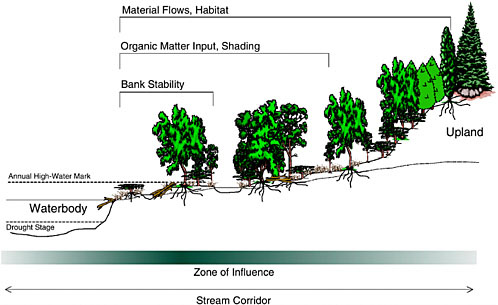
Riparian areas are transitional between terrestrial and aquatic ecosystems and are distinguished by gradients in biophysical conditions, ecological processes, and biota. They are areas through which surface and subsurface hydrology connect waterbodies with their adjacent uplands. They include those portions of terrestrial ecosystems that significantly influence exchanges of energy and matter with aquatic ecosystems (i.e., a zone of influence). Riparian areas are adjacent to perennial, intermittent, and ephemeral streams, lakes, and estuarine-marine shorelines.
An important feature of this definition is the concept of riparian areas having gradients in environmental conditions and in functions between uplands and aquatic ecosystems. The shaded zone of influence in Figure ES-1 represents this gradient. Although riparian areas encompass some of the wetlands in a typical landscape setting and also include portions of adjacent aquatic and upland environments, important distinctions between these systems are made (Chapter 1).
STRUCTURE AND FUNCTIONING OF RIPARIAN AREAS
Riparian areas are the products of water and material interactions in three dimensions—longitudinal, lateral, and vertical. They include portions of the channel system and associated features (gravel bars, islands, wood debris); a vegetated zone of varying successional states influenced by floods, sediment deposition, soil-formation processes, and water availability; and a transitional zone to the uplands of the valley wall—all underlain by an alluvial aquifer.
Fluvial Processes, Sediment Dynamics, and Biogeochemical Interactions
Riparian areas receive water from three main sources besides precipitation: (1) groundwater discharge, (2) overland and shallow subsurface flow from adjacent uplands (hillslope runoff), and (3) flow from the adjacent surface waterbody by multiple pathways. Riparian areas can both gain or lose water as a result of interactions with groundwater. Depending on the setting, groundwater may pass directly through riparian sediments or bypass them entirely through deeper flow paths. Flow across the surface of riparian areas can occur via overbank flow from the channel, hillslope runoff, and rainfall directly onto those saturated areas. The relative importance of overbank flow versus hillslope runoff tends to increase with increasing stream order.
The channel can also supply water to riparian areas via infiltration through channel banks. Indeed, bank storage refers to channel water moving laterally into subsurface riparian areas when river stage is high, and then gradually moving back to the channel when river stage drops. Hyporheic exchange involves flow within the stream channel that enters subsurface sediments and returns to the channel at a downstream location. All of these processes affect water storage, physical and chemical transformations in riparian areas, and the composition and extent of riparian plant communities. Riparian areas that become hydrologically disconnected from their adjacent stream channels (e.g., via levees or channel incision) lose many of their ecological functions.
Varying flow regimes have corresponding sediment dynamics that help shape riparian areas. Although precipitation and runoff promote erosion of uplands and the transport of sediment into stream channels, riparian areas may trap some of these particles. Once sediment-laden water reaches the stream system, the decrease in channel gradient downstream leads first to the deposition of course material (gravel, cobble) in the middle reaches followed by the deposition of fine materials (sand, silt) in the lowest-velocity environments (e.g., coastal segments). Floods tend to rework channel sediments such that riparian areas continually gain and lose substrates—key processes that determine their nature and productivity. Riparian vegetation plays a role in sediment dynamics by providing hydraulic resistance during floods. Subsequent to floods, riparian vegetation becomes established on newly exposed areas of the channel bed, streambanks, and floodplains, providing stability to these areas during subsequent floods.
Soils found in riparian areas have pronounced spatial variability in structure, particle size distribution, and other properties—not only across a riparian area, but also vertically within a given soil profile. This variability is the result of interactions between streamflow patterns and sediment transport in conjunction with variations in local geology, channel morphology, and streamside vegetation. Periods of high flow and the lateral migration of rivers over long periods of time can create a multitude of landforms common to many riparian systems, particularly in unconstrained or relatively wide alluvial valleys. These include meanders, oxbows, natural levees, point bars, secondary channels, floodplains, and terraces.
For waterborne chemicals and particles, the major transformation and transport processes associated with riparian areas include infiltration, deposition, filtration, adsorption, degradation, and assimilation. Infiltration, during which dissolved chemicals and particulates enter the subsurface, is facilitated by macroporous vegetation or litter layers in riparian areas that offer high resistance to overland flow and decrease its velocity (which promotes deposition of sediments formerly suspended in runoff). Filtration of solid particles by riparian vegetation during overland flow traps larger soil particles, aggregates, and particulate organic matter, while adsorption to clay and organic matter in soils intercepts dissolved compounds such as orthophosphorus, heavy metals, and some pesticides. Finally, the plant and microbial assemblages in riparian areas can transform chemicals via many different mechanisms, e.g., denitrification and assimilation. These fate and transport processes occur in subsurface water moving through riparian soils, in slack-water habitats (i.e., shallow and slowly moving sections of channels), and in hyporheic zones. The importance of these mechanisms in controlling water quality depends on the amount of time that hillslope runoff is retained in the riparian area, on whether overland and subsurface flows concentrate and flow through only a portion of the riparian area, and on the stream order of the adjacent channel.
Climate and Resulting Riparian Vegetation
Climate has a strong influence on the structure and functioning of riparian areas, through temperature, precipitation, evapotranspiration, and runoff. Floods play a significant role in determining the composition of riparian vegetation by controlling the germination and successful establishment of seedlings as well as their long-term survival. Rivers in arid regions experience flood discharges that can be orders of magnitude greater than their base flows. This results in significantly greater flow variation and physical disturbance, which promote the growth of tree species and associated plant assemblages that can tolerate these disturbance conditions. The microtopographic variation created by diverse fluvial processes supports a species richness that would not otherwise occur.
Although physical disturbances are a prevalent controlling feature in many riparian areas, soil moisture and the depth to the water table also influence the composition of plant communities. For example, riparian areas in humid climates at the lowest elevations commonly experience soil anoxia brought on by persistent flooding or saturation, which in those areas is a greater factor in controlling riparian species composition than is physical disturbance.
Regional variations in climate have thus resulted in variable riparian plant communities across North America. For example, while there are from 26 to 33 tree genera in riparian areas for regions east of the Great Plains, for regions to the west the number ranges from 9 to 22. Despite wide regional variations in riparian tree genera represented, a core of genera—alders, cottonwoods, and willows—is found in riparian areas across the continent.
Riparian vegetation has many critical functions. It provides friction and resistance to flowing water and to runoff during floods, creates soil macropores by root growth and decay, and stabilizes streambanks via roots. Trees intercept, store, and evaporate a portion of incoming precipitation. Indeed, the amount of water utilized by deep-rooted riparian vegetation has been an issue of significant concern, particularly in arid regions. Riparian plant canopies have an important role in influencing stream temperature and the health of aquatic species. Finally, forested riparian areas contribute wood to streams and lakes, which helps maintain their physical habitat, slows the downstream routing of sediment and organic matter, provides increased hydraulic resistance to flow, and provides a food supply to microorganisms and invertebrates.
Environmental Services of Riparian Areas
The fundamental ecological functions that riparian areas perform fall into three major categories: (1) hydrology and sediment dynamics, (2) biogeochemistry and nutrient cycling, and (3) habitat and food web maintenance. Functions related to hydrology and sediment dynamics include storage of surface water and sediment, which reduces damage from floods downstream from the riparian area. Riparian areas intercept, cycle, and accumulate chemical constituents in shallow subsurface flow to varying degrees, with the societal benefit of removing pollutants from overland flow and shallow groundwater that might otherwise contaminate nearby waterbodies.
Maintaining biodiversity is one of the most important functions of riparian areas and is the basis for many valued fisheries, in addition to bird and other wildlife habitat. The benefits of functioning riparian areas to fish stem directly from the role of vegetation in controlling temperatures, stream structure, and sedimentation. Riparian areas themselves are home to an abundance of animal life, including invertebrates, almost all amphibian species and many reptiles, the majority of bird species (particularly in the semiarid West), and many mammal
species with semiaquatic habitats. In addition to being characterized by unique assemblages of plants compared to uplands and wetlands, riparian areas frequently harbor rare plant species.
Except for support of biodiversity, some of the environmental services of riparian areas can be provided by technologies, such as reservoirs for flood control and treatment plants for pollutant removal. However, these substitutions are directed at single functions rather than the multiple functions that riparian areas carry out simultaneously and with little direct costs to society.
Riparian areas perform important hydrologic, geomorphic, and biological functions. They encompass complex above- and below-ground habitats created by the convergence of biophysical processes in the transition zone between aquatic and terrestrial ecosystems. The characteristic geomorphology, plant communities, and associated aquatic and wildlife species of riparian systems are intrinsically linked to the role of water as both an agent of disturbance and a critical requirement of biota.
Riparian areas, in proportion to their area within a watershed, perform more biologically productive functions than do uplands. They provide stream microclimate modification and shade, bank stabilization and modification of sedimentation processes, organic litter and wood to aquatic systems, nutrient retention and cycling, wildlife habitat, and food-web support for a wide range of aquatic and terrestrial organisms. Even though they occupy only a small proportion of the total land base in most watersheds, riparian areas are regional hot spots of biodiversity and exhibit high rates of biological productivity in marked contrast to the larger landscape. This is particularly dramatic in arid regions, as evidenced by the high number of plant and animal species found along watercourses and washes.
HUMAN ALTERATIONS OF RIPARIAN AREAS
Because humans worldwide use more than half of the geographically accessible river runoff, their significant impact on the structure and functioning of riparian areas is not surprising. Effects include changes in the hydrology of rivers and riparian areas, alteration of geomorphic structure, and the removal of riparian vegetation. Drastic declines in the acreage and condition of riparian lands in the United States over the last 100 years are testimony to these effects.
Hydrologic and Geomorphic Alterations
Manipulation of the hydrologic regime via the construction of dams and other structures, interbasin diversion, and irrigation has served to disconnect
rivers from their riparian areas. Changes in hydrologic disturbance regimes and patterns of sediment transport include alteration of the timing of downstream flow, attenuation of peakflows, and other effects.
Dams have an immediate upstream effect—the complete loss of riparian structure and functioning due to inundation. Downstream effects include changes in the transport of sediment due to retention behind the dam such that channels below a dam can become increasingly “sediment starved.” A second type of downstream alteration is related to the pattern of river flow following dam construction. Large dams can dampen the magnitude of high flows that would occur normally, increase the duration of moderate flows, or even dewater downstream reaches causing substantial declines of riparian forests. Levees are similarly effective at severing hydrologic linkages (i.e., frequency, magnitude, and duration of overbank flows) between a channel and its adjacent riparian areas. The degree of impairment is less for those levees located farther from the stream system (particularly if located outside the meander belt of a river).
Bank stabilizing structures—revetments and rip-rap, gabions, groins, and jetties—have also influenced the characteristics of riparian systems. Rip-rap eliminates microhabitats of plant species that naturally stabilize banks. In addition, because many bank structures reduce the hydraulic roughness (i.e., the frictional resistance to flow) along the channel margins, flow velocities are greater along the bank during high flows, which often precludes the survival of many riparian plant species.
Channelization converts streams into deeper, straighter, and often wider waterbodies to facilitate conveyance of water downstream so that the immediate floodplain area will not flood as long or as deeply, resulting in reduced soil water content. Channelization has the direct effect of destroying riparian vegetation via the use of heavy equipment or by moving the stream channel to a new location where no natural riparian vegetation exists. Indirectly, channelization reduces the survivability of riparian vegetation by lowering the water table and reducing the frequency of overbank flow. The increased flow capacity afforded by channelization compresses the period of water conveyance, making streams “flashier” and increasing erosion rates. Downstream effects include higher flood peaks and greater loading of sediment, nutrients, and contaminants.
Water withdrawals, both from surface waters and groundwater, can have serious deleterious effects on riparian area functioning caused by the lowering of water tables in the vicinity of riparian vegetation. Groundwater pumping for water supply throughout large areas of the West is increasingly common. Because groundwater and surface water are generally connected in floodplains, declines in groundwater level can indirectly be caused by surface water withdrawals or by the regulation of surface water flow by dam construction. Lowering groundwater levels by just one meter beneath riparian areas is sometimes sufficient to induce water stress in riparian trees, especially in the western United States.
Phreatophytic (water-loving) plants historically have been cleared from riparian areas in arid and semiarid climates because they have been viewed as competing with other users of water, particularly irrigated agriculture and municipalities. However, phreatophyte eradication destroys nearly all ecological and geomorphic benefits provided by riparian vegetation, including stabilization of alluvial fill, shading, and provision of wood and microhabitats.
Agriculture
A second major impact to riparian areas has been their conversion to other plant species via land uses such as forestry, row crop agriculture, and livestock grazing. The periodic removal of trees by forestry has the potential to alter the long-term composition and character of riparian forests. Where large portions of the standing timber are harvested or where the period between harvest operations is short, substantial changes to the composition, structure, and function of riparian forests will almost certainly result. The harvest of riparian forests can increase the amount of solar radiation reaching a stream, which can increase water temperatures and affect aquatic primary production. The removal of vegetative cover can impair the ability of riparian areas to retain water, sediment, and nutrients such as nitrogen and phosphorus. In general, the effects of forestry on riparian structure and function are much greater when forests are clear-cut or harvested right up to streambanks and lake shorelines.
Nationwide, traditional agriculture is probably the largest contributor to the decline of riparian areas. Conversion of undeveloped riparian land to agriculture has the potential to decrease infiltration and increase overland flow volumes and peak runoff rates. This results in high erosion rates that inundate riparian vegetation with sediment and limit the filtering functions of the riparian area. Stream channels accommodate the higher flows by increasing their cross-sectional area through widening of the channel or downcutting of the streambed. Tile-drained agricultural areas additionally experience the circumventing of many biological processes that typically occur in riparian areas. Finally, the transport of agricultural chemicals from upslope can negatively impact fauna and flora located in riparian areas and downstream receiving waters.
The primary effects of livestock grazing include the removal and trampling of vegetation, compaction of underlying soils, and dispersal of exotic plant species and pathogens. Grazing can also alter both hydrologic and fire disturbance regimes, accelerate erosion, and reduce plant or animal reproductive success and/ or establishment of plants. Long-term cumulative effects of domestic livestock grazing involve changes in the structure, composition, and productivity of plants and animals at community, ecosystem, and landscape scales. Livestock have a disproportionate effect on riparian areas because they tend to concentrate in these areas, which are rich in forage and water. Although native ungulates can inflict
similar types of damage to riparian vegetation, their impact is generally much less than that of livestock in areas that support both.
Industrial, Urban, and Recreational Impacts
A variety of mining practices can severely degrade riparian areas. Depending upon the type, size, and location of the mining operation, total hillsides can be excavated and their stream systems moved or buried. Mining spoils are sometimes deposited along stream channels and can destroy riparian vegetation, particularly if they contain toxic metals such as arsenic, cadmium, chromium, copper, lead, mercury, and zinc. When a mining operation exposes large areas of bare ground, substantial increases in overland flow and sediment production can occur during rainfall. Unless a well-designed and operated system of detention ponds is in place, such runoff may greatly increase sediment delivery to nearby riparian areas. Gold mining in valley bottoms has been particularly detrimental in that all riparian vegetation was removed and soils and underlying gravel substrates were mechanically dredged.
Transportation systems have directly and indirectly altered a large number of riparian areas. River transportation has often necessitated the removal of large wood and other obstructions from streambanks. Also significant to riparian systems have been the widespread impacts of channelization, lock construction, and other facets of maintaining these transportation corridors. Road and rail systems have been frequently sited along rivers and lakes, leading to the removal of riparian vegetation from the area occupied by the roadbed, the alteration of topography to provide a roadbed foundation, and local hydrologic modifications to reroute surface water and groundwater. Where sinuous rivers or streams were encountered during highway or railroad construction, portions of the channel were often filled to maintain a straight road alignment at the cost of reduced channel length. Bridges or culverts require the construction of abutments along the bank to provide roadway support. Because the abutments physically constrain the stream, future lateral adjustments by the stream are effectively eliminated. As discussed below for urban development, highway systems and urban roads outside of riparian areas can increase peak overland flow, thus fundamentally altering the hydrologic disturbance regime of adjacent riparian areas.
Urbanization and the accompanying increase in impervious surfaces have profoundly modified watershed hydrology and vegetation, and consequently the structure and functioning of riparian areas. As vegetation is replaced by impervious surfaces (roads, buildings, parking lots), infiltration, groundwater recharge, groundwater contributions to streams, and stream base flows all decrease, while overland flow volumes and peak runoff rates increase. Stream channels respond by increasing their cross-sectional area to accommodate the higher flows. This channel instability triggers a cycle of streambank erosion and habitat degradation
in riparian areas similar to that seen with channelization. Above a certain percent imperviousness (approximately 10 to 20 percent), urban stream quality is consistently classified as poor. A secondary effect of urbanization is caused by changes in how overland flow and shallow subsurface flow enter and transverse riparian areas following development. Development promotes the formation of concentrated flows that are less likely to be dispersed within riparian areas, greatly reducing their potential for pollutant removal. For the most part, urbanization and development permanently impair the functioning of riparian areas.
Riparian areas are popular sites for recreational activities that can introduce sediment, nutrients, bacteria, petrochemicals, pesticides, and refuse to adjacent water bodies. Effects on riparian soils include trampling by foot, animal, or vehicle traffic that leads to compaction, destruction of soil biota, and increased erosion. Damage to vegetation can be incidental, as through trampling, or deliberate, as in its removal for the construction of recreational facilities or collection of firewood. Animal life can be affected negatively by recreation in riparian areas in ways that include direct disturbance, modification, or destruction of habitat; pollution; or introduction of pathogens.
The introduction of exotic plant and animal species for various purposes has had a substantial effect on riparian areas. The most common concern about exotic organisms is their displacement of native species and the subsequent alteration of ecosystem properties. For example, saltcedar has replaced cottonwood and other native riparian trees throughout much of the southwestern United States. This situation has been exacerbated by a reduction in flood flows caused by dams and by the lowering of water tables caused by water withdrawal. Other exotic plants that have become abundant in riparian communities include reed canary grass, buckthorns, scotch broom, Chinese privet, and kudzu.
Global climate change could bring about changes to riparian structure and functioning, including the shifting of riparian areas in response to sea-level rise and temperature change. Nonetheless, as significant as climate changes are likely to be, land- and water-use changes have had and will continue to have the greatest effect on riparian areas in the near and medium term.
Current Status of Riparian Lands in the United States
There have been few assessments of national riparian acreage and only a handful of comprehensive studies on the condition of riparian lands. Current estimates of riparian acreage range from 38 million to 121 million acres. Although the available data are highly variable, it is clear that riparian areas constitute a small fraction of total land area in the United States, probably less than 5 percent. Case histories show that in some areas loss of natural riparian vegetation is as much as 95 percent—indicating that riparian areas are some of the most severely altered landscapes in the country.
Information on riparian condition is similarly variable and sparse. Less than half of public riparian areas administered by the Bureau of Land Management (excluding Alaska) are rated as healthy (although this reveals little about the condition of riparian areas in the East, where the percentage of public lands is small). Water-quality impairments to 300,000 miles of streams (10 percent of the total) and to more than 5 million acres of lakes suggest that riparian areas adjacent to impaired streams are suffering similar degradation. Finally, historical trends for wetlands provide clues about trends in riparian lands, given that these areas sometimes overlap. Between 1780 and 1980, every state experienced declines in wetland acreage, with greater than 50 percent loss in 22 states.
The majority of riparian areas in the United States have been converted or degraded. Although landscape studies assessing the status of riparian areas are limited, they reveal that the spatial extent of riparian forests has been substantially reduced, plant communities on floodplains have been converted to other land uses or have been replaced with developments, and the area of both woody and non-woody riparian communities has decreased. The functions of these riparian areas are greatly diminished in comparison to what occurred historically.
There is no comprehensive or methodologically consistent monitoring of trends in riparian areas. It has only been relatively recently that assessments of the areal extent and condition of riparian systems have been undertaken. Unfortunately, these efforts have been limited in scope (covering a small fraction of perennial streams and almost no intermittent and ephemeral streams), they are difficult to compare because of differing methodologies, and they provide only a fragmented view of the nation’s riparian systems.
Given the profound lack of information on riparian land status and trends, a comprehensive and rigorous assessment of riparian coverage is greatly needed. A national program to map riparian areas should incorporate broadly available remotely sensed data, such as satellite multispectral data, which could be used to classify and map land cover and land use information in each of the states.
EXISTING LEGAL STRATEGIES FOR RIPARIAN AREA PROTECTION
Only during the last decade have riparian areas begun to receive legal recognition as places requiring special attention. The degree of protection, the focus, and the spatial coverage of laws and programs are highly variable at federal, state, and local levels. A variety of laws offer mechanisms to help protect some riparian areas or aspects of riparian areas. Few of these laws, however, reflect
awareness of riparian areas as unique physical and natural systems in their own right and as landscapes supporting multiple important functions and warranting special management and protection. Rather, protection of riparian areas is an indirect consequence of other objectives, such as water-quality protection or habitat management.
Five approaches have been used to protect riparian areas, depending on whether the land is publicly or privately owned. First, certain federal laws require the evaluation of adverse effects that would be caused by federal actions, along with consideration of less environmentally damaging alternatives. Such an approach is not specific to riparian areas, nor does it require their protection, but it does ensure attention to their environmental values if they would be potentially affected by a proposed federal action. A second approach is to place special limits on activities in riparian areas on public lands. For example, in the Pacific Northwest, logging and other activities are restricted in riparian reserves that have been established on federal lands in order to protect salmon. A third approach is to regulate activities in privately owned riparian areas. Examples are found in statewide programs such as the Massachusetts Rivers Protection Act and the New Hampshire Comprehensive Shoreland Protection Act. Fourth, incentives such as cost-sharing, low-cost loans, or tax reductions may be used to encourage stewardship on private riparian areas. At the national level, several Farm Bill programs provide incentives for moving intensive agricultural practices away from streams by installing riparian buffers. Fifth, privately owned riparian lands can be purchased—either in fee or by easement—for public management.
For the regulatory and nonregulatory approaches used by the states to address protection of privately owned riparian areas, a significant limitation is that their success is measured by the number of practices implemented and rarely by actual environmental improvements. Indirect metrics of success (such as “miles of riparian buffer installed”) are typical of state and federal conservation programs rather than measured improvements in water quality. Because of these uncertain metrics, and because many restoration programs are relatively new, it is difficult to know whether the federal, state, and local programs have been or will be effective in restoring structure and functioning to riparian areas on privately owned land. Interest seems to be growing in the use of conservation easements and other incentives to induce landowners to hold riparian areas as buffers, natural areas, or open space, as well as in the purchase of riparian lands for greenways or wildlife areas. The Total Maximum Daily Load (TMDL) Program (stemming from the Clean Water Act) is expected to have a significant impact on riparian areas because many of the TMDL implementation plans being developed call for restoration of riparian areas as a required management measure to achieve needed reductions in nonpoint source pollution.
The use and management of public lands and resources are governed by both federal and state laws. The specific federal laws that apply depend on which system (e.g., national forest, Bureau of Land Management land, wild and scenic
river) the land is included within and what resources are at issue. Each managing agency affords some consideration to riparian areas and resources, whether by regulation or in an internal manual or policy handbook. Few specific provisions for riparian areas have been established in legislation or in executive orders, but agencies have considerable latitude to decide how and to what extent their planning and management activities will account for these areas. One result is that individual districts or units within agencies may vary in their interpretation and implementation of riparian measures established administratively. Thus, while different and additional constraints apply to management of federal riparian lands as compared to privately owned riparian lands, the constraints are not uniform from agency to agency, nor are they even uniformly interpreted and applied within agencies. For the most part, they have been established principally by administrative action, not by legislation, and thus are subject to administrative change. Riparian areas on federal lands are seldom managed as natural systems, though they may receive management attention or protection when they support resources of concern (such as wildlife or fisheries) and are threatened by certain land uses (such as livestock grazing or mining). Federal statutes contain very little guidance for land managers who face conflicts between riparian area protection and permissible land uses. Only if a federal agency proposes an activity in or affecting a riparian area that would jeopardize threatened or endangered species or violate water-quality requirements is riparian area protection clearly required.
There are opportunities for protection of riparian areas by extending water rights to instream uses. Current water law in the western states follows the doctrine of prior appropriation, whereby the first to take control of and actively develop and use a water resource holds a protectable legal right to the water against all other claimants. In the eastern states, water rights are afforded to those landowners adjacent to a water body (riparian doctrine). Though neither of these systems protects the water needs of streams or their riparian areas, there have been attempts to amend state laws to acknowledge instream water use and afford it water rights.
Management guidelines and regulations differ drastically among forest, range, agricultural, residential, and urban lands on private lands. No state has a general land-use law or framework to coordinate management of the landscape for multiple uses (e.g., forestry, grazing, agriculture, mining, urban development). Although many states have been willing to regulate or manage timber harvesting on private lands in riparian areas, they have not been nearly as willing to restrict other agricultural activities, except in some areas with demonstrated water-quality problems. Instead, the preference has been to induce change in farming practices through incentives provided by programs such as the Conservation Reserve Program, the Conservation Reserve Enhancement Program, and the Water Quality Incentive Program.
States should consider designating riparian buffer zones adjacent to waterbodies within which certain activities would be excluded and others would be managed. The broad importance of protecting riparian areas for water quality and fish and wildlife benefits calls for state-level programs of land-use regulation that treat all riparian landowners equally, such as the Massachusetts Riverfront Protection Act. At the very least, states should consider establishing such buffers for sensitive areas (as has been done for the Chesapeake Bay). In the absence of a statewide program, local governments should be encouraged to develop riparian buffer zones.
Few, if any, federal statutes refer expressly to riparian area values and as a consequence generally do not require or ensure protection of riparian areas. Even the National Wild and Scenic Rivers Act refers only to certain riparian values or resources; it does not consider riparian areas as natural systems, nor does it require integrated river corridor management. Moreover, statutes governing federal land management do not direct agencies to give priority to riparian area protection when conflicts among permissible land uses arise. This absence of a national riparian mandate stands in stark contrast to the existence of a federal wetlands law.
Public lands should be managed to protect and restore functioning riparian areas. Federal land management agencies should promulgate regulations requiring that the values and services of riparian areas (habitat-related, hydrologic, water quality, aesthetic, recreational) under their jurisdiction be restored and protected. At a minimum, agencies should assess the condition of riparian areas, develop and implement restoration plans where necessary, exclude incompatible uses, and manage other uses to ensure their compatibility with riparian area protection. Ideally, Congress should enact legislation that recognizes the myriad values of riparian areas and direct federal land management and regulatory agencies to give priority to protecting those values.
Instream flow laws can help protect riparian areas if river and stream flows are managed to mimic the natural hydrograph. Water allocation has historically favored human claims to water over using it for environmental needs. Recently, the needs of natural systems have been addressed in some cases by preserving minimum stream flows. Because riparian functioning is dependent on the full range of variation in the hydrologic regime, the reintroduction or maintenance of such flow regimes (in addition to minimum stream flow) is essential for restoring and sustaining, respectively, healthy riparian systems.
MANAGEMENT OF RIPARIAN AREAS
Strategies that reflect a spectrum of goals are needed for improving the ecological functions and the sustainability and productivity of existing riparian
areas. Protection (preservation or maintenance) of intact riparian areas is vital because these areas represent valuable reference sites for understanding the goals and efficacy of other restoration efforts, and they are important sources of genetic material for the reintroduction of native biota into degraded areas. Measures to protect intact areas are often relatively easy to implement, have a high likelihood of being successful, and are less expensive than the restoration of degraded systems.
Restoration refers to the process of repairing the condition and functioning of degraded riparian areas. Ecological restoration in particular has the stated goal of regaining predisturbance characteristics. There are many riparian systems where ecological restoration is achievable. However, there are also situations where permanent changes in hydrologic disturbance regimes (e.g., dams), natural processes (e.g., global climate change), channel and floodplain morphology (e.g., channel incision), and other impacts (e.g., extirpation of species, biotic invasions) may preclude a recovery to the composition and functions that previously existed. Nevertheless, even in such situations, there are often opportunities to effect significant ecological improvement of riparian areas and to restore, at least in part, many of the functions they formerly performed.
Assessment Tools
For decision-makers to be effective in managing riparian areas, they need information on the status and condition of these areas. A variety of assessment tools are available for this purpose, although most have been developed for application to wetlands. Nonetheless, if further refined, these tools can be instrumental in prioritizing restoration activities and in more efficiently allocating resources toward restoration projects. Although there are no nationally recognized protocols for assessing the ecological condition of riparian areas, several methods and approaches are available, ranging from landscape-level to site-specific, from rapid and qualitative to research-level and model-based, and from those designed to answer ecological questions to those oriented toward socioeconomic issues.
Three reference-based methods may be particularly useful—Proper Functioning Condition (PFC), the Hydrogeomorphic Approach (HGM), and the Index of Biological Integrity (IBI). All are oriented toward evaluating the condition of ecosystems by comparing the project site with conditions expected in the absence of human activities or in least-disturbed sites. Once methods are developed in the form of guidebooks (for HGM) or indices (in the case of IBI), their application is relatively straightforward. PFC is the most rapid assessment method in that it is conducted in the field and the results are “immediately” known. While PFC is qualitative and dependent on the knowledge and judgment of a team of experts, HGM and IBI are based on quantitative data gathered and analyzed from unaltered to degraded sites prior to assessor involvement (although the collection and
analysis of such data require considerable expertise). Unlike PFC, neither HGM nor IBI was developed primarily for riparian areas, and both would require modification in their approaches to data collection and analysis.
The concepts underlying most assessment tools currently used for wetlands and aquatic ecosystems are transferable to riparian areas, suggesting that these tools can be modified to assess the condition of riparian areas. In some cases, this would require an expansion from the aquatic portion to the floodplain and terrestrial parts of riparian areas. In cases where wetlands are major components of riparian areas, modifications would be minimal.
Proper Functioning Condition provides a good first-generation framework for riparian assessment. This method, which can be rapidly applied, may have its greatest utility in quickly identifying riparian areas that have been significantly degraded. However, there is currently no consideration of riparian biology in PFC because the assessment principally evaluates physical factors. Independent testing and evaluation are critical to ensure PFC’s accuracy, usability, and credibility across the diverse suite of riparian areas in any given region.
The Hydrogeomorphic Approach and the Index of Biological Integrity hold considerable potential for assessing the condition of riparian areas. HGM (originally developed for wetlands) provides data useful not only for the assessment of condition, but also for the overall design of regional or watershed-scale restoration efforts. Most IBI assessments have been limited to aquatic ecosystems. Both HGM and IBI should be revised for use in riparian areas, for example by developing indices of integrity for riparian plant communities.
Management Strategies
The range of possible restoration activities in riparian areas is broad, spanning from simple activities at a single site to large-scale projects. In many cases, relatively easy things can be done to improve the condition of riparian areas, such as planting vegetation, removing small flood-control structures, or reducing or removing a stressor such as grazing or forestry. Where the objective of restoration is to improve the entire river system, more holistic watershed approaches will be necessary, and management strategies such as removing impediments to the natural hydrologic regime may be required. Restoration can be either passive (halting those activities that are causing degradation) or active (management to accelerate the development of self-sustaining and ecologically healthy systems) or both. Successful restoration requires local knowledge of hydrology and ecology including the range of natural variability, disturbance regimes, soils and landforms, and vegetation.
Reestablishing the Hydrologic Regime
Where natural hydrologic regimes (and corresponding sediment transport regimes) have been significantly altered by dams, levees, locks, low-water diversion channels, or off-stream storage ponds, perhaps the most important restoration need is to reestablish or restore these disturbance regimes to the extent possible. In the majority of cases to date, restoration involving changes in flow regime such as dam re-regulation has targeted fish populations and has not considered riparian objectives. Restoring the natural flow regime should focus on reestablishing the magnitude, frequency, and duration of peak flows needed to reconnect and periodically reconfigure channel and floodplain habitats. Fortunately, research is now demonstrating the essential functions performed by periodic flooding in shaping river channels, building floodplains, creating backwater sloughs, and supporting riparian vegetation. As a result, dam operations are changing in some locations to allow at least some controlled flooding. Given the current level of water resources infrastructure, dammed rivers will probably never have flow releases that fully replicate pre-dam flow regimes, and upstream portions of dammed rivers may never be restored. However, in many areas there may be major opportunities for altering flow release patterns so that they are increasingly “friendly” to the hydrologic needs of downstream riparian areas. There is also considerable potential for restoring riparian areas by altering levees, dikes, and other structures designed to impede the movement of water away from a channel.
Strategies that focus on returning the hydrologic regime to a more natural state have the greatest potential for restoring riparian functioning. Riparian vegetation has evolved with and adapted to the patterns of changing flows associated with stream and river environments. Altering dam operations, removing levees, and otherwise re-creating a more natural flow regime and associated sediment dynamics are of fundamental importance for recovering riparian vegetation and the functions that it provides. Geomorphic restoration alone cannot bring about the complexity that would result from a fully functioning river corridor with a free-flowing exchange of sediment and organic matter between the channel and riparian area.
Dam operations should be modified where possible to help restore downstream riparian areas. There is an increasing need to send greater flows down long segments of rivers to improve riparian plant communities. The effects on downstream riparian areas of manipulating dam discharges should be monitored to help identify those practices that show potential for aiding riparian restoration. In most cases it may not be possible to reinstate pre-dam conditions, but it may be possible to create a smaller, more natural stream that mimics many characteristics of the historical one.
Future structural development on floodplains should occur as far away from streams, rivers, and other waterbodies as possible to help reduce its impact on riparian areas. Structural developments typically have significant and persistent effects on the size, character, and functions of many riparian areas. Thus, preventing unnecessary structural development in near-stream areas should be a high priority at local, regional, and national levels. In addition, acquisition of land through conservation easements can be used to retain currently undeveloped land within floodplains in a more natural state.
Vegetation Management
Because of the fundamental importance of vegetation to the ecological functioning of riparian areas, where such vegetation has been degraded or removed, its recovery is a necessary part of any restoration effort. In many instances, recovery of riparian vegetation can be attained simply by discontinuing those land- and water-use practices that caused degradation (passive restoration). Attempts to actively restore altered systems without first removing or reversing the cause of decline are not likely to achieve functional riparian vegetation.
With regard to historically harvested riparian forests, there may be opportunities to combine passive and active restoration approaches. The protection of riparian vegetation from future harvest would be a passive approach. Active restoration approaches include planting native trees, encouraging more rapid development of late-successional stages through intermediate harvests, and augmenting large wood in streams to meet ecological goals.
A common restoration tactic in riparian areas of the Pacific Northwest has been to reintroduce large wood into streams. Unfortunately, this has frequently been done without consideration of restoring the riparian forest over the long term. Wood has even been added to streams that never contained appreciable amounts historically (e.g., meadows). Before large wood is introduced into streams, it must be determined whether wood is appropriate for creating the habitat conditions and ecological processes associated with restoration goals.
For overgrazed riparian areas, the passive restoration approach is simply to exclude domestic livestock from riparian areas via fencing, herd management, or other approaches. Excluding cattle from riparian areas is the most effective tool for restoring and maintaining water quality and hydrologic function, vegetative cover and composition, and native species habitats. Once ecological and hydrologic functions are restored, grazing in some cases could have minor impacts if well managed.
Where cattle are not excluded from riparian areas degraded by livestock grazing, conditions are unlikely to improve without changes in grazing management. Changing the season of use, reducing the stocking rate or grazing period, resting the area from livestock use for several seasons, and/or implementing a different grazing system can lead to improvements in riparian condition and
functioning. Although grazing strategies other than full exclusion may promote restoration, they are likely to proceed more slowly and run a greater risk of failure.
In riparian areas that support agricultural crops, the long-term loss of native plants and the widespread occurrence of exotic plants increase the difficulty of accomplishing restoration goals, such that active management of riparian areas (using constructed buffer zones) is likely to be needed. Buffer zones are a valuable conservation practice with many important water-quality functions. Under proper conditions, these buffers are highly effective in removing a variety of pollutants from overland and shallow subsurface flow. They are most effective for water-quality improvement when hillslope runoff passes through the riparian zone slowly and uniformly and along lower-order streams where more of the flow transverses riparian areas before reaching the stream channel. Riparian buffer zones should be viewed as a secondary practice that assists in-field and upland conservation practices and “polishes” the hillslope runoff from an upland area.
Even when riparian buffer zones are marginally effective for pollutant removal, they are still valuable because of the numerous habitat, flood control, groundwater recharge, and other environmental services they provide. Unless new evaluation procedures are developed that consider both the water quality and ecological functions of riparian areas, it is unlikely that riparian zone size (width and length) and composition (vegetation types, other features) will be determined in a way that optimizes their potential for environmental protection.
Riparian areas associated with forested, grazed, and agricultural lands provide some of society’s best opportunities for restoring habitat connectivity across the landscape. Management of riparian vegetation in ways that optimize their value as habitat for plants and animals will require planning and action at both site-specific and landscape scales. In addition, more integrated management that uses a functional approach and seeks to optimize habitats for a variety of native species is needed. Much riparian management currently suffers from focusing on a single species or taxon.
Management of Other Activities
Many of the restoration strategies discussed above involve land- and water-use changes that will require a new understanding of why riparian areas are important. Through improved educational programs, the ecological importance and intrinsic human values associated with these lands may be better balanced against the competing wants and needs of a modern society.
Although recreational use provides an excellent opportunity to foster stewardship of riparian areas, most recreational development in riparian areas lacks sound ecological assessment and planning. Future management should combine careful design using a landscape perspective, limitations on certain uses that are
incompatible with preservation or rehabilitation of riparian areas, and involvement of the local community and other stakeholders. The goal of managing recreational activities in riparian areas is to perpetuate natural functions (e.g., wildlife habitat) while still allowing human use and enjoyment of these areas.
More formal education on riparian areas needs to reach broad and diverse audiences if it is to succeed in effecting positive change in riparian management. It should include traditional educational institutions and reach out directly to policy makers, natural resources personnel, government officials, developers, landowners, and the public at large. Natural resources professionals need to expand their perspectives beyond their formal background and training. The public’s aesthetic appreciation of waterbodies is already high. This appreciation should be harnessed to further public stewardship of riparian areas.
CONCLUSIONS
Riparian areas provide essential life functions such as maintaining streamflows, cycling nutrients, filtering chemicals and other pollutants, trapping and redistributing sediments, absorbing and detaining floodwaters, maintaining fish and wildlife habitats, and supporting the food web for a wide range of biota. The future success of at least five national policy objectives—protection of water quality, protection of wetlands, protection of threatened and endangered species, reduction of flood damage, and beneficial management of federal public lands—depends on the restoration of riparian areas.


