
National Academy of Sciences | 150 Year Anniversary

Questions? Call 800-624-6242

| Items in cart [0]

The National Academies Press

PAPERBACK
price:$15.00
add to cart

Rights & Permissions

topleft topright

Making Sense of Complexity: Summary of the Workshop on Dynamical Modeling of Complex Biomedical Systems (2002)
Board on Mathematical Sciences (BMS)

Citation Manager

Casella, George, Wu, Rongling, Wu, Sam S., Weidman, Scott T.. "Color Plates." Making Sense of Complexity: Summary of the Workshop on Dynamical Modeling of Complex Biomedical Systems. Washington, DC: The National Academies Press, 2002.

Please select a format:

BibTeX EndNote RefMan


Page
37
bottomleft bottomright

The following HTML text is provided to enhance online readability. Many aspects of typography translate only awkwardly to HTML. Please use the page image as the authoritative form to ensure accuracy.


Making Sense of Complexity: Summary of the Workshop on Dynamical Modeling of Complex Biomedical Systems

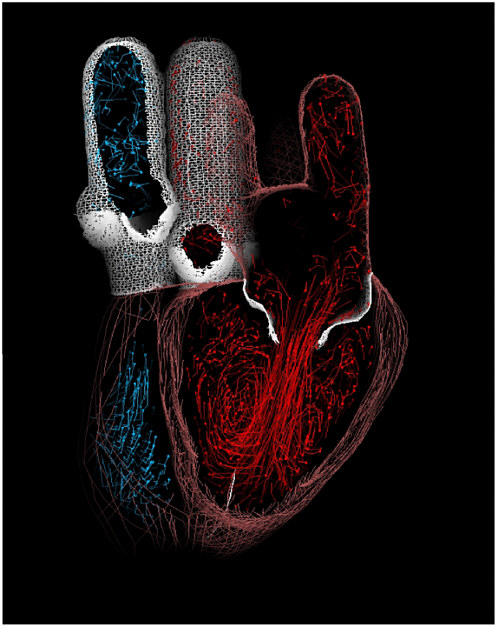
PLATE 1 Section of the model heart through the left ventricle in diastole. Structures at the top (from left to right in the figure) are pulmonary artery, aorta, and left atrium (with two pulmonary veins appearing in the section). At the bottom (from left to right in the figure), are the right and left ventricles. The anterior and posterior leaflets of the mitral valve appear in cross section at the top of the left ventricle. Note the prominent vortex (rotating clockwise in the figure) that has been shed from the anterior leaflet of the mitral valve, and the less prominent counter-rotating vortex that has been shed from the posterior leaflet. Together these are presumably the cross section of a ring vortex that has been shed like a smoke-ring from the mitral valve as a whole. Reprinted with permission from Kovacs, S.J., D.M. McQueen, and C.S. Peskin. Modeling cardiac fluid dynamics and diastolic function. Phil. Trans. R. Soc. Lond. A 359:1299-1314, 2001.
Page
37

Below are the first 10 and last 10 pages of uncorrected machine-read text (when available) of this chapter, followed by the top 30 algorithmically extracted key phrases from the chapter as a whole.
Intended to provide our own search engines and external engines with highly rich, chapter-representative searchable text on the opening pages of each chapter. Because it is UNCORRECTED material, please consider the following text as a useful but insufficient proxy for the authoritative book pages.

Do not use for reproduction, copying, pasting, or reading; exclusively for search engines.

OCR for page 37
Making Sense of Complexity: Summary of the Workshop on Dynamical Modeling of Complex Biomedical Systems PLATE 1 Section of the model heart through the left ventricle in diastole. Structures at the top (from left to right in the figure) are pulmonary artery, aorta, and left atrium (with two pulmonary veins appearing in the section). At the bottom (from left to right in the figure), are the right and left ventricles. The anterior and posterior leaflets of the mitral valve appear in cross section at the top of the left ventricle. Note the prominent vortex (rotating clockwise in the figure) that has been shed from the anterior leaflet of the mitral valve, and the less prominent counter-rotating vortex that has been shed from the posterior leaflet. Together these are presumably the cross section of a ring vortex that has been shed like a smoke-ring from the mitral valve as a whole. Reprinted with permission from Kovacs, S.J., D.M. McQueen, and C.S. Peskin. Modeling cardiac fluid dynamics and diastolic function. Phil. Trans. R. Soc. Lond. A 359:1299-1314, 2001.
OCR for page 38
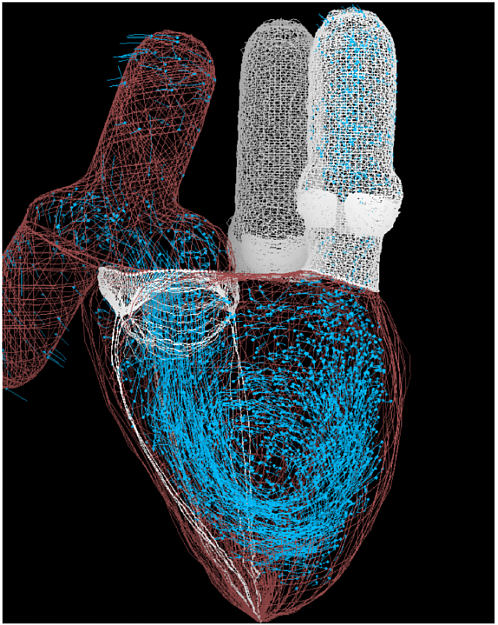
Making Sense of Complexity: Summary of the Workshop on Dynamical Modeling of Complex Biomedical Systems PLATE 2 Cutaway view of the model heart showing the flow pattern of blood in the right ventricle during diastole. Structures seen from left to right in the upper part of the figure are the superior vena cava connecting to the right atrium with the interior vena cava below, the aorta, and the pulmonary artery. In the lower part of the figure, a prominent vortex (rotating counterclockwise in the figure) fills the right ventricle. A jet of blood flowing through the open tricuspid valve merges with and presumably drives this vortex. Reprinted with permission from Kovacs, S.J., D.M. McQueen, and C.S. Peskin. Modeling cardiac fluid dynamics and diastolic function. Phil. Trans. R. Soc. Lond. A 359:1299-1314, 2001.

OCR for page 39
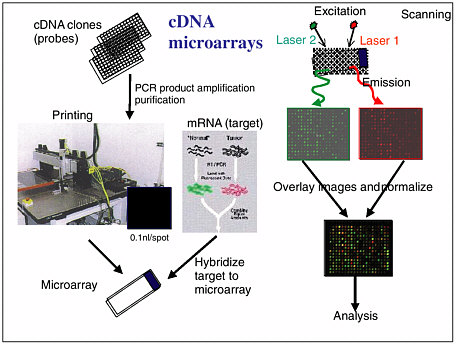
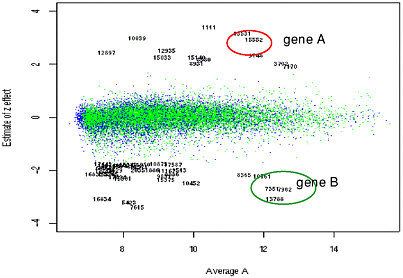
Making Sense of Complexity: Summary of the Workshop on Dynamical Modeling of Complex Biomedical Systems PLATE 3 Microarray construction. Figure courtesy of Terry Speed. PLATE 4 Estimates of zone effects: log (zone 4/zone 1) versus average A. Figure courtesy of Terry Speed.

Representative terms from entire chapter:

pulmonary artery