





Below is the uncorrected machine-read text of this chapter, intended to provide our own search engines and external engines with highly rich, chapter-representative searchable text of each book. Because it is UNCORRECTED material, please consider the following text as a useful but insufficient proxy for the authoritative book pages.
247 B ecause of the variability among the cases presented in Chapters 2â7, the committee conducted a cross-case analysis. It is valuable tocompare the cases systematically to see what this small sample of incidents can tell us in terms of factors that are present in all the cases, those that are present in some cases and not others, and those that are entirely absent. Through such activities we can parlay this small number of complex cases into a more coherent pattern of understanding. Later, in Chapter 11, we consider the cases as though they were a small dataset that can be used to influence our judgments about likely causes and plausibly effective interventions. We begin by describing the committeeâs analytic framework for creating and analyzing the cases and the method of infer- ence used. We then test the plausibility of different substantive claims that are made about the important causes of these events. ANALYTIC FRAMEWORK AND METHOD OF INFERENCE As described in Chapter 10, violence can best be understood through processes operating at multiple levels of explanation, taking account of the dynamics that seem necessary, if not sufficient, to produce a violent incident (National Research Council, 1993). These levels include factors operating at the social, community, group or subcultural, family, and individual levels of society. They often changeâsometimes rapidly. In addition, sequences of events, powered and guided by microsocial pro- cesses, are often important in transforming the potential for violence into 8 A Cross-Case Analysis
248 DEADLY LESSONS: UNDERSTANDING LETHAL SCHOOL VIOLENCE the concrete reality of an event. The ideas and cognitions that operate in the heads of offenders are important as they become agents of violent events. The aim here is to bridge these different levels of analysis. Our interests go beyond what might have caused the individual shooting and what might have prevented it. We are also interested in the incident as a cause of both a community and a policy response. Table 8-1 is a representation of the committeeâs analysis. Although lacking precision, the table is meant to convey the extreme rarity of school rampage violence within the larger picture of lethal school vio- lence, other serious youth violence, youth violence in general, and vio- lence in general. In reviewing the cases, the case authors and committee members developed multiple hypotheses about what might be driving the behav- ior and checked them against the data collected in the six cases. For example, in one case an offender had a more successful older sibling; in another the family of the offender had recently moved into town; in an- other the offender knew a great deal about a previous school rampage shooting, and those attending school were organized in a large number of subcultures with few overlapping members and little interaction with one another. We then considered whether there was a plausible causal con- nection between the feature observed and the likelihood that the violent incident would have occurred or would have taken a particular shape. If the factor showed up in any of the other cases and seemed to be working in the same way, then there was a plausible hypothesis about an impor- tant causal phenomenon. If little such evidence was found, then the hypothesis seemed less likely to be true, or less important even if true, because its impact could not be seen across the cases examined. We also considered some common hypothesesâfor example, that the offenders had been bullied and the attack was an attempt to get back at those who bullied them, or that the schools in which the incidents had occurred had allowed cliques to form and to skirmish with one another in the schoolâand looked at the cases for any examples. If none of the cases was characterized by such a feature, that cast significant doubt on either the truth or the importance of that factor as a contributing cause of the violence. These methods, although not systematic enough to confirm or refute alternative causal explanations, could be viewed as an effort to undertake the preliminary scientific task of generating causal hypotheses and doing the rough work of casual inspection that helps make some hypotheses seem stronger than others. In this approach, part of the task is to reduce confidence in any particular claim by imagining the variety of things that could be true and then ordering the claims according to some rough sense of plausibility.
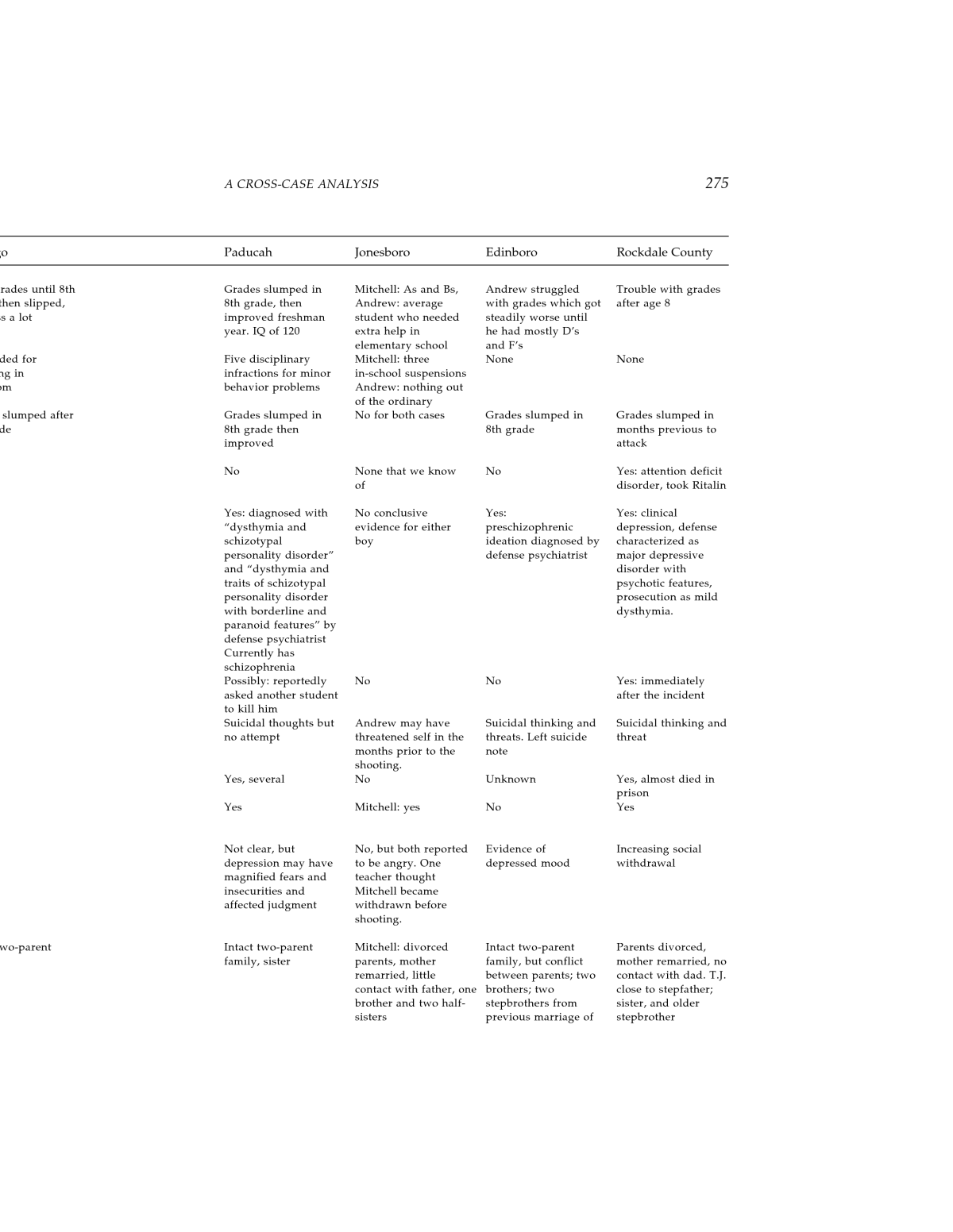
249A CROSS-CASE ANALYSIS SIMILARITIES AND DIFFERENCES Table 8-2, at the end of this chapter, lays out the details of the case studies for ease of comparison. All seven of these incidents involved young people arming them- selves, in several cases with semiautomatic weapons, and opening fire on their schoolmates and teachers, killing or seriously injuring them (mean fatalities: 2.2; mean injuries: 4.5; all but 4 killed or injured were other students). The incidents occurred in places that were supposed to be safeâthe hallways and common areas of schools and at a school-spon- sored event. The offenders were all young themselvesâmost were age 13 or 14 (range: 11â15). The offenders in six of the seven incidents were convicted of homicide in adult courts, and most were sentenced to long prison terms. These events also took place in a society that seems to encourage or condone violence. The popular culture is tolerant of violence. The United States has the worldâs largest supply of privately owned weapons (used in four of these incidents). And recently there was a dramatic increase in violence occasioned at least in part by an epidemic of cocaine use fueled and supported by violent illegal drug markets. In the committeeâs view, levels of violence are influenced by such structural factors, and we cannot exclude their importance in producing the events examined, although it is hard to find direct evidence of these factors in the cases. All of these events occurred in the sturm and drang of adolescent development. The youth who committed the offenses were young men trying to become grownups. They were intensely concerned with their status and power, with their masculinity, and with their relationships with members of the opposite sex. They were all vulnerable to exagger- ated hopes and fears and to the perceptions and judgments of peers and adults. At this time of life, it is easy to imagine that one is under threat, or that there are certain things one has to do to gain attention or standing in the world. It is also a time of life when adult authority and norms are being contested. These processes were at work in both the inner city and in the suburban and rural areas. An important difference between the inner-city and suburban and rural contexts lies in the coherence of the events. In each of the three incidents in the two inner-city schools, the offender had a specific reason to shoot when he did, where he did, and at whom he did. Moreover, the reasons given were comprehensible to their peers and even to the adults and officials who investigated and responded to the events. The shootings were occasioned by a very specific relationship between the shooter and some other student at school, which ripened into an unresolved dispute, in which there was a continuing, seemingly credible threat of violence
250 DEADLY LESSONS: UNDERSTANDING LETHAL SCHOOL VIOLENCE TABLE 8-1 Stages in the Development and Aftermath of the Incident Micro/Social, Durable Conditons Situational Processes Factors Leading That Create Potential That Transform To Incidents For Violent Incident Potential Into Act The Incide Society Wide Poverty Economic inequality Racial discrimination Culture of violence Weapon availability Community Economic isolation Rapid mobility Inter-group conflict School Inadequate resources Arbitrary disciplinary Ineffective management actions Ineffective discipline Unexpected negative Weak faculty/student relations feedback Poor physical security Local Youth Culture Violent norms/scripts Status threats Inter-group conflict Physical threats Non-inclusive cliques Audience for violence Bullying Status hierarchies Family Broken homes Parental crises Emotional distance Parental rebukes Inattentive parenting Sibling Competition Individual Psychology Acute feelings of Low cognitive functioning inadequacy Fear and rage against the person who ended up doing the shooting. There were even intimate, local encouragements for the shootings to occur, in the sense that there was a youthful audience that knew about the dispute, under- stood the rules by which such disputes could be settled, and would have viewed the reluctance of the shooter to act as an invitation to degrade his status and make him a victim because of his reluctance to use force to defend his status and, in one case, the status of his brother. The four suburban and rural incidents lacked this coherence and so- cial clarity. That is not to say that these shooters didnât have their reasons to shoot. Like the inner-city shooters, the suburban and rural shooters
251A CROSS-CASE ANALYSIS Location Weapons Number of victims Seriousness of injuries Relationship of victims to offender How ended: âSuicide âLegal interven. âCitizen interven. âFlight cident , Immediate, Social Longer Term, rocesses First Round Interpretation Second Round rm Consequences and Response Consequences and o Act The Incident of Incident to Incident Response to Incident Notoriety Commentary Changes in federal Media in media policy coverage Commentary Research studies in expert communities Shock Local political Civil court processing Self-defense discussion ciplinary Security Broad discussion Installation of new Decisions of cases and security negative prevention Creation of new Grief counseling relations w/students s Shock Hidden discussion Altered relations ats Self-defense among youth? Willingness to report violence s Humiliation Soul searching Getting on with life kes Sadness s of Criminal Trial Civil court processing y justice e processing were intensely interested in defending or elevating their social standing. They believed that they were being ignored, or were under attack, or had been unjustly treated. That provided much of the energy they used in preparing for and executing the attack. Yet in the suburban and rural shootings, the shootersâ perceptions seemed to have little basis in reality, or, if they were real, they were not widely understood or shared by others. The acts were more the product of aberrant thought than of requirements of social circumstancesâas re- flected in the occasion, the victims, and the targets of the shooting. The suburban shooters were not being threatened with physical violence at
252 DEADLY LESSONS: UNDERSTANDING LETHAL SCHOOL VIOLENCE the time they shot. While there was often some relationship between the suburban shooters and those at whom they shot or who were in the vicin- ity of the shooting, they mostly did not have specific targets or hit those whom they might have been targeting. Their grievances were more dif- fuse, and their shooting more indiscriminate. An important finding of the committee is that events of this kind did not seem to have occurred in the inner-city schools. TESTING THE PLAUSIBILITY OF VARIOUS EXPLANATIONS OF VIOLENCE The Role of Economic and Social Structure A well-established tradition in sociology and criminology is to begin the search for the causes of violence in the structural characteristics of society. The idea is that violence occurs among those in social positions who are disadvantaged relative to others in society, or who are excluded and alienated from the dominant culture, or who are victims of oppres- sion and injustice. This tradition is reflected in the inner-city cases. The case writers locate the violence exactly where this view would expect to find itâin communities that have been socially, economically, and politi- cally marginalized. It is hard not to draw the conclusion that these factors played an important role in causing the violence observed. What is startling, however, is that some portion of the lethal violence observed happens not in economically marginalized communities, but in ones that are relatively well off economically, socially, and politically. Paducah is not a thriving community; it has its pockets of poverty. But the other three suburban or rural communities studied were relatively affluent, and homogeneously so. Jonesboro, Edinboro, and Rockdale County were all thriving, affluent areas in which few were left behind. It would be hard to attribute the shootings in these areas to economic or social disadvantage. The role of economic and social status cannot be wholly excluded. In one of the suburban cases, the social position of the shooter was relatively low in his community, which may suggest to some that class did play an important role in shaping the character and motivations of a future of- fender. And there are plenty of reasons to think that great tensions lurk beneath the surface of the apparently successful communities, that great gulfs divide adults from youth in these places, and that the places them- selves are a bit unstable due to recent economic growth. An important similarity across the urban and rural and suburban environments was the presence of rapid social change in five of the six communities, which can produce instability even when the changes are positive ones.
253A CROSS-CASE ANALYSIS The Role of Culture A second idea with widespread currency is that lethal school violence is caused by a societal and popular culture that tolerates, encourages, or even demands violence. There are different versions of this argument. In one version, a claim is made that inner-city violence seeped into pop culture, embodied in the mass media, and tended to glorify and encourage violence. The focus of the mass media on violence is seen not only as a reflection of a general enthusiasm for violence, but also as an influence that barrages American society with graphic images of vio- lence. The important role of the mass media is thought to be particu- larly attractive and dangerous to youth who can spend hours viewing TV, listening to music with violent lyrics, and playing video games that feature violence. It is hard to exclude this hypothesis on the basis of the evidence. All the incidents occurred against the backdrop of a popular culture that seems to tolerate if not encourage violence. However, it should be noted that the offenders in the cases did not seem to be more obsessed with these materials than the millions of kids who did not go on a shooting spree. A second version of a claim about cultural influences emphasizes the gap between adult culture and youth culture. The argument is that if adults are not much present in the lives of youth, they will not be able to guide them toward such adult values as self-reliance, self-discipline, civil- ity, mutual respect, patience, generosity, and empathy toward others. Without adult influence, youth culture might turn out to be particularly vulnerable to dangerous influences from the media or from peers. One extreme version of this is the emergence of a gang culture in which youth gangs perform the protecting, explaining, and socializing roles that would ordinarily be performed by families. From the outset of our work, the committee was much attracted to this hypothesis. The inner-city cases were profoundly influenced not only by the general culture of violence in their neighborhoods, but also more particularly by youth gangs whose interactions created an impor- tant part of the social circumstances that animated and authorized the shootingsâat least in the minds of the boys who fired the weapons. The suburban and rural cases also showed strong evidence that the world of youth was not very well understood by adults, especially youth who were forming their own culture supporting some forms of antisocial behavior. In Rockdale County, a syphilis outbreak among teens caused by wide- spread sexual promiscuity of a particular group of kids who gathered at an unmonitored house to watch pornography on TV and imitate the acts
254 DEADLY LESSONS: UNDERSTANDING LETHAL SCHOOL VIOLENCE they saw offered strong evidence of the absence of adult and parental guidance. In Paducah as well, the case writer observed that the âsocial dynamics of adolescence were almost entirely hidden from adult view.â So there is in these cases a gap between the adult and the youth culture. Communication did not flow easily across these boundaries. The adults at school did not seem to know the kids very well, or to be much present in their lives other than as administrators and teachers. These adolescents did lots of things that the adults in the communities would view as dangerous. We can also see that this gap matters, because it allows gangs, cliques, and rivalries to grow, and it lets festering disputes and grievances go unnoticed and unresolved. When information became available that should alert adults to the likelihood of a fight or an assault by one youth against another, the information often did not cross the boundary that divides adults and officials from the adolescents. It is unclear whether the gap between adults and youth in these par- ticular communities exists in other communities that have not experi- enced these tragedies. In our cases, this gap was evident in both the poor inner-city neighborhoods and the more well-to-do suburban sitesâboth in terms of the quality and intensity of their engagement and in terms of the substantive values they embraced. The committee discussed ways of closing this gap. But it is important to recognize that this gap can never be fully closed and probably should not be. Successful human development, and the development of society as a whole, depend on new generations being able to separate themselves to some degree from their parents and the traditions they embody. A third version of a cultural explanation for lethal violence in schools and school rampages focuses on the pervasive presence of guns in the United States. It was not difficult for the shooters to obtain weapons, getting them from friends or stealing them, unnoticed, from family mem- bers or neighbors. And many of the shooters had some experience with guns. Three of them had gone hunting or shooting with an adult prior to the time of the shooting. At least one other had practiced shooting by himself and so had some experience with how to use the weapon. Again, it seems obvious that easy access to guns facilitated the lethal school violence and school rampages. In sum, we cannot rule out the big cultural explanations: the distinc- tive American tradition of violence, the impact of the mass media, the gap between adult and youth culture, and the role of guns in U.S. society. But for purposes of scientific explanation, the potential impact of smaller, faster-moving aspects of culture and their carriers are also of interest: the special role of violent rap music and video games, the role of gangs in spreading a culture of violence among kids, and the impact of the press coverage given to the rural and suburban shootings themselves. These
255A CROSS-CASE ANALYSIS things are a possible link between the inner-city violence and the rural and suburban violence. The Role of the School The fact that the violence took place in schools tends to magnify its importance and social consequences. Because people expect schools to be safe havens for adolescents, when violence happens in them, the conse- quences are particularly severe. Another important implication is that the schools can be seen as a platform for launching interventions to prevent and control violence. Finding ways to engage schools in efforts to accomplish this goal would seem to be an urgent task. A third implication is that conditions inside the school may be a po- tential cause of the violence. In one version of this idea, one could see the failure of the schools to put in place preventive measures as an important cause of the lethal violence and school rampagesâan error of omission rather than commission. Or one could see the schools themselves as âcriminogenicââthe social relationships and norms existing within the schools might have actually caused the violence to occur. A fourth implication is that the school, as the largest and most com- mon social setting for adolescents, is the most likely setting for interper- sonal violence among them. And because it is the most common social setting, it also serves as the primary public arena for acting out. In most of the rural and suburban cases examined, the school served not only as a convenient place to commit violence, but also as a public stage on which to perform and to be seen. In considering these hypotheses in light of the cases, the committee sees evidence for the first claimâthat the location in school makes the social consequences of the violence worse, regardless of where the school is located. There is also evidence that the school was considered an im- portant place to launch efforts to prevent future incidentsânot only in the places that experienced the violence, but also in communities across the country. It is much harder to determine whether the schools were an impor- tant cause of the violenceâthrough either omissions or commissions. The schools successfully constructed a protective boundary that separates them to some degree from conditions in the community; generally speak- ing, kids are safer in schools than in other locations. The difficulty is that the boundary is not impermeable. The violence of inner-city communi- ties can reach into the schools, and the impulses associated with rampage shootings like those we have seen in workplaces can come into schools as well. In hindsight, it seems that there might have been some things that
256 DEADLY LESSONS: UNDERSTANDING LETHAL SCHOOL VIOLENCE the schools could have done to prevent and deal more effectively with the violence when it occurred. While evidence is scarce that the schools somehow generated the violence as a consequence of the way they were structured and adminis- tered, the sense of community between youth and adults in these schools, which research has shown is protective against crime, was lacking. In the worst example, the school allowed a school newspaper to print an article that humiliated one of the students who became a shooter. The adults involved may have been too distant from the students to prevent some social processes leading to the potential for violence or resulting in an intolerable humiliation for some particularly vulnerable youth. In order to prevent violence from occurring, the adult culture and the schoolâs administration and faculty may have to find ways to successfully engage the youth culture, to make every student feel valued, and to keep the youth culture in the school from becoming lethally dangerous. In hindsight, the schools in the cases may have been insufficiently preven- tive. But they do not seem to have been criminogenic in themselves. Characteristics of the Offenders Another tradition in criminology focuses attention on the more or less stable individual characteristics that make some individuals more likely to offend than others. In these respects, there may be important differ- ences between the cases of violence in the inner city and the rural and suburban areas. Many social pressuresâlarge and small, durable and transientâled toward the incidents of lethal violence observed in the inner-city schools. In the suburban and rural schools, the social pressures leading to violence seem much less visible. This may leave more to be explained by individual-level factors. The shooters had some characteristics that, based on evidence from research, would place them at high risk for serious offending: being male, having mental health and, in one case, substance abuse problems, and having previous minor behavior problems. Most had recently begun hanging out with delinquent or more troubled friends and had a recent drop in their grades at school. All had easy access to guns (see Farrington and Loeber, 1999). Of special note is how young all the shooters were. None was older than 15, and the youngest was 11. At least two important aspects of this age period have implications for what occurred. First, it is during early adolescence when peer relations and finding oneâs place in the social order of the school become most important. Second, during this period, cognitive abilities, including perspective taking, are developing. Young
257A CROSS-CASE ANALYSIS adolescentsâ ability to make accurate judgments, especially about social relationships, may be lacking. Most of the shooters did not have either records or reputations that would link them to violent crime, but there are some important differ- ences between the inner-city and the suburban and rural incidents. Two of the three offenders in the inner-city cases had previous arrests for serious crimes and were known to the police. One of the inner-city shoot- ers and all of the suburban shooters had no previous arrests for serious crimes and were largely unknown to the police. However, we cannot conclude from these facts that the underlying level and seriousness of criminal offending was different in the inner city and the suburban cases, or that the inner-city kids had more experience in committing crimes than the rural and suburban kids. One had committed an undetected felony- level theft, one had stolen and sold his fatherâs gun, and one had molested a two-year-old child. We can say, however, that the urban teens were more likely to have previous records of offending than the suburban kids, who essentially had none. The shootersâ records of school performance were similar for five of the boys. In the two inner-city cases, the offenders had good records until 8th grade, when their performance began to slip; that shift was attributed either to the fact that receiving good grades was seen as a sign of weakness or that the offender became involved with a gang culture. In the committeeâs view, this shows the influence of local subcultures in the schools that were powerful influences on young, impressionable adolescents beginning their high school careers and their developing hostility to âgoodâ performance. In the rural and suburban cases, two of the offenders struggled in school. For the others, their grades ranged from average to good until around 8th grade. Disciplinary records in school were similarly varied. At least one of the inner-city offenders and two of the suburban offenders had disciplin- ary records; the others didnât. The offenders could not be said to be notorious âbad actorsâ in their schools. They seemed to be adolescents struggling to make their way academically and socially in the competitive environment of gangs and cliques that characterize most junior and se- nior high schools. In considering the causes of these offenses and potential points of intervention, a crucially important question is the extent to which the shooters can be considered mentally ill. For events that seem largely unaccountable (as in the suburban cases), and when there are no apparent powerful social factors shaping conduct (as in the suburban/rural cases), it is tempting to seek the explanation not just in individual characteristics, but in mental illness. Such an analytic move should be suspect, even though it may seem objective and logical. One reason is that such diag-
258 DEADLY LESSONS: UNDERSTANDING LETHAL SCHOOL VIOLENCE noses are difficult to make objectively after the fact in cases like these. Moreover, in young adolescents, it can be hard for nonprofessionals to distinguish the early stages of mental illness from the ordinary confusion that kids tend to have about the world. Only two of the shooters (both suburban/rural) had any diagnosis or clear sign of mental health problems prior to age 12. One of these had been diagnosed with attention deficit hyperactivity disorder in grade 4, and the other, the 11-year old shooter, had shown signs of conduct disor- der, noted by the case study authors. After the events occurred, three other offenders (one-inner-city, two suburban) were diagnosed with men- tal illness. Another, one of the youngest shooters, had molested a two- year-old child. In addition, two of the offenders made an explicit suicidal gesture during the shooting, and one of these (later diagnosed with schizo- phrenia) repeatedly tried to commit suicide once he was in custody. Sui- cidal thinking was a prominent feature in all of the suburban and rural shooters studied. A common legal standard for finding people not guilty by reason of insanity is that they are not aware of the consequences of their actions at the time they took them. None of these cases rises to that standard. In fact, there is evidence of both premeditation and rational calculation. In all the cases, the offenders made preparations to commit the offenses: they ac- quired weapons. They made plans for the shooting. They warned their peers that something big would happen. All this adds up to strong evi- dence of a kind of rationality that exposes the shooters to harsh judgments of culpability. At the same time, in the cases of the rural and suburban shooters, the worries that prompted the shootings appear to be exaggerated, as were the hopes that attended the shootings. The circumstances were not well judged, the purposes were obscure, and the means were inappropriate to the ends. This sort of thinking does not provide a legal excuse for the action, but it is important to recognize it in adolescents in making a just and effective response. The information gathered on the family background of the shooters included not only the basic structural conditions, but also something about the family interactions and the ways in which they were changing over time. We expected to find a significant amount of family pathology and a low degree of parental involvement in the lives of their children. There was some evidence of this, but it was by no means a universal pattern across the offenders. Two of the three inner-city shooters and two of the five rural and suburban shooters lived in intact, stable families at the time of the shooting. In two rural cases, the case writers found evidence of parental conflict. In one case, a videotape of the interaction between the mother of the offender and the offender suggested to the case writer an
259A CROSS-CASE ANALYSIS astonishing degree of distance in the relationship. There was no evidence either of family violence or child abuse and neglect in any of the cases examined. The parents seemed to remain involved with their children and vigilant of their conduct. Relationships within the family did not change markedly in the period leading up to the shooting. The case writers also gathered information about the social standing of the offenders and the quality of relationships they had with their peers. Although the expectation was that the shooters would be isolated loners, this was true of only one suburban shooterâthe one diagnosed with attention deficit disorder before the shooting and who attempted suicide shortly after the incident occurred. All the others had a status that could be described as marginal. The urban youth were members of marginal groups, and the rural youth seemed to be on the periphery of many groups rather than firmly at the center of any single group. One theme was that the offenders were the kinds of youth who sought to draw attention to themselves through practical jokes or joking around. Often, their humor seemed inappropriate to others. This may suggest the importance to these youth of their standing in their peer community, and that they were struggling with a significant gap between their desired status and the status they actually experienced. More interesting and important is that, in six of the seven shootings, the offenders had recently changed their relationship with their peers. The only case in which this was not true was the case involving the loner. Also of importance is that in the three suburban-rural cases, the shooters had a recent experience of being rejected by a girl. This supports the idea that one of the factors fueling these shootings was a struggle to find status, understand masculinity, and develop relations with members of the opposite sex. When these desires were frustrated and there seemed to be nowhere to turn, a dramatic, violent act may have provided an attrac- tive avenue of expression. Contagion Mechanisms The case study method allowed the committee to explore whether important contagion mechanisms were operating to spread and elevate the violence. While we cannot say much about whether such mechanisms were at work in spreading lethal violence in inner-city schools, or the extent to which inner-city violence seemed to have leapt out of the inner city and touched off the increase in lethal violence in the suburban and rural areas, we can address the extent to which contagion mechanisms seemed to elevate and spread school rampage shootings. It turns out that only some of the suburban shooters were aware of other shootings, and in only one case (the one involving the loner) were the
260 DEADLY LESSONS: UNDERSTANDING LETHAL SCHOOL VIOLENCE other shootings accorded a significant role. In that case, the offender was powerfully influenced by the shooting at Columbine High School in Littleton, Colorado. He knew about it, studied it, and took inspiration from it. In the committeeâs view, that counts as a copycat incident. Although that offender might have done something else hazardous to himself and others if the Columbine incident had not occurred, it seems clear that Col- umbine had a very large effect on the shape his actions took. In another case, the shooter showed a high interest in the Jonesboro shooting, which occurred exactly one month previously. In that case the shooting incident itself was very different, so it is not clear whether he was copying the Jonesboro incident; his general behavior might have been inspired by it, however. Given that these are rare events, even one copycat shooting makes contagion an important contributor to the kinds of shooting sprees that occurred in the rural and suburban cases. Community Responses The committee analyzed the communitiesâ responses by looking at how they learned about and formed interpretations of the events; the role of the local and national media; the role of community leaders; and the policy responses made by the communities: what they did to deal with the grief and anxiety that spread in the aftermath of the events, what they did to improve security in schools, how they handled the offenders, and what lessons they drew from the experience. There was significant vari- ability in the responses as well as some common elements. Media Coverage Media attention created enormous difficulties for the communities in which these events occurred. In the cases for which information was collected, the media coverage of the event was considered to be inaccu- rate by the community and turned out to be so inaccurate that the case writers could not rely on it. It is also clear that the media coverage was experienced as destructive and unhelpful to the communities and the schools. This was particularly true for the suburban and rural schools that experienced shooting sprees, which attracted huge, sustained na- tional media coverage. The reports from Paducah, Jonesboro, and Rock- dale County indicate significant local hostility to the national media and their negative impact on the local communities. In Chicago, the media coverage was so intense and so inaccurate that it caused the case writer to conclude that the case had been decided in the press before the trial was conducted, distorting the facts and limiting the dispositional options.
261A CROSS-CASE ANALYSIS Community Forums The communities varied a great deal with respect to the creation of local forums for discussing the meaning of the events and the appropri- ate responses. All the communities responded in the immediate after- math of the shootings with more or less elaborately organized efforts to provide grief counseling to those who were victims or eyewitnesses or who were swept up in the emotions following the events. While this was a common response, there was an interesting difference between the inner-city neighborhoods and the suburban neighborhoods beyond the immediate reaction. Both inner-city communities responded with antiviolence marches and rallies organized by informal and formal community leaders. They developed new programs for strengthening the relationships among stu- dents of the school, adults in the school, and adults in the surrounding communities. Both communities succeeded in engaging the interest and commitment of elected leaders and the appointed heads of the school system. In short, the inner-city communities reacted through widespread mobilization. In contrast, the response of the rural and suburban communities was more sporadic, ad hoc, and less political. Only in Jonesboro and Edinboro was there anything resembling community rallies and meetings. In Jones- boro, a ministerial alliance was formed, but there was little evidence of its impact on the community. In Edinboro, a series of meetings were held, but they did not involve many citizens or have much impact on the policy and programmatic responses of governmental organizations. In Paducah and Rockdale County, there was essentially no community or political response; the actions taken were all official ones, as the schools made professional responses to the problem. Community Understanding The processes of reacting to, trying to understand, and making a just and effective response to the events led the communities to two quite different interpretations. In both inner-city cases, the community ap- peared to arrive at a diagnosis that attributed the lethal school violence to a generally violent atmosphere, to the presence of gangs in the schools, and to a wide communication gap between adults and youth about the danger in general, but particularly the youth involved in a gang culture. In two of the rural cases (Paducah and Jonesboro), the communities join the inner-city communities in attributing the violence to a lack of commu- nication between adults and youth. They saw this as both a general contributing cause of the violence and as a specific problem that pre-
262 DEADLY LESSONS: UNDERSTANDING LETHAL SCHOOL VIOLENCE vented threats made by the shooters in advance of the events from being heard and taken seriously by adults. In the other two suburban cases (Edinboro and Rockdale County), the problem was not attributed to a general community problem but instead was seen as the result of a single troubled kid growing up mentally ill in a troubled family. None of the suburban communities attributed the violence in their communities to violence in American society, perhaps because they felt insulated from the violence that was happening elsewhere. Nor did they attribute the violence to gangs, because they did not see the cliques that formed in their schools as gangs that created occasions for or supported violent acts. The adults and youth in these communities may have been influenced in some ways by the violence of the wider society, but if they were being so influ- enced, they were not much aware of it. Criminal Justice Response These different interpretations of the events did not lead to different criminal justice responses to the shootings. All except two of the shooters were tried as adults on the most serious charge that the evidence would support, usually first- or second-degree murder. All those charged with murder in adult court eventually pleaded guilty to lesser offenses that recognized mitigating circumstances. In two of the inner-city cases, the mitigating circumstance was either âacting under extreme emotional dis- tressâ or âacting in self-defense.â In two of the rural/suburban cases (Paducah and Rockdale County), the mitigating circumstance was mental illness. Four of the shooters received very long sentences: 45 years for the Chicago offender; life without parole for 25 years for the Paducah shooter; 30â60 years in prison, eligible for parole at age 45, for the Edinboro youth; and 60 years of custody, including 40 years of probation, for the mentally disturbed adolescent in Rockdale County. The two New York shooters received somewhat more lenient sentences: 3â9 years in prison, part served in a youth facility for one, and 6â20 years in prison for the other (of which only 5 years were served, but the offender remains under supervision in the community for the rest of his sentence). The juvenile offenders from Jonesboro got the maximum sentence allowed under the juvenile lawâan indeterminate sentence to age 21. The fact that the Jonesboro offenders will be getting out of jail relatively soon has created great concern in that community. Only one victim of the inner-city shootings chose to pursue civil liti- gation against the school board. In three of the four suburban shootings, civil litigation was also initiated by the victims against the shooters, the shootersâ families, and (in two cases) against those who were the source of weapons for the shooting. In Paducah, the suit also named high school
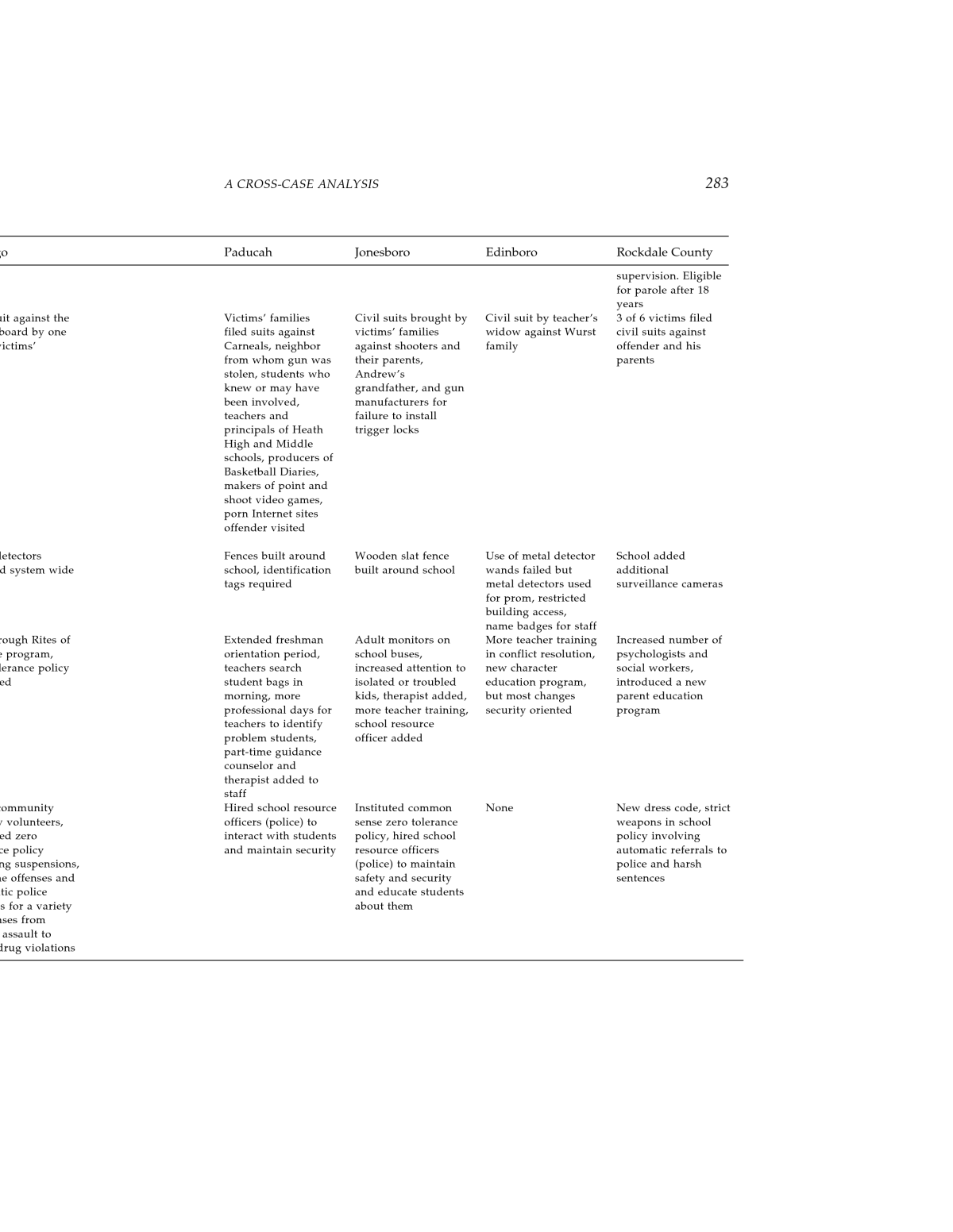
263A CROSS-CASE ANALYSIS officials and the producers of the video games and pornography that were found on the computer of the shooter. It is not clear that these legal processes have done justice or brought an emotional sense of closure to these communities. They seem to come too late and to be too discon- nected from the community to be of use in helping restore a sense of self- confidence or peace. Policy Responses The communities all made what might be considered localized, school- level responses to prevent the occurrence of lethal violence in the future. Not all were well considered, however. All the communities except Rock- dale County (the community in which a mentally disturbed loner was the shooter) made some kind of technical or security response to the school shootings. The two inner-city schools turned to heavy reliance on metal detectors in the school. The use of metal detectors, long a policy in New York, was intensified in the wake of the school shootings there. In Chicago, Mayor Richard Daley seized on the school shooting to institute a citywide policy mandating the use of metal detectors; the case authors note there have been no subsequent lethal shootings in Chicago schools since the adoption of this policy. The rural and suburban schools did not go for metal detectors but rather built fences around the schools and instituted the use of nametags to identify faculty and students. Such measures are designed only to keep those who are not members of the school community out of the schools. Yet in all the cases in which these measures were installed, the shooter was a member of the school community and would not have been kept out of the school by them, so such preventive measures may be of ques- tionable effectiveness. Four communities supplemented the technical security arrangements with the redeployment or hiring of new security personnel. New York instituted a policy of more intensive police patrols inside and outside the schools. Chicago hired new security officials from the local communities to enforce a zero tolerance policy for weapons carrying and fighting in the schools. Both Paducah and Jonesboro also hired community resource officers to provide a regular presence in the schools and to educate stu- dents and enforce rules about weapons, fighting, and violence. Edinboro and Rockdale County did not put additional security officials in schools. Finally, all the communities also made some sort of programmatic effort to strengthen relationships between adults and youth in the schools and among the kids themselves. They increased the adult presence in the schools and encouraged the adults to engage more closely with the stu- dents. Much of this took the form of closer supervision and monitoring
264 DEADLY LESSONS: UNDERSTANDING LETHAL SCHOOL VIOLENCE by school officials, but additional help was provided to students who seemed to be in trouble, and some more general programs focusing on character education and leadership were provided to encourage the stu- dents to assume more responsibility for establishing an appropriate nor- mative environment or moral order in the schools. In East New York, a special program of retreats involving adults and youth was initiated by a powerful city councilwoman. There is little evidence from the cases about the impact of these programs on the character of school life, the degree of security that individuals felt, and so on. But undertaking such initiatives was clearly important to these communities, at least as an expression of concern if not something that was instrumentally effective in protecting them from what was a very low-probability event.
265A CROSS-CASE ANALYSIS TABLE 8-2 FOLLOWS ON PAGES 266-283
266 DEADLY LESSONS: UNDERSTANDING LETHAL SCHOOL VIOLENCE TABLE 8-2 Comparison of Cross-Case Variables Variable NYâJason NYâKhalil Chicago Paducah 1.0 The Incident 1.1 Date 11/25/1991 2/26/1992 11/19/1992 12/1/1997 1.2 Time of day Midmorning Morning No specific info but 7:42 am looks like morning 1.3 Victims: 1.3.1 Number killed 1 2 1 3 Number 1 0 2 5 (2 serious wounded 1.3.2 Victim status Student and teacher Students Students Students 1.3.3 Relationship Bystanders Rivals Rivals One victim to offender he had unr crush on (fr but never d Other mem prayer grou question w shot them b they were p group or w they were t convenient an open sp 1.3.4 Targeted by No: uninjured other Yes but claimed No but self-defense Not clear offender? person was target, self-defense was element as a but done in self- result of a gambling defense dispute 1.4 Location of School hallway School hallway School hallway/ School lobb incident stairway 1.5 Perpetrator at time of attack: 1.5.1 Number 1 1 1 1 arrested 1.5.2 Demographics: Black male; age 14; Black male; age 15; Black male; age 15; White male age; grade; family 9th grade; two-parent 10th grade; parental 10th grade; stable 9th grade; a structure and stable family, both conflict/divorce; two-parent family, two-parent employment parents working sister also withdrew middle/working well educat status from family, mother class works 1.5.3 Suspected No, but aiding Friend supplied gun Gang affiliation Yes, but no co-conspirators brother may have t Goth youth help him ta the school 1.5.4 Under influence No No No No of alcohol or illegal drugs 1.6 Apparent motivation:
267A CROSS-CASE ANALYSIS go Paducah Jonesboro Edinboro Rockdale County 1992 12/1/1997 3/24/1998 4/24/1998 5/20/1999 cific info but 7:42 am 12:35 pm 9:40 pm Around 8:am ke morning 3 5 (1 teacher) 1 0 5 (2 serious) 10 (1 teacher) 3 (1 serious) 6 (1 serious) ts Students Students and two Teacher killed; Students teachers teacher and two students injured One victim was girl Ex-girlfriends of None None he had unreturned both boys; one cousin crush on (friends, of Andrew, other but never dated). students, including Other members of neighbors of Andrew prayer group. Open and two teachers, question whether he student bystanders shot them because they were prayer group or whether they were the convenient group in an open space. self-defense Not clear Not clear No No ment as a of a gambling e hallway/ School lobby Right outside school School dinner dance Schoolâs common y in building outside of area school 1 2 1 1 male; age 15; White male; age 14; White males; one age White male; age 14, White male; age 15, ade; stable 9th grade; affluent, 13, 7th grade; one age 8th grade; middle- 10th grade; parental rent family, two-parent family, 11, 6th grade. 13- class; two-parent divorce age 4, mother /working well educated year-old family, older father remarried age 7, broken/troubled who owns business affluent family family, working parental conflict class; 11-year-old intact, established family, middle class ffiliation Yes, but no proof; Two offenders; report No No may have thought of third older kid but Goth youths would never corroborated help him take over the school No No No No
268 DEADLY LESSONS: UNDERSTANDING LETHAL SCHOOL VIOLENCE 1.6.1 Resolve Yes: on behalf of Yes: others Yes: others No interpersonal brotherâdefending understood there was understood dispute brother, dispute a dispute understood by others 1.6.2 Self-defense Yes: defending Yes: believed his life Yes: feared for his No himself and his was in danger and his life in gang-related brother family threatened gambling dispute 1.6.3 Revenge No No No Only in a v general sen people he s were not th who tormen Was impor show some the bullies, respect from school com 1.6.4 Live up to script Yes Yes Yes No or code 1. 6.5 Copycat No No No No 1.7 Weapons: 1.7.1 Used in attack Gun Gun Gun Gun 1.7.2 In hands of Hand Gun Hand Gun Small semi-automatic .22 pistol perpetrators at pistol time of attack 1.8 How attack Shooter ran outside Shooter ran outside Shooter ran across Shooter sur ended street to school p 1.9 How perpetrators Arrested by police Arrested by police Arrested by police Surrendere apprehended right outside school right outside school across street from principal school 2.0 Community Setting 2.1 Type of Urban Urban Rural community 2.2 Community Isolated, advanced urban decay, Urban decay, River town socioeconomic hypersegregated, no economic structure, economic than nation status no jobs. Adults commute outside to work. disinvestment, and unemploym History of economic disinvestment rapid social change in 1997; wi regarding of economi race/ethnicity of background residents. Much low- trailer park income housing and mansions housing projects TABLE 8-2 continued Variable NYâJason NYâKhalil Chicago Paducah
269A CROSS-CASE ANALYSIS hers No Not clear Not clear No tood ared for his No No No No gang-related ng dispute Only in a very Yes: Mitchell claims Maybe: conflicting No general sense. The intended only to scare reports over whether people he shot at people, claimed particular students were not the ones âangerâ was his were to be targeted, who tormented him. motive. Andrew was although none of the Was important to âmad at a teacher.â victims appears to show something to Both felt as though have been. Made the bullies, earn they were âput uponâ general statements respect from entire by fellow students. that he wanted to school community. âkill nine peopleâ he hated and then kill himself No No No No No Likely not Maybe: showed high Yes: Columbine a interest in Jonesboro factor, may have shooting intended suicide Gun Gun Gun Gun emi-automatic .22 pistol 30.06 semi-automatic .25 caliber semi- .22 caliber rifle; .357 rifle w/scope; rifle automatic pistol Magnum handgun r ran across Shooter surrendered Stopped shooting Fled outside to back Chased outside by to school principal probably in response of banquet hall other students. Knelt to construction down and put gun in workers shouts and his mouth fled toward van d by police Surrendered to Arrested by police Apprehended at rifle Surrendered to school street from principal near van point by banquet hall official owner Rural Rural Rural Suburban decay, River town, higher Jonesboro itself has University town, Affluent area with a mic than national average thriving and diverse thriving economy, median household stment, and unemployment rate manufacturing, middle- to upper- income higher than ocial change in 1997; wide range service and retail middle-class area. surrounding counties ng of economic economy. Shootings Education, or the U.S. 75% home hnicity of backgrounds from happened outside manufacturing, and ownership ts. Much low- trailer parks to Jonesboro in a largely retail businesses are housing and mansions rural area with cornerstones of g projects practically no economy industry or service sector. Working- and go Paducah Jonesboro Edinboro Rockdale County
270 DEADLY LESSONS: UNDERSTANDING LETHAL SCHOOL VIOLENCE 2.3 Social relations in community: 2.3.1 Community Hypersegregated, poor, black Racially and Considerab heterogeneity ethnically population heterogeneous: 32% but school white, 46% black, but white. Con Josephâs tract and class hetero others around it hypersegregated 2.3.2 Community Drug war and epidemic of youth violence Racial tension and None conflict early 1990s conflict, gang violence 2.3.3 Community Community decay since 1960s but entry Rapid change in Rapid chan change of crack in 1980s accompanied by high racial composition, rural to ind homicide rates and violence lowered housing service-bas values, low income economy housing and racially homogeneous gangs emerged. Layoffs in 1990s 2.4 Level of violence and crime in the community: 2.4.1 All violence Neighborhood characterized by violent Overall violence on Low violen drug wars. Led city in homicides in 1993 South Side high at the time. Mostly gangs 2.4.2 Youth violence Homicide leading cause of death Gang-related fights in School figh school hallways daily some off-gr fighting 2.5 Youth alienation from adults: 2.5.1 Separate youth Yes: kids did not tell parents or other Yes: parents felt they Yes: profou culture adults how bad the violent environment had little influence disconnect was over kids, especially adults expe related to gangs. and small g Police did not assert disaffected control in âSocial dyn neighborhood, did adolescence not respond to calls. entirely hid Kids thought they adult viewâ had no one to turn to 2.5.2 Prevalence/ Crews important to survival, but not Criminal gangs had No density of youth much about criminal gangs in these cases significant presence gangs in neighborhood TABLE 8-2 continued Variable NYâJason NYâKhalil Chicago Paducah
271A CROSS-CASE ANALYSIS middle-class families. Low crime rates, considered âgreat place to liveâ by residents. y and Considerable black Christian. Rural areas Mostly white (92%) Over 75% white area, lly population in area, are virtually all white, area. Vintage small- small inner city geneous: 32% but school almost all although Jonesboro town America: where blacks and 46% black, but white. Considerable has a small but community service poor whites with ties s tract and class heterogeneity. significant black clubs, lots of to rural past live around it population and a community sports egregated growing Hispanic and cultural events population. tension and None None None None , gang e change in Rapid change from Small but growing Rural, with little Rapid social change omposition, rural to industrial and generally cohesive change; steady from rural/exurban to d housing service-based community. Influx of economic growth suburban. Population low income economy poorer residents and a tripled in a short g and racially significant problem period of time eneous gangs with crystal meth d. Layoffs in l violence on Low violent crime Low crime rates Low crime rate Rare Side high at the Mostly gangs elated fights in School fights rare, Youth violence low, No Rare hallways daily some off-grounds but bullying is an fighting issue. Youth gangs are in area and drug use by teens at the high school a significant problem rents felt they Yes: profound Yes and no: kids Yes: students did not Evidence that adults le influence disconnect between knew right away that tell adults about donât know about or ds, especially adults experiences it was Mitchell and Andrewâs threats, monitor youth to gangs. and small group of Andrew, but adults adults shocked. behavior (syphilis did not assert disaffected teens. shocked. Some kids Parents largely outbreak) in âSocial dynamics of had reported problem unaware of problem orhood, did adolescence almost behaviors of Andrew behavior among pond to calls. entirely hidden from to adults youth ought they adult viewâ one to turn to al gangs had No Gangs were supposedly No No ant presence a problem in the town hborhood of Jonesboro, but crime rates were low, so not clear if these were criminal gangs go Paducah Jonesboro Edinboro Rockdale County
272 DEADLY LESSONS: UNDERSTANDING LETHAL SCHOOL VIOLENCE 3.0 School Setting 3.1 School type High school High school High schoo 3.2 Economic and Poor/working class Working class/poor Mixed social status of students 3.3 Level of school Not high High: daily fights in Low violence halls but killings almost never occurred 3.4 Social relations Kids members of crews, embedded in Difficult to avoid Both vertic in school peer relationships/conflicts; needed gang entanglements, horizontal protection from seeming weak, couldnât school was differentiat do things seen as weak, like get good recruitment site for students m grades gangs, daily fights in between gr halls of school some antag between gr 3.4.1 Divisions among Different crews, usually made up of Lots of racial and Cliques: pr students friends/relatives. âBeefâ a feature of gang conflicts group, Goth social interaction 3.4.2 Separation of Yes Yes Yes teachers from students 3.4.3 Separation of N/a N/a N/a school administrators from students 4.0 Background and character of perpetrators 4.1 Prior offending/police contact: 4.1.1 Offender known No Yes Yes No to police? 4.1.2 Offending by Gun carrying Robbery arrest Burglary, gang Increasing shooter activity, possessing CDs, guns, stolen property from dad, machine an weapon fro neighbor 4.1.3 Victimsâ No Robbery arrest Robbery and drug No offending arrests for two surviving victims 4.2 Prior arrests for serious offenses: 4.2.1 Offender No Yes Yes No 4.2.2 Victims No Yes Yes No TABLE 8-2 continued Variable NYâJason NYâKhalil Chicago Paducah
273A CROSS-CASE ANALYSIS chool High school Middle school Middle school High school ng class/poor Mixed Middle class Middle class Upper middle class daily fights in Low Low Low Low ut killings never d lt to avoid Both vertical and Bullying a significant Generally good Generally amicable, ntanglements, horizontal problem at Westside open to newcomers, was differentiation, some but not clear that the fluid cliques ment site for students move easily problem is any bigger daily fights in between groups, than other middle f school some antagonism schools between groups racial and Cliques: preps, prayer Some bullying. Cliques, but no Lots of cliques: onflicts group, Goths, jocks cliques: athletes and disruptive divisions rednecks, jocks, cheerleaders, band preps, Christians, kids, druggies, wiggers, âstraight- cliques generally not edge mafia or seen as impermeable vegansâ Yes Yes Yes Yes N/a N/a N/a N/a No No No No ry, gang Increasing stealing: Mitchell: threats to Alcohol and other Small amount of y, possessing CDs, guns, $100 bills teacher and other drug use, illegal minor delinquency, property from dad, fax kids, minor discharge of a firearm stole stepfatherâs gun machine and murder vandalism, molested and sold it, weapon from a two-year-old experimental soft neighbor Andrew: reports that drug and alcohol use he tortured and killed animals y and drug No No No No for two ng victims No Mitchell was brought No No before a juvenile court for the molestation issue No No No No go Paducah Jonesboro Edinboro Rockdale County
274 DEADLY LESSONS: UNDERSTANDING LETHAL SCHOOL VIOLENCE 4.3 School record of offender: 4.3.1 Academic Good grades until 7th grade for both Good grades until 8th Grades slum achievement boys, then no. Getting good grades seen grade, then slipped, 8th grade, t as sign of weakness at T.J. High cut class a lot improved f year. IQ of 4.3.2 Disciplinary Not included in cases studies Suspended for Five discip record at school gambling in infractions bathroom behavior pr 4.3.3 Changes in Grades slumped after 8th grade Grades slumped after Grades slum school status 8th grade 8th grade t improved 4.4 Mental illness of offender: 4.4.1 Formal diagnosis No No, but believed to No No prior to event have emotional problems 4.4.2 Formal diagnosis No Yes: defense No Yes: diagno after event diagnosis was mental âdysthymia illness relating to schizotypal stress and trauma personality from living in East and âdysth New York; traits of sch prosecutor claimed personality antisocial personality with borde paranoid fe defense psy Currently h schizophren 4.4.3 Suicide attempt No No No Possibly: re during incident asked anoth to kill him 4.4.4 Previous suicide No No No Suicidal tho attempt/threat no attempt 4.4.5 Suicide attempt No No No Yes, severa after incident 4.4.6 Psychological No Yes No Yes counseling prior to incident 4.4.7 Recent changes No Fearful Fearful Not clear, b in mood depression magnified insecurities affected jud 4.5 Family background of offender: 4.5.1 Family structure Intact two-parent Divorced parents, Intact two-parent Intact two-p family, siblings sister withdrew family family, sist from family TABLE 8-2 continued Variable NYâJason NYâKhalil Chicago Paducah
275A CROSS-CASE ANALYSIS grades until 8th Grades slumped in Mitchell: As and Bs, Andrew struggled Trouble with grades then slipped, 8th grade, then Andrew: average with grades which got after age 8 ss a lot improved freshman student who needed steadily worse until year. IQ of 120 extra help in he had mostly Dâs elementary school and Fâs ded for Five disciplinary Mitchell: three None None ng in infractions for minor in-school suspensions om behavior problems Andrew: nothing out of the ordinary slumped after Grades slumped in No for both cases Grades slumped in Grades slumped in de 8th grade then 8th grade months previous to improved attack No None that we know No Yes: attention deficit of disorder, took Ritalin Yes: diagnosed with No conclusive Yes: Yes: clinical âdysthymia and evidence for either preschizophrenic depression, defense schizotypal boy ideation diagnosed by characterized as personality disorderâ defense psychiatrist major depressive and âdysthymia and disorder with traits of schizotypal psychotic features, personality disorder prosecution as mild with borderline and dysthymia. paranoid featuresâ by defense psychiatrist Currently has schizophrenia Possibly: reportedly No No Yes: immediately asked another student after the incident to kill him Suicidal thoughts but Andrew may have Suicidal thinking and Suicidal thinking and no attempt threatened self in the threats. Left suicide threat months prior to the note shooting. Yes, several No Unknown Yes, almost died in prison Yes Mitchell: yes No Yes Not clear, but No, but both reported Evidence of Increasing social depression may have to be angry. One depressed mood withdrawal magnified fears and teacher thought insecurities and Mitchell became affected judgment withdrawn before shooting. wo-parent Intact two-parent Mitchell: divorced Intact two-parent Parents divorced, family, sister parents, mother family, but conflict mother remarried, no remarried, little between parents; two contact with dad. T.J. contact with father, one brothers; two close to stepfather; brother and two half- stepbrothers from sister, and older sisters previous marriage of stepbrother go Paducah Jonesboro Edinboro Rockdale County
276 DEADLY LESSONS: UNDERSTANDING LETHAL SCHOOL VIOLENCE 4.5.2 History of family No No No No violence 4.5.3 History of abuse No Possible No No and neglect 4.5.6 Recent changes No Yes: sister withdrew No No in family from family relations 4.6 Status of perpetrators in school/community: 4.6.1 Social standing Marginal group Marginal group Marginal group Marginal m in community member, had member, had friends member, had friends many grou friends friends but forming fri with others socially ins relationship in school b clown 4.6.2 Member of youth No No Yes No gang 4.6.3 Interest in violence Donât know Donât know Donât know Yes media 4.6.4 Involvement in Guns part of daily Guns part of daily Donât know No gun culture life life 4.6.5 Victim of Yes Yes Donât know Yes bullying 4.6.6 Bullying others No No No Yes, but wa physically i 4.6.7 Recent changes Yes Yes Yes Yes: trying in peer relations impress Go 4.6.8 Recent peer No No No Yes: had re rejection dumped gi favor of oth who did no attentions. 5.0 Preparatory Actions of Perpetrators 5.1 Evidence of Carried gun but Got gun from friend Got gun from friend, Yes: elabor planning otherwise no to defend himself loaded and test-fired planning bu from previous threats the gun the night if alone or before TABLE 8-2 continued Variable NYâJason NYâKhalil Chicago Paducah
277A CROSS-CASE ANALYSIS Andrew: intact well- father, but not part of established family, Andrewâs life two half-siblings lived elsewhere most of the time No Mitchellâs dad had No No explosive temper No Mitchell: possibly No No emotional by father, molested by neighbor. No evidence of abuse for Andrew No Mitchellâs father Recent family No threatened he might conflict have to live with him. al group Marginal member of Mitchell: had Conventional friends Loner by middle r, had friends many groups, had conventional friends, (small group of long- schoolâincreasingly friends but difficulty close to brother, time friends that passive and forming friendships involved in school included boys and withdrawn, did not with others and and community girls) but began join groups or play socially insecure in activities, sports, and hanging out with sports relationships, active choir more troubled group in school band, class Andrew: had friends clown but not popular, played trumpet, class clown No Mitchell: wannabee No No (Westside Bloods) know Yes Mitchell: yes Yes Yes Andrew: yes know No Mitchell: limited use No Yes: one of his most of guns important sources of Andrew: yes social identity know Yes Mitchell: yes No No Andrew: probably Yes, but was not Mitchell: yes Yes No physically imposing Andrew: yes Yes: trying to Yes Yes: started hanging Yes: began hanging impress Goths out with kids with with kids considered behavior problems to be âfringeâ but mostly a loner Yes: had recently Mitchell: had just lost Yes: had recently lost No dumped girlfriend in a girlfriend a girlfriend, was favor of other girl rejected by another who did not return his girl he asked to the attentions. dance n from friend, Yes: elaborate Yes: elaborate Planning involved but Yes and test-fired planning but not clear planning not clear if alone or n the night if alone or with others with others go Paducah Jonesboro Edinboro Rockdale County
278 DEADLY LESSONS: UNDERSTANDING LETHAL SCHOOL VIOLENCE 5.2 Source of Carried a gun Friend Bought from Stolen from weapons neighborhood boy 5.3 Threats/warning No Responded to threat Responded to threat Hinted som would happ week befor 5.3.2 Warnings to No Not really, but No adults mother knew he had to defend himself but not that he had a gun 5.4 Reason for particular place and day: 5.4.1 Reaction to Yes No No No immediate events 5.4.2 Preventive Yes Yes Yes and no No response to threat 5.4.3 Proactive No No A little Yes 6.0 Community Response 6.1 Impact of media coverage on community: 6.1.1 Accuracy of Slight inaccuracies at first but quickly Not accurate Not accura media coverage corrected and followed by high-quality residentsâ v investigation in many in own 6.1.2 Impact of media Not discussed Case decided in press Community on community before trial: jury pool against pre deliberation and tainted, no room for media, med welfare plea bargain aggressive, interviewed without pa consent 6.2 Community interpretation/understanding of events: 6.2.1 Community Antiviolence marches and rallies attended Antiviolence rallies No commu forums: by celebrities, diverse community and a new Rites of forums but existence, nature, organizing under the auspices of Centers Passage program for school prof impact for Disease Control and the New York the students and days were City Health Department to educate the teachers to teach identify stu community about violence, retreat for antiviolence and serious pro students in Catskills with local politician leadership skills, school coun leadership from added to he principals, and the freshmen tr local school councils high school therapist vi school one week to tal students TABLE 8-2 continued Variable NYâJason NYâKhalil Chicago Paducah
279A CROSS-CASE ANALYSIS from Stolen from neighbor Stolen from father Stolen from father Stolen from parents orhood boy and grandparents ded to threat Hinted something big Gave many hints, Gave many hints that Only a few oblique would happen the said something big no one took seriously remarks to peers in week before was going to happen weeks before tomorrow shooting ally, but No Adults at school told Teacher knew of No knew he had of Andrewâs threats âwillâ given to nd himself but by at least one another student, t he had a gun student and studentâs teacher reported father threatening conversation between Andrew and another student to school administrator No No No No d no No No No No Yes Yes Yes Yes curate Not accurate in the Mixed: local media Not accurate Not accurate residentsâ views, and generally more in many instances our accurate own ecided in press Community united Community hates Community Community despises trial: jury pool against presence of national media, media considered media media as too , no room for media, media too too aggressive as in presence to be aggressive, distorting rgain aggressive, Paducah intrusive their area, making it interviewed students difficult to move without parentâs forward consent olence rallies No community Jonesboro Ministerial Town government Community-wide new Rites of forums but more Alliance formed launched no major invitational meetings, e program for school professional (religion-based) to initiatives. Series of church meetings, dents and days were added to resolve community meetings over the invited youth from s to teach identify students with problems, no summer with Littleton to a retreat, lence and serious problems, evidence it played community members school system hip skills, school counselor any role, teacher to develop increased number of hip from added to help debriefing held the recommendations for psychologists and als, and the freshmen transition to day after shooting to the schools mostly social workers in the hool councils high school, outside discuss how to deal focused on security, system, introduced therapist visits to with students, character education parent education school one day per additional social program developed program, held series week to talk with workers and full-time for students, more of meetings to students counselors added, training in conflict discuss school federal assistance and resolution instituted security needs, and help from National for teachers, made changes in Organization for Christian group behavior and dress Victims of Crime sponsored youth codes (NOVA) sought center go Paducah Jonesboro Edinboro Rockdale County
280 DEADLY LESSONS: UNDERSTANDING LETHAL SCHOOL VIOLENCE 6.2.2 Engagement of Councilwoman Wooten developed year- Mayor Daly used Political political long retreat program, Mayor Dinkins incident to get metal representat representatives called for an antiviolence movement, detectors installed not engage Chancellor Fernandez established 40 new system-wide, local by choice o smaller schools school councilâs school representatives engaged in public debate over security measures 6.2.3 Community Violent atmosphere, gulf in Gangs, gulf in Freak, inex understanding of communication between kids and adults communication event, coul event between kids and predicted o adults explained 6.2.4 Grief counseling Yes Yes Yes 6.2.5 Impact on More attention to community violence More attention to Potential ne community and danger gang problem impact on climate community to attract h professiona many stude teachers sti treatment, unresolved 6.3 Criminal justice response: 6.3.1 Charges filed 2nd degree murder 1st degree 1st degree murder 3 counts of manslaughter counts atte murder, 1 c burglary 6.3.2 Prosecuted as Adult Adult Adult Adult juvenile or adult 6.3.3 Defense offered Plea to lesser Acting under Act of self-defense Pleaded gu charge of 1st influence of extreme mentally ill degree emotional distress Alford plea manslaughter 6.3.4 Disposition/ 3â9 years in prison, 6 2/3 to 20 years in 45 years in Illinois Life withou sentence part in youth part in prison, served 5 years State Prison for 25 years adult facility TABLE 8-2 continued Variable NYâJason NYâKhalil Chicago Paducah
281A CROSS-CASE ANALYSIS Daly used Political No information Town government Participation in t to get metal representatives were launched no community meetings rs installed not engaged, mostly initiatives described above, -wide, local by choice of the judge ordered tough councilâs school laws posted in ntatives schools d in public over security es gulf in Freak, inexplicable Generally cannot Troubled kid from Mental illness and unication event, could not be understand why this troubled family family problems n kids and predicted or happened but when happened to live there explained pressed cite several factors including lack of communication between kids and adults, decline in religiosity, media influence, availability of guns Yes Yes Yes Yes ttention to Potential negative Community angry Community felt this Sense of shame roblem impact on about sentences for could have happened among some young communityâs ability boys, some felt there anywhereâtroubled people to say where to attract high-quality is better cohesion in boy, many people they are from, but professionals to jobs, the community, blamed parents, relates as much to many students and shooting no longer general sense that syphilis outbreak as teachers still in widely discussed, community is ready shooting. treatment, civil suits civil suits unresolved to move on Community did not unresolved feel different from any other community ree murder 3 counts of murder, 5 Delinquency was Criminal 18 counts of counts attempted actual charge, but homicide/1st degree aggravated assault, murder, 1 count based on 5 counts murder six counts of cruelty burglary capital murder and 10 to children, and 5 counts first degree counts of illegal battery for each boy possession and use of firearms Adult Juvenile Adult Adult self-defense Pleaded guilty but Mitchell: pleaded Pleaded guilty to 3rd Pleaded guilty but mentally ill under an guilty degree murder mentally ill to above Alford plea Andrew: pleaded not charges guilty, judge ruled that in juvenile proceeding insanity and incompetency defense could not be raised s in Illinois Life without parole Indeterminate 30â60 years in prison, Sentenced to 60 years rison for 25 years sentence to age 21 for eligible for parole at of custody including both boys age 45 40 years of probation go Paducah Jonesboro Edinboro Rockdale County
282 DEADLY LESSONS: UNDERSTANDING LETHAL SCHOOL VIOLENCE TABLE 8-2 continued Variable NYâJason NYâKhalil Chicago Paducah 6.4 Civil litigation None None Civil suit against the Victimsâ fam school board by one filed suits a of the victimsâ Carneals, n parents from whom stolen, stud knew or ma been involv teachers an principals o High and M schools, pro Basketball D makers of p shoot video porn Intern offender vi 6.5 School security responses: 6.5.1 School security: Metal detectors installed Metal detectors Fences buil hardware installed system wide school, iden tags require 6.5.2 Efforts made to Yes: through retreats and violence Yes: through Rites of Extended fr strengthen education programs Passage program, orientation relationships in zero tolerance policy teachers sea school instituted student bag morning, m professiona teachers to problem stu part-time g counselor a therapist ad staff 6.5.3 Other security Daily police patrols inside and outside Hired community Hired scho school, supplemental programs dealing security volunteers, officers (po with violence prevention and crime at 40 instituted zero interact wit schools, additional after-school programs tolerance policy and mainta proposed, replace very large schools like including suspensions, T.J. High with 50 smaller schools for some offenses and automatic police referrals for a variety of offenses from serious assault to minor drug violations
283A CROSS-CASE ANALYSIS go Paducah Jonesboro Edinboro Rockdale County supervision. Eligible for parole after 18 years uit against the Victimsâ families Civil suits brought by Civil suit by teacherâs 3 of 6 victims filed board by one filed suits against victimsâ families widow against Wurst civil suits against victimsâ Carneals, neighbor against shooters and family offender and his from whom gun was their parents, parents stolen, students who Andrewâs knew or may have grandfather, and gun been involved, manufacturers for teachers and failure to install principals of Heath trigger locks High and Middle schools, producers of Basketball Diaries, makers of point and shoot video games, porn Internet sites offender visited detectors Fences built around Wooden slat fence Use of metal detector School added d system wide school, identification built around school wands failed but additional tags required metal detectors used surveillance cameras for prom, restricted building access, name badges for staff rough Rites of Extended freshman Adult monitors on More teacher training Increased number of e program, orientation period, school buses, in conflict resolution, psychologists and lerance policy teachers search increased attention to new character social workers, ed student bags in isolated or troubled education program, introduced a new morning, more kids, therapist added, but most changes parent education professional days for more teacher training, security oriented program teachers to identify school resource problem students, officer added part-time guidance counselor and therapist added to staff community Hired school resource Instituted common None New dress code, strict y volunteers, officers (police) to sense zero tolerance weapons in school ed zero interact with students policy, hired school policy involving ce policy and maintain security resource officers automatic referrals to ng suspensions, (police) to maintain police and harsh me offenses and safety and security sentences atic police and educate students s for a variety about them nses from assault to drug violations
