
2
Fairbanks Case Study
The committee was charged to develop this interim report with a focus on Fairbanks, Alaska, one of the most challenging carbon monoxide (CO) nonattainment areas in the country. The Fairbanks North Star Borough stands out as the only serious CO nonattainment area with a population under 100,000 and little industry. In Fairbanks, vehicle emissions, meteorology, and topography combine to produce conditions conducive to high ambient CO concentrations.1 First, the low winter temperatures increase CO emissions from passenger cars, vans, sport utility vehicles, and light-duty trucks, especially during cold starts. Second, Fairbanks experiences strong and long-lasting ground-level temperature inversions during the winter, trapping pollutants close to the ground. Third, Fairbanks is in a river valley, which exacerbates the strength of inversions and decreases windspeeds, further reducing pollutant dispersion.
As discussed in later sections, it is not the coldest days that have the highest CO concentrations. At very low temperatures (down to −50 °F), the use of engine-block heaters, which reduce cold-start emissions, and the presence of
ice fog (from water vapor that is emitted and freezes), which raises the inversion height, help prevent accumulation of high ambient CO concentrations. The current problem with high ambient CO concentrations tends to occur (five out of the last six exceedances of the 8-h National Ambient Air Quality Standard [NAAQS]) at temperatures of roughly 0–20°F, when ice fog is not present and the use of engine-block heaters is not necessary for starting.
This chapter discusses the CO problem in Fairbanks, beginning with the physical and demographic characteristics of the area; the management strategies used to control the CO problem; and a simple air quality model for coupling meteorology and vehicle emissions. Lessons learned from the Fairbanks case are summarized in the committee’s findings and recommendations in the Summary of this interim report and serve as a basis for the development of a final report that will include assessments of other CO problem areas. The specific health effects of exposure to CO in Fairbanks are not discussed, because no human exposure or epidemiological data were available.
GEOGRAPHICAL, METEOROLOGICAL, AND SOCIETAL CONTEXT
Physical Setting
Fairbanks is in a floodplain on the north shore of the Tanana River, just upstream of its confluence with the Chena River. The city is open to the south and southeast, with a very gradual slope in that general direction from the Tanana River up to the foothills of the Alaska Range, some 75 km away. To the west and north, residential areas extend into the Yukon-Tanana uplands a few hundred meters above the city. Level ground extends some 35 km to the east except for Birch Hill northeast of town. Figure 2–1 shows a topographical representation of Fairbanks and the surrounding area.
The meteorology is fairly typical of interior Alaska and other continental high latitudes. In the typical winter pattern, anticyclones (high-pressure systems), weak lows, and other weak pressure fields dominate the weather, all with moderate windspeeds. Strong pressure gradients and cyclonic (low-pressure) systems are unusual in winter. For 1996 through 2001, all exceedances of the 8-h CO health standard in Fairbanks have occurred with southeasterly winds aloft. These winds, which travel over the Alaska Range, are associated with counterclockwise geostrophic flow around a low-pressure system in or near the Gulf of Alaska.
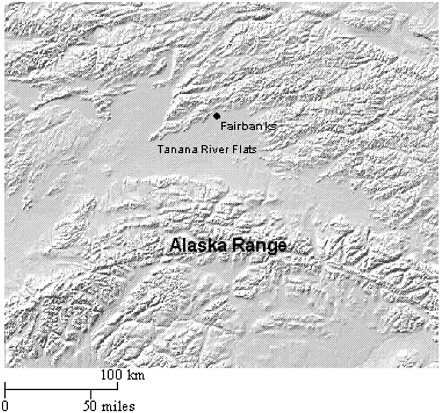
FIGURE 2–1 Map of topography in the Fairbanks area.
Ground-based inversions of considerable strength (typically a few degrees Celsius per 100m but sometimes much stronger) topped by weaker inversions reaching as high as about 1–2 km are normal in winter and can occur anytime during the year. A surface inversion due to net energy loss from the surface occurs in the few meters closest to the ground, although the weaker inversion topping it may be caused by subsidence or transport of warmer air aloft. The combination of high albedo (reflection of sunlight due to snow cover) and the low solar elevation (failure of the sun to rise high in the sky) characteristic of northern latitudes in winter creates little heating of the ground and weak vertical mixing between the surface and overlying air. With clear skies and low absolute water-vapor content, the ground loses considerably more energy by radiation to space than it is able to absorb from the sun. Those surface conditions may persist in Fairbanks for days, and the situation is exacerbated by the
insulation provided by high-albedo snow cover. Although such an inversion may weaken or even dissipate during the middle of the day, it tends to become reestablished or strengthened throughout the late afternoon and into the night. The upper part of the inversion appears to be associated with subsiding (downward) southeasterly flow crossing the Alaska Range. Although the lack of surface warming in winter is common, it now appears that recent exceedances occurred with the upper-level inversion also in place.
Observations in Fairbanks and Anchorage suggest that solar heating of the ground alone is insufficient to produce any substantial mixing layer with solar elevations less than 6° over bare ground or 12–15° over deep snow (Bowling 1985). As shown in Figure 2–2, solar elevations in winter are very low in Fairbanks, even at solar noon.2 Thus, solar heating seldom breaks the ground inversion from November to February, even without snow cover. Clear skies are much more likely in January through March than in November (Figure 2– 3); the low incoming solar heating may help to explain the greater frequency of exceedances during these months.
Inversion measurements (temperature as a function of height) provide an indication of the strength of a ground-level inversion. Ordinary sounding measurements are not sufficient to resolve strong inversions near the ground, although they do at times record inversion strengths larger than 10°C/100 m. In most areas, inversions of several degrees per 100 m would be considered strong. Three limited datasets support such high inversion strengths:
-
Traverse data of temperature differences between vehicle-mounted thermistors 0.5 m and 2 m above the ground showed inversions of about 1°C/1.5 m (67°C/100 m) in ice fog and as much as 3°C/1.5 m (200°C/100 m) in clear air (Bowling and Benson 1978). Background inversions in the first 2 m are obviously extremely strong, but nonlinearity in inversion strength makes it difficult to extrapolate this observation to higher altitudes. Such strong low-level ground inversions are unlikely to persist in the downtown area, because heat is normally added with CO in automobile exhaust plumes and mechanical turbulence associated with vehicles can cause further mixing.
-
Three tethered-balloon measurements in the downtown area during high-CO conditions indicated a “mixing layer” from the ground up to 6–30 m
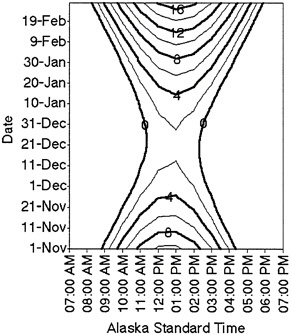
FIGURE 2–2 Solar elevation for Fairbanks in degrees as a function of time of day and day of year.
-
(Bowling 1986). Background measurements made outside the downtown area with the same tethered balloons showed ground-based inversions of 10–40°C/ 100 m.
-
Borough measurements of temperatures 3, 10, and 23 m above the ground are taken on a meteorological tower in the downtown area (Figure 2– 4). Inversion strengths of as much as about 30–40°C/100 m have been measured on the tower during episodes. For example, Figure 2–5 shows the inversion strengths measured on the tower during an exceedance of the CO standard in November 1999. The inversion, measured between 10 and 23 m altitude, averaged 21°C/100 m on November 19, 1999, with maximum hourly values of about 30°C/100 m.
Inversions of the strength observed in Fairbanks cause the buildup of CO in several ways, with stronger inversions associated with higher CO concentrations. First, such inversions strongly inhibit vertical mixing. Second, inversions inhibit momentum transfer, thereby preventing winds aloft from reach-

FIGURE 2–3 Fractions of clear (0–2 oktas [eighths of sky]), partly cloudy (3–6 oktas), and cloudy (7–8 oktas) by month, based on NOAA 1961–1990 averages.
ing the surface—a particular problem when warm air advected from the south across the Alaska Range does not reach the ground in Fairbanks. The surface winds that exist in Fairbanks during winter are probably controlled by gravity drainage from higher elevations to the north, often in a direction opposite to that of winds just a few hundred meters higher. These surface winds are difficult to characterize in the downtown area; 90% of the time, winter windspeeds are at or below the minimal starting speed (3 mph) of a standard anemometer. Finally, the combination of strong ground-level inversions with surface temperatures and winds that probably vary widely over horizontal distances of 0.1 km suggests that inversion strength (and probably mixing height) may be highly variable spatially (Holmgren et al. 1975).
February has been the month with the most exceedances over the last 5 y. In February, the reestablishment (or strengthening) of ground inversions occurs rapidly near 5:00 p.m., trapping pollutants emitted when sunset and maximal traffic occur near the same time (Bowling 1984, 1986). The reestablish-
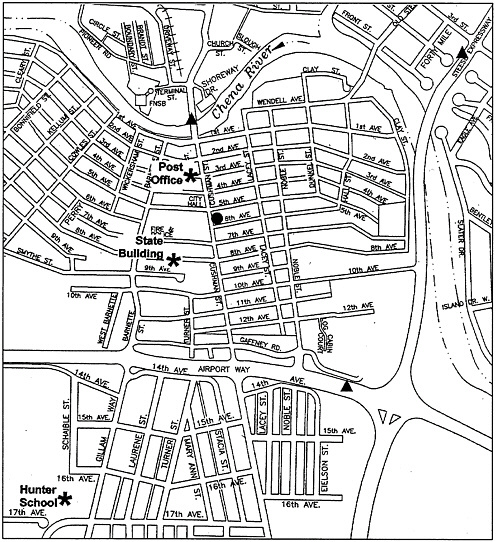
FIGURE 2–4 Map of downtown Fairbanks. Asterisks indicate CO monitoring sites; triangles indicate where vehicles are counted. The meteorological tower is indicated by a dot.
ment of the ground-level inversion in late afternoon and early evening is clearly visible in the inversion-strength measurements made from the meteorological tower in downtown Fairbanks (S.A.Bowling, Fairbanks Meteorology, in preparation, 2002).
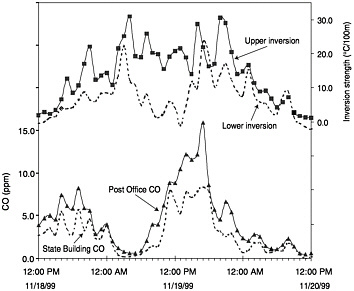
FIGURE 2–5 CO concentrations (ppm) and inversion strengths (degrees Celsius/100 m) measured during an exceedance of the CO standard on November 19, 1999. The inversion strengths were calculated from temperature measurements taken on the meteorological tower. The upper inversion was measured between 10m and 23 m altitude and the lower inversion was measured between 3 m and 10m.
Demographics
As pointed out earlier, Fairbanks is a small city to have such a severe air pollution problem. Its 2000 population of only 30,224 was spread over an area of 32.8 mi2. The entire Fairbanks North Star Borough had a population of 83,632 in an area of 7,361 mi2, growing from 77,720 in 1990. Over the last decade, the city population has been nearly constant, most of the growth being in the outlying parts of the borough.
The borough’s population can be greatly affected by large construction projects and government spending. For example, the construction of the Trans-Alaskan Oil Pipeline caused the borough’s population to rise from 45,864 in 1970 to 72,037 in 1976. After completion of the pipeline, the population fell to 51,659 in 1981. Spending of state oil revenue by local and state government helped the borough’s population rebound to 75,079 in 1985.
The economy of the borough depends heavily on federal, state, and local government sectors, which combine to account for 30% of jobs. Some 20%
of the borough’s population are military or military dependents. Retail trade and services account for 18% and 26%, respectively, reflecting the importance of Fairbanks as a tourist center and service center for most of the state north of the Alaska Range.
The population is relatively young. In 2000, the median age of the borough’s residents was 29.5 y, compared with 32.4 y in the state and 35.3 y in the United States as a whole. Only 9.5% of households had members 65 y old or older, compared with 11.9% in the state and 23.4% in the United States as a whole. Male residents made up 52.2% of the population in 2000, compared with 51.7% in the state and 49.1% in the United States (U.S. Census Bureau 2000).
Local transportation is largely by motor vehicle. Traffic counts show that vehicle-miles traveled (VMT) in the area increased from an estimated average of 665,398 mi/day (d) in 1990 to 752,992 mi/d in 2000 (ADEC 2001a). The VMT growth rate exceeds the growth in population of the borough, indicating that residents are driving more on a per capita basis, a trend observed throughout the United States. The average hourly traffic counts observed at three locations in Fairbanks (see Figure 2–4) are shown in Table 2–1 for the CO seasons of 1995–1996 through 2000–2001. Traffic has increased by 6–7% on the Steese Expressway, decreased by 3% on Airport Way, and remained fairly constant at Cushman Street and the Chena River in downtown Fairbanks. Increasing residential, commercial, and retail development outside the city of Fairbanks probably contributes to the increase in VMT and in traffic on the Steese Expressway; however, little additional data are available to confirm this hypothesis. Changing traffic patterns in the city will change the spatial distribution of emissions and ambient CO.
CO DATA
The borough has measured CO in downtown Fairbanks since 1972. The locations of the three monitoring sites currently in operation are shown in Figure 2–4. Although the sites were run year-round in the past, they are now operated only from October 1 through March 31 (ADEC 2001a). The measurements are made with commercially available monitors that have an uncertainty on the order of 0.1 ppm and a detection limit of around 0.1 ppm. Hourly average concentrations are recorded. The borough provided these hourly data to the committee for the CO seasons (November through
TABLE 2–1 Average Hourly Traffic Counts for Fairbanks, Alaska, During Winter Months
|
|
Airport Way |
Steese |
Expressway Cushman St. and Chena River |
|
Nov. 1995–Feb. 1996 |
644 |
758 |
557 |
|
Nov. 1996–Feb. 1997 |
641 |
747 |
558 |
|
Nov. 1997–Feb. 1998 |
648 |
778 |
568 |
|
Nov. 1998–Feb. 1999 |
636 |
779 |
536 |
|
Nov. 1999–Feb. 2000 |
615 |
786 |
539 |
|
Nov. 2000–Feb. 2001 |
626 |
814 |
575 |
|
% change 95–96 to 00–01 |
−2.75 |
7.31 |
3.16 |
|
% change 95–97 to 99–01a |
−3.35 |
6.27 |
−0.18 |
|
aReferring to the average of the last two seasons (Nov. 1999–Feb.2000 and Nov. 2000– Feb. 2001) compared with the first two seasons (Nov. 1995–Feb. 1996 and Nov. 1996– Feb. 1997), reducing the possible effect of one unusual year. |
|||
February) of 1995–1996 through 2000–2001. As described below, a detailed trend analysis of the running 8-h average concentrations computed from these data (a total of 47,980 data points) was conducted by the committee to illustrate statistical techniques for assessing progress in reducing CO concentrations.
Although the three monitoring sites satisfy EPA’s monitoring guidelines, they are located quite close together and therefore do not provide much information about the spatial distribution of CO concentrations across the borough. The following analysis of observations at these three sites is limited in that respect, and similar analyses should be conducted in the future with data that are more spatially representative. The Alaska Department of Environmental Conservation (ADEC) has conducted two saturation studies—during the winters of 1999–2000 and 2000–2001—to begin improving the characterization of CO on the regional scale (Guay 2001).
Exceedances in Fairbanks
As in most areas, the number of exceedances of the 8-h NAAQS for CO
in Fairbanks has decreased over the last 25 y (Figure 2–6).3 During the early years of regular CO monitoring in Fairbanks, there were more than 130 d with exceedances per year, distributed over all months. The numbers dropped rapidly until 1987–1988 after which they decreased more slowly. Exceedances since then have occurred entirely during the winter months of November through March. As of January 2002, there have been no exceedances since February 2000.
As shown in Figures 2–7 and 2–8, exceedances vary by day of the week and hour of the day. Figure 2–7 shows that substantially fewer exceedances occur on weekend days; this reflects the decreased use of vehicles on these days and possibly the timing of vehicle operations. Figure 2–8 shows the number of monitor hours4 with 1-h CO concentrations over 9 ppm for the six most recent exceedance days for each hour of the day. This figure shows that high CO concentrations have recently been most likely around 5:00–6:00 p.m. Five of the six most recent exceedance days have been in February. As described in the previous section, strong temperature inversions tend to occur around sundown when people are leaving work and starting their cars.
Temperatures on seven of the eight most recent exceedance days ranged from −4.2°F to 28.6°F. The potential importance of exceedances occurring in the “relative warmth” of about 0–20°F is that, at this temperature range, vehicles do not usually need to be plugged in to start easily. It is thought that the high emissions from cold starts of vehicles that had not been plugged in contributed to the exceedances.
CO exceedances in the borough are a function of location. Of the last six exceedances, four had the highest measured CO concentrations at the Post Office monitor (Courthouse Square), one at the Hunter School, and one at the State Office Building. Studies by the ADEC Air Monitoring Section, which deployed temporary monitors over a wider area, indicate that CO concentra-
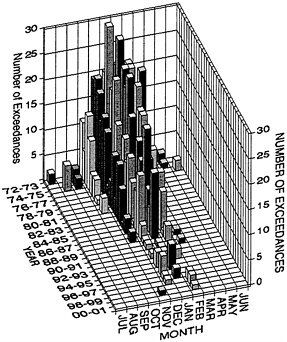
FIGURE 2–6 Number of days with exceedances of the 8-h CO standard per month per year.
tions vary widely throughout the borough in both horizontal and vertical dimensions. Variability in CO as a function of altitude may reflect heterogeneity in the mixing-layer height. However, it is not known how large the area of high CO is or generally how CO concentrations vary spatially in the nonattainment area.
|
BOX 2–1 Recommendations: Meteorological Conditions of Primary Concern Air quality management in Fairbanks should focus on the 0° to 20°F temperature range. Emissions inventories should be refined and verified and control programs evaluated for their effectiveness with emphasis on that temperature range. In addition, air quality modeling should be developed, conducted, and evaluated for the extreme conditions found in Fairbanks in winter. |
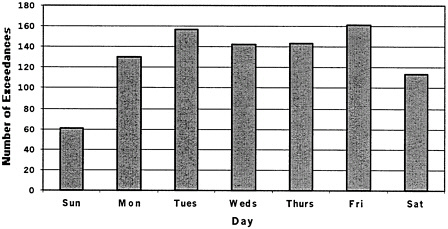
FIGURE 2–7 Number of borough exceedances of the 8-h NAAQS for CO for the period 1972–2001, by day of the week. Source: Data provided by Paul Rossow, Fairbanks North Star Borough.
Recent CO Trends
Concentrations of CO measured at the three monitoring stations in downtown Fairbanks during November through February (the CO season) in 1995– 1996 through 2000–2001 were analyzed by the committee.5 The results of the analyses are shown in Table 2–2. The first maximum, the second nonoverlapping maximum, and several percentiles (the 75th, 90th, 95th, and 99th) were examined as summary measures of the distribution of the running 8-h average CO concentrations observed each season. The percentiles were analyzed because they are more statistically robust benchmarks for measuring progress in reducing CO than are extreme values, like the second nonoverlapping maximum. Extreme values are usually highly variable, especially in the presence of extreme meteorological conditions such as those in Fairbanks. At the same time, an analysis of the central tendency statistics is also not appropriate, because for CO, like many other environmental
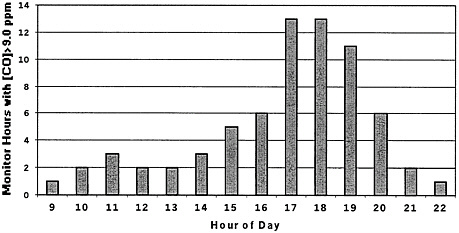
FIGURE 2–8 The number of monitor hours with CO concentrations >9.0 ppm during the most recent exceedance days of 2/23/98, 2/24/98, 2/11/99, 2/16/99, 11/19/99, and 2/8/00.
pollutants, our concern lies with trends in high concentrations and the conditions that produce them.
Across all three monitoring stations, the summary measures decrease over the 6-y period. For each summary measure and each monitoring station, the decreasing trend was summarized into an annual change rate, defined as the slope coefficient for the linear regression of the six values for the annual summary measure on time (see Table 2–2). Similar linear-regression equations were fitted for each of the six summary measures at each of the three monitoring stations (a total of 18 regression equations).6 Averaged across the three
TABLE 2–2 Trends in CO (in ppm) Measured November Through February at Fairbanks Monitoring Locations
|
Site |
Year |
75th Percentile |
90th Percentile |
95th Percentile |
99th Percentile |
Second Nonoverlapping Maximum |
First Maximum |
|
Hunter School |
1995–1996 |
2.68 |
4.16 |
5.08 |
7.29 |
8.84 |
11.56 |
|
Hunter School |
1996–1997 |
3.25 |
4.86 |
6.15 |
8.24 |
9.81 |
12.75 |
|
Hunter School |
1997–1998 |
2.68 |
4.30 |
5.41 |
7.45 |
10.01 |
10.44 |
|
Hunter School |
1998–1999 |
2.55 |
3.70 |
4.75 |
6.95 |
9.75 |
9.88 |
|
Hunter School |
1999–2000 |
1.94 |
2.99 |
3.93 |
5.79 |
6.76 |
8.60 |
|
Hunter School |
2000–2001 |
2.22 |
3.24 |
3.91 |
5.12 |
6.93 |
8.34 |
|
Annual change ratea |
−0.18 |
−0.31 |
−0.38 |
−0.53 |
−0.54 |
−0.83 |
|
|
T-test for annual change rate |
−2.31 |
−2.93 |
−2.73 |
−3.52 |
−1.87 |
−4.50 |
|
|
Post Office |
1995–1996 |
3.28 |
4.93 |
6.31 |
9.03 |
11.15 |
15.16 |
|
Post Office |
1996–1997 |
3.66 |
5.31 |
6.50 |
8.45 |
9.76 |
13.26 |
|
Post Office |
1997–1998 |
2.68 |
4.10 |
5.15 |
8.36 |
10.35 |
12.13 |
|
Post Office |
1998–1999 |
3.03 |
4.31 |
5.20 |
7.58 |
9.43 |
10.26 |
|
Post Office |
1999–2000 |
2.64 |
3.80 |
4.78 |
6.54 |
9.68 |
11.48 |
|
Post Office |
2000–2001 |
2.28 |
3.45 |
4.16 |
5.40 |
7.01 |
8.57 |
|
Annual change ratea |
−0.22 |
−0.33 |
−0.45 |
−0.70 |
−0.62 |
−1.15 |
|
|
T-test for annual change rate |
−2.94 |
−4.08 |
−5.65 |
−7.52 |
−3.08 |
−5.22 |
|
|
State Building |
1995–1996 |
2.59 |
3.93 |
4.90 |
7.81 |
9.23 |
13.09 |
|
Site |
Year |
75th Percentile |
90th Percentile |
95th Percentile |
99th Percentile |
Second Nonoverlapping Maximum |
First Maximum |
|
State Building |
1996–1997 |
3.16 |
4.55 |
5.71 |
7.60 |
9.14 |
12.20 |
|
State Building |
1997–1998 |
2.53 |
3.78 |
4.71 |
6.68 |
9.20 |
10.76 |
|
State Building |
1998–1999 |
2.40 |
3.58 |
4.25 |
6.58 |
7.36 |
9.09 |
|
State Building |
1999–2000 |
1.90 |
2.94 |
3.69 |
6.11 |
8.78 |
9.72 |
|
State Building |
2000–2001 |
2.03 |
2.99 |
3.69 |
4.91 |
6.34 |
8.14 |
|
Annual change ratea |
−0.19 |
−0.28 |
−0.36 |
−0.55 |
−0.50 |
−0.97 |
|
|
T-test for annual change rate |
−2.63 |
−3.28 |
−3.38 |
−7.48 |
−2.39 |
−6.73 |
|
|
aAnnual change rate is defined as the regression slope coefficient for rate of change in concentration. Note: CO observations are 8-h running averages of hourly average date. Approximately 2,880 data points are available at each site for each year. Source: Data provided by Paul Rossow, Fairbanks North Star Borough. |
|||||||
monitoring stations, the first maximum decreased by about 1 ppm each year; the second nonoverlapping maximum and the 99th percentile decreased by about 0.5 ppm each year; the 95th percentile, 90th percentile, and 75th percentiles decreased by about 0.4, 0.3, and 0.2 ppm, respectively, each year. The t-test statistics for the slope coefficients indicate that the decreases are statistically significant at the conventional 5% level for 17 of the 18 annual change rates.
As shown in Table 2–3, the ratio of the annual change rate to the value of the summary measure in 1995–1996 is about 7% for all the measures at all three sites. That implies that for the 75th percentile and higher, CO concentrations have been declining by about 7% each year in the Fairbanks nonattainment area over the period 1995–1996 to 2000–2001.
The analysis of the most recent 6 y shown in the current analysis only provides limited representativeness of the trends in CO concentrations in Fairbanks. Trends in ambient CO concentrations in Fairbanks have also been reported by EPA for 1986–1995 (EPA 2000a) and by ADEC for 1972–2000 (ADEC 2001a). EPA (2000a) noted a downward trend of the hourly average CO concentrations for 1986–1995, although the median and interquartile range of the daily maximum 8-h average concentration remained relatively unchanged for 1989–1995. ADEC (2001a) reported a strong downward trend in the number of exceedance days per year and in the highest and second highest CO concentrations observed. However, based on the committee’s independent examination of Figure III.C.3–3, it should be noted that the decline reported in ADEC (2001a) and confirmed in the preliminary analysis presented above is not uniform over time. Further analysis beyond the most recent 6 y is therefore warranted.
Air Quality Alerts
The borough has been broadcasting alerts since at least the winter of 1979– 1980 on days when analysts predict that there is a good chance that the CO 8-h average NAAQS of 9 ppm will be exceeded. Forecasts of air quality are made daily by the borough’s air quality specialist on the basis of observed CO concentrations, meteorological conditions, and expert judgment. Table 2–4 shows the results of forecasting during the winters of 1997–1998 through 2000–2001. Note that the 4 d with the highest observed 8-h average CO concentrations were called correctly. Rows in italics were days on which exceedances oc-
TABLE 2–3 Ratio of Annual Change Rate to Statistic for 1995–1996
|
Site |
75th Percentile |
90th Percentile |
95th Percentile |
99th Percentile |
Second Nonoverlapping Maximum |
First Maximum |
Overall Mean |
Overall Standard Deviation |
|
Hunter School |
−0.068 |
−0.074 |
−0.074 |
−0.073 |
−0.061 |
−0.072 |
−0.070 |
0.005 |
|
Post Office |
−0.067 |
−0.068 |
−0.072 |
−0.078 |
−0.056 |
−0.076 |
−0.069 |
0.008 |
|
State Building |
−0.074 |
−0.071 |
−0.073 |
−0.070 |
−0.054 |
−0.074 |
−0.069 |
0.008 |
|
Mean |
−0.070 |
−0.071 |
−0.073 |
−0.074 |
−0.057 |
−0.074 |
−0.070 |
|
|
Standard Deviation |
0.004 |
0.003 |
0.001 |
0.004 |
0.004 |
0.002 |
0.007 |
TABLE 2–4 Maximum 8-h Average CO (ppm) in Fairbanks for Exceedances and Alerts During the Winter Seasons of 1997–1998 through 2000–2001
|
|
Observed CO |
||||||
|
Winter |
Date |
Day |
Forecasted CO |
Observed CO |
Post Office |
State Building |
Hunter School |
|
97–98 |
19 Dec |
Friday |
11 |
12.1 |
12.1 |
10.8 |
10.0 |
|
97–98 |
20 Jan |
Tuesday |
9 |
7.3 |
7.2 |
6.5 |
7.3 |
|
97–98 |
21 Jan |
Wednesday |
9 |
2.5 |
2.5 |
1.9 |
2.4 |
|
97–98 |
4 Feb |
Wednesday |
9 |
8.1 |
8.1 |
6.0 |
7.7 |
|
97–98 |
5 Feb |
Thursday |
10 |
8.7 |
6.7 |
6.6 |
8.7 |
|
97–98 |
6 Feb |
Friday |
9 |
5.7 |
5.2 |
4.1 |
5.7 |
|
97–98 |
23 Feb |
Monday |
No Alert |
10.2 |
10.2 |
8.0 |
7.5 |
|
97–98 |
24 Feb |
Tuesday |
12 |
11.1 |
10.4 |
11.1a |
10.4 |
|
97–98 |
25 Feb |
Wednesday |
11 |
5.7 |
5.3 |
3.8 |
5.7 |
|
98–99 |
12 Jan |
Tuesday |
9 |
8.2 |
8.2 |
7.1 |
7.6 |
|
98–99 |
11 Feb |
Thursday |
No Alert |
9.8 |
9.4 |
7.4 |
9.8b |
|
98–99 |
16 Feb |
Tuesday |
No Alert |
10.3 |
10.3 |
9.1 |
9.9 |
|
99–00 |
19 Nov |
Friday |
9 |
11.2 |
11.2 |
7.3 |
5.8 |
|
99–00 |
5 Feb |
Saturday |
9 |
3.3 |
3.3 |
1.4 |
3.0 |
|
99–00 |
8 Feb |
Tuesday |
10 |
11.5 |
11.5 |
9.7 |
8.6 |
|
99–00 |
9 Feb |
Wednesday |
9 |
2.8 |
2.8 |
1.9 |
2.2 |
curred but for which there was no alert. During the four seasons, 16 alerts were called; four alerts were correct (an exceedance actually occurred), and 12 were called when no exceedance occurred. During the same period, three exceedances occurred that were not forecast.
Preliminary analysis suggests that such alerts have little effect on vehicle counts. But, they may make the public more aware of the CO problem. In addition to making air quality forecasts available to the media, the borough has recently put them online to make them accessible to the public through the internet.
Empirical Modeling
Further analysis has been conducted using the Fairbanks CO data to investigate the factors that affect CO concentrations. Empirical modeling attempts to discern statistically significant relationships between an outcome variable and various predictor variables. In particular, an empirical model was developed using the 1-h average CO concentration at the Hunter School monitoring site7 as the dependent variable and the following predictors: average hourly vehicle counts at three locations in Fairbanks and average hourly meteorological measurements made at a 75-ft tower in the downtown area. (See Figure 2–4 for locations of the CO monitors, traffic counters, and meteorological monitors.) The meteorological measurements included lower inversion strength (measured 3–10 m above the ground), upper inversion strength (measured 10–23 m above the ground), and windspeed, temperature, and atmospheric pressure (all measured 10m above the ground). All data were from the six winter seasons from November 1, 1995, to the end of February 2001—a total of 722 d (17,328 h). Only hours with complete data in all seven variables were included in the analysis; 5.8% were excluded because of incomplete data in one or more variables.
Most of the variables showed near-normal distributions, but the distribution of CO concentrations was right-skewed and followed a lognormal distribution approximately. Accordingly, the variable was transformed to log(CO
TABLE 2–6 Preliminary Multiple Linear-Regression Analysis for Log(CO+0.1) on Standardized Units
|
|
Coefficient |
Standard Errora |
P-valuea |
|
Traffic |
0.179 |
0.0025 |
<0.0001 |
|
Low inversion |
0.096 |
0.0036 |
<0.0001 |
|
High inversion |
0.077 |
0.0035 |
<0.0001 |
|
Windspeed |
−0.161 |
0.0025 |
<0.0001 |
|
Temperature |
−0.042 |
0.0026 |
<0.0001 |
|
Pressure |
0.010 |
0.0024 |
0.0001 |
|
aNot adjusted for autocorrelation; given for reference only. |
|||
+0.1).8Table 2–5 shows the correlation matrix for the seven variables. Log(CO+0.1) has the strongest correlation with windspeed (negative, as expected) and moderate correlations with inversion strengths and traffic (all positive, as expected); low and high inversion strengths are strongly and positively correlated with one another, as might be expected.
Table 2–6 shows the results of a preliminary multiple linear-regression analysis with standardized units.9 Traffic stands out as the most important (positive) predictor variable; windspeed (negative) is next, followed by the inversion strengths. The R2 for the model is 0.44. This preliminary regression analysis does not take into account autocorrelation among hourly CO concentrations; therefore the standard errors and p-values are invalid and given as references only. This preliminary analysis also does not address possible nonlinearity in the relationship between log(CO+0.1) and the predictor variables or possible interactions among the predictor variables. Furthermore, other variables not included in this analysis, such as wind direction, may also be important predictors.
TABLE 2–5 Correlation Matrix for Hunter School Log(CO+0.1), Traffic Count, and Meteorological Variables
|
|
Traffic |
Low Inversion |
High Inversion |
Windspeed |
Temperature |
Pressure |
log(CO+0.1) |
|
Traffic |
1.00 |
−0.27 |
−0.20 |
0.09 |
0.14 |
−0.01 |
0.29 |
|
Low inversion |
−0.27 |
1.00 |
0.74 |
−0.13 |
0.19 |
−0.10 |
0.29 |
|
High inversion |
−0.20 |
0.74 |
1.00 |
−0.16 |
0.13 |
−0.07 |
0.33 |
|
Windspeed |
0.09 |
−0.13 |
−0.16 |
1.00 |
0.25 |
−0.14 |
−0.45 |
|
Temperature |
0.14 |
0.19 |
0.13 |
0.25 |
1.00 |
−0.23 |
−0.08 |
|
Pressure |
−0.01 |
−0.10 |
−0.07 |
−0.14 |
−0.23 |
1.00 |
0.06 |
|
log(CO+0.1) |
0.29 |
0.29 |
0.33 |
−0.45 |
−0.08 |
0.06 |
1.00 |
|
Source: Data provided by Aaron Owens, DuPont Central Research. |
|||||||
|
BOX 2–2 Recommendations: Improving Ambient Monitoring in the Borough In the short term, the ambient-CO monitoring network in the borough should be expanded to measure concentrations over a wider area. In the longer term, vertical distributions of CO concentrations and the wind field should be characterized to support the development and application of modeling approaches better than those now available. |
EMISSIONS AND VEHICLE CHARACTERISTICS
CO Inventory and Forecasted Reductions
The most recent inventory of CO emissions in the borough was estimated by ADEC (ADEC 2001a; ADEC 2001b). A summary of the inventory for 1995 and 2001 is shown in Table 2–7. This inventory is for a typical winter day, because exceedances are more likely to occur then. ADEC (2001a) also provides emissions reduction estimates for various control strategies that the borough has implemented to come into attainment with the NAAQS for CO. A summary of estimated emissions reductions is shown in Table 2–8.
The onroad mobile source emissions inventory was developed with a hybrid approach. Because of the importance of cold-start emissions in the borough, onroad mobile source emissions are separated into initial-idle emissions (when the vehicle starts up and idles before traveling) and traveling emissions. Estimates of initial-idling emissions were based on emissions testing of vehicles during winter in Fairbanks. Later onroad emissions (traveling emissions) estimates were based on EPA’s Serious Area CO Model (Darlington and Kahlbaum 1998), which is a version of EPA’s Mobile Source Emissions Factor (MOBILE) model that accounts for cold-temperature emissions standards.10 The remainder of the CO emissions inventory (nonroad, area, and point sources) was developed with the emissions factors described
in EPA (1998a) and activity factors estimated locally, except for aircraft and related emissions, which were estimated with the Federal Aviation Administration Emissions and Dispersion Modeling System.
As shown in Table 2–7, onroad motor vehicles are estimated to have contributed about 69% (21.7 tons/d, or tpd) of total CO emissions in 1995. By 2001, these emissions are estimated to have declined by 7.3 tpd, to 14.4 tpd (62% of total CO emissions), even though VMT in Fairbanks continued to grow. The fraction of CO emissions attributed to onroad motor vehicles is higher in Fairbanks than in the national inventory (see Table 1–2) reflecting the large contribution of cold-start emissions in Fairbanks. Although cold-start, initial-idle, and traveling emissions are estimated to have decreased from 1995 to 2001, the fraction of onroad mobile-source emissions attributed to cold-start and initial-idle emissions has increased. In 1995, cold-start and initial-idle emissions were estimated to be 38% of total onroad emissions; by 2001 the estimate had increased to 45%.
Other emissions sources in Fairbanks include nonroad, area, and point sources. In 2001, nonroad sources are estimated to contribute about 16% (3.7 tpd) of total CO emissions. Area and point sources are estimated to contribute about 4% (0.9 tpd) and about 19% (4.3 tpd), respectively. Although other emissions sources (onroad, nonroad, and area sources) have generally decreased from 1995, point sources have increased by 5%. The contribution to enhanced surface CO concentrations from large point sources, particularly those that release emissions from tall stacks, is not well known. Surface inversion conditions can inhibit mixing of those emissions down to the surface, reducing the impact of nearby point sources. However, their contribution cannot be completely discounted because the surface inversion can break down, enabling rapid mixing with the surface, or the trapped pollution can be transported to the surrounding uplands.
Overall CO emissions in the borough were estimated to have declined by about 8.1 tpd from 1995 to 2001. As shown in Table 2–8, 90% of the reductions (7.3 tpd) came from onroad motor vehicles. The largest contributor to the reduction was fleet turnover, the replacing of older vehicles with new ones that have more stringent emissions standards. The next largest contributors to the reductions are the inspection and maintenance (I/M) program (both operation and enforcement) and expansion of the number of parking spaces equipped with electric outlets for plug-in units. Area-source emissions reductions also occurred as a result of reduced wood-burning. Reductions in nonroad mobile-source emissions are attributed to reduced aircraft emissions.
TABLE 2–7 CO Emissions Inventory for the Fairbanks North Star Borough Nonattainment Area
|
Source Category |
1995 Emissions (tons per day) |
2001 Emissions (tons per day) |
|
Onroad sources |
21.69 |
14.40 |
|
Cold-start and initial-idle emissions |
8.28 |
6.49 |
|
Traveling emissions |
13.41 |
7.91 |
|
Nonroad sources |
4.00 |
3.66 |
|
Airport ground support equipment |
2.36 |
1.91 |
|
Aircraft, excluding ground support equipment |
1.27 |
1.37 |
|
Snowmobiles |
0.27 |
0.28 |
|
Railroad operations (Locomotives) |
0.04 |
0.04 |
|
Forklifts |
0.02 |
0.03 |
|
Air compressors |
0.01 |
0.01 |
|
Area sources |
1.53 |
0.89 |
|
Residential wood burning |
1.29 |
0.67 |
|
Fuel oil |
0.16 |
0.13 |
|
Natural gas |
- |
0.01 |
|
Structural fires |
0.08 |
0.08 |
|
Point sources |
4.14 |
4.33 |
|
MAPCO (Williams) |
0.15 |
0.43 |
|
Fort Wainwright |
2.09 |
1.72 |
|
GVEA/North Pole |
0.02 |
0.02 |
|
University of Alaska (Fairbanks) |
0.51 |
0.52 |
|
Petro (Star) |
0.01 |
0.01 |
|
Fairbanks MUS (Aurora) |
1.37 |
1.63 |
|
Total |
31.36 |
23.29 |
|
Source: ADEC 2001a. |
||
Increased operations at the local electric utility and the refinery are the reason for increased point-source emissions. Using the statistical rollback approach described in Chapter 1, ADEC (2001a) concluded that the overall 26% decrease in emissions will be sufficient for attainment.
TABLE 2–8 Summary of Emissions Reductions in the Borough Over the 1995-to-2001 Time Period
|
Source Category |
Reduction (tons per day) |
% Change |
|
Onroad Mobile Sources |
|
|
|
Improved New Vehicle Emissions Standards (fleet turnover) |
5.73 |
|
|
I/M Program Enhancements |
1.26 |
|
|
I/M Increased Enforcement |
0.25 |
|
|
Expanded Plug-Ins |
0.05 |
|
|
Total Onroad Mobile Sources |
7.29 |
33.6% |
|
Area Sources |
0.64 |
41.8% |
|
Nonroad Mobile Sources |
0.34 |
8.5% |
|
Point Sources |
−0.19 |
−4.6% |
|
Total Reductions |
8.11 |
26% |
|
Source: ADEC 2001a. |
||
Vehicle-Fleet Characteristics
Characterizing the onroad fleet during design conditions is critical for estimating motor-vehicle emissions. Figure 2–9 shows CO emissions rates predicted by EPA’s MOBILE5b model for vehicle emissions in 2000 for the last 25 model years of automobiles and light-duty trucks using the default vehicle-fleet distribution. The higher emissions rates for earlier-model-year vehicles result from less stringent certification standards when the older vehicles entered the fleet and deterioration of their emissions-control systems over time. However, older vehicles tend to be relegated to being secondary vehicles and are driven less because they are generally less reliable than the other vehicles in the household. The greatest contribution to overall emissions in most urban areas tends to come from the middle-aged vehicles, which have high emissions rates, are in the fleet in large numbers, and are still driven extensively.
Local fleet composition affects emissions from the onroad fleet. The Fairbanks onroad-fleet composition during the winter months depends less on vehicle ownership than on vehicle use. About 8% of vehicles registered in the borough obtain seasonal waivers; that is, they are not operated between November 1 and March 31 and are exempted from the I/M program. Vehicles
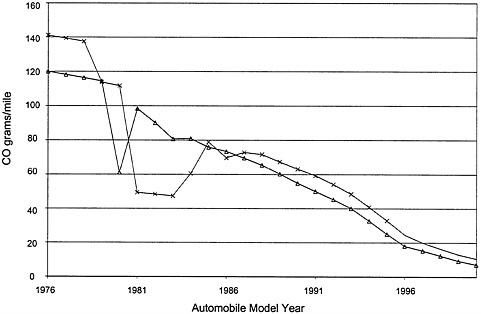
FIGURE 2–9 Predicted MOBILE5b CO basic emissions rates in 2000 (at 20 °F, average vehicle speed of 15 mph, national default fleet assumptions, and no I/M program). The counterintuitive dips in emissions rates, such as those for 1980-model-year automobiles, reflect internal model correction factors in MOBILE5b that apply differently to certain model-year technology groups.
operated in the borough during extremely low temperatures are typically newer and better-maintained than the average summer fleet.
In the winter of 2000, ADEC conducted a license-plate survey in downtown parking lots to ensure that only the vehicles normally used during the winter were included in emissions modeling for state implementation plan (SIP) development (ADEC 2001b). Large differences in model-year distributions can lead to much larger changes in emissions because of the nonlinear relationships involved. Given the importance of using accurate vehicle fleet compositions in modeling, ADEC should undertake a new round of winter fleet studies. The agency is encouraged to address the following in the experimental design to ensure that representative samples are obtained: land use at license-plate sampling locations (which is related to trip types), potential interactions between temperature and fleet composition, collection of supplemental onroad license-plate data, and potential inaccuracies in the vehicle-registration database.
CO CONTROL PROGRAMS
This section examines the motor-vehicle CO emissions-control programs that have been or may be implemented in the borough. In general, mobile-source emissions-reduction strategies can be categorized into new-vehicle certification programs, fleet-turnover incentives, in-use vehicle control strategies, and transportation control measures (TCMs) (Guensler 1998, 200011). Except for new-vehicle certification standards, which are discussed in Chapter 1, this section outlines various emissions-control strategies in each major control category that are applicable to the borough.
Fleet-Turnover Incentives
Strategies designed to increase vehicle-fleet turnover will increase the number of clean vehicles entering the fleet each year while retiring older, high-emitting vehicles. These include voluntary scrapping programs, in which an agency purchases and scraps high-emitting vehicles, and economic incentives, in which taxes and other fees are designed to encourage the ownership of newer vehicles over older ones. Fairbanks is already one step ahead of most urban areas because its flat registration fee applies to all vehicles. This policy could be enhanced by eliminating registration fees for the first few years of new-vehicle ownership or by adding a surcharge to fees for older, high-emitting vehicles.
In-Use Vehicle Controls
Clean-fuels programs and I/M programs are the mainstays of nationwide in-use vehicle controls. In Fairbanks, where cold engine starts contribute substantially to the regional nonattainment emissions inventory, cold-start controls in the form of engine preheating also provide valuable emissions reductions.
|
11 |
Guensler, R. 2000. TRANS/AQ 2000; Transportation and Air Quality; Courseware CD-ROM; Version 1.0; Georgia Institute of Technology; Atlanta, GA; August. http://transaq.ce.gatech.edu/ |
Fuels Control
Three major fuels-control programs have the potential to reduce CO emissions in the borough: increased fuel volatility, use of oxygenated fuels, and reduced fuel sulfur concentrations. Detergent additives also help to control emissions by keeping fuel injectors clean and keeping emissions-control systems functional.
Gasoline Volatility
Gasoline volatility is critical to cold starting. Higher fuel vapor pressures ensure adequate fuel vaporization during cold starting. However, when vapor pressures are too high, vapor lock can prevent liquid fuel from flowing to the fuel injectors. Volatility standards are designed to ensure that engines can start in cold weather while minimizing both the possibility of vapor lock and evaporative emissions from the fuel tank under normal operating conditions. During the winter months (middle of September to middle of May), refiners can produce gasoline with a maximal vapor pressure of 15 psi. Both refineries that supply Fairbanks report that their gasoline in winter has a vapor pressure of 14.5 psi (Boycott and Cherry 2001; Henderson 2001).
Oxygenated Fuels
Adding an oxygenate to the fuel increases the oxygen-to-fuel ratio in the combustion process, changing the combustion chemistry and decreasing emissions of CO formed during incomplete combustion. Colorado instituted the use of oxygenated fuels (oxyfuels) in 1988 to reduce winter CO concentrations. EPA later extended the oxyfuels program to other areas of the United States that were exceeding the NAAQS for CO (typically during winter). The federal oxyfuels program required that fuels contain an oxygenate—usually methyl tertiary-butyl ether (MTBE) or ethanol—with oxygen at 2.7% or more by weight. A 1997 study of the winter oxyfuels program initiated by the White House Office of Science and Technology Policy concluded that at temperatures above 50°F, CO emissions from most vehicles were reduced by about 3–6% per weight percent oxygen (NSTC 1997). Emissions reductions were generally smaller in newer-technology vehicles (those with closed-loop fuel control and three-way catalysts) and larger in high-emitting and older-
technology vehicles (those with permanent open-loop fuel control and two-way catalysts).
Oxyfuels with MTBE were introduced in Fairbanks in October 1992. Public complaints about the odor and potential health concerns led to a suspension of and then statewide ban on the use of MTBE in Alaska in December 1992. Fairbanks has been reluctant to reintroduce oxyfuels, such as gasoline containing 10% ethanol, despite the fact that an ethanol blend is required in Anchorage and provides the largest source of projected CO reductions there (ADEC 2001c).
Because extremely high emitters are less likely to operate in Fairbanks during winter (because of reduced reliability) and oxygenates provide little or no benefit for late-model vehicles under warmed-up running conditions, the reintroduction of oxyfuels may not provide a large emissions-reduction benefit for running exhaust emissions in Fairbanks. However, the use of oxyfuels may reduce CO emissions during cold starts in late-model vehicles when the O2-sensor is offline during the first several minutes of operation. There is a lack of information on the effectiveness of oxyfuels at temperatures below 50°F. EPA (Mulawa et al. 1997) tested three vehicles at 20, 0, and −20°F at its cold-weather facility using unleaded gasoline containing 10% ethanol (3.5% oxygen by weight). Two cars showed substantial improvement in CO emissions, and a third showed no emissions benefits. The Colorado Department of Public Health and Environment (Ragazzi and Nelson 1999) found an average 11% decrease in CO emissions from switching to 10% ethanol blended fuels in 24 vehicles that it tested at 35°F. Although theory suggests that oxygenated fuels should provide emissions benefits under extreme cold-start conditions, available data are not sufficient to support or refute the argument. Before an oxygenate, such as ethanol, is required in Fairbanks gasoline during the critical mid-winter months, more research on its effectiveness at low temperatures should be conducted. However, such studies are warranted and should be conducted in the near term.
|
BOX 2–3 Recommendations: Oxygenated Fuels Alaska, EPA, and others should conduct additional research and vehicle testing to assess the effectiveness of ethanol in gasoline for decreasing CO and air-toxics emissions during cold starts and operation at ambient temperatures below 20°F. If such research indicates that substantial benefits can be achieved, ethanol blending should be considered for Fairbanks. |
Sulfur Content
A key finding of the Auto-Oil Project (Benson et al. 1991) was that fuel sulfur increases exhaust emissions. Sulfur in gasoline is known to affect the efficiency of vehicle emissions-control systems adversely by poisoning the catalyst, thus decreasing pollutant conversion efficiency and potentially lengthening the time needed after vehicle ignition for the catalyst to become effective. The 1991 Auto-Oil study concluded that reducing sulfur concentrations from 450 to 50 ppm would result in a 13% decrease in CO exhaust emissions in 1990 Tier 0 technology vehicles. In addition, low-sulfur fuel is expected to reduce emissions of hydrocarbons (HC), nitrogen oxides (NOx), hydrogen sulfide, sulfur dioxide, and sulfuric acid aerosols, as well as lengthen lubricant and engine life. Reversing the effects of sulfur on catalytic performance requires fuel-rich conditions and aggressive accelerations that achieve high catalyst temperatures (about 1,200°F). However, sulfur’s effects are not easily reversed on the newer-model lower-emissions vehicles (Truex 1999). To guard against the poisoning effects of sulfur, it is best to operate these newer-model vehicles on low-sulfur fuel only. On the basis of concerns about the increased sensitivity of the newer-technology vehicles to sulfur poisoning, EPA published new fuel standards requiring refiners to meet an average sulfur concentration of 30 ppm beginning January 1, 2006 (EPA 2000c). Additional studies are needed on the effect of high-sulfur gasoline on catalyst efficiency and light-off time (the time it takes the catalyst to reach peak efficiency after starts) in cold climates.
Gasoline available in Fairbanks comes from the Tesoro and Williams refineries. Tesoro’s average fuel sulfur concentration is less than 1 ppm (although a particular batch may have up to 5 or 10 ppm because of batch-to-batch variations), and Williams’s average fuel sulfur is around 200 ppm. Immediately requiring the use of low-sulfur gasoline during winter months in Fairbanks is likely to reduce CO emissions. Reduction of gasoline sulfur on a year-round basis would be even more effective. However, adequate safeguards are needed to ensure that gasoline prices in Fairbanks do not increase substantially and that other areas of the state are not negatively effected. Introduction of lower-sulfur gasoline could be facilitated through accelerated approval of refinery-construction permits or through a state-brokered gasoline-exchange program. Policy and economic analyses should be conducted in consultation with the two local refiners to determine the best approach.
|
BOX 2–4 Recommendations: Fuel Sulfur Content The borough should consider requiring the sale of low-sulfur gasoline as soon as possible. Introduction of low-sulfur gasoline could be facilitated through accelerated approval of refinery construction permits and through a state-brokered gasoline-exchange program. Policy and economic analyses, in consultation with the two local refiners, are needed to determine the best approach to ensure that this mandate will not substantially increase the cost of gasoline to Fairbanks residents or compromise the air quality in other parts of the state. A public-awareness campaign to explain the benefits of low-sulfur fuels is needed, and the sulfur content of fuels should be posted at gasoline stations. |
I/M Programs
Inspection and maintenance (I/M) programs have been instituted in many jurisdictions to ensure that emissions-control equipment operates efficiently throughout the life of a vehicle. The programs attempt to identify vehicles that have higher emissions than allowable and to ensure that such vehicles are repaired or removed from the fleet. Inspection typically involves regularly scheduled exhaust tests that measure emissions of CO, HC, and sometimes NOx. I/M tests may also include visual inspection of the components that control evaporative and exhaust emissions and a functional gas-cap test.
The borough implemented an I/M program in 1985 to reduce motor-vehicle CO emissions. The program includes exhaust, visual, and functional tests of model-year 1975 and newer vehicles. The borough operates a test-and-repair program in which tests are performed at service stations that can also do repairs. Exhaust emissions are evaluated with a two-speed idle test. Vehicles less than 2 y old and vehicles that are not driven during the winter (from November 1 to March 31) are exempted from the I/M test. Vehicle registration along with windshield stickers are used to distinguish between vehicles driven in winter, which are subjected to the I/M test, and vehicles that are not. Until 1997, annual I/M tests were required; in 1997, Alaska passed a law changing testing to every 2 y.
As of July 1, 2001, model-year 1996 and newer vehicles must pass a test of their onboard diagnostics (OBDII) system in addition to the standard tail-
pipe test. If the test is operating properly, OBDII inspections will fail vehicles if the emissions-control components are or have been malfunctioning or if the sensors monitoring emissions-control components are malfunctioning. In Fairbanks, OBDII testing programs can aid in identifying problems that occur under a variety of operating conditions, not only when a vehicle is being idle-tested. NRC (2001) contains a discussion of major issues associated with OBDII I/M programs.
The I/M program is a critical element of the borough’s efforts to control CO. The SIP submitted by Alaska specifies that the largest reductions in CO emissions from local initiatives in Fairbanks will be from improved vehicle testing and increased enforcement of the I/M program. The borough estimates that the I/M program is effective in reducing vehicle CO emissions; the program is expected to reduce fleet-average CO emissions rates by 15.1% compared with the modeled emissions without an I/M program. That reduction is almost three times the 5.4% reduction estimated for the federal I/M performance standard for a similar program (ADEC 2001a). However, the move from annual to biennial testing probably has decreased the overall effectiveness of the program; failure rates went from 10% in the annual program to 14% in the biennial program (Lyons 2001). The committee found no evidence that the benefits of the I/M programs had been evaluated with respect to in-use vehicle emissions.
Methods and Data for Evaluating the I/M Program
The borough would benefit from continuing evaluation of its I/M program. The evaluation should include study of the overall emissions benefits of the I/M program using in-use vehicle emissions data, the level of program noncompliance, the types and effectiveness of emissions-related vehicle repairs, and the adequacy of current types of testing for identifying high-emitting vehicles. Various data could be used to estimate vehicle emissions, repairs, and noncompliance, including I/M-program data, remote-sensing data, and data collected through special emissions studies. EPA has described several methods for using this information to estimate effects of I/M programs in emissions (Sierra Research 1997; EPA 1998b, 2001d, 2001e). Many of the issues associated with I/M evaluations are discussed in a recent NRC report (NRC 2001) and in evaluations completed by state and independent researchers (CARB 2000; IMRC 2000; Stedman et al. 1997; Wenzel 1999). The NRC report concluded that each method and data source for evaluating I/M pro-
grams had its own inherent advantages and disadvantages. The report further concluded that a thorough understanding of all potential effects of I/M on vehicle emissions would come only through the use of multiple data sources and evaluation methods.
The committee believes that ongoing evaluation of the I/M program will help identify ways to improve it. For example, Sierra Research (1999) indicated that 1984 and older gasoline-powered cars and trucks accounted for only 8.2% of the total vehicle-miles traveled but for 20.7% of the CO emitted from the light-duty gasoline fleet. An evaluation of its program could help the borough to determine whether modified or additional I/M programs should be adopted to ensure compliance and reduce emissions from older vehicles. The evaluation also might indicate that mandatory replacement of O2 sensors in older fuel-injected vehicles or inspection of pre-1975-model-year vehicles could provide significant benefits.
Remote sensing is one possible method of collecting emissions data to evaluate the I/M program. It is used to measure emissions from individual vehicles as they drive by a roadside sensor. Other advances that have facilitated the collection and interpretation of remote-sensing measurements include pattern-recognition software to read vehicle license plates automatically and sensors to measure speeds and accelerations of passing vehicles. Because extreme cold can affect system performance, remote-sensing systems are typically not deployed in the winter. However, remote sensing is currently deployed year-round as a method for screening low-emitting vehicles from scheduled I/M tests in Greeley, Colorado (Klausmeier and McClintock 1998) and has been deployed in Yellowstone National Park (Bishop et al. 1999) in the winter to measure emissions from snowmobiles. An alternative approach may be to deploy the remote-sensing system solely to read vehicle license plates automatically and produce an improved breakdown of vehicle types and model years being operated in high CO areas.
Remote-sensing data can be used to evaluate an I/M program by using the license-plate data collected at the same time as emissions are being measured, and existing registration and I/M records. With this information, how quickly repair effectiveness diminishes, how much repair takes place before the I/M test, and the number and emissions of vehicles that avoid testing can be estimated. EPA (2001d) has issued draft guidance on the use of remote sensing for evaluating I/M programs. However, implementing remote sensing for I/M-program evaluation or testing requires careful attention to issues associated with site selection, quality control, and vehicle operating conditions and engine load. Those issues are discussed in NRC (2001).
|
BOX 2–5 Recommendations: I/M Programs in the Fairbanks North Star Borough Frequency and Exemptions The borough should consider resuming annual inspections. The committee is aware that this may require state legislation. The borough should also expand the coverage of its I/M program to include 1968–1974 model-year vehicles. The current new-car testing exemption is reasonable; it may also be cost-effective, starting with the 2000 model year, to expand the exemption to cover the four most recent model years. Improvements in Emissions Testing The borough should comprehensively assess emissions-testing methods to determine appropriate inspection procedures for various vehicle technologies. This assessment should consider the use of annual two-speed idle tests for pre-1982 vehicles and biennial testing under driving load conditions for 1982–1996 vehicles. The assessment should also consider the issues associated with using OBD testing in cold climates. Because of the frequency of O2-sensor failure, the borough should also evaluate the potential emissions-reduction effectiveness of a mandatory O2-sensor replacement program for older, high-mileage vehicles and implement such a program if it is found to be effective. Remote Sensing Use of remote-sensing capabilities should be considered for the borough’s I/M program, as temperatures and atmospheric conditions permit, to help to characterize emissions of the vehicle fleet. A continuing remote-sensing program should be considered to evaluate the potential effectiveness of the I/M program, as is done in other regions. The borough could also consider using remote sensing to identify vehicles that must be tested or other vehicles that could be given an exemption. |
|
Ongoing Evaluation of I/M The borough should evaluate the I/M program more rigorously to estimate its emissions-reduction benefits and to identify where improvements to the program are needed. The evaluation should allow the direct comparison of the emissions reductions achieved by the program with those estimated in the borough’s attainment plan. It should also look for methods to improve the effectiveness of I/M. |
Cold-Start Controls
Emissions tests conducted in Fairbanks indicate that cold-start and onroad CO emissions can increase by an order of magnitude when ambient temperature goes from 75°F to −20°F (Sierra Research 1996). The increase reflects the effects of ambient temperature on the duration of fuel-rich conditions during cold starting before closed-loop fuel metering occurs and a substantial delay in reaching catalyst light-off temperature. As described earlier, a large component of vehicle emissions during winter is attributed to cold-start operations. Therefore, effective local in-use vehicle control strategies can focus on reducing the number of winter engine cold starts or the length of time it takes for vehicles to warm up. The borough has provided free bus service during the winter to reduce the number of cold starts and has focused extensive efforts on plug-in cold-start controls to reduce the time it takes vehicles to warm up.
Plug-In Strategies
Starting and operating a car or truck in very cold climates has long been a challenge. Electric heating of the engine before starting is a part of everyday life during the winter in Fairbanks. Without preheating, some vehicles will not start under the most extreme cold conditions. Vehicles that operate in the winter in Fairbanks need to have one or more electric heating devices (plug-
ins) installed. Residents plug the devices into electric outlets at home, at work, and in other places. The most popular device is a 600-watt electric resistance heater submerged in the engine coolant. On larger engines, a second coolant heater may be used. Electric heating pads are also glued to the underside of the oil pan to help keep the lubricant warm. The battery is sometimes wrapped in an electric heating blanket to improve cold-cranking performance. Winterizing a vehicle with two 600-watt block heaters and an oil-pan heating pad is estimated to cost several hundred dollars, including parts and labor. Indeed, winterizing is considered part of the cost associated with owning a car in a cold climate.
Engine preheating substantially reduces CO and HC emissions during cold start and engine warmup. In a study that estimated cumulative CO emissions from six vehicles in a cold start plus 15 min of idling, the ADEC (2001b) reports a 70% reduction in CO emissions after plugging in the vehicles for 4–8 h. Vehicle preheating provides side benefits, such as lower engine wear, quicker passenger-compartment heating, and windshield defrosting. For the temperatures when CO violations are most likely (0–20°F), preheating is not required to start the engine, and most plug-in and extended idling activity is probably undertaken for personal comfort. Therefore, the borough has encouraged people to plug in even when the temperature is as high as 20°F.
The challenges to plug-in programs are twofold: making sure that active electric outlets are available wherever vehicles are parked for any length of time and getting people to use the plug-ins even when it is warm enough (0– 20°F) for vehicles to start without preheating. Many businesses, schools, and government offices provide electric plug-in outlets in their parking lots, but others do not. The borough actively requires employers and government buildings to provide more parking spaces with plug-in receptacles and the necessary electric power. A recent ordinance implemented by the borough requires employers and businesses with more than 274 parking spaces with outlets to provide power when the ambient temperature is less than 21°F (Ordinance No. 2001–17). Although seen as a convenience by motorists to reduce the need for extended idling of unoccupied parked cars, the program is intended to reduce engine-start emissions. Additional studies on individual responses in terms of the frequency and duration of plug-in use would help the borough to determine the effectiveness of the current strategies and to determine whether plugging in should be mandatory and integrated into parking regulations with appropriate enforcement.
Many uncertainties are associated with the use of plug-ins to reduce cold-start emissions. Relationships among engine size, heater power, and heating
time required to reduce cold-start emissions substantially are not well understood. The time for engine idle between cold starting and driving off may also be an important factor in total CO emissions during a vehicle trip. Moderate idling times will increase idle emissions but may reduce drive-off emissions, resulting in a net decrease in emissions for the entire trip. Sparse data suggest that 5 min of idle after an engine cold start under very cold conditions may be near the optimum for reducing total CO emissions for a trip, but this optimum time varies among vehicles depending on the emissions-control system (Sierra Research 1999). In addition, some vehicle models equipped with an air pump may automatically divert air from the catalyst to protect the catalytic material from overheating and damage during extended engine idling. That can increase idle rates of CO emissions substantially (Sierra Research 2000). Additional study with instrumented vehicles at low temperatures (−20°F to 20°F) would help to determine the potential effects of extended vehicle idling on emissions.
After-Market Retrofits
Retrofits to existing emissions-control systems to reduce cold-start CO emissions are also possible. Catalytic converters can be preheated to reduce light-off time, thereby reducing cold-start emissions. Electrically heating the catalyst just before engine starting has shown promising reductions in HC and CO. The greatest effect was realized when supplemental air was also injected into the catalyst inlet during open-loop operation (Heimrich 1990; Heimrich et al. 1991); however, no studies have been conducted on how this strategy might be practically implemented as an after-market control measure. Advances in that technology have reduced the substantial electric power demand for catalyst heaters, but it remains doubtful that in-fleet vehicle batteries can both heat the catalyst and then start the engine at low temperatures. Researchers could explore the value of a separate plug-in system for the catalyst. Another potential retrofit would be the addition of air into the exhaust manifold (upstream of the catalytic converter) during fuel-rich open-loop operation, although the introduction of air at temperatures below about 0°F may lengthen the time needed for full catalyst warmup. The required modifications to the exhaust, electric, and other emissions-control components needed for retrofit options may be extensive and more suitable for the original equipment manufacturer.
|
BOX 2–6 Recommendations: Vehicle Plug-ins The borough should continue to expand the plug-in program by requiring or encouraging the equipping of more parking spaces with electric outlets for plug-ins. Efforts to increase the use of plug-ins at 0–20°F are especially warranted. Public-education campaigns should continue. Adoption and enforcement of engine-preheating regulations on days expected to have high ambient CO concentrations should be considered. However, further analyses could determine the factors that motivate the voluntary use of plug-ins and the incentives that will expand their use. Additional effort should be directed toward understanding the relationships among engine size, heater power, and the heating time required to substantially reduce cold-start emissions. |
Transportation Control Measures
Transportation control measures (TCMs) are actions designed to change travel demand or vehicle operating characteristics to reduce motor-vehicle emissions, energy consumption, and traffic congestion. TCMs include transportation-demand management (TDM) strategies and transportation-supply improvement (TSI) strategies. TDM strategies attempt to reduce the frequency or length or shift the timing of automobile trips by changing driver behavior via regulatory mandates, economic incentives, and education campaigns. In contrast, TSI strategies attempt to reduce emissions by changing the physical infrastructure of the road system to improve traffic flow and reduce stop and go movements. Table 2–9 describes TCMs that have been applied in urban areas nationwide (EPA 2001f) and notes whether they have been implemented in Fairbanks.
The Alaska Department of Transportation and Public Facilities, in conjunction with the borough, has implemented a few TCMs, including a package of highway and intersection improvements to reduce traffic delays, a public-education campaign to encourage the use of plug-ins, and a program to promote mass-transit use by making buses free during the winter. Only small CO emissions reductions are attributed to the programs in the SIP (ADEC 2001a). Additional improvements in the road system, a coordinated mass-transit program, and the purchase of new buses are listed as contingency
TABLE 2–9 Transportation Control Measures (TCMs)
|
TCM Description |
Applicability to Fairbanks |
|
Improved public transit |
|
|
Incentives for single occupancy vehicle commuters to use convenient and reasonably priced mass transit alternatives. The three major ways of increasing ridership on public transit are (1) system/service expansion, (2) system/service operational improvements, and (3) inducements to increase ridership. |
· Public bus system since 1977. · Free bus rides during winter CO season (11/1 to 3/31) started in 2000. Extensive campaign informing residents about free rides and encouraging them to try transit. · Coordinated transit program and new buses considered in SIP. |
|
Traffic flow improvements |
|
|
Strategies that enhance the efficiency of a roadway system, without adding capacity, including traffic signalization, traffic operations, and enforcement and management. |
· Highway and intersection improvements to reduce traffic delays implemented since 1996. · Other roadway improvements considered in SIP. |
|
High-occupancy vehicle (HOV) lanes |
|
|
Roadways dedicated for HOV use. |
· Not adopted. |
|
Intelligent transportation systems |
|
|
Traffic detection and monitoring, communications, and control systems. Examples include traffic signal control, freeway and transit management, and electronic toll collection systems. |
· Not adopted. |
|
Bicycle and pedestrian programs |
|
|
Includes sidewalks, bicycle lanes, and bicycle racks. |
· Available along major roads but not used much during CO season. |
|
Commute alternative incentives |
|
|
Incentives, usually employer based, to encourage commuters to carpool or use transit services. |
· Not adopted. |
|
Telecommuting |
|
|
Working at home using electronic communication instead of physically traveling to a distant work site. |
· Not adopted. · Could be considered for alert days. |
|
Guaranteed ride home programs |
|
|
Ensures transportation (e.g. taxi or transit passes) for carpooling employees in the case of an unforeseen circumstance. |
· Not adopted. |
|
TCM Description |
Applicability to Fairbanks |
|
Work schedule changes |
|
|
Adjusting hours worked to control peak emissions: Examples include staggered hours, flextime, and a compressed work week. |
· Not adopted. · Could be considered for alert days. |
|
Trip reduction ordinances (Regulatory mandates) |
|
|
Regulations that attempt to adjust personal travel decisions through employer-based incentive/disincentive programs. |
· Not adopted. · Could be considered for very large employers. |
|
Congestion pricing |
|
|
Financial disincentives to driving on highly-used roadways, or priced alternatives to a congested roadway. |
· Not adopted. |
|
Parking pricing |
|
|
Programs that encourage single-occupant vehicle users to switch to other means of travel by imposing fees for parking, or that encourage shifting times for vehicle starts away from peak CO periods. |
· Not adopted. · Could be considered to shift cold starts away from peak CO times. |
|
Parking management |
|
|
Allocation of parking spaces intended to encourage single-occupant vehicle users to use other means of travel. |
· Not adopted. |
|
Source: EPA 2001f. |
|
measures if the borough exceeds the CO standard (ADEC 2001a). It is unlikely, however, that the borough could achieve significant additional reductions in CO emissions through those measures. Most of the other TCMs recommended by EPA (Table 2–9) are probably not appropriate for Fairbanks, given the low levels of congestion, low density of development, and severe winter weather conditions. Some of the demand-management and supply-improvement strategies that may be applicable to Fairbanks are discussed below.
Transportation-Demand Management
Demand-management measures include no-drive days, employer-based trip-reduction programs, parking management, park-and-ride programs, work-
schedule changes, mass-transit fare subsidies, and public-awareness programs. Such strategies can be categorized into trip-reduction mandates, market incentives, voluntary programs, and education-exhortation campaigns (Guensler 1989). In general, trip-reduction mandates have not proved effective in the United States at reducing vehicle-miles traveled (Guensler 1998). However, such mandates may be effective for very large employers, such as universities and major government centers.
Market incentives, or strategies that attempt to influence travel decisions by adjusting the prices of travel modes, have been applied in Fairbanks to encourage bus ridership. The borough established a public-transit system, the Metropolitan Area Commuter System, in 1977. According to the borough Transportation Department, ridership has varied from 550,000 per year during the 1980s to fewer than 200,000 riders per year in 1988, when several important routes were eliminated because of budgetary constraints. Ridership increased to about 230,000 riders per year after two new routes were added in 1996. In 2000, the borough received federal Congestion Mitigation and Air Quality funds to begin implementing a free-ride program during the winter season (November 1-March 31). This program included an extensive public-information campaign to inform residents about the free rides and to encourage them to try public transit. Ridership increased by 72% while the free-ride program was in effect, though this was estimated by ADEC (2001 a) to provide a rather small 0.05-tpd reduction in CO emissions. Aside from these numbers on past ridership, the borough has not conducted studies of transit needs in Fairbanks. Such a study would help identify whether expanding the service could result in significant emissions reductions.
Recent studies indicate that one of the most cost-effective TCMs is associated with parking-price programs (see, for example, Guensler [1998] for additional details). A possible application in Fairbanks is the implementation of graduated parking pricing in a downtown parking garage that is under construction. Under such a program, the price for parking could be used to provide incentives for reducing or eliminating vehicle starts during late afternoon hours (when observed CO concentrations are highest). For example, parking would be less expensive (or free) for those not leaving the lot between 4 and 7 p.m. Research on effects on travel behavior would need to be performed to make sure that not everyone tries to leave at 3:59 p.m. or chooses to use other parking facilities. This strategy would clearly have a greater effect if expanded to other parking facilities and made part of an alert-day strategy.
Another set of TCMs that needs further exploration in Fairbanks includes telecommuting and teleservices. Many jobs are conducive to telecommuting (for example, working from home rather than commuting to the office) at least
1 d per week. Many state and local governments have worked with employers to establish telecommuting programs for their employees. Teleservices, the provision of government or business services over the phone or the Internet, might also be encouraged and expanded. Recent statistics on computer and Internet access in Alaska support the feasibility of such programs. In 2000, almost 65% of households in Alaska had computers, and over 55% had Internet access (U.S. Department of Commerce 2000). Participants in such programs realize many benefits, including reductions in gasoline use, in vehicle wear, in time, and in hassles of cold-weather driving.
Some TDM measures might provide short-term emissions reductions for Fairbanks if implemented through an expanded alert-day program when conditions are likely to create CO exceedances. Although CO alert-day programs would not have a large effect on average annual CO emissions, they might have enough effect to help to avert an exceedance. For example, on alert days, employees could be encouraged to leave work earlier or later, shifting vehicle emissions away from the period when maximum concentrations are most likely. On the same days, the borough might encourage residents to put off trips in the nonattainment area for services or shopping. The EPA’s Transportation Air Quality Center provides a database of previously implemented programs of this sort and ways to evaluate their effectiveness (EPA 2002).
The success of alert-day programs depends on two factors. First, the borough must be able to identify conditions that are conducive to CO exceedances with a reasonable degree of accuracy. As discussed earlier and shown in Table 2–4, data from the borough show that over a 3-y period staff predicted four exceedances that occurred, did not predict three that occurred, and predicted 12 that did not occur. Exceedances, however, need not be perfectly predicted. The absence of an exceedance on an alert day could be due to the emissions-reduction efforts on the part of the community rather than to a forecasting failure. Second, local employers need to cooperate in the alert-day programs, allowing their workers to stay late or telecommute, for example. If voluntary participation falls short of the required levels, the borough could consider adopting modified trip-reduction or mandatory plug-in ordinances.
Transportation-Supply Improvement
Transportation-supply improvement (TSI) strategies attempt to reduce emissions by improving traffic flow, usually by increasing the effective capacity of the existing roadway system. Because CO emissions from vehicles are
higher under hard acceleration conditions, improvements in traffic flow can help to reduce them. Given the low levels of congestion and large excess transportation capacity in Fairbanks, most TSI strategies implemented in other urban areas would not help to reduce CO emissions in Fairbanks. Since 1996, Fairbanks transportation planners have completed 11 highway-improvement projects in the nonattainment area, including several intersection improvements. ADEC estimates that these projects increased average speeds in the nonattainment area by about 0.2 mph. Although the modeling results show only a slight increase in average speeds, intersection projects have the potential to reduce CO emissions substantially by improving traffic flow and reducing the idling and acceleration associated with intersection delays (Hallmark et al. 2001). Signal timing improvement should be a priority for implementation in downtown Fairbanks and should optimize emissions reductions rather than focusing solely on total delay.
|
BOX 2–7 Recommendations: Traffic Flow and Motorist-Directed Control Strategies The borough should explore parking pricing, telecommuting, and teleservices strategies. The borough should evaluate the effectiveness of its “alert-day” program and consider enhancing it. In addition, a travel-demand study, including a winter diary and a transit-ridership survey, should be undertaken to provide a basis for evaluating the potential effectiveness of proposed TCMs. |
Public Education and Surveys
Education and exhortation programs can increase the success of control strategies, especially voluntary ones, which depend on consumer behavior. The borough has adopted some control strategies in which consumer participation is voluntary. Public-education efforts were initially aimed at increasing awareness about the CO problem and how the use of plug-ins and mass-transit may help to alleviate the problem. Paid television and radio announcements were aired during heavy viewing or listening times. Later messages explained the increased enforcement activities associated with the I/M program and the possible adverse consequences for the borough of not reaching compliance with the CO standards (ADEC 2001a). The health effects associated with
exposure to CO were not addressed in these public-education campaigns. The committee is concerned that the public-education campaign has not sufficiently emphasized the health concerns associated with high CO exposure and has thus reinforced to residents the notion that the federal standards are arbitrary.
Surveys are an important tool for assessing the effectiveness of public-education activities and identifying avenues for improved efforts. The borough conducted a survey in November 2000 that indicated that its public-education activities may have been successful (ADEC 2001a). The use of public transportation has increased, and the awareness of plugging in at temperatures above 0°F seems to have increased. However, 86% of people polled listed improved vehicle starting as one of the major reasons for plugging in and only 54–56% listed improved air quality and public health as a major reason. Education and marketing have played important roles and will probably continue to do so in the borough’s efforts to attain the NAAQS for CO. Given the large potential outlays of money in public-education campaigns, the committee recommends that studies be undertaken to assess their effectiveness.
|
BOX 2–8 Recommendations: Public Education Public-education programs should be continued and expanded to increase public awareness of the potential health effects of high ambient CO concentrations and to increase public participation in efforts to improve air quality. Surveys of public opinion should be used in designing the programs and assessing their effectiveness. |
Methods and Data to Quantify Control-Strategy Effects
Evaluation of CO-control strategies is important for two reasons: to determine whether an intervention strategy is working and is cost-effective and to identify ways to improve it. Because of its importance as a local emissions-control strategy, I/M evaluation is recommended by the committee, as discussed earlier. Other elements of the borough’s CO-control strategy would also benefit from evaluation. Ideally, such evaluations should include the following three components:
-
Adoption: the extent to which the intervention is delivered successfully to the target audience; for example, the number of vehicles using electric plug-ins or engine heaters because of a public-education and marketing program that promotes broader use of plug-ins to reduce cold-start CO emissions or the rate of compliance with I/M requirements.
-
Efficacy: the potential effect of the intervention on the intended outcome when the intervention is delivered successfully; for example, the reduction in the total CO emissions attributable to each vehicle that uses an electric plug-in engine heater or the reduction in emissions attributable to each vehicle that completes the I/M program (including the ability of the I/M program to identify high-emitting vehicles, the repair efficiency for those that are repaired, and removal of those not repaired).
-
Effectiveness: the overall effect of the intervention program on the intended outcome; for example, the reduction in CO emissions per day attributable to the public-education program promoting plug-ins (the “bottom line” of the intervention program) or the overall emissions reduction attributable to the I/M program.
The overall program effectiveness depends on both adoption and efficacy. If plug-ins did not reduce CO emissions from individual vehicles (were not efficacious), the promotion program would be ineffective even if it were successful in increasing the use of plug-ins broadly. But an intervention that is highly efficacious but is not adopted widely is also ineffective. The efficacy of strategies that directly affect emissions from vehicles can be estimated with laboratory and field experiments, such as the tests that show emissions reductions that occur when high-emitting vehicles are repaired. Program evaluation attempts to synthesize data from various sources to combine efficacy and adoption and estimate overall program effectiveness. For example, the efficacy of repairs of high-emitting vehicles in a laboratory setting needs to be evaluated more extensively in repair shops and combined with data on compliance and other factors to evaluate the overall effectiveness of a full I/M program.
Generally, the assessment of program adoption and overall program effectiveness requires causal inference to determine the portions of the adoption and of the overall outcome that are attributable to the intervention program. For example, the borough may want to determine how much of the increase in bus ridership is attributable to having free bus service during the winter months, that is, how many of the riders would have driven a private vehicle if the incentive were not provided. The ideal method for developing causal
inference is a randomized trial. In evaluating the ridership effect, a pilot study to determine consumer receptivity of free bus service might randomize and track samples of residents who do and do not receive a waiver of bus fare. When randomized trials are not possible due to resource limitations and other factors, such as sampling selection bias, a pre-post design is common in program evaluation. With pre-post methods, researchers assess program adoption or outcomes before and after the implementation of the intervention program and then examine the changes to assess their effect on program effectiveness. For example, I/M programs can be evaluated by comparing vehicles that have undergone emissions testing in an area with vehicles that have not or by comparing vehicle emissions in an area that has emissions testing with emissions in an area that does not. However, it is often challenging to use pre-post methods to determine whether an observed change is due to the intervention program or to changes in other factors.
Control-Strategy Benefits for Related Pollutants
Reducing the emission of CO during cold starts would have additional benefits, because other pollutants are also formed during fuel-rich conditions. The amounts of HC, particulate matter (PM), and other toxic emissions are a strong function of air-to-fuel ratio and therefore correlate strongly with CO emissions under cold-start conditions. The emissions of such pollutants as benzene, 1,3-butadiene, polycyclic aromatic hydrocarbons (PAHs), and aldehydes are strongly favored during fuel-rich operation (SAE 1992).
Hydrocarbon (HC) emissions are largely a result of the excess liquid fuel injected during a cold start. The lower the engine temperature, the larger the total amount of fuel called for by the engine control unit to ensure adequate starting. Heating the engine block or coolant reduces the total requirement for fuel injection and has a direct effect on the emission of unburned fuel during a cold start. Because benzene is present in small amounts in the fuel, benzene emissions result from evaporation and emission of unburned benzene as well as from incomplete combustion of other gasoline components. Aldehydes, PAHs, and PM generated during partial oxidation increase during fuel-rich operation. Therefore, methods that reduce the amount of fuel injected in the engine or increase oxidation in the catalyst reduce the amounts of fuel-derived pollutants. However, strategies for reducing CO emissions will not always reduce all HC emissions. The use of oxygenated fuels for control of CO should decrease the concentrations of PAHs and benzene but would most
likely increase emissions of aldehydes (which one depends on the oxygenate) (SAE 1992). Likewise, switching from gasoline to diesel-fueled vehicles will reduce CO but may be associated with higher emissions of NOx and PM.
PM emissions from gasoline engines are also sensitive to ambient temperatures. A study performed at the Alaska Department of Environmental Protection (Mulawa et al. 1997) showed a linear correlation of PM10 with HC and CO emissions. Therefore, CO emissions-reduction measures would probably also have a beneficial effect on the emissions of correlated pollutants, such as HC, PM10 and PM2.5, and PAHs.
Mechanical Vertical Mixing
The combination of the extremely shallow depth and strong stability of the atmospheric boundary layer in Fairbanks and the possibly small spatial extent of high CO concentrations provides an opportunity to consider mechanical means to disperse CO. Wind turbines that destabilize the boundary layer are used in agricultural areas to mix cold air upward and warm air downward to prevent crops from freezing on calm, clear nights. Those types of turbines might also be used in the borough to mix CO-laden air upward and clean air downward. The objective is not to blow CO out of the nonattainment area but to mix and dilute the air vertically; this is energetically more viable.
Figure 2–10 illustrates the depth and extent of mixing that such wind machines can achieve. The figure shows the vertical cross section of temperature responses produced by a 320-lb thrust wind turbine. As shown in this figure, the turbine-induced vertical mixing brings warmer air downward. Stippled areas represent trees and solid vertical lines indicate masts on which temperature sensors were mounted. Crawford (1965) indicated that one machine with a thrust of 1,000 lb can influence an area of 20 acres and that the most effective mixing of large areas is with slowly rotating turbines. Bates (1972) reported that two turbines, each with a thrust of 1,310 lb and rotating once every 9 min, could warm an area of 23 acres substantially.
The feasibility and the various local and regional effects of a mechanical mixing approach would need to be thoroughly researched before implementation. To explore the concept further, the borough could pursue physical or numerical modeling. For example, the Fairbanks central urban area could be represented in a wind-tunnel model with a stable thermal stratification designed to mimic that of Fairbanks. Pielke (2002) illustrates the appropriateness of using such physical modeling in stably stratified locations. CO, or a
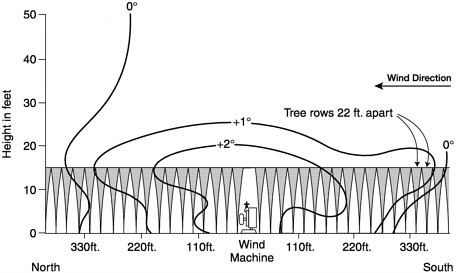
FIGURE 2–10 Illustration of the depth and extent of mixing that wind machines can achieve. Solid lines indicate temperature change (in degrees Fahrenheit) due to induced mixing. Source: Crawford 1965. Reprinted with permission from Meteorological Monographs; copyright 1965, American Meteorological Society.
surrogate gas, could be input at the lowest level of the physical model. Alternatively, the spatial scale of the downtown area is small enough to use detailed fluid-dynamics models (such as large-eddy simulation) to conduct numerical experiments on the effect of wind turbines in mixing air and the effect of buildings in dissipating air movement.
As discussed previously, the spatial extent of the high CO concentrations found in Fairbanks needs to be known to evaluate the value of such an approach. Furthermore, cost, noise, and safety considerations could be important in such a strategy and must be assessed. Because of these concerns, the committee feels that other emissions-control strategies should be pursued before further investigating a strategy of mechanical vertical mixing.
SIMPLE BOX MODEL OF THE BOROUGH
Various models that have been used for attainment demonstrations, research purposes, and air quality forecasting were discussed in Chapter 1. In
its most recent SIP, Fairbanks used a statistical rollback model to estimate the emissions reductions needed to reach attainment (ADEC 2001a). Although more sophisticated tools (such as dispersion and urban-airshed models) are available, Fairbanks claimed in its SIP that it did not have sufficient information about its meteorology or emissions inventories to use them. Nevertheless, the borough acknowledges the limitations of the rollback approach and is committed to pursuing the development of dispersion modeling capabilities. In addition to improving the meteorological data and emissions inventory, the borough will also have to address the limitations of widely available dispersion models under conditions of severe temperature inversions and very low windspeeds (Bowling 1985).
In the meantime, the committee has developed a simple box model for the borough nonattainment area to gain some insight into the roles played by emissions and meteorological variables. This type of model can also be used to test various emissions scenarios and possibly for attainment demonstration. The model solves for the time-varying CO concentration as a function of CO emissions and meteorological conditions in the nonattainment area, about 88 km2—6.4 km north-south by 13.8 km east-west, centered on downtown Fairbanks. Uniform conditions are assumed for the volume of the box. Specifically, CO concentrations are assumed to be well mixed, and meteorological variables—windspeed and wind direction, temperature, pressure, and mixinglayer height—are constant throughout the box. It is known from observations that those quantities vary over the nonattainment area and probably have a substantial effect on local CO concentrations, but the variations are not resolved here. In addition, it is assumed that there is negligible CO in the air entering the box—a reasonable assumption for a box of this size and for a city far from other CO sources.
To demonstrate how a simple box model works, the results are presented for an average 72-h CO event in which the 9-ppm standard is exceeded during the middle day (hours 24–48). The event was calculated by averaging hourly observations of CO concentrations, vehicle counts, and meteorological variables during five of the last six exceedances in Fairbanks. The five events averaged were centered on 2/23/98, 2/11/99, 2/16/99, 11/19/99, and 2/8/00; an exceedance of the 8-h CO standard also occurred on 2/24/98. The highest 8-h average was observed four of the five times at the Post Office and once (2/11/99) at the Hunter School. A more rigorous application of the model would be to simulate a single exceedance.
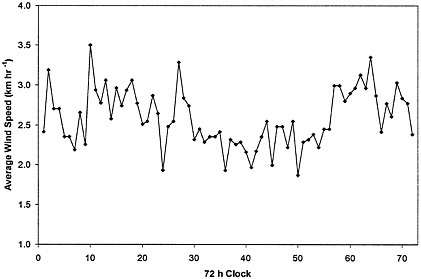
FIGURE 2–11 Windspeed (km/h) measured at 10 m height at the meteorological tower in downtown Fairbanks. The hourly values are averaged over the five exceedance events.
The Data
The model inputs include average hourly values of meteorological variables and vehicle counts and average daily emissions rates. Temperature, pressure, and windspeed (Figure 2–11) were measured at a 10-m altitude at the meteorological tower in downtown Fairbanks.12 The temperature-inversion strength (−∆T/∆z) is computed from temperature measurements at 3 and 10m (Figure 2–12). The air density is calculated from the hourly average temperature and pressure, assuming that air is an ideal gas. Variations in these meteorological parameters might be much larger for the original measurements than for the averages shown here. Emissions of CO in the box are assumed to be 8.4 tpd from stationary sources and 16.5 tpd from mobile sources, fol-
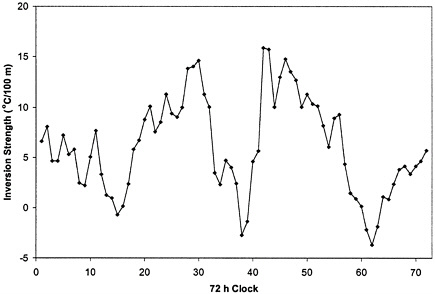
FIGURE 2–12 Inversion strength (°C/100 m) computed as the temperature difference between 3 and 10 m heights measured at the meteorological tower in downtown Fairbanks. The hourly values are averaged over the five exceedance events.
lowing the values estimated by Sierra Research in a 1999 CO emissions inventory.13 Mobile sources in that inventory are estimated to be 7.0 tpd from cold-start and initial-idle emissions and 9.5 tpd from traveling emissions. Observed vehicle counts in downtown Fairbanks (at locations shown in Figure 2–4) are used to convert the daily mobile-source emissions rate to hourly emissions (Figure 2–13). The model performance is evaluated on the basis of CO measurements made at the three monitoring sites in downtown Fairbanks. The CO observations are averaged hourly and over the three monitoring sites.
The Model
The mass of CO in a box representing the nonattainment area can be determined with a mass-balance expression (assuming that CO concentrations
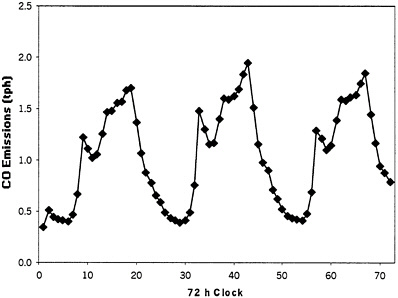
FIGURE 2–13 CO emissions (E[t]) in tons per hour (tph) for the average exceedance event.
outside the box are negligible):
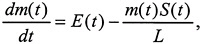
(1)
where
t=time (h);
m(t)=mass of CO in box (ton);
E(t)=emissions of CO in box (tph);
S(t)=windspeed (km/h); and
L=length of box (km) in direction of wind.
Using the relationship between mass and concentration:
m=c(t)ρ(t)V(t),
(2)
where
c(t)=concentration (ppm);
ρ(t)=air density in the box (g/km3); and
V(t)=volume of the box (km3).
The mass-balance equation can be expressed in units of concentration:

(3)
Finally, the concentration of CO at any time c(t+∆t) can be estimated with Equation 3 as follows:
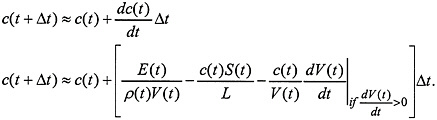
(4)
We solved Equation 4 by using a time increment, ∆t, of 1 h.
Solving Equation 4 requires knowing or assuming time-dependent values of the variables on the right side. As discussed previously, observed values were available for windspeed, S(t); air density, ρ(t) (computed from temperature and pressure); emissions, E(t); and an initial value for CO concentration, c(t). The box length, L, was assumed to be 6.4 km, the length of the box from north to south, in the direction of the incoming wind. The major challenge was devising a function for the volume V(t) that is reasonable and yields a calculated CO concentration that varies with time in a way similar to the observed hourly average. Because the area of the box is constant, the variations in the volume are based on variations in the height of the mixing layer, H(t). The committee assumes that H(t) depends on the observed inversion strength ∆T/∆z) in the following way:
Stable conditions: ∆T/∆z<0°C/100 m H=8 m
Mild inversion conditions: 0°C/100m<∆T/∆z<11°C/100 m H=5 m
Severe inversion conditions: ∆T/∆z>11°C/100 m H=2.25 m
The mixing heights assigned that way are shown in Figure 2–14. They are highest in the early afternoon, when the atmosphere can become unstable (positive lapse rate, negative inversion) because of solar heating.
Mixing height during severe inversion conditions is determined by a combination of turbulent mixing (mostly from high-speed exhaust gas leaving vehicle tailpipes and vehicle motion under low-windspeed conditions) and convective mixing from the rising, initially hot exhaust gas. Thus, the mixing height is rather heterogeneous over the nonattainment area, and it is difficult to determine directly from observations a single height to use in the box model. For these reasons, the mixing heights used in the model were derived to best match the observed CO concentrations. As such, the model provides a useful tool for estimating an effective mixing height based on the constraints of estimated emissions and observed surface CO concentrations.
Results and Discussion
Concentrations of CO predicted by the model are compared with those of the average observed event in Figure 2–15. In general, the model does a good job of reproducing the magnitude of the CO concentration and the diurnal variation over the 72-h event. To simulate the high CO concentrations observed during the exceedance, the mixed-layer height needed to be low (2.25 m, about 7.4 ft) during severe inversions. Marginally less wind and more traffic on the average exceedance day (see Figures 2–11 and 2–13) did not yield the observed doubling of CO concentrations compared with the days before and after the exceedance. A box height of 2.25 m may be too low if the spatial variability in CO emissions invalidates the assumption of a well-mixed box. In particular, if CO emissions are greater in the downtown area (where the three CO monitors are) than elsewhere in the modeled area, the mixing height downtown could be higher.
The lowest CO concentrations (about 1 ppm) are observed in the early morning hours, between about 2 and 6 a.m. The model shows concentrations during those times about twice as high (about 2 ppm), suggesting that the stationary-source CO emissions used in the model (0.35 tph) are too high during these hours. The discrepancy could be due to insufficient horizontal dispersion in the model, but that does not appear to be the case. With an
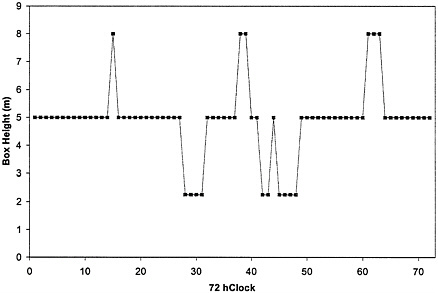
FIGURE 2–14 The box heights (m) used for the model fit shown in Figure 2–15.
assumed box length in the direction of the wind of 6.4 km and an average windspeed of 2.6 km/h, the time constant for horizontal dispersion in the model is about 2.5 h, certainly fast enough to deplete CO to low concentrations during the early morning hours, when emissions are low.
Although the model generally yields the correct shape of the diurnal variations of CO concentration, the calculated afternoon maximums lag those observed at about 5 p.m. The highest CO emissions in the model are between 5 and 6 p.m., when vehicle traffic is maximal. However, idling emissions in the downtown area before people leave work to go home have the effect of shifting the observed emissions maximum 30–60 min earlier than would be expected on the basis of vehicle counts. Improving the model requires an emissions inventory more detailed in time and space, particularly with respect to plug-in and idling behavior.
The box model described here provides an illustrative example of how this technique can be applied to better understand the roles of emissions and meteorology in high-CO episodes. The model could be adapted in a number of ways. As mentioned before, a specific exceedance event, rather than averaged events as shown here, could be analyzed. Another modification could be to consider a different surface area of the control volume. For example, the
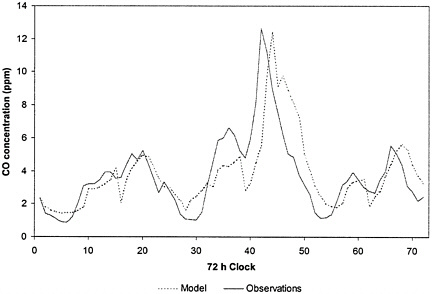
FIGURE 2–15 Comparison of simulated and observed CO concentrations (ppm) for the average exceedance event.
model could simulate only downtown Fairbanks. For this case, the assumption that no CO is transported into the box would need to be reassessed. A vertically resolved, one-dimensional model also could be used. That approach could help improve the understanding of how stationary sources affect surface CO concentrations.
In the short term, the committee recommends that the borough use a box-model approach for air quality planning and for demonstrating attainment. Unlike less physically comprehensive rollback models, a box model can provide information on how temporal changes in emissions and meteorology affect CO concentrations. Unlike more physically comprehensive airshed modeling, the monitoring data to implement a box model are readily available. The box-model approach used by the borough need not be identical to the one developed here; some of the modifications described above should be considered. The borough may want to use a box model in conjunction with a model that focuses on an area immediately surrounding a monitoring site, such as the probabilistic rollback models described in Chapter 1; however, the time and effort needed to develop inventories for these local modeling approaches may be better spent developing more physically comprehensive regional modeling
capabilities for the Fairbanks area. For the future, the committee recommends that the data needed to initiate and validate airshed modeling be gathered and that more physically comprehensive models be used.
|
BOX 2–9 Recommendations: Improving Ambient-CO Modeling in the Borough In the near term, Alaska should use a simple box-model approach, which simulates the effects of emissions and meteorology in a well-mixed control volume, for air quality planning purposes in Fairbanks. Such an approach could provide greater insights into the effects of the timing of CO emissions and meteorological variables. The relative contributions of mobile and stationary sources to CO episodes could also be assessed with this type of model. Enhanced data-collection efforts are required to support this and more sophisticated modeling efforts. Improvements in the statistical forecasting approach used by the borough might help in forecasting episodes of high CO concentrations. More work is also needed to develop, apply, and evaluate more sophisticated, physically comprehensive models that would simulate how CO concentrations vary with time and space over the entire borough. Such models could be used for planning, forecasting, and assessing human exposure to high CO concentrations. It is important that model development and testing be specific to the extreme conditions that occur in Fairbanks. Model development must occur in conceit with improved monitoring to enable model evaluation. |
SUMMARY
Fairbanks presents a challenge for air quality management. It constitutes an extreme example of the roles of topography and meteorology in producing air quality problems. In winter, the area is subject to extreme ground-level inversions. Although no industries in the region emit large amounts of CO or other pollutants, the inversions are extremely effective in trapping the products of incomplete combustion that are emitted near ground level, particularly CO from vehicles. Monitors in the downtown area have measured as many as 130 d/y with exceedances of the 8-h CO standard. The situation has greatly improved over the last 30 y. No exceedances have occurred over the last 2 y.
The days currently most susceptible to high CO concentrations in Fairbanks are not the coldest days. Meteorological conditions in Fairbanks lead to exceedances of the CO health standard primarily when the ambient temperatures typically are −20 to 20°F. The combination of human behavior and motor-vehicle technology further narrows the primary temperatures of concern to 0–20°F. Air quality planning and controls should focus on such days. The committee has identified a number of options available to the borough and Alaska to reduce CO emissions further. Among them, improving the vehicle I/M program has high priority, as does an enhanced plug-in program. Use of low-sulfur fuel would also help. An enhanced alert-day program might provide needed reductions on critical days. And there is a need to inform and educate the community better about the health effects of exposure to air pollutants and ways to improve air quality.
Improved monitoring and characterization of CO concentrations in the area are needed. Modeling CO in the borough is a serious challenge, but it can be helpful in planning and in forecasting possible exceedance days. For now, a simple box model is suggested for planning purposes; more sophisticated models either are inappropriate for the conditions or require much more extensive monitoring data. Statistical models can be used, for now, to help in forecasting, but work is needed to improve them. More research with comprehensive models is needed for future application for both forecasting and planning. These more comprehensive models will also require improvements in the emissions inventory, including the nonroad, area, and point sources that contribute to high-CO episodes.


