
4
Important Areas for Investment
The committee’s charge calls for it to point to important areas for future investment in nanoscale science and engineering. Below, the committee discusses those areas that are most critical for realizing benefits from nanoscale advances and for future leadership in nanoscale science and technology. Although many of them are already in the current portfolio, their critical importance means they will require sustained investment to reach fruition.
The important areas for investment outlined below all have in common the theme of interdisciplinary science. The promise of nanoscale science and technology is dependent on research spanning many scientific cultures and disciplines, and the last two decades have seen an increasing awareness of the need to foster interdisciplinary work at the intersection of chemistry, physics, biological sciences, molecular biology, engineering, materials science, and surface science. Box 4.1 uses tissue engineering to demonstrate the advances that may come from such interdisciplinary work.
In considering investments in the areas outlined below, it is important that NSET base its decisions on the promise of the science involved and not on rigid definitions of the nanoscale. For example, microscale technology will clearly be critical to the realization of nanoscale science, so NSET must think broadly when defining NNI mission and portfolio investments.
NANOMATERIALS
Nanomaterials are nanoscale materials that exhibit new phenomena or behavior or that can be controlled at the nanometer scale. Such materials will probably feature in the first big successes for nanoscale technology. Nanomaterials are also the building blocks upon which complex two- and three-dimensional functional nanoscale systems will be built, enabling new devices and new functionalities. Box 4.2 discusses the importance of materials advances in achieving the potential payoff of nanoscale science and technology.
Broad markets for early nanoscale materials are expected in the near future. Several manufacturers have plans to use nanomaterials in catalytic surfaces. Nanomaterials are also excellent candidates for filters for liquid separations of various sorts—from water purification to chemical waste separation—because nanoscale titania and zirconia materials can facilitate the trapping of heavy metals and attract and retain bioorganisms. Nanoparticles have already been used in timed-release drug delivery systems, and their pharmaceutical uses will probably expand. Enzymes are being attached to nanoparticles that can be steered internally or externally to kill diseased cells. Future advances in nanofluidics, including lab-on-a-chip, may lead to faster diagnosis of distance and new procedures for delivering medications. Nanoparticles have also been used in creating novel optical films and in producing materials having optical or magnetic properties that enable new performance levels. For example, magnetic nanoparticles and quantum dots will be used to produce ultrasmall disk drives with 10 times the current capacity and memory chips with speeds of several hundred gigahertz.
NSET has done an excellent job supporting and coordinating research and development for nanoscale science and technology and materials science. The current NNI investment in materials science should be
|
BOX 4.1 All tissues of the human body, including brain, heart, bone, skin, muscle, and cartilage, contain differentiated cells living in an extracellular matrix exquisitely designed by nature (Figure 4.1.1). These matrices contain nanofibers, microfibers, sheaths of material, mineral nanocrystals, proteins, and other biopolymers. The nanoscale architecture of these matrices is critical for the proper functioning of each tissue. Advances in cell biology and nanotechnology are expected to enable the fabrication of structurally and functionally designed synthetic matrices that will provide cells with all the necessary cues to regenerate structural tissues, organs, and body parts. In one vision of this future, liquids will be delivered to parts of the body in noninvasive ways, and through self-assembly at the nanoscale, fully biodegradable matrices will form to serve as templates for regeneration. Nanoscale science and technology are needed to bring human capabilities to the scale at which nature designs the matrices for function. To make this happen, chemists, biologists, engineers, and physicists will have to work together to create the necessary strategies to synthesize matrices with nanosized features. The targets include the regeneration of spinal cord to reverse paralysis, and the regeneration of the retina to reverse blindness. 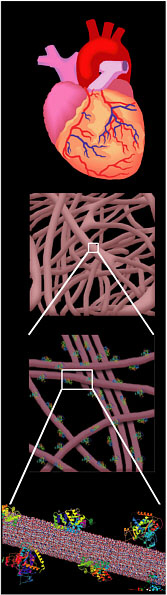 FIGURE 4.1.1 |
|
BOX 4.2 All technologies utilize materials, whether they are linked to information, energy, transportation, consumer products, or medicine. In the second half of the 20th century, the field of materials science and engineering emerged as a discipline. This field seeks to understand how the structure of materials is connected to their properties and thereby enable “materials by design,” with special properties required for particular applications. Important connections have been established between microscale properties such as the structure of metals or the molecular weight of polymers and their respective properties. As a result, materials available today are stronger, lighter, more durable, or have other unique properties that enable applications such as high-speed integrated circuits. The world of designed materials should be significantly impacted by nanotechnology, leading to materials and devices with significantly advanced properties. Imagine organic, inorganic, and hybrid materials made up of nanostructures that can have prescribed shapes, as proteins do in biology. There have already been some previews in the scientific literature of what these new capabilities may bring. Inorganic nanostructures measuring only a few nanometers (quantum dots) (Figure 4.2.1) have unique optical properties. Recently discovered organic nanofibers mimic collagen fibrils found in our tissues (Figure 4.2.2). These structures may help us create materials that resemble bone for medical applications, but they could also produce bone-inspired hybrid materials in which organic nanofibers guide the organization of quantum dots or other inorganic nanocrystals (Figure 4.2.3). Such hybrid materials, and others such as carbon nanotubes, may someday be part of computers with memories and speeds that are thousands or millions of times greater than the ones we know today or be part of materials that help us improve the energy efficiency of the systems we use everyday. 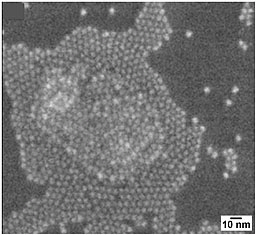 Figure 4.2.1 Quantum dots. 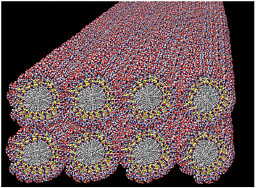 Figure 4.2.2 Organic nanofibers that mimic collagen fibers. 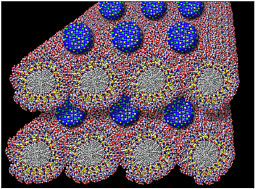 Figure 4.2.3 Organic nanofibers used to guide the organization of inorganic nanocrystals. SOURCE: All three figures in this box are from Annual Review of Materials Science, Volume 30, 2000. Used by the permission of Annual Reviews, <www.AnnualReviews.org>. |
continued, with a special focus on developing and characterizng materials with novel properties.
INTERFACE OF NANOSCALE TECHNOLOGY WITH BIOLOGY
The relevance of the NNI to biology, biotechnology, and the life sciences cannot be overstated. Cellular processes and molecular biology techniques are inherently nanoscale phenomena. By elucidating cellular mechanisms, molecular biology provides us with a good textbook on nanoscale technology. However, the true challenge is to (create ways to) construct nanodevices and systems capable of complex functions. Nature integrates biological molecules into functioning three-dimensional macrostructures. Nevertheless, while we already have a good understanding of how nature works, we are not yet able to create synthetic systems that rival nature’s elegance.
At the nanoscale, cells record information, process information, carry out a set of instructions, transform energy from one form to another, replicate themselves, and adapt to changing environments in ways that allow optimal performance of necessary tasks. Biological systems provide great inspiration for the design of functional nanoscale structures and can also help us learn how to organize nanostructures into much larger systems. Understanding biological phenomena at the nanoscale will be central to our continuing drive to understand cell function. It may also lead to biomimetic models for harnessing and duplicating organic-based functional systems for nonbiological applications, which is the idea behind such concepts as DNA computing. Box 4.3 provides an elegant example
|
BOX 4.3 Sensing and actuation in living systems are based on nanometer-scale mechanisms (protein-protein interactions). As nanotechnology advances, the merging of natural and synthetic modalities will provide novel approaches to nanoscale system design and application. One ubiquitous natural actuator is the ATPase motor, a few hundred nanometers in size, that utilizes naturally occurring substances to provide actuation in living systems. Nanotechnology is allowing scientists to fabricate inorganic materials at the same scale. By merging the two (natural and synthetic), researchers have attached a nanopropeller to a natural ATPase motor (Figure 4.3.1). The propeller rotated at approximately 10 revolutions per second for several hours (Ricky K. Soong et al., “Powering an Inorganic Nanodevice with a Biomolecular Motor,” Science 290:1555-1558). Such hybrid nanodevices lay the foundation for building complex nanosystems capable of performing complex functions useful in medical and environmental applications. 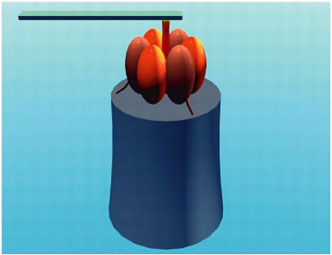 FIGURE 4.3.1 A nanoscale motor created by attaching a synthetic rotor to an ATP synthase. Reprinted with permission of the American Association for the Advancement of Science from Soong et al., Science 290, 1555 (2000). © 2000 by AAAS. |
of the use of biological phenomena as the basis for nanoscale mechanical systems. Box 4.4 details an example in which the ability to mimic biological systems would greatly improve the capabilities of existing devices.
Many of the most readily foreseen applications of nanoscale science and technology are in biomedical technologies, including some that may be useful to counter bioterrorism. For example, one can envision the military use of nanostrucures to produce smart protective textiles such as high-efficiency particle air (HEPA) filters that are effective against particulates or biological toxins that might be dispersed as aerosols. Nanoscale technology might also enable the development of ultrasensitive detectors of biological or chemical threats. Box 4.5 discusses a new Army initiative to utilize nanoscale technology in defense applications. Potential early breakthroughs in medicine include regeneration of functional biomaterials such as bone or skin using nanostructured materials as a template for
|
BOX 4.4 Green plants have structures called chloroplasts that carry out the highly efficient conversion of light into energy and biomass. Chloroplasts are self-organized structures that contain hundreds of nanometer-size structures called thylakoids (Figure 4.4.1). Within the thylakoids are numerous antenna nanostructures that capture light with high efficiency and convert it into chemical energy. A solar cell is a man-made photovoltaic device that converts light energy into electrical energy (Figure 4.4.2). A solar cell is relatively expensive compared with plant material and does not have the same overall efficiency. Photovoltaic devices and other microelectronic devices are made with so-called top-down fabrication processes. All biological systems use a bottom-up process to self-assemble molecules into nanostructures, then into larger structures, and finally into macroscopic structures (plants and animals). A Grand Challenge for nanotechnology will be the merger of top-down and bottom-up fabrication processes, which will allow us to self-assemble a whole new generation of inexpensive electronic and photonic devices with efficiencies closer to those achieved in nature. 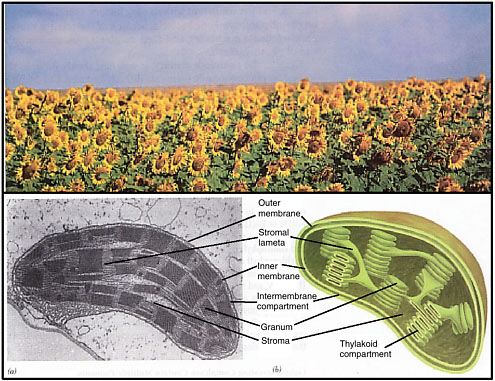 FIGURE 4.4.1 Plant chloroplast. SOURCE: Fundamentals of Biochemistry, Donald Voet, Judith G. Voet, and Charlotte W. Pratt, 1998. This material is used by permission of John Wiley & Sons, Inc. 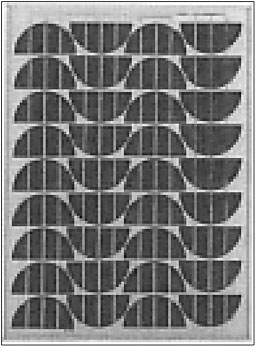 FIGURE 4.4.2 Solar cell array. |
|
BOX 4.5 The Department of the Army has selected the Massachusetts Institute of Technology (MIT) to develop a variety of nanomaterials that will allow equipping future soldiers with uniforms and gear that can “heal them, shield them, and protect them against chemical and biological warfare.” The Institute for Soldier Nanotechnologies (ISN), as it will be known, will receive $50 million over 5 years, with industry partners providing an additional $40 million in funds and equipment. The ISN will focus on six key soldier capabilities: threat detection, threat neutralization (such as bulletproof clothing), concealment, enhanced human performance, real-time automated medical treatment, and reducing the weight load of the fully equipped soldier from 125-140 pounds to 45 pounds. The primary role of ISN is to support basic and applied research. These innovations will lead to an array of innovations in nanoscience and nanotechnology in a variety of survivability-related areas. They will be transferred to industrial partners for future Army requirements and eventually civilian applications. Current and future DOD-sponsored nanoscience research is expected to lead to a variety of nearterm (1-5 years) and long-term (5-15 years) advances in uniforms and equipment. These advances could include such capabilities as a semipermeable membrane with molecular-scale pores that open to allow passage of water but remain closed to other molecules. Such a membrane could be used in water filtration and purification systems or for chemical/biological protective clothing. Another possible outcome is engineering of molecular-scale rotors on a three-dimensional grid array so that they can pivot and block off high-intensity laser light—a molecular-scale Venetian blind—to protect soldier eyes from laser blinding or to act as high-speed switches in optoelectronic circuits. Nanoparticles of gold in solution, linked together by strands of DNA that are specifically encoded to respond to the DNA of biological agents, may produce reliable field detection of biological warfare agents at very low sample sizes or rapid, reliable screening for such diseases as influenza or strep throat. Materials are also sought that could react to a wound by becoming, for example, a tourniquet or to a fractured bone by becoming a hard cast. |
growth and novel cancer or gene therapy strategies using nanoscale particles to deliver treatment to specific cell or gene types.
The scientific community currently recognizes the importance of nanoscale biological and biomedical research. In particular, NSF and NIH report increased numbers of proposals submitted in nano-bio areas. NSET has done a fair job of responding to this pressure and of promoting investment at the intersection of nanoscale science and technology and biology and biomedicine. For example, NIH has implemented a new interdisciplinary review system based on special emphasis panels (SEPs). SEPs are formed on an ad hoc basis to review research proposals requiring special expertise not found on any one standing review panel. The ability to convene SEPs means that interdisciplinary proposals are less likely to fall through the cracks of the NIH review system because no one standing panel can comprehend all aspects of the proposal. Nevertheless, NIH’s support of nanoscale science and technology R&D funding is small ($39 million in FY 2001) considering the size of its overall budget ($21 billion) and the potential impact that such research could have on the human condition.
NSET should examine means to increase the NNI investment in research at the intersection between nanoscale technology and biology and biomedicine. One could envision a multiagency research program in bio-nano areas for which an interagency review mechanism is established, as it may not be reasonable to expect single agencies to bear the very high cost of biobased research. Examples include research on single-molecule detection, nanofabrication processes for biocompatible materials, and novel sensors. It is clear that understanding the cell is the next major challenge in biological science. Nanoscale science and technology will be critical both to achieving this understanding and to leveraging the understanding to achieve novel nanoscale devices.
INTEGRATION OF NANOSYSTEMS
Revolutionary change will come from integrating molecular and nanoscale components into higher order structures. The integration of nanoscale components with larger-scale components and the integration of large numbers of nanoscale components with one another are challenges that need to be overcome to
achieve practical devices based on nanoscale phenomena. At present, the best techniques to produce large numbers of nanoscale systems are self-assembly techniques, which are only likely to produce fairly regular structures with low information content. These simple structures contrast to the components found in today’s computers, which derive their capabilities from the great complexity that has been imposed by human designers. To achieve improvements over today’s systems, chemically or biologically assembled machines must combine the best features of top-down and bottom-up approaches. Integration at the nanoscale is inherently complex and must be approached stepwise, and solutions to these problems will require a sustained investment and long-term commitment.
Research investments in molecular electronics and quantum and molecular computing could be critical for realizing this goal of integration. Real breakthroughs require fully integrated systems capable of manipulating the molecules, efficiently reading the code, and allowing for parallelism and diversity. One strategy toward for achieving three-dimensional assembly and complex functionality is to use self-organizing ideas and mechanisms gleaned from biology. Efficient self-assembly mechanisms will lead to advances in numerous areas, including decreases in the size of instrumentation and the ability to integrate multiple sensing devices on a chip.
INFRASTRUCTURE AND INSTRUMENTATION
The committee echoes the recommendations made at the culmination of the Bioengineering Consortium symposium—namely, that one of the most important areas for investment is the development of instrumentation, computation, and facilities to support research at the nano-bio interface.1 The sophisticated and expensive equipment and facilities required for a multifaceted initiative such as the NNI can be shared among many investigators, and the specialized facilities can employ highly trained individuals to assist researchers in the optimum use of such equipment.
NSET has done an outstanding job of developing, supporting, and encouraging multiuser instrumentation and facilities. For example, DOE is proposing three new nanoscale science and technology centers. A “molecular foundry” is proposed for its Lawrence Berkeley National Laboratory that will focus on the connection of “soft” and “hard” materials, multicomponent functional assemblies, and multidisciplinary research. This facility is used in Box 4.6 to illustrate some of the features important to such centers. The Center for Integrated Nanotechnologies at Sandia National Laboratory and Los Alamos National Laboratory will concentrate on nanoelectronics and photonics, nanomechanics, complex materials, and the nano-biomicro interface. At Oak Ridge National Laboratory, the Center for Nanophase Materials Sciences will focus on soft materials and complex nanophase materials. As another example, the national nanofabrication user network (NNUN) supported by NSF involves four primary sites and one secondary site at universities. The sites at Cornell, Penn State, and Stanford have personnel with biological expertise.2 The NNUN is accessible to academic and industrial researchers and is particularly useful to start-up companies, which will be able demonstrate proof-of-principle without major capital outlay.
However, most of the equipment in these user facilities is for traditional use. For instance, Stanford’s semiconductor wafer fabrication center was created for complementary metal-oxide semiconductor (CMOS) processes and developments. Materials that deviate from those used in CMOS technology cannot be used in the etchers, evaporators, and other equipment. Many of the interdisciplinary techniques researchers wish to utilize require nonstandard materials, so no user facilities are available for them. This issue must be addressed if NNUN is to truly serve the needs of researchers working at the interface between biology, chemistry, and materials science at the nanoscale. If it is to realize the research gains that it seeks, especially in the area of nanoscale studies of biological systems and the creation and characterization of nanoscale devices based on biological systems, NSET must encourage and support the development of multiuser facilities, particularly those that can tolerate the introduction of biological samples and saline solutions. This might be accomplished in partnership with the new National Institute of Bioimaging and Bioengineering, part of NIH.
In addition to supporting large user facilities, NNI must invest heavily in new instrument development if
|
BOX 4.6 The Department of Energy (DOE) has funded nanoscale science since the 1980s. Recently, DOE Basic Energy Sciences decided to fund nanoscale science research centers (NSRCs) at three national laboratories: the “molecular foundry” at Lawrence Berkeley National Laboratory, the Center for Integrated Nanotechnologies at Los Alamos and Sandia National Laboratories, and the Center for Nanophase Materials Sciences at Oak Ridge National Laboratory. These centers will house specialized facilities for the synthesis, processing, fabrication, and characterization of nanoscale materials. They will all be scientific user facilities, with successful proposals selected by peer review. They will be located at existing DOE laboratories that have experience in operating such user facilities. By providing large-scale facilities that would be too expensive for individual universities, together with an interdisciplinary support staff, they will foster the interdisciplinary environment necessary for studying materials at the nanoscale. Figure 4.6.1 is an artist’s rendition of the new building for the molecular foundry at Lawrence Berkeley National Laboratory. 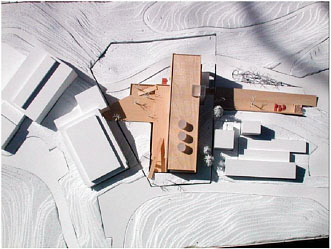 FIGURE 4.6.1 Artist’s rendition of the molecular foundry at Lawrence Berkeley. Courtesy of Lawrence Berkeley National Laboratory. |
it wishes to accelerate breakthroughs in nanoscale science and technology. Many important advances in science came after the appropriate investigative instruments, such as the scanning tunneling microscope, were made available (see Box 4.7). One must be able to measure and quantify phenomena in order to understand and use them, which is true also for nanoscale phenomena.
Metrology at the nanoscale will also be critical. Most metrological tools currently available and in use in both laboratory and industrial settings do not provide the capability to perform measurements on the nanoscale. The ability to measure nanoscale dimensions in real systems such as integrated circuits is important to verify nanoscale advances.
LONG-TERM INVESTMENTS
Applications based on nanoscale technology are predicted to have profound impacts on society and the economy over the next several decades. Government and private science and technology funding sources and those responsible for determining industrial R&D funding will need a long-term view and patience in the development of a roadmap for nanoscale technology.
It was impossible in 1947 to predict the cost of producing an individual transistor on an integrated circuit in the year 2001, nor are we now able to predict what the real costs of manufacturing circuits and networks of devices fabricated at the nanoscale will be several decades from now, but like the transistor, it seems
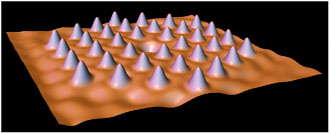
FIGURE 4.7.1 Three-dimensional STM image of man-made lattice of cobalt atoms on a copper (111) surface. Note that the center atom was deliberately omitted from the array, and the dip there is a result of the quantum mechanical standing wave field of the surface electrons. The image width is 14 nm. Courtesy of Don Eigler, IBM Almaden Research Center.
likely that eventual production costs will be low enough for mass production. However, two to three decades of research may be necessary to achieve reliable, low-cost interconnected networks of nanoscale devices, either for electronics, materials, or health-care applications. Since very few small start-ups or even large companies can afford to spend decades pursuing dreams without near-term economic payback, extended research in universities and national laboratories is needed to establish much of the groundwork for the most profound breakthroughs in nanoscale technology. This research will need to be far more interdisciplinary than that which most universities currently foster.
To develop nanoscale technologies into products with the greatest socioeconomic benefit, it is important that NNI create the best partnerships between those entities with present and future applications and those with technology vision, and sustain funding for decades of research and development. New ways will have to be found for the government to encourage industry research and offer long-term support of the industry-university-national laboratory partnerships needed to achieve the required breakthroughs.
SPECIAL TECHNOLOGICAL CHALLENGES
Many present technological paths to nanofabrication are safe paths—for example, integrated circuit producers will follow Moore’s law using modifications of established lithographic processes that will produce
nanometer-scale silicon and complementary metaloxide semiconductor (CMOS)3 devices within the next 10 or 15 years. Industry will fully utilize and exploit present lithography-based manufacturing processes to produce devices with nanometer dimensions. Nevertheless the production of these devices will be dependent on billion-dollar fabrication facilities.
A significant challenge for nanoscale science and technology is the development of truly revolutionary nanofabrication processes. These new processes might utilize aspects of synthesis and self-assembly to allow for the heterogeneous integration of a diversity of molecular components, nanocomponents, and micron-scale components into a new generation of three-dimensional structures, devices, and systems. Basically, these new nanofabrication processes would eliminate the need for prohibitively expensive fabrication facilities.
There exists as well a large number of special challenges in nanostructures having to do with regard to their electrical, mechanical, optical, materials, and chemical properties. A few of these challenges are described next.
One outstanding challenge was posed by Feynman:4 the use of the third dimension for electronic storage and processing of data. Current chips do use the third dimension for electrical interconnects. It is an open question, however, whether the tyranny of large systems would prevent effective use of the third dimension for layers of devices. Feynman maintained that only this use would provide plenty of room for future development. Integration in two dimensions has not made use of molecular precision and dimensions. In fact, not even the densities typical for solids can be achieved, since current technology is based on the existence of dilute (relative to the atomic densities of solids) donors and acceptors of electrons. Devices need to be found that can be based on solid-state densities. These devices will require control of pattern generation and perfection on a molecular scale.
New massively parallel schemes such as cellular automata or nanostructures integrated to perform quantum computing are ripe for exploration, including demonstrating in principle their potential functionality. The current state of the art has not demonstrated the feasibility of executing even a greatly simplified computational task. Once feasibility is determined, an assessment needs to be made of those circumstances in which the advantages of these approaches would out-weigh their disadvantages (e.g., the requirement of low temperature).
Biological systems such as ionic channels have great advantages over current transistors, such as an infinite on/off current ratio. However, all biological systems work on a time scale much shorter than the switching times of current silicon technology. A challenge is to find material systems and implementations that have the advantages of the biological materials and designs and that also operate at high speed.
All of these challenges will require the development of computational tools that permit the simulation of these devices from their atomistic structure to their connections to macroscopic components and their integration into large systems.


