
1
The Importance of Nanoscale Science and Technology
Nanoscale science and technology, often spoken of as “nanoscience” or “nanotechnology,” are simply science and engineering carried out on the nanometer scale, that is, 10−9 meters. Figure 1.1 provides some sense of how this scale relates to more familiar, everyday scales. In the last two decades, researchers began developing the ability to manipulate matter at the level of single atoms and small groups of atoms and to characterize the properties of materials and systems at that scale. This capability has led to the astonishing discovery that clusters of small numbers of atoms or molecules—nanoscale clusters—often have properties (such as strength, electrical resistivity and conductivity, and optical absorption) that are significantly different from the properties of the same matter at either the single-molecule scale or the bulk scale. For example, carbon nanotubes are much less chemically reactive than carbon atoms and combine the characteristics of the two naturally occurring bulk forms of carbon, strength (diamond) and electrical conductivity (graphite). Furthermore, carbon nanotubes conduct electricity in only one spatial dimension, that is, along one axis, rather than in three dimensions, as is the case for graphite. Nanoscale science and engineering also seek to discover, describe, and manipulate those unique properties of matter at the nanoscale in order to develop new capabilities with potential applications across all fields of science, engineering, technology, and medicine.
The National Nanotechnology Initiative (NNI) was established primarily because nanoscale science and technology are predicted to have an enormous potential economic impact. Many potential applications of nanoscale science and technology have been touted in both the scientific and the popular press, and there has been no shortage of promises made for the ability of nanoscale technology to revolutionize life as we know it. Beyond any speculation or hype, the committee can point to current applications of nanoscale materials and to devices that are already impacting our nation’s commerce, as well as advances that are mature enough to promise impacts in the near future. Figure 1.2 is a time line for anticipated impacts. Some of the current impacts, as well as anticipated longer-term impacts, of the technical revolution that will be ushered in by nanoscale science and technology are discussed in more detail below.
PRESENT APPLICATIONS OF NANOSCALE MATERIALS AND PHENOMENA
The earliest application of nanoscale materials occurred in systems where nanoscale powders could be used in their free form, without consolidation or blending. For example, nanoscale titanium dioxide and zinc oxide powders are now commonly used by cosmetics manufacturers for facial base creams and sunscreen lotions. Nanoscale iron oxide powder is now being used as a base material for rouge and lipstick. Paints with reflective properties are also being manufactured using nanoscale titanium dioxide particles. Nanostructured wear-resistant coatings for cutting tools and wear-resistant components have been in use for several years. Nanostructured cemented carbide coatings are used on some Navy ships for their increased durability.
More recently, more sophisticated uses of nanoscale materials have been realized. Nanostructured materials are in wide use in information technology, integrated into complex products such as the hard disk drives that
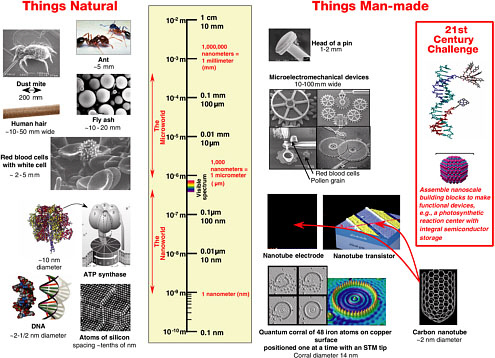
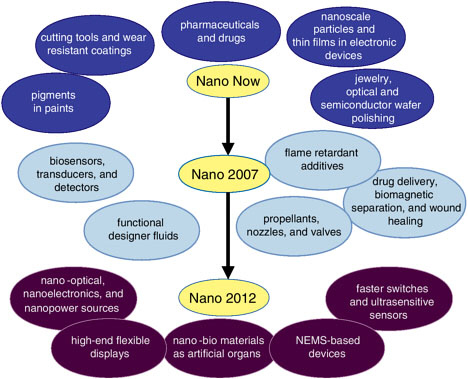
FIGURE 1.2 Current applications of nanotechnology and time line for anticipated advances.
store information and the silicon integrated circuit chips that process information in every Internet server and personal computer. The manufacture of silicon transistors already requires the controlled deposition of layered structures just a few atoms thick (about 1 nanometer). Lateral dimensions are as small as 180 nanometers for the critical gate length, and semiconductor industry roadmaps call for them to get even smaller. With shorter gate lengths come smaller, faster, more power-efficient transistors and corresponding improvements in the cost and performance of every digital appliance. Similar processes are required for the manufacture of information storage devices. The giant magnetoresistive (GMR) read heads in computer industry standard hard disk drives are composed of carefully designed layered structures, where each layer is just a few atoms thick. The magnetic thin film on the spinning disk is also a nanostructured material. Last year IBM announced the introduction of an atomically thin layer of ruthenium (humorously referred to as “pixie dust”) to substantially increase the information storage density of its products. Greater storage density translates directly to the less expensive storage of information. Incorporating nanostructured materials and nanoscale components into complex systems, both magnetic data storage and silicon microelectronics provide a glimpse of the future of nanoscale science and technology. Box 1.1 provides a look at the history of miniaturization in computing and the potential impact of nanoscale science and technology on that sector.
In biomedical areas, structures called liposomes have been synthesized for improved delivery of therapeutic agents. Liposomes are lipid spheres about 100 nanometers in diameter. They have been used to encapsulate anticancer drugs for the treatment of AIDS-related Kaposi’s sarcoma. Several companies are using magnetic nanoparticles in the analyses of blood, urine, and other body fluids to speed up separation and improve selectivity. Other companies have developed derivatized fluorescent nanospheres and nanoparticles that form the basis for new detection technologies. These reagent nanoparticles are used in new devices and systems for infectious and genetic disease analysis and for drug discovery.
Many uses of nanoscale particles have appeared in specialty markets, such as defense applications, and in markets for scientific and technical equipment. Producers of optical materials and electronics substrates such as silicon and gallium arsenide have embraced the use of nanosize particles for chemomechanical polish-
|
BOX 1.1 The history of information technology has been largely a history of miniaturization based on a succession of switching devices, each smaller, faster, and cheaper to manufacture than its predecessor (Figure 1.1.1). The first general-purpose computers used vacuum tubes, but the tubes were replaced by the newly invented transistor in the early 1950s, and the discrete transistor soon gave way to the integrated circuit approach. Engineers and scientists believe that the silicon transistor will run up against fundamental physical limits to further miniaturization in perhaps as little as 10 to 15 years, when the channel length, a key transistor dimension, reaches something like 10 to 20 nm. Microelectronics will have become nanoelectronics, and information systems will be far more capable, less expensive, and more pervasive than they are today. Nevertheless, it is disquieting to think that today’s rapid progress in information technology may soon come to an end. Fortunately, the fundamental physical limits of the silicon transistor are not the fundamental limits of information technology. The smallest possible silicon transistor will probably still contain several million atoms, far more than the molecular-scale switches that are now being investigated in laboratories around the world. But building one or a few molecular-scale devices in a laboratory does not constitute a revolution in information technology. To replace the silicon transistor, these new devices must be integrated into complex information processing systems with billions and eventually trillions of parts, all at low cost. Fortunately, molecular-scale components lend themselves to manufacturing processes based on chemical synthesis and self-assembly. By taking increasing advantage of these key tools of nanotechnology, it may be possible to put a cap on the amount of lithographic information required to specify a complex system, and thus a cap on the exponentially rising cost of semiconductor manufacturing tools. Thus, nanotechnology is probably the future of information processing, whether that processing is based on a nanoscale silicon transistor manufactured to tolerances partially determined by processes of chemical self-assembly or on one or more of the new molecular devices now emerging from the laboratory. 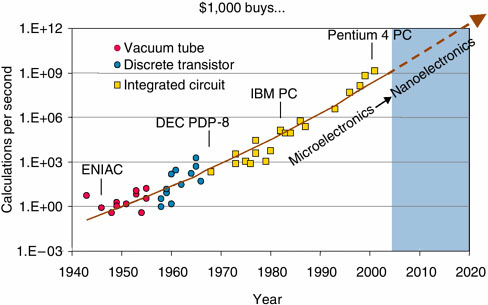
FIGURE 1.1.1 The increasing miniaturization of components in computing and information technology. Adapted from R. Kurzweil, The Age of Spiritual Machines, Penguin Books, 1999. |
ing of these substrates. Nanosize particles of silicon carbide, diamond, and boron carbide are used as lapping compounds to reduce the waviness of finished surfaces from corner to corner and produce surface finishes to 1-2 nm smoothness. The ability to produce such high-quality components is significant for scientific applications and could become even more important as electric devices shrink and optical communications systems become a larger part of the nation’s communications infrastructure.
DEVELOPING APPLICATIONS OF NANOSCALE TECHNOLOGY
Several nanoscale technologies appear to be 3 to 5 years away from producing practical products. For example, specially prepared nanosized semiconductor crystals (quantum dots) are being tested as a tool for the analysis of biological systems. Upon irradiation, these dots fluoresce specific colors of light based on their size. Quantum dots of different sizes can be attached to the different molecules in a biological reaction, allowing researchers to follow all the molecules simultaneously during biological processes with only one screening tool. These quantum dots can also be used as a screening tool for quicker, less laborious DNA and antibody screening than is possible with more traditional methods.1
Also promising are advances in feeding nanopowders into commercial sprayer systems, which should soon make it possible to coat plastics with nanopowders for improved wear and corrosion resistance. One can imagine scenarios in which plastic parts replace heavier ceramic or metal pieces in weight-sensitive applications. The automotive industry is researching the use of nanosized powders in so-called nanocomposite materials. Several companies have demonstrated injection-molded parts or composite parts with increased impact strength. Full-scale prototypes of such parts are now in field evaluation, and use in the vehicle fleet is possible within 3 to 5 years. Several aerospace firms have programs under way for the use of nanosized particles of aluminum or hafnium for rocket propulsion applications. The improved burn and the speed of ignition of such particles are significant factors for this market.
A number of other near-term potential applications are also emerging. The use of nanomaterials for coating surfaces to give improved corrosion and wear resistance is being examined on different substrates. Several manufacturers have plans to use nanomaterials in the surfaces of catalysts. The ability of nanomaterials such as titania and zirconia to facilitate the trapping of heavy metals and their ability to attract biorganisms makes them excellent candidates for filters that can be used in liquid separations for industrial processes or waste stream purification. Similarly, new ceramic nanomaterials can be used for water jet nozzles, injectors, armor tiles, lasers, lightweight mirrors for telescopes, and anodes and cathodes in energy-related equipment.
Advances in photonic crystals, which are photonic bandgap devices based on nanoscale phenomena, lead us closer and closer to the use of such materials for multiplexing and all-optical switching in optical networks. Small, low-cost, all-optical switches are key to realizing the full potential for speed and bandwidth of optical communication networks. Use of nanoscale particles and coatings is also being pursued for drug delivery systems to achieve improved timed release of the active ingredients or delivery to specific organs or cell types.
As mentioned above, information technology has been, and will continue to be, one of the prime beneficiaries of advances in nanoscale science and technology. Many of these advances will improve the cost and performance of established products such as silicon microelectronic chips and hard disk drives. On a longer time scale, exploratory nanodevices being studied in laboratories around the world may supplant these current technologies. Carbon nanotube transistors might eventually be built smaller and faster than any conceivable silicon transistor. Molecular switches hold the promise of very dense (and therefore cheap) memory, and according to some, may eventually be used for general-purpose computing. Single-electron transistors (SETs)2 have been demonstrated and are
being explored as exquisitely sensitive sensors of electronic charge for a variety of applications, from detectors of biological molecules to components of quantum computers. (Quantum computing is a recently proposed and potentially powerful approach to computation that seeks to harness the laws of quantum mechanics to solve some problems much more efficiently than conventional computers.) Quantum dots, discussed above as a marker for DNA diagnostics, are also of interest as a possible component of quantum computers. Meanwhile, new methods for the synthesis of semiconductor nanowires are being explored as an efficient way to fabricate nanosensors for chemical detection. Rather than quickly supplanting the highly developed and still rapidly advancing silicon technology, these exploratory devices are more likely to find initial success in new markets and product niches not already well-served by the current technology. Sensors for industrial process control, chemical and biological hazard detection, environmental monitoring, and a wide variety of scientific instruments may be the market niches in which nanodevices become established in the next few years.
THE FUTURE OF NANOSCALE SCIENCE AND TECHNOLOGY
As efforts in the various areas of nanoscale science and technology continue to grow, it is certain that many new materials, properties, and applications will be discovered. Research in areas related to nanofabrication is needed to develop manufacturing techniques, in particular, a synergy of top-down with bottom-up processes. Such manufacturing techniques would combine the best aspects of top-down processes, such as microlithography, with those of bottom-up processes based on self-assembly and self-organization. Additionally, such new processes would allow the fabrication of highly integrated two- and three-dimensional devices and structures to form diverse molecular and nanoscale components. They would allow many of the new and promising nanostructures, such as carbon nanotubes, organic molecular electronic components, and quantum dots, to be rapidly assembled into more complex circuitry to form useful logic and memory devices. Such new devices would have computational performance characteristics and data storage capacities many orders of magnitude higher than present devices and would come in even smaller packages.
Nanomaterials and their performance properties will also continue to improve. Thus, even better and cheaper nanopowders, nanoparticles, and nanocomposites should be available for more widespread applications. Another important application for future nanomaterials will be as highly selective and efficient catalysts for chemical and energy conversion processes. This will be important economically not only for energy and chemical production but also for conservation and environmental applications. Thus, nanomaterial-based catalysis may play an important role in photoconversion devices, fuel cell devices, bioconversion (energy) and bioprocessing (food and agriculture) systems, and waste and pollution control systems.
Nanoscale science and technology could have a continuing impact on biomedical areas such as therapeutics, diagnostic devices, and biocompatible materials for implants and prostheses. There will continue to be opportunities for the use of nanomaterials in drug delivery systems. Combining the new nanosensors with nanoelectronic components should lead to a further reduction in size and improved performance for many diagnostic devices and systems. Ultimately, it may be possible to make implantable, in vivo diagnostic and monitoring devices that approach the size of cells. New biocompatible nanomaterials and nanomechanical components should lead to the creation of new materials and components for implants, artificial organs, and greatly improved mechanical, visual, auditory, and other prosthetic devices.
Exciting predictions aside, these advances will not be realized without considerable research and development. For example, the present state of nanodevices and nanotechnology resembles that of semiconductor and electronics technology in 1947, when the first point contact transistor was realized, ushering in the Information Age, which blossomed only in the 1990s. We can learn from the past of the semiconductor industry that the invention of individual manufacturable and reliable devices does not immediately unleash the power of technology—that happens only when the individual devices have low fabrication costs, when they are connected together into an organized network, when the network can be connected to the outside world, and when it can be programmed and controlled to perform a certain function. The full power of the transistor was not really unleashed until the invention of the integrated circuit, with the reliable processing techniques that produce numerous uniform devices and connect them across a large wafer, and the computerized design, wafer-scale packaging, and interconnection
techniques for very-large-scale integrated circuits themselves. Similarly, it will require an era of spectacular advances in the development of processes to integrate nanoscale components into devices, both with other nanoscale components and with microscale and larger components, accompanied by the ability to do so reliably at low cost. New techniques for manufacturing massively parallel and fault-tolerant devices will have to be invented. Since nanoscale technology spans a much broader range of scientific disciplines and potential applications than does solid state electronics, its societal impact may be many times greater than that of the microelectronics and computing revolution.


