







Below is the uncorrected machine-read text of this chapter, intended to provide our own search engines and external engines with highly rich, chapter-representative searchable text of each book. Because it is UNCORRECTED material, please consider the following text as a useful but insufficient proxy for the authoritative book pages.
APPENDIX A Elder Mistreatment Measures and Studies 165
166 ELDER MISTREATMENT TABLE A-1 Elder Mistreatment Measures Measure Summary Characteristics Properties Pathophysiological Uses items such as Subjective and Poor sensitivity signs and symptoms unexplained bruising, objective clinical and specificity. Fulmer (1984) dehydration, urine observations as Lachs and Fulmer burns, fractures. documented by (1993) health care Dyer et al. (2000) clinicians. Haviland and OâBrien (1989) OâBrien (1986) Conflict Tactic Scale Perception of 19-item self-report, Chronbachâs alpha Straus (1978) upsetting and e.g., âHas anyone reliability: 0.88. injurious threatened you with Content circumstances in a a knife or gun?â validity 0.80. personâs life. Available in Spanish. Elder Assessment Provides information 40-item screening Content Instrument to clinicians to tool with both validity 0.83. Fulmer (1984) better inform subjective and Interrater judgments about objective items to agreement 0.84. risk of elder determine if an older Available in mistreatment. person should be Spanish. referred for suspected elder mistreatment. The QUALCARE Assessment of six 53-item observational Extensive Scale areas: physical, rating scale designed psychometrics Phillips et al. medical management, to quantify and reported: (1990a, 1990b) psychosocial, qualify family Interrater environmental, caregiving. agreement range: human rights, and 0.79-0.88. financial. Chronbachâs alpha: 0.81-0.95 on 6 subscales. Hwalek-Sengstock Assessment of 15-item assessment Discriminant Elder Abuse physical, financial, screen for detecting function analysis: Screening Test psychological, and suspected elder 9 items identified Neale et al. (1991) neglectful abuse and neglect. 94% of cases. situations. Three conceptual domains: violation of personal rights, characteristics of vulnerability, and potentially abusive situations.
APPENDIX A 167 TABLE A-1 Continued Measure Summary Characteristics Properties Fulmer Restriction Assessment of 34-item scale Chronbachâs Scale physical, designed to elicit alpha: 0.78. Fulmer and Gurland psychological, and information Interrater (1996) financial restriction regarding agreement: 0.93. of older adults. unnecessary Available in restriction of the Spanish. older adult. Indicators of Abuse Developed 29-item set of Discriminant Screen specifically for use indicators for use function analysis: Reis and Nahmiash by social service by social service 29 items identified (1998) agency practitioners agency 96.3% of cases. likely to visit the practitioners to Factor analysis: no older adult in the identify elder reliable pattern of home. mistreatment. variable clusters. Adult Protective Intake forms used to No specific format. No psychometrics Service Reports document calls of available. suspected elder mistreatment from public hot lines and state agencies.
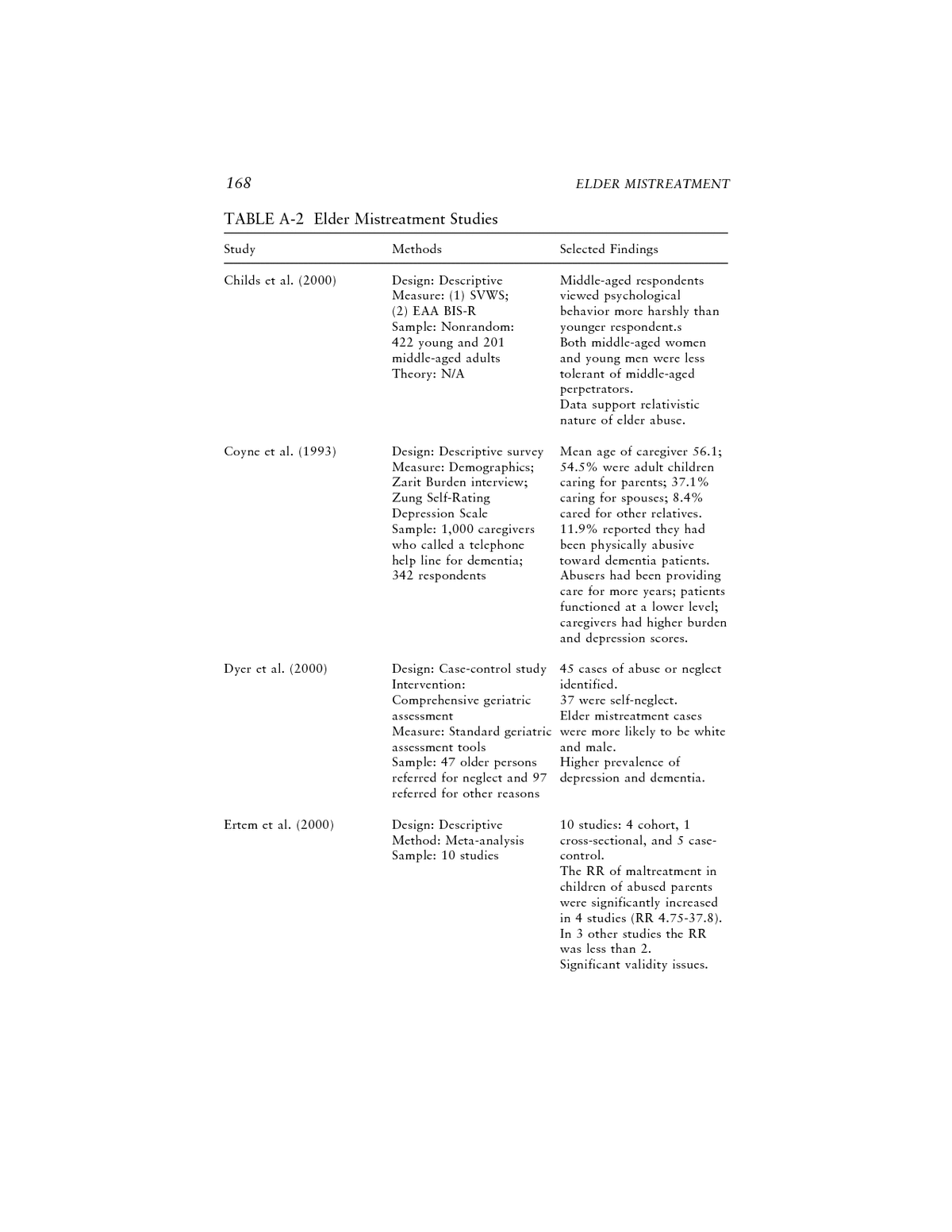
168 ELDER MISTREATMENT TABLE A-2 Elder Mistreatment Studies Study Methods Selected Findings Childs et al. (2000) Design: Descriptive Middle-aged respondents Measure: (1) SVWS; viewed psychological (2) EAA BIS-R behavior more harshly than Sample: Nonrandom: younger respondent.s 422 young and 201 Both middle-aged women middle-aged adults and young men were less Theory: N/A tolerant of middle-aged perpetrators. Data support relativistic nature of elder abuse. Coyne et al. (1993) Design: Descriptive survey Mean age of caregiver 56.1; Measure: Demographics; 54.5% were adult children Zarit Burden interview; caring for parents; 37.1% Zung Self-Rating caring for spouses; 8.4% Depression Scale cared for other relatives. Sample: 1,000 caregivers 11.9% reported they had who called a telephone been physically abusive help line for dementia; toward dementia patients. 342 respondents Abusers had been providing care for more years; patients functioned at a lower level; caregivers had higher burden and depression scores. Dyer et al. (2000) Design: Case-control study 45 cases of abuse or neglect Intervention: identified. Comprehensive geriatric 37 were self-neglect. assessment Elder mistreatment cases Measure: Standard geriatric were more likely to be white assessment tools and male. Sample: 47 older persons Higher prevalence of referred for neglect and 97 depression and dementia. referred for other reasons Ertem et al. (2000) Design: Descriptive 10 studies: 4 cohort, 1 Method: Meta-analysis cross-sectional, and 5 case- Sample: 10 studies control. The RR of maltreatment in children of abused parents were significantly increased in 4 studies (RR 4.75-37.8). In 3 other studies the RR was less than 2. Significant validity issues.
APPENDIX A 169 TABLE A-2 Continued Study Methods Selected Findings Fulmer and Gurland (1996) Design: Descriptive Cognitive impairment risk Measure: CTS, FRS and factor for elder NMAP Survey, Beck mistreatment. Depression Scale, BDBS CTS higher for CI patients. Sample: 125 elder-caregiver FRS higher for CI patients. dyads; 51 dyads with CI patients more dependent. cognitive impairment and CI patients had higher 74 dyads with no cognitive BDBS. impairment; mean age of CI patients had higher Zarit the elder 78 years Burden scores. Theory: Risk and vulnerability Fulmer et al. (1999) Design: Descriptive Prevalence of elder Method: Analysis of a mistreatment 12.3%. probability sample of Apprehensive behavior was ADHC clients in New highest reported behavior; York State. Social workers with this item removed, served as informants. prevalence 3.6%. Sample: 9 sites drawn Social workers noted through random sampling concern regarding elders who appeared frightened in the presence of their home caregiver. Fulmer et al. (2000) Design: Descriptive 36 patients eligible for Measure: EAI, MMSE study. Sample: 180 emergency 7 patients screened positive department patients over for neglect. the age of 70 with MMSE Nurses were able to screen of 18 or greater for elder neglect with greater than 70% accuracy; true positive 71%, false positive 7%. Huber et al. (2001) Design: Descriptive 5 most frequent complaints Method: Analysis of were (1) loss of dignity and cross-sectional 6-state respect; (2) accidents; (3) ombudsman database physical abuse; (4) call lights Sample: 23,787 complaints unanswered; (5) poor personal hygiene. Race and gender differences noted. Hudson (1991) Design: Descriptive Agreement on a 5-level Measure: 3-round Delphi taxonomy. survey 11 theoretical definitions Sample: 63 elder proposed by panel. mistreatment experts
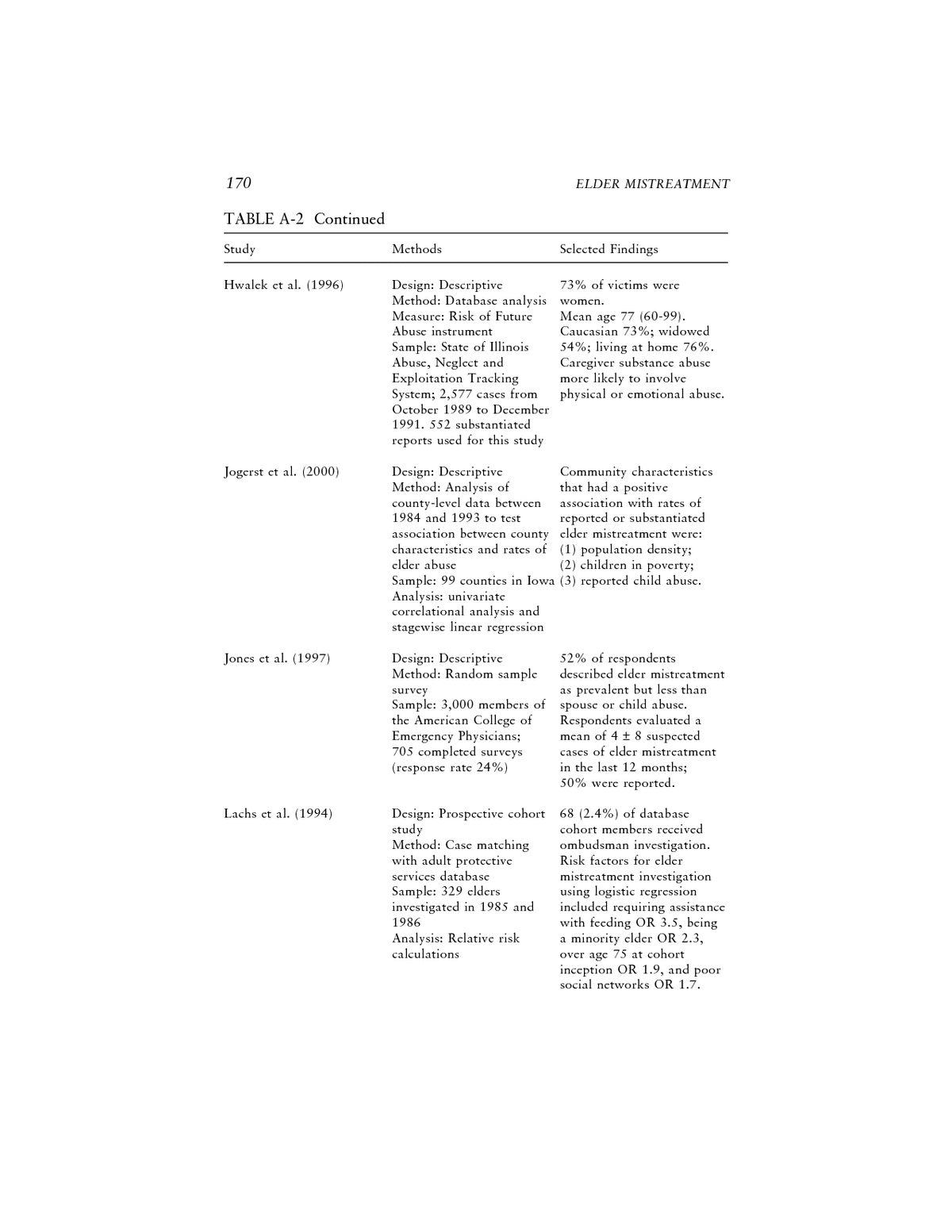
170 ELDER MISTREATMENT TABLE A-2 Continued Study Methods Selected Findings Hwalek et al. (1996) Design: Descriptive 73% of victims were Method: Database analysis women. Measure: Risk of Future Mean age 77 (60-99). Abuse instrument Caucasian 73%; widowed Sample: State of Illinois 54%; living at home 76%. Abuse, Neglect and Caregiver substance abuse Exploitation Tracking more likely to involve System; 2,577 cases from physical or emotional abuse. October 1989 to December 1991. 552 substantiated reports used for this study Jogerst et al. (2000) Design: Descriptive Community characteristics Method: Analysis of that had a positive county-level data between association with rates of 1984 and 1993 to test reported or substantiated association between county elder mistreatment were: characteristics and rates of (1) population density; elder abuse (2) children in poverty; Sample: 99 counties in Iowa (3) reported child abuse. Analysis: univariate correlational analysis and stagewise linear regression Jones et al. (1997) Design: Descriptive 52% of respondents Method: Random sample described elder mistreatment survey as prevalent but less than Sample: 3,000 members of spouse or child abuse. the American College of Respondents evaluated a Emergency Physicians; mean of 4 ± 8 suspected 705 completed surveys cases of elder mistreatment (response rate 24%) in the last 12 months; 50% were reported. Lachs et al. (1994) Design: Prospective cohort 68 (2.4%) of database study cohort members received Method: Case matching ombudsman investigation. with adult protective Risk factors for elder services database mistreatment investigation Sample: 329 elders using logistic regression investigated in 1985 and included requiring assistance 1986 with feeding OR 3.5, being Analysis: Relative risk a minority elder OR 2.3, calculations over age 75 at cohort inception OR 1.9, and poor social networks OR 1.7.
APPENDIX A 171 TABLE A-2 Continued Study Methods Selected Findings Lachs et al. (1997a) Design: Prospective cohort 47 cohort members were study seen for elder mistreatment Method: Case matching (prevalence 1.6%). with adult protective Age, race, poverty, services database functional disability, and Sample: 184 cohort cognitive impairment were members identified as risk factors for Analysis: Pooled logistic reported elder mistreatment, regression with ORs reported. The onset of new cognitive impairment was also associated with abuse and neglect. The influence of race and poverty is likely to be overestimated due to reporting bias. Lachs et al. (1997b) Design: Prospective cohort 114 individuals accounted study for 628 visits (median 3, Method: 7-year range 1-46). longitudinal database with 30.6% resulted in hospital identification of 182 admission. victims of elder abuse 66% had at least one visit Sample: 114 elders seen in that resulted in an injury- 2 emergency departments related chief complaint. Lachs et al. (1998) Design: Prospective cohort Cohort members seen for study elder mistreatment at any Measure: mortality among time during follow up had elders for whom protective poorer survival (9%) than services were used to others. corroborate mistreatment Reported and corroborated and elderly persons for elder mistreatment and whom protective services self-neglect are associated were used for self-neglect with shorter survival after Sample: 176 adult adjusting for other factors protective services elders associated with increased mortality in older adults.
172 ELDER MISTREATMENT TABLE A-2 Continued Study Methods Selected Findings Moody et al. (2000) Design: Descriptive Principal components FA of Measure: H-S/EAST 15-item instrument Sample: 100 black, supported the 3-factor Hispanic, and white elders structure for a total of 10 living in public housing items explaining 38% of the variance. Discriminant function analysis showed that 6 items were as effective as the 9-item model in classifying cases as abused (71.4%). National Center on Elder Design: Descriptive study 551,000 elder mistreatment Abuse at the American Method: Incidence study cases in 1996. Public Human Services using sentinel agency Female elders are abused at Association [formerly reports higher rates than males. American Public Welfare Sample: 20 counties in 15 The oldest elders (80 years Association] in states: nationally and older) are abused and collaboration with representative sample neglected at 2-3 times their Westat, Inc. (1998) proportion in the elderly population. In almost 90% of elder mistreatment cases, the perpetrator is a family member and 2/3 are adult children or spouses. Victims of self-neglect are usually depressed, confused, or extremely frail. OâMalley et al. (1984) Design: Descriptive Cases divided into three Measure: Case analysis categories: (1) extremely using OARS impaired who receive care Sample: 24 cases from from individuals responsible primary care clinic for abuse and neglect (N = 4); (2) impaired elders who receive inadequate or intermittent care (N = 9); (3) involved independent elders whose only care needs resulted from threats or violence from relatives (N = 11).
APPENDIX A 173 TABLE A-2 Continued STudy Methods Selected Findings Paveza et al. (1992) Design: Descriptive Severe family violence as Measure: CTS measured by the CTS was a Sample: Purposive sample significant problem: overall from Alzheimerâs disease prevalence 17.4%. registry: 184 patients 15.8% of patients had been violent since diagnosis. 5.4% of caregivers reported being violent toward the patient. Violence by the Alzheimerâs disease patient against the caregiver was serious problem. Pavlik et al. (2001) Design: Descriptive Neglect accounted for 80% Method: Analysis of Texas of allegations. Department of Protective The incidence of being and Regulatory Services, reported to adult protective Adult Protective Services services increased sharply Sample: 62,258 allegations after age 65. of elder mistreatment in Prevalence was 1,310 over 1997 100,000 > 65 years of age. Phillips and Rempusheski Design: Descriptive 4-stage model describing (1985) Method: Interviews with decisions of health care grounded theory analysis providers about elder abuse. Sample: 29 health care Model identifies 3 types of providers (16 nurses and decisions: diagnostic, value, 13 social workers) and intervention. Complexity of decision processes is revealed via 5 pathways. Phillips et al. (1990a) Design: Adaptation of the QUALCARE Scale contains QUALPACS six subscales and 53 items. Method: Instrument Included in 6 subscales: development environmental, physical, Sample: Piloted with 8 medical maintenance, data collectors (4 in each psychological, human rights, of 2 sites) who interviewed and financial. 4 elder-caregiver dyads. A total of 29 elder-caregiver dyads were interviewed
174 ELDER MISTREATMENT TABLE A-2 Continued Study Methods Selected Findings Phillips et al. (1990b) Design: Descriptive Interrater reliability for 55 correlational study observations ranged from Measure: QUALCARE 79% to 88%. Sample: Convenient sample Internal consistency: of 249 elder-caregiver alpha = .097. dyads Conceptual structure: confirmatory factor analysis indicated 6 significant factors accounting for 64.4% of the variance. Criterion validity: all correlations between criteria variables and QUALCARE were in correct direction and p < 0.05 level. Construct validity: 8 of 9 correlations in the predicted direction. Pillemer and Finkelhor Design: Descriptive 63 elder persons were (1988) Method: Stratified random maltreated. sample survey Rate of 32 per 1,000. Sample: 2,020 community- 95% confidence interval of dwelling elders in 25-39 per 1,000. metropolitan Boston No minority differences or age differences. Those in poor health were 3 to 4 times likely to be abused. Males were more likely to be abused than females. Pillemer and Finkelhor Design: Descriptive Factors associated with elder (1989) Method: Case control mistreatment included Sample: 46 abuse or abuser factors of deviance, neglect victims and 215 dependence on victim, and random controls life stress. Victim factors included court help, disability, dependence on abuser, and conflictual relationship (spouse only).
APPENDIX A 175 TABLE A-2 Continued Study Methods Selected Findings Pillemer and Moore (1989) Design: Descriptive 36% of the sample had seen Measure: CTS at least one incident of Sample: 577 nursing physical abuse in the personnel from 31 nursing preceding year. homes in New Hampshire Most frequent abuse observed was excessive restraint. Second most frequent type was physical abuse. 81% observed at least one psychologically abusive incident in the preceding year. 10% of respondents reported committing physical abuse. 40% of respondents reported committing psychological abuse. Pillemer and Suitor (1992) Design: Descriptive Characteristics predictive of Method: Analysis of violent feelings in caregivers quantitative and included physical aggression qualitative data by elder, disruptive Sample: 236 family behaviors, and a shared caregivers for dementia living situation. victims Structural relationship and caregiver age were related to actual violence: spouses were more likely to be violent than other relatives, as were older individuals. Violence by elder was positively related to caregiver violence. Rosenblatt et al. (1996) Design: Descriptive 17,238 of cases were older Method: Analysis of State than age 65. of Michigan records of Physicians reported only 2% reported cases of suspected of cases. elder abuse 1989â1993 Physician reporting rates did Sample: 27,371 cases of not increase over a 5-year possible elder mistreatment period.
176 ELDER MISTREATMENT TABLE A-2 Continued Study Methods Selected Findings Shaw (1998) Design: Descriptive The two types of abusive Method: Grounded theory nursing home staff were Sample: 21 semistructured identified as reactive and interviews conducted with sadistic. six abuse investigators and 15 nursing home staff Wolf (1986) Design: Descriptive Victims and nonabuse clients Method: Analysis of cases were similar in age, sex, and from an elder mistreatment health status. intervention project Caretakers for both groups Sample: 59 elder were similar in age and mistreatment cases health status. compared with 49 cases More perpetrators were randomly selected from a males. nonabuse caseload A majority of elder mistreatment cases resided with family members versus nonabused persons living alone. Victims and perpetrators had more psychological and emotional health problems. Abused elders did not appear to be more dependent. Wolf and Pillemer (1997) Design: Descriptive Wives more likely to be Measure: ADLs, IADLs, dependent on husbands for CTS IADLs. Sample: 73 older women: Adult children more likely to 22 victimized by husbands be dependent on mothers and 51 victimized by adult for housing and finances. children Husbands more likely to use physical violence against wives than adult children
APPENDIX A 177 TABLE A-2 Continued Study Methods Selected Findings against mothers. Wolf and Li (1999) Design: Descriptive Rate of reports varied from Measure: DV was number a low of 2.41 per 1,000 of reports per 1,000 through 9.31 per 1,000. persons age 60 years and Higher rates of reporting older during 1994 were associated with lower Sample: 27 geographical socioeconomic status, more areas in Massachusetts community training, higher agency service rating scores, lower community agency relationship score. SOURCE: Adapted from Fulmer (2002).
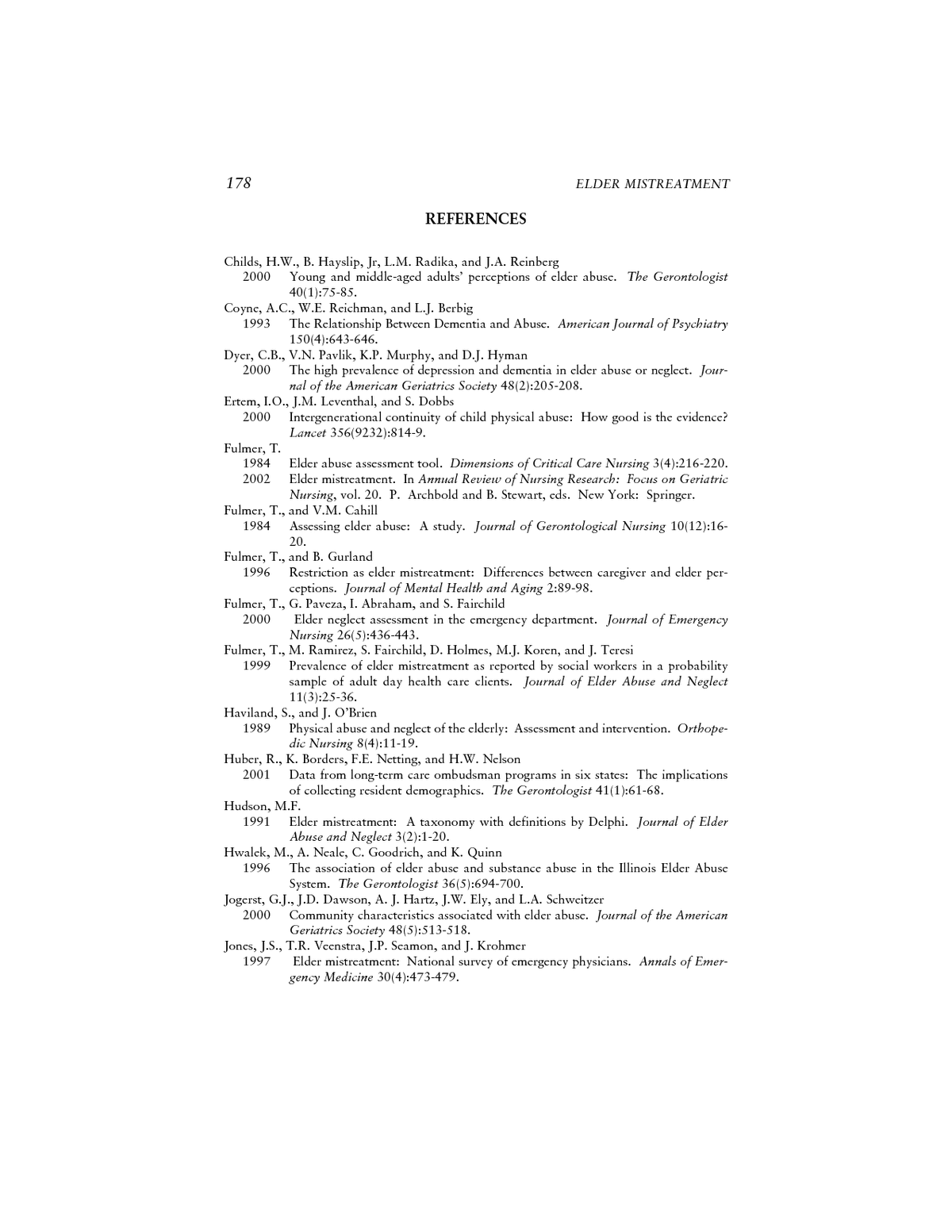
178 ELDER MISTREATMENT REFERENCES Childs, H.W., B. Hayslip, Jr, L.M. Radika, and J.A. Reinberg 2000 Young and middle-aged adultsâ perceptions of elder abuse. The Gerontologist 40(1):75-85. Coyne, A.C., W.E. Reichman, and L.J. Berbig 1993 The Relationship Between Dementia and Abuse. American Journal of Psychiatry 150(4):643-646. Dyer, C.B., V.N. Pavlik, K.P. Murphy, and D.J. Hyman 2000 The high prevalence of depression and dementia in elder abuse or neglect. Jour- nal of the American Geriatrics Society 48(2):205-208. Ertem, I.O., J.M. Leventhal, and S. Dobbs 2000 Intergenerational continuity of child physical abuse: How good is the evidence? Lancet 356(9232):814-9. Fulmer, T. 1984 Elder abuse assessment tool. Dimensions of Critical Care Nursing 3(4):216-220. 2002 Elder mistreatment. In Annual Review of Nursing Research: Focus on Geriatric Nursing, vol. 20. P. Archbold and B. Stewart, eds. New York: Springer. Fulmer, T., and V.M. Cahill 1984 Assessing elder abuse: A study. Journal of Gerontological Nursing 10(12):16- 20. Fulmer, T., and B. Gurland 1996 Restriction as elder mistreatment: Differences between caregiver and elder per- ceptions. Journal of Mental Health and Aging 2:89-98. Fulmer, T., G. Paveza, I. Abraham, and S. Fairchild 2000 Elder neglect assessment in the emergency department. Journal of Emergency Nursing 26(5):436-443. Fulmer, T., M. Ramirez, S. Fairchild, D. Holmes, M.J. Koren, and J. Teresi 1999 Prevalence of elder mistreatment as reported by social workers in a probability sample of adult day health care clients. Journal of Elder Abuse and Neglect 11(3):25-36. Haviland, S., and J. OâBrien 1989 Physical abuse and neglect of the elderly: Assessment and intervention. Orthope- dic Nursing 8(4):11-19. Huber, R., K. Borders, F.E. Netting, and H.W. Nelson 2001 Data from long-term care ombudsman programs in six states: The implications of collecting resident demographics. The Gerontologist 41(1):61-68. Hudson, M.F. 1991 Elder mistreatment: A taxonomy with definitions by Delphi. Journal of Elder Abuse and Neglect 3(2):1-20. Hwalek, M., A. Neale, C. Goodrich, and K. Quinn 1996 The association of elder abuse and substance abuse in the Illinois Elder Abuse System. The Gerontologist 36(5):694-700. Jogerst, G.J., J.D. Dawson, A. J. Hartz, J.W. Ely, and L.A. Schweitzer 2000 Community characteristics associated with elder abuse. Journal of the American Geriatrics Society 48(5):513-518. Jones, J.S., T.R. Veenstra, J.P. Seamon, and J. Krohmer 1997 Elder mistreatment: National survey of emergency physicians. Annals of Emer- gency Medicine 30(4):473-479.
APPENDIX A 179 Lachs, M.S., L. Berkman, T. Fulmer, and R. Horwitz 1994 A prospective community-based pilot study of risk factors for the investigation of elder mistreatment. Journal of the American Geriatrics Society 42(2):169-73. Lachs, M.S., and T. Fulmer 1993 Recognizing elder abuse and neglect. Clinical Geriatric Medicine 9(3):665-81. Lachs, M.S., C. Williams, S. OâBrien, L. Hurst, and R.I. Horwitz 1997a Risk factors for reported elder abuse and neglect: A nine-year observational cohort study. The Gerontologist 37(4):469-474. Lachs, M.S., C.S.Williams, S. OâBrien, L. Hurst, A. Kossack, A. A. Siegal, and M.E. Tinetti 1997b ED use by older victims of family violence. Annals of Emergency Medicine 30(4):448-454. Lachs, M. S., C.S. Williams, S. OâBrien, K.A. Pillemer, and M.E. Charlson 1998 The mortality of elder mistreatment. Journal of the American Medical Associa- tion 280(5):428-432. Moody, L. E., A. Voss, and C.A. Lengacher 2000 Assessing abuse among the elderly living in public housing. Journal of Nursing Measurement 8(1):61-70. The National Center on Elder Abuse 1998 The National Elder Abuse Incidence Study Final Report: Washington, DC: Na- tional Center on Elder Abuse. Neale, A., M. Hwalek, R. Scott, M. Sengstock, and C. Stahl 1991 Validation of the Hwalek-Sengstock Elder Abuse Screening Test. Journal of Applied Gerontology 10(4):406-418. OâBrien, J. G. 1986 Elder abuse and the physician. Michigan Medical Journal 85(11):618, 620. OâMalley, T.A., H.C. OâMalley, D.E. Everitt, and D. Sarson 1984 Categories of family-mediated abuse and neglect of elderly persons. Journal of the American Geriatrics Society 32(5):362-9. Paveza, G.J., D. Cohen, C. Eisdorfer S. Freels, T. Semla, J.W. Ashford, P. Gorelick, R. Hirschman, D.J. Luchins, and P. Levy 1992 Severe family violence and Alzheimerâs disease: Prevalence and risk factors. The Gerontologist 32(4):493-497. Pavlik, V.N., D.J.Hyman, N.A. Festa, and C. Bitondo Dyer 2001 Quantifying the problem of abuse and neglect in adultsâanalysis of a statewide database. Journal of the American Geriatrics Society 49(1):45-48. Phillips, L.R., E.F. Morrison, and Y.M. Chae 1990a The QUALCARE Scale: Developing an instrument to measure quality of home care. International Journal of Nursing Studies 27(1), 61-75. 1990b The QUALCARE Scale: Testing of a measurement instrument for clinical prac- tice. International Journal of Nursing Studies 27(1):77-91. Phillips, L.R., and V.F. Rempusheski 1985 A decision-making model for diagnosing and intervening in elder abuse and ne- glect. Nursing Research 34(3):134-139. Pillemer, K.A., and D. Finkelhor 1988 The prevalence of elder abuse: A random sample survey. The Gerontologist, 28(1):51-57. Pillemer, K.A., and D. Finkelhor 1989 Causes of elder abuse: Caregiver stress versus problem relatives. American Jour- nal of Orthopsychiatry 59(2):179-187.
180 ELDER MISTREATMENT Pillemer, K.A., and D.W. Moore 1989 Abuse of patients in nursing homes: Findings from a survey of staff. The Geron- tologist 29(3):314-320. Pillemer, K. A., and J.J. Suitor 1992 Violence and violent feelings: What causes them among family caregivers? Jour- nal of Gerontological Nursing 47(4):S165-S172. Reis, M., and D. Nahmiash 1998 Validation of the indicators of abuse (IOA) screen. The Gerontologist 38(4):471- 480. Rosenblatt, D. E., K.H. Cho, and P.W. Durance 1996 Reporting mistreatment of older adults: The role of physicians. Journal of the American Geriatrics Society 44(1):65-70. Shaw, M.M.C. 1998 Nursing home resident abuse by staff: Exploring the dynamics. Journal of Elder Abuse and Neglect 9(4):1-21. Straus, M..A. 1978 The Conflict Tactic Scale. Reprinted in Handbook of Family Measurement Tech- niques, J. Touliatos, B. Perlmutter, and M. Straus, editors. Newbury Park, CA: Sage. Tatara, T 1993 Understanding the nature and scope of domestic elder abuse with the use of state aggregate data: Summaries of key findings of a national survey of state APS and aging agencies. Journal of Elder Abuse and Neglect 5:35-57. Wolf, R.S. 1986 Major findings from three model projects on elderly abuse. In Elder Abuse: Conflict in the Family, K.A. Pillemer and R.S. Wolf, eds. Dover MA: Auburn House Publishing. Wolf, R.S., and D. Li 1999 Factors affecting the rate of elder abuse reporting to a state protective services program. The Gerontologist 39(2):222-228. Wolf, R.S., and K.A. Pillemer 1997 The older battered woman: wives and mothers compared. Journal of Mental Health & Aging 3(3):325-336.
