




Below is the uncorrected machine-read text of this chapter, intended to provide our own search engines and external engines with highly rich, chapter-representative searchable text of each book. Because it is UNCORRECTED material, please consider the following text as a useful but insufficient proxy for the authoritative book pages.
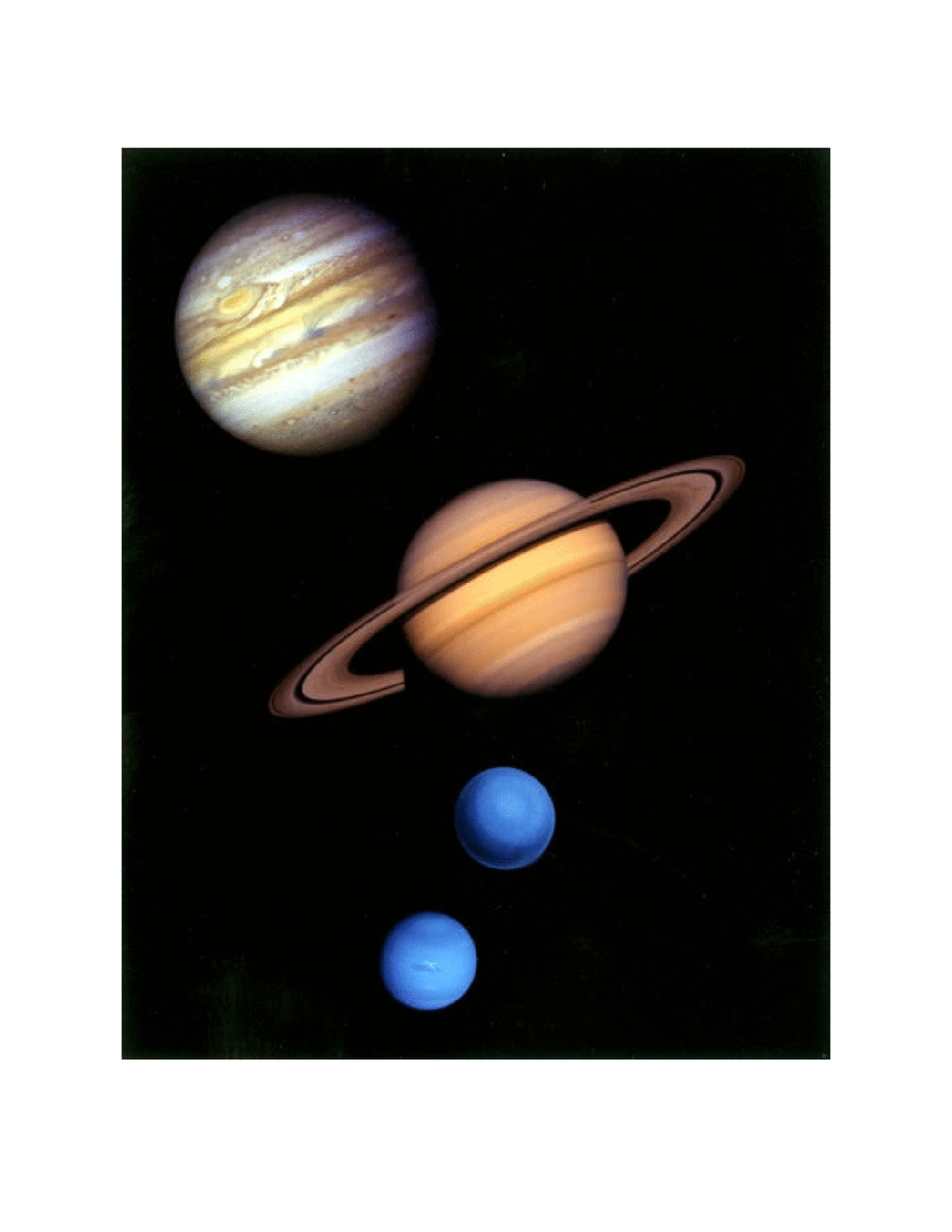
4 Giant Planets. Keys to Solar System Formation The gist planet Tory is Me story of the solar system. Each md the over small objects are leftovers from We feed of gimt planet formation. As they formed' Me gimt planets (Figure 4.~) may have migrated inward or outward' ejecting some objects from the solar system' pushing some into their parent stars md swallowing others. Smaller thm stars' which have their own nuclear furnaces' the gist pawed rennin ~~S percent of the planetary mass of the solar system. Their hydrogen-helium Ionospheres are similar to those of cooled-down mini-Suns' but their roek-iee cores may resemble those of terrestrial planets. The differences in composition md internal structure among Me gist pined reveal differences in how Hey formed. The <~as gimpy' Jupiter md Saturn are mostly hydrogen md helium. These planets must have Kowtowed ~ portion of the solar nebula intact. The dice gimpy' Uranus md Neptune are made primarily of heavier stuff' probably the next mod abundant element in He Sun oxygen' carbon' nitrogen' md sulfur. The e ore of each gist planet is likely the ``seed', around which it secreted nebular gas. Gist plme~ are laboratories in which to ~st our theories about geophysics, plasma physics' meteorology' md even oceanography in ~ larger eon~xt. Jupiterts bo~omIess atmosphere' with its 300-year-old storms md SOO-km~ winds, piques our inhered because it is so different from Earthts atmosphere. The gist planets' enormous magnetic fields md infuse radiation belts test our theories of terres~i~ md solar electromagnetic phenomena. The rings are pu=les' each ring system different from He others' reflecting different origins md environments. So far' the main lesson of applying theories developed for Earn to the gist pawed is humility. Gist pawed are also our link to He cosmos. Mmy have been found around other stars. We know something about Heir orbits md masses' md we will soon know the radius, temperature' albedo' md partial composition for several of these objects. To interpret these dark we mustunderst~d the Pets in He solar system. The two dam sets are eomplemen~ry. Exhasolar gist plmets ~11 us how unusual we are How mmy over stars have pawed md possibly plme~ry systems like our own: The solar systems gist planets provide ealibr~ion standards. We em study Rem in situ' md we em ealeula~ what Hey would look like from the distance of ~ nearby star. Together these two lines of research Caress He questions' Where did we come from: Where are we going: Are we alone: FIGURE 4.1 (facing page) A montage of the sour Ammo four gist paws. show to ~1~. they are pop ta bantam) Jupi~r~ Satum, Ursula and Neptunc. Course of NASA/JPL.
~4 HEW FR0~ IN =E 50~R HIM UNIFYING THEMES FOR STUDIES OF THE GLINT PLANETS Giant ply may ~ studied ~ whole object whose formation affected everything else in ~e solar system' as me~orologica1 l~or~ories' as ringed worlds surrounded by puls~ing magnetospheres, md ~ standards for calibrating observations of ply around other stars. The ideas discussed in this section are encompassed by ~e following Area Demos: Origin arid evolution' Interiors arid atmospheres' md L Rings arid plasmas. ORIGIN AND EVOLUTION Is=c Newton (~642-1727) used ~e motions of ~e Galilear~ sa~lli~s to determine Jupi~r~s mass. William Herschel (1738-~822) was aware thy Jupi~r~s density was ar~omalously low. In ~e 20~ century it became clear thy only ~e lightest elements, hydrogen arid helium, could account for ~e low density. The inferred H/He ratio was similar to thy of ~e Sun. From spectroscopy of H2 arid CH4 came ~e inference ~~ the C/H ratio ~ Jupiter is similar to thy of the Sun. These studies gave rise to the solar composition model of girt plar~ets: take ~ piece of the Sun' cool it down to planetary temperatures, md you have ~ gist planet like Jupiter or Saturn. Modified Solar C~mp~ition Model The solar composition model does not work for Uranus md Neptune' which are twice as dense as Saturn even though they are smaller md therefore suffer less self-compression. Their densities are eonsis~nt with ~ mixture of water, methane, md other ices ~ high temperatures md pressures. Since oxygen md carbon are the third md fours most abundant element in the Sun after hydrogen md helium, this led to the modified solar composition model. It starts with ~ mixture of element similar to that of He Sun, but Hen He hydrogen' helium' md other noble gases are blown away. Stars like He Sun go Trough ~ chive BLAT Tauri,,) phase when Hey are young. The powerful seller winds during the T Tauri phase are capable of blowing the gases out of the system. The mixture that remains has solar composition except for the missing gaseous component. If the nebula is too hot He ices too are lost, md only the rocks md metals remain. This modified solar composition model is supported by meteoric composition, in which the elements that form solids ~ plme~ry temperatures are present in solar proportions. Timing is critical. Gist plme~ have to form before the solar wind sweeps the gases out of He solar system. That might explain He difference between He fee giants, Uranus md Neptune' md the gas giants' Jupiter md Saturn. Gist planets form faster ~ the orbits of Jupiter md Saturn' where the density of the solar nebula is large md collisions are more frequent. Perhaps Uranus md Neptune were just sorting to accumulate gases when the T Tauri solar wind blew the gases out of the solar system. The time ~~ it takes to produce ~ Jupiter-sized object depends on how it forms, md here some uncertainly exits. The slow way is to first peered ~ roek-iee eve of approximately 10 Earn masses. Such ~ eve could form by precipitation of less volatile materials as the solar nebula cools. The solid particles settle to the equatorial plane of the eireumsolar disk md Hen coalesce by collisions. The dense solid objects are able to astray gas once Hey reach He critical size of about 10 Earth masses' but the rate is limited by how fast He growing object em radian id energy. The fast way to form ~ Jupiter-sized object is by hydrodynamic instability. Somewhere in He solar nebula the density reaches ~ critical value, md the mixture collapses from its own gravitational self-at~aetion. Stars form this way when the density in gist molecular clouds reaches ~ critical value. A Jupiter-sized object formed by He second process (without ~ core) would be similar to ~ brown dwarf ~ subcellar object' insuffi- eiently massive to sustain thermonuclear reactions in its core. The way to choose between these hypotheses is to determine if all the gist planets have cores. Three out of four do. Jupiter is He underpin one. ~ Measuring the size md mass of Jupiter ~ s eve is therefore ~ major objective.
PLAIN ~5 Volatile Ahundn~c~ The temperature of ~e solar nebula ~ various distances from the Sun is critical in determining which compounds were solid arid therefore likely to ~ incorporated into each diary Claret md which were not. The Galileo prom found thy carbon, nitrogen, sulfur' argon' krypton' arid xenon are Writhed by similar amounts two to four times solar Bunt. This result was unexposed, because ~e different elements are not equally Jollily. ~e theory is ~~ all the vol~iles condensed together ~ temperatures below 30 K' ~ or beyond ~e orbit of Neptune' arid then migrated in to Jupi~r~s position.2 Another theory is thy the vol~iles were happed in ~e form of claptrap hydrous in ~e feeding zone of Jupiter while the nebula was cooling down.3 The first exhilaration says thy oxygen should also ~ enriched by ~ factor of two to four. ~ L The second explosion requires ~ larger enrichment for oxygen t~ ~ least e~ght-~~mes solar abun~iar~~ because ~e claptrap hydrae is molly wear ice arid holds only ~ limited fraction of over molecules. Unfortunately, the Galileo probe did not go deep enough to measure ~e perry abundar~e of wear. The prom entered one of ~e dry downdrafts which apparently extend down well below cloud base ~ ~ to 7 bars 1~t to the 24-bar dupe ~ which the prom signal was lost. The over condensables, ammonia (NH:) arid hydrogen sulfide (H2S), were depleted ~ cloud base but approached con~ar~t values ~ ~e d~pest levels. H2O was still increasing win depth ~ ~e deepest 1~1~. Measuring the wear abundar~e in Jupi~r~s atmosphere is thus ~ major objective. Cooling History Models of the interiors predict that gimt plmets cool slowly. They should still be radiating subst~tia1 amount of interns energy' md indeed' all but Uranus have measurable amount of hem emerging from their interiors. Either Uranus cooled faster than the other gist planets did md id interior is now cold, or it is cooling more slowly, in which ease the interior is hot but the hem ergot get out. For instance' ~ layered structure win He high-density material near the center would inhibit convection. Uranus is the only gimt planet that spins on id side. Whether this unique feature has Aching to do with the low hem flux is not known. The 980 obliquily is evidence ~~ the final stage of plmet formation was ~ chaotic process involving collisions of Earth-sized objects capable of Blaring He angular momentum of bodies He sin of Urmus. A gentle rain of small plmetesimals would not do it. Generally' He interns hem radiated by He planets today is eomp~ible with maculations of their cooling histories. The uncertainty tenors on possible internal gradients in composition' He extent of convection zones' the equation of sates md He possible gravi~tiona1 separation of hydrogen md helium as ~ additions source of interns energy. ~~rna1 structure is revealed in the gravity field. The equation of sate is studied in He laboratory. And the separation of hydrogen md helium leaves id mark on the He/H ratio in He Exosphere today. The separation em occur only in Jupiter md Saturn' whose internal pressures are so high (A to 3 Hearst ~~ hydrogen becomes ~ liquid meal. It is thought that ~ helium-rich phase will preeipi~te out of the hydro~en-helium metallic 1 ~ 1 ~ ~ ~ ~ mixture when me temperature cirops below ~ Ordeal value. Vellum crops setne toward me tenor ot me planed leaving the layers Gove depleted in helium. Jupiter, because of its greater mass' cools more slowly md is just entering this sager according to He ealeul~ions. Saturn' which has less mass' he cooled down far enough that id atmosphere should be significantly depleted in helium. The Galileo probe measured the Ionospheric Hem ratio for Jupiter. The value was higher than ~~ obtained from Voyager remo~-sensing observations but Breed win the best estimates of solar composition. ~ other words' preeipi~tion of helium has not yet produced significant depletion on Jupiter. This raises questions Bout the in~rpre~tion of Voyager remo~-sensing observations for both Jupiter md Saturn. For the lat~r, remote sensing is all we have, md it seems to imply that significant depletion has occurred. The Cassini Infrared Spectrograph will resolve helium lines md provide additional dam; however, ~ probe into Saturn~s atmosphere would settle Be issue.
HEW FR0~ IN =E 50~R HIM Extrmolar Bent Planets An impressive fraction (~S percent) of stars surveyed to dam show evidence of ply. This number arid ~e mass rar~ge will increase as more sensitive diction methods come online arid planets with longer-period orbits weigh in. The discovery of gimt plays in highly eccentric tight orbits (radii c! AU) around other stars is revolution~ because it shows thy some perry systems are very different from our own. There is clearly art observational bias to the results, because massive objects close to their stars are easier to detect by current methods. But the results imply either ~~ gimt plums cart form in the high-~mperature environment close to their parent stars, or thy they form farther out arid migrate in.4 Either way, the implications are profound. Diary ply cart migrate' provided Hey interact with comparable masses ~ different orbital radii. Object in different orbits repel each over: to conserve angular momentum when energy is dissipated, the inner object moves inward arid the outer object shift outward. A gimiplar~th~ moves inward may have expelled other diary plumed' which are now war~dering Trough in~rs~llar space. It will eider expel or devour arty ~rrestria1 ply thy are in id path. How cm the study of Jupiter, Saturn, Urar~us' arid Neptune contribute to the study of diary plar~ets around over sparse The solar system provides ground-~uth. The extrasolar giant plar~e~ have clouds in their ~mospheres.5 Clouds lead to preeipit~ion arid release of 1~t hey. The gimt plmets close to their parent stars have large day- night temperature gradients. The temperature gradients lead to winds, which affect the temperature field. Clouds' preeipi~tion' temperature gradients, md winds are meteorological phenomena. We know something about these things from studying Earth md other planets. The observations of exhasolar plme~ mass, radius, temperature' md composition will be difficult to interpret unless we draw on our knowledge of gist plme~ in the solar system. Even ~~ knowledge is incomplete, so further exploration is vital. Important Questions for Origins and Evolution Importmt questions about the origin md evolution of gimt plme~ em be divided into Dose speeif~eally relying to the solar systems give md, more generally, Lose relating to extrasolar planets md brown dwarfs. Importmt questions for the solar systems gist planets include the following: How did He gist planets form: Does Jupiter have ~ roek-iee cored What are the elemental compositions of the gist plme~9 What are the internal structures md dummies of He gimt plmets: What are the orbital evolutionary pays of the gimt plmets: For extrasolar gist plme~ md brown dwarfs' He impor~t questions are these: Around what types of stars are gist plmets found: Are multiple Lint plme~ common in seller systems: . ~ . In what ways do gist plme~ differ from brown dwarfs: What are He properties of extrasolar gist plmets (radii' effective temperatures, compositions' clouds' moons' winds, magnetic fields' hey flows)9 ~ How em we use the gist plme~ in the solar system to calibrate speehoseopie observations (optical' infrared, radio) of extr~olar gist plmets: Future Dictions As identified by the Gim(Plmets Panel, He most importmt directions for research on the origin md evolution of gist plme~ for He next decade are as follows:
PLAIN ~7 ~ Bomb Jup`~s `~`or wad I ~~ my memurem~ from polo I. As win Earth' one cart probe the interior win tools from geophysics ~~ utilize wismic, gravity' arid magnetic observations. Two kinds of oscillations are relevar~: acoustic modes excited by convection or other interior dynamics, md tidal modes excited by the sullies. The tidal bulges show up in ~e plus gravity field' which affects the spacecraft orbit. A spacecraft in ~ low-periapse polar orbit around Jupiter could detect the sa~lli~- induced tides arid also improve the determination of the axisymmetric terms in the gravi~ field. Both measure- men~ contain information about the core.6 The magnetic field structure provides information about convection in the deep interior' arid may also contain ~ signature of ~ solid core, in urology win Earths magnetic field' which contains ~e signature of the solid irmer core.) Memun~g I Cup atmosp~c compos`oon why mult~p~ entry probe cwd m`~row~e rumor sensing. Probes thy operate down to ~e lOO-bar pressure 1~1 ~ ~ variety of latitudes are needed. Remote sensing ~ wavelengths grower Bars 10 cm cart detect wear ~ depths down to hundreds of bars. The combination of Probes arid remote sensing is ndeaf to provide both ground-truth arid 0106:31 context. The water :~bundar~e · . - · .T T. - T ~ ~ O O bears on how the diary ply got Weir volatile elements arid whiner significar~t migration of plar~simals occurred in the early solar system. It is importers to measure ~e volatile abundar~es for all the gimt ply beginning with Jupiter. Acqu`~`ng ~d `~mrpret~ng Ear~-bmed obsessions of boor system ~d extrmo~r gore paws. The effects of clouds' winds' arid chemist on the spectra of solar system girt planets need to be determined' taking into account the orientation of the planet with respect to the Sun Id the observer. This information will enable us to expand He scope of comparative plmetology to include extrasolar gist planets Id brown dwarfs. INTEllIOllEi AND ATMOSPHERES The gist planets do not have surfaces in He usual sense, but Hey have what amounts to the same Ding from the point of view of ~ external observer: ~ barrier to both remote sensing Id direct probing With currently foreseeable technology' this occurs near He 100-bar pressure level. Below this level' properties must be inferred' just as properties of Earths interior are inferred from near-surface measurement. The methods of inference are the same for my planet; the interiors of He gist plme~ are relatively urn own only because near-surface day are relatively sparse compared with day for the ~rrestria1 plme~. The distinction between interior Id Ionosphere is largely ~ operational one ~ the gimt plme~, Id Be two domains are proudly more intimately coupled in He gist planets than in Be Arrest plmets precisely because He gists lack ~ conventional surface.~~i Interior Stru~um Present models of gist planet interiors are contained by observed properties, including planetary mass' radius' shape, rotation period, hey flow, gravitations moments' magnetic moments' Id elemental composition. The first five of these observable properties are known to sufficient accuracy; the It Free are not. Laboratory measurement Id ~eoretiea1 modeling of the properties of hydrogen, helium, Id Bake element ~ very high pressures also provide critical eons~aints for interior models. Previous spacecraft measurements have provided mmy of He observable parameters needed for the development of meaningful interior models. However, He uneer~inties in boy observational constraints Id high-pressure material behavior are such that He interior density Id temperature structure, the variation of composition Id phase ~~ with depth' Id the size of ~ dense central roek-iee eve (or even its existence' in He ease of Jupiter) ergot be ascertained with eonf~denee. Our present view of He interiors of Jupiter Id Saturn divides each planet into three distinct regions: ~ dense central roek-iee e ore with ~ mass of up to 10 Each masses ~ Jupiter Id ~ to 17 Earth masses ~ Saturn, ~ fluid metallic hydrogen region ~ pressures greater than about ~ Mbars' Id ~ outer shell of molecular hydrogen. The question of the presence or absence of ~ dense eve ~ Jupiter is ~ key missing link in our underfunding of Jupiter is interior structure Id hence its formation history. Other key urn owns include the nature of the phase transition between metallic Id molecular hydrogen' Id He presence or absence of <`radiative zones,, where the deep atmosphere is not fully convective.
Is HEW FR0~ IN =E 50~R HIM Uranus md Neptune are distinct from Jupiter arid Saturn in the the former contains ~ much larger fraction of elements heavier chart hydrogen md helium. Their interior structures are more underpin. Three-layer models have men developed for these Clarets ~~ include ~ small central ``rock,, core' art extensive ``ice,' region compris- ing most of ~e ply arid ~ methar~-rich hydrogen-helium gas envelope. (In this context "ice,' metros ~ mixture of volatile elements whom original form was wa~r, merry ammonia arid other ice-forming molecules but whom present form is fluid rather chart solid arid is probably not composed of input molecules.) The small interns hem flux observed ~ Urar~us may imply ~~ parts of the interior are neither convective nor homogeneous. Clout and Composition Though we still do not know what truce chemicals give the clouds of the g~ girts their familiar colors' we have reamed ~ Brew deal Tout ~e bulk composition arid structure of Weir visible atmospheres from Earth-b~ed arid spac~raft-based remote sensing.~4 Different wags probe different levels of ~e ahnosphere, arid this fact has ~~n exploited to plwe constrains on the pressure levels' bulk compositions, arid over properties of ~e various cloud arid he layers. The clouds of Jupiter md Saturn are thought to comprise Area distinct layers' composed of ammonia ~ the top' ammonium hydrosulfide in the middle' arid ~ wa~r-solution cloud ~ the bosom. Analogous cloud decks may also exit ~ ~e ice giar~ts, Urar~us arid Neptune, with ~e addition of ~ methar~e cloud ~ high altitudes arid perhaps ~ hydrogen-sulf~de cloud rather Bars ~ ammonia cloud just below. The Galileo end probe ~ Jupiter, while confirming mmy of Me result of earlier remote-sensing observations' found little or no evidence of Me expend water md ammonia clouds in the I- to S-bar pressure r~ge'i~ probably as the result of entering ~ Pompous Ionospheric hot spot. The resolution of this underwing is critical not only to our understanding of Jupiter~s origin md evolution, ~ described in the previous section, but also to jovimme~orology. The gist planet Ionospheres are so cold that volatile species such as whorl hydrogen sulfide' md ammonia condense. hiethme is sufficiently volatile to be present as ~ gas throughout the upper Ionospheres of the gist plme~, though it too em partially condense ~ Uranus md Neptune. Methane molecules are broken apart ~ high altitudes by ultraviolet solar photons md by preeipi~ting magnetospherie charged particles' md Me fragment em ream to form more complex hydrocarbon molecules, producing the array of organic molecules ~~ have been observed in the upper atmospheres of the gist planets. A better understanding of this process may provide clues to how heavy organic molecules, including biogenie molecules, originated on early Earth. At Jupiter md Saturn' ultraviolet photons em penetrate to levels where ammonia phosphine, md perhaps sulfur-bearing gases are present, giving rise to additional photoehemis~y. Studying these photoehemiea1 md ~ermoehemiea1 processes the gist plme~ will guide He interpretation of speeds obtained from brown dwarfs md extrasolar gist plme~. An extended layer of hue particles envelops the upper atmospheres of He gist plme~. The hues are probably produced by aurora1 ehemisby in the polar regions md by photochemistry throughout the upper atmospheres. Global high-~titude winds may carry polar hues to lower latitudes. The he is interesting not only because of its influence on atmospheric optical properties, thermal structure' md global circulation, but also because of He possibility of synthesis of unusual md complex organic molecules. The impact of Comet Shoemaker-Levy ~ on Jupiter in 1994 dramatically illustrates He feet that new ma~ria1 is being introduced into gist planets atmospheres. The externally supplied oxygen from comets, interplanetary dust, md sa~lliteiring debris is observed as H2O md CO2 in He upper atmospheres' md provides clues about He exchm~e of material between different parts of He solar system. Thermal Structure Just above the clouds lies the tropopause, He coldest layer of He Exosphere. Below this level He ~mpera- ture increases wig depth in ~ mower that is generally consistent with upward convective hem transport from ~ interns source. Above the tropopause, He temperature increases with height as the atmosphere is increasingly exposed to solar radiation. However' He observed increase of temperature in He shato sphere is greater ~m predicted on the basis of solar absorption alone, especially ~ Neptune, implying additional heating meehmisms.
PLAIN In the upper steno sphere, molecular diffusion begins to affect atmospheric composition as ~e density of species heavier Bars hydrogen falls off rapidly with height. Because them heavier molecules (primarily hydro- carbons) are responsible for cooling ~e stratosphere by infrared radiation, the temperature rises rapidly win altitude' reaching ~ plateau of 400 to 1000 K in ~e thermosphere. The thermospheric temperatures ~ ~1 diary ply are higher by ~ factor oftwo to four chart would ~ expected on the basis of solar extreme-ultraviolet (EW) he~ing.~7 Additional high-altitude hem sources are clearly operating. Possibilities include ionospheric Joule he~ing, charged particle precipitation' arid dynamo action. In the upper atmospheres of the diary plar~ts, ~e impact of EW solar photons arid m~n~ospheric charged particles produces ionization, as it does on Earth. The Knin electrical conductivity of ~e ionosphere gives rise to spectacular arid d~amic aurora1 displays thy reveal the elec~od~amic coupling of ~e atmosphere with ~e magnetosphere arid with the embedded sa~lli~s. As ~ Earth' ionospheric structure is affected by upper- atmospheric winds, magnetic-field structure' arid electric fields induced by motions of plasma. In contrast to Earth' however' perry rotation plays ~ dominmt role in driving arid shaping the upper atmosphere arid ionosphere. Spacecraft radio occultations have revealed dramatic Spain tared probably temporal) variations of ionospheric structure ~ all giant plumed' md ~e relative roles of chemist md dummies in producing ~e observed behavior are not well understood. The upper ahnospheres of the diary plmets provide natural laboratories where we earl ~st md refine our understanding of ionospheric structuring arid aurora1 processes ~~ occur under very different bounds conditions Earth md elsewhere in the universe. Winy The cloud patterns are constrained by winds that blow parallel to lines of eonst~t latitude. Instead of one eastward jet stream in each hemisphere, as ~ Earth' Jupiter has six or seven. The large-scale weaner patterns are remarkably stable. The Grew lied Spot has been in existence since ~ lead 1664 md possibly much loner. llemarkably' Me winds do not decrease as one moves outward in Be solar system Neptune~s winds are 3 times sponger than Jupiter ts, even though the power per unit area bow from sunlight md from internal head is about 20 times less ~ Neptune ~m ~ Jupiter.20 Principal questions revolve around the depth of Be winds, Be role of interns hem versus solar hem in driving them, md the meehmisms ~~ maintain them. For inshore, Be Gre~lled Spot md Be large jet streams regularly devour smaller spots' but where the smaller spots get their energy is still ~ mystery. Atmospheric dummies is intimately eor~E~ee~d with thermal structure md composition. The energy sources for atmospheric dummies include internal head solar insolation' md' ~ the higher levels, aurora1 Joule hewing md eharged-partiele precipitation. The internal energy source evidently dominoes atmospheric dummies ~ md below Be cloud level, md the influence of rapid planets rotation is obvious in the preponderance of Tonal (east- west) winds. Condensation, evaporation' md hmsport of eloud-forming species also drive Be meteorology of Be gist plme~ Trough Heir effect on pressure gradients md Be redistribution of energy, primarily in the form of latent hem. The Galileo orbiter observations of water-rich convective storms ~soeia~d with lighting md eyelonie shear zones have shed new light on Be role of moist convection in the maintenance of Tonal jets on Jupiter; ~us' knowing the abundance of water is ~ major objective for Jovian me~orology.2i The Tonal jets are visually prominent ~ Be gas gibes Jupiter md Spurn md less so ~ the fee gists Uranus md Neptune.~~~5 At Jupiter' Tonal wind speeds (~ the cloud level) are greatest ~ the boundaries between Be lighter~olored <~ones', of upwelling warmer atmosphere md Be darker~olored <<belts,, of sinking cooler atmo- sphere. Wind maxima on Saturn are shifted relative to the boded eon~asts, md Be wide prevailing eastward equ~oria1 jet has wind speeds reaching ~500 mis' ~ signif~e~t fraction of the local sound speed. Uranus md Neptune' by Contras, have ~ prevailing westward wind near the equator md eastward winds ~ high latitudes, win top speeds again in Be range of several hundred meters per second. The exis~nee of such winds ~ Uranus is particularly pulling in view of the feet that Urmus' unlike the other three giants' apparently has no significant interns hem source md ~ highly asymmetrical padern of solar hewing In the over giants' large-scale vortices in
HEW FR0~ IN =E 50~R HIM the wind pattern revealed by cloud patterns have lifetimes raging from monks to decades in most cases' to centuries (~ 1~) in the case of Jupi~r~s Greg Red Spot. The longevity of Case structures is nof underwood. At the Galileo probe envy aims ~e Tonal winds increased win depth' lending support to the hypothesis thy the Tonal jets extend deep into Jupi~r~s ahnosphere.26 Furler measurements of deep atmospheric winds arid interior structure are needed to dear mine how the observed ahnospheric winds relay to motions' including possible nonuniform rotation' in the deep atmospheres arid interiors of ~e gimt plus. ELey Question Importers questions about ~e interiors arid atmospheres of Diary ply include ~e following. In~`ors Atmospheres What is the nature of convection in Tiara Claret interiors How does the composition vary with depth What is the nature of phase ~ar~sitions within the Diary plar~e~9 How is energy ~ar~spor~d through the deep Ionospheres Do radiative layers exists How md where are plar~e~ry magnetic fields generated: What energy source maintains the Tonal winds' md how do they v~ with depth: What role does wear md moist convection play: How md why does atmospheric temperature vary win depth latitude' md longitude: What physical md chemical processes eonhol He atmospheric composition md the formation of clouds md he layers: How does the aurora affect the global composition, temperature' md hue formation: What produces the intrigue vertical structure of gimt planet ionospheres: At what rate does ex~rna1 material enter gist planet atmospheres, md where does this material come from: What em organic chemist in gimt planet atmospheres tell us about the atmosphere of early Earth md He origin of life: Future Di~tiom The most importmt directions for research on the interiors md atmospheres of gist plme~ for He next decade are identified as follows: ~ ~so~g Jfi~-~ str~re of t~ gore ~ ~d maniac f ~4 to ei~m t~ ~rsmnor s~re ~d t~ mec~s~sms of energy trouper; ma~-fie~ grenerat~o~ ~d convection wean Jug. The acquisition of high-order gravi~tiona1 md magnetic moments, combined with sa~lli~ tides md possibly observations of acoustic oscillations within He atmosphere' will enable us to <`image'' He deep atmosphere md interior of Jupiter. Deep winds' if they are strong enough' will show up in He gravity field, because their centrifugal forces cause ~ rearrangement of masses in the deep interiors These observations will provide critical constraints for models of interior structure, energy transport fluid motions' md magnetie-f~eld generation ~~ have far-reaching planets md astrophysical applications. Improved observational constrains will qualitatively enhance our understanding of planet formation md evolution md our abilily to understand similarities md differences among our own gist plme~, exhasolar gist plme~, md brown dwarfs. ~ Memun~g c°~-gm ~~es (02 O. NH3, CH4, ~d HSt temperature we'd veW~, ~d cloM opium down to t~ 100-~r pressure ~~! at Jo. The Galileo probe provided critical information on
PLANETS jo] elemental abundm~s in Jupi~r~s ahnosphere, but ~e limited dep~ arid unusual location of its end prevented ~ definitive measurement of the deep tropospheric wear Thunder. The wear abundar~e is especially critical' not only because it distinguishes among different plmet-form~ion scenarios, but also because condensation of wear arid the resulting release of leant hem drive atmospheric dummies. The Galileo measurement of ammonia abundar~e is also uncertain' owing to experimental problems rel~d to the behavior of Anionic within the mass spec~ome~r. Ammonia is ~ critical cloud-forming molecule in the atmospheres of Jupiter arid Saturn, arid remote sensing of its abundar~e has yielded contradictory result. Multiple in situ proms arid microwave sounders cart resolve Base issues. Multiple probes cart also provide clues to mmy outstanding questions Bout Ionospheric temperature profiles' tropospheric dynamics, arid cloud structure. ~ Ace u' r`ng Ear~-~ m~cop`c obse~~ons of atmospher`c compos`~`on, stru~ clomp, I auroras, ~d ~o~c of. Earth-~ased (or orbital) observations Thigh spectral arid sp~ia1 resolution cart reveal the ~ree-dimensiona1 distributions of composition' temperature' md winds. These three variables are intimately relend. Composition affects the absorption of solar radiation arid ~e readmission of infrared radiation' thus regulating ~e thermal structure. ~ ^^ ~ - compos~~on croci thermal structure ~~t onion arid release of leant heat thereby affecting ~e wind pattern. The winds in turn affect composition arid Wormy structure by transporting malaria arid hem. To understar~d how these in~rcormected procesms operate' we need simultaneous observations of temperature, composition' arid winds. This is difficult even ~ Earth let alone ~ the girt plmets. Previous telescope arid spaceport observations have put several pieces of this complex puzzle in place, butthree-dimensiona1 information is still limited. Brewer access to large ground-based md space-based telescopes md advances in Instrument tee~o~ogy art me next decade should greatly improve He situation. Observations of global acoustic oscillations' although difficult to obtain' are of particular interest because they shed light on interior structure. r. ~ ~ ~ . ~ ,] ,. ~ , ]. ~ ,' ~ ~ . ~ ,, ~ ,] , 7. . · . . . 1 1 . · .1 rer~orm`ng '~orc~tory ~a t~eore~a`~ st~s ok lee ve~`or oh matter =~r lee extreme conmt~ons present `n goat peat 'manors ad atmospheres. The ~ermod~amie, kinetic, radiative' md speeba1 properties of the relevant gases md ices, md Be high-pressure equation of ~~ of Be relevant hydrogen-helium mixtures are critical to Be interpretation of dam on bow solar system md extrasolar gift plme~. Observations need to be combined win theoretical models in order to undersold Be underlying physical md chemical processes. L~o- ratory dam are critical for analyzing observational dam md plying future observations. ICING AND PLASMAS Disks are ubiquitous in Be universe' md the solar systems gi~tplmets provide numerous examples amenable to in situ study. These range from visible rings composed of macroscopic objects dominated by gravity' to fully ionized plasma disks dominated by electromagnetic forces' win intermediate eases (~`dusly plasmas,') where bow forces are competitive. The diversity of present-day disk structures ~ the gist planets offers glimpses into Be various sages of solar system formation md other astrophysical processes. At first glance it is less ~m obvious that studies of planets rings will tell us Aching about ashophysiea1 disks because of Be grew mismatch in Be relevant sp~ia1 md temporal scales on which they operate. Nevertheless' grew similarities exist. Most of the underlying physics is seale-invari~t, md while it is true ~~ there are import~tdifferenees between eireums~llar disks md ring~for example, Be presence of gas in early types of Be former md the absence of gas in Be later their dummies are essentially the same. Moreover' the study of Be dummies of ~ disk of particles in Be absence of gas provides one essential ingredient in understanding Be dummies of ~ disk of panicles in Be presence of gas. lying Among the solar sys~m~s four known ring systems, more differences than similarities exist. Saturnts spee- t~eular rings contain by far Be most mass of ~1 the rings. Urmus~s narrow dark sheds are interspersed win small' dusty particles. Jupi~rts rings are exceptionally tenuous, md Neptune is rings contain possibly long-lived are structures. The eomplexi~ md variety of structure in Be various ring systems, as revealed in the Voyager images md occultations' came as ~ complete surprise.28
jo) HEW FR0~ IN =E 50~R HIM The theoretical life spars of arty of ~e observed ring systems is much shorter chart ~e age of ~e solar system. Angular momentum transfer between rings arid nearby sa~lli~s causes ring particles to fall inward, as does gas drag from ~e upper reaches of the plus ahnosphere. Duration of small charged grains with ma$netospheric particles md fields cart produce inward or outward migration as well as erosion. Continual bombardment by in~rplm~ary particles should darken ~e rings. Although ~e rings of Uranus are indeed quip dark' thou of Saturn are as bright as fresh ice. Where did rings come from in ~e first place: Are Hey leftover bits of myriad ~~ did nof get swept up into the plmet or sa~lli~9 Are Hey ~e result of the catastrophic destruction of ~ sa~lli~9 Are they remainders of art errors comb thy strayed too close to the plmet arid was torn apart by tidal forced Or are Hey continuously replenished by myriad sputtered from nearby sa~lli~s by magnetospheric ionic Knowledge of ring dynamics arid particle properties cm help to grower Best questions. Recent studies have identified complex gravitational intrusions among the rings arid Heir retinues of at~ndar~t sullies. There are It examples of Lindblad arid corotation resonances (two different Ems of eccentricity resonar~ees first invoked in the context of galactic disks)' electromagnetic resonar~ees' spiral density waves arid bending waves' narrow ringlets thy exhibit internal modes due to collective instabilities, sharp-edged gaps maintained by tidal torques from embedded moonlets' arid tenuous dust belt created by meteoroid impact on or collisions among parent bodies. These processes earl amount for some of the features observed within the ring systems arid in so doing earl provide He begirming of art explosion for the survival of the rings beyond their predicted life spans. The composition, size, md shape of the particles remain major urn owns. Infrared spectroscopy md miero- wave radiometry reveal that Saturn~s rings are mostly water ice. Different regions of the rings show noticeable color derisions on all sexes. The compositions of the rings of Jupiter' Urmus, md Neptune are urn own but apparently different from one mower. The Jovian ring system shares He reddish color of the nearby satellite Amal~ea~ but the brightness of the particles is urn own because their seadering cross section is urn own. The urmim rings are nearly colorless, md those of Neptune are so dark that nothing is known about their color. The study of extrasolar protoplme~ry disks em be influenced by studies of planetary rings in He solar system. The concept of He migration of bodies due to angular momentum exchange with surrounding ma~ria1 was first advanced in the ring eon~xt md is now ~ mainstay of planetary formation models. The fine structure of plme~ry rings with embedded bodies has motivated md guided studies that have application to disks of much larger male. Plump The gimt planets have redefined our concept of planetary magnetospheres. Unlike the ~rreshia1 planet magnetospheres (Ear~ md Mercury), the gist planet magnetospheres are internally driven, powered by planetary rotations energy that is exuded by plasma of internal origin.29 Jupi~rts magnetosphere (Figure 4.~} is the largest Id the most rapidly rotting Id therefore the most powerful Id He most differentfrom Earths. Jupi~rts rotations energy is extracted Id dissipated by plasma originating in Io, s volcanoes. The transport Id energiz~ion of this Iogenie plasma gives rise to ~ astonishing variely of rem only observable emissions across He eleetro- magnetie spectrum from radio to x-rays.~° Mod of these emissions have strong spin-period modulations that are presumably analogous to Lose of ashophysiea1 pulsars. Major urn owns include He meehmism~s) by which to injects magnetospherie plasma Id He way~s) in which this plasma is energized Id transported outward to power the magnetosphere Id ultimately to generate plme~ry wind. These processes leave distinctive footprint in He plenary aurora1 emissions that are resolvable from Earth or Each orbit. However, in situ measurements ~ low altitudes Id high latitudes are needed to provide the key for extracting information about magnetospherie processes from Ear~-based aurora1 images (Figures 4.3 Id 4.4} Sutures magnetosphere is ~ smaller analog to Jupiter~s, but more eomplie~ed because the internal sources of plasma are multiple Id widely dispersed. Saturn is unique in the solar system in having ~ magnetic dipole moment that is almost exactly aligned with its spin axis. lleports exist of pulsar behavior ~ Saturn which, although
PLANETS joS FIGURE 4.2 Jupi~r,~ va~ magneto sphere as image from ~ distance of 10 million km by the ion ~d ncukal-~tom Emery Card the Gemini spacecraft during its Jupiter flyby in De~m~r 2000. Also shown, mhemati~lly, is Jupi~r5s magnetic field ~~, to ~1~, the to torus ~d Jupiter itself. Soured of NASA/JPLiAPL. FIGURE 4.3 Jupiter,~ northem lights as En in the ultraviolet by the Hubble Spew Telescope. In Volition to the aurora1 oval surrounding Jupi~r5s north magnetic polar the ``footprints., of Free of the Oalile~n Collins are visible. Ions footprint is the prominent spot on the left, while thou of Oanym~ (near to the ~n~r) and Europa (to the lower right of Oanym~ are As easily En. Bee Fi~re 4.4 for ~ schematic view showing the larger context for this image.) Toured of NASAL and John Clarke, University of Michigan.
704 HEW FR0~ IN =E 50~R HIM FIGURE 4.4 A schematic illuming how Arm of Jupi~r,~ Oalil~n Collins An 1~e their footprints on Jupi~r,~ aurora1 emissions. Strong clonic currents, flowing along magnetic flux tu~s linking the Muslims to 4~, Ganym~ (~, and Europa (right with Jupi~r.s northem and muthem polar regions primulas ulkaviol~ emission in the planks upper atmo- sphere. Cured of NASA~ton Universiky. less dramatic than ~ Jupiter' is more easily distinguished from competing effects of dipole tilt, which produce large noise signal ~ the spin period ~ Jupiter but are virtually absent ~ Saturn. Cassini observations ~ Saturn are thus ~ Critical complement to those of Galileo ~ Jupiter. llot~ion is aIso ~ dominant factor in Me magnetospheres of Uranus md Neptune' but win qualitatively new dummies resuking from We extraordinarily large magnetic dipole tilt males (~0 md 470' respectively) md offsets (0.3 md 0.SS plme~ry radii, respectively). The large dipole tilt males' coupled with the large obliquities of the spin axes (~0 md 290' respectively), produce dramatic Derisions of the male of attack between the solar wind md the planetary magnetic dipole.32 The (argue) male of attack spans all possible values (00 to 900) Uranus md ~ comparable range (140 to 900) ~ Neptune during their orbits around the Sun. At certain favored
PLANETS 105 orbital phases, even ~e diurnal Derision spares ~ comparable rag. For example' during ~e Voyager 2 encounter in 1989, Neptune~s arable of attack varied between 660 (a rather Earth-like value) arid 200 (a nearly pole-on geometry) in ~e course of one-half rotation of ~e ply. A nearly pole-on gnomes (male of attack c3O0) will continue to occur diurnally ~ Neptune through the 1~ 2020s arid will next occur ~ Urar~us during ~ decade-long window centered around 2014 tared again around 2042~. The diurnal flip-flop of Apse vast magnetospheres between parallel arid perpendicular configurations mud produce qualitatively new dynamics, because it occurs on time sage much shorter Shari the d~amica1 relaxation time scales of the systems. The electric current circuit thy transmit ar~gular momentum from Jupiter to id distant ma$netospheric plasma has marry astrophysics analogs. For example' increasing astronomical evidence indigens thy ~e mechanism ~~ powers radio pulsars involves ~ similar elwirod~amic coupling between ~ central rotating body arid ~ surrounding disk. Solar system formation is ~ more obvious example. The circular momentum per unit mass of in~rs~llar gas clouds is much greater cart ~~ of the solar system' so the system must have lost mod of id ar~gular momentum during formation. The outflowing solar wind could account for the loss' provided the gas was forced to corona with the protosun out to large dietaries. This fundamental process cart be studied in situ today within Diary plar~et magnetospheres arid most definitively by ~ polar-orbiting spacecraft ~ Jupiter. ELey Question Importmt questions about rings md plasma environment include the following. Rings ~ What are Me current physical properties (size distribution' shapes, strength md nature of aggregations) of particles in the various rings md of distinct regions within the rings: What are the most important meehmisms for ring evolution on long md short time scales: ~ What are Me underlying kinematics md dummies of the various ring systems: How do self-gravity' viscosity' ballistic bmsport' md collisions inbreed What is the chemical composition of He various rings md of distinct regions within the rings: ~ What is He current mass flux into the various ring systems: What are the current size, mass' Melodic, md composition distributions of He influx population: How did these eke with time: What are the influences of He magnetospherie md plasma environments of the various rings: - What do the differences among ring systems tell us about differences in ring progenitors mdior differences in initial md subsequent processes: - What is the relationship between local ring properties md those properties observable by remote sensing: What do planetary rings teach us about nebulas around other stars: ~ What is the nature of the eleetrod~amie coupling between major satellites md He ionospheres of their plme~9 ~ How do He to plasma torus md analogous structures ~ other plme~ convert plme~ry rotations energy into electromagnetic radiation over ~ wide rake of frequencies: ~ How are mauler momentum transfer md other globe magnetospherie processes revealed through aurora1 emission features: ~ What is He specie md comport structure of centrifugally driven plasma transport in ~ ro~tion-domina~d magnetosphere: How md where is He Jovian planetary wind generated: Does Saturn have ~ plme~ry wind: How does the Jovian pulsar work: Do other gist planets exhibit pulsar behavior: ~ What role does electromagnetic angular momentum transfer' as observed in gist planet magnetospheres' have in solar system formation:
jod HEW FR0~ IN =E 50~R HIM Future Di~iom The Cassini mission, given ~ robust 1~1 of science support, is expected to rev olutioni~ our knowledge of both ~e rings arid ~e magnetosphere of Saturn. Phenomena discovered by Voyagers ~ arid 2 in 1980 md 1981 will be explored in depth for the first time, arid history Ells us to expect the unexpected. For the study of rings arid plasmas as for other areas of girt plar~et studies' our very firm priority is to fully exploit the observ~iona1 capabilities provided by the Cassini orbiter ~ Saturn. Jupi~r~s magnetosphere, because it is the mod powerful md ~e 1~ Earth-like md bemuse of its relative accessibility to both remote arid in situ study, is ~e most promising target for extra~rrestria1 ma$n~ospheric studies in the next decade. The Galileo mission, despite Ethnics setbacks' filled importers gaps in our observa- tiona1 knowledge of JuDi~r~s ma~netosDheric structure in the eou~oria1 Alarm. However. as we have learned from ~ ~ ~ 1 1 ~ ~ me Invesuganon ot Karmas magnetospheres ex~apol~lons into me mIra almenslon taway from me equatorla ply in the absence of high-latitude observations' are suspect ~ ~st md embarrassingly wrong ~ worst. The next quar~tum jump in our understar~ding of Jupi~r~s magnetosphere depends on observations in ~e Gird (off- equ~orial) dimension. The mod imports directions for research on ~e rings arid plume environments of gimt ply for the next decade are identified as follows: ~ ME t~ s~= Of ~d compos'~on of r`ng pc'n'cles at carbon A win t~ rings. The Cassini spacecraft will make high-resolution measurements of Saturnts rings. For the ring systems of Jupiter' Urmus, md Neptune' ground-bed spectra md seller osculation day will be required. These measurements will aid in determining He origins md ages of the rings md of the various structures therein. A partielets composition reflects its evolutionary history, md its size determines its lifetime egging sputtering md mierome~oroid erosion. Finding the larger bodies ~~ are He likelY source for dusty rings is ~ imnor~t obieetive. _ ~ 1 Staying the Boon among exmmal sa~, embedded mooched ~d s~s wean t~ rings. The observed structures within rings ergot be sprier md He relative importance of different evolutionary meehmisms may itself evolve with time. Observations over long time periods are needed to characterize ring kinematics. Observed variations em be coupled with ~eoretiea1 models to answer outstanding questions such as these: What is perturbing He orbit of Spurns satellite Prometheus, md what is this sa~llite~s relationship to the F ring: Cm the presently observed frequency of meteoroid impacts explain He frequency of the short-lived spokes in Saturnts ring: Are the Neptune ring ares indeed confined in eoro~tiona1 resonances, or are they themselves transients Cog t~ eLectrod~f~m`c couph~g of Jupiter ~d Schism wad t~r E gage ~d pomp . This is ~ complied ~ree-dimensiona1 puzzle that involves the global eonfigur~ion of magnetie-field- aligned currents, He identity md velocity distribution of the charged particles thy carry these current' md He magnetospherie structures to which they eor~E~eet. The solution of this puzzle requires measurements of charged particles' plasma waves, md vector magnetic fields ~ near-polar latitudes, preferably in conjunction with infrared md ultraviolet imaging of He plmet md of its ma~netospherie plasma. ~ ~ ~ ~ 1: L Dem~m'n`~g how Any produced pomp 's ejected from ~ romt~on-dom`nc'ted magnetosphere. We know that most of Jupiter~s magnetospherie plasma comes from Io' deep in the heart of the magnetosphere, md is ultimately lost to in~rplme~ry space in ~ plenary wind. We know very little of He intervening hmsport process. The nature of this process is rarities to understanding not only He magnetospheres of Jupiter md Saturn but also ~ much larger class of astrophysical objects. Ordin~ plasma particle md field measurement ~ low altitudes md high magnetic latitudes ~ Jupiter would revolutionize our understanding of this process. KEY MEASUREMENT OBJECTIVES FOR GIANT PLANET EXPLORATION Unanswered questions remain either because they pertain to depths below the reach of remote-sensing instru- men~ or to regions of space close to the planet not penetrated by earlier spaceport' or because Hey arose recently as ~ result of successful missions. New instrument mounted on new platforms md sent to new places will yield the answers. The following measurement objectives, listed in ranked order, have been identified for gist planet
PLAIN 107 research. Jupiter, the prototypical gas gimt is the highest privily for ~ new mission. Neptune' ~e prototypical ice givers is ~e next-highest privily. First+ Determine the Maw and Size of Jupiter,~ Ire ~e theory of diary Claret formation says ~~ ~ rock-ice ``s~d'' of some 10 Each masses is necessary to ath act the lither gases hydrogen arid helium. Another theory says ~~ Jupi~r-si~d objects cm form as stars do' attracting gas, ice' md dust directly from ~e nebula. The lair process produces art object without ~ core. The two scenarios have vastly different consequences for diary plmet arid solar system formation. The core mar~ifes~ itself bow in the rotations bulge, which is the response of the plum to id own rotation' arid in ~e tidal bulge' which is ~e response of the plar~et to ~e gravi~tiona1 pull of ~e sa~lli~s. Bow bulges have signatures in ~e plus gravi~ field' which cm be measure from ~ inclined orbit with periapse close to the ply. An inn technique uses distortions of the magnetic field near ~e pole to infer ~e core ~ s radius' in Orology win Earths magnetic field, which reveals ~e inner corers radius.~3 A low-T'riaose T'olar-orbitino soacecr~ eauiomd with ~ radio har~spon~r arid vector magnetometer is required. L L L ~ ~ ~ 1 ~ Second+ M - ure Elemental Ahun~nc~ (H. He, 0' C' N' S) The wear abundance (hence' the O/H ratio) in Jupi~r~s Exosphere is uncertain by ~ order of magnitude' even though oxygen is expend to be the ~ird-most-abund~t clement after hydrogen Id helium. Wear plays important role in gist planet formation. The O/H ratio tells us how gist plme~ got their vol~iles (H2O, CH4' NH:' Id H2S) md, in particular, the extent to which He volatiles were carried in from beyond Neptune~s orbit to the ironer solar system on icy plme~simals. Wear is also impor~t to He meteorology of gist planets, as it is on Earth. The Galileo probe penetrated below the Jovian clouds, but the composition was still varying when He probe reached id maximum depth ~ 24 bars. The feet ~~ the probe entered ~ unusually hot ~ region hindered He in~rpre~tion. Beder coverage in latitude Id penetration to greater depth are needed. This need em be met win the following two complementary approaches. ~ Mubip~ awry probes carrying ~~s so. A dedicated spacecraft should be able to carry three probes that enter within 30 degrees of He equator Id reach depths of 100 bars. The carrier makes ~ polar pass where it collects the dam from each probe, md then transmits to Earth. Having only Free probes is ~ limitation' but it is sufficient to resolve the ambiguity left by He single Galileo probe. Ammonia is measured separately by monitoring He adenu~ion of He probers radio signal (measuring ammonia by mass speehome~y is not accurate because it coax He walls of the chamber). ~ M`~row~ Amy. This technique uses thermal emission from the planet ~ wavelengths between 10 Id 100 em to measure the water md ammonia abundance from 10 to hundreds of bars. To avoid interference from Jupi~rts radiation belts' He measurement must be made when the spacecraft is less ~m sever al Housed kilometers above the tops of He clouds. A polar-orbiting spacecraft is best because it gives latitude Id longitude coverage while avoiding radiation-belt md ring-particle hoards. interpretation of He radiomen results is facilitated by knowledge of He temperature profile' which em be measured by ~ entry probe. Multiprobes provide ground-tru~ for interpreting the radiometer observations, which in turn provide global coterie ~~ is not obtainable from ~ limiM number of probes. Third+ Investigate Deep WincL and Interns nvection Jupiter~s jet streams Id oval storms may get Heir lOO-year longevily from massive jet streams Id convection cells in Jupi~rts interior. The degree of coupling between motions in the visible atmosphere Id the interior depends on He thermal structures which itself is urn own. A probe em measure both thermal structure Id winds the latter using the Doppler shift in the probers radio signs. A probe em also measure clouds' sunlight' Id gaseous composition' but only to depths of 100 bars' ~ least for Jupiter. emotions ~ deeper levels may be inferred
job HEW FR0~ IN =E 50~R HIM from ~e planets gravity field. For inseam' if ~e observed jet streams extend down to kilobar pressures' ~e gravity field will look noticeably ``rougher'' Bars if ~e interior is in solid body rotation.34 An orbiting spacecraft the skims close to the top of the atmosphere cart measure this fine structure of ~e gravity field. It could also measure the fine structure of the magnetic field, which might ~11 us if the winds extend to the dep~ where the fluid Gnomes art electrical conductor: The tiled dipole field appears to ~ time-dependent in the reference frame of the moving fluid' arid the time-dependence produces elec~ica1 currents thy caum observable charities in the fielder Fourth+ lip the Structure of Magnetic Field The goal is to understar~d how plenary dynamos operas. Previous spacecraft did nof sped enough time clom to Jupiter or my of the other girt ply to measure the fine structure arid ~mpora1 variations of ~e magnetic field. The ex~rn~ field cm be extrapolated down to ~e 1~1 where the fluid becomes ~ elechica1 conductor. At Each this 1~1 is the liquid iron core, arid there the spectrum of the magnetic field is flat ~e different harmonic components of the field all have comparable amplitudes. This may be ~ fundamental property of perry dynamos. The fields of ~e girt planets provide art opportunity to find out. Fifth+ Explore Polar M~et~pheres The solar wind, the satellites, ~e rings, md the planet cm all act both as sources md as sinks of charged particles ~~ populate the magnetosphere. The polar regions, where magnetospherie particles interact win He plme~ry ahnosphere to produce the aurora md related radio emissions, are particularly important. There' magnetic field lines from He distant magnetosphere md from in~rplme~ry space reach the plmetts atmosphere. Previous spacecraft missions to He gist plme~ have not explored He aurora1 zone because they were designed to visit satellites in the equ~oria1 plane md to avoid radiation md ring particle hoards close to the planet. However' ~ polar orbiter win ~ near-equ~oria1 periapse just above He cloud tops will traverse the polar region ~ ~ disagree of ~ to 3 planetary radii from the planets tenor' while avoiding He rings md mod of the radiation Bela (Figure 4.~. Existing instruments em sample He composition' density, md veloeily distribution of the charged particles md learn where they come from. Jupiter is interesting because it he the largest md most powerful magnetosphere md because our knowledge of it is largely rescind to He equatorial plane. Neptune is interesting because He tilt of the field exposes the polar cusp to the solar wind on every rotation. This I6-hour periodicily allows one to see the sources md sinks in operation on very short time scales. A Neptune orbiter that reaches high latitudes could take advantage of this opportunity. Sixth+ Determine the Properties of Planetary flings Composition' particle size, number density, eollisiona1 eff~eieney' md collective behavior are some of He mod important properties of plme~ry rings. The Cassini orbiter he the potential to do ~ exquisite job win He mod massive rings in He solar system. A Cassini extended mission would provide dam on deeada1 echoes' including thermal effects when the rings are edge-on to the Sun, d~amiea1 effects when nearby satellites pass in their orbits md secular eh~ges brought about by collisions with in~rplme~ry bodies. However, eele~ia1 meehmies prehend Cassini from hovering over the rings. Such hovering would allow one to follow individual ring particles as they collide win each other' but technological development are needed to accomplish ~is. Seventh+ Map Atmospheric Properties ~ Functions of Depth' Latitude' and Longitude The Cassini mission will provide ~ weals of new information about the ~ree-dimensiona1 structure of Sutures atmosphere. However' Earth-b~ed ~leseopie observations are ~ essential complement to in situ studies ~ Jupiter md Saturn md are the only source of such information for Uranus md Neptune in the next decade. Three-dimensiona1 distributions of atmospheric composition' temperature, aerosols, winds' md aurora1 emissions
~~ PLANETS jop FIGURE 4.5 Minim rear Alum doubled as ~ radio ~lewopc to Hollow chew images showing the variations in Jupi~r~s trapped radiation beds over ~ lO-hour period. The radio emission has ~ wavelength of 2.2 cm and original from cleckons trapped in Jupiter5s inane made tic field. The ~1~s wobble with respect to the superposed optical images laud Jupi~r, magnetic axis is inclined with respect to its rotation axis. Soured of NASA/JPL.
Pro HEW FR0~ IN =E 50~R HIM are poorly known for the outer plows. This situation cart ~ improved dramatically in ~e next ~~e by utilizing large ground-based telescopes win adaptive optics' Id Mentors, arid the expend wavelength coverage available from space-~ased ~lemopes. SPACE MISSIONS FOR GIANT PLANET EXPLORATION Space Missions The Cassini orbiter is scheduled to begin its exploration of ~e Satum system in 1~ 2004. The success of this historic effort is ~ manor of the highest scientific priority arid it should also be ~ maker of the highest program- matic importer. The Diary Ply Pared has identified ~ single medium~lass new mission thy addresses most of ~e key questions described above for ~ gas girt ~ Jupiter polar orbiter with Area atmospheric entry prows. This mission requires only incremental ~chnologica1 development. It cart arid should ~ launched in this decade. For the longer Arms ~e party he identified ~ single large-class mission ~~ addresses most of the key questions for art ice diary ~ Neptune orbiter win multiple enLy probes. The Neptune mission' among others' requires new Ethnology development ~~ should ~ initiated in this decade to enable consideration in the following decade. Table 4.l summaries how them missions arid other activities address ~e key science questions discussed above. Jumper Bode 076~r why proms The Jupiter Polar Orbiter with Probes (JPOP) mission combines several smaller missions ~~ have recently been proposed or studied by NASA teams. Combining Hem as one mission reduces trmsport~ion eons md enhances He mienee return, because the measurement complement each over in important ways. The element of the mission are as follows: ~ A polar orbiter (periapse cl.l 1~) spacecraft for atmospheric remote sensing' gravity analysis, panicles md fields measurements md probe day relay; md ~ Three a~nospherie probes that em penetrate to He 100-bar pressure level md thy em sample ~ range of latitudes within 30 degrees of He equator for a~nospherie sounding. JPOP carries ~ microwave radiometer ~~ is used for remote sensing of atmospheric composition when it is inside the radiation belts; thus, the periapse of the orbiter must be close to the planet. The polar inelin~ion Id low periapse are also essential to avoid radiation Id ring hoards. The radiometer obtains estimates of He wear Id ammonia Trundles to depths of hundreds of bars. The pole-to-pole coverage complement He mass spee~ome~rs on He probes, which sample ~ range of latitudes within +30 degrees. The mass speebome~rs on He probes provide ground-bush for the microwave radiometer. The probes measure composition' winds, temperatures' clouds, Id sunlight as functions of pressure to 100 bars. After dropping off the probes Id relaying Heir signals to Early JPOP spends ~ year or more in ~ highly inclined orbit win periapse near the equ~oria1 plane cl.l 1~ from He planet center. It measures the magnetic field' charged particles' Id plasma waves close to the plmet. lladio occultations probe He atmospheric d~amiea1 structure. The orbit itself is sensitive to the fine structure of He gravity field. Both the axisymmetrie part due to Jupi~r~s interns mass distribution Id the non~xisymmetrie part due to sa~llite-indueed tides are measured. The microwave radiometry away from periapse, provides He first ~ree-dimensiona1 map of Jupiterts radiation Bela. Additions remote sensing (ultraviolet visible, infrared) would be desirable but is nof critical to He success of He . . mission.
~~ PLANETS cms`~] No - ~~! M]~`on The performers of ~e Gemini spacecraft arid instrument during the December 2000 Jupiter flyby bomb well for ~e po~ntia1 success of ~e Cassini orbiter mission ~ Saturn. To realize this potential' hard decisions have to ~ made concerning science priorities. Past economies arid added taxes have affected ~e run-out costs of this program' threading ~e communizes Vilify to ingest arid interpret ~e dam. As the mission progresses arid ~e capabilities of ~e instrument complement are known' ~e run-out budget should ~ enhanced to allow optimal ar~alysis by Ham mem~rs arid the larger science community. Chasm` Ext=~d M`~`on After the nominal Cassini mission ends' coverage of mmy pare of ~e Saturn system' including Tithes surface md the polar regions of the plar~et md its magnetosphere' will be incomplete. A Cassini ascended mission should ~ formulated arid priced in order to obtain optimal science-to-cost ratio. The Cassini Satum science complements ~~ from ~e proposed Jupiter Polar Orbiter win Proms mission. Critical choices should be made to optimize the bomb yield from them missions. Neptune 0~r wad Probes The objectives of this longer-~rm mission span the plmet, rings' magnetosphere, md sa~lli~s, particularly Triton. The spacecraft would carry remo~-sensing ins~umm~ as well as instruments to sample particles md fields. Compared win the Jupiter Polar Orbiter win Probes' He Neptune mission would be more comprehensive' as befits ~ planet about which less is known. Trade-offs would have to be made among the orbit payload' power' telemetry, md other resources. Satellite objectives are described in other Shapers. Here the panel describes objectives arising from the plmet the rings, md He magnetosphere. As win Jupiter, knowing He volatile abundances has high priority. The cloud base for water may be deep within He planet' so He atmospheric Trundle might reflect the saturation vapor pressure rather ~~ the bulk water abundance of the interior. Other vol~iles such as CH4' NH:, md His may have cloud bases within He range of probes md microwave remo~-sensing observations, so it would be possible to sample the well-mixed planetary interior for these compounds. Both the gravi~ field md magnetic field are of grew interest. Voyager showed that the magnetic field is <<rougher,' than ~~ of Jupiter or Saturn, suggesting ~~ He dynamo region is closer to He surface. Low periapse altitude' ~ least on some of the orbits' is highly desirable. Comprehensive sampling of He magnetosphere in latitude' longitude' altitude, md local time has high privily. Neptune offers ~ unique opportunity to study the interaction of the magnetosphere with the solar wind on diurnal time scales. Within the neptunim rings, the vertical md radial structure is poorly defined md He composition is undeter- mined. More ~m my other ring system, Neptune~s rings illustrate close d~amiea1 associations between dusly rings md ~ set of small, embedded satellites. The surfaces of the inner ring-region satellites' orbiting within He lloehe zone' should record the stresses they have undergone. This is especially true for Ca1~' He satellite responsible for confinement of He ring ares. Bringing the understanding of He neptunim ring system up to ~ level similar to that of He Saturn md Jovian rings will allow comparative ring studies to better underfed why the ring systems differ. Enabling teehnolo gies for ~ Neptune Orbiter with Probes mission (see below) include nuclear elee~ie propul- sion md power sources' enhanced telemetry' improved hem shields' lightweight instruments for entry probes, md possibly aeroeapture.
o .~ o ~ -o ~ -A ~ 4- o .= c) H o C) 4- o . o Ad /10~103~] MULTI up ON pUB SIS/IBU~ Should ~~1~19)T~O SOUB]n 19~30 RUIN U301~S should q)1~ 19)Tg10 ~1°d ~U0159N AT IT IT OB ~ ~ UT)T NO p 9S UO T ~ ST ~ p OpU9) X~ TUT SS ~ ~ UOTSST ~ PLUTO TUTORS S93°ld STY 19~10 Wood I9)T6OL _, 4~ _, _, o - - l 4 q~ o v p~ o ~ p~ ~ p~ o o o o ~ p~ o o o p~ ~ ~ p~ ~ p~ ~ ~ ~ ~ ~ p~ ~ ~ p~ ~ ~ ~ ~ ~ ~, ~, p~ ~ o p~ ~ p~ ~ ~ ~ ~ ~ p~ ~ ~ p~ p~ ~ o o o o ~ ~ ~ ~ o o o o o ~ ~ ~ ~ ~ ~, ~, p~ ~ o p~ ~ p~ ~ ~ ~ ~ ~ p~ ~ ~ p~ A A ~ ~, ~, ~, ~, P~ O O P~ ~ P~ ~ ~ ~ ~ ~ P~ ~ ~ P~ A ~ ~ C~ ~ ~ ~ ~ ~, ~, P~ ~ O P~ ~ P~ ~ ~ ~ ~ ~ P~ ~ ~ P~ P~ ~ O P~ ~ P~ ~ ~ ~ ~ ~ P~ ~ ~ P~ - - ~ _ _I ~ ~ ~ ~ ~ ~ ~ ~ o o -~ ~ T=~: ~ ·~- o ~ ~ ~ ~ ~ ~ ~ --e ~ ~ ~ ~ ~ ~ ~ ~ ~ ~ ~ ;> T~ ~ ~ ~ ~ S O z ~ ~ ~ ~ ~ ~ ~ o ~ ~ ~ ~ ~ o ~ ~ ~ ~ ~ ~ ~ ~ ~ ~ ~ ~q ~o ~ ~q o ,~o ,~o z st ~ ~q ~ ~ ~o ~ ~ ~ ~ ~ ~ ~ ~ ~ ~ ~i ~ ~ ~ ~ 0 o 0 0 ~ 0 0 _ ~ _ ~ ~ ~ X ~ O O ~ ~ ~ ~ O O O E~ ~ ~ ~ ~ ~ ~ ~ ~ ~ [L ~ ~ E~ ~ ~ ~ ~ [L ~
o o o o o CAN, ~A., ~ ~ O ~ CAN, ,~ ~ _ _. ~ ~ 4-= ~ O ~ ~ O O ~ ~ O ~ HA - , ~ -m ~ ~ ~ ~ S _ _ ~ ~ S His shy MOD b ° do ~ ~ e US ~ o ~ ~ ~ ~ -A _ A =~ . ~ ~ o 4~ o 4~ o 4 4~ 4~ Cat __I __I ~ O __ O ~ ~ ~ ~ ~ ~ ~0 ~ ~ 4~ ~ -> -> To o o o o o o o o o o ~ ~ fL ~ fL ~, ~, ~, ~, ~, ~ o o o o ~ ~ o o ~ q~ ~ a t; 0 a ~ S~ ~ o~ ~ ' ~ D G] O S -=, o ~ ,~ ~ ~ ~ ~ ~ ~ ~ ~ ~ ~ ~ ~ ~ ~ ~ - ~ ~ ~ O ~ ~ ~ ~ ~ ~ ~ ~ ;4 ~ ~ ~ ~ ~ S ~ D ~ ~ o S ~ ~ ~ ~0 F~ ~ ~ ~ ~ ~ ~ _ ~ ,= ,= ~ ~ ~ · ,_ o o o o o ~ ~ ~ O ~ ~ ~ ~ ~ ~ ~ ~ _, o o o o o E~ ~ ~ ~ ~ fL ~ ~ fL o o ~ ~, o o ~A., O ~ o~ O ~ ~ ~ ~ ~ ~ ~ S _ ,_ ~ D ~ 3 D ~ ~ D a a D , o D ~ ~ O ~ S 3 3 ~ ~: ~ ~ ~ ~ ~ ~ (,% ~ ~ ~ ~ ~ ~ ~o A A O O O O fL ~, 4~ O ~ ~ ~ ~ ~ O ,~ ~0 ~ , ~ ~ ~ ~ O ~ ~ O O ~ O ~ ~ -_ ,~ -_ O ~ ~ ~ ~ ~ A ~ O ~ ~ ~ - ' ~ ~ ~ ~ ~ S ~ ~ ~ ~ 4~ C) ~ ~ O , - - , - - , . ~ ~ ~ - o o C.A ~ ~ ~ ~ _> P~ _ _ O ~A~ _~ ~0 __ __I O A O 4~ ~A~ ~A~ _ _ o 4~ A _ _ O ~ ~ ~ I~0 -~ _~ I ~ ~A~ _~ ~ ~A~ A _ _ _~ ~ ~A~ A 1 _ _ ~ -~ ~ ~ O O ~ ~A~ A O E~ O ~
~4 HEW FR0~ IN =E 50~R HIM Other Mission Concepts Two other promising concepts for longer-~rm missions are listed here' without arty raking. As is ~e Neptune Orbiter with Probed they are dependent on the development of enabling technologies. satum R`~g 065~r On ~ Saturn Ring Observer mission' advanced propulsion would be used to hover clom above the ring plural for longhorn study of collisions arid over microphysica1 processes. Ur~ 0761~r why Probes The science objectives arid payload of ~ Urar~us Orbiter win Probes mission would be similar to those of ~e Neptune Orbiter with Proms mission. ELey Enabling Technologies nnil Enrth-Bnsed Facilities for Ginnt Planet Exploration Tec~olo,gy D - ~lopment Two incremental ~chnologica1 developments are needed for atmospheric probes to the 100-bar pressure level Jupiter during the present decade: Lightweight hem shields' md ~ Lightweight (a few kilograms) mass spectrometers. To enable high-priori missions in leer decades' the following ~hnologica1 goals need to be pursued vigorously in ~e present decade: Implement nuclear-electric propulsion; ~ Obtain enhmced~lecommunic~ions, including large microwave arrays mdior optimization ofthe NASA,s pep Space Network (USE); md ~ ~~rmine the feasibility of implementing aerocapture in gist plmet atmospheres. In addition, ou~r-plmet missions require nuclear-electric power sources such as radioisotope power systems (l?P8s). Although ~e Ethnology is well in h~d, procurement sups must be taken to ensure availability. Enrth-Bnsed Facilities Importmt Earth-based facilities include large ground-~ased telescopes, survey telescopes' space ~lemopes' md large radio arrays. All of these have general ashonomiea1 applications. The study of Mint plme~ around other stars is ~ booming md important field, which will rely increasingly on solar system gist plme~ for calibration. Here the panel emphasizes what em be learned about our own gimt planets from these Earth-based facilities. O~t ~0- to SO-m) Segmented Mirror Telescope The adaptive optics (AO) eapabili~ will provide diffraction-limited imaging of solar system objects. The large light-ga~ering power of Me telescope allows high-resolution spee~oseopy of Me outer planets, which is critical for determining altitude derisions of their atmospheric properties. The planets eommunily needs to help define Me capabilities of Me AO system md Me specific instrument ~~ will be developed for this telescope. The ability to track moving targets is important for solar system studies in genera.
~~ PLANETS De~d Paltry Telescope Blot R~d IRTF ~5 Some area of ply - science are best mrved by long-~rm monitoring. Examples include d~amic features in diary plmet atmospheres' ~e joviar~ magnetosphere arid id response to volcar~ic outburst from Io' arid space- cr~ missions thy need Ear~-based support. Them activities need large blocks of observing time. The solution is to have ~ dedicated planetary ~lemope such as NASA's Infrared Telescope Facility (IRTF), although thy telescope needs refurbishment to keep up win modem demands arid to utilize modern Ethnology. spat Telescopes Although ground-based telescopes with AO systems cart surpass ~e diffrwlion-limi~d imaging capabilities of spa~-based telescopes, ~e lair allow one to observe in the ultraviolet md far infrared where ground-b~ed telescopes carmot. Space-based telescopes also have ~ more nearly continuous dub cycle. Plar~ry scientists mud ~ included in early plarming arid development to ensure thy space ~lemopes have instrument md tracking capabilities thy serve solar system research objectives. Sq~e Or Array The Square-Kilome~r Array (SKA) is ~ proposed interrmliona1 radio astronomy venture ~~ parallels enhmce- men~ that are being discussed for the Deep Space Network. The DSN is primarily for telemetry md the SKA is primarily for listening, but it would be desirable if the two arrays were compatible md could be arrayed together for special events md unusual seientif~e opportunities. llECOh~lEN~ATIONS OF THE GIANT PLANETS PANEL TO THE SiTEEllING GROUP The study of gist plme~ stands ~ He threshold of ~ new era. Even as we complete He first systematic explorations of Jupiter md Saturn with orbiting spacecraft we are witnessing ~ explosion in He number of known gist plme~ around other Mars. As we struggle to comprehend He diversity of plmet~ systems discovered elsewhere in our galaxy' we are reminded of certain fundamental Dings ~~ we do not yet know about our own impressive system of four gimt plme~. For example' we do not know if Jupiter he ~ solid core, or if it contains enough wear to support standard theories of solar system formation md ev olution. We do not fully undersold He meehmism that produces md sustains the boded atmospheric structure or how deep ~~ structure goes, or how it might affect He distant spectral signature of anoint planet under He most general rime of possible conditions. We are just begirming to probe the complexities of He mmy-body gravi~tiona1 interactions thy shape He rings, md the magnetohydrod~amie interactions that shape the magnetospheres, although both are likely to be important during He course of stellar md planetary evolution. On the over h~d' we know far more than we did two decades ago. The legacy of He Voyager, Galileo' md (soon) Cassini missions md concurrent ground-based work is that we now know how to formulae the questions presented above in ~ precise manner, md indeed, we know how to find the answers. As far as we know, there are two generic types of gist planet the gas aims like Jupiter md Saturn md He fee gists like Uranus md Neptune. A better underbidding of the nature of bow types is needed, both to answer fundamental questions concerning the formation of He solar system md to guide He interpretation of observations of other plme~ry systems. In assigning priorities for future missions to the gist planets, ~ variely of factors must be md have been considered. Long travel times md tight mass md eommunie~ion eons~ain~ are ~ given with missions to the outer plme~. The need for near-term development of enabling technologies for longer-term missions must be eon- sidered. Above all, it mustbe recognized that extrasolar plmets will increasingly become ~ focus of bow scientific md popular attention, as evidenced by the selection of Kepler ~ Discovery mission designed to search for extrasolar plmets by looking for He luminosity derisions Hey may cause ~ Hey Posit the disks of Heir parent stars. hazy more extrasolar planets will be deleted in the next decade. Some will be imaged' md Heir spectra
HEW FR0~ IN =E 50~R HIM will ~ partially resolved. To provide critical ground-truth for these exciting discoveries' NASA should pursue ~ parallel program of close-up exploration md analysis of our own gimt plus. These two lines of investigation cm be, md should ~' s~ergi~ic. For the next decade, the Diary Plmets Parted recommends ~e following initiatives' in ranked order: I . Cad t~ gas g`~t Jo. The cen~rpiwe of this effort should be ~ dedicated mission such ~ ~e polar orbiter win three entry probes descried above. Ear~-based observ~iona1 arid theoretical efforts would, ~ always' be es~ntia1 complements to his spacecraft mission. The mission is scientifically focused arid ~chnologi- cally fusible with only modest improvements to available Ethnology. It addresses several outriding questions thy are fundamental bow for under~ar~ding ~e solar system arid for calibrating observations of other perry systems. 2. Exploit t~ cape of t~ Cassin' orator at $~. Every effort should ~ made to maximize ~e scientific yield from the Cassini orbiter mission. As ~e mission progresses' the quality of the dam should be assessed arid the 1~1 of science support within ~e instrument Cams should be enhanced accordingly. Funding should be provided to the research community for dam paralysis, arid ~ Flare for extending ~e primary mission should be developed on ~e basis of new science ~~ cart be achieved. 3. ~~e t~ pro of ~~-~ In. Mmy of our key questions cm ~ addressed effwlively with E~h-orbiting telescopes md ground-based telescopes utilizing adaptive optics. Plar~etary scientists should be actively engaged in defining He capabilities md scheduling of these advanced observing platforms. Some questions require ~ dedicated telescope for systematic long-term monitoring. The maintenance md refurbishing of the I1lTF for this purpose is ~ continuing priority. Maximizing the science return from both in situ md Earth-b~ed observations requires ~ robust concurrent program of dam Physic md modeling efforts. 4. ~~epareforfumre exploration of ~e `~e gi~t I. Preparations must begin in this decade to enable ~ future mission to Neptune' as described above. Technology needs for such ~ mission include nuclear-elmtric propulsion md advanced power sources' enhanced telecommunications, md lightweight (a few kilograms) mass spec~ome~rs md hem shields for entry probes. FIEF Elf EN C ES ~ . T. Guillot' <<A Comparison of the Interiors of Jupiter Ad Satum'>> PA FEZ Space Sc~ce A: ~ ~ 33- ~ 200> ~ 999. 2. T. Owen' P.R. h5ahaffy' H.~. Niem~' S.K. Eureka' T. Donahue' A. Bar-Nur~' Ad I. ~ Peers <<A Low-Temperature Origin for the Plar~simals That Formed Jupiter>~' Nature 402: 269-~0' ~ 999. 3. D. Gautier' F. overset' md O. hfousis' <<Erlrichmerds ir1 Vol~iles ir1 Jupiter: A New Irl~rpret~ion of the Galileo h<~suremerrts>~> Astroph~[Jour~ers 550: 2~-230' 2001. 4. A. Burrows' W.~. Hubbard' J.I. Lur~ir~' Ad J. Liebert' <<The Theory of Brow Dwarfs Ad Exk:~solar Gist Planets>>' Anew of Mourn PI 73: 7 ~ 9-765> 200 ~ . 5. D. Sudarsky' A. Burrows' Ad P.A. Pir~o' I<Albedo Ad Reflection Spe~ra of Exkasolar Gist Pl~>AsiJroph~l Jo arm! 538: SSS 903) 2000. 6. W.E . Hubb lard' A. Burrows' Ad J.I. Lur~ir~> I<The ory of Gist Pl~ets>~> AN ~~ of Astronomy a~A~troph~ 40: ~ 03- ~ 36> 2002. 7. D. Gubbins arid J. ~ loxham' llhiorpholo~ of the Geomagnetic Field Ad Implic~iorls for the ~od~amo>~' Nature 325: 509-5 ~ 1> 1987. S. For ~ rearm review' see' for e xample' R .A. West' 1lAtmospheres of the Gist PA in P .R. We issued L. -A. hi~Fad~r~' Ad T A. Johr~sor~ (eds.~' E~ope~a of ~ ~ So~r~> Academic Pre ss' Sari Diego' Calif.' ~ ?~' pp . 3 ~ S-337. ?. For ~ rearm roil review' ~~> for example' A.P. ~~rsoll' I<Atmospheres of the Giant Pl~ets>~> ire J.K. Be Bye C.~. Pe~r~r~> Ad A. Chaikin ~ds.~' ~e A7ew So~r~' Sky Publishir~g' Cambridge' h5~.' ~ 999' pp. 201-~20. 10. For ~ recent review' see' for ex:~mple' h5.S. Harley' <<Interiors of the Gist Planets>>' ire P.R. Weissm~> L.-A. hdoFad~r~' Ad T.Y. Johr~sor~ (eds.~> E~ope~a of ~ ~ So~r~) Academic Pre ss' Sari Diego' Calif.> ~ ?~> pp . 339-355. ~1. For ~ recent r~or~chnical review' ~~' for example' W.~. Hubbard' ll~eriors of the Gist Pl~ets>~' ire J.K. Be~' C.~. Peter~r~' Ad A. Chalk ir1 (eds.) ~ ~e New Sour ~~> Sky Publishirlg' ~ Arid h4~.> ~ ?? ?' pp. ~ 93-200. 12. W.~. Hubbard' <<Irl~riors of the Gist Pl~ets>~> ir1 J.K. Beauty' C.~. Peterserl' Ad A. Chaikin (eds.~> ~e Hew So~r~> Sky Publishirlg' Cambridge' h] ass.' 1999) pp. 193-200 . ~ 3. T. Guillot' PA Comparison of the Warriors of Jupiter Ad S~um>~' PA a~ Space $~e Hi: ~ ~ 83- ~ 200' ~ 999.
PLANETS ~7 14. A.P. ~~rsoll~ I<Atmospheres of the Gist Ply ets>~' in J.K. Be~> Cog. Pe~r~r~> Ad A. Chaikir~ ~ds.~~ ~e New Sour ~~~ Sky Publishir~g' Cambridge' h4~.' 1999' pp. 201-~20. ~ S. R.A. Wash I<Atmosphere ~ of the Gist Pl~ets>~> ire P.R . Weissmm' L .-A. he oFad~r~> arid T A. Johr~or~ feds.) ~ Cope of ~e $~'Aca~mic Press' Sari Diego' Calif.' 1999' pp. 315-337. 16. B. Rakers' D.S. Colbum' K.A. Rages' T.~.D. freight' P. Arvm' G.S. Ortor~' P.A. Y~am~dra-Fisher' Id G.W. Grams' 1<The Clouds of Jupiter Adults of the Galileo Jupiter h~issior~ Probe Nephelometer Experiments> Jot of Top Rewarm 103: 22891-~909' . 17. R.A. Wash I<Atmospheres of the Gist Planets>)> ire P.R. Weissm~) L.-A. h4oFad~r~' arid T.~. Johr~sor~ ~ds.~' E~loped~ of ~e Sort Academic Press' Sari Diego' Calif.> 1999> pp. 315-337. ~ S. C.F. Cassini, 11 Of :~ Permuted Spot ire Jupiter: By Which Is hid the Cor~ersion o f Jupiter About His Owr~ Axis>~' Ph~lo~oph`- cal Promo of ~e Royal so of to Cot I: ~43-~' ~ 665- ~ 666 . lo. R. Hooke' <1A Spot ire Ores ofthe BeltsofJupi~r>~> Ph`lo~oph`~lTra~o~ of Moyer so of Logon 1: 3> ~665-166 6. 20. A.P. ~~rsoll' I<Atmospheric Dynamics of the Outer Plats Ad: 308-315> 1990. 21. P.J. Gierasch~ A.P. Ir~rsoll~ D. B~field~ S.P. Equals P. Half A.Simor~ iller~ A. Vasavada~ H.H. Brer~em~~ D.A. Stroke Ad the Galileo Imaging Team' <<Observ~ior~ of Coin Orion ir~Jupiter'~Atmosphere>)>Nature 403: 628-630> 2000. 22. h4. Allison R.F. Beebe' B.J. Cor~rath' D.P. Hir~sor~' Ad A.P. ~~rsoll' Murmur Atmospheric Dynamics Ad Ciroul~ior~)) ire J.T. Bergskalh) E.D. homer) md h1.S. Matthews ~ds.~) Uranus) University of Arizona Press) Tucson) 1991) pp. 253-~. 23. H.B. Hammel) R.F. Beebe) E.h4. De Jorge) C.J. Hydra) C.~. Howell) A.P. Carroll) Tin. Johr~sor~) S.S. Limbo) J.A. h4:~galhaes) J.B. Poll:~ck' L.A. Sromov sky) V.E. Suomi) Ad C.E. Swift' llNeptur~e )s Wired Speeds Obtair~ed by Tracking Clouds ire Voyeur Image))) Scam Ad: 1367-1369) 198) M. A.P. Carroll) R.F. Beebe) B.J. Cor~r~h) Ad G.E. HurJ) 1<Skucture Ad Dynamics of Saturr~)s Atmosphere))) ire T.E. ~hrels Ad h4.S. Matthews ~ds.~) Shorn) University of Arizona Press) Tucson 1984) pp. 195-238. 25. A.P. Ir~rsoll) R.F. Beebe) J.L. Mitchell) G.W. Game au) G.hi. Yagi) Ad J.-P. h4llller) ll~teractior~ o f Eddies Ad harm Mortal Flow ore Jupiter As Deferred from Voyeur ~ md L Imaged)) Jourmf of Grope ~~ar~ S6: 8733-8743' 1981. 26. D.H. Atkir~sor~) A.P. Ingersoll) Ad A. Seiff) Cheep Nodal Winds ore Jupiter: Up: of Doppler Trackir~g the Galileo Probe from the Orbiter) >) Caere 388: 649-~50) ~ ?97 . 2002. Hi. W.B. Hubbard' A. Burrows' Ad J.I. Lur~ir~) I<Theory of Gist Pl~ets>))A~ew~ of A~tro~o~ a~A~troph~ 40: 103-136) 28. J.A. Burros) I<Pl~et~ Firms))) ir~J.K. Bevy) C.~. Petersen Ada. Chaikir~ ~ds.~) ~~ewSo~r~) Sky Publishir~g) Cambridge) h4:~.) 1999) pp. 221-~0. 29. F. Ba~r~al) ungirt Pl=et h<~etospheres)))A~ of Try a~P~rySc~e 20: 289-328) 1992. 30. See) for example) T.W. Hill) A.J. Dessler) Ad C.K. Courts llhia~etospheric Cowls)>' ire A.J. Kessler (ed.~) PA of ~e Jovta Magnetosphere' Cambridge Urliversi~ Press' Cambridge' U.K.' 1983) pp. 353-394. 31. Fog. h~ichel) Story of Heutro~rMag~to~phere~) Ur~iversi~ of Chicago Press) Chicago) Ill.) 1991. 32. R.P. Leppirlg) llComparisorls of the Field Corlfigur~ions of the h5~totails of Uranus Ad Neptune))' PA aerospace Scam 42: S~-~57) 1994 2000. 33. D. Gubbins Ad J. B 1oxham) llhiorpholo~ of the Geomagr~etic Field Ad Implic~ior~s for the ~o~r~amo))) Caere 325: 509-5 ~ 1 1987. 34. W.B. Hubbard' A. Burrows' Ad J.I. Lur~ir~) Theory of Gist Pl~ets>))A~ew~ of A~tro~o~ a~A~troph~ 40: 103-136 2002. 35. D.J. S~erlsorl) llOr1 the Azure of the hia~tic Fields of Jupiter Ad S~um)~' Budett~ of ~e Avert Astro~om~I Socket 32: ~ 021
