
NOTICE
MATERIALS AND MAN’S NEEDS
SUPPLEMENTARY REPORT OF THE COMMITTEE ON THE SURVEY OF MATERIALS SCIENCE AND ENGINEERING (COSMAT)
The content of this Supplementary Report is part of the basis for the Summary Report of the NAS Committee on the Survey of Materials Science and Engineering. In contrast to the Summary Report, however, the views expressed here are those of the various contributors and do not necessarily represent a consensus of COSMAT.
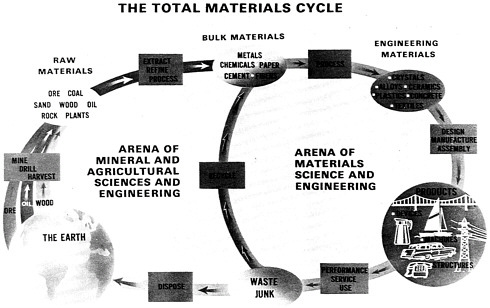
Frontispiece: A schematic representation of the materials cycle, portraying its global nature and principal stages.
PREFACE
The Summary Report of the Committee on the Survey of Materials Science and Engineering (COSMAT) was published in the Spring of 1974. It was based on informational inputs generated by numerous committees, panels, and individuals. That background information has now been organized into this Supplementary Report, Volumes I to IV.
In assembling this extensive resource, a complete editorial function was not attempted. Thus, occasional redundancies and overlaps as well as some unevenness in style and coverage will be noted. There will also be found views, and perhaps contradictions, that did not make their way into the Summary Report, inasmuch as the latter reflects a consensus of COSMAT. Nevertheless, we believe that it will prove useful to the science and engineering communities, as well as to others concerned with the broader implications of technology, to have available the rich store of information that was collected by COSMAT.
We have organized the present Supplementary Report as follows:
Volume I—The History, Scope, and Nature of Materials Science and Engineering, containing Chapters 1, 2, and 3, is concerned mainly with tracing the history and evolution of materials technology, and of materials science and engineering in particular; also with describing the dimensions of the present role of materials in society; and with a study of the way in which materials science and engineering operates as a multidisciplinary field.
Volume II—The Needs, Priorities, and Opportunities for Materials Research begins, in Chapter 4, with a discussion of how materials research is related to various national goals or “areas of impact.” In Chapter 5, the results of a comprehensive survey of materials research properties are presented, both for applied research related to these areas of impact and for basic research. Chapter 6 provides a description of several of the more prominent materials research opportunities, again both basic and applied.
Volume III—The Institutional Framework for Materials Science and Engineering (Chapter 7) describes the industrial, governmental, academic, and professional activities in materials science and engineering in the U.S. In the industrial section, emphasis is given to illustrative descriptions of materials technologies and to the roles of materials scientists and engineers in various types of industry. The governmental section describes the ways in which the federal government is involved with the performance and support of materials science and engineering. The academic section contains detailed qualitative and quantitative information on the status and trends in university education and research both in “materials-designated” and “materials-related” departments and in materials research centers. In the professional section,
consideration is given to the characteristics and numbers of materials scientists and engineers, as well as to their professional activities and opportunities.
Volume IV—Materials Technology Abroad (Chapter 8) deals with many facets of materials technology, as practiced in other countries. In collecting this information, it was often difficult, or even impossible, to delineate policies and practices specific to the materials field from those pertinent to science and technology in general. In such cases, the broader situation has been reviewed on the assumption that its applicability to the materials sphere is implicit. Volume IV surveys national policies and administrative structures for science and technology, education, R & D, institutions, technology-enhancement programs, technical achievements, and international cooperation. Much of the content revolves around the general theme of technological innovation.
It is surely obvious from the magnitude of this Supplementary Report that COSMAT is enormously indebted to a wide diversity of committees and individual contributors, whose inputs and insights have proved so valuable. The COSMAT Panels, Committees, and Consultants are listed in the Summary Report. They and other individual contributors are also referred to in this Supplementary Report.
COSMAT is deeply grateful to Marguerite Meyer, Beverly Masaitis, and Judy Trimble for their indefatigable efforts in the typing and assembling of these four volumes; theirs was a prodigious task, indeed. We are also most indebted to Amahl Shakhashiri for her careful editing of these volumes.
And once again, COSMAT wishes to acknowledge the support of the National Science Foundation and the Advanced Research Projects Agency in this undertaking , carried out under the aegis of the Committee on Science and Public Policy of the National Academy of Sciences.
Morris Cohen, Chairman
William O.Baker, Vice Chairman
Committee on the Survey of Materials Science and Engineering
September 1975
COMMITTEE ON THE SURVEY OF MATERIALS SCIENCE AND ENGINEERING (COSMAT)
*Morris Cohen (Chairman)
Massachusetts Institute of Technology
*William O.Baker (Vice Chairman)
Bell Telephone Laboratories, Inc.
Donald J.Blickwede
Bethlehem Steel Corporation
Raymond F.Boyer
Dow Chemical Company
*Paul F.Chenea
General Motors Corporation
Preston E.Cloud
University of California, Santa Barbara
*Daniel C.Drucker
University of Illinois
Julius J.Harwood
Ford Motor Company
I.Grant Hedrick
Grumann Aerospace Corporation
Walter R.Hibbard, Jr.
Owens-Corning Fiberglas Corporation
*John D.Hoffman
National Bureau of Standards
Melvin Kranzberg
Georgia Institute of Technology
*Hans H.Landsberg
Resources for the Future, Inc.
Humboldt W.Leverenz
RCA Laboratories, Inc.
Donald J.Lyman
University of Utah
Roger S.Porter
University of Massachusetts
Rustum Roy
Pennsylvania State University
*Roland W.Schmitt
General Electric Company
Abe Silverstein
Republic Steel Corporation
Lawrence H.Van Vlack
The University of Michigan
Ex Officio Members
*Harvey Brooks (as former Chairman, Committee on Science and Public Policy, NAS)
Harvard University
*N.Bruce Hannay (as Chairman, National Materials Advisory Board, National Research Council, NAS-NAE)
Bell Telephone Laboratories, Inc.
*Ernst Weber (as Chairman, Division of Engineering, National Research Council, NAS-NAE)
National Academy of Sciences
Survey Directors
Alan G.Chynoweth
Bell Telephone Laboratories, Inc.
S.Victor Radcliffe
Case Western Reserve University
MATERIALS AND MAN’S NEEDS
Supplementary Report of the Committee on the Survey of Materials Science and Engineering
|
Volume I |
The History, Scope, and Nature of Materials Science and Engineering |
|
|
|
Chapter 1: |
Materials and Society |
|
Chapter 2: |
The Contemporary Materials Scene |
|
|
Chapter 3: |
Materials Science and Engineering as a Multidiscipline |
|
|
Volume II |
The Needs, Priorities, and Opportunities for Materials Research |
|
|
|
Chapter 4: |
National Objectives and the Role of Materials Science and Engineering |
|
Chapter 5: |
Priorities in Materials Research |
|
|
Chapter 6: |
Opportunities in Materials Research |
|
|
Volume III |
The Institutional Framework for Materials Science and Engineering |
|
|
|
Chapter 7: |
Industrial, Governmental, Academic, and Professional Activities in Materials Science and Engineering |
|
Volume IV |
Materials Technology Abroad |
|
|
|
Chapter 8: |
Aspects of Materials Technology Abroad |
TABLE OF CONTENTS FOR VOLUME II
Chapter Number
Page Number
LIST OF FIGURES FOR VOLUME II
Figure Number
Page Number
CHAPTER 4. NATIONAL OBJECTIVES AND THE ROLE OF MATERIALS SCIENCE AND ENGINEERING
|
4.1 |
Partial Relevance Tree for Telecommunications |
|||
|
4.2 |
Expenditures for Space Research and Technology |
|||
|
4.3 |
Partial Relevance Tree for Achieving Space Goals |
|||
|
4.4 |
Partial Relevance Tree for Energy |
|||
|
4.5 |
Partial Relevance Tree for Transportation |
|||
|
4.6 |
Partial Relevance Tree for Health Services |
|||
|
4.7 |
Partial Relevance Tree for Environmental Goals |
|||
|
4.8 |
Partial Relevance Tree for Housing |
CHAPTER 5. PRIORITIES IN GOAL-ORIENTED MATERIALS RESEARCH
|
5.1 |
Priority for Basic Research |
|||
|
5.2 |
Priority for Applied Research—Area 10—Communications, Computers, and Control |
|||
|
5.3 |
Priority for Applied Research—Area 20—Consumer Goods |
|||
|
5.4 |
Priority for Applied Research—Area 30—Defense and Space |
|||
|
5.5 |
Priority for Applied Research—Area 40—Energy |
|||
|
5.6 |
Priority for Applied Research—Area 50—Environmental Quality |
|||
|
5.7 |
Priority for Applied Research—Area 60—Health Services |
|||
|
5.8 |
Priority for Applied Research—Area 70—Housing and Other Construction |
LIST OF TABLES FOR VOLUME II
Table Number
Page Number
CHAPTER 4. NATIONAL OBJECTIVES AND THE ROLE OF MATERIALS SCIENCE AND ENGINEERING
|
4.1 |
Changes in Federal Budget Outlays, 1950–1972, Selected Fiscal Years |
|||
|
4.2 |
Expenditures for National Goals, 1962 and 1969 |
|||
|
4.3 |
Expenditures for Private Consumption, 1962 to 1969 |
|||
|
4.4 |
Illustrative Levels in a Relevance Tree |
|||
|
4.5 |
Example Programs Displayed According to Relevance Trees |
|||
|
4.6 |
Types of Equipment in Telecommunications Systems |
|||
|
4.7 |
Elements in the Telephone Handset |
|||
|
4.8 |
Summary of Some Major Achievements in Telecommunications Technology and Related Materials Achievements |
|||
|
4.9 |
Summary of Some Materials Innovations in TC Technology |
|||
|
4.10 |
Characteristics of New Nationwide Networks that May Have an Impact on the Public Network |
|||
|
4.11 |
Space Research and Technology |
|||
|
4.12 |
Some Major Pieces of Legislation Relating to Electric Power |
|||
|
4.13 |
Technological Advances Relating to Electric Power |
|||
|
4.14 |
Materials Employed in the Electric Power Industry |
|||
|
4.15 |
Energy Developments in Which Further Advances in Technology Are Now Limited or Inhibited by Materials |
|||
|
4.16 |
Critical Energy-Related Materials Areas in Which Solutions Appear Possible, Given Substantially Increased Materials Research |
|
4.17 |
Relation of Energy to Value of Materials |
|||
|
4.18 |
Major Events in Transportation Legislation |
|||
|
4.19 |
Changing National Objectives and Priorities Concerning Health Care—Key Documents |
|||
|
4.20 |
Distribution of National Expenditures for Health Care |
|||
|
4.21 |
Materials for Medical Care—1970 Sales and Growth Rate |
|||
|
4.22 |
Materials Innovation in Health Care |
|||
|
4.23 |
Environmental Goals as Presented in Presidential Messages, 1967–1972 |
|||
|
4.24 |
Estimated Volume of Industrial Wastes Before Treatment, 1964. |
|||
|
4.25 |
Changing National Objectives and Priorities—Key Documents |
|||
|
4.26 |
Housing Construction Needs, 1968–1978 |
|||
|
4.27 |
Relative Shares of Development & Construction Costs in Different Types of Housing |
|||
|
4.28 |
Relative Shares of Specific Construction Cost |
|||
|
4.29 |
Past Materials Innovations in Housing Technology |
|||
|
4.30 |
Goal-Oriented Materials Research Bearing on Areas of National Impact |
CHAPTER 5. PRIORITIES IN GOAL-ORIENTED MATERIALS RESEARCH
|
5.3a |
Assessment of the Overall Importance of Materials Science and Engineering to Each Area of Impact According to Highest Degree |
|||
|
5.3b |
Assessment of the Overall Importance of Materials Science and Engineering to Each Area of Impact According to Discipline of Highest Degree |
|||
|
5.3c |
Assessment of the Overall Importance of Materials Science and Engineering to Each Area of Impact According to Age Bracket |
|||
|
5.3d |
Assessment of the Overall Importance of Materials Science and Engineering to Each Area of Impact According to Type of Institution |
|||
|
5.3e |
Assessment of the Overall Importance of Materials Science and Engineering to Each Area of Impact According to Type of Activity |
|||
|
5.3f |
Assessment of the Overall Importance of Materials Science and Engineering to Each Area of Impact According to Management Level |
|||
|
5.4 |
Overall Importance of Materials Science and Engineering to Areas of Impact—Classification by Respondees Familiar with Area of Impact |
|||
|
5.5a |
Priority for Basic Research—Classified According to Highest Degree |
|||
|
5.5b |
Priority for Basic Research—Classified According to Discipline of Highest Degree |
|||
|
5.5c |
Priority for Basic Research—Classification by Age |
|||
|
5.5d |
Priority for Basic Research—Classification According to Type of Institution |
|||
|
5.5e |
Priority for Basic Research—Classified According to Type of Activity |
|||
|
5.5f |
Priority for Basic Research—Classified According to Level of Management |
|||
|
5.6a |
Level of Priority for Basic Research Classified According to Classes of Materials as Rated by Experts in Each Category |
|
5.6b |
Level of Priority for Basic Research Classified According to Classes of Properties as Rated by Experts in Each Category |
|||
|
5.6c |
Level of Priority for Basic Research Classified According to Processes as Rated by Experts in Each Category |
|||
|
5.7a |
Priorities for Basic Research in Materials (Properties) |
|||
|
5.7b |
Priorities for Basic Research in Materials (Materials) |
|||
|
5.7c |
Priorities for Basic Research in Materials (Processes) |
|||
|
5.8 |
Sub-Areas of Impact and Responses Received |
|||
|
5.9a |
Priorities for Applied Research—Properties of Materials |
|||
|
5.9b |
Priorities for Applied Research—Classes of Materials |
|||
|
5.9c |
Priorities for Applied Research—Processes |
|||
|
5.9d |
Priorities for Applied Research—Disciplines |
|||
|
5.10a |
Rank Ordering of Priority for Applied Research— Properties of Materials (Corrected for Familiarity) |
|||
|
5.10b |
Rank Ordering of Priority for Applied Research— Classes of Materials (Corrected for Familiarity) |
|||
|
5.10c |
Rank Ordering of Priority for Applied Research— Processes (Corrected for Familiarity) |
|||
|
5.10d |
Rank Ordering of Priority for Applied Research— Disciplines (Corrected for Familiarity) |
|||
|
5.11 |
Priority for Applied Research—Area 10—Communications, Computers and Control |
|||
|
5.12 |
Priority for Applied Research—Area 20—Consumer Goods |
|||
|
5.13 |
Priority for Applied Research—Area 30—Defense and Space |
|||
|
5.14 |
Priority for Applied Research—Area 40—Energy |
|||
|
5.15 |
Priority for Applied Research—Area 50—Environmental Quality |


