
1
Planning Long-Term Ecosystem Science
In 1989 the T/V Exxon Valdez spilled about 11 million gallons of crude oil into Prince William Sound in Alaska, setting off a cascade of effects that still have repercussions more than a decade later (Figure 1–1). One result was that in 1991 the U.S. District Court approved a civil settlement that required Exxon Corporation to pay the United States and the State of Alaska $900 million over 10 years to restore the resources injured by the spill and to compensate for the reduced or lost services (human uses) the resources provided. Under the court-approved terms of the settlement the Exxon Valdez Oil Spill Trustee Council made up of three federal and three state members was formed to administer these funds. The mission of the Trustee Council has been to return the environment to a “healthy, productive, world-renowned ecosystem” by restoring, replacing, enhancing, or acquiring the equivalent of natural resources injured by the spill and the services provided by those resources. It also set aside some of the funds to create a permanent trust to support continued, long-term research and monitoring in the region. At this point the Trustee Council is developing a plan to guide this new research program, to be known as the Gulf Ecosystem Monitoring (GEM) program.
As part of its mission the Trustee Council has disbursed research funds for almost 10 years, at first for damage assessment activities and then for monitoring and research to better understand the ecosystem and to understand impacts of the oil spill on important “resource clusters,” or communities/resources (e.g., salmon, herring, marine mammals, subsistence resources). Extensive research has been conducted over the decade, making this the most studied cold water marine oil spill in history. In
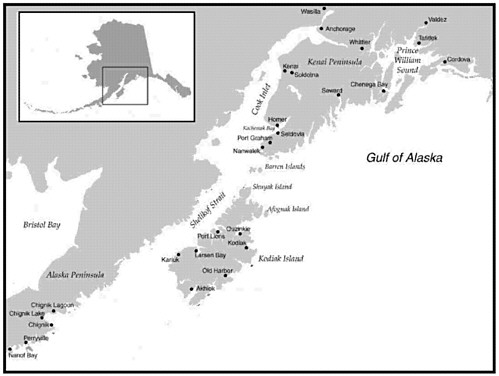
FIGURE 1–1 Region encompassed by GEM.
keeping with its mandate and after extensive public input the Trustee Council decided to use the trust fund to support continued research and monitoring in the region into the future. The GEM program has a unique opportunity to obtain the long time series of data necessary to support research on the effects of decadal-scale change on the structure, function, and ability of a marine ecosystem to provide goods and services to people. This research program will provide the depth and continuity of data collection necessary for both practical management lessons and deeper understanding of the causes and effects of ecosystem change.
The Trustee Council showed great foresight in setting aside funds over the years to create the trust fund that will now provide long-term funding to the GEM program. As envisioned, the program will offer an unparalleled opportunity to increase understanding of how large marine ecosystems in general, and Prince William Sound and the Gulf of Alaska in particular, function and change over time. The committee believes that it stands to be a significant program of importance to Alaska, the nation, and the scientific community.
THE COMMITTEE’S CHARGE
To ensure that its plan for long-term research and monitoring in the Gulf of Alaska ecosystem is the best possible, the Trustee Council asked the National Academies for assistance, and a specially appointed committee was formed to review the scope, content, and structure of the draft science program and draft research and monitoring plan. The Committee to Review the Gulf of Alaska Ecosystem Monitoring Program was asked to provide independent scientific guidance to the Trustee Council, research community, and public as the Trustee Council develops a comprehensive plan for a long-term, interdisciplinary research and monitoring program in the northern Gulf of Alaska. Specifically, the committee was charged to:
-
gain, through briefings and literature review, familiarity with the relevant body of scientific knowledge, including but not limited to that developed by the research and monitoring activities sponsored by the Trustee Council in the past.
-
convene one or more information-gathering meetings in Alaska, where researchers, the public, and other interested people can convey their perspectives on what the research and monitoring plan should accomplish.
-
review the general strategy proposed in the draft science program (which includes information on the social and political context, mission, approach, and scientific background) and make suggestions for improvement.
-
review the draft research and monitoring plan, including the scope, structure, and quality of the approach proposed for a long-term research and monitoring program in the northern Gulf of Alaska. This includes whether the conceptual foundation provides an adequate basis for long-term research and monitoring, and whether the research and monitoring plan adequately addresses gaps in the knowledge base and existing uncertainties.
Since this committee was formed in June 2000 we met five times to discuss the GEM program and consider the strengths and weaknesses of the program’s planning documents. We have conveyed our comments and recommendations in a letter report (November 2000) with advice on program timing and in a more detailed interim report (February 2001) that critiqued an early draft of the program’s science plan. These reports focused on the early planning for GEM, were specific to the draft planning documents, and were primarily directed to program staff. In this final report we provide broader comments and a document that has more general and longer-lasting lessons about which elements are essential to
the success of a long-term research and environmental monitoring program such as GEM.
ELEMENTS OF A SOUND LONG-TERM SCIENCE PLAN
The world’s oceans have long been viewed as producing an inexhaustible supply of protein and other goods and services for human use. But evidence of the adverse effects of human activities on marine ecosystems is increasing and reminding us that the ocean’s resources are not inexhaustible (NRC, 1999a). It is increasingly clear that the structure and functioning of marine ecosystems is profoundly linked to variability and changes in ocean climate and that those changes can occur rapidly. One of the greatest challenges facing society, and particularly managers of marine living resources in the Gulf of Alaska and elsewhere, is to understand the relative effects of human activities and natural changes in ocean climate on the goods and services supplied by marine ecosystems (NRC, 1996).
Why is this so difficult? One reason is that marine ecosystems are large, complex interactive systems in which organisms, habitats, and external influences act together to regulate both the abundance and distribution of species (NRC, 1999a). Species interactions and the effects of variability in ocean climate on those interactions occur at spatial scales ranging from centimeters to hundreds of kilometers and on temporal scales ranging from minutes to decades. Human activities also act at various scales and may act selectively on certain components of an ecosystem (e.g., higher trophic levels), although such activities can have cascading effects throughout marine ecosystems (Carpenter et al., 1985; NRC, 1996). These disparate spatial and temporal scales make it difficult to measure the processes affecting marine ecosystems and to monitor ecosystem structure and functioning (Weisberg et al., 2000). The diversity of temporal scales at which important processes affect marine ecosystems makes it difficult to measure many of these processes over short periods of time. Finally, perturbations to marine ecosystems often appear to act in subtle, nonlinear ways making it difficult to understand the consequences on ecosystem components that may be of particular interest to society, such as birds, mammals, and fishes. Given these challenges, we commend the Trustee Council for having the vision to develop a long-term ecological monitoring program that stands to have great enduring value to the stakeholders of this vast and diverse marine ecosystem.
Good management requires good information and the knowledge of how to use this information to predict the outcome of management decisions. Thus, a prerequisite of good management is good science. As the committee noted in its interim report, given the complexity of marine eco-
systems and the failure of single-species management to produce sustainable fisheries in many parts of the world (NRC, 1999a), it is not surprising that both scientists and managers have increasingly promoted the concepts of multi-species or ecosystem-based management. However, it is clear that not enough is known about most large marine ecosystems, including the Gulf of Alaska, to implement a useful whole-system approach to management.
It is reasonable to ask what an ecosystem-based approach to management could provide in the medium term that a single-species approach cannot. The National Research Council’s Committee on Ecosystem Management for Sustainable Marine Fisheries considered two benefits (NRC, 1999a). One benefit is that it broadens the policy framework to include a wide range of ecosystem goods and services and it acknowledges the critical role of ecosystem processing in providing those goods and services. Another benefit is that there is an explicit recognition that segments of society may have different goals and values with respect to marine ecosystems and that those goals and values may conflict. The committee believes that the promise of an ecosystem-based approach to resource management, which recognizes the changing nature of both the physical environment and species interactions and the fact that many of these changes occur at time scales greater than several years, provides a forceful scientific rationale or conceptual foundation for the GEM program. The other benefit is an explicit recognition that segments of society may have different goals and values concerning marine ecosystems and that those goals and values may conflict. To meet its goals effectively the GEM program must take a longer (interdecadal) view at appropriate spatial scales.
GEM can respond to current concerns without sacrificing long-term data sets that will prove increasingly useful as they accumulate. A well-designed and broad-based program will provide the best possible scientific basis for dealing with short-term ecological issues of public concern. Indeed, a strongly designed program will provide a sound basis for additional attention to be paid to matters of urgency or immediate public concern, even if they are not central to the program itself. However, GEM will have to be carefully constructed to avoid being excessively distracted by real or perceived ecological crises. It will, therefore, be important to define clearly not only the program goals in terms of scientific questions but also the products of the program that are expected to be of value to managers (Weisberg et al., 2000). As stated by Weisberg et al., “The most successful programs have been those with clearly defined users for the data they produce, which requires early interaction between scientists responsible for designing the program and targeted data users.” The GEM program should not be used to substitute for routine monitoring and stock
assessment activities that have customarily been the province of state and federal agencies. Such a use of GEM funding would constitute a tragic waste of an extraordinary opportunity.
As conceived, GEM is meant to be a long-term monitoring activity, and long time series are essential to detecting change on intermediate and long time scales. It is vital to recognize that long-term monitoring per se will not necessarily lead to a better scientific understanding of the ecosystem. The value and utility of monitoring critically depends on the variables measured, the spatial and temporal extent, and intensity of sampling. Without clear vision at the outset it is difficult to establish monitoring programs that will provide useful data for sound resource management. This is why the monitoring program must have a strong conceptual foundation and be hypothesis-driven (Box 1–1).
|
BOX 1–1 Providing Focus by Selecting Key Research Questions GEM is a unique opportunity to establish a realistic long-term monitoring program. Thus one logical approach would be to shape the program around long-term monitoring as the core activity, with smaller elements added to meet other goals, and base the science plan on this two-prong structure. To make success more likely program planners would need to select a few key questions to guide the work, and these questions in turn should be based on some clear conceptual model (e.g., NRC, 1995, 2000). One way to begin is to ask what parameters are most able to provide insight into the desired questions if there is a long time series of data available. Another approach is to identify the questions for their own sake and let them suggest the parameters to be monitored. The questions listed in Appendix C-2 of EVOSTC (2000a) are a good start. The quality and relevance of the questions suggested by members of various communities that made presentations in Anchorage on October 6, 2000, were excellent. For example, the question about the degree to which ocean conditions (productivity) affect the growth and survival of juvenile salmon and hence the degree to which science can help predict the probable percentage of returns from hatchery releases is very relevant. To answer this question requires information on physical, chemical, and biological features of the ocean, including information about salmon. Long time series of information on such factors would not only help answer the specific question but would be of great use for understanding related questions, such as insights into fluctuations in the populations of other impor- |
The unique aspect of GEM is the guarantee of funding over a long time frame and the possibility of consistent, long-term measurement of species and processes in the Gulf of Alaska and Prince William Sound. Although it will require sustained commitment, long-term monitoring is an essential underpinning of the major goals of the GEM program, which stands to have great value as a model for how to monitor and understand other complex marine ecosystems. After all, the management issues facing users of Prince William Sound and the Gulf of Alaska are much the same as those found elsewhere in Alaska’s marine waters and around the globe. Making long-term research the focus of GEM will create greater benefits to both basic understanding of the gulf ecosystem and its long-term management than would an abundance of short-term projects, many of which could be funded in other ways.
|
tant ecosystem components, including marine mammals, crabs, marine birds, and herring. Several approaches could provide greater focus on GEM during implementation, even given its broad mission and goals. The committee is not recommending these as the “right” tasks, but as illustrations of the range of thinking that is necessary.
|
Monitoring over extremely long time periods, such as envisioned in GEM, cannot be differentiated from research; research designed to evaluate the ecological impact of climate change is of longer duration than the familiar three- to five-year process studies (Box 1–2). The development of long time series measurement is a crucial research tool for understanding ecosystem function. Along with the opportunity afforded by GEM comes an obligation to craft a research plan that can withstand the test of time. This requires a core set of measurements that can be taken consistently and indefinitely, as well as flexibility to alter both conceptual understanding and research interests. Long-term programs should be modified only when a compelling case is made that change will improve the program (Weisberg et al., 2000).
The committee identified a number of elements deemed essential for a successful long-term science program of the magnitude necessary to fulfill the mission statement and goals articulated for the GEM program by the Trustee Council (EVOSTC, 2000a). These elements are similar to those in a recent synthesis of lessons learned in a number of large-scale coastal
|
BOX 1–2 Monitoring versus Research In oceanography today, repeated measurements made for long periods of time are typically called monitoring, while repeated measurements made over shorter periods of time are likely to be called research. While there can be other differences between monitoring and research, often the only difference between the two is the duration of the sampling. When the purpose of long- and short-term measurements is the same, that is, observing the oceans and interpreting trends, both really are aspects of scientific research. Thus, in many (if not most) cases, monitoring might just as appropriately be called research. This clarification is important only because at times the scientific community deems monitoring less meaningful than research. But for GEM, this is clearly not the case: Long-term monitoring should be the heart of the program. Over the course of GEM, it is expected that some measurements will be made over the entire duration of the program, whereas others will be of briefer duration—years, months, days, or hours. Both timeframes of observation are important. The short-term measurements will allow the study of short-term processes, but their contributions to scientific research are not necessarily greater or lesser than the sustained observations. Indeed, a strength of the GEM program will be that it provides ocean observations of various durations with short-term sampling embedded within the sustained observations. |
|
BOX 1–3 Themes Needed in All Coastal Monitoring Programs
|
monitoring efforts (Box 1–3; Weisberg et al., 2000). In addition, the committee examined a number of existing science plans for lessons to help guide GEM planning (Box 1–4); although great variety was found in these plans, they generally confirm the importance of the elements determined by this committee as important.
Elements seen as essential to the GEM program include:
-
A conceptual foundation. A conceptual foundation expresses the main focus of a plan and provides a general picture of how parts of the ecosystem function and interact. A broad conceptual foundation with a sound scientific basis provides a strong scientific justification for a program and helps to defend it from criticism and political pressures over time. It provides an intellectual structure that can guide modification of the program if that becomes necessary.
-
A scope and geographic focus for study. In any ecosystem study, a trade-off exists between the extent of the region to be studied and the quality, density, and frequency of measurements (Weisberg et al., 2000). It is necessary to identify that portion of an ecosystem that can be monitored with sufficient intensity to provide the density of measurements needed to identify change at the desired level of scientific confidence. The Exxon Valdez oil spill affected Prince William Sound, the northern and western Gulf of Alaska, and lower Cook Inlet. Selecting an appropriate subset of the northern Gulf and its adjacent waters that can be studied over the long term as a connected whole will challenge the GEM program.
-
Scientific leadership. GEM must have strong scientific leadership. A
|
BOX 1–4 Common Elements of Other Science Plans The term “science plan” has an elusive definition, encompassing documents as disparate as specific research proposed for the upcoming field season (e.g., Palmer Station Long-term Ecological Research) and new visions of multi-disciplinary research to inspire funding (e.g., RIDGE 2000). We examined a number of science plans in an effort to define our expectations of the GEM program plan. These plans are described briefly here.
|
|
butions that will be made toward providing solutions to those problems, primarily through the use of satellite-based observations that will be obtained with EOS satellites and instruments.” Seven focal areas are: atmospheric circulation, ocean, atmospheric chemistry, hydrology, cryosphere, stratosphere, and volcanoes. <http://eospso.gsfc.nasa.gov/sci_plan/chapters.html>.
|
|
integrated understanding of the relationships among the geological and geophysical processes of planetary renewal at mid-ocean ridges and the seafloor and subseafloor ecosystems that they support. Studies under this new program will be defined by an integrated, whole-system approach encompassing a wide range of disciplines, and a progressive focus within scientifically defined, limited geographic areas.” The science plan distinguishes integrated (multiple disciplines focused on one place), exploratory (discovery of new places), and time-critical studies (responding to tectonic events). Each category is addressed in terms of overarching goal (conceptual foundation), questions and hypotheses, and the scope or approach for answering the questions. Technology (measurement devices) and infrastructure (data management) are addressed at the end of the plan. Because the plan was written to motivate federal funding of portions of the plan, there is no explicit description of organizational structure. <http://ridge.oce.orst.edu/R2K/R2Ksciplan/>.
These brief descriptions should make it clear that almost all have at their core a working understanding of the structure and function of a complex environmental system. Surprisingly, many of the plans incorporate long-term change or natural versus anthropogenic change in this conceptual foundation. The following elements are common to many of the plans we examined:
These common elements map fairly well onto the elements the committee evaluated for GEM: conceptual foundation, scope, community involve- |
|
ment, data management, and synthesis and review. We note the lack in most plans of explicit descriptions of organizational structure. This lack probably occurs because the organizational structures are already in place (for instance, in NASA) or because they will never be in place (for many of the science plans that describe loose collaborations). GEM, however, requires an organizational structure to be defined that will disburse funds and involve communities effectively. One other major difference is the size of the plans: Most science plans (with the exception of EOS) tend to be 10–30 pages long. Such conciseness is intentional so that the purpose, scope, and methods can be synthesized down to a clear foundation, and knowing that the scientists involved will work out as the program evolves. The committee also notes that no plans are designed to involve local communities or traditional ecological knowledge in the formation of research questions and activities. Rather, these plans portray community involvement only through outreach. GEM is in the challenging but exciting position to craft a science plan that bridges science and society in ground-breaking fashion. |
-
Scientific and Technical Advisory Committee should provide scientific oversight and ensure the scientific integrity and quality of the GEM program. An appointed chief scientist or science director should have responsibility for leading and implementing the GEM science program.
The selection of particular projects and observations is achieved through a program’s organizational structure, influences who is involved in honing the conceptual foundation into testable hypotheses and research questions, and demonstrates how open the program is to new personnel and ideas. A vibrant and innovative program must encourage new people to become involved over time, yet long-term plans inevitably reward people with previous experience.
Periodic external review of the science program can ensure that the chief scientist and the Scientific and Technical Advisory Committee have the vision and discipline necessary to run a successful program.
-
Involvement of stakeholders in the planning process. Large scientific programs designed to understand ecosystems used by a variety of different communities require the support of those communities if the programs are to be of maximum utility. Communities affected by such studies include not just program managers and the scientists involved in conducting research, but also those who live adjacent to the ecosystem, those who harvest resources (whether for subsistence or commercial use) in the ecosystem, and those who use the ecosystem for recreation. When those di-
-
verse communities can be brought together to plan the studies, rather than just being asked to approve or comment on what others have planned, there is a greater chance of a more holistic view of the goods and services of concern to society and thus the opportunity to design a more satisfactory science program that will enjoy long-term community support.
-
Management of data to ensure safekeeping and accessibility. Data management is crucial to a monitoring program because of the need for storing and retrieving large amounts of data (Weisberg et al., 2000). Large long-term scientific studies generate enormous amounts of data, data that must be useful far into the future. One fundamental aspect of data management is that it be designed specifically to support the central purpose of a long-term science program, that is, the comparison of measurements over long periods of time. First, it is essential that there be a mechanism for archiving data that will be durable and that permits data transfer from one storage medium to another as technological innovations appear. A second challenge is to support real-time sharing of data within the program, which is essential for collaboration and integration between disciplines and geographic subdivisions of the study. Third, there needs to be public access to data and data products so the broader community can assess the progress of “their” ecosystem study. Delivery of timely and appropriate data products will be essential if decision makers are to benefit from the program (Weisberg et al., 2000). The successful accomplishment of these three elements makes the data management program the heart of a large long-term scientific program.
-
Assessment of progress through synthesis and evaluation. Synthesis and evaluation are essential scientific activities. They provide information on whether a program is making progress toward testing hypotheses and in achieving an understanding of ecosystem function. Syntheses will require a variety of modeling efforts (conceptual, statistical, and numerical), and one should be aware that both the modeling of results and the acquisition of data will vary considerably between physical and biological aspects of the research program (Weisberg et al., 2000). Although generating syntheses of long-term data from these different disciplines is likely to be a challenge, doing so will be important to the long-term success of the GEM program.
This report is divided into sections that address the above elements and includes insights drawn from other long-term science plans regarding issues such as governance structures and data management. Finally, the committee summarizes its conclusions about planning the GEM program and provides recommendations to help guide its continued development.


