
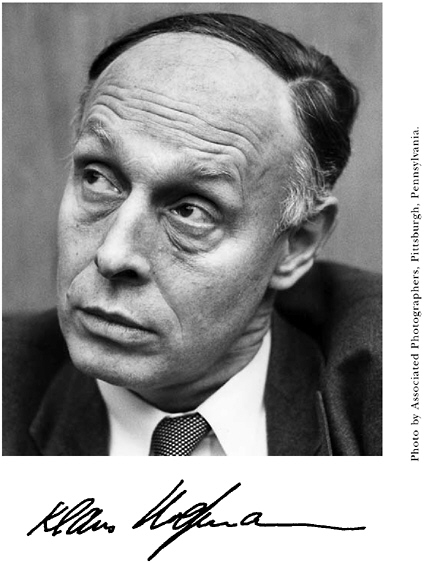
KLAUS HOFMANN
February 21, 1911–December 25, 1995
BY FRANCES M. FINN AND BERT W. O’MALLEY
KLAUS HOFMANN WORKED in many areas of chemistry and biochemistry over his long and productive career. His published work covers the fields of steroids, enzymes, vitamins, fatty acids, and peptides. Without question, though, he was best known for his contributions to the field of peptides. His most publicized, though not the one he considered his most fundamental contribution, was the synthesis of a fully active, shortened chain of the pituitary hormone adrenocorticotropin (ACTH). His work on ACTH led to the recognition that peptide hormones, unlike steroid hormones, could be dramatically modified without substantially altering their biological potency. In his later work on peptides he was able to delineate the types of amino acids that contributed to the strong interactions between peptide chains that were vital to the strong and specific interactions responsible for recognition and binding of the hormone by its specific receptor.
Klaus Hofmann was born in Karlsruhe, Germany. His father died when he was only a year old and his mother returned with her son to Switzerland, where he was to remain until a Rockefeller Foundation Fellowship brought him to the United States in 1938 at the age of 27. Even as a
boy he was interested in science. At the boarding school he attended in Switzerland he became a close friend of his natural history teacher, Hans Noll, who profoundly influenced his subsequent education. Together they banded sea gulls on the Lake of Zürich and determined from the rings returned to them that the gulls wintered in Spain and southern France. During this period he also became interested in chemistry, soaking filter papers in the nitroglycerin he had prepared in the school lab and exploding them on an anvil with a hammer.
The family, engaged in the natural silk business, felt that young Hofmann should embark on a career in business. That is, until they were defrauded by someone who sold them on a “new” process to produce synthetic silk. By the time they realized that the so-called new process was the same process everyone else was using, they had lost considerable sums of money and the prospect of having Hofmann study chemistry before entering the business suddenly became appealing. He enrolled at the Federal Institute of Technology in Zürich as a chemical engineer, and by the time he graduated he was fascinated with the work being done on steroid hormones in the laboratories of Leopold Ruzicka and Thaddeus Reichstein. No more silk for him.
Hofmann did his thesis work on terpenes. Ruzicka was convinced that there was a structural relationship among the various terpenes based on a common building block (now known as the isoprene unit). In the hope of finding a synthetic principle for the construction of this class of compounds, Ruzicka put his students to work on determining structures of and synthesizing many of the terpenes. By the time Hofmann had completed his Ph.D. and two years of postdoctoral work with Ruzicka, he had produced 13 publications on structure determination and synthesis of a
pentacyclic triterpene, oleanolic acid, a dehydroandrosterone derivative, and incidentally, the prototype for the birth control pill. The biology of reproduction was not understood at that time and therefore the potential significance of the latter compound was not appreciated.
As a young Swiss male Hofmann was required to train and serve in the militia, which he did with enthusiasm. Not only did he complete the basic requirements but he also enrolled in officer’s training and specialized in heavy artillery, commanding a battery of guns at the age of 25. In his own words, “This was an exhilarating experience for a young man.”
In 1938 he came to the United States to work for Max Bergman at the Rockefeller Institute on a one-year fellowship. There he worked out the lysine specificity of the enzyme trypsin. In Bergman’s laboratory he met Joseph Fruton, William Stein, and Stanford Moore, and he enjoyed a lifelong friendship with all of them. During a second fellowship year, the Swiss army was mobilized in response to the beginning of World War II, and as an artillery officer Hofmann reported to the Swiss consulate and prepared to set sail. The Swiss government chose not to call military personnel from abroad and he was able to complete his second year of training at Rockefeller. As he was preparing to return to Switzerland he had a chance encounter with Vincent du Vigneaud. He told du Vigneaud of his plans to depart and said his farewell. Du Vigneaud immediately offered him another fellowship, this time working on the vitamin biotin at Cornell Medical College, and he decided to accept. He characterized this period as “a very pleasant three years.” Hofmann had learned the column chromatography techniques of Martin and Synge while still a postdoctoral student in Ruzicka’s laboratory, and he applied these to the isolation of biotin. In less than one month he had suc-
ceeded in isolating crystalline biotin. Together he, du Vigneaud, and Melville elucidated the structure of the vitamin.
The United States was already involved in World War II when Hofmann left Cornell to find a job. With so many academic institutions engaged in war-related work, it was impossible for a foreigner to find a university position. A close friend Ernst Oppenheimer, an endocrinologist and then vice-president for research at the Ciba Company in Summit, New Jersey, offered Hofmann a salary, a laboratory, and a technician as a scientific guest at Ciba. During this period Hofmann synthesized analogs of biotin, among them oxybiotin, in which oxygen was substituted for the ring sulfur. Oxybiotin was biologically active, proving that the sulfur was not essential for activity.
When the war was over he applied for a position at the University of Pittsburgh, which was to become his scientific home for the next 51 years. At that time the university had no strong research program, but the newly appointed dean for research, Herbert Longenecker, was given the task of remedying that situation. He hired Hofmann and several other young scientists as assistant research professors for the express purpose of building a research component in the natural sciences.
Hofmann moved to Pittsburgh, a city whose principal businesses were engaged in all aspects of steel production. The transition was an experience never to be forgotten. This was a period in the history of Pittsburgh when the air was so filled with smoke from the soft-coal-burning furnaces of the local residents that it was frequently impossible to see from one side of the street to the other even at noon. His first act was to scrub his new laboratory from top to bottom, but he soon learned that the lab benches had to be
cleaned each morning to remove the previous day’s soot deposits.
Still, Pittsburgh held many pleasant memories for Hofmann. He loved to play the violin and particularly enjoyed playing string quartets with his new friends from the university. His only child, Suzanne, showed a gift for music at a very early age, and he began to teach her violin. By the time she reached six she was playing at a level well beyond her years, and he decided to get formal instruction for her. He liked to tell the story of his first encounter with the man who was to become her teacher for the next 12 years, the assistant concertmaster of the Pittsburgh Symphony, Willie Frisch. Although Hofmann had told him of Suzanne’s remarkable ability, Willie was used to parents overestimating the talents of their children, and he took a wait-and-see attitude, telling Hofmann that the child might be ready for a lesson once a month considering her youth. When he heard her play a Bach solo sonata, he was so impressed with her mastery of the instrument that he vigorously endorsed weekly sessions. Suzanne’s musical gifts were a constant source of enjoyment for Hofmann.
Through a collaboration with Abraham Axelrod, who was conducting the biological assays for biotin analogs, Hofmann developed an interest in the fatty acids of bacteria. These compounds seemed to replace biotin in bacterial growth. As little was known in general about the fatty acids of bacteria, Axelrod and Hofmann set about isolating them from large batches of lactobacilli. A novel acid, which Hofmann named lactobacillic acid, was isolated and found to contain a three-membered ring. The precursor for this new fatty acid was not oleic acid as conventional wisdom would have dictated but cis-vaccenic acid.
During his first eight years at Pittsburgh, Hofmann rose from assistant research professor of chemistry to chairman
of the Biochemistry Department in the School of Medicine. Concomitant with his move to the medical school, Hofmann began to develop methods for the synthesis of peptides. With the isolation and synthesis of the posterior pituitary hormones—oxytocin and vasopressin—by du Vigneaud, Hofmann became convinced that peptides would eventually become a very important part of biomedical research. At this time the Armour Company in Chicago had become very interested in the anterior pituitary hormone, ACTH, and had begun to purify it from concentrates. From early on it was clear that ACTH was rich in the amino acid arginine. There were no methods as yet for introducing arginine into peptides, so Hofmann’s entry into the peptide hormone field began with development of methods to produce arginine-containing peptides.
A group at the Lederle Laboratories in Pearl River under the direction of Paul Bell managed to isolate pure ACTH and determine its structure. They also showed that the entire 39 amino acid peptide was not necessary for biological activity; a fragment containing amino acids 1 to 24 was able to stimulate the adrenal cortex just as effectively as the entire structure. By 1960, applying his newly developed methods, Hofmann and his research group were able to synthesize a peptide from the constituent amino acids corresponding to the sequence of the first 23 amino acids of natural ACTH and show that it, too, had full biological activity. At approximately the same time a group in the Yale medical school led by Aron Lerner isolated another anterior pituitary hormone and showed that it could darken the skin of frogs bleached by hypophysectomy. The material was the melanocyte-expanding hormone, MSH. There were in fact several substances with melanocyte-expanding activity and the one called α-MSH had the same structure as the first 13 amino acids of ACTH. This, too, was synthesized by Hofmann
and his coworkers, and with it Lerner was able to prove that the same factor that restored color to the frog could darken a human.
Once the synthetic methods had been successfully applied to ACTH and α-MSH, Hofmann began preparing peptide hormone analogs to determine which amino acids in the sequence were important for biological activity. He hypothesized that the peptide hormone combines with some structural counterpart (receptor) from the target cell by virtue of noncovalent forces. He noted that species variation in the sequence of ACTH occurred outside the minimal sequence essential for full biological activity and designated the amino acids in these portions of the peptide “filler sequences.” By synthesizing peptides in which the chain of the fully active ACTH1-23 was systematically shortened and peptides in which specific amino acids were replaced, he hoped to distinguish two classes of amino acids, those whose replacement or elimination resulted in diminished activity and those whose replacement abolished activity. He postulated that the former were involved in binding the hormone to its receptor, while the latter might be involved directly in biological activity. The sulfur-containing amino acid, methionine, was replaced by an aliphatic amino acid, α-amino n-butyric acid without destroying biological activity. Thus, in ACTH as in biotin, sulfur was not essential for biological activity. From the results of the studies conducted during this period, it was also concluded that the positively charged sequence arg-arg-lys-lys made strong contributions to the binding of the hormone to its receptor. Peptides in which all of the positive charges were eliminated had exceedingly low activity. Working with ACTH was a frustrating experience, however, because the assay systems that existed involved injecting the peptide into an animal in order to measure biological activity. Too many unknowns affecting
the peptide from the site of injection to its interaction with the target organ created ambiguities in the results. Hofmann searched for a simpler, more direct assay system in which to test his theories of peptide hormone action.
The S-peptide/S-protein system was discovered by Frederick Richards while working in Linderstrøm-Lang’s laboratory. It presented what seemed to be the ideal model for peptide hormone action. Ribonuclease A, whose complete structure was known from the work of Hirs, Stein, and Moore, could be split with the enzyme subtilisin between amino acids 20 and 21 to yield ribonuclease S, a structure in which the peptide corresponding to the first 20 amino acids (S-peptide) remained attached to the remainder (S-protein, amino acids 21-124) by noncovalent forces. The proteolytically cleaved ribonuclease S had the full enzymatic activity of the parent protein. The two components, S-peptide and S-protein, could be separated by reversible denaturation, and the separation abolished enzymatic activity; however when the individual components were mixed together again, fully active ribonuclease S reformed. Eventually it was established that the enzyme’s active site was composed of amino acids located both in S-peptide and in S-protein. Furthermore, the noncovalent forces that held the two pieces together were sufficiently strong to align the amino acids correctly to reconstitute the active site. This system provided the model Hofmann needed. He viewed S-peptide as the “hormone” and S-protein as “its receptor.” At last here was a system where measuring activity of analogs could be done directly without all the vagaries introduced by injecting the peptides into whole animals.
Using the S-peptide/S-protein model, he and his colleagues synthesized dozens of analogs to test the contributions that specific amino acid side chains made to noncovalent interactions in proteins. The chain of S-peptide was short-
ened by preparing a peptide that contained only the first 14 amino acids of the prototype, mimicking the same process that was done with ACTH. S-peptide1-14 proved to be fully active as well. Next, methionine was replaced just as had been done previously with ACTH. The results were parallel; sulfur played no role in activity, only in binding. One by one the importance of each of the amino acid side chains of the peptide for binding strength was investigated by replacing them. When the putative active site amino acid histidine, in position 12, was replaced by a synthetic, isosteric analog with an entirely different acid-base behavior (pK ~2.5), β-(pyrazolyl-3)-alanine, (pyr-3-ala) the reformed enzyme was devoid of activity. Moreover, it was shown that when pyr-3-ala peptides were mixed with analogous histidine-containing peptides, the inactive pyr-3-ala peptides could bind to S-protein as well as their histidine-containing counterparts. At a ratio of pyr-3-ala peptide to histidine peptide of 1:1, the resulting enzymatic activity of the reformed enzyme was reduced 50 percent.
When the X-ray structures of ribonucleases A and S became available through the work of the groups led by David Harker at Rosewell Park and by Frederick Richards at Yale, the identity of the amino acids with which the various side chains of S-peptide were interacting could be ascertained and general information on protein-protein interactions were established with these studies. This system had provided an interesting paradigm for Hofmann’s view of hormone-receptor interaction, showing that indeed binding and active site amino acids could be distinguished from one another.
The opportunity to test these ideas on an authentic hormone/receptor pair presented itself when techniques became available for isolating highly purified plasma membranes. Hofmann’s group prepared adrenal cortical plasma membranes, and the interaction of various ACTH analogs
was measured by inhibiting the binding of synthetic radio-labeled ACTH1-20 to the membranes. The results obtained with this system confirmed the earlier findings derived from measuring biological activity of ACTH analogs in whole animals.
Techniques for isolating hormone receptors and measuring in quantitative terms their ability to interact with their respective hormones were being developed and applied to the field. Another development that influenced the direction of work in Hofmann’s laboratory was the synthesis by Gerald Mueller and his group of a derivative of biotin (N-hydroxysuccinimide ester) that activated it for attachment to other reactive sites. A biotin-containing estrogen derivative was synthesized to isolate estrogen receptors. Hofmann remembered his early work with biotin and its unusually strong affinity for the egg-white protein avidin. He decided to attach avidin to a support and use it to anchor a biotin-derivatized peptide hormone. This combination could then be used to bind the peptide hormone’s receptor selectively. Using this technique on ACTH receptors was at that time out of the question. Adrenal cortical plasma membranes were difficult to prepare in large amounts, and it had not been established that soluble ACTH receptors were still capable of binding the hormone. Pedro Cuatrecasas had, however, shown that soluble insulin receptor retained affinity for insulin, and large amounts of the receptor could be prepared from human placenta. A sabbatical leave, productively spent in the laboratories of Helmut Zahn in Aachen, equipped Hofmann with the synthetic know-how to attach biotin to a specific site on the hormone insulin without altering the affinity of insulin for its receptor. With avidin the biotinyl insulin derivative and large quantities of partially purified insulin receptor in hand he and his coworkers successfully isolated insulin receptor.
Due to the high capacity of the affinity chromatographic columns provided by the method used to attach biotin to insulin, and the mild conditions that were developed in Hofmann’s laboratory for recovery of the receptor from the chromatographic column, both the hormone-binding activity and the tyrosine kinase activity of the pure receptor were preserved.
The time was ripe for applying these methods to the ACTH receptor. Biotin-containing derivatives of ACTH were synthesized and evaluated and eventually one was used to construct an analogous affinity column for receptor isolation. Initial attempts produced a material with the correct ACTH analog affinities that was shown to have a molecular weight of ~43,000. Just as it seemed that his dream of obtaining ACTH and its receptor in purified form, illness struck and the business of living from day to day became the overwhelming focus of life for Klaus Hofmann.
During his tenure as chairman of biochemistry in the School of Medicine he spent many hours learning about medicine in order to make the study of biochemistry more meaningful for medical students. He considered it his mission as chairman to inspire students with the knowledge that comes from understanding the practical aspects of medicine and how biochemistry relates to it. One of us (B.W.O.) had the “pleasure” of participating as a medical student in Klaus Hofmann’s notorious biochemistry course at the University of Pittsburgh School of Medicine. It was an intimidating and difficult course but one that challenged this student first to a summer lab experience, then to part-time lab employment during the school year, and finally to a career in biomedical research.
Despite Hofmann’s deep commitment to his research, his presence was regularly observed at scheduled teaching activities in the clinical department of his institution. Every
month he went to the surgical suite to witness the latest procedures and his surgical colleagues were pleased that a basic scientist was so deeply interested in their world. Weekly clinical pathology conferences were also part of his life during this and later years, and he read avidly on the basic biochemical principles associated with disease. His knowledge of medicine gave him a clear understanding of the course of his own illness, but despite this he remained optimistic throughout this period. He continued his pursuit of medicine, reading everything connected with his own malignancy and participated in an informed way in decisions concerning treatment. Although he went every day to the laboratory until he was hospitalized in the terminal phases, his energy and concentration were visibly drained and he could no longer function with the vigor and enthusiasm that had characterized his career in the laboratory.
The laboratory he led was often, but not always, first to report its findings or syntheses because throughout his career his motto was “Einmal ist Keinmal.” A single result never sufficed; a single synthesis was not enough for him. His coworkers had to show that everything they did and made was reproducible. It meant more to him to be right than to be first and this principle guided him in his pursuit of truth in science.
His attitude toward his chosen career can probably best be summed up in the words used in his epitaph.
Science was his greatest joy and he practiced it with wisdom, intuition and uncompromising honesty. His life was rich with experiences and knowledge that he shared willingly, in his unique style, with those who were fortunate enough to have been his students.
MEMBERSHIP ON NATIONAL COMMITTEES
|
1960 |
Panel to evaluate National Science Foundation predoctoral fellows |
|
1960-64 |
Member, Biochemistry Study Section, National Institutes of Health |
|
1964-69 |
Scientific Review Committee, Health Research Branch, National Institutes of Health |
|
1970-74 |
National Advisory Council on Health Research, National Institutes of Health |
|
1975 |
Ad Hoc Committee on Drug Development, National Institutes of Health |
MEMBERSHIP IN PROFESSIONAL AND SCIENTIFIC SOCIETIES
American Association for the Advancement of Science
American Chemical Society
American Society for Biochemistry and Molecular Biology
Endocrine Society
National Academy of Sciences
Sigma XI
Swiss Chemical Society
HONORS
|
1962 |
Pittsburgh Award |
|
1963 |
Election to membership in the National Academy of Sciences Borden Medal Chancellors Medal, University of Pittsburgh |
|
1972 |
Mellon Lecture, University of Pittsburgh |
|
1976 |
Senior Scientist Award, Alexander Von Humboldt Foundation, Bonn, West Germany |
|
1981 |
Third Alan E. Pierce Award by the American Peptide Chemists |
|
1983 |
Japan Society for the Promotion of Sciences Fellowship Award |
|
1987 |
First Huggins Memorial Award, University of Pittsburgh |
NATIONAL LECTURESHIPS
|
1962 |
Squibb lecture, Rutgers University |
|
1963 |
DuPont lecturer, University of Pennsylvania Medical School Harvey lecture, New York Academy of Medicine |
|
1964 |
Reilly lecturer, University of Notre Dame |
|
1965 |
Hanna lecture, Western Reserve University |
|
1966 |
Venable lecture, University of North Carolina |
|
1966 |
Rennebohm lecture, University of Wisconsin |
|
1986 |
Distinguished lecture series, University of Pittsburgh School of Medicine (first lecture in connection with the medical school’s 100th anniversary) |
EDUCATION AND TRAINING
|
1936 |
Ph.D., organic chemistry, Federal Institute of Technology, Zürich, Switzerland |
|
1936-38 |
Postdoctoral fellow, Department of Organic Chemistry, Federal Institute of Technology, Zürich, Switzerland. (Prof. L. Ruzicka) |
|
1938-40 |
Fellow of the Rockefeller Foundation, Rockefeller Institute for Medical Research, New York City (Prof. Max Bergman) |
|
1940-42 |
Research associate, Department of Biochemistry, Cornell Medical College, New York City (Prof. V. du Vigneaud). |
|
1942-44 |
Scientific guest, Ciba Pharmaceutical Products, Inc., Summit, New Jersey. |
APPOINTMENTS AND POSITIONS
|
1944 |
Assistant, associate, and research professor, Department of Chemistry, University of Pittsburgh |
|
1952 |
Chairman, Biochemistry Department, University of Pittsburgh |
|
1964 |
Professor of experimental medicine and director of the Protein Research Laboratory, University of Pittsburgh |
|
1992 |
University professor emeritus, University of Pittsburgh |
EDITORIAL SERVICES
|
1960-65 |
Associate member, Editorial Board, Journal of Biological Chemistry |
|
1974-78 |
Editorial Advisory Board, Journal of the American Chemical Society |
SELECTED BIBLIOGRAPHY
1939 With L. Ruzicka. Zur Kenntnis von 17-Athinyl- und 17-Vinyl-androstanbezw. - androsten-Derivaten und deren Oxydationsprodukten. Helv. Chim. Acta 22:150-55.
With M. Bergmann. The specificity of trypsin II. J. Biol. Chem. 130:81-86.
1941 With V. du Vigneaud, D. B Melville, and P. Gyorgy. Isolation of biotin (vitamin H) from liver. J. Biol. Chem. 140:643-51.
With V. du Vigneaud, D. B. Melville, and J. Rachele. The preparation of free crystalline biotin. J. Biol. Chem. 140:763-66.
1942 With D. B. Melville and V. du Vigneaud. Adipic acid as an oxidation product of the diaminocarboxylic acid derived from biotin. J. Biol. Chem. 144:513-18.
1945 With R. H. McCoy, J. R. Felton, A. E. Axelrod, and F. J. Pilgrim. The biological activity of oxybiotin for the rat and chick. Arch. Biochem. 7:393-94.
1950 With R. A. Lucas. The chemical nature of a unique fatty acid. J. Am. Chem. Soc. 72:4328.
1952 With R. A. Lucas and S. M. Sax. The chemical nature of the fatty acids of Lactobacillus arabinosus. J. Biol. Chem. 195:473-85.
1953 With A. Rheiner and W. D. Peckham. Studies on polypeptides. V. The synthesis of arginine peptides. J. Am. Chem. Soc. 75:6083.
1956 With W. D. Peckham and A. Rheiner. Studies on polypeptides. VII. The synthesis of peptides containing arginine. J. Am. Chem. Soc. 78:238-42.
1958 With M. E. Wollner, H. Yajima, G. Spühler, T. A. Thompson, and E. T. Schwartz. Studies on polypeptides. XII. The synthesis of a physiologically active blocked tridecapeptide amide possessing the amino acid sequence of α-MSH. J. Am. Chem. Soc. 80:6458.
1960 With T.-Y. Liu. Lactobacillic acid biosynthesis. Biochim. Biophys. Acta 37:364-65.
1961 With H. Yajima, N. Yanaihara, T.-Y. Liu, and S. Lande. Studies on polypeptides. XVIII. The synthesis of a tricosapeptide possessing essentially the full biological activity of natural ACTH. J. Am. Chem. Soc. 83:487-89.
1962 With H. Yajima, T.-Y. Liu, and N. Yanaihara. Studies on polypeptides. XXIV. Synthesis and biological evaluation of a tricosapeptide possessing essentially the full biological activity of ACTH. J. Am. Chem. Soc. 84:4475-80.
With H. Yajima, T.-Y. Liu, N. Yanaihara, C. Yanaihara, and J. L. Humes. Studies on polypeptides. XXV. The adrenocorticotropic potency of an eicosapeptide amide corresponding to the N-terminal portion of the ACTH molecule; Contribution to the relation between peptide chain-length and biological activity. J. Am. Chem. Soc. 84:4481-86.
1963 With F. M. Finn, W. Haas, M. J. Smithers, Y. Wolman, and N. Yanaihara. Studies on polypeptides. XXVI. Partial synthesis of an enzyme possessing high rnase activity. J. Am. Chem. Soc. 85:833.
With R. D. Wells, H. Yajima, and J. Rosenthaler. Studies on polypeptides. XXVII. Elimination of the methionine residue as an essential
functional unit for in vivo adrenocorticotropic activity. J. Am. Chem. Soc. 85:1546-47.
1965 With F. M. Finn. Studies on polypeptides. XXXIII. Enzymic properties of partially synthetic ribonucleases. J. Am. Chem. Soc. 87:645-51.
1966 With M. J. Smithers and F. M. Finn. Studies on polypeptides. XXXV. Synthesis of S-peptide1-20 and its ability to activate S-protein. J. Am. Chem. Soc. 88:4107-4109.
1970 With J. P. Visser and F. M. Finn. Studies on polypeptides. XLIV. Potent synthetic S-peptide antagonists. J. Am. Chem. Soc. 92:2900-2909.
1977 With F. M. Finn, H.-J. Friesen, C. Diaconescu, and H. Zahn. Biotinylinsulins as potential tools for receptor studies. Proc. Natl. Acad. Sci. U. S. A. 74:2697-2700.
1980 With S. W. Wood, C. C. Brinton, J. A. Montibeller, and F. M. Finn. Iminobiotin affinity columns and their application to retrieval of streptavidin. Proc. Natl. Acad. Sci. U. S. A. 77:4666-68.
1984 With F. M. Finn, G. Titus, and D. Horstman. Avidin-biotin affinity chromatography: Application to the isolation of human placental insulin receptor. Proc. Natl. Acad. Sci U. S. A. 81:7328-32.
1988 With C. J. Stehle and F. M. Finn. Identification of a protein in adrenal particulates that binds ACTH specifically and with high affinity. Endocrinology 123:1355-63.
With K. D. Ridge and F. M. Finn. ATP sensitizes the insulin receptor to insulin. Proc. Natl. Acad. Sci. U. S. A. 85:9489-93.


