
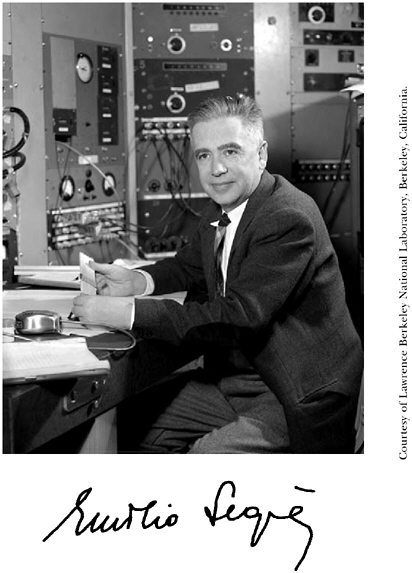
EMILIO GINO SEGRÈ
January 30, 1905–April 22, 1989
BY J. DAVID JACKSON
EMILIO GINO SEGRÈ made important contributions to atomic and nuclear physics and discovered two new elements. He shared the Nobel Prize in physics with Owen Chamberlain in 1959 for the discovery of the antiproton. Segrè was born in Tivoli, Italy, on January 30, 1905 (recorded officially as February 1). He died suddenly in California on April 22, 1989. His youth, spent growing up in a well-to-do Jewish family in Tivoli, was apparently a happy time. After high school he entered the University of Rome, initially majoring in engineering but later in physics. He pursued graduate studies and attained his doctorate in 1928. Military service consumed 1928-29. He then returned to the University of Rome and began research in atomic spectroscopy under Enrico Fermi.
In the period 1929-32 he was an assistant to O. M. Corbino, while also holding a traveling Rockefeller Foundation Fellowship that permitted him to visit and work with O. Stern in Hamburg and P. Zeeman in Amsterdam. In 1932 he became the equivalent of an assistant professor under Fermi. In 1934 the Fermi group switched from atomic spectroscopy to nuclear physics to work on the interactions of neutrons with matter, making Rome the center of research with this new tool for nuclear transformations.
Segrè was appointed to the physics professorship in Palermo in 1936. That year he visited Berkeley and persuaded Ernest Lawrence to give him various discarded parts made radioactive by exposure in the cyclotron. In collaboration with the Palermo chemist Carlo Perrier he discovered the element technetium (atomic number Z = 43), not known in nature because all of its isotopes are radioactively unstable.
In 1938, on a visit to the United States, Segrè decided to emigrate because of the increasing anti-Semitism and the threat of war in Europe. He became a visitor at Lawrence’s Radiation Laboratory and continued work on radioisotopes. Eventually, he became a research associate and after the start of World War II a lecturer in the Berkeley Physics Department. He was a co-discoverer of astatine (Z = 85), another element not known in nature. He worked with Glenn Seaborg and others on the fission properties of 239Pu under slow neutron bombardment after its discovery in 1941. He also invented chemical methods of isolating nuclear isomers together with Seaborg.
In 1943 Segrè went to Los Alamos where his group’s most important contribution was discovery and measurement of the spontaneous fission rate of plutonium. The rate proved sufficiently high that the cannon design used for the 235U bomb could not be used with plutonium. The risky implosion design was then urgently pursued to a successful conclusion for a 239Pu bomb.
After the war Segrè returned to Berkeley as professor of physics and group leader at the Radiation Laboratory. Two key members of his Los Alamos team Owen Chamberlain and Clyde Wiegand joined him, Chamberlain on the faculty and Wiegand as a laboratory staff scientist. Among early postwar research were investigations of isomerism and the modification of the rate of electron capture by a nucleus
caused by a change in the chemical environment of the atom. As higher-energy particle beams became available Segrè and his colleagues began study of high-energy proton and neutron bombardment of nuclei, particularly hydrogen, at the 184-inch synchrocyclotron. With the completion in 1955 of the bevatron, an accelerator whose energy was chosen to produce antiprotons (if they existed), several groups began searches that culminated in success that summer for Chamberlain, Segrè, Wiegand, and Ypsilantis. The discovery of the antiproton removed any lingering doubts about the particle-antiparticle symmetry of nature. The achievement was recognized by the award of the Nobel Prize in physics to Chamberlain and Segrè in 1959.
In addition to his accomplishments in research Segrè is the author or editor of a number of books: texts, handbooks, popularizations of the history of physics, and a biography of Fermi. For 20 years he served as editor of the Annual Review of Nuclear Science. He was elected to numerous learned societies, including the National Academy of Sciences in 1952, and received many honorary degrees.
EARLY YEARS
Emilio Segrè’s childhood, indeed his whole life, is described in detail in his autobiography.1 Only a brief sketch is given here. He was born in Tivoli, Italy, on January 30, 1905, into a prosperous Jewish family originally from northern Italy. His father ran a papermaking and hydroelectric plant; his uncles were academics, lawyers, and engineers. He had a happy, even pampered, childhood, playing in the famous gardens of Villa d’Este and attending elementary school and the first years of high school (ginnasio). In 1917 the family moved to Rome, where Emilio attended a new high school (ginnasio, then a liceo), graduating in 1922 at age 17 with a specialization in engineering. Private tutoring
and instruction from cousins led to early mastery of German and English.
He entered the University of Rome, beginning with a two-year general course for scientists and engineers and then entering the School of Engineering. He soon switched to the Physics Institute, did the equivalent of graduate studies, and received his doctorate in 1928, with a thesis titled “Anomalous Dispersion and Magnetic Rotation.” During these university years Segrè’s friends included Ettore Majorana, a fellow student; Edoardo Amaldi; and Franco Rasetti, a colleague of Fermi’s and a bit older. In addition to mountain climbing with Segrè, Rasetti was instrumental in introducing Emilio to Fermi in 1927. Under the tutelage of Rasetti (experiment) and Fermi (theory) and the paternal oversight of O. M. Corbino, director of the institute, Segrè developed laboratory skills and gained much theoretical knowledge before getting his doctorate after only one year as a physics student.
In 1928-29 Segrè did his compulsory military service (officers’ training school in 1928), spent a six-month hiatus back at the Physics Institute, and then received a commission as a second lieutenant in the antiaircraft artillery stationed near Rome. In early 1930 he was discharged into the reserve. While in the military he managed to study some advanced treatises and visit the institute occasionally to keep in touch. He became an assistant to Corbino in 1930. Segrè’s early life, especially in its intersection with Fermi’s, is described by Laura Fermi.2
Emilio Segrè was a complicated man. He had high standards and expected others to measure up. He appeared proud, aloof, and somewhat intimidating, but underneath he was welcoming and generous in his support of younger physicists, always ready with helpful advice. He was cultured in the European tradition, able to speak several languages
and to quote at length from Latin classics, Dante, nineteenth-century British poets, and Victor Hugo or Schiller. He was a great outdoorsman who accomplished very impressive climbs in the Alps in his youth and took up fly-fishing in America. He was also an accomplished hunter of wild mushrooms.
It is convenient to summarize here the major personal events in Segrè’s life. In 1936 he married Elfriede Spiro. They had three children: Claudio born in Palermo in 1937 and two daughters, Amelia born in Berkeley in 1942 and Fausta born in Los Alamos in 1945. Claudio’s autobiography3 gives a son’s view of the Segrè family life. The Segrès emigrated to the United States in 1938. Emilio’s mother was captured by the Nazis in 1943 and died at their hands. His father escaped capture but died of natural causes in 1944. After Elfriede’s death in 1970 Segrè married Rosa Mines, a Uruguayan friend of Elfriede’s, in 1972. Segrè collapsed and died on April 22, 1989, at age 84 while on his regular walk with his wife near their home in Lafayette, California. Rosa Segrè died from injuries received in a freak accident in Tivoli in 1997.
FIRST RESEARCHES
In 1928-29 Segrè had already begun publication of his research results. First were two papers jointly with Amaldi, one on anomalous dispersion in atoms and the other on the theory of the Raman effect. A third paper, by Segrè alone, explained the anomalous dispersion in band spectra of molecules caused by the accumulation of absorption lines near the head of a band. The experimental work of Segrè, Amaldi, and Rasetti focused on the Raman effect until 1931. But in the fall of 1930, pursuing an idea entirely his own, Segrè examined so-called forbidden (S↔D) transitions in alkali spectra. By studying the Zeeman effect in absorption
he showed that the forbidden lines were the result of electric quadrupole radiation. This important proof of a hitherto neglected form of atomic deexcitation was published as a short letter4 in Nature in November 1930. Pursuing his studies of forbidden spectra, Segrè went to Amsterdam to work in Pieter Zeeman’s laboratory and later on a Rockefeller Foundation Fellowship to Otto Stern’s laboratory in Hamburg and again to Amsterdam in September 1932. Fermi and Segrè collaborated in a theoretical study of atomic hyperfine structure, published in 1933,5 that shows that hyperfine structure arises from the purely electromagnetic interactions of the nuclear magnetic moment with the electron’s spin and orbital magnetic moments.
SLOW NEUTRONS
In 1933 Fermi and his colleagues began to shift emphasis from atomic spectroscopy to nuclear physics and Fermi devoted more and more of his time to experiment. The group studied the work of Rutherford, copied nuclear apparatus, and learned radiochemistry. By 1934, when artificial radioactivity was discovered by the Joliot-Curies, the Rome group was ready to participate. Fermi immediately saw the great advantage of using neutrons rather than charged particles to cause transmutations. Under his leadership the group (Amaldi, D’Agostino, Fermi, Rasetti, Segrè) used a radon-beryllium source to bombard every available element in the periodic table in a search for new artificial radioactivities. Segrè was charged with finding the elements for bombardment, an experience that paid off in later years. During 1934 the Rome group was amazingly productive, publishing new results almost weekly.6,7 They discovered (n, p) and (n, α) reactions, as well as (n, γ) or perhaps (n, 2n) reactions that made radioactive isotopes of the target element. The brilliant achievements of the Rome group
were dimmed only slightly by their not unnatural error of mistaking the fission of thorium and uranium for the production of transuranic elements. In late 1934 the use of paraffin to surround a target led to the discovery that moderation of the neutrons’ energies enhanced manyfold their effectiveness in production of radioactive isotopes of the targets. The field of radiative slow neutron capture was born.
PALERMO AND TECHNETIUM
In the late fall of 1935 Segrè won the competition for the professorship of physics at the University of Palermo, where he joined a modest number of colleagues in other fields of science and began to modernize the physics instruction and build up his small research laboratory. In the summer of 1936 Segrè and his wife visited the United States, first New York at Columbia University, where he had spent time the previous summer, and then Berkeley at Lawrence’s Radiation Laboratory. He persuaded Lawrence to let him take back to Palermo some discarded cyclotron parts that had become radioactive. He hoped that there might be something interesting to be found in their long-lived radioactivity.
Back in Palermo, he found that his samples contained a variety of known radioactivities that had been deposited on them from bombardment of different targets. One was 32P, an activity with a two-week half-life, with which he began a collaboration with the local professor of physiology in tracer studies of metabolism. In early 1937 Lawrence sent him a molybdenum foil that had been part of the deflector in the cyclotron. For Segrè this was a godsend. The atomic number of molybdenum is Z = 42. The foil had been bombarded with deuterons, a hydrogen isotope of mass 2 consisting of a neutron and a proton. By then (d, p) and (d, n) reactions were recognized, in which one or the
other of the projectile’s nucleons is captured by the target nucleus. In the (d, n) process, the proton is captured to create a nucleus with Z = 43. Alternatively, the (d, p) process could lead to a radioactive isotope of molybdenum that undergoes beta decay to produce Z = 43. In 1934, when he was the procurer of elements for Fermi, Segrè sought element 43, known as masurium, from his chemical supplier and was told that the supplier had never seen a sample of it. Now, he suspected that its alleged discovery in the mid-1920s had been a mistake.
Segrè enlisted his experienced chemist colleague Carlo Perrier to attempt to prove through comparative chemistry that the molybdenum activity was indeed Z = 43, an element not existent in nature because of its instability against nuclear decay. With considerable difficulty they finally succeeded in isolating three distinct decay periods (90, 80, and 50 days) that eventually turned out to be two isotopes, 95Tc and 97Tc, of technetium, the name given later by Perrier and Segrè to the first man-made element.8,9
Rightly proud of having filled a gap in the periodic table by their discovery of technetium, Segrè apparently was disturbed by lack of recognition in Italy and by perceived hindrances to his career caused by academic and national politics in Rome. The edge to his personality, visible in later years, and his tendency to criticize, were not moderated by these events.10 Without knowing his mind at the time, one can imagine that he viewed the discovery of technetium as research of Nobel-prize quality and smarted internally from lack of what he felt was sufficient recognition. Such speculations aside, he began seriously in 1937 to look elsewhere for a position, at least in part because of the hints, and more, of trouble for Jews.
BERKELEY (1938-1942)
Pursuing their researches on samples from Lawrence’s laboratory, Perrier and Segrè wished to look for short-lived technetium radioactivities not present in samples received through the mails. In the summer of 1938 Segrè came without family to Berkeley to investigate short-lived radioactivities from cyclotron bombardments. He was initially a visitor at the Radiation Laboratory, expecting to return to Italy at the end of the summer, but the situation in Europe was deteriorating rapidly. Before the summer’s end Segrè decided to stay in the United States. His wife and son joined him in October 1938, and Lawrence appointed him a paid research associate. In 1939 together with Glenn T. Seaborg he developed chemical methods to isolate nuclear isomers.11 He continued studies of technetium, with further proof of Z = 43 from the energies of internal conversion electrons from a six-hour isomeric transition in 99Tc. After the discovery of fission in 1939 by Hahn and Strassmann research at the Radiation Laboratory focused on the high end of the periodic table. When the 60-inch cyclotron began operating in 1940, Segrè, Corson, and MacKenzie bombarded bismuth with alpha particles to create Z = 85 (astatine), another element missing in the periodic table. After the discovery of plutonium in early 1941 Segrè collaborated with Seaborg, Kennedy, and Wahl on the isolation of the isotope 239Pu by slow neutron bombardment of uranium and then studied its chemistry and nuclear fission properties. Segrè’s position in the collaboration was rather bizarre because of government restrictions on aliens concerning topics viewed as sensitive. Matters became even more complex with the entry of the United States into the war.
For four and one-half years (1938-43) Segrè held a series of term appointments as research associate in
Lawrence’s laboratory. In the fall of 1940, with regular faculty off on defense work, he was appointed lecturer in the Berkeley Physics Department (January 1941 to September 1942), teaching advanced undergraduate and graduate courses in modern physics. During 1942 Segrè was busy with war-related work, identifying and monitoring the effectiveness of the pilot mass spectrometer experiments aimed at large-scale separation of uranium isotopes, studying spontaneous fission of heavy elements, measuring the fission cross section of uranium. In some of this work Segrè was joined by two students, Clyde Wiegand and Owen Chamberlain, who with others went to Los Alamos with Segrè in 1943.
LOS ALAMOS
In the spring of 1943 Segrè accepted Oppenheimer’s invitation to join the atomic bomb project at Los Alamos. There he headed a group including Chamberlain and Wiegand to measure the spontaneous fission rates of 235U and 239Pu. The delicate measurements, which required construction of a remote laboratory away from all possible radioactive backgrounds, proved crucial to the design of a 239Pu bomb. The plutonium spontaneous fission rate, though small, is sufficiently large that the (relatively) slow cannon design of the first 235U bomb could not be used with plutonium. (The spontaneous fission proved to be mostly from the “contaminant” isotope 240Pu, not from 239Pu.) The laboratory had to develop the unproven and risky but more rapid implosion design from concept to reality, and it did. In 1944, while at Los Alamos, Segrè and his wife Elfriede became U.S. citizens. At the end of the war he entertained a number of offers before accepting a professorship at Berkeley. He returned in early 1946 and began official university duties in March. R. T. Birge, then chair of the Physics
Department, gives a blow-by-blow account from a chair’s point of view of the successful effort to have Segrè come (return) to Berkeley.12
BERKELEY (1946-1954)
Having left Berkeley in 1943 as a lecturer on a temporary appointment, Segrè returned as a full professor with a regular campus appointment as well as affiliation with the Radiation Laboratory. He set up a research group at the laboratory with Clyde Wiegand as a graduate student and later as an essential staff member. He was joined in 1948 by Owen Chamberlain, who was appointed to the faculty after receiving his Ph.D. at the University of Chicago. Initially Segrè’s research continued with projects stemming from work at Los Alamos and others interrupted by his war work. One of these was the modification of a nuclear lifetime by alteration of the chemical environment, specifically the electron capture rate in 7Be.13
In 1948 Segrè’s group began experiments on nucleon-nucleon scattering with the 90-MeV neutron and proton beams produced from deuterons accelerated in the 184-inch synchrocyclotron. The data on elastic neutron-proton scattering showed the first evidence for strong exchange forces in the nucleon-nucleon interaction. As the energy of the available beams increased to 300-350 MeV in the period 1948-55 the group made a detailed study of elastic proton-proton scattering of increasing sophistication. Thomas Ypsilantis, then a graduate student, pushed the development and use of polarized beams. These extensive data from single-, double-, and triple-scattering experiments were subjected to a phase-shift analysis by Henry Stapp, Ypsilantis, and Nicholas Metropolis, using computers at Los Alamos. They stand as the most complete description of proton-proton interactions at those energies ever assembled.
As this stage of his career Segrè’s style was more managerial and less hands-on than some group leaders. He provided overall direction, argued for funds, gave advice, and was the final arbiter on the science to be pursued. But he was comfortable leaving the details of execution to his trusted associates, Chamberlain, Wiegand, and Ypsilantis (after his Ph.D., an assistant professor on campus).
ANTIPROTON
The discovery of the antiproton by the Segrè group occurred in 1955. From the early 1930s, when Carl Anderson established that electrons had oppositely charged partners of the same mass and spin (called positrons) as predicted by Dirac, the suspicion was that all known particles probably had antiparticle partners. However, the waters were muddied by the existence of the neutron with approximately the same mass as the proton and the magnetic moment of the proton, so different from Dirac’s prediction for spin 1/2 particles. Thus, while physicists were on the lookout for antiprotons (same mass and spin, opposite charge to a proton), there was some doubt as to whether the charge conjugation symmetry of electrons and positrons applied to strongly interacting particles such as the proton and neutron. With the discovery after the war of various unstable particles, the evidence for charge conjugation symmetry mounted. Lawrence and colleagues designed the bevatron to have a beam of 6-GeV protons, nicely sufficient to produce proton-antiproton pairs (if they existed) in collisions of protons with a stationary nucleon target.
Planning of experiments began as the machine was under construction. When the bevatron began operation in 1955, several Berkeley groups with different techniques competed in the search for antiprotons. Deflection in a known magnetic field permits identification of the sign of charge and
the particle momentum. The Segrè-Chamberlain group chose a Cherenkov detector, supplemented by time-of-flight, for a velocity measurement to combine with the momentum to determine the mass. A novel mass spectrometer was built and the Cherenkov detector was constructed by Chamberlain and Wiegand. In the final stages a crucial veto Cherenkov detector was added to eliminate the otherwise overwhelming number of negative pions relative to the antiprotons in the momentum-analyzed beam. The experimental apparatus was assembled during the early summer while Segrè was absent at Brookhaven. Soon after the run began in August antiproton events began to appear. The first experiment was completed in short order; the publication announcing the discovery14 was received on October 24 by Physical Review. Gerson Goldhaber, a member of the Segrè group, and collaborators exposed emulsions to the beam selected by the counter experiment and found annihilation stars in which there was clearly much more than 1 GeV of energy released in the form of pions and recoiling fragments. These annihilation events confirmed the negatively charged particle as the proton’s antiparticle. For the discovery of the antiproton Chamberlain and Segrè were awarded the Nobel Prize in physics for 1959.
The circumstances surrounding the discovery of the antiproton were not without controversy. Claims were raised that key ideas for the experiment had been stolen. Even within the group, feelings of injustice prevailed. The discovery paper has four authors (Chamberlain, Segrè, Wiegand, and Ypsilantis). The process of nomination and selection for Nobel Prizes is arcane, to say the least, but the practice of no more than three persons to share any one prize seems inviolate. There are those who feel that Wiegand was as deserving as any one to share the prize. Why he was not included is not publicly known. Wiegand’s own recount of
the initiation, construction, and operation of the 1955 experiment at a symposium in Berkeley in 1985 on the thirtieth anniversary of the discovery gives a glimpse of his own views.15 For his own part Segrè undoubtedly felt that as group leader responsible for marshaling the resources and fighting successfully to get the experiment scheduled, he deserved a significant share of the glory, regardless of who had actually taken the data. He now had the accolade that had eluded him 20 years earlier.16
BERKELEY (1956-1989)
The antiproton discovery was followed by studies of its properties and interactions, as well as those of the antineutron. In subsequent experiments Chamberlain and Wiegand worked independently of Segrè, with Chamberlain rejoining the Segrè group after a few years but on an equal footing in what became the Segrè-Chamberlain group. In the early 1960s Ypsilantis, with Wiegand and students, mounted an ambitious counter experiment to study pion-pion interactions through pion production by pions. Theorists had described the electromagnetic form factors of the proton and neutron in terms of a spin-one resonance between pions with an energy in the range of 500-600 MeV. The experiment was designed to find such a resonant state. In the event the resonance proved to be at 760 MeV, near the upper limit of the apparatus. The discovery of the rho meson, as the state was called, was accomplished by others using hydrogen bubble chambers. The counter experiment confirmed the bubble chamber results but could add little.17 Segrè blamed the theorists for their incorrect prediction of the resonant energy.
Segrè’s life changed as it does for most upon receiving the Nobel Prize. He became increasingly involved in travel, guest lectures, and committee service, but he was only 54
and stayed as co-head of the research group, now more in an advisory role than as a participant. He had excellent physical intuition and made many helpful suggestions to advance the group’s program. He retired in 1972, but remained active with traveling and writing taking much of his time. He retained an enduring curiosity about new developments in physics and often sought out a colleague to explain their significance.
Segrè served as editor or author of a number of books both before and after retirement. In the immediate postwar years he edited an influential three-volume handbook on experimental nuclear physics.18 He served as chairman of the editorial board overseeing the publication of the collected papers of Enrico Fermi.19 In 1964 he authored a text on nuclei and particles,20 and in 1970 a biography of Fermi.21 His lectures on the history of physics were transformed into two appealing and accessible books.22,23 His autobiography1 appeared posthumously in 1993. He served for 20 years (1958-77) as editor of the Annual Review of Nuclear Science. A few years after stepping down as editor he gave an account of his life in physics in a prefatory chapter in the Annual Review.24
ACADEMIC LIFE
Segrè’s academic life in teaching and university service was as full as his life as a research scientist, at least in his Berkeley years. His autobiography makes little mention of teaching during his years in Rome. He tells of how Corbino, after smoothing his transition from engineering to physics by giving him a phantom grade in a laboratory course, assigned him to teach the course after he received his Ph.D. It seems that Segrè’s position in the Physics Institute was primarily in research.
As mentioned above, Segrè taught courses in the Ber-
keley Physics Department in 1941-42. Departmental records show that he taught upper-division optics, quantum mechanics, and atomic physics, and graduate thermodynamics and statistical mechanics. Upon his return in 1946 he taught fairly regularly the undergraduate quantum mechanics and nuclear physics courses. The latter led to preparation of the textbook Nuclei and Particles.19 In the 1970s he turned to the history of twentieth-century physics and later to that of the seventeenth through the nineteenth centuries. In subsequent years, even well into retirement, he continued to lecture from time to time on historical topics in an undergraduate special topics course. The two books emerging from these lectures have already been mentioned.22,23
In departmental and university affairs Segrè took an active role. He was a regular at the weekly departmental colloquium, often with a probing question at the end. He took very seriously the intellectual health of the department and its future development. He was a shrewd judge of character and ability. He played a strong role in departmental faculty meetings, even after retirement, when rules permitted emeriti to speak but not vote. At least one chair remarked that Emilio invariably came into his office the day of a faculty meeting to discuss the agenda and advise on how the chair should conduct the meeting. He himself served as departmental chair in 1965-66 in Burton Moyer’s absence. In the wider arena he served regularly on a variety of committees of the Academic Senate. Perhaps most important was his service for four years (1961-65) on the powerful Budget Committee, which has little to do with budgets but everything to do with appointments and advancements of faculty on the Berkeley campus.
His professional service through advice to governmental agencies both in the United States and abroad was extensive and in some cases recognized with appropriate hon-
ors. In 1974 Segrè was honored by the Italian Parliament with an ad hominem chair at the University of Rome. He served one year before reaching the mandatory retirement age.
PH.D. STUDENTS
During his time at Berkeley Segrè was responsible for training 30 Ph.D. students, many of whom went on to distinguished careers. A list of those he could recall when writing his autobiography appears in Footnote 16 (p. 317 of Note. 1). To mention only a few, he supervised the research for part of the thesis of Chien-Shung Wu (Ph.D., 1940), resulting in a short joint publication,25 but because he was a research associate, not a faculty member, his name does not appear in her official records. Madame Wu, a fine experimenter, went to Columbia. She is best known for the experimental discovery of parity violation in weak decay processes. The first Ph.D. on the postwar list is Herbert F. York (Ph.D., 1949), who went on to have a distinguished career in laboratory, governmental, and university service. In later years are Thomas J. Ypsilantis (Ph.D., 1955) and Herbert M. Steiner (Ph.D., 1956). Ypsilantis eventually went to Europe and played a major role in scattering experiments and detector development at CERN and in Paris. Steiner became a member of the Segrè-Chamberlain group at the Radiation Laboratory and then a faculty member in the Berkeley Physics Department. He served as departmental chair from 1992 to 1995.
CODA
Proud and opinionated, Segrè showed remarkable common sense in matters of substance. One vignette is illustrative. By 1970 the nuclear weapons branch of the Radiation Laboratory at Livermore, already essentially autonomous,
had grown so large that its budget dwarfed that of the original Berkeley site. Edward Teller argued that Livermore should become a totally independent entity because in his mind the Berkeley lab was a hindrance to Livermore in seeking government funds. McMillan, the director of the whole Radiation Laboratory, called a meeting in Berkeley to discuss the idea of separation. Influential senior physicists argued that Livermore should remain formally part of the overall laboratory for the converse of Teller’s argument for separation. They feared that Berkeley’s funding would suffer if Livermore were to cut free. Among the younger physicists the sentiment was for separation. After listening to the arguments, Segrè spoke up. He said, “Logic argues for separation of the weapons work from the pure science in Berkeley. If funding suffers, so be it.” Senior colleagues, who believed Segrè to be cautious and conservative, were taken aback by his statement. It seemed to carry the day. Shortly thereafter, the university regents formally separated the two laboratories giving them the names recommended by McMillan: Lawrence Berkeley Laboratory and Lawrence Livermore Laboratory. Funding to the Berkeley lab did not suffer.
EMILIO SEGRÈ VISUAL ARCHIVES
A legacy of Emilio Segrè is the Emilio Segrè Visual Archives of the American Institute of Physics. Located in College Park, Maryland, as part of the Center for the History of Physics, the Segrè Visual Archives is the result of a donation by Rosa Segrè after Emilio’s death, subsequently augmented by a bequest from her on her death in 1997. The American Institute of Physics already had a sizable collection of photographs, but Rosa Segrè’s gifts permitted the institute to preserve and organize its collection. Segrè
was a skillful amateur photographer. Many of his photographs are in the archives.
SEGRÈ’S AUTOBIOGRAPHY has obviously been of great help, but the written and informal recollections and views of others have been equally valuable. I thank especially Herbert M. Steiner for his helpful comments and attention to historical accuracy. Spencer Weart kindly supplied the background on the creation of the Emilio Segrè Visual Archives at the American Institute of Physics.
NOTES
1. E. Segrè. A Mind Always in Motion: The Autobiography of Emilio Segrè. Berkeley: University of California Press, 1993.
2. L. C. Fermi. Atoms in the Family. Chicago: University of Chicago Press, 1954.
3. C. Segrè. Atoms, Bombs, and Eskimo Kisses: A Memoir of Father and Son. New York: Viking, 1995.
4. E. Segrè. Nature 126 (1930):882.
5. E. Fermi and E. Segrè. Z. Phys. 82 (1933):729-49.
6. These communications were published in Italian in La Ricerca Scientifica, the journal of the Consiglio Nazionale delle Ricerche. A listing of the many of them is given in Footnote 22, pp. 305-306 of Note 1.
7. E. Fermi, E. Amaldi, O. D’Agostino, F. Rasetti, and E. Segrè. Proc. R. Soc. Lond. A 146 (1934):483-500 (a summary paper communicated by Lord Rutherford).
8. C. Perrier and E. Segrè. Rend. Lincei, 6th ser., 25(1937):723-30; 27 (1937):579-81.
9. A popular account (in English), Cinquant’anni dalla scoperta del tecnezio (The adventurous history of the discovery of technetium) appears in E. Segrè. Atti Accad. Lig. Sce. Lett . XLVI (1989):84-95.
10. For Segrè’s self-assessment, see Note 1, p. 150, lines 6-12.
11. E. Segrè, R. S. Halford, and G. T. Seaborg. Phys. Rev. 55(1939):55.
12. R. T. Birge. History of the Physics Department (informal departmental document), vol. V, ch. XVIII, pp. 11-16.
13. E. Segrè and C. E. Wiegand. Phys. Rev. 75(1949):39-43. Erra
tum 81(1951):284. R. F. Leininger, E. Segrè, and C. Wiegand. Phys. Rev. 76 (1949):897-98.
14. O. Chamberlain, E. Segrè, C. Wiegand, and T. Ypsilantis. Phys. Rev. 100 (1955):947-50.
15. There is a footnote about Wiegand’s 1985 presentation by a puzzled Segrè in Footnote 9, p. 316 of Note 1.
16. Segrè was also disappointed not to share in the 1951 Nobel Prize in chemistry awarded to McMillan and Seaborg for his contributions to the work on plutonium. See Note 1, p. 299.
17. L. B. Auerbach, T. Elioff, W. R. Johnson, J. Lach, C. E. Wiegand, and T. Ypsilantis. Phys. Rev. Lett. 9(1962):173-76.
18. E. Segrè (ed.). Experimental Nuclear Physics, 3 vols. New York: Wiley, 1953-59.
19. E. Fermi. Collected Papers, 2 vols. Chicago: University of Chicago Press, 1962-65.
20. E. Segrè. Nuclei and Particles. New York: W. A. Benjamin, 1964 (2nd ed., 1977).
21. E. Segrè. Enrico Fermi, Physicist. Chicago: University of Chicago Press, 1970.
22. E. Segrè. From X-Rays to Quarks: Modern Physicists and Their Discoveries. San Francisco: W. H. Freeman, 1980.
23. E. Segrè. From Falling Bodies to Radio Waves: Classical Physicists and Their Discoveries. San Francisco: W. H. Freeman, 1984.
24. E. Segrè. Fifty years up and down a strenuous and scenic trail. Ann. Rev. Nucl. Part. Sci. 31(1981):1-18.
25.E. Segrè and C. S. Wu. Phys. Rev. 57(1940):552.
SELECTED BIBLIOGRAPHY
1930 Evidence for quadrupole radiation. Nature 126:882.
1931 With C. J. Bakker. Der Zeemaneffekt von Quadrupollinien bei den Alkalien. Z. Phys. 72:724-33.
1933 With E. Fermi. Zur Theorie der Hyperfeinstruktur. Z. Phys. 82:729-49.
1934 With E. Amaldi, O. D’Agostino, E. Fermi, and F. Rasetti. Artificial radioactivity produced by neutron bombardment. Proc. Roy. Soc. Lond. A 146:483-500.
With E. Amaldi, E. Fermi, B. Pontecorvo, and F. Rasetti. Azione di sostanze idrogenate sulla radioactività provocata da neutron. Ric. Sci. 5:282.
1935 With E. Amaldi, O. D’Agostino, E. Fermi, B. Pontecorvo, and F. Rasetti. Artificial radioactivity produced by neutron bombardment II. Proc. Roy. Soc. Lond. A 149:522-58.
With E. Amaldi. Einige spektoskopische Eigenschaften hochangeregter Atome. Zeeman Verhandelingen, pp. 8-17. ‘s Gravenag: Martinus Nijhoff.
1937 With C. Perrier. Alcune proprietà chimiche dell’elemento 43. Rend. Lincei, 6th ser., 25:723-30; 27:579-81. Some chemical properties of element 43. J. Chem. Phys. 5:712-16; 7:155-56.
1939 With R. S. Halford and G. T. Seaborg. Chemical separation of nuclear isomers. Phys. Rev. 55:321-22.
1940 With D. R. Corson and K. R. MacKenzie. Possible production of radioactive isotopes of element 85. Phys. Rev. 57:459; 58:672-78.
With C. S. Wu. Some fission products of uranium. Phys. Rev. 57:552.
1945 With C. S. Wu. Radioactive xenons. Phys. Rev. 67:142-49.
1947 Possibility of altering the decay rate of a radioactive substance. Phys. Rev. 71:274 (abstract).
1948 With J. Hadley, E. L. Kelly, C. E. Leith, C. Wiegand, and H. F. York. Angular distribution of n-p scattering with 90-MeV neutrons. Phys. Rev. 73:1114-15.
1949 With C. E. Wiegand. Experiments on the effect of atomic electrons on the decay constant of Be7. Phys. Rev. 75:39-43. Erratum 81(1951):284.
1950 With E. L. Kelly, C. E. Leith, and C. Wiegand. Experiments with 260 MeV neutrons. Phys. Rev. 79:96-98.
1951 With O. Chamberlain and C. Wiegand. Experiments on proton-proton scattering from 120 to 345 MeV. Phys. Rev. 83:923-32.
1952 Spontaneous fission. Phys. Rev. 86:21-28.
1954 With O. Chamberlain, R. Tripp, C. Wiegand, and T. Ypsilantis. Experiments with high-energy polarized protons. Phys. Rev. 93:1430-31.
1955 With O. Chamberlain, C. Wiegand, and T. Ypsilantis. Observation of antiprotons. Phys. Rev. 100:947-50.
1956 With E. Amaldi, G. Baroni, C. Castagnoli, O. Chamberlain, W. W. Chupp, C. Franzinetti, G. Goldhaber, A. Manfredini, and C. Wiegand. Antiproton star observed in emulsion. Phys. Rev. 101:909-10.
With O. Chamberlain, D. V. Keller, H. M. Steiner, C. Wiegand, and T. Ypsilantis. Antiproton interaction cross sections. Phys. Rev. 102:1637-40.
1964 Nuclei and Particles. New York: W. A. Benjamin (2nd ed., 1977).
1980 From X-Rays to Quarks: Modern Physicists and Their Discoveries. San Francisco: W. H. Freeman.
1984 From Falling Bodies to Radio Waves: Classical Physicists and Their Discoveries. San Francisco: W. H. Freeman.


