
A Overview of the Environmental Management Science Program and Pending Changes
The Department of Energy (DOE’s) site cleanup program is one of the largest environmental cleanup efforts in world history. The program is currently estimated to cost more than $220 billion (DOE, 2002). To deal with this task, DOE established its Office of Environmental Management (EM) in November 1989. As this report was being finished, EM completed a “top-to-bottom” review of its programs (DOE, 2002). The review led to significant changes, which will be finalized at the start of fiscal year 2003 pending approval by Congress. This appendix presents an overview of the EM Office of Science and Technology (OST) and the Environmental Management Science Program (EMSP) before the top-to-bottom review. It also describes elements of the restructured OST and EMSP known to the committee in spring 2002.
The EM Office of Science and Technology
The Office of Science and Technology is the EM office charged with developing new technologies to assist the cleanup mission. Research and development investments by OST have the following objectives:
-
To meet the high-priority needs identified by the cleanup project managers.
-
To reduce the cost of EM’s costliest cleanup projects.
-
To reduce the technological and programmatic risk of completing major cleanup projects on time and within budget.
-
To accelerate and increase technology deployments (DOE, 2000e).
OST used three main approaches to achieving its objectives: (1) site technology coordinating groups (STCGs), (2) focus areas, and (3) the EM Science Program.
To identify science and technology needs, OST formed an STCG at each major cleanup site to interact with local contractor personnel and others directly involved in the cleanup activities. Each group included a senior manager from the site DOE office, site contractors, and national laboratory personnel. The STCGs were responsible for developing and prioritizing a list of site problems and technology needs based on environmental management issues relevant to a specific site.
Beginning in 1995 and continuing through most of the committee’s study period for this report, OST’s activities were organized around five focus areas:
-
deactivation and decommissioning
-
high-level waste tanks
-
subsurface contaminants
-
transuranic and mixed waste
-
nuclear materials
The primary role of the focus areas was to identify, develop, and deploy new technologies to meet site needs. The National Research Council (NRC) provided a number of studies and reports for the focus areas, as well as a summary report (NRC, 1999b).
The Environmental Management Science Program
The EMSP was established in response to a mandate from Congress in the fiscal year 1996 Energy and Water Development Appropriations Act. Congress directed DOE to “provide sufficient attention and resources to longer-term basic science research which needs to be done to ultimately reduce cleanup costs, . . . develop a program that takes advantage of laboratory and university expertise, and . . . seek new and innovative cleanup methods to replace current conventional approaches which are often costly and ineffective” (DOE, 2000a, p.1). Research supported by the EMSP is expected to lead to new knowledge and technologies that reduce the costs, schedule, and risks associated with the most challenging technical problems in DOE’s site cleanup program. From its inception in 1996 through fiscal year 2001, the EMSP has provided $294 million in
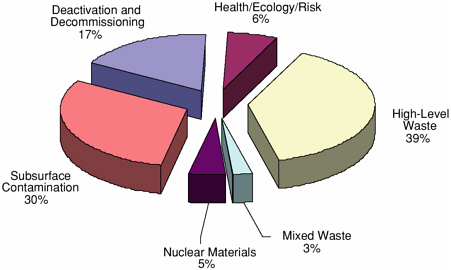
FIGURE A.1 Breakdown of EMSP funding by problem area in fiscal year 2002. The EMSP budget request for fiscal year 2003 is about $30 million.
Source: DOE Environmental Management Science Program.
funding for 361 research projects. Information on how the EMSP develops its requests for research proposals, evaluates proposals, and funds research was presented in three previous reports (NRC 2000a, 20001a, 2001b).
The DOE Office of Environmental Management and the DOE Office of Science jointly managed the EMSP.1 EM’s OST had lead responsibility, and the EMSP was closely tied to OST’s focus areas. Each year, the EMSP issued calls for research proposals related to one or two of OST’s focus areas—this report was prepared to assist in a planned call for proposals in the transuranic and mixed waste area in fiscal year 2003. Research proposals and their funding were tracked according to the focus areas, as indicated in Figure A.1 and Table A.1. Current planning is to move the EMSP out of EM entirely and into the Office of Science under its Office of Biological and Environmental Research (OBER).2
A two-part review of research proposals—for scientific merit by the Office of Science and for relevance to site cleanup by EM—has been a key feature of the EMSP. The relevance review was based largely on site needs identified by the STCGs and the focus areas,
TABLE A.1 EMSP Projects in Transuranic and Mixed Wastes
|
Project Title |
Funding |
|
Removal of Heavy Metals and Organic Contaminants from Aqueous Streams by Novel Filtration Methods |
$330,000 |
|
Architectural Design Criteria for F-Block Metal Ion Sequestering Agents |
$1,800,000 |
|
A Novel Energy-Efficient Plasma Chemical Process for the Destruction of Volatile Toxic Compounds |
$980,222 |
|
Extraction and Recovery of Mercury and Lead from Aqueous Waste Streams Using Redox-Active Layered Metal Chalcogenides |
$333,000 |
|
Utilization of Kinetic Isotope Effects for the Concentration of Tritium |
$1,354,000 |
|
An Alternative Host Matrix Based on Iron Phosphate Glasses for the Vitrification of Specialized Nuclear Waste Forms |
$624,834 |
|
Acid-Base Behavior in Hydrothermal Processing of Wastes |
$379,620 |
|
High Fluence Neutron Source for Nondestructive Characterization of Nuclear Waste |
$745,139 |
|
New Anion-Exchange Resins for Improved Separations of Nuclear Materials |
$1,212,211 |
|
Managing Tight-Binding Receptors for New Separations Technologies |
$350,000 |
|
Processing of High-Level Waste: Spectroscopic Characterization of Redox Reactions in Supercritical Water |
$112,000 |
|
Photocatalytic and Chemical Oxidation of Organic Compounds in Supercritical Carbon Dioxide |
$660,000 |
|
Supramolecular Chemistry of Selective Anion Recognition for Anions of Environmental Relevance |
$775,000 |
|
The Sonophysics and Sonochemistry of Liquid Waste Quantification and Remediation |
$769,843 |
|
Spectroscopy, Modeling, and Computation of Metal Chelate Solubility in Supercritical CO2 |
$265,937 |
|
The Adsorption and Reaction of Halogenated Volatile Organic Compounds (VOCs) on Metal Oxides |
$390,000 |
|
Adsorption/Membrane Filtration as a Contaminant Concentration and Separation Process for Mixed Wastes and Tank Wastes |
$609,987 |
|
Development of Advanced In Situ Techniques for Chemistry Monitoring and Corrosion Mitigation in Supercritical Water Oxidation Environments |
$696,395 |
|
De Novo Design of Ligands for Metal Separation |
$380,000 |
|
Ion and Molecule Sensors Using Molecular Recognition in Luminescent, Conductive Polymers |
$1,500,000 |
|
Fundamental Chemistry and Thermodynamics of Hydrothermal Oxidation Processes |
$1,220,000 |
|
Photooxidation of Organic Waste Using Semiconductor Nanoclusters |
$1,251,000 |
|
Hazardous Gas Production by Alpha Particles in Solid Organic Transuranic Waste Matrices |
$400,362 |
|
Real-Time Broad Spectrum Characterization of Hazardous Waste by Membrane Introduction Mass Spectrometry |
$655,000 |
|
The Development of Cavity Ringdown Spectroscopy as a Sensitive Continuous Emission Monitor for Metals |
$538,000 |
|
Rational Synthesis of Imprinted Organofunctional Sol-Gel Materials for Toxic Metal Separation |
$450,000 |
|
Genetic Engineering of a Radiation-Resistant Bacterium for Biodegradation of Mixed Wastes |
$442,398 |
|
Measurements and Models for Hazardous Chemical and Mixed Wastes |
$500,000 |
|
Novel Miniature Spectrometer for Remote Chemical Detection |
$549,000 |
|
Isolation of Metals from Liquid Wastes: Reactive Scavenging in Turbulent Thermal Reactors |
$1,075,000 |
|
Rational Design of Metal Ion Sequestering Agents |
$405,000 |
|
Genetic Engineering of a Radiation-resistant Bacterium for Biodegradation of Mixed Wastes |
$480,000 |
|
Miniature Chemical Sensor Combining Molecular Recognition with Evanescent-Wave Cavity Ring-Down Spectroscopy |
$949,999 |
|
Radiation Effects on Materials in the Near-Field of Nuclear Waste Repository |
$450,000 |
along with input from advisory groups such as this and previous NRC committees (NRC 2000a, 2001a, 2001b). Without the focus area structure it may be more difficult for the EMSP to identify site technology needs and especially to keep a perspective on long-term needs that can be addressed through scientific research. Maintaining the relevance of its funded research to site cleanup needs will be important for the EMSP after the restructuring is completed in fiscal year 2003—for example, by continuing the joint review of EMSP proposal by both OST for relevance to EM’s needs and the Office of Science for scientific merit.
The Reoganization of OST
In an effort to expedite and reduce the ultimate costs of DOE site cleanup, the Secretary of Energy directed that a review of the EM program be undertaken. In August the Assistant Secretary for EM created a Top-to-Bottom Review Team, which issued its findings in February 2002 (DOE, 2002). As a result of the review, OST began a reorganization that is intended to, inter alia,
-
optimize and fast-track the use of science and technology for EM cleanup projects;
-
concentrate on high-risk, high-cost problems; and
-
focus only on activities that promise high payback or step improvements.
In place of the focus areas, OST is to be structured around two “thrusts” that are identified as closure site support and alternatives and step improvements to current high-risk, high-cost baselines (see Sidebar A.1).
|
SIDEBAR A.1 NEW THRUSTS FOR THE EM OFFICE OF SCIENCE AND TECHNOLOGY OST’s new thrusts, which are to replace the focus areas, were presented to the NRC Board on Radioactive Waste Management in April 2002. These thrusts, objectives, and strategies as developed at that time were the following: Thrust 1: Closure Site Support Objectives:
Strategies:
Thrust 2: Alternative and Step Improvements to Current High-Risk, High-Cost Baselines Objectives:
Strategies:
SOURCE: Owendoff, 2002. |


