
3
Processes
This chapter summarizes the physical, chemical, and biological processes that together comprise the science of contaminant bioavailability in soils and sediments. These processes are strongly influenced by a range of site-specific variables, such as soil or sediment composition, contaminants of concern, and available human or ecological receptor(s), as addressed in detail throughout this chapter. While there is substantial understanding of many of the processes that determine contaminant bioavailability, quantitative models are lacking for most.
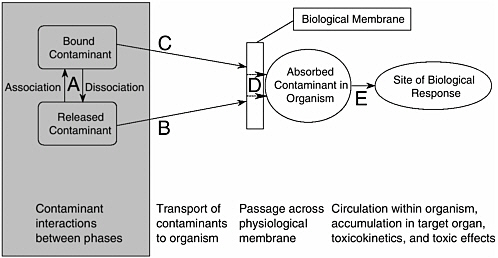
The schematic presented as Figure 1-1 is repeated here to emphasize how physical, chemical, and biological processes interact as part of the bioavailability concept. As illustrated in this figure, contaminants may reside in a bound form (associated with soil or sediment particles), a released form (dissolved in a liquid or gas phase), or associated with a living organism. Contaminants become bound to solids as a result of chemical and physical interactions with soils or sediments (A in Figure 1-1). For example, heavy metals in soil or sediment are usually associated with ionic groups of soil surfaces. The strength of association will determine the extent to which contaminant–solid interactions can be disrupted, allowing the contaminant to become more bioavailable. Thus, understanding contaminant–solid interactions is a necessary first step to assessing bioavailability.
To appreciate the importance of this interaction, it is worth noting that for many chemicals of concern the fraction of contaminant mass that resides in the released form is orders of magnitude less than that which may be present in the bound form. For example, in Lake Michigan only 3 percent of the total polychlorinated biphenyl (PCB) pool is dissolved in the water column, with the bulk bound in bottom sediments (Pearson et al., 1996). In contrast, Lake Superior,
which is situated in a less industrialized area than Lake Michigan and receives most of its PCB inputs via the atmosphere, has a much higher fraction (67 percent) of PCBs in the aqueous phase (Jeremiason et al., 1994). The rate and extent to which bound-phase contamination can be released (or transported directly) to an organism are often the controlling factors, such that understanding contaminant release is critical to the establishment of bioavailability-based cleanup levels and soil or sediment quality criteria. As discussed in Chapter 1, contaminant release can occur far from the receptor, directly on skin surfaces, or within the lumen of the gut.
Following release from the bound state, a contaminant enters a dissolved aqueous state or a gas state (B in Figure 1-1), where it is subject to transport processes such as diffusion, dispersion, and advection. These processes combine to move contaminant molecules through the liquid or gas phases and may result in the reassociation of the contaminant with the soil or sediment (i.e., a return to the bound state), or they may carry the contaminant to the surface of a living organism. Transport of bound contaminants (C in Figure 1-1) via similar processes can also bring contaminants within close proximity of potential receptors. Because exposure of an organism to contaminants is strongly influenced by transport processes, contaminant transport is an important bioavailability component. However, in cases where the contaminant has been released directly on the skin or within the gut, transport processes (other than movement of the organism itself into the vicinity of the contaminated material) may be negligible.
Once the contaminant comes into contact with an organism (either externally or internally in the gut lumen), it is possible for the contaminant to enter living cells and tissue (D in Figure 1-1). Because of the enormous diversity of organisms and their physiologies, the actual process of contaminant uptake into a
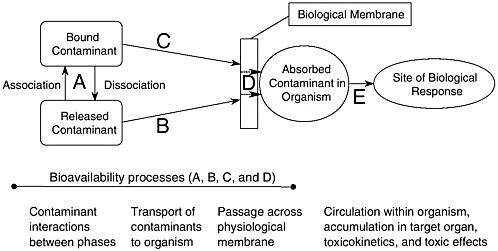
FIGURE 1-1 Bioavailability processes in soil and sediment.
cell—or factors that may impede or facilitate uptake—varies depending on receptor type. One common factor among all organisms is the presence of a cellular membrane that separates the cytoplasm (cell interior) from the external environment. Most contaminants must pass through this membrane before deleterious effects on the cell or organism occur. (In some instances, it is possible for contaminants to exert a toxic effect without penetrating the cell membrane such as β-lactam antibiotics, which damage bacterial cell walls and cause cell lysis.) Uptake generally requires contaminant transfer to and through a released state. In the case of bacteria, physical features (e.g., the cell wall) can isolate their cellular membrane from contact with particulate material, such that contaminants must be dissolved in the aqueous phase before they can be taken up. However, there are exceptions to the notion that bioavailability is directly dependent on solubility. For example, contaminant-laden particles that undergo phagocytosis can be delivered directly into some cells (although within the cell the contaminant may eventually need to be solubilized to reach its site of biological action). How contaminants in the bound or released state interact with the surface of a living organism constitutes the final step that defines the concept of bioavailability.
Once absorbed, contaminants may be metabolized, they may be excreted, or they may cause a toxic effect, among other things. Although these pathways are discussed in this chapter (and shown as E in Figure 1-1), they are not considered bioavailability processes.
SOLIDS PRESENT IN NATURAL ENVIRONMENTS
An important step that limits the bioavailability of contaminants is their retention onto solids that compose soils and sediments. A wide range of solids exists in natural systems that vary in their reactivity toward organic and inorganic contaminants. Before discussing retention processes themselves, it is useful to review the types of solids in soils and sediments and to define how the terms soils and sediments are used in this report.
Box 3-1 provides comprehensive definitions of soil and sediment that acknowledge the richness of these materials as ecosystems. For the purposes of this report, however, simpler more operational definitions are adequate and used throughout the chapter. Soils are usually considered to be unconsolidated (organic and mineral) material on upland landscapes and thus well aerated. As a result, their organic matter content is generally less than 5 percent, and oxidized materials define their mineralogy. Sediments, in contrast, are generally referred to as material having an overlying stratum, either water or soil. Aquatic sediments are saturated with water, and their aeration status depends on the redox conditions of the water column; they often achieve very anoxic states due to limited diffusion of molecular oxygen through sediments. Subsurface sediments underlie soils, often contain very low organic carbon content, and may be aerated or anaerobic depending primarily upon the carbon content in the formation. For
|
BOX 3-1 Different Perspectives on Soil and Sediment Although the operational definitions of soil and sediment are adequate for the purposes of this report, soils and sediments are characterized by intricate associations of biological, chemical, and physical processes that impart functionality in these systems. Furthermore, scientists, engineers, and policy makers define these terms quite differently. Soil Soil is an elaborate ecosystem that encompasses secondary mineral matter derived from the weathering of geological material in association with detrital and living organic matter. A rich community of micro- and macroorganisms resides within and acts upon soils, an aspect not well captured by the operational definition of soil as simply unconsolidated matter at the earth’s surface. As a result, contaminants in soil may undergo complex reaction pathways involving microbial degradation, plant assimilation, or binding to multiple phases ranging from mineral to organic in structure. Soil is a term used frequently by many groups whose definitions of these media often differ greatly. Farmers and plant scientists may consider soils a medium for plant growth. Geologists may consider them as the “skin” on the geologic body. Structural engineers might envision soils as material for supporting roads and buildings, while environmental engineers consider soils as filtration media. From a soil science perspective, soils are defined as “dynamic natural bodies having properties derived from the combined effects of climate and biotic activities, as modified by topography, acting on parent material over periods of time” (Jenne, 1968). Thus, soils are not just inert material on the surface of the earth but rather a complex ecological system, with biological functionality and undergoing continual evolution. |
the purposes of this report, the term sediment when used alone refers to aquatic sediments unless otherwise noted. The contrasting physical environments for soils and sediments can lead to very different solids—and thus properties with regard to contaminant retention (i.e., both strength and magnitude of retention).
Common Materials within Soils and Sediments
Solids within both soils and sediments are a composite of inherited material termed primary minerals (which are minerals formed by geological processes) and solids developed in place (authogenic). Such solids also have a balance of inorganic and organic fractions. This section discusses both primary and authogenic minerals, focusing mainly on clay minerals and organic compounds which are often the most reactive phases and thus most important for influencing bioavailability.
|
Sediment Aquatic sediments are an open, dynamic, structured biogeochemical system typically composed of an oxic zone overlying anoxic materials (Fenchel, 1969; Chapman, 1989; Luoma, 1983, 1989). A variety of organisms ingest aquatic sediments or particulate detritus as food or live within the upper few centimeters of sediments, maintaining contact with the oxic zone to satisfy their oxygen requirements. The depth of the boundary between oxic and anoxic zones is affected by the diffusion rate of oxygen into the sediment compared to the consumption of oxygen by microbes in addition to complex interactions between deposition and erosion, geochemical reactions, and physical and chemical effects of the benthos (Aller, 1982; Myers and Nealson, 1988). Biologists consider sediment to be a medium within which benthos live. Engineers might be concerned about its physical properties with respect to supporting a building or describing the stability of a slope. Hydrologists might be interested in the water holding characteristics of aquatic sediment. These various definitions may assume dimensions that differ from the operational definition used in this report. Geologists define sediment as a solid material that is produced by the weathering, erosion, and redeposition of preexisting rocks (referred to previously as “subsurface sediment”) (Blatt et al., 1980). Sediments can be formed either by erosion and deposition by water (such as beaches), air (such as dunes), or ice (such as glacial moraine deposits) (Gary et al., 1974). The materials that form sediments can be derived from any preexisting rock type, including previously formed sediments, or accumulated by other “natural agents,” such as organic matter that settles after being formed in suspension by organisms. Sediments become generally more compacted and altered chemically (consolidated and lithified) when they are buried within the subsurface. Broadly, the present composition of a sediment depends upon the source materials, the transport processes that occur, the redeposition environment, and any post-depositional processes. Thus, the geologist’s description of sediments tends to focus on factors that identify the sediment formation process. |
Inorganic Materials
Greater than 90 percent of the Earth’s crust is composed of silicate (silicon and oxygen framework) minerals (Hurlbut and Klein, 1977), and as a result these minerals constitute a large fraction of soils and sediments. More specifically, quartz and feldspars make up the greatest fraction of coarse materials (those having particle diameters greater than 0.05 mm) and can also be appreciable in finer (< 0.05 mm) materials of soils and sediments (Allen and Hajek, 1986; Huang, 1989). With the degradation of primary minerals, smaller particles (< 0.002 mm in diameter) develop. This smallest size fraction is typically dominated in volume by secondary (authogenic) minerals composing a mineralogical class known as the clay minerals (a chemical definition of layered aluminosilicate minerals). Although they do not generally constitute the greatest abundance, the high surface area reactivity of clay minerals (as well as organic or carbonaceous
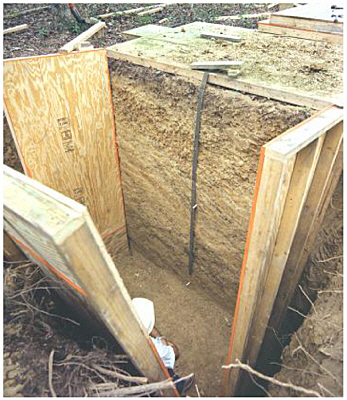
Soil profile at Oak Ridge National Lab showing the intricate and complex nature of soils.
components—see below) causes them to be one of the most important classes of materials controlling contaminant–solid interactions.
Clay minerals are layered silicates in which sheets of silicon coordinated by oxygen anions are bound with sheets of aluminum and/or magnesium coordinated by hydroxyl anions. Individual layers then stack to form the clay mineral. Kaolinite, a material of alternating silicate and aluminum sheets, is probably the most ubiquitous clay mineral in the world. The physical and chemical properties of soils and sediments in temperate climates are usually dominated by smectite and vermiculite minerals, organic matter, or metal (e.g., iron, aluminum, and manganese) hydrous oxides. Smectite and vermiculite are aluminosilicate minerals containing a permanent negative charge that originates from cations of lesser charge substituting for Si4+ or Al3+ within the sheet structure (commonly Al3+ substitutes for Si4+ and Mg2+ for Al3+). The extra negative charge associated with
the defect structure is then satisfied by hydrated cations within soils and sediments, and the degree of negative charge is denoted as the cation exchange capacity (CEC).
A multitude of additional phases may be present in soils or sediments at much lower concentrations, and such phases are termed accessory minerals, most of which are authogenic. Despite their low levels, many accessory phases exert a strong influence on the chemical-physical properties of natural environments owing to their high reactivity, their ability to form coatings on other minerals, and their high surface area. Hydrated oxides of iron and aluminum are the most prevalent accessory minerals within aerated environments (i.e., soils); manganese oxides, while less abundant, have a very high reactivity. Collectively, these phases are termed hydrated metal oxides, and they often control the dissolved concentrations of inorganic contaminants such as lead or arsenic through reaction with ionizable surface functional groups.
Conditions within anaerobic sediments lead to the destabilization and dissolution of iron and manganese oxides. If sulfur is prevalent in such an environment, e.g., as for marine systems, this can lead to the precipitation of minerals such as pyrite or other iron sulfide phases (Morse et al., 1987). Elevated levels of carbon dioxide within waterlogged sediments can also lead to conditions favorable for the precipitation of carbonate minerals, particularly at alkaline pH values, that may include calcite, dolomite, and siderite. All of these solids have a defined reactivity toward contaminants that is addressed further below.
Organic and Carbonaceous Materials
Organic matter in surface soils and many sediments is principally from detrital material of plants and animals or their degradation products, as well as thermally altered and geologic forms of organic matter, such as kerogen, coal, soot, charcoal, and black carbons. Organic matter in solids tends to be highly reactive toward ionic and polar contaminants because ionizable functional groups within natural organic matter (e.g., carboxylate, phenolate, sulfhydral, amino, and phosphate groups) have a propensity to bind metal ions. In addition, aromatic moieties and hydrophobic micropores within organic matter promote the sorption of many hazardous organic compounds.
Because plant and animal residues degrade rapidly in aerated environments of temperate and tropical regimes, soils typically contain less than 5 percent organic matter (Brady and Weil, 1999). Nevertheless, owing to the reactive nature of organic matter, even just a few percent of such material can impart dominant physical and chemical characteristics to soils (Buol et al., 1997). Sediments, on the other hand, are often characterized by anaerobic conditions, and thus tend to accumulate carbon over time. Indeed, wetlands, including estuarine environments, can accumulate an organic fraction well in excess of 20 percent and have their physical-chemical characteristics completely dominated by this material.
Degradation products of plant and animal matter are often broadly categorized based on operational definitions of their solubility. Nondetrital organic matter that is insoluble in acid or base is termed humin, while that which dissolves in base is classified as humus. Humus can further be broken into fractions that are insoluble in acid (humic acids) and those that are soluble in acid (fulvic acids). Although these definitions are based on extraction procedures, the properties of organic matter are well represented by this methodology. For example, fulvic acids are small molecular weight organic molecules (generally less than 2000 daltons) and have a high proportion of functional groups that make them extremely reactive. Humic acids are larger molecular weight compounds with less functionality than fulvic acids. Despite differences in the degree of reactivity, all natural soil and sediment organic matter has appreciable effects on contaminant retention and therefore bioavailability.
Black carbon—particularly noteworthy because of its high reactivity towards nonpolar organic pollutants and its ubiquitous occurrence in sediments (Schmidt and Noack, 2000)—is a product of combustion/pyrolysis of either vegetation or fossil fuel. Post-1900 sediments and soils contain oil- and coal-derived black carbon as well as residues derived from plant combustion prior to 1900. Black carbon is condensed and highly aromatic in structure and composition. Because it is extremely resistant to weathering processes, it persists in the environment.
Along with black carbon, other forms of thermally altered carbonaceous material (coals, kerogens) appear to dominate hydrophobic organic compound sorption and desorption in some systems and potentially dominate bioavailability, even when they make up a small proportion of total carbon. These types of carbonaceous materials arise from geologic processes such as sediment burial and associated elevated temperature that (1) make the material more condensed and aromatic, (2) reduce its oxygen and hydrogen contents, and (3) increase its carbon content (Tissot and Welte, 1978). Under conditions of regional metamorphism, graphite can be formed. Coals, which by definition contain greater than 50 percent organic matter (Hutton, 1995) from primarily terrestrial plant material, are created through “coalification” (peat, lignite, bituminous coal, anthracite) that also results in more condensed and structured organic matter. Below the depth of soil formation, there is evidence that these older and more resistant forms of carbonaceous material can form the bulk of the observable carbon in at least some circumstances (Keller and Bacon, 1998). As explained in Box 3-2, the different types of organic matter discussed above bind contaminants to varying degrees, which may influence bioavailability.
Table 3-1 provides the chemical composition and characteristics of some representative forms of carbonaceous material that occur in soils and sediments. To briefly summarize, humic substances (humic and fulvic acids and humin) generally contain more oxygenated functional groups and less aromatic character and turn over more readily than more condensed, thermally altered forms of
|
BOX 3-2 Differing Sorptive Capacities of Organic Materials Different types of solid organic carbon retain hydrophobic organic contaminants (HOCs) to different degrees. In particular, coal-derived and coaly, particulate sorbent media are significantly more efficient in sequestering HOCs compared to natural sediment organic matter (Karapanagioti et al., 2000). Gustafsson et al. (1997) reported for Boston Harbor sediments that polyaromatic hydrocarbon (PAH) sorption coefficients for carbonaceous residues from pyrogenic sources like soot may be two to three orders of magnitude greater than that for biogenic organic matter. Similarly, Grathwohl (1990) has shown that partition coefficients for HOCs on coals and shales may be approximately two orders of magnitude higher than that for HOCs on soil organic matter, such as humic acids. Reported values of sorption coefficients for different sorbent carbons are illustrated in Figure 3-1 for trichloroethylene (TCE). The H/O ratio of the carbonaceous material indicates its polarity and provides a general indication of the structural characteristics of the material. The figure indicates that more condensed organic phases, such as coals and kerogenic shales, result in higher equilibrium TCE sorption. Similar behavior has been observed for phenanthrene (Gustafsson et al., 1997; Huang et al., 1997). It is evident that soot, coals, and shale-derived carbonaceous materials found in soils and sediment have nearly two orders of magnitude higher sorption capacities compared to humic substances and plant materials that are commonly predominant in modern surficial soils. Thus, from purely equilibrium considerations, the presence of even low proportions of diagenetically or thermally altered carbon solids in sediments should result in a substantial reduction in aqueous equilibrium or pore-water concentrations of the sorbed contaminants. To the extent that exposure and bioavailability are proportional to the aqueous concentration of HOCs, the presence of soot, coal, and charcoal may reduce toxicity and accumulation in comparison to humic or fulvic acids. 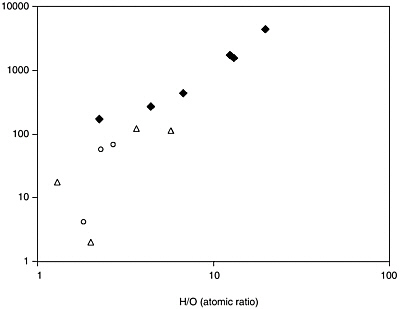 FIGURE 3-1 Reported partition coefficient values for trichloroethylene (TCE) on different types of carbon materials that can occur in soil and sediment. SOURCE: Reprinted, with permission, from Grathwohl (1990). © (1990) American Chemical Society. |
TABLE 3-1 Representative Characteristics of Organic and Carbonaceous Materials
|
Material |
Approximate Age (yr)a |
MW (Da)b |
C%b |
H/Cc |
O/Hc |
|
Soil fulvic acid |
102–103 |
~103 |
46 |
2.20 |
1.19 |
|
Soil humic acid |
102–103 |
104–105 |
56 |
1.95 |
0.84 |
|
Humin |
103 |
104–106 |
|
|
|
|
Kerogen (in shales) |
104–106 |
104–106 |
66 |
1.3 |
0.1 |
|
Coal |
104–106 |
105–106 |
80 |
|
|
|
bituminous |
|
|
|
0.78 |
0.06 |
|
anthracite |
|
|
|
0.32 |
0.02 |
|
Soot, chard |
10–106 |
|
48–97e |
|
|
|
aFrom Weber et al. (2001) for all materials except soot/char. bAs cited in Weber et al. (2001) except for soot and char (Allen-King et al., 2002). cAs cited in Grathwohl (1990) for example materials. dSoot and char contain a high proportion of C and a highly aromatic structure (Schmidt and Noack, 2000; Allen-King et al., 2002). eBlack carbon is predominantly elemental C and has an extended, aromatic network structure. NOTE: Values shown are for particular well-characterized example materials typical of the characteristic compound described. |
|||||
carbonaceous material such as soot, shale-derived kerogen, or hard coal. Although humic substances are usually the dominant form of carbonaceous material in soils and modern sediments, they have much lower sorption capacity for hydrophobic organic contaminants than the more condensed carbon forms. The methods used to identify and, when appropriate, quantify the forms of carbonaceous matter in soil and sediment are described in Chapter 4.
The prevalence and reactivity of solids—both organic and inorganic—found in soils and sediments are summarized in Table 3-2. The surface reactivity of the solids is broadly grouped into three categories: chemical, electrostatic, and hydrophobic reactivity. Surfaces having reactive functional groups (coordinatively unsaturated sites on mineral surfaces) are deemed chemically reactive. Electrostatic reactivity results from the development of charge, whether it be from isomorphic substitution in phyllosilicate minerals or from ionizable surface functional groups. Organic material having non-polar sites provides the possibility of hydrophobic bounds and thus is classified as having “hydrophobic reactivity.” The probability of the material reacting with inorganic or organic contaminants is broadly classified, such that there are exceptions to the generalizations. Finally, those solid fractions with higher specific surface area (e.g., clays) tend to have higher reactivity.
TABLE 3-2 Prevalence and Dominant Reactivity of Solids Common to Soils and Sediments
|
Material |
Type of Reactivitya |
Occurrence |
Reactivity with Inorg. Contamin. |
Reactivity with Org. Contamin. |
|
Fulvic acid |
Chemical, Electrostatic, Hydrophobic |
Soils, Aquatic sediments |
High |
Moderate |
|
Humic acid |
Chemical, Electrostatic, Hydrophobic |
Soils, Aquatic sediments |
High |
Moderate |
|
Humin |
Hydrophobic |
Soils, Aquatic sediments |
Moderate |
Moderate |
|
Kerogen |
Hydrophobic |
Soils, Aquatic sediments, Subsurface sediment |
Low |
High |
|
Coal |
Hydrophobic |
Soils, Aquatic sediments, Subsurface sediment |
Low |
High |
|
Soot |
Hydrophobic |
Soils, Aquatic sediments, Subsurface sediment |
Low |
High |
|
Clay minerals |
Electrostatic, Chemical |
Ubiquitous |
High |
Low |
|
Metal oxides |
Chemical, Electrostatic |
Soils, Subsurface sediment |
High |
Low |
|
Metal carbonates |
Chemical, Electrostatic |
Alkaline environments |
Low to moderate |
Low |
|
Metal sulfides |
Chemical, Electrostatic |
Aquatic sediments |
High |
Low |
|
aChemical reactivity denotes material having functional groups that tend to form bonds with contaminants through the sharing of electrons (covalent/ionic bonds). Electrostatic reactivity relates to the creation of a charged surface. Hydrophobic reactivity results from the presence of non-polar surface groups. |
||||
Aggregates in Soils and Sediments
Within soils and sediments, various “glues”—organic and inorganic polymers—bind individual particles together forming larger clumps of matter termed aggregates that can greatly affect overall reactivity with contaminants. Aggregation can fundamentally alter water infiltration and transport and consequently bioavailability; in general, infiltration and translocation of water are enhanced by aggregate formation because larger channels are formed between particles. For these reasons, aggregation is one of the primary factors controlling soil structure.
Aggregation is initially promoted by high ionic strength, which allows particle flocculation (or the bridging of individual precipitates). Organic matter invariably promotes aggregation of small assemblages produced by flocculation within aerobic and anaerobic environments as manifested by increased hydraulic conductivity and water movement. Inorganic polymers such as hydrous ferric oxides, mineral carbonates (principally calcite), and silica (typically as an amorphous phase) may also promote aggregation. However, inorganic polymers may undergo hardening within soils upon dehydration (Buol et al., 1997), leading to conditions in which water flow (and penetration by soil organisms) is restricted.
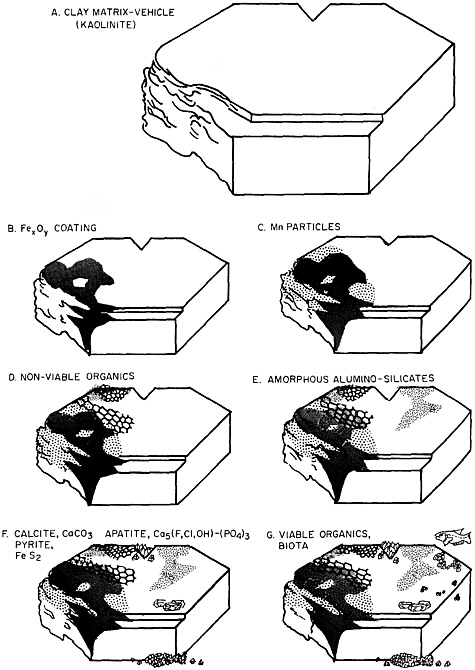
The chemical properties of soils are also influenced by aggregation and heterogeneous precipitation, since it is the composite material and not its separate components that dictates overall reactivity. As depicted in Figure 3-2, in a natural soil environment, mineral grains such as kaolinite have an integral assemblage of secondary material deposited on their surface. Commonly deposited precipitates include (hydr)oxides of iron and manganese, organic material, and metal carbonates. The complexity of natural soil solids was recently illustrated for iron oxides, which are typically not pristine minerals as commonly depicted but rather an association of iron oxide and silica bound by organic matter (Perret et al., 2000). As one would expect, the reactivity of natural iron oxides, in terms of contaminant attenuation or reductive dissolution, is dramatically different than for pristine mineral phases.
Aggregates of particles in soils and sediments can be broken up through physical and chemical perturbations, such as increased fluid shear, a decrease in ionic strength, a change in electrolyte compositions from divalent to monovalent cations, the introduction of a reductant, or a change in pH (Bunn et al., 2002). When this occurs, small particles or colloids initially present in the aggregates may be mobilized, carrying with them any associated contaminants. This can fundamentally alter the percentage of contaminant mass thought to be bioavailable, particularly if organisms can take up and be adversely affected by particle-bound contaminants. Certain extraction techniques discussed in Chapter 4 can be used to determine what percentage of the total mobile contaminant mass of interest is colloid-bound as opposed to dissolved in the aqueous phase. The potential for colloid-enhanced contaminant transport and organismal uptake of colloids depends on many factors, as discussed later in this chapter.
CONTAMINANTS
The contaminants discussed in this section are those for which bioavailability considerations are expected to be important (see Chapter 5 for more in-depth discussion). That is, they are persistent and tend to bind strongly to soils and sediments in natural settings. In addition, they tend to exist as mixtures that may have widely varying properties that affect bioavailability, such as solubility. Organic and inorganic compounds are differentiated for two reasons. First, the bioavailability of organic compounds over time tends to decrease as these compounds diffuse into soil and sediment particles. Metals, on the other hand, may experience increased or decreased bioavailability over time depending on the form of the metal originally deposited in soil or sediment. Second, some organic compounds can be microbially degraded to harmless products in the subsurface, while metals can only be transformed to a different metal species. The susceptibility of organic compounds to degradation is closely related to their bioavailability.
Organic Contaminants
The United States produces and consumes enormous quantities of organic and inorganic chemicals, some of which enter the environment through accidental or purposeful releases. Approximately eight million synthetic and naturally occurring organic compounds have been widely disseminated since the late nineteenth century (NRC, 1994) through their uses in fuels, solvents, food additives, and other products. Many organic pollutants released into the environment are found associated with soils and sediments, where they can persist for decades.
Classes of contaminants commonly found in soils and sediments are listed in Table 3-3. Because many of these compounds bind strongly to solids, the movement of the particulate phases, rather than the advective flow of water or air, can dominate their transport in soil and sediment systems. Depending on the receptor, association of these contaminants with the solid phase may also reduce the potential for their transport into living cells that come in contact with a contaminated matrix.
Polycyclic aromatic hydrocarbons (PAHs) exhibit persistence in soils and sediment due in part to their tendency to sorb strongly. PAHs are created from or used in combustion processes, petroleum refining, wood treating operations, and natural processes. Sites contaminated with PAHs over a century ago are still routinely found to contain soils and sediments containing high levels of these pollutants despite long-term weathering and natural attenuation processes. Other contaminants persistent in soil and sediment systems are PCBs and certain pesticides such as DDT. PCBs were once used in a variety of industrial materials including electrical transformers, and they tend to accumulate in aquatic sediments. Pesticides are widespread in the subsurface primarily as a result of com-
TABLE 3-3 Organic Contaminants, their Frequency, and their Sources
|
Compound Class |
Examples of Compoundsa |
Sources |
|
Polycyclic aromatic hydrocarbons (PAHs) |
Naphthalene Phenanthrene Benzo[a]pyrene Pyrene |
Combustion of coal, oil and wood Asphalt, creosote Automobile emissions, fuels, lubricating oils Coal tarb |
|
Nitroaromatics |
2,4,6-trinitrotoluene (TNT) Trifluralin Benefin Ethalfluralin Methyl parathion |
Military installations Bombing ranges Bactericides Pesticides |
|
Phenols, anilines |
Pentachlorophenol Phenylamide herbicides: phenylureas, phenylcarba-mates, and acylanilides |
Wood preservative Biocide Dyestuff wastewater Phenylamide herbicides |
|
Halogenated aromatics |
Polychlorinated biphenyls (PCBs) Dioxinsc |
Hydraulic oils, capacitor dielectric Pesticide application Incineration of medical/municipal sludge Forest fires and volcanic eruptions Cement kilns and boilers Petroleum, coal, and tire combustion Draft black liquor boilers Secondary lead smelting |
|
Halogenated aliphatics |
Chloroform Bromomethane Carbon tetrachloride Vinyl chloride 1,1-dichloroethylene Trichloroethylene (TCE) Tetrachloroethylene (PCE) |
Degreasing solvents Former dry-cleaning facilities Plastics manufacturing |
|
Pesticidesd |
Alachlor Aldicarb Atrazine BHC Carbofuran Chlordane 2,4-D Toxaphene DDT, DDD, DDE |
Agriculture Residential and industrial pest control |
|
Compound Class |
Examples of Compoundsa |
Sources |
|
Petroleum hydrocarbons |
Benzene Xylenes Toluene Ethylbenzene Alkanes |
Oil recovery and refining industry Automobiles and other forms of transportation Oil tankers, pipe lines, and other modes of transporting oil Industry |
|
aCompounds given are examples and are not all-inclusive. bCoal tar is a liquid byproduct of coal gasification that was commonly disposed of in burial pits at gaswork sites. cDioxins is a term used to collectively refer to the congeners of polychlorinated dibenzodioxins and dibenzofurans. dNote that some pesticides are also halogenated aliphatics. SOURCE: Adapted from NRC (1994, 2000). |
||
mercial agriculture and residential application. Nitroaromatics, another class of recalcitrant compounds in soil, are used for a range of applications from explosives to biocides to polymer-precursors in synthetic chemical production. One example commonly associated with soils at military facilities is 2,4,6-trinitrotoluene (TNT). TNT has been found to persist for decades, partly because it is relatively resistant to microbial degradation.
Several other classes of contaminants are frequently detected in soil, sediment, and groundwater, but do not display the long-term persistence of the previous examples. This may be due to several factors, including the compound’s biodegradability, its tendency to partition into water, or its volatility. For example, the gasoline components benzene, toluene, ethylbenzene, and xylene (BTEX) are widespread contaminants of the subsurface, but are reasonably water soluble and tend to biodegrade rapidly. Thus their potential to be highly persistent in soils and sediments is generally less than for hydrocarbons such as PAHs.
Inorganic Contaminants
At least nine of the top 25 most frequently detected hazardous substances in groundwater are inorganic compounds, primarily metals (NRC, 1994). Nitrate is the most commonly detected inorganic contaminant in groundwater, while the most frequently detected metals are lead (Pb), chromium (Cr), zinc (Zn), arsenic (As), cadmium (Cd), copper (Cu), nickel (Ni), and mercury (Hg). These elements plus antimony (Sb), beryllium (Be), selenium (Se), silver (Ag), and thallium (Tl) constitute the “priority pollutant metals” established by the U.S. Environmental Protection Agency based on potential hazard to human health.
Inorganic chemical contamination in soils and sediments is the result of multiple commercial, industrial, and military uses, including mining, metal refining, battery recycling, fertilizer application, and weapons operations. Radionuclides (primarily uranium, technetium, strontium, and tritium) generated during the manufacture of nuclear weapons are a significant threat at Department of Energy hazardous waste sites.
Table 3-4 lists the classes of inorganic chemicals that are major environmental contaminants. As many of these contaminants occur in multiple chemical forms, the most important isotopes in terms of toxicity, mobility, and bioavailability are noted.
Inorganic contaminants can exist in soil and sediment systems in the aqueous phase, as part of a precipitated mineral, or adsorbed on the surface of a mineral. The phase association of an element is very important in determining its availability to plants and animals. For elements that have at least moderate solubility in the aqueous phase, the tendency to bind on other minerals is often the factor that controls mobility and hence bioavailability. Most of the inorganic contaminants listed in Table 3-4 bind strongly from water onto surfaces of soil and sediment components depending on solution conditions, with pH and ionic composition being primary determining factors (Sposito, 1989; Dzombak and Morel, 1990; Langmuir, 1997). Exceptions are the chemical species that occur in water primarily as hard monovalent anions (e.g., nitrate and perchlorate).
The speciation of inorganic compounds also plays a dominant role in determining their bioavailability and other processes such as toxicity. Depending on
TABLE 3-4 Inorganic Contaminants and their Sources
|
Chemical Classes |
Example Contaminantsa |
Sources or Applications |
|
Metals |
Cr, Cu, Ni, Pb, Hg, Cd, Zn, As, Se |
Mining, leaded gasoline, batteries, paints, fungicides, pesticides, irrigation drainage |
|
Nonmetals |
Ammonia Nitrate (Per)chlorate Phosphate |
Fertilizers, paper manufacturing, disinfection, aerospace |
|
Organometallics |
Tributyltin Methylmercury |
Paints, chemical manufacturing |
|
Radionuclides |
3H, 238, 239, 240Pu, 235, 238U, 99Tc, 60Co, 137Cs, 90Sr |
Nuclear reactors, weaponry, medicine, food irradiation |
|
aContaminants given are examples and are not all-inclusive. SOURCE: Adapted from NRC (1994, 1999, 2000). |
||
the compound and the receptors of concern, certain species of both metals and non-metal inorganic compounds are more or less mobile and/or toxic. Cyanide, for example, is extremely toxic in its free form or when weakly complexed with metal cations such as zinc, while strong metal-cyanide complexes, e.g., iron or cobalt cyano complexes, render the cyanide much more inert with respect to toxicity (Ghosh et al., 1999). Mercury and arsenic are examples of where the complexed (in this case methylated) metal is more toxic than the free ion form (e.g., to fish). For plants in particular, the concentration of the free ion of metals is thought a key parameter that determines their biological effects (Lund, 1990; Stumm and Morgan, 1996; Parker and Pedler, 1997). However, exceptions to this concept have been demonstrated for both plants and aquatic species, indicating that complexed ions are also bioavailable (van Ginneken et al., 1999; Parker et al., 2001). The transformation processes that bring about changes in inorganic compound speciation are discussed in a subsequent section.
CONTAMINANT–SOLID INTERACTIONS
An important factor affecting bioavailability of contaminants is their interaction with solids in soils and sediments, as shown in the grey highlighted section of Figure 1-1 below. Such interactions are termed association (retention) and dissociation (release) in order to be inclusive of the multitude of mechanisms that may be operational. The association reactions of organic and inorganic contaminants may differ appreciably. Inorganic contaminants associate with solids through physical or chemical bonding or through the precipitation of a new solid phase. Organic contaminant binding may involve hydrophobic partitioning or the
formation of chemical or physical bonds with the solid surface. The terminology used to describe contaminant–solid interactions for both organic and inorganic contaminants is provided below:
Association, Retention, or Sorption: The binding of a species without implication to the mechanism (which may include adsorption, absorption, precipitation, and surface precipitation).
Adsorption: The binding of an ion or small molecule to a surface at an isolated site—a two-dimensional surface complex. Binding can be electrostatic, chemical, or hydrophobic.
Absorption: The uptake of a species within another material (analogous to water uptake into a sponge).
Partitioning: The distribution of a population of molecules of a given compound between any two phases, determined by the compound’s relative compatibility with each medium (Schwarzenbach et al., 1993).
Precipitation: The formation of a three-dimensional structure without the association of a substrate (sorbent) material. This process occurs in solution directly and leads to discrete particles. Surface precipitation, a heterogeneous mechanism, refers to nucleation on previously existing particles. Both are important processes for metal and metalloid retention but generally do not contribute to organic compound retention in soils and sediments.
Retention of Inorganic Contaminants
Unlike organic molecules, inorganic species cannot be degraded. They can, however, be retained on mineral and organic surfaces or they can form discrete precipitates; in either case they are removed from the aqueous phase and their bioavailability is consequently restricted. The predominant components of soils and sediments that retain inorganic compounds are clays and oxides of iron, aluminum, and manganese. These components bind ions from solution through electrostatic attraction and through short-range chemical bonding interactions, with the retention strength dependent on the given mechanism. The principal associations of inorganic contaminants with solids, as defined above, are depicted in Figure 3-3.
There are many different processes responsible for the removal of an inorganic species from solution, and each has a different binding strength. The strength of association (or degree to which the contaminant will resist release from the solid phase) depends both on the solids within the system and the contaminant itself. Associations can be predicted by understanding the chemical
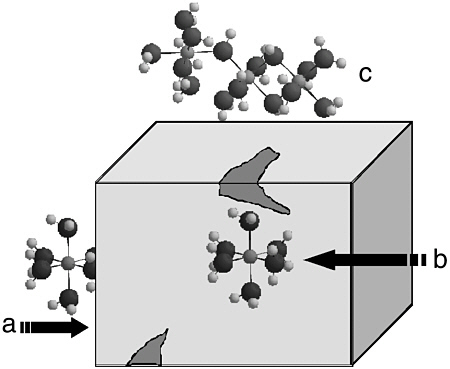
FIGURE 3-3 Ion retention mechanisms illustrating (a) adsorption, (b) absorption, and (c) precipitation reactions on a mineral surface.
reactivity of the contaminant (Table 3-5) and solids (Table 3-2). For example, chemical interactions, described below, should arise if the contaminant has a high reactivity and the solid has ionizable functional groups (hydrous metal oxides or organic matter). Additionally, conditions conducive to the precipitation of a contaminant (Table 3-5) will also lead to a strong association with the solid phase. If chemical interaction or precipitation is not operable, then associations via a physical attraction of an ion and surface of opposite charge may arise. The following sections discuss different association mechanisms and their retention strengths, including information about the current state of knowledge of inorganic solute retention mechanisms and models. Our current understanding of mechanisms and processes is limited to relatively simple systems, such as sorption mechanisms on pristine minerals or soil/sediment isolates. Retention under native conditions—in particular rates of release from the solid-phase—are much more poorly understood.
Adsorption
Adsorption refers to an ion associated with a surface (organic or mineral) either by (1) chemical interactions through a sharing of electrons (covalent or ionic bonding) or (2) electrostatic attraction involving an ion and surface of opposite charge (see Figure 3-4). The energy of adsorption includes contributions from both electrostatic and chemical interactions (Dzombak and Morel, 1990; Stumm, 1992). It is important to note that even if the ion and surface have like
TABLE 3-5 Inorganic Contaminant Reactivitya and Conditions Conducive for Precipitation
|
Class |
Contaminant |
Chemical Reactivity |
Precipitation Conditions |
|
Metal cations |
Cr3+, Al3+ |
High |
pH > 5 |
|
Pb2+, Cu2+, Co2+, UO22+ |
Highb |
pH > 7 |
|
|
Cd2+, Zn2+, Ni2+ |
Moderatec |
High carbonate or sulfide |
|
|
Sr2+, Ca2+ |
Low |
High carbonate |
|
|
Cs+ |
Lowd |
Limited |
|
|
Oxyanions |
AsO43–, AsO33–, PO43– SeO32– |
High |
High dissolved Al or Fe |
|
SO42–, CrO42– |
Moderate |
Limited |
|
|
NO3–, ClO4– |
Low |
None |
|
|
aContaminant reactivity is a necessary factor for chemical adsorption. bLimited reactivity for U when carbonate complexes form. cHigh for Cd and Zn in anaerobic environments. dBinds strongly to vermiculite and illite clays. |
|||
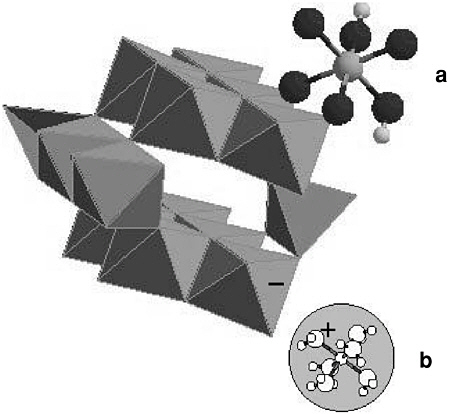
FIGURE 3-4 Adsorption reactions illustrating (a) chemical interactions and (b) electrostatic (physical) associations.
charges, the chemical affinity of an ion for the surface can override the electrostatic repulsion (i.e., if there is a sufficiently strong chemical interaction, a positively charged ion can adsorb on a positively charged surface).
Ions retained strictly by electrostatic forces are generally easily displaced by ions of like charge and are thus termed exchangeable. Exchangeable ions are essential for maintaining plant nutrient levels, but are not typically strong enough to immobilize environmental pollutants over a prolonged time period. The affinity of a charged surface for an exchangeable cation is principally based on the ion’s charge-to-size ratio. As a result, ion charge will be the primary factor controlling the electrostatic retention force, with ion size having a secondary role. The greater the charge and the smaller the hydrated radius, the greater the affinity.
Chemically retained ions form very strong associations with solids that are often considered to be irreversible (McBride, 1994). As a result, chemically bound ions will have a diminished potential for release and should therefore pose a lower risk than ions held strictly by electrostatic forces. A transition from an electrostatic to a chemical association with increased reaction time, as discussed below, will modify the availability of the contaminant.
Inorganic contaminants vary considerably in their tendencies to bind on soil and sediment components, even with similar solution conditions. Figure 3-5, for example, shows data for the adsorption of various metal cations on iron and aluminum oxides as a function of pH. This figure illustrates that lead binds appreciably across a wide pH range, while other metal cations such as strontium bind less extensively than lead at similar pH values. Note that for either electrostatic or chemical associations, cation adsorption will generally increase with increasing pH while anion adsorption will generally increase with decreasing pH. Electrostatic binding increases as a result of greater charge on ionizable functional groups; chemical binding is facilitated by the formation of better leaving groups on the contaminant or surface.
Precipitation
Precipitation reactions result from a solution being oversaturated with respect to a solid phase. Solubility constants for precipitation in bulk solution are tabulated in many textbooks. Using these constants, one can use the saturation index (SI) to determine if a solution is undersaturated (SI < 0), oversaturated (SI > 0), or in equilibrium (SI = 0) with a solid:
SI = log (IAP/Ksp)
where IAP is the ion activity product and Ksp is the solubility constant for the specific reaction. Precipitation is the underlying mechanism assumed for the acid volatile sulfide (AVS) method used to assess the bioavailability of many metals in sediments (see Chapter 2).
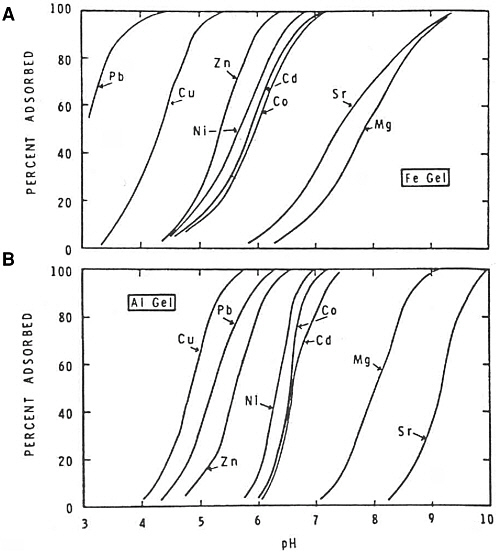
FIGURE 3-5 Retention behavior of eight divalent metal cations as a function of solution pH. For each experimental system (data point), MeT = 0.125 mM in 1M NaNO3 background electrolyte. (A) Adsorption data for freshly precipitated ferric hydroxide, FeT = 0.093 M. (B) Adsorption data for freshly precipitated aluminum hydroxide, AlT = 0.093 M. SOURCE: Reprinted, with permission, from Kinniburgh et al. (1976). © (1976) Soil Science Society of America Journal.
While the SI is a convenient means for assessing the thermodynamic possibility of precipitation, it does not reveal whether the reaction will actually happen—only if it is possible. Kinetic factors usually govern the phase that forms over a short period of time, which is primarily dictated by the activation energy or energy barrier of a reaction. Generally, large well-crystallized particles have a
lower Ksp and higher activation energy. Consequently, amorphous particles are frequently found in soils and sediments due to their meta-stable conditions. Given sufficient time, these amorphous phases will transform into more crystalline solids (a process called “ripening”), which are thermodynamically more stable (i.e., they have a lower solubility). Additionally, existing surfaces often provide a catalytic role in precipitation and lead to surface (or heterogeneous) precipitates.
Recent evidence has revealed the potential for mixed metal phases to form as precipitates on mineral surfaces, providing the resulting phase has a lower solubility than the parent substrate. Association of transition metals with unstable aluminosilicate clay minerals, such as pyrophyllite, may lead to the release of aluminum from the clay and incorporation of the transition ion in a takovite-like solid; such phases have been noted recently for cobalt (Thompson et al., 1999), nickel (Scheidegger et al., 1996), and zinc (Ford and Sparks, 2000). Upon aging, silicon appears to be reincorporated into the precipitate leading to the neoformation of a transition metal-bearing clay mineral. Moreover, the stability of the phase increases with age and thus will lead to diminished dissolved concentrations of transition metal contaminants.
***
In summary, association of inorganic contaminants with solids in soil or sediment is typically dominated by adsorption processes. However, depending on the specific contaminant and site conditions, precipitation may play a large role in governing aqueous metal concentrations, particularly in anaerobic sediment environments where high concentrations of sulfide can result in the precipitation of metal sulfides.
Retention of Organic Contaminants
Organic contaminants can be retained on different components of soils and sediments, as illustrated in Figure 3-6. Nonpolar organic compounds are usually retained on organic components of soils and sediments such as condensed humic material or soot particles. Polar and ionizable organic compounds, in contrast, can associate with soils and sediments primarily through interaction with reactive sites on the mineral components (Sposito, 1989; Schwarzenbach et al., 1993). As described below, the primary retention mechanisms for organic compounds are absorption (partitioning) and adsorption.
Low Polarity Organic Compounds
Low polarity organic chemicals, which have had widespread use, generally associate with carbonaceous components of soils and sediments, although retention on mineral surfaces may be important in materials rich in high-surface-area

FIGURE 3-6 Conceptual model of association and dissociation of hydrophobic organic compounds with soils and sediments. The geosorbent domains include different forms of sorbent organic matter (SOM), combustion residue particulate carbon such as soot, and anthropogenic materials including nonaqueous-phase liquids (NAPLs). Retention processes denoted within the diagram are (A) absorption or partitioning into amorphous or “soft” natural organic matter or NAPL; (B) absorption or partitioning into condensed or “hard” organic polymeric matter or combustion residue (e.g., soot); (C) adsorption onto water-wet organic surfaces; (D) adsorption to exposed water-wet mineral surfaces (e.g., quartz); and (E) adsorption into microvoids or microporous minerals (e.g., zeolites) with porous surfaces at water saturation < 100 percent. SOURCE: Reprinted, with permission, from Luthy et al. (1997a). © (1997) American Chemical Society.
clay compounds with extremely low carbon content (Schwarzenbach et al., 1993). Although progress has recently been achieved in understanding these processes, substantive debate over specific mechanisms and models continues.
Organic pollutants can undergo both solvent partitioning and adsorption mechanisms (Karickhoff, 1984; Weber et al., 1992). Two-domain models have been proposed that capture these two empirical functionalities:
q=qp+qa
where qp and qa are the solvent partitioning and adsorption contributions to total retention, respectively (see Figure 3-7). For recent reviews of such models and
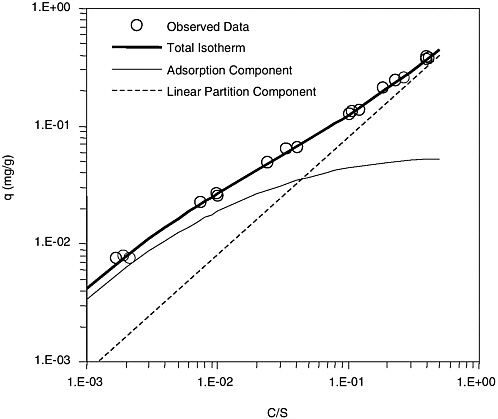
FIGURE 3-7 Example of a model fit of pyrene retention to a silty/clayey aquitard material, showing contributions of adsorption and partitioning to total retention. On this plot, aqueous concentration (C) is normalized by solubility (S). Note that for this example material, the adsorption component dominates at lower solution concentrations while the partitioning component dominates at the highest solute concentrations. The magnitude of the contribution of each of the two components depends upon the relative abundance of the types of carbonaceous materials present in the sediment. SOURCE: Data reprinted, with permission, from Xia and Ball (1999). © (1999) American Chemical Society. Model lines reprinted, with permission, from Allen-King et al. (2002). © (2002) Elsevier Science.
the underlying mechanisms see Xia and Ball (1999), Weber et al. (2001), and Allen-King et al. (2002).
Solvent Partitioning. Partitioning is often found to be linear for low polarity compounds (Chiou et al., 1983). It is an absorption process in that the sorbate exists and is essentially “dissolved” within the complex organic matrix. The solvent partitioning coefficient (Kp) that defines the extent of this behavior has been modeled as the product of two parameters:
Kp=KOCfOC or KOC=Kp/fOC
where Koc is the organic-carbon normalized partition coefficient and is intended to be a compound-specific parameter and foc accounts for the sediment or soil properties by simply quantifying the organic carbon content. Similar formulations exist that use the organic matter (OM) content of the sediment as the normalizing parameter instead of organic carbon. For many sediments and soils, the Koc of individual compounds (or Kom in the case of OM normalization) is essentially constant (Schwarzenbach et al., 1993). Furthermore, Koc can be correlated to physicochemical properties, such as the octanol-water partitioning coefficient or inverse of water solubility, for a variety of low polarity organic compounds (e.g., Karickhoff, 1981). PAHs exhibit a large Koc compared to other nonpolar solutes, apparently because of structural compatibility with aromatic components of soil organic matter (Chiou et al., 1998).
The organic-carbon (or organic-matter) normalized partitioning concept has been the paradigm applied to virtually all neutral organic compounds. It appears to explain retention behavior best when (1) the solute is present at a high concentration relative to compound solubility (Chiou et al., 1998; Xia, 1998) (see Figure 3-7) and (2) when humic substances are the dominant carbonaceous material (Kleineidam et al., 1999). In practice, samples with organic carbon contents greater than ~0.5 percent exhibit dominantly solvent partitioning behavior (Xia, 1998). The organic matter in sediments is less polar than in soils and exhibits approximately two-fold greater retention of low polarity compounds than soils (Kile et al., 1999).
Adsorption. Low polarity organic compounds may also bind through adsorption mechanisms, which result in greater binding coefficients relative to partitioning and also nonlinear behavior. Thermally or diagenetically altered forms of carbonaceous materials such as coals, kerogen from shales, soot, and charcoal (Grathwohl, 1990; Weber et al., 1992; Binger et al., 1999; Bucheli and Gustaffson, 2000; Karapanagioti et al., 2000) have particularly high binding coefficients and nonlinear adsorption behavior. The carbon-normalized Freundlich sorption coefficients (at 1 μg/L for comparison) reported for these materials are as large as 50 to 250 times greater than typically reported Koc values (Grathwohl, 1990; Binger et al., 1999; Kleineidam et al., 1999; Bucheli and Gustaffson, 2000). The attributes of these carbonaceous materials that may account for the observed behavior include a greater H/O ratio, greater aromaticity, and a “more structured” form. In these studies, particles variously labeled as coaly particles, a charcoal-like substance, soot, kerogen, and coal/wood particles are responsible for the majority of compound retention even though they constitute a small portion of the total sediment mass (Binger et al., 1999; Ghosh et al., 2000) or a small proportion of the foc (Gustafsson and Gschwend, 1997; Chiou et al., 2000; Karapanagioti et al., 2000). Ghosh et al. (2000) provides the only direct
measurements that retention by “coal/wood” particles within a sediment is greater than retention by humic substances associated with silicate mineral grains.
Although various forms of black carbon (coal particles, soot) have been implicated in retention for some field sample–compound combinations, the specific properties of carbonaceous material responsible for this effect have yet to be identified. For example, it is not clear whether the enhanced retention associated with the carbonaceous material in shales results from geologic thermal alteration (due to elevated pressure and temperature associated with sediment burial) or is attributable to the presence of combustion products (e.g., char) within the original sediment. A better understanding of the operative mechanisms will be important to understanding the relative importance of adsorption versus partitioning of nonpolar organic compounds onto these solids.
Polar and Ionizable Organic Compounds
Compared to nonpolar organic compounds, polar and ionizable organic compounds are involved in more diverse binding mechanisms, which for ionizable compounds are similar to those outlined for inorganic contaminants. For organic compounds that have one or more ionic groups in their structure, electrostatic attraction–repulsion and bonding at specific surface sites can contribute to compound retention. Organic compounds that are polar but nonionizing exhibit sorption characteristics that span those of hydrophobic compounds and ionizing compounds. Sorption can occur primarily through hydrophobic interactions with organic matter rather than site-specific reactions, depending on the nature of the chemical (Schwarzenbach et al., 1993). In general, the more polar a compound, the less important is hydrophobic partitioning.
Polar and ionizable substituents on organic compounds can either enhance or inhibit the extent of retention relative to related neutral, nonpolar compounds, depending on the characteristics of the molecule and the extent of ionization. For example, Evanko and Dzombak (1998) studied the binding of five ionizing carboxylic acids on the iron oxide goethite, ranging from benzoic acid (one carboxyl group on the benzene ring) to mellitic acid (six carboxyl groups on the benzene ring). As the number of carboxyl group substituents on the benzene ring increased, retention increased and extended over a wider pH range (Figure 3-8).
The association of organic acids (a very common class of ionizable organic compounds) with the solid vs. the aqueous phases is strongly affected by the state of protonation of the compound. This is reflected in a strong dependence of retention on pH, which is illustrated in Figure 3-8. Organic acids generally are retained most strongly to oxidic minerals at lower pH values, and desorb as the pH increases. Thus, many organic acids will be more bioavailable at higher pH values where association with the aqueous phase is favored.
A very specific adsorption interaction has been documented between nitroaromatic compounds and clays. It seems that the aromatic nucleus of the
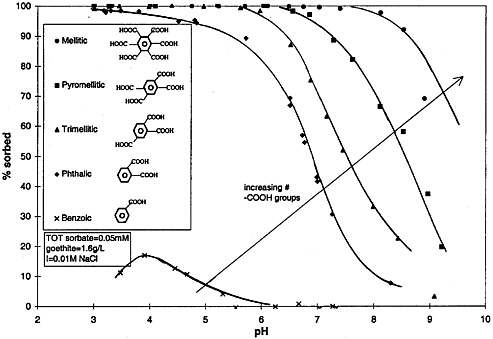
FIGURE 3-8 Fractional retention or sorption of carboxylic acids to the iron oxide goethite as a function of pH and number of carboxylic functional groups. SOURCE: Reprinted, with permission, from Evanko and Dzombak (1998). © (1998) American Chemical Society.
nitroaromatic compounds engages in electron donor/acceptor interactions with the oxygens of the external siloxane surface of the clays (Weissmahr et al., 1997). Such interactions are extremely fast and reversible, apparently independent of pH and ionic strength, and a strong function of the exchangeable cation (Haderlein et al., 1996). However, Sheremata et al. (1999) showed that the extent and reversibility of binding on actual sediments (consisting of mixtures of organic and inorganic phases) of TNT and several of its biodegradation products differed substantially. That is, the amino product compounds such as 2,4-diamino-6-nitrotoluene were more strongly retained than TNT, suggesting that the clay-based adsorption mechanism was insignificant in this scenario. Clearly, although the binding of many polar and ionizable organic compounds can be readily reversible, the extent and kinetics can vary significantly depending on the compound and the solid phase.
Overall, the retention of polar and ionizable compounds such as trinitrotoluene, chlorinated phenols, and other common compounds on soils and sediments is governed by a complex set of physical-chemical processes making it difficult to generalize about trends in behavior. The retention of ionizing organic compounds is much more dependent on solution chemistry than is the case for nonpolar compounds.
Aging Effects on Retention
An important aspect governing the bioavailability of solid-phase contaminants is time. With aging, a contaminant is generally subject to transformations that yield a more stable solid-associated compound. This in turn leads to a decrease in the bioavailability of the contaminant with increased reaction time in both soils and sediments.
Inorganic Contaminants
The state of an inorganic contaminant bound to the solid phase may change on a micropore scale with increasing reaction time. Depending on the solid, the contaminant, and solution conditions, various mechanisms may account for such changes. Contaminants that undergo a rapid uptake on organic or inorganic solids via electrostatic adsorption will gradually undergo a secondary transformation that may lead to the development of an inner-sphere complex (Sparks, 1989). The latter species is more stable than the former and thus decreases the availability of the contaminant. In addition, metal contaminants may actually become incorporated within the lattice structure of solids over time in such a way as to limit subsequent release. For example, Ainsworth et al. (1994) observed increasing desorption hysteresis for cobalt and cadmium, but not lead, upon increasing incubation time with hydrous iron oxide; they speculated that their results reflected contaminant incorporation into the lattice structure, the rate of which corresponded with ionic radii. Intraparticle surface diffusion, a third mechanism, may be a rate-limiting step that leads to the sequestration of metals within microporous solids such as hydrous iron, aluminum and manganese oxides, and some types of organic matter (Aharoni and Sparks, 1991; Axe and Trivedi, 2002).
As noted in the preceding section, mixed metal hydroxides occur extensively on a number of clay minerals. Aging results in new solids being formed, each having progressively decreasing solubilities (a ripening effect) and further retarding the dissolution of a sequestered contaminant (Ford and Sparks, 2000). For common clay minerals such as montmorillonite, nickel retention has been noted to continually increase even beyond a 206-day reaction period owing to the “neoformation” of a nickel phyllosilicate clay (Dahn et al., 2002). A final process that may account for diminished availability of inorganic contaminants over time is simply physical occlusion by deposition of organic or inorganic matter. As a result of the microscale burial, contaminants become sequestered within the solids and have minimal contact with surrounding aqueous solutions. Some of these aging processes are illustrated in Figure 3-9 using lead as an example. Many of these processes are considered irreversible (e.g., occlusion) or reversible only over very long time periods (e.g., surface diffusion).
Although laboratory investigations have clearly established that availability to the aqueous phase may decrease with aging of inorganic contaminants in soils
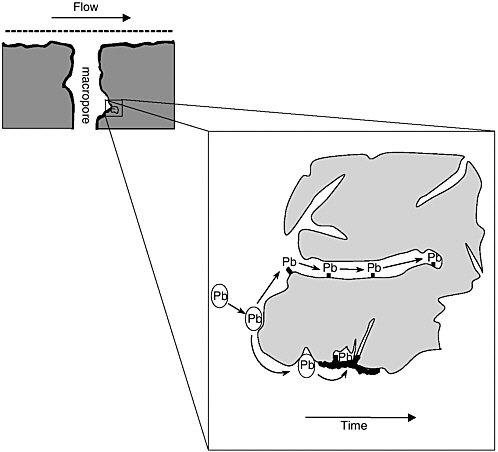
FIGURE 3-9 An example of the effects of aging on Pb+2 retention. The initial step in adsorption is film diffusion and the formation of an electrostatic bond. With increased reaction time, a chemical bond may develop between the ion and surface functional group. Despite the strong retention, the ion may migrate along the surface (surface diffusion) into the interior of the particle (upper pathway). It is also possible that once within the micropore, addition material (mineral or organic) may coat the particle and occlude the micropore (bottom pathway). In either case, contaminants become less susceptible to release into the aqueous phase.
or sediments, field observations of contaminant distribution upon aging have been variable and dependent on specific site conditions—often for the same metal. For example, within smelter-contaminated soils in France and at Leadville, Colorado, lead predominated as a surface complex on organic matter and hydrous oxides of iron and manganese (Morin et al., 1999). Lead was also noted within the organic fraction of garden soils proximal to an alkyl lead production plant (Manceau et al., 1996). In contrast, lead silicates were observed within soils associated with a former lead battery reclamation facility (Manceau et al., 1996).
A consistent theme from studies of natural materials is that surface phases of organic matter and hydrous metal oxides can have a pronounced effect on inorganic contaminant sequestration (Bertsch and Seaman, 1999). Retention within the lattice structure of such solids is also likely, including the precipitation of secondary aluminosilicates (Manceau et al., 1992; Ford and Sparks, 2000).
Organic Contaminants
Although the aging processes that affect the retention of organic contaminants to solids over time are less well understood than for inorganic contaminants, there are two general types: diffusional or reaction processes of the organic solute, and diagenetic processes that change the properties of the soil or sediment sorbent. Solute-based aging processes include chemical oxidation reactions that lead to solute incorporation into natural organic matter (Richnow et al., 1994; Burgos et al., 1996; Karimi-Lotfabad et al., 1996); slow diffusion into very small pores (similar to Figure 3-9 for lead) (Carroll et al., 1994; Hatzinger and Alexander, 1995; Weber and Huang, 1996; Pignatello and Xing, 1996; Cornelissen et al., 1998); and absorption into organic matter (Nam et al., 1998). Diagenetic alterations of the sorbent are caused by various physical, chemical, and biological processes. For example, soil organic matter becomes more aromatic in character with time as continued biochemical transformation of degrading plant matter occurs. This greater aromaticity of natural organic matter results in greater sorption capacity for hydrophobic organic contaminants. Grathwohl (1990) demonstrated that the sorption capacity of soil constituents is related to the age of the soil organic matter. Simulated diagenesis of peat has shown that aged peat had increased sorption capacity for phenanthrene (Johnson et al., 2001).
In general, the longer the contaminant is in contact with the sorbent, the greater is the extent to which aging processes advance. The slower rate of release or greater propensity for retention the longer an organic compound is in contact with soil or sediment may be manifested by extremely slow diffusion rates and high desorption activation energies (e.g., Ghosh et al., 2001). In addition, hysteresis (or an irreversibility of sorption processes) may be observed between the sorption and desorption isotherms (Chen et al., 2000).
It has been demonstrated that the movement of molecules during aging into the micropores of soils and sediments can result in their inaccessibility to even the smallest of microorganisms (Nam and Alexander, 1998). For example, the rate and extent of phenanthrene mineralization by bacteria in silica declined as the percentage of the pollutant in nanopores within silica particles increased (Hatzinger and Alexander, 1998). Further examples of the role of aging in organic compound bioavailability are given in Bosma et al. (1997), Kelsey and Alexander (1997), Alexander and Alexander (1999), White et al. (1999), and Morrison et al. (2000)—with an interesting counterexample provided by Reeves et al. (2001). Taken together, these studies point to the need for improved mecha-
nistic understanding of the aging processes that determine organic contaminant bioavailability.
Contaminant Release
Physical-Chemical Release Processes
Contaminants can be released (the opposite of retention) to water or gas in contact with soil or sediment by a variety of physical and chemical processes. These releases occur in response to changes in water saturation of the soil or sediment, to changes in water and gas chemistry, and to changes in soil or sediment surface properties. Rates of release can be relatively fast (minutes to hours) or extremely slow (many years) depending on the contaminant, solid phase, and fluid properties.
Dissolution of solids in water can lead to the release of contaminants existing as part of, or entrapped in, a solid structure. Metal ions, for example, can be released into water by dissolution of a metal oxide or carbonate solid. Dissolution processes usually have a large role in determining the chemistry of natural waters (e.g., Morel and Hering, 1993; Langmuir, 1997). For those contaminants bound to the surfaces of soil and sediment particles by adsorption or partitioning, desorption can occur in response to changes in water chemistry or surface properties. In addition to releases into the aqueous phase, volatile contaminants may be transferred to the gas phase (Lyman et al., 1990; Lorden et al., 1998). The rate of contaminant volatilization from soil or sediment to a gas phase depends not only on the specific contaminant but also on environmental factors such as temperature.
Contaminant release to the bulk aqueous phase of pore water or surface water involves multiple steps as the chemical moves through different soil or sediment compartments. Some of the inter-compartment transfers occur rapidly while others are slow. This multi-step process may be seen in Figure 3-10 where the release of a biphenyl molecule from sediment particles to the water column in a river is shown. In accordance with current understanding, release from sediment to the water column is considered to involve three steps: (1) contaminant desorption from the river sediment to the pore water until equilibrium is achieved (note that equilibrium may never happen given the following coupled processes); (2) diffusional transport of the contaminant in the macropores of the sediment toward the sediment–water interface; and (3) diffusional transport across the boundary layer at the sediment–water interface and into the river water (Formica et al., 1988; Wang et al., 1991; Ortiz, 1998).
Because these steps are sequential, the slowest step will control the overall rate of contaminant release to the water column. For many strongly retained compounds, the rate of desorption controls the rate of release to the aqueous or gas phases in contact with soil or sediment. In general, overall release rates are
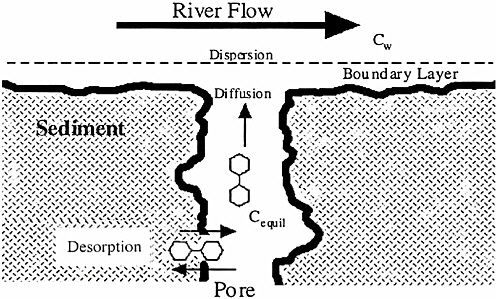
FIGURE 3-10 Schematic illustrating the desorption of a PCB molecule from sediment into porewater, and diffusive transport of the PCB molecule through the sediment macropore to the sediment–water interface. After the molecule moves across the interface it will be transported with the flowing river water. Note: the scale of this figure is significantly larger than the right-hand portion of Figure 3-9. SOURCE: Reprinted, with permission, from Ortiz (1998). © (1998).
controlled by the combined effect of the solid and the contaminant. In the case of retained organic contaminants, the release rate into water is often, but not always, strongly dependent on particle size (Wu and Gschwend, 1986; Ball and Roberts, 1991). However, no effect of particle size on the rate or extent of desorption of organic compounds from natural soils or sediments has been noted in other cases (Pavlostathis and Mathavan, 1992; Pignatello et al., 1993; Carroll et al., 1994).
Biologically Mediated Release Processes
A variety of biological processes within soils or sediments may alter contaminant retention and release and thus impact bioavailability. The most prominent example is contaminant desorption from soil or sediment particles mediated by the digestive tract—the mechanisms of which vary considerably across species. Within the gut, acid extraction, removal by surfactants, ligand complexation in solution and on membranes, transport with amino acids, and enzymatic breakdown of organic chemicals are all operative. Extraction tests developed to mimic these processes are discussed in detail in Chapter 4. Other biologically induced release processes include chemical transformations brought about by microbes and plants, as discussed below. Such biologically induced transformations need
to be appreciated because they often underlie strategies for remediating hazardous waste sites.
Microbial Surfactants. Hydrophobic organic compounds have low aqueous solubility, which when coupled with strong binding onto solids may limit their biodegradation. Surfactants produced by some microbes (biosurfactants) have the potential to increase the amount of sparingly soluble organic compounds in the liquid phase via incorporation into surfactant micelles or aggregates. Some microorganisms growing on essentially insoluble alkanes or oils secrete surface-active or emulsifying agents (microbial surfactants) that convert the hydrocarbon to droplets or particles with diameters of 0.1–1 microns (Einsele et al., 1975). These surfactants increase the apparent solubility of organic molecules and can account for their utilization by microbes (Goswami and Singh, 1991; Alexander, 1994). Microbial surfactants have been characterized as polysaccharides, polysaccharide-protein complexes, or glycolipids (Rosenberg, 1986). These and related compounds produced from the enzymatic degradation of starch and other materials have been studied to determine whether they may significantly increase bioavailability and thereby enhance the biodegradation of low-solubility organic compounds. Representative research has shown, for example, that two forms of a biosurfactant, a monorhamnolipid and a dirhamnolipid, and a cyclodextrin increased the apparent solubility and biodegradation of phenanthrene (Zhang et al., 1997; Wang et al., 1998). While biosurfactants can certainly enhance mobilization and biodegradation of organic compounds that exist as a separate organic phase (Herman et al., 1997), it is less clear whether they can enhance desorption and biodegradation of predominantly solid-associated organic compounds. Thus, at this time a clear understanding of surfactant effects and the linkages between solubilization, bioavailability, and biodegradation in systems comprised of hydrophobic organic compounds and soils or sediments is lacking.
Plant and Microbial Effects on Contaminant Release. Plants can also influence contaminant release from solid surfaces. In order to access required macro- and micronutrients, plant roots have the ability to alter the environment directly adjacent to them. Some of the parameters that may be altered as a result of plant activity include pH, redox status, ionic strength of the soil solution, macronutrient concentration and nature, and concentration of organic ligands (McLaughlin et al., 1998). The extent of alteration of the rhizosphere environment will vary by plant species and cultivar as well as by the nutrient status of the soil. The examples below illustrate the extent of modifications that are commonly observed as well as their implications for the bioavailability of contaminants.
In cases of phosphorus deficiency, plants can secrete organic acids along with H+ to solubilize soil phosphorus. One side effect of this is that in arsenic-contaminated soils, phosphorus deficiency will induce elevated arsenic uptake and potential phytotoxicity, because both elements share the same uptake system
(Lee, 1982). Plant uptake of lead and zinc are also elevated in cases of phosphorus deficiency, potentially via plant-induced dissolution of lead and zinc phosphate precipitates (Laperche et al., 1997, Brown et al., 2003) or via dissolution of iron oxides. This may occur as a result of rhizosphere acidification or root proliferation and secretion of organic acids.
The mechanisms by which plants access solid phase soil iron can also influence the release of other contaminants in a soil system. At biological pH, the maximum amount of uncomplexed iron in solution is no greater than 10–18 M. Yet, most aerobic microorganisms and all plants need iron for growth. Plants follow one of two strategies to solubilize iron (see Figure 3-11). The roots of Strategy I plants (dicots and non graminaceous monocots) may induce reducing conditions in the rhizosphere with NAD(P)H electron donors located on root cells’ plasma membranes. These plants may also secrete reducing or chelating compounds (often phenolic compounds). Proton pumps located on the surface of root cells can decrease solution pH by up to 2 units. In addition to solubilizing iron, these alterations can inadvertently solubilize a range of cations, particularly ones bound to iron mineral surfaces, that may be detrimental to the soil system.
Strategy II plants (grasses) release phytosiderophores (from the Greek: plant “iron carriers”)—low molecular weight compounds that have a high affinity for ferric iron (Marschner, 1995). Many microorganisms also synthesize and secrete siderophores. Most siderophores that have been characterized belong chemically to the catecholates, the hydroxamates, or the polyhydroxycarboxylates, or they are polyfunctional. These molecules can compete successfully with the hydroxyl ion for Fe(III). Most microbial siderophore uptake systems involve an outer membrane receptor (Neilands, 1984) and a transport system consisting of a periplasmic binding protein, an integral membrane component, and an energy-providing membrane-bound ATPase (Winkelmann, 1991). Siderophore production is regulated by iron availability (Neilands, 1995), and formation constants for iron chelates are very high (>1030). Coincidentally, gallium and elements from the actinide series, as well as other heavy metals, can be tightly bound to siderophores (Winkelmann, 1991). In plants, the uptake mechanism for iron chelates is specific enough to prohibit entry of cations other than iron. However, there is the potential for their uptake through other, less specific mechanisms.
In some cases, plants have evolved specific mechanisms that permit them to survive in potentially phytotoxic soils by reducing contaminant bioavailability to plant tissue. For example, wheat roots exude malate to complex and detoxify aluminum in acid soils (Papernik and Kochian, 1997), although the relevance of this mechanism is limited because aluminum is generally not considered a contaminant. A very limited number of metal hyperaccumulator or excluder plant species have been identified that are able to tolerate excess concentrations of metals in soil solution by highly specialized exclusion mechanisms (Baker, 1987; Kramer et al., 1996; Reeves et al., 1999). Such species are generally found only on historically contaminated soils.
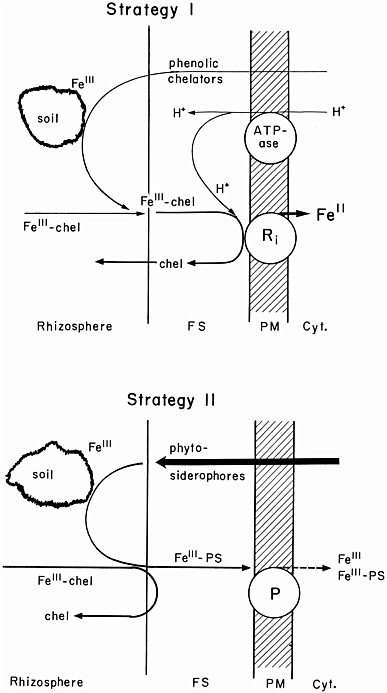
FIGURE 3-11 Plants utilize two distinct strategies to access solid phase soil Fe. Strategy I plants secrete phenolic chelators that can induce reducing conditions as well as hydrogen ions to lower rhizosphere pH, leading to reduction of Fe (III) via membrane-bound reductases. Strategy II plants secrete highly specific phytosideraphores (iron chelates) into the rhizosphere. SOURCE: Courtesy of David Parker, University of California, Riverside.
In addition to plants and microorganisms altering the soil and sediment environment in order to better access compounds for themsleves, their activities can also gratuitously affect the bioavailability of compounds to other receptors.
|
BOX 3-3 Arsenic in Bangladesh: Microbially Mediated Release Arsenic is a toxic trace element that is rather ubiquitously distributed throughout the world. Owing to its toxicity and accumulation, even low concentrations of arsenic in drinking water can pose a serious health threat. Bangladesh and West Bengal serve as examples of the serious health impacts arsenic can impose and the role of microbes in increasing arsenic mobility, transport, and bioavailability. In order to eliminate the potential for disease via surface water pathogens, the use of groundwater as the primary source of drinking water within Bangladesh and West Bengal has been promoted by government and world heath organizations. The shallow aquifers used are within sediments derived from upland Himalayan catchments and are laden with arsenic. Nearly 28 percent of the shallow wells in the region have arsenic concentrations exceeding 50 μg/L (the drinking water standard of Bangladesh) (Smedley and Kinniburgh, 2002). As a consequence, between 30 and 35 million people in Bangladesh alone have been exposed to water exceeding allowable arsenic levels. An estimated one million people have been projected to be impacted by arsenocosis with incidence of cancer in the tens of thousands (Chowdhury et al., 2000; Anawar et al., 2002). Although the solid concentrations of arsenic in the region (typically less than 6.5 mg/ kg—Smedley and Kinniburgh, 2002) do not exceed world average concentrations for river sediment (Martin and Whitfield, 1983), and are on the order of one-tenth to one-hundredth those of mining-impacted sediments or soils (Harrington et al., 1988; Moore et al., 1988), the dissolved concentrations remain high. The reason why arsenic is partitioned to the solution and not the solid phase is because of redox conditions present in the subsurface. Arsenic is a redox active element that generally exists in either the +3 or +5 oxidation state. Both oxidation states lead to oxyanions—As(III) as arsenite and As(V) as arsenate, although As(III) may also be coordinated by sulfur ligands in sulfide-rich environments. Arsenate dominates in aerobic environments while arsenite persists in anaerobic systems. With the exception of its redox activity, arsenate is an analog to phosphate and generally binds tenaciously to solids within soils and sediments, particularly hydrous oxides of ferric iron. Arsenite also forms strong complexes on iron (hydr)oxides and iron sulfide minerals but it has a narrow adsorption envelop centered around pH 7, and it does not partition extensively on Al-hydroxide or aluminosilicate minerals (e.g., kaolinite). Thus, in non-sulfidic systems where ferric (hydr)oxides are absent or undergoing degradation, or where the pH deviates appreciably from neutrality, one can expect arsenic to partition to the solution phase. Unfortunately, the subsurface sediments of Bangladesh and West Bengal support anaerobic conditions leading to the formation of arsenite, and the sediments are not enriched in reactive iron sulfide phases. In addition, ferric (hydr)oxides are absent or undergoing degradation because of anaerobic microbial respiration. That is, Fe(III) is serving as an electron acceptor for dissimilatory iron reducing bacteria (DIRB), which are ubiquitous within surface and subsurface material and account for the vast majority of iron (hydr)oxide reductive dissolution (Lovley, 1991). Microbially mediated degradation of ferric solids by DIRB has, in fact, been demonstrated as a release mechanism for |
As discussed in Box 3-3, the microbial reduction of iron in sediment (which has led to the release of iron oxide-bound contaminants) has contributed, along with other important processes, to serious arsenic exposure to humans in Bangladesh.
|
retained arsenic (Cummings et al., 1999; Zobrist et al., 2000)—a pathway that accounts for the majority of arsenic within anaerobic waters. While various hypotheses have been given for the release of arsenic within sediments of Bangladesh, microbial reductive dissolution of ferric hydr(oxides) and the concomitant release of arsenic is a probable mechanism. Carbon introduced from surface runoff laden with animal and human excrement may episodically stimulate DIRB activity and lead to reductive dissolution of the ferric solids. Alternatively, or possibly in concert, detrital organic matter (predominantly as peat) residing in the sediment may allow for slow but sustained reduction of ferric (hydr)oxides. In either case, the unfortunate outcome of the aquifer conditions and biologically induced solid-phase alteration is that arsenic is placed in a bioavailable form to which millions of people are exposed. 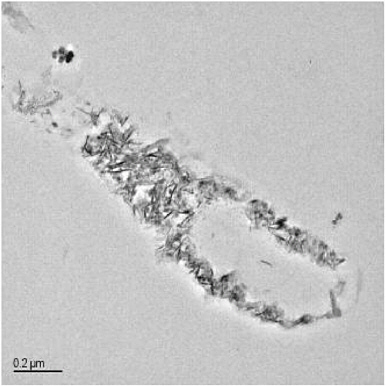 Goethite encrusting the a cell of the dissimilatory iron-reducing bacterium Shewanella putrefaciens. |
Bioturbation. It has long been recognized that the presence of macrofauna can change the physical and chemical properties of sediments (Aller, 1982; Rhoads and Boyer, 1983). Bioturbation is the mixing that occurs when biota move sediments from one location to another (usually vertically) by ingestion and defecation or by activities such as burrow construction. Bioturbation and resuspension can change the release of contaminants and consequently their bioavailability. Another common effect is to mix surface material into the sediment column or to move sediments from depth to the surface. In aquatic environments, resuspension can be caused by currents generated by tides, winds, and high velocity flows. Metals, for example, are released slowly from sediments in general, but rates are faster from oxidized than from anoxic sediment. When resuspension or bioturbation move sediment from an anoxic microenvironment (e.g., at depth) to an oxic environment (e.g., at the sediment surface), desorption of metals can accelerate (Giblin et al., 1986). The opposite can also occur if surficial contamination is buried.
The dramatic influences of bioturbation by the lugworm Arenicola marina on uptake and distribution of cadmium in a marine sediment was recently demonstrated by Rasmussen et al. (1998) using laboratory sediment cores. In cores without lugworms, all cadmium was found in the surface sediment over 16 days of exposure. In cores containing lugworms, cadmium was found dispersed throughout the sediment column to 15 cm depth (the feeding depth of the worm) after 16 days. The presence of lugworms more than doubled the rate of removal of cadmium from solution to sediment due, at the least, to increased turnover of sediment (from feeding activity) and increased contact of cadmium-labeled water with potential binding sites in the sediment.
Bioturbation does not always lead to increased removal or transformation of contaminants. For example, burial by bioturbation slowed the degradation rates of fluoranthene (Kure and Forbes, 1997). Bioturbation depths differ considerably, and short-lived isotopes of atmospheric origin can be employed to determine how deep the sediments are mixed (Fuller et al., 1999). In the San Francisco Bay, mixing occurred over a 30-cm depth in some locations during a six-month period (Fuller et al., 1999).
Summary
For inorganic contaminants, a variety of mechanisms exist by which ions associate with the solid phase. This mechanism will in turn determine the extent to which the contaminant is bioavailable. Ions retained by electrostatic forces (physical adsorption) can easily be displaced by other ions and thus will have a high probability of being rapidly released. Thus, formation of such complexes would not be expected to appreciably retard the bioavailability of a contaminant (i.e., the contaminant remains available for release into solution and for subsequent biological uptake). In contrast, compounds that form strong chemical inter-
actions with the solid will not be easily displaced. Often they can be considered irreversibly bound and thus their potential for release (desorption) into solution is minimal. Similarly, contaminants forming precipitates on existing mineral surfaces or as discrete phases will be rendered immobile and unavailable for plant or animal uptake via the surrounding solution, provided that conditions maintaining a stable solid (i.e., low solubility) prevail.
Polar organic compounds will undergo adsorption processes similar to those noted for electrostatic interactions of inorganic ions; they bind to charged functional groups on minerals and particulate organic matter. Nonpolar organic compounds, however, are usually retained on organic components of soils and sediments such as condensed humic material or soot particles. Owing to the porous nature of organic matter (or at least a large fraction of it), molecules may diffuse into the interior portion of the particles. Within these confines their potential for release is dramatically diminished. Furthermore, pores may become occluded, thus entrapping contaminants within the particle and helping to minimize their bioavailability.
Rates of desorption for both organic and inorganic contaminants from soils and sediments are highly variable and dependent on the mode of uptake, the time of reaction (aging), and on the current solution conditions.
CONTAMINANT TRANSPORT
Inorganic and organic contaminants associated with soils and sediments can be transported to biological receptors by a variety of pathways in environmental systems. As highlighted in the grey box below, the contaminant may be transported on the soil or sediment particle with which it is associated, or it may be released from the soil/sediment particle to water or a gas phase (e.g., soil gas or
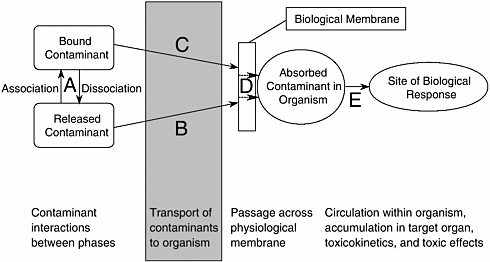
air) and transported in that medium. In some circumstances, contaminants may be transported in liquids other than water, such as oil or gasoline, but this is most relevant to a spill scenario for which considerations of bioavailability are secondary. The particular transport pathway depends on the initial location of the contaminant (such as occurrence in deep or shallow soil or sediment), the properties of the contaminant (such as volatility and aqueous solubility), and on environmental properties (such as degree of water saturation in the soil and near-sediment water velocity).
Transport of Contaminants on Particles
Contaminants on soil and sediment particles can be transported along with the particles themselves, via entrainment in moving water or air. This allows transport of contaminants that are strongly associated with the particles and have little potential for release in soluble form to water or in vapor form to air.
Soil-borne Contaminants
There are three major transport pathways for soil particles and associated contaminants to reach receptors that are not in their immediate vicinity: entrainment in air, suspension in water, and colloidal movement in groundwater. Soil particles at the soil–air interface can be entrained in air flows moving over the ground surface, or they can be suspended in surface runoff following precipitation. These contaminant-bearing particles may be transported directly to receptors, e.g., through inhalation by animals or deposition on plants, or to other environmental media, e.g., via atmospheric deposition or runoff to surface waters. In addition, solid-bound contamination can be transferred to receptors via colloid movement in groundwater. Colloid movement is notable because generally soil particles below the ground surface are immobile, and thus serve to keep any affiliated contaminants immobile. However, the finest (< 10 μm) soil particles can be mobile in coarse-grained porous media under some conditions (Figure 3-12). These colloids have potential to move with groundwater through the near-surface unsaturated zone to the deeper, saturated zone and then to pumping wells, discharge areas, plant roots, and other receptor locations. Significant contaminant transport by colloids in the subsurface appears to be possible only under special conditions, such as when contaminant adsorption is strong and not readily reversible, and when concentrations of mobilized colloids are high (Ryan and Elimelech, 1996; Roy and Dzombak, 1997, 1998). While there has been much study of the association and transport of contaminants with soil particles, including colloids, there has been much less study of the availability of these particle-associated contaminants to human and ecological receptors. What is known about the extent of uptake of colloid-bound contaminants during oral ingestion and inhalation by mammals and invertebrates is discussed in a subsequent section.
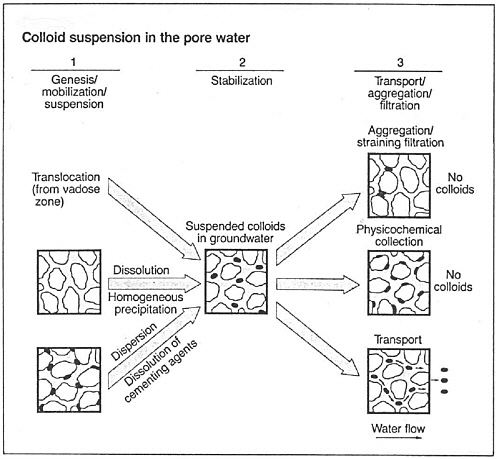
FIGURE 3-12 Colloid suspension in soil pore water. SOURCE: Reprinted, with permission, from McCarthy and Zachara (1989). © (1989) American Chemical Society.
Sediment-borne Contaminants
Contaminated sediment particles at the sediment–water interface can be transported via resuspension in water flows moving along the sediment surface (Figure 3-13). Due to their size, larger and heavier particles may be suspended for just a short period of time, resulting in their deposition after lateral transport for a short distance. This process, known as bed load transport, often can be repeated many times in sequence, resulting in the downstream movement of the larger, heavier particles (Figure 3-13). Downstream bed load sediment transport occurs at a slower rate than is the case for smaller, lighter particles, which tend to remain suspended in flowing water. The amount of material transported downstream is an exponential function of flow velocity, so large events (floods) are responsible for a large proportion of the sediment transport in most systems. In contaminated rivers this means that floods can move contaminated sediments onto floodplains. In the Clark Fork River, Montana, contaminated sediments of many meters depth
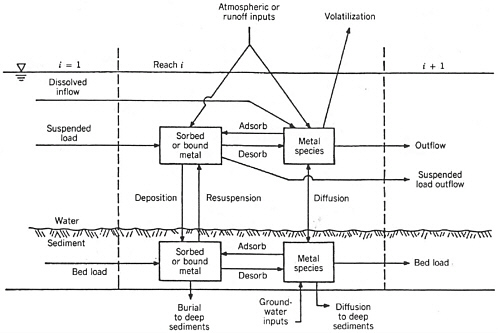
FIGURE 3-13 Schematic representation of metal transport in a stream or river showing suspended and bed load transport of dissolved and retained particulate material. Note that the suspended load contains particles of all size including colloids. SOURCE: Reprinted, with permission, from Schnoor (1996). © (1996) John Wiley and Sons, Inc.
occur across the entire floodplain near the mining district, and substantial contamination is deposited in floodplains more than 200 km downstream from the mining district (Moore and Luoma, 1990). Most of the contaminated sediment probably was moved onto the floodplains during a few floods. The implication is that, as the river cuts new banks, over centuries, it continually cuts into the contaminated sediments present in the floodplain, creating a downstream, secondary source of additional contamination. Contaminated floodplains thus add to the complexity of remediating contaminated rivers.
Sedimentation and burial are also important transport processes than can effect the bioavailability of sediment-bound contaminants. The rate of sedimentation is dependent on the particle size and density and on the physical-chemical conditions in the system that determine the rate and extent of particle aggregation. Whether particles that are deposited on the bed of the surface water undergo burial or are resuspended and moved downstream depends on the hydraulics of the surface water, the size and density of the particle, and the magnitude of the suspended particle load. Within a single water body there usually are locations where particles tend to settle and accumulate and locations in which particles reside in the sediments for only a short period of time. Connolly et al. (2000) describe sections of the Hudson River in which particle deposition and burial occur and sections in which particle resuspension is the norm.
Transport of Released Contaminants
Compared to our understanding of contaminant–solid interactions, our current understanding and ability to model contaminant transport in fluid phases (water, air, or soil gas) are fairly well advanced. Once contaminants are released to water, air, or soil gas, they are transported in those phases by the movement of the fluid, or advection. This is illustrated in Figure 3-14 for the mobilization of a contaminant from near-surface, unsaturated soil. Infiltrating water moves through the unsaturated zone to soil in which the pores are completely filled with water (i.e., the saturated zone). Input of the contaminated infiltration water to the saturated zone results in establishment of a contaminant concentration (Co) in the volume directly beneath the contaminated soil. Groundwater flow in the saturated zone (from left to right as indicated in Figure 3-14) transports (advects) contaminant mass “downstream,” resulting in a plume of contaminated groundwater emanating from beneath the site. A similar process occurs for any contaminant mass that is volatilized and moves up and out of the soil in soil gas. As shown in Figure 3-14, when this contaminant mass enters the air flowing over the contaminated soil area, it will be transported with the air in the prevailing wind direction—sometimes for long distances. The long-range transport and atmospheric deposition of PCB congeners, for example, has been found to add to the chemical burden of animals far from where the chemicals were used or disposed. Using butter as a sampling matrix to reflect global-scale distribution of PCBs and DDT,
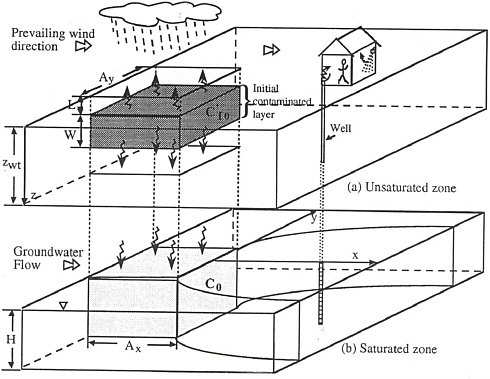
FIGURE 3-14 Schematic illustrating potential transport pathways for contamination in a soil layer at ground surface. SOURCE: Reprinted, with permission, from Labieniec et al. (1996). © (1996) Journal of Environmental Engineering.
Kalantzi et al. (2001) found PCBs in butter in remote areas, while the levels of DDT, which is not as volatile as PCBs, where highest in areas of current use. This illustrates the importance of accounting for bioavailability processes that operate both locally and remotely.
If the fluid into which the contaminant is released is not flowing or flowing only at very slow rates, such as groundwater in low permeability soil or porewater in fine-grained sediments, molecular diffusion will be the primary means of transport. An example is again provided in Figure 3-10, which shows the release of a biphenyl molecule into the porewater of a fine-grained sediment, and the diffusive transport of that molecule to the sediment–water interface. Subsequent transport of the molecule to flowing river water would result in advective transport of the molecule. Once in a flowing system, molecular diffusion and nonuniform velocities in the fluid cause mixing of the contaminant mass in the fluid volume, a process known as dispersion. Dispersion causes the contaminant mass to become distributed nonuniformly in a flowing fluid, even one that is moving in a uniform, steady state manner. Advective processes, including resuspension and
upwelling of groundwater currents, and bioturbation dominate over diffusion processes in more dynamic systems, with dramatic impacts on bioavailability.
Contaminants undergoing transport in water, air, or soil gas are subject to immobilization reactions and processes that result in the contaminant not being transported with the fluid indefinitely in its original state. Some important immobilization processes for transport in water include sorption on solids (such as aquifer material, river sediments, or settlable particles), precipitation, and physical entrapment in micropores or immobile zones; each of these has been discussed previously.
Transformation of Released Contaminants
As contaminants are being transported to receptors upon release from soils and sediments, they can undergo transformation of chemical form by means of various chemical and biochemical processes. These include biotransformation, oxidation–reduction reactions, reactions with water (hydrolysis and acid–base reactions), and photochemical transformation. These transformations, relevant and important for both inorganic and organic contaminants, can affect greatly the bioavailability and toxicity of the contaminant.
Many different chemical forms of a particular element can exist in aqueous systems. These different forms can have vastly different properties, affecting their reactivity, toxicity, and fate in the environment. Transformation processes fundamentally alter the chemical form of inorganic contaminants. Microorganisms can mediate the transformation of species of elements from one form to another, for example the transformation of dissolved Hg2+ to extremely toxic methylmercury (CH3Hg+) and the conversion of selenate to organoselenium, elemental selenium, and highly toxic methylated selenium. Varying chemical conditions can cause redox-active elements such as arsenic and selenium to change oxidation states, e.g., the oxidation of dissolved Cr3+ to the much more toxic CrO42– form in which chromium exists in the +6 oxidation state. Many elements react with water; dissolved mercury hydrolyzes to form the hydroxy species HgOH+, Hg(OH)2o, and Hg(OH)3–. These complexes dominate mercury speciation across a wide pH range and are sufficiently strong that they can inhibit mercury retention in soils and sediments (Dzombak and Morel, 1990). Photochemical reactions can also affect inorganic contaminants. For example, compounds of copper with organic molecules having carboxylate and amino functional groups are photoreactive (Morel and Hering, 1993). Light absorption by such compounds can result in their decomposition and subsequent redox transformation of the metal or the organic moiety.
Arsenic illustrates the potential complexity of inorganic contaminant transformations. Arsenic is typically in the pentavalent oxidation state in aerated environments, forming the arsenate oxyanion HxAsO4x–3. Upon anaerobiosis, arsenic is reduced to the trivalent state that often forms the arsenite anion,
HxAsO3x–3. As discussed in Box 3-3, arsenite is more toxic than arsenate, and conditions conducive to its formation (such as the reduction of ferric iron solids) tend to enhance the mobility of arsenic. If a sediment is reduced to the point of being sulfidic, arsenic may form soluble sulfur complexes (e.g., H2As3S62–) or insoluble phases such as the mineral orpiment (As2S3).
Organic compounds can also undergo a wide range of biochemical, thermochemical, and photochemical transformations, resulting in wholly different compounds. PCBs provide good examples of the diversity of transformation processes. PCBs can undergo biotransformation under aerobic and anaerobic conditions, though the pathways and extent of these reactions are compound specific. Complete mineralization of less-chlorinated PCBs can be achieved by many aerobic organisms (Bedard, 1990; Furukawa, 1994). Di- and tri-chlorobiphenyls can be degraded by aerobic cometabolic processes using biphenyl or 4-monochlorobiphenyl as carbon and energy sources. More specialized microorganisms are capable of degrading tetra- and higher chlorinated biphenyls (Bopp, 1986). Formation of intermediates during PCB degradation is common, particularly chlorobenzoates, which may be more recalcitrant than the original PCB (Sylvestre et al., 1985; Seeger et al., 1997). Environmental conditions, including pH, affect the rate and extent of aerobic PCB biodegradation (Williams and May, 1997).
Under anaerobic conditions such as typically found in PCB-contaminated sediments, reductive dechlorination can occur resulting in an increase in less-chlorinated PCBs, that is, mono-, di-, and tri-chlorobiphenyls (Brown et al., 1987, 1988; Natarajan et al., 1996) and a decrease in the highly chlorinated (tri-, tetra-, and higher substituted) congeners (Mohn and Tiedje, 1992; Berkaw et al., 1996; Quensen and Tiedje, 1997). From these observations it has been inferred that reductive dehalogenation of PCBs can occur, although no axenic cultures of anaerobes reductively dehalogenating PCBs have been obtained so far (Wiegel and Wu, 2000). Different sediment systems appear to have different populations of dechlorinating organisms (Quensen et al., 1990; Sokol et al., 1994; Bedard and Quensen, 1995), and dechlorinating organisms show specific congener preferences (Rhee et al., 1993; Sokol et al., 1994). The less-chlorinated congeners of a PCB mixture are substrates for cometabolic transformation by organisms expressing biphenyl oxidation pathways (Fetzner and Lingens, 1998; Billingsley et al., 1999; Bruhlmann and Chen, 1999; Seah et al., 2001). Interestingly, the final congener distribution may vary widely from the parent PCB material due to combined aerobic and anaerobic transformations. Although the daughter material may exhibit reduced toxicity, it may have increased mobility due to the inverse relationship between chlorine substitution and aqueous solubility (Opperhuizen et al., 1988; Mackay et al., 1992).
PCBs are subject to other kinds of reactions that affect their fate and transport. The effective solubility of PCBs can be enhanced, for example, in aqueous systems with high dissolved natural organic matter (Brownawell and Farrington, 1985, 1986) or with significant quantities of miscible organic liquids. Conversely,
PCB solubility in water is diminished in systems with oil or other immiscible organic liquids (Luthy et al., 1997b). Hydrolysis or photolysis are only significant for PCBs under non-environmental conditions (e.g., Zhang and Hua, 2000).
***
In summary, the chemical form of the contaminant released from soil and sediment, the geochemical environment where the release and transport take place, and the fluid properties of that environment will determine the form, delivery route, and delivery rate of contaminant to biological receptors. All of these factors must be considered in assessing the availability of a soil or sediment contaminant to biological receptors.
CONTACT AND ENTRY
The terms contact and entry are often used to describe how contaminants (typically in their released—i.e., dissolved or gaseous—state) interact with and pass through a biological membrane and into a cell. This section provides basic information on the mechanisms that cells employ to take up chemicals from the environment and how these mechanisms differ between tissues and organisms.
Because a range of receptors—microorganisms, plants, animals, and humans—and a range of exposure routes are of interest in contaminant bioavailability, it is difficult and perhaps dangerous to generalize the process of contact and entry. It is possible, however, to represent the processes conceptually, and to describe how an organism’s physiology and the mode of contact can influence the extent of contact and entry that may occur. Contact and entry steps are highlighted by the grey box in the figure below.
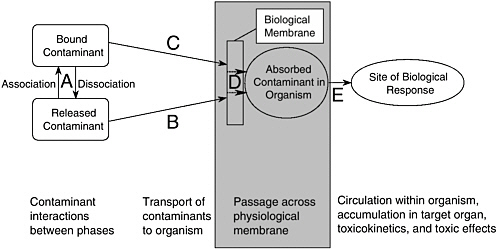
Movement Across Cellular Membranes
The organization of biological systems depends, in part, on the presence of membranes that serve to separate biological compartments within an organism as well as separate the organism from the outside world. In order to be functional, biological membranes must allow some substances to move through them while resisting the passage of others.
The ability of membranes to serve as selective barriers is a function of their structure. Biological membranes are composed primarily of phospholipids arranged in a bilayer, with the hydrophobic portion of the molecules oriented toward the middle of the membrane and the hydrophilic portion toward the outside (Figure 3-15). Thus, the surface of the membrane, which interfaces with water, is hydrophilic, while the center of the membrane is lipid in nature. Proteins are embedded in the lipid bilayer membrane, some of which play a role in the movement of chemicals across the membrane, either by creating pores in the membrane through which small chemicals can move, or by serving as carriers. There are four fundamental processes by which chemicals can move across biological membranes, described below.
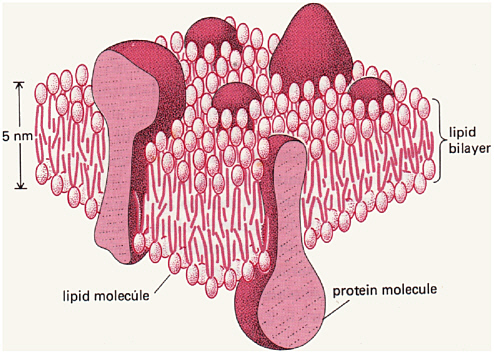
FIGURE 3-15 Basic structure of membranes. SOURCE: Reprinted, with permission, from Alberts et al. (1989). © (1989) Garland Science Publishing.
It is important to recognize that many organisms maintain other structures outside of the cell membrane that may influence the ability of a contaminant to reach the cellular membrane. For example, in some bacteria (excluding the Mycoplasma) a cell wall exists, and in most cases an external outer membrane or addutibak layers (e.g., S-layer, exopolymeric substance layer) are present. Both structures represent a potential barrier to contaminant uptake across the cell membrane.
Passive Diffusion
During passive diffusion, chemicals move across a membrane in the direction of their concentration gradient. Pores in the membrane offer one pathway for movement, but their size is usually small (< 4 nm), and they are consequently accessible only to molecules with molecular weights of a few hundred Daltons or less. Nonetheless, pores are an important means of passage for small hydrophilic molecules. Passive diffusion for larger molecules necessitates moving through the lipid membrane. The rate at which these chemicals cross a membrane by passive diffusion is determined by their lipid solubility and molecular size. Greater lipid solubility allows a chemical to penetrate the lipophilic core of the membrane more easily, and small lipophilic molecules are able to move through membranes by passive diffusion more quickly than large ones. The rate of movement of a chemical across a membrane increases as a function of the concentration gradient and, in terms of mass movement across a membrane, also with increasing surface area. Nonionic species (organic contaminants) typically diffuse through the cellular membrane, such that the microbial uptake of many hydrophobic solvents (e.g., alkanes, mono- and polynuclear aromatic hydrocarbons) is often a simple passive diffusion process (Bateman et al., 1986; Sikkema et al., 1995; Bugg et al., 2000). However, ionized groups on certain chemicals can greatly impede passive diffusion. Thus, for example, the diffusion of heavy metals across the membrane is typically limited. For weak acids and bases, the extent of ionization is controlled by pH, and pH is therefore an important determinant in the absorption of these chemicals.
Facilitated Diffusion
In facilitated diffusion, chemicals move in the direction of their concentration gradient (as with passive diffusion), but movement of the chemical across the membrane is assisted by carrier proteins. The chemical binds to the carrier protein and is carried through the membrane through a process that requires no cellular energy. There is some specificity to the carrier protein binding, and so this process is applicable only for selected chemicals. For example, transport of some essential metals across membranes may be facilitated by carriers or pores specific to the element (Nies and Silver, 1999). It also appears to be common that
metals are transported on carriers designed for elements of similar physicochemical characteristics (e.g., manganese and copper may share a carrier in some phytoplankton; Nies and Silver, 1999). For microbial uptake of heavy metals, the process involves diffusion across the outer wall through porins, and then facilitated diffusion across the cytoplasmic membrane via the relatively unspecific magnesium uptake system that involves a membrane integral protein and is driven solely by chemiosmotic gradients (Nies and Silver, 1999; Rensing and Rosen, 2000). One way to identify facilitated diffusion experimentally is to demonstrate that the influx rate can become saturated (i.e., demonstrate that a finite number of carriers exist).
Movement by passive or facilitated diffusion does not preclude cellular accumulation of contaminants (and other chemicals) to concentrations higher than in the external media. If the chemical is rapidly transformed by complexation (as is the case for many metals), conjugation, or conversion to a stable compound (e.g., selenium), then an inward diffusion gradient can be sustained. Equilibrium-based exchange between the converted form and the form crossing the membrane will ultimately determine the steady state concentration that the chemical will attain. Internal contaminant concentrations can reach levels 103–106 higher than in the external medium if robust transformation reactions occur.
Active Transport
Active transport uses carrier proteins to move chemicals against their concentration gradient, which requires cellular energy in the form of adenosine triphosphate (ATP) or a proton motive force. As with facilitated diffusion, there is specificity in the binding of chemicals to these carrier proteins. Active secretion of organic acids and bases by the kidneys, for example, utilizes membrane active transport processes. Physiologists use strict criteria to differentiate active transport from facilitated diffusion, primarily based upon energy dependence. Although the term “active transport” is occasionally employed for hazardous chemicals, little evidence exists that transport of any organic contaminant is energy dependent. Rather, passive or facilitated diffusion followed by transformation is sufficient to explain most organic contaminant uptake. However, for microbes there can be active export of certain contaminants. For example, several solvent-resistant bacterial strains exhibit an active efflux system for organic solvents to regulate their intracellular concentration (e.g., Kieboom et al., 1998; Bugg et al., 2000) because extensive accumulation of hydrophobic solvents can deteriorate a membrane’s physicochemical properties. Similarly, because elevated extracellular metals concentrations necessarily result in elevated intracellular concentrations, many microbial cells have developed metal-ion homeostasis mechanisms, which often involves active (ATP or proton gradient-driven) heavy metal export (Nies and Silver, 1999).
Phagocytosis and Pinocytosis
Other processes also exist to bring substances across membranes and into cells. Large particles can be internalized into cells through phagocytosis, during which the plasma membrane of a cell surrounds and engulfs a particle that is outside the cell. The membrane closes around the particle, creating a vesicle that then detaches within the cell. Macrophages use phagocytosis to remove damaged tissue components, destroy microorganisms, and process antigens. Cells of the reticuloendothelial system also use phagocytosis to clear particulates from the blood. Pinocytosis is similar to phagocytosis, except that it involves surrounding and internalizing an external volume of fluid rather than a particle. Pinocytosis and phagocytosis are well known in mammals. Uptake of iron particles by phagocytosis has been demonstrated in marine mussels (Mytilus edulis) (George et al., 1978), but the quantitative importance of this specific process is difficult to demonstrate.
Animal Uptake
Three types of uptake into animals are discussed that correspond to the three pathways of direct exposure evaluated in risk assessment—direct ingestion, dermal contact, and inhalation.
Absorption from the Gastrointestinal Tract
Because the gastrointestinal tract is the principal site of nutrient uptake, it is a prime location for uptake of chemical contaminants as well. A colloid- or particle-bound contaminant can reside in the gastrointestinal tract for hours to days—plenty of time for the unique environment of the gut to affect particle– contaminant associations. Although the membrane transport processes described above are universal, digestive processes result in more complicated membrane transport phenomena than occur, for example, across the gill in aquatic organisms or across the skin in mammals. This complexity is illustrated by absorption of metals from the gastrointestinal tract. A prevailing assumption is that metals must be in a free ion form before they can be transported across a membrane. But in the gut this is not necessarily the case. The gut is designed to transport simple organic compounds as well as elements, such that absorption of contaminants can be facilitated by their association with specific amino acids. Within the organism classes discussed below, gut characteristics of different species vary greatly with regard to the types of enzymes present and their concentration, the presence of organic-rich fluids, pH, and redox potential.
Invertebrates. Invertebrate digestion is complex, with transport mechanisms in the gut receiving limited study. It is known, however, that invertebrates, like
bivalves, digest materials in the gastrointestinal tract both externally (in the intestinal lumen) and intracellularly (within cells that, presumably, engulf materials in the “digestive gland”). Intracellular digestion is more rigorous in that animals that employ this mechanism can take up metals otherwise predicted to be unavailable (Decho and Luoma, 1991). For example, marine bivalves with strong capabilities for intracellular digestion can assimilate insoluble Americium with about 30 percent efficiency (Luoma et al., 1992); they can assimilate otherwise unavailable Cr(III) from bacteria with about 90 percent efficiency (Decho and Luoma, 1996); and they appear to assimilate metals that are not in solution from algal cells (Wang et al., 1995, 1996; Schlekat et al., 2000). (The tool used to measure uptake in these cases—assimilation efficiency—is discussed in detail in Chapter 4.)
Compounds in gut fluids play a role in determining what contaminants are available for transport into the organism. In particular, high concentrations of amino acids (>1M) and surfactants can occur in the gut fluids (Mayer et al., 1997) and are very effective in solubilizing sediment-associated metals and organic contaminants (e.g., PAHs), respectively. Indeed, metal and PAH concentrations in the gut fluids of marine polychaete worms (Arenicola marina) can be orders of magnitude higher than predicted from seawater–solid partitioning (Mayer et al., 1996). The relationship between metals and amino acids in the invertebrate gut is particularly intriguing. Among 35 deposit- and suspension-feeding invertebrates, metal and amino acid concentrations differed widely and yet correlated strongly. Enrichment factors in the fluids also followed the Irving-Williams series, among metals, consistent with soft ligand complexation (Chen and Mayer, 1999). Metal-to-amino acid ratios in tissues and gut also agreed with each other to within one order of magnitude. Such results do not directly elucidate the transport mechanisms responsible for bringing the contaminant from the gut into the tissue, but the relationship between gut fluids and tissues suggests that transport of the amino acid-bound metals occurs.
For soil invertebrates, the relative importance of gut ingestion of contaminants vs. soil pore water as a source of exposure depends on the physical characteristics of the animal (soft or hard bodied) and the physiology of the gut. Soft-bodied animals such as earthworms and some insect larvae are thought to be exposed mainly by the soil pore water (Saxe et al., 2001; Scott-Fordsmand et al., 2002). Those covered with a hard cuticle or carapace (adult forms of many beetles, insects, and crustacea) are thought to be exposed more through food and soil ingestion routes (Smit et al., 1998). The physiology of soil invertebrate digestive systems also influences the bioavailability process of gut uptake of contaminants in soils. Because many sediment and soil invertebrates are related taxonomically, the discussion above provides insight into some of these processes.
As with sediment invertebrates, mechanisms of uptake in soil invertebrates are not fully understood, although there have been attempts to model Eisenia andrei body concentrations of cadmium, copper, lead, and zinc as a function of pH, metals, and soluble organic carbon (SOC) (Saxe et al., 2001). In this case, the
model assumed that metals soluble at bulk soil pH were available for dermal exposure, while gut exposure was estimated by determining the soil metal in solution near neutral pH. This was based on evidence that the optimal pH for earthworm enzymes associated with digestion is near neutrality (Merino-Trigo et al., 1999), and that pH in several earthworm species’ guts is buffered near neutral pH (Michel and DeVillez, 1978; Doube, 1997). The model, which combines relevant soil chemistry characteristics with certain biological phenomena thought to influence metal bioavailability to earthworms, awaits further refinement and validation.
Mammals. Gastrointestinal absorption in higher species, and particularly in mammals, has been studied in much greater detail. While the stomach and even the oral cavity can be sites of absorption for a number of chemicals, most gastrointestinal absorption occurs in the intestine. The contents of the intestine are well mixed overall, but there is a layer of watery content adjacent to the intestinal wall that is relatively stationary. This layer, termed the unstirred water layer, is about 30–100 nm thick, and chemicals must diffuse through it to be absorbed. Between the unstirred water layer and the outer membrane of the epithelial cells lining the intestine (sometimes termed enterocytes) is another very thin layer, which forms a microacidic environment. This layer is significant for the absorption of weak acids and bases, because the pH here determines their extent of ionization and consequently their ease of passive diffusion across the apical or brush border membrane of the enterocyte.
Generally, chemicals can be absorbed from the intestine by either passing through or around the enterocytes, which comprise the intestinal villi that line the intestine (Figure 3-16). In order to pass through the cells, they must first cross the apical membrane. This can occur by passive diffusion, by carrier-mediated transport (active transport or facilitated diffusion), or by pinocytosis, depending upon the chemical. The chemical then passes through the basolateral membrane of the enterocyte, through the basement membrane, and into the subepithelial space of an individual villus called the lamina propria. Movement across the basolateral membrane can also occur by diffusion, transport, or pinocytosis. Enterocytes are connected by tight junctions, but these form an imperfect seal. Water and small molecules can move readily through channels between cells, cross the basement membrane, and reach the lamina propria.
Another means to bypass movement through endocytes is termed persorption. Enterocytes are rapidly and continuously produced, migrating from the base of the intestinal villi, where they are formed, to the tip of the villi. Once they reach the tip of the villi, they are sloughed off (Figure 3-17). During the sloughing, a temporary break in the junctions between enterocytes is formed. Large particles have been observed to enter the circulation through these breaks. Once a chemical reaches the lamina propria, it can enter the circulation by passing through the membrane of one of the numerous capillaries there (see Figure 3-16).
FIGURE 3-16 Structure of the intestinal villus. Individual cells of the villi, noted as absorptive cells here, are termed epithelial cells or enterocytes in the text. SOURCE: Reprinted, with permission, from Aranda-Michel and Giannella (1999). © (1999) Current Medicine, Inc.
Chemicals that cannot readily penetrate the capillary membrane enter the circulation by a more circuitous route through the lymphatics. For example, studies in both dogs and sheep have shown absorption of PCBs into intestinal lymphatic drainage following oral administration (Ziprin et al., 1980; Busbee et al., 1985). When flow from the intestinal lymphatics to the vascular circulation was interrupted by cannulation of the thoracic lymph duct, appearance of PCBs in the plasma following an oral dose was prevented (Busbee et al., 1985), indicating that virtually all of the PCB dose in the gut entered the bloodstream via the lymphatic route.
The gastrointestinal absorption of most environmental contaminants probably occurs by passive diffusion, but there appear to be many exceptions. Many inorganics are nutrients, and specialized transporters exist to regulate and facilitate their absorption from the gastrointestinal tract. For example, DMT1, a divalent metal transporter, is located in absorptive epithelial cells of the intestine. It has broad specificity, and has been shown to transport Fe+2, Zn+2, Mn+2, and other ions (Canonne-Hergaux et al., 2000). Copper absorption in mammals is thought to involve active transport across the basolateral membrane (Linder, 1991). There is considerable evidence that the intestinal uptake of lead occurs
FIGURE 3-17 Persorption of particulates by the intestinal villus. SOURCE: Reprinted, with permission, from Wilson et al. (1989). © (1989) Ellis Horwood Ltd.
through a capacity-limited process, implying a transport mechanism. Competition for the transporter could explain the ability of a variety of substances to interfere with lead absorption, including iron, zinc, calcium, phosphorus, and magnesium (Conrad and Barton, 1978).
While it is often assumed that chemicals must exist in solution to be absorbed, there has been clear demonstration of the intestinal absorption of small particulates including colloids. Much of this research aimed to develop microparticulates as oral drug delivery systems. Using microspheres of varying size and composition, rapid uptake and distribution to the liver, spleen, and bone marrow have been reported (Jani et al., 1990; Mathiowitz et al., 1997). Evidence exists for at least four mechanisms of small particulate absorption: (1) persorption, described above; (2) endocytosis by enterocytes; (3) phagocytosis by intestinal macrophages; and (4) uptake by the M cells of the Peyer’s patches1 (O’Hagan, 1996). Persorption has been observed in a number of species, including humans, involving particles up to 100 μm. Other processes appear to be restricted to much smaller particulates, typically 1 μm or less. Observations suggest that uptake of microparticulates can occur both by passing through and around epithelial cells.
Particulates absorbed from the gut appear rapidly in the mesenteric lymphatics and are ultimately delivered to the portal circulation of the liver (Thomas et al., 1996; Mathiowitz et al., 1997). Particle size and composition, age of the animal, and dietary composition all appear to influence particulate uptake (Simon et al., 1994, 1997; Seifert et al., 1996; O’Hagan, 1996). Although gastrointestinal absorption of soil microparticulates has not been explicitly demonstrated, it is reasonable to suspect its occurrence. In a study of arsenic-bearing mine tailings that had been sieved to a small particle size (< 20 μm) and dosed to 12-day old mouse pups, arsenic was found primarily in the liver (Golub et al., 1999). This observation is consistent with uptake of soil microparticulates in the gut and delivery via lymphatics to the liver.
Absorption Through the Skin
In contrast to the gut and the lung, there is no mechanism for absorption of chemicals attached to soil or sediment particles through intact skin. Consequently, dermal absorption requires dissociation of the chemical from the soil or sediment matrix.
Mammalian skin is comprised of three layers. The outermost layer of skin is called the epidermis, which consists of the stratum corneum and the viable epidermis (see Figure 3-18). The stratum corneum overlies the viable epidermis and in humans consists of several layers of flattened, keratinized, dead cells called corneocytes. Corneocytes are stacked together like over-lapping plates and bound together by adherent structures (called corneodesmosomes). The water content of corneocytes is usually relatively low, particularly for cells near the surface, which may be only 15 percent water by weight. Spaces between the corneocytes are filled with intercellular lipid. The structure and composition of the stratum corneum make it an effective barrier, not only against escape of water from the body, but also against entry of microbes and chemicals.
Cells on the outermost surface of the stratum corneum last about two or three weeks before they are sloughed off and replaced by cells moving up from deeper layers. Stratum corneum cells originate from the underlying viable epidermis, which also contains pigment cells (melanocytes). The second layer, the dermis, lies beneath the epidermis and comprises most of the thickness of the skin. A network of connective tissue in the dermis gives the skin its strength and elasticity. Unlike the epidermis, the dermis contains an extensive vascular network, and some portion of a chemical that penetrates the epidermis can be absorbed into the circulation here. The third layer, the hypodermis, is below the dermis, and consists of a loose fibrous network and fat cells. The hypodermis is responsible for much of the insulating and mechanical cushioning properties of the skin. Like the dermis, this layer is extensively vascularized.
Hair follicles extend from the surface of the skin through the epidermis, with the base in the dermis or hypodermis. Sebaceous glands secrete sebum, a lipid
FIGURE 3-18 Structure of skin. SOURCE: Reprinted, with permission, from Washington and Washington (1989). © (1989) Ellis Horwood Ltd.
substance, into the hair follicle. There are two types of sweat glands, eccrine and apocrine. The more numerous eccrine sweat glands, located in the dermis, deliver an aqueous secretion directly to the skin surface through a coiled duct. Apocrine sweat glands are fewer but larger and secrete their fluid into the hair follicles.
The stratum corneum represents by far the greatest barrier to absorption of chemicals through the skin. Chemicals can traverse the stratum corneum by traveling through the corneocytes and interstitial spaces (called the transcellular route) or by traveling around the cells through the lipid-containing interstitial spaces (called the intercellular route). Lipid soluble chemicals are thought to favor the latter route, although this convoluted pathway greatly limits their rate of absorption. The transcellular route is generally envisioned as more suitable for water and hydrophilic chemicals, although some experimental evidence argues against separate routes for polar and nonpolar chemicals (Zatz, 1993).
Once a chemical has traversed the stratum corneum, the viable epidermis, the dermis, and the hypodermis offer little additional resistance to absorption. However, the high lipid content of the hypodermis can act to delay absorption of lipophilic chemicals. Lipophilic chemicals that are not readily taken up by the vasculature of the dermis and hypodermis may partition into the lipids, with the adipocytes serving as a reservoir of chemical that has permeated the skin, but not yet reached the circulation.
Hair follicles and eccrine sweat glands offer pathways for chemicals to reach the dermis and hypodermis without having to cross the stratum corneum. Within the hair follicles, the space surrounding the hair shaft is filled with sebum, through
which lipophilic compounds can presumably readily diffuse. The aqueous secretions of the sweat glands offer a pathway of entry for hydrophilic chemicals, although diffusion would have to occur against their direction of flow. Hair follicles and sweat glands, although offering means for chemicals to circumvent the stratum corneum barrier, have usually been regarded as minor pathways for dermal absorption because they comprise a very small percentage of the surface area of the skin. However, experiments using rat skin where hair follicles and sweat gland pathways have been eliminated suggest that, at least in some circumstances, their contribution to dermal absorption may be substantial (Zatz, 1993).
Several factors can influence the absorption of chemicals through the skin. One is the age of the individual. Neonates do not possess a fully developed stratum corneum, and thus chemicals can be absorbed more readily through their skin. Pre-term infants are particularly vulnerable. In the elderly, the stratum corneum becomes thickened and more dried, reducing dermal absorption. Another factor is the anatomical location of the skin. In general, permeability of skin follows the order: genitals > head > trunk > limbs (Zatz, 1993). Hydration of the stratum corneum can reduce its barrier function considerably, particularly with respect to hydrophilic compounds (Behl et al., 1980). Swelling of the corneocytes as their water content increases may disrupt the organization of the stratum corneum, increasing both the size and the hydrophilicity of the spaces between the cells. Similarly, disease and mechanical injury can disrupt or remove the stratum corneum, increasing the permeability of skin. Psoriasis, ichthyosis, inflammation, sunburn, and thermal burns all have been shown to increase skin permeability (Frost et al., 1968; Spruit, 1970; Behl et al., 1980). Stratum corneum disruption can also occur from chemical exposure. Contact with chemicals with surfactant properties or solvents in particular are associated with increases in skin permeability.
Absorption from the Respiratory Tract
Chemicals can enter the respiratory tract as gases, vapors, or particulates. Chemicals in gas or vapor form could arise through volatilization from contaminated soils or sediments. Inhalation of particulates is important when contaminated soils give rise to respirable dust.
When air is inhaled through the nose, it passes through the nasal turbinates. These ridge-like structures create turbulence in the air flow, causing large particulates to come in contact with the mucosal lining. Nasal mucous drains into the oral cavity where it is swallowed, carrying with it particulates trapped in the nasal cavity. Although absorption of airborne environmental contaminants directly from the nasal mucosa has not been well studied, it is apparent from observations (such as the carcinogenicity of inhaled formaldehyde in rodents) that significant absorption can occur there. The importance of nasal absorption probably varies with species because the structure and complexity of the nasal turbinates differ
substantially among species, with rodents, for example, having much more intricate structure than humans do. This offers both greater opportunity for deposition of particulates and a larger surface area for absorption. Also, rodents and many other species are obligate nose-breathers, whereas some portion of inspired air in humans enters through the mouth, bypassing the nasal mucosa.
From the nasal cavity or the mouth, air is conducted into the lungs through the larynx, trachea, bronchi, and non-respiratory bronchioles. These conducting airways are lined with epithelial cells and mucous-secreting cells. The upper airways contain numerous ciliated cells. Movement of the cilia assists in creating a flow of mucus up the airway toward the nasopharynx. Particulates coming in contact with the walls of the upper airways adhere to the mucus and are swept upward and eventually swallowed. In the bronchioles, the numbers of ciliated cells is greatly diminished. Clara cells are found in increasing numbers as the bronchioles become progressively smaller. Their function is not known with certainty, but they appear to be secretory. Pulmonary architecture of the lower respiratory tract varies somewhat with species, but in all cases the respiratory pathways terminate with small sac-like alveoli.
Most of the surface area of the alveoli (over 90 percent) is lined with flattened epithelial cells called Type 1 cells (Figure 3-19). The remainder of the surface area is occupied primarily by cuboidal Type II cells, which secrete a surfactant fluid. This surfactant fluid reduces surface tension in the alveoli, preventing their collapse. To facilitate exchange of oxygen, carbon dioxide, and other gases between the blood and the alveolar space, capillary circulation is
FIGURE 3-19 Structure of the alveolus. SOURCE: Reprinted, with permission, from Sabourin (1994). © (1994) Appleton & Lange.
quite close to the alveolar lumen. In fact, in some locations, membranes of the endothelial cells lining the capillaries have become fused with membranes of Type 1 cells lining the alveolus to form a thin basement membrane. This creates a very short diffusion distance for absorption from the alveoli, about 0.4 μm. Macrophages are found in the lumen of the alveoli, where they remove particulates and microorganisms by phagocytosis.
Potential sites of absorption of inhaled chemicals within the respiratory tract depend in part on the characteristics of the substance. Water soluble gases tend to dissolve into the mucus lining the upper airways and reach the lower airways and alveoli only when present in high concentrations in air. Lower solubility gases such as ozone reach the lower airways more readily. Because the structure of the alveolus favors rapid diffusion of gases between the alveolar space and the capillary blood, gases reaching the alveolus are usually readily absorbed. The rate of uptake of the gas into the blood will depend upon both its concentration in air and its solubility in blood.
The depth within the respiratory tract reached by inhaled aerosols and particulates depends upon the size of the particles, with smaller particles better able to remain suspended in air and reach the alveoli. Particles greater than 5 μm are usually deposited in the nasopharyngeal region. Particles deposited in mucus in the anterior portion of the nose may be removed by sneezing, nose-blowing, etc. Particles deposited more deeply in the nasopharyngeal region will follow the flow of mucus to the oral cavity and be swallowed. As such, the site of absorption for chemicals bound to these particulates may include both the nasal mucosa and the gastrointestinal tract. Particles between 2 and 5 μm will reach the tracho-bronchiolar region. The flow of air slows here, allowing particles in this size range to settle on the mucus-covered membranes. Trapped particles are carried by ciliary-assisted upward movement of mucus and are eventually swallowed. Particles that are 1 μm or less are able to reach the alveoli. There they may deposit and be carried by the flow of alveolar fluid up to the ciliated mucosa, and then transported up through the conducting airways and cleared as described above. They can also be phagocytized by alveolar macrophages, which are then cleared upward by mucociliary action and swallowed. Particles in the alveoli may be absorbed directly into the lymphatics because the endothelial cells lining the alveolar lymphatic capillaries are porous, allowing relatively large molecules to enter. Finally, partial or complete dissolution of the particle in the alveolus can result in absorption into the blood or lymphatics, primarily through passive diffusion. Aqueous membrane pores assist the movement of hydrophilic chemicals, with the rate of diffusion inversely proportional to molecular size.
Plant Uptake
In plants the most common route of exposure is through the roots. Ions and organic molecules contact roots via the transpiration stream, diffusive transport,
and microbially facilitated transport. Once at the root surface, soluble contaminants have the potential to enter into root tissue through the transpiration stream or through a range of mechanisms that are designed to facilitate nutrient uptake. In general, it is thought that only uncomplexed, free ionic species of cations and ions can be taken up by roots; this has been described using a free ion activity model (FIAM) (Lund, 1990; Parker and Pedler, 1997). However, exceptions to this model have been identified. Ionic or organo-metal complexes that increase the total concentration of elements at the root surface have been correlated with increased uptake, either through disassociated ions or through uptake of intact complexes (McLaughlin et al., 1994: Parker et al., 2001). In addition, it is not clear how well plants can distinguish between ions of similar size and charge. The size of solid particles precludes their entry into plant roots, even for very small particles like colloids, such that contaminant release from the solid phase is a prerequisite regardless of the underlying uptake mechanism.
Plant uptake of macronutrients is much better understood than uptake of micronutrients or contaminants, with the primary work on uptake of micronutrients focusing on iron (Welch, 1995). Different mechanisms have been identified that control macronutrient uptake by plants; these mechanisms may provide a means through which contaminants can enter root tissue (Figure 3-20). One mechanism (Figure 3-20A) involves altering pH through efflux of H+ ions, which sets up an electrochemical gradient that facilitates transport of cations and anions. Such proton pumps often require cellular energy in the form of ATP. Ion channels (Figure 3-20B) also exist as a means of entry, although their role in uptake has been more clearly defined for plant shoot rather than root tissue. Ion channels are thought to facilitate uptake of divalent cations and to mediate uptake and release of K+; when open they are capable of rapidly transporting ions. Specific channels have been identified for Ca2+, K+, H+ and Cl–. There is also evidence for carrier mediated active transport (Figure 3-20C) of K+, SO42–, NO3–, and Mg2+ that uses ATP as an energy source as well as specific binding sites. ATP driven pumps are located at both the plasma membrane and the tonoplast (Marschner, 1995).
With regard to micronutrients, there are chemical reduction mechanisms present at the plasma membrane to facilitate uptake of iron that may play a role in uptake of other cations (Welch, 1995). This is because the selectivity of many of these mechanisms is limited, so that ions or compounds of similar charge and radius may be indistinguishable from nutrients. For example, root exudates in iron-deficient barley and wheat plants are associated with increased uptake of zinc, copper, and manganese in addition to iron, although cadmium uptake is unaffected (Fan et al., 2001). Other examples where lack of selectivity has lead to increased contaminant uptake include mechanisms that gratuitously transport cadmium along with zinc, lead along with calcium, and selenate in addition to sulfate (Oliver et al., 1994; Huang and Cunningham, 1996; Feist and Parker, 2001). The factors controlling plant uptake of cadmium have been extensively
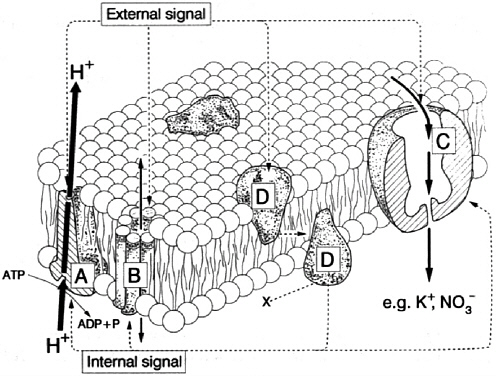
FIGURE 3-20 The primary mechanisms of ion transport across plant root membranes: (A) H+ pump using ATP; (B) ion channel; (C) carrier facilitated transport; and (D) proteins for signal perception and transduction. SOURCE: Reprinted, with permission, from Marschner (1995). © (1995) Academic Press.
studied because consumption of plant tissue with elevated cadmium at levels below phytotoxic thresholds has resulted in human fatalities. Plant zinc concentrations, soil temperature and moisture status, soil solution chloride concentration, pH, total and extractable cadmium concentrations, and plant species and cultivar have all been found to affect plant uptake of cadmium (McLaughlin and Singh, 1999).
In general, less is known about specific uptake mechanisms for organic compounds, where the primary research has focused on herbicides. Although many herbicides’ mode of action is through direct contact with leaf tissue, several are delivered to plant roots through soil and the transpiration stream. However, only smaller, more soluble organic compounds are able to enter root vascular tissue (Hsu et al., 1990). More lipophilic compounds enter plant tissue through diffusion into root cells (symplasmic pathway) (Little et al., 1994). The mode of action of many herbicides centers on the destruction of root cell membrane integrity (Devine et al., 1993; Holtum et al., 1994; Koo et al., 1997) and it is possible that this mechanism may result in root exposure to other xenobiotics as well.
ACCUMULATION AND EFFECTS
Although chemicals such as caustic agents can damage an organism simply by coming in contact with it, most chemicals exert their biological effects from within organisms. After contact and entry into an organism, chemicals interact with one or more cellular constituents to alter biological functionality. Because soil and sediment play no role at this stage, accumulation and subsequent effects are not considered bioavailability processes per se. However, they are influenced by other bioavailability processes and thus are indicators of bioavailability, they are frequently measured endpoints, and they are of great concern to some stakeholders.
The fate of a chemical once it enters the organism can be complex. Its binding to different constituents within the organism, the actions of various enzymes on the chemical, and the efficiency of excretion mechanisms can all profoundly influence the concentration and form of the chemical reaching its biological target. Since the magnitude and the nature of the effect will be determined in part by the form and concentration of the chemical at its active site(s), consideration of these factors is critical to an overall understanding of the health consequences of exposure to environmental contaminants. If concentrations of the chemical achieved at the biological targets are too low, or if the chemical has been converted to a form that no longer interacts with the target, no effect will be observed. On the other hand, exposure may lead to concentrations that are sufficiently high so as to be lethal. Between these extremes is the potential for non-lethal, yet deleterious effects such as reduced metabolic activity, impaired reproduction, and increased sensitivity to physical or chemical stresses. The events that act upon a chemical after contact and entry, the interaction of the chemical with its biological targets, and the consequences of those interactions, are represented by the gray box in the figure below.
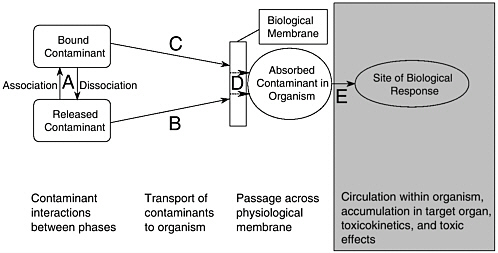
Fate of Contaminants that Enter the Organism
Distribution, Accumulation, and Sequestration
The ability of a chemical to move about within an organism will depend, to some extent, on the same factors that influenced its uptake. Chemicals with attributes that allow them to readily diffuse across membranes will tend to be distributed widely in an organism. Chemicals with limited ability to cross membranes may be confined to localized areas unless carriers or transporters exist to facilitate their movement.
A chemical moves within an organism in either a free or bound form. Usually a chemical will spend much of its time in an organism bound to some other compound. In order to move in an aqueous environment such as blood or lymph, strongly lipophilic molecules must attach themselves to a water-soluble compound. For example, PCBs and organochlorine pesticides exist in the blood in association with lipoproteins (Kenaga, 1975; Lawton et al., 1985). Metal ions are also bound to proteins, and some proteins (e.g., metallothionein, transferrin, ceruloplasmin) seem to function primarily as transporters for certain metal ions (e.g., Scott and Bradwell, 1983). Even relatively hydrophilic organic chemicals can be bound to plasma proteins such as albumin. This binding is nearly always reversible, but nonetheless it affects where, how rapidly, and to what extent a chemical will distribute to different parts of the organism, and even how rapidly it will be eliminated.
Some chemicals tend to accumulate at target sites within an organism, creating storage sites or depots. If the affinity of the chemical for a storage site is high, as is the case for lipophilic chemicals and fatty tissue, this can lead to profound accumulation of the chemical. For example, the presence of comparatively high concentrations of lipophilic chemicals such as PCBs and organochlorine pesticides (e.g., DDT) in adipose tissue of numerous species has been well documented (Dix, 2001). Because lead may become substituted for calcium in bone, the skeleton is an important storage site for lead in the body, over time accounting for 95 percent of the lead body burden (Gordon et al., 2002). These storage sites can act as sinks by pulling chemicals away from biological target sites, thereby reducing the effects of the chemical. However, chemicals held within these storage sites are generally inaccessible to normal elimination mechanisms such as metabolism and excretion (discussed below), making them persistent in the body. Slow release of the chemical from these storage sites can result in protracted “exposure” within the body even when external exposure has been reduced or eliminated.
This accumulation of chemicals in biological tissues is called bioaccumulation (usually measured as a tissue concentration—mg/kg). The term encompasses both direct and indirect contaminant accumulation. That is, organisms can be exposed to contaminants directly from abiotic media—such as soil,
sediments, water, or air—or indirectly through their diet. Thus, aquatic organisms can bioaccumulate waterborne contaminants through their gills during respiration or by consuming contaminated prey (Farrington, 1991). Bioconcentration refers specifically to accumulation from direct exposure. When the ratio of body mass to surface area of an organism exposed to contaminants is small, as it is for many primary producers, bioconcentration of contaminants from environmental media is of primary importance. For organisms higher on the food chain that have a higher body mass to surface area ratio, there is a shift in the processes contributing to the body burden of contaminants from bioconcentration via direct contact to bioaccumulation via dietary intake.
The term sequestration is used when compounds are accumulated from the environment but are inactivated in the tissues of the plant or animal. These sequestered contaminants may become available at some point to organisms that eat the plant or animal in which the contaminants are sequestered. Plants often “store” metabolites or conjugates in vacuoles, which can be thought of as exterior to the cell’s ongoing metabolic processes. While this initial process of compartmentalizing the contaminant (or its metabolites) is analogous to bioaccumulation in other organisms, further processing of the contaminant (or metabolite) is often observed with the eventual covalent binding of the contaminant into the lignin of the plant (Zenk, 1996; Hall, 2002; Susarla et al., 2002). Carbon in this form is not readily broken down or reused by the plant; thus, long-term sequestration results. In most instances, this incorporation of a contaminant into the lignin of the plant transforms the compound to a state in which it is no longer bioactive. Similarly, animals can bind both inorganic contaminants such as metals and organic compounds in such a way that the compounds are not available to interact with critical structural or functional biomolecules.
Metabolism and Biotransformation
Biotransformation processes are common to all forms of life. The term metabolism frequently is used to capture these processes. However, metabolism generally refers to the transformations of natural substrates necessary for life rather than the transformation of contaminants. Consequently, the term xenobiotic metabolism, while more cumbersome, is better suited to a discussion of metabolic reactions involving environmental contaminants. Technically, xenobiotic metabolism eliminates the contaminant from the body by converting it to a different chemical species. The products of these reactions are termed metabolites. From a toxicokinetic perspective, the contaminant has been eliminated as soon as it has been changed into the initial metabolite. In most instances, the toxic effect of a contaminant is inversely proportional to the extent of its metabolic detoxification and subsequent elimination. The more efficient the removal of the contaminant, the less of it that will be available at the site of toxic action.
Xenobiotic metabolic steps are largely enzymatic transformations that confer increased water solubility, which will afford easier elimination of the contaminant in urine or bile of animals or the translocation to leaf-tissues of plants. They can also change the configuration of the chemical such that its structural attributes responsible for toxicity (i.e., that allow it to interact with its biological target to produce an effect) are lost. Both processes—increasing the ease of excretion and decreasing the inherent biological activity of the chemical—contribute to its detoxification. On the other hand, xenobiotic metabolic transformation can convert some classes of contaminants into more active and toxic products— a type of reaction that has attracted considerable attention from toxicologists because it is crucial in a number of important types of toxicity. For example, most environmental contaminants designated as carcinogens are thought to produce cancer through conversion to toxic metabolites (Hietanen et al., 1997).
The processes by which plants and animals metabolize xenobiotics share similarities. In both cases, xenobiotic metabolism is divided into primary (Phase I) reactions and secondary (Phase II) synthesis (Grant, 1991). Primary metabolism refers to biotransformations that alter basic chemical structure. Examples of Phase I reactions include oxidations, reductions, and hydrolysis. A classic example of Phase I metabolism is the stepwise oxidation of the methyl group of toluene to benzyl alcohol, benzaldehyde, and benzoic acid (Williams, 1959).
Phase II metabolism is often referred to as conjugation. It involves modification of existing reactive functional groups by combining either the original or an altered molecule with sugars, amino acids, or other compounds. In keeping with the above example, this might include the conjugation of the Phase I product benzoic acid with glycine to form hippuric acid (i.e., benzoylglycine). The preferred types of conjugation reactions vary somewhat with species. In the preceding example, glycine conjugation with benzoic acid would be expected in most species except birds and reptiles, where ornithine conjugation would occur instead (Bridges et al., 1970). Because most of the conjugates are ionized at physiological pH, Phase II conjugation is usually successful in increasing the water solubility of the xenobiotic compound and hence its excretion via the kidneys or the bile. Also, particularly in the case of attachment of bulky groups such as glucuronic acid, Phase II reactions substantially change the overall structure of the chemical, which usually dramatically reduces the toxicity of the chemical (though there are exceptions).
In general, the metabolites formed by Phase II reactions are excreted rapidly and are not further metabolized. However, metabolites from Phase I reactions can either be excreted without further metabolism, undergo additional Phase I metabolism, or undergo Phase II metabolism. If the metabolite undergoes another Phase I metabolic reaction, the same options apply to its metabolite. As illustrated in the benzoic acid example above, Phase I reactions can occur as a series of metabolic steps. As a result, it is not uncommon for a single chemical entity to be converted to several metabolites, and literally dozens of metabolites have been
identified for some compounds. Although the presumed objective of these reactions is detoxification, the reality is that many of these intermediates may retain some biological activity, and, as mentioned above, may even be more toxic than the parent molecule. This compels consideration of not only the chemical itself, but also its metabolites when trying to understand mechanisms of toxicity.
Excretion
Excretion is the removal of a contaminant from the blood and its return to the external environment (Rozman and Klaassen, 2001). In contrast to metabolism, which is a chemical mechanism for eliminating the toxicant, excretion is a physical mechanism. The route and speed of excretion depend largely on the physicochemical properties of the contaminant. Substances may be excreted as parent compound, Phase I metabolites, or Phase II conjugates.
The major excretion route for most chemicals (especially low molecular weight, polar chemicals) is via the kidneys (Wilkinson, 2001). Water-soluble chemicals in the plasma not bound to proteins can appear in the urine through glomerular filtration. In theory, passive diffusion of chemicals from the plasma to the urine can also occur in the renal tubules, although this mechanism is probably a minor contributor to overall urinary excretion because concentration gradients typically favor reabsorption more than excretion (Wilkinson et al., 2001). (Organic acids and bases, which at certain pH values are significantly ionized in the urine and, thus “trapped”, are exceptions.) Some chemicals may be substrates for the organic anion and cation transporters in the renal proximal tubules that actively secrete organic acids and bases into the urine. Depending upon the physicochemical properties of the toxicant or its metabolite (e.g., lipophilicity/ hydrophilicity), some portion of a chemical that appears in the urine may be reabsorbed in the tubules through passive diffusion. Also, reabsorption of some small proteins filtered in the glomerulus occurs in the renal tubules; a chemical bound to one of these proteins can escape excretion by being reabsorbed along with the protein. An often-noted example of protein-bound reabsorption is the small protein metallothionein, which carries bound cadmium with it from the tubular lumen into proximal tubular cells, where the cadmium produces toxicity (Dorian et al., 1992).
Excretion in the feces is a second key pathway for elimination of toxicants; it is generally more complex and less well understood than urinary excretion. Some ingested xenobiotics pass through the gut unabsorbed, especially metals. Other materials are transported from the liver into the bile and excreted into the gut (i.e., biliary excretion). In such cases if the chemical is not reabsorbed from the gut, it is eliminated with the feces. Biliary excretion is the major contributing pathway to fecal excretion (Wilkinson, 2001). This reflects the liver’s ability to extract, transform, and eliminate orally ingested toxicants prior to systemic distribution.
The mechanisms of xenobiotic transport from plasma to hepatocyte and hepatocyte to bile are largely unknown, with no less than four transport systems having been identified (McKinney and Hosford, 1992; Takikawa, 1995).
For several xenobiotics (e.g., dinitrobenzamide and hexachlorobenzene) neither intestinal non-absorption nor biliary excretion can explain the concentration of toxicant found in the feces. In these cases direct passive diffusion from the blood has been proposed as the mechanism for fecal excretion (Dayton et al., 1983). Thus, fecal excretion is an important route of excretion, especially for high molecular weight chemicals and their conjugated metabolites found in bile.
Volatile chemicals such as solvents and metabolites may be eliminated from the lungs in expired air (Feingold, 1977). This is thought to occur simply through passive diffusion from alveolar capillaries into the alveolar space. Chemicals can also escape the body by excretion into sweat, hair, nails, and saliva (Wilkinson, 2001). These routes of excretion are typically insignificant from the standpoint of mass excreted but sometimes form the basis for tests to indicate exposure (e.g., the measurement of arsenic in hair and fingernails; the measurement of pesticides in saliva).
Excretion of chemicals into breast milk is important, not only as a means of elimination of the chemical, but also as a source of exposure for the nursing young. The percent fat content of milk varies with species, but is often substantial, allowing lipophilic chemicals such as PCBs, DDT, and dioxins to be carried from the mother to the infant (e.g., Cavaliere et al., 1997; Czaja et al., 2001). Metals, such as lead, and pesticides have also been detected in milk.
In plants, the term excretion is not typically used to describe the loss of contaminants or their metabolic products. However, various processes take place that result in the elimination of these materials from a plant. Volatilization through the stomata is important for volatile compounds (Schonherr and Riederer, 1989; Kesselmeier, 1992). Chemicals that are translocated to leaves will be lost during shedding (Ernst et al., 1992).
Effects of Contaminants after Entry
Changes to Cellular Activity
Contaminants affect cells adversely by one of the following means: cellular dysfunction or impairment of internal or external cellular maintenance, and inappropriate repair. These in turn can lead to altered cell function, mutation, or death.
Cellular Dysfunction. The reaction of a contaminant at the molecular site of action may result in impaired cellular function. The type of cellular dysfunction caused by the contaminant depends on the role of the affected target molecule. If the target molecule is involved in cellular regulation, then dysregulation of gene
expression and/or dysregulation of momentary cellular activity will occur. However, if the target molecule is involved predominately in the cell’s internal maintenance, then the resultant dysfunction potentially impacts cell survivability. In addition, reactions of a contaminant with targets that serve external functions influence the processes of other cells and thus the organ or organ system.
Although contaminants can induce a variety of cellular dysfunctions, among the more important is dysregulation of gene expression. Dysregulation of gene expression may occur at elements that are directly responsible for transcription, at components of the signal transduction pathway, and at the synthesis, storage, or release of the signaling molecules. For example, transcription of genetic information from DNA to mRNA is controlled largely by interplay between transcription factors and the regulatory or promoter region of genes. While a variety of natural compounds, (e.g., hormones, vitamins) influence gene expression, some contaminants mimic these natural ligands.
An interesting example is the disruption of estrogenic activity (Kavlock, 1999; Taylor and Harrison, 1999). A number of classes of environmental contaminants, including the hydroxylated metabolites of PCBs, are known to be estrogenic (Waller et al., 1996) in that their structure resembles the natural ligand 17ß-estradiol (Shi et al., 2001). Many PCB congeners are metabolized in vivo to more polar compounds that can further disrupt normal estrogen system activity (Bergman et al., 1994; Koga et al., 1992; Schultz et al., 1998). The net result can be inappropriate cell division, apoptosis, or altered protein synthesis.
Disruption of Cellular Maintenance. All cells must synthesize endogenous molecules; assemble macromolecular complexes, membranes, and cell organelles; maintain the intracellular environment; and produce energy. Contaminants that disrupt these functions impact survivability. Because both impairment of oxidative phosphorylation and a sustained rise of cytoplasmic Ca2+ have consequences that are detrimental to cell survivability, these events are regarded as common ultimate mechanisms for lethal cellular toxicity.
Synthesis of ATP is a complex, multi-step process consisting of hydrogen and oxygen delivery to the electron transport chain, electron transport itself, and ADP phosphorylation. Alteration in any step (e.g., uncoupling of oxidative phosphorylation) will result in impaired synthesis. The impairment of oxidative phosphorylation is detrimental to organisms not only because of the depletion of ATP but also because the failure of ADP to rephosphorylate results in an accumulation of ADP and other breakdown products. Among the better-known soil contaminants that disrupt oxidative phosphorylation are phenols with multiple halo moieties (e.g., pentachlorophenol) (Stockdale and Selwyn, 1971). In eukaryotes, these toxicants act at the level of the mitochondrial membrane by inhibiting the coupling between the electron-transport chain and phosphorylation reactions without affecting the respiratory chain (Mitchell, 1966; McLaughlin and Dilger, 1980; Terada, 1981).
Contaminants may induce elevation of cytoplasmic Ca2+ levels by promoting Ca2+ influx into or inhibiting Ca2+ efflux from the cytoplasm. Sustained elevation of intracellular Ca2+ can result in depletion of energy reserves, dysfunction of microfilaments, and activation of hydrolytic enzymes. Other cellular mechanisms that cause death include direct damage to membranes, destruction of the cytoskeleton, and disruption of protein synthesis. Moreover, contaminants also may interfere with cells that are specialized to provide support to other cells and tissues; contaminants acting on the liver demonstrate this type of hazard.
Inappropriate Repair. Repair occurs at the molecular, cellular, or tissue level of organization, with molecular repair involving proteins, lipids, or DNA. An example of contaminants disrupting molecular repair are those that oxidize protein thiols to protein disulfides, protein-glutathione mixed disulfides, and protein sulfenic acids (Caldwell and Mills, 2000). Thiol groups are essential for the function of numerous proteins. At a higher level, the active removal of damaged cells (apoptosis or programmed cell death) can be disrupted by chemical contaminants. PAHs have been demonstrated to induce apoptosis in several cell types (Burchiel and Luster, 2001; Yoshii et al., 2001; Tithof et al., 2002).
Resulting Impairments
If cell function is altered, the cell is present and viable but no longer performs as it should to maintain the normal physiology of the organism. The consequences of this depend upon the cell type affected and how it is affected. For example, altered function in immunocytes could lead to immune system compromise and increased susceptibility to infectious disease, or it could lead to a hyperresponsive immune system and autoimmune disease. Usually, cell function is restored if exposure to the chemical is removed.
Cells that have undergone mutation may express a different phenotype. The principal concern is mutation leading to uncontrolled growth of cells. The resulting benign or malignant neoplasms can produce morbidity and mortality, usually by interfering with the function of other cells. In some situations, the progression of a mutated cell to a malignant cell can be influenced by the continued presence of the chemical. However, once a malignant transformation has taken place, it cannot be reversed by removing exposure to the chemical. PAHs are noted for their genotoxic and tumor-initiating effects (Upham et al., 1998; Rummel et al., 1999).
Cell death results in loss of cell function, the consequences of which will depend upon the number of cells affected and their function. The difference between this and “altered” cell function, other than perhaps the severity of effects, is in the prognosis for recovery if exposure is terminated. If cell death occurs in a situation where repair is rapid and complete, recovery may be complete. On the other hand, if replacement of the dead cells is slow or incomplete,
the tissue may undergo changes in its architecture that result in lasting impairment. The liver provides an example of both situations. Acute poisoning with the drug acetaminophen can destroy a significant percentage of liver cells. However, provided the individual can survive the toxic insult, the dead cells are usually replaced within a short time with no apparent lasting consequences. With chronic liver injury from alcohol and other agents, dead cells are often replaced with fibrous tissue, leaving scars in the liver. With the accumulation of these connective tissue scars, the number of viable cells is diminished and their normal arrangement in the tissue is distorted. Over time, the liver will begin to fail irreversibly. Some tissues, such as the nervous system, characteristically have limited ability to replace dead cells. In these situations, effects can persist long after exposure has been eliminated.
At the organism level, the impairment of cellular activities can lead to acute or chronic effects. Acute effects occur rapidly (within a few hours or days) and are relatively severe. The most common acute organism effect is lethality; other acute effects include weight loss, lethargy, behavioral modifications, and general morbidity. Chronic effects may be lethal or sublethal, and they sometimes alter growth, reproduction, or both. PAHs may induce pathologic changes in the blood vessel wall, including endothelial cell injury—an event that is critical in the pathogenesis of vascular disease (Sbarbati et al., 1991). Moreover, benzo[a]pyrene has been shown to be a promoter of atherosclerosis in animal models (Penn and Snyder, 1988). Other chronic effects include behavioral changes.
HIGHER ORDER PROCESSES
The physical, (bio)geochemical and biochemical processes described above are commonly considered the dominant forces influencing bioavailability. But biological processes operating at the level of the whole organism can also be important, both directly and indirectly, in determining exposure to a contaminant—particularly for ecological risk assessment. If simple uptake from solution were assumed to be the only important route of exposure to contaminants, then biological differences among species might have a relatively small effect on contaminant bioavailability. However, when differences in how species interact with soils and sediments, how they feed, and food web structure are added to the considerations, the biological and ecological attributes of the organism become increasingly significant. Thus the conceptual model guiding exposure assessments must include not only first-order geochemical and biological principles but appreciation of higher order biological and ecological processes as well.
In order to capture processes important for higher order organisms, Figure 1-1 can be made more detailed to show food web transfer of contaminants from prey to predators and other higher order organisms (see Figure 3-21). In fact, food chain transfer is probably a more important exposure pathway to contaminants in soils and sediment for higher order animals than is direct ingestion of the soil or
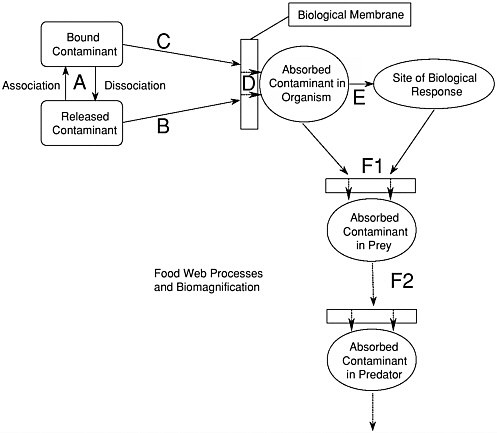
FIGURE 3-21 Bioavailability processes in soil or sediment, focusing on those between prey and predator that affect higher-order animals (denoted F1 and F2).
sediment. Figure 3-21 captures some additional processes that control the bioavailability of contaminants in soils and sediment to higher order animals, in particular the extent of contaminant uptake through the biological membranes of each successive organism and the resulting bioaccumulation in each organism. If there is sufficient biomagnification through the food web, higher organisms can be exposed to contaminants that originated in soils and sediments at concentrations high enough to cause adverse effects. Issues such as feeding ecology, food chain transfer, and biomagnification that control contaminant bioavailability to higher-order organisms are discussed below. Given the wide areal range over which exposure can occur to some higher-order animals, these processes may spread contamination far from its initial release site.
Feeding Ecology
Studies with invertebrates provide examples of some of the feeding ecology processes that can be important to bioavailability. As discussed in Chapter 2, the
bioavailability of certain metals in sediment is partially controlled by the presence of sulfides that bind to these metals and take them out of solution. Indeed, the AVS method for determining metal bioavailability in sediments is based on this reaction. However, benthic species (which are in continual contact with sediments and are often an ecological receptor of concern) obtain oxygen and nutrients differently from sediments and are exposed to different microenvironments. Some oligochaetes feed “head-down” in reduced sediments and “breathe” by periodically returning to the oxidized surface of the sediments (G. Lopez, SUNY Stony Brook, personal communication). These organisms would be predominantly exposed to sulfide-rich, reduced sediments, and would be directly impacted by the influences of sulfides on metal bioavailability. In contrast, most meiofauna are restricted to oxidized layers of sediments where metals sulfides occur in low concentrations. Sulfides are much less likely to be a consideration in this microenvironment. Many macrofauna bury into the reduced layers of sediments, but use tubes or burrows to feed and obtain oxygen from the oxidized sediment surface. The influences of sulfides are probably limited for such species. These differences have been borne out in experiments by Hare et al. (1994) and Warren et al. (1998) that showed how different lake benthos responded to cadmium-contaminated sediments.
Generically, different species ingest different foods from sediments, and feeding can change within species in response to their environment or life stage. The availability of food is also an important factor controlling exposure to contaminants. Lee and Luoma (1998) found that as benthic microalgae were added to sediments, the uptake of cadmium, zinc, and chromium to bivalves increased because the living fraction of the sediment material had grown and more algae were being ingested. Similarly, organisms may select to ingest only specific types of particulate material within a sediment, which can bias uptake towards certain geochemical forms of metals. For example, Luoma and Jenne (1977) and Harvey and Luoma (1985) showed that bivalve uptake of cobalt, cadmium, zinc, and silver from ingested sediments varied by 10-fold or more depending on whether the metals fed to the clams were bound to iron oxides, manganese oxides, detritus, carbonates, or organic coated iron oxides. All of these forms can occur in natural sediments (Jenne, 1977).
Similar processes also affect exposure of soil invertebrates to contamination. The feeding ecology of soil invertebrates concerns where the animal is located within the soil as well as the extent to which it will engulf soil particles as part of its diet. Earthworms in particular are represented by groups that live and feed at the surface (epigeic), that live in soil burrows but feed at the surface (anecic), and that live and feed below the surface (endogenic). Most studies have worked with anecic or epigeic species because they are thought to be more abundant and important in food webs (Diercxsens et al., 1985).
For those soil invertebrates that ingest particles, selective feeding on particular fractions (e.g., particle size and soil type) may be an important bioavailability
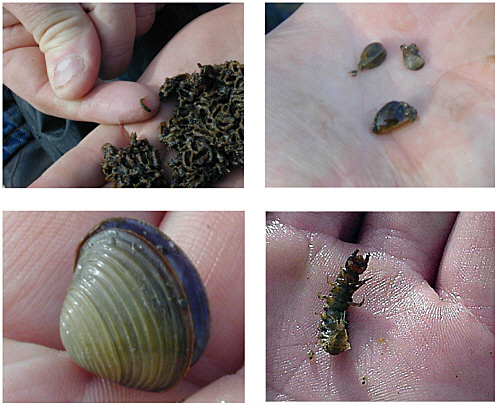
Invertebrates are an integral part of soil and sediment food chains and are the frequent target of bioavailability measurement tools.
process. Selective feeding has been found to affect the composition of material within invertebrate digestive systems compared to the surrounding soil (Edwards, 1997). For example, Diercxsens et al. (1985) found that PCBs were enriched in earthworm gut contents as compared to the surrounding soil, probably because the worms were ingesting the more organically rich soil components to which PCBs are more strongly associated.
From the above it is clear that although geochemical processes may have broad effects relevant to bioavailability, biological processes determine how each organism is exposed to that geochemical milieu, and substantial differences in that exposure are possible among species and among contaminants. It is not practical to understand all biological factors for all species in the near term (e.g., contaminant assimilation from all combinations of food sources available to all benthos). But understanding, for example, assimilation of the most common food items, and generalizing about how biology and ecology affect exposures for key species, may be necessary for reliable exposure assessments. Such understanding could also be critical in evaluating whether some species might be more vulner-
able to contaminants than others because of the way that they experience their environment.
Food Web Concepts
Bioavailability processes vary greatly between predators, prey, and degraders within an ecosystem (Kim et al., 2002). As mentioned earlier, organisms can be exposed to contaminants either from soil, sediments, water, or air, or through their diet. Invertebrates that bioconcentrate PCBs from sediment can be eaten by other wildlife, allowing the compounds to bioaccumulate in their tissues. Eventually, an entire food chain, which refers to the sequential feeding of a series of organisms, can be affected (Hebert et al., 2000). Biomagnification refers to the process by which tissue concentrations of bioaccumulating contaminants increase via the food chain as they pass from one trophic level to the next. Biomagnification results in exposure to higher contaminant levels in top predators of some ecosystems and, consequently, greater bioavailability (Fisk et al., 2001). Thus, important bioavailability processes are not limited to exposure to contaminants at the first trophic level; higher-order food transfers can be extremely relevant.
The susceptibility of compounds to bioconcentration, bioaccumulation, or biomagnification is a characteristic of the food web, the compound of concern, and the status of the system in terms of steady state. Biomagnification is generally observed for nonpolar or lipophilic contaminants that have low solubility, high log Kow, and are recalcitrant in the environment and in the organism (Fraser et al., 2002). Biomagnification is generally not as great a concern for metals, except for those which biotransform to organic forms that are toxic (e.g., tin, selenium, mercury, and plutonium).
The food web concept defines interactions of interrelated food chains and takes into account species participation in multiple food chains over different trophic levels (see Figure 3-22) (Sharpe and Mackay, 2000; Fisk et al., 2001). Food web models can be used to elucidate the presence or potential for contaminant bioconcentration, bioaccumulation, and biomagnification. This can be done by direct measurements from within the food web or, alternatively, it can be predicted by utilizing empirical data (e.g., BSAF data—see Chapter 2) in conjunction with food web models. For each of these methods uncertainties can be minimized by reducing the length of pathways along which predictions are to be made (Fisk et al., 2001).
Even in instances where the food web concept coupled with a predictive model accurately assess compound bioconcentration, bioaccumulation, and biomagnification, the limitations of such predictions must be understood. Different organisms within the same food web can have vastly different toxic responses to a given chemical (Russell et al., 1999). For example, aquatic emergent insects display a low level of sensitivity to PCBs, while higher organisms within the
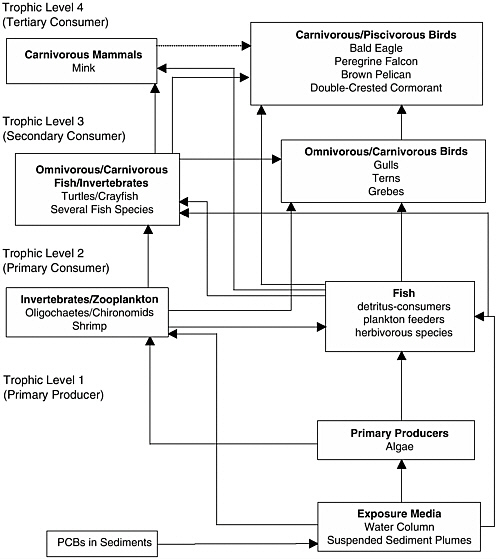
FIGURE 3-22 Food web with examples of representative species. This figure illustrates the complexity of determining whether contaminants are bioavailable to higher-order (trophic level 2 or greater) organisms. The solid lines represent primary pathways of exposure by predators consuming prey, while dotted lines represent possible exposure routes that are less likely.
same food web such as mink and bald eagles are considered highly sensitive (Olsson et al., 2000). A second limitation is that the toxicity of individual components of contaminant mixtures can be vastly different. Finally, even when the total contaminant concentration is predictable, the relative concentrations of individual components may change due to processes such as weathering, bio-
accumulation, and metabolic processes as the chemicals move from one trophic level to the next (Fisk et al., 2001). This is described in Box 3-4 for the case of PCBs, in which certain congeners are more or less bioavailable depending on what trophic level is being considered.
|
BOX 3-4 Bioavailability of Different PCB Congeners Up the Food Chain One of the major concerns about predictive food web models is their ability to describe the movement of complex mixtures across trophic levels. Contaminant mixtures such as PCBs can contain between 60 and 85 different congeners with different chemical-physical characteristics. Environmental weathering changes the relative concentrations of PCB congeners due to differential solubilities, volatilities, and sorption coefficients (Mackay et al., 1983). In addition, metabolism by microorganisms (Bedard, 1990) and animals (MacFarland and Clarke, 1989) can cause relative proportions of some congeners to increase while others decrease (Boon and Eijgenraam, 1988; Borlakoglu and Walker, 1989). The resulting degree and position of chlorine substitution on the biphenyl rings influence not only the physicochemical properties but also toxic effects (Williams and Giesy, 1992; Quensen et al., 1998). When concentrations of individual PCB congeners and total PCB concentrations were examined in the sediments of Saginaw Bay and after bioaccumulation into different animals, it was found that the absolute and relative tissue concentrations of individual congeners change as a function of trophic level (Froese et al., 1998). Individual PCB congeners and total PCBs were measured in sediments, emergent aquatic insects (primarily Chironomidae), and eggs and nestlings of tree swallows (Tachycineta bicolor). First, average lipid-normalized PCBtotal concentrations were not different among the invertebrates, eggs, or nestlings. The average organic carbon-normalized PCBtotal in sediments was about an order of magnitude less than tissue values. This suggests that there is no net biomagnification of PCBs at these trophic levels. Furthermore, this observation indicates that the changes in relative concentrations of individual PCB congeners, while significant, did not have a great influence on the total mass of PCBs predicted to occur in tissues of higher trophic levels. In addition, these results suggest that the concentrations of total PCBs in the tissues of the tree swallow eggs and nestlings were near steady state. The results for individual congeners were quite different. In this instance the critical toxicants to which wildlife are exposed are the congeners that are structurally similar to 2,3,7,8-tetrachlorodibenzo-p-dioxin (TCDD) (Ludwig et al., 1996). Concentrations of “TEq” represent the total potential of the dioxin-like PCB congeners to cause TCDD-like toxicity. Froese et al. (1998) found that lipid-normalized concentrations of TEqs increased with increasing trophic level. The greatest increase, as measured by the ratio between trophic levels, was from invertebrates to the tree swallow eggs, with a lesser increase from the eggs to the nestlings. These results illustrate that bioaccumulation and biomagnification processes are species-and chemical-specific. |
To summarize, although geochemical factors will impart a contextual framework on bioavailability, higher order biological and ecological processes can determine ultimate exposure within specific environments. Food chain transfer is probably the most important exposure pathway to soil and sediment contaminants for higher order animals and must be considered a primary bioavailability process (Sharpe and Mackay, 2000).
CONCLUSIONS AND RECOMMENDATIONS
The bioavailability of contaminants present in soils and sediments is governed by a wide range of physical, chemical, and biological processes. Within this chapter we have described the individual processes impacting bioavailability. While it is instructive to consider these processes in isolation, it is imperative to realize that they occur in concert and often are interdependent. In fact, bioavailability is the integrated result of a number of complex, site-specific, chemical-specific, and organism-specific processes. Bioavailability of a contaminant to a receptor will be determined by the combined effect of these processes, as well as by the properties of the soil or sediment, the contaminant, and the receptor of interest. In particular, the heterogeneity of soils and sediments has a profound effect on bioavailability processes.
Although the number of specific processes involved in bioavailability is invariably large, typically a few steps will be most restrictive and thus impart the greatest impact on total bioavailability (i.e., for a given situation, a select few processes are expected to dominate contaminant bioavailability). In planning a bioavailability assessment, which typically will involve measurement of various physical-chemical properties and some kind of biological response, the objective should be to characterize only the most critical features of the system using tools appropriate for measuring bioavailability (described in Chapter 4). The challenge is to understand the system well enough (i.e., mechanistically) so that the measurements taken sufficiently address key aspects, and the aspects not studied experimentally are well known (or their uncertainty is recognized). To meet this need, a multi-disciplinary team approach is essential.
At a given site, bioavailability must be evaluated through measurements and conceptual modeling of exposure pathways, similar to that done during human health and ecological risk assessment. At present, it is possible to form conceptual models and identify some important processes. Nevertheless, our level of understanding regarding these processes is highly variable. For example, our understanding of contaminant speciation in solution is generally well developed, but contaminant retention by various types of organic matter remains unresolved. Important aspects of feeding ecology remain unknown for certain species but are well recognized for others. Free-ion uptake is well described, but the effects of metal complexation with humic materials and anthropogenic chelating agents on bioavailability are not well understood. In general, our understanding of the fate,
transport, and uptake of dissolved contaminants is substantially greater than for solid-bound (including colloid-bound) contaminants. And, finally, very little is known about bioavailability processes for contaminant mixtures, which are common to almost all contamination scenarios. There are sure to be synergisms and antagonisms that affect how contaminants in mixtures bind to subsurface solids and how they are taken up into organisms. (For example, it is known that cadmium uptake into plants is affected by zinc and calcium.) In order to provide accurate assessments of contaminant bioavailability as part of quantitative risk assessment, we must seek to fill the voids in our knowledge and better understand how the various different processes are linked.
The following specific recommendations address the most pressing knowledge gaps deemed necessary for better understanding, predicting, and measuring bioavailability processes.
An improved understanding of contaminant–solid interactions is needed, especially regarding the nature and effects of aging on contaminant release rates. It is presently recognized that contaminants may become less available for biological uptake with aging in soils or sediments. However, in many situations quantitative descriptions and physicochemical understanding of the mechanisms responsible for reduced release rates over time are lacking. Without this knowledge predictions about changes in bioavailability over the long term are not feasible.
Mechanistic knowledge of bioavailability processes at the field-scale is needed. A reductionist approach has been commonly taken to decipher the mechanisms of individual processes. Although important information has certainly been gleaned from such studies, scaling up to the complexity of natural systems has generally assumed a linear coupling of the isolated processes. In reality, the interdependence of different processes and the shear complexity of natural environments (including the presence of contaminant mixtures) likely translate into non-linear effects in scaling. As a consequence, processes need to be understood within the complexity of their natural states.
Improved understanding is needed for some of the biological processes that can most influence bioavailability. For example, it should be a goal to identify generally operative and quantifiable mechanisms of uptake in the gastrointestinal track that might hold across multiple species. The feeding ecology of animals is critical to better understanding exposure of those animals, given the wide differences in assimilation efficiency observed when animals select different types of food from soils and sediments. The bioavailability of contaminants associated with particles such as colloids—including what fraction of the contaminant pool is bound, how gut and lung environments promote contaminant– colloid dissociation, and the extent of particle uptake across biological mem-
branes—needs to be much better understood. How consumer organisms bioaccumulate and transfer contaminants to their predators is essential to understanding the broad effects of some types of soil and sediment contamination.
Quantitatively descriptive models of bioavailability processes are critical and at present lacking. Such models are integral to accurately predicting the fate of contaminants and describing links between bioavailability processes. For example, well tested models of the association–dissociation processes which account for the heterogeneous nature of soil and sediment and the various retention mechanisms operating at different contaminant concentrations are needed to accurately predict bioavailability process A in Figure 1-1 for a spectrum of field settings. Similarly, knowledge of the dynamic properties of contaminant uptake (focusing on D in Figure 1-1) would allow development of species-specific bioaccumulation models that could incorporate factors that affect bioavailability (e.g., food type). Data for model development and validation are generally scarce and yet essential for accurate bioavailability assessment.
REFERENCES
Aharoni, C., and D. L. Sparks. 1991. Pp. 1-18 In: Rates of soil chemical processes. D. L. Sparks and D. L. Suarez (eds.). SSSA Special Pub. No. 27. Madison, WI: Soil Sci. Soc. Am.
Ainsworth, C. C., J. L. Pilon, P. L. Gassman, and W. G. Van Der Sluys. 1994. Cobalt, cadmium, and lead sorption to hydrous iron oxide: residence time effect. Soil Sci. Soc. Am. J. 58:1615-1623.
Alberts, B., B. Bray, J. Lewis, M. Raff, K. Roberts, and J. D. Watson. 1989. The plasma membrane. Pp. 275 In: Molecular biology of the cell. 2nd ed. New York: Garland Publishing Inc.
Alexander, M. 1994. Biodegradation and bioremediation. San Diego: Academic Press.
Alexander, R. R., and M. Alexander. 1999. Genotoxicity of two polycyclic aromatic hydrocarbons declines as they age in soil. Environ. Toxicol. Chem. 18:1140-1143.
Allen, B. L., and B. F. Hajek. 1986. Mineral occurrence in soil environments. Pp. 199-278 In: Minerals in the soil environments. J. B. Dixon and S. B. Weed (eds.). Madison, WI: Soil Sci. Soc. Am.
Allen-King, R. M., P. Grathwohl, and W. P. Ball. 2002. New modeling paradigms for the sorption of hydrophobic organic chemicals to heterogeneous carbonaceous matter in soils, sediments, and rocks. Advances in Water Resources 25(8-12):985-1016.
Aller, R. C. 1982. The effects of macrobenthos on chemical properties of marine sediment and overlying water. Pp. 53-89 In: Animal-sediment relations: the biogenic alteration of sediments. P. L. McCall and M. J. S. Tevesz (eds.). New York: Plenum Press.
Anawar, H. M., J. Akai, K. M. G. Mostofa, S. Safiullah, and S. M. Tareq. 2002. Arsenic poisoning in groundwater: health risk and geochemical sources in Bangladesh. Environ. Int. 27:597-604.
Aranda-Michel, J., and R. A. Giannella. 1999. Physiology of the small intestine. Pp. 419 In: Clinical practice of gastroenterology. Volume 1. L. J. Brandt (ed.). Philadelphia, PA: Current Medicine, Inc.
Axe, L., and P. Trivedi. 2002. Intraparticle surface diffusion of metal contaminants and their attenuation in microporous amorphous Al, Fe, and Mn oxides. J. Colloid Interface Sci. 247:259-265.
Baker, A. J. M. 1987. Metal tolerance. New Phytol. 106:93-111.
Ball, W. P., and P. V. Roberts. 1991. Long-term sorption of halogenated organic chemicals by aquifer material. 1. Equilibrium. Environ. Sci. Technol. 25:1223-1236.
Bateman, J. N., B. Speer, L. Feduik, R. A. Harling. 1986. Naphthalene association and uptake in Pseudomonas putida. J. Bacteriology 166:155-161.
Bedard, D. L. 1990. Bacterial transformation of polychlorinated biphenyls. In: Biotechnology and biodegradation. D. Kamely, A. Chakrabaty, and G. S. Omenn (eds.). Houston, TX: Gulf Publishing Company.
Bedard, D. L., and J. F. I. Quensen. 1995. Microbial reductive dechlorination of polychlorinated biphenyls. Pp. 127-216 In: Microbial transformation and degradation of toxic organic chemicals. C. Yong (ed.). New York: Wiley.
Beeson, K. C., L. Gray, and M. B. Adams. 1947. The absorption of mineral elements by forage plants. I. The phosphorus, cobalt, manganese, and copper content of some common grasses. J. Am. Soc. Agron. 39(5):356-362.
Behl, C. R., G. L. Flynn, T. Kurihara, N. Harper, W. Smith, W. I. Higuchi, N. F. H. Ho, and C. L. Pierson. 1980. Hydration and percutaneous absorption. 1. Influence of hydration on alkanol permeation through hairless mouse skin. J. Invest. Dermatol. 75:346-352.
Bergman, Å., E. Klasson-Wehler, and H. Kuroki. 1994. Selective retention of hydroxylated PCB metabolites in blood. Environ. Health Perspect. 102:464-469.
Berkaw, M., K. R. Sowers, and H. D. May. 1996. Anaerobic ortho dechlorination of polychlorinated biphenyls by estuarine sediments from Baltimore Harbor. Appl. Environ. Microbiol. 62:2534-2539.
Bertsch, P. M., and J. C. Seaman. 1999. Characterization of complex mineral assemblages: implications for contaminant transport and environmental remediation. Proc. Natl. Acad. Sci. 96:3350-3357.
Billingsley, K. A., S. M. Backus, and O. P. Ward. 1999. Production of metabolites from chlorobiphenyls by resting cells of Pseudomonas strain LB400 after growth on different carbon sources. Canadian Journal of Microbiology 45(2):178-184.
Binger, C. A., J. P. Martin, R. M. Allen-King, and M. Fowler. 1999. Variability of chlorinatedsolvent sorption associated with oxidative weathering of kerogen. J. Contamin. Hydrol. 40:137-158.
Blatt, H., G. Middleton, and R. Murray. 1980. Origin of sedimentary rocks, 2nd edition. Englewood Cliffs, NJ: Prentice Hall.
Boon, J. P., and F. Eijgenraam. 1988. The possible role of metabolism in determining patterns of PCB congeners in species from the Dutch Wadden Sea. Mar. Environ. Res. 24:3-8.
Bopp, L. H. 1986. Degradation of highly chlorinated PCBs by Pseudomonas strain LB400. Journal of Industrial Microbiology 1:23-29.
Borlakoglu, J. T., and C. H. Walker. 1989. Comparative aspects of congener specific PCB metabolism. Eur. J. Drug Metab. Pharmacokinet. 14:127-131.
Bosma, T. N. P., P. J. M. Middeldorp, G. Schraa, and A. J. B. Zehnder. 1997. Mass transfer limitation of biotransformation: quantifying bioavailability. Environ. Sci. Technol. 31:248-252.
Brady, N. C., and R. R. Weil. 1999. The nature and properties of soils. 20th Edition. Englewood Cliffs, NJ: Prentice Hall.
Bridges, J. W., M. R. French, R. L. Smith, and R. T. Williams. 1970. Fate of benzoic acid in various species. Biochemical Journal 118(1):47-51.
Brown, J. F., D. L. Bedard, N. J. Brennan, J. C. Carnahan, H. Feng, and R. E. Wagner. 1987. Polychlorinated biphenyl dechlorination in aquatic sediments. Science 236:709-712.
Brown, M. P., B. Bush, Y. G. Rhee, and L. Shane. 1988. PCB dechlorination in Hudson River sediment. Science 240:1674-1675.
Brown, S. L., C. H. Henry, R. L. Chaney, H. Compton, and P. DeVolder. 2003. Using municipal biosolids in combination with other residuals to restore metal-contaminated mining areas. Plant and Soil 249(1-2):203-215.
Brownawell, B. J., and J. W. Farrington. 1985. Pp. 97-120 In: Marine and estuarine geochemistry. A. C. Sigleo and A. Hattori (eds.). Chelsea, MI: Lewis Publishers.
Brownawell, B. J., and J. W. Farrington. 1986. Biogeochemistry of PCBs in interstitial waters of a coastal marine sediment. Geochim. Cosmochim. Acta 50:157-169.
Bruhlmann, F., and W. Chen. 1999. Transformation of polychlorinated biphenyls by a novel BphA variant through the meta-cleavage pathway. FEMS Microbiology Letters 179(2):203-208.
Bucheli, T., and O. Gustafsson. 2000. Quantification of the soot-water distribution coefficient of PAHs provides mechanistic basis for enhanced sorption observations. Environ. Sci. Technol. 34: 5144-5151.
Bugg, T., J. M. Foght, M. A. Pickard, and M. R. Gray. 2000. Uptake and active efflux of polycyclic aromatic hydrocarbons by Pseudomonas fluorescens LP6a. Appl. Environ. Microbiol. 66:5387-92.
Bunn, R. A., R. D. Magelky, J. N. Ryan, and M. Elimelech. 2002. Mobilization of natural colloids from an iron oxide-coated sand aquifer: effect of pH and ionic strength . Environ. Sci. Technol. 36:314-322.
Buol, S. W., F. D. Hole, R. J. McCracken, and R. J. Southard. 1997. Soil genesis and classification. Ames, IA: Iowa State University Press.
Burchiel, S. W., and M. I. Luster. 2001. Signaling by environmental polycyclic aromatic hydrocarbons in human lymphocytes. Clin. Immunol. 98:2-10.
Burgos, W. D., J. T. Novak, and D. F. Berry. 1996. Reversible sorption and irreversible binding of naphthalene and α-naphthol to soil: elucidation of processes. Environ. Sci. Technol. 30:1205-1211.
Busbee, D. L., J.-S. H. Yoo, J. O. Norman, and C. O. Joe. 1985. Polychlorinated biphenyl uptake and transport by lymph and plasma components. Proc. Soc. Exp. Biol. Med. 179:116-122.
Caldwell, J., and J. J. Mills. 2000. The biochemical basis of toxicity. Pp. 125-139 In: General and applied toxicology. B. Ballantyne, T. C. Marrs, and T. Syveren (eds.). London, UK: Macmillian References Ltd.
Canonne-Hergaux, F., M. D. Fleming, J. E. Levy, S. Gauthier, T. Ralph, V. Picard, N. C Andrews, and P. Gros. 2000. The Nramp2/DMT1 iron transporter is induced in the duodenum of microcytic anemia mk mice but is not properly targeted to the intestinal brush border. Blood 96:3964-3970.
Carroll, K. M., M. R. Harkness, A. A. Bracco, and R. R. Balcarel. 1994. Application of a permeant/ polymer diffusional model to the desorption of polychlorinated biphenyls from Hudson River sediments. Environ. Sci. Technol. 28:253-258.
Cavaliere, M., P. Semeraro, C. Anania, G. Frandina, P. Rea, C. Pacchiarotti, F. Torroni, and G. Oliviero. 1997. Polychlorinated biphenyls and dichlorodiphenyl trichloroethane in human milk. A review. European Review for Medical and Pharmacological Sciences 1(1-3):63-68.
Chandler, W. V. 1941. Phosphorus adsorption by five Alabama soils as influenced by reaction, base saturation, and free sesquioxides. J. Am. Soc. Agron. 33(1):1-12.
Chapman, P. M. 1989. Review: current approaches to developing sediment quality criteria. Environ. Toxicol. Chem. 8:589-599.
Chen, X. W., A. T. Kan, and M. B. Tomson. 2000. Irreversible adsorption of chlorinated benzenes to natural sediments: implications for sediment quality criteria. Environ. Sci. Technol. 34:385-392.
Chen, Z., and L. M. Mayer. 1999. Sedimentary metal bioavailability determined by the digestive constraints of marine deposit feeders: gut retention time and dissolved amino acids. Mar. Ecol. Prog. Ser. 176:139-151.
Chiou, C. T., D. E. Kile, D. W. Rutherford, G. Sheng, and S. T. Boyd. 2000. Sorption of selected organic compounds from water to a peat soil and its humic-acid and humin fractions: potential sources of the sorption nonlinearity. Environ. Sci. Technol. 34:1254-1258.
Chiou, C. T., S. E. McGroddy, and D. E. Kile. 1998. Partition characteristics of polycyclic aromatic hydrocarbons on soils and sediments. Environ. Sci. Technol. 32:264-269.
Chiou, C. T., P. E. Porter, and D. W. Schmedding. 1983. Partition equilibria of nonionic organic compounds between soils organic matter and water. Environ. Sci. Technol. 17:227-231.
Chowdhury, U. K., B. K. Biswas, T. R. Chowdhury, G. Samanta, B. K. Mandal, G. C. Basu, C. R. Chanda, D. Lodh, K. C. Saha, S. K. Mukherjee, S. Roy, S. Kabir, Q. Quamruzzaman, and D. Chakraborti. 2000. Groundwater arsenic contamination in Bangladesh and West Bengal, India. Environ. Health Persp. 108:393-397.
Codling, E. E., R. L. Chaney, and C. L. Mulchi. 2000. Use of aluminum- and iron-rich residues to immobilize phosphorus in poultry litter and litter-amended soils. J. Environ. Qual. 29(6):1924-1931.
Connolly, J. P., H. A. Zahakos, J. Benaman, C. K. Ziegler, J. R. Rhea, and K. Russell. 2000. A model of PCB fate in the Upper Hudson River. Environ. Sci. Technol. 34:4076-4087.
Conrad, M. C., and J. C. Barton. 1978. Factors affecting the absorption and excretion of lead in the rat. Gastroenterology 74:731-740.
Cornelissen, G., P. C. M. van Noort, and A. J. G. Harrie. 1998. Mechanism of slow desorption of organic compounds from sediments: a study using model sorbents . Environ. Sci. Technol. 32:3124-3131.
Cummings, D., F. Caccavo, S. Fendorf, and R. F. Rosenzweig. 1999. Arsenic mobilization by the dissimilatory Fe(III) reducing bacterium Shewanella alga BrY. Environ. Sci. Technol. 33:723-729.
Czaja, K., J. K. Ludwicki, K. Góralczyk, and P. Strucinski. 2001. Relationship between two consecutive lactations and fat level in persistent organochlorine compound concentrations in human breast milk. Chemosphere 43(4-7):889-893.
Dahn, R., A. M. Scheidegger, A. Manceau, M. L. Schlegel, B. Baeyens, M. H. Bradbury, and M. Morales. 2002. Neoformation of Ni phyllosilicate upon Ni uptake on montmorillonite: a kinetic study by powder and polarized extended X-ray absorption fine structure spectroscopy. Geochim. Cosmochim. Acta 66:2335-2347.
Daniel, H. A., and H. J. Harper. 1935. The relation between effective rainfall and total calcium and phosphorus in alfalfa and prairie hay. J. Am. Soc. Agron. 27(8):644-652.
Dayton, P. G., Z. H. Israili, and J. D. Henderson. 1983. Elimination of drugs by passive diffusion from blood to intestinal lumen: factors influencing nonbiliary excretion by the intestinal tract . Drug Metabolism Reviews 14(6):1193-1206.
Decho, A. W., and S. N. Luoma. 1991. Time-courses in the retention of food material in the bivalves Potamocorbula amurensis and Macoma balthica: significance to the absorption of carbon and chromium. Marine Ecology Progress Series 78:303-314.
Decho, A. W., and S. N. Luoma. 1996. Flexible digestion strategies and trace metal assimilation in marine bivalves. Limnology and Oceanography 41:568-572.
Devine, M. D., J. C. Hall, M. L. Romano, M. A. Marles, L. W. Thomson, and R. H. Shimabukuro. 1993. Diclofop and fenoxaprop resistance in wild oats is associated with an altered effect on the plasma membrane electrogenic potential. Pestic. Biochem. Physiol. 45:167-177.
Diercxsens, P., D. deWeck, N. Borsinger, B. Rosset and J. Tarradellas. 1985. Earthworm contamination by PCBs and heavy metals. Chemosphere 14(5):511-522.
Dix, K. J. 2001. Absorption, distribution, and pharmacokinetics. Pp. 563-582 In: Handbook of pesticide toxicology. R. I. Krieger (ed.). San Diego, CA: Academic Press.
Dorian, C., V. H. Gattone II, and C. D. Klaassen. 1992. Renal cadmium deposition and injury as a result of accumulation of cadmium-metal-lithionen (CdMT) by proximal convoluted tubules— a light microscope autoradiographic study with 109CdMT. Toxicol. Appl. Pharmacol. 114:173-181.
Doube, B. M. 1997. Functional interaction between earthworms, microorganisms, invertebrates, and plants. In: Earthworm ecology. C. A. Edwards (ed.). Boca Raton, FL: CRC Press.
Dzombak, D. A., and F. M. M. Morel. 1990. Surface complexation modeling: hydrous ferric oxide. New York: Wiley and Sons.
Edwards, C. A. 1997. The use of earthworms in processing organic wastes into plant growth media and animal feed protein. In: Earthworm ecology. Boca Raton, FL: CRC Press.
Einsele, A., H. Schnieder, and A. Fiechter. 1975. J. Ferment. Technol. 53:241-243.
Ernst, W. H. O., J. A. C. Verkleij, and H. Schat. 1992. Metal tolerance in plants. Acta Botanica Neerlandica 41(3):229-248.
Evanko, C. R., and D. A. Dzombak. 1998. Influence of structural features on sorption of NOM-analogue organic acids to goethite. Environ. Sci. Technol. 32:2846-2855.
Fan, T. W. M., A. N. Lane, M. Shenker, J. P. Bartley, D., Crowley, and R. M. Higashi. 2001. Comprehensive chemical profiling of gramineous plant root exudates using high-resolution NMR and MS. Phytochemistry 57:209-221.
Farrington, J. W. 1991. Biogeochemical processes governing exposure and uptake of organic pollutant compounds in aquatic organisms. Environmental Health Perspectives 90:75-84.
Feingold, A. 1977. The elimination of volatile substances from the lungs. International Anesthesiology Clinics 15(4):153-168.
Feist, L. J., and D. R. Parker. 2001. Ecotypic variation in selenium accumulation among populations of Stanleya pinnata. New Phytol. 149:61-69.
Fenchel, T. 1969. The ecology of marine microbenthos. Ophelia 6:1.
Fetzner, S., and F. Lingens. 1998. Bacterial dehalogenation. Applied Microbiology and Biotechnology 50:633-657.
Fisk, A. T., K. A. Hobson, and R. J. Norstrom. 2001. Influence of chemical and biological factors on trophic transfer of persistent organic pollutants in the Northwater Polynya marine food web. Environ. Sci. Technol. 35:732-738.
Ford, R. G., and D. L. Sparks. 2000. The nature of Zn precipitates formed in the presence of pyrophyllite. Environ. Sci. Technol. 34:2479-2483.
Formica, S. J., J. A. Baron, L. J. Thibodeaux, and K. T. Valsaraj. 1988. PCB transport into lake sediments: conceptual model and laboratory simulation. Environ. Sci. Technol. 22:1435-1440.
Forster, I., D. A. Higgs, B. S. Dosanjh, M. Rowshandeli, and J. Parr. 1999. Potential for dietary phytase to improve the nutritive value of canola protein concentrate and decrease phosphorus output in rainbow trout (Oncorhynchus mykiss) held in 11 degrees C freshwater. Aquaculture 179(1/4):109-125.
Fraser, A. J., I. C. Burkow, H. Wolkers, and D. Mackay. 2002. Modeling biomagnification and metabolism of contaminants in harp seals of the Barents Sea. Environ. Toxicol. Chem. 21:55-61.
Froese, K. L., D. A. Verbrugge, G. T. Ankley, G. J. Niemi, C. P. Larsen, and J. P. Giesy. 1998. Bioaccumulation of polychlorinated biphenyls from sediments to aquatic insects and tree swallow eggs and nestlings in Saginaw Bay, Michigan, USA. Environ. Toxicol. Chem. 17:484-492.
Frost, P., G. D. Weinstein, J. Bothwell, and R. Wildnauer. 1968. Icthyosiform dermatoses. III. Studies of transepidermal water loss. Arch. Dermatol. 98:230-233.
Fuller, C. C., A. van Geen, M. Baskaran, and R. Anima. 1999. Sediment chronology in San Francisco Bay, California, defined by 210Pb, 234Th, 137Cs, and 239,240Pu. Mar. Chem. 64:7-27
Furukawa, K. 1994. Molecular genetics and evolutionary relationship of PCB degrading bacteria. Biodegradation 5:289-300.
Gary, M., R. McAfee, Jr., and C. L. Wolf (eds.). 1974. Glossary of geology. Washington, DC: American Geological Institute.
George, S. G., B. J. S. Pirie, and T. L. Coombs. 1978. Detoxification of metals by marine bivalves: an ultrastructural study of the compartmentation of copper and zinc in the oyster Ostrea edulis. Biochemical Society Transactions 5:136-147.
Ghosh, R. S., D. A. Dzombak, and R. G. Luthy. 1999. Equilibrium precipitation and dissolution of iron cyanide solids in water. Environmental Engineering Science 16:293-313.
Ghosh, U., J. S. Gillette, R. G. Luthy, R. N. Zare. 2000. Microscale location, characterization, and association of polycyclic aromatic hydrocarbons on harbor sediment particles. Environ. Sci. Technol. 34:1729-1736.
Ghosh, U., J. W. Talley, and R. G. Luthy. 2001. Particle-scale investigation of PAH desorption kinetics and thermodynamics from sediment. Environ. Sci. Technol. 35:3468-3475.
Giblin, A. E., G. W. Luther III, and I. Valiela. 1986. Trace metal solubility in salt marsh sediments contaminated with sewage sludge. Estuarine, Coastal and Shelf Sci. 23:477–498.
Golub, M. S., C. L. Keen, J. F. Commisso, C. B. Salocks, and T. R. Hathaway. 1999. Arsenic tissue concentration of immature mice one hour after oral exposure to gold mine tailings. Environ. Geochem. Health 21:199–209.
Gordon, J. N., A. Taylor, and P. N. Bennett. 2002. Lead poisoning: case studies. British Journal of Clinical Pharmacology 53(5):451-458.
Goswami, P. C., and H. D. Singh. 1991. Different modes of hydrocarbon uptake by two Pseudomonas species. Biotechnol. Bioeng. 37:1-11.
Graetz, D. A., V. D. Nair, K. M. Portier, and R. L. Voss. 1999. Phosphorus accumulation in manureimpacted Spodosols of Florida. Agric. Ecosyst. Environ. 75(1/2):31-40.
Grandhi, R. R. 2001. Effect of supplemental phytase and ideal dietary amino acid ratios in covered and hulless-barley-based diets on pig performance and excretion of phosphorus and nitrogen in manure. Can. J. Anim. Sci. 81(1):115-124.
Grant, D. M. 1991. Detoxification pathways in the liver. Journal of Inherited Metabolic Disease 14(4):421-430.
Grathwohl, P. 1990. Influence of organic matter from soils and sediments from various origins on the sorption of some chlorinated aliphatic hydrocarbons: implications on Koc correlations. Environ. Sci. Technol. 24:1687-1693.
Gustafsson, O., and P. M. Gschwend. 1997. Soot as a strong partition medium for polycyclic aromatic hydrocarbons in aquatic systems. Pp. 365-381 In: Molecular markers in environmental geochemistry. R. P. Eganhouse (ed.). Washington, DC: Am. Chem. Soc.
Gustafsson, O., F. Haghseta, C. Chan, J. MacFarlane, and P. M. Gschwend. 1997. Quantification of the dilute sedimentary soot phase: implications for PAH speciation. Environ. Sci. Technol. 31:203-209.
Haderlein, S. B., K. W. Weissmahr, and R. P. Schwarzenbach. 1996. Specific adsorption of nitroaromatic explosives and pesticides to clay minerals. Environ. Sci. Technol. 30:612-622.
Hall, J. L. 2002. Cellular mechanisms for heavy metal detoxification and tolerance. Journal of Experimental Botany 53(366):1-11.
Hare, L., R. Carignan, and M. A. Huerta-Diaz. 1994. A field experimental study of metal toxicity and accumulation by benthic invertebrates: implications for the acid-volatile sulfide (AVS) model. Limnol. Oceanogr. 39:1653-1668.
Harrington, J. M., R. F. Rosenzweig, W. C. Rember, and S. E. Fendorf. 1998. Phase associations and mobilization of iron and trace metals in sediments of Lake Coeur d’Alene, Idaho. Environ. Sci. Technol. 32:650-656.
Harvey, R. W., and S. N. Luoma. 1985. Effect and adherent bacteria and bacterial extracellular polymers upon assimilation by Macoma balthica of sediment-bound Cd, Zn, and Ag. Marine Ecology 22:281-289.
Hatzinger, P. B., and M. Alexander. 1998. Biodegradation of organic compounds sequestered in organic solids or in nanopores within silica particles. Environ. Toxicol. Chem. 16:2215-2221.
Hatzinger, P. B., and M. Alexander. 1995. Effect of aging of chemicals in soil on their biodegradability and extractability. Environ. Sci. Technol. 29:537-545.
Haustein, G. K., T. C. Daniel, D. M. Miller, P. A. Jr. Moore, and R. W. McNew. 2000. Aluminum-containing residuals influence high-phosphorus soils and runoff water quality. J. Environ. Qual. 29(6):1954-1959.
Hebert, C. E., K. A. Hobson, and J. L. Shutt. 2000. Changes in food web structure affect rate of PCB decline in herring gull (Larus argentatus) eggs. Environ. Sci. Technol. 34:1609-1614.
Heck, A. F. 1935. Availability and fixation of phosphorus in Hawaiian soils. J. Am. Soc. Agron. 27(11):874-884.
Herman, D. C., Y. Zhang, and R. M. Miller. 1997. Rhamnolipid (biosurfactant) effects on cell aggregation and biodegradation of residual hexadecane under saturated flow conditions. Appl Environ. Microbiol. 63:3622-3627.
Hesterberg, D., and S. Beauchemin. 2001. Molecular-scale mechanisms of phosphate bonding on goethite. Soil Sci. Soc. Am. Abstracts. Annual Meeting Oct 21-25, Charlotte, NC.
Hesterberg, D., W. Zhou, K. J. Hutchison, S. Beauchemin, and D. E. Sayers. 1999. XAFS study of adsorbed and mineral forms of phosphate. Journal of Synchrotron Radiation 6:636-638.
Hietanen, E., K. Husgafvel-Pursiainen, and H. Vainio. 1997. Interaction between dose and susceptibility to environmental cancer: a short review. Environmental Health Perspectives 105(Suppl. 4):749-754.
Holtum, J. A., R. E. Hausler, M. D. Devine, and S. B. Powles. 1994. Recovery of transmembrane potentials in plants resistant to aryloxyphenoxypropanoate herbicides: a phenomenon awaiting explanation. Weed Sci. 42:293-301.
Hsu, F. C., R. L. Marxmiller, and A. Y. Yang. 1990. Study of root uptake and xylem translocation of cinmethylin and related compounds in detopped soybean roots using a pressure chamber technique. Plant Physiol 93:1573-1578.
Huang, W. L., W. Huang, T. M. Young, M. A. Schlautman, H. Yu, and W. J. Weber, Jr. 1997. A distributed reactivity model for sorption by soils and sediments: general isotherm nonlinearity and applicability of the dual reactive domain model. Environ. Sci. Technol. 31(6):1703-1710.
Huang, J. W., and S. D. Cunningham. 1996. Lead phytoextraction: species variation in lead uptake and translocation. New Phytol. 134:75-84.
Huang, P. M. 1989. Feldspars, olivines, pyroxenes, and amphiboles. Pp. 975-1050 In: Minerals in the soil environment. J. B. Dixon and S. B. Weed (eds.). SSSA Book Ser. No. 1. Madison, WI: Soil Sci. Soc. Am.
Hurlbut, C. S., Jr., and C. Klein. 1977. Manual of mineralogy. 19th edition. New York: John Wiley and Sons.
Hutton, A. C. 1995. In: Composition, geochemistry, and conversion of oil shales. C. Snape (ed.). Boston: Kluwer Academic.
Ingersoll, C. G., G. Ankley, D. A. Benoit, E. L. Brunson, G. A. Burton, F. J. Dwyer, R. A. Hoke, P. F. Landrum, T. J. Norberg-King, and P. V. Winger. 1995. Toxicity and bioaccumulation of sediment-associated contaminants using freshwater invertebrates: a review of methods and applications. Environ. Toxicol. Chem. 14:1885-1894.
Ippolito, J. A., K. A. Barbarick, and E. F. Redente. 1999. Co-application effects of water treatment residuals and biosolids on two range grasses. J. Environ. Qual. 28(5):1644-1650.
Jani, P., G. W. Halbert, J. Langridge, and A. Florence. 1990. Nanoparticle uptake by the rat gastrointestinal mucosa: quantitation and particle size dependency. J. Pharm. Pharmacol. 42:821-826.
Jenne, E. A. 1968. Controls on Mn, Fe, Co, Ni, Cu and Zn concentrations in soils and water: the significant role of hydrouts Mn and Fe oxides. Pp. 337-425 In: Trace inorganics in water. R. F. Gould (ed.). Washington, DC: Am. Chem. Soc.
Jenne, E. A. 1977. Trace element sorption by sediments and soils: sites and processes. Pp. 425-553 In: Molybdenum in the environment. W. R. Chappell and K. K. Peterson (eds.). New York: Marcel Dekker.
Jeremiason, J. D., K. C. Hornbuckle, and S. J. Eisenreich. 1994. PCBs in Lake Superior, 1978-1992: decreases in water concentrations reflect loss by volatilization. Environ. Sci. Technol. 28:903-914.
Johnson, M. D., W. Huang, and W. J. Weber. 2001. A distributed reactivity model for sorption by soils and sediments: simulated diagenesis of natural sediment organic matter and its impact on sorption/desorption equilibria. Environ. Sci. Technol. 35:1680-1687.
Kalantzi, O. I., R. E. Alcock, P. A. Johnston, D. Santillo, R. L. Stringer, G. O. Thomas, and K. C. Jones. 2001. The global distribution of PCBs and organochlorine pesticides in butter. Environ. Sci. Technol. 35:1013–1018.
Karapanagioti, H., S. Kleineidam, D. Sabatini, G. Grathwohl, and B. Ligouis. 2000. Impacts of heterogeneous organic matter on phenanthrene sorption: equilibrium and kinetic studies with aquifer material. Environ. Sci. Technol. 34:406-414.
Karickhoff, S. W., D. S. Brown, and T. A. Scott. 1979. Sorption of hydrophobic pollutants on natural sediments. Water Research 13:241-248.
Karickhoff, S. W. 1981. Semi-empirical estimation of sorption of hydrophobic pollutants on natural sediments and soils. Chemosphere 10(8):833-846.
Karickhoff, S. W. 1984. Organic pollutant sorption in aquatic systems. J. Hydraulic Engineering 110:707-735.
Karimi-Lotfabad, S., M. A. Pickard, and M. R. Gray. 1996. Reactions of polynuclear aromatic hydrocarbons on soil. Environ. Sci. Technol. 30:1145-1151.
Kavlock, R. J. 1999. Overview of endocrine disruptor research activity in the United States. Chemosphere 39:1227-1236.
Keller, C. K., and D. H. Bacon. 1998. Soil respiration and georespiration distinguished by transport analyses of vadose CO2, (CO2)-13C, and (CO2)-14C. Global Biogeochemical Cycles 12(2):361-372.
Kelsey, J. W., and M. Alexander. 1997. Declining bioavailability and inappropriate estimation of risk of persistent compounds. Environ. Toxicol. Chem. 16:582-585.
Kenaga, E. E. 1975. Partitioning and uptake of pesticides in biological systems: environmental dynamics of pesticides. Environmental Science Research 6(1):217-273.
Kesselmeier, J. 1992. Plant physiology and the exchange of trace gases between vegetation and atmosphere. Pp. 946-966 In: Precipitation scavenging and atmosphere-surface exchange, Vol. 2, the semonin volume: atmosphere-surface exchange processes. S. E. Schwartz and W. G. N. Slinn (eds.). Washington, DC: Hemisphere Pub.
Kieboom, J., J. J. Dennis, G. J. Zylstra, and J. A. de Bont. 1998. Active efflux of organic solvents by Pseudomonas putida S12 is induced by solvents. J. Bacteriol. 180:6769-6772.
Kile, D. E., R. L. Wershaw, and C. T. Chiou. 1999. Correlation of soil and sediment organic matter polarity to aqueous sorption of nonionic compounds. Environ. Sci. Technol. 33:2053-2056.
Kim, S. K., D. S. Lee, and J. R. Oh. 2002. Characteristics of trophic transfer of polychlorinated biphenyls in marine organisms in Incheon North Harbor, Korea. Environ. Sci. Technol. 21:834-841.
Kinniburgh, D. G., M. L. Jackson, and J. K. Syers. 1976. Adsorption of alkaline earth, transition, and heavy metal cations by hydrous oxide gels of iron and aluminum. Soil Science Society of America Journal 40:796-799.
Kleineidam, S., H. Rugner, B. Ligouis, and P. Grathwohl. 1999. Organic matter facies and equilibrium sorption of phenanthrene. Environ. Sci. Technol. 33:1637-1644.
Koga, N., A. Shinyama, C. Ishida, N. Hanioka, and H. Yoshimura. 1992. A new metabolite of 2,4,3’,4’-tetrachlorobiphenyl in rat feces. Chem. Pharmacol. Bull. 40:3338-3339.
Koo, S. J., J. C. Neal, and J. M. DiTomaso. 1997. Mechanism of action and selectivity of quinclorac in grass roots. Pestic. Biochem. Physiol. 57:44-53.
Kuo, S. 1996. Phosphorus. Pp. 869-920 In: Methods of soil analysis, Part 3: chemical methods. J. M. Bartels and D. L. Sparks (eds.). Madison, WI: Soil Science Society of America, Inc.
Kramer, U., J. D. Cotter-Howells, J. M. Charnock, A. J. M. Baker, and J. A. C. Smith. 1996. Free histidine as a metal chelator in plants that accumulate nickel. Nature 379:635-638.
Kure, L. K., and T. L. Forbes. 1997. Impact of bioturbation by Arenicola marina on the fate of particle-bound fluoranthene. Mar. Ecol. Prog. Ser. 156:157-166.
Labieniec, P. A., D. A. Dzombak, and R. L. Siegrist. 1996. SoilRisk: risk assessment model for organic contaminants in soil. J. Environmental Engineering 122:388-398.
Langham, W., W. N. McMillen, and L. Walker. 1943. A comparison of carotene, protein, calcium, and phosphorus content of buffalo grass, Buchloe dactyloides, and blue grama, Bouteloua gracilis. J. Am. Soc. Agron. 35(1):35-42.
Langmuir, D. 1997. Aqueous environmental geochemistry. Englewood Cliffs, NJ: Prentice Hall.
Laperche, V., T. J. Logan, P. Gaddam, and S. J. Traina. 1997. Effect of apatite amendments on plant uptake of lead from contaminated soil. Environ. Sci. Tech. 31:2745-2753.
Lawton, R. W., M. R. Ross, J. Feingold, and J. F. Brown. 1985. Effects of PCB exposure on biochemical and hematological findings in capacitor workers. Environ. Health Perspect. 60:165-184.
Lee, R. B. 1982. Selectivity and kinetics of ion uptake of barley plants following nutrient deficiency. Ann. Bot. (London) 50:429-449.
Lee, B.-G., and S. N. Luoma. 1998. Influence of microalgal biomass on absorption efficiency of Cd, Cr, and Zn by two bivalves from San Francisco Bay. Limnology and Oceanography 43:1455-1466.
Linder, M. C. 1991. Biochemistry of copper. New York: Plenum Press.
Little, D. L., D. W. Ladner, S. L. Shaner, and R. D. Ilnicki. 1994. Modeling root absorption and translocation of 5-substituted analogs of the imidazolinone herbicide, imazapyr. Pestic. Sci. 41:171-185.
Logan, T. J., T. O. Oloya, and S. M. Yaksich. 1979. Phosphate characteristics and bioavailability of suspended sediments from streams draining into Lake Erie. J. Great Lakes Res. 5:112-123.
Lorden, S. W., W. Chen, and L. W. Lion. 1998. Experiments and modeling of the transport of trichloroethene vapor in unsaturated aquifer material. Environ. Sci. Technol. 32:2009-2117.
Lovley, D. R. 1991. Dissimilatory Fe(III) and Mn(IV) reduction. Microbiol. Rev. 55:259-287.
Ludwig, J. P., H. Kurita-Matsuba, H. J. Auman, M. E. Ludwig, C. L. Summer, J. P. Giesy, D. E. Tillitt, and P. D. Jones. 1996. Deformities, PCBs and TCDD-equivalents in double-crested cormorants (Phalacrocorax auritus) and Caspian terns (Hydroprogne caspia) of the Upper Great Lakes 1986-1991: testing cause–effect relationships. J. Great Lakes Res. 22:172-197.
Lund W. 1990. Speciation analysis—why and how? Fresenius Journal of Analytical Chemistry 337:557-564.
Luoma, S. N., and E. A. Jenne. 1977. The availability of sediment-bound cobalt, silver, and zinc to a deposit-feeding clam. Pp. 213-230 In: Biological implications of metals in the environment. R. W. Wildung and H. Drucker (eds.).
Luoma, S. N. 1983. Bioavailability of trace metals to aquatic organisms: a review. Sci. Total Environ. 28:1-22.
Luoma, S. N. 1989. Can we determine the biological availability of sediment-bound trace elements? Hydrobiologia 176/177:379-396.
Luoma, S. N., C. Johns, N. S. Fisher, N. A. Steinberg, R. S. Oremland, and J. Reinfelder. 1992. Determination of selenium bioavailability to a benthic bivalve from particulate and solute pathways. Environ. Sci. Technol. 26:485-491.
Luthy, R. G., G. R. Aiken, M. L. Brusseau, S. D. Cunningham, J. J. Pignatello, M. Reinhard, S. J. Traina , W. J. Weber, and J. C. Westall. 1997a. Sequestration of hydrophobic organic contaminants by geosorbents. Environ. Sci. Technol. 31:3341-3347.
Luthy, R. G., D. A. Dzombak, M. J. R. Shannon, R. Unterman, and J. R. Smith. 1997b. Dissolution of PCB congeners from an aroclor and an aroclor/hydraulic oil mixture. Wat. Res. 31:561-573.
Lyman, W. J., W. F. Reehl, and D. H. Rosenblatt. 1990. Handbook of chemical property estimation methods. Ch. 16. Volatilization from soil. Washington, DC: Am. Chem. Soc.
MacFarland, V. A., and J. U. Clarke. 1989. Environmental occurrence, abundance, and potential toxicity of polychlorinated biphenyl congeners: considerations for a congener-specific analysis. Environ. Health Perspect. 81:225-239.
MacKay, D., S. Paterson, and M. Joy. 1983. Application of fugacity models to the estimation of chemical distribution and persistence in the environment. Pp. 175-196 In: Fate of chemicals in the environment. R. L. Swann and A. Eschenroeder (eds.). Washington, DC: Am. Chem. Soc.
Mackay, D., W. Y. Shiu, and K.-C. Ma. 1992. Illustrated handbook of physical-chemical properties and environmental fate of organic chemicals. Chelsea, MI: Lewis Publishers.
Manceau, A., M.-C. Boisset, G. Sarret, J.-L. Hazemann, M. Mench, P. Cambier, and R. Prost. 1996. Direct determination of lead speciation in contaminated soils by EXAFS spectroscopy. Environ. Sci. Technol. 30:1540-1552.
Manceau, A., A. I. Gorshkov, and V. A. Drits. 1992. Structural chemistry of Mn, Fe, Co, and Ni in manganese hydrous oxides. Part I. Information from EXAFS spectroscopy and electron and x-ray diffraction. Am. Mineralogist 77:1144-1157.
Marschner, H. 1995. Mineral nutrition of higher plants. London: Academic Press. New York, NY: McGraw-Hill.
Martin, J. M., and M. Whitfield. 1983. The significance of the river input of chemical elements to the ocean. Pp. 265-295 In: Trace metals in sea water. C. S. Wong, E. Boyle, K. W. Bruland, J. D. Burton, and E. D. Goldberg (eds.). New York: Plenum Press.
Mathiowitz, E., J. S. Jacob, Y. S. Jong, G. P. Carino, D. E. Chickering, P. Chaturved, C. A. Santos, K. Vijayaraghavan, S. Montgomery, M. Bassett, and C. Morrell. 1997. Biologically erodable microspheres as potential oral drug delivery systems. Nature 386:410-414.
Mayer, L. M., Z. Chen, R. H. Findlay, J. Fang, S. Sampson, R. F. L. Self, P. A. Jumars, C. Quetel, and O. F. X. Donard. 1996. Bioavailability of sedimentary contaminants subject to deposit-feeder digestion. Environ. Sci. Technol. 30:2641-2645.
Mayer, L. M., L. L. Schick, R. F. L. Self, P. A. Jumars, R. H. Findlay, Z. Chen, and S. Sampson. 1997. Digestive environments of benthic macroinvertebrate guts: enzymes, surfactants and dissolved organic matter. J. Mar. Res. 55:785-812.
McBride, M. B. 1994. Environmental chemistry of soils. New York: Oxford Press.
McCarthy, J. F., and J. M. Zachara. 1989. Subsurface transport of contaminants. Environ. Sci. Technol. 23:496-502.
McKinney, T. D., and M. A. Hosford. 1992. Organic cation transport by rat hepatocyte basolateral membrane vesicles. Am. J. Physiol. 263(6):G939-G946.
McLaughlin, S. G. A., and J. Dilger. 1980. Transport of protons across membranes by weak acids. Physiol. Rev. 60:825-863.
McLaughlin, M. J., L. T. Palmer, K. G. Tiller, T. W. Beech, and M. K. Smart. 1994. Increasing soil salinity causes elevated cadmium concentrations in field-grown potato tubers. J. Environ. Qual. 23:1013-1018.
McLaughlin, M. J., E. Smolders, and R. Merckx. 1998. Soil-root interface: physicochemical processes. In: Soil chemistry and ecosystem health. P. M. Huang (ed.). Madison, WI: Soil Science Society of America.
McLaughlin, M. J., and B. R. Singh (eds.). 1999. Cadmium in soils and plants. Dordrecht, The Netherlands: Kluwer Academic Publishers.
Merino-Trigo, A., L. Sampedro, F. J. Rodriguez-Berrocal, S. Mato, and M. P. de la Cadena. 1999. Activity and partial characterisation of xylanolytic enzymes in the earthworm Eisenia andrei fed on organic wastes. Soil Biol. Biochem. 31:1735-1740.
Metzger, W. H. 1940. Significance of adsorption, or surface fixation, of phosphorus by some soils of the prairie group. J. Am. Soc. Agron. 32(7):513-526.
Metzger, W. H. 1941. Phosphorus fixation in relation to the iron and aluminum of the soil. J. Am. Soc. Agron. 33(12):1093-1099.
Michel, C., and E. J. DeVillez. 1978. Pp. 509-554 In: Physiology of annelids. P. J. Mill (ed.). New York: Academic Press.
Mitchell, P. 1966. Chemiosmotic coupling in oxidative and photosynthetic phosphorylation. Biol. Rev. 41:445-502.
Mohn, W. W., and J. M. Tiedje. 1992. Microbial reductive dehalogenation. Microbiological Reviews 56:482-507.
Moore, J. N., and S. N. Luoma. 1990. Hazardous wastes from large scale metal extraction: a case study. Environ. Sci. Technol. 24:1279-1285.
Moore, J. N., W. H. Ficklin, and C. Johns. 1988. Partitioning of arsenic and metals in reducing sulfidic sediments. Environ. Sci. Technol. 22:432-437.
Morel, F. M. M., and J. G. Hering. 1993. Principles and applications of aquatic chemistry. New York: Wiley and Sons.
Morin, G., J. D. Ostergren, F. Juillot, P. Ildefonse, G. Calas, and G. E. Brown, Jr. 1999. XAFS determination of the chemical form of lead in smelter-contaminated soils and mine tailings: importance of adsorption processes. Am. Mineral. 84:420-434.
Morrison, D. E., B. K. Robertson, and M. Alexander. 2000. Bioavailability to earthworms of aged DDT, DDE, DDD, and dieldrin in soil. Environ. Sci. Technol. 34:709-713.
Morse, J. W., F. J. Millero, J. C. Cornwell, and D. Rickard. 1987. The chemistry of the hydrogen sulfide and iron sulfide systems in natural waters. Earth-Science Rev. 24:1-42.
Myers, C. R., and K. H. Nealson. 1988. Microbial reduction of manganese oxides: interactions with iron and sulfur . Geochim. Cosmochim. Acta 52:2727-2732.
Nam, K, and M. Alexander. 1998. Role of nanoporosity and hydrophobicity in sequestration and bioavailability: tests with model solids. Environ. Sci. Technol. 32:71-74.
Nam, K., N. Chung, and M. Alexander. 1998. Relationship between organic matter content of soil and the sequestration of phenanthrene. Environ. Sci. Technol. 32:3785-3788.
Natarajan, M. R., W. M. Wu, J. Nye, H. Wang. L. Bhatnagar, and M. K. Jain. 1996. Dechlorination of polychlorinated biphenyl congeners by an anaerobic microbial consortium. Applied Microbiology and Biotechnology 46(5-6):673-677.
National Research Council (NRC). 1994. Alternatives for ground water cleanup. Washington, DC: National Academy Press.
NRC. 1999. Groundwater and soil cleanup: improving management of persistent contaminants. Washington, DC: National Academy Press.
NRC. 2000. Natural attenuation for groundwater remediation. Washington, DC: National Academy Press.
Neilands, J. B. 1984. Siderophores of bacteria and fungi. Microbiol. Sci. 1:9-14.
Neilands, J. B. 1995. Siderophores: structure and function of microbial iron transport compounds. J. Biol. Chem. 270:26723-6.
Nies, D. N., and S. Silver. 1999. Microbial heavy-metal resistance. Applied Microbiology and Biotechnology 51:730-750.
O’Hagan, D. T. 1996. The intestinal uptake of particles and the implications for drug and antigen delivery. J. Anat. 189:477-482.
Oliver, D. P., R. Hannam, K. G. Tiller, N. S. Wilhelm, R. H. Merry, and G. D. Cozens. 1994. The effects of zinc fertilization on cadmium concentration in wheat grain. J. Environ. Qual. 23:705-711.
Olsson, A., K. Valters, and S. Burreau. 2000. Concentration of organochlorine substances in relation to fish size and trophic position: a study on perch (Perca fluviatilis L.). Environ. Sci. Technol. 34:4878-4886.
Opperhuizen, A., F. A. P. C. Gobas, J. M. D. Van der Steen, and O. Hutzinger. 1988. Aqueous solubility of polychlorinated biphenyls related to molecular structure. Environ. Sci. Technol. 22:638-646.
Ortiz, E. O. 1998. Evaluation of physical/chemical mechanisms controlling PCB release from river sediments. Ph.D Thesis. Carnegie Mellon University, Pittsburgh, PA.
Papernik L. A., and L. V. Kochian. 1997. Possible involvement of Al-induced electrical signals in Al tolerance in wheat. Plant Physiology 115(2):657-667.
Parker, D. R., and J. F. Pedler. 1997. Reevaluating the free-ion activity model of trace metal availability to higher plants. Pp. 107-112 In: Plant nutrition for sustainable food production and environment. T. Ando et al. (ed.). Dordrecht, the Netherlands: Kluwer Academic Publishers.
Parker, D. R., J. F. Pedler, Z. A. S. Ahnstrom, and M. Resketo. 2001. Reevaluating the free-ion activity model of trace metal toxicity toward higher plants: experimental evidence with copper and zinc. Environ. Toxicol. Chem. 20:899-906.
Pavlostathis, S. G., and G. N. Mathavan. 1992. Application of headspace analysis for the determination of volatile organic compounds in contaminated soils. Environmental Technology 13:23-34.
Pearson, R. G., K. C. Hornbuckle, S. J. Eisenreich, and D. L. Swackhamer. 1996. PCBs in Lake Michigan water revisited. Environ. Sci. Technol. 30:1429-1436.
Penn, A., and C. Snyder. 1988. Arteriosclerotic plaque development is promoted by polynuclear aromatic hydrocarbons. Carcinogenesis 9:2185-2189.
Perret, D., J.-F. Gaillard, J. Dominik, and O. Atteia. 2000. The diversity of natural hydrous iron oxides. Environ. Sci. Technol. 34:3540-3546.
Pierzynski, G. (ed). 2000. Methods of phosphorus analysis for soils, sediments, residuals, and waters. Southern Cooperative Series Bulletin No. # 396. Available at www.soil.ncsu.edu/sera17/publications/sera17-2/pm_cover.htm.
Pierzynski, G., J. T. Sims, and G. F. Vance. 2000. Soils and environmental quality. Boca Raton, FL: CRC Press.
Pignatello, J. J., F. J. Ferrandino, and L. Q. Huang. 1993. Elution of aged and freshly added herbicides from a soil. Environ. Sci. Technol. 27:1563-1571.
Pignatello, J. J., and B. Xing. 1996. Mechanisms of slow sorption of organic chemicals to natural particles. Environ. Sci. Technol. 30:1-11.
Pote, D. H., T. C. Daniel, A. N. Sharpley, P. A. Moore, Jr., D. R. Edwards, and D. J. Nichols. 1996. Relating extractable soil phosphorus to phosphorus losses in runoff. Soil Sci. Soc. Am. J. 60:855-59.
Pote, D. H., T. C. Daniel, D. J. Nichols, A. N. Sharpley, P. A. Moore, D. M. Miller and D. R. Edwards. 1999. Relationship between phosphorus levels in three ultisols and phosphorus concentrations in runoff. J. Environ. Qual. 28:170-175.
Quensen, J. F., M. A. Mousa, S. A. Boyd, J. T. Sanderson, K. L. Froese, and J. P. Giesy. 1998. Reduction in aryl hydrocarbon receptor-mediated activity of PCB mixtures due to anaerobic microbial dechlorination. Environ. Toxicol. Chem. 17:806-813.
Quensen, J. F., and J. M. Tiedje. 1997. Methods for evaluation of PCB dechlorination in sediments. Bioremediation Protocols 2:241-253.
Quensen, J. F. I., S. A. Boyd, and J. M. Tiedje. 1990. Dechlorination of four commercial polychlorinated biphenyl mixtures (Aroclors) by anaerobic microorganisms from sediments. Appl. Environ. Microbiol. 56:2360-2369.
Rasmussen, A. D., G. T. Banta, and O. Andersen. 1998. Effects of bioturbation by the lugworm Arenicola marina on cadmium uptake and distribution in sandy sediments. Mar. Ecol. Prog. Ser. 164:179-188.
Reeves, R. D., A. J. M. Baker, A. Borhidi and R. Berazain. 1999. Nickel hyperaccumulation in the serpentine flora of Cuba. Ann. Bot. 83:29-38.
Reeves, W. R., T. J. McDonald, N. R. Bordelon, S. E. George, and K. C. Donnelly. 2001. Impacts of aging on in vivo and in vitro measurements of soil-bound PAH availability. Environ. Sci. Technol. 35:1637-1643.
Rensing, C., and B. P. Rosen. 2000. Pp. 129 In: Molecular biology and toxicology of metals. R. K. Zalupa and J. Koropatnick (eds.). New York: Taylor & Francis.
Rhee, Y. G., R. C. Sokol, C. M. Bethoney, and B. Bush. 1993. Dechlorination of polychlorinated biphenyls by Hudson River sediment organisms: specificity to the chlorination pattern of congeners. Environ. Sci. Technol. 27:1190-1192.
Rhoads, D. C., and L. F. Boyer. 1983. The effects of marine benthos on physical properties of sediments: a successional perspective. Pp. 3–43 In: Animal-sediment relations: the biogenic alteration of sediments. P. L. McCall and M. J. S. Tevesz (eds.). New York: Plenum Press.
Richnow, H. H., R. Seifert, H. Hefter, M. Kästner, B. Mahro, and W. Michaelis. 1994. Metabolites of xenobiotics and mineral oil constituents linked to macromolecular organic matter in polluted environments. Org. Geochem. 22:671-681.
Rosenberg, E. 1986. Microbial Surfactants. CRC Crit. Rev. Biotechnol. 3:109-132.
Roy, S. B., and D. A. Dzombak. 1997. Chemical factors influencing colloid-facilitated transport of contaminants in porous media. Environ. Sci. Technol. 31:656-664.
Roy, S. B., and D. A. Dzombak. 1998. Sorption nonequilibrium effects on colloid-enhanced transport of hydrophobic organic compounds in porous media. J. Contaminant Hydrology 30:179-200.
Rozman, K. M., and C. D. Klaassen. 2001. Absorption, distribution, and excretion of toxicants. Pp. 107-132 In: Casarett & Doull’s Toxicology: the basic science of poisons, 6th Ed. C. D. Klaassen (ed.). New York: McGraw-Hill.
Rummel, A. M., J. E. Trosko, M. R. Wilson, and B. L. Upham. 1999. Polycyclic aromatic hydrocarbons with bay-like regions inhibited gap junctional intercellular communication and stimulated MAPK activity. Toxicol. Sci. 49:232-240.
Russell, R. W., F. A. P. C. Gobas, and G. D. Haffner. 1999. Role of chemical and ecological factors in trophic transfer of organic chemicals in aquatic food webs. Environ. Toxicol. Chem. 18:1250-1257.
Ryan, J. N., and M. Elimelech. 1996. Colloid mobilization and transport in groundwater. Colloids Surfaces A, 107:1-56.
Sablijc, A., H. Gutsen, H. Verhaar, and J. Hermens. 1995. QSAR modeling of soil sorption: improvements and systematics of log Koc vs. log Kow corrections. Chemosphere 21:4489-4514.
Sabourin, P. J. 1994. Pulmonary toxicology. Pp. 491-517 In: Introduction to biochemical toxicology, 2nd Edition. E. Hodgson and P. E. Levi (eds.). Norwalk, CT: Appleton & Lange.
Saxe, J., C. A. Impellitteri, W. J. Peijnenburg, and H. Allen. 2001. Novel model describing trace metal concentrations in the earthworm, Eisenia andrei. Environ. Sci. Technol. 35(22):4522-4529.
Sbarbati, R., M. de Boer, M. Marzilli, M. Scarlattini, G. Rossi, and J. A. van Mourik. 1991. Immunologic detection of endothelial cells in human whole blood. Blood. 77:764-769.
Scheidegger, A. M., G. M. Lamble, and D. L. Sparks. 1996. Investigation of Ni sorption on pyrophyllite: an XAFS study. Environ. Sci. Technol. 30:548-554.
Schlekat, C. E., P. R. Dowdle, B.-G. Lee, S. N. Luoma, and R. S. Oremland. 2000. Bioavailability of particle-associated Se to the bivalve Portamocorbula amurensis. Environ. Sci. Technol. 34: 4504-4510.
Schmidt, M. W. I., and A. G. Noack. 2000. Black carbon in soils and sediments: analysis, distribution, implications, and current challenges. Global Biogeochemical Cycles 14:777-793.
Schnoor, J. L. 1996. Environmental modeling: fate and transport of pollutants in water, air, and soil. New York: Wiley and Sons.
Schonherr, J., and M. Riederer. 1989. Foliar penetration and accumulation of organic chemicals. Review of Environmental Contamination and Toxicology 108(1):1-64.
Schultz, T. W., D. H. Kraut, G. S. Sayler, and A. C. Layton. 1998. Estrogenicity of selected biphenyls evaluated using a recombinant yeast assay. Environ. Toxicol. Chem. 17:1727-1729.
Schwarzenbach, R. P., P. M. Gschwend, and D. M. Imboden. 1993. Environmental organic chemistry. New York: John Wiley & Sons.
Scott, B. J., and A. R. Bradwell. 1983. Identification of the serum binding proteins for iron, zinc, cadmium, nickel, and calcium. Clinical Chemistry 29(4):629-633.
Scott-Fordsmand, J., D. P. Stevens, and M. J. McLaughlin. 2002. A novel method to measure zinc bioavailability in earthworms: isotope exchange, does it work? Paper for the 22nd Annual Meeting of the Society of Environmental Toxicology and Chemistry, Baltimore, MD.
Seah, S. Y. K., G. Labbe, S. R. Kaschabek, F. Reifenrath, W. Reineke, and L. D. Eltis. 2001. Comparative specificities of two evolutionarily divergent hydrolases involved in microbial degradation of polychlorinated biphenyls. J. Bacteriology 183(5):1511-1516.
Seeger, M., K. N. Timmis, and B. Hofer. 1997. Bacterial pathways for the degradation of polychlorinated biphenyls. Marine Chemistry 58:327-333.
Seifert, J., B. Haraszti, and W. Sass. 1996. The influence of age and particle number on absorption of polystyrene particles from the rat gut. J. Anat. 1889:483-486.
Sharpe, S., and D. Mackay. 2000. A framework for evaluating bioaccumulation in food webs. Environ. Sci. Technol. 34:2373-2379.
Sheremata, T. W., S. Thiboutot, G. Ampleman, L. Paquet, A. Halasz, and J. Hawari. 1999. Fate of 2,4,6-trinitrotoluene and its metabolites in natural and model soil systems. Environ. Sci. Technol. 33:4002-4008.
Shi, L. M., H. Fang, W. Tong, J. Wu, R. Perkins, R. Blair, W. Branham, and D. Sheehan. 2001. QSAR models using a large diverse set of estrogens. J. Chem. Inf. Comput. Sci. 41(1):186-195.
Sikkema, J., J. A. de Bont, and B. Poolman. 1995. Mechanisms of membrane toxicity of hydrocarbons. Microbiol. Rev. 59:201-22.
Simon, L., G. Shine, and A. D. Dayan. 1994. Effect of animal age on the uptake of large particulates across the epithelium of the rat small intestine. Int. J. Exper. Path. 75:369-373.
Simon, L., I. Warren, and A. D. Dayan. 1997. Effect of solid and liquid diet on uptake of large particles across intestinal epithelium in rats. Dig. Dis. Sci. 42:1519-1523.
Smedley, P. L., and D. G. Kinniburgh. 2002. A review of the source, behaviour and distribution of arsenic in natural waters. Appl. Geochem. 17:517-568.
Smit, C. E., J. V. Overbeek, and C. A. M. Gestel. 1998. The influence of food supply on the toxicity of zinc for Folsomia candida (collembola). Pedobiologia 42:154-164.
Sokol, R. C., O. S. Kwon, C. M. Bethoney, and Y. G. Rhee. 1994. Reductive dechlorination of polychlorinated biphenyls in St. Lawrence River sediments and variations in dechlorination characteristics. Environ. Sci. Technol. 28:2054-2064.
Sonzogni, W. C., S. C. Chapra, D. E. Armstrong, and T. J. Logan. 1982. Bioavailability of phosphorus inputs to lakes. J. Environ. Qual. 11:555-563.
Sparks, D. L. 1989. Kinetics of soil chemical processes. New York: Academic Press.
Sposito, G. 1989. The chemistry of soils. New York: Oxford University Press.
Spruit, D. 1970. Evaluation of skin function by the alkali application technique. Curr. Probl. Dermatol. 3:148-153.
Stockdale, M., and M. J. Selwyn. 1971. Effects of ring substituents on the activity of phenols as inhibitors and uncouplers of mitochondrial respiration. Eur. J. Biochem. 21:565-574.
Stumm, W. 1992. Chemistry of the solid-water interface. New York: Wiley and Sons.
Stumm, W., and J. J. Morgan. 1996. Pp. 632-637 In: Aquatic chemistry, 3rd ed. New York: Wiley and Sons.
Susarla, S., V. F. Medina, and S. C. McCutcheon. 2002. Phytoremediation: an ecological solution to organic chemical contamination. Ecological Engineering 18(5):647-658.
Sylvestre, M., R. Masse, C. Ayotte, F. Messier, and J. Fauteax. 1985. Total biodegradation of 4-chlorobiphenyl (4CB) by a two-membered bacterial culture. Applied Microbiology and Biotechnology 21:192-195.
Takikawa, H. 1995. Bile acid transport in hepatocytes. Hepatology Research 3(1):S20.
Taylor, M. R., and P. T. C. Harrison. 1999. Ecological effects of endocrine disruption: current evidence and research priorities. Chemosphere 39:1237-1248.
Terada, H. 1981. The interaction of highly acute uncouplers with mitochondria. Biochim. Biophys. Acta 639:225-242.
Thomas, N. W., P. G. Jenkins, K. A. Howard, M. W. Smith, E. C. Lavelle, J. Holland, and S. S. Davis. 1996. Particle uptake and translocation across epithelial membranes. J. Anat. 189:487-490.
Thompson, H. A., G. A. Parks, and G. E. Brown, Jr. 1999. Dynamic interactions of dissolution, surface adsorption, and precipitation in an aging cobalt(II)-clay-water system. Geochim. Cosmochim. Acta 63:1767-1780.
Tissot, B. P., and D. H. Welte. 1978. Petroleum formation and occurrence. New York: Springer-Verlag.
Tithof, P. K., M. Elgayyar, Y. Cho, W. Guan, A. B. Fisher, and M. Peters-Golden. 2002. Polycyclic aromatic hydrocarbons present in cigarette smoke cause endothelial cell apoptosis by a phospholipase A2-dependent mechanism. FASEB J. 16:1463-1464.
Upham, B. L., L. M. Weis, and J. E. Trosko. 1998. Modulated gap junctional intercellular communication as a biomarker of PAH epigenetic toxicity: structure-function relationship. Environ. Health Perspect. 106:975-981.
Van Ginneken, L., M. J. Chowdhury, and R. Blust. 1999. Bioavailability of cadmium and zinc to the common carp, Cyprinus carpio, in complexing environments: a test for the validity of the free ion activity model . Environ. Toxicol. Chem. 18:2295-2304.
Waldroup, P. W., J. H. Kersey, E. A. Saleh, C. A. Fritts, F. Yan, H. L. Stilborn, R. C. Crum, and V. Raboy. 2000. Nonphytate phosphorus requirement and phosphorus excretion of broiler chicks fed diets composed of normal or high available phosphate corn with and without microbial phytase. Poultry Sci. 79(10):1451-1459.
Waller, C. L., T. I. Oprea, K. Chae, H. K. Park, S. Korach, S. C. Laws, T. E. Wiese, W. R. Kelce, and L. E. Gray, Jr. 1996. Ligand-based identification of environmental estrogens. Chem. Res. Toxicol. 9:1240-1248.
Wang, W.-X., N. S. Fisher, and S. N. Luoma. 1995. Assimilation of trace metals ingested by the mussel, Mytilus edulis: effects of algal food abundance. Mar. Ecol. Prog. Ser. 129:165-176.
Wang, W.-X., N. S. Fisher, and S. N. Luoma. 1996. Kinetic determinations of trace element bioaccumulation in the mussel, Mytilus edulis. Mar. Ecol. Prog. Ser. 140:91-113.
Wang, J. M., E. M. Marlowe, R. M. Miller-Maier, and M. L. Brusseau. 1998. Cyclodextrin-enhanced biodegradation of phenanthrene. Environ. Sci. Technol. 32:1907-1912.
Wang, X. Q., L. J. Thibodeaux, K. T. Valsaraj, and D. D. Reible. 1991. Efficiency of capping contaminated sediments in situ. 1. Conceptual basis and equilibrium assessment. Environ. Sci. Technol. 25:1578-1584.
Warren, L. A., A. Tessier, and L. Hare. 1998. Modeling cadmium accumulation by benthic invertebrates in situ: the relative contributions of sediment and overlying water reservoirs to organism cadmium concentrations. Limnol. Oceanogr. 43:1442-1454.
Washington, C., and N. Washington. 1989. Drug delivery to the skin. Pp 109-120 In: Physiological pharmaceutics. Biological barriers to drug absorption. C. G. Wilson and N. Washington (eds.). Chichester: Ellis Horwood Ltd.
Weber, W. J., and W. Huang. 1996. A distributed reactivity model for sorption by soils and sediments: intraparticle heterogeneity and phase-distribution relationships under nonequilibrium conditions. Environ. Sci. Technol. 30:881-888.
Weber, W. J. Jr., E. J. LeBoeuf, T. M. Young, and W. Huang. 2001. Contaminant interactions with geosorbent organic matter: insights drawn from polymer sciences. Water Research 35(4):853-868.
Weber, W. J., Jr., P. M. McGinley, and L. E. Katz. 1992. A distributed reactivity model for sorption by soils and sediments. 1. Conceptual basis and equilibrium assessments. Environ. Sci. Technol. 26:1955-1962.
Weissmahr, K. W., S. B. Haderlein, and R. P. Schwarzenbach. 1997. In situ spectroscopic investigations of adsorption mechanisms of nitroaromatic compounds at clay minerals. Environ. Sci. Technol. 31:240-247.
Welch, R. M. 1995. Micronutrient nutrition of plants. Critical Reviews in Plant Science 14:49-82.
White, J. C., M. Hunter, K. P. Nam, J. J. Pignatello, and M. Alexander. 1999. Correlation between biological and physical availabilities of phenanthrene in soils and soil humin in aging experiments. Environ. Toxicol. Chem. 18:1720-1727.
Wiegel, J., and Q. Wu. 2000. Microbial reductive dehalogenation of polychlorinated biphenyls. FEMS Microbiol. Ecol. 32(1):1-15.
Wilkinson, G. R. 2001. Pharmacokinetics: the dynamics of drug absorption, distribution, and elimination. Pp: 3-30 In: Goldman and Gilman’s The Pharmacological Basis of Therapeutics, 10th Ed. J. G. Hardman and L. E. Limbird (eds.). New York: Pergamon Press.
Williams, R. T. 1959. Detoxification mechanisms. New York: John Wiley & Sons, Inc.
Williams, L. L., and J. P. Giesy. 1992. Relationships among concentrations of individual polychlorinated biphenyl (PCB) congeners, 2,3,7,8-tetrachlorodibenzo-p-dioxin equivalents (TCDD-eq) and rearing mortality of Chinook salmon (Oncorhynchus tshawytscha) eggs from Lake Michigan. J. Great Lakes Res. 18:108-124.
Williams, W. A., and R. J. May. 1997. Low temperature microbial aerobic degradation of polychlorinated biphenyls in sediment. Environ. Sci. Technol. 31:3491-3496.
Wilson, C., C. Washington, and N. Washington. 1989. Overview of epithelial barriers and drug transport. Pp 11-20 In: Physiological pharmaceutics. Biological barriers to drug absorption. C. Wilson and N. Washington (eds.). London: Ellis Horwood Ltd.
Winkelmann, G. (ed.). 1991. CRC handbook on microbial iron chelates. London: CRC Press.
Wu, S. C., and P. M. Gschwend. 1986. Sorption kinetics of hydrophobic organic compounds to natural sediments and soils. Environ. Sci. Technol. 20:717-725.
Xia, G., and W. P. Ball. 1999. Adsorption-partitioning uptake of nine low-polarity organic chemicals on a natural sorbent. Environ. Sci. Technol. 33:262-269.
Xia, G. 1998. Sorption behavior of nonpolar organic chemicals on natural sorbents. Ph.D. Dissertation, Department of Geography and Environmental Engineering, Johns Hopkins University, Baltimore, MD.
Yoshii, S., M. Tanaka, Y. Otsuki, T. Fujiyama, H. Kataoka, H. Arai, H. Hanai, and H. Sugimura. 2001. Involvement of alpha-pak-interacting exchange factor in the pak1-c-jun nh(2)-terminal kinase 1 activation and apoptosis induced by benzo[a]pyrene. Mol. Cell Biol. 21:6796-6807.
Zatz, J. L. 1993. Rationale and approaches to skin permeation. In: Skin permeation: fundamentals and application. Wheaton, IL: Allured Publishing Corp.
Zenk, M. H. 1996. Heavy metal detoxification in higher plants—a review. Gene 179(1):21-30.
Zhang, G. M., and I. Hua. 2000. Cavitation chemistry of polychlorinated biphenyls: decomposition mechanisms and rates . Environ. Sci. Technol. 34(8):1529-1534.
Zhang, Y., W. J. Maier, and R. M. Miller. 1997. Effect of rhamnolipids on the dissolution, bioavailability, and biodegradation of phenanthrene. Environ. Sci. Technol. 31:2211-2217.
Ziprin, R. L., M. H. Elissalda, D. E. Clark, and R. D. Wilson. 1980. Absorption of polychlorinated biphenyl by the ovine lymphatic system. Vet. Hum. Toxicol. 22:305-308.
Zobrist, J., P. R. Dowdle, J. A. Davis, and R. S. Oremland. 2000. Mobilization of arsenite by dissimilatory reduction of adsorbed arsenate. Environ. Sci. Technol. 34:4747-4753.


