
2
Malaria and Mobility—A Brief History and Overview
Human mobility has had a tremendous effect on the global malaria situation. Among 20 countries with high risk of malaria transmission in the Americas, 16 have identified human mobility as a major cause of persistence of transmission (Pan American Health Organization, 1995). Migration has been associated with the spread of drug-resistant malaria in Africa and Southeast Asia and with dramatic change in the local epidemiology of malaria in Pakistan (Verdrager, 1986; Thimisarn et al., 1995; Kazmi and Pandit, 2001). In Kenya, seasonal movement of large numbers of workers from lowland areas to highland tea plantations has been associated with yearly epidemics (Malakooti et al., 1998; Shanks et al., 2000). Seasonal movement of migrant farm workers from Central and South America has been associated with outbreaks of local transmission of malaria in the United States (Zucker, 1996), raising concerns about the possibility of reestablishment of local transmission (Olliaro et al., 1996).
Even movements of individuals or small numbers of people can have an effect on the malaria situation in a given area, as evidenced by the outbreaks of local transmission in the United States (Zucker, 1996). Movements of large populations either into or out of malaria-endemic areas, however, have a much greater likelihood of disastrous consequences.
SPEED, DURATION, AND CAUSE OF MASS POPULATION MOVEMENTS
Large populations can move rapidly in response to a single cataclysmic event (e.g., natural disaster) or a high-intensity political event (e.g., war). Populations can also move more gradually (seasonally or over years), such as migration toward urban or peri-urban areas for economic reasons or into new areas for agricultural reasons. Movement can be away from a bad situation, toward a promising one, or both (Prothero, 1989; Martens and Hall, 2000). Displaced populations can move into organized settings, such as planned refugee camps, into temporary or chaotic settings where minimal services are available, disperse into established communities, or remain highly mobile. The duration of dislocation or displacement can range from short (such as with seasonal work) to long-term or even permanent relocation. While returning a displaced population back home from a country or area of refuge is a fundamental goal, displacement can last for years or even decades, especially when its origins are political in nature. Displacement due to development projects, such as dams, can permanently alter the environment, making return impossible.
While this review focuses primarily on rapid movements of large populations and the recommendations provided are geared toward nongovernmental organizations (NGOs) providing humanitarian relief during such situations, the principles presented are derived primarily from malaria control in stable populations and could be applied to more slowly developing or more chronic situations.
The evolution of a complex humanitarian emergency (and, to some degree, any large, unplanned, rapid population movement) can be divided into two general phases: the emergency phase and the postemergency phase (Toole and Waldman, 1990).
Emergency Phase
The emergency phase of a complex emergency is often marked by increased mortality (exceeding 1 death per 10,000 population per day) (Bureau for Refugee Programs, 1985; Toole and Waldman, 1990; Centers for Disease Control, 1992; Burkholder and Toole, 1995; Meek et al., 1999). Priorities during this phase are directed toward addressing critical needs, such as provision of food, immunizations, water/sanitation, and shelter.
This phase may be characterized by outbreaks of communicable diseases, and health services often focus on case management for the most common illnesses and prevention of illnesses with the greatest epidemic potential.
A definition of the emergency phase was developed primarily to characterize a given situation and help prioritize public health interventions during emergencies occurring in developing countries where infectious diseases account for the bulk of morbidity and mortality. More recently, however, the nature of humanitarian crises in Kosovo and Bosnia-Herzegovina have brought into question the appropriateness of using mortality rates alone to define an emergency situation (Waldman and Martone, 1999; Spiegel and Salama, 2000, 2001; Waldman, 2001).
Postemergency Phase
The second stage is the postemergency or maintenance phase. During this period, the health profile of the displaced population returns to levels similar to preflight times and increasingly reflects the same communicable diseases that are present in the host population in the surrounding areas (Burkholder and Toole, 1995). It is during the postemergency phase that the focus of public health interventions for communicable diseases should shift from a predominantly curative approach to a sustainable, comprehensive approach that includes appropriate curative and prevention components, especially for common endemic diseases such as malaria. The goal of health care services during this period should be to maintain at acceptable levels, or further diminish, morbidity and mortality rates within the population.
POLITICAL AND ECONOMIC CAUSES OF POPULATION MOVEMENT
War and severe political strife can disrupt health care services and disease control programs. Health care infrastructure can be destroyed or can simply cease to function. The food supply can be interrupted, causing deterioration in nutritional status. Homes and communities can be destroyed, and large populations may move in search of food, shelter, and safety.
A rapidly growing population can strain the capacity of rural areas and lead to population movement (Prothero, 1989; Martens and Hall, 2000). The search for new farmland causes people to encroach on forests and
marginal lands. Large irrigation schemes are developed to produce food in arid areas. Dams are built, and roads are extended into remote areas. People who are no longer able to support themselves in rural areas move to urban areas in search of work or engage in such activities as logging, mining, and hunting that bring them into malaria-risk areas.
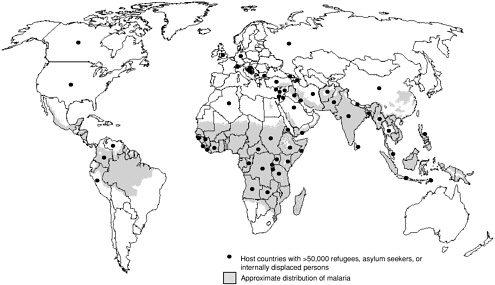
During the past 20 years, a large proportion of complex humanitarian emergencies have occurred in many regions where malaria is transmitted (see Figure 2-1). Many of the same socioeconomic forces that cause political instability also predispose areas to continued malaria transmission and vice versa. The drive for economic development can cause projects to be pushed forward with little or no consideration for health effects.
War and Civil Strife
In Southeast Asia, malaria was considered the primary cause of morbidity and mortality among Cambodian refugees when they first arrived in eastern Thailand in 1979 (Glass et al., 1980). Surveys conducted in Somalia during 1980 showed that, while malaria was not one of the leading causes of mortality, it still accounted for 2 to 5 percent of all deaths (Toole and Waldman, 1988). In 1984 among Karen refugees fleeing Myanmar to western Thailand, the annual incidence rate for malaria was 1,037 cases per thousand, with over 80 percent of infections due to Plasmodium falciparum, causing malaria control to be given high priority (Decludt et al., 1991). Malaria continues to be a major public health concern in these camps and surrounding areas (Brockman et al., 2000; Nosten et al., 2000; Chareonviriyaphap et al., 2000). In Central Asia, civil war and the attendant collapse of the health care infrastructure led to a reemergence of malaria in Tajikistan (Pitt et al., 1998). Recent relief efforts in East Timor and Afghanistan have been complicated by malaria (Ezard, 2001a; Sharp et al., 2002).
Similarly in Africa, malaria was the leading cause of death among adult Mozambican refugees in Malawi and among Ethiopian refugees in eastern Sudan (Centers for Disease Control, 1992). In the midst of massive cholera and dysentery epidemics at the beginning of the Rwandan refugee crisis in eastern Zaire (now the Democratic Republic of Congo) in 1994, fever presumed to be malaria was second only to diarrheal disease as the leading cause of morbidity and mortality (Goma Epidemiology Group, 1995; Centers for Disease Control and Prevention, 1996). In the years since the Rwandan refugee crisis, malaria has remained a major public health prob-
lem among displaced populations in the eastern Democratic Republic of Congo (International Rescue Committee, personal communications), Guinea (P. Spiegel, Centers for Disease Control and Prevention, personal communication, 2001; Ezard, 2001b) and Ethiopia (Salama et al., 2001).
Resettlement and Development
Resettlement typically refers to an organized relocation of large populations for purposes of population redistribution (e.g., “transmigration” in Indonesia), settlement of nomadic people, resettlement of repatriated refugees or demobilized military (Eritrea and Angola), social engineering (postcolonial Tanzania), or economic development (Brazil, Indonesia). Movement can be away from areas of development because of loss of land, such as occurs with dam building, or toward areas of development for purposes of employment (the latter is less likely to be an organized population movement).
The potential financial gains associated with economic development projects or large-scale commercial enterprises frequently attract large numbers of people. Often these movements are not organized and living conditions in new settlements can be poor, such as occurs with peri-urban slums or squatter’s camps. The greater concentrations of people that occur can create highly focal areas of concern for malaria control, especially when the population is non-immune. In Brazil large groups of people travel from nonendemic areas into malarious areas to obtain work in mining operations and then become ill at very high rates (Veeken, 1993; de Andrade et al., 1995). Large-scale irrigation projects or hydroelectric water production schemes have been shown in many instances to facilitate mosquito breeding and malaria transmission (Kloos, 1990; Singh et al., 1999). In Indonesia, malaria has been identified as the primary public health concern of transmigrants and as a limitation to their acceptability of hydroelectric schemes (Abisudjak and Kotanegara, 1989).
Even relatively small-scale projects, such as road building or small dams, can have a large effect on malaria incidence through opening up malarious areas to travel (Hôpital le Bon Samaritain, Limbé, Haiti, unpublished surveillance data, 1965-1996), changing local environmental conditions, and attracting laborers (Sawyer, 1993; Alemayehu et al., 1998).
Urbanization
Between 1960 and 1980 the population living in urban settings in the developing world doubled (Knudsen and Sloof, 1992). This rapid urbanization of marginal areas within or on the outskirts of urban centers is commonly done in an uncontrolled fashion without thought or planning. Conditions are crowded; housing is of poor quality or of temporary construction; and the provision of health care, sanitation, and vectorborne disease control is inadequate. The result can be lack of proper drainage, leading to explosive growth of mosquito vectors, increased exposure to vectors due to poor housing, and amplification of disease to epidemic proportions through lack of effective treatment.
ENVIRONMENTAL AND NATURAL DISASTERS
Natural disasters, such as floods or earthquakes, can precipitate mass population movements out of affected areas or can cause a normally dispersed population to crowd around food and water sources, health care facilities, or debarkation points. Disasters involving flooding or severe rains can increase mosquito breeding sites (Mason and Cavalie, 1965). After a natural disaster a number of behavioral changes can occur that can increase the impact of malaria. Loss of housing or fear of collapsing structures can cause people to sleep outside, where contact with mosquitoes is increased. Normal health care services and disease control activities can be disrupted (Sáenz et al., 1995).
Hurricanes
Two to three months following a hurricane, Haiti experienced a severe epidemic of malaria that caused an estimated 75,000 cases (Mason and Cavalie, 1965). This epidemic was attributed to the presence of a considerable amount of malaria before the hurricane; destruction of shelter, putting people at increased risk of exposure; disruption of malaria control activities; massive increases in mosquito breeding sites due to rainfall and flooding; and a large influx of people to areas providing health care, food, and other assistance.
Earthquakes
After an earthquake in Costa Rica in 1991, malaria incidence increased between 1,600 and 4,700 percent in some affected cantons (Sáenz et al., 1995). These increases were associated with people being afraid to sleep indoors, disruption of malaria control activities in the area, and environmental changes due to the earthquake and flooding that allowed explosive growth in mosquito numbers.
Heavy Monsoon Rains/Floods
Heavy monsoon rains or other causes of flooding can dramatically increase mosquito breeding sites and result in massive increases in mosquito numbers. As with other natural disasters, heavy rains or flooding can disrupt normal malaria control efforts and destroy shelter, putting inhabitants at increased risk of acquiring malaria. Unusually heavy monsoon rains after the El Niño-Southern Oscillation (ENSO) in 1992 resulted in a malaria epidemic affecting four districts of Rajasthan, India, a typically arid region (Bouma and van der Kaay, 1994). Increased malaria transmission or epidemics have also occurred in association with ENSO events in Colombia, Uganda, Kenya, and elsewhere, although in the Tanzanian highlands malaria was reduced following the 1997-1998 ENSO (Bouma et al., 1997; Lindblade et al., 1999; Lindsay et al., 2000; Githeko et al., 2000).
Drought and Famine
Over the past 30 years, food shortages caused by drought and often exacerbated by war have been a frequent cause of population movements, especially in sub-Saharan Africa (Toole and Waldman, 1993; Prothero, 1994). In some cases, populations have been forced from malaria-free highland areas into endemic lowlands, exposing many of them to malaria for the first time and placing them at high risk of malaria-associated morbidity and mortality (Roundy, 1976; Mouchet et al., 1998; Anonymous, 1999).
|
Speed, Duration, and Cause of Mass Population Movements: Key Points
|
MALARIA-RELATED CHARACTERISTICS OF MASS POPULATION MOVEMENTS
Large unplanned movements typically have a number of common attributes that increase not only people’s risk of acquiring malaria but also the risk of epidemic malaria. Additionally, infrastructural changes or local and international politics may further complicate the provision of effective public health programs, exacerbating public health problems, including malaria.
Poor or No Housing
Studies conducted among stable populations living in malaria-endemic areas have shown that housing quality is associated with the risk of malaria infection (Koram et al., 1995a; Wolff et al., 2001). Similar problems have been noticed among refugee populations as well (Meek, 1989). Sub-standard shelter is common in situations where movement has been rapid and unplanned, such as occurs in refugee situations or when movement is
expected to be temporary, such as movements for economic reasons. Sub-standard housing provides minimal or no protection from mosquitoes. Additionally, the areas in which people settle, whether refugee camps or peri-urban slums, are typically not planned with vector control in mind. Lack of planning for drainage of wastewater, for example, can create situations where explosive growth in vector populations is possible.
Movement into High-Risk Areas
Displaced populations are often forced to relocate or settle in areas with high risk of malaria. These can be areas that are unused by the stable population for specific reasons, such as known health risks (e.g., lack of safe water, known risk of disease). Migrant workers are often drawn to high-risk areas in search of work, such as mining in Brazil and Cambodia or logging in Myanmar and Thailand. Displaced populations may intentionally locate near water sources. While this facilitates the ready use of water, it may also put the population at increased risk of malaria if the water source is also a breeding site for mosquitoes.
Deliberate Movement to Areas Near Water
Displaced populations may intentionally locate near water sources. While this facilitates ready use of water, it may also put the population at increased risk of malaria if the water source is also a breeding site for mosquitoes.
Overcrowding
Crowding can increase the malaria burden among displaced populations by increasing the density and proximity of both infected individuals and susceptible people. This phenomenon is seen even among stable populations exposed to fairly constant levels of transmission (Defo, 1995).
Low Socioeconomic Status
Within stable populations, low socioeconomic status has been associated with increased risk of malaria (Koram et al., 1995a). The exact reason for this is unclear, but it may be related to decreased access to health care,
limited knowledge of risk factors, poor housing, marginal nutritional status, or behaviors that put individuals at increased risk of malaria.
Proximity of Livestock
A number of explanations have been offered for a reported two-fold higher prevalence of malaria among Afghan refugees living in Pakistan, as compared with local Pakistani residents. One is that the refugees came from an area of low malaria endemicity to an area of higher endemicity and were at increased risk because of low population-level immunity (Suleman, 1988). Other explanations focus on “zooprophylaxis” (Service, 1990). Some malaria vector mosquitoes will feed preferentially on livestock if available; if insufficient numbers of livestock are kept nearby, mosquitoes may begin to feed on humans. Conversely, livestock may attract mosquitoes, which may feed on nearby people if the opportunity arises, causing increased exposure to malaria (Hewitt et al., 1994; Bouma and Rowland, 1995; Mouchet et al., 1998). Information on the behavior of the specific vectors in the area is essential to understand the potential impact of livestock on malaria risk.
Mobility
Movement back and forth between settlement areas and areas of high malaria risk (“circulation”) can increase people’s exposure to malaria and the risk of introduction of the disease into malaria-free areas (Prothero, 1977). In Thailand a well-described cause of epidemic malaria is the movement of people between the forested areas of the Thai-Myanmar and Thai-Cambodian borders, where malaria risk is high, and nonendemic lowland villages. Most of the movement is for economic reasons, including logging, hunting, and charcoal making (Singhanetra-Renard, 1993; Chareonviriyaphap et al., 2000).
Immune Status
Understanding the interaction between the probable immune status of populations in transition and the intensity of malaria transmission to which they will be exposed is exceedingly important in anticipating the likely impact of malaria.
Displaced populations can move from an area of high malaria transmission to another area of high transmission. Although there are some indications that, because of antigenic or strain variation, an adequate or protective immune response in one area does not guarantee an adequate or protective immune response in another area, typically this situation carries the least risk in terms of increased morbidity or mortality. Population-level immunity would be expected to be high and, while malaria may still be a major cause of illness and death, it would not be expected to be clinically worse than it would be in the area of origin.
A far more serious situation occurs when displaced populations from an area of low or no malaria risk arrive in an area with high transmission. Because the overall level of immunity would be low, a significant risk of severe illness and death exists. In these situations an aggressive malaria control program becomes essential; not only is ready access to effective curative services needed, preventive measures, including comprehensive public education, should be included.
A similar level of concern should be given to addressing malaria risk among nonimmune responders (see Chapter 10, Prophylaxis and Personal Protection for Aid Workers). Relief workers and other personnel responding to displacement situations are frequently from nonendemic areas and can be at high risk of malaria-associated morbidity and mortality. For example, U.N. Peacekeepers in the Democratic Republic of Congo and Sierra Leone have reportedly had a serious problem with malaria, resulting in increased sick-leave and even deaths (C. Halle, U.N. Department of Peacekeeping Operations, personal communication, 2002).
Finally, displaced populations can move from an area of high transmission to an area of low or no malaria risk. Many areas, countries, or regions have successfully eradicated malaria even though competent mosquito vectors still exist. In this situation, concern should include not only treatment of clinical cases as they occur but also reduction of the likelihood of introduction or reintroduction of malaria. Strategies to accomplish this include screening or presumptive therapy of new arrivals and vector control. Because immunity to malaria wanes over time in the absence of exposure, displaced populations spending as little as one or two years away from their homes in endemic regions should be considered nonimmune and appropriate precautions should be instituted upon repatriation or resettlement to malaria-endemic areas.
A similar problem exists if the areas of origin and refuge differ with regard to the prevalence of drug-resistant malaria. Refugees arriving in an area where little or no drug resistance occurs from another area where drug-resistant malaria is common can act as a source of introduction of resistance. This can be an issue both with newly arriving refugees and with repatriation back to the country of origin.
It is possible that new arrivals will come with different histories of previous exposure. Rwandan refugees arriving in the Democratic Republic of Congo (then Zaire) in 1994, for example, came from all over Rwanda, including some highland areas where malaria risk is lower or nonexistent. The prevailing treatment policy at the time, however, was use of chloroquine, despite high levels of resistance to that drug. While an individual with acquired immunity can still respond adequately to a marginally effective antimalarial drug, one who comes from an area with little or no malaria transmission (and therefore little or no acquired immunity) would likely be at risk of severe complications or even death.
While an individual’s level of acquired immunity can affect the clinical presentation of malaria (see Chapter 3, section on Epidemiology of Clinical Malaria), malaria infection can increase the risk of infection or modify the progression of disease due to other pathogens, through either direct immunosuppression or other alterations in host factors. Evidence of such interactions exists for Salmonella and human immunodeficiency virus and may also exist for tuberculosis (Mabey et al., 1987; Xiao et al., 1998; Hoffman et al., 1999; Enwere et al., 1999). Malaria infection can reduce the immune response to vaccines for tetanus, typhoid, and meningitis (Greenwood et al., 1981). Successful prevention of malaria through combined use of insecticide-impregnated bed nets and chemoprophylaxis resulted in a significant drop in mortality from all causes among Gambian children, suggesting a substantial indirect effect on nonmalarial illness (Alonso et al., 1993).
Nutritional Deficiency
The interaction between malnutrition and malaria is complex and not well understood. Studies of the interaction between nutrition and malaria have had conflicting results (Hendrikse et al., 1971; Murray et al., 1977; Oppenheimer et al., 1986a; Greenwood et al., 1987; Smith et al., 1989; Snow et al., 1991; van Hensbroek et al., 1995). A critical evaluation of these studies, their methodologies, and their interpretations, though, sug
gests that protein energy malnutrition is in fact associated with an increase in malaria morbidity and mortality (Shankar, 2000). Information collected during famine relief efforts suggests that nutritional rehabilitation of famine victims can induce recrudescence of sequestered parasites, causing an increase in malaria, and that refeeding programs should include provisions for malaria prevention (Murray et al., 1976, 1978; Shankar, 2000).
The effects of specific micronutrient deficiencies on malaria morbidity and mortality is equally complex and requires more investigation. The effect of specific micronutrient deficiencies may be reflected not only in greater susceptibility to malaria (e.g., increased incidence or higher parasite densities) but also poorer response to malaria therapy. For example, the prevalence and degree of parasitological resistance to both chloroquine and sulfadoxine/pyrimethamine were worse among malnourished Rwandan refugees, possibly because of impairment of immune function (Wolday et al., 1995).
While malaria may be exacerbated by certain nutritional deficiencies, malnutrition can also be worsened because of it. Malaria causes increased red blood cell destruction and decreased production, further complicating preexisting nutritional anemias (Greenwood, 1987). The anorexia and vomiting frequently associated with malaria infection can limit food intake (McGregor, 1982). One study even raised the question of whether P. vivax infection might be a cause of acute malnutrition in Vanuatu (Williams et al., 1997).
Destruction or Overburdening of Existing Infrastructure
In many settings, local health care infrastructure may be lacking or inadequate to deal with a large, newly arrived population. After natural disasters and war, disruption of normally adequate infrastructure can occur. There may be insufficient numbers of buildings, equipment, and trained staff. Drugs and medical supplies may be inadequate and difficult to obtain. Normal disease control efforts can also be disrupted, contributing to epidemics, as occurred in Costa Rica after an earthquake (Sáenz et al., 1995).
The logistics of supplying and supporting services may also change dramatically. Roads may become impassable. The population may move to remote areas where existing services or roads are inadequate for large-scale movement of supplies. Trucks and other vehicles, spare parts, trained mechanics, and fuel may all be in short supply.
Availability of Health Care
Although governments and international agencies go to great lengths to provide health care services in emergency situations, it is not always apparent to the population being served where or how to access that care. The availability of health care services must also be sufficient for the size of the population. Surveys conducted in refugee camps in Goma, Zaire, found that 47 percent of people dying from diarrheal disease had never visited a health care facility (Goma Epidemiology Group, 1995). Overall, more than 90 percent of deaths from all causes occurred outside health care facilities, suggesting that health care services were not accessible to most of the population or that the demand for curative services overwhelmed the capacity of the organizations (Centers for Disease Control and Prevention, 1996). A malaria control strategy based on prompt, effective therapy of acute febrile illness can only be successful if people know where to go to get diagnosed and treated and if such facilities are easily accessible.
Operational Concerns
Nongovernmental organizations frequently suffer from high turnover of staff, causing a loss of institutional knowledge. Expatriate staff often lack specialized knowledge or experience with tropical diseases, especially malaria.
Coordination of malaria control efforts across organizations can be an impediment to successful implementation of malaria control activities. Often, there is no clearly identified lead agency responsible for coordinating the implementation of these activities. Responsibilities related to malaria control may be divided between nongovernmental organizations and other multinational organizations: one may be responsible for curative health care, another for environmental control, still another for outreach or other community-based interventions. Unfortunately, these various agencies work under different and, at times, conflicting paradigms and agendas.
Donor Fatigue
As complex emergencies or other situations involving mass population movements become prolonged affairs, international support can wane. International relief organizations move on to the next emergency. Some transfer responsibility to local nongovernmental organizations that may not
have the international visibility needed to supplement diminishing public financial support. Responsibility may also shift to the government of the host country, which may already be hard pressed to provide adequate services to its own citizens. Additionally, high-cost interventions may be introduced by comparatively well-funded international agencies that the inheriting local nongovernmental organization or government might have a difficult time sustaining. Examples include the first-line use of relatively expensive antimalarial drugs or rapid diagnostic (“dipstick”) methods that are not a normal part of the host country’s national formulary or practices.
|
Factors Affecting Overall Risk of Malaria: Key Points
|


