
1
Introduction and Background
ORIGINS OF THE SMITHSONIAN INSTITUTION1
The Smithsonian Institution (SI) originated in the mind of the English scientist James Smithson. Before his death in 1829, he named the United States the trustee of a sizable sum of money on the condition that the United States establish a research and educational institution to benefit all people. Congress accepted the trust in 1836 and debated what type of institution the Smithsonian should be for the next 10 years. In 1846, Congress and President James Polk approved a statute establishing the Smithsonian as an institution for “the increase and diffusion of knowledge among men,” as envisioned in Smithson’s will. SI is unlike any other federal organization in that it is an independent trust instrumentality, a product of the United States government that has no governing function.
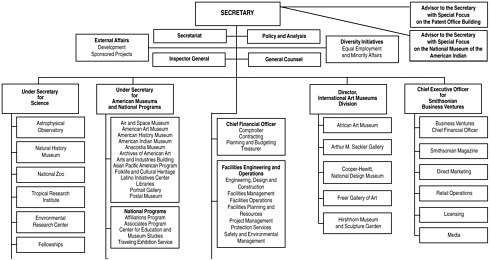
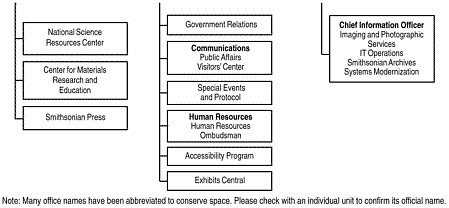
Today, SI comprises 16 museums and gallery buildings, the National Zoological Park, and several research centers. (Figure 1-1 shows the SI organization chart.) Throughout its history, the balance of the Smithsonian’s focus between scientific research and natural history and museum collections has changed under the influence of the various men who have served as Secretary and their visions for the institution. At the time of its founding in 1846, the Board of Regents, the institution’s governing body, sought as Secretary a person with “eminent scientific and general requirements” who might take on the task of “advancing science
and promoting letters by original research and effort.” The Secretary was also expected “to act as a respected channel of communication between the institution and scientific and literary individuals and societies in this and foreign countries.” The regents chose Joseph Henry, who might have been America’s most distinguished scientist at the time. Henry later served as second president of the National Academy of Sciences, which he had helped President Lincoln to establish.
Henry strongly promoted research as the key focus of SI. Although the act of Congress establishing SI directed the Institution to have a library, a museum, and an art gallery, Henry believed that it should have such a charge only temporarily and that the management and operation of these entities should be transferred to other agencies as soon as possible. However, through the efforts of the then Assistant Secretary Spencer Fullerton Baird, the Smithsonian began to receive major natural history and cultural collections that document the minerals, fossils, rocks, animals, and plants of North America, which ultimately grew to be the best collection of its kind in the world. Baird succeeded Henry as Secretary in 1878 and embraced the museum mandate he favored for the Institution. Under Baird, research and public activities centered around natural history.
In 1887, Samuel Pierpont Langley, a prominent and internationally respected scientist in astrophysics and aeronautics, was appointed the third Secretary of SI. Under his leadership, the balance of Smithsonian interests tilted toward the physical sciences. Langley established the Smithsonian Astrophysical Observatory and the departments of biology, anthropology, and geology.
In 1907, Charles Doolittle Walcott, one of the leading paleontologists of the time, began a 20-year term as Secretary. The return to prominence of natural history research at SI culminated in the opening of the National Museum of Natural History to the public in 1910. Under Walcott’s leadership, the Smithsonian also participated in a major biological survey in the Panama Canal Zone, an effort that led to the establishment of the Smithsonian Tropical Research Institute.
For the rest of the 20th century, SI maintained its high standing in the advancement of science under the direction of scientist-secretaries. SI science expanded rapidly in the 1960s and 1970s, when ample funds were available for equipment, expeditions, and collection management. Those favorable circumstances attracted world-class scientists to the Institution. In 1965, Secretary S. Dillon Ripley established the newest of the federally supported science units, the Chesapeake Bay Center for Environmental Studies, now known as the Smithsonian Environmental Research Center, for the conduct of natural history and ecological research. As universities became less interested in whole-organism study, the Smithsonian, with
its collections and its research centers on protected land, was able to take the lead in research that focused on long-term, large-scale data-gathering in terrestrial and marine ecology, global change, and biodiversity.
DEVELOPMENT OF THE SCIENTIFIC RESEARCH CENTERS
Although there are many science-related museums renowned for their roles in public education around the world, their associated research centers are often less visible to the public. This is true of the Smithsonian: the general public is mostly unaware of the scientific and other research conducted by the Institution. Because of the lack of understanding of the continuing and central role of research in the mission of the Smithsonian and the misconception that the Institution is solely a collection of museums and a zoo, justifying a substantial budget for research at the Institution to policy-makers can be difficult. Indeed, in his formal inaugural address as the 11th Secretary of SI, Lawrence Small decried the lack of awareness of SI science among the public, members of Congress, and the administration.
Today, six SI units are assigned to the management of the Under Secretary for Science as “scientific research centers.” These centers include the most publicly familiar entities—the National Museum of Natural History (NMNH) in Washington, DC, and the National Zoological Park (NZP) in Washington, DC, and Front Royal, Virginia. The others are the Smithsonian Astrophysical Observatory (SAO) in Cambridge, Massachusetts; the Smithsonian Tropical Research Institute (STRI) in Panama; the Smithsonian Center for Materials Research and Education (SCMRE) in Suitland, Maryland; and the Smithsonian Environmental Research Center (SERC) in Edgewater, Maryland. SI also operates several other research centers, such as the Center for Earth and Planetary Sciences in the National Air and Space Museum and various research units in its art museums; these research centers report to the Under Secretary for American Museums and National Programs.
The act of Congress that established the Smithsonian in 1846 (9 Stat 102) specifically provided for a natural history museum. It stated that a building should be constructed “with suitable rooms or halls for the reception and arrangement, upon a liberal scale, of objects of natural history, including a geological and mineralogical cabinet” and that
as suitable arrangements can be made for their reception, all objects of art and of foreign and curious research, and all objects of natural history, plants, and geological and mineralogical specimens, belonging, or hereafter to belong, to the United States, which may be in the city of Washington, in whosesoever custody the same may be, shall be delivered to such persons as may be authorized by the board of regents to receive
them, and shall be arranged in such order, and so classed, as best [to] facilitate the examination and study of them, in the building so as aforesaid to be erected for the institution; and the regents of said institution shall afterwards, as new specimens in natural history, geology, or mineralogy, may be obtained for the museum of the institution, by exchanges of duplicate specimens belonging to the institution, (which they are hereby authorized to make,) or by donation, which they may receive, or otherwise, cause such new specimens to be also appropriately classed and arranged.
The relationship between the collections acquired by other government offices and what was called the National Museum at the Smithsonian was reinforced in 1879 legislation that created the US Geological Survey (USGS; 20 Stat 377). It required that all natural history collections made by the US government “when no longer needed for investigations in progress shall be deposited in the National Museum.” A separate building was erected for the natural history collections and opened to the public in 1910; it was renamed the National Museum of Natural History in 1969. Box 1-1 presents a concise chronology of the development of the Smithsonian.
SI Secretary Samuel P. Langley established SAO in 1890. An astrophysicist himself, Langley set up SAO in Washington, DC, primarily for studies of the sun, using Smithsonian trust funds. A year after its establishment, Congress made its first appropriation, totaling $10,000 for FY 1892, dedicated to the maintenance of the observatory. SAO is now in Cambridge, Massachusetts, where it moved from Washington in 1955 to affiliate with the Harvard College Observatory. The affiliation was strengthened and formalized in 1973 by the creation of the Harvard Smithsonian Center for Astrophysics under a single director with a joint appointment to SI and Harvard University. Although established mainly as a center for solar studies, over a century later SAO is a research center active in nearly every kind of astronomical observation and at nearly every wavelength, from the gamma-ray regime to the radio regime—a characteristic that SAO shares with no other observatory in the world.
The Zoo began as a collection of live animals used as taxidermists’ models. The collection soon became a sufficiently popular public attraction that Congress created NZP and placed it under the direction of SI. NZP was officially opened to the public in 1891. In 1975, a center for the conservation-related activities of NZP, called the Conservation and Research Center, was established in Front Royal, Virginia, to encourage the advancement of the conservation of biological diversity.
The history of the Tropical Research Institute dates back to 1923 when Barro Colorado Island, which was created by the construction of the
|
BOX 1-1 Timeline of Key Historical Smithsonian Institution Events
NOTE: Events relevant to the research centers in this study are in boldface type. |
Panama Canal, became one of the first biological reserves in the New World. Charles Doolittle Walcott, the fourth Secretary of the Smithsonian, began a major biological survey of the Panama Canal Zone. SI was originally one of several organizations participating in research and administration at Barro Colorado Island, but in 1946 Barro Colorado Island became a unit of SI dedicated to conducting long-term research in tropical biology. In 1966, the organization changed its name to the Smithsonian Tropical Research Institute and expanded the scope of its research by establishing marine science centers on the Atlantic and Pacific coasts of Panama and the geographical range of its research by extending its work to other tropical countries. Its broad research interests were legally recognized by the government of the Republic of Panama in 1974, and the relationship of STRI and the Republic of Panama was formalized in the 1977 Panama Canal Treaties. In 1985, the government of Panama granted the Institute status as an international mission; and in 1997, Panama agreed to extending STRI’s custodianship of the facilities beyond the termination of the Panama Canal Treaties. Today, STRI is the oldest tropical research station in continuous use and works not only in Panama but throughout the tropics. The Institute has recently signed a contract with the government of Panama whereby it is authorized to continue its research activities and maintain its management of the Barro Colorado Nature Monument with the status of an international mission for a further 20 years.
The Smithsonian Center for Materials Research and Education has its origins in SI’s establishment of the Analytical Laboratory in 1963 “to provide information about the objects in the collections of the Smithsonian Institution that is not available through existing facilities. Ways of obtaining information that is required to describe how an object is made, what materials it is made out of, the state of condition or deterioration, and the conservation treatment to be applied in other than routine cases will be investigated and employed.” Although the facility, renamed the Conservation Research Laboratory in 1964 and later the Conservation Analytical Laboratory (CAL), was not charged to perform routine conservation, it became overloaded with such requests. In 1978, the Senate Committee on Rules and Administration instructed the Smithsonian to develop plans for CAL to become solely a center for conservation research and education as part of a new museum support center, stressing that the laboratory was not to perform service work for Smithsonian museums, but rather to focus on research and education that would benefit all museums. In 1998, CAL was renamed the Smithsonian Center for Materials Research and Education to reflect its mission in research on preservation, the technical study and analysis of museum collections and related materials, archaeometry, and the organization of conservation training programs.
The Smithsonian Environmental Research Center is the most recently
established of the SI scientific research facilities. Originally called the Chesapeake Bay Center for Environmental Studies (CBCES), SERC was established on 368 acres bequeathed to the Smithsonian by Robert Lee Forest on his death in 1962. In 1965, CBCES was established for the conduct of natural history and ecological research programs, especially on the Chesapeake Bay. On July 1, 1983, the facility was renamed the Smithsonian Environmental Research Center after its merger with the Radiation Biology Laboratory, formerly part of SAO. Over the years, several owners of the neighboring land donated their properties to SERC, and SI purchased more of the surrounding property. Today, SERC encompasses 2700 acres, including a completely protected watershed of the Rhode River, a subestuary of the Chesapeake Bay, and 12 miles of undeveloped shoreline.
Although the research units arose as a series of historical contingencies owing to circumstances, dominant personalities, or the availability of funds, the Institution has forged the various branches into a powerful force advancing research, education, and outreach to the public. Considered as a whole, the collection of research units is a major stimulus of continuing public awareness and support of science in the United States and constitutes a distinctive and distinguished addition to the federal research establishment. No government institution maintains a research capacity of such breadth. Ranging from molecular to cosmic scales, scientific research at the Smithsonian includes topics of consequence, such as the population genetics that now undergirds conservation of rare and endangered species worldwide, the long-term databases with which the effects of human activities on terrestrial and aquatic ecosystems can be sorted from normal system dynamics, and indeed the universe. With respect to subjects, research methods, temporal and spatial dimensions of the research, relevance to both long-standing and current scientific issues of importance to the nation, modes of operation, funding mechanisms, and means of administration, the research units of SI collectively add diversity to the nation’s overall science enterprise.
BUDGET OVERVIEW AND MOTIVATIONS FOR THIS STUDY
Since the inception of the trust, the US government has generously supported the Smithsonian financially. Although the construction of SI’s headquarters building (“the Castle”) was financed by the interest accrued from the Smithson trust, the federal government shouldered the expenses of moving the collections and of the care of the collections thereafter. For about 30 years, the Department of the Interior (DOI) reimbursed the Smithsonian for those expenses with funds from its own budget. As the annual contribution from the government increased, Congress, the Secre-
tary of the Smithsonian, and the Secretary of the Interior agreed that it would be more efficient for the Institution to receive direct appropriations from the federal government. Hence, SI became a participant in the federal budget process. In FY 2001, SI had a total budget of about $665 million, of which 57% came from direct federal appropriation. The remainder of the budget is supplied from what SI terms “trust funds,” which include income from private donations and contributions; research grants and contracts from such sources as the National Science Foundation (NSF), the National Aeronautics and Space Administration (NASA), and private foundations and nonprofit organizations; proceeds from Smithsonian business ventures (shops, magazine, and so on); and investment earnings.
Table 1-1, which originates from the FY 2003 presidential budget document, provides information on the research budgets of the federal agencies that support scientific research. The total research funding appropriation to SI was $108 million and $111 million for FY 2001 and 2002, respectively—the smallest research budget of the organizations listed. Table 1-1 also shows how the listed agencies classified the allocation of their research budgets among categories of varying levels of merit review, as specified by Office of Management and Budget (OMB) Circular A-11. The review categories of Circular A-11 include research performed at congressional direction ( “earmarks” not subject to merit review), “inherently unique” research, merit-reviewed research with limited competitive selection, merit-reviewed research with competitive selection and internal (program) evaluation, and merit-reviewed research with competitive selection and external (peer) evaluation. Inherently unique research is defined as “intramural and extramural research programs for which funding is awarded to a single performer or team of performers without competitive selection. The award may be based on the provision of unique capabilities, concern for timeliness, or prior record of performance” (emphasis added). The Smithsonian classifies its entire federally appropriated research budget as inherently unique research.2
Competitive processes, such as merit-based peer review, are well established means of setting research priorities in the federal agencies that support US science, with the National Institutes of Health (NIH) and NSF being the premier examples. Prospective peer review is widely regarded as a reliable and fair way to support major science programs over a long period, and competitive grant programs have been recommended repeat-
TABLE 1-1 Allocation of Federal Research Funding, 2001 and 2002 (Budget Authority, Millions of Dollars)
|
Agency |
Research Performed at Congressional Discretion |
Inherently Unique Research |
Merit-Reviewed Research with Limited Competitive Selection |
Merit-Reviewed Research with Competitive Selection and Internal Evaluation |
Merit-Reviewed Research with Competitive Selection and External Evaluation |
Total |
||||||
|
|
2001 |
2002 |
2001 |
2002 |
2001 |
2002 |
2001 |
2002 |
2001 |
2002 |
2001 |
2002 |
|
Health and Human Services |
89 |
142 |
206 |
230 |
2392 |
2718 |
201 |
216 |
17777 |
20126 |
20665 |
23432 |
|
Energy |
134 |
223 |
1078 |
1068 |
2382 |
2820 |
305 |
395 |
821 |
788 |
4720 |
5294 |
|
Defense |
678 |
426 |
295 |
350 |
1012 |
1014 |
2712 |
2950 |
247 |
221 |
4944 |
4961 |
|
National Aeronautics and Space Administration |
230 |
287 |
152 |
149 |
532 |
398 |
1377 |
1550 |
1894 |
2291 |
4185 |
4675 |
|
National Science Foundation |
0 |
0 |
0 |
0 |
191 |
206 |
184 |
192 |
2700 |
2887 |
3075 |
3285 |
|
Agriculture |
105 |
122 |
815 |
893 |
720 |
676 |
0 |
0 |
206 |
157 |
1846 |
1848 |
|
Commerce |
18 |
21 |
354 |
377 |
100 |
108 |
204 |
218 |
142 |
166 |
818 |
890 |
|
Veterans Affairs |
1 |
0 |
0 |
0 |
2 |
2 |
349 |
370 |
381 |
408 |
733 |
780 |
|
Interior |
27 |
48 |
156 |
154 |
379 |
392 |
26 |
31 |
2 |
3 |
590 |
628 |
|
Transportation |
55 |
82 |
69 |
73 |
0 |
0 |
338 |
380 |
0 |
0 |
462 |
535 |
|
Environmental Protection Agency |
39 |
60 |
39 |
38 |
195 |
192 |
69 |
68 |
133 |
130 |
475 |
488 |
|
Education |
5 |
0 |
0 |
0 |
0 |
0 |
0 |
0 |
169 |
180 |
174 |
180 |
|
Smithsonian |
0 |
0 |
108 |
111 |
0 |
0 |
0 |
0 |
0 |
0 |
108 |
111 |
|
Other |
385 |
413 |
11 |
7 |
17 |
17 |
76 |
74 |
6 |
6 |
495 |
517 |
|
TOTAL |
1766 |
1824 |
3283 |
3450 |
7922 |
8543 |
5841 |
6444 |
24478 |
27363 |
43290 |
47624 |
edly as a way to ensure the high quality of funded research (e.g., National Research Council, 1994, 1995, 2000). Most academic researchers and many federal researchers regularly compete for grants from such agencies as NSF, NASA, the Department of Energy (DOE), the Department of Defense (DOD), and NIH. Ensuring the best and most responsible use of public funds by increasing the proportion of federal science research that is subject to merit review has been a recurrent theme under many administrations. For example, the guidance to agencies for the FY 1996 budget issued by John H. Gibbons, Director of the Office of Science and Technology Policy (OSTP), and Leon Panetta, Director of OMB, stated a Clinton administration policy that “research not subject to merit review with peer evaluation is expected to decline and funding in these areas should be moved into areas of merit reviewed research with peer evaluation” (Gibbons and Panetta, 1994). The administration’s current interest in ensuring high levels of merit review for the federal science portfolio is by no means a new concern.
The federal research funding appropriations to SI reported in Table 1-1 were $108 and $111 million in FY 2001 and 2002, respectively. Those numbers include research expenses at the six scientific research centers covered by this study, additional nonscience research carried out in other parts of SI, and overhead and administrative costs (Smithsonian Budget Office, pers. comm. to Evonne Tang, National Research Council). The classification by SI of its appropriated research funds as “inherently unique” implies that these funds are being spent at SI’s discretion on projects of its choosing and without competition. The apparent lack of competition could be interpreted to mean that the work of Smithsonian scientists is not subject to the same rigorous evaluation as that of their academic peers, and this in turn might call into question whether such use of public money is producing research of the highest quality.
The federally appropriated research budgets of most of the SI science centers are supplemented by so-called “trust funds,” which is actually a catchall term for funds other than those received through direct federal appropriation or transferred from the appropriations of other federal agencies to SI for services. For purposes of this study, trust funds can be divided into two major categories according to their source: (1) government grants and contracts awarded to Smithsonian researchers through competitive processes, and (2) donations, gifts, endowment funds, and business income (Table 1-2). The direct federal appropriations to SI are used largely to cover 12-month salaries and infrastructure costs, and another concern that has been voiced is whether SI scientists have an unfair advantage over researchers in universities and elsewhere who do not receive similar support. Does SI’s receipt of federal appropriations somehow distort the “playing field” on which the US scientific research community competes for research funding?
TABLE 1-2 Estimated FY 2001 Research Budget of Six Smithsonian Research Units by Source (Research Budget, Millions of Dollars)
|
|
Federal Funds |
Trust Funds |
|
||
|
Unit |
Federal Appropriation |
Federal - Othera |
Government Grants and Contracts |
Other Trustb |
Total Research Budget |
|
NMNH |
14.8 |
0.2 |
1 |
4.8 |
20.8 |
|
SAO |
24.9c |
0.4 |
54.7 |
3.9 |
83.9 |
|
NZPd |
3.4 |
0.2 |
0.6 |
2.1 |
6.3 |
|
STRI |
6.1 |
0.3 |
1.2 |
2.2 |
9.8 |
|
SCMRE |
1.2 |
0.2 |
0 |
0 |
1.4 |
|
SERC |
2.1 |
0.1 |
2.2 |
0.8 |
5.2 |
|
TOTAL |
52.5 |
1.6 |
59.7 |
13.8 |
127.4 |
|
NOTE: See the companion report by NAPA (2002) for a more detailed discussion of funding for research. aTransferred from other federal agencies. bPortion of endowment income, business income, and gifts raised by the research centers or allocated to them by SI. cIncludes $7 million in a separate appropriation for the construction of such major scientific instrumentation as the multiple-mirror telescope and submillimeter array. dBecause NZP reclassified its projected expenses for FY 2002 to reclassify some staff as collection staff rather than research staff, the estimated expenses for FY 2001 shown in this table will not match those shown in the NAPA report (2002). The NAPA report uses the new expense classification for FY 2001, FY 2002 and FY 2003. |
|||||
In the administration’s FY 2003 budget document, OMB suggested the commissioning of a study
to recommend how much of the funds directly appropriated to the Smithsonian for scientific research should be awarded competitively. The review will encompass all Smithsonian scientific research. It will focus on enabling Smithsonian scientific research to compete on a level playing field with other potential performers of the research, where that potential exists. Following the review, if appropriate, the Administration will submit its request to transfer necessary amounts from the Smithsonian to the National Science Foundation.
SCOPE AND EXECUTION OF THIS STUDY
After the release of the President’s FY 2003 budget, a process involving contact between OMB and the Smithsonian led to the formulation of a charge for two parallel studies to be conducted by the National Academy
of Sciences (NAS) and the National Academy of Public Administration (NAPA). In response to the charge presented to NAS by the Smithsonian, the National Research Council appointed the Committee on Smithsonian Scientific Research to conduct the review with the following questions as its charge:
-
Are there portions of the Smithsonian research portfolio, which for reasons of their special contribution or uniqueness, should be exempted from being prioritized within that field via a competitive peer reviewed grants program open to all researchers in the public and private sector? Conversely, could some or all of the funds now allocated by the federal government as support for Smithsonian science programs be used more effectively for science if the funds were awarded through a competitive process open to all research performers?
-
What are the implications for Smithsonian science programs and for the relevant scientific fields if only those Smithsonian science programs determined to be unique or exempt continue to receive direct federal appropriations?
-
For those exempted Smithsonian science programs, how should the quality of this work be regularly evaluated and compared against other research in the relevant fields?
The Committee was asked to apply that charge to the six scientific research centers under the management of the SI Under Secretary for Science—NMNH, SAO, NZP, STRI, SCMRE, and SERC. The Committee was not asked to address the research centers that report to the Under Secretary for American Museums and National Programs. Nor was it asked to assess the quality of research per se at the six centers. Those issues are being evaluated by the Smithsonian Science Commission, which is expected to deliver its report to the Board of Regents at the end of 2002.
The 13 members of the Committee on Smithsonian Scientific Research were chosen for their expertise in the fields of research conducted by the SI science centers covered by the study (astrophysics, ecology, tropical biology, marine biology, biogeochemistry, environmental science, anthropology, paleontology, volcanology, and the collection and preservation of museum specimens) and, where possible, their knowledge of the science and understanding of the roles of the six SI science centers in the broader scientific community. The Committee membership also includes museum directors and academic scientists with extensive relevant experience in institutional management. (The biographies of the Committee members may be found in Appendix A.)
The Committee held its first meeting on May 28-29, 2002, to gather information on SI and its research centers and to hear from representatives of OMB and OSTP. It also heard presentations on how DOE, NASA, and NIH allocate their research budgets through open competitive and
other processes. (Although a speaker from NSF was not able to participate in this meeting, committee members and staff interviewed a number of NSF staff during the study.) To facilitate its work, the Committee divided into three panels—on astrophysics (to address SAO), on ecology, environmental science and conservation (to address NZP, STRI, and SERC), and on museum and materials research (to address NMNH and SCMRE). Each panel met with facility directors and other research unit representatives for data-gathering and discussion. After the first meeting, the panels and the Committee’s executive group (composed of the Committee chair and the panel leaders) met often by teleconference to draft the Committee’s report. The Committee met for a second and final time on July 30-31, 2002, to discuss its findings, reach consensus on its recommendations, and agree on the final report. Throughout the process, the Committee also kept in close contact with the staff and committee that were conducting the parallel NAPA study. (See Appendix B for the NAPA panel’s charge and membership).
Chapter 2 of this report describes the SI scientific research units, including their funding structure, research, and outreach activities. Chapter 3 contains the Committee’s overall findings, conclusions, and recommendations. Although each panel developed text for this report relevant to the centers it examined, this report constitutes a consensus of the full Committee as agreed to at its final meeting.


