A
Manufacturing, Design, and Reliability
SYSTEMS FOR COMPUTER-AIDED DESIGN, MANUFACTURING, AND PROCESS PLANNING
The declining costs of computers and the increasing costs of labor are changing our manufacturing society from human-dependent to machine-dependent systems. This has significant implications for nanoscale products. Electromechanical systems are often developed for the automation of internal manufacturing processes in industry. They are applied to many tasks, from simple assembly operations to large-scale material-handling processes. Machine designs are very much application-dependent, and there is an ongoing need for new electromechanical system designs either for new product development or existing process improvement. System design for an electro-mechanical machine involves mechanical and electrical control. Because of the growing importance of computers, software design is also receiving a great deal of attention.
Today, the life cycle of a product in the semiconductor market is short (usually no more than 15 months). Manufacturing model fitting and parameter estimations cannot begin until the process is fixed. Since it takes at least 3 months to fix a process and 6 months or longer to derive a suitable model and parameters, it must take less than six months for an integrated circuit with a good correlation between yield and reliability to be produced if everything is done properly and effectively. That is, after great effort and a large investment, a company can benefit from a reliable model for no more than 6 months.
BURN-IN
Since most microelectronic components ordinarily have an “infant mortality period”—that is, a period of higher failure rates on initial operation— the reliability problem during this period becomes extremely important. One purpose for requiring burn-in—initial, in-factory operation of electronic components before shipping and product installation—is to guarantee high reliability for the final product assembly. In addition, analysis of early failures provides lessons for further component improvement.
LIFE-CYCLE APPROACH
The discipline of life-cycle engineering (LCE) uses CAD/CAM and computer-aided support systems to describe many aspects of a product, including its cost; maintenance planning; reliability prediction and apportionment; mechanical, electric, and electronic failure modes; sneak circuit analysis; maintainability allocation; accessibility and testability evaluation; test point selections; and test sequencing. An LCE description can be built by a well-informed system designer. An interactive process review by specialists in various disciplines can identify deficiencies that are outside the designer’s experience.
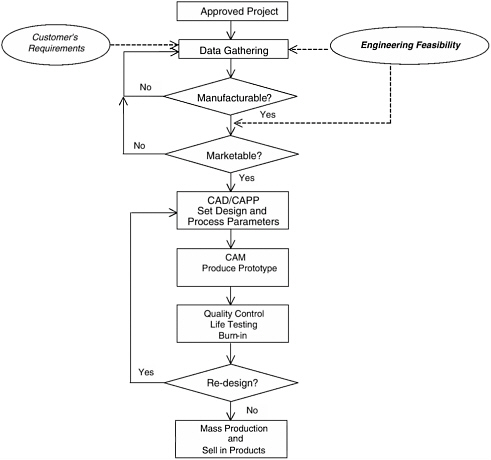
Prototypes will need to be manufactured for life testing. If the quality is acceptable, production will proceed; if not, redesign might be needed. The popularity of a product could justify its remodeling or the modification of selling strategies. If it is found that the product is not competitive, development profiles as well as field reports will be put into a database for future reference. After it has been on the market for some time, an unprofitable product may be terminated and the production equipment either sold or used for making other items.
A flowchart for a typical procedure for product design and manufacture is shown in Figure A-1. During the design and manufacturing cycle, a potential product is qualified according to the market’s needs, attainable manufacturing techniques, and potential profits. Once the engineering, marketing, and finance departments have approved a product, computer designs can be initiated, followed by computer-aided design (CAD), computer-aided process planning (CAPP), and computer-aided manufacturing (CAM). Many techniques have been proposed and applied in practice through initial computer-aided design.