
Appendix D
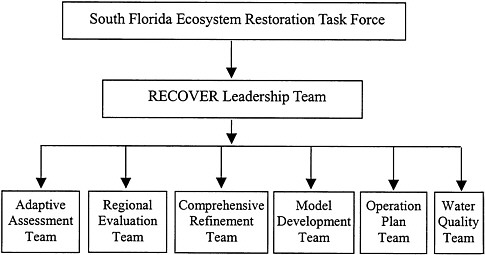
Structure of RECOVER
The role of REstoration, Coordination, and VERification (RECOVER) is to organize and apply scientific and technical information in ways that are most effective in supporting the objectives of the Comprehensive Everglades Restoration Plan (CERP). RECOVER links science and the tools of science to a set of system-wide planning, evaluation, and assessment tasks. These links provide RECOVER with the scientific basis for meeting its overall objectives of evaluating and assessing CERP performance, refining and improving the plan during the implementation period, and ensuring that a system-wide perspective is maintained throughout the restoration program.
RECOVER LEADERSHIP TEAM
The RECOVER Leadership Team is responsible for coordinating and integrating the activities of the other six RECOVER teams and ensuring that the overall focus and direction of the implementation process remain consistent with the goals of system-wide restoration. Specifically, the leadership team's tasks include:
-
setting the overall priorities for RECOVER
-
issuing the annual report card
-
refining the overall vision of success for the CERP
RECOVER TEAMS
Adaptive Assessment Team (AAT)
Objectives:
-
Create, refine, and provide documentation for a set of conceptual ecological models for the total system and for each of the major physiographic regions of south Florida
-
Create and refine a set of attribute-based biological performance measures for the CERP
-
Design and review the system-wide monitoring and data management program needed to support the CERP
-
Use the information coming from the system-wide monitoring program to assess actual system responses as components of the CERP and produce an annual assessment report describing and interpreting these responses
-
Coordinate all scientific peer reviews of RECOVER documents
Regional Evaluation Team (RET)
Objectives:
-
Review and revise the set of system-wide stressor-based performance measures
-
Review and revise restoration targets
-
Resolve technical issues pertaining to the performance measures
-
Coordinate with the Comprehensive Refinement Team and project delivery teams during the plan formulation and design phases of the projects, and evaluate the effects of these plans on the system as a whole
-
Analyze and compare the regional effects of refinements to the CERP
-
Refine the existing and future plan without project condition
-
Conduct system-wide analyses of the CERP using the latest refinements in predictive tools (e.g., South Florida Water Management Model, Everglades Landscape Model)
Comprehensive Refinement Team (CRT)
Objectives:
-
Recommend refinements and improvements to the CERP throughout the implementation period, as new information that identifies where, how, and why these improvements should be made becomes available
-
With the other five RECOVER teams, identify needed plan refinements and a means for incorporating these refinements into the design
-
Serve as the “keeper” of information on the most current version of the CERP and “without project” conditions
-
Address system-wide performance issues
Model Development Team (MDT)
Objectives:
-
Ensure that the predictive tools used to conduct the evaluations of CERP components are consistent with the scales and targets set by the performance measures for each component
-
Oversee the quality of physical, water-quality, and ecological models
-
Coordinate the resolution of technical issues pertaining to the models, including any necessary refinement or enhancement of system-wide tools (e.g., the South Florida Water Management Model)
Operation Plan Team (OPT)
Objectives:
-
Coordinate and resolve system-wide operational issues associated with the implementation of the CERP
-
Support the project delivery teams in the design of operational criteria and water-control plans for each of the CERP components
-
Work with the Adaptive Assessment Team in reviewing hydrologic responses during the implementation period
-
Coordinate or recommend interim operational criteria wherever these changes may provide enhancements in the performance of the plan before all components of the plan are in place
Water Quality Team (WQT)
Objectives:
-
Develop and review water-quality performance measures
-
Develop the water-quality components of the CERP system-wide monitoring plan
-
Provide input into the annual assessment of system responses, particularly as they relate to water quality
-
Serve as a link between RECOVER and project delivery teams to ensure local water quality for projects is appropriately addressed and is coordinated with system-wide water quality performance measures and targets
-
Work with CERP environmental compliance coordinators to develop a system-wide strategy for permit-related water-quality monitoring
-
Coordinate with efforts underway to develop the South Florida Water Quality Protection Program and the CERP Water Quality Feasibility Study
SOURCE: SFWMD, 2002b


