
1
Introduction and Overview
|
This chapter introduces:
|
June 2004, Indonesia: A ship suspected of carrying contraband arms has been tracked and is heading for the harbor of a hostile nation. A SEAL team is to be dispatched by high-speed boat to intercept, board, and take control of the vessel. The team leader checks with the METOC officer and ascertains that the wave heights are averaging 3 feet from the southwest. He estimates the intercept can be made a few miles before the ship enters hostile waters if the boat averages 45 knots. The mission is launched at 2300 hours. The sea has shifted to the northwest, and the wave height is now 6 feet. As the boat picks up speed, the violent shocks of the craft engaging the 6-foot seas directly on the bow become unbearable to the SEALs and the boat crew. The boat must slow to 30 knots and the intercept is missed.
May 2004, Gulf of Oman: An aircraft nuclear carrier (CVN) and three cruisers choose to anchor for the evening in the Gulf of Oman in the lee of Masirah Island. The anchoring process goes well, and the ships settle in for the night. Four hours after sunset, all of the ships start to experience clogging of their seawater cooling systems. Machinery starts overheating and air conditioning fails. Major electronic systems overheat and trip off line. A perceived small problem now threatens to disable the entire force. The engineers open the cooling pumps and find them clogged with what appear to be jellyfish. The staff METOC officer is called, and he recalls that this area is known for its cool water upwelling and an exceptionally high concentration of marine life. Further research reveals that in the evening layers of marine life are known to rise to shallow depths if attracted by lights. The ships order all external lights secured and the situation improves. Divers subsequently verify that a heavy layer of marine life rises in the evening and, if attracted by surface lights, comes almost to the surface.
February 2005, Somalia: An important naval gunfire support mission is called for during the early morning hours to support U.S. Marines deployed inland as part of a multinational force committed to breaking up a concentration of hostile combatants with ties to an international terrorist organization. The weather forecast predicts clear skies. As the shooting commences just after sunrise the spotter who is based on shore reports losing sight of the target due to a heavy haze that smells like wood fires. The mission continues without accurate spotting. A small number of men from the elite Canadian Airborne Regiment take advantage of a weakness in the enemy’s perimeter defense and move forward. Radio communications between the troops inland and the surface force become unreliable. By the time news of the Canadian advance and new position are relayed to U.S. Navy surface combatants offshore, the Canadians have taken significant casualties from friendly fire. The diplomatic complaints are strong and endanger future joint operations in the area. Subsequent METOC analysis suggests that an early morning temperature inversion trapped the wood fire smoke that is common in developing countries and the strong atmospheric gradient resulted in electromagnetic ducting, which in turn resulted in poor radio communications.
U.S. Naval Forces carry out operations in the face of a complex set of challenges. Coordinating the actions of a large number of personnel and platforms, even during peacetime, requires a fundamental understanding of the capabilities and limitations of the assets involved and the environmental conditions under which activities will be carried out. Actions during wartime are even more challenging, as the actions and intentions of opposing forces significantly complicate every decision. Although environmental factors clearly will not always make or break military operations, warfighters, weapons systems, and platforms already
under stress can be significantly and adversely affected by unforeseen or unplanned for environmental conditions. In the fast-paced and dangerous world of military operations, where anything that can go wrong often does, failure to understand the significance of environmental factors can have tragic consequences.
As pointed out by the three simple scenarios above, a naval commander must deal with some degree of uncertainty in almost every decision he or she makes. To support naval warfighters, the policymaker is challenged to decide how to allocate resources in a manner that reduces uncertainties in those areas where the result will do the most good. Is it important to know a target’s location down to a foot or the depth of a harbor channel down to a few inches? In these cases, money would be better spent in other areas, since pinpoint target location and precise depth information are not needed to ensure success. METOC information clearly falls into a category where one must both evaluate the nature of uncertainty and determine acceptable levels of uncertainty. The challenge to the commander in the field is to understand the nature of uncertainty with respect to the various types of environmental information provided in order to conduct a broad spectrum of naval warfare operations. Infinite expenditures could come closer to yielding perfect information, but the stochastic nature of many environmental processes means that perfect information is not achievable. In addition, because environmental information is only one (and often a minor) factor that commanders must weigh, the ability to effectively utilize vast amounts of environmental information is limited.
Simple logic, therefore, suggests that some degree of uncertainty must be acceptable, as the cost of further reducing uncertainty through additional information gathering is prohibitive or the value of the improved knowledge it leads to is inconsequential in military terms. Setting priorities, therefore, for the acquisition, management, and dissemination of environmental information requires identifying what must be known and what level of uncertainty is acceptable under any given set of circumstances. Understanding the nature of uncertainty with respect to environmental data can be viewed as a form of tactical decision aid in that knowledge of uncertainty related to forecasts, models, sensor nets, and so forth can influence the choice of missions, weapons platforms, and “go/no go” decisions.
Short of having perfect environmental information, the naval commander needs to know how uncertain the information is in terms of time and space. In the METOC world, decisions regarding acceptable levels of uncertainty are often made years in advance by deliberations at the budget table or during weapons system design. Any analysis of the effectiveness of METOC information will lead to examination of a broad range of wartime and peacetime requirements and the recognition that perfect environmental knowledge (complete understanding of the processes shaping the environment) could yield better forecasts that are only marginally more valuable in many tactical situations than the forecasts that are currently obtainable. The analysis in the subsequent chapters focuses on areas
where efforts to reduce uncertainty will produce the largest payoff in the quest for military superiority.
EVOLUTION OF THE ROLE OF METOC IN MILITARY OPERATIONS: THE PAST AS PROLOGUE
Mariners have always been very interested in forecasting weather and sea conditions. Initially this interest sprang simply from the desire to survive in a dangerous environment. High winds and heavy sea conditions could capsize ships or drive them far off course to a point where dwindling water and rations could be life threatening. Any advance warning could mean the difference between life and death. However, unreliable forecasts were of limited value and undermined confidence in forecasting.
The question was and is: Where should investments be made to improve reliability? Initially there were not many choices. As ships became larger and more seaworthy, sailors ventured greater distances and made observations about prevailing weather conditions, tides, currents, and water depths. It was no longer enough to survive. Economic success often depended on the skillful use of wind, weather, and currents. Masters developed charts, detailed sailing directions, and new instruments to help them avoid danger and reach their destinations before their competitors. Thumb rules such a “red skies in the morning, sailors take warning” abounded, along with sea tales that led to pilot charts and proprietary information created by shipping companies (see Box 1-1).
Knowledge of weather and sea conditions had other payoffs. In battle it could spell the difference between victory and defeat. From the beginning, there was always a strong military involvement in improved understanding of atmospheric and oceanographic processes. U.S. Naval Forces are the services most interested in maritime METOC. Working with the rest of the Department of Defense (DOD), the National Science Foundation, the National Aeronautics and Space Administration, the Department of Commerce, academia, and industry, the U.S. Navy makes a significant investment in and contributions to scientific efforts to understand fundamental METOC processes.
National Weather Service Under the Army
The evolution of the National Weather Service provides an interesting picture of who was most interested in weather forecasting. The first nationally organized weather service was developed under the direction of the military at what eventually became Ft. Myer in northern Virginia. The first director of the service was Brevet Brigadier General Albert J. Myer. The service was established in 1878 at Ft. Whipple, in northern Virginia in the hills overlooking the Potomac River and Washington, D.C. Organized forecasting was originally relegated to local observations and analysis, but the advent of the telegraph made possible the
|
BOX 1-1 Developing Forecast Capabilities: Skill Born of Necessity The magnetic compass allowed ships to maintain roughly the right headings, and positions could be estimated by dead reckoning. Knowing one’s location gave some clues to the expected weather and sea conditions, and changes in barometric pressure heralded changes in weather conditions. Cloud types, ocean swells, and wind direction gave more clues, and 18th-century masters could be quite proficient in assimilating data to form a reasonably accurate picture of what lay ahead. On sailing ships, a few minutes’ warning to shorten or reef sails could avert disaster. The advent of the barometer gave captains the ability to foresee weather changes hours in advance. Admiral Robert Fitz-Roy of the Royal Navy systematically installed barometers on Royal Navy ships in 1854 and started the first heavy-weather warning system. The introduction of accurate clocks allowed the determination of longitude. This permitted more precise positioning and accurate charting, the avoidance of groundings, and a better correlation of historical weather and sea observations. There was a wealth of knowledge in ships’ logs that were compiled over the 18th and 19th centuries. It took a naval officer, Lieutenant Matthew Fontaine Maury, to collect, analyze, and publish these data in the form of pilot charts that provided seasonal data for the best shipping routes and military operations at sea (Nelson, 1990). This established the U.S. Navy and the Oceanographer of the Navy as the custodians of these data. Maury’s effort to secure large amounts of data provided for development of general climatologies for many parts of the global ocean environment, a great step in reducing uncertainty. The Office of the Oceanographer of the Navy has primary responsibility for meeting the environmental knowledge needs of the fleet. This is accomplished by a widespread network of METOC centers, survey vessels, and other remote and airborne assets, historical databases, computing facilities, and public/international environmental monitoring networks (e.g., World Meteorological Organization stations, U.S. Historical Climate). This environmental information is then distributed to forward-deployed battle groups as discrete products or packages of information that can be further analyzed by local METOC officers. The ONR works to develop understanding of relevant environmental processes, which can be applied through improved technological approaches to produce more accurate and useful environmental information for the fleet and Marine Corps. |
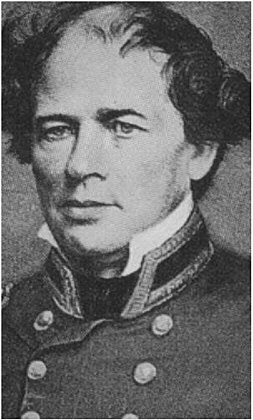
Lieutenant Matthew Fontaine Maury is generally credited with the first U.S. efforts to collect, analyze, and publish nautical data in the form of pilot charts (Photo courtesy of the U.S. Navy).
transmission of observations and forecasts for a considerable distance. This led to the development of so-called synchronous reporting and synoptic weather charts and depictions of moving weather systems. Since the U.S. Army Signal Corps had the most robust communications network, it is no surprise that the original weather service developed under the Corps’ direction. The obvious military advantages of accurately predicting the weather were not lost on Army tacticians. The Army was picked for this task because it was believed that military discipline would probably secure the greatest promptness, regularity, and accuracy in the required observations.
Weather Forecasts Important for Flight Safety
Knowing the weather at the origin, en route, and at one’s destination was essential for safe flight. Before the days of instrument flying, aviation safety also demanded knowledge of conditions aloft, which led to the development of radiosonde balloons and the means to measure and forecast conditions at altitude.
By 1940 it was very clear to the Roosevelt administration that the largest and most demanding user of weather information was the aviation industry, which was rapidly surpassing railroads as the primary means of personal transportation and also becoming a significant freight carrier. For this reason the National Weather Service was transferred to the Department of Commerce, where it remains today.
Shift from Landline to Wireless Technology and Ship Safety
Landline telegraph and eventually wireless service were driving factors in the improvement of reporting and forecasting in general and specifically in dealing with weather conditions at sea. Wireless technology made it possible for ships to receive and send weather information to and from shore as well as to other ships. In 1902 shore stations first broadcast weather information to ships, and in 1905 ships were able to send their own data.
The importance of these developments cannot be overstated. Real-time observations from over 70 percent of the planet, which had previously been inaccessible, were now possible. The new system would soon grow to the point where scientists would reach the conclusion that weather is directly driven by sea surface temperature and thus climate is strongly influenced by thermal gradients and undersea currents.
Aviation-Capable Ships and Flight Safety
The operation of aircraft at sea demands accurate meteorological information from the surface to 50,000 feet out to hundreds of miles from aviation-capable ships. Reliable one- to six-hour weather forecasts are also critical for safe landing conditions. Today, aviation safety and efficiency are the dominant requirements for both the U.S. Navy and Marine Corps METOC communities.1 Every large aviation-capable ship, shore facility, and fleet staff has its own METOC-
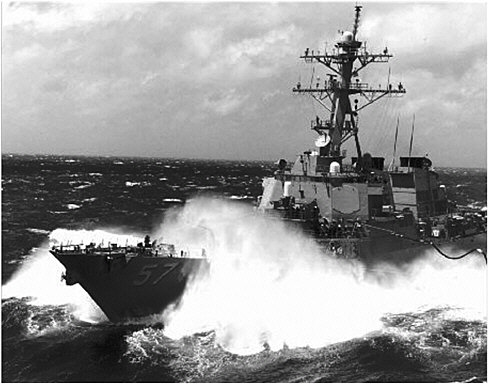
Rough seas can be a hazard even to today’s large surface vessels such as this Burke class destroyer, the USS Mitchener (DDG 57), which displaces more than 8,000 tons (Photo courtesy of the U.S. Navy).
facility capable of providing detailed forecasts of any number of atmospheric conditions of interest to aviators.
Evolution from Safety to Warfighting Tool
It was soon recognized that a superior knowledge of water conditions could yield an advantage in battle. The requirement has thus evolved from safety to a serious warfighting tool. World War II saw a growing demand for knowledge of ocean conditions. The U.S. Navy, along with many other groups, began to understand that ocean conditions drive atmospheric conditions and that underwater characteristics determine acoustic properties vital to antisubmarine warfare.
Tactical cruise missiles with ranges of over 1,000 miles place even greater demands on METOC personnel, who must forecast en route and target weather conditions hundreds of miles away and up to 90 minutes in advance. The most complex problem of all is the land-sea boundary, where amphibious operations are conducted. Dynamic shore, beach, and undersea conditions generate com-
plex environments that are very difficult to measure, model, or forecast. Any number of parameters, if incorrectly predicted, could threaten the mission. Many other factors need only be known to a general approximation. Thus, the key is not to predict all parameters with great accuracy but to predict the most significant ones with adequate accuracy. Discerning which parameters will be key is as difficult as developing the forecast.
Classic historical examples where METOC information was critical are the air war in Europe and the go/no go decision at Normandy. The long-range B-29 raids over Japan were aided by the discovery and prediction of high-altitude jet streams, and the final decisions on the atom bomb targets were driven by weather considerations.
LESSONS LEARNED
The short history given above brings us to the present, where the U.S. Navy maintains a METOC corps of 400 officers and over 1,300 enlisted personnel, stationed throughout the world. The U.S. Marine Corps maintains an additional METOC corps of about 450 personnel.2 Their mission continues to be to measure, communicate, and forecast, with the highest certainty, weather and sea conditions. The remainder of this report examines, in part, how available resources are deployed in an efficient manner that ensures safety and military superiority at sea.
Clearly, the use of environmental information by U.S. Naval Forces has evolved dramatically. The coevolution of naval tactics and weapons systems with environmental observation and prediction capabilities continues in the 21st century. Combined with the dynamic nature of warfare operations, the naval battlespace is now recognized as a complex system where environmental conditions vary continuously on many temporal and spatial scales. Requirements for conducting modern military operations in the “4-D cube” (i.e., 3-dimensional space plus time) include the need for development of capabilities to observe and predict the global environment on spatial and temporal scales appropriate to overlapping warfighting operations (or mission areas). A continuing theme of environmental information needs is the corequirement to reduce or at least better understand uncertainty related to environmental data and forecasts.
MISSION DOMAINS IN MODERN U.S. NAVAL DOCTRINE
Modern U.S. Navy doctrine groups naval missions into five domains (Department of the Navy, 1997a, 2000). Four of these domains—sea dominance (e.g., mine warfare, antisubmarine warfare, surface warfare), air dominance (e.g., air
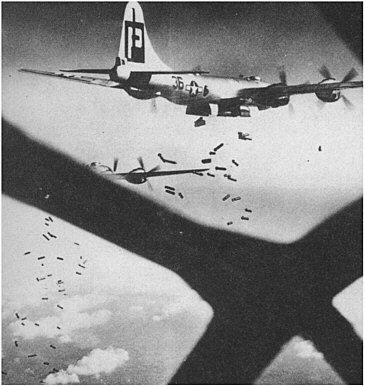
B-29s of the U.S. Army Air Corps flew countless daylight missions over Japan. Accurate forecasts of the position of the jet stream played an important role in mission planning and execution (U.S. Army Air Corps photo).
defense, antiship missile defense, suppression of enemy air defenses), deterrence (e.g., deterrence of both conventional weapons and weapons of mass destruction), and power projection (e.g., strike warfare, naval special warfare, amphibious warfare)—represent traditional warfighter operations. The fifth area—sensors and information superiority (e.g., intelligence, surveillance, reconnaissance, naval METOC)—provides essential information needed to support the other four areas (Department of the Navy, 2002).
Tactical Oceanography
The value of oceanographic information for planning and executing naval operations has been recognized by the U.S. Navy for decades (National Research Council, 1997). Consequently, the ONR has been a primary source of funds for oceanographic research for many years. In an effort to improve the academic ocean science community’s understanding of the operational demands placed on naval units, the Ocean Studies Board, through the support of the ONR and the
Office of the Oceanographer of the Navy, convened six symposia on tactical oceanography (National Research Council, 1991, 1992, 1994, 1996b, 1997, 1998, 2000).
These symposia, which focused on the role of environmental information for a variety of specific naval missions (e.g., amphibious warfare, antisubmarine warfare, strike warfare and ship self-defense, naval special warfare, mine warfare) constituted a valuable mechanism to facilitate more efficient use of naval research funds and to help academic scientists identify areas of research of high value to U.S. Naval Forces. A recurring theme in each symposium was the need for warfighters to receive timely and pertinent environmental information, specific to the needs of each mission. Real-time decisionmaking is crucial and the need for adequate and accurate environmental data on small scales is paramount for minimizing uncertainty and reducing risk.
U.S. Naval Forces operate in varied, dynamic, and often extreme environments; thus, accurate and detailed information on these areas is important for mission planning and operations. Personnel and platforms involved in naval surface warfare, aviation strike warfare, special forces warfare, amphibious operations, submarine and antisubmarine warfare, and counter-mine warfare operations have certain minimum environmental thresholds. When environmental conditions fall below these thresholds, performance is degraded. If these minimum thresholds are met, the success of the mission is partially the result of the ability to account for other higher-level and less predictable environmental variables; each area of operation has related but also other unique environmental criteria that are important. For example, the capacity to accurately predict environmental conditions at the launch platform, en route to the target, conditions at the target, egress from the target, and finally expected conditions at the return platform (especially at sea) figure significantly into the decision to proceed with an operation. Strike capabilities, antisubmarine warfare, ship defense, and special warfare operations in the littoral zone (where many future conflicts will most likely occur) are relying more and more on METOC’s ability to describe and predict environmental conditions.
Over the past decade reports form this symposia series have highlighted the various environmental information needs for discrete mission roles, described certain knowledge deficits, and enumerated where future research should be directed. In general, environmental information is needed for the following roles: ship defense (including over-the-horizon defense, which thus expands the area for which environmental information is needed); target acquisition (e.g., infrared, laser, and electrooptical targeting); littoral penetration by special forces (e.g., swimmer and swimmer delivery vehicles to the surf zone, beach trafficability, and even inland road conditions); antisubmarine warfare (e.g., it is very difficult to detect and accurately target submarines in shallow nearshore environments due to such factors as acoustic backscatter, turbidity, and bottom characteristics that obscure active and passive detection); and counter-mine warfare (e.g.,
nearshore sediment transport as it interferes with mine detection), not to mention weapon delivery platforms, such as strike aircraft, surface ships, and submarines (e.g., environmental conditions influence how and where they operate as well as their stealth capabilities).
In 1993 the National Research Council released Coastal Oceanography and Littoral Warfare, which summarized lessons learned during a symposium on littoral warfare and highlighted a number of factors that affect naval operations (including mine warfare and amphibious warfare) in this zone. Table 2 of Coastal Oceanography and Littoral Warfare breaks these factors down into the following categories: atmosphere, biologic, oceanographic, bathymetric and topographic, acoustic, geophysical/magnetic, and anthropogenic. Environmental factors of importance that are found throughout this series of reports include:
Atmosphere
-
Weather (clouds, fog, precipitation, wind speed and direction, air temperature)
-
Ambient light, marine boundary layer properties (temperature, humidity, refractivity)
Biologic
-
Ambient noise
-
Optical scattering
-
Bioluminescence
Oceanographic
-
Tides
-
Internal waves (currents: surface and subsurface)
-
Water conductivity, temperature, depth, and salinity
-
Sea state
-
Wave height and direction
-
Surf conditions
-
Optical properties (vertical and horizontal)
-
Turbidity
Bathymetric and Topographic
-
Bottom and beach slope
-
Beach and bottom composition
Acoustic
-
Scattering
-
Ambient noise
Geophysical/Magnetic
-
Bottom roughness and type
-
Sediment properties, bottom strength and stability
-
Ambient magnetic and electrical background
Anthropogenic
-
Pollution
-
Noise
A follow-up report in 1997, Oceanography and Naval Special Warfare: Opportunities and Challenges, reinforced the previous report with a detailed list of areas in which METOC capabilities were inadequate and adequate but not optimal. The report also indicated that the current METOC capability to support naval special warfare is inadequate in the following areas: water temperature at depth, nearshore bathymetry, nearshore currents, lightning, internal waves, winds, precipitation (liquid), water clarity (turbidity), humidity (impact on communications as related to ducting or vulnerability), biofouling, beach trafficability, and bioluminescence. The following are adequate but not optimal: nearshore bathymetry, waves, tides, cloud ceiling, bottom composition, surf, offshore currents, visibility, and toxins and dangerous animals.
Additionally, conditions in shallow water environments are more subject to change than most other operational areas. Currents, tides, storm events, longshore transport of sediment, and other highly dynamic factors currently make planning these types of operations more of an art form than a science. High-resolution, temporal, and spatial data are needed if conditions are to be predicted with high confidence five to seven days in advance. Even then the chaotic nature of certain processes operating in these areas may limit both the precision and accuracy of five- to seven-day advance predictions for some parameters, regardless of how much data are collected. Nearshore bathymetry and beach condition change on small spatial scales and are difficult to measure, not to mention model.
In addition to the factors previously presented that will cut across many operational areas, the 1996 report Proceedings of the Symposium on Tactical Meteorology and Oceanography also identified three main areas for which METOC data are needed to support strike warfare. These are 100 km from shore, 100 km inland, and a 100-km radius around a ship. Temperature and humidity levels need to be better resolved vertically and horizontally, with higher resolutions near ground/sea level and progressively lower resolutions with increases in altitude. Data accuracy needs are also projected for:
|
Air temperature |
(0.25°C) |
|
Sea surface temperature |
(0.50°C) |
|
Relative humidity |
(2 percent) |
|
Wind vector |
(10 percent) |
|
Wave height and period |
(10 percent) |
Technology has always been a “force multiplier” for U.S. Naval Forces. The increased ability to measure these various environmental parameters, whether in situ or remotely, will impact future mission planning and operations in all theaters in which naval forces operate.
These challenges span global application of on-scene data collection; remote sensing data collection; integration of data collected in real time with archived data; incorporation of collected and archived data into the naval METOC produc
tion system; assimilation of collected and archived data into modeling and analysis efforts; and better assessments and predictions of METOC effects on platforms, weapons, and sensors in at-sea and real-time operations.
The mission of U.S. Naval Forces is to influence events onshore by projecting power from the sea. Since the end of the Cold War, naval operations have become increasingly focused in waters of the continental shelf and along coastal areas. This region, referred to by the U.S. Navy as the littoral (National Research Council, 1996b) has thus become the focus of efforts to understand and predict ocean and atmospheric processes and their influence on the conduct of naval operations. A thorough understanding of the coastal water column (depths of less than 100 m), the nature of the coastline, seafloor variability and stability, subseafloor characteristics, and the concentration of biological growth on or near the seafloor can help ensure mission success. In addition to concerns related to littoral oceanography, there is much that needs to be learned regarding air-sea interactions in littoral regions, air-sea-land interactions, atmospheric variability, and marine boundary layer dynamics (see Appendix B for more discussion).
Use of Environmental Information to Support Naval Missions
To help ensure success in these highly complex regions, higher-resolution descriptions of current conditions (nowcasts) and future conditions (forecasts), as well as analysis of oceanic, atmospheric, coastal, and beach conditions for littoral areas around the world, are sometimes needed. Capabilities to derive and/or measure data in denied areas and provide timely analysis and exploitation of current and developing technologies and available platforms have become essential. Warfighters require integrated synopses (tailored to their specific mission requirements) of a broad range of environmental parameters (see Chapter 2 for more detail). Efforts to improve the timeliness and usefulness of these environmental products will require not only an increased understanding of the environmental processes themselves but also parallel improvements in sensors and sensing capabilities, data management techniques, modeling approaches, computer software and hardware design, and increased communications capacity.
ORIGIN AND SCOPE OF STUDY
The current METOC enterprise and its predecessor organizations have brought the U.S. Naval Forces high-quality environmental information that has served it well in peace and in war. However, as the DOD transforms its force structure to meet the challenges that now face the nation, METOC must also examine how it will support the future. New approaches will be needed to provide METOC customers with information more rapidly anywhere and at any time. This will require new ways to collect the necessary data, new ways to analyze those data to create and present information, and new ways to deliver or make
available that information worldwide to advantaged and disadvantaged users alike.
The METOC Organization and Relevant Efforts at the Office of Naval Research
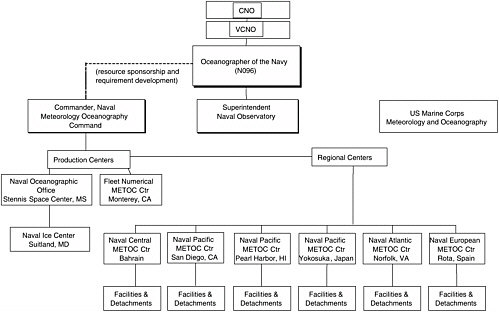
The organization of U.S. Navy METOC (see Figure 1-1) is complex and characterized by the interaction of a robust Navy METOC officer, civilian, and enlisted organization with the operational U.S. Naval Forces at several levels. Tracing the lines of authority and the flow of money is difficult, and it takes considerable time and experience to grasp how the process works. Even with this challenging organization, METOC serves the U.S. Naval Forces extremely well and is highly regarded in government, industry, and academic worlds.
The Oceanographer of the Navy is an unrestricted line officer who normally comes to the assignment after an extensive career as a warfighter, commanding officer, and Navy resource manager. Recent oceanographers have been anti-submarine warfare specialists, nuclear submariners, and computer scientists. The oceanographer is normally not an oceanographer or weather specialist but rather acts as a bridge from the operational world of U.S. Naval Forces to the world of naval METOC. He or she is based at the Naval Observatory in Washington, D.C. This officer is actually a member of the staff of the Chief of Naval Operations (CNO) with the code N096. The budget authority stems from the CNO and includes all personnel, research and development,3 and operating and ownership costs of the METOC community. The budget is managed by the N096 staff and executed by Navy METOC. In relative terms the entire budget is quite small and equates to less than half the cost of a new destroyer, or about $430 million.
Conversely, the Chief of Naval Research reports to the Secretary of the Navy through the Assistant Secretary of the Navy for Research, Development, and Acquisition (Figure 1-2). Thus, ONR constitutes a separately funded and administered science and technology effort totaling nearly $2 billion annually in programs throughout academia, industry, and the Naval Research Laboratories4 (NRL, located principally in California, the District of Columbia, and Missis-
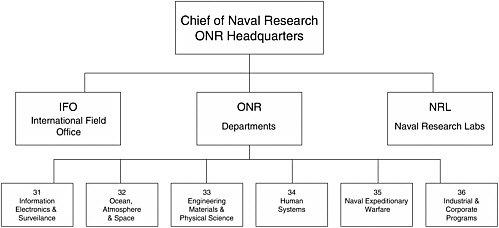
sippi). Thus, the U.S. Navy is one of the largest single supporters of both oceanographic and meteorological research.
Environmental science and technology programs at ONR are generically referred to as addressing aspects of battlespace environments as opposed to METOC (see Appendix C for discussion of relevant science and technology programs at ONR). Thus, throughout this text the use of METOC is restricted to programs and personnel actively involved in operational efforts (as opposed to science and technology efforts) to support the fleet and Marine Corps. While ONR is responsible for basic and applied research that may be of value to METOC efforts, ONR has no specific or formal relationship to the Oceanographer of the Navy, CNMOC, or the rest of METOC. For example, the Office of the Oceanographer’s research and development dollars are directed at systems acquisition managed through the Space and Naval Systems Command. Conversely, ONR directly supports some warfare commands, such as the Naval Special Warfare Command. Shaping the nature of future efforts to address the need for environmental information by U.S. Naval Forces is thus a truly collaborative effort of several more or less autonomous groups within the Department of the Navy.
Navy METOC operations are the responsibility of the Commander of Navy Meteorology and Oceanography Command (CNMOC), who is physically located at the Stennis Space Center, near Bay St. Louis, Mississippi. This position is held by a career METOC officer holding the rank of rear admiral (lower half). Historically CNMOC serves for three years and then retires. Although only about 75 people make up the CNMOC staff, CNMOC oversees the entire METOC organization. The two key production centers are the Naval Oceanographic Office (NAVOCEANO), also at the Stennis Space Center, and the Fleet Numerical Meteorology and Oceanography Center (FNMOC) in Monterey, California. There are six fleet centers located in Norfolk, Virginia; Bahrain; Rota, Spain; San Diego, California; Pearl Harbor, Hawaii; and Yokosuka, Japan. Several other smaller activities such as the Naval Ice Center report to NAVOCEANO or directly to CNMOC (Department of the Navy, 1996, 1997b, 1999).
Personnel, procurement, and operations and maintenance money flows to CNMOC and out to the field activities. The Oceanographer of the Navy is the METOC program sponsor responsible for resources and requirements development, while CNMOC is the Navy METOC claimant and therefore the community overseer. The Oceanographer of the Navy is therefore a primary interface for CNMOC and the operational Navy. CNMOC’s clamaincy is responsible for providing environmental support to the U.S. Naval Forces, but the Oceanographer of the Navy and CNMOC share responsibility for ensuring that the suite of products meets the needs of U.S. Naval Forces. U.S. Navy METOC, therefore, includes the worldwide survey fleet at this writing, consisting of eight ships that are operated by NAVOCEANO. This command has about 950 personnel and performs numerous functions in support of the operating forces and other components of METOC. These activities include maintenance of a world oceanographic data-
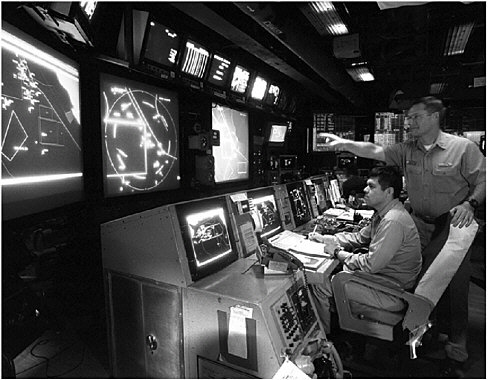
The U.S. Navy METOC enterprise produces environmental information to support U.S. Naval Forces. Modern combat information centers (such as the one depicted here) allow multisensors and information sources in establishing a common tactical information picture (Photo courtesy of the U.S. Navy).
base and extensive oceanographic models. The Warfighter Support Center at NAVOCEANO provides real-time and near real-time information to operating forces in the form of tailored reports and tactical decision aids.
The FNMOC has a staff of about 270 personnel and operates several supercomputer models of the atmosphere and oceans. It also functions as a communications hub that prepares and transmits products around the globe on a continuous basis.
The FNMOC’s focus is on regional collection and forecasting and on providing direct inputs to the operational commander through local communications facilities. Some centers, such as the one in Hawaii, have special joint responsibilities. This center works with the U.S. Air Force to operate a Joint Typhoon Warning Center for the entire Pacific.
METOC personnel are also stationed on ships and stations throughout the world under various type commanders who operate aircraft, ships, and sub
marines. Their equipment and expendable resources are typically funded by these type commanders. The largest support is from the aviation community.
The METOC budget is reviewed every year, and a five-year plan is presented by N096 to the CNO. After priorities are set by N096, research and development money is provided to the Space and Naval Warfare Command in San Diego, where R&D projects are engineered to become operational systems. In an effort to ensure that fielded systems are truly of value to operators, the fielding of new systems must be funded with procurement and operational funds of the respective warfare communities. Thus, new METOC shipboard sensing systems have to compete with weapons, radar, and communications equipment. Because procurement and operational funds are hard to come by, this competitive process often delays modern METOC equipment installation. Achieving the support of the various warfare commands for new METOC capabilities is thus imperative.
Establishing priorities is further complicated by the competition for highspeed communications connections essential to the delivery of METOC products. The warfighting communities also fund this connectivity, and METOC officers must compete to obtain a significant portion of the communications “pipe.” Fielding modern METOC capabilities is thus a complex, and at times divisive, decisionmaking process involving a variety of stakeholders with competing priorities. Over the years the METOC community has done remarkably well in making this process work. This is a reflection of the great skill and energy of the METOC officer and civilian leadership and supporting personnel. There is nothing automatic about the process. Budget battles must be fought and won every year.
The role of the Oceanographer of the Navy, especially one coming from a warfighting community, can therefore be critically important at the budget table. Interestingly, this assignment has been filled with surface and submarine officers almost exclusively. Over the past 15 years, there have been five surface officers and two submariners.
The dynamic process of establishing priorities for addressing the needs of U.S. Naval Forces for environmental information works well, but the complex interdependencies of budget support are cumbersome and delay introduction of the newest systems. Unfortunately, this is not unusual for large bureaucracies and certainly not unique to the U.S. Navy structure. It is only because science and technology are evolving so fast that these difficulties are now clearly denying our forces the latest technologies. It could be a crucial issue in the future.
THE TASK
In recognition of the growing need to support fleet operations in a variety of mission areas, the Office of the Oceanographer of the Navy and ONR requested that the Ocean Studies Board, in cooperation with the Naval Studies Board, undertake a two-year study to examine current and proposed efforts by the U.S. Navy
to provide pertinent and useful information, in a timely manner, to the U.S. Naval Forces as a whole and to individual warfighters (as appropriate). Emphasis was placed on identifying the key characteristics of a process for optimizing the acquisition, assimilation, and application of meteorological and oceanographic data, including model development, fusion of data and value-added products with model results, and dissemination of environmental information (see Box 1-2).
STUDY APPROACH AND REPORT ORGANIZATION
It is a daunting task to develop insights and make useful recommendations for improving a process as complex and rooted in practical experience as naval METOC. Although the U.S. Navy and Marine Corps were very forthcoming in providing information on existing processes and programs (see Appendix E for a list of information-gathering activities conducted by the committee), the sheer volume of material took several months to assimilate. Based on this material, the committee focused on developing a few central themes that could in turn be used to refocus existing efforts or develop new programs. With that in mind, the present report is structured to reflect the development of these themes. Chapter 2 discusses the current METOC system and explores the value of the environmental information it produces. Chapter 3 provides a broad assessment of the current
|
BOX 1-2 Statement of Task This committee will analyze the end-to-end environmental information system currently used by the U.S. Navy as well as that envisioned for the future to recommend possible approaches for improving both the individual components and the system as a whole. Emphasis will be on developing a framework process that can be adapted by the U.S. Navy to prioritize data collection and management, model development, fusion of data and value-added products with model results, and dissemination of environmental information to support individual missions and suites of naval missions. The committee will also identify segments of the process that would benefit from targeted research (e.g., specific ocean processes or general area of uncertainty). Finally, based on its analysis and the recommendations described above, the committee will prioritize the proposed improvements by identifying which actions are the most needed and achievable, which are most likely to make a needed impact on timeliness of analysis, and which are most readily exploitable given planned and available data collection opportunities. |
state of METOC information and its sources and limitations. Analysis of this information will help the reader develop a sense of the existing METOC process and the key components of that process that the committee thinks could be modified to improve efficiency. Chapter 4 lays the groundwork for implementing changes to key components of the METOC system by focusing on uncertainty, the cost of uncertainty, and approaches to reduce both. Chapter 5 discusses the ramifications for expanded consideration and communication of uncertainty by implementing key network-centric concepts. Finally, Chapter 6 summarizes and categorizes the Committee’s findings and recommendations in a manner that reflects the degree to which each is readily exploitable given planned and ongoing activities related to METOC or battlespace awareness.5
It was impractical for the committee to be exposed to all the programs and systems currently being developed to support U.S. Naval Forces. Thus, it is possible that many of the concepts discussed in this report are already being suggested, considered, or even implemented in some way or another. If the discussion in this report provides an impetus for deliberations, or if new concepts are evaluated and subsequently discarded in the face of more lengthy examination, the committee will believe its efforts have been worthwhile.


