
3
Implementing and Managing the Program
The revised strategic plan is a more complete and articulate presentation of the federal government’s scientific plan for the U.S. Climate Change Science Program (CCSP). The plan addresses much of the critical science in a strategic framework that places the research it proposes in the context of national needs. The committee is concerned, however, about some aspects of how the CCSP and participating agencies propose to implement the plan. In some cases, the plan does not recognize inherent challenges on the pathway to implementation. In other cases, the plan puts forward ambitious goals that exceed currently available resources, without presenting a strategy for prioritization that addresses barriers to achieving the stated research agenda. The management structure proposed by the CCSP is complex, will require significant interagency cooperation, and is essentially untested. In this chapter, such factors that may hinder implementation of the plan are addressed.
MATURING PROGRAM MANAGEMENT
The new management structure described in the strategic plan is designed to coordinate the activities of 13 federal agencies, oversee implementation of the strategic plan, and integrate research, technology development, and decision support activities. Chapter 16, “Program Management and Review,” provides a broad description of the roles and responsibilities of the thirteen participating agencies, briefly describes the complex budgeting and appropriations process, references management mechanisms to ensure that data needs are coordinated across disciplines and research areas, and explains five management mechanisms in detail.
Despite these improvements to the program management chapter of the plan, the plan still lacks a process by which higher levels of management will ensure that program goals are met. As the program matures, continual attention should be paid to refining strategic plan priorities; applying priorities and criteria in the program selection and budgeting process of the participating agencies; and defining measurements (metrics) that can indicate success in achieving goals. These management processes should be institutionalized to ensure a lasting research enterprise. At the same time, the management structure needs to remain flexible and open to adjustments as program leaders learn from experience.
Institutionalizing Accountability at All Leadership Levels
The management structure for the CCSP (see Figure 3-1) engages high-level officials who could ensure that the program has the necessary resources and could monitor progress toward program goals. It involves a CCSP interagency governing body, chaired by the CCSP director; an Interagency Working Group on Climate Change Science and Technology to supervise the CCSP and the complementary Climate Change Technology Program (CCTP); and above that, a cabinet-level Committee on Climate Change Science and Technology Integration to link both programs into the White House Office of Science and Technology Policy. The Interagency Working Group and the CCSP Program Office will need to work closely together to ensure effective plan execution. Ultimately, successful implementation of the CCSP will depend on whether these high-level management groups can influence individual agency programs and budgets.
Involving high-level political leaders in CCSP management helps to provide the program with resources that it requires, but also allows the possibility that the program’s priorities or scientific results could be influenced by political considerations. Either the reality or perception of such influences could discredit the program unless independent evaluations of the program and its products are conducted on a regular basis. In its first report, this committee recommended that the CCSP establish a standing advisory body charged with independent oversight of the entire program. The CCSP considered this recommendation (see Box 3-1), but decided that it would provide independent program oversight through “a number of external advisory mechanisms, including periodic overall program reviews by the NRC or other groups, rather than a single body” (CCSP, 2003, p. 175). The committee still
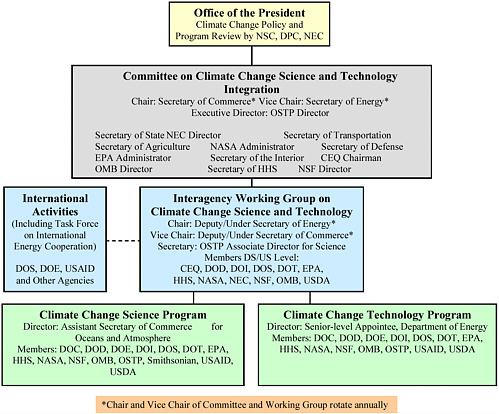
FIGURE 3-1 Climate Science and Technology Management Structure. SOURCE: CCSP. Available online at <http://www.climatescience.gov>.
|
BOX 3-1 Planning Climate and Global Change Research (NRC, 2003b) Recommendation The CCSP should establish a standing advisory body charged with independent oversight of the entire program. Revisions to the CCSP Strategic Plan The revised strategic plan includes a section in Chapter 16 (Program Management and Review) on “External Interactions for Guidance, Evaluation, and Feedback” (CCSP, 2003, p. 175). In this section, the plan states that the CCSP considered this recommendation to establish a standing advisory body, but chose not to implement it at this time. The plan states: “CCSP believes that essential program oversight is better provided by the use of a number of external advisory mechanisms, including periodic overall program reviews by the NRC or other groups, rather than a single body. Additional mechanisms to seek external scientific input, such as workshops, steering committees, ad hoc working groups, and review boards, will be employed as needed. CCSP will continue to consider creation of a permanent overall advisory group as program implementation proceeds.” The committee still believes that an independent, standing advisory body for the entire program would be the most effective way to maintain the long-term scientific credibility of the program. |
believes that an independent, standing advisory body for the entire program would be the most effective way to maintain the long-term scientific credibility of the program. Such a group should include highly respected scientists and other stakeholders spanning the broad range of topics addressed by the program. This group would supplement advisory groups already established for many CCSP program areas. Whatever mechanism is chosen, the committee believes that independent program oversight will be essential to maintaining the long-term credibility of the CCSP.
Recommendation: The CCSP should establish a mechanism for independent oversight of the program as a whole in order to maintain its long-term scientific credibility.
Nearly all of the structural accountability for achieving the CCSP’s goals appears to reside in practice at the program element level. All the strategic plan’s chapters have clearly identified lead authors and contributors, providing an important accountability and openness for this document. This accountability has substantially strengthened the scientific and programmatic content of the plan, and sends a message that the U.S. scientific community is prepared to take on these research challenges provided the resources are available. The committee notes a more tenuous level of accountability for implementing activities to meet the goals of newer initiatives and program elements. Of greatest concern is the enormous gulf between the ambitious goals identified in the chapters on decision support and human dimensions and the likely level of implementation ascertained from comments by agency representatives.
The strategic plan states that the responsibility for ensuring that the program’s five overarching goals are met falls to the interagency governing body that manages the CCSP (see Box 3-2). However, the plan is not specific about the mechanisms it will employ to ensure that the overarching CCSP goals are met. Because the goals do not provide any real target for accomplishment, it is difficult to ascertain what will be considered success. The description of accountability at levels above the CCSP is even less clear. The cabinet-level committee and the Interagency Working Group should regularly solicit independent plan evaluation to measure progress toward the program’s goals and help ensure that overarching program goals are met by taking steps to clearly link strategic plan priorities and activities to the vision, mission, and goals of the plan.
To address concerns about program management and accountability, the committee recommends that the CCSP clearly codify accountability at all levels of the program. In particular, the program needs to more clearly identify what each level of leadership is accountable for, and put processes in place to ensure that the plan’s five overarching goals are met. Having these responsibilities clearly laid out could help ensure that presently under supported activities move forward and that priority areas are properly addressed. The responsibilities of the cabinet-level
|
BOX 3-2 Planning Climate and Global Change Research (NRC, 2003b) Recommendation The revised strategic plan should describe the management processes to be used to foster agency cooperation toward common CCSP goals. The revised plan also should clearly describe the responsibilities of the CCSP leadership. Revisions to the CCSP Strategic Plan Chapter 16 of the revised plan includes a much improved discussion of program management and review. The chapter describes the cabinet-based management structure, program criteria, principal areas of focus for CCSP agencies, and responsibilities of the CCSP Office. It is clearly stated in the revised plan that the CCSP interagency governing body, chaired by the CCSP director, is responsible for coordination of program activities. Planning Climate and Global Change Research (NRC, 2003b) Recommendation The revised strategic plan should more clearly outline agency responsibilities for implementing the research. Revisions to the CCSP Strategic Plan Box 16-1 of the revised plan describes the principal areas of focus for each CCSP participating agency in general terms (CCSP, 2003, pp. 170-172). Specific objectives in Chapters 3-13 are not associated with a responsible agency, making it difficult to link CCSP goals and objectives to programs supported at the individual agencies. |
committee and the Interagency Working Group should include reviewing the CCSP’s and CCTP’s overarching goals, ensuring that they meet the nation’s needs and are complementary, and making sure that the goals are accomplished. Special attention is needed to identify who is responsible for addressing the CCSP-CCTP interface and identifying gap areas of research. Given that addressing climate change will be a challenge for decades, implementation of the strategic plan will take place over a succession of administrations; consequently, the program should carefully document its management processes.
Recommendation: The CCSP should establish and institutionalize effective management processes that create accountability for meeting program goals.
Adaptive Management of the Program
As the strategic plan is implemented, the CCSP leadership should adopt an adaptive management approach for the program as a whole by carefully monitoring its progress and periodically revisiting and adjusting the plan, its timelines, and its deliverables to address any shortcomings. This activity will require independent plan evaluation to measure progress against plan goals, assessment of stakeholder input and feedback, and a review of the degree to which the individual program elements are integrated to form a larger and more useful overall perspective. One possible unintentional result of failure to revisit the plan could be that the 21 proposed synthesis and assessment products would become the default substitutes for program selection criteria, budgetary decision criteria, and strategic plan evaluation. Such an unproductive outcome should be avoided.
The complex management structure proposed by the CCSP is essentially untested. Coordination among more than a dozen agencies will be a formidable challenge. The strategic plan is a research framework that requires considerable buy-in by the agencies. The plan itself has no real mandate for command-and-control functions and hence the success of the program will require a management approach that enhances coordination, and is collaborative and adaptive. This is the charge of the Interagency Working Group and the CCSP Office.
An important core function of the CCSP Office will be using the strategic plan in making decisions concerning research investments, priorities, and direction. Because the program and its strategic plan is expected to evolve over time, explicit mechanisms are needed to continuously engage the agencies, the research community, and stakeholders in order to gauge progress and incorporate new developments and priorities into the program. This can be accomplished in many ways, some of which are discussed in the context of decision support in Chapter 2 of this report. Whatever mechanism is chosen, constant attention to the overarching goals and a matching of the results and deliverables against these goals will be crucial. In the early years of the CCSP, the use of specific identified products to evaluate progress against these goals will need to be explicit and routine. At the same time, the program should have a mechanism for making revisions to the goals and outcomes when it is important. Any such process should be grounded in science and transparently involve the science community.
The committee recognizes that the challenges for understanding and responding to climate and associated global change have both near-term and long-term management issues. There is a need to make progress early, but there is also a need for mechanisms that ensure continuity over time. It is unlikely that all the scientific questions and policy-relevant problems will be resolved in the near term, and hence the management of this program needs to be based on modalities that transcend different administrations and conditions. This will require institutionalizing a mature management process that can adapt and grow as priorities shift. The program should recognize explicitly those longer-term problems that will not be resolved in the near term, develop a mechanism for making the necessary investments today to enable longer-term payoffs, and create adaptive management mechanisms that transcend individual administrations, events, or conditions.
INTERNATIONAL LINKAGES
The plan’s description of international linkages in Chapter 15 is improved (see Box 3-3), providing an impressive list of U.S. involvement in international climate and associated global change research programs. The chapters on modeling and observations, as well as the final section of many other chapters, explicitly recognize that expanded international cooperation is required and list some specific programs. But the plan is still weak in identifying explicit opportunities where international cooperation can enhance or leverage CCSP research, thus increasing the efficiency and effectiveness of the program. Many of the research programs in the strategic plan will benefit from strong links to the international community of climate and associated global change scientists; indeed, many of the programs require such linkage. To enhance the strategic aspect of the CCSP, opportunities to build on bilateral, regional, and international programs that meet U.S. information needs both in science and decision support should be identified and reinforced. Among the key reasons to work more diligently on the international programs is that efficiency of resource use can be improved.
|
BOX 3-3 Planning Climate and Global Change Research (NRC, 2003b) Recommendation The revised strategic plan should clearly describe how the CCSP will contribute to and benefit from international research collaborations and assessments. Revisions to the CCSP Strategic Plan Chapter 15 (International Research and Cooperation) of the revised plan provides an impressive list of U.S. involvement in international climate change research programs. The chapter describes international frameworks established to coordinate global change research, international assessment activities, bilateral discussions the United States has had with other countries, international efforts to build observing systems and shared data management, and capacity building in developing countries. Linkages with the international community are also identified within many of the program chapters. The plan could be more specific about how the CCSP will contribute to the international efforts and could provide more detail about how the United States would benefit from this involvement. |
Two important sets of international linkages should be strengthened within the program. The first is the need for international capacity building through collaborations with developing countries such as those pursued through the International Geosphere Biosphere Programme (IGBP), International Human Dimensions Program (IHDP), World Meteorological Organization (WMO), Inter-American Institute for Global Change Research (IAI), Asia-Pacific Network for Global Change Research (APN), and a variety of bilateral programs. These collaborations can be very beneficial to U.S. climate change research in that they build understanding of regions that play key roles in the global climate system, such as the Amazon or the Asian monsoon region, and contribute to attempts to establish a global observing system. The plan includes some discussion of capacity building in developing countries (CCSP, 2003, p. 167). However, compared to the level of detail provided about domestic research initiatives, the plan fails to develop plans or identify resources for such programs.
Second, the CCSP should develop a more detailed recognition, review, and plan for collaboration with scientists in regions such as Europe, Japan, Australia, and China. The plan briefly describes bilateral discussions that the United States has had with several other nations (CCSP, 2003, p. 160-161). In some cases these international partners are funding science that greatly enhances or overlaps with U.S. activities. The International Group of Funding Agencies (IGFA) provides a venue for coordination of international research funding. Climate modeling in the United Kingdom, Germany, and Japan provides important comparative and competitive opportunities for the proposed two-center U.S. modeling initiative. European Union and national research programs are focusing considerable resources on questions of climate impacts, adaptation, mitigation, outreach to stakeholders, and assessments that can provide research implementation and funding models for the new U.S. programs. Some of these programs (e.g., the U.K. Climate Impacts Programme) focus on interaction with stakeholders and decision support and provide important lessons that could allow a faster startup for new U.S. initiatives.
RESOURCES TO IMPLEMENT THE PLAN
Feasibility Analysis
In clearly stating five overarching goals for the CCSP, the revised strategic plan is a significant improvement over its draft. However, the strategic plan does not provide enough information to allow the committee or the community at large to make a fully informed judgment as to whether there are sufficient financial and other resources to meet the program goals. This lack of information on resource needs coupled with an abundance of vaguely worded objectives, as discussed in Chapter 1 of this report, makes it difficult to assess the likelihood that the CCSP will succeed at reaching its overarching goals. In short, it appears that the CCSP has not carefully conducted a feasibility analysis of the activities proposed in the strategic plan.
The strategic plan would have been more convincing if the reader were able to draw a line from budgetary inputs through an implementing agency to final or even interim products. For example, the most clearly identified deliverables in the revised plan are the 21 synthesis and assessment products. As noted elsewhere in this report, the connection between each of these synthesis products and the overarching program goals is not clearly made. Moreover, it is not clear what these products are envisioned to encompass. At one extreme, they may simply represent summaries of the current state of knowledge about the selected topics. Although it would be feasible to produce such summaries quickly and at relatively low cost, this would represent at best a minimal step toward reaching the plan’s overarching goals. On the other extreme, if these
synthesis products are intended to provide the scientific basis for achieving these higher-level goals, then the plan is unrealistically optimistic in what can be accomplished at current funding levels in two to four years. The true aim likely lies somewhere between these extremes, but without further clarification it is not possible to say whether the objectives are likely to be achieved.
Recognizing the difficulties of government officials commenting on future budgets, some indication of the financial and other resources that will be required to carry out the program is nonetheless needed. The CCSP has indicated that these details would be worked out as implementation of the plan moves forward, but no process by which this would occur has been proposed. It is absolutely critical to the success of the plan that such a process be formalized and initiated as soon as possible and that it involve scientists and stakeholders from outside the federal government in both the design and oversight of research programs. The committee believes that significant progress toward the plan’s higher-level goals is possible at reasonable levels of funding and over a reasonable period of time. However, to ensure that progress is made, it is necessary to develop specific research programs, conduct careful feasibility analysis, and provide adequate funding, institutional, and other support required to achieve the stated objectives.
Ensuring Adequate Financial Resources
The revised strategic plan identifies a much broader scope of activities than has historically been supported under the auspices of the Global Change Research Program (GCRP). To succeed, such an expansion in scope will require a concomitant expansion in funding. A fully informed assessment of whether adequate funding is available for the proposed program was not possible because the CCSP did not provide the committee with prospective budget information and because many of the objectives in the plan are too vaguely worded to determine what will constitute success. However, the present budget for the CCSP does not appear to be capable of supporting all of the activities identified in the strategic plan. Whereas well-established program elements have a track record of funding, newer or expanded areas in the strategic plan lack clear budget lines and agency homes. The major expansion in climate modeling and climate observations that the plan calls for will also require an increase in funding above current levels. There is no evidence in the plan or elsewhere of a commitment to provide the necessary funds for these newer or expanded program elements. Whatever the budget allocations, the CCSP and participating agencies will need to start making budget decisions and setting priorities to allow the program to meet the ambitious overarching goals of the plan.
The CCSP needs strong leadership and effective management approaches to address problems in the distribution of current funding and to develop new funding as needed. The committee recognizes the major challenges associated with deciding how to allocate new resources and shift existing resources across 13 agencies and congressional jurisdictions. There are at least four management approaches to funding that could be used to address these challenges. One approach would be to designate a single agency to manage or coordinate the program. Such an approach would avoid some of the difficulties in coordinating programs and budget across so many agencies and congressional jurisdictions. However, this approach could weaken strong research programs that are currently managed by other agencies if these programs felt “disenfranchised” by the lead agency. A second approach would to provide the CCSP Office itself with a significant amount of funding to be used to support new and crosscutting initiatives and other program priorities. This would create a strong incentive for agency programs to coordinate with each other on these initiatives while leveraging existing programs within individual agencies. A potential downside to this approach would be that it could lead to significant reductions in funding in existing programs unless accompanied by major increases in funding for the CCSP as a whole. A third approach would be to require the CCSP agencies to prepare and submit a joint budget to the Office of Management and Budget (OMB), as was done in the early years of GCRP, and to empower OMB to recommend changes in funding allocations across the agencies. This approach would create incentives for agencies to cooperate in preparing a joint budget. If not implemented carefully, however, it could put OMB, rather than the CCSP leadership and others who are more knowledgeable about climate change science and technology issues, in a position of making decisions on programmatic priorities. A fourth approach would be to have the interagency CCSP make recommendations about funding and program allocations to the Interagency Working Group on Climate Change Science and Technology, which is the process described in the strategic plan. An advantage of this approach is that it allows those most knowledgeable about the program to make funding decisions. The division of authority among 13 agencies is likely to make it difficult to agree on changes in funding allocation and prioritization, as has been observed throughout the history of the GCRP (NRC, 2001).
Recommendation: The CCSP and its parent committees should (1) develop a clear budgetary process linking tasks to agency and program budgets; (2) secure the financial resources, for the present and the future, that will ensure the overall success of the plan; and (3) consider new approaches to funding that will enable
new initiatives and shifting of resources to respond to the nation’s evolving needs.
Capacity Building
In reviewing the draft strategic plan, the committee recommended that the revised strategic plan “explicitly address the major requirements in building capacity in human resources that are implied in the plan” (see Box 3-4). The revised plan mentions capacity building in the context of the modeling strategy, decision support, and international research and cooperation, but does not discuss capacity needs spanning the entire program. The CCSP likely faces shortages in the human and institutional capacity needed to implement the strategic plan, especially in new and expanded program areas. Of particular concern is the need for a program to train the next generation of “adaptation specialists” that can work in sectors most impacted by climate, such as energy, water management, agriculture, fisheries, and ecosystems management. To meet the nation’s needs for innovative solutions to challenging social problems associated with climate change, the CCSP should devise ways to support economists, sociologists, anthropologists, statisticians, lawyers, policy advisors, communications specialists, and other social science specialists in climate and adaptation programs.
Within the agencies, the capability and inclination to provide decision support—as opposed to basic scientific results—may be limited. Given the expanded attention to decision support, communication with stakeholders, and interagency coordination, the committee sees a much larger role and responsibility being placed on the CCSP Office. However, that office may not have the human resources necessary to meet the strategic plan objectives. As the provision of decision support is a central goal of the overall plan, failure in this area would represent a serious failure of the overall program.
Recommendation: The CCSP should carefully assess the needs in capacity implied by the strategic plan and address any gaps by coordinating ongoing capacity building efforts at participating agencies and initiating new programs as needed. The CCSP Office should be appropriately resourced to reflect its expanded roles.
|
BOX 3-4 Planning Climate and Global Change Research (NRC, 2003b) Recommendation The revised strategic plan should explicitly address the major requirements in building capacity in human resources that are implied in the plan. Revisions to the CCSP Strategic Plan Capacity building is mentioned in three chapters of the revised plan: Chapter 10 (Modeling Strategy) states that the CCSP will “establish graduate, post-doctoral, and visiting scientist programs to cross-train new environmental scientists for multidisciplinary climate and climate impacts modeling research and applications” (CCSP, 2003, p. 107); Chapter 11 (Decision Support Resources Development) states that “the analyses and development of other decision support resources are intended to support the decision-making process and to be capacity-building activities” (CCSP, 2003, p. 112); and Chapter 15 (International Research and Cooperation) includes a section on CCSP efforts to “build scientific capacity in the developing world” (CCSP, 2003. p. 167). The plan does not present a discussion of human resources and institutional capacity needs spanning the entire program. Of particular concern is the capacity needed to achieve goals in new or expanded areas of the program. |


